INTRODUCTION
Patients with cancer and their partners are at increased risk for psychological distress (Hagedoorn et al., Reference Hagedoorn, Sanderman and Bolks2008; Hasson-Ohayon et al., Reference Hasson-Ohayon, Goldzweig, Braun and Galinsky2010; Manne et al., Reference Manne, Badr and Kashy2012). While shame- and guilt-proneness have been shown to be associated with distress among the general population (Pineles et al., Reference Pineles, Street and Koenen2006; Uji et al., Reference Uji, Kitamura and Nagata2011), the role of these tendencies in the context of psycho-oncology has not been studied.
Guilt and shame can be conceptualized and measured as either situation-specific feelings or as trait-motivational tendencies across situations (Tangney, Reference Tangney1996; Giner-Sorolla et al., Reference Giner-Sorolla, Piazza and Espinosa2011). The experience of shame involves a painful scrutiny and negative evaluation of the self, often accompanied by a sense of exposure and worthlessness (Tangney, Reference Tangney1990). Unlike shame, the focus of the negative evaluation in the guilt experience is not on the entire self, but rather on a specific behavior (Tangney et al., Reference Tangney, Wagner and Fletcher1992). While guilt often motivates to alter behavior and take reparative actions, shame may motivate a desire to hide from others or disappear, as it may involve the fantasy of being rejected and/or of being disapproved of by others (Tangney et al., Reference Tangney, Wagner and Fletcher1992).
Among the general population, shame-proneness is consistently associated with negative psychological aspects (Wei et al., Reference Wei, Shaffer and Young2005; Pineles et al., Reference Pineles, Street and Koenen2006; Lynch et al., Reference Lynch, Hill and Nagoshi2012), while guilt-proneness has been found to be associated with both greater depression (Uji et al., Reference Uji, Kitamura and Nagata2011; Barr, Reference Barr2012) and reduced levels of depression (Stuewig & McCloskey, Reference Stuewig and McCloskey2005). Theoretically, proneness to shame or to guilt is expected to be stable across a broad range of everyday situations (Tangney, Reference Tangney1996). Yet receiving a diagnosis of cancer can constitute a type of life crisis (Hajdarevic et al., Reference Hajdarevic, Rasmussen and Hörnsten2014), distinguishing this situation from an “everyday situation”. Studies conducted in psycho-oncology have focused only on shame and guilt in respect to illness, which can be conceptualized as feeling states, rather than trait-motivational tendencies. Accordingly, associations were found between smoking behavior and feelings of guilt and shame among patients (LoConte et al., Reference LoConte, Else-Quest and Eickhoff2008; Shin et al., Reference Shin, Park and Kim2014), between feelings of shame about bodily changes and depression/anxiety following a diagnosis of breast cancer (Hill et al., Reference Hill, Holcombe and Clark2011), and between feelings of shame, depression, and decline in couples communication (Dirkse et al., Reference Dirkse, Lamont and Li2014).
Communication patterns, specifically disclosure and concealment, are conceptually and empirically related to both shame and guilt. Shame is assumed to generate concealment (Morrison, Reference Morrison1983; Larson et al., Reference Larson, Chastain and Hoyt2015), while guilt has been found to be associated with increased self-disclosure in a nonclinical sample (Bruno et al., Reference Bruno, Lutwak and Agin2009). Moreover, trait self-concealment has been found to mediate the association between shame-proneness and distress (Pineles et al., Reference Pineles, Street and Koenen2006). In the psycho-oncology setting, contextual self-concealment has been associated with elevated levels of distress (Wertheim et al., Reference Wertheim, Hasson-Ohayon and Mashiach-Eizenberg2016).
The current study examines a mediation model applying to the psycho-oncology context in which shame-proneness motivates trait self-concealment, which in turn affects contextual self-concealment, which in turn affects distress (i.e., trait and contextual self-concealment act as mediators between shame-proneness and distress). The suggested mediation model is presented in Figure 1. Guilt-proneness was also examined, but due to inconsistencies in the literature regarding its association with distress, its examination was exploratory. Additionally, possible differences between patients with cancer and spouses of patients with cancer in regard to the study variables were explored by comparing four independent subsamples divided by role (patients with cancer, spouses of patients with cancer) and gender.
Hypothesized model of mediation.

METHOD
Study Design
The current study was part of a large-scale cross-sectional study on self-concealment among patients with cancer and spouses of patients with cancer (Wertheim et al., Reference Wertheim, Hasson-Ohayon and Mashiach-Eizenberg2016). Due to considerations of sample size, the need for independence between samples, and the research questions, the current study was based on two independent subsamples: patients with cancer and spouses of patients with cancer, who were not dyads. Data were collected from March of 2014 to June of 2016 using both convenience and snowball sampling techniques.
Participants
Initially, some 770 individuals were approached to participate: 550 were approached during their visit to the cancer center of a central hospital in Israel, and 220 were recruited via the distribution of an anonymous online survey. Three hundred and eighteen (41.2%) individuals declined to participate due to being too physically exhausted, lacking emotional availability, fearing emotional overload, lacking the time to complete the survey, and wishing to protect their privacy. Of the remaining 452 (58.7%), 80 (17.6%) were ineligible due to the following reasons: (1) the patient did not have a spouse or intimate partner; (2) the patient and/or spouse had an insufficient understanding of the Hebrew language; (3) the patient was diagnosed with cancer more than five years prior to the study and was not currently receiving treatment; and (4) both members of the same dyad were diagnosed with cancer. Of the remaining 372 (82.3%) participants who signed consent forms, 124 (33.3%) either did not complete the surveys in their entirety or had more than 25% of missing data. Thus, a total of 248 participants completed surveys (32.2% rate of survey completion). The final sample was characterized by a majority of female patients and included 61 dyads (122 participants, 49.2%). To guarantee equal representation of genders and roles (patients/spouses) and no dependence between the two subsamples, 160 participants were drawn from the large sample. In cases of patient–spouse dyads, only one of the dyad members was included based on a matching process between patients and partners, with respect to sociodemographic characteristics. A total of 80 patients with cancer and 80 spouses of (other) patients with cancer participated in our study.
Procedure
The study protocol was approved by the institutional review board of a central hospital in Israel and by an Israeli university psychology department's ethics committee. Participants were recruited by approaching potential participants during their visit to the hospital and by distributing anonymous online survey (Qualtrics, 2005; Qualtrics, Provo, UT). Entering the date of birth of both the respondent and his/her spouse enabled detection of patient–spouse dyads. Online recruitment sources were Facebook posts, emails, and social networks. Some 57 participants (35.6%) were recruited online, and 103 (64.4%) were recruited during their visit to the hospital. No differences with regard to study variables were found between participants in the two types of recruitments. After signing the informed consent form, the survey took 40 minutes on average to complete. Spouses filled out medical information regarding themselves and the patient.
Measures
Shame-Proneness and Guilt-Proneness
The short version of the Test of Self-Conscious Affect, Version 3 (TOSCA–3; Tangney & Dearing, Reference Tangney and Dearing2002) in its Hebrew version (Behrendt & Ben-Ari, Reference Behrendt and Ben-Ari2012) was administered in order to assess the tendency to respond to various situations involving shame and guilt. It consists of 11 brief negative scenarios, followed by two brief descriptions of possible shame responses and guilt responses. Participants were asked to rate the likelihood that they would react to the scenario in each of the manners described, using a 5-point scale ranging from 1 to 5. Reliability was demonstrated in previous studies (Barr, Reference Barr2012; Hasson-Ohayon et al., Reference Hasson-Ohayon, Ehrlich-Ben Or and Vahab2012). The value of Cronbach's alpha in the current study for the shame-proneness subscale were α = 0.75 for patients and α = 0.76 for partners. The values of Cronbach's α for the guilt-proneness subscale were α = 0.73 for patients and α = 0.63 for partners.
Trait Self-Concealment
The Self-Concealment Scale (SCS; Larson & Chastain, Reference Larson and Chastain1990) in its Hebrew version (Wertheim et al., Reference Wertheim, Hasson-Ohayon and Mashiach-Eizenberg2016) consists of 10 items that assess: (1) the tendency to keep things to oneself, (2) having secrets or distressing thoughts not shared with others, and (3) concerns about the disclosure of concealed personal information. Responses are coded on a 5-point scale ranging from 1 to 5. The scale had demonstrated adequate reliability and validity (Larson & Chastain, Reference Larson and Chastain1990; Cramer & Barry, Reference Cramer and Barry1999). In the present study, the values of Cronbach's α for the scale were α = 0.90 for both patients and spouses.
Contextual Self-Concealment
The Couples Illness Self-Concealment (CISC; Wertheim et al., Reference Wertheim, Hasson-Ohayon and Mashiach-Eizenberg2016) scale includes 13 items that assess the frequency of self-concealment behavior in the context of couples coping with a chronic illness. It emphasizes the effort spent in actively trying to conceal different matters related to the illness (e.g., medical information, physical symptoms, feelings, and the implications of illness) using various methods (e.g., camouflaging the illness symptoms, keeping secrets etc.). Responses are coded on a 7-point scale, ranging from 1 to 7. The CISC scale has demonstrated acceptable psychometric qualities (Wertheim et al., Reference Wertheim, Hasson-Ohayon and Mashiach-Eizenberg2016). The values of Cronbach's α in the current study were high (α = 0.91 for patients and α = 0.90 for partners).
Anxiety and Depression
Psychological distress was measured using the Hospital Anxiety and Depression Scale (HADS; Zigmond & Snaith, Reference Zigmond and Snaith1983). Each subscale (depression, anxiety) includes 7 items, with responses ranging from 0 to 3, and a possible total score of 21. The HADS is frequently employed in cancer studies (Vodermaier & Millman, Reference Vodermaier and Millman2011) and has demonstrated high internal consistency reliability (Lambert et al., Reference Lambert, Pallant and Girgis2011; Beesley et al., Reference Beesley, Smithers and Khosrotehrani2015). In the present study, the values of Cronbach's α for the anxiety subscale were α = 0.82 for patients and α = 0.86 for partners. The values of Cronbach's α for the depression subscale were α = 0.78 for patients and α = 0.84 for partners.
Statistical Analysis
SPSS (v. 20, IBM Corporation, Armonk, New York; Released, 2011) was employed. Descriptive statistics were calculated and Pearson correlation coefficients between the study variables were computed. Significance was set at the 0.05 level, and all tests of significance were two-tailed. The serial mediation of the SCS and the CISC in the relationship between shame-proneness and distress was examined via regression analysis and a bootstrap procedure (PROCESS Macro; Hayes, Reference Hayes2013). The 95% confidence interval (CI 95%) for the estimate of the mediated effect was obtained with 1,000 bootstrap resamples. If this CI 95% does not include zero, then it can be concluded that the mediated pathway is statistically significant at the 0.05 level (Hayes, Reference Hayes2013). The analysis was conducted on the whole sample twice—once for each dependent variable (depression/anxiety). Finally, group comparisons were performed using 2 × 2 analyses of variance (ANOVAs), comparing study variables means and standard deviations by role (patients vs. spouses) and gender.
RESULTS
Sociodemographic and Medical Characteristics of Study Participants
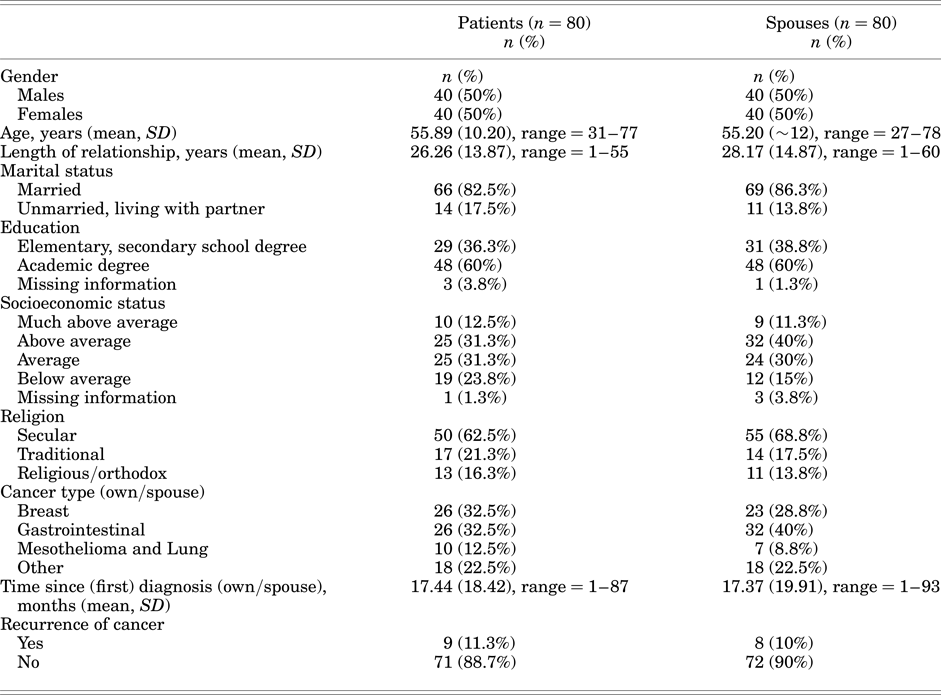
Descriptive statistics for the demographic and medical variables of patients and spouses are presented in Table 1. The majority of participants were married (for clarity of presentation, partners are referred to as spouses, regardless of actual marital status), and most of the patients were being actively treated for cancer. Almost 30% of participants either did not know what stage cancer they had been diagnosed with, or what stage of cancer their spouse had been diagnosed with. Some 113 participants (70.6%) knew their or their spouse's stage of cancer. Of these, 70 (43.7%) reported advanced cancer (stage III or IV) and 43 (26.9%) reported early cancer (stage I or II).
Participant characteristics (N = 160)

Correlations Between Distress, Dispositional Measures and CISC
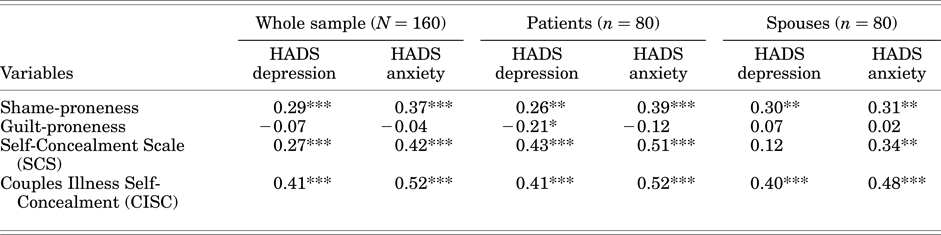
The correlations between the study variables in the whole sample and in both subsamples (patients, spouses) are reported in Table 2. As can be seen, a significant positive correlation was found between shame-proneness and both anxiety and depression—in the whole sample as well as in both subsamples. The correlation between shame-proneness and anxiety was slightly stronger in patients, and in both subsamples it was stronger than the correlation found between shame-proneness and depression. Contrary to shame-proneness, no significant correlation was found between guilt-proneness and neither anxiety nor depression in the whole sample. Among patients only, a significant negative correlation was found between guilt-proneness and depression. SCS score was significantly positively correlated with both anxiety and depression among the whole sample, as well in patients. Among spouses, SCS score was significantly positively correlated only with anxiety, but not depression. CISC score was significantly positively correlated with both anxiety and depression among the whole sample, as well as in patients and spouses.
Pearson correlations between psychological distress and study variables

* p < 0.05; ** p < 0.01; *** p < 0.001.
Testing the Serial Mediation Model
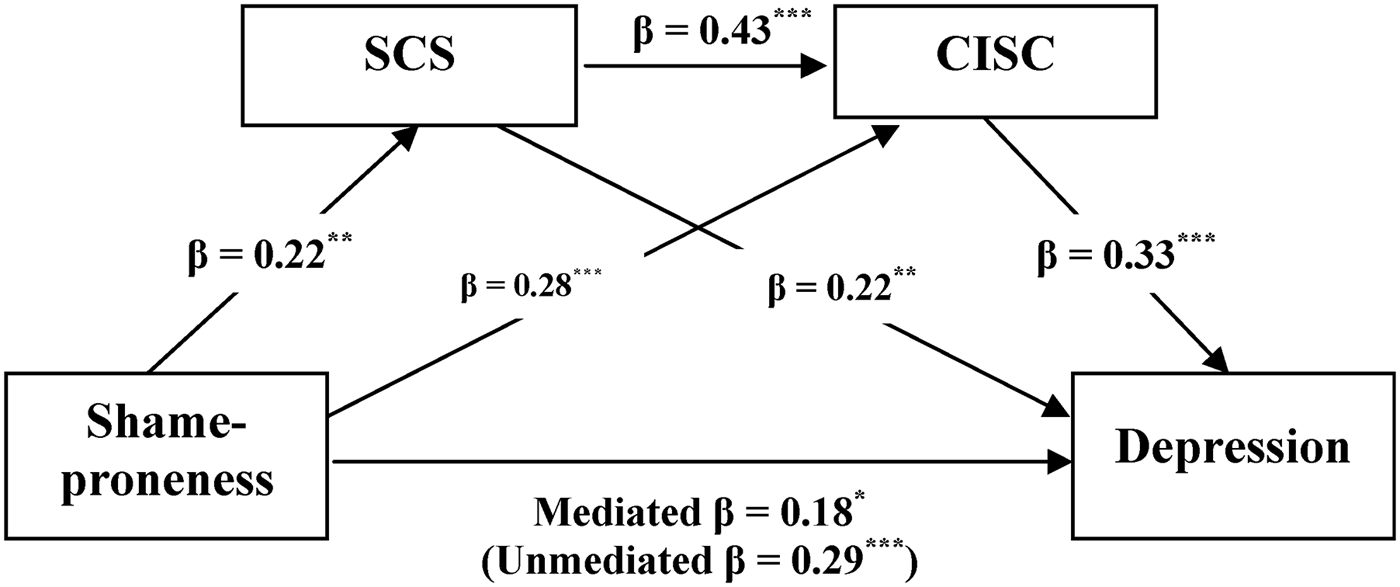
As can be seen from Figure 2, the total effect of shame-proneness on depression was significant. The effects of shame-proneness on SCS and CISC scores were significant. The effect of SCS score as the first mediating variable on the second mediating variable of CISC score (controlling for shame-proneness) was significant. A review of the effects of mediating variables on depression (controlling for shame-proneness) showed that the effects of SCS and CISC scores were significant. When shame-proneness and all other mediating variables were simultaneously entered into the equation, the relationship between shame-proneness and depression, in relation to the direct effect, was significant. Even though the direct effect was still significant, it was reduced from β = 0.29 to β = 0.18 when controlling for SCS and CISC scores. Also, bootstrapping results indicated significant indirect effects of shame-proneness on depression via SCS and CISC scores (mediation effect = 0.02, CI 95% = [0.01, 0.04]). These results support the role of SCS and CISC as mediating the relationship between shame-proneness and depression. In addition, the overall model was significant (F(3,156) = 13.53, p < 0.001) and explained 21% of the total variance in depression.
Results for linear regression analyses for the serial mediation hypothesis: SCS and CISC as mediating between shame-proneness and depression. *p < 0.05; **p < 0.01; ***p < 0.001.

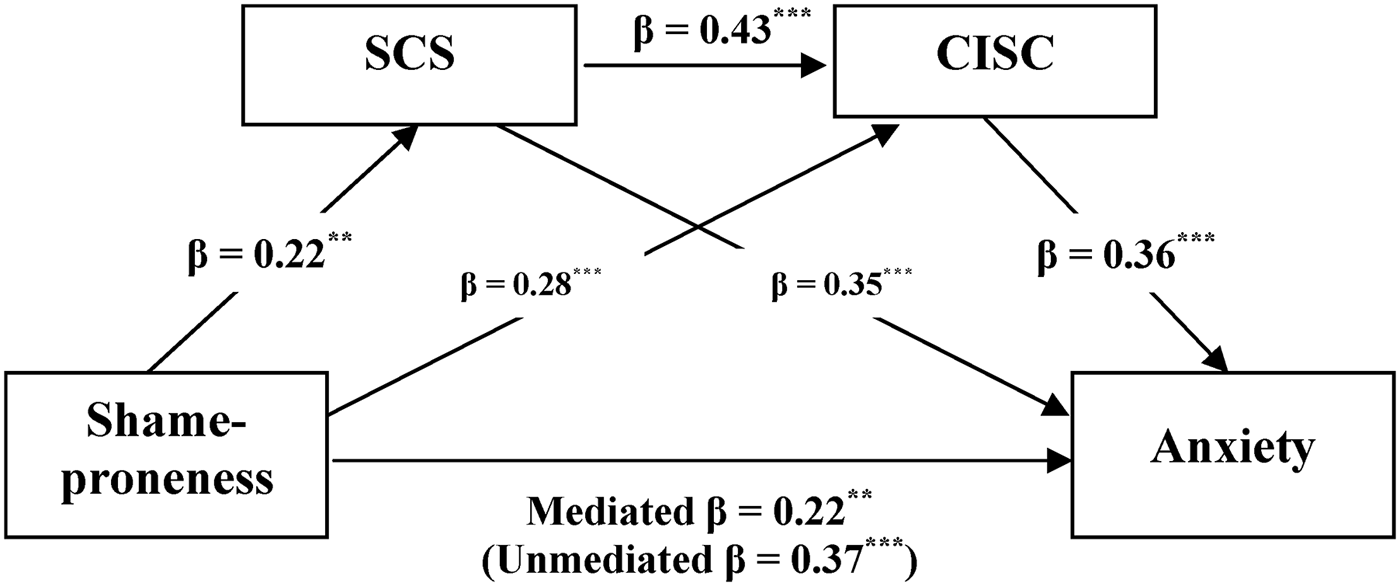
As can be seen from Figure 3, the total effect of shame-proneness on anxiety was significant. The effects of mediating variables on anxiety (controlling for shame-proneness) showed that the effects of SCS and CISC scores were significant. When shame-proneness and mediating variables were simultaneously entered into the equation, the relationship between shame-proneness and anxiety, in relation to the direct effect, was significant. Even though the direct effect was still significant, as can be seen, it was reduced from β = 0.37 to β = 0.22 when controlling for SCS and CISC scores. Also, bootstrapping results indicated significant indirect effects of shame-proneness on anxiety via SCS and CISC scores (mediation effect = 0.03, CI 95% = [0.01, 0.06]). These results support the role of SCS and CISC as mediating the relationship between shame-proneness and anxiety. In addition, the model overall was significant (F(3,156) = 28.25, p < 0.001) and explained 35% of the total variance in anxiety.
Results for linear regression analyses for the serial mediation hypothesis: SCS and CISC as mediating between shame-proneness and anxiety. *p < 0.05; **p < 0.01; ***p < 0.001.

Notably, there was no point in testing a similar mediation model using guilt-proneness as the predictor variable, as no significant correlation was observed between guilt-proneness and either depression or anxiety in the whole sample.
Group Comparisons
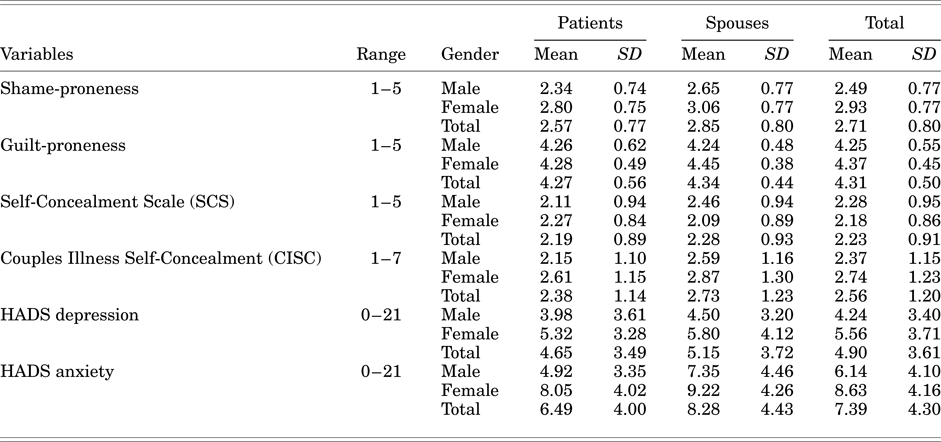
Two-by-two ANOVAs were performed in order to compare the means between patients and spouses and between males and females. Table 3 presents the mean scores for all study measures. A significant main effect of role was found for shame-proneness (F(1,156) = 5.57, p < 0.05, ηp2 = 0.03) and anxiety (F(1,156) = 7.90, p < 0.01, ηp2 = 0.05), with spouses reporting both greater shame-proneness and anxiety than did the patients. No significant differences were found between patients and spouses in guilt-proneness, SCS, CISC, and depression. Although the difference between patients and spouses in CISC score did not reach a significant level, our analysis revealed a trend in which spouses reported greater CISC scores than did patients (F(1,156) = 3.59, p = 0.06, ηp2 = 0.02). A significant main effect of gender was found for shame-proneness (F(1,156) = 13.02, p < 0.001, ηp2 = 0.08); CISC (F(1,156) = 3.92, p < 0.05, ηp2 = 0.03); depression (F(1,156) = 5.48, p < 0.05, ηp2 = 0.03); and anxiety (F(1,156) = 15.26, p < 0.001, ηp2 = 0.09). Female participants reported greater shame-proneness, higher level of CISC, and greater depression and anxiety than did male participants (weak-medium effect). There were no significant differences between female and male participants in guilt-proneness and SCS score, and no significant role–gender interaction effect in any of the measures. Using the recommended cutoff score of 8+ for both the HADS anxiety and depression subscales (Bjelland et al., Reference Bjelland, Dahl and Haug2002) revealed that the mean level of anxiety was below the clinical cutoff for patients and above the clinical cutoff for spouses. Moreover, the mean level of anxiety was below the clinical cutoff for males and above the clinical cutoff for females, regardless of role. The mean level of depression was below the clinical cutoff for both patients/spouses and males/females.
Means and standard deviations for all study variables

DISCUSSION
Expanding the literature on motivational tendencies, communication patterns, and distress in psycho-oncology, our study examined a mediation model of shame-proneness, trait and contextual self-concealment, depression and anxiety among patients with cancer and the spouses of patients with cancer. It also examined possible associations between guilt-proneness and distress. The mediation model discovered in the current study, in which trait and contextual self-concealment partially mediated the relationship between shame-proneness and distress, is consistent with previous research among the general population indicating associations between: shame-proneness and distress (Pineles et al., Reference Pineles, Street and Koenen2006; Lynch et al., Reference Lynch, Hill and Nagoshi2012); distress and trait self-concealment (Larson & Chastain, 1990; Kelly & Yip, Reference Kelly and Yip2006); as well as mediation of trait self-concealment between shame-proneness and distress (Pineles et al., Reference Pineles, Street and Koenen2006). It expands our understanding regarding the psychological mechanisms related to elevated levels of anxiety and depression in psycho-oncology. Notably, the partially mediated path further indicates that there is a robust effect of predictor (shame-proneness) on outcome (anxiety/depression) that is independent of neither trait nor contextual self-concealment. This partial mediation stresses the importance of examining both contextual variables and trait tendencies while identifying risk factors for psychological distress in psycho-oncology.
Results demonstrate that patients and spouses did not differ in terms of guilt-proneness and trait self-concealment, but spouses reported significantly greater shame-proneness than did patients. This finding is in contrast to the assertion that shame-proneness would be relatively stable across situations (Tangney, Reference Tangney1996). Yet, there is some evidence suggesting that changes in shame-proneness may occur during the course of therapy (Fergus et al., Reference Fergus, Valentiner and McGrath2010), which implies that there can also be changes in shame-proneness when one is confronted with unique life events. In addition, since many psycho-oncology services are primarily aimed at patients, rather than their spouses, it is possible that the differences between them stemmed from patients' participation in therapy. Notably, though the CISC scores were generally similar for patients and spouses, a trend was observed suggesting that spouses reported greater CISC scores than did patients. While this trend should be interpreted cautiously, it may reflect a spouse's choice to prioritize the patient's needs as part of the cancer caregiver's role (Ussher & Perz, Reference Ussher and Perz2010). Results did reveal gender differences in CISC score, with females recording greater CISC scores than males. This finding may reflect society's expectation of women to care for others and put others' needs before their own, whether these others are sick or healthy (Forssén et al., Reference Forssén, Carlstedt and Mörtberg2005).
A main effect of gender was found for shame-proneness, but not for guilt-proneness, with females reporting greater shame-proneness than males, consistent with previous research (Gross & Hansen, Reference Gross and Hansen2000; Benetti-McQuoid & Bursik, Reference Benetti-McQuoid and Bursik2005). The lack of gender difference with regard to trait self-concealment provides important information, since many of the previous studies exploring trait self-concealment (in nonclinical samples) used samples characterized by a majority of female participants (Kelly & Yip, Reference Kelly and Yip2006; Pineles et al., Reference Pineles, Street and Koenen2006; Uysal & Lu, Reference Uysal and Lu2011), therefore limiting the ability to examine gender differences.
With regard to psychological distress, results revealed that spouses reported greater anxiety (but not depression) than did patients. In addition, females reported significantly greater anxiety and depression than did males. However, no significant interaction effect of gender/role was found for psychological distress. These findings are consistent with a metaanalysis on couples coping with cancer (Hagedoorn et al., Reference Hagedoorn, Sanderman and Bolks2008) and inconsistent with a recent study reporting no main effect for role with regard to anxiety, and a significant interaction between gender and role, with female spouses reporting especially higher levels of anxiety (Moser et al., Reference Moser, Künzler and Nussbeck2013).
The current study results may have important clinical implications. The partial mediation found in the current study, along with a study suggesting that changes in shame-proneness may occur during the course of therapy (Fergus et al., Reference Fergus, Valentiner and McGrath2010), and also with the extensive research regarding associations between poor cancer-related communication and distress-indicate that psychological interventions for patients and spouses in the psycho-oncology setting should not only focus on improving dyadic communication but also on decreasing feelings of shame, and consequently reducing feelings of depression and anxiety. For example, as part of an individual therapeutic intervention, exposure of distressing cancer-related concerns is encouraged, and while practicing in open dialogue within the therapeutic relationship, the therapist should be sensitive to underlying feelings of shame (e.g., shame about the cancer diagnosis, about physical symptoms etc.) and address them in a safe and well-contained environment. Moreover, the main effects that were found for gender and role imply that being a female and/or being a spouse may serve as risk factors for shame-proneness, as well as for poor spousal communication, and consequently for distress. Based on these data, we suggest that healthcare providers would do well to be aware of these risk factors, and especially in case of caring for a spouse or a woman coping with cancer (whether patient or spouse), and to seek out opportunities to discuss underlying feelings of shame and offer relevant psychoeducation regarding the cost of self-concealment behavior. Routine screening of spouses, as well as patients, for shame-proneness and self-concealment behavior is recommended in order to assess their adjustment to illness and to better tailor interventions.
Study results must be considered in light of several methodological limitations. The cross-sectional design limits conclusions about the directionality/causality of effects. Perhaps preexisting distress has triggered self-concealment behavior and activated the predisposition toward shame. A longitudinal study design would provide a stronger test of the suggested mediation model. Second, the use of two independent subsamples of patients and spouses did not allow the examination of dyadic interdependencies. Third, Bruno and her colleagues (2009) suggested that guilt-proneness as measured by TOSCA may reflect a reaction to guilty feelings, rather than proneness to feeling guilty. Thus, it is recommended that future studies use additional measures of trait guilt to examine the proposed associations. Finally, it should be noted that variables that were not a part of the current study may play an important role in the linkage between shame-proneness and distress—for example, being ambivalent about seeking professional help, a factor that was previously shown to be associated with trait self-concealment (Larson et al., Reference Larson, Chastain and Hoyt2015).
ACKNOWLEDGMENTS
This article is based on the first author's doctoral dissertation from the Department of Psychology at Bar-Ilan University (Ramat-Gan, Israel). The dissertation is mentored by Professor Ilanit Hasson-Ohayon.
We thank the medical and psychosocial staff at the oncology unit of the Chaim Sheba Medical Center at Tel Hashomer for their assistance in the recruitment of participants. We also thank the Gamani Facebook support group (for women with breast cancer), and especially the group members who volunteered to participate in the current study as well as to help in distributing study questionnaires.