INTRODUCTION
Protected areas (PAs), particularly national parks and nature reserves (NRs), are the main tool of nature conservation policies on a global scale. The discussion of their classification by the IUCN PA category system illustrates their diversity of approaches to nature conservation and complex features (Dudley et al. Reference Dudley, Parrish, Redford and Stolton2010). Both a means to safeguard threatened species or natural habitats and a social construct, a PA is simultaneously characterized by its purpose, its biodiversity conservation issues, its management system and governance, its human resources and funding, and its interdependency with the surrounding landscape (Zube & Busch Reference Zube and Busch1990; Hansen & DeFries Reference Hansen and DeFries2007; Dudley Reference Dudley2008; Bertzky et al. Reference Bertzky, Corrigan, Kemsey, Kenney, Ravilious, Besançon and Burgess2012).
Over the last 30 years, conservation policy concerning PAs has undergone a major paradigm transition (Phillips Reference Phillips2004; Locke & Dearden Reference Locke and Dearden2005), contrasting the traditional ‘segregative’ or ‘fences and fines’ model with a more modern ‘integrated’ model. While the former involves the exclusion of humans and their activities from PAs, the latter considers PAs as tools for the sustainable use of natural resources and the development of local communities. Three issues are usually cited to describe the transition: (1) an evolution in the perceived purpose of PAs from conservation to sustainable development; (2) an expanded conception of nature conservation from protecting a strictly limited area to considering it as part of its surrounding environment and landscape matrix; and (3) a broader consideration of the stakeholders involved, not just limited to the state, experts and environmentalists, but to all citizens in local communities and local authorities. In reaction to injustices and displacement of local people caused by a ‘segregative’ establishment of PAs in the developing world (Peluso Reference Peluso1993; Agrawal & Redford Reference Agrawal and Redford2009), there has thus been an enlargement in PA governance systems that has developed towards the implementation of a sort of ‘good governance’, presented as more equitable and better accepted by local communities (Lockwood Reference Lockwood2010). This transition to an integrative approach has been observed on a global scale (Phillips Reference Phillips2004), but also in Europe (Mose Reference Mose2007) and France (Depraz Reference Depraz2008). Tools such as Integrated Conservation and Development Projects, Community-Based Conservation, French Regional Natural Parks as well as the Biosphere Reserves in the UNESCO Man and the Biosphere Program are illustrations of the diversity of tools now used in more integrative models of PAs.
Today, both models are still being implemented but are questioned by biological and social scientists (Locke & Dearden Reference Locke and Dearden2005; Brosius Reference Brosius2006). They are often considered from a static and binary perspective (Miller et al. Reference Miller, Minteer and Malan2011), implying that a specific tool should depend on one model or the other. However, a growing community of scholars consider PAs as complex and adaptive social–ecological systems (SESs) characterized by a set of interactions among humans and between humans and biophysical components across multiple spatial and time scales (Berkes and Folke Reference Berkes and Folke1998; Ostrom Reference Ostrom2009; Cumming et al. Reference Cumming, Allen, Ban, Biggs, Biggs, Cumming, De Vos, Epstein, Etienne, Maciejewski, Mathevet, Moore, Nenadovic and Schoon2015). Applying the SES approach provides an opportunity to go beyond the static perspective usually associated with PA analysis and consider PAs not only as geographical and environmental entities but also as socio–political–historical constructs (Mathevet & Mauchamp Reference Mathevet and Mauchamp2005) with multiple dimensions and different scales that change in time. In this way, PAs should not be considered as either one model or the other, but to lie on a gradient between segregative and integrative approaches.
To explore this hypothesis, we focused on French NRs, which are one of the main regulatory tools for nature conservation in France along with national parks. Traditionally, the public image of an NR is that of a fenced-off human-exclusion zone (Depraz Reference Depraz2008; Therville et al. Reference Therville, Mathevet and Bioret2012). However, many NR managers now promote a more integrated approach (RNF 2008). Between the segregative cliché, that is to say the improper and over-generalized association of segregative characteristics with all NRs and their managers, and the more recent integrated approaches (Therville et al. Reference Therville, Mathevet and Bioret2012), our study aims to investigate if there was an observable transition in NRs from a segregative to an integrative model, and if so in what ways can this transition be portrayed. To this end, we applied statistical analyses on national datasets investigating two criteria: conservation practices and the attitudes of managers.
MATERIALS AND METHODS
NR network
French NRs were instituted by law in 1976 as important areas of natural heritage to be conserved and protected over the long term by specifically adapted rules and managed in cooperation with local stakeholders (Bioret et al. Reference Bioret, Estève and Sturbois2009). In the 40 years since this law, 310 NRs covering around 30 000 km² of marine and terrestrial habitats have been designated (IUCN France Reference France2010). Since 2002, there are three categories of NRs: national nature reserves (NNR), regional nature reserves (RNR) and Corsican nature reserves (CNR). The supervisory authority, which could be national or regional government authorities, delegates NR management to a body that acts in cooperation with a management advisory committee and a scientific committee. In 2012, 20% of NNR and CNR managers were from national authorities, 50% from environmental NGOs and 30% from local authorities (Therville Reference Therville2013). The three main official mandates of NR managers are (1) nature protection through enforcement and policing; (2) habitat management through ecological monitoring and management; and (3) administrative monitoring through the preparation of progress reports and management plans. Many NRs are also involved in raising public awareness for nature conservation, without being financially supported by the supervisory authorities. The managers’ authority and funding depend on a supervisory authority, but they can also apply for a wide variety of complementary funds through private and public partnerships (MATE & DNP 1997). NRs present considerable diversity in terms of their protection aims and purposes (e.g. geological features, particular species, ecosystems, iconic landscapes, etc.), their form and size (from less than 1 ha to 2.7 million ha) and their management intervention strategies (from low intervention to high degrees of management). However, a typical NR is a rather small site (between 10 and 100 ha) focused on the protection of inland wetlands or temperate plain habitats with protected and/or threatened species and ecosystems, and managed by a NGO. NRs are located in a wide range of local contexts (Therville Reference Therville2013). Some are in peri-urban environments with a high population density and subject to urban sprawl, whereas others are in more ‘wild’ or marginal rural areas, which are sparsely populated and subject to local issues such as forestry and livestock farming. Some NRs are located in highly touristic areas while others are in rural contexts that are intensively used for farming and/or hunting activities but are only marginally affected by tourism.
Survey
We investigated conservation practices and the attitudes of managers.
Conservation practices of NR management structures
To analyse conservation practices we used the national ARENA database (which records the activities of NRs) created by the French NR network. This database compiles yearly information about all NNRs and CNRs: their management structure, staff members, rules, partnerships and the actions carried out by the NRs. We obtained access to information for a 5-year period (2004–2008), and for each NR we selected the year of data with the most recent and complete information. At the time of the study, the database included only 165 NRs since RNRs were not integrated. The management body of 12 NNRs did not respond to the survey so our full dataset concerned 153 NRs (Table 1). The absence of RNRs may lead to a bias in the results because although the core missions are similar to those of NNRs, RNRs are more recognized as tools for local development by their regional supervisory authorities (IUCN France Reference France2010). We thus restricted our analysis of the paradigm shift to those NRs with a common overall framework and goal.
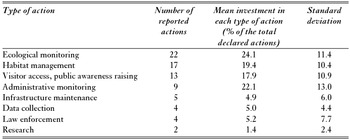
Actions carried out by managers of French nature reserves, n = 153. Source: ARENA.

We focused on conservation practices carried out by managers. The ARENA database reports on 76 types of action, classified into eight major categories: (1) ecological monitoring (22 forms of action), (2) habitat management (17 actions), (3) visitor reception, access and awareness raising (13 actions), (4) administrative monitoring (nine actions), (5) infrastructure maintenance (five actions), (6) data collection (four actions), (7) law enforcement (four actions), and (8) research (two actions; Table 1). Managers had to detail the actions they have carried out and rank their importance during the year by giving them a score from 3 to 1.
Social–psychological profile of NR managers
We supplemented the previous database with a national survey to gather information on the perceptions and attitudes of NR managers. The focus was on managers because NRs are often managed by structures hiring only a few employees (fewer than three in 60% of NNRs and CNRs). In these NRs, the manager plays a key role (Therville Reference Therville2013). The questionnaire was distributed via the internet to 250 NRs in 2010, and 107 NR managers responded. First, we used the questionnaire to study the socio–cultural characteristics of the respondents, analysing the following variables that describe the managers and which may influence their attitudes: age, education, gender, past professional experience, involvement in extra-professional activities and region of origin. Some categories such as ‘extra-professional activities’ and ‘perceived qualities’ proposed a list of terms built from our knowledge of the NR network, pushing the managers to display characteristics associated with specific attitudes. Other categories such as ‘profession’ and ‘kind of experience’ were purely descriptive.
Second, to explore the managers’ attitudes, we used concepts and methods, typically used in environmental social psychology, which allowed us to analyse values, attitudes, behaviours and their interactions (Ajzen & Fishbein Reference Ajzen and Fishbein1977; Stern & Dietz Reference Stern and Dietz1994; Kaiser et al. Reference Kaiser, Wolfing and Fuhrer1999; Schultz Reference Schultz2011). An ‘attitude’ is defined as the degree of cognitive support for a certain behaviour. We used two kinds of methods proposed by environmental social psychologists to assess attitude.
The first method, which was based on the New Environmental Paradigm (NEP) and Likert-type scales (Dunlap & Van Liere Reference Dunlap and Van Liere1978; Dunlap et al. Reference Dunlap, Van Liere, Mertig and Jones2000; Hawcroft & Milfont Reference Hawcroft and Milfont2010), allowed us to discern anthropocentric, ecocentric or apathetic attitudes towards the environment (Thompson & Barton Reference Thompson and Barton1994). Managers were invited to express their level of agreement with statements reflecting three kinds of attitudes: segregative, integrative and apathetic (McFarlane & Boxall Reference McFarlane and Boxall2003). The response scale was from (-2) strongly disagree to (2) strongly agree. The proposed statements, rather exaggerated and a priori non-consensual, forced the managers to state their views clearly.
The second method was based on choice and ranking of words. The proposed terms were associated with a segregative or an integrative attitude. The respondents chose from a list of terms the three that were the most meaningful to them, ranking them from the most to the least significant and associating them with a score from 3 to 1. Terms that were not chosen were coded as 0.
Although we were concerned that primarily managers interested in integrated approaches would respond, the diversity of identified attitudes led us to believe that this potential bias was limited.
Statistical procedures
For each dataset (Table S1) we explored the relationships between the variables using two kinds of multivariate analysis (Chessel et al. Reference Chessel, Dufour and Thioulouse2004; Lê et al. Reference Lê, Josse and Husson2008). Principal Components Analysis (PCA) was used for quantitative data. Non-symmetric Correspondence Analysis (NSCA), which gives more weight to the most quoted variables (Kroonenberg & Lombardo Reference Kroonenberg and Lombardo1999), was used to analyse the managers’ attitudes due to the high number of variables considered. The qualitative variables, whether nominal or ordinal, were numerically encoded in order to perform PCA or NSCA. The figures presenting the multivariate analyses illustrate only the main explanatory variables for each dataset. In the case of the NEP method, we compared the different attitudes using a Kruskal–Wallis test followed by a multiple comparison test (Tukey-HSD post-hoc test) due to the non-normality of the data (Siegel & Castellan Reference Siegel and Castellan1988; Giraudoux Reference Giraudoux2012). All statistical analyses were carried out using ‘R’ software and the ‘ade4’ package.
RESULTS
NR conservation practices
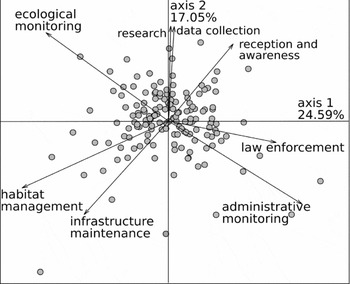
The number of actions carried out in each NR varied between two and 59, with an average of 23. Ecological and administrative monitoring represented about 45% of the management actions, whereas research activities only represented 1.4% (Table 1). The PCA highlighted important differences between the NRs in terms of investment in the main categories of conservation practices (Fig. 1). The first two PCA axes explain 41.6% of the PCA inertia. The first axis distinguishes NRs that are more involved in ecological monitoring, habitat management and infrastructure maintenance (Fig. 1; left) from NRs that present an overall small total number of actions and that are more involved in administrative monitoring and law enforcement (Fig. 1; right). The second axis distinguishes NRs that are characterized by a medium level of activity in ecological monitoring and data collection, and to a lesser extent in visitor access, raising awareness and research (Fig. 1; top). For the NRs located in the upper-right corner of the figure, actions linked to visitor access and environmental education are central, reaching up to 30% of the conservation practices.
Principal Component Analysis on conservation practices carried out in the nature reserves. Only the variables whose contribution to axis construction was superior to the mean of all variable contributions are represented. n = 153 National nature reserve/Corsican nature reserve.

NR managers
The majority of the respondents were male (71%) between the ages of 25 and 62 (average age of 40; Table S2). More than 50% were involved in extra-professional activities for environmental NGOs. The vast majority had studied life sciences (89%) to the level of Master or higher (84%). In 43% of cases, the respondents held other functions in the NR besides being the manager, often acting as rangers, educators or being part of the management body that employs them and acts on a larger scale than the NR. Most of the respondents had been managers for less than 5 years (46%), but 31% had been in their current position for more than 10 years; 61% had at least one role in PA management before becoming an NR manager.
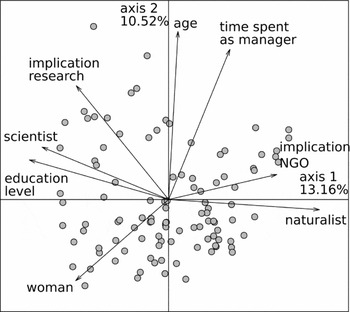
We carried out a PCA to examine the relationships among these socio–cultural variables (Fig. 2). The first two PCA axes explain 24% of the PCA inertia. The first axis distinguished managers involved in environmental NGOs from those who emphasized their scientific capacities, were highly involved in research and had a high education level. The second axis separates older men who had occupied their job for a long time from younger men and women who represented a new generation of NR manager. These two axes highlight four socio–cultural profiles. The ‘naturalist elders’ (Fig. 2; top right) were older men who were involved in naturalist and nature protection NGOs, had a Bachelor's level of education, and mostly originated from the region of the NR to which they were assigned. They had mostly been in the post for a long time and considered their capacities as naturalists, and secondarily as teachers, as the fundamental assets for management of the NR. The ‘scientists’ (Fig. 2; top left) were also older men who had been in the post for a long time; however, they emphasized their capacities as scientists as key elements in NR management and were less likely to define themselves as teachers and naturalists than the average respondent. The ‘managers’ (Fig. 2; bottom right) were less clearly defined. They were mostly younger men with at least a Master's level of education who had been in the position for a shorter time, were involved in naturalist and nature protection NGOs, and primarily emphasized their capacities as naturalists. Lastly, the ‘integrators’ (Fig. 2; bottom left) were younger men and women who had been in the post for a shorter time and were less likely to define themselves as naturalists than the average respondent.
Principal Component Analysis on nature reserve managers’ socio–cultural variables (Table S2). Only the variables whose contribution to axis construction was superior to the mean of all variable contributions are represented. n = 107 respondents.

Attitudes towards NRs
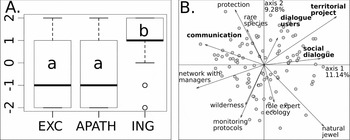
The NEP and Likert-type scale method indicated a dominant discourse among managers, while the method based on choice and ranking of words revealed more heterogeneity among managers’ attitudes and positions regarding segregative and integrative approaches to conservation (Fig. 3).
Managers’ attitudes. (a) Results from the New Environmental Paradigm method (Table 2). Level of agreement (-2: strongly disagree; 2: strongly agree) to segregative (EXC), apathetic (APATH) and integrative (ING) statements. The letters indicate the significant differences between groups according to a Tukey-HSD post-hoc test (p < 0.05). (b) Results from the choice and ranking of EXC and ING items (Table 3). Non-symmetric Correspondence Analysis on all the items. Only the items whose contribution to axis construction was superior to the mean of all item contributions are represented. Integrative terms are shown in bold. n = 107 respondents.

A shared discourse
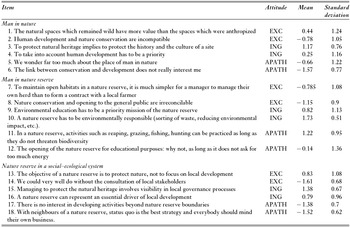
The NEP method (Table 2) showed the degree of agreement was negative for segregative and apathetic statements (-0.51 and -0.68 respectively), and positive (1.02) for integrative statements (Fig. 3 a; Tukey-HSD post-hoc test: p < 0.001).
Items used in the New Environmental Paradigm method to define managers’ attitude (-2: completely disagree to 2: completely agree). APATH = Apathetic; EXC = Segregative; ING = Integrative.

Heterogeneous attitudes
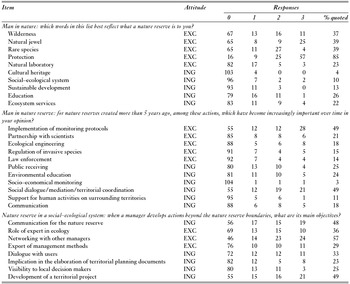
The method based on the choice and ranking of segregative or integrative words showed that the managers’ responses were much less homogeneous (Table 3); only one term (‘protection’) was selected by more than 80% of the respondents. By contrast, eight out of 29 terms were selected by less than 20% of the respondents. The results of the NSCA (Fig. 3 b) helped to clarify the differences in the managers’ attitudes. The first two axes explained only 20.4% of the NSCA inertia. The uniform distribution of the respondents in the NSCA plane highlights the difficulty in identifying clear patterns. The right side of the first axis discriminates integrative terms that are weakly institutionalized and marginal such as ‘social dialogue’, ‘territorial project’ and ‘dialogue with users’. The managers that selected these terms had an integrative vision, focused on the surrounding landscape and inter-sectoral policies. The left side of the first axis (Fig. 3 b) distinguished segregative and integrative terms commonly used by managers to describe their activities and were characteristic of the prevalent vision of NRs held by the NR network: ‘protection’, ‘rare species’, but also ‘networking with other managers’ and ‘communication’ with a diversity of stakeholders. The managers that selected these terms had a traditional view of the perceived core mission of managers. However, they also showed a modern attitude characterized by an emerging willingness to integrate other concerns such as social issues and to be connected to a larger diversity of stakeholders. The terms below the second axis (Fig. 3 b) are archetypes of a segregative attitude: ‘natural jewel’ and ‘wilderness’ reflected these managers’ vision of an NR, and ‘role of expert in ecology’ and ‘implementation of monitoring protocols’ were selected as the most important actions. The managers that selected these terms also emphasized networking with other managers of natural areas.
Definition of managers’ attitudes. Items used in the method based on choice and ranking of words (0: not quoted; 1 to 3: from the least to most important). Response rate associated with each item. EXC = Segregative; ING = Integrative.

DISCUSSION
In French NRs, the segregative model is more of a cliché than a reality. We highlight considerable heterogeneity in the conservation practices of NRs and in the socio-cultural profiles and attitudes of their managers, indicating a more complex reality than the traditional segregative–integrative dichotomy would portray (Phillips Reference Phillips2004). This heterogeneity reflects a general pattern in the evolution of environmental protection in France and the ability of conservation management in NRs to adapt to local contexts and to function as part of wider SESs.
The evolution of nature conservation policies in France
To explain the diversity in NR conservation practices and in managers’ attitudes, it is necessary to analyse the socio–political–historical construction of environmental public policy in France, and particularly of NR policy. Until the beginning of the 20th century, nature conservation in France was rooted in resource preservation, romantic and naturalist sensitivities, colonialist experimentation and NGO involvement (Larrère et al. Reference Larrère, Lizet, Berlan-Darqué and Larrère2009). The main regulatory tools of French conservation policy were implemented later: national parks in 1960 and NRs in 1976. In retrospect, the segregative cliché associated with NRs is understandable. The law that established them was elaborated during a period of industrial and ecological disasters (Carlson Reference Carlson1962; Meadows et al. Reference Meadows, Meadows, Randers and Behrens1972) and the governance was characterized by a sovereign, centralized state based on segmentation and specialization (Cans Reference Cans1994; Charvolin Reference Charvolin2003). Those who were first involved in the implementation of NR policy (national governmental agencies or nature conservation NGOs) supported the idea of a state-administered zone managed by experts (Therville et al. Reference Therville, Mathevet and Bioret2012). The first NRs, in line with the original PAs in France and elsewhere (Runte Reference Runte2010), were mostly large sites of several thousand hectares that protected iconic mountainous landscapes; created in the 1970s, they were managed by national governmental agencies.
Since the 1980s, French nature conservation policy has developed a more integrated approach. This transition was influenced by social discord (events of May 1968), decentralization, the development of a more integrated and larger vision of nature conservation and the aim of sustainable development. PA management has broadened its conservation aims, with a shift to governance systems that include stakeholders with different interests, including local authorities (Larrère et al. Reference Larrère, Lizet, Berlan-Darqué and Larrère2009, Mathevet et al. Reference Mathevet, Thompson, Delanoë, Cheylan, Gil-Fourrier and Bonnin2010, Therville et al. Reference Therville, Mathevet and Bioret2012). This enlargement in NR governance systems has contributed to the diversification in managers’ profiles that we observed. At the same time, following the growing awareness of the under-representation of certain natural habitats, the NR network has experienced a gradual diversification in its conservation interests (Therville Reference Therville2013). In the 1980s, natural caves or other geological features became integrated. Since the 1990s, the protection of fluvial, marine environments and French Overseas Territories has involved the creation of larger NRs: an increasing proportion is larger than 100 ha.
This history of the NR network is demonstrative of the establishment of conservation policy in France, which reveals three general features: (1) the collective nature of these policies – between different sectors and between the state and civil society; (2) the hybrid and transversal policy content resulting from these collectives; (3) and the weakness of these policies which were built upon compromises with more powerful state bodies (Lascoumes Reference Lascoumes1994; Charvolin Reference Charvolin2003). Social science studies demonstrate a specific French model, which is based on a compromise among different objectives, spaces and stakeholders with diverse interests (Charles & Kalaora Reference Charles and Kalaora2003; Larrère et al. Reference Larrère, Lizet, Berlan-Darqué and Larrère2009).
Our results show that conservation practices in NRs now well exceed the core mission established by the state, mainly of ecological and administrative monitoring, habitat management and law enforcement. We found that visitor access and public awareness are significant categories of action, despite the lack of financial resources for these missions. These categories suggest the existence of complementary resources as well as diversified roles and legitimacies of NRs. This can be explained by an historical and paradoxical aspect to NR policy, particularly in the case of NNRs. While the state has refocused NNRs on traditional core missions such as law enforcement, the management of NRs has been delegated to local organizations whose employees rely on private interests and laws (Therville et al. Reference Therville, Mathevet and Bioret2012). So although the official aims of NRs are more rooted in the segregative model, their institutional organization is increasingly modelled on an integrative paradigm.
In addition, NRs are subject to socio–cultural influences. Our results show that NR managers are not a homogeneous social group, either in terms of socio–cultural characteristics or in terms of attitudes held. This heterogeneity reflects the diversity of organizations and their associated cultures involved in NR management (e.g. NGOs, local authorities, national government agencies) and their social representations and socio–professional status. The managers’ socio–cultural profiles reveal an evolution in the profession, from skilled naturalists to expert negotiators able to develop bridging organizations (Brown Reference Brown1991; Granjou et al. Reference Granjou, Mauz and Cosson2010). The managers’ culture, knowledge and perception of their role have progressively changed with the emergence and expansion in the NR network of concepts such as ‘management’ in the 1980s and ‘integration’ in the 1990s (Therville et al. Reference Therville, Mathevet and Bioret2012). Their contrasting attitudes are not simply defined along a segregative–integrative axis, but also according to an institutionalized identity claimed at a national level by the NR network (Therville et al. Reference Therville, Mathevet and Bioret2012), which consists of a mixture of protection, ecological monitoring, networking, environmental education and communication. Our results identified managers that fell on either side of this reference group, who demonstrated an attitude that was more or less open to an integrated approach.
Nonetheless, the results obtained through the NEP method illustrate a common attitude of NR managers that is close to the dominant discourse of most of the French and European conservation organizations (Phillips Reference Phillips2004): they strongly supported integrative statements and massively rejected apathetic and segregative statements. Several studies in political ecology have illustrated the existing gap between the support of stakeholder groups for ‘integrated’ discourses and the practices implemented. They have also underlined that strategic interests are part of mainstream positioning (Gautier & Benjaminsen Reference Gautier and Benjaminsen2012; Robbins Reference Robbins2012), as suggested for the NR network in the following quote: ‘we had the idea that we would not achieve anything if we stayed stuck among naturalists, birds and plants in our own land estates (. . .) It had to be in a culture, in a shared project’ (interview with an NR manager, leader in the NR network, 2010). Another manager stated that ‘if you are well integrated, things can happen, if the people around you are convinced of the interest of the conservation project, they will be its first guardians (. . .) It is the NR life insurance’ (interview with an NR manager, 2010). The issue for NRs is often to seek reinforcement, access financial resources and social support and avoid marginalization.
NRs as part of a larger SES
An analysis of the NR network on a national scale is not sufficient to explain the observed diversity both in conservation practices and managers’ attitudes. This heterogeneity also needs to be understood in terms of local context. NRs and their managers must have a level of adaptability to their local conditions, interacting in complex SESs (Ostrom Reference Ostrom2009; Palomo et al. Reference Palomo, Montes, Martín-López, González, García-Llorente, Alcorlo and Mora2014; Cumming et al. Reference Cumming, Allen, Ban, Biggs, Biggs, Cumming, De Vos, Epstein, Etienne, Maciejewski, Mathevet, Moore, Nenadovic and Schoon2015). The heterogeneous investments of NR managers in different types of conservation action and their various attitudes are related to variable local social–ecological interdependencies (Therville Reference Therville2013).
In the actual conservation practices of NRs, managers have long implemented integrative actions, whether consciously or not. Negotiation, a contractual approach and compromise are part of their daily routine. As described previously, this can be partly explained by features of French conservation policy associated with decentralization and the use of contractual tools. But the need for local adaptation and cooperation with stakeholders is also linked to social–ecological interdependencies between PAs and the surrounding landscape and to their spatio–temporal variability (Thompson et al. Reference Thompson, Mathevet, Delanoë, Gil-Fourrier, Bonnin and Cheylan2011). Any PA, in its multiple dimensions (physical space, rules, resources, influence, monitoring, etc.), is shaped by and itself shapes the SES of which it is a part (Mathevet et al. Reference Mathevet, Thompson, Folke and Chapin III2016).
Given the complexity of these interdependencies, enforcement policies, although essential, appear to be insufficient to assure long-term conservation. The proposed procedures, objectives and resources of an organization do not always allow a worker to achieve his or her goals, and social scientists have shown that there is a discrepancy between mandated and actual work (Dejours Reference Dejours2003). We observed this situation with NR managers who perceived that they need to go beyond the regulatory framework and resources provided by the supervisory authority in order to achieve their conservation goals (Therville et al. Reference Therville, Mathevet and Bioret2012). One manager commented that ‘we under-estimate human labour behind our scientific missions. If you want to propose an action, you will meet different stakeholders, discuss, adapt your idea (. . .) It is not considered (. . .) while it is essential’ (interview with an NR manager, 2010). This extension beyond mandated actions requires taking into account and adapting to interdependencies between NRs and the surrounding landscape, which is necessary for the conservation of biodiversity in the long term. The need to adapt to local conditions can also partly explain potential incongruence between a manager's attitude and his or her implemented conservation practices. For example, the proximity of a dense urban population requesting access to natural spaces can lead a manager who is culturally attached to a segregative model to invest in visitor reception, access and awareness raising (Therville Reference Therville2013). This attitude may also evolve in time, shaped by local working conditions. The practices and attitudes of a site or manager should be regarded as path dependent, adaptable and situated in their local conditions as well as influenced by the evolution of PA policies.
BEYOND A SEGREGATIVE–INTEGRATIVE DICHOTOMY
Our case study on French NR policy provides pertinent perspectives for other PAs around the world. First, there is an intrinsic diversity and coexistence of segregative and integrative models, both in terms of conservation practices and attitudes. This coexistence brings into question the view of segregative and integrative approaches as a dichotomy (Miller et al. Reference Miller, Minteer and Malan2011; Linnell et al. Reference Linnell, Kaczensky, Wotschikowsky, Lescureux and Boitani2015). Our results can be partly explained by trends in nature conservation policies in France and on a global scale (Dearden et al. Reference Dearden, Bennett and Johnston2005; Bertzky et al. Reference Bertzky, Corrigan, Kemsey, Kenney, Ravilious, Besançon and Burgess2012) associated with the appearance of new norms, making integrative approaches more desirable and leading to a general evolution of pre-existing tools towards integrative models. Along this segregative–integrative axis, the debate often focuses on the best strategy to adopt, implying that a specific tool should necessarily depend on one model or the other, and that one or the other should be chosen, whereas they could be complementary options (Linnell et al. Reference Linnell, Kaczensky, Wotschikowsky, Lescureux and Boitani2015). This leads to excessive generalization of these models and to their interpretation as opposing ideologies. The limitations of this dualism are numerous. Given the existing diversity of nature conservation tools in France, it is not possible, for example, to formally associate them with the PA typology of the IUCN, whether in terms of the degree of naturalness or the institutional arrangements or purposes (IUCN France Reference France2010). Second, for NRs as well as for other PAs on a global scale, this study highlights issues of context dependency and indicates that some nuance is required to question the relevance of one model over the other. Our results show that, in France, the segregative model is more of a cliché than a reality. There is a gap between the widespread perception of nature as ‘set apart’ and the observed diversity of integrated practices in the NR network. One significant influence of the segregative cliché is linked to cultural and social representations where the opposition between humans and nature and between conservation and development holds a major place. This limits the social acceptance of PAs and the legitimacy of managers to implement integrated strategies. Significant investment by managers is thus required to consider the complexity of the interdependencies between PAs and their surroundings.
In a similar way, the development of an integrative approach by NR managers but also by other PAs managers must be associated with strategic and normative issues. In our findings, NRs and their managers were not situated clearly at either end of the segregative–integrative axis, but somewhere in between, depending on their socio–historical and geographical variables. While the NRs presented features associated with both models, they could not be strictly associated with one or the other.
Our work thus outlines important lessons for future studies to deal with the duality and static approaches usually applied to PAs around the world. The multiple aspects that characterize nature conservation tools need first to be considered: their purposes (the sectoral aspect), the areas concerned with nature conservation issues (the spatial aspect), and the stakeholders involved (the institutional arrangement aspect). Moreover, qualitative localized monographs, mobilizing both ecological and social sciences, should study PAs coupled with their surrounding landscape as complex and context-dependent SESs. PAs are social–ecological constructions that mirror the social interactions between humans and between humans and nature in complex systems. As such PAs need to be considered according to local institutional arrangements and the spatio–temporal variability of the entire SES that the PA is part of.
ACKNOWLEDGEMENTS
This study was carried out through a CIFRE industrial research agreement. The authors thank Réserves Naturelles de France (RNF), the Agence Nationale de la Recherche et Développement, the Regions Nord-Pas-de-Calais, Languedoc-Roussillon and Bretagne, the Fondation de France, the French Ministry of Research and the French Ministry of Ecology and Sustainable Development. The authors are particularly grateful to RNF, which provided us with access to the ARENA database. This work was also financed by the EU FP7 SCALES Project (‘Securing the Conservation of Biodiversity across Administrative Levels and Spatial, Temporal and Ecological Scales’; Project #226852, AA).
Supplementary material
To view supplementary material for this article, please visit http://dx.doi.org/10.1017/S0376892916000047