Introduction
Between 1815 and 1930, more than 50 million people emigrated from Europe.Footnote 1 Roughly 60 percent of these emigrants went to the United States, while the other 40 percent settled mostly in South America, Australia, and Canada. Along with British and Irish emigrants, German emigrants were one of the largest groups to leave Europe in the middle of the nineteenth century. Most Germans settled in North America, but a handful landed in countries south of the equator.Footnote 2
Germans played a role, even if minor, in European emigration to the Southern Hemisphere. Of the 11 million people who immigrated to Latin America between 1854 and 1924, 2.7 percent were of German descent; they were the fourth-largest immigrant group in Brazil (Luebke Reference Luebke1990: 98; Mörner Reference Mörner and Sims1985: 50). Before 1860, this percentage was probably quite a bit higher. Today, countries like Brazil, Chile, Argentina, and Australia all contain hundreds of thousands of people who claim some degree of German ancestry. In 2001, for instance, out of a population of 18.9 million, 700,000 Australians claimed German ancestry.Footnote 3 While Brazil and Chile were two of the more common countries of destination for Germans in South America, a sizable number of Germans settled elsewhere in Argentina, Colombia, Paraguay, Peru, Uruguay, and various places in Central America.
Like with North America, much German migration to South America and to Australia took place in the nineteenth century.Footnote 4 A significant number of German emigrants started arriving in Australia in the 1830s. Possibly at least half came as assisted migrants or even indentured servants.Footnote 5 These arrangements became necessary to encourage European migration to Australia. Immigration dramatically increased with the Australian gold rush of the early 1850s, which managed to attract about a half million immigrants to the country, including a considerable number of Germans. One claim is that 70,000 German-speaking people moved to Australia between 1840 and 1890 (Tampke Reference Tampke2006: 72).
Germans started immigrating to Brazil in larger numbers in 1824 (Mörner Reference Mörner and Sims1985: 25; Seyferth Reference Seyferth, Baily and Míguez2003). Footnote 6 The end of the foreign slave trade in Brazil in 1850, however, made Brazil more interesting for European settlers, and German immigration to Brazil reached at least 125,000 persons in official statistics in the nineteenth century (Luebke Reference Luebke1990: 93–95). On the demand side, in the 1850s Brazil began to seek out European farmers and artisans; Germans who settled in Brazil for the most part ended up in the southern more temperate states: Parana, Rio Grande do Sul, and Santa Catarina, regions where replicating a European style of farming was easier (Mörner Reference Mörner and Sims1985: 25; Wtulich Reference Wtulich1986: 19).Footnote 7 Germans made their mark on Brazil: “Conservative” estimates exist that place the number of German nationals or descendants in the latter two states at between 150,000 and 200,000 toward the end of the nineteenth century (Kent Reference Kent2006: 23). Some scholars also think German immigrants had an outsized influence on the development of Brazilian immigration policy (Seyferth Reference Seyferth, Baily and Míguez2003).
In Chile, a migration law passed in 1845 was used to attract “desirable” Europeans (Solberg Reference Solberg1976: 133). That same year Chile also set up an official colonizing office in Europe. Germans started arriving in 1846, mostly from the southwest and the Hessian states. Larger-scale emigration occurred later in the 1850s, lasting until 1900 and involving the Chilean provinces of Valdivia, Llanquihue, and Chiloé. More than 3,000 Germans settled in Chile in the late 1840s and 1850s.Footnote 8 Germans also settled in other parts of South America.Footnote 9
With the goal of understanding better which German emigrants went south and why, this article examines those who chose uncommon paths and settled in the Southern Hemisphere, focusing on Hessians who went to either Australia or South America.Footnote 10 I use a data set of more than 50,000 emigrants who left the German principality of Hesse-Cassel in the years between 1832 and 1866.Footnote 11 The vast majority, 88 percent, of these Hessian emigrants went to the United States, but the other 12 percent, more than 6,000 individuals, settled in other European countries, or farther away in non–North American continents. Those who migrated to the Southern Hemisphere were quite different from those Hessians who moved to the United States. More striking, however, are the different backgrounds of the Australian-bound versus the South American–bound groups: These two groups were comparable in size, but in terms of any identifying socioeconomic characteristic they diverged more from each other than from those who went to the United States. This work shows that the choice of destination mattered for individuals and that certain destinations attracted particular types of individuals and groups, placing a reemphasis on the role of self-selection in the migration experience.
Why Did People Emigrate?
In the nineteenth century, a permanent move to a faraway place was a serious decision, especially made so by high moving costs and the lack of information about the destination. Most German overseas migrants settled in the United States, but not all. This article builds on a broader literature in migration history that has documented the variety of destinations that emigrants chose and especially the unusual ones, examined how the relevance of different destinations could change over time, and finally, explained the factors that led to different migrants settling in different places. Various works by Walter Kamphoefner, for instance, look at Germans who instead moved to South America, including Kamphoefner (Reference Kamphoefner, Hoerder and Nagler1995) and Kamphoefner (Reference Kamphoefner2000). Swierenga (Reference Swierenga1993) illustrates how fewer Dutch emigrants chose the United States after 1893 and how economic factors played a role. Most Portuguese who moved overseas settled in Brazil, but work by Marcelo Borges explores why those from the region of Algarve in Portugal's south did something different and predominantly settled in Argentina (Borges Reference Borges2003, Reference Borges2009). Exploring the various alternatives emigrants had and especially their atypical choices helps migration historians to understand the quirkiness of migration behavior or the path-dependent nature of regional and international migration flows. Borges is more decisive and stresses that occupation interacted with social networks and that migrants were always reevaluating this decision: “Algarvian patterns of geographic mobility show that different labor market and economic conditions in combination with socio-occupational networks and demographic factors provided a framework for a dynamic process that made migrants more likely to choose particular destinations” (Borges Reference Borges2009: 137).
Similarly, most German emigrants seemed to have left based on broadly defined economic concerns. Economic factors were typically the most important in the decision to migrate; they were, however, not the only ones. Still, political and social reasons were often tied very strongly to economic factors. Political adversity, for example, can translate directly into economic discrimination or barriers, such as when one group is prevented from owning property or operating certain types of businesses. In a further example, many European women left for the United States in the nineteenth century with the hopes of marrying; this was both socially as well as economically motivated.
With economic concerns at the forefront for most, after 1800 only a few communities were founded based on religious identity in the New World. For German Catholics, however, South America offered the option of settlement in predominantly Catholic countries, something that other destinations like the United States could not offer, and some South American colonies indeed advertised for Catholic settlers.Footnote 12 Seeking out a religious community one could be compatible with, however, does not seem to have been a chief concern of many German emigrants (Kamphoefner Reference Kamphoefner2000: 207, 213). In fact, Frederick Luebke claims that most Germans who immigrated to Brazil were of some Protestant denomination (Luebke Reference Luebke1990: 93).
While it is true that migration historians have found plenty of examples of emigrants settling in areas with emigrants of similar religious and cultural backgrounds, as maps of turn-of-the-century New York City or Buenos Aires would attest to with their ethno-centric communities, not all migrants ended up in ethnically and religiously homogenous communities at the destination, and such maps may encourage social historians to overemphasize the importance of such communities (Homberger Reference Homberger1994: 136; Moya Reference Moya1998).
People moved, for the most part, if they thought that their socioeconomic prospects for the future were better somewhere else and they could manage to pay for the moving costs themselves or find someone else to do so. Many social scientists have explained migration movements in terms of wage gaps (Hatton and Williamson Reference Hatton and Williamson1998), but the picture is more complicated. Many immigrants to Australia, for example, were given the opportunity to purchase land at subsidized prices upon arrival, and this special access to a land market is not incorporated into wage data. As origin economies in Europe became more industrialized throughout the nineteenth century, the pool of potential immigrants changed and so could their choices: For example, while 97 percent of Dutch emigrants moved to the United States between 1880 and 1900, this proportion dropped to 66 percent by 1901 and stayed at this level at least until 1920, a period when Dutch immigrants were moving in larger numbers to South America, Asia, and South Africa; Swierenga describes this shift across the four decades as one from “family to industrial migrants” (Swierenga Reference Swierenga1993: 423).
Moving was and remains a complicated decision, and diverse people faced with the same set of prospects might make different choices. Deciding to live in any place would involve examining a host of factors relevant to the site including economic opportunities for oneself, future economic opportunities for one's children, political conditions, the presence (or nonpresence) of family members and friends, the presence of people with similar cultural or religious interests, and so forth. The particular preferences of a potential migrant mattered in terms of how he or she might weigh these factors relative to each other. In addition, an individual's preference for return versus risk influenced his or her decision to migrate or stay home: Some individuals preferred lower incomes that were more reliable, while others were willing to take on more risk in the hopes of higher incomes in some years (Stark Reference Stark1990). While it seems ludicrous to imagine a potential migrant literally calculating out expected discounted income like economists theorize, it is perfectly reasonable to imagine a potential migrant considering in some way the factors mentioned in the preceding text as well as searching for a way of life that suited his or her particular preferences for risk, saving, investing, and providing for his or her family's future.
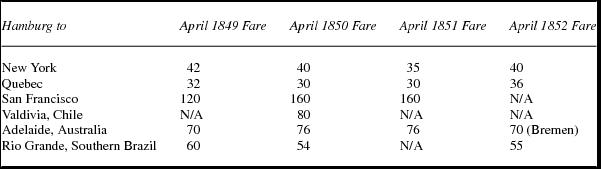
Migration was a costly matter. Relevant migration costs involved the passage fare across the ocean, possible train fare upon disembarkation to the interior, and the loss of income while en route. Traveling to destinations like South America or Australia required greater financial assets than those needed for travel to the United States. Alternatively, a potential emigrant could secure funding from a relative or from a firm at the destination that was interested in hiring workers. Table 1 shows the cost of passage in steerage to various overseas destinations from the port of Hamburg. Fares from Bremen were comparable but usually slightly cheaper.Footnote 13
Passage fares across the Atlantic Ocean (in Reich Thalers)

Source: See footnote 13.
Table 1 compares fares for the month of April from four different years. The figures provided show the relative costs of traveling from Hamburg (except for the 1852 fare to Adelaide) to different overseas destinations, with one Reichsthaler (referred to in this article as a Thaler) worth approximately US$0.67.Footnote 14 Fares were driven by the demand for and supply of space on the ship. The demand for space depended on how many emigrants were trying to leave Europe in a given year; the supply side depended on the number of ships in the market, influenced by new construction and the entry and exit of firms into the passenger market. The late 1840s and the early 1850s saw the increase of firms offering regularly scheduled passenger spaces.
Roughly, for those leaving northern Europe the farther the distance, the higher the price they had to pay. This simple feature made the United States the obvious option for many emigrants leaving northern Europe. In fact, most European emigrants who left from northern Europe prior to 1890 traveled to the United States. Compared to traveling from Hamburg to New York City, fares to the southern part of Brazil were 35 to 50 percent more, fares to Chile were double, and fares to Australia were two-thirds to more than double. These fares, especially those to places farther than New York, were difficult for most Hessians to afford. A typical annual wage for a rural Hessian male farmhand was 23 Thalers (not including the value of the in-kind portion), although for someone living in the capital city of Kassel, wages were much higher: Farm laborers who ventured out to farms near the city of Kassel could make about 70 Thalers.Footnote 15 Even a fare of 35 Thalers to New York represented an enormous sum in terms of annual incomes.
Knowing someone at the destination could make some of these costs easier to bear. A previous emigrant could help new emigrants with finding a job, securing room and board, providing information about the destination, translating a foreign language, and providing money for the passage fare and other costs (Wegge Reference Wegge1998).Footnote 16 What also may have helped encourage emigration was an established communication and transportation network that had existed between northern European and American ports already since the early to mid-1700s (Wokeck Reference Wokeck1999). A network between South America and Germany along with that between Australia and Germany also existed, but with much smaller trade volumes the resulting networks were nowhere near as dense.
More importantly, only a very few European emigrants could afford the higher passage fare to South America or Australia; if they ended up there, in many cases they were sponsored by a firm, colony, or a government looking for workers in these places. In the absence of family and friends at the destination, organized recruitment efforts could convey information and promote emigration, especially regarding places less traveled to like South America and Australia. Whether emigrants trusted these sources or even paid attention is an entirely different matter. Before 1860, Australian colonies all offered incentives, either in the form of free or subsidized ship passages or land guarantees or some combination of the two (Fitzpatrick Reference Fitzpatrick1994: 9). Assisted passage programs were vital in the peopling of Australia (Broeze Reference Broeze1982: 249; Jackson Reference Jackson1988: 52). For example, one can find advertisements around this time promising free passage to Australia for shepherds. In particular, the agent Heinrich Schmidt of the city of Jena placed an ad in one of the main German emigration newspapers in 1855 announcing free passage to Australia for shepherds without family members.Footnote 17 Auerbach argues that most of the emigrants leaving Hesse-Cassel for Australia traveled gratis; she wonders, in addition, how “free” these passage fares were and even labels these emigrants as “so-called indentured” (Auerbach et al. Reference Auerbach, Wolf and Schüler1984: 21).
While perhaps not quite as widely available, various South American firms and governments sponsored or subsidized emigrants or promised gifts of land to new settlers. The German emigration newspaper, Allgemeine Auswanderungszeitung, featured several interesting ads in the early 1850s promising great opportunities in South America.Footnote 18 In Brazil, the Hamburger Kolonizationsverein (Hamburg Colonization Organization) established the private colony, Dona Francisca (Joinville), in the southern province Santa Catarina, and placed several ads in the 1850s providing information about passenger fare and opportunities in the colony.Footnote 19 Eventually Joinville became one of the more successful colonies.Footnote 20 Another well-known and ultimately quite successful colony in the province of Santa Catarina that attracted many German emigrants was the Blumenau colony, founded by Hermann Blumenau and well publicized by books he wrote in the 1850s.Footnote 21 To the south of Santa Catarina was the province of Rio Grande do Sul, and several advertisements that promised grants of land to new settlers can be found in the 1850s for the colony of Santa Cruz.Footnote 22 This colony was historically one of the better known colonies, founded by the state in 1849 and initially settled by Germans from the Rhineland and Pomerania.Footnote 23
Outside of Brazil, one could find advertisements for opportunities to migrate to the province of Valdivia in Chile. Like in Brazil, the Chilean colony of Llanquihue in the province of Valdivia pledged to give new settlers land free of charge.Footnote 24 Hamburg merchants had long been involved in international trade with Chile, meaning that ships already traveled between Hamburg and Chile (Young Reference Young1974: 30). From Peru came promises of subsidized passage fares in 1851 and “guaranteed” monthly wages for five years in a host of occupations.Footnote 25
Hessian Emigrants Who Emigrated to the Southern Hemisphere
To study the characteristics of Hessian emigrants, I use data from the HESAUS records, which provide information on those who left the German principality between 1832 and 1866, although the data for 1858 to 1866 are quite incomplete. The HESAUS data have been collected from archival records, and are discussed in more depth in Auerbach (Reference Auerbach1993) and Auerbach (Reference Auerbach1987–88). The records exist because the law of Hesse-Cassel required citizens who wanted to leave to secure formal permission to do so.Footnote 26 The HESAUS emigrant data set provides the following detailed information on emigrants who left more than 1,300 different villages in Hesse-Cassel: village of origin, occupation, age, exported cash, destination, and month and year of departure. For Hessians who migrated to either the South American or Australian continents, I use all the data available for 1832 to 1866.Footnote 27 For my comparisons with those who went to the United States, I use the 1832–57 period. By linking these emigrant data to Historical Census data on the communities of Hesse-Cassel, one gains some understanding of their origins.Footnote 28 Other work of mine has studied these issues, showing that previous migration, even at the village level, is an important driving factor of later migration rates (Wegge Reference Wegge1998).
The Background of the Hessian Emigrants
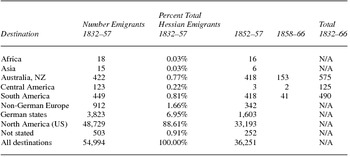
Table 2A provides information on the destinations of the Hessian emigrants. Emigrants who left for places other than the United States and Canada, almost 12 percent, mostly went to other German states or other European nations. Only about 0.8 percent of Hessian emigrants left for South America, and another 0.8 percent left for Australia or New Zealand. These are small percentages, but by examining those who went to South America or to Australia I am focusing on 1,065 different individuals, almost 2 percent of the entire Hesse-Cassel emigrant population, a large group.
Hesse-Cassel emigrants by destination, 1832–66

Sources: For statistics for emigration to Africa, Asia, non-German Europe, German states, North America, and “not stated” see Wegge (Reference Wegge2003: 375). Statistics for Australia/NZ, Central America, and South America are reexamined from the HESAUS files for this paper (Auerbach Reference Auerbach1987–88).
The emigrant records in Hesse-Cassel did not always specify the destination in detail. Among the Hessians I am examining, those who left for South America primarily went to Chile, Brazil, or more often generically “South America.” Among specific destinations within South America only Chile was frequently identified. Those who migrated to Central America mostly went to the island of Victoria in Honduras. Lastly, those who claimed to leave for Australia or New Zealand merely specified “Australia.”Footnote 29
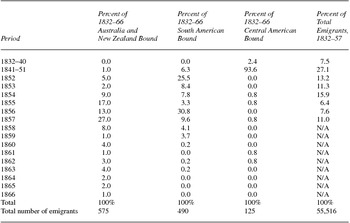
Hessians who emigrated to the Southern Hemisphere mostly did so after 1851, as one can see from table 2B. The Hessian emigrants who settled in South America moved primarily in the specific years of 1852 and 1856, while the pattern is different for Australian-bound Hessians, who left mostly in 1855, 1856, and 1857. Emigration to the United States, in contrast, was an older tradition, with many Hessians having left in the 1840s.
United States and southern-bound Hessian emigrants by arrival year

Sources and notes: Statistics for Australia/NZ, Central America, and South America are from the HESAUS files (Auerbach Reference Auerbach1987–88). Data for total emigrants (last column) are taken from Table 2A, Wegge (Reference Wegge2003), p. 372; 88 percent of these emigrants went to the United States (or Canada).
While emigration to the United States was a well-established practice by 1850 for Hessians, and Hessians knew about it and how to do it, emigration to Australia was not. There was an upswing by Hessians to move to Australia in the mid- to latter 1850s, but it appears that this upswing was temporary and motivated by the first Australian gold rush in 1851. The presence of advertisements for guidebooks in the migration newspapers may be a leading indicator of interest in a destination.Footnote 30 Hessians were obviously not the only ones interested in moving to Australia: In just 10 years, between 1851 and 1861, the population of Australia tripled to 1.1 million.
Of the 125 Hessians who are listed as having left Hesse-Cassel for Central America, it is mostly a sad story. Government documents report that a large majority left Hesse-Cassel in the summer of 1841 with the intention of moving to Honduras. They traveled as a group, led by Wilhelm Klein of the town of Guxhagen in the district (Kreis) of Melsungen, who secured a deal for the participants of this group to buy Honduran land at 1 British pound per English acre in return for their entire savings and financial assets. Upon arrival in the port of Hamburg, no places in ships were available and the Hessian applicants were deemed “unfit.” This group returned home penniless.Footnote 31
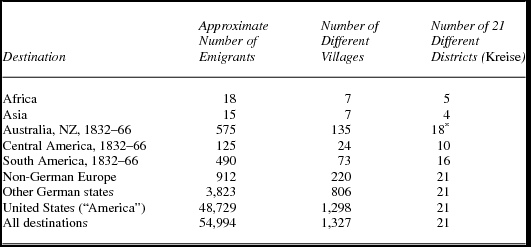
Table 3 shows how many emigrants left for particular destinations, and how many different villages and different districts (Kreise) they came from. One can identify approximately 1,376 different villages and towns in the principality of Hesse-Cassel in the mid-nineteenth century, and almost every single community lost someone to emigration. Also, someone from almost every village left for the United States. Individuals who left for other German states also left from a very large variety of towns and villages, exactly 806. This contrasts with the geographic origins of those who went to South America or Australia, who came from a much smaller set of villages, 73 and 135 respectively. Of those who went to Central America, 125 emigrants left from 24 different villages, while those traveling to other European but not German states left from 220 different villages.Footnote 32
Geographic origins of emigrants villages and districts (Kreise) 1832 to 1857 or 1866

Sources and notes: Data used are from the HESAUS files (Auerbach Reference Auerbach1987–88). Statistics are based on the years 1832–57, except for statistics for Australia, Central America, and South America, which are based on 1832–66. Here * signifies that in addition to the 18 different districts in the contiguous area of Hesse-Cassel that Australia-bound emigrants left from, a few others left from Frankfurt and Thüringen, regions adjacent but not a part of Hesse-Cassel.
Information flows mattered here. Emigrants had better access to information about opportunities in the United States and in other German states than they had for Central and South America or for Australia. It is interesting to note that about the same number of people left for Australia as for South America, but those who went to Australia, arguably a farther distance to travel, came from a set of villages that was almost twice as large. Those who went to South America were more likely to travel with family members and not alone, explained in the following text.
Figure 1 displays the exact village origins of those who went to destinations in the Southern Hemisphere between 1832 and 1857.Footnote 33 Among those who left from the contiguous area of the Hesse-Cassel principality, many of those who went to Australia came from a few clusters of villages in the Kreise of Frankenberg, Homberg, Kassel, and Witzenhausen. Those who went to South America left from some of the same Kreise, but those who went to Australia came from villages more widely spread out across the principality. Kamphoefner argues that both South American– and Australian-bound emigrants came from “small, concentrated pockets, not uniformly distributed.”Footnote 34 What is different here is that about the same number of Hessians went to South America as to Australia, but those who went to Australia left from about twice the number of villages and a set of villages that were much more spread out geographically. Those arriving in Australia in the mid-nineteenth century were primarily Northern Europeans, mostly people of British or Irish background, some of the same groups emigrating to the United States at this point as well. Hessians may have felt more comfortable venturing off to places being settled by other Northern Europeans.
Number of Hessians who went to Australia and South America 1832–57. This map was constructed by Nora Santiago, Urban Policy Analyst at the College of Staten Island (using data from the author), with support from the CUNY High Performance Computing Center at the College of Staten Island for computational resources, technical infrastructure, and data storage.

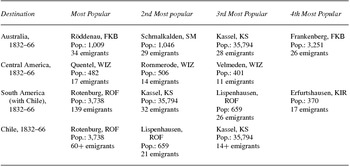
Table 4A shows the most common origins of Hessian emigrants in terms of districts (Kreise). Some who went to places in the Southern Hemisphere left from districts with some of the highest emigration rates in general, like Rotenberg (ROF) or Melsungen (MEG). Others left districts like Kassel (KS) and Witzenhausen (WIZ), which had some of the lower emigration rates in the principality.Footnote 35 Kassel contained, however, the capital city of the principality and perhaps some of the best information one could acquire about countries that were very far away like Australia.
Geographic origins of emigrants: Most popular districts (Kreise)

Sources and notes: Data used are from the HESAUS files (Auerbach Reference Auerbach1987–Reference Auerbach88). The principality was composed of four contiguous regions and two noncontiguous districts (Kreise), Schmalkalden (SM) and Rinteln (RI). Together there were 21 Kreise (districts) in the principality. The four contiguous regions (provinces) contained the following 19 Kreise:
-
Lower Hesse: Eschwege (ESW); Fritzlar (FZ); Hofgeismar (HOG); Homberg (HOM); Kassel (KS); Melsungen (MEG); Rotenberg (ROF); Witzenhausen (WIZ); Wolfhagen (WOH).
-
Upper Hesse: Frankenberg (FKB); Kirchhain (KIR); Marburg (MR); Ziegenhain (ZIG).
-
Fulda: Fulda (FD); Herseld (HEF); Hünfeld (HUN).
-
Hanau: Gelnhausen (GN); Hanau (HU); Schlüchtern (SLU).
A third pattern is notable. The northern part of the principality was the typical place of origin for those going to the Southern Hemisphere, as one can see from figure 1, where this part of the principality contains a great deal of dots and triangles. It may indicate something about the flow of information and chain migration networks. Among those who intended to settle in Central America, most left from the two districts Witzenhausen and Melsungen, both of which are in the northern part of the principality in the province of Lower Hesse and next to each other.Footnote 36
Similarly, a few towns contributed numerous emigrants. The most popular hometowns for emigrants bound for the Southern Hemisphere and Central America are listed in table 4B, along with their respective populations for the year 1849 and the number of emigrants. The communities with at least 3,000 in population, along with Schmalkalden, were all district capitals, suggesting that the heightened flow of information about faraway places encouraged a significant portion of the emigration to the Southern Hemisphere. The rest of the villages listed in table 4B were much smaller communities with a few hundred people, the typical-sized Hessian village. That there were some small communities generating heavy interest in emigration to South America and/or Australia suggests that there were group efforts and personal networks at play.
Geographic origins of emigrants: Most popular towns and villages of origin

Sources and notes: Data used are from the HESAUS files (Auerbach Reference Auerbach1987–Reference Auerbach88). Popularity is determined by highest numbers of emigrants from these towns (not emigration rates). Population figures for 1849 are listed and abbreviated as “Pop” and from the Germany, Staatskalendar of 1850. Lispenhausen is 4 kilometers away from Rotenburg.
The capital city of the Hesse-Cassel principality, namely Kassel, was a very popular hometown for emigrants, whether they went to Australia or South America.Footnote 37 In the case of Kassel, it was the capital for the district (Kreis) of Kassel as well as the capital of the entire principality. Again, this reflects both the larger pool of possible emigrants because these towns had larger populations along with the enhanced flow of information that could exist in a more populated place, especially a city with diplomats like Kassel.
Among the towns listed in table 4B is Rotenburg/ROF, from which almost a quarter of the South America–bound individuals left, many for Chile, in 1856 and 1857; in addition, quite a few emigrants left from villages just a few kilometers from Rotenburg.Footnote 38 In contrast, no one leaving for Central America came from this town or even the district of Rotenburg, and only two families departing for Australia left from the Rotenburg district. So, some of the individuals leaving for Australia came from a similar area as those who went to South America, as in the case of Kassel. Many others, however, left from completely different villages and districts and seemed to be in different networks. These various patterns remind one of what Borges found for the Algarve emigrants, that there were distinct emigration patterns by county as well as particular ones associated with different parishes. On this point, he states that “As in the case of chains to the U.S., those to Argentina and Brazil were grounded in specific sets of parishes and occupations” (Borges Reference Borges2003: 368, 372).
Historians credit the renowned Bernardo (Bernhard) Phillipi for being the person most responsible for encouraging around 4,000 Germans to settle in Chile in the 1840s, 1850s, and 1860s. His first recruits came out of the principality of Hesse-Cassel, specifically nine families from the Kreis of Rotenburg in 1846 who settled in the Chilean province of Valdivia (Young Reference Young1974: 30, 38). These early Hessian settlers are referred to often as some of the first organized German settlers in Chile. The letters these colonists sent back possibly encouraged more citizens of Rotenburg to move to Chile, as Philippi thought of them as positive enough to publish in 1851 in Germany with the idea of drumming up more interest in the Valdivia colony (Young Reference Young1971: 487; Reference Young1974: 54). These letters were instrumental in encouraging more emigration to Chile from Hesse-Cassel and Germany in general: Even though Bernardo Phillipi resided in Germany from late 1848 to the early months of 1852 to engage in recruiting Germans to Chile, his own brother Rudolf wrote that the letters sent back home from the Hessians in this first group made much more of an impact than all the other types of materials Bernardo Phillipi published (Young Reference Young1974: 76, 93). Interestingly, the nine families who arrived in Chile in 1846 are nowhere to be found in the Hesse-Cassel data for the 1840s. The ones who came a bit later make up an interesting group, which I discuss in more detail in the following text.
Emigration of Families and Single Individuals and Chain Migration
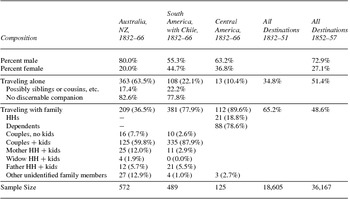
A first step in investigating the kinds of migration strategies emigrants employed and whether they included other family members is an examination of the gender distribution of each destination group. For women in particular, the actual act of migration usually hinged on a family or “extended” network (Harzig Reference Harzig and Sharpe2001: 23). Gender distributions are displayed in table 5A. Between 1852 and 1857 most emigrants, 73 percent exactly, leaving from Hesse-Cassel were men. What is interesting is how the gender composition varied by destination. More men than the average of 73 percent across all destinations went to Australia, 80 percent to be exact. In contrast, only 55 percent of the emigrants bound for South America were men. Women were only a fifth of those who went to Australia and almost half of those who went to South America. Thus, emigration to Australia was male dominated, while emigration to South America was gender balanced.
Gender and family characteristics

Sources and notes: Data used are mostly from the HESAUS files (Auerbach Reference Auerbach1987–Reference Auerbach88). For the figures on traveling alone in the last two columns, see Wegge (Reference Wegge1997), Vol. 2, p. 328, Table 4.8, Row 1 (Group Size of 1). A weighted average was calculated for 1832–51, hence 34.8 percent traveling alone. For all destinations, 14,900 women emigrated (Wegge Reference Wegge and Sharpe2001: 168), and this figure is divided by 54,994 to get the gender distribution in the first two rows of the last column. HH is the abbreviation for Head of Household.
Much of this has to do with family composition, shown in table 5A in terms of those who traveled alone and those who traveled with family. Compared to those who traveled to Australia, emigration to South America was much more family oriented. More than 77 percent of the Hessians who went to destinations in South America were traveling with family; of this 77 percent, almost 90 percent of them were couples with children, all traveling together. Despite the high percentage of men traveling alone in the group that went to Australia, it is doubtful that these emigrants bound for Australia were engaged in seasonal or nonpermanent migration, and thus planning to return at some point. The distance and thus the cost were both just too immense, and no company sponsored return migration from Australia to Europe.Footnote 39
Still, the contrast between those bound for South America and those bound for Australia is a stark one. One factor driving up the percentage of men among those bound for Australia is that many of them were shepherds or herdsmen, an occupation that did not pay well in Germany and was most suited to young men. The Australian gold rushes of the early 1850s may also have attracted more bachelors than families. Interestingly, the Hessians who left for Australia look similar to the Irish immigrants who settled in Australia between 1848 and 1870, only 40 percent of whom were traveling in family groups (Fitzpatrick Reference Fitzpatrick1994: 12).
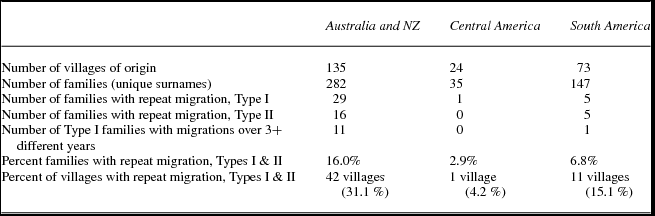
One migration theory espouses that migrants come from many of the same places. Much of this has to do with the tendency of friends and family members to follow those who have gone before. Migration historians have written widely of the importance of networks in explaining the patterns of mobility. South American–bound individuals came from a much smaller set of villages and districts (Kreise) in comparison to the comparably sized group of Hessians bound for Australia. Who was more networked? By the very specific definition that chain migration is defined as two or more migration groups with the same family name leaving from the same village and migrating in different years (Type I in table 5B), the degree of chain migration was stronger for the group bound for Australia. This is not surprising, as those going to South America were already traveling mostly as intact family groups, while 63.5 percent of the Australian bound were traveling alone, leaving open the possibility for family members to follow and thus a network relationship to be formed. Those going to Latin America did not have as much need for networks.
Chain migration—Connections across time 1832–66

Sources and notes: Data used are from the HESAUS files (Auerbach Reference Auerbach1987–Reference Auerbach88). Repeat Migration of Type I is defined as two or more migration groups from the same village with the same family name migrating in different years. It is defined as Type II when two or more migration groups from the same Kreis (district) with the same family name migrate in different years. Excluded are those with common surnames from towns with a population size greater than 1,000 people.
Exactly 135 different villages contributed emigrants who left for Australia, and 31.1 percent of these villages experienced a repeat emigration, broadly defined and namely the departure of citizens in least two different years to Australia from the same family and often the same village, as one observes in table 5B.Footnote 40 In contrast, 73 different Hessian villages lost people to South America, and fewer of these villages, 15.1 percent, lost residents who were related in at least two different years (broadly defined, Type I and II). I could find only five families from the exact same village (Type I) that underwent repeat migration to South America, and the same number was almost six times (29 families) as much for those bound for Australia.
While I suspect that those who went to South America did not generate a great deal of interest among other Hessians to do the same at some future date, several explanations are possible. First, the South American group was much more family oriented to begin with, and whole immediate families often left en masse at one point in time. In the case of Australia, in contrast, more often one member of a family left (not a whole family), a person who could easily encourage one other family member to leave subsequently. It is possible that the business and/or colonial interests that recruited for South America preferred families rather than single adults.Footnote 41 Second, those who went to South America had more financial assets (table 6C), whereas the use of personal networks was more necessary for those with small savings at hand. Third, there may be a reason at the destination that did not engender positive feelings about South America back in the homeland. Stories like the 1857 murder and robbery of the Justus Schmidt family, listed in the HESAUS records, who had left from the epicenter of Hessian–South American emigration, the town of Lispenhausen in the district of Rotenburg, and settled in Chile were certainly not conducive for generating more emigration.Footnote 42 It is unclear what the reverberations of such a tragedy were, but it may have nipped in the bud any nascent emigration movement to Chile. As one can see in table 2B, emigration to South America, as well as to Australia, fell off quite a bit in 1858, quite possibly due to an overall secular trend and/or missing data and/or news of the murder. It is difficult to discern the effect of each factor.
Occupations and Cash Assets of the Emigrants
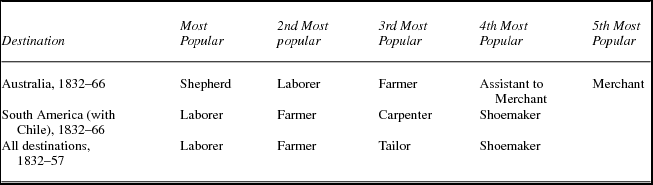
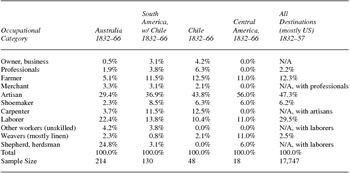
Table 6A shows the most common occupations for emigrants traveling to the various possible destinations, and table 6B uses a classification system of occupational backgrounds according to some broad categories and common occupations to show the occupational distribution of different emigrant groups.Footnote 43 These occupational statistics by and large concern men over the age of 16.Footnote 44 Most Hessians typically worked as farmers, laborers, or artisans of the sort commonly found in villages. Such “village” occupations could be practiced without membership in a guild and included carpenters, masons, bakers, butchers, and smiths, among others.Footnote 45 A few of these occupations were in demand at the destination.
Emigrants’ most common occupations

Sources and notes: Data used are from the HESAUS files (Auerbach Reference Auerbach1987–Reference Auerbach88). The figures in the last row for “All destinations 1832–57” are from Wegge (Reference Wegge1997), Vol. 2, pp. 319–22, where laborers are 25.5 percent, farmers 12.4 percent, tailors close to 9 percent and shoemakers 6.2 percent.
Distribution of emigrant occupations

Sources and notes: Data used are from the HESAUS files (Auerbach Reference Auerbach1987–Reference Auerbach88). The figures in the last column for “All destinations (mostly US)” are from Wegge (Reference Wegge2003: 378).
Hessians who went to Australia were grossly unskilled. The laborers, unskilled workers and shepherds in table 6B made up more than 50 percent of the adult men who went to Australia (for whom occupational data exists). In contrast, the analogous figures for South America (with Chile), Chile, and emigrants to “All Destinations” were 21.5 percent, 12.5 percent, and 32 percent, respectively. Of particular interest is the high number of shepherds bound for Australia: About half of the 50 percent or 24.8 percent of all employed individuals were shepherds, an enormous number compared to anything else. Two-thirds of these shepherds who went to Australia left in the years 1854, 1855, and 1856. Like the Hessians, the Irish who immigrated to Australia were fairly unskilled (Fitzpatrick Reference Fitzpatrick1994: 17), but this is representative of the skill level of the entire Irish emigrant population, and not just those who settled in Australia.Footnote 46 Similarly, emigration to Australia was only possible for most Irish given the subsidies the various Australian states offered to those who made the trip. Here labor market conditions helped determine why specific destinations were attractive to particular occupational and demographic groups, and in this case unskilled laborers in terms of Australia (Borges Reference Borges2009).
In stark contrast, Hessians who immigrated to South America were substantially more skilled. The percentages of artisans, farmers, business owners, and professionals are all higher for the group who went to Latin America than to Australia. The Hessians who went to Chile were especially skilled or more likely to be managers or owners of some type of business and less likely to be farmers, not only compared to those who went to other destinations in South America, but also compared to those who settled in the United States. The historian Samuel Baily found a similar difference among Italians who settled in Buenos Aires, Argentina, versus those who settled in New York City, with the former group being composed of by more northern Italians, who on average were more literate and skilled.Footnote 47 Here, I think the skill differences among Hessians are less about specific geographic origins and more about the emigrants self-selecting for particular destinations.
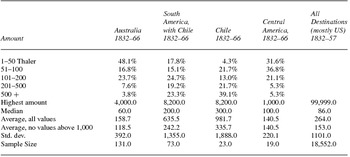
The data on cash that emigrants took with them further emphasizes the point that Hessians who went to Australia were the poorest, as table 6C attests to. The median cash amount that the Australian bound took was 60 Thalers, while it was 86 Thalers for all Hessian emigrants between 1832 and 1857, 200 Thaler for the South American bound, and 300 Thaler for those who ended up in Chile. Those who went to South America were wealthier than most Hessian emigrants, and the very wealthiest were those who went to Chile. This characterization of Hessians who emigrated to South America differs starkly from what Oliver Marshall claimed in his work on English, Irish, and Irish American settlers in Brazil, that “by the mid-1850s only the most desperate German emigrants would consider going to Brazil” (Marshall Reference Marshall2005: 19). Similar to Marshall, Frederick Luebke argued that “the social and cultural characteristics of the German emigrants to both the U.S. and Brazil were also much the same,” although he cautioned that this was based on what he termed “impressionistic evidence” and “may be proved wrong by systematic research” (Luebke Reference Luebke1990: 97, 106). In contrast, something Luebke cites, Wolfgang von Hippel found similar patterns for Germans leaving the state of Württemberg, that “Germans headed for South America were somewhat wealthier than those going to North America” (Luebke Reference Luebke1990: 106; von Hippel Reference von Hippel1984: 254–67).
Distribution of cash taken (in Thalers)

Sources and notes: Data used are from the HESAUS files (Auerbach Reference Auerbach1987–Reference Auerbach88). For all the preceding calculations, people for who the cash amount is missing (zeros) are excluded. For the last column, “All destinations (mostly US),” see Wegge (Reference Wegge1997: 326), Table 4.7.1 and Wegge (Reference Wegge2003: 379). The highest amount for a US-bound emigrant, 99,999 Thaler, may be an error; the next highest amount is 30,000 Thaler, and the third highest is 25,142 Thaler.
The HESAUS data studied here confirm what a contemporary wrote in one of the main German emigrations newspapers in 1852 about emigrants leaving Hesse-Cassel, that shepherds went to Australia and that some of the richest Hessians leaving went to Chile:
Most go to the northern states of the Union. Still, also Texas, California, Chile and even Australia demonstrate their attraction. Most are going to northern states of US, but some are off to CA, TX, Chile and even Australia. To Australia go shepherds and managers of mines (“Bergfachbeflissene”). Chile, however, gets the wealthiest business people (“Gewerbsleute”).Footnote 48
Religion
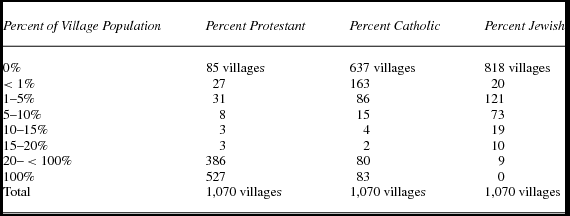
In terms of religion, the citizens of the principality of Hesse-Cassel were primarily of a Protestant faith, which included members of the Lutheran, Mennonite, and Reformed (Calvinist) churches. Table 7A describes the religious distribution across all Hessian communities:
Religious distribution of Hesse-Cassel communities 1850s

Source: Germany, Bestand H3, 1850s village survey data for the principality of Hesse-Cassel, Staatsarchiv in Marburg, Germany.
For the 1,376 different villages and towns in Hesse-Cassel, the religious distribution for the population is known for 1,070 of these communities. The breakdown along religious lines for the entire principality based on these 1,070 communities was 83.6 percent Protestant, 15 percent Catholic, and 1.4 percent Jewish.
Many communities, however, were quite polarized. Protestants were in almost every community, with only 85 communities, or 8 percent having no Protestants, and 527 different communities or 49 percent with only Protestants. About 60 percent of the communities had no Catholics, and 8 percent had only Catholics. Jews clearly were a minority and made up only small percentages of the 24 percent of the villages they lived in.Footnote 49 Jews also primarily lived in the towns and larger villages. It was easy enough to find communities where less than 10 Catholics lived, but this was rare in the case of Jews.Footnote 50
For the period 1832 to 1857, those leaving for South America left a subset of towns that was 94 percent Protestant, 3.7 percent Catholic, and 2.1 percent Jewish.Footnote 51 Those leaving for Australia came from towns that were a bit less Protestant and Jewish and a bit more Catholic. Table 7B summarizes these data.
Religious background of villages emigrants left from 1832–57

Source: Germany, Bestand H3, 1850s village survey data for the principality of Hesse-Cassel, Staatsarchiv in Marburg, Germany.
Did religion possibly matter for Hessians in terms of the decision to migrate to the Southern Hemisphere? It may have. If a Hessian Protestant wanted to settle in a community with like-minded individuals, Australia was one such possibility given the many Lutherans from Prussia who settled there in the 1830s and 1840s.Footnote 52 The King of Prussia, Friedrich William III, merged the Old Lutheran and Reformed (Calvinist) churches in 1817, and in response several Lutheran Prussians immigrated to Australia.Footnote 53 Hessian Lutherans may have been similarly attracted to Australia. Information on the religious composition of the villages that lost the most emigrants to Australia is incomplete, but it is known for Frankenberg, the fourth most popular town of origin for this group. Frankenberg was made up of by 83 percent Lutherans and 17 percent Reformed Protestants.Footnote 54 Thus the town and possibly area around Frankenberg was a great source for Hessian Lutherans, and possibly dissatisfied ones.
For Catholic Hessians, an overwhelmingly Catholic South America might have been an attractive place for them, many of whom were members of a religious minority in the communities they lived in. The emigrants leaving for the Southern Hemisphere tended to leave from towns that were more Protestant and more Jewish than the average Hessian community. It may still be possible that many emigrants going to South or Central America were Catholic and felt particularly lonely in their home villages (on average 94 percent Protestant), and sought new lives in more Catholic societies. Hessian emigrants who went to Chile may, however, been deterred. Certainly, the Chilean government wanted to attract Catholic Europeans, and Bernhard Philippi tried to accomplish this during his German tour between 1848 and 1852, but was roundly refused by the various German Catholic bishops in Fulda, Paderborn, Regensburg, and Trier (Young Reference Young1971: 490); these bishops even went on to exhort their respective flocks not to emigrate. Whether Hessian Catholics avoided Chile and South America in general is impossible to discern from the emigration records because an emigrant's religious affiliation is not provided.
To some historians it seems, however, that religion was a secondary matter for these emigrants. In regard to Prussian emigrants, Kamphoefner, for instance, has found no relationship between Catholicism and a preference for South America (Kamphoefner Reference Kamphoefner2000: 207). Still, without more extensive study of the exact religious identity of the emigrants, one cannot distinguish between two distinct possibilities, that Hessians bound for South America were Catholics looking for a majority Catholic society or instead Protestants for whom the religion of the destination society was either secondary or even irrelevant. Similarly, were Hessians going off to Australia looking for fellow Lutherans or other religious communities they could find affinity with or was the religion of the destination society just not that important? Tentative evidence suggests that those leaving Frankenberg were possibly attracted to the Prussian Lutheran settlements in Australia. With the gold rush in the early 1850s, Australia was attracting significant groups of both Catholics and non-Catholics, so a wide variety of Christian groups could find their preferred community if they wanted to.
How did Jewish Hessians think about this? Emigrants leaving for Australia and South America were leaving from communities where the percentage of Jews was above the principality average. It is not clear whether these emigrants were Jewish. These numbers could be related to a very high Jewish emigration rate or be a function of the better information flow about distant places in the larger communities, where Jews tended to live.
Summarizing the Results on a Multivariate Basis
So far, I have analyzed various characteristics of the emigrants solely on a univariate basis, examining one variable at a time. In this section I analyze the differences between those who went to South America and those who went to Australia using a multivariate logistic model. While it would be preferable to compare both groups one at a time to those who went to the United States, the huge size of the US-bound group overwhelms both groups that went south on a statistical basis.
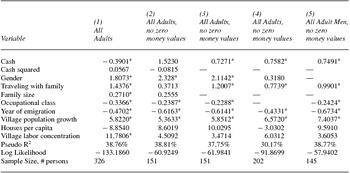
Using a 1 for the South American bound and a 0 for those who went to Australia as the dependent variable, I look at both individual characteristics and some traits of their own villages. Table 8 provides the results, and the appendix defines the different explanatory variables used.
Comparing South American bound with Australian bound 1832–66 logit estimations

Sources and notes: Emigration data, here the dependent variable, are from the HESAUS files (Auerbach Reference Auerbach1987–Reference Auerbach88). Data on village socioeconomic characteristics are from Germany, Bestand H3, the 1850s village survey for the principality of Hesse-Cassel, Staatsarchiv in Marburg, Germany. * indicates significance of 10 percent or less. The dependent variable is equal to 0 if the adult migrated to Australia and equal to 1 if the adult migrated to South America.
Estimation (1) regresses a migrant's regional classification on a very large set of variables: cash taken, cash taken squared, a gender dummy (1 for female, 0 for male), whether they were traveling with family (1 for with family, 0 for alone), family size of travel group, occupational class (with lower skilled occupations having higher numbers), the population growth of a migrant's village, houses per capita in a migrant's village, and a measure of the concentration of laborers in a migrant's home village economy. This first estimation (1) was estimated on all the migrants with an occupational classification and any money value. This proved to be problematic, as about two-thirds of the 607 individuals in my data set did not report any cash value. To get around this, I have assumed they took nothing or very little with them, which leads to measurement error and can cause regression coefficients to be biased. In fact, the coefficient on cash in this estimation is negative, implying that the South American bound took less cash, and we know from the preceding text that this is not true from a univariate perspective, and not likely true even when holding all other variables constant.
In the remaining estimations, I examined only migrants who reported nonzero cash values. The coefficient on cash in estimations (2), (3), (4), and (5) is the expected positive sign. I also decided to eliminate the family size variable because it has a positive correlation of 78 percent with the traveling with family variable, which can cause problems of multicollinearity. I tried various other specifications, but the results are fairly robust: The South American–bound Hessians took more cash with them, were more likely to be traveling with family members, had a higher occupational class, and tended to leave in earlier years; they also left from villages with higher population growth. This exercise does not change anything discussed in previous sections of this article.
Conclusion
The historian and archivist probably most familiar with the Hessian emigrant data, Dr. Inge Auerbach, argued that the flow of Hessian emigrants to places like Brazil and Chile was something almost not worth mentioning, although she thought that is was worth noting that so many who went to Chile left from the Kreis of Rotenburg (Auerbach Reference Auerbach1993: 7, 11, 19, 132). Based on the sheer volume of Hessians who went to the United States and that less than 2 percent of the Hessian emigrants sailed for the Southern Hemisphere, this is a reasonable statement. However, those who went south are fascinating because they were so different from the average emigrant who settled in the United States.
These emigrants appear to have been economically motivated, but interested in particular opportunities in the places they were going to. Those bound for Australia on average, for instance, were very poor and unskilled relative to those who went to South America. They were even poorer than the Hessians who went to the United States. Many Australian states were subsidizing passage fares in the effort to attract Northern Europeans and thus made it possible for cash-strapped Hessians to leave, drastically reducing the out-of-pocket cost of moving. The choice set for these less well-off Hessians may have been limited to staying home, emigrating to another German state, or going to Australia. With less subsidization of fares, Australia would not have been as possible. Many of the poor Hessians who ended up in Australia were shepherds and herdsmen, most likely seeking out employment opportunities in the burgeoning livestock business of the region or seeking their fortune in the Australian gold rush of the 1850s. Those bound for South America, in contrast, were more skilled and much wealthier in terms of the cash they took with them, which starkly differs from Marshall's description of “only the most desperate Germans” moving to Brazil (Marshall Reference Marshall2005: 19). The ones who left for Chile were the wealthiest of all Hessian emigrants. Many left for specific colonies and may have been specially recruited for their talents and financial assets. There was some subsidization of fares to parts of South America, especially Brazil, but it was probably less than what existed for Australia.
In general, the average Hessian emigrant of the mid-nineteenth century was male. This is the case with those who went to the United States as well as with those who immigrated to Australia. The exception is the group who went to South America, which was basically gender balanced and made up to a high degree by people traveling in family groups (78 percent). A large percentage of these family groups were intact families. Most of them left from a district in the province of Lower Hesse, in particular from the Kreis of Rotenburg. In comparison, those who migrated to Australia left from a wider set of communities that were much more spread out, almost twice as many, and were more likely to be “networked” to an emigrant with the same surname who had moved in a previous year. The families bound for South America did not have to be “networked” because they had the resources to migrate as intact families in a single year. In a broader sense of networks, it is still possible that those who went to South America used personal networks that were denser, with more connections between the different families who went to South America (and in the same year in many instances) than between those who went to Australia.
The religious identity of the emigrants is impossible to discern from the emigrant records. It is quite conceivable, however, that Hessian Lutherans were leaving for Australia where Prussian Lutheran groups had established themselves in the 1830s. It does not appear, however, that Hessian Catholics were necessarily attracted to South America or to Australia. An examination of the religious practices in their home villages indicates that those who left for South America left from places that were on average less than 4 percent Catholic and instead places with an exceptionally high concentration of Protestants and higher than average numbers of the Jewish faith. This latter factor suggests that the emigration rates of Jews were high and/or that people leaving for non-US destinations tended to come from more urban settings where the information on countries in the Southern Hemisphere was typically better than in rural villages. In comparison, those who left for the United States could rely on information emanating from the thousands of personal networks that formed very quickly in the late 1830s and in the 1840s between previous emigrants and their family members and friends back home (some of them potential emigrants).
What emerges from this study of individuals and families who went to South America and Australia is that they were not only quite different from the US-bound contingent but that they could not be more different from each other. Of these three groups, the adult men among the Australian bound were the least skilled, poorest, and most likely to be young adults traveling alone. In contrast, the adult men who went to South America were the most skilled and professional, the richest, and mostly traveling with their wives and children. In fact, almost 80 percent of those who went to South America were traveling with family, compared to 37 percent for those who went to Australia. In contrast, those bound for the United States seem to have had characteristics somewhere in the middle of those who went to Australia and those who went to South America, perhaps being somewhat closer to the Australian group, especially regarding those who went to North America in the 1850s.
If such an elite group went to South America and such a poor group went to Australia, an interesting question to ponder is whether the descendants of Hessians in South America did better economically than the descendants of Hessians who settled in Australia. Some recent research on intergenerational mobility states that it takes many generations for existing elites to lose economic and social power and that our genetic and social inheritance is more determinative than most of us would suspect or even like to believe (Clark et al. Reference Clark, Cummins, Hao and Vidal2014).Footnote 55 Such research would favor the Hessians who ended up in Chile. Immigrants, however are self-selected from the general population, and some social scientists suspect that migrants are more willing to take on risk and care more about economic advancement, which could provide a countering or dampening effect of some of the determinative factors Clark et al. describe.Footnote 56 I leave it for future research and other scholars to address this issue.
Appendix
Description of Variables in Logistic Regression
Independent variables:
-
A. Emigrant Specific:
-
Cash: For migrants, this is the cash taken or promised in the future by family; the natural log of cash is used here.
-
Gender: 0 if male, 1 if female
-
Traveling with Family: 0 if traveling alone, 1 if traveling with family
-
Family Size: Size of family leaving together
-
Occupational Class: This is numbered as the following:
-
1: Owner of firm/business; 2: Professionals; 3: Farmers, land owners;
-
4: Artisans; 5: Merchants; 6: Shoemakers; 7: Carpenters; 8: Laborers; 9: Other nonskilled laborers; 10: Linen weavers; 11: Shepherds
-
-
-
B. Variables that describe the emigrant's village of origin:
-
Village population growth between 1832 and 1849
-
Houses per capita in 1849 in emigrant's village
-
Village Labor Concentration: Number of laborers and simple weavers divided by population (concentration of unskilled labor)
-