Introduction
The Chinese population is rapidly ageing: with 10.1 per cent of its population aged 60 or more years, China became an ‘ageing nation’ at the turn of this century (National Bureau of Statistics of China 2001). Those aged 80 or more years, the age group that is most likely to require health care or long-term care or both, in 2000 reached 11.4 million (0.9% of the total population), and is projected to grow to 102.8 million (7.3% of the total) by 2050 (United Nations Organisation 2006). Mean life expectancy at birth in China reached 72 years in 2000, and is projected to be 79.3 years by 2050 (United Nations Organisation 2006). The fast increases in the older population and in life expectancy will result in the need to care for a vast number of older adults.
Chinese society has been characterised by close and interdependent family relations, strong intergenerational cohesiveness and high filial expectations (Bond Reference Bond and Bond1996; Cheng and Chan Reference Cheng and Chan2006), and families have long been the major source of eldercare (Gu and Liang Reference Gu, Liang, Bengtson, Kim, Myers and Eun2000). Recent economic development and socio-cultural changes, however, have made it increasingly difficult for Chinese families to care for their own (Bartlett and Phillips Reference Bartlett and Phillips1997). To survive in the developing economy, individuals in both urban and rural areas are devoting more time and energy to work. Greater numbers of adult children move away from their ageing parents to find employment, often in cities faraway (Ji and Feng Reference Ji and Feng2007). The one-child policy since 1980 has created the ‘4-2-1’ families, in which a couple, both members single children, need to care for four older adults and their own child (Guo Reference Guo2007; Yang Reference Yang2007). Furthermore, women in urban China are gaining equal access to higher education and becoming more career oriented (Tsui and Rich Reference Tsui and Rich2002). As a result, the gendered cultural expectations of women in providing care for ageing parents may be jeopardised, and the availability of eldercare provided by adult children has become questionable (Bai Reference Bai2001; Chen Reference Chen2007).
In these circumstances, eldercare and especially its institutional forms has received increasing attention from central and local governments and the private sector as a way to meet the needs of older adults in both urban and rural areas (State Council of the People's Republic of China (PRC) 2000, 2006a; Tao and Zhai Reference Tao and Zhai2004). Institutional eldercare is not new to China, for since the Tang Dynasty (618–907 AD) the government has set up institutions for impoverished older adults without family support (Chou Reference Chou, Huang and Zurcher1993). Although this tradition has continued, contemporary China is witnessing various new types of institutions for non-poor older adults. Yang-lao ji-guo, which literally translates as ‘eldercare institutions’, is an umbrella term for residential eldercare provided outside the family in China today. There are five major types: she-hui-fu-li- yuan (social welfare institution), jing-lao- yuan (institution for paying respect to older adults), yang-lao- yuan (institution for providing care for older adults), lao-nian-gong-yu (senior apartment), and lao-nian-hu-li-yuan (nursing home) (State Council of the PRC 2006b). Traditionally, the first two types serve older adults with no or low income, such as individuals known as the ‘three nos’ and in need of ‘five guarantees’;Footnote 1 and the latter three are geared towards older adults with higher socio-economic status (He Reference He2005; State Council of the PRC 2006b). Given the recent rapid growth in the older population and in eldercare institutions, some institutions that originally served only publicly-paid clients have begun to accept privately-paid clients, for example the she-hui-fu-li- yuan and jing-lao- yuan (Yian, Lee and Dong Reference Yian, Lee and Dong2005).
The level of care provided varies by geographical area. In rural areas, jing-lao- yuan predominate, and most are minimally equipped and offer low levels of care and services (Zhang, Zhang and Zhao Reference Zhang, Zhang and Zhao2008). Eldercare institutions in urban areas, on the other hand, tend to be better equipped and to provide better care and services (Yian, Lee and Dong Reference Yian, Lee and Dong2005), although there are reports of disparities in care and services across institutions (Zhao and Xie Reference Zhao and Xie1999). In both rural and urban areas, and among all five types of residential institution, some serve mainly able-bodied older adults and offer minimum care and services, whereas others provide a wide range of care and services, from room-and-board services for able-bodied older adults to nursing care for individuals with chronic illnesses and limitations in carrying out the Activities of Daily Living (ADL) – commonly there are two to four levels of care (Yian, Lee and Dong Reference Yian, Lee and Dong2005). Jiang and Si (Reference Jiang and Si2006) caution that among the eldercare institutions that claim to provide nursing care, some are reluctant to accept older adults with very low physical and/or mental functioning capacities and high nursing-care needs. The monthly costs of living in eldercare institutions vary from about 300 yuan to more than 1,000, depending on the type of facility, public or private ownership, the level of care and service provided, room type (single, double or multiple occupancy), and the financial status of the client (e.g. ‘five guarantees’ individuals as against individuals with more financial means) (Yian, Lee and Dong Reference Yian, Lee and Dong2005). Individuals needful of ‘five guarantees’ are financially supported by the government or local communities to live in eldercare institutions, and other people's expenses are paid by themselves or their family. For self-paid clients, some facilities charge fees scaled by the person's origin (local residents, individuals from out of town, and individuals from overseas, e.g. Hong Kong, Macau and Taiwan), with locals charged least and those from overseas the most (Yian, Lee and Dong Reference Yian, Lee and Dong2005).
The government's promotion of institutional care has been accompanied by substantial investment. For example, Beijing City Government spent more than 100 million yuan on building one eldercare institution and allocates four million yuan each year for its operation (Lü Reference Lü2005). Some communities also pool sources from the public and private sectors to build eldercare institutions, as in Nanjing and Lanzhou (Shang Reference Shang2001). Recent studies have documented ambitious plans and actual increase in eldercare institutions in rural and urban China (e.g. Guan, Zhan and Liu Reference Guan, Zhan and Liu2007; Lü Reference Lü2005; Pong, Liang and Chen Reference Pong, Liang and Chen2006). Researchers have also commented that institutional eldercare has become a cornerstone of China's development of eldercare (Lü Reference Lü2005). By the end of 2005, China had 39,546 eldercare institutions with 1,497 million beds, most of which were in rural areas or townships (29,681 institutions, 9,895 million beds) (State Council of the PRC 2006b).
The purpose of the study
Although currently China needs an estimated 6.7 million beds to meet its long-term care requirement (Zhang Reference Zhang2007), unfilled beds have been reported nationwide (Pong, Liang and Chen Reference Pong, Liang and Chen2006; Tao and Zhai Reference Tao and Zhai2004), and occupancy rates for some individual homes are as low as 50 and in rare cases 30 per cent (Tao and Zhai Reference Tao and Zhai2004; Wang, H. Y. Reference Wang2006; Zhao and Xie Reference Zhao and Xie1999). One reason for the low occupancy may be the unwillingness of older adults to live in institutional settings. Although there have been several studies of long-term care, the degree of willingness and factors contributing to such willingness have not been adequately considered. The Chinese term for willingness is yuan-yi, which connotes willingness to do something even under less than ideal circumstances. To the Chinese, yuan-yi often implies acceptance of an undesirable situation or a compromise between one's desire and actual possibilities. Like many of their counterparts in other countries, Chinese older adults generally regard institutional long-term care as the option of last resort. Willingness or lack of willingness to live in eldercare institutions, however, is not a simple expression of a person's likes or desires. It represents the tip of the iceberg, with a host of factors hidden underneath, as the present study shows. The purpose of the study was to examine the level of willingness among older Chinese to live in eldercare institutions and to investigate the social, cultural, health and economic factors associated with such willingness. As China is now formulating crucial long-term care policies to meet the needs of its booming ageing population, this study is timely and will provide useful insights for social policy.
Conceptual framework
Models in studying long-term care service usage
The conceptual framework for this study stems from three resources: existing models of long-term care service utilisation, empirical findings from previous studies in China, and relevant characteristics of Chinese culture and society. Andersen's behavioural model postulates that health services utilisation is determined by predisposing factors (e.g. age, gender, education, marital status, family size, values concerning health and illness, and attitudes toward health services), need factors (e.g. perceived and evaluated functional capacity, symptoms and general health status), and enabling factors (e.g. family and community resources and accessibility of those resources) (Andersen Reference Andersen1995; Andersen and Newman Reference Andersen and Newman1973). Although originally developed for studying the utilisation of acute health-care services, it has been applied to long-term care usage (Lai Reference Lai2004) and intentions to use long-term institutional care (Bradley et al. Reference Bradley, Curry, McGraw, Webster, Kasl and Andersen2004). In adapting the model to long-term care settings, Bradley et al. (Reference Bradley, McGraw, Curry, Buckser, King, Kasl and Andersen2002) added related psycho-social factors, including attitudes, knowledge, social norms and perceived control.
Based on consumer decision-making theory, Zhai and Tao (Reference Zhai and Tao2005) proposed a model of the intention to live in eldercare institutions in China. They argued that individual and family characteristics are key influences on a Chinese older adult's choice between receiving care at home from family members and living in an institution. They postulated that Chinese older adults' propensity to use institutional care is a positive function of advanced age, higher financial status, having fewer or no adult children or having unfilial adult children, inadequate housing or household arrangements, poorer health, and having more modern values or attitudes toward institutional care. Although Andersen's behavioural model offers a more generic and comprehensive framework for research in long-term care service usage, it is understandably short on considerations specific to long-term care and to different cultures and societies. Zhai and Tao's model, albeit more grounded in Chinese culture and society, does not consider many mediating factors, such as gender, educational level, marital status, socio-cultural beliefs about raising children to insure eldercare, the presence of institutional care in the local community and residential area (metropolitan, urban or rural).
Previous empirical findings
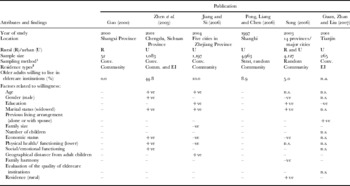
A systematic review of the literature in both English and Chinese identified six empirical studies on older adults' willingness to live in eldercare institutions in China.Footnote 2 As shown in Table 1, estimates of the extent of willingness (or ‘yuan-yi’) varied from zero in rural areas (Gao Reference Gao2000), through five per cent in rural and urban areas as a whole (Song Reference Song2006), to 8.9 per cent (Pong, Liang and Chen Reference Pong, Liang and Chen2006) and 44.8 per cent (Zhen et al. Reference Zhen, Li, Liu, Yang, Wu and Wang2003) in urban areas. It has also been found that age is positively related to willingness, whereas gender, education, marital status (widowhood), economic status, and physical health/functioning, and social/emotional functioning have mixed effects. Living alone or without a spouse positively associates with willingness, whereas family size is negatively associated, and number of children has no effect. Family harmony and one's status at home are negatively related to willingness, although evaluation of the quality of eldercare institutions has no effect. Finally, rural residence and geographical distance from adult children have positive effects on willingness.
Key findings from previous studies of older adults' willingness to live in eldercare institutions in China

Notes: 1. Conv. convenience. Strat. stratified. 2. Comm. and EI, community and eldercare institution. Associations: +ve positive, −ve negative, n.s. not significant, – not available/applicable. Given the different statistical methods and incomplete reporting (in some studies), only the existence and directions of the relationships are given.
Although the cited studies provide a foundation for further research, they are limited in several ways. First, some potentially important factors have not been examined, for example, the availability of eldercare institutions in the community, and specific cultural values about old age, eldercare and filial piety. Second, although these studies highlighted the importance of some socio-demographic, economic, social and family factors in relation to willingness, the results were mixed; and third, the studies had methodological limitations, including for some small sample sizes and for most non-random samples. Some of the inconsistencies in the findings may derive from methodological limitations and differences. Moreover, the views of rural populations have been neglected, for only two studies examined the level of willingness of rural older adults (Gao Reference Gao2000; Song Reference Song2006). Only Song examined the factors associated with the level of willingness, and although it was found that rural residence is a significant factor, no systematic information about urban–rural differences was provided.
Chinese cultural and social background
Chinese culture places strong emphasis on filial piety, and one of the clearest indicators is caring for ageing parents. For thousands of years, adult children have played a critical role in providing care to parents, and Chinese culture and society has expected them to do so dutifully and devotedly (Chou Reference Chou, Huang and Zurcher1993; Ikels Reference Ikels2004). Raising and investing in children has been a way for many parents to ensure that they will be cared for in old age. A classic and popular adage, ‘raise children to ensure old age care’, encapsulates the rationale and the expectation that has passed down from generation to generation. Although the traditional practice was disrupted during the first three decades of Communist Party rule, when socialist policies imposed constraints on the parental capability to invest in their children, it was revived during the mid-1980s when China introduced economic reforms (Lee and Xiao Reference Lee and Xiao1998). Studies have shown that Chinese parents have subsequently reinstated the traditional practice, becoming heavily involved in supporting their children's education, marriage and employment – many parents invest as much as they can on their children's human and economic capital (Lee and Xiao Reference Lee and Xiao1998). Another traditional and still popular maxim, ‘there will be no filial children at the side of a chronically bed-ridden parent’, reveals however a timeless concern about the reliability of adult children in providing prolonged care to ailing parents. As eldercare needs increase, older Chinese parents are concerned that they may become a burden to the younger generation. Such socio-cultural values and concerns influence older adults' attitudes towards living in eldercare institutions. Older parents who believe in ‘raising children to ensure care in old age’ may be less willing to live in eldercare institutions. Older parents who are chronically ill and do not believe that their children will provide long-term care, and those who regard themselves as a burden to their family, may be more inclined to live in eldercare institutions.
The research model
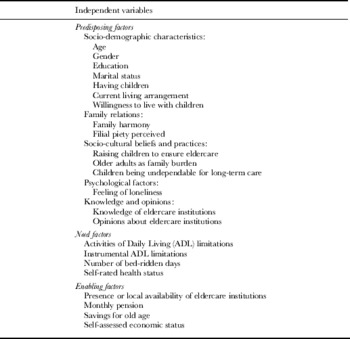
Based on previous empirical studies and Chinese socio-cultural values and attitudes regarding eldercare, an integrated model of the factors associated with Chinese older adults' willingness to live in eldercare institutions was constructed (Table 2). The independent variables include predisposing, need and enabling factors. The predisposing factors are socio-demographic attributes (age, gender, education, marital status, having adult children, current living arrangement and willingness to live with adult children), family relationships (perceived family harmony and perceived filial piety), socio-cultural beliefs and practices about filial piety and old age (investing in children to ensure care in old age; older adults being a burden; children being unreliable for long-term care), a psychological factor (feeling of loneliness) and knowledge and opinions about eldercare institutions. The need factors include functional levels (ADL and Instrumental ADL (IADL) limitations) and health (number of bed-ridden days and self-rated health status). The enabling factors include the presence of institutional long-term care facilities and financial means (monthly pension, amount of savings for old age, self-perceived economic security, and self-assessed economic situation).
Independent variables in the integrated model for willingness to live in eldercare institutions

Note: The dependent variable is ‘Willingness to live in eldercare institutions’.
The underlying hypotheses are that people with the following list of characteristics will be more willing to live in eldercare institutions: of older ages, female, more educated, living alone, believing that ‘children cannot be depended upon to provide long-term care’, believing that ‘older adults are a family burden’, feeling lonely, having knowledge of eldercare institutions, having good opinions about eldercare institutions, having more limitations in carrying out the ADLs, having more limitations with the IADLs, having more bed-ridden days, having worse self-rated health status, having an eldercare institution in the community, receiving a higher monthly pension, having more savings for old age, and having better self-assessed economic status. It was also hypothesised that individuals with the following characteristics will be less likely to be willing to live in eldercare institutions: married, having children, being willing to live with adult children, perceiving one's family as harmonious, perceiving children as filial, and believing in ‘investing in children to ensure eldercare’.
As mentioned, few studies have examined urban–rural differences in older adults' attitudes towards institutional care in China. There are, however, great disparities between urban and rural China in mortality rates, age structures, economic development, old-age security systems, pension systems, older people's living arrangements, and support for older parents (Lee and Xiao Reference Lee and Xiao1998; Shi Reference Shi2006; Wang, D. W. Reference Wang2006; Yi and Wang Reference Yi and Wang2003; Zhao and Tong Reference Zhao and Tong2000). Because such disparities may influence attitudes towards institutional eldercare they merit close attention. To understand how residence interacts with predictors of willingness, the same model was applied to the urban and rural sub-samples.
Methods
Data and sample
This study analyses data from the Sample Survey of the Aged Population in Urban/Rural China (SSAPUR), a nationwide study of people aged 60 or more years living in the community that was conducted in 2000 by the China Research Center on Ageing (CRCA 2002). Using a stratified multi-stage and probability sample design, CRCA drew subjects from 20 provincial-level administrative divisions in the North, Northeast, East, South Central, Southwest and Northwest Regions of China.Footnote 3 The data were collected through face-to-face interviews using a structured questionnaire. The total sample has 20,255 respondents, with 10,171 in urban areas and 10,084 in rural areas. The overall response rate was 98.6 per cent.
Measures
The dependent variable ‘willingness to live in an eldercare institution’ was indicated by responses to the question, ‘are you willing to live in an eldercare institution, such as an institution for respecting older adults, social welfare institution, or senior apartment?’, and the responses were coded ‘1’ (yes) and ‘0’ (no). The independent variables are measures of the predisposing, need and enabling factors. ADL and IADL are scales, and the other independent variables are continuous or categorical measures.
There were several sets of predisposing factors. Beginning with the socio-demographic attributes, age was measured in years, and gender as a dichotomy (‘0’ male, ‘1’ female). The attained level of education completed was an ordinal scale, from ‘0’ illiterate to ‘5’ college education or above. Marital status was a dichotomy, with ‘1’ married and ‘0’ not married (including separated, divorced, widowed and never married). Having children was also dichotomised into ‘0’ no children and ‘1’ having children. Current living arrangement was dichotomised into ‘1’ living with any of the following: spouse, son or daughter-in-law, daughter or son-in-law; and ‘0’ not living with any person. Willingness to live with adult children was coded from responses to the question, ‘are you willing to live with your children?’ into a three-category Likert scale (‘0’ no, ‘1’ uncertain, and ‘2’ yes).
There were two measures of family relationships. ‘Family harmony’ was coded from responses to the question, ‘is your family harmonious?’ (‘1’ yes, ‘0’ no), and ‘Perceived filial piety’ was coded from responses to the question, ‘how do you think of your children in terms of filial piety?’ into a four-category scale with anchors of ‘3’ (very filial) and ‘0’ (not filial). Three variables indicated socio-cultural beliefs and practices. ‘[I would] Raise children to ensure care in old age’ was measured by responses to the question, ‘in order to insure your financial future for late years, which of the following options are your first, second, third and fourth choices: (a) join the social insurance programme, (b) buy commercial insurance, (c) spend all I have on children and depend on them for care in old age and (d) save’. Selecting ‘spend all I have on children and depend on them for care in old age’ as the first, second, third and fourth choices were scored ‘4’, ‘3’, ‘2’ and ‘1’, respectively. Responses to the statement ‘there are no filial children when parents are bed-ridden for a prolonged time’ were coded ‘1’ agree and ‘0’ do not agree. Responses to the statement ‘older adults are a burden to the family’ were coded ‘2’ agree, ‘1’ hard to say, and ‘0’ do not agree. ‘Feeling of loneliness’ was coded from responses to the statement ‘I often feel lonely’ into ‘2’ agree, ‘1’ hard to say, and ‘0’ do not agree. Having knowledge of eldercare institutions was measured by responses to the question ‘Do you know about eldercare institutions?’ (‘1’ yes, ‘0’ no). Responses to the question ‘what is your general opinion about eldercare institutions?’ were coded into ‘2’ good, ‘1’ so so, and ‘0’ not good.
Turning to the need factors, the score for limitations in performing the ADL was based on six items: eating, dressing, toileting, bathing, getting in and out of bed, and walking indoors. The IADL was measured by items on cooking, washing clothes, lifting 10 kilograms, walking 1.5–2 kilometres, sweeping the floor, grocery shopping, and going up and down stairs (the last two only for urban respondents). Each ADL and IADL item was rated on a three-point Likert scale (‘2’ unable to perform the task, ‘1’ find the task somewhat hard, and ‘0’ the task is not hard). Cronbach's alphas were 0.90 and 0.91 for the ADL scores in the rural and urban sub-samples, respectively; and 0.87 and 0.89 for the IADL scores. Higher scores in ADL or IADL indicated more limitations and hence higher support and care needs. The number of bedridden days (including in hospital) during the previous year was recorded, and self-rated health was given by responses to the question, ‘how do you assess your current health conditions?’ and coded into a five-category scale with anchors of ‘0’ (very bad) and ‘4’ (very good).
Five variables indicated enabling factors. Responses to the question, ‘is there an eldercare institution, such as a respectable elder home, social welfare institution, or senior apartment in your township or community?’ were dichotomised into ‘1’ yes and ‘0’ no. Monthly pension was measured by responses to the question, ‘how much is your monthly pension?’, and coded ‘0’ none, ‘1’ 1–349 yuan, ‘2’ 350–749 yuan, and ‘3’ 750 or more yuan. Savings for old age was measured by response to the question, ‘how much is your savings for old age?’ and coded ‘0’ none, ‘1’ 1–999 yuan, ‘2’ 1,000–4,999 yuan, and ‘3’ 5,000 or more yuan. Self-assessed economic status was coded from responses to the question, ‘how do you rate your economic (financial) situation?’ into ‘3’ have more than enough money, ‘2’ have about enough, ‘1’ it is somewhat difficult, and ‘0’ it is very difficult. A dichotomy for ethnicity was used as a control variable: ‘0’ Han, and ‘1’ not Han.
Results
Characteristics of the sample
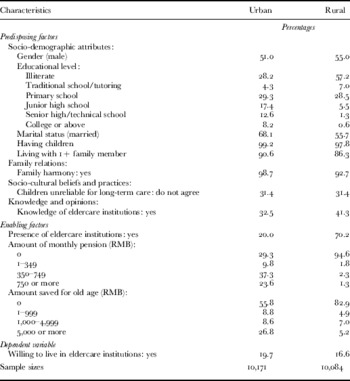
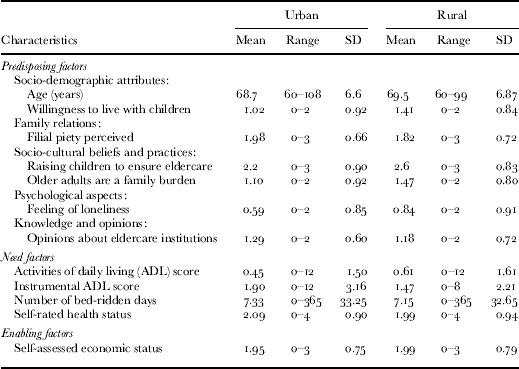
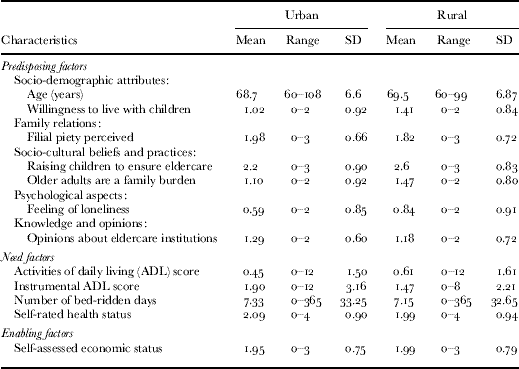
Tables 3 and 4 display the sample's characteristics. The ages ranged from 60 to 108 years, with a mean of 69 years for urban older adults and 70 for rural older adults. A majority of the respondents were men (urban 51%, rural 55%). Urban older adults had a higher level of education than rural older adults, and 28 and 57 per cent, respectively, of urban and rural older adults were illiterate. The majority of the sample was married (urban 68%, rural 56%), had children (urban 99%, rural 98%), lived with at least one family member (urban 91%; rural 86%), and perceived their family as harmonious (urban 99%, rural 98%). Rural older adults, on average, scored higher on willingness to live with their children than urban older adults (1.41 versus 1.02), perceived less filial piety from their children (1.82 versus 1.98), and more felt lonely (0.84 versus 0.59). Turning to socio-cultural beliefs and practices, rural older adults scored higher than urban older adults on investing in children to ensure eldercare (2.6 versus 2.2) and on the idea of older adults being a family burden (1.5 versus 1.1). An equal and high percentage (68.6%) of both urban and rural older adults believed that children were unreliable sources of long-term care. The majority of the sample had no knowledge of eldercare institutions (urban 68%, rural 58%), and urban older adults had a better opinion of eldercare institutions (1.3 versus 1.2).
Characteristics of the sample, China, 2000

Source of data: Sample survey of the aged population in urban/rural China (for details see text).
Characteristics of the sample, China, 2000
Note: SD: standard deviation.
Source of data: Sample survey of the aged population in urban/rural China (for details see text).
As for the need factors, the ADL scores were 0.45 (urban) and 0.61 (rural), and the IADL scores 1.9 (urban) and 1.47 (rural). Number of bed-ridden days for the past year ranged from none to 365, with an average of 7.3 and 7.2 days for urban and rural older adults, respectively. Regarding self-rated health status, the sample averaged 2.09 (urban) and 1.99 (rural). Finally, among the enabling factors, 80 per cent of urban older adults and 30 per cent of rural older adults reported that there were no eldercare institutions in their neighbourhood or community. The respondents' monthly pensions ranged from none to 750 or more yuan. The vast majority (95%) of rural older adults and 30 per cent of urban older adults reported having no monthly pension. Savings for old age ranged from none to 5,000 yuan, with the majority (83%) of rural older adults and more than half (56%) of urban older adults having no savings. Interestingly, self-assessed economic status was higher among rural older adults than their urban counterparts (1.99 versus 1.95), although rural older adults had lower pensions and savings.
Factors influencing willingness to live in eldercare institutions
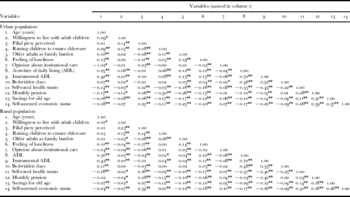
Only a minority of the participants (urban 20%, rural 17%) were willing to live in eldercare institutions. The first step of the analysis of the influences on willingness was to inspect the correlation matrices of all the continuous and ordinal variables for the urban and rural sub-samples (Table 5). The highest individual correlation coefficients were between the ADL score and bed-ridden days, with values of 0.46 for the urban respondents and 0.48 for the rural respondents, which indicates no multi-colinearity among the predictors. The strongest correlation coefficients between willingness to live in eldercare institutions and the independent variables were with perceived filial piety (+0.14 in the urban sub-sample, and +0.23 in the rural sub-sample), and 19 of the 26 coefficients were very low (<|0.1|), although because of the large sample sizes most were statistically significant.
Pearson correlation matrices

Notes: Sample sizes: urban 10,171; rural 10,084.
Significance levels: * p<0.05, ** p<0.01.
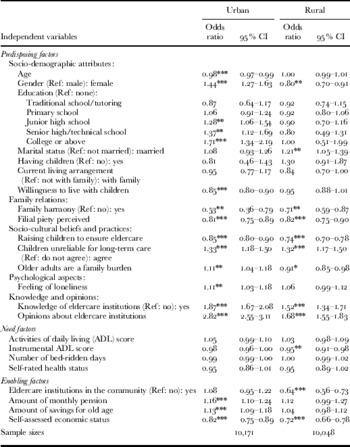
To examine the multivariate relationships, binary logistic regression analysis was used. Separate models were calibrated for the rural and urban sub-samples, and Table 6 presents the results. Taking first the urban sub-sample, as hypothesised it was found that respondents with the following characteristics were more likely to be willing to live in eldercare institutions: female, having higher education, believing ‘children are undependable for long-term care’, believing ‘older adults are a burden on the family’, feeling lonely, having knowledge of and a better opinion of eldercare institutions, having a higher monthly pension, and having more savings for old age. Also as hypothesised, individuals who were willing to live with adult children, who perceived their family to be harmonious, who perceived their children as filial and who believed in ‘raising children to ensure eldercare’ were less likely to be willing to live in eldercare institutions. Contrary to the hypotheses, however, older individuals and those with better self-assessed economic status were less likely to be willing to reside in institutions. Several variables had no significant effect on willingness: marital status, having children, current living arrangement, ADL score, IADL score, number of bed-ridden days, self-rated health status, and presence of an eldercare institution in the community or neighbourhood.
Binary logistic regression of willingness to live in eldercare institutions

Notes: Ref: reference category. CI: confidence interval. The Hosmer and Lemeshow goodness-of-fit test statistic was p=0.09 and 0.70 for the urban and rural models, respectively (see Note 6). The non-significant p-values indicate both models had adequate fit.
Significance levels: * p<0.05, ** p<0.01, *** p<0.001.
Turning to the results for the rural older adults, as hypothesised it was found that those who believed that their children could not be depended upon to provide long-term care and who had knowledge of and a better opinion of eldercare institutions were more likely to be willing to live in eldercare institutions. Also, individuals who perceived their family as harmonious and their children as filial, and who believed in raising children to ensure eldercare, were less willing to reside in eldercare institutions. Contrary to the hypothesis, however, married individuals were more likely to be willing to reside in eldercare institutions. Also, contrary to the hypotheses, individuals with the following characteristics had lower willingness: female, regarded older adults as a family burden, had higher IADL scores, had an eldercare institution in the community, and had better self-assessed economic status. The variables that had no significant effect on willingness were: age, educational level, having children, current living arrangement, willingness to live with children, feeling of loneliness, ADL score, number of bed-ridden days, self-rated health status, amount of monthly pension, and amount of savings for old age.
Discussion
Among the SSAPUR national random sample, 20 per cent of urban older adults and 17 per cent of rural older adults were willing to live in eldercare institutions, which compares with findings from previous studies of from 0 to 45 per cent. The SSAPUR urban estimate is lower than that reported by Zhen et al. (Reference Zhen, Li, Liu, Yang, Wu and Wang2003), but higher than those reported by Jiang and Si (Reference Jiang and Si2006) and Pong, Liang and Chen (Reference Pong, Liang and Chen2006) – all three previous estimates were from local samples. The SSAPUR rural estimate is higher than that from Gao's (Reference Gao2000) small sample study. Given that SSAPUR and the cited studies were all conducted between 1997 and 2004, the differences in willingness probably reflect variations in sample sizes, methods (random versus convenience) and scope (national versus local).
Contrary to the hypotheses, urban respondents of more advanced age were less willing to live in eldercare institutions than younger respondents, whereas age had no effect on willingness in rural areas.Footnote 4 The negative association in urban areas may derive from the positive association between age and ADL and IADL-related needs (Table 5). Since some eldercare institutions have been reluctant to admit individuals with more severe physical functional limitations, those in advanced old age who are more likely to have high care needs may be less willing to contemplate residence in eldercare institutions. The lack of a significant relationship between willingness and age among rural older adults replicates the findings of Song (Reference Song2006) and Guan, Zhan and Liu (Reference Guan, Zhan and Liu2007). It turned out that other factors were more critical in determining willingness in rural areas. In line with another multi-province study (Song Reference Song2006), and as hypothesised, in urban areas women were more likely to be willing to live in eldercare institutions than men, but this gender difference was not found in the rural sub-sample. Descriptive statistical analyses (not shown) indicate that in comparison with urban men and women and rural men, rural women had the least education, the strongest belief in ‘raising children to provide elder care’, the lowest average monthly pension, and the least savings. These factors might have played a role in their exceptional reluctance to live in eldercare institutions.
A distinctive feature of this study is the inclusion of measures of family relationships and socio-cultural values and practices in the models. As hypothesised, those who perceived higher family harmony and higher filial piety tended to be less willing to live in eldercare institutions. This demonstrates the potential influence of family discord and perceived lack of filial piety in motivating older adults to move into institutions. Also as hypothesised, parents who more strongly believed in ‘raising children to ensure eldercare’ tended to be less willing to live in eldercare institutions. For thousands of years, Chinese parents, especially those with meagre means, followed the tenet of ‘raising children to ensure eldercare’, and clearly the practice and aspiration still applies. Reports indicate that many Chinese parents have been investing their resources heavily in raising their children, sending them to schools, providing money for weddings and houses, and helping with the care of grandchildren and household chores (e.g. Lee and Xiao Reference Lee and Xiao1998). Understandably, many of them expect care from their children as a form of old age insurance and are correspondingly unwilling to move into institutions.
Less clear is how much children can be depended upon to provide long-term care. The SSAPUR data suggest that an astounding 69 per cent of parents in both urban and rural settings thought that children could not be relied upon (see Table 3). The logistic regression analysis confirmed that parents with a stronger sense of their children's unreliability displayed a greater inclination to be willing to live in eldercare institutions. A related influence is an older person's perception of being a burden on the family. This study showed that the strength of this perception was not only significantly related to functional limitations and care needs (namely the ADL and IADL scores and bed-ridden days) and self-rated health status (Table 5), but also predicted willingness to live in eldercare institutions. Interestingly, the direction of the prediction was different for urban and rural older adults. While urban older adults with a stronger sense of being a family burden were more likely to be willing to live in eldercare institutions, their rural counterparts averred the opposite. The inversion may arise from financial disparities, the differential availability of eldercare institutions, or different opinions about the quality of eldercare institutions. Among the urban older adults in this study, 70 per cent had a monthly pension, 55 per cent had savings for old age, and 27 per cent had savings of 5,000 or more yuan. Urban older adults also had a more favourable view of eldercare institutions. Among urban older adults who needed more care and felt they were a burden on their families, many probably would have had enough money to move into an eldercare institution that fitted their needs. In contrast, only 5.4 per cent of rural older adults had a monthly pension, seven per cent had savings and five per cent had savings of 5,000 or more yuan. In addition to their relative poverty, rural older adults also had a less favourable view of eldercare institutions. Consequently, although they might have felt being a burden to their family when they were in need of more care, they probably would not have been willing to live in an eldercare institution.
Overall, the predisposing and enabling factors performed better than the need factors in predicting willingness to live in an eldercare institution. With the exception of the IADL score for rural older adults, none of the need factors was related to willingness. A preliminary logistic regression analysis of only the need factors (not shown) revealed a different picture, however, for the IADL score and self-rated health significantly predicted the likelihood of willingness in both urban and rural areas.Footnote 5 In other words, IADL and self-rated health by themselves were significant predictors, but when tested in the full model, their significance was for the most part overshadowed by other factors, although in rural areas the IADL score remained significant. One interesting finding about the effect of IADL was its direction. Contrary to the hypothesis, individuals with higher IADL needs were actually less likely to be willing to live in institutions than those with lower IADL needs. This finding is consistent with Jiang and Si's (Reference Jiang and Si2006) finding that individuals with lower physical functioning were less likely to choose to live in eldercare institutions – they surmised that many eldercare institutions do not accept older adults with very poor physical functioning.
Among the enabling factors, monthly pension and savings were significant predictors of willingness in the urban sub-sample, but had no effect in the rural sub-sample. This may be because only five per cent of rural older adults actually had a monthly pension, and only five per cent had substantial savings. Unlike the amounts of a monthly pension and of savings, better self-assessed economic status predicted less willingness for both urban and rural sub-samples, although the three variables showed moderate positive correlations (Table 5). Such contradictory findings from the objective economic measures (monthly pension and savings for old age) and the subjective economic measure (self-assessed economic status) merit further investigation. Another perplexing finding is that the presence of eldercare institutions in the community or neighbourhood had a negative effect on willingness for the rural sub-sample. It is possible that opinions about eldercare institutions played a role. Since rural older adults tended to have worse opinions about eldercare institutions than their urban counterparts, the presence of eldercare institutions nearby might have heightened their unwillingness to live there. More study is needed on this matter.
This study has a number of limitations. First, the constraints in the content of the questionnaire and the low Cronbach's alpha reliability estimates for the initial attempts to construct multi-item measures prevented the use of multi-item scales for the majority of variables. Consequently, most variables were measured by single items but grouped into thematic clusters.Footnote 6 Second, although the question for the dependent variable on willingness included different types of eldercare institutions, the respondents were required to give one general response and could not differentiate their willingness to enter different types. Responses to the question therefore represented willingness to live in eldercare institutions rather than non-institutional care settings, such as family care, home health-care and community care. Similarly, because of data restrictions it was not possible to differentiate the types of eldercare homes that elicited negative opinions. Further study is needed to differentiate opinions about the willingness to live in different types of institutional care settings, such as social welfare institutions, institutions for respecting older adults, institutions for caring for older adults, senior apartments, and nursing homes.
Finally, some studies have reported that living in eldercare institutions is often stigmatised and perceived as ‘losing face’ for older adults and families (Chen Reference Chen1996; Feng Reference Feng2006; Shang Reference Shang2001), probably a legacy of the origins of contemporary eldercare institutions as social welfare facilities for impoverished older adults and tied up with the implication that one's children are not filial. Other studies have indicated that societal attitudes toward eldercare institutions are changing, and that institutions are becoming less stigmatised and more acceptable, especially in urban areas (e.g. Zhan, Feng and Luo Reference Zhan, Feng and Luo2008). Because of data constraints, however, this study was not able to examine stigma as a predictor of willingness.
Conclusions
Although several previous studies have examined the willingness of older adults in China to live in eldercare institutions, this study is the first to have used a large national random sample, to have been guided by an integrated model, and to use an urban–rural comparative approach. Given the huge older population in China and the country's changing social, economic and family conditions, providing long-term care for older adults poses a daunting challenge. Results from this study have substantive, theoretical and policy implications for long-term care in China. This study has generated valuable findings. It was found that only 20 and 17 per cent of older adults in urban and rural China, respectively, are willing to live in eldercare institutions. Gender, perceived family harmony, perceived filial piety, socio-cultural beliefs and practices about raising children and eldercare, knowledge and opinion about eldercare institutions, and self-assessed economic status associated with willingness to live in eldercare institutions for both urban and rural older adults. Age, education, willingness to live with children, feeling of loneliness, monthly pension and savings associated with willingness for urban older adults, but not for rural older adults. Marital status, IADL score and presence of eldercare institutions associated with willingness for rural older adults but not for urban older adults. By examining the urban and rural sub-samples, this study has provided new insights on urban–rural differences, not only in the extent of willingness but also in the interaction between living arrangement and the factors associated with willingness. There is evidence that, as the society changes, more and more older Chinese are willing to live in eldercare institutions (e.g. Guan, Zhan and Liu Reference Guan, Zhan and Liu2007; Zhan, Feng and Luo Reference Zhan, Feng and Luo2008). This study has provided evidence that this is the case to an extent among urban older adults, but not for rural older adults, who continue to hold strong traditional views about eldercare. Compared with urban older people, those in rural areas had less favourable opinions of eldercare institutions and were more reluctant to live in them. This study may serve as a baseline for future studies.
This study has formulated and tested a comprehensive and socio-culturally relevant model of the willingness to live in eldercare institutions in China. In expanding the Andersen model, Bradley et al. (Reference Bradley, McGraw, Curry, Buckser, King, Kasl and Andersen2002) highlighted the importance of psycho-social factors, such as attitudes, knowledge and social norms, in understanding attitudes to long-term care among different racial and ethnic groups. Guided by existing models and the results of previous empirical studies, this study has taken a further step by incorporating into the model family relations (family harmony and perceived filial piety), and Chinese cultural and social beliefs, practices and concerns. This study has shown that to understand the attitudes of older Chinese about living in eldercare institutions, it is essential to include family and cultural-social factors. The family and cultural-social characteristics (or predisposing factors) actually overshadowed physical health (the need factors) in predicting the outcome.
In terms of policy implications, this study has shown that the majority of older Chinese people, particularly those in rural areas, are averse to living in eldercare institutions, and that multiple demographic, social, cultural, health and economic factors influence their attitude. While China develops a long-term care policy for its ageing population and allocates resources accordingly, it will be useful to take these findings into consideration. If institutional care continues to be prioritised, it will be desirable to enhance the level and quality of care. For both economic and socio-cultural reasons, researchers have pointed to the need to offer more support for family care and to expand and strengthen non-institutional forms of long-term care, such as home health and community-based care (Chen Reference Chen2000; He Reference He2005; Xu and Ho Reference Xu and Ho2005). This study has provided additional evidence of the need to build a long-term care system that is consistent with China's economic and socio-cultural conditions and that meets older adults' needs and preferences.