Introduction
Typical soils in the Altiplano plateau, located between the Western and Eastern Cordillera of the Andes Mountains, and the highlands in the central Andes are thin, fragile and have low organic matter content (Fonte et al., Reference Fonte, Vanek, Oyarzun, Parsa, Quintero, Rao, Lavelle and Sparks2012). They are subject to harsh climatic conditions such as high variations in diurnal temperature, frequent frost, low and irregular precipitation and a high risk of drought during the crop growing season (Garcia et al., Reference Garcia, Raes, Jacobsen and Michel2007). These conditions, combined with high evapotranspiration rates because of strong winds, create an arid region where agriculture is mostly restricted to well-adapted crops like potato (Solanum tuberosum L.), quinoa (Chenopodium quinoa Willd.) and others originating in the Andean and the sub-Andean regions (Fonte et al., Reference Fonte, Vanek, Oyarzun, Parsa, Quintero, Rao, Lavelle and Sparks2012). This scenario has driven agricultural production mainly towards smallholder farming and subsistence practices since ancient times (Mulligan et al., Reference Mulligan, Rubiano, Hyman, White, Garcia, Saravia, Leon, Selvaraj, Gutierrez and Saenz-Cruz2010). However, the recent expansion of quinoa cropping induced by the enormous opportunities of international markets has opened the possibility of using mechanization and modern technology that includes chemical fertilizers (Fonte et al., Reference Fonte, Vanek, Oyarzun, Parsa, Quintero, Rao, Lavelle and Sparks2012).
The substantial increase in land area cultivated for quinoa production in the Andean highland as well as the intensification of quinoa production practices have caused reduction in yield, mostly due to depletion of soil nutrients. This decreasing trend has resulted in average yields of 0.64 t ha−1 in 2000 dropping to 0.52 t ha−1 in 2012 (Gandarillas et al., Reference Gandarillas, Rojas, Bonifacio, Ojeda, Bazile, Bertero and Nieto2015). This situation threatens the sustainability and competitiveness of quinoa production in this delicate ecosystem (Blajos et al., Reference Blajos, Ojeda, Gandarillas and Gandarillas2014). In order to maintain acceptable yields, local farmers tend to use increasing amounts of chemical fertilizers because quinoa responds strongly to nitrogen-based fertilization (Berti et al., Reference Berti, Wilckens, Hevia, Serri, Vidal and Mendez2000; Schulte-auf'm Erley et al., Reference Schulte-auf'm Erley, Kaul, Kruse and Aufhammer2005). Despite financial constraints that local farmers face when purchasing chemical fertilizers, they need to supply on average 35 kg of N per 1000 kg of grain (García et al., Reference García, Miranda and Fajardo2014). However, poor agricultural practices together with the utilization of chemical fertilizers have exacerbated soil organic matter (SOM) loss and erosion (Fonte et al., Reference Fonte, Vanek, Oyarzun, Parsa, Quintero, Rao, Lavelle and Sparks2012; Gandarillas et al., Reference Gandarillas, Rojas, Bonifacio, Ojeda, Bazile, Bertero and Nieto2015). The production of other crops like potato, broad beans and others in these nutrient-depleted soils has also decreased (Aguilera et al., Reference Aguilera, Motavalli, Gonzales and Valdivia2012). To restore soil fertility, local farmers have traditionally used organic material (mostly manure, but also compost and plant residues) or left land fallow (Fonte et al., Reference Fonte, Vanek, Oyarzun, Parsa, Quintero, Rao, Lavelle and Sparks2012). However, the intensification of cropping systems (shorter fallow periods, use of tillage) and the low availability of manure and therefore high price, make the use of organic amendments difficult (García et al., Reference García, Miranda and Fajardo2014). On the other hand, quinoa is mostly exported to North American and European markets as an organic produce, which demands that the quinoa grains be free of chemical fertilizers (Furche et al., Reference Furche, Salcedo, Krivonosb, Rabczukc, Jara, Fernández, Correa, Bazile, Bertero and Nieto2015). Therefore, the decreasing availability of animal manures and increasing reliance on chemical fertilizers has led to greater risk of soil degradation and overall reductions in ‘organically-grown’ quinoa for export markets. This situation merits exploring technologies and alternative fertilizer options as presented in this paper, with a strong focus on exploiting beneficial microorganisms.
Trichoderma (Hypocreales, Ascomycota) is a ubiquitous resident of soils and is particularly present in the plant rhizosphere (Mendes et al., Reference Mendes, Garbeva and Raaijmakers2013). It is a free living fungal genus that is highly active in soil, root and foliar environments; therefore it plays an essential role in rhizosphere and phyllosphere ecosystems, providing numerous benefits to the plant host (Berg and Smalla, Reference Berg and Smalla2009). It can also form endophytic associations with plants and can interact with other microorganisms surrounding root tissues, thereby influencing pathogen populations resulting in plant disease protection (Hermosa et al., Reference Hermosa, Viterbo, Chet and Monte2012). Due to their beneficial attributes, various species from the genus Trichoderma have been used for waste and residue decomposition (Bari et al., Reference Bari, Begum, Sarker, Rahman, Kabir and Alam2007), production of industrial enzymes (Ahamed and Vermette, Reference Ahamed and Vermette2008; Seiboth et al., Reference Seiboth, Ivanova, Seidl-seiboth and Dos Santos2011), plant disease control (Howell, Reference Howell2003; Harman, Reference Harman2006; Hermosa et al., Reference Hermosa, Rubio, Cardoza, Nicolás, Monte and Gutiérrez2013), suppression of soil-borne pathogens (Pugliese et al., Reference Pugliese, Liu, Gullino and Garibaldi2008) and as biofertilizer (Contreras-Cornejo et al., Reference Contreras-Cornejo, Macías-Rodríguez, Cortés-Penagos and López-Bucio2009; Harman, Reference Harman2006). The last mentioned attribute, promotion of plant growth, is the topic of this study.
Trichoderma-plant interaction is a dynamic process, mediated by chemical cross-talk involving the secretion of chemical compounds by the fungi, which are recognized by the plant partner (Hermosa et al., Reference Hermosa, Viterbo, Chet and Monte2012). Similarly, interaction with other rhizosphere/endosphere microorganisms includes molecular signaling and the release of inhibitory metabolites, enzymes and other compounds by Trichoderma (Mukherjee et al., Reference Mukherjee, Horwitz and Kenerley2012). Trichoderma is able to secrete about 40 different secondary metabolites (SMs) and many enzymes that participate in symbiotic processes and plant tissue colonization, and can also restrict the growth of other microorganisms (Sivasithamparam and Ghisalberti, Reference Sivasithamparam, Ghisalberti, Kubicek and Harman1998). The SMs are volatile and non-volatile molecules that include phytohormones like the indole-3-acetic acid (IAA) and related molecules, which regulate root development and general plant growth (Contreras-Cornejo et al., Reference Contreras-Cornejo, Macías-Rodríguez, Cortés-Penagos and López-Bucio2009; Martínez-Medina et al., Reference Martínez-Medina, Alguacil, Pascual and Van Wees2014). The IAA and other plant growth regulators produced by different strains of Trichoderma have shown beneficial properties that stimulate growth of model plants (Arabidopsis, Salas-Marina et al., Reference Salas-Marina, Silva-Flores, Uresti-Rivera, Castro-Longoria, Herrera-Estrella and Casas-Flores2011) as well as of crops (melon, cherry rootstocks, cucumber, etc., Sofo et al., Reference Sofo, Scopa, Manfra, De Nisco, Tenore, Troisi, Di Fiori and Novellino2011; Zhang et al., Reference Zhang, Yuan, Yang, Cui, Chen, Ran and Shen2013; Martínez-Medina et al., Reference Martínez-Medina, Alguacil, Pascual and Van Wees2014).
The discovery of Trichoderma SMs that promote plant growth opens an enormous potential for their application on agriculture (López-Bucio et al., Reference López-Bucio, Pelagio-Flores and Herrera-Estrella2015). The purpose of the present work was to isolate and identify Trichoderma species from the rhizosphere and endosphere of native crop plants from the high Andean Mountains and Altiplano and evaluate the potential application of Trichoderma-derived SMs to stimulate plant growth. We hypothesized that Trichoderma SMs produced as crude material would increase plant growth and therefore crop production. This work is significant because crop production (mostly quinoa) in these areas could decline due to the problems described above. Consequently, environmental-friendly alternatives are required to substitute for chemical-based fertilizers and to continue growing high quality organic quinoa.
Materials and Methods
Fungal isolation and culture conditions
Nine locations scattered along the Altiplano and Andean Mountains were selected for sampling. Altitude and geographic positions of the locations selected for sampling are described in Supplementary Table S1. Five plots (1 plot = 1 hectare) were randomly selected in each of the nine locations and roots of 10 plants including the soil surrounding them (~5 g) were sampled per plot, making a total of 450 individual samples. The 10 samples obtained from the same plot were mixed in order to prepare composite samples that were transported to the laboratory under cold conditions (~4°C), and processed for fungi.
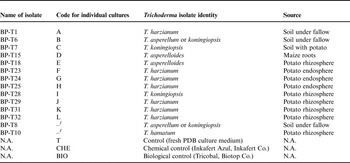
The field plots had been traditionally planted with three varieties (Malcacho, Polonia and Waych'a) of potato (Solanum tuberosum L. ssp. andigena) or with a highland race of native maize (Zea mays L.). These potato varieties belong to the subspecies andigena comprising important native cultivars with broader, diverse genetic background than subspecies tuberosum and are well adapted to high altitude ecosystems. Some plots had been fallow for 1–2 years, hence no roots were sampled. For further description of Trichoderma isolates and their sampling, please see Table 1. Soil properties are typical of Altiplano and Andean Mountains: Sandy loam, slightly acidic, low SOM content (<1%), with relatively high salinity at the southern Altiplano and clay loam, moderately to strongly acidic on hillside of the mountains.
Taxonomic identity of the Trichoderma isolates and source of sampling.

1 Trichoderma species not considered for SMs production because of their poor performance in dual cultures on semi-solid media.
N.A., not applicable.
Soil samples were diluted by 10−4 times using sterile water. Cultures with 1 ml of each dilution were prepared on Petri dishes (90 mm diameter) containing PDA (Potato dextrose agar) medium. Three independent cultures were established per composite sample to assure Trichoderma isolation. After the incubation period (9 days at 25°C), fungal growth was evaluated. For fungal isolation from internal plant root tissues, approximately 30 g of roots were thoroughly washed with tap water and then sterilized by a two-step procedure. First, roots were placed in 70% ethanol for 1 min and then transfer to a solution of sodium hypochlorite (1.2% v/v) for 15 min under agitation at 100 rpm. Subsequently, roots were rinsed three times using sterile water. Finally, excised roots were deposited on PDA medium and incubated at 25°C to stimulate fungal growth.
Detection of indole acetic acid (IAA)
IAA production by Trichoderma isolates was detected by a colorimetric method (Gordon and Weber, Reference Gordon and Weber1951). The amount of IAA production was not quantified specifically, only presence-absence of IAA. All Trichoderma isolates were cultured in potato dextrose broth (PDB) medium enriched with 50 mm of L-Tryptophan (amino acid used as a precursor in the synthesis of IAA). After 7 days of incubation at 25°C and 100 rpm, the cultures were centrifuged at 5000 rpm for 10 min to facilitate the reading of the IAA in the growth medium. The culture medium (100 µl) was deposited in a multiwell plate in triplicate and then 10 µl of Salkowski solution (Gordon and Weber, Reference Gordon and Weber1951) was added to each well. The multiwell plate was stored in dark conditions for 15 min. Any color change detected by the plate reader after this incubation period was considered a positive result for IAA production. Two well-known bacterial producers of IAA from our collection that belong to the Bacillus genus (B. subtilis and B. amiloliquefasciens) were used as positive controls.
Identification of Trichoderma isolates
Trichoderma isolates were identified using a standard method based on molecular and bioinformatics analyses of DNA sequences obtained from selected genetic markers (Druzhinina et al., Reference Druzhinina, Kopchinskiy, Komoń, Bissett, Szakacs and Kubicek2005). Genomic DNA was extracted from Trichoderma isolates following the protocol according to Melo et al. (Reference Melo, Pungartnik, Cascardo and Brendel2006). A well-known technique called polymerase chain reaction (PCR) was performed following a standard protocol (Kullnig-Gradinger et al., Reference Kullnig-Gradinger, Szakacs and Kubicek2002). Briefly, amplification reactions were prepared in 25 µl reaction mixtures containing 1.0 µl genomic DNA, 200 µm each deoxyribonucleotide, 400 nm each primer, 0.4 U Phusion DNA polymerase (NEB, Ipswich, MA, U.S.A.), 1× HF buffer and 1× Q reagent (Qiagen, Valencia, CA, U.S.A), and the primer sets for amplifying ribosomal genes (RNAr 18S and RNAr 5.8S), internal transcribed spacers (ITS1 and ITS2), the ITS1/ITS2 intergenic region (Kullnig-Gradinger et al., Reference Kullnig-Gradinger, Szakacs and Kubicek2002) and the fourth and fifth introns and a significant portion of the last large exon of tef1 gene (that encodes a translation elongation factor 1-alpha) (Nagy et al., Reference Nagy, Seidl, Szakacs, Komon-Zelazowska, Kubicek and Druzhinina2007) were LR1 and SR6R, and EF1-728F and TEF1LLErev respectively. The PCR conditions were according Kullnig-Gradinger and others (Reference Kullnig-Gradinger, Szakacs and Kubicek2002) and Nagy et al. (Reference Nagy, Seidl, Szakacs, Komon-Zelazowska, Kubicek and Druzhinina2007), followed by the final incubation period at 72°C for 5 min.
The PCR products were verified by electrophoresis on 1.2% w/v agarose gels and staining with ethidium bromide. A molecular mass marker was included to estimate the length of the amplicons. PCR products were purified using Qiaquick (Qiagen) columns following manufacturer's instructions. DNA sequencing was performed at the DNA Sequencing & Genotyping facility, The University of Chicago, following conventional Sanger technology and using the same primers as for the amplifications. Nucleotide sequences were determined at least once on each DNA strand and they were trimmed and edited using BioEdit v.7.1.3.0 (Hall, Reference Hall1999). The DNA sequences were analyzed and compared with databases using TrichoBLAST and TrichOKEY bioinformatics tools (Druzhinina et al., Reference Druzhinina, Kopchinskiy, Komoń, Bissett, Szakacs and Kubicek2005).
Trichoderma–Trichoderma interactions through dual cultures
We used dual cultures (i.e., pairings or pairwise combinations) to evaluate the ability of Trichoderma isolates to produce and secrete SMs. For this, we have established in total 105 cultures on semi-solid culture medium using 14 isolates of Trichoderma. Dual cultures were prepared according to Reaves and Crawford (Reference Reaves and Crawford1994) protocol. Briefly, the 14 Trichoderma isolates were cultured on PDA medium. After 7 days of incubation at 25°C, discs of 5 mm diameter of culture medium where the fungi grew were taken to inoculate Petri dishes (90 mm diameter) containing fresh PDA medium. The discs of two different Trichoderma isolates were deposited at the opposite sides of the dish, making a total of 91 dual cultures (i.e., pairings or pairwise combinations). Controls of individual cultures were also performed (14 cultures). Three replicates of each dual and individual cultures were made. The cultures were incubated at 25°C for 9 days under dark conditions. After incubation, the following data was recorded: the horizontal distance (in cm) of fungi growth from both inoculated discs (i.e., colony radius), inhibition zone (no fungal growth area between both isolates), visible accumulation of compounds between colonies (this area, normally pigmented, was called ‘barrier of defense’ and the width was measured in cm) and an aggressive growth of one isolate with respect to the other, limiting the advance of the one isolate by the other isolate.
Laboratory production of metabolites
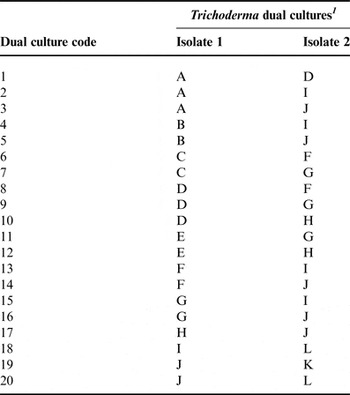
The dual cultures that showed wider barriers (0.5–0.7 cm) on PDA medium were replicated in PDB medium. For this, we selected only 20 dual cultures, which consist in the pairwise combination of 12 out of the 14 Trichoderma isolates (see Table 2 for details about pairwise combinations of Trichoderma isolates). Individual cultivation of the 12 Trichoderma isolates was also performed (see Table 1). The dual and individual cultures were independently incubated at 25°C under agitation (100 rpm) for 9 days. After incubation, mycelia were removed using a microbial loop avoiding fragmentation of the mycelium. The remaining liquid was heated to 50°C for 15 min to destroy any remaining live mycelium and then it was subjected to three consecutive filtration steps: (1) Whatman No. 1 filter paper, (2) Whatman No. 6 filter paper (a pore diameter of 3 µm) and (3) Cellulose acetate sterile syringe filter (a pore diameter of 0.2 µm). This final filtrate is hereafter called SMs. To assure optimum filtration procedure (i.e., the absence of mycelia and conidia), a control assay was performed by spreading 30 µl of final filtrate on Petri dishes containing PDA medium under sterile conditions. The plates were incubated as previously described and fungal growth was examined. No fungal growth was observed in any plate.
Trichoderma isolates used to produce the dual cultures and the laboratory-scale production of SMs for the greenhouse studies.

1 Trichoderma isolates used in dual cultures. See Table 1 for identity of Trichoderma isolates according to the code.
Plant growth promotion of Trichoderma metabolites
The plant growth promoting activity of Trichoderma metabolites obtained from PDB dual and individual cultures was tested in planta. We tested lettuce (Lactuca sativa L.), radish (Raphanus sativus L.) and quinoa (Chenopodium quinoa Willd.). For this, seeds of lettuce var. Grand Rapids TBR, radish var. Crimson Giant and quinoa var. Real were sown in pots containing sterile substrate (sterilized at 150°C with steam for 120 min) composed of rice husks, sand and humus (1:1:1). Plants were grown in a greenhouse with natural light (16–8 h light-dark cycle) at 22–28°C and 0.012–0.016 kg m−3 relative humidity. Greenhouse assays were run in two stages: first with lettuce and radish using all SM treatments, then with quinoa using a subset of SM treatments, which resulted in the greatest lettuce and radish growth. The seedlings with true leaves (5, 14 and 21 days after sowing for C. quinoa, R. sativus and L. sativa, respectively) were inoculated (by soil drenching) with 500 µl of filtrated PDB media where dual or individual Trichoderma isolates were grown. In the case of lettuce and radish plants, the control treatments comprised independent assays using: (1) fresh PDB medium, (2) Inkafert Azul, an inorganic fertilizer suitable for vegetables (Inkafert Co., http://www.inkafert.com.pe, see Supplementary Table S2 for composition) and (3) Tricobal, a fertilizer made with live spores of Trichoderma harzianum, Trichoderma koningiopsis and Bacillus subtilis (manufactured by Biotop Co., http://www.biotopbolivia.org). Tricobal was included in the analysis as a control because Trichoderma spores, once germinated in soil, generate the proliferation of the mycelia that can potentially produce phytohormones for enhancing plant growth. Tricobal and Inkafert Azul were added to control plants following the instructions of the manufacturers (0.5 and 0.44 g per plant respectively). In total, 35 treatments were performed for lettuce and for radish (20 dual-culture treatments, 12 individual-culture treatments and 3 controls, see Tables 3 and 4) and six repetitions of six plants each were used for all treatments and controls. After 45 days of growth, lettuce and radish plants were harvested. For lettuce, the following variables were measured as a proxy of general plant growth: leaf weight (g), root weight (g), root length (cm) and root volume (ml). For radish, leaf weight (g), bulb diameter (cm), bulb weight (g), total root length (cm) and root volume (ml) were measured. Quinoa plants were only inoculated with SMs from dual and individual cultures which exhibited the highest impact on plant growth (i.e., dual cultures 3, 4, 7 in lettuce and dual culture 10 in radish; Tables 2–4) and six repetitions of six plants each were also used for treatments and control. We measured quinoa variables response in two stages. Two-month old quinoa plants were harvested and plant height (from collar to end of panicle, cm), root length (cm), root weight (g), root volume (ml), panicle length and diameter (cm) were measured. For grain yield, a group of quinoa plants inoculated with the mentioned SMs were left growing 2 additional months to finish the grain ripening and then the grains were harvested. At this additional 2 months stage, plants undergo severe defoliation, roots tend to break and general plant decline and yellowing occurs, which makes measuring all variables except grain yield difficult.
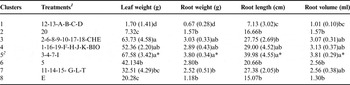
Effect of SMs on the growth of lettuce var. Grand Rapids TBR and cluster analysis to determine the treatments that promote highest plant growth. Each variable is the average of six repetitions, with six plants each.

1 Lettuce plants inoculated with SMs produced by different dual or individual cultures. Measured parameter values correspond to the mean of the treatments per cluster. Values in parentheses indicate standard deviations. Each treatment consists of six repetitions with six plants each. Numbers represent dual cultures (Table 2) and capital letters individual cultures (Table 1).
2 Cluster with treatments showing largest values on all response variables analyzed.
CHE, chemical control (Inkafert Azul); BIO, biological control (Tricobal); T, control (PDB culture medium).
* Treatments resulted in highest plant growth according analysis of variance calculated with values P < 0.01 for response variables. Means followed by the same letter in the same column are not significant at the 5% probability level by Tukey test.
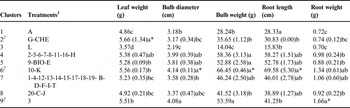
Effect of SMs on the growth of radish var. Crimson Giant and cluster analysis to determine the treatments that promotes highest plant growth. Each variable is the average of six repetitions, with six plants each.

1 Radish plants inoculated with SMs produced by different dual or individual cultures. Measured parameter values correspond to the mean of the treatments per cluster. Values in parentheses indicate standard deviations. Each treatment consists of six repetitions with six plants each. Numbers represent dual cultures (Table 2) and capital letters individual cultures (Table 1).
2 Clusters with treatments showing largest values on the following response variables: for bulb diameter, root length and root weight (cluster 6); leaf weight (cluster 2); and root weight (cluster 9).
CHE, chemical control (Inkafert Azul); BIO, biological control (Tricobal); T, control (PDB culture medium).
* Treatments resulted in highest plant growth according to analysis of variance calculated with values P < 0.01 for response variables. Means followed by the same letter in the same column are not significant at the 5% probability level by Tukey test.
Statistical analyses
The dual cultures on PDA medium that showed similar growth were grouped using the cluster analysis tool available in PAST v 3.06 software (Hammer et al., Reference Hammer, Harper and Ryan2001). PAST allows clustering by grouping taxa or, in this case, dual or individual cultures based on the distance of fungal growth, and the presence/absence of a ‘barrier of defense’ (see below) and its width. The same software was used for the evaluation of greenhouse plant responses in order to group SMs treatments based on increases in plant growth compared to controls. Independently, analysis of variance was calculated in SAS v.9.2 statistical software at a confidence level of 99%, to evaluate SMs treatments using data from response variables obtained in the greenhouse analyses. In this case, six blocks or repetitions and 35 treatments per crop were analyzed in a randomized complete block design (see Tables 3 and 4). SMs treatment means were compared by Tukey's multiple comparison test at the 5% probability level.
Results
Trichoderma isolation, identification and IAA production
Forty-five composite soil samples and plant roots from three potato varieties and rustic maize were used as the starting material to isolate Trichoderma. After the isolation and incubation period, the colonies that grew on PDA-containing dishes were evaluated for morphology and mycelia attributes. Fourteen fungal isolates resembled Trichoderma, some of them having the same appearance. These isolates were subsequently confirmed at the species level by means of a DNA barcoding technology (Table 1). Of the 14 Trichoderma isolates, four were obtained from soil, seven from rhizosphere and three from endosphere (Table 1). Most of the isolates were identified as belonging to the T. harzianum species complex but we also found other species (i.e., T. koningiopsis, Trichoderma hamatum, Trichoderma asperellum, Trichoderma asperelloides, see Table 1). It was difficult to identify two Trichoderma isolates due to technical restrictions of the marker genes used (i.e., isolates BP-T6 and BP-T8, Table 1). Then we tested IAA production by Trichoderma isolates. The results showed that all of them (i.e., BP-T1, BP-T6, BP-T7, BP-T8, BP-T10, BP-T15, BP-T18, BP-T23, BP-T24, BP-T25, BP-T28, BP-T29, BP-T31, and BP-T32) were able to produce IAA.
Dual culture tests
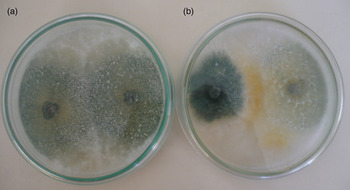
A number of dual cultures of Trichoderma isolates showed no production of SMs after the incubation period, suggesting growth compatibility (Fig. 1a), however other dual cultures showed an incompatibility which represented the accumulation of SMs (the ‘barrier of defense’, see Fig. 1b). Moreover, when comparing the growth behavior of one isolate to another, three additional conditions were observed, (1) a minor predominance of one isolate over another, (2) one isolate overgrows the other and (3) a zone of inhibition between the two Trichoderma isolates, where no visible fungal growth and no SMs accumulation occurred.
Dual cultures of Trichoderma after incubation period showing different interactions. (a) Two Trichoderma isolates confronted in the same culture dish showing compatibility; (b) Two Trichoderma isolates confronted in the same culture dish showing SMs production between them, one isolate (right) developed in larger area than the other isolate.

Cluster analysis identified four major groups for the 105 dual cultures: (1) 20 dual cultures with thick barriers (0.5–0.7 cm wide), (2) 11, with medium-wide barriers (0.3–0.49 cm wide), (3) 27, with thin barriers (0.1–0.29 cm wide) and (4) 47 without barriers (compatible Trichoderma isolates). The first cluster was selected for a laboratory scale production of SMs in liquid culture medium.
Promotion of crop growth by Trichoderma secondary metabolites
Fungal isolates, which produced the largest areas of SMs accumulation on both single and dual cultures on semi-solid media (see Table 2 for a list of the dual cultures that produced barriers from 0.5 to 0.7 cm), were used for laboratory-scale production of SMs. Then, the SMs were used to test their plant growth promoting activity under greenhouse conditions.
Lettuce growth responses clustered into eight groups, with the highest growth responses for Group 5 (dual cultures 3, 4, 7 and individual culture I, see Table 3). This was confirmed by the analysis of variance (ANOVA) analysis, which shows significant differences between SM clusters for the response variables leaf weight, root weight, root length and root volume (Table 3). For radish, cluster analysis identified nine groups (Table 4). Cluster 6 included the highest bulb diameter, bulb weight and root length for the dual (10) and individual cultures (K, Table 4). Cluster 2 contained the highest leaf weight for individual culture G and control CHE (chemical fertilizer) and finally, cluster 9 showed the highest root weight, for dual culture 3 (Table 4). The significant differences between treatments with different SMs produced by dual and individual cultures of Trichoderma isolates were also corroborated by an ANOVA analysis (for a significance level of P < 0.01).
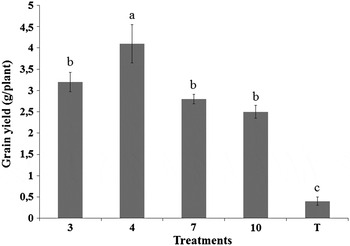
Treatments and control of quinoa plants inoculated with selected SMs (i.e., dual cultures 3, 4, 7, 10 and control T, see Tables 1 and 2) showed no statistically significant differences in any of the variables (data not shown) except grain yield (Fig. 2). The yield differences between plants inoculated with SMs and controls were significant (P = 0.0076). However, not all SMs from dual cultures showed the same response. SMs produced by dual culture 4 provided the highest grain yield (Fig. 2).
Comparison of the response variable grain yield in quinoa as affect by SMs inoculation and the control T (fresh PDB culture medium). Dual culture treatments: 3. A (T. harzianum BP-T1) and J (T. harzianum BP-T29); 4. B (Trichoderma spp. BP-T6) and I (T. koningiopsis BP-T28); 7. C (T. koningiopsis BP-T7) and G (T. harzianum BP-T24); 10. D (T. asperelloides BP-T15) and H (T. harzianum BP-T25) (see Tables 1 and 2 for Trichoderma individual and dual cultures codes and identity of isolates). Means within a column followed by the same letter are not significantly different according to ANOVA test at P < 0.01. Bars mean standard deviation.

Discussion
In this work, we isolated different Trichoderma species from soil and plant roots sampled from lands located at high Andean Mountains and Altiplano. As far as we know, this is the first report about Trichoderma species isolated from high altitudes in the Andean region. These Trichoderma isolates are mostly rhizosphere or endosphere inhabitants and correspond to well-known Trichoderma species (i.e., T. harzianum, T. koningiopsis, T. asperelloides and others). This is not surprising since Trichoderma species have been found at many latitudes worldwide; associated with plant tissues or litter (Hermosa et al., Reference Hermosa, Viterbo, Chet and Monte2012).
We found T. harzianum as the predominant species followed by others. Ghildiyal and Pandey (Reference Ghildiyal and Pandey2008) also found T. harzianum in highlands in the Himalayas and Hoyos-Carvajal et al. (Reference Hoyos-Carvajal, Orduz and Bissett2009) isolated different Trichoderma species from Andean lowland soils, with T. harzianum being the most abundant, followed by T. asperelloides and T. asperellum. This is consistent with findings by Kullnig et al. (Reference Kullnig, Szakacs and Kubicek2000) and Kubicek and others (Reference Kubicek, Bissett, Druzhinina, Kullnig-Gradinger and Szakacs2003), which also identified T. harzianum as the most common species in different geographic regions. T. harzianum, T. asperelloides and T. asperellum have been described as common inhabitants of organic rich soils or poorly degraded plant material (Hoyos-Carvajal and Bissett, Reference Hoyos-Carvajal, Bissett and Grillo2011), however, our results indicate that these species also grow in arid soils with low organic content such as the soils of the high Andean Mountains.
Normally, Trichoderma produces a mixture of extracellular hydrolytic enzymes and other molecules from its secondary metabolism that show multiple functions, either as plant growth promoters, biocontrol agents or others (Vinale et al., Reference Vinale, Manganiello, Nigro, Mazzei, Piccolo, Pascale, Ruocco, Marra, Lombardi, Lanzuise, Varlese, Cavallo, Lorito and Woo2014; López-Bucio et al., Reference López-Bucio, Pelagio-Flores and Herrera-Estrella2015). We performed a series of experiments conducted to stimulate in vitro production of SMs, which consisted using two different Trichoderma isolates in semi-solid dual cultures (i.e., pairings). These experiments helped us to identify the Trichoderma isolates that produced the highest amount of SMs, hence we replicated these dual cultures in liquid medium in order to prepare a crude extracts for plant inoculation.
The incompatibility or antagonism between the two different Trichoderma isolates exhibited as zones of inhibition and as a profuse production of substances and molecules (i.e., SMs) on semi-solid dual cultures. We set out to show that incompatible or antagonist Trichoderma isolates undergo stress when they have to compete for space, nutrients and fungal growth competition, releasing substances preventing the growth of other fungal isolates and, alternatively, triggering higher production of SMs compared with individual cultures. Under stressed situations Trichoderma can synthesize higher amounts of metabolites, which include diffusible and volatile compounds, antibiotics and hydrolytic enzymes possibly in competition for space and nutrients with other microorganisms or as a process of mycoparasitism (Mukherjee et al., Reference Mukherjee, Horwitz and Kenerley2012; Saba et al., Reference Saba, Vibhash, Manisha, Prashant, Farhan and Tauseef2012). However, the opposite could be also true, since SMs from individual cultures (individual culture I in lettuce and K in radish) also showed plant growth promoting attributes. This concurs with other reports that indicate that unstressed strains of Trichoderma can enhance plant growth (Windham et al., Reference Windham, Elad and Baker1986).
Interestingly, all Trichoderma isolates that produced higher amount of raw SMs on semi-solid individual and dual cultures also produced the plant growth regulator IAA. This suggests that one of the molecules that would be present in the SMs is IAA. Although we did not analyze the chemical composition of SMs, the simple experiments carried out in this work suggested that IAA might be the one important component of SMs responsible for promoting plant growth of the two vegetables tested and for the increasing of quinoa grain yield. This assumption is not unusual since it is well known that various species of Trichoderma synthesizes IAA and other related growth regulators, which can be recognized by plant tissues and stimulate growth (Gravel et al., Reference Gravel, Antoun and Tweddell2007; Hermosa et al., Reference Hermosa, Viterbo, Chet and Monte2012). However, more specific investigations are needed to further study the chemical identity and relative abundance of SMs components as well as to better understand their effect on plants.
Conclusion
Andean native Trichoderma species were isolated, identified and used to produce SMs suitable for promoting plant growth and crop production. Although we did not identify the molecular components of the SMs produced by the Andean isolates of Trichoderma, this work lays the groundwork for future development of new biostimulants by using Trichoderma's compounds as active ingredients. This represents an attractive alternative to products containing only living microorganisms (López-Bucio et al., Reference López-Bucio, Pelagio-Flores and Herrera-Estrella2015) and especially to chemical fertilizers. The latter is important because Trichoderma's SMs might help prevent or lessen dependence on chemical fertilizers and thus maintain the organic attribute of Andean export products (mainly quinoa).
The Trichoderma's SMs approach appears to be a promising and accessible technology for small-scale farmers in order to maintain the competitiveness, sustainability, affordability and accessibility of food production in the Andes Mountains and Altiplano, while respecting the environment and soil properties. We intentionally tried to keep the SMs production as simple as possible through the preparation of straightforward culture media (mainly based on potato broth) and co-culturing adequate Trichoderma isolates (e.g., dual cultures 3, 4, 7 or 10, see Table 2). Although our results showed significant potential, there is a need to transfer this simple technology to local farmers for replication. On the other hand, this work also opens the opportunity to explore a cost-effective, large-scale production of Trichoderma's SMs similar to microorganisms-based bioproducts developed by Ortuño et al. (Reference Ortuño, Castillo, Claros, Navia, Angulo, Barja, Gutiérrez and Angulo2013).
Supplementary material
For supplementary material accompanying this paper, visit http://dx.doi.org/10.1017/S1742170516000302.
Acknowledgements
We gratefully acknowledge financial support from FONTAGRO-BID (project number FTG7075), McKnight Foundation (Laderas project) and Fundación Proinpa (internal grant support). We appreciate the helpful collaboration of Dr Michael A. Powell for technical suggestions and language editing and reviewers for helpful comments.
Conflict of interest
The authors declare that they have no conflict of interest.