Introduction
It was not until 1943 that the first case series of children suffering from autism was published (Kanner, Reference Kanner1943).Given that autism is a developmental disorder, many of the subsequent studies aimed at phenotyping autism in childhood. Today, we see autism as a dimensional construct, with “autism spectrum disorders” (ASD) being characterized by a triad of qualitative impairments in the areas of social interaction, communication, and restricted patterns of behavior and interests. The prevalence of ASD is estimated at 0.6–0.7% (Fombonne, Reference Fombonne2009), with up to 70% also having been diagnosed with mental retardation (Fombonne, Reference Fombonne1999), although more recent studies reported figures ranging between 40% and 49% (Baird et al., Reference Baird2000; Bertrand et al., Reference Bertrand, Mars, Boyle, Bove, Yeargin-Allsopp and Decoufle2001).
The prevalence estimation is based on population surveys in which ages ranged from birth to early adult life (Fombonne, Reference Fombonne2009). Approximately 12% of autistic patients achieve a high level of independence in adulthood (Howlin et al., Reference Howlin, Goode, Hutton and Rutter2004), but, although some improvement may be expected over the years, the majority still suffer from “significant degrees of symptomatology and dependency” in adult life (Seltzer et al., Reference Seltzer, Shattuck, Abbeduto and Greenberg2004). Assuming normal survival rates in Western countries, older populations should show similar ASD prevalence rates, but formal data are lacking. In clinical practice, elderly patients with confirmed ASD were usually not diagnosed properly earlier in life for various reasons. First, autism was not included in the psychiatric classification system until the introduction of the DSM-III in 1980 (while Asperger's disorder did not appear until the publication of the DSM-IV in 1994). Moreover, awareness of the persistent nature of autism following childhood was also limited. Second, clinical practice has lacked proper ASD screening and diagnostic instruments for the assessment of adults, and elderly people in particular. Third, many autistic patients live in institutions or may have been able to function sufficiently well throughout their lives owing to a highly structured, non-stressful environment. Finally, psychiatric comorbidity may mask ASD, given that (a) high comorbidity rates have been reported for ASD (Gillberg and Billstedt, Reference Gillberg and Billstedt2000); (b) comorbidity, such as intellectual impairment and neuropsychiatric disorders, have been more strongly related to social and adaptive functioning in adult life than specific ASD symptoms (Nordin and Gillberg, Reference Nordin and Gillberg1998); and (c) referrals to old-age psychiatric services are rare for suspected ASD (James et al., Reference James, Mukaetova-Ladinska, Reichelt, Briel and Scully2006).
The threefold objective of this paper is therefore to review the literature on ASD in the elderly and the existing diagnostic procedures and tools, to illustrate the diagnostic process with three recent cases of suspected ASD, and to provide some guidelines for clinical practice.
Methods
Literature review
We conducted a search of PubMed, PsychLIT and EMBASE for relevant literature published between 1996 through to December 2009 using the key words “developmental disorders”, “autism”, “autistic disorder”, “autism spectrum disorders”, “Asperger syndrome” in combination with “elderly”, “aged”, “aged, 80 and over” and “old age”.
Case series
In order to illustrate the diagnostic process of ASD in elderly patients, we present three cases. All three patients gave their written and informed consent for publication.
Results
Literature review
The literature search identified only three relevant papers. One paper described a case series of five patients diagnosed with Asperger's syndrome in later life (James et al., Reference James, Mukaetova-Ladinska, Reichelt, Briel and Scully2006), of which one patient had been described before in a separate paper (Naidu et al., Reference Naidu, James, Mukaetova-Ladinska and Briel2006). The third comprised a brief report stressing the difficulties of diagnosing ASD in later life and the need for more research in this largely neglected area (Heijnen-Kohl and van Alphen, Reference Heijnen-Kohl and van Alphen2009). As our search failed to yield any empirical studies, we decided to make an attempt at translating the process used for the diagnosis of ASD in childhood and adulthood into a procedure suitable for diagnosing the disorder in later life.
Clinical diagnostics
The clinical diagnosis of ASD is based on a careful psychiatric examination that includes a detailed developmental history as reported by the patient's parents. For ASD diagnoses in later life such a developmental history may pose serious problems due to the lack of informants who have known the patient since childhood and because of significant memory bias (owing to the long time line and potential cognitive impairment of the elderly informant). This can partly be resolved by resorting to school reports or diary notes (James et al., Reference James, Mukaetova-Ladinska, Reichelt, Briel and Scully2006). Nevertheless, with elderly patients it is unlikely that the exact age at which first words and phrases were uttered can be determined reliably. Since this criterion is currently the main distinguishing characteristic between autistic disorder and Asperger's disorder in the DSM-IV, the diagnostic process is seriously compromised.
As many ASD patients have impaired insight into their disabilities (Perry et al., Reference Perry, Marston, Hinder, Munden and Roy2001; Kan et al., Reference Kan, Buitelaar and van der Gaag2008), the accuracy of the diagnostic process can, in the absence of parents, be augmented by the use of other informants like spouses, close relatives, teachers, colleagues or other knowledgeable parties. Carer information, for instance, may provide valuable details with respect to ASD in adults with an intellectual impairment (Bhaumik et al., Reference Bhaumik, Tyrer, Barrett, Tin, McGrother and Kiani2010) and may be even more important in elderly patients.
Screening instruments
Several screening instruments have been developed for children with suspected ASD of which only the Checklist for Autism in Toddlers (CHAT), the Modified Checklist for Autism in Toddlers (M-CHAT) and the Social Communication Questionnaire (SCQ) have been evaluated in sufficiently large populations (Berument et al., Reference Berument, Rutter, Lord, Pickles and Bailey1999). Despite good psychometric properties, these instruments are not applicable in later life as a substantial number of their items refer to the ages of 4–5 years. Only two self-report screening questionnaires, the Autism-Spectrum Quotient (AQ; Baron-Cohen et al., Reference Baron-Cohen, Wheelwright, Skinner, Martin and Clubley2001a) and the Empathy Quotient (EQ; Baron-Cohen and Wheelwright, Reference Baron-Cohen and Wheelwright2004), and one clinician-rated instrument, the Autism Spectrum Disorder in Adults Screening Questionnaire (ASDASQ; Nylander and Gillberg, Reference Nylander and Gillberg2001), might be relevant for use in older adults.
The AQ consists of 50 items that have to be rated by the patient on a 4-point Likert scale and assesses five domains (social skills, attention switching, attention to detail, communication and imagination). Internal consistency of the domains range from moderate to high (0.63–0.81), with good test-retest reliability (Baron-Cohen et al., Reference Baron-Cohen, Wheelwright, Skinner, Martin and Clubley2001a; Kurita et al., Reference Kurita, Koyama and Osada2005; Hoekstra et al., Reference Hoekstra, Bartels, Cath and Boomsma2008). Using a cut-off score of 32, 80% of the adults with ASD showed positive scores versus only 2% of the healthy controls (Baron-Cohen et al., Reference Baron-Cohen, Wheelwright, Skinner, Martin and Clubley2001a). Because some ASD patients may not sufficiently recognize their symptoms, the validity may be improved by additionally having the spouse or another family member complete the Autism Questionnaire for Relatives (AQ-R). Although it has not yet been tested empirically, the AQ seems a promising tool for use in old-age psychiatry as the content of all individual items appear applicable to older people.
The Empathy Quotient (EQ) is a self-report instrument which gauges empathy in adults of normal intelligence and might be interesting for screening elderly patients given that adult patients with Asperger's disorder scored significantly lower on the EQ than matched controls (Baron-Cohen and Wheelwright, Reference Baron-Cohen and Wheelwright2004). However, further validation studies are needed before its clinical application can be recommended. A similar limitation applies to the clinician-rated ASDASQ.
Diagnostic instruments
The Autism Diagnostic Interview-Revised (ADI-R; Lord et al., Reference Lord, Rutter and Couteur1994) and the Autism Diagnostic Observation Schedule (ADOS; Lord et al., Reference Lord2000) both have excellent psychometric properties and are considered the gold standards for diagnosing ASD in children (Lord et al., Reference Lord, Risi, DiLavore, Shulman, Thurm and Pickles2006).
The ADI-R is a semi-structured investigator-based interview, which is administered to the parents or (former) caregivers of a suspected ASD patient. The ADI-R requires reliable memories of the patient's characteristics at 4 or 5 years of age, a condition not readily satisfied and thus negating the use of this instrument in elderly patients. The same holds for the Diagnostic Interview for Social and Communication disorders (DISCO; Wing et al., Reference Wing, Leekam, Libby, Gould and Larcombe2002) and the Developmental, Dimensional and Diagnostic Interview (3di; Skuse et al., Reference Skuse2004). The latter is a computer-based diagnostic interview designed to quantify the severity of autistic traits across their range and is suitable for people between the ages of 4 and 25 years, to be conducted in the presence of parents or carers for additional information. Use in the elderly is limited as one may expect many items to go unanswered.
The ADOS is a standardized observation of social and communicative behavior using a series of (semi-)structured prompts to gauge social interaction, communication and play, which are graded systematically. Four modules of the ADOS are available for specific age bands and language levels, with Module 4 being specifically developed for use in adolescents and adults with fluent language skills. Sensitivity and specificity of the ADOS 1–3 are excellent (de Bildt et al., Reference de Bildt2004; Gotham et al., Reference Gotham, Risi, Pickles and Lord2007). ADOS Module 4 has good predictive value (Bastiaansen et al., submitted). It can be used effectively to distinguish between autism spectrum and non-spectrum and to a lesser degree between autistic disorder and Pervasive Developmental Disorder – Not Otherwise Specified (PDD-NOS) (Lord et al, Reference Lord2000; Gotham et al., Reference Gotham, Risi, Pickles and Lord2007; Bastiaansen et al., submitted). The ADOS takes 45–60 minutes when administered by a trained examiner experienced in working with patients with autism. In clinical practice the ADOS is applied in addition to an indepth psychiatric interview to obtain a standardized observational assessment of (spontaneous) social behavior and communication. However, the ADOS does not allow an adequate assessment of restricted and repetitive behaviors and does not inquire into patient history or functioning in other contexts, making it possible that an individual receives an ADOS classification of autism but a clinical diagnosis of PDD-NOS or Asperger's disorder (Lord, et al., Reference Lord2000). In sum, the ADOS may be of use for the diagnosis of autism ASD in elderly patients, but empirical data are lacking.
Neuropsychological examination
The three dominant theories of ASD are founded on impairments in three cognitive domains: theory of mind (ToM), central coherence and executive dysfunction.
ToM is the capacity to attribute the desires, beliefs and intentions of others to oneself and others. An impaired ToM results in a diminished mentalization ability, which leads to problems in understanding and predicting behavior of others and may inhibit language development (Frith and Happé, Reference Frith and Happé1994). Since some individuals with ASD are capable of successfully completing ToM tests (Ozonoff et al., Reference Ozonoff, Pennington and Rogers1991; Happé, Reference Happé1994), it is important to ask open-ended questions about the character's mental states, as in the Thematic Apperception Test (Beaumont and Newcombe, Reference Beaumont and Newcombe2006) and the Awkward Moments Test (Heavey et al., Reference Heavey, Phillips, Baron-Cohen and Rutter2000) to find out more about “advanced” ToM capabilities (such as recognizing irony and bluff). Deficits in ToM are not specific for autism (Kissgen and Schleiffer, Reference Kissgen and Schleiffer2002) and are also found to a lesser degree in bipolar affective disorder, schizophrenia, some forms of dementia, psychopathy, as well as in other psychiatric disorders (Brüne and Brüne-Cohrs, Reference Brüne and Brüne-Cohrs2006).
Frith conceptualized central coherence as a cognitive style, a spontaneous tendency of individuals to integrate local details into a global entity. Weak central coherence asserts that individuals with ASD tend to fail to utilize context in understanding their environment (Happé and Frith, Reference Happé and Frith2006) and direct their attention to parts rather than to a global entity. By doing so, they have difficulty in recognizing expressions (Teunisse and de Gelder, Reference Teunisse and Gelder2003). Individuals with ASD tend to process visuospatial information in a fragmented way and focus on details (Schlooz et al., Reference Schlooz2006), which can be observed during and through neuropsychological examination.
Executive function is a multidimensional construct and involves planning, response inhibition, flexibility, organization, self-monitoring and working memory. The pertinent executive function in the context of ASD is cognitive flexibility, which relates to the ability of the cognitive system to dynamically activate and modify cognitive processes in response to changing task demands and context factors. Although several neuropsychological studies show planning and cognitive-flexibility deficits in autism relative to typically developing controls, the evidence is inconclusive (Kenworthy et al., Reference Kenworthy, Yerys, Gutermuth Anthony and Wallace2008). Moreover, executive dysfunction is seen in many disorders (including ADHD, conduct disorder, obsessive compulsive disorder, Tourette's syndrome, schizophrenia, dementia, phenylketonuria, corticobasal degeneration, and dementia with Lewy bodies), and can therefore not be used primarily to differentiate among them.
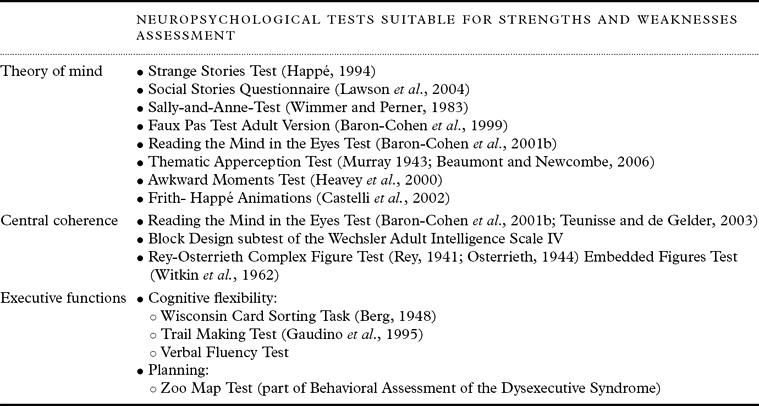
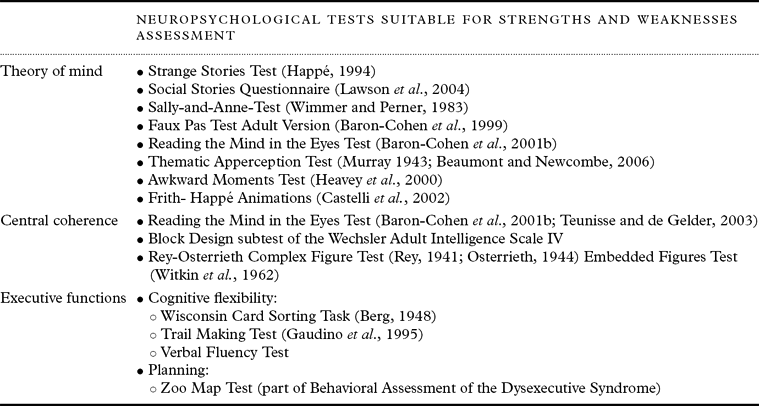
Neuropsychological examination has an important role in identifying strengths and weaknesses and can be useful in treatment planning (Kan et al., Reference Kan, Buitelaar and van der Gaag2008). Table 1 lists neuropsychological tests that are suitable for a strengths and weaknesses assessment. Because impaired results on various of the tests are not specific for ASD, the value of neuropsychological examination is limited when it comes to differentiating ASD from other mental disorders, although it can provide useful additional observational information.
Neuropsychological tests for the main areas of cognitive dysfunctioning in ASD
Differential diagnosis
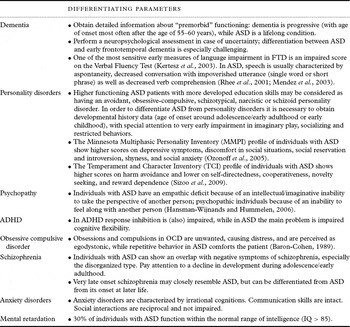
Autistic features can be disguised by comorbid psychiatric disorders or compensated by a normal or high intelligence (Kan et al., Reference Kan, Buitelaar and van der Gaag2008). Furthermore, ASD symptoms can show an overlap with other disorders of which the most important ones are described in Table 2.
Differential diagnosis

Case series
The following case studies describe three elderly patients in the Netherlands who were referred to a mental health facility for various reasons.
Case I
Mr. H, aged 72 years, was referred for electroconvulsive therapy in 2007 because of a therapy-resistant, late-onset depression prompted by the death of his wife when he was 64 years old and by his retirement one year later. Symptoms were: low mood, lethargy, fear, worrying, lack of future perspective, regressive behavior and self-neglect. The central complaint was a general “fear for the day, for life, for the future”. Prior to his admission he had been unsuccessfully treated with various antidepressants and anxiolytics for six years.
Background. Mr. H's daughter expressed that he had never really shown any interest in others, which was also the reason for his son to break off all contact with him. Mr. H had not been able to establish relations with others apart from his wife and a friend of hers. Nevertheless, Mr H liked to be in the company of people. When among others he preferred to remain by himself, making no attempt at socializing, but still seemingly enjoying the occasion. An erudite technician, before his retirement he was always busy in his own company producing office appliances. He was sometimes teased at work for his strict behavior. When this happened, he would become upset and withdrawn. After work he often visited a tennis club. He was fascinated by tennis and seemed especially interested in the rules of the game. Furthermore, he always set himself high standards. His daughter described him as “remote” and as a “strict authoritarian.” He described himself as a loner, without much interest in having contact with others. His wife took care of the home (parenting, housekeeping, social contacts, etc.). He became upset when his strict routine was disrupted. Soon after his wife's death he developed a general fear of not being able to live through the day. He was unable to explain in detail what it was he was afraid of. He no longer felt inclined to get out of bed and he gradually developed a dependent and helpless presentation. In addition, he showed repetitive shaving and hair-grooming patterns, especially when he was feeling anxious. During the interviews, he spoke in a monotonous voice, did not make appropriate eye contact and was preoccupied with trying to recollect exact dates. Although not formally tested, his intelligence appeared to be normal to above normal. School reports showed no signs of language delay at an early age.
ADOS. Within the “Communication” domain, Mr. H met the autism threshold. His speech contained little variation in pitch and tone. He sometimes elaborated his own responses spontaneously during the ADOS session, but only offered factual information. There was no spontaneous use of descriptive, empathic or emotional gestures. Within the “Reciprocal Social Interaction” domain, Mr. H also met the autism threshold. He showed a limited range of facial expressions, and the effectiveness of the communication of his understanding of and empathy for the feelings of other people was also limited. The majority of his social overtures during the session were restricted to his personal demands or related to his own interests. He showed a somewhat limited responsiveness to most social situations. Social interchange during the session in terms of verbal behaviors was limited and restricted to certain contexts. The overall quality of the interaction with Mr. H could be described as being one-sided. Since all three thresholds for autism were met, an ADOS classification of autism was appropriate.
Before ASD was considered, the patient was suspected of suffering from a personality disorder. For a further characterization of his personality traits a psychological assessment was performed. The MMPI-2 profile showed high scores on depression (worrying), paranoia (suspiciousness), psychopathy (struggle anger), and extremely high scores on psychasthenia (worry, anxiety, tension, doubts, obsessiveness, seeking perfection) and schizophrenia (social alienation). Furthermore, Mr. H scored high on avoidance and low on assertiveness as evaluated with the Utrecht Coping List (UCL).
We concluded that his personality was characterized by obsessive, avoidance and dependency traits, and perfectionism, and that he had adopted a passive and avoiding coping style.
Mr. H was diagnosed with high functioning autism, although Asperger's disorder cannot be ruled out as information about delayed language development was sparse. Secondary diagnoses were generalized anxiety disorder and moderately severe depression. Electroconvulsive therapy (ECT) did not lead to any noticeable improvements. Mr. H was subsequently referred to a residential ward that was well equipped to meet his needs for extensive help in the performance of activities of daily living.
Case II
Mr. B is a 78-year-old man with recurrent depressive episodes since the age of 35 years, superimposed on an OCD and an obsessive-compulsive personality disorder. His obsessions concern the belief not to have acted in accordance with his conscience. He had been hospitalized since 2001, because his wife could no longer deal with his unpredictable behavior and extreme expressions of anger.
Background. According to Mr. B he was an intelligent student but was bullied at school. He explained that as a child he had been involved in imitative play. At age 21 he joined the Franciscan Order hoping to find guidance in his troubled thoughts about “good and bad”. After having spent six months in the monastery he went to university to study English and subsequently became an English teacher. He was interested in structure and grammar. He never had friends. He had married because he “thought it was a good thing to do” and they had five children, all of whom had left the parental home. His wife stated that he had never been able to react appropriately to emotional expressions and had always shown little interest in social interaction. She had given up trying to change her husband a long time ago and was accepting of his inflexibility and rigidity. He had always been highly sensitive to stimuli. During the interviews he seemed more concerned with grammatical correctness than with the content of the interview. He expressed himself in a formalistic manner. There was no natural eye contact and he showed a lack of reciprocity in his communications. There was no affect modulation and his speech was monotonous. AQ: 34 (cut-off score: 32).
In 2008 Mr. B took part in a neuropsychological assessment in order to exclude a neurodegenerative disease because of subjective memory decline and increased inertion. The tests showed impaired cognitive flexibility, slow information processing, a normal visual memory function, an impaired verbal memory function and mild impairment in word retrieval. Performance scores on the visual and constructive tasks were good. The patient had already shown inertness and word-finding problems for many months.
Although the neuropsychological assessment showed a frontal and subcortical profile (slowness, impaired memory retrieval, impaired planning), at this point there were insufficient grounds for a diagnosis of dementia. The neuropsychological assessment is to be repeated. Extreme punctuality and compulsiveness might also underlie slowed task performance, while – although potentially ASD-related – poor flexibility could also be explained by the depressive disorder. Moreover, the discrepant findings on visual and verbal working memory were not characteristic of ASD, although relatively poor memory for complex visual and verbal information is seen in ASD (Dawson et al., Reference Dawson, Soulières, Gernsbacher and Mottron2007).
ADOS. Within the “Communication” domain, Mr. B met the autism threshold. During the session there was little reciprocal conversation. The statements he made about his career as an English teacher were idiosyncratic, but it was extremely difficult for the examiner to interpose her thoughts or questions, since he talked continuously. Moreover, the complete absence of empathic or emotional gestures (that generally accompany speech) was especially notable. Within the “Reciprocal Social Interaction” domain, Mr. B also satisfied the autism threshold. Mr B used poorly modulated eye contact to regulate social interaction. The communication of his understanding of and empathy for the feelings of other people was superficial. His sparse attempts to initiate social interaction with the examiner lacked quality. Mr. B did show responsiveness to social situations, although his social responses were limited and from time to time socially awkward. Most of Mr. B's communications were in response to questions and there was no social chat during the ADOS session. Since all thresholds for autism were met, Mr. B satisfied the ADOS diagnostic criteria for autism.
The chronic history of interpersonal difficulties in combination with rigidity, inflexibility, lack of social reciprocity, emotional bonding, difficulty dealing with unexpected events, together with the ADOS classification of “autism” led to the diagnosis of high functioning autism and a secondary severe recurrent depressive disorder. However, in the absence of detailed information on communication problems in early life, again Asperger's disorder could not be ruled out.
Case III
Mr. V, aged 83 years, had no psychiatric history when he was referred to an outpatient department specializing in the diagnosis and treatment of ASD in adults. His wife, who had known Mr. V for all of 60 years, had initiated the referral because she had recognized his autistic behavior after their son had been diagnosed with PDD-NOS. She accompanied Mr. V on his hospital visits. He had suffered from a depressed mood for years, but had never sought help for his problems. Mr. V spent a great amount of time contemplating (the meaning of) life and his Christian beliefs. He had shown very little initiative and had difficulty expressing his emotions and was irritable. His stance could be characterized by rigidity; he had problems dealing with change and with planning and organizing his day. He could react extremely angrily when his strict routines were interrupted (e.g. a deviation from strict meal times).
Background. Mr. V explained that when he was a child he had created his own world and did not share his experiences nor initiated contact with others. He interpreted language literally and often failed to recognize the humor in verbal communications. He was obsessed by the component parts of toys and could not stop playing with them. His wife recalled numerous anecdotes from relatives about her husband's peculiar childhood behavior.
During the Second World War his father had collaborated with the Germans and Mr. V had joined Nazi youth organizations at a very young age. He was later recruited and ordered to guard railway stations in Germany. Mr. V perceived this period as very traumatic. After the war he was incarcerated for several years. His relatives henceforth explained his odd behavior by referring to his war-time experiences.
Mr. V had been married for 53 years and had two children. There was no reciprocity in his relationship with his wife and his children. Before retirement he had been employed as a technical supervisor. Mr. V had no friends, but did not seem to miss having any.
ADOS. Within the “Communication” domain, Mr. V met the autism threshold. His speech during the ADOS session included some spontaneous elaborations of his own responses, but to a lesser extent than could be expected given his level of expressive language. There was some spontaneous but infrequent use of descriptive, empathic or emotional gestures. Within the “Reciprocal Social Interaction” domain, Mr. V also satisfied the autism threshold. He had a continuously tense facial expression, although it was directed at the examiner. The communication of his understanding of and empathy for others’ emotions was superficial. The majority of his social overtures during the session lacked social quality and were inappropriate. Thus, at the start of the ADOS session, even before any formal introductions had been made, Mr. V did not wait to be offered a cup of coffee but instead assumed that the examiners’ cup of (cold) coffee (sitting at her end of the desk) was his. His response to most social situations was socially awkward. Social interchange in terms of verbal and nonverbal behaviors during the session was limited and infrequent. Since all three thresholds for autism were met, an ADOS classification of autism was appropriate.
Information about his childhood was provided by Mr. V himself and confirmed by his wife, who recollected anecdotes about his childhood behavior told to her by relatives during the first years of their acquaintance. These stories revealed signs of deviant behavior, but no signs of early impairments in communication. His wife also provided vital information about his actions and behaviors during the 60 years she had known him, showing a chronic pattern of rigidity, obsession with detail, lack of reciprocity and social interchange, and a tendency to take language literally.
Although no formal developmental data were available, the clinical presentation and the results of the ADOS, in combination with the information Mr. V and his wife provided about his youth justified a diagnosis of Asperger's disorder. Minimal qualitative impairments in communication made a diagnosis of autistic disorder less likely, although it could not be ruled out. In particular, the type and onset of the self-reported deviant behavior in childhood renders the possibility of a personality disorder unlikely.
Discussion
It is highly likely that ASD is underdiagnosed in older people. The paucity of literature on the subject suggests that lack of awareness of ASD among mental health professionals working with elderly people may be an important factor. Our hypothesis is further substantiated by our three case series, which showed that the diagnosis of ASD was most likely delayed by a lack of knowledge of and attention to the signs of the disorder. An adequate screening for and proper diagnosis of ASD in elderly patients is important for various reasons. A diagnosis of ASD may offer the patient and his/her family/caregivers some relief because it not only explains the current problems, but also puts the “odd” lifelong behavior into perspective. Educating and coaching the patient and his/her family then is an important therapeutic step – and should be extended to the (nursing) staff if patients live in residential care facilities. Additionally, a failure to diagnose ASD may lead to iatrogenic damage and extra costs due to an overkill in treatment strategies for mental health problems that are secondary to ASD (e.g. standard, protocol-based psychotherapy or ECT (James et al., Reference James, Mukaetova-Ladinska, Reichelt, Briel and Scully2006) and are more likely to be resolved by simple psychosocial interventions (e.g. by providing a more predictable environment). Although generalization and maintenance continues to be a challenge and effects have as yet not been studied in elderly patients, interventions aimed at enhancing social communication skills have shown moderate effects in younger patients (Reichow and Volkmar, Reference Reichow and Volkmar2010).
Aging is a demanding process in which major changes occur. The biographies of the cases described in this paper show how people with ASD were able to fare relatively well in the right (structured) social circumstances, but at the same time they illustrate the vulnerability of this well-being: when Mr. H was first faced with the loss of his wife and then his retirement, this unbalanced him greatly, while Mr. B was even admitted to a residential psychiatric facility in later life. Being able to cope with changes adequately requires a great deal of flexibility and since individuals with ASD tend to have an inflexible disposition they have great difficulty dealing with changes. These changes can, accordingly, result in major behavioral disturbances and a variety of psychiatric disorders (e.g. depressive or anxiety disorders), which may mask the “premorbid” ASD pathology. For a diagnosis of ASD, adequate information on premorbid functioning is essential. Have early signs of a premorbid impairment in social interaction been overlooked? Were there indications of problems understanding idiomatic expressions, trouble keeping conversations going or initiating and maintaining relationships with others? Does the patient's history demonstrate restricted behaviors or interests? A tendency to take figures of speech literally? Difficulties in mentalization or organization? In the diagnostic process of the patients presented in this paper the information from relatives proved crucial. It is hence indispensable always to interview relatives to gain a more objective perspective and to obtain additional information on the patient's developmental history and the occurrence of ASD within the family. However, the older the patient, the harder it is to obtain relevant information from surviving family members. Due to the long interval between the period of interest and the time of the interview memory bias is highly probable, while a possible decline in the interviewee's cognitive functions may further compromise the reliability of the information provided. Whenever possible, (older) siblings, other family members or significant other people who have known the patient for a long time should be approached for their perspectives, while school reports may also yield additional details.
Due to the incomplete or inconclusive information about the patients’ early childhood, a diagnosis of Asperger's disorder could not be ruled out in two of the cases presented, and in one case autistic disorder was not precluded. Currently, for a diagnosis of Asperger's disorder the DSM-IV stipulates the absence of a significant general delay in language and for autistic disorder the absence of delayed or abnormal functioning before the age of three. However, high functioning autism and Asperger's disorder have a similar phenotype in later life and this close resemblance, in combination with an inability to establish the age of onset accurately in retrospect, renders the differentiation between the two disorders in later life nearly impossible. On the other hand, such a differentiation seems academic to us and lacks clinical relevance as it does not lead to different treatment strategies. The developmental history should provide information about reciprocal peer interaction and communication in preschool and early school years. As most patients remember issues from interactions with peers at school and, if asked, can give some examples, we feel that symptoms before the age of 12 years would be a good alternative criterion. This debate and our proposal is in line with the current recommendations of the DSM-V task force who put less weight on delay in language and the exact onset of ASD symptoms. They propose to replace the age criterion by the recognition of autistic symptoms in childhood since an early appearance of symptoms and a pervasive course are typical for ASD (see www.dsm5.org). The differentiation of ASD as laid down in the DSM-IV is also challenged by empirical findings in that the specific ASD disorders are inconsistent over time, variable across sites, and often more strongly associated with severity, language level or intelligence than features of the disorder. Following the proposed DSM-V criteria, our case studies would all be diagnosed as having an autistic disorder.
The proposal of the task force to replace the discrete DSM-IV ASD diagnoses by the generic term “autism spectrum disorder” and a severity rating in the DSM-V (www.dsm5.org) will certainly facilitate the diagnosis of ASD in elderly people. In case of an insufficient developmental history, the additional information gathered by means of the ADOS would then support the diagnosis by allowing a better distinction between “normal” and “autistic” current behavior.
In two of our cases (Mr. H and Mr. B), observations from hospital staff pertaining to social and emotional reciprocity, nonverbal behaviors and mental inflexibility contributed to the diagnosis; thus, admission to a psychiatric facility for observation should be considered when the basis for a definitive diagnosis remains uncertain.
Conclusion
Being a relatively recent syndrome, ASD is still largely unknown to mental health professionals who work with older individuals. Due to demographic aging the number of elderly people with ASD is likely to increase in the near future. To facilitate an accurate diagnosis, healthcare professionals should be alert for signs of autism in their elderly patients as comorbidity, most often the primary reason for referral to psychiatric care facilities, may conceal ASD. When a patient's history gives rise to a suspicion of ASD, we recommend screening the patient with the AQ. Moreover, history-taking should include biographical information as well as the perspectives of relatives, to be expanded with the Autism Questionnaire for Relatives (AQ-R). Whenever possible, a formal developmental history should be taken, but when this is not feasible, relatives should be probed for relevant information about long-lasting behavioral patterns. In clinical practice, it is likely that in this way most cases of ASD in older persons will ultimately be identified. However, when there is uncertainty about the severity of current autistic behavior, clinical observation or administration of the ADOS (Module 4) should be considered, although further research into its use in older persons is warranted. Deviations on neuropsychological tests need to be viewed with caution since they can reflect other pathology than ASD; their use should therefore be restricted to ruling out neurodegenerative disorders (over time) and analyzing a patients’ strengths and weaknesses.
An improved recognition of and diagnostic procedure for ASD in older people may reveal many ASD patients who have previously gone undiagnosed. If so, more research should be aimed at phenotyping ASD in the elderly and developing guidelines for evidence-based treatments.
Conflict of interest
None.
Description of authors' roles
The original rationale for the present study arose during a discussion among M.E.H. van Niekerk, W. Groen and R.C. Oude Voshaar. The paper was written by M. van Niekerk, C.C. Kan and R.C. Oude Voshaar, with W. Groen, C.Th.W.M. Vissers and D. van Driel-de Jong providing critical comments on earlier versions. Primary data collection was performed by M.E.H. van Niekerk (literature search, case histories) and Th.W.M. Vissers (ADOS).