Phenylketonuria (OMIM: 261600) is an autosomal recessive disorder caused by hepatic phenylalanine hydroxylase (EC 1.14.16.1) deficiency. Phenylketonuria is the most prevalent inborn error of amino acid metabolism. Increased phenylalanine levels cause irreversible neurological damage in almost all children if they are not treated with a phenylalanine-restricted diet, commenced soon after birth. Adequate and continuous dietary treatment results in good neurological outcome in early diagnosed patients.Reference Jahja, Huijbregts, de Sonneville, van der Meere and van Spronsen 1
Atherosclerotic risk factor assessment relies mainly on the evaluation of dietary habits, anthropometric measurements and blood pressure, blood lipid and homocysteine levels, and other inflammatory biomarkers, as well as genetic factors. Natural protein-restricted and phenylalanine-restricted diets, even if they are rich in fruits and vegetables (antioxidants), represent a serious risk for nutritional deficiencies – for example, selenium, zinc, ubiquinone-10, and L-carnitine;Reference Rocha and Martins 2 however, despite this vegan diet, the risk for inflammation and oxidative stress increases in phenylketonuria patients.Reference Schulpis, Papassotiriou, Tsakiris, Vounatsou and Chrousos 3 – Reference Sanayama, Nagasaka and Takayanagi 5 Moreover, despite decreased saturated lipids in this non-atherogenic green diet, atherogenic blood changes such as altered lipid profileReference Nagasaka, Tsukahara and Okano 6 – Reference Colomé, Artuch, Lambruschini, Cambra, Campistol and Vilaseca 8 or elevated homocysteine levelsReference Schulpis, Papassotiriou, Tsakiris, Vounatsou and Chrousos 3 , Reference Schulpis, Karikas and Papakonstantinou 9 have been observed in some studies. Inflammation, dyslipidaemia, and hyperhomocysteinaemia were shown to be important risk factors for atherosclerosis.Reference Ait-Oufella, Sage, Mallat and Tedgui 10 , Reference Perk, De Backer and Gohlke 11 Atherosclerosis, beginning in childhood, may be predictive of coronary artery disease in adulthood.Reference Li, Chen and Srinivasan 12 , Reference Raitakari, Juonala and Kähönen 13 Therefore, early diagnosis of atherosclerosis is essential to prevent its future complications.
There are few studies that have investigated the known risk factors of atherosclerosis, such as blood lipids, homocysteine, and mean platelet volume in phenylketonuria patients, in the literature.Reference Schulpis, Papassotiriou, Tsakiris, Vounatsou and Chrousos 3 , Reference Nagasaka, Tsukahara and Okano 6 – Reference Schulpis, Karikas and Papakonstantinou 9 , Reference Agostoni, Scaglioni, Bonvissuto, Bruzzese, Giovannini and Riva 14 – Reference Mütze, Beblo and Kortz 22 In most of these previous studies, these factors were evaluated independently, and only one of them included mean platelet volume levels.Reference Mütze, Beblo and Kortz 22 The primary aim of the present study was to investigate the serum atherogenic markers in adolescent phenylketonuria patients and compare these parameters with healthy peers. The secondary aim of this study was to compare the well-controlled and poorly controlled patients regarding these atherogenic markers.
Patients and methods
Study population
This study was conducted in Dokuz Eylül University Faculty of Medicine, Department of Paediatrics, Division of Paediatric Metabolism, Izmir, Turkey, between June 2013 and December 2013. Participants included adolescent phenylketonuria patients and healthy controls between 11 and 18 years of age. In total, 89 adolescent phenylketonuria patients were screened. Patients with a disease other than phenylketonuria, such as diabetes mellitus (one patient) and hypothyroidism (one patient), who used other medications such as anti-inflammatory, antipyretic, or anticonvulsive drugs or herbal medicines (three patients), and smokers (two patients) were excluded. Patients with acute infections (two patients) were also excluded from the study. Patients with obesity (15 patients) or protein–energy malnutrition (five patients) were not included in this study. In total, 59 patients were included in this study. None of the adolescent girls in the study group or the control group were using oral contraceptive drugs. All the patients were diagnosed as having classical phenylketonuria by mass screening in the neonatal period. Moreover, all the patients had pre-treatment phenylalanine levels greater than 1200 µmol/L between 3 and 7 days of life, and classical phenylketonuria was diagnosed in these patients by the analysis of dihydropteridine reductase activity in erythrocytes and pteridine analysis in urine.Reference Walter, Lachmann and Burgard 23 All the patients were on phenylalanine-restricted diet since the diagnosis. According to our standard treatment protocol, adolescent patients had monthly visits to our outpatient clinic. All the patients were given amino acid mixtures. The phenylalanine tolerance and diet regulations of all patients were adjusted according to serum phenylalanine levels during every visit. Patients’ total protein intakes were 0.8–1.2 g/kg/day – 0.20–0.40 g/kg/day from natural sources and 0.6–0.8 g/kg/day from amino acid mixture. Daily phenylalanine intakes ranged between 300 and 900 mg/day according to phenylalanine tolerance and the patient’s age and weight. Patients who consumed vitamins, minerals, or fish oils in the last three months were not included in the study.
Physical examinations and anthropometric measurements of all patients and controls were performed. The body mass index was calculated as weight divided by height squared (kg/m2). Obesity was defined as a body mass index exceeding the 95th centile based on the patient’s age and sex.Reference Cole and Lobstein 24 Relative weight was defined as the ratio of the actual weight of the patient to the weight of a child in the 50th centile of the same height and gender×100. All patients and control children had normal anthropometric values.
Systolic blood pressure and diastolic blood pressure were measured by a mercurial sphygmomanometer using the right arm in sitting position in all the adolescents. Blood pressure higher than the 95th percentile of blood pressure according to age-, sex-, and height-specific norms was accepted as hypertension. 25 Patients – one patient was obese – or controls with hypertension were not included.
Patients were divided into two subgroups according to their mean serum phenylalanine levels of the previous year, which were calculated from the data from the monthly visits of the last year: well-controlled patients (group 1) and poorly controlled patients (group 2). The upper limit for the recommended range of blood phenylalanine levels in phenylketonuria patients in this age group who received the phenylalanine-restricted diet varies between countries.Reference Blau, van Spronsen and Levy 26 We used 360 µmol/L (6 mg/dl) as the upper limit of cut-off for both children and adolescents in our institution. On the other hand, some of the patients, especially adolescents, did not follow this diet strictly, as in other countries.Reference Blau, van Spronsen and Levy 26 , Reference Das, Goedecke and Meyer 27 Mean serum phenylalanine levels between 120 and 360 µmol/L were accepted as well-controlled for classical phenylketonuria patients. Mean serum phenylalanine levels greater than 360 µmol/L were defined as poorly controlled in this study.
The control group (group 3) consisted of asymptomatic healthy adolescents who were admitted to the well-child outpatient clinic of our hospital for medical screening, which included screening for hepatitis, thyroid function, lipid profile, coeliac disease, anaemia, etc. All the screening test results were normal. All the adolescents in this group were not taking any medications, vitamin or mineral supplementation, and did not use tobacco. All of them were on an omnivorous diet. None of them had an acute or chronic infectious disease. None of them had a history of familial hypercholesterolaemia, hypertension, or chronic disease. Anthropometric values of the controls were in the normal range. Complete blood count, phenylalanine and glucose level tests, lipid profiles, and liver function tests of the control group were performed and the results were found to be in normal ranges.
Laboratory analyses of atherosclerotic biomarkers
All the measurements were performed using blood samples collected on the same morning in each child. Blood was obtained by venipuncture in the forearm in the morning after an overnight fast. Standard tubes without an anti-coagulant (BD Vacutainer, Becton Dickinson Company, New Jersey, United States of America) were used for biochemical analysis. Samples were centrifuged at 3000 g at 4°C for 15 minutes. We measured the levels of fasting serum glucose, total cholesterol, high-density lipoprotein cholesterol, triglycerides, vitamin B12, and folic acid. Low-density lipoprotein cholesterol level was calculated using the Friedewald formula (LDL-C=total cholesterol−HDL-C−triglycerides/5).Reference Friedewald, Levy and Fredrickson 28 Serum vitamin B12 and folic acid concentrations were measured by chemiluminescence immunoassay method (Abbott Architect i2000). Serum was used for measuring blood phenylalanine levels, which were measured by flourometric analysis (RF-5301PC, Shimadzu).
Standard tubes with constant amount of K3-ethylenediaminetetraacetic acid (BD Vacutainer, Becton Dickinson Company) were used for complete blood count analyses and for testing plasma homocysteine levels. Plasma homocysteine was measured using a kit (IC2801, ImmunoChrom) by high-performance liquid chromatography with fluorescence detection (Shimadzu). Complete blood count analyses were performed using a Coulter analyzer (LH-780, Beckman Coulter, Brea, California, United States of America) by the impedance method (intra-assay variation coefficient 1.6%, inter-assay variation coefficient 1.6%), which was routinely checked every month in the central laboratory of our institution at regular intervals of 1 hour.
Ethical approval
The study protocol was designed in compliance with the Declaration of Helsinki. Informed consent was obtained from both the adolescents and their parents on enrolment to the study. The study was started after the approval of the Ethics Committee of the Dokuz Eylul University Faculty of Medicine was obtained (Ethics approval number: 2013/29-11)
Statistical analysis
Statistical analysis was performed using the Statistical Package for Social Sciences version 15.0. Data are presented as mean±standard deviation and median [range, 25P–75P]. Student’s t-test was used for comparing the phenylketonuria group with the control group regarding age, relative weight, phenylalanine level, and concentrations of lipids, vitamin B12, homocysteine, and folic acid. The Kruskal–Wallis test was used for analysing group averages among the three groups (well-controlled, poorly controlled patients, and healthy controls). The Mann–Whitney U-test was used for comparing two group averages as a post-hoc test (well-controlled patients versus poorly controlled patients; well-controlled patients versus controls; and poorly controlled patients versus controls). The χ2 test was used for comparing group ratios. All the p values are two-tailed, and group differences or correlations with p<0.05 were considered to be statistically significant.
Results
A total of 59 phenylketonuria patients (32 male, mean age 13.7±2.4 years, median: 12.6 [11–17] years) and 44 healthy controls (19 male, mean age 13.0±2.0 years, median: 12.0 [11–15] years) were enrolled in this study. There were no significant differences between phenylketonuria patients and controls regarding age, gender, and relative weight (p=0.125, 0.321, and 0.594, respectively).
Haemoglobin levels, leucocyte and platelet counts, triglyceride, total cholesterol, low-density lipoprotein cholesterol, and vitamin B12 levels did not differ significantly between patients and controls. On the other hand, mean high-density lipoprotein cholesterol levels were significantly lower in patients than in controls (1.1±0.2 versus 1.4±0.2 mmol/L, p<0.001). Homocysteine (9.5±5.9 versus 5.8±1.8 µmol/L, p<0.001), folic acid (32.7±9.2 versus 22.5±7.2 nmol/L, p<0.001), and mean platelet volume (9.1±1.0 versus 7.7±0.6 fL, p<0.001) were higher in patients than in healthy peers. Homocysteine levels were >15.0 µmol/L in five children (8.5%, mean homocysteine level in this group was 23.7±9.6 µmol/L, median 19.0 [15.6–34.1] µmol/L) in the patient group. There was no case of hyperhomocysteinaemia in the control group. High-density lipoprotein cholesterol levels of the hyperhomocysteinaemic group were significantly lower (0.9±0.07 mmol/L, median 0.9 [0.8–1.0] mmol/L) than in patients with homocysteine levels <15.0 µmol/L (1.1±0.2 mmol/L, median 1.0 [0.9–1.3] mmol/L) and in controls (p=0.044 and p<0.001, respectively). No significant difference was observed between triglyceride and low-density lipoprotein cholesterol levels in all the three groups.
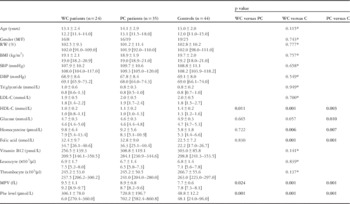
Among all, 24 phenylketonuria patients (41%, 8 girls) were well-controlled and 35 patients (59%, 19 girls) were poorly controlled. Clinical characteristics, serum phenylalanine concentrations, and haematological and biochemical parameters of patients and controls are presented in Table 1. Mean serum phenylalanine levels were 306.1±78.0 µmol/L in well-controlled and 720.8±196.7 µmol/L in poorly controlled patients (p<0.001). In control adolescents, mean serum phenylalanine levels were 48.8±12.2 µmol/L (p<0.001 for both phenylketonuria groups). None of the adolescents in the control group had serum phenylalanine levels >120 µmol/L.
Comparison of clinical and laboratory parameters between well-controlled (WC) and poorly controlled (PC) PKU patients and healthy controls (data are presented as mean±standard deviation and median [range]).

BMI=body mass index; DBP=diastolic blood pressure; HDL-C=high-density lipoprotein cholesterol; LDL-C=low-density lipoprotein cholesterol; MPV=mean platelet volume; Phe=phenylalanine; PKU= phenylketonuria; RW=relative weight; SBP=systolic blood pressure
* The Kruskal–Wallis test and the Mann–Whitney U-test were used
Statistically significant results were represented in bold characters
The mean high-density lipoprotein cholesterol levels of well-controlled patients (1.0±0.2 mmol/L) were significantly lower compared with poorly controlled patients and controls (1.1±0.2 mmol/L, p=0.011 and 1.4±0.2 mmol/L, p<0.001, respectively). Moreover, poorly controlled patients had lower high-density lipoprotein cholesterol levels than healthy controls (p=0.003). Homocysteine levels of both well-controlled and poorly controlled patients were significantly higher compared with control adolescents (Table 1). On the other hand, there was no statistically significant difference regarding homocysteine levels between the two patient groups (Table 1). Mean platelet volume levels showed no difference between girls and boys in the patient (9.1±0.9 versus 9.1±1.1 fL, p=0.970) and control groups (7.7±0.7 versus 7.8±0.4 fL, p=0.704). The mean platelet volume levels of well-controlled patients (9.5±1.1 fL) were higher compared with the poorly controlled patients and controls (8.9±0.8 fL, p=0.024 and 7.7±0.6 fL, p<0.001, respectively). Furthermore, poorly controlled patients had higher mean platelet volume levels than healthy controls (p<0.001) (Table 1).
Discussion
The results of this study showed that adolescent phenylketonuria patients had significantly higher homocysteine and mean platelet volume levels and lower high-density lipoprotein cholesterol levels compared with healthy controls. Furthermore, lower high-density lipoprotein cholesterol levels and higher mean platelet volume levels were detected in well-controlled patients compared with the poorly controlled ones. Furthermore, mean homocysteine levels were higher in both phenylketonuria groups compared with healthy peers; however, they were similar in both well-controlled and poorly controlled patient groups.
Previous studies investigating high-density lipoprotein cholesterol status in phenylketonuria patients have shown conflicting results. Some studies in the literature did not find any difference between phenylketonuria patients and controlsReference Agostoni, Scaglioni, Bonvissuto, Bruzzese, Giovannini and Riva 14 , Reference Nagasaka, Okano and Kimura 15 and also between well-controlled and poorly controled phenylketonuria patients and healthy controls regarding high-density lipoprotein cholesterol levels.Reference Schulpis, Papassotiriou, Tsakiris, Vounatsou and Chrousos 3 , Reference Schulpis, Karikas and Papakonstantinou 9 , Reference Schulpis, Karakonstantakis, Bartzeliotou, Karikas and Papassotiriou 16 , Reference Schulpis, Bartzeliotou, Tsakiris, Gounaris and Papassotiriou 17 On the contrary, few other studies have found lower high-density lipoprotein cholesterol levels in phenylketonuria patients than in controls, similar to our findings.Reference Nagasaka, Tsukahara and Okano 6 – Reference Colomé, Artuch, Lambruschini, Cambra, Campistol and Vilaseca 8 Different mechanisms might be involved for the lower high-density lipoprotein cholesterol levels in phenylketonuria patients. First, depressed apolipoprotein E (Apo E) synthesis in PAH-deficient patients might cause high-density lipoprotein cholesterol deficiency.Reference Nagasaka, Tsukahara and Okano 6 Nagasaka et alReference Nagasaka, Tsukahara and Okano 6 showed that phenylketonuria patients who were treated with phenylalanine-restricted diet had diminished Apo E and high-density lipoprotein cholesterol levels compared with hyperphenylalaninaemia patients who did not receive restricted diet and healthy controls. They concluded that the diminished Apo E levels were due to supressed high-density lipoprotein cholesterol synthesis;Reference Nagasaka, Tsukahara and Okano 6 however, the exact mechanism is not known. We did not measure Apo E levels or perform Apo E genotyping in our patients. Second, phenylketonuria patients generally consume a vegetarian diet, especially well-controlled patients who strictly comply with this low-cholesterol diet.Reference Colomé, Artuch, Lambruschini, Cambra, Campistol and Vilaseca 8 , Reference Mütze, Beblo and Kortz 22 Our results support this hypothesis. Numerous studies have shown that people consuming vegetarian and also vegan diet had lower high-density lipoprotein cholesterol levels compared with omnivorous healthy people.Reference Jian, Chiang and Lung 29 – Reference Chiang, Lin and Chen 31 Although the exact mechanism is not clear, a recent public-based study showed that Apo A-1 levels were significantly lower in vegan women than in their carnivorous peers when adjusted for body mass index.Reference Bradbury, Crowe, Appleby, Schmidt, Travis and Key 32 As Apo A-1 is an important structural apolipoprotein of the high-density lipoprotein cholesterol molecule, diminished Apo A-1 levels might be a causative factor for lower high-density lipoprotein cholesterol levels in vegetarians. Another possible mechanism is the effect of elevated homocysteine levels on high-density lipoprotein cholesterol trafficking in phenylketonuria patients. Holven et alReference Holven, Aukrust and Retterstøl 33 demonstrated that hyperhomocysteinaemic patients had impaired ability to induce cholesterol efflux from lipid-loaded macrophages and had dysfunctional high-density lipoprotein particles with attenuated anti-atherogenic activity. Hyperhomocysteinaemia was detected in five patients in our patient group. High-density lipoprotein cholesterol levels were significantly lower in this hyperhomocysteinaemic group than in patients with normal homocysteine levels and healthy controls. Our results support this hypothesis. Finally, the results of an experimental study by Castillo et al.Reference Castillo, Zafra and Garcı´a-Peregrin 34 showed that hyperphenylalaninaemia might inhibit 3-hydroxy-3-methylglutaryl-CoA reductase and mevalonate-5-pyrophosphate decarboxylase, which are two of the main regulatory enzymes of cholesterogenesis. Although lower high-density lipoprotein cholesterol levels were seen in our study, total cholesterol and low-density lipoprotein cholesterol levels were similar between groups. Thus, whether the results of this animal study can be adapted to humans is unclear. Decreased high-density lipoprotein cholesterol levels were found to be associated with atherosclerosis in numerous adult studies.Reference Yu, Yarnell, Sweetnam and Bolton 35 , Reference Jacobs, Mebane, Bangdiwala, Criqui and Tyroler 36 On the other hand, new basic and clinical studies are needed to evaluate the atherogenic effect of diminished high-density lipoprotein cholesterol levels in phenylketonuria patients.
In this study, mean platelet volume in well-controlled patients were higher compared with poorly controlled patients and controls. Platelets play an important role in the pathogenesis of disorders associated with local or systemic inflammation.Reference Ware, Corken and Khetpal 37 , Reference Rondina, Weyrich and Zimmerman 38 During atherogenesis, platelet activation and aggregation along with migration of smooth muscle cells from the media to the endothelium and consequent proliferation are the early events. The status of mean platelet volume has been proposed as a marker for platelet activation, as larger-sized platelets have been associated with higher pro-thrombotic risk, which may also reflect atherosclerosis.Reference Chesnutt and Han 39 – Reference Chu, Becker and Berger 42 The role of mean platelet volume has been previously demonstrated in various systemic disorders related to inflammation and atherosclerosis, such as familial Mediterranean fever,Reference Makay, Turkyilmaz and Unsal 43 obesity,Reference Arslan and Makay 44 , Reference Arslan, Makay and Hızlı 45 diabetes,Reference Dolasık, Sener, Celebi, Aydın, Korkmaz and Canturk 46 and coronary artery disease.Reference Khode, Sindhur, Kanbur, Ruikar and Nallulwar 47 , Reference Verdoia, Camaro and Barbieri 48 To date, there are no data about the presence of atherosclerosis in phenylketonuria patients. On the other hand, several studies demonstrated that phenylketonuria patients had increased sub-clinical inflammation and oxidative stress.Reference Okano and Nagasaka 4 , Reference Sanayama, Nagasaka and Takayanagi 5 In the previously mentioned study of Mutze et al,Reference Mütze, Beblo and Kortz 22 which investigated the long-term effects of phenylketonuria diet on fatty acid metabolism, 12 phenylketonuria patients with good metabolic control and eight healthy controls were included. This study also investigated the status of mean platelet volume in phenylketonuria patients. The mean platelet volume levels of the patients were not significantly different compared with the controls in this study. In our study, we had a larger number of patients and we showed a significant difference between groups in terms of mean platelet volume. Furthermore, we compared the patients with good metabolic control and poor metabolic control.
Homocysteine levels were higher in both phenylketonuria groups compared with healthy peers in our study. To date, one adult and five paediatric studies have been reported investigating the serum/plasma homocysteine levels in phenylketonuria patients.Reference Schulpis, Papassotiriou, Tsakiris, Vounatsou and Chrousos 3 , Reference Schulpis, Karikas and Papakonstantinou 9 , Reference Lucock, Yates and Hall 18 – Reference Colomé, Artuch and Sierra 21 Lucock et al and Huemer et al did not find any differences between phenylketonuria patients and controls regarding homocysteine levels.Reference Lucock, Yates and Hall 18 , Reference Huemer, Födinger and Bodamer 19 On the other hand, Schulpis et alReference Schulpis, Papassotiriou, Tsakiris, Vounatsou and Chrousos 3 , Reference Schulpis, Karikas and Papakonstantinou 9 found higher homocysteine levels in well-controlled phenylketonuria patients compared with poorly controlled patients and healthy peers in their two different studies. Recently, two studies reported reduced homocysteine levels in phenylketonuria patients.Reference Huemer, Simma and Mayr 20 , Reference Colomé, Artuch and Sierra 21 Elevation of homocysteine concentration has been shown to be related to atherosclerosis in previous case–control and prospective studies.Reference Ahluwalia, Blacher and Szabo de Edelenyi 49 On the other hand, no data were found indicating hyperhomocysteinaemia and presence of atherosclerosis in phenylketonuria patients in the literature. Hyperhomocysteinaemia enhances vascular disease via endothelial dysfunction, smooth muscle cell proliferation, and vascular re-modelling.Reference Steed and Tyagi 50 It was demonstrated that homocysteine elevation enhanced platelet activation in both in vitroReference Signorello, Pascale and Leoncini 51 and in vivoReference Holven, Aukrust, Pedersen, Ose and Nenseter 52 studies. Moreover, it was demonstrated in animal studies that homocysteine elevation caused oxidative stress-diminished cardiac oxygen consumption, which might lead to cardiac metabolic disease.Reference Becker, Adler and Schneeberger 53 All these mechanisms may contribute to the pathogenesis of atherosclerosis. Elevation of homocysteine levels in phenylketonuria patients could be a result of functional vitamin B12 deficiency due to a relatively low intake of vitamins B6 and B12 as well as folate.Reference Schulpis, Papassotiriou, Tsakiris, Vounatsou and Chrousos 3 , Reference Vugteveen, Hoeksma and Monsen 54 On the other hand, few other studies have shown that phenylketonuria patients following a strict diet supplemented with phenylalanine-free amino acid formulae were not at risk of developing deficiencies in these micronutients.Reference Thiele, Weigel and Ziesch 55 , Reference Rohde, von Teeffelen-Heithoff and Thiele 56 More studies are required to clarify these conflicting results.
A major limitation of our study is its small sample size. The second limitation is the lack of the hyperphenylalaninaemia patients whose blood phenylalanine levels range between 120 and 600 µmol/L without any dietary treatment to compare the dietary effect on lipids, homocysteine, and mean platelet volume levels as well as other nutritional factors. Another limitation of this study is the absence of information regarding other known inflammation parameters such as C-reactive protein and tumour necrosis factor alpha as well as oxidative stress markers. Finally, we did not measure intima media thickness of the patients to directly identify the presence or absence of atherosclerosis.
In conclusion, lower high-density lipoprotein cholesterol levels and higher homocysteine and higher mean platelet volume levels were detected in phenylketonuria patients in our study. These changes were more prominent in well-controlled phenylketonuria patients. We conclude that phenylketonuria patients might be at risk for atherosclerosis, and therefore screening for atherosclerosis and atherosclerotic risk factors should be included in the phenylketonuria therapy and follow-up in addition to other parameters, such as patients’ history, examination, anthropometrical data, laboratory analyses, and further clinical diagnostics such as intima media thickness. The exact mechanism causing higher mean platelet volume and lower high-density lipoprotein cholesterol in well-controlled phenylketonuria patients needs to be investigated.
Acknowledgements
The authors thank all the patients and parents who contributed to this study.
Financial Support
This research received no specific grant from any funding agency, commercial, or not-for-profit sectors.
Conflicts of Interest
The authors declare no conflicts of interest.
Ethical Standards
The authors assert that all the procedures contributing to this work comply with the ethical standards of the relevant national guidelines on human experimentation and with the Helsinki Declaration of 1975, as revised in 2008, and has been approved by the institutional committees of Dokuz Eylul University Faculty of Medicine.