1. Introduction
Condensed matter physics concerns the “study of matter at everyday length and energy scales” (Nelson Reference Nelson2002). The physics of such systems is by and large decoupled from the more “fundamental” physics at small lengths and higher energies. The nature of this decoupling is of great interest and brings with it the possibility of understanding aspects of how certain phenomena can be emergent. I believe there are important problems (many problems, in fact) for which “fundamental theory” will be completely inadequate for explanation. How a drop breaks as it drips from a faucet is one such problem. I will examine this problem from two perspectives. First, from the perspective of a (perhaps) less “fundamental” theory, continuum hydrodynamics. Second, from the perspective of state-of-the-art simulations in the (perhaps) more “fundamental” theory of molecular dynamics.
Let me begin the discussion by quoting a statement concerning the concept of “fundamental physics” with which I have some sympathy. This comes from the introduction to David R. Nelson's recent book Defects and Geometry in Condensed Matter Physics.
The modern theory of critical phenomena has interesting implications for our understanding of what constitutes “fundamental” physics. For many important problems, a fundamental understanding of the physics involved does not necessarily lie in the science of the smallest available time or length scale. The extreme insensitivity of the hydrodynamics of fluids to the precise physics at high frequencies and short distances is highlighted when we remember that the Navier-Stokes equations were derived in the early nineteenth century, at a time when even the discrete atomistic nature of matter was in doubt. …
A first-principles calculation of the viscosity and density of water, for example, would require a molecular or atomic starting point. Deriving hydrodynamic parameters such as the viscosity from an atomistic framework is the task of kinetic theory, in which significant progress has been made during the last century …; and we are impressed when ab initio band-structure experts are able to correctly predict the lattice constant and crystal structure of silicon via numerical solutions of Schrödinger's equation. Nevertheless, there will always be important problems that a strict ab initio approach based on a more fundamental theory are unlikely to resolve. (Nelson Reference Nelson2002, 3–4)
My aim here is in part to argue that this last claim is too weak. There are problems “fundamental” theory cannot resolve. The drop breakup problem provides an interesting and, I think, representative example of the kind of issues involved.
While the computer simulations of molecular dynamics are not the ab initio derivations of which Nelson speaks, they do indeed share many features with such derivations, and they are powerful tools that are receiving much attention in the literature. I believe that such simulations provide genuine insight into the nature of the molecular theory and what it can tell us about real systems. This will become clear below.
In what follows, I will first describe, from the point of view of Navier-Stokes theory, the problem of drop breakup and show how that theory is capable of providing deep understanding of the shape of the drop at the point of breakup. Of course, just prior to breakup as the radius neck of the fluid narrows down and approaches molecular scales, some kind of molecular mechanism must come into play. Thus, I turn to molecular dynamical simulations of the breakup at the level of nanometers. Following this, I discuss an attempt to reconcile the two perspectives and draw some conclusions about the nature of “fundamental theory.” I will argue that the concept of fundamental theory is ambiguous, admitting both ontological and epistemological readings that do not march in lockstep.
2. Hydrodynamics
As water drips from a faucet it undergoes a topological change—a single mass of water changes into two or more droplets. This is the most common example of a hydrodynamic discontinuity that arises in a finite period of time. In Victorian times Lord Rayleigh recognized that drops form as a result of a competition between gravitational force and surface tension. He was able to determine the typical size of a droplet and was able to set the time scale upon which a drop would form (Eggers Reference Eggers1997, 866).
Recent work on the problem has focused on characterizing the shape of the fluid interface at and near the time of breakup. One needs to examine the nonlinear Navier-Stokes equations for free surface flows. The Navier-Stokes equations must develop a singularity in finite time that is characterized by divergences both in the fluid velocity and in the curvature of the interface at the point of snap-off.
The solution to the Navier-Stokes equations in this context is a difficult and complex moving boundary value problem. We are interested in what happens near the point at which the fluid breaks—at the singularity. Prima facie, that should make the problem even more difficult, as nonlinear effects will dominate. Nevertheless, by focusing on the behavior of the fluid near the singularity, it is possible to simplify the problem dramatically and provide exact solutions to these equations. There are two aspects of the problem that allow this to happen.
The first derives from the fact that, near breakup, the axial extension of the fluid is much greater than its radial extensionFootnote 1 (Eggers Reference Eggers1995, 942). This allows us to to make the simplifying assumption that the singularity is line-like. This simplification, in turn, allows us to find a one-dimensional solution to the full Navier-Stokes equations by introducing a characteristic axial length scale for the about-to-form drop,
 $l_{z}$
, that is related to a radial length scale
 $l_{r}$
according to the following scheme:

where ∊ is a small parameter. If, in addition, we introduce a characteristic time scale
 $t_{z}$
we can nondimensionalize the quantities that appear in the Navier-Stokes equations.
The second feature of the moving boundary problem that allows for simplification is the fact that near the singularity, surface tension, viscous forces, and inertial forces all become equally important (Eggers Reference Eggers1995, 942). Surface tension is related to the radius of curvature of the neck which diverges at the singularity, viscous forces are also important, and inertial forces must also be considered as the fluid velocity is increasing with greater pressure gradients due to the increasing curvature. Given this, the fluid acceleration diverges, leaving the constant acceleration of gravity out of the picture near the singularity.
Furthermore, and this is extremely important, close to the singularity, all of the length scales become arbitrarily small in comparison with any external length scale such as the nozzle size of the faucet. This is an indication that one should expect the singular solutions of the one-dimensional Navier-Stokes problem to possess similarity or scaling properties. To a large extent and for a wide range of fluids, this turns out to be the case.
It is worth stressing the importance of discovering a similarity solution to a physical problem. This discovery will mean that one can expect essentially identical behavior in the system when “viewed” at different (appropriately chosen) scales. Such solutions are crucial in standard cases of modeling in which one builds a model, experiments with it, and then argues that the same observed properties will hold at different scales. For instance, consider the investigation of the aerodynamic properties of wings through experimentation on model wings in a wind tunnel.Footnote 2 In addition, however, the existence of similarity solutions and their corresponding scaling laws plays an essential role in our understanding of why different systems exhibit identical or nearly identical behavior when described in the appropriate (dimensionless) variables. This will become clear as the argument below progresses.
Returning to the process of drop formation, recall the following fact. “External” length and time scales that are determined by the initial conditions and the boundary conditions become irrelevant in the description of the singularity. This is critical for our understanding of the nature of the singularity. It means, for example, that it is possible to describe the flow near the breakup using only “internal” length and time scales, defined in terms of the fluid parameters. One introduces the so-called viscous length scale and the viscous time scale as follows:Footnote 3

These scales imply that when the viscosity ν is doubled, the breakup will look the same at length scales four times as large and at time scales eight times as large. This is an instance of scaling.
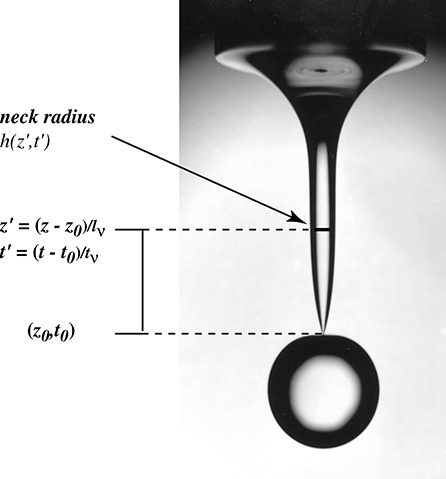
On the supposition that the breakup occurs at a single point
 $z_{0}$
, and at an instant
 $t_{0}$
(see Figure 1), we can measure spatial and temporal distance from the singularity in terms of the dimensionless variables:

In effect, the scales
 $l_{\nu }$
and
 $t_{\nu }$
characterize the width of the critical region around the singularity.
Water droplet at breakup. Courtesy of Sidney R. Nagel from Nagel (Reference Nagel2001).

It is possible now to demonstrate that a scaling or similarity solution in the variables
 $z^{\prime }$
,
 $t^{\prime }$
exists that describes
 $h(z^{\prime },\: t^{\prime }) $
—the drop radius or “shape” function:

where the similarity variable ξ is defined as follows:

One can determine the values of the scaling exponents α and β from dimensional analysis. Eggers then shows, both analytically and numerically, that the similarity solution (6) does hold for the problem. One finds the function Φ by inserting the similarity solution into a nondimensionalized version of the fundamental differential equation for the problem derived from the Navier-Stokes equations given the simplifying assumptions mentioned above. It turns out that this solution is in excellent agreement with the full solutions for the (one-dimensional) Navier-Stokes equations at low viscosities.Footnote 4
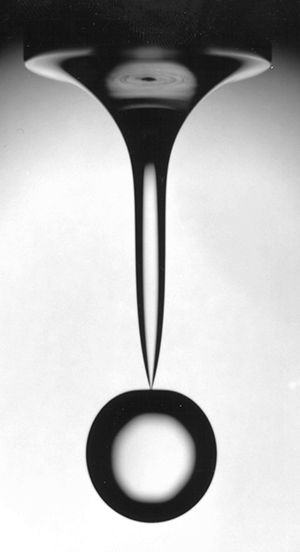
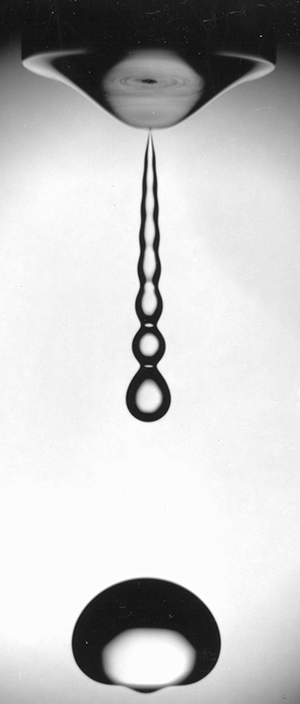
The existence of such a similarity solution in the variable ξ indicates that the shape of breaking drops is universal. One can see evidence of this by examining the shapes in Figures 2 and 3.
Water droplet at breakup. Courtesy of Sidney R. Nagel from Nagel (Reference Nagel2001).

Water droplet after breakup. Courtesy of Sidney R. Nagel from Nagel (Reference Nagel2001).

Notice the cone-to-sphere shape in Figure 2 and note the identical shape at the top of the about-to-break satellite drop in Figure 3. This demonstrates that how the drop is formed (whether, for instance, it drips solely under the influence of gravity or is sprayed in the air by a crashing wave) is irrelevant for the shape it takes on as it breaks.Footnote 5
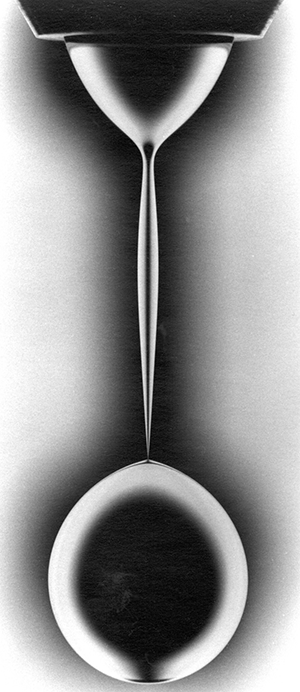
In fact, this similarity solution characterizes an entire class—a universality class—of fluids at breakup. This class is, in part, determined by the ratio of the viscosity of the fluid to the viscosity of the surrounding medium. For example, the shape of water drops dripping from a faucet surrounded by air (Figures 2 and 3) in which
 $\nu _{\mathrm{int}\,}\gg \nu _{\mathrm{ext}\,}$
is different than that of a drop forming in a fluid surrounded by another fluid of approximately the same viscosity (Figure 4) where
 $\nu _{\mathrm{int}\,}\approx \nu _{\mathrm{ext}\,}$
.Footnote 6
Two fluid breakup:
 $\nu _{\mathrm{int}\,}\approx \nu _{\mathrm{ext}\,}$
. Courtesy of Sidney R. Nagel from Nagel (Reference Nagel2001).

That these shapes are to be expected is completely accounted for by the nature of the similarity solution (6) just prior to breakup. Furthermore, Eggers has shown that for scales sufficiently larger than the microscopic, it is actually possible to continue, uniquely, the similarity solution before breakup to one that holds beyond the singularity, after breakup. At breakup some molecular mechanism must come into play, but the uniqueness of this continuation is an indication of the self-consistency of the hydrodynamic description. The striking conclusion is that the evolution of the fluid both before and after breakup is independent of the molecular microscopic details.
So the existence of the scaling solutions to the one-dimensional Navier-Stokes equations provide evidence for the universality of the phenomenon. And, as a result, it is possible to explain why different fluids, of different viscosities, dripping from different nozzles, and so on, will exhibit the same shape upon breakup.
3. Molecular Dynamics
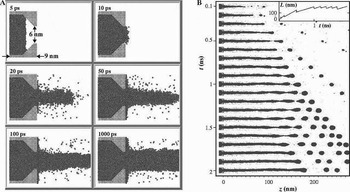
Let me now describe the drop breakup problem from the point of view of state-of-the-art simulations in molecular dynamics. Michael Moseler and Uzi Landman (Reference Moseler and Landman2000) investigate the formation, stability, and breakup of jets at the nanolevel. They model propane as it is injected into a vacuum through a nozzle of diameter 6 nanometers. The simulation involves following approximately 200,000 propane molecules as they are pushed through a nozzle composed of gold molecules at various pressures.
The nanojets in Figure 5 were simulated by pressurizing the nozzle downstream at 500 MPa (million Pascals) and a controlled temperature within the nozzle of 150 K. This results in a 200 m/s flow velocity for the jet. For
 $t< 1$
nanosecond following the initial exit of the fluid, the flow exhibits transient behavior. In Figure 5B, one can see the beginnings of the formation of fast moving droplets and molecular clusters in this initial period, and after that one sees the formation of necking instabilities resulting in breakup and the formation of drops. Moseler and Landman note that for
 $t\geq 1$
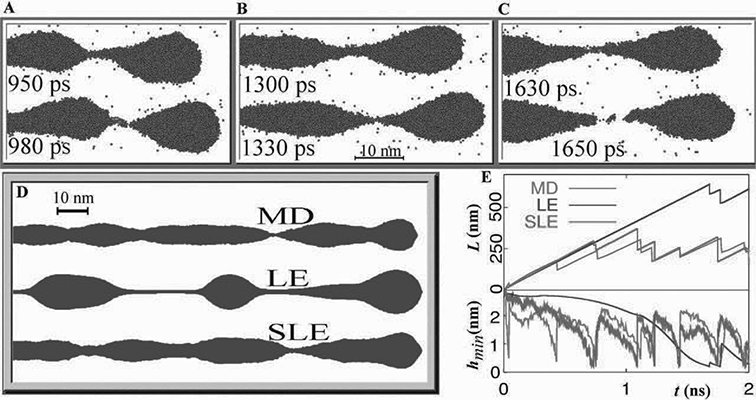
nanosecond, a steady state is achieved with an average breakup length of 170 nanometers. They report that, upon repeated simulations, the typical shape at breakup resembles a double cone as shown in Figure 6B and the upper image in Figure 6D. Occasionally, however, they witness the formation of nonaxisymmetric necks as in Figure 6A and an elongated neck configuration as in Figure 6C which was accompanied by the formation of small “split-off” molecular clusters or “satellite drops.”
Formation of nanojets. Courtesy of Uzi Landman from Moseler and Landman (Reference Moseler and Landman2000, 1166).

Molecular dynamical configurations of nanojets. Courtesy of Uzi Landman from Moseler and Landman (Reference Moseler and Landman2000, 1168).

If we suppose that the hydrodynamic equations discussed in the last section could apply to the nanoscale drop formation problem, then we would expect the propane (at the nanoscale) to be quite viscous. (Even though, at larger scales, propane is surely not very viscous.)Footnote 7 Viscous fluids such as glycerol or honey exhibit long necks prior to breakup. (Just think about the honey that you drip into your cup of tea, or the maple syrup you pour over your pancakes.) In fact, Moseler and Landman solve the one-dimensional hydrodynamic equations and show that, as expected for a viscous fluid, the propane jet should develop long necks prior to breakup. This is shown in Figure 6D and is the simulation labeled “LE” for “lubrication equations.”
The discrepancy between the double cone shape of the the molecular dynamical simulation and the hydrodynamic description of the same process is a direct indication that continuum deterministic hydrodynamics fails to apply at the nanoscale. Large hydrodynamic fluctuations become important at the nanolevel, signaling a breakdown of the deterministic continuum description. As Moseler and Landman (Reference Moseler and Landman2000, 1168) note, “the continuum description of such small systems requires the use of exceedingly small volumes, each containing a very limited number of particles, and consequently, continuum variables associated with such small volume elements, which represent (local) averages over properties of the microscopic constituents are expected to exhibit large fluctuations.”
Moseler and Landman introduce a stochastic term (Gaussian noise) into the hydrodynamic equations and solve the stochastic continuum equations. They demonstrate remarkable agreement with the dominant double cone shape of the molecular dynamical simulations. This agreement is displayed in Figure 6D. Compare the top molecular dynamical run with the stochastic continuum equations labeled “SLE.” This agreement “strongly suggests that in [nanojets] the very nature of the dynamical evolution is influenced strongly by hydrodynamic fluctuations, deviating in a substantial way from the behavior predicted through the analysis of the deterministic [continuum equations]” (Moseler and Landman Reference Moseler and Landman2000, 1168). Further analysis shows that it is possible to see the failure of the deterministic continuum equations as a consequence of a new length scale becoming important at the nanolevel. Moseler and Landman introduce this so-called thermal capillary length that for most materials is on the order of interatomic distances.
The fact that a new length scale becomes important at the nanolevel is, according to Moseler and Landman, further indication that the universality described above (provided by the scaling solutions to the Navier-Stokes equations) breaks down. As they say, “The appearance of an additional length scale in the [stochastic continuum] simulations … is a direct consequence of the extension to include temperature-dependent stress fluctuations, and its magnitude determines the nature of the jet evolution, including the appearance of solutions other than the universal ones predicted through the deterministic [continuum equations]” (Moseler and Landman Reference Moseler and Landman2000, 1168).
Let me make a few observations and pose a couple of questions concerning the molecular dynamical simulations and their potential for providing explanations for certain aspects of very small-scale drop phenomena. First of all, notice that every molecular dynamical simulation of nanojet formation is different. The images in Figure 6A, B, and C attest to this. While Moseler and Landman (Reference Moseler and Landman2000) assert that “[t]he most frequently observed breakup process [exhibits] close to pinch-off formation of an axisymmetric double cone shape of the neck,” this amounts to a statistical claim based solely upon generalizations from different simulation runs. And, while it is sometimes appropriate to say that the explanatory buck must stop somewhere, one might, in this situation, ask for an explanation of why this is the statistically dominant shape for nanojet breakup.
One important virtue of the scaling solutions to the Navier-Stokes equations discussed in Section 2 is that they allow for exactly such an answer to the analogous explanatory why-question on larger scales. We can explain and understand (for large scales) why a given drop shape at breakup occurs and why it is to be expected. The answer depends essentially upon an appeal to the existence of a genuine singularity developing in the equations of motion in a finite time. It is because of this singularity that there is a decoupling of the breakup behavior (characterized by the scaling solution) from the larger length scales such as those of the faucet diameter. Without a singularity, there is no scaling or similarity solution. Thus, the virtue of the hydrodynamic singularity is that it allows for the explanation of such universal behavior. The very breakdown of the continuum equations enables us to provide an explanation of universality. This is completely analogous to the renormalization group explanation of the universality of critical phenomena.Footnote 8
No such explanation, appealing to a singularity to explain the universal double cone structure, is available from the “fundamental” theory that lies behind the molecular dynamical simulations. If one looks, for example, at any of the results presented in Figure 6A, B, or C, one cannot locate the actual breakup location in either time or space. There is no well-defined singularity in the equations. And, of course, one would not expect there to be, since the Newtonian molecular dynamical equations do not develop singularities in finite times.
4. Reconciliation?
So the question is whether it is possible to provide some kind of theoretical answer to the question of why the double cone structure is to be expected in nanojet breakup. Moseler and Landman show that if one introduces fluctuations into the continuum hydrodynamic equations, and solves those equations, the shape is similar to that typical of many molecular dynamical simulations. But the challenge is to understand the qualitative change in the breakup shape that occurs in the regime in which fluctuations apparently make a leading contribution to the shape function. To put this another way, we would like to have an account of the statistical universality of the double cone structure—one that provides the kind of understanding that the scaling solutions provide for the breakup profile at larger scales by demonstrating that most of the details of the evolution are by and large irrelevant.
In a paper entitled “Dynamics of Liquid Nanojets,” Jens Eggers (Reference Eggers2002) provides the desired explanation. Eggers (Reference Eggers2002, 084502-1) notes that Moseler's and Landman's stochastic continuum equations suggest that “hydrodynamics, at least when suitably generalized to include fluctuations, is fully capable of describing free surface flows down to the scale of nanometers.” There is a simple physical argument to understand what goes on at the nanolevel. One can think of the random noise introduced into the continuum equations as representing a kind of effective force that is generated by the fluctuations. “[A] random fluctuation which increases the thread radius also increases its effective mass, slowing down the motion. Any fluctuation towards a smaller neck radius, on the other hand, accelerates the motion. On average, the fluctuations thus drive the thread towards breakup, in fact more effectively than surface tension” (Eggers Reference Eggers2002, 084502-2).
As Eggers notes, however, conventional perturbative analysis around the deterministic continuum solution cannot describe this mechanism. This is because the fluctuations—the noise—make the dominant contribution. The idea that one can average about a fixed time “no longer makes sense for this problem, because there is a finite probability for pinchoff to have occurred, so the original formulation ceases to be valid. Thus a valid description has to be conditioned on the event of breakup to take place at a fixed time
 $t_{0}$
. It is then natural to ask for the most probable sequence of profiles that brings one from the initial condition to a ‘typical' breakup event” (Eggers Reference Eggers2002, 084502-2). Eggers develops an ingenious and difficult argument involving path integrals to determine probability of the “optimal” path to breakup. For our purposes here, the interesting feature is that to solve this problem he needs to assume, for a fixed breakup time
 $t_{0}$
, that the solution is self-similar. He finds that the unique solution, on this assumption, is the symmetric profile of a double cone unlike the asymmetric long-neck similarity profile for the deterministic equations. It is important that the similarity solution is only possible on the assumption that there is a singularity at
 $t_{0}$
in the (stochastic) hydrodynamical equations. The result is an explanation for why such a symmetric profile is to be expected that is grounded in the “less fundamental” continuum theory of hydrodynamics.
A further consequence of this explanation is that we can understand why so few satellite drops are formed in nanojets and why there is a very narrow distribution in the size of the droplets that are formed. If one looks back at Figure 3, one sees that a satellite drop is about to detach itself from the nozzle at the upper end of the picture. This is a consequence of the asymmetric, long-neck nature of the dripping process. That smaller satellite molecular clusters, such as that in Figure 6C, are rare is a direct consequence of the universality of the double cone profile for nanojets. They occur only for large fluctuations in the neck region which are statistically rare.
So surface tension driven pinching at larger scales essentially determines the breakup time. Nevertheless, at times very close to that, a different process dominated by fluctuations takes over, speeding up the breakup at the nanoscale. The transition between these different scaling regimes can be understood in terms of the emergence, as one approaches the nanolevel, of a new length scale—the thermal capillary length. Most importantly, however, our understanding of this transition and of the universality of the different profiles depends essentially upon singularities in the continuum hydrodynamical equations. The details of the molecular dynamics drop out of our explanation of the origin of the different universality classes.
5. Conclusion
I began this paper with a passage from David Nelson's book to the effect that sometimes, “fundamental” theory will be unlikely to “resolve” various important problems. The case of a dripping faucet is, I believe, a representative example of just such a problem. I have tried to show that a complete understanding (or at least an attempt at a full understanding) of the drop breakup problem requires essential use of a “nonfundamental” theory—namely, the continuum Navier-Stokes theory of fluid dynamics. But, of course, if we think of the molecular theory as fundamental, then there is a conflict. How can a false (because idealized) theory such as continuum fluid dynamics be essential for understanding the behaviors of systems that fail completely to exhibit the principal feature of that idealized theory? Such systems are discrete in nature and not continuous.
I think that we may be able to better understand what is going on here if we examine exactly what is meant by “fundamental theory.” Throughout this paper I have placed the term in scare quotes for a reason. I think that the term “fundamental theory” is ambiguous. On the one hand, there is a clear sense in which the molecular theory is more fundamental than the fluid dynamical theory. It is more fundamental because it more accurately describes the genuine nature of the system. Fluids are composed of a finite number of molecules, and when we are looking at fluids around the scale of intermolecular distances, that theory most correctly characterizes the system of interest. This is a sense in which the molecular theory is ontologically fundamental. It gets the metaphysical nature of the system right.
On the other hand, I have argued here and elsewhere that such ontologically fundamental theories are often explanatorily inadequate. Certain explanatory questions—particularly, questions about the emergence and reproducibility of patterns of behavior—cannot be answered by the ontologically fundamental theory. I think that this shows that, for many situations, there is an epistemological notion of “fundamental theory” that fails to coincide with the ontological notion.
Explanations of universal patterns of behavior require means for eliminating details that ontologically distinguish the different systems exhibiting the same behavior. Such means are often provided by a blow-up or singularity in the epistemologically more fundamental theory that is related to the ontologically fundamental theory by some limit. In the present case, the Navier-Stokes equations for free surface flows contain the seeds of their own destruction—they can develop singularities in finite times. But far from rendering the theory useless, out of the singularity is born the explanatory structure needed for full understanding.
In a brief communication in Nature entitled “Euler's Disk and Its Finite-Time Singularity,” H. K. Moffatt (Reference Moffatt2000, 833) states that “nature abhors a singularity, and some physical effect must intervene to prevent its occurrence.” In one sense, the above investigation bears this out. We see no real singularity in the molecular dynamical simulations of nanojet breakup. The finite-time singularity in the Navier-Stokes equations is prevented by the molecular mechanisms that that theory (legitimately) ignores. In another sense, though, nature needs the singularities. For without them, one cannot fully characterize, describe, and explain the emergence of new universal phenomena at different scales.
Finally, there is another way of thinking about a certain aspect of this problem. The molecular dynamical simulations of Moseler and Landman allow for a Humean statistical generalization: most simulations appear to yield a double cone structure for nanojet breakup. But the simulations do not provide any theoretical account or explanation for this statistical generalization. Rather, in order to account for the empirical generalization at the “fundamental” level of molecular dynamics, we must appeal to the non-Humean similarity solution (resulting from the singularity) to the idealized continuum Navier-Stokes theory.