Introduction
Water submersion is the third most common cause of death by accidental injury worldwide.Reference Kaur, Drummond and Furyk 1 Historically, these deaths have been attributed to hypothermia; however, recent research suggests a possibility of arrhythmogenic syncope contributing to water submersion deaths. 2 Research has been undertaken previously to investigate the risk of cardiac arrhythmias during cold water submersion in healthy individuals. This has identified a high incidence of cardiac arrhythmias in study participants with figures ranging from 60% to 81%. It should also be noted, the dysrhythmias observed were asymptomatic and thought to be of little clinical significance.Reference Tipton 3 , Reference Tipton, Kelleher and Golden 4
The case discussed below describes a fit and healthy individual experiencing arrhythmia secondary to cold water submersion during helicopter underwater escape training (HUET). Helicopter underwater escape training scenarios involve the participants being immersed in cold water while in an aircraft simulator with the aim of improving survival.
Report
A 32-year-old, Caucasian male presented with a less than 24-hour history of palpitations with the onset following participation in HUET. He reported no chest pain, shortness of breath, syncope, or pre-syncope symptoms.
There was a past medical history of well-controlled asthma, having had no symptoms in 10 years. He had no personal history of cardiac disease, although there was a family history of hypertension.
On examination, an irregularly irregular pulse was noted at a rate of 120 beats per minute with a blood pressure of 132/84. Heart sounds were normal with no added sounds. The chest was clear with good air entry bilaterally with oxygen saturations of 99% on room air. No peripheral oedema was noted and the jugular venous pressure was not elevated clinically. The patient was afebrile.
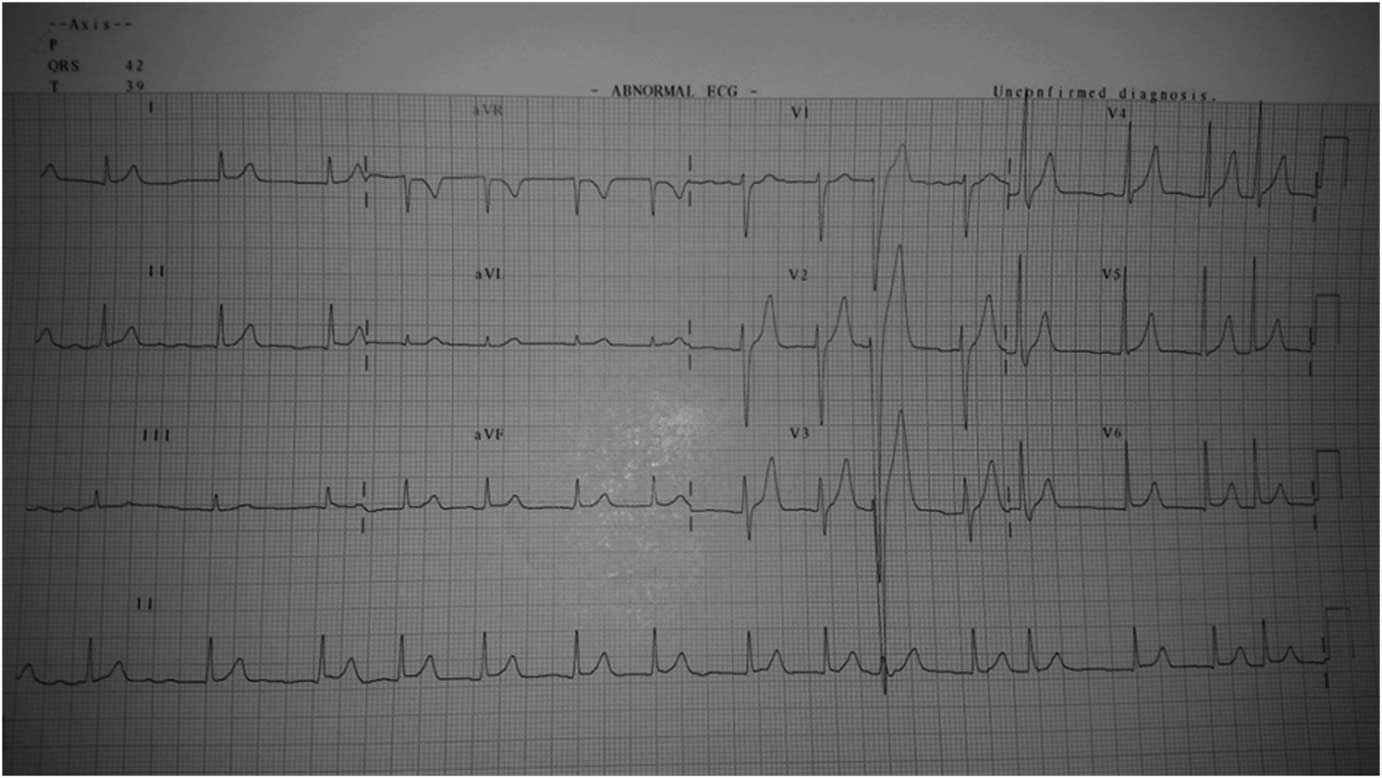
The electrocardiogram (ECG) demonstrated atrial fibrillation at 97 beats per minute with a normal axis, normal QRS complexes, and a QTc of 399 ms (Figure 1).
The ECG Demonstrating Atrial Fibrillation. Abbreviation: ECG, electrocardiogram.

Bloods, including full blood count, renal function, electrolytes (sodium, potassium, calcium, magnesium, and phosphate), liver function tests, and troponin and thyroid function tests were all within normal limits.
The chest x-ray was normal.
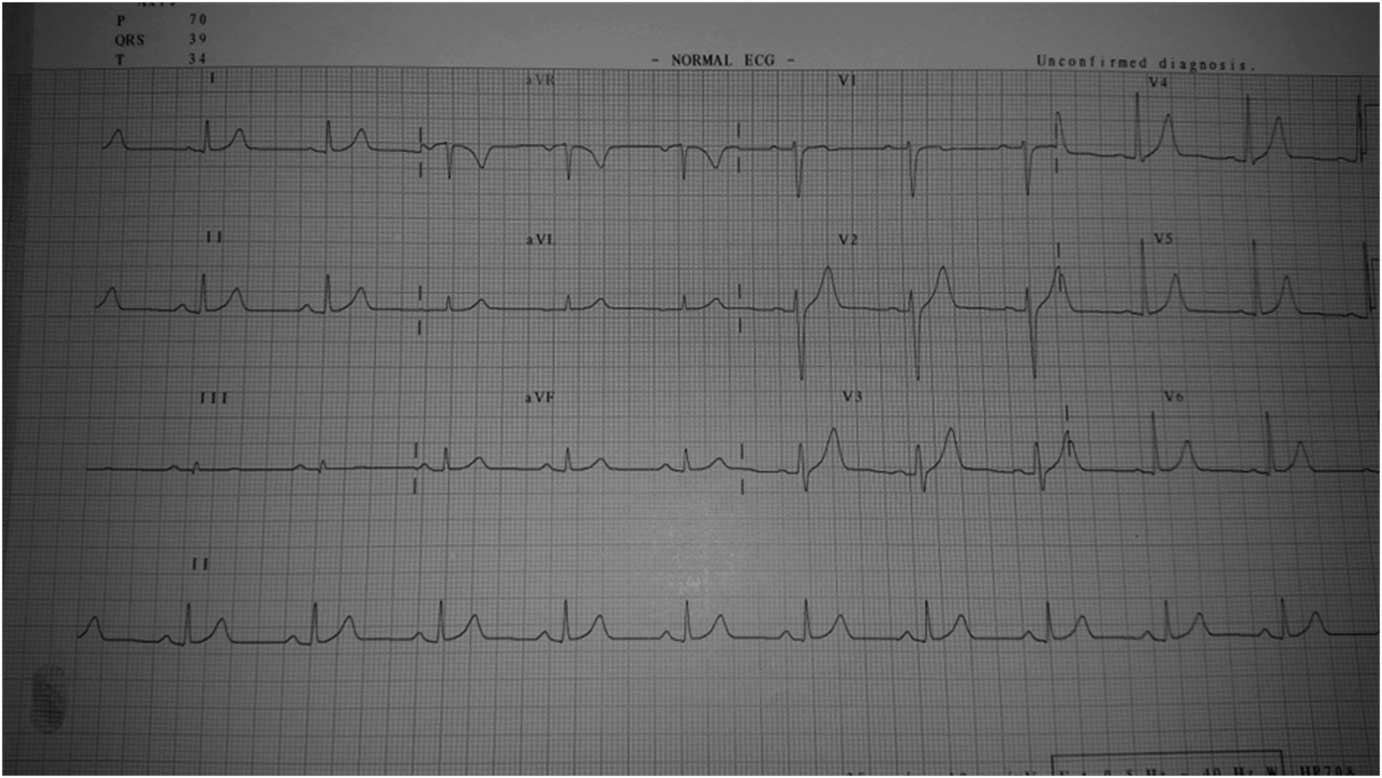
The patient was loaded with amiodarone and reverted to sinus rhythm with a normal post reversion ECG (Figure 2).
The Patient Reverted to Sinus Rhythm with a Normal Post Reversion ECG. Abbreviation: ECG, electrocardiogram.

Five years on, following further HUET, the patient attended the emergency department with an identical presentation. His ECG showed fast atrial fibrillation at a rate of 115 beats per minute. On this occasion, he was sedated and Direct Current cardioverted with reversal to sinus rhythm after one shock.
It was felt that the precipitating factor for this patient’s atrial fibrillation, in both cases, was HUET.
Discussion
Helicopter underwater escape training is a training program for professionals who are required to fly over or near water. It is mandatory training for aviation medical professionals, firefighters, and marine pilots. It involves simulated scenarios with an aircraft simulator being submerged in water and rotated 180 degrees from which participants must escape. The aim is to increase post-accident underwater survival.Reference Datta and Tipton 5 Prior to participation in the course, medical clearance is required, which includes a cardiovascular examination; however, this is not required to include an ECG. 6 In this case, non-heated pools were used, which were kept at a temperature of approximately 20 degrees Celsius.
It has been observed that participants of activities involving water submersion may develop an arrhythmia. 7 It is thought that the sympathetic nervous system is stimulated by both the stress of the situation and by submersion in cold water. This is known as the “cold shock response” and results in the release of stress hormones, including adrenaline causing tachycardia and hypertension. However, concurrent activation can occur of the parasympathetic nervous system, triggered by breath holding, as well as the sudden cooling of the face, in particular the ophthalmic division of the trigeminal nerve. This triggers what is known as the “diving response” resulting in bradycardia. This simultaneous stimulation of both the sympathetic and parasympathetic nervous systems results in what is known as the “autonomic conflict.” It is proposed that this autonomic conflict is the cause of the high incidence of cardiac arrhythmias observed during and after cold water submersion with breath holding.Reference Shattock and Tipton 8 , Reference Tipton, Gibbs, Brooks, Roiz de Sa and Reilly 9
Variables affecting the probability of an arrhythmia occurring include the extent of an individual’s sympathetic and parasympathetic response, as well as their age, fitness, habituation to the stimulus, and clothing. The effect of the actual water temperature is of unclear significance. A review of the literature has shown a range of temperatures described as cold, but that dysrhythmias can develop with submersion in water up to 29.5 degrees Celsius.Reference Shattock and Tipton 8
A number of arrhythmias have been observed in subjects undergoing submersion and breath holding, predominantly supraventricular and junctional rhythms. Prevalence of arrhythmias in these studies varies between 60% in subjects with submersion and breath holding without face immersion and 81% with face immersion.Reference Tipton 3 , Reference Tipton, Kelleher and Golden 4
However, in these studies, all subjects who developed arrhythmias were asymptomatic, and furthermore, the arrhythmias self terminated. Compared to these studies, the case described in this report is unusual given the arrhythmia was symptomatic and sustained for a number of hours until terminated by medical intervention.
Conclusion
The case discussed describes a previously fit and well subject who developed a sustained arrhythmia secondary to cold water submersion. Evidence suggests water submersion can provoke cardiac arrhythmias via the suggested theory of autonomic conflict.Reference Shattock and Tipton 8 , Reference Tipton, Gibbs, Brooks, Roiz de Sa and Reilly 9 It has been proposed that a number of unexplained deaths related to water submersion may be secondary to arrhythmogenic syncope. 2