1 Introduction
When trying to express an action or process involving an agent and a patient, speakers of English are faced with a choice between two basic options, the active and the passive voice, as in (1) and (2) respectively:
(1) My boss has hired John as her new assistant.
(2) John has been hired by my boss as her new assistant.
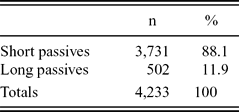
While the active sentence in (1) displays an agent + patient word order, the long passive (or passive with an overt agent, see Biber et al. Reference Biber, Johansson, Leech, Conrad and Finegan1999: 154) illustrated in (2) serves as a reversing-order strategy, yielding the opposite arrangement of constituents, patient + agent.Footnote 2 Other strategies, such as topicalisations and left-dislocations, are available in English to alter the basic configuration of linear order, but they differ from passives in being clearly more marked from both a pragmatic and a stylistic point of view, mostly because they result in deviation from the basic SV(O) order (see Siewierska Reference Siewierska1984: 234−6; Maslova & Bernini Reference Maslova and Bernini2006: 113, Sornicola Reference Sornicola2006: 392). As for short passives, they are in fact a more frequent alternative to the active than long passives, accounting for more than 80 per cent of all passive constructions in Svartvik (Reference Svartvik1966: 141), 86 per cent in Biber et al. (Reference Biber, Johansson, Leech, Conrad and Finegan1999: 938), and more than 88 per cent in my own corpus here (see table 2). However, the primary motivation for the use of short passives is to background the agent/experiencer of the action by omitting it. That is, only long passives constitute order-rearranging strategies yielding unmarked SV(O) order which can count as equivalent alternatives to the active construction.
A number of competing motivations determine the choice between actives and long passives, and the aim of this article is to identify these, examining their interactions and assessing their strength and independence in Modern English. Although long passives are of fundamental concern here, the empirical evidence provided will also serve to address more general issues pertaining to the status and interaction of syntactic complexity, animacy, and discourse structure in grammatical variation, a topic which has received considerable attention in recent years but which is still in need of ‘more systematic investigations . . . in a wider range of constructions and languages’ (Wasow Reference Wasow2002: 82).
This article is organised as follows. Section 2 deals with the nature of active vs long passive variation in English, while section 3 identifies the major factors involved in the choice between active and long passive. Section 4 presents the analysis of corpus data, reflecting on the nature of those factors found to be at work and on their possible interactions. Finally, section 5 summarises the conclusions drawn from the study.
2 Active vs long passive variation in English: choice of topic/subject
As already noted, a number of factors interact in the choice between actives and long passives. For their identification it is essential to understand the nature of long passives not only as order-rearranging devices, which is how I have described them thus far, but also as topicalising constructions: passives, by locating a patient or benefactive noun phrase in initial position, serve the purpose of assigning it topic and subject function. Consequently, it is necessary to take into account that it is the assignment of subject and topic that is at issue in active vs passive variation, not merely the reorganisation of elements in the clause. For this reason, this section will briefly examine the characteristics of topics/subjects in English, since from these stem the factors which determine voice variation, which are further discussed in section 3.
The notion of topic has been variously described and there is no all-encompassing definition. In general, however, topics are characterised as having a semantic, pragmatic and syntactic dimension. From a purely semantic perspective, topic tends to be defined as the constituent which expresses what the clause is about, thus assuming the position of the referent about which something is predicated (Levelt Reference Levelt1989: 151; Lambrecht Reference Lambrecht1994; Kiss Reference Kiss and Siewierska1998; Sornicola Reference Sornicola2006: 375–7). At the pragmatic level, topic has generally been viewed as having an anchoring function, that is, it provides information which is given or old in the listener's presumed state of knowledge, hence available for quick retrieval (Dahl Reference Dahl and Dahl1974; Chafe Reference Chafe and Li1976; Prince Reference Prince and Cole1981; Maslova & Bernini Reference Maslova and Bernini2006: 70). These two characterisations, which point to a high degree of accessibility,Footnote 3 determine the eligibility of noun phrases to become topics and thus have an effect on the choice between active and long passive (see the familiarity hierarchies, section 3).
In terms of syntax, topic is identified with clause-initial position (Chafe Reference Chafe and Li1976; Li & Thompson 1976; Halliday Reference Halliday1985; Sornicola Reference Sornicola2006: 378). Placing topical material in initial position constitutes an addressee-oriented strategy since initial topics provide the addressee with an easily accessible and familiar referent that can serve both as a link with previous discourse and as the perspective from which the new information in the sentence can be interpreted (Prince Reference Prince and Cole1981: 224; Sornicola Reference Sornicola1994: 4639). The import of this correlation for the choice between active and long passive is captured in the formal hierarchy (see section 3).
Another characteristic of topics in English, which also applies to the topics in long passives, is their tendency to be encoded as the grammatical subject. This tendency is explained by the fact that subjects, like topics, (i) generally occupy initial position, and (ii) usually convey easily accessible language data, for the reasons which follow here. Firstly, subjects normally have human referents, which reflects the primary interest of speakers in themselves, in their interlocutors and in other humans (Levelt Reference Levelt1989: 152, Siewierska Reference Siewierska1994: 4996). Secondly, subjects most often play the semantic role of agent, which is pragmatically prominent because actions and events in the real world start with the agent, and, as the Iconicity Principle predicts, a coded experience will be easier to store, retrieve and communicate if it is coded in such a way that its structure corresponds to the order of things in the real world and mirrors universally accepted perceptions of salience and dominance (see Levelt Reference Levelt1989: 138; Siewierska Reference Siewierska1994; Horie 2000; Maslova & Bernini Reference Maslova and Bernini2006: 85–8). These two features of subjects, animacy and agentivity, correlate with easy accessibility of the language material, which in turn involves easy and smooth, almost automatic, processing on the part of the hearer (Halliday Reference Halliday, Lockwood, Fries and Copeland2000; Sornicola Reference Sornicola2006: 477). The correlation between topic and human/agent subjects is one of the reasons behind the predominance of actives over passives in English and is supposed to be a crucial factor controlling the active–passive choice (Givón Reference Givón1979; Bock 1982; Foley Reference Foley1994). As will be duly explained in section 3, the import of this correlation is captured in the dominance hierarchies: the animacy, empathy and semantic role hierarchies (Siewierska Reference Siewierska1988: 29ff.).
The above characterisation of topic and its close association with the subject function determines the factors that, in turn, control the choice between the active and the long passive, which are the concern of the following section.
3 Determinants of active vs long passive variation in English
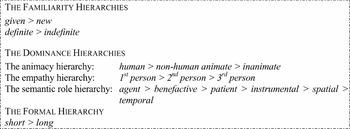
As shown in section 2, active vs long passive variation largely depends on the choice of subject/topic. Given the sequence JOHN FLOWERS BUY, the speaker may decide to select John as the topic and will thus produce the active John is buying some flowers, or may wish to topicalise flowers and thus say Some flowers are being bought by John. The eligibility of the subject/topic depends on an array of crosslinguistic factors which are represented in several prominence hierarchies. These are not categorical but describe tendencies, and apply specially to SVO languages (Sornicola Reference Sornicola2006). As figure 1 illustrates, they can be classified into three broad groups (see Siewierska Reference Siewierska1988: 29ff.; Seoane Reference Seoane, van Kemenade and Los2006). Noun phrases with features figuring at the left of these hierarchies are the most likely candidates to become topics and occupy initial position, thus determining active vs long passive variation.
Prominence hierarchies
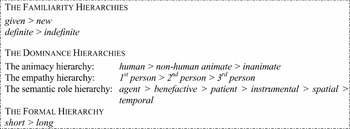
The hierarchies in figure 1 allow us to make some predictions regarding the long passives in our corpus: for instance, according to the first familiarity hierarchy, they should contain subjects which are more given than their by-phrases. However, there is no consensus among scholars on the notion of givenness. The same is the case with the notions of animacy or length, and for this reason the remainder of this section will discuss the different categories included in figure 1 as they have been understood and applied to long passives in this article.
Two of the hierarchies are straightforward: (i) the empathy hierarchy, which predicts that, within human referents, speech-act participants – that is, noun phrases with first- and second-person referents – outrank human third-person referents (see Kuno & Kaburaki Reference Kuno and Kaburaki1977); and (ii) the semantic hierarchy, according to which the most likely candidates to become topics are noun phrases with the role of agent, followed by those with the role of benefactive, patient and oblique (Siewierska Reference Siewierska1994). The other hierarchies, however, involve categories which need further clarification.
Starting with the first of the familiarity hierarchies, given-before-new is a simplified representation of a more general category normally referred to as discourse status (Arnold et al. Reference Arnold, Wasow, Losongco and Ginstrom2000) or pragmatic information status (Hawkins Reference Hawkins2004), and concerns the accessibility of information to discourse participants (Prince Reference Prince and Cole1981, Reference Prince, Thompson and Mann1992; Gundel et al. Reference Gundel, Hedberg and Zacharski1993; Birner & Ward Reference Birner and Ward1998; Arnold et al. Reference Arnold, Wasow, Losongco and Ginstrom2000; Huddleston & Pullum Reference Huddleston and Pullum2002; Sornicola Reference Sornicola2006: 470). Discourse status has often been encapsulated in the binomial category given and new as in figure 1, since it constitutes a straightforward and useful coding scheme for empirical studies. We should not forget, however, that this dichotomy is simply a construct, one that fails to capture the fact that given and new are two points on a continuum of accessibility. In view of this, different authors have proposed more comprehensive accounts of accessibility, which take into account the recency of mention in the previous discourse and the degree of inferability of information and how these may affect the cognitive status of the hearer. Thus, for example, Levelt (Reference Levelt1989) proposes to classify information in four distinct categories: brand new, inferable,Footnote 4 accessible and in focus. Prince (Reference Prince, Thompson and Mann1992), on the other hand, suggests three categories: discourse given, inferable, discourse new (see also Birner Reference Birner1996). Other helpful taxonomies can be found in Gundel et al. (Reference Gundel, Hedberg and Zacharski1993), Chafe (Reference Chafe1994: 72, Reference Chafe1996: 40), Lambrecht (Reference Lambrecht1994: 165) and Biber et al. (Reference Biber, Johansson, Leech, Conrad and Finegan1999), among others. While I acknowledge the rigour and theoretical soundness of these proposals, I believe that in the present study, which aims to identify those factors which determine the ordering of clausal elements, we need to focus on the relative information status of two constituents in particular, the syntactic subject and the by-phrase, and for this purpose, given and new are perfectly valid values. If given and new are indeed scalar concepts, and allow for different degrees of givenness and newness, then this is also the case with the taxonomies described above. For example, a noun phrase whose referent is said to be inferable in Prince's (Reference Prince, Thompson and Mann1992) model, or hearer-old in Birner's (Reference Birner1996) account, is equally scalar, and it would be difficult to perceive exactly the extent to which a ‘highly inferable’ referent should be lower on the accessibility continuum than a ‘discourse given’ one. As scalar concepts, further refinement of the categories given, new, inferable, and so on is always possible and potentially of interest, but there is no guarantee that finer-grained distinctions in discourse status will necessarily affect the findings of analysis into ordering preferences (Wasow & Arnold Reference Wasow, Arnold, Rohdenburg and Mondorf2003: 129–30).
In this study, therefore, the givenness and newness of the referents involved was established by assessing the linguistic and extralinguistic contexts. Thus, I have classified a referent as given (i) when it has been mentioned in the previous linguistic context, (ii) when it is inferable from knowledge of the world (e.g. stereotypical agents such as the doctor in The doctor operated on her urgently), or (iii) when it is present in the extralinguistic context, that is, when it is within the perception of both interlocutors (e.g. deictic elements such as this table in This table was brought in only today). New classifies a referent that is mentioned for the first time, is new in the linguistic and extralinguistic context, and is not inferable from knowledge of the world. As already mentioned, what is important in this study is the relative discourse status of subject and by-phrase. Consider example (3):
(3) This, therefore, makes me think it reasonable to suppose it is not from this quarter that Mr Pope hath been ill used, but must have been betrayed by his English Servants, who have more Cunning and a readier way of making money of them than ours have here; (1740. The Correspondence of Alexander Pope. Vol. IV. ARCHER)
The nominal constituents of this long passive have been classified as given/new, because the subject, Mr Pope, is repeatedly mentioned in the previous context, whereas the referent of the by-phrase, his English servants. . ., is mentioned for the first time. I am aware, however, that not all the information conveyed in the by-phrase is new, since anaphoric his, referring to Mr Pope, is given information. In fact, a by-phrase like this would be classified by Biber et al. (Reference Biber, Johansson, Leech, Conrad and Finegan1999), for example, as given/new. In this study, since it provides information which is clearly newer than that of the subject, the example is classified as containing a given subject and a new by-phrase.
The second familiarity hierarchy, definite > indefinite (see figure 1), concerns the degree of definiteness of the noun phrases involved, which is an important grammatical correlate of the distinction between identifiable and unidentifiable referents. In other words, the form of referring expressions is determined by the cognitive status of the referent in the hearer's mind, and for this reason we can expect the topics in our long passives to be highly definite elements such as pronouns, proper names and definite noun phrases (Ariel Reference Ariel1990; Gundel et al. Reference Gundel, Hedberg and Zacharski1993; Lambrecht Reference Lambrecht1994: 79; Kiss Reference Kiss and Siewierska1998: 683).
It is important to bear in mind that in this study definiteness is taken to be a formal property of noun phrases, not a conceptual property of the referents they invoke (see Lee Reference Lee1996 for a discussion of semantic definiteness). For this reason, we could in principle be faced with mismatches such as that illustrated by wine in Wine can be good for your health. The formally indefinite noun phrase wine refers to an identifiable and accessible entity, and hence is encoding given or old material. However, in our hierarchy it aligns itself with other indefinite noun phrases, which typically encode new material. In the present corpus no exceptions were found to the correlations definite−given and indefinite−new. The noun phrases involved in the passives in the corpus were classified, from most to least salient, in the following classes: pronouns > proper nouns / proper names > definite noun phrases > indefinite noun phrases (see Chafe Reference Chafe and Li1976; Prince Reference Prince, Thompson and Mann1992).
The animacy hierarchy, originally proposed by Silverstein (Reference Silverstein and Dixon1976), contains the elements human [+H+A] > non-human animate [−H+A] > inanimate [−H−A]. Animacy, as shown in the personal hierarchy here, is a simplified conceptualisation which only distinguishes the core prototypical cases, that is, individual human beings, non-human animates such as animals, and inanimate entities. However, other fuzzy referents can be found in language, such as inanimate entities being conceptualised as humans. This is the case, for example, with personifications, such as Nature is generous, metonymical extensions, as in Spain celebrated its victory in the championship, and the conceptualisation of certain collective nouns, such as government or company as a group of people (see Dahl & Fraurud Reference Dahl and Fraurud1996: 62–3; Rosenbach Reference Rosenbach2007: 153–5). Only prototypical cases were found in the long passives in the corpus.
As for the formal or structural hierarchy, the traditional Principle of End Weight formulated in Quirk et al. (Reference Quirk, Greenbaum, Leech and Svartvik1972) predicts that long, heavy constituents tend to occupy the final position of the clause. Weight, or structural complexity, has been characterised in a variety of ways; some scholars consider weight in the sense of length, that is, the number of words or syllables in a constituent (Altenberg Reference Altenberg1982: Rosenbach Reference Rosenbach2002, Reference Rosenbach2005, Reference Rosenbach2007), while others take complexity into account, the number of nodes and phrasal nodes dominated, for example (see especially Hawkins Reference Hawkins1994, Reference Hawkins2004). These characterisations are broadly in correlation with each other, since complex constituents also tend to be longer, and in fact it is still a matter of contention as to whether these characterisations are distinct or not (Wasow Reference Wasow1997, Reference Wasow2002; Wasow & Arnold Reference Wasow, Arnold, Rohdenburg and Mondorf2003).
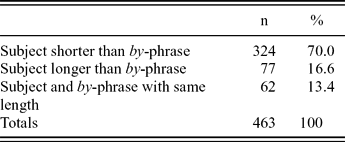
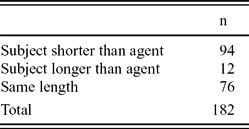
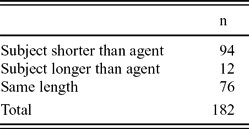
Another significant consideration regarding syntactic complexity is that it is the relative weight of relevant constituents that affects ordering, not the absolute weight of any one constituent (see Wasow Reference Wasow1997: 91, Reference Wasow2002: 30; Hawkins Reference Hawkins1994; Arnold et al. Reference Arnold, Wasow, Losongco and Ginstrom2000: 29). For this reason, this variable is coded here in three categories: (i) subject shorter than by-phrase; (ii) subject longer than by-phrase; (iii) subject and by-phrase with same length (table 6). An additional advantage of considering the relative weight of the two constituents is that it allows us to observe the graded nature of weight effects, as will become apparent in section 4.2.
All these hierarchies have been examined in relation to the long passives in the corpus, as section 4 below shows.
4 Corpus analysis: the choice between active and long passive in Modern English
The analysis of active vs long passive variation was conducted in a 300,000-word corpus of Modern English. The Early Modern English sample (1500–1700) contains 150,000 words and is taken from the Helsinki Corpus (see Kytö Reference Kytö1993). The Late Modern English data (1700–1900) are drawn from (i) 125,000 words belonging to the British English part of ARCHER (see Biber et al. Reference Biber, Finegan, Atkinson, Fries, Tottie and Schneider1994), and (ii) 25,000 words of British English legal texts, which are not represented in ARCHER and have been especially compiled for this article, using extracts of laws and statutes from the period.
The text-types represented in my corpus are Sermons, Science, Law, Drama, Fiction and Private Letters, with 25,000 words per subperiod each. Even though the corpus evidence used in this study covers several centuries and different text-types, the observed patterns are generally consistent across timeFootnote 5 and registers. For this reason, the focus of the study is not diachronic and the register parameter is not pursued further.
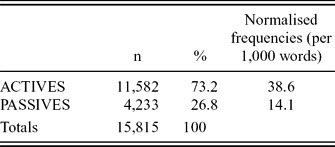
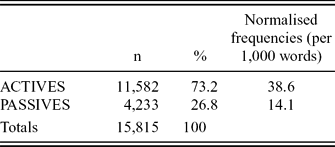
Table 1 shows the normalised frequencies of passives per 1,000 words, as well as the ratio of passives to actives. The count of active constructions is restricted to those for which a passive counterpart would be available, that is, active transitive structures with a patient or benefactive noun phrase eligible to become subject of a passive clause. Table 2 provides the proportion of long passives in the corpus.
Number and ratio of actives and passives, with indication of relative frequency
Number and percentage of short and long passives
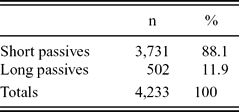
As table 2 shows, the corpus contains 502 long passives. The hierarchies outlined in section 3 above, however, can only be applied to nominal constituents. As a consequence, 39 long passives were excluded for containing clausal constituents, as illustrated in example (4) below (clausal extraposed subject in square brackets). Since I am interested in linear ordering, examples where the agent precedes the subject have also been excluded, such as in the case of (5) (by-phrase and subject in bold type).
(4) And be it further enacted by the authority aforesaid, [That the sum of twenty one thousand pounds, . . . shall, if not before paid by the said trustees, be allowed to . . .] (The UK Law Statute Database. Act of Settlement 1700 c.2, II)
(5) If he had broke the spell by which we are bewitched to the continent, I would have pronounced him the greatest man that ever lived. (1759. The letters of Samuel Johnson. Vol. I. ARCHER)
After excluding examples like these, only 463 examples of long passives remained. These were analysed in relation to the hierarchies described in the previous section. The results yielded by two of the hierarchies had to be discarded because the number of instances that they could be applied to were too low to draw any kind of conclusion. The first of these was the empathy hierarchy: in the corpus there were fewer than 20 long passives involving speech-act participants (as exemplified in (5) above). The second hierarchy to be discarded was that of semantic role, a hierarchy which shows that the most likely candidates to become subjects/topics are the noun phrases bearing the semantic role of agent, followed by that of benefactive > patient > instrumental > spatial > temporal. In the case of passives, the only possible choice is that between a benefactive noun phrase (as in John was given a red rose) and a patient noun phrase (?A red rose was given John), and such a choice is only offered by passives derived from a ditransitive active (They gave John a red rose). As was the case with the empathy hierarchy, the number of passives derived from ditransitive actives was too low to be considered indicative of any trend in the use of long passives. The few instances found do, however, correspond to the predictions in the hierarchy, as can be seen in example (6).
(6) At her approach Sosander, with a stern countenance and in a haughty commanding tone, thus began. ‘Mistress’, said he ‘what's the meaning I am thus opposed by you? Is this your obedience?’ (1723. Arthur Blackmore. Luck at Last, or the Happy Unfortunate. Four before Richardson. ARCHER)
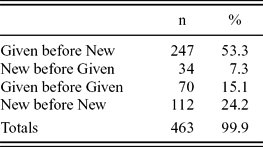
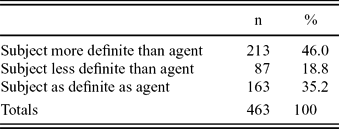
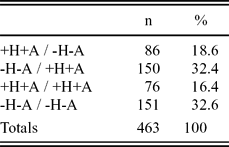
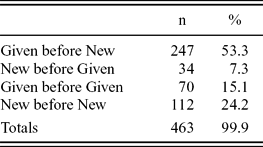
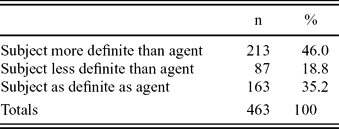
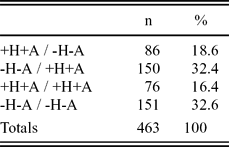
Analysis of the effects of the remaining hierarchies on the long passives in the corpus yields the results set out in tables 3 to 6. The first row in each table corresponds to the optimal ordering predicted by these hierarchies, that is, given precedes new (table 3), subject is more definite than by-phrase (table 4), human precedes nonhuman (table 5), and short precedes long (table 6).
Accessibility of the information conveyed by the subject and by-phrase
Relative degree of definiteness of subject and by-phrase
Human and animacy features of the subject/by-phrase
Relative length of subject and by-phrase
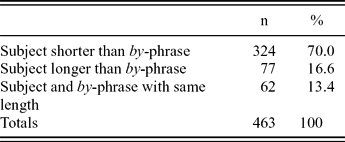
These tables show that all factors play a role in determining the use of long passives except one, namely the animacy of the subject and by-phrase. In table 5 passives promoting human subjects are not the most common, since they only make up 18.5 per cent of the total. The reverse order, where an inanimate noun phrase is promoted to subject position at the expense of a human by-phrase, is the most frequent ordering wherever there is a discrepancy between the subject and by-phrase as regards their degree of animacy. Therefore, promoting human noun phrases is not a conditioning factor in long passives, a surprising result since it goes against the crosslinguistic tendency to locate human referents in initial position. In fact, the effects of the animacy hierarchy are categorical in some languages, such as Lummi, which has person-driven passives (Bresnan et al. Reference Bresnan, Dingare, Manning, Butt and King2001), Navaho, where the passive voice is used whenever the patient outranks the agent in animacy (Siewierska Reference Siewierska1988: 49–50; Comrie Reference Comrie1989: 193), and Sesotho, a Bantu language which also exhibits animacy-based word-order preferences (Hawkins Reference Hawkins1994). The theoretical import of this finding is discussed in section 4.1 below.
Long passives in the corpus are responsive to the orderings predicted in all the other hierarchies. Therefore, they prove to be sensitive to two types of factor. Firstly, pragmatic ones, the familiarity and definiteness of the information conveyed (tables 3 and 4), which are themselves closely related, as noted by Prince (Reference Prince, Thompson and Mann1992: 317): ‘the apparent tendency for subjects to be definite is likewise seen to be simply a reflex of their tendency to be Discourse-old’. In fact, the close relationship between familiarity and definiteness is said to be universal (see Gundel et al. Reference Gundel, Hedberg and Zacharski1993: 285). Secondly, long passives here prove to be sensitive to structural factors, that is, the relative weight of the constituents (table 5; see also Biber et al. Reference Biber, Johansson, Leech, Conrad and Finegan1999: 940–2). Clearly, these factors are intimately interrelated, in that given, definite information tends to be structurally short (consider, for example, anaphoric pronouns), while new information needs modification and specification and therefore tends to be longer.
As to why given should precede new and short should precede long, this ordering has been interpreted as facilitating communication, from the perspective of both speaker and the listener. Speaker-oriented accounts maintain that such ordering facilitates utterance planning and production, since it allows the speaker to postpone till the end of the utterance the elements that are new (verbalised for the first time) and formally complex, and hence harder to produce; the time thus gained allows for their correct formulation (Levelt Reference Levelt1989). Listener-oriented accounts, on the other hand, argue that the short–long and given–new ordering facilitates parsing because heavy and new constituents are essentially more difficult to comprehend and therefore best left till the end of the utterance (Wasow Reference Wasow1997: 94–5, Reference Wasow2002: 40ff.; Hawkins Reference Hawkins1994: 57, Reference Hawkins2004: 30). Moreover, by virtue of having certain positions within the sentence recognised as the loci for given and new information, communication can be made more efficient, since speakers will be able to convey that what they are placing in initial position is given and should be taken as a point of departure and what they place at the end of the clause should be interpreted as new; this constituent ordering would also be speaker- and listener-friendly, in that it would help them avoid potential ambiguities (see Arnold et al. Reference Arnold, Wasow, Losongco and Ginstrom2000 for an extensive literature review; Wasow & Arnold Reference Wasow, Arnold, Rohdenburg and Mondorf2003: 147ff.). Despite their obvious interconnection, though, most studies overlook the possible effects of one on the other in determining constituent ordering.Footnote 6Section 4.2 examines to what extent they interact with each other in conditioning linearisation and their potential independence.
4.1 The locus of animacy effects in grammatical variation
As noted above, the corpus findings show that the choice of the long passive over the active in the corpus is not determined by the relative animacy of the passive subject and the by-phrase, which contradicts the widely held belief that animacy is an extra-linguistic property that exerts a strong influence on the active vs passive choice (see, for instance, Foley Reference Foley1994: 1684). According to the animacy hierarchy, it should play a role in the assignment of topic/subject functions, but this is not true for long passives, even though they contain canonical subjects in unmarked topic position in the same way as actives do. Similar results are obtained by Ferreira in her 1994 study, where she conducts four experiments in which subjects receive two nouns and a transitive verb and must compose a sentence. Her third experiment shows that ‘with normal agent-theme or experiencer-theme verbs, animacy has little effect on sentence form’ (Reference Ferreira1994: 725), theme referring to the semantic role of patient (e.g. the book in John bought the book).
This raises the question of what the locus of the effects of animacy as a grammatical determinant really is. This question is not new, and has been discussed in the last two decades with respect to various constructions in different languages. In order to determine the effects of animacy in language structure, it is necessary to use a model of speech production which allows us to identify the locus, if any, of animacy effects. A very influential model of speech production such as Levelt's (Reference Levelt1989; see also Bock & Levelt Reference Bock, Levelt and Gernsbacher1994) shows four levels of processing: (i) the message level; (ii) the functional level; (iii) the positional level; and (iv) the phonological level. The first of these, the message level, deals with the speaker's intended meaning and provides the raw material for subsequent levels, while the last, the phonological level, concerns the phonological encoding of the utterance. The area of speech production we are interested in comprises the two middle steps in the generation of an utterance: functional processing, where lemmas are selected and assigned a syntactic function, and positional processing, where the linear ordering of elements is established. These two levels constitute the grammatical encoding of the utterance.
Studies by Levelt (Reference Levelt1989) and Bock & Levelt (Reference Bock, Levelt and Gernsbacher1994) show that the impact of factors such as animacy is crucial in functional processing (level (iii)), where the assignment of syntactic functions takes place. This would explain the well-known correlation between human referents and subject function. Their experiments also show that, despite the conspicuous statistical correlation between subject and initial position, the impact of animacy on the ordering of elements is weak to nonexistent; syntactic functions have an almost exclusive impact on ordering. In other words, animacy would influence word-order variation only via syntactic function assignment, a view confirmed in other studies; McDonald et al. (Reference McDonald, Bock and Kelly1993), for example, argue that in transitive sentences animacy plays a role in word order only via the assignment of syntactic function.
How do my corpus data fit into this model? While my findings do confirm the view that animacy has no direct effect on ordering, they clearly contradict the assertion that animacy influences word-order variation via the assignment of grammatical functions, since animacy is not a determinant of subject function in the corpus.
Rosenbach (Reference Rosenbach2007: 158–9) mentions other studies on the effects of animacy in languages where subjecthood and first position do not correlate so strongly (see van Nice & Dietrich Reference Van Nice and Dietrich2003 and Kempen & Harbusch Reference Kempen, Harbusch, Pechmann and Habel2004 for German; Tanaka et al. Reference Tanaka, Branigan and Pickering2005 for Japanese). In these languages, the fact that animacy places constituents in initial position cannot be attributed to syntactic function assignment exclusively. According to her, such studies show that ‘animacy can affect word order via function assignment and firstness’ (2007: 159). In view of this evidence, the Bock−Levelt model would have to be modified to merge both functional and positional processing in one stage only, a stage which would constitute the locus of the effects of animacy. My corpus data, once more, fail to corroborate this view, since in the corpus animacy does not correlate with initial position either, as it likewise does not correlate with subject function.
Another study explicitly addressing the role of animacy is Dahl & Fraurud (Reference Dahl and Fraurud1996), which discusses animacy as a crosslinguistic factor influencing which noun phrases can go into which syntactic slots in a sentence. One of their examples is the syntactic role of subject of a transitive verb, which is normally required to have a referent higher in the animacy hierarchy than the object. They mention the evidence from Navaho provided in Comrie (Reference Comrie1989), where, in order to avoid violations of this constraint, passive or passive-like constructions are used; these constructions rearrange elements so that animate noun phrases occupy the subject slot and occur earlier in the sentence than the inanimate object. The corpus data in the present study show that this is not the case in English, where long passives are not used to keep the animate–inanimate order. They are not determined in the least by the desire to subjectivise or topicalise an animate referent at the expense of a non-inanimate one; rather, long passives are greatly responsive to other factors, those of a pragmatic and syntactic nature, as shown in tables 3, 4 and 6.
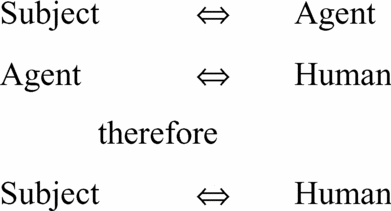
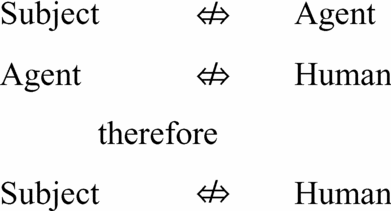
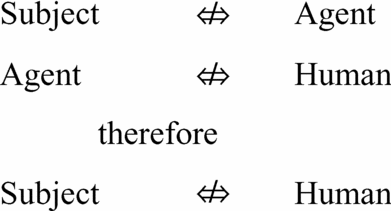
All the studies mentioned above agree that a connection exists between a high degree of animacy and the syntactic function of noun phrases. The present corpus data, however, point in a different direction, and lead us to postulate a different type of connection, which can be described as follows (see figure 2). The syntactic function of subject tends, in typical cases, to have the semantic role of agent, since language is iconic and consistent with the perceived directionality of events, which tend to start with an agent doing something (see Siewierska Reference Siewierska1994: 4996–7). The semantic role of agent crucially involves a human referent, since only human referents can show intentionality, control, responsibility, consciousness (see Dahl & Fraurud Reference Dahl and Fraurud1996: 58). These two correspondences, subject with agent, and agent with human referent, form a transitive implicational relationship such that the syntactic function of subject is intimately linked to a high degree of animacy (human referent).
Connection between subject function and animacy

The result of this relationship is reflected in the animacy hierarchy: human noun phrases are more likely to become subjects/topics than are inanimate noun phrases. However, it is essential to take into account that, as shown in figure 2, the correlation between subject function and high degree of animacy is not direct but mediated by the agent role, which in turn tends to be assigned subject function (see Ferreira Reference Ferreira1994). That the direct connection between human referent and subject function suggested in other studies fails to capture the effects of animacy on word order is apparent in the case of (long and short) passives, where subjects are not agents (see figure 3). Passives disrupt one part of the relationship and as a consequence the ordering predicted in the hierarchy no longer applies.
Disrupted connection between subject function and animacy
Unlike the animacy hierarchy, the other hierarchies reflect the ordering preferences successfully, at least as far as active–passive variation is concerned. Thus, in the case of discourse status, the correlation between subject/topic and given information holds true for both actives and passives, and the hierarchy is therefore valid. The same is the case with the definiteness and syntactic hierarchies: they predict that subjects/topics tend to be definite and short, and this holds for all unmarked subjects/topics, whether they bear the semantic role of agent or not.
Several theoretical implications follow from the foregoing discussion. The first is that the locus of animacy effects is neither in the assignment of syntactic functions, as is generally believed, nor in the assignment of word order or linearisation, as the animacy hierarchy predicts, but in the assignment of semantic roles exclusively. Another implication here is that the animacy hierarchy does not account for English clausal word order, since it equates a high degree of animacy with subject/topic function, and this is not, strictly speaking, the case. The equation needs to be mediated by the semantic role of agent, because if and only if the subject has the semantic role of agent does the correlation subject function−animate referent arise. In other words, as soon as the subject is dissociated from its agentive semantic role, it also becomes wholly dissociated from any link with animacy. Animacy ceases to be relevant, even if the subject is still the topic, still occupies initial position, states what the clause is about, determines the primary point of view, and so on. Viewed from a wider perspective, these findings, if they prove to be generalisable to other constructions, would entail that the animacy hierarchy should be excluded from the set of prominence hierarchies having an effect on subject/topic choice, which itself means that the centrality of animacy in discussions of subjecthood and topichood would need to be revised. Assertions such as Comrie's, that there seems to be no way of defining ‘topic-worthiness’ independently of animacy (Comrie Reference Comrie1989: 198–9, also discussed in Dahl & Fraurud Reference Dahl and Fraurud1996: 59), do not seem to be sustainable for English.
Finally, while the study of active vs long passive variation does not recognise the word-order effects of animacy, other studies, such as those by Rosenbach on English genitive variation (Reference Rosenbach2002, Reference Rosenbach2005, Reference Rosenbach2007), successfully show that animacy is an independent variable determining word-order variation, from which we can only conclude that far from being universal, the effects of animacy are construction-specific. This is consonant with Rosenbach's view that ‘there is more to the locus of animacy effects than mere function assignment and linearization and . . . there may be other factors, inherent in the specific constructions at hand, that may account for animacy effects in grammatical variation’ (2007: 163). As potential loci of its effects Rosenbach (Reference Rosenbach2007) considers two options: function assignment and decisions on linearisation. As noted already, in the case of passives neither of these seems to be the target of such effects, and only the assignment of semantic roles is significant. My study, then, indirectly corroborates her view that the locus of animacy effects needs further investigation.
4.2 Syntactic vs pragmatic factors as determinants of active vs long passive variation
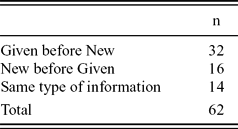
To return to the corpus results, we are essentially left with the fact that most examples have the order given-before-new and short-before-long, as in example (7):
(7) It is fettered by none of those conditions which confine the swiftest bodies that traverse the surface of the earth; (18XX. The world's great sermons, vol. VII. ARCHER)
It, which refers to the (previously mentioned) wind, conveys given information and is short, while the by-phrase is new information and is longer than the subject. Therefore, the long passive may have been chosen over the active counterpart by virtue of the subject It being given or short or both. In other words, we need to determine firstly whether these two factors, syntactic complexity and discourse status, are independent or whether, on the contrary, one factor is entirely responsible for ordering and the other just epiphenomenal, as some scholars suggest (see Niv Reference Niv1992; Hawkins Reference Hawkins1994). Secondly, if they do prove to be independent, we also need to ascertain whether it is mainly discourse status or structural complexity that induces long passives such as (7).
Several studies have tried to examine the interaction of these two factors in a number of constructions (Siewierska Reference Siewierska1993; Hawkins Reference Hawkins1994, Reference Hawkins2004; Arnold et al. Reference Arnold, Wasow, Losongco and Ginstrom2000; Wasow Reference Wasow2002; Wasow & Arnold Reference Wasow, Arnold, Rohdenburg and Mondorf2003). In the remainder of this section, I briefly consider the interplay of weight and discourse status in English long passives following the methodology used by Rosenbach (Reference Rosenbach2002, Reference Rosenbach2005) for her analysis of the interaction between animacy and weight as determinants of genitive variation in English.
Firstly, in order to ascertain whether discourse status and structural complexity are independent variables, I examined discourse status in contexts neutralised for the effect of weight (see table 7), and weight in contexts neutralised for the effect of discourse status (see table 8). Footnote 7
Discourse status in contexts neutralised for the effect of weight
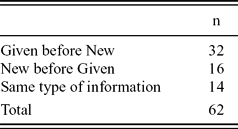
Weight in contexts neutralised for the effect of discourse status
The first row of table 7 shows that there are discourse status effects that cannot be attributed to weight, because weight is neutral yet given-before-new is preferred nevertheless. In the same way, the first row in table 8 shows that there are weight effects that cannot be attributed to discourse status, because the discourse status is the same in subject and agent. These results clearly indicate that weight and discourse status are independent factors, neither of them being an epiphenomenon of the other; this is also the conclusion reached by Wasow (Reference Wasow2002: 81) in his study of the ordering of postverbal elements.
Assessing the relative importance of these two factors involves examining contexts where discourse status and length do not go together, that is, (i) passives where prototypical short-before-long word order prevails despite yielding new-before-given patterns, and (ii) passives exhibiting given-before-new word order in spite of having long-before-short order. Unfortunately, given the strong correlation between weight and discourse status, the number of passives where discourse status and syntactic complexity are completely dissociated is only 24. Most of them (15 out of 24) are examples of (ii), where discourse status seems to be a more powerful factor than length. If these results were confirmed in a larger corpus, they would suggest that discourse status is more important than weight in determining the use of long passives. However, these data are too scanty to draw any kind of conclusion.
Finally, it is also important to bear in mind that, as predicted by Arnold et al. (Reference Arnold, Wasow, Losongco and Ginstrom2000), the impact of each factor depends on the strength of competing factors. Therefore, the effect of weight will depend on how strong givenness is, and, as for givenness, its effects on word order will depend on the strength of weight. In order to be able to assess the strength of these factors we need to measure them as graded categories. This is possible because, despite the fact that here I have been using the dichotomies given−new and short−long, discourse status and structural weight are both scalar concepts (see section 3). One of the advantages of measuring weight as length is that we can treat weight as a graded concept, so that if the subject is longer than the agent we can measure how much longer it is. A rough assessment in the corpus shows that in the passives where weight is more powerful, the agent is 3.8 words longer than the subject on average, whereas in the passives where discourse status is more powerful, the average difference in length is lower, at only 3.2 words. If these data were confirmed in a larger corpus, they would indicate that givenness is probably overruled by weight when the weight difference between the subject and agent reaches a certain level, and would thus confirm the above-mentioned prediction by Arnold et al. (Reference Arnold, Wasow, Losongco and Ginstrom2000).
A related prediction is that givenness is likely to be more powerful than weight if a constituent is given because it has just been mentioned in the preceding linguistic context. In cases of high degree of givenness such as this, discourse status probably overrules syntactic complexity, as Arnold et al. (Reference Arnold, Wasow, Losongco and Ginstrom2000) found. However, in order to measure the impact of weight depending on the degree of givenness it would be necessary to have articulated discourse status in terms of degree, which I have not done here, and which remains for future research.
5 Conclusions
In this article I have tried to identify the factors that may have a bearing on the variation between the active and the long passive in Modern English. For this purpose I have considered the nature of the long passive not only as an order-rearranging device but also as a strategy which crucially creates new topics and new canonical subjects. Viewed from this perspective, the passive is a topicalising device, and as such is subject to the effect of prominence hierarchies, which predict which noun phrases are eligible to become topics on a universal level. The long passives in the corpus were found to conform predominantly with the predictions made in all the hierarchies with the exception of one, animacy, since long passives clearly favour the promotion of inanimate noun phrases to subject/topic position at the expense of human animate noun phrases, which are relegated to final position and to the status of an oblique adjunct. Closer analysis here revealed that the strong and allegedly universal connection between subject/topic and animacy is mediated by the semantic role of agent, in such a way that, if the subject ceases to be the agent, the connection ceases to apply. The theoretical import of this is twofold. Firstly, and contrary to what is widely believed, the locus of the effects of animacy is neither the assignment of syntactic functions nor the linearisation of constituents, but rather the assignment of semantic roles exclusively. As a consequence of this, the second conclusion to be drawn here is that the animacy hierarchy should be excluded from those prominence hierarchies which successfully predict what noun phrases occupy initial topic position, since its predictions – at least for passives – do not hold. That is, if this finding is generalisable to other constructions, then the much-debated characterisation of subjects and topics would also have to be revised accordingly.
Of all the other variables analysed, discourse status (given-before-new) and syntactic complexity (short-before-long) were found to be most influential in the choice between active and long passive. A preliminary test for their interaction showed that despite their strong correlation they are independent variables, and that discourse status seems to be more prominent than weight in the choice of long passives.