INTRODUCTION
Shipping has been implicated in the introduction into the Mediterranean of myriad neritic organisms, from protists and macrophytes to fish (Galil, Reference Galil, Davenport and Davenport2006). The transport on the hulls of ships of boring, fouling, crevicolous or adherent species is certainly the most ancient vector of aquatic species introduction. Fouling generally concerns small-sized sedentary, burrow-dwelling or clinging species, though large species whose life history includes an appropriate life stage may be disseminated as well (Zibrowius, Reference Zibrowius1979). Water and sediment carried in ballast tanks, even after voyages of several weeks' duration, have been found to contain many viable organisms (Wonham et al., Reference Wonham, Carlton, Ruiz and Smith2000). Since the volume of ballast water may be as much as a third of the vessel's deadweight tonnage, it engenders considerable anxiety as a vector of introduction. Though it is seldom possible to ascertain the precise means of transmission, as one species may be transported by a variety of vectors, yet it is assumed that port and port-proximate aliens are dispersed primarily by shipping.
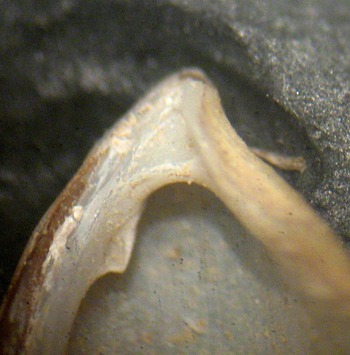
The black striped mussel Mytilopsis sallei (Rècluz, 1849), originally described from Guatemala, is a native of the tropical and subtropical western Atlantic waters, extending from the Gulf of Mexico to Colombia. Its shell colour varies from black to pale, with shells of some younger individuals chevron patterned (Figure 1). The slightly larger right valve overlaps the left valve. The morphological features that distinguish it from its cogeners are the shape of the septum and apophysis that support the anterior adductor muscle (Marelli & Gray, Reference Marelli and Gray1983) (Figure 2). The species is opportunistic, colonial, and prolific, has wide temperature (10–35°C), salinity (0–50 ppt) and oxygen tolerances, and can survive highly polluted conditions (Raju et al., Reference Raju, Mangapathi Rao, Ganti and Kalyanasundaram1975; www.marine.csiro.au/crimp/nimpis).
Mytilopsis sallei (Rècluz, 1849), collected in Haifa Port, Israel, 5 February 2008, external view of shell.

Mytilopsis sallei (Rècluz, 1849), collected in Haifa Port, Israel, 5 February 2008, internal view of shell, septum and apophysis of left valve.

The dreissenid bivalve was first recorded in south-east Asia from Visakhpatnam Harbour, India (Ganapati et al., Reference Ganapathi, Rao and Varghese1971), and spread in quick succession to Japan, Taiwan, China, Hong Kong, Singapore, Malaysia, Thailand and Australia (Habe, Reference Habe1980; Morton, Reference Morton1980; Chang, Reference Chang1985; Sin et al., Reference Sin, Wong, Chou and Alias1991; Willan et al., Reference Willan, Russel, Murfet, Moore, McEnnulty, Horner, Hewitt, Dally, Campbell and Bourke2000; Swennen et al., Reference Swennen, Moolenbeek, Ruttanadakul, Hobbelink, Dekker and Hajisamme2001; Zheng, Reference Zheng2005). Its presumed presence in Fiji is based on mistaken identity: Morton (Reference Morton1980) considered M. allyneana Hertlein & Hanna, Reference Hertlein and Hanna1949, a junior synonym of M. sallei, whereas it is a junior synonym of M. adamsi Morrison, Reference Morrison1946 (Marelli & Gray, Reference Marelli and Gray1983). The species is commonly found in intertidal fouling communities and has been widely reported to foul manmade structures in ports and marinas. It forms a ‘densely populated band … up to several kilometres inland from the sea’ (Tan & Morton, Reference Tan and Morton2006: 430) that exclude most other species, leading to a substantial reduction in biodiversity in infected areas and economic losses (Morton, Reference Morton1989; Subba Rao, Reference Subba Rao2005; Lin & Yang, Reference Lin and Yang2006). The cost of its eradication from enclosed marinas inside Darwin Harbour, Northern Territory, Australia, was $2.2 million (www.dpi.nsw.gov.au).
RESULTS
The research vessel of the National Institute of Oceanography, RV ‘Shikmona’, 27 m long, operates in the Levantine basin. Since its previous dry-docking (February, 2004) it did not visit any foreign port, and docked either in its home port at Haifa Bay, or at the port of Ashdod, 120 km to the south.
On 5 February 2008 the RV ‘Shikmona’ was dry-docked at Haifa port and its hull checked for fouling. The hull was bare but for small areas near its propeller, and stripes along its bottom where the vessel had been supported during its previous dry-docking and lacked antifouling paint. The fouled areas were photographed, scraped and preserved in 10% buffered formaldehyde. Specimens of Mytilopsis sallei were found among empty shells of Balanus trigonus Darwin, 1854. Of the 15 live specimens (6–20 mm in length) collected, two adult specimens were deposited in the National Collections, Tel Aviv University (TAU MO 60853), the rest are in the collections of D. Marelli, Tallahassee, USA and C. Bogi, Livorno, Italy.
DISCUSSION
The Mediterranean Sea, encircled by major ports, is susceptible to ship-transported bio-invasions, whether they occur in fouling communities or in ballast. The increase in shipping-related invasions was noted in recent publications, and may be attributed to the increase in shipping volume throughout the region, changing trade patterns that result in new shipping routes, improved water quality in port environments, augmented opportunities for overlap with other introduction vectors, and rising awareness and research effort (CIESM, 2002). The global maritime trade connections of Mediterranean ports sustain a large-scale dispersal process of both inbound and outbound biota. Shipping is also an important vector for secondary introduction—the dispersal of an alien beyond its primary location of introduction. The invasive mussel, Brachidontes pharaonis (Fischer P., Reference Fischer1870), that had settled in dense clusters on mid-littoral and infralittoral rocks, piers and debris in the Levantine basin, has spread as far west as Sicily and Corsica in ship fouling (Di Geronimo, Reference Di Geronimo1971; Boudouresque, Reference Boudouresque and Sanlund1999). Similarly, Musculista senhousia (Benson in Cantor, 1842), first recorded in the Mediterranean in 1964 from Tel Aviv, Israel (as Modiola arcuatula) (Barash & Danin, Reference Barash and Danin1971), was subsequently transported to Étang de Thau, France (Hoenselaar & Hoenselaar, Reference Hoenselaar and Hoenselaar1989), Ravenna on the Adriatic coast of Italy (Lazzari & Rinaldi, Reference Lazzari and Rinaldi1994), Slovenia (De Min & Vio, Reference De Min and Vio1997), and most recently to the port of Livorno, on the Tyrrhenian coast of Italy (Campani et al., Reference Campani, Coppini, Cuneo and Margelli2004). Travelling seemingly in the opposite direction was another invasive ship-transported mollusc: the Asian semelid bivalve Theora (Endopleura) lubrica Gould, 1861, was first collected in the Mediterranean in the port of Livorno (Balena et al., Reference Balena, Campani, Coppini and Margelli2002; Campani et al., Reference Campani, Coppini, Cuneo and Margelli2004), and later found in Haifa port, Israel (Bogi & Galil, Reference Bogi and Galil2007).
In 2006, 13,000 merchant vessels made 252,000 calls at Mediterranean ports and an additional 10,000 vessels transited through the sea (REMPEC/WG.29/INF.9). With the exception of the South Pacific and the north-east Pacific ‘… the Mediterranean is connected by considerable sea trade with most global regions.’ … (CIESM, 2002: 6). The inbound commercial traffic arrives through the Strait of Gibraltar (81%) and the Suez Canal (19%). The native range of vessel-transported alien taxa recorded in the Mediterranean is most commonly the Indo-Pacific Ocean (30%), pantropical (17%), and the Indian Ocean (15%). However, the native range is not necessarily the area of origin of the Mediterranean populations as propagules may have been introduced from established alien populations elsewhere (secondary introductions). Mytilopsis sallei may have been transported via vessels arriving from tropical western Atlantic ports (8% of the Gibraltar inbound vessels originate from Caribbean, Gulf of Mexico and central American ports), or vessels transiting through the Suez Canal. The recent records of M. sallei from Râs el-Barr and Dumyat, 13 km up-river on the eastern arm of the Nile, west of the Mediterranean terminal of the Suez Canal (Hoffman et al., Reference Hoffman, Van Heugten and Dekker2006), suggest that the invasive mussel entered the Mediterranean Sea in the fouling of vessels arriving from south-east Asia through the Suez Canal. The presence of both young and adult specimens in the hull fouling of the RV ‘Shikmona’ indicates the presence of an established population.
The last decades of the 20th Century saw ‘… a significant increase in the average temperature of the waters …’ in the Mediterranean (Francour et al., 1994: 523), and growing concern over the ‘tropicalization’ of its fauna and the marked rise in the number and expansion of thermophilic alien species, with the Levantine Basin acting as a ‘reservoir’ (Bianchi & Morri, Reference Bianchi and Morri2003; Galil, Reference Galil2007, Reference Galil2008a, Reference Galilb). These shifts can not be attributed solely to climate change due to the complexity of the ecosystem and the difficulty in understanding the biotic response to climate variability. More likely, multiple stressors together with changes in vectors of introduction are implicated: the increase in shipping volume throughout the region, changing trade patterns that result in new shipping routes, improved water quality in port environments, and rising awareness and research effort (CIESM, 2002; Galil, Reference Galil, Davenport and Davenport2006). The presence of warm-water aliens on buoys, piers and sea walls in the harbours and marinas of the Mediterranean Sea may serve to indicate changes both in the patterns of ship-borne transport and seawater temperatures.
ACKNOWLEDGEMENTS
The authors thank Giora Boxer, the captain of the RV ‘Shikmona’, and Mel Cooper who collected the fouling biota. The authors are grateful to Dan Marelli, Tallahassee, Florida, USA, for his help in the identification of the specimens and for additional information.