INTRODUCTION
In November 2005, Ellen Johnson Sirleaf defeated former soccer star George Weah to become President of Liberia, and the first woman ever elected to head an African country. Many sources including the BBC (Fleming Reference Fleming2005), the New African (Gberie Reference Gberie2006) and Sirleaf herself (Soares Reference Soares2005) credited her win to the widespread and enthusiastic support she received from women. Turnout statistics from the National Elections Commission of Liberia show that, with 77·1% turnout in the October election and 69·9% turnout in the November run-off, literate females had the highest turnout of any group in the Liberian electorate. However, few data are available showing how women voted, and whether their level of participation was above the level of participation exhibited by other groups.
Within narrow spheres, African women wield considerable power. As market proprietors, farmers, peacemakers and community caretakers, they have a wide-ranging impact on households, communities, societies and economies, and on the ability of societies to recover from conflicts (Mazurana & Carlson Reference Mazurana and Carlson2004). This power, however, has rarely translated itself into politics, and women, despite their important efforts, often find themselves excluded when negotiations and interactions reach a higher level of authority (Connell Reference Connell1998; Moran & Pitcher Reference Moran and Pitcher2004). Did the 2005 Liberian election mark a departure from this tendency? Have women in Liberia proven themselves to be a formidable voting bloc? If this is indeed the case, what institutional and structural conditions enabled women to transform one type of power into another?
The answers to these questions are relevant for Liberia and for emerging democracies in sub-Saharan Africa and elsewhere. Understanding successful cases of citizen empowerment can provide valuable insights to other efforts to promote democratic principles, particularly when they involve traditionally underrepresented groups like women. This paper explores the role of women voters in Sirleaf's 2005 victory by using content analysis of Liberian newspapers published in the months preceding the election, and finds that the consistency of women's participation in the electoral process may have allowed them to surpass other civil society groups in affecting the election's outcome. The following sections summarise the events surrounding the 2005 Liberian election and present an analysis of popular media as an indicator of the role of women's groups in the democratic process. The paper concludes with a discussion of what factors may have led to the new prominence of women and why these changes may persist into the future.
THE LIBERIAN ELECTION OF 2005
Background
For roughly 130 years following Liberia's independence in 1847, politics in the country were dominated by the elite Americo-Liberian settlers: free people of colour who colonised the area under the sponsorship of the American Colonisation Society. More specifically, the country was dominated by the Americo-Liberian True Whig Party from 1883 until 1980, when a coup deposed the last in a long line of True Whig presidents.
The reach of the Liberian state was confined to the coastal areas until the 1880s, when competing European imperialists mandated that governments demonstrate their control over areas being claimed as their own. This induced the government to expand Liberia's borders to the extent they assume today, but also led many indigenous communities to resist, and to the subsequent creation of a national army.
Liberia's longest-serving president, William Tubman, assumed office in 1944 and set about a process of gradual administrative, if not cultural, unification of the interior (or indigenous areas) and the coast (where much of the Americo-Liberian population was located). Indigenous Liberians, both men and women, were granted the right to vote in the 1940s, but property ownership requirements prevented the country from claiming truly universal suffrage at this time. On Tubman's death in 1971, the presidential mantle was assumed by William Tolbert, Tubman's vice-president during his final years as president.
Tolbert's rule came to a violent end in 1980, when Samuel Doe overthrew the government and became the country's first indigenous ruler. The Doe regime perpetrated a multitude of oppressive tactics against the populace, but eventually succumbed to international and internal pressure to hold an election in 1985. This election was widely viewed as fraudulent: the government intervened in vote-counting and summarily declared Doe the winner when it became evident that an opponent had garnered a majority of the votes. This event set in motion the bitter opposition movement that led to the outbreak of civil war in 1989 and a second coup overthrowing Doe in 1990.
No fewer than eleven international attempts to bring an end to the conflict were made between 1990 and 1995, with a meeting in Abuja, Nigeria in 1995 finally succeeding, temporarily. The resulting peace agreement established an interim government headed by Ruth Perry and an election was held in 1997 during a break in the fighting. Charles Taylor, the warlord leading the National Patriotic Front of Liberia, one of the parties to the civil war, won easily with 75% of the vote. The assertion by some international observers that the election was free and fair is disputed, but ‘despite problems and allegations, the election did seem more free and fair than not’ (Harris Reference Harris1999).
Given Taylor's atrocities, the resulting destabilisation of other countries in the region, and his subsequent trial as a war criminal, it is natural to conclude that Taylor's election was perverse. Harris (Reference Harris1999), Lyons (Reference Lyons1998) and others have outlined possible explanations. At the time it might have been easy to blame the events of the civil war on other actors, to conclude that he was the best candidate for the job (or at least the best available), or to believe that the failure to elect such a powerful warlord would return the country to chaos. Alternatively, international pressure may have caused the election to be held too soon, with insufficient time to recruit and market candidates, give candidates who had fled the civil war time to return and re-establish themselves, inform voters, or otherwise ensure that the election could be considered fair and free. It can also be argued that Taylor was the only candidate with access to sufficient funds and with sufficient media savvy to campaign effectively (Moran & Pitcher Reference Moran and Pitcher2004). Whatever the reason, the victory of a warlord who had previously committed atrocities and went on to perpetrate additional atrocities calls the result into question.
Atrocities and war continued throughout Taylor's rule, with fighting spreading into neighbouring Sierra Leone (IRIN 2006). Unemployment remained as high as 80%. By the time Taylor was exiled to Nigeria in 2003, the country had been entangled in a devastating conflict for fourteen years. Over 550,000 people registered officially as displaced persons, although by some estimates up to 80% of the rural population was displaced; more than 300,000 Liberians were killed (UNOCHA 2007; IRIN 2006). The interim government put in place by an international peace agreement did little to restore hope and trust, and by the time the promised 2005 election occurred, it had assumed such importance that a less-than-ideal outcome could have destroyed the fragile peace (Sawyer Reference Sawyer2008). The pressure to hold the 2005 election could have returned the country to a state of conflict, just like that of 1997. What was different? As we will see below, one possible contributing difference was the mobilisation of women, who no longer trusted men to fix their broken country.
The 2005 election
The 2003 Comprehensive Peace Agreement brought an end to the civil war and outlined the process and timeline for the 2005 election. It put into place a transitional government, allocated seats in a temporary one-house legislature among the numerous stakeholders (including representatives of the various warring factions), and included a requirement that appointments should reflect the gender balance of the country.
Twenty-two candidates competed in the 11 October 2005 election for president. Of these, two were women, one of whom was the eventual winner (NECL 2005a). George Weah was the campaign's obvious Cinderella story; he had been raised in a Monrovia slum and grew up to become a world-class soccer star in Europe. Weah's stardom caused the media to ignore the other compelling story of the campaign: the potential for Africa to have its first elected female head of state. Ellen Johnson Sirleaf was a career bureaucrat with a long personal history of support for grassroots efforts to resolve her country's problems. She was educated in the United States, and had been a finance minister in Tolbert's government, a former employee of the World Bank and the United Nations Development Programme, and, for a time early in her career, an ally of Charles Taylor.
The presence of twenty-two candidates in the presidential race allowed for any number of loyalties to interfere with a female voting bloc. As many scholars attest, socioeconomic class, political party, regional ties, religion, and other categorisations and loyalties, can confound attempts to unify voters by gender (Geisler Reference Geisler1995; Htun Reference Htun, Dominguez and Shifter2003; Inglehart & Norris Reference Inglehart and Norris2000; Waylen Reference Waylen1994). A reduction in the number of candidates would necessarily reduce the number of possible competing loyalties, and could increase the likelihood that women would be able to have an impact on the outcome. Given the amount of publicity Weah received, Sirleaf's best strategy was to come in second and hold Weah to less than a majority, forcing a run-off as required by Liberia's Electoral Reform Law of 2004. To the extent that women might vote together for a well-qualified fellow woman, eliminating these competing loyalties could help consolidate women's support for Sirleaf.
The strategy to hold Weah to less than 50% of the vote succeeded. Weah came in first with 28·3% of the vote, and Sirleaf second with 19·8%. A run-off took place on 8 November, when Sirleaf overwhelmed Weah, taking 59% of the vote to Weah's 41%. Africa had its first democratically elected female head of state. Although the campaign had already fallen short of the National Election Commission of Liberia's goal of attracting women as 30% of candidates, women were nevertheless elected to 12·5% of the seats in Liberia's lower house (Zeleza Reference Zeleza2006), more than double the 5·7% recorded in 1994 (UNECA 1998).
The popular media in Liberia made much of the importance of the female vote for both the October election and the November run-off. One article in the Daily Observer provides a dramatic account of Red Light Market – one of Monrovia's largest – on election day, completely empty of market women who had presumably sacrificed a day's wages (or at least a portion of a day's wages) to vote (Bradford Reference Bradford2005). Another story claimed that ‘Liberia [sic] women have unanimously pledged their full support to presidential candidate and Unity Party leader, Ellen Johnson-Sirleaf’ (Kwanue Reference Kwanue2005). The Daily Observer gave Sirleaf a ringing endorsement prior to the October elections in an article entitled ‘Ellen Johnson-Sirleaf, our best choice,’ in which editor-in-chief Kenneth Best (Reference Best2005) emphasised the importance of the female vote.
Before turning to a detailed assessment of these claims, it is useful to examine the literature for a perspective on how women have influenced political outcomes in other circumstances.
THE GLOBAL ROLE OF WOMEN IN ELECTIONS AND POLITICS
There is disagreement in the literature as to the degree to which women vote as a bloc and influence the outcome of elections. Htun (Reference Htun, Dominguez and Shifter2003) writes that in many Latin American countries, ‘women owe their primary loyalty to their parties, not to other women politicians’. Race, socio-economic conditions, regionalism, values, party loyalties and class can all serve as explanations for women's voting behaviour (Htun Reference Htun, Dominguez and Shifter2003; Waylen Reference Waylen1994), although gender can explain some differences (Inglehart & Norris Reference Inglehart and Norris2000). Geisler (Reference Geisler1995) describes the rivalry between loyal party women and professional women in Botswana, Zambia and Zimbabwe, noting that it cannot be assumed that the common denominator among women is their gender. She too writes that ‘party divisions outweigh gender divisions’.
The coordination problem implied by women's competing loyalties is compounded by the fact that women's movements are often sidelined in post-transition governments. In Eritrea and South Africa, Connell (Reference Connell1998) finds that the demands of women's groups who supported struggles for independence or political rights in these countries were forgotten or ignored once these goals were achieved. Moran and Pitcher (Reference Moran and Pitcher2004) find a similar result in Liberia and Mozambique. Institutional democratisation is no guarantee that gender relations will likewise be democratised (Waylen Reference Waylen1994), and the failure to make institutional changes to guarantee women's continued access to power can allow barriers to women to re-emerge after the transition has taken place (Franceschet Reference Franceschet2001).
This marginalisation can occur when women have focused on their ‘difference’ from men and relied on their traditional roles, or what Waylen calls their ‘gendered identities’ – as mothers, caretakers and peacebuilders – as a justification for their political activism. In examples from Latin America, women played a significant role in transitions from authoritarian rule by agitating against human rights abuses that had affected their families (Waylen Reference Waylen1994). In Liberia and Mozambique, women used motherhood as justification for their involvement in peacebuilding and recovery (Moran & Pitcher Reference Moran and Pitcher2004). While this approach can provide women with the space they need to effect change by associating their activities with ‘female’ spheres that are typically considered non-political (and therefore non-threatening) (Franceschet Reference Franceschet2001; Moghadam Reference Moghadam2003; Waylen Reference Waylen1994), it can also backfire by making it easy for men to exclude them when activities reach a higher level of the political structure. Moran and Pitcher (Reference Moran and Pitcher2004) note, for example, that the women who had agitated for high-level peace negotiations between Liberia, Guinea and Sierra Leone were excluded when these negotiations finally took place. When this happens, women's movements must decide whether to integrate into traditional political parties, or to maintain their autonomy and risk marginalisation (Waylen Reference Waylen1994; Tripp Reference Tripp2001).
Nevertheless, women can organise to become a formidable societal force. Htun (Reference Htun, Dominguez and Shifter2003) and Waylen (Reference Waylen1994) find that women in some areas of Latin America played an important role in transitions from autocratic rule to democracy. Mazurana and Carlson (Reference Mazurana and Carlson2004) draw a similar conclusion in the transition from war to peace in Sierra Leone, and Tripp (Reference Tripp2001) notes the skill of the Ugandan women's movement in exploiting the ‘space’ offered them by the autocratic ruling regime. Women's movements can flourish under autocratic conditions, when traditional political institutions have been banned or severely restricted (Franceschet Reference Franceschet2001; Waylen Reference Waylen1994). Their success under such conditions is aided in some cases, as mentioned above, by the conception that women's activities must necessarily be outside the political sphere.
Htun (Reference Htun, Dominguez and Shifter2003) identifies two means by which women (or other groups, presumably) can influence electoral outcomes: first, by mobilising female voters as a swing vote, and second, through issue voting. Htun does not define ‘swing voter’, which however WordNet (2008) defines as an unaffiliated voter with no allegiance to any particular party, whose unpredictable voting patterns can swing an election one way or the other. Issue voting occurs when (1) the public is divided on the issue; (2) the issue is salient to voters; and (3) candidates or parties have taken distinct positions on the issue. To Htun's two pathways of female influence on electoral outcomes we can add a third: by exploiting their informal power (in the household and the community, for example) to mobilise both male and female voters to select their chosen candidates. When this last pathway is taken into account, it becomes less important to know how women voted, and more important to know how active they were in election activities. While women may not be motivated by gender issues per se, their unity on a given issue or in support of a given candidate can make them an important constituency.
In order to determine whether women's groups exploited these pathways in a way that gave them a disproportionate impact on the election outcome in Liberia, it is necessary to measure the activity of women's groups relative to other groups. To do this, newspaper coverage surrounding the election was used as a means of comparing the level of women's involvement to that of the numerous other groups that had an interest in the election's outcome. Methods and findings are described in detail below.
METHODOLOGY
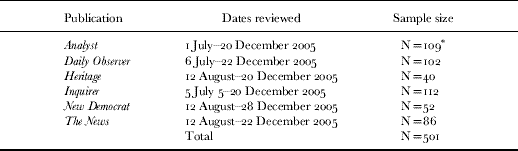
The Liberian Collections Project at Indiana University (http://onliberia.org/index.php) is one of the largest archives of documents related to Liberia in the world, and includes a large collection of newspapers from the election period. This analysis focuses on coverage by Liberian newspapers only: foreign media coverage was more sporadic and selective, whereas local papers provided daily coverage of the election and could be expected to capture better the activities of a broad range of groups. Analysis relies on the assumption that group activities mentioned by the media are a proxy for actual election-related activity by a given group. To reduce the effects of bias (towards a given party or candidate, for example) exhibited by any given publication, six newspapers (all those with significant holdings in the collection spanning the election period) were reviewed. Dates reviewed ranged from July or August (depending on the holdings in the collection) until December 2005, when Weah conceded the election, and when attempts by various groups to influence the election's outcome ceased. Table 1 provides a complete list of publications reviewed.
Publications reviewed (all published in Monrovia)
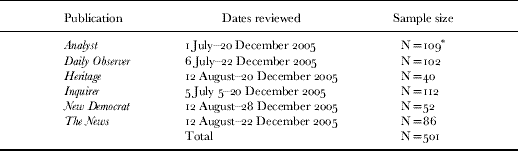
* Approximate.
Since the focus of this paper is on the activities of Liberian voters, only organisations based in Liberia and branches of organisations based in West Africa which included Liberia as part of a regional focus (such as the West Africa Network for Peacebuilding of Liberia) were examined. International organisations based outside Liberia were excluded. A list of all groups whose activities were cited appears in Appendix A. Organisations could officially recognise themselves as a group (‘the Liberian Council of Churches’), or be more informal (‘85 imams’), as long as the group was acting in some unified way to impact the election. Political parties were excluded. Only activities made on behalf of groups were included; statements or activities by individuals, even those identified as affiliated with a given group, were not recorded unless it was explicitly stated that the individual was acting on the group's behalf.
Content analysis was conducted by physically reviewing all papers and recording the dates and nature of activities by all civil society groups attempting to influence the election. Activities could include supporting or campaigning on behalf of a specific candidate, conducting voter outreach activities, holding rallies, and any number of other actions. In order to avoid overcounting the activities of any one group due to duplicate coverage in the six publications, coverage of the same group within one day in either direction was assumed to be coverage of the same activity, and only counted as one incident of participation by that group. Other coverage confirmed to be referring to the same event was likewise counted as a single incident.
Groups were categorised according to their names and any description included in the article. No further action was taken to categorise organisations. Categories used were: education, religion, development, men's groups, women's groups, military and law enforcement, age (such as youth or elders groups), trade (such as unions), ethnicity, disability, human rights, democracy and reform, media, geographic or regional groups, and groups focused on civil society generally. A group could fit into more than one category; for example, an activity by the River Gee Progressive Youth Alliance would be counted as both an age-based group activity and a geographic group activity. In an effort to isolate the impact of women's organisations, women's groups fitting under other categories were counted only once, as women. That is, activity by the Bassa Women Development Association would be counted only as an activity by women, and not an activity by a development or geographic group. Groups not explicitly identified as women's groups were assumed to be either mixed-gender groups or male groups.
RESULTS
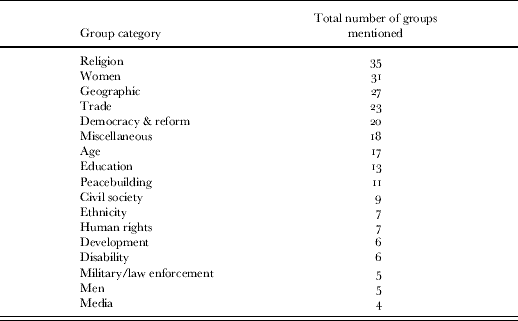
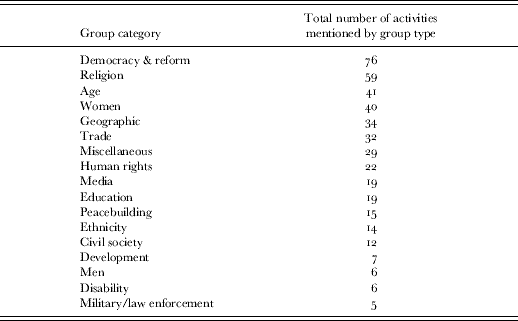
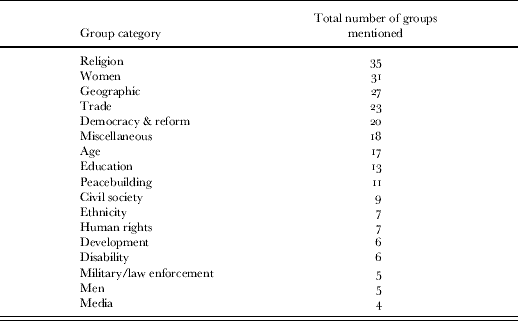
Tables 2 and 3 show the level of media coverage by number of individual groups mentioned and the number of activities mentioned per group type, respectively. The activities of 209 groups were recorded; 138 of these were counted in only one group type. Based on the number of groups mentioned, religious groups, women's groups, geographically based groups, trade groups, and democracy and reform groups were the most prevalent. Based on the number of activities mentioned for all groups in a given category, democracy and reform groups, religious groups, groups based on age, women's groups, trade groups and geographically based groups showed the most activity.
Number of groups mentioned
Number of activities mentioned by group type
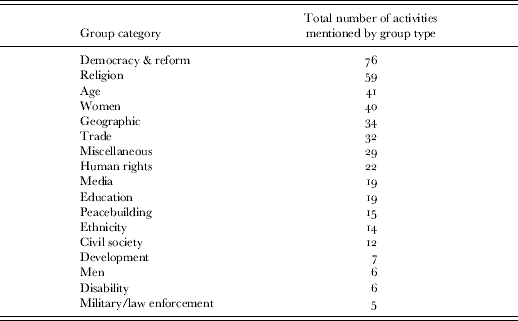
Using these tallies, it is clear that women's groups were one of several kinds of groups that participated heavily in the election. They score high in number of groups, coming in second after religious groups with a total of thirty-one groups, showing a wide range of participation. In terms of the total number of activities mentioned, women's groups rank fourth after democracy and reform groups, religious groups and age-based groups, indicating that a given women's group was less active than individual groups falling in these other group types.
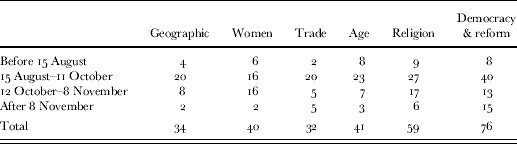
These results are in keeping with findings in previous literature showing that gender is one of many loyalties that affect women's voting behaviour, and also further reflect the open playing field that characterised the 2005 election. However, a more detailed breakdown of these numbers reveals an important pattern. The numbers above show participation over the entire election cycle, from early July to the end of December, when Weah conceded the election. This election period can be broken down into four distinct sub-periods: before the official election season (which started 15 August 2005); between 15 August and 11 October, when the election took place; between 11 October and 8 November, when the run-off took place; and from 8 November until Weah's concession in December. Looking only at the most active groups, participation breaks down as shown in Table 4.
Number of activities mentioned, by group type and time period
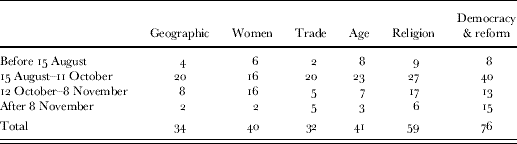
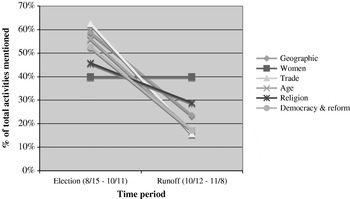
If we isolate the official election and run-off periods, since that is when groups were most active, and show these results graphically, it becomes clear that participation patterns differed between group types. Figure 1 shows the number of activities mentioned by group type for the election and run-off periods as a percentage of total mentions for each group type. Broken down this way, women's groups show a distinct difference from most other group types. For the most active group types, a majority of activities were mentioned in the period preceding the election, with a significant drop-off during the period between the election and the run-off. The number of election-related activities dropped between 60% and 70% for age-related, geographic, democracy and reform, and trade groups; for religious groups, activity dropped by 37%. In sharp contrast, activities by women's groups showed no decline. While the volume of women's activities was not enough to claim that women's groups impacted the election more than other group types, the consistency of women's activities throughout the election and run-off periods may have made a difference in the final vote, and helped Sirleaf to defeat Weah despite expectations to the contrary. This analysis does not allow us to conclude that women necessarily supported Sirleaf and that this resulted in her victory, but merely demonstrates that women's groups were consistently active throughout the election process.
Election activity of civil society groups over time (women's groups counted separately).

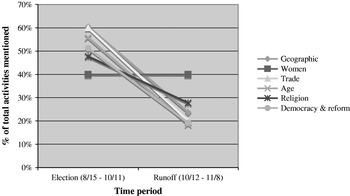
These results hold even if women's groups are counted as more than one type of group (that is, the Lofa Business Women's Association would be counted as a women's group, trade group, and geographic group). Figure 2 replicates the data in Figure 1, showing the percentage of election-related activity in the election and run-off by group type. The largest change is that religious groups in this analysis show a larger decline of 42%, while the other group types still show declines of roughly 60%.
Election activity of civil society groups over time (women's groups counted in multiple categories).

EXPLAINING THE ROLE OF WOMEN ON THE ELECTION OUTCOME
The 2005 election was historic and changed the environment for civil society groups across Liberia. The True Whig Party had dominated politics for a century at the time of the 1980 coup, and a party with a monopoly on power has little incentive to make gestures to underrepresented constituencies. The only election held under Samuel Doe was widely viewed as fraudulent and restrictive. The 1997 election did not allow fair competition among an open field of candidates for the reasons already described.
However, in the 2005 election, there was no incumbent party or candidate, as the members of the transition government were not allowed to run. Weah, the favourite, had no political experience and little education. In addition to these factors, Harris (Reference Harris2006) notes the fragility of party solidarity (evidenced by the willingness of voters to break away from loyalties along ethnic, regional or other lines) as an important factor in determining the nature of the election process. The whole of society was ready for change: after fourteen years of civil war the economy was devastated, public infrastructure was in terrible disrepair, and families and communities were coping with displacement and loss. While this new environment affected everyone, it may have been particularly conducive to public participation by women for several reasons.
First, the power of women in African society generally and Liberian society specifically is not new, and Liberian women, through groups like the Women in Peacebuilding Network, had recently honed this power in the context of peacebuilding. Women's economic and social contributions are evident in a 1985 report published by the UN Food and Agriculture Organisation. This study found that women in Africa perform 90% of work in food processing, 80% of food storage tasks, 90% of hoeing and weeding, and 60% of harvesting and marketing, plus load-carrying and transport (FAO 1985). Women likewise play important roles in the economy, the household, the community, and in peacebuilding and conflict recovery.
Several authors have described the expansion of women's power into more public settings. Mazurana and Carlson (Reference Mazurana and Carlson2004) cite instances of women in Sierra Leone using their control over food supplies to prevent abuse of girls in guerrilla camps, and of their considerable activities in promoting peace and supporting ex-combatants. Moran and Pitcher (Reference Moran and Pitcher2004) document the experiences of women during the war, and cite examples of women in Liberia providing refugee relief, organising reconciliation workshops and participating in demonstrations. The book Liberian Women Peacemakers (AWPSG 2004) details the evolution of women's activities in the context of the Liberian peace process, describing a stepwise development of sophistication and confidence as women identified and filled peacebuilding needs. Based on this account, women progressed from responding to the needs of their neighbours and communities, to taking on roles as community leaders, to networking with and learning from international partners (Liberian diaspora, NGOs, others with experience in recovering from conflict), to becoming activists themselves and guiding the peace process.
Second, in addition to making women comfortable with a more public role, the lengthy peace process left them better equipped to organise for long periods of time; given their experience of being shut out of high-level political processes (Connell Reference Connell1998; Franceschet Reference Franceschet2001; Moran & Pitcher Reference Moran and Pitcher2004; Waylen Reference Waylen1994), they developed persistence as an absolutely necessary skill. Just as women peacemakers knew that arranging peace talks to discuss how to end the long war that controlled Liberia and Sierra Leone for so many years was not the same as bringing the war to an end – and thus required continued activism to make sure an agreement was reached – women backing Sirleaf knew that getting her into the run-off was not the same as winning the election. This attitude may explain the consistent activity level displayed by women's groups through both election periods when other groups greatly reduced their participation.
Third, as discussed by Franceschet (Reference Franceschet2001) and Waylen (Reference Waylen1994), the absence of conventional, male-dominated political and/or social structures can create the space that women's groups need to organise and mobilise a constituency. Experiences in Rwanda, South Africa and Mozambique support this conclusion. These three countries have undergone massive upheavals – genocide in Rwanda, the abandonment of the apartheid system in South Africa, and civil war in Mozambique – but have now stabilised and are among the sixteen countries worldwide with national assemblies made up of more than 30% women (Zeleza Reference Zeleza2006). Such devastating breaks in the existing social order create space for women to fill for several reasons. This may occur because a large proportion of men have been killed, because the main parties to the conflict are no longer able to participate, because the conflict was so protracted that none of the pre-existing institutions can be revived, or, in South Africa's case, because the electorate has changed so dramatically that the old political order has been delegitimised. Liberia's civil war similarly produced an upheaval in society, and generated a void that women could fill.
Fourth, of all African nations, Liberia is perhaps one of the best situated to promote women into positions of high-level, formal power. At the outset of the war, the country had a large population of educated, professional women (Moran & Pitcher Reference Moran and Pitcher2004) from which to draw potential leaders, perhaps because of its ties to the United States, where equal opportunities for women are held up as an ideal. Further, it has a history of women in high-profile positions. It may now claim the honour of having both the first modern female head of state in Africa – Ruth Perry, appointed head of the interim government put in place after the 1995 peace process – and the first democratically elected female head of state, Ellen Johnson Sirleaf. It was likewise the home of the first African university to have a female president (Moran & Pitcher Reference Moran and Pitcher2004), and the founders of the long-dominant True Whig Party included one woman (Dunn et al. Reference Dunn, Beyan and Burrowes2001). The relevance of educated women is evident in voter turnout data from the election. The urban, literate population voted in high numbers, but turnout by literate female voters was particularly impressive, with 77·1% and 69·9% turnout for the October election and November runoff, respectively (NECL 2005b).
Liberia is also suited to empower citizens because of its history of a dense civil society. Waylen (Reference Waylen1994) found that female participation in transition processes is highest (1) when there is a history of grassroots activism by women, and (2) where the transition process is slow enough to allow women's groups to organise effectively. Moran and Pitcher (Reference Moran and Pitcher2004) found the number of women's and other civil society organisations to be much higher than expected in Liberia, and further that these organisations were present at all levels of society. Sawyer (Reference Sawyer2005) also finds that Liberia's civil society assets (such as communication and support networks) are dense and provide a potential basis for recovery. While civil society organisations were certainly disturbed by the long conflict, the memory and elements of their structure persisted, providing at least a foundation for reorganisation when the transition process began. The methodical transition process established by the Comprehensive Peace Agreement, not to mention the experience that both Liberia and the international community gained from numerous other attempts at peace, perhaps aided the re-establishment of these social networks.
Finally, the failure of multiple male-dominated peace efforts, combined with the presence of a well-qualified, charismatic female candidate who had invested for years in Liberian women of all levels of education and social status, gave women the impetus to invest themselves in the election's outcome. The length and severity of the conflict was such that women may have seen no choice but to bring their many years of increasing participation in politics to a culmination by putting one of their own at the top of the hierarchy. Much of the political science literature discusses the importance of institutions in enabling societies and groups to make credible commitments to future courses of action (Acemoglu & Robinson Reference Acemoglu and Robinson2006; North & Weingast Reference North and Weingast1989). Male-dominated political institutions had lost their capability to make such a commitment – an argument that the Sirleaf campaign could implicitly exploit. But not just any woman would do, as shown by the unremarkable performance of the one other female candidate in the race, Margaret Tor-Thompson, who came thirteenth out of the twenty-two candidates (NECL 2005a). Sirleaf's long dedication to grassroots women's causes, her extensive qualifications and her charisma as a candidate were the qualities needed to draw women together, particularly when competing loyalties were minimised by reducing the candidate pool from twenty-two to just two.
It is important here to revisit the issue of the mechanisms by which different groups influence elections. As noted above, and as further demonstrated by the preceding analysis, one cannot discern the whole story of a given group's impact just by looking at how members of that group (and its constituency) voted. To do so neglects the potential impact of voter mobilisation activities and the use of numerous paths of influence to sway votes and motivate participation: that is, women's actions can motivate both men and women, and the high, consistent visibility of women agitating for Sirleaf could well have made the difference in the election's outcome. When considering the impact of civil society groups of any type, voter mobilisation may be just as important, if not more important, than the votes of the group's constituency themselves.
Of great interest will be the longevity of Liberia's newfound democracy and peace. For several reasons, it can be speculated that the elevated role of women in this election is not an aberration from Liberia's male-dominated political history, but the mark of a new era in Liberian politics. First, Liberia, as mentioned above, has a population of well-educated women who are capable of acting as leaders. Second, the presence of a woman at the top of the hierarchy increases the likelihood that women will be able to demand the institutional and structural changes that will preserve their power into the future. Third, conventional, male-dominated political structures have been damaged, leaving room for change.
* * *
The long civil wars in Liberia and Sierra Leone made clear that the events in one country can have important implications for its neighbours. For this reason, the outcome of Liberia's election and its future stability are of great interest. In addition, the events in Liberia have implications for emerging democracies everywhere.
This paper has explored the role of women in Liberia's 2005 election and democratic transition. It is beyond its scope to prove that women's groups were responsible for Sirleaf's success, but a review of media coverage suggests that this election was unique in the activity and organisation of women's groups relative to other civil society groups. The use of content analysis to gauge the activities of different civil society groups during the election period allows us to see that consistency in election-related activities may have allowed women's groups to surpass other civil society group types in their impact on the election. The level of activity displayed by women's groups remained stable between the election and run-off periods, in contrast to other group types whose activity level dropped anywhere from 37% to 70%. The combined effect of these activities on both men's and women's voting behaviour may have been profound.
The persistence and impact of women's groups may be explained by a number of factors. First, women were already powerful within certain spheres of society, and their role in the recent peace process had helped them become accustomed to using their power in a more public way. Second, the length of the peace process and the experience of being excluded regularly from high-level political processes equipped women to organise over long periods of time and to be persistent. Third, the decimation of traditional social and political structures left women a space to participate that may not otherwise have existed. Fourth, Liberia was uniquely positioned to accommodate elevated participation by women and to accept the idea of a female leader, given its large population of educated women and long history of women in prominent roles. Finally, the failure of multiple male-dominated peace efforts and the presence of a well-qualified and charismatic female candidate gave women particular motivation to agitate for change.
There are reasons to believe that the elevated role of women in this election will persist into the future. Liberia has a population of well-educated women who can act as leaders, and having a woman at the top of the hierarchy and a gap in the conventional, male-dominated political structures increase the likelihood of structural and institutional changes that will increase and maintain women's participation. While having women in leadership roles is no guarantee of positive outcomes, ensuring that underrepresented groups like women have more voice and better access to resources is a step forward for any burgeoning democracy.