1. IntroductionFootnote 1
For almost the entire reign of al-Ashraf Barsbāy, ruler of the sultanate of Egypt and Syria between 825/1422 and 841/1438, Barsbāy's former rival and the less successful adversary in the competition for the position of sultan in 824–5/1421–2, the amīr or military and political leader Jānibak al-Ṣūfī (d. 841/1437), continued to cast a remarkable shadow over Barsbāy's authority. Even inspite of Jānibak's compulsory exclusion from central politics throughout all these years — first as a prisoner and then as a fugitive — contemporary sources refer to him as posing a direct threat to the stability of Barsbāy's sixteen-year government. The remarkable latent tension between the royal court in the citadel of Cairo and one of its former members, active for more than a dozen years in a wide variety of places (Alexandria, Cairo, and various cities and towns in Syria and in southern and eastern Anatolia), has evidently received some attention in modern historiography. Nevertheless, this attention has mostly remained peripheral to that for other protagonists in the 1420s and 1430s, resulting in brief and conflicting generalisations rather than in any detailed analysis or insightful synthesis. As Barsbāy's nemesis with a track record that connected Egypt, Syria and Anatolia into one eventful whole, Jānibak al-Ṣūfī is certainly entitled to more detailed research. His remarkable story on the wrong side of the sultan's dispensation — although being physically chased away from the centre towards the fringes of the sultanate's politics in 824/1421, he only disappeared entirely from court when he died many years later — is particularly interesting for furthering today's knowledge of the complex relationships of power and authority that were emanating from Barsbāy's court in Egypt and that were simultaneously existing in Anatolia.
This article will develop a new and better appreciation of Jānibak's story, presenting it as an interesting case for a more nuanced understanding of Cairo's engagements with Anatolia — and vice versa — at the time of Barsbāy's sultanate.Footnote 2 It will do so by first reconstructing in some detail Jānibak's whereabouts in Anatolia, between 838/1435 and 841/1437, as they appear from contemporary source material on the one hand, and as they have been analysed in a handful of modern studies on the other. A remarkable dichotomy in current understandings will become apparent, wavering between Jānibak's presentation either as an active agent or as a passive puppet within a context that was either defined by Cairo's dominance or by Anatolian interests. In the main part of this article, we will therefore problematise these analyses and suggest instead a more comprehensive understanding of Jānibak's role and significance, combining local readings with trans-local Mamluk and Anatolian ones in one integrated social network approach. This will then allow to draw some conclusions related to the enormous complexity of southern and eastern Anatolian political life in the 830s/1430s, to the nature of Barsbāy's authority — in terms of its limits and of its gradual expansion —, and to the shared realities of ninth/fifteenth-century political cultures in the Nile-to-Black-Sea area.
2. The remarkable career of Jānibak al-Ṣūfī: contemporary and modern understandings
a. Life and career before 838/1435
Until 824/1421, the career of Jānibak al-Ṣūfī unfolds as that of an exemplary high-profile member of the sultanate's socio-political life at the beginning of the ninth/fifteenth century. Jānibak —allegedly of Circassian origins— began his career in Cairo as a young apprentice mamlūk of sultan al-Ẓāhir Barqūq (r. 784–802/1382–1399), as did many others.Footnote 3 Under Barqūq's son and successor, sultan al-Nāṣir Faraj (r. 802–815/1399–1412), Jānibak's career still mostly remained under the radar of the period's sources, but it nevertheless seems to have taken off very well, with promotions in the hierarchy of military commanders or amirs culminating in reports of his acquisition of the highest rank of amir of 100 and of his rise to lordly status at court.Footnote 4 This process was at first continued by the next sultan, al-Muʾayyad Shaykh (r. 815–824/1412–1421), who appointed Jānibak in various high-ranking court positions.Footnote 5 In 818/1415, however, Jānibak was thrown into prison for unknown reasons, and he was only released in 822/1418.Footnote 6 For the next two years, then, he remained in the background, until in 824/1421, upon the accession of al-Ẓāhir Ṭaṭar (r. 824/1421), he was called back to the forefront of court politics and re-appointed to a high-ranking position.Footnote 7 Within a few months he was even appointed to the leading position at court of atābak al-ʿasākir.Footnote 8 As a consequence, when the fatally ill sultan al-Ẓāhir Ṭaṭar was arranging his succession from his deathbed, he entrusted Jānibak with the responsibility for the governmental management of his minor son's reign, while nominating another leading amir from his entourage, Barsbāy, to act as the tutor of the young sultan.Footnote 9 In the power struggle that ensued between these two leading amirs, Jānibak al-Ṣūfī was soon outdone by the charismatic Barsbāy and, after a brief clash between their supporters, Barsbāy had Jānibak captured and sent to the prison of Alexandria.Footnote 10 However, this detainment and the subsequent accession of his opponent as sultan al-Ashraf Barsbāy in early Rabīʿ II 825/April 1422 was not the end of it for Jānibak, nor for his vexed relationship with Barsbāy. Jānibak's dim future took a very different turn in Shaʿbān 826/July 1423, when he almost miraculously managed to escape from prison.Footnote 11 The court chronicler Ibn Taghrī Birdī explains this event and its immediate and long-term consequences in a typically dramatised but insightful way:
The sultan continued [to reign] while there was nothing at all to disturb him, until Friday the 7th of Shaʿbān (16 July 1423). [On that day] news reached the sultan that the senior amir Jānibak al-Ṣūfī had fled from Alexandria, from the tower where he had been imprisoned, and [that] he had left this frontier city without anyone noticing it. When the sultan heard this news, his soul almost expired, and he became furious. From this day onwards, he unleashed on the people distress, punishments, and attacks on households, which we will mention for the whole length of his sultanate. The life of al-Ashraf was disturbed from the day he learned the news, and he turned against a large group of his amirs, seizing them and banishing others accordingly.Footnote 12
In fact, all contemporary reports agree with Ibn Taghrī Birdī that even after almost two years in prison and without any substantial resources readily available to him, Jānibak continued to be perceived at court as a legitimate contender for the sultanate and as a direct threat to Barsbāy's authority — or at least as a potential rallying point for opposition that could present such strong claims for a legitimate alternative to Barsbāy that it was considered a realistic threat. For many years after 826/1423, and in spite of very active searches, the only news that reached Cairo about the refugee Jānibak al-Ṣūfī consisted of rumours about his alleged whereabouts in Egypt, Syria and Anatolia; despite the vague and unfounded nature of these messages (or perhaps rather as a result of this frustrating obscurity), al-Ashraf Barsbāy remained extremely worried about a possible threat from Jānibak al-Ṣūfī and his agents, and he is claimed to have launched a true campaign of terror as a result. In this campaign, Jānibak's remaining family and former supporters were neutralised, and the slightest suspicion of sympathy for Jānibak was considered sufficient to get arrested, or worse.Footnote 13
For no less than twelve years, however, Jānibak al-Ṣūfī himself managed to find refuge and shelter well out of the Egyptian sultan's (and his chroniclers’) reach. As a result the picture of his actual whereabouts remains very blurred. It seems that he eventually managed to find such refuge with local leaders in Anatolia. This is suggested most clearly by the fact that when all of a sudden in late 838/1435 very concrete information of Jānibak's activities was presented to the sultan, he was revealed to having been residing for some time already with Isfandiyār b. Bayazīd (r. 805–843/1402–1439), the Türkmen local ruler of the Anatolian town of Sinop by the Black Sea.Footnote 14 This news, which was brought to Barsbāy by envoys from his governors in the northern provinces of Aleppo and Daranda, was actually quite disconcerting: Jānibak turned out to be gathering his strength in Anatolia, and he had sent these two and many other governors and chiefs in the area letters inviting them to join forces with him.Footnote 15 After twelve years of doubts and suspicions, it seemed finally clear what Jānibak was up to.
b. The Northern Frontier Zone between Barsbāy, Murād Beg and Shāh Rukh
As these references to Mamluk governors and Türkmen rulers suggest, the sudden re-emergence of Jānibak al-Ṣūfī in Anatolia in 838/1435 was first and foremost a token of the eternal complexity of the constantly shifting and crisscrossing allegiances and authorities of local, regional, and trans-regional rulers in many parts of Anatolia. In the mid-1430s, this complexity coalesced into the competition of a handful of Türkmen leaders for access to land and resources and — simultaneously — of the rulers of Cairo, Bursa and Herat for geopolitical hegemony and for local military and economic control. Between 820/1417 and 822/1419, while Ottomans and Timurids were slowly recovering from disruptive internecine warfare, in two military campaigns the sultan al-Muʾayyad Shaykh had managed to restore Cairo's authority deep into south-eastern Anatolia, acquiring control over Divriği (Diwrikī) and Kayseri (Qayṣariyya).Footnote 16 An Egyptian amir was installed as governor over the first region, and over the second a governor was appointed by the sultan from among the local Türkmen ruling family of Elbistan (Albulusṭayn) and Marash (Marʿash, today Kahramanmaraş), the Dulgadirids. This policy of sultanic sovereignty and active representation in Anatolia — “of reward and coercion”, as Kellner-Heinkele put itFootnote 17 — was continued throughout the 1420s and 1430s, under Shaykh's successor Barsbāy. Despite (or perhaps rather because of) increased effective interest in the southeast Anatolian region from the Ottoman ruler Murād Beg (r. 824–855/1421–1451) in Western Anatolia and from the Timurid sovereign Shāh Rukh (r. 807–850/1405–1447) in Iran and Azerbaijan, Barsbāy successfully managed to deploy a resourceful combination of diplomacy, representation and military campaigning aimed at the continued integration of Anatolian towns, citadels, caravan routes and Türkmen leaders into Cairo's sphere of influence. Southern and eastern Anatolia's main Türkmen leaders and their families and clans — from West to East the Karamanids of Konya, the Ramadanids of Tarsus and Adana, the Dulgadirids of Elbistan and Marash, and ʿUthmān Qarā Yülük and his sons, leading the Aqquyunlu tribal grouping and dominating the Diyar Bakr and Erzincan regions — all tried to deal with this in their own best interests, continuously pursuing their competing claims to Anatolian resources either by challenging their integration into the sultan's orbit or by bringing their claims to court in Cairo.Footnote 18
This was the complex Anatolian arena in which Barsbāy's old foe Jānibak suddenly made his public re-appearance in late 838/1435. It certainly was a dangerous arena, on the fringe of the sultan's reach, but one that at the same time proved to offer unusual opportunities for someone like Jānibak. Those opportunities arose more precisely when, in 838/1435, long-standing competition between Karamanids and Dulgadirids for control over the strategic town of Kayseri again erupted in a direct military confrontation, with substantial trans-regional repercussions. Since the days of Muʾayyad Shaykh awarding formal control over Kayseri was considered to belong to the Egyptian sultan's prerogatives, so that Barsbāy and his representatives were almost automatically drawn into the dispute when representatives both of the Karamanid ruler Ibrāhīm Beg (r. 1423–1462) and of his Dulgadirid counterpart Nāṣir al-Dīn Meḥmed (1399–1442) came to court seeking formal recognition. In return for promises of substantial tribute, Barsbāy sided with the Karamanids against the Dulgadirids. This Kayseri controversy moreover happened within a larger context of an expansionist Karamanid policy that was adopted by Ibrāhīm Beg in the mid-1430s, bringing the Karamanids of Konya also into direct conflict with their northern neighbours, the Ottomans. Sultan Murād Beg therefore took a similarly active interest in this local conflict on the Mamluk frontier, siding with the enemies of his enemies, the Dulgadirids. Finally, the mid-1430s witnessed renewed westward Timurid campaigning in Azerbaijan and east Anatolia, so that Shāh Rukh's actions and other leaders’ reactions and anticipations had an equally substantial impact on the course of the Kayseri controversy.Footnote 19
From Shawwāl 838/May 1435 onwards, Kayseri was thus again controlled — with the Egyptian sultan's approval — by Ibrāhīm Beg the Karamanid, while the Dulgadirid Nāṣir al-Dīn Meḥmed and his son Sulaymān tried to recapture their former possession in every possible way. This also generated numerous raids on other towns in the area, most of them under direct or indirect sultanic control. Reported raiding parties were mainly led by Dulgadirids, but also involved other local leaders, especially the Aqquyunlu leader ʿUthmān Beg Qarā Yülük (r. 806–839/1403–1435) and some of his sons. All this resulted in military campaigns being sent by the Egyptian sultan against the Dulgadirids and one Ottoman campaign against the Karamanids, and in the subsequent breakdown of Karamanid and Dulgadirid control over their core regions of Konya and of Elbistan respectively. By early 841/mid-1437, however, the increase of Ottoman involvement in the Kayseri controversy after Shāh Rūkh's sudden retreat eastwards resulted in a settlement between the conflicting parties, restoring the pre-conflict situation for both Karamanids and Dulgadirids, and the general acknowledgment of Barsbāy's suzerainty over both. A final Egyptian campaign in Ramaḍān-Dhu l-Ḥijja 841/March-June 1438 — the last of Barsbāy's reign — against the warring sons of Qara Yülük — who himself had died in Ṣafar 839/August-September 1435 when summoned to offer assistance to Shāh Rukh — also once more restored the general acknowledgment of Barsbāy's suzerainty over the Northern Euphrates area. Only when the news of the sultan's death on 13 Dhū l-Ḥijja 841/7 June 1438 reached his commanders in eastern Anatolian Erzincan did they end the campaign and return to Egypt.Footnote 20
c. Jānibak al-Ṣūfī's whereabouts in the Anatolian Frontier zone, 1435–1438
This situation of a rapid transformation and eventual restoration in southeast Anatolia of local and regional power balances between 1435 and 1438 was the context that offered Jānibak sufficient opportunities to re-emerge as a leading public figure. What exactly extant source reports say that happened to him will be reconstructed here;Footnote 21 an analysis of how and why it happened — or was represented as such — will be considered thereafter.
From his re-appearance in Ottoman Central Anatolia in late 838/1435 over his alliance with the Dulgadirid cause until his death in Aqquyunlu captivity on 26 Rabīʿ II 841/26 October 1437, Jānibak got deeply engaged in the full complexity of the Kayseri conflict in a range of events that can be grouped into five separate phases.
1) Shawwāl 838-Rabīʿ I 839/May-October 1435
A first phase sees Jānibak emerging in Anatolia as a local leader, quite successfully generating support and followers across local Türkmen leaderships — from Ramadanids in the west to Aqquyunlu in the east — and engaging in profitable raiding in the Cairo controlled Anatolian regions of Divriği and Malatya. This phase, which was very alarming from Barsbāy's perspective, ended abruptly in betrayal.
As mentioned above, in late 838/mid-1435, after many years of silence, very concrete information of Jānibak's activities was again presented to the sultan: he was revealed to having been residing for some time already with the Türkmen ruler of the town of Sinop,Footnote 22 and to be gathering his strength in the spring of 838/1435 in central Anatolia, sending the sultan's governors and Türkmen chiefs in Northern Syria and South-East Anatolia letters inviting them to join forces with him.Footnote 23 Several local Türkmen chiefs pledged their supportFootnote 24 and around the same time, Jānibak also got support from another refugee Egyptian amir, Qurmush al-Aʿwar, a brother-in-arms for many years who now suddenly re-appeared in this region.Footnote 25 With Qurmush, his personal followers and a handful of Türkmen chiefs, Jānibak then moved south, eventually joining forces with the lord of the citadel of Çemişgezek (Qalʿat Jumurkasak), the Aqquyunlu Meḥmed b. ʿUthmān Beg Qarā Yuluk, to raid the region of Cairo controlled Divriği. At that moment, however, this course of local east Anatolian events was interrupted by the third and last Timurid campaign against Qara Qoyunlu Türkmen control over Azerbaijan, in the period 838–840/1434–6. The Aqquyunlu Türkmen leadership of south-east Anatolia — including Meḥmed — was summoned by Shāh Rukh to come to his assistance against their Qara Qoyunlu foe in the lake Van region. As a result, Jānibak al-Ṣūfī and his followers were left alone in the Divriği region, and they moved further south, heading for the strategic town of Malatya.Footnote 26
In the meantime in the Syro-Egyptian sultanate, sultan Barsbāy reacted to the news of the Anatolian activities of Jānibak al-Ṣūfī by preparing his Syrian governors for action.Footnote 27 Barsbāy's mind was, however, set at rest when he received a letter informing him that Jānibak had been arrested. In the course of Jānibak's siege of Malatya, on 17 Rabīʿ I 839/10 October 1435, he had been betrayed and captured by a son of the Dulgadirid leader Nāṣir al-Dīn Meḥmed. Before any of Jānibak's followers had realised it, he had been taken in shackles to Elbistan.Footnote 28 When this news reached the sultan, an envoy was immediately sent out to ask for the extradition of Jānibak al-Ṣūfī.Footnote 29
2) Jumādā II 839-Rabīʿ I 840/December 1435-October 1436
In this second phase, Jānibak encountered a rather unexpected supporter and partner in the Dulgadirid ruler Nāṣir al-Dīn Meḥmed. Their joint challenge to Barsbāy's authority resulted however, in protracted Egyptian raiding and campaigning in Dulgadirid lands that all but finished Dulgadirid local leadership in southeast Anatolia. Meḥmed and Jānibak eventually finding shelter in Ottoman lands marks the end of this phase.
Fortunately for Jānibak, already in Jumādā II 839/December 1435 his captor's father decided to set his son's prisoner free, even despite the arrival in Elbistan of an envoy from the sultan. When this envoy returned empty-handed to Cairo in Rajab 839/January 1436, Barsbāy's court got in great turmoil, and it was decided to send north from Cairo an impressive military force of leading amirs and royal elite forces.Footnote 30 In Elbistan, meanwhile, Jānibak al-Ṣūfī was restored to his former status as a regional leader, and he moved further south from Elbistan, towards Dulgadirid Marash.Footnote 31 Meanwhile, the troops marching north from Cairo were gathering in Aleppo. Early in Ramaḍān 839/mid-March 1436, Barsbāy's governor of this northern province had already left for Anatolia with his own troops. In the end, these troops moved further north than Marash, against Nāṣir al-Dīn Meḥmed in Elbistan, who therefore fled the town with his followers. When the pursuit of Meḥmed and his band proved futile, the abandoned town of Elbistan and its surrounding region were thoroughly looted and raided by Barsbāy's governor and his army, taking everything they found with them to Aleppo and leaving behind only scorched and depleted lands. “Not a single keddah of grain was left in Abulustayn or its districts”, the Egyptian sources claim, “It was burned and pillaged — both [the town] and its villages —, and it was left a barren plain”.Footnote 32
Upon this raiding army's return to Aleppo, a combination of those fresh Egyptian and other Syrian troops took over and marched north, eventually taking up positions near Gaziantep (ʿAyntāb), some 100 kilometres north of Aleppo and controlled by one of the sultan's governors. As Jānibak and his followers continued to move south, a confrontation became unavoidable. This happened on 24 and 25 Dhū l-Ḥijja 839/9 and 10 July 1436, and after two days of fighting, Jānibak and his band of supporters were totally defeated. Most of Jānibak's followers were captured, Jānibak himself only just managing to escape.Footnote 33 Defeated, bereft of supporters and resources, and hunted down by raiding Syro-Egyptian troops, Jānibak al-Ṣūfī and Nāṣir al-Dīn Meḥmed were obliged to flee ever further into Anatolia. When those troops finally gave up their pursuit near Sivas (Sīwās) in central Anatolia, arriving back in Aleppo in Rabīʿ I 840/September-October 1436, all they brought with them was more booty, and the news that Jānibak and Meḥmed had found refuge in Ottoman lands. Shortly afterwards, it would become known that together they had settled down near Ottoman Ankara (Ankūriyah).Footnote 34
3) Jumādā I - Dhū l-Qaʿda 840/November 1436 - May 1437
In this third phase — only known through brief allusions to reports arriving in Cairo — the region of Kayseri again became a bone of contention between Karamanids and Dulgadirids, when the latter — including Jānibak — received full Ottoman support and then returned to South-East Anatolia. This phase ended when the Ottomans concluded peace with the Karamanids.
On 12 Jumādā II 840/22 December 1436, a message arrived in Cairo that the defeated Dulgadirids had found a powerful ally in the Ottoman sultan Murād Beg who took their side in territorial disputes with the Karamanids. As a result no less than three armies started their march from Ottoman lands towards Ibrāhīm Beg in Kayseri, Barsbāy in Cairo offered assistance to his Karamanid partner by “sending money and weapons to each of [his governors] in Gaziantep (ʿAyntāb), Malatya (Malaṭiya), Kâhta (Kakhtā) and Gerger (Karkar) and [by] writing to the loyal Türkmen groups (Turkumān al-ṭāʿa) to aid Ibrāhīm b. Qaramān against his enemy”.Footnote 35 Further disconcerting news, however, arrived in Cairo some three months later, on 10 Ramaḍān 840/18 March 1437: also Nāṣir al-Dīn Meḥmed, his “partner” (nazīluhu) Jānibak al-Ṣūfī and their band of followers were reported to having joined the Ottoman march against “Karamanid territories”. In fact, it appears that from the region of Ankara they had managed to join forces near Kayseri with Meḥmed's son and his Ottoman allies, participating in an attempt to recover control over the town. In Cairo, Barsbāy reacted eventually by instructing his Syrian governors to march north to offer assistance to Ibrahim Beg. By the time the governor of Aleppo reached Marash, however, it became known that the Karamanids and the Ottomans had concluded peace, settling their territorial disputes and ending two years of hostile activities between them. As a result, these Syrian troops returned south and on 20 Dhū l-Qaʿda 840/26 May 1437 they were welcomed back in Aleppo.Footnote 36
4) Muḥarram 841/July 1437
From the perspective of Jānibak's whereabouts the previous phase seamlessly flowed into this next, fourth one. What changed, however, was that these whereabouts again became much more localised, without any direct involvement from Cairo or Bursa. This phase ended in a renewed defeat and flight, and in Jānibak's definitive separation from the Dulgadirids as a result.
As the Dulgadirid siege of Karamanid Kayseri continued, Nāṣir al-Dīn Meḥmed and Jānibak al-Ṣūfī wandered south with a small band of followers, towards the scorched Dulgadirid heartlands which they had been chased from a year before. Their re-appearance did not go unnoticed however, and on 15 Muḥarram 841/19 July 1437, their encampment — about two days travel from Marash — was attacked by “the [Egyptian] governor of Divriği . . . with a number of governors of those districts, and others, numbering around two thousand horsemen, . . . [who] looted what was there and burned it”. Just as had happened a year before, Jānibak and Meḥmed were forced to flee, but this time circumstances made them split up. Meḥmed managed to escape again towards Ottoman territories in the northwest, but Jānibak had to seek refuge in the other direction, eventually ending up in Aq Qoyunly territories with his former companion Meḥmed b. ʿUthmān Beg Qarā Yülük and his brother Maḥmūd.Footnote 37
5) Muḥarram-Rajab 841/July 1437-January 1438
In this fifth and final phase, Jānibak was once again betrayed — this time by his Aqquyunlu hosts — to Barsbāy's agents; when he tried to evade capture he was mortally wounded and died.
According to the most widespread version of Jānibak's story, Barsbāy's governor of Aleppo managed to persuade Meḥmed b. ʿUthmān Beg Qarā Yülük and his brother to arrest their guest. This was planned for Friday 25 Rabīʿ II 841/25 October 1437, but Jānibak al-Ṣūfī was warned so he tried to escape. In the battle that ensued he was hit by an arrow, fell from his horse and was eventually captured. He died from his wounds the next day. When a courier from Aleppo came to collect Jānibak, and pay Meḥmed and Maḥmūd, it was only Jānibak's severed head that was exchanged for money. This head was then presented to the governor in Aleppo, who immediately forwarded it to Cairo, where — much to the sultan's delight — it was said to have been displayed on a spear in the city's streets on 1 Jumādā I/30 October, and then thrown into a ditch. Some two months later, in early Rajab/January 1438, Jānibak's sword reportedly also arrived in Cairo with a son of Maḥmūd b. ʿUthmān Beg Qarā Yuluk. This ritual act, loaded with symbolism of Barsbāy's victory and sovereignty, finally concluded Jānibak's longstanding story on the fringes of the sultan's authority, only a few months before the sultan's own demise in Dhū l-Ḥijja 841/June 1438.Footnote 38
d. Jānibak al-Ṣūfī's Anatolian whereabouts in contemporary and modern historiography
The historical picture of Jānibak al-Ṣūfī in this volatile frontier zone of southeast Anatolia that emerges from Egyptian sources thus presents him as morphing from a rather successful military leader, gathering his strength with local and regional support and threatening strategic strongholds of the sultanate such as Divriği and Malatya; over to an unexpected Dulgadirid partner against Karamanids and Barsbāy, continuing to cast his threatening shadow but bringing but little good fortune to the Dulgadirid cause and finally to a defeated refugee to Aqquyunlu hospitality, welcomed at first but then sold for gold coins to Barsbāy's agents. In general, this contemporary representation thus accorded a rather central and protagonist role to Jānibak. It pictures him as a leading public figure who was joined by some of the main rulers of the South-Eastern Anatolian regions and beyond in his subversive campaigns against Barsbāy's sovereignty. This construction of a refugee amir's sudden acquisition of effective and far-reaching political and military agency in South-Eastern Anatolia between 1435 and 1438 is shared by most contemporary Egyptian historians, and therefore certainly also by their audiences.Footnote 39 Their shared memberships of Cairo's political and cultural elites at the time of these events suggests that this story at least represents the dominant way in which formal and informal messages and news about Jānibak's whereabouts were received and perceived among these elites, a dominant perception of Jānibak's agency that was based on correspondence and eyewitness accounts reaching Cairo from South-Eastern Anatolia via Aleppo.
As may be expected, modern reception of this late medieval Egyptian perception, as preserved in the only hitherto known source material for Jānibak's case, is mixed reading. At the same time, however, there so far seems to have been no divergence to date from the more or less one-dimensional approach to the issue of Jānibak's agency. We still have to rely for detailed modern reconstructions of Jānibak's story on the only modern history of sultan Barsbāy's reign ever written, by Ahmad Darrag, which was published now more than fifty years ago, in 1961, and on the equally detailed reconstruction of Dulgadirid history by Refet Yinanç, produced as a PhD dissertation in 1973.Footnote 40 Darrag's reconstruction of Jānibak's story in particular is of interest here. It was interwoven in his detailed account of developments in the Anatolian frontier zone —“la frontière orientale”— at the time of Barsbāy, as part of a subchapter —“la coalition des ennemis de Barsbāy”— that describes in much detail how between 838/1435 and 841/1438 Barsbāy was forced to become more deeply involved than ever in Anatolian affairs. In Darrag's view, this was all started by “a coalition” of his enemies, most importantly Shāh Rukh and his local agents: the Aqqoyunlu, the Ottomans, and the Dulgadirids.
A la fin de 838/1435 se dressèrent contre l’Égypte à la fois Šāh-Ruḫ doublé de ses satellites, les Turcomans du Mouton Blanc et les Ottomans auxquels s’étaient ralliés les Ḏulqādirides. C’est alors que ses adversaires lancèrent dans la lice Ğānibak Ṣūfī. Cependant cette grave situation se dénoua heureusement pour elle grâce aux alliés occasionnels qui se présentèrent, grâce à la chance persistante qui sourit à son souverain.Footnote 41
Just as is illustrated by this passage, Jānibak appears from time to time in Darrag's narrative, but only as a rather passive refugee who was used and also abused by Ottomans and others, who needed protection against his “mortal enemy” (son mortel ennemi) Barsbāy, and who should at best be considered an Anatolian adventurer (l’aventurier), unwillingly caught up in events that transcended him by far.Footnote 42
This understanding of Jānibak's role as a passive instrument, looking at him mainly from the perspective of how he was useful to Barsbāy's opponents, has been quite influential, especially in some ‘Anatolian’ studies that picked up Jānibak's case in their dealings with these opponents. In John Woods’ seminal work on the Aqquyunlu, Jānibak understandably hardly figures. But when he does enter the narrative, it is not just as Barsbāy's “long-time archrival”, but again as a “Mamluk rebel and adventurer”. Above all, Woods suggests, Jānibak's brief presence among the Aqquyunlu provided Barsbāy with the ideal excuse to send in his third and final expedition against them; in reality, Woods explains, this had nothing to do with Jānibak, but rather was an attempt “to abet the Aqquyunlu Great Civil War by extending official Mamluk recognition to several factions simultaneously”.Footnote 43 A similar picture emerges from Margaret Venzke's 2000 survey of the Dulgadirid position “within the Ottoman-Mamluk Rivalry”: Jānibak may well have been a “Mamluk rebel and aspirant to the throne”, but he appears first and foremost as a useful tool for the Dulgadirids to challenge Barsbāy's authority once they lost his support over Kayseri: “This [challenging] was seen in Meḥmed's harbouring of the Mamluk rebel and aspirant to the throne, Emir Janibeg al-Ṣūfī. Worse than not handing Jānibeg over to Barsbāy as the latter had demanded, Meḥmed married him off to one of his daughters !”Footnote 44 In fact, considerations of Jānibak al-Ṣūfī's story from a mid-fifteenth-century Anatolian historiographical perspective tend to deem it out of place, because primarily Egyptian, and therefore lacking any relevant historical agency within the Anatolian context; as such, it was even considered irrelevant to be included by Barbara Kellner-Heinkele, in her study of the formation of Ramadanid and Dulgadirid local leaderships, and by Shai Har-El, in his detailed exploration of fifteenth-century Ottoman-Mamluk frontier relations.Footnote 45
A handful of works of specifically Syro-Egyptian history, however, take a remarkably different approach towards Jānibak's case. Unlike the example set by the pioneering contribution of Darrag, they adopt in the clearest terms a perspective of full and very decisive agency, furthering an understanding that — as explained above — Egyptian sources had already suggested for Jānibak's activities. In one of the very few English-language surveys of the sultanate's history published back in 1973, Sir John Glubb summarised Jānibak's story as follows:
Suddenly, in May 1435, Jānibak al Sufi appeared in Anatolia and wrote to the Qaraman Ameer [sic], to Ibn Dulqadir of Albistan and to Shah Rukh. The latter sent back robes of honour and urged all concerned to invade Syria. Janibek thereupon besieged Malatia. . . . On 9th July, 1436, Janibek with some twelve thousand men was defeated near Ain Tab, north of Aleppo, and in October 1437 he was killed. His death, the defeat of Qara Yülük and the humiliation of Shah Rukh's ambassador, did much to restore Mamluke [sic] prestige.Footnote 46
This understanding of Jānibak's leading role in these events is mirrored in André Clot's 1996 l’Egypte des Mamelouks.Footnote 47 The same is also largely true for the much more specialist survey of the region's history in The Age of the Crusades, written by the Mamluk historian Peter Holt and published in 1986. In a much more nuanced approach to the extant source material, Holt also stressed Jānibak's very active role in bringing about the southeast-Anatolian events of 1435–8. Holt even claimed that “the arrival of Janibek in Anatolia brought together the individuals and groups opposed to Barsbāy and more generally to the Mamluk sultanate as such”. Briefly surveying “the threat from Janibek in the north” — from his alliances with the Aqquyunlu and the Dulgadirids over the confrontation at Gaziantep in July 1436 to his flight from Marash to the Aq Qoyunly — Holt concluded that his death in October 1437 delivered Barsbāy from no less than “the most dangerous of his enemies”.Footnote 48
3. Towards an integrative approach: Jānibak al-Ṣūfī's ego network in the Mamluk/Anatolian Frontier zone
What should we make of these differing perspectives on Jānibak? In the third and main part of this article, we will not try to engage in any futile argumentation in favour of one or the other. Rather, we wish to present a different, more nuanced approach, which tries to integrate these different perspectives and understandings into a more comprehensive analytical framework.
Two related assumptions will be the starting point for this re-assessment. The first is the acknowledgement of the reality that throughout most of the fifteenth century, southern and eastern Anatolia remained a dynamic and permeable zone between Ottoman, Egyptian and Timurid sovereignties, where by a kind of a process of imperial stretch the physical enforcement of their trans-regional authorities was limited and where as a result plenty of opportunities and strategies were available for local and regional leaders to manifest themselves against their subordinates, peers, competitors and overlords.Footnote 49 As a result, we need to operationalise the fact that between 838/1435 and 841/1438 Jānibak was active in a frontier zone, on the constantly shifting fringe of competing Mamluk, Timurid and Ottoman spaces of power and authority. This means that we have to accept that in this enormous geographical area stretching between Timurid Iran, Ottoman West-Anatolia and Mamluk Syria, political instability, constantly changing sovereignties, and continuous competition for control over, and access to, resources defined the standards of power elites’ social practice, and that this created huge opportunities as well as dangerous pitfalls for local chiefs who wished to try their luck, for regional leaders who wished to pursue their ambitions, and for trans-regional leaders who wished to manifest their authority and expand their reach. For Jānibak, this means that we cannot neglect the fact that he should be also considered from a local Anatolian perspective, without at the same time forgetting that more than anything it was a trans-local high-profile Mamluk background that made him who he was, even in remote areas such as Sinop by the Black Sea.
The second basic assumption which follows from this is that we need to accept the simple fact that the historical realities and perceptions of Jānibak's case may have meant many different things to many different people at many different times and in many different places. It is therefore extremely relevant to take into account who those different people were for whom Jānibak's case may have been meaningful, and to see how these differing perspectives and the different relationships that tied them to Jānibak as a result can further understandings of this story. Most importantly for the purpose of this article, these two basic assumptions mean that conflicting assessments of Jānibak's agency versus his non-agency can be reconciled by an exploration of the varied and interlocking social groups of agents that interacted in meaningful ways with Jānibak between 838/1435 and 841/1437, an interaction that coalesced into a complex and dynamic ego-network that was brokered by Jānibak's agency and identity.Footnote 50 More precisely, this ego-network will be reconstructed through the prism of the changing scale of the spatial realities (local, regional, trans-regional) in which it operated, three interrelated socio-spatial network perspectives that help to make more sense of Jānibak's story, as well as of the different relational contexts in which it was constructed: a local or intra-regional Türkmen Anatolian perspective, an inter-regional Mamluk Anatolian perspective, and a trans-regional Anatolian frontier zone perspective.
4. Jānibak as a power broker in Türkmen Anatolia
From his appearance near Ottoman Tokat down to his last combat near Aqquyunlu Çemişgezek, the historiographical representation of Jānibak's Anatolian adventures and connections come across as not necessarily different from those of local chiefs in the area. Just as these chiefs all did, Jānibak al-Ṣūfī basically used the interlocking opportunities offered by this political and military frontier zone — local autonomy amidst fluid trans-local sovereignties, direct access to resources that were beyond the physical reach of trans-local monopolies, and a readily available pool of experienced warriors that were not bound to trans-local loyalties — to carve out a place for himself in this huge and hybrid social space.
All reports agree that Jānibak never operated alone, that there were always people moving around through South-East Anatolia with him. Even in his final hours of freedom, on Friday 25 Rabīʿ II 841/25 October 1437, when he was trying to escape from his Aqquyunlu hosts, Egyptian sources suggest that he only did so after “consultation with his companions (fa-shāwara aṣḥābahu)” and that he fled “with some twenty horsemen from among his companions, so as to save himself (wa-maʿahu ʿishrūn fārisan min aṣḥābihi li-yanjū bi-nafsihi)”.Footnote 51 It remains impossible to retrieve the actual identity of these “companions”, but the fact that they were reported as having remained with Jānibak in his hour of need, when he had been obliged to seek Aqquyunlu shelter, suggests that there was a strong tie binding them to their leader's cause. Another reference indeed suggests that these “companions” refer to a select personal retinue of “sworn brothers”: two months earlier, on 15 Muḥarram 841/19 July 1437, when Jānibak and his Dulgadirid partner Nāṣir al-Dīn Meḥmed had been camping near Marash, Egyptian sources again explain that “Ibn Dulghādir and Jānibak al-Ṣūfī were with a small group (nafar qalīl), because their main party (jumūʿahumā) had remained with the amir Sulaymān b. Nāṣir al-Dīn Meḥmed, besieging Qaysariyyat al-Rūm (Kayseri)”.Footnote 52 A small band was all that had been accompanying them when they were surprised by an overwhelming majority of “[the sultan's] nāʾibs and their peers with about 2,000 horsemen”.Footnote 53 What is important to understand from this is that it suggests that Jānibak had been leading others, next to those close “companions”, on his Dhū l-Ḥijja 839/July 1436 flight with Nāṣir al-Dīn Meḥmed deep into Ottoman lands and then on their Ramaḍān 840/March 1437 march back against Kayseri; these were probably a mixture of Dulgadirid and other troops and followers, put to work in the Kayseri-siege, while their leaders had gone out raiding or hunting in old Dulgadirid territories with a small selection of followers, who can only have been — indeed — their personal retinues.
These troops and personal retinues however, were only a tiny remainder of the much larger hosts that had been following the leaderships of Nāṣir al-Dīn Meḥmed and Jānibak al-Ṣūfī before the two devastating Syro-Egyptian campaigns in the regions of Elbistan and Gaziantep, in the summer of 839/1436. Jānibak's total defeat near Gaziantep, and his narrow escape from the arrest which befell most of his followers, clearly was a turning point in his Anatolian career, as was remarked by the contemporary Egyptian historian Ibn Taghrī Birdī:
“From that day onwards, Jānibak al-Ṣūfī's case went downhill, after rulers and common people (mulūk wa-khalāʾiq) had been rallying to him; [this was] because of his ill fortune”.Footnote 54
Much more information is indeed known about the wide range of supporters that had been rallying to Jānibak's cause before Dhū l-Ḥijja 839/July 1436. Already when he had been residing in Ottoman Tokat, many surely had been attracted by the appeal of a new and promising leadership, confirmed by the support from the Ottoman sultan Murād Beg's representative in Tokat, and by the terror which was rumoured to be spreading among sultan Barsbāy's agents in northern Syria and Anatolia.Footnote 55 Others were drawn in by a very pro-active campaign of official correspondence from Tokat; the substance of one type of such correspondence is suggested by the summary of the first contact that was established between Jānibak and Nāṣir al-Dīn Meḥmed in Elbistan, in Shawwāl 838/May 1435:
“The dawādār of the amir Jānibak al-Ṣūfī and Meḥmed b. Kundughdī b. Ramaḍān al-Turkumānī had arrived with Nāṣir al-Dīn Meḥmed b. Dulghādir in Elbistan. They had made him swear that he would not hand over nor abandon Jānibak al-Ṣūfī in case he would come to him”.Footnote 56
Other types of such correspondence to lesser regional figures included more direct appeals for support, alliance or even subordination to Jānibak's authority.Footnote 57 Whatever its actual nature and faraway sources’ reconstructions of it, this soon turned out to be a very successful campaign, feeding many rumours in Syro-Egyptian lands about who was or was not part of Jānibak's growing Anatolian network of allies, partners, and subordinates;Footnote 58 most importantly, it resulted in the build up of a substantial military force around Jānibak, eventually — by the time of these troops’ fatal attack on the sultan's army near Gaziantep in Dhū l-Ḥijja 839/July 1436 — reaching a substantial size to Anatolian standards, assessed by Egyptian sources at “about 2,000 horsemen”.Footnote 59 The wide variety of local participants in this new leadership project is best illustrated in a summarising report by the contemporary court historian Ibn Taghrī Birdī, who tried to capture this remarkable emergence and deployment of a highly diverse new Anatolian power network in the following sentences:
“He appeared again in [the town of] Tokat in the course of Shawwāl of the previous year, I mean the year 838. Its ruler, ʾArkuj Pasha, took it upon himself to offer him support, so he honoured him, he provided him with gifts, and he wrote to Nāṣir al-Dīn Meḥmed b. Dulghādir, nāʾib of Abulustayn, to Aslamās b. Kubak, to Meḥmed b. Quṭbakī, to Qarā Yuluk, and to other Türkmen amirs like them to stand with him and to prepare to offer assistance to him. Thereupon, a large group rallied around Jānibak al-Ṣūfī. He geared up, and departed with them from Tokat. [. . .] He travelled from Tokat to the amir Meḥmed b. Qarā Yulūk, lord of the citadel of Jumurkashak. This Meḥmed honoured them and strengthened their ranks. Thereupon, they launched raids from there on the town of Divriği and they harassed its people and plundered its surroundings”.Footnote 60
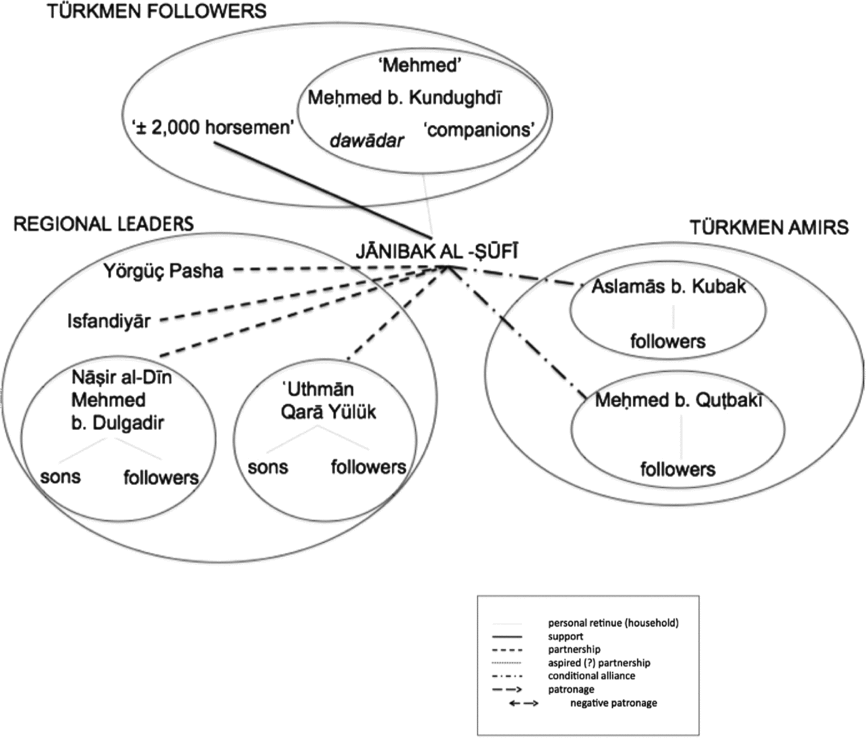
From this and similar reports that provide at least a few more details about the individuals and groups that joined Jānibak's ranks, there actually emerge three types of Türkmen participants in this new network, each more or less integrated into it in different ways and for different reasons.
A first type concerned those that had accepted Jānibak's leadership in unequivocal fashion, Ibn Taghrī Birdī's “large group” of supporters, those who had rallied to Jānibak's cause when he was in Tokat, or perhaps even already before, as well as those who had come to Tokat to also physically strengthen his ranks. Source reports have next to nothing to say about these rank-and-file whose chief Jānibak became, but most of them probably were of very mixed Anatolian Türkmen origins, surely also including at least some bands of Türkmen brigands and freebooters hoping to benefit from their new leader's actions. It may also be assumed that this first circle of subordinate anonymous supporters made up a majority among the great host of horsemen that rode with Jānibak in Dhū l-Ḥijja 839/July 1436. At the core of this first, subordinate and anonymous Türkmen type of supporters in Jānibak's Anatolian network there undoubtedly stood his afore-mentioned personal retinue: two or more dozens of personal bodyguards and sworn brothers who would stay with Jānibak up to the dramatic end of his adventures. “His dawādār” or master of the pen-box, mentioned above as representing Jānibak in the first negotiations with Nāṣir al-Dīn Meḥmed, must have been a member of this close retinue, as would have been other holders of similar household-positions of prestige in Jānibak's entourage. By analogy with that dawādār, also the other representative in this important mission to Nāṣir al-Dīn Meḥmed — referred to as Meḥmed b. Kundughdī b. Ramaḍān al-Turkumānī — must have been a member of that private retinue; nothing further is known about this Meḥmed, but his name suggests that it concerned a member of the Türkmen Ramadanid dynasty of Adana and Tarsus who, for unknown reasons, was trying his luck way beyond his family's homeland, as a trusted member of Jānibak's close entourage.Footnote 61 This mainly Türkmen identity of Jānibak's personal retinue and military household at the centre of the growing number of his Anatolian followers is finally indicated by the fact that another envoy from Jānibak — sent in Shawwāl 838/May 1435 on a similarly important mission to the sultan's territories in northern Syria but intercepted and arrested near Aleppo — was described in the sources as “a Türkmen known as Meḥmed (rajul turkumānī yuqāl lahu Muḥammad)”.Footnote 62
Whereas these Türkmen followers were in a clear subordinate position to Jānibak's leadership, a very different kind of relationships was established with Türkmen leaders and their followings in the region of South-Eastern Anatolia. For relationships established before Shawwāl 838/May 1435 with local rulers such as Isfandiyar, the Türkmen ruler of Sinop, and Yörgüç Pasha, the Ottoman governor of Amasya, information about what exactly connected them to Jānibak's cause — apart from a general attitude of hospitality for a refugee Egyptian grandee — remains wanting.Footnote 63 We are better informed, however, about the ties that were created after the Shawwāl 838/May 1435 promotional campaign of envoys and letters sent from Tokat to Türkmen amirs such as — in Ibn Taghrī Birdī's words — “Nāṣir al-Dīn Meḥmed b. Dulghādir, nāʾib of Abulustayn, Aslamās b. Kubak, Meḥmed b. Quṭbakī, and Qarā Yuluk”. Almost all of these has an interesting story to tell about the dynamic contours of Jānibak's Türkmen network.
The two characters that look least familiar in this list, and about whom almost no further information has been preserved, are Aslamās b. Kubak and Meḥmed b. Quṭbakī. For the latter Meḥmed, no further data could be retrieved, apart from the fact that Ibn Taghrī Birdī and his Egyptian colleagues indeed all linked him to a position of local Türkmen leadership in southeastern Anatolia.Footnote 64 Some better idea of what this type of leadership consisted of, may be retrieved from the datum that has been preserved for Aslamās b. Kubak. Although no biographical information has been preserved for Aslamās himself, there has for another member of his family, providing a much better insight into the position and status of this family in southeast Anatolia. This concerns the amir al-Ḥusayn b. Kubak al-Turkumānī, identified by Ibn Taghrī Birdī as “amīr al-Turkumān al-Kubakiyya”, leader of the ‘Kubak-Türkmen’ group.Footnote 65 Several Egyptian source reports detail how, for several years and often leading a mixed host of Türkmen and Kurdish troops, this Ḥusayn b. Kubak and his brother Sūlaw had been raiding and causing havoc in the region of Cairo-controlled Malatya, even looting the town of Malatya itself on several occasions.Footnote 66 Eventually, Ḥusayn b. Kubak was murdered in 821/1418, by order of sultan al-Muʾayyad Shaykh, as part of his Anatolian campaigns to restore Mamluk hegemony in the region.Footnote 67 Although they had been subdued by the assassination of Ḥusayn, the Kubak family's leadership position over a local gathering of Türkmen groups in or on the fringes of the Malatya region seems to have continued. This is suggested by the fact that — at least in one version of the first phase of Jānibak's story by al-Ṣayrafī — Jānibak and his following only joined forces with Aslamās (and with Meḥmed b. Quṭbakī) when they were moving south from Divriği to Malatya, that is, when they were marching through Kubakiyya homelands.Footnote 68 This local leadership is also suggested by Ibn Ḥajar's phrase that it were “the amirs of Aslamās b. Kubak and of Meḥmed b. Quṭbakī” who had joined Jānibak's ranks.Footnote 69 It is, finally, most clearly visible from the fact that Aslamās suddenly appeared in Cairo in late Ramaḍān 839/April 1436, where he was duly rewarded by sultan Barsbāy for abandoning Jānibak at this crucial moment, just before the Gaziantep confrontation, and received gifts and honours, after which — in Ibn Ḥajar's words — ‘the sultan [. . .] sent him back to his lands’”.Footnote 70 This Aslamās clearly then represents another type of participants in Jānibak's network, a type that also encompassed his peer Meḥmed b. Quṭbakī and — according to Ibn Taghrī Birdī — “other Türkmen amirs like them”Footnote 71 : they were some of the many small-time southeast-Anatolian Türkmen leaders that were active on the fringes of Mamluk suzerainty in an endless competition for opportunities, loyalties, and resources, who from Shawwāl 838/May 1435 onwards rallied with their personal retinues and troops around Jānibak; when the large-scale Syro-Egyptian campaigning of Ramaḍān-Dhū l-Ḥijja 839/March-July 1436 erased any apparent prospect for new opportunities, Aslamās, and probably also many of the other small-time chiefs like him — of whom, indeed, nothing further is heard —, proved to be of little use to Jānibak, and most of them returned to their previous activities in search for new opportunities in the area.
Ibn Taghrī Birdī's list includes two more names of Türkmen amirs in Jānibak's network: “Nāṣir al-Dīn Meḥmed b. Dulghādir, nāʾib of Abulustayn” and “Qarā Yuluk”. The Dulgadirid leader of Elbistan and the Aqquyunlu leader ʿUthmān Beg Qarā Yülük have been introduced above as the dynastic leaders of regionally powerful Türkmen tribal confederations — the one emanating from the regions of Elbistan and Marash, the other from the Upper Euphrates region —, and throughout their long careers each of Meḥmed and ʿUthmān in their own ways enjoyed very mixed relations with attempts to extend Cairo's suzerainty over the lands they controlled. In terms of resources, manpower, and regional authority, these two leaders clearly were of a very different standing from that of small-time chiefs such as Aslamās. The ties that bound these regional leaders and their families to Jānibak's cause also were of a far more complex nature than was the case for Türkmen amirs like Aslamās. They represent, therefore, a third type of Türkmen partners in Jānibak's network.
Relations with Nāṣir al-Dīn Meḥmed in particular developed in peculiar and complex ways. As illustrated in a quote above, various sources agree that at first these relations were of a rather formalised and nominal nature, Meḥmed simply guaranteeing Jānibak's agents “that he would not hand over nor abandon Jānibak al-Ṣūfī in case he would come to him”.Footnote 72 Soon thereafter, in Rabīʿ I 839/October 1435, this formal acceptance of Jānibak's Anatolian position by the Dulgadirid leadership seemed to materialise in real support, when near Malatya Jānibak's group was strengthened by Nāṣir al-Dīn's son Sulaymān and an alleged number of “150 horsemen”.Footnote 73 At first however, this turned out to be a ploy designed to win Jānibak's trust, isolate him from his followers, capture him, and take him to Elbistan.Footnote 74 Later, when soon after their arrival in Elbistan Nāṣir al-Dīn undid his son's actions and restored Jānibak to his leadership, this Dulgadirid double-dealing enabled the unexpected creation of a remarkably close partnership between Nāṣir al-Dīn Meḥmed and Jānibak, that was to last until Muḥarram 841/July 1437. Jānibak's cause and that of Nāṣir al-Dīn Meḥmed's became inextricably connected, and wherever Nāṣir al-Dīn turned up throughout these twenty odd months — whether between Elbistan and Marash, in Ottoman lands, or in Karamanid territory — “his partner” (nazīluhu)Footnote 75 Jānibak and his followers were by his side. Actually, this partnership was cemented at some point between Rabī I and Rajab 839/October 1435 and February 1436 by the marriage between Jānibak and Nāṣir al-Dīn Meḥmed's daughter Nafīsa.Footnote 76 By the time of the Syro-Egyptian campaigning of Ramaḍān-Dhū l-Ḥijja 839/March-July 1436, the powerful reality of this relationship was demonstrated by the presence of “all the sons of Nāṣir al-Dīn Beg Ibn Dulghādir — except for Sulaym ān —” in Jānibak's army that marched on Gaziantep.Footnote 77 Its strength was then illustrated by the fact that even despite the disastrous outcome of the confrontation near Gaziantep, the partnership between the two leaders — now on the run — was continued beyond Dhū l-Ḥijja 839/July 1436. Only in Muḥarram 841/July 1437, when their encampment in the Marash region was attacked by the governor of Divriği, did their relationship end. Upon this new calamity, Ibn Taghrī Birdī explains, “Ibn Dulghādir started to hate him, and they separated from that day onwards”.Footnote 78
As seen above, at that particular moment, Jānibak sought refuge with the sons of that other regional leader of repute and status, the Aq Qoyunly ʿUthmān Beg Qarā Yuluk. However, by Muḥarram 841/July 1437, ʿUthmān Beg was already dead, and his sons Meḥmed and Maḥmūd proved unreliable hosts, to say the least. Clearly, at this particular moment, there was no longer reason for them to ally with Jānibak, and just as Nāṣir al-Dīn Meḥmed had done, and as Aslamās and his peers had done in the spring of 839/1436, they forsook him.Footnote 79 This act of betrayal was however not unanimously welcomed among the new Aqquyunlu leadership, the brothers of Meḥmed and Maḥmūd.Footnote 80 Most importantly, it was not entirely consistent with previous Aqquyunlu policy vis-à-vis Jānibak's cause. In fact, the previous policy mirrored the positive engagements of the Dulgadirid leadership's far more than this negative outcome would suggest. Although no direct information has survived, it is highly likely that the above mentioned Tokat correspondence to “Qarā Yuluk” concerned an initiative parallel to that to Nāṣir al-Dīn Meḥmed. In this case too, the promotional campaign seems to have resulted in a formal expression of acceptance and nominal support for Jānibak by ʿUthmān Beg. This is at least suggested by the fact that shortly after Shawwāl 838/May 1435, Jānibak joined forces with ʿUthmān Beg's son Meḥmed — who would betray him some two years later — who “received them honourably and strengthened their [forces]”.Footnote 81 This active involvement of the Aqquyunlu in Jānibak's Anatolian network, however, came to a premature end when the Aqquyunlu were summoned north by Shāh Rukh and when ʿUthmān Beg died in the course of that campaign. In fact, it was only after the sudden disruption of this Aqquyunlu association that Jānibak entered into more active contact with the Dulgadirids.
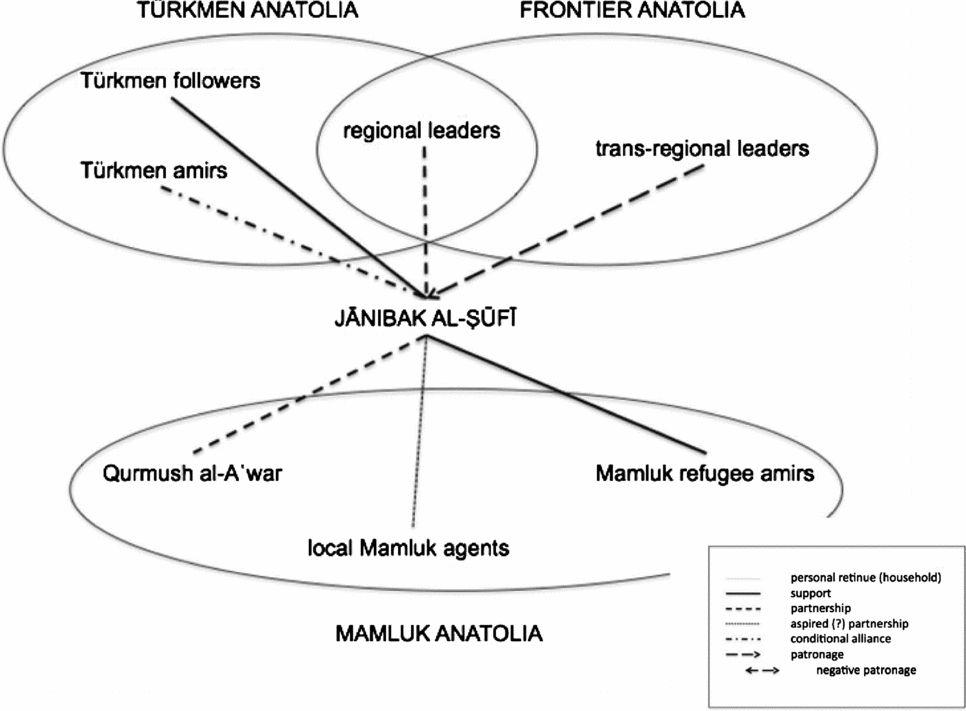
Nāṣir al-Dīn Meḥmed and ʿUthmān Beg Qarā Yuluk, as representatives of the third type of members in Jānibak's network, display indeed a very particular sort of interaction with Jānibak's leadership, which is very different from that of the other two types. Unlike Jānibak's entourage of Türkmen followers and of small-time local chiefs, these regional leaders —including also the ruler of Sinop and the Ottoman governor of Tokat — acted as patrons, or at best as partners, rather than as subordinates for Jānibak's leadership project. As a result of this, they limited themselves to a symbolically empowering recognition of Jānibak's status, followed only in second instance by active support, which was then however rather delegated to sons and other agents. In the Aqquyunlu case, the relationship was then cut short by other significant occurences. In the Dulgadirid case, the opposite happened and the relationship was maximised by a very different turn of events, which from Ramaḍān 839/March-April 1436 onwards resulted in all but the annihilation of the Dulgadirid enterprise itself.
Before that moment however, as Ibn Taghrī Birdī rightly remarked, “rulers and common people (mulūk wa-khalāʾiq) had been rallying to [Jānibak]”;Footnote 82 more precisely, between Shawwāl 838/May 1435 and Ramaḍān 839/March-April 1436 an intricate three-tiered web of vertical and horizontal ties was knitted around the newly emerging leadership of Jānibak, consisting of a dynamic following of Türkmen warriors and small-time South-East-Anatolian chiefs, and of regional partnerships with Türkmen dynastic rulers, with the Dulgadirid Nāṣir al-Dīn Meḥmed in particular. Whatever the historical dynamics of this ego network of Jānibak al-Ṣūfī beyond Dhū l-Ḥijja 839/July 1436, its combination of horizontal ties with regional Türkmen rulers and of vertical relations of power with Türkmen followers and local chiefs, spread out over an area that stretched from Sinop in the North to Gaziantep in the South, demonstrates first and foremost how this Egyptian amir of Circassian origins was all but an outsider to Türkmen Anatolian realities.Footnote 83 Through this network, Jānibak's leadership and the ups and downs of its performance were deeply integrated into the Anatolian framework in which they were developing, and from this perspective, Jānibak's full agency on the Türkmen Anatolian stage stands out from his active brokerage at the centre of that ego network.
This full integration of Jānibak al-Ṣūfī and his leadership in their Türkmen Anatolian context emerges not just from the different types of Türkmen groups and actors that rallied around his cause. It also transpires from the type of actions that generated the transformation of these disparate groups and actors into one powerful cohort. In the best of Türkmen chieftainship traditions, between Shawwāl 838/May 1435 and Dhū l-Ḥijja 839/July 1436 in particular, ranks were closed behind Jānibak's leadership, and income and resources were generated for his followers and their leaders, by their joint marching against Anatolian towns and their joint raiding of villages and local communities. At first, with Aqquyunlu support, “raids” (ghārāt) were organised against the fortified town of Divriği, “the people of which were gravely affected and the surroundings of which were looted (ḍāyaqū ahlahā wa-nahabū ḍawāḥīhā)”.Footnote 84 Then, they moved further south and laid siege to the town of Malatya (nazalū ʿalā Malaṭiya . . . wa-ḥaṣarū Malaṭiya), where their ranks were briefly strengthened by Dulgadirid warriors.Footnote 85 Upon the settlement of subsequent Dulgadirid differences, Jānibak “fell upon Marash (nazala ʿalā Marʿash)”.Footnote 86 Finally, in Dhū l-Ḥijja 839/July 1436, it was said that “Jānibak and his followers agreed to make a raid on (ijtamaʿa Jānī Bak wa-man maʿahu an yakbasūhu)” Gaziantep,Footnote 87 after which they were defeated and Jānibak only barely managed to escape north. Throughout this first and second phase of Jānibak's Anatolian whereabouts, and to some extent also thereafter,Footnote 88 the reality of his Türkmen network's activities as much as the representation thereof in Egyptian sources were clearly framed in violent actions and phrases that do not differ in any way from how any other local Türkmen chief was thought to perform and establish local authority: securing revenue for followers and supporters by raiding, looting, besieging and using violence. Jānibak al-Ṣūfī himself therefore was acting just as such a Türkmen chief, generating his authority from a full-scope local agency that emanated from and resulted in a complex ego-network of Türkmen partners and supporters, who closed ranks behind him, but only as long as his leadership appeared to guarantee them benefit.
5. Jānibak as a power broker in Mamluk Anatolia
As suggested above, this Türkmen context of supporters, partners and local violence, however, was not all that made for Jānibak's case. In many ways, the above mentioned Egyptian source representations of Jānibak's Anatolian activities could well just be interpreted as representing a framing in negative terms of the renewed public activities of someone whom dominant Cairene circles had been made to think of as Barsbāy's dormant nemesis ever since this sultan's accession in 825/1422. In this respect, the contemporary court historian al-ʿAynī's representation of these events’ reception in Cairo is tellingly clear, when he referred to “messages that had come about the attack of the enemy and the destruction of the lands (al-akhbār allatī taʾtī min hujūm al-ʿadūw wa-fasād al-bilād)”.Footnote 89 The framing of these Anatolian activities with labels of social disruption and violence reveal how Anatolia was indeed perceived in Cairo as a region beyond the sultan's direct control but within his sphere of moral responsibility, a distant frontier zone that at the very same time was in constant need of the preservation and restoration of social order by the sultan's agents. More importantly, the framing of Jānibak's activities from this perspective of the challenge to a Cairo-guarded regional social order also reveals how — at least in the minds and thoughts of Cairo's political and cultural elites — Jānibak operated not just in a context of Türkmen friends, followers and forays, but also on a fringe of the Mamluk sultanate. From this perspective of a specifically Mamluk liminal space and frontier zone, it was Jānibak's Mamluk identity and especially the memory thereof, rather than his local chieftainship, that were considered meaningful and that added to his actions a layer of subversive meanings, in direct opposition to his former opponent for the sultanate, al-Ashraf Barsbāy.
This Mamluk royal-centre-versus-subversive-periphery understanding of Jānibak's Anatolian activities was not however, just a matter of Egyptian historiographic rhetoric and political discourse. Underlying facts suggest that this operating of Jānibak in a specifically Mamluk frontier zone reflects another dimension of the historical reality of Jānibak's story, which ran parallel to the Türkmen context and which was equally crucial for its proper understanding. As in the Türkmen case, this reality of the Mamluk frontier reveals itself best via the further analysis of Jānibak's brokerage of an ego network, with an additional Mamluk type of members and an additional Mamluk layer of meanings equally meriting full attention.
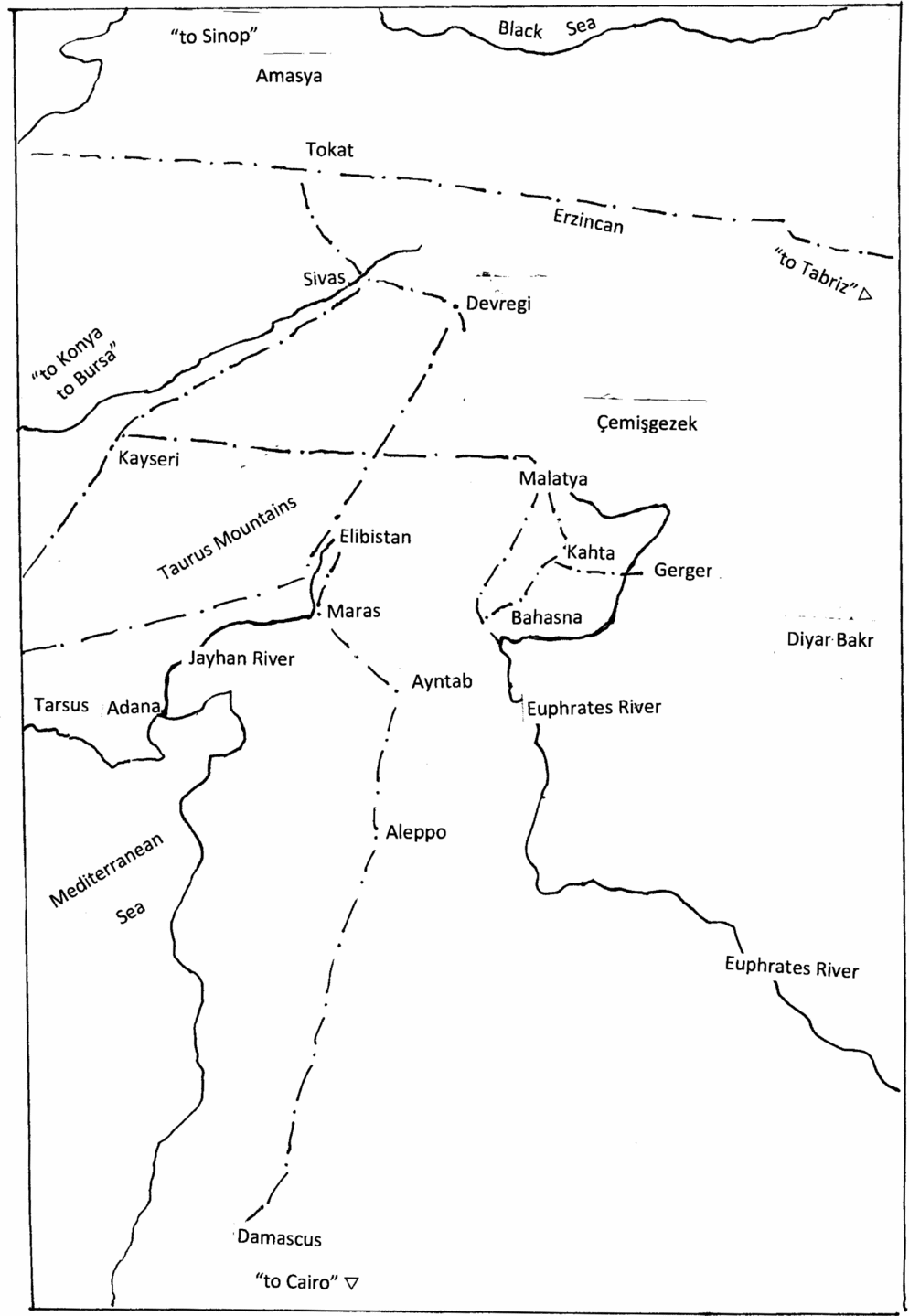
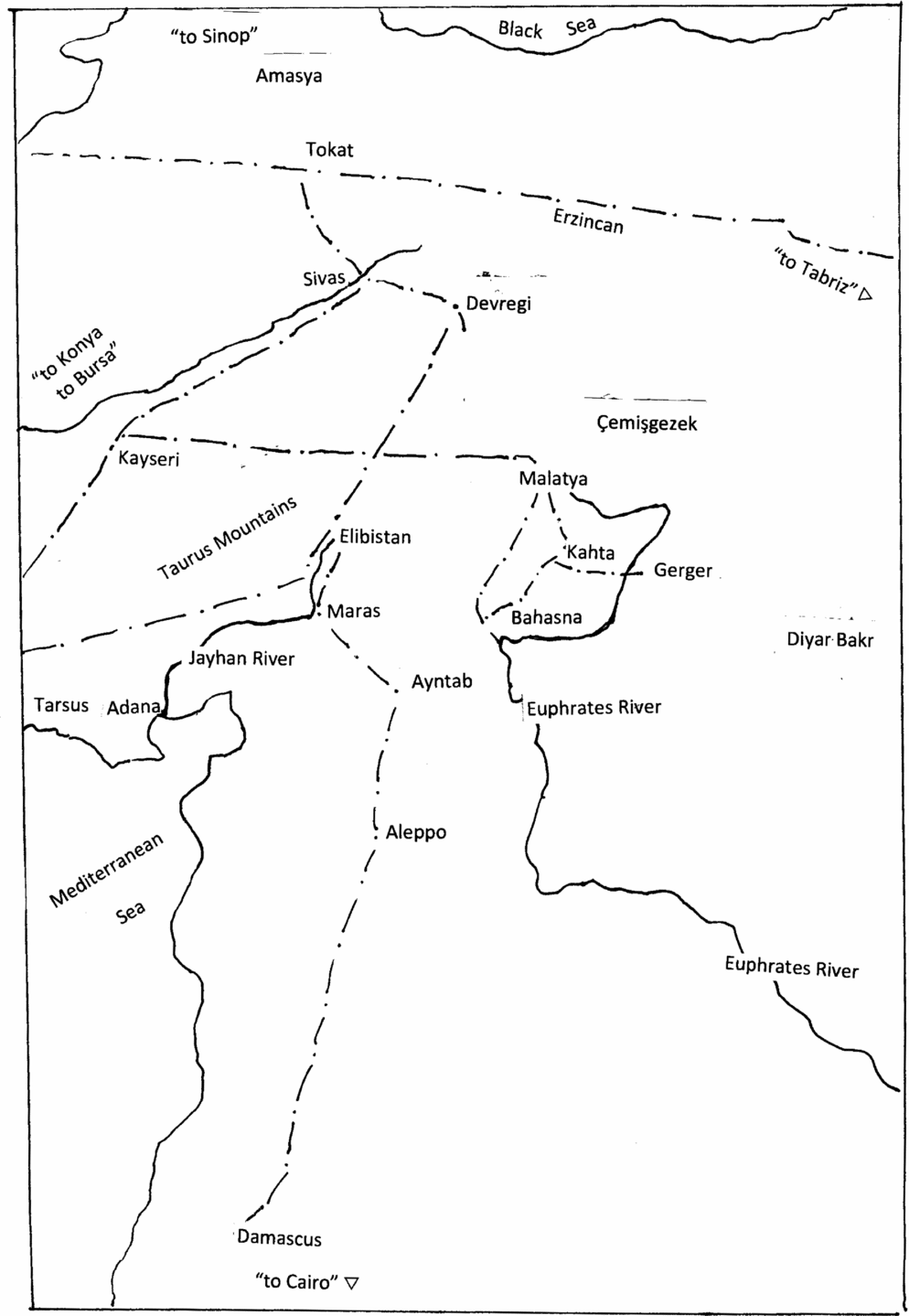
First, there is the unmistakable and simple fact of the north-south axis along which Jānibak's actions between Shawwāl 838/May 1435 and Ramaḍān 839/March-April 1436 proceeded, from Sinop by the Black Sea, over Tokat in Central Anatolia, and Divriği and Malatya to the southeast, to eventually Gaziantep some 100 kilometres north of Aleppo (see Figure 1: map). Whether real or not, an intention to target the sultan's authority in Syria was certainly suggested by this physical course of the Anatolian whereabouts of Jānibak's network, and in Aleppo and Cairo subsequent reports surely triggered their being perceived as such.Footnote 90 This perception of a direct threat to the Cairo court's regional interests was certainly also the result of the fact that the different Anatolian towns and regions that appeared (or were perceived) as the specific targets of Jānibak's raids and sieges in this period — Divriği, Malatya, Gaziantep — all happened to be directly controlled by Barsbāy's agents, whereas lands under local or regional Türkmen control all seemed to be left alone. The growing threat posed by Jānibak and his troops to Barsbāy's authority and suzerainty in this frontier zone in general, and to his direct control over and strategic interests in the wedge of towns, routes, basins, plateaux and mountain ridges between Dulgadirid and Aqquyunlu lands — the “Mesopotamian Marches (thughūr al-Jazīra)”Footnote 91 — in particular, was thus sourly felt by the sultan's local agents. To them, and to their overlords in Cairo, it may well have looked as though Jānibak was pursuing a full takeover of Cairo's control over this strategic Anatolian zone, before moving further south.
Main towns, cities, routes and geographical markers in 9th-/15th-century southeastern Anatolia and Syria (important towns in Jānibak's story are marked by cartouches, blue cartouches indicating that these were towns under direct Egyptian control)
Jānibak's Türkmen Anatolian network

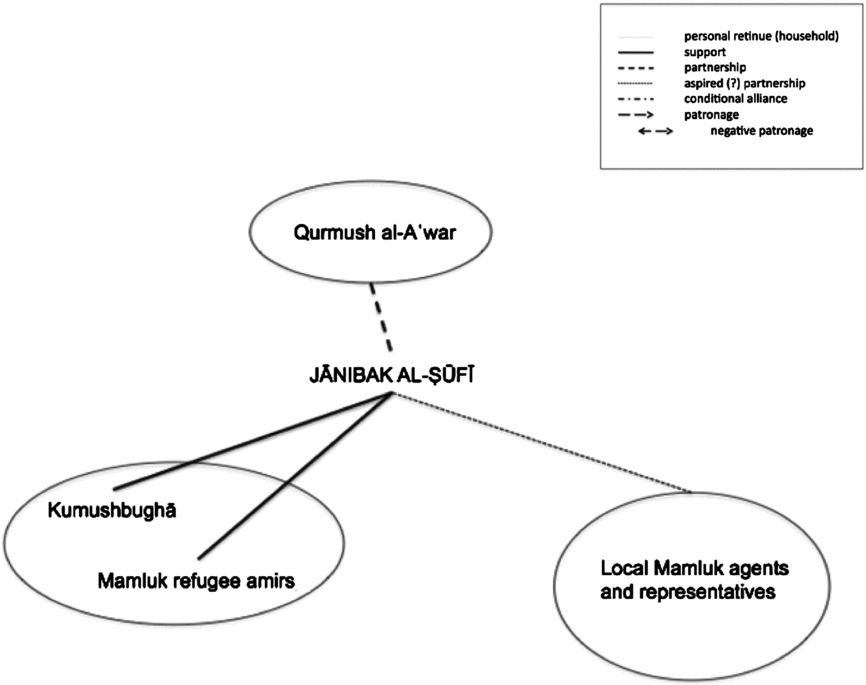
This Mamluk dimension to Jānibak's actions was certainly not just a matter of geographical strategies, centre-periphery perceptions, or personal ambitions. It was also deeply connected to the composition of Jānibak's ego network, which in fact included apart from its Türkmen participants a remarkable Syro-Egyptian element that suggested that at least by Ramaḍān 839/March-April 1436, Jānibak's Anatolian campaign had successfully merged with, or even transformed into, a full-fledged anti-Barsbāy rebellion.
In Ibn Taghrī Birdī's description of key members of Jānibak's ego network, quoted above, one element has so far indeed not yet been discussed. “The amīr Qurmush al-Aʿwar, one of the former muqaddams ʾalf in Egypt [. . .] showed up with him”, Ibn Taghī Birdī explained, “and with all who had joined him — including the amir Qurmush — he travelled from Tokat”.Footnote 92 In this list — as well as in the reality of the network taking shape around Jānibak— the amir Qurmush al-Aʿwar was awarded a central role as a key protagonist, who operated as a sort of right hand to Jānibak.Footnote 93 This amir Qurmush was claimed to having been very close to Jānibak — in his biographical notice, Ibn Taghrī Birdī illustrates this bond by making him say that “I have carried Jānibak al-Ṣūfī on my shoulders in the Circassian homelands and I have raised him as though he was a son”;Footnote 94 Qurmush had joined Jānibak at Tokat in Shawwāl 838/May 1435 after many years of Syro-Egyptian experiences that paralleled those of his would-be son: a senior amir in Egypt, the one-eyed (al-aʿwar) Qurmush sided with Jānibak in 824/1421 and after Barsbāy's victory he was removed to a position in Damascus, where, in 826/1423, he joined another unsuccessful revolt against Barsbāy's leadership and then disappeared from the sultan's radar — “it seems that he had been hiding in these regions”— for more than ten years, until he appeared again in Tokat to join his lost foster-son Jānibak.Footnote 95
Qurmush, however, was not the only Syro-Egyptian veteran to join Jānibak. There actually was a fourth type of members in Jānibak's network, consisting of another group that accepted his leadership in ways similar to how his Anatolian Türkmen accepted it. These members, however, all shared a very different, non-Anatolian background that was directly related to Jānibak's Egyptian origins. Reporting about the fatal battle near Gaziantep in Dhū l-Ḥijja 839/July 1436, the contemporary chronicler al-ʿAynī (as his name indicates originally from Gaziantep!) consistently refers to a much wider Syro-Egyptian involvement:
“the great battle with Qurmush the rebel (al-khārij ʿan al-ṭāʿa) and the amir Kumushbughā, from the amirs of Aleppo, who had deserted (tasaḥḥaba) and gone to Jānibak al-Ṣūfī. . . . God caused the defeat of Qurmush and his fellow turk and turkumān, getting him, Kumushbughā and a group of about thirty individuals from the turk caught”.Footnote 96
This passage suggests not only that Qurmush was perceived in Cairo as a leading figure in Jānibak's entourage, but also that there were good reasons to believe that there were many dozens like him in that entourage: al-ʿAynī's use of the common identifier turk, in clear contradistinction to Jānibak's Türkmen followers, suggests that these indeed were renegades from the political and military elites of the Dawlat al-Atrāk, the so-called Mamluk polity.Footnote 97 Most prominent among these turks in Jānibak's camp — and most suggestive for their renegade Syro-Egyptian originsFootnote 98 — was the ‘deserter’ from the milieu of amirs in Aleppo, Kumushbughā, identified by Ibn Taghrī Birdī as “the amir Kumushbughā, known as Amīr ʿAshara, one of the amirs of Aleppo, who had gone from Aleppo and rallied to Jānibak al-Ṣūfī long time before this date (Dhū l-Ḥijja 839/July 1436)”.Footnote 99 Having been — just as Jānibak and Qurmush — a mamlūk apprentice of sultan al-Ẓāhir Barqūq, this Kumushbughā al-Ẓahirī was said to have had a low ranking amir's default career in the anonymous mass of “military ranks and governorates (imriyyāt wa-wilāyāt)” before going over to Jānibak's side.Footnote 100 Apart from Qurmush and Kumushbugha, none of the other turks in Jānibak's entourage are further identified in any of the available sources, suggesting that they all were of lower rank and status than Kumushbughā. What is clear, however, is that they were by Jānibak's side when he attacked the sultan's forces near Gaziantep in numbers sufficiently large to be noticed and reported, and that the majority of them shared Kumushbughā's renegade status, for they included, as Ibn Taghrī Birdī remarked in the biography of Jānibak, “a group from the amirs of Aleppo and elsewhere [that] had fled to him (wa-kāna qad haraba ilayhi jumāʿa min umarāʾ Ḥalab wa-ghayrihā)” just before the Gaziantep confrontation.Footnote 101
Whatever their origins and reasons for joining Jānibak, what all these Syro-Egyptian members of Jānibak's ego network clearly had in common was their antagonistic attitude towards Barsbāy's authority.Footnote 102 Apparently, Barsbāy's state was perceived as quite inhospitable by all of them, and from the moment Jānibak's project presented itself as a viable alternative that gradually came within reach due to its successful southward progress through ‘the Mesopotamian marches’, these outcasts from Barsbāy's authority switched sides —“they all agreed to fight against al-Malik al-Ashraf”, Ibn Taghrī Birdī remarkedFootnote 103 —, from Qurmush who went to Tokat already in Shawwāl 838/May 1435, over to Kumushbughā who joined some time later, and to other amirs who came from northern Syria when Jānibak was camping near Gaziantep, in Ramaḍān 839/March-April 1436. In fact, in the original letter writing campaign from Ottoman Tokat, also other members of Barsbāy's political and military elites had been targeted, such as the afore-mentioned nāʾib of Daranda and even the nāʾib of Aleppo, the amir Qurqumās al-Shaʿbānī.Footnote 104 These attempts allegedly came to naught, with the interception of these messages and the execution of Jānibak's envoys.Footnote 105 But there are also source reports that suggest that the anti-Barsbāy element in Jānibak's network may have been — or was at least perceived as having been — larger and more threatening than what materialised near Gaziantep in Dhū l-Ḥijja 839/July1436.Footnote 106
Jānibak's Mamluk Anatolian network

Therefore, the combination of an apparent spatial strategy developing in this Mamluk frontier zone, with a coalition of old and new outcasts from Barsbāy's polity gaining strength on the fringe of his authority, ensured that Jānibak's activities were understood in Cairo in the clearest of anti-Barsbāy terms. This perceived threat would certainly explain why a reaction was not left — as was more usual for local disturbances in this Mamluk frontier zone — for local agents of the sultan (the governor of Aleppo in particular) to solve. Between Jumādā II and Shaʿbān 839/January and March 1436, substantial Egyptian forces, involving seven of Barsbāy's most trusted amirs with their personal troops, “1,000 royal mamluks, and 1,000 soldiers from the ḥalqa”, were equipped in Cairo and sent up north.Footnote 107 Between late Ramaḍān and Dhū l-Ḥijja 839/April and July 1436, this full-scale deployment of Barsbāy's force in and near the northern Mamluk frontier zone indeed was successful in restoring the sultan's social order in the area, by defeating and breaking up Jānibak's network, laying waste to Dulgadirid Elbistan, and then pursuing Jānibak and his Dulgadirid partner Nāṣir al-Dīn Meḥmed up to Sivas in central Anatolia. Most revealing for this anti-Barsbāy dimension of Jānibak's ego-network — at this Gaziantep confrontation in particular, and within the reality of the Mamluk frontier zone as much as in its perception at Barsbāy's court — is the subsequent punishment of those from Jānibak's Syro-Egyptian followers who were captured near Gaziantep. Once brought to Aleppo, they were all put to death, but the remains of Qurmush and Kumushbugha were subsequently given a treatment that is only reserved for — as al-ʿAynī indeed already suggested above — ‘rebels’ and ‘deserters’ who had been perceived as a true and realistic threat for Barsbāy's royal authority, and whose defeat — as all source reports agree — had to be advertised in the clearest and most public of terms, in the periphery as much as in the centre of the sultan's power. Their heads were cut off, sent to Cairo, paraded in the city's streets, and then publicly disposed of in the most humiliating of ways.Footnote 108 This Mamluk dimension and the shared agency in it for Jānibak and his Syro-Egyptian supporters is surely most dramatically summarised in Ibn Taghri Birdī's report of this Gaziantep confrontation and its aftermath:
“The two sides collided, and there was a great battle between them, in which Jānibak al-Ṣūfī was defeated. The amir Qurmush al-Aʿwar and the amir Kumushbugha Amīr ʿAshara — they had been the two ‘wings’ that had carried [Jānibak’s] sovereignty (wa-humā kānā janāḥay mamlakatihi)— and eighteen horsemen from Jānibak al-Ṣūfī's companions were captured. Jānibak was put to flight with some people, and the armies pursued them, but did not manage to catch up with them, so they returned. [The commander] Khujā Sūdūn took Qurmush and Kumushbughā with their followers, he had them enchained, and led them to Aleppo. [These events] were reported to the sultan in a letter that arrived in Ṣafar of the year 840 (August 1436) and the messenger brought with him the head of the amir Qurmush al-Aʿwar and the head of the amir Kumushbughā Amīr ʿAshara, reporting that those who had been captured with them had been put to death in Aleppo. The two heads were paraded in Cairo, and then thrown in the sewers by order of the sultan, rather than buried. A message of gratitude and praise was sent to the governor of Aleppo and to Khujā Sūdūn”.Footnote 109
6. Jānibak as a pawn in frontier Anatolia
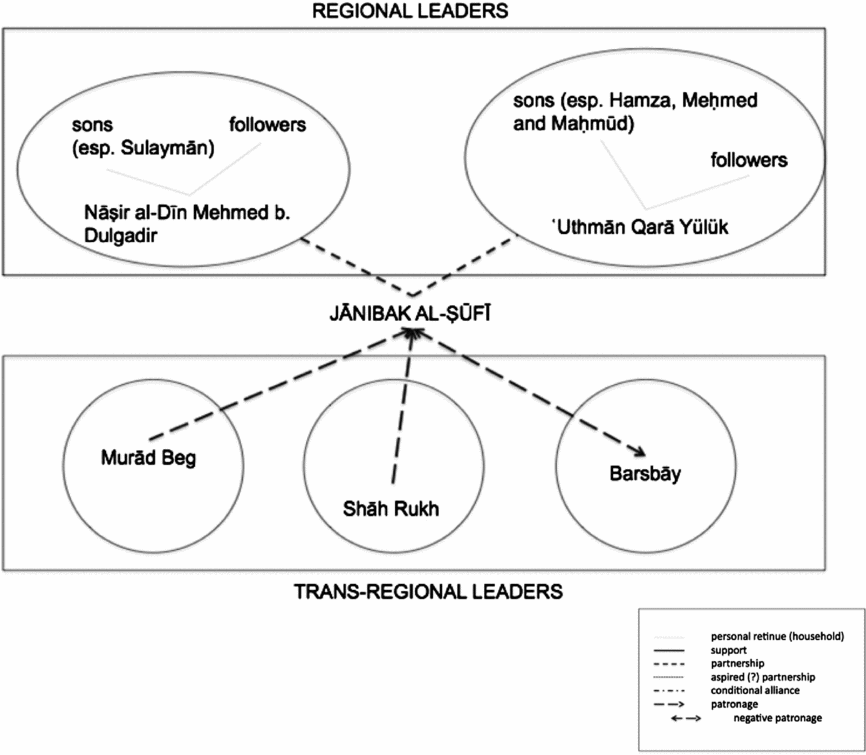
Jānibak's activities however, were not just fully integrated into their Türkmen contexts and meaningful, even acute, within a Mamluk context. The staging of Jānibak's story also needs to be considered from a third, interlocking perspective: that of a multi-directional Anatolian frontier zone, where traditional Egyptian suzerainty was constantly challenged from, and undermined by, various and competing regional and trans-regional forces. Surely southern and eastern Anatolia were fully integrated as a dynamic frontier zone into the performance of Barsbāy's sovereignty, in both discursive and coercive ways, but Jānibak's story also demonstrates how different political centres in Anatolia, and beyond, simultaneously engaged with or attempted to draw closer to this frontier zone, in this particular case by using Jānibak's position to challenge Barsbāy's authority, on a regional as well as on a trans-regional scale.
In the first instance, the different regional partners in Jānibak's Türkmen ego network — both Aqquyunlu and Dulgadirid — did not just have mere local reasons to act. It was rather Jānibak's Egyptian background and his very concrete subversive meaning within the context of Barsbāy's authority that made him useful, for allying with him equalled the public performance of a powerful act against Barsbāy's suzerainty. Regional rulers such as Nāṣir al-Dīn Meḥmed and surely also Qarā Yülük ʿUthmān Beg were very much aware of that dimension, as was Barsbāy. Jānibak certainly also tried to put this symbolic dimension of his role in Anatolia to best use, but this proved, more often than not, beyond his control.
Egyptian sources provide most detailed information about how Nāṣir al-Dīn Meḥmed tried to instrumentalise Jānibak in his strained relation with Barsbāy. Some time before the arrival of Jānibak on the scene, Barsbāy's agents had intervened in a conflict within the Dulgadirid family for control over the town of Marash, and they had captured one of Nāṣir al-Dīn Meḥmed's sons and taken him to Cairo as a prisoner of the sultan; soon thereafter, another of Mehmed's sons, Sulaymān, lost the town of Kayseri to the Cairo-backed Karamanids.Footnote 110 Cairo-Dulgadirid antagonism was thus on the rise, and with one of his sons in an Egyptian prison, Nāṣir al-Dīn Meḥmed had little room for manoeuvre. As a sort of very last resort, he sent his wife on a diplomatic mission to Cairo to try and obtain the release of his son and the return of Kayseri. When Jānibak's envoys presented their master's case to Nāṣir al-Dīn in Elbistan however, he saw an opportunity to create some more leverage in his negotiations with Barsbāy, and he therefore schemed with Sulaymān to capture Jānibak and to try and use him to strike a better deal with the sultan.Footnote 111 “[Sulaymān] caught [Jānibak near Malatya]”, the contemporary scholar Ibn Ḥajar summarised the continuation of these events,
“and he took him along overnight until he entered Elbistan. He wrote to the governor of Aleppo informing him that he had captured him on the 17th of Rabīʿ I [839] (9 November 1435), and he settled on his exchange for 5,000 dinar. The governor of Aleppo sent his letter on to the sultan in Egypt. But Nāṣir al-Dīn [Meḥmed] sent his envoy to his son Sulaymān, telling him to write to the lord of Egypt and inform him about this and to tell Jānibak that he had only laid his hands on him so as to obtain the release of his son Fayyāḍ. [Nāṣir al-Dīn] had not yet been informed of his release, until in the course of all this, [his wife] Khadīja and her son Fayyāḍ arrived [in Elbistan]”.Footnote 112
Once it became clear to Nāṣir al-Dīn that his wife and son had safely returned from Cairo — his son even in the capacity of Cairo-appointed governor of Marash — and that Barsbāy's support for Karamanid control over Kayseri was to remain unchanged, he almost immediately changed policy. Jānibak al-Ṣūfī was released and restored to his local leadership position, and bonds between them were — as mentioned above — strengthened through marriage. Nāṣir al-Dīn Meḥmed thus openly joined ranks with an Egyptian refugee, whom Barsbāy's court had continued to consider a rebel and an enemy ever since 824/1422. His anti-Barsbāy intentions were publicly confirmed when he sent back empty-handed the envoy Barsbāy had sent to Elbistan to take Jānibak to Cairo.
“When [the amir Shādi Bak] arrived with Nāṣir al-Dīn Bak Ibn Dulghādir, he was honourably welcomed and the presents, gifts and money he brought with him were taken from him. Thereafter, Nāṣir al-Dīn Bak Ibn Dulghādir started to put the amir Shādi Bak off day after day, until the matter dragged on and it became clear to Shādi Bak that he would not be allowed [to take Jānibak to Cairo]. He spoke to him about that, and Nāṣir al-Dīn Bak offered as an excuse for not handing him over that he feared being publicly condemned if he would do that and that he had received letters from Shāh Rukh and from other regional rulers pleading on [Jānibak’s] behalf, and all kinds of other stories like this. The only intention was of course to prevent him from [taking Jānibak]. Shortly afterwards, he released [Jānibak] and returned him to his previous position, which became even better [than before]”.Footnote 113
It was against this background of crisscrossing opportunities offered by the Anatolian frontier zone that Nāṣir al-Dīn became an active partner in Jānibak's ego network, participating with his sons in this local campaign that was gradually transforming into a full-fledged anti-Barsbāy rebellion. As much as this may have suited the interests of Jānibak himself and those of his Syro-Egyptian partners, this movement certainly also agreed with the intentions of the Dulgadirid leadership to wrest themselves from Barsbāy's frustrating suzerainty, “to abandon treating the sultan with flattery and to start thinking of the change of fortune (wa-taraka mudārāt al-sulṭān wa-ashghala fikr al-dawla)”, al-Maqrīzī explained, “because the rebellion of Jānibak had brought about something [that looked] wiser and more opportune [to pursue] (li-annahu qad jāʾa min khurūj Jānibak mā huwa adhā wa amarr)”.Footnote 114
Despite the paucity of further information, it is very likely that the same was actually true for other regional partners in Jānibak's Anatolian ego network, and that the Türkmen ruler of Sinop, the Ottoman governor of Tokat, and the Aqquyunlu leader ʿUthmān Beg Qarā Yülük all decided to invest one way or another in the anti-Barsbāy symbolism that Jānibak happened to bring into their Anatolian midst. This is at least suggested from the only extant information on Jānibak's dealings with one of these latter regional leaderships, in particular at the very end of his Anatolian adventures. As detailed above, by Rabīʿ II 841/October 1437 the Aqquyunlu Meḥmed b. ʿUthmān and his brother Maḥmūd succumbed to the pressures of Barsbāy's governor of Aleppo and exchanged Jānibak — or rather his Anatolian frontier value as a challenge to Barsbāy's authority — for the neat sum of 5,000 dinar.Footnote 115 However, their brother Ḥamza was reported by al-Maqrīzī to have had very different plans.
“When [Ḥamza] was informed of Jānibak's stay with his brothers Meḥmed and Maḥmūd, he wrote to his brother Meḥmed [instructing him] to send him on to him, so as to intimidate the sultan with him (li-yurahhib bihi al-sulṭān). But Meḥmed preferred the promises of money that had been made by the governor of Aleppo and he killed Jānibak. Ḥamza then did not stop making his brother promises and awakening his desire, until he came to him, thinking that he would give him control over one of his towns. But as soon as [Meḥmed] came within [Ḥamza’s] reach, he killed him”.Footnote 116
Just as Nāṣir al-Dīn Meḥmed two years before, Ḥamza b. Qarā Yülük (d. 848/1444), ruler of Mardin and Erzincan and the ascending successor to Aqquyunlu general leadership, saw an opportunity in Jānibak's sudden appearance in Aqquyunlu lands to boost his campaign to re-negotiate the nature of Barsbāy's suzerainty. This did not materialise, however, due to his brothers’ more pragmatic concerns for resources, nor did Ḥamza's wider anti-Barsbāy campaign bear any real fruits for him. It rather resulted in a last deployment of Barsbāy's military apparatus in the Anatolian frontier zone between Shaʿbān 841 and Muḥarram 842/February and July 1438, in intrusions deep into Aqquyunlu lands up to Erzincan, and in the ritual submission of several Anatolian local and regional leaders — including Ḥamza himself — to Barsbāy's suzerainty.Footnote 117
Barsbāy's troubled relationship with the Anatolian regional leaderships of the Dulgadirids and the Aqquyunlu and the way that Jānibak's anti-Barsbāy meanings were — or were at least aspired to be — operationalised within that relationship thus ran very parallel courses, even in their outcomes of another reconfirmation of Barsbāy's suzerainty in this Anatolian frontier zone, by his successful deployment of violence and symbolic communication. As the Aqquyunlu case suggests, however, this build up of tension in the Anatolian frontier zone did not just revolve around Jānibak al-Ṣūfī's case. Transcending this by far was the continuous negotiation over the physical and symbolic frontiers of the sultan's authority in Anatolia between these regional leaders and Barsbāy's court, and in this negotiation Jānibak al-Ṣūfī was just one of those instruments that could offer the former considerable leverage.
This symbolic value of Jānibak al-Ṣūfī in the Anatolian frontier zone as Barsbāy's accessible nemesis was not just picked up by regional leaders such as Nāṣir al-Dīn Meḥmed and Ḥamza. It was also operationalised by trans-regional leaders, especially when they appeared to pursue an extension of their authority in that frontier zone and attempted to challenge Barsbāy's traditional suzerainty over it. As mentioned before, this concerned the actions of the Ottoman ruler Murād Beg and, in particular, of the Timurid leader Shāh Rukh.
In the Ottoman case, any allusions to Murād Beg's appreciation of Jānibak's frontier value remain very indirect and speculative. As seen above, it was mainly the Ottoman governor in the city of Tokat whose support and promotional campaign enabled the re-appearance of Jānibak as an Anatolian chief,Footnote 118 and after his defeat at Gaziantep in Dhū l-Ḥijja 839/July 1436, it was in Ottoman lands that Jānibak found shelter against his pursuers as well as renewed support to return to the Anatolian frontier zone.Footnote 119 As a result, Egyptian historians’ representations of the reception at Barsbāy's court of this news indicate that Ottoman actions involving Jānibak were considered as aimed against the heart of Barsbāy's authority, generating concrete plans to make the sultan himself march up north and face the enemy.Footnote 120 However, whereas in the Tokat case it is highly likely that Murād Beg was involved one way or another in his governor's engagement with Jānibak, in the other case there is nothing in the sources to suggest the same. Stripped of most of his Anatolian and Syro-Egyptian supporters, Jānibak simply had no option but to follow his Dulgadirid partners as long as they endured him, and the fact that Murād Beg did not operationalise his symbolic value during the joint Ottoman-Dulgadirid military operations against the Karamanid leader Ibrāhīm Beg only suggests that this value was not really picked up in the Ottoman camp, or at least that it was not considered worth their trouble. This lack of Ottoman interest soon also became clear in Cairo, where any plans for the sultan's personal engagement in military operations in Ramaḍān 840/March 1437 were similarly and quickly forsaken. The peace treaty concluded shortly afterwards between Murād Beg and Ibrāhīm Beg and the subsequent Ottoman retreat northwards confirmed that, whatever the original Ottoman interests in Jānibak, this had not been a campaign against Barsbāy.Footnote 121
Things were somewhat different with Shāh Rukh, who used the opportunity of his Azerbaijan campaign to try and extend his authority in truly Timurid universal rule style over the entire eastern Mediterranean. This plan became first known in Cairo when, “in Ṣafar 839/September 1435, the news arrived with the sultan”, Ibn Taghrī Birdī reported, “that Shāh Rukh, the son of Tīmūrlank, had sent robes of honour to sultan Murād Beg b. ʿUthmān, the ruler of Rūm, to the amir Ṣārim al-Dīn Ibrāhīm b. Qaramān [. . .], to Qarā Yülük and his sons, and to Nāṣir al-Dīn Beg b. Dulghādir, making them his governors in their realms”.Footnote 122 This was perceived as a direct challenge to the sultanate's suzerainty in the Anatolian frontier zone, a perception that proved true when messages arrived that Shāh Rukh had taken Tabriz. The challenge turned out to be even greater when in early Rajab 839/January 1436, an envoy from Shāh Rukh is reported to have appeared in Cairo with another robe of honour, this time for Barsbāy himself, to become the Timurid ruler's “governor of Egypt”. Enraged and humiliated by this bold diplomatic gesture, Barsbāy is said to have sought to set up an alliance with Murād Beg against Shāh Rukh, but this was cut short by Shāh Rukh's sudden return eastwards in Shawwāl 839/April 1436, and the subsequent disappearance of his threat to Barsbāy's authority and suzerainty.Footnote 123 It was in fact in the midst of this build up of trans-regional tension with Shāh Rukh that Jānibak re-appeared in the Anatolian frontier zone, and that, in Rabīʿ al-Ākhir 839/October 1435, it became known to Barsbāy that Jānibak too had been the object of correspondence from the Timurid ruler. At that time, a most disconcerting intercepted letter was forwarded from Aleppo to Cairo, in which Shāh Rukh “incited Jānibak al-Ṣūfī to take the Syrian lands, and [he promised him] that he [ = Shāh Rukh] would send to him his son Aḥmad Jūkī and [his leading military commander] Bābā Ḥājjī to assist him fighting the sultan of Egypt”.Footnote 124 If this letter, and its representation in Egyptian sources, were at all genuine, it seems that Shāh Rukh hoped for much more than merely operationalising Jānibak's Mamluk values and meanings in the Anatolian frontier zone. In this case, the Timurid ruler intended to also operationalise Jānibak's ego-network of Türkmen and Syro-Egyptian partners and followers, and to generate or at least to enhance its gradual transformation into a full-fledged anti-Barsbāy revolution, aiming for Jānibak's full take over of Barsbāy's political project in Shāh Rukh's name, first in Syria, and then, also with Timurid assistance, in Egypt. Among Barsbāy's entourage at least, the coinciding of Shāh Rukh's emergence from the east with Jānibak al-Ṣūfī's in the Anatolian frontier zone was perceived from such a hugely threatening perspective.
For Jānibak al-Ṣūfī himself, this perspective of the Anatolian frontier zone shows how he also got caught up in events that transcended him by far, and how regional and especially trans-regional rulers also attempted and even succeeded in patronising him and his ego-network in their negotiations with and challenges to Mamluk suzerainty. In many cases, this certainly enhanced Jānibak's cause and enabled him to maximise his ego-network, so that in the course of its existence it consisted not just of a variety of partners and followers, but also of a succession of powerful patrons. At the same time, the nature of these patrons’ interests never really — or at best only temporarily — coincided with Jānibak's, so that in the end he and his supporters were more than once victimised rather than supported by their policies. In many ways, even the meanings attached by Barsbāy's entourage to Jānibak's Anatolian whereabouts and the resulting extremely forceful Syro-Egyptian military reactions, especially in Ramaḍān-Dhū l-Ḥijja 839/March-July 1436, can also be considered an unwelcome function of this type of patronage, as they were certainly partly also brought about by trans-regional interests such as those that were imposed upon Jānibak's campaigns.
Jānibak's frontier network

In the Anatolian frontier zone, where interests and authorities of regional and trans-regional rulers were in a continuous flux, their negotiation, challenge and establishment took on a variety of forms and applied a plethora of strategies and tools, often difficult to evade and even more difficult to control for local leaders such as Jānibak. The only constant factor in this process at the time of Jānibak's emergence, however, remained the imperial reach of Barsbāy's suzerainty, established through symbolic means when possible, and through violent force when necessary. Jānibak's mixed adventures with Ottoman, Aqquyunlu, Dulgadirid, and Timurid patrons, and with Syro-Egyptian opponents, are certainly also a token of that.
7. Conclusions
The relatively rich historical and historiographical texture, and the multiple local and trans-local socio-political dimensions of Jānibak's whereabouts between 838/1435 and 841/1438 invite for some concluding observations on the meanings of this particular case, for fifteenth-century participants and observers as much as for modern understandings, of the Syro-Egyptian sultanate and of late medieval southern and eastern Anatolia in particular. A somewhat surprising, but very revealing way into such observations is offered by the much better known case of Jem Sulṭān, the brother of the Ottoman sultan Bayezid II (r. 1481–1512). More than four decades after Jānibak's adventures, Jem brought to Mamluk Egypt trans-regional meanings and interests that are not just quite as well documented in a variety of sources, but that are also thought-provoking in their parallelism with Jānibak's earlier whereabouts in Anatolia.
Arriving in Cairo in early Shaʿbān 886/the last week of September 1481, Jem was welcomed with receptions, feasts, and eventually also an audience with sultan Qāytbāy (r. 1467–1496). In fact, having just been defeated by his brother in a violent confrontation over the succession to the Ottoman throne, Jem Sulṭān put the Egyptian sultan in an awkward position vis-à-vis Bayezid. Especially when Jem Sulṭān began planning a new campaign to march against his brother and to try and wrest the Ottoman throne from him, he put the sultan in what has been termed by Ralph Hattox a “diplomatic dilemma”.Footnote 125 After defeating Jem Sulṭān a second time in 887/1482, Bāyezid's relationship with the Cairo court, which had welcomed his rebel brother and given him a free hand to march again, got increasingly strained. According to the contemporary Egyptian historian Ibn Iyās, allowing Jem to leave again was “a capital mistake” (ʿayn al-ghalaṭ) that gravely weakened the Egyptian position.Footnote 126 When Jem Sulṭān appeared shortly afterwards as a refugee in Rhodes, his host, the Grand Master of the Order of the Hospitallers, followed, as Ralph Hattox concludes, a very different but far more productive course of policy from that of the Egyptian sultan:
Only two years earlier the Hospitallers had been beleaguered in their island fortress by Mehmed's troops. Here now was a tool which, if used properly, would ensure their security, and few scruples about offending Bayezid restrained them. They did allow themselves to be convinced — for a price — by Bayezid's envoys to remove Cem to Europe. There he was passed among European princes, the carefully-watched house guest of several courts, until his death in 1495. For Christendom, he was a guarantee of Bayezid's good behaviour; as long as the threat existed that he could be put at the head of an army and sent east to claim his throne, Bayezid dared not raise his hand against the West. For the next twelve years the Ottoman advance against Christendom was halted. With any serious campaigning in Europe precluded, Bayezid had not only the time but now the predisposition to direct his attention against the Mamluks.Footnote 127
Possessing widely acknowledged but frustrated claims to the throne, used as an effective tool against the sultan, appearing at a variety of courts, and exchanged for money, this well-known fate of Jem Sulṭān surely reminds us of the story and fate of Jānibak al-Ṣūfī as it has been analysed here. Just as Jem Sulṭān in the 1480s and 1490s, the Egyptian amir Jānibak was a defeated contender for the sultanate whose value as a potential threat to the sultan was operationalised between 838/1435 and 841/1437 in a variety of expansionist struggles with that sultan, by himself, by Syro-Egyptian rebels, by Dulgadirid and Aqquyunlu regional leaders, and by Ottoman and Timurid rulers. Due to his personal background and history, Jānibak too was a tool that could provide leverage against the sultan. This dialectic royal quality generated valuable meaning to his person and status, a precious symbolic capital that was appreciated in south-east Anatolia and beyond, that enabled the construction and reconstruction of a personal network of patrons, partners and followers in south-east Anatolia, that caused great concern in Cairo, and that only disappeared when he died in 841/1437. When Jānibak's severed head was finally shown around in Cairo, in Jumādā I 841/early November 1437, “the souls became at rest”, the leading contemporary scholar Ibn Ḥajar al-ʿAsqalānī commented, “and whoever experienced the obstruction of his desire befell an intolerable sadness, for the epic battle was discontinued and the lies of those who had fabricated them became evident”.Footnote 128 From this perspective of Jānibak's substantial impact on Cairo's elite circles, the marriage of Barsbāy's successor, sultan al-Ẓāhir Jaqmaq (r. 842–857/1438–1453), to Jānibak's former Dulgadirid wife Nafīsa bint Nāṣir al-Dīn Mehmed in 843/1440 can be explained as an act of reconciliation with the Dulgadirid leadership, but also as a belated act of closure of this symbolic threat and long-standing political fissure, a final re-integration of any remnant of Jānibak's supporters.Footnote 129
Above all, the striking parallel between the stories of Jem Sulṭān and Jānibak al-Ṣūfī informs about the particular nature of socio-political culture in fifteenth-century Cairo. As one of the sons of the former Ottoman sultan, Jem Sulṭān's legitimate claims to rule and its general acknowledgement inside and outside Ottoman domains are easily explained. Not being related by blood or marriage to any of the previous Mamluk sultans, Jānibak's situation is at first sight a very different matter. Nevertheless, the general acknowledgement of his legitimate claims to rule, inside and outside the sultanate's domains, never seem to have been a matter of any concern for his contemporaries. In his case, it seems that his pedigree paralleling sultan Barsbāy's — from his origins in Circassia, over his being a mamlūk of sultan Barqūq's household, to his high profile leadership position with Barsbāy's predecessors, Sultan Ṭaṭar and his son — awarded Jānibak with the same credentials to rule as Barsbāy's, and as Jem Sulṭān's in the Ottoman context. In the Ottoman case, as with Bayezid and Jem Sulṭān, male members of the ruling Ottoman family indeed had equal claims to rule, and one of them only acquired the sultanate by demonstrating in Turco-Mongol monarchic fashion his leadership qualities by emerging victoriously from a violent confrontation with the other contenders for the throne.Footnote 130 In Cairo, this practice of Ottoman fratricide — combining refined ancient ideologies of divine intervention and dynastic fortune with a brutal selection of military leadership capacities — clearly was adapted to Mamluk realities, so that the contours of the legitimately ruling clan were extended to include individual leaders such as Jānibak, Barsbāy and their peers.Footnote 131 As a rule of thumb in late medieval Egyptian as much as in Ottoman succession practices, new sultans had to make sure they fully neutralised such brothers and peers before new threats to their authority could be posed.
In the Egyptian case, Barsbāy clearly failed in this task when Jānibak managed to escape. Jānibak's symbolic meaning as a legitimate contender for the Mamluk throne — if only he could beat Barsbāy in battle! — therefore remained intact throughout all the years of Barsbāy's reign, and Barsbāy remained very much aware of that. Eventually Jānibak was even able to capitalise again on this symbolic value of his Mamluk person, generating the complex ego-network of patrons, partners and followers that was described above and that operated on various levels of spatial interaction. Inside Anatolia, it allowed Jānibak to transform into a local chief over a variety of Türkmen partners and followers, deeply engaged in local resource generating activities. In the Mamluk frontier zone, increasingly dominant anti-Barsbāy interests and followers transformed this still growing ego-network into a full-fledged anti-Barsbāy rebellion, spreading fear for a total loss of control over Anatolia and northern Syria. On the local level and to a large extent also in the Mamluk context, Jānibak's agency appears as quite considerable, as was also picked up in a handful of modern studies from the Mamluk perspective. These activities of Jānibak were however time and again cut short by Barsbāy's agents, and by repeated impressive displays of Barsbāy's authority and force deep into the Anatolian frontier zone. Despite the almost total loss of patrons, partners and followers after Dhū l-Ḥijja 839/July 1436 as a result, it was mainly the high symbolic value of his Mamluk person that enabled Jānibak to linger on as before, to retain at least some of that agency, and to continue to be perceived as a real threat at Barsbāy's court, until his violent death.
Paradoxically, it is especially on the spatial level of the Anatolian frontier zone, in the direct competition between Barsbāy and other regional and trans-regional rulers, where that high symbolic meaning had highest valued, that Jānibak's fate was left for others to decide. When non-Mamluk regional and trans-regional players engaged with Jānibak's meaning, this was always done in an attempt to expand their own authorities, and to square Jānibak, his Mamluk value, and his ego-network, with their own interests. This is the perspective that seems to have informed the more dismissive attitude towards Jānibak's story in modern ‘Anatolian’ historiography. Being of more use alive than dead, Jānibak was quite safe in this Anatolian frontier zone, but he lacked any real agency on this level of trans-regional interaction, and if the Aqquyunlu leader Ḥamza would have had it his way, Jānibak might well have ended up, just as Jem Sulṭān four decades later, as “the carefully-watched house guest of several courts”.
Jānibak's ego-network, 838–841/1435–1438

Apart from issues of agency and non-agency, of ego-networking, and of surprising parallelisms between Mamluk and Ottoman political culture, two final conclusions that impose themselves on this analysis of Jānibak's activities have to do with their liminal, frontier dimension. In very revealing ways, the borders of Barsbāy's authority and of his ‘state’ are made explicit here by Jānibak's longstanding ability to continue to cast some shadow over Barsbāy's rule and to remain beyond the reach of Barsbāy's agents in Cairo, Egypt, Syria, and Anatolia. Clearly, these frontiers of Barsbāy's ‘state’ were not so much geographically, but rather socially defined, resulting from Barsbāy's expanding court's need to continuously negotiate his authority with other social elites and groups in the cities, towns and countrysides of Egypt, Syria and Anatolia. Amidst this ongoing competition between centripetal and centrifugal forces, Jānibak was offered sufficient opportunities to find refuge and to survive in the many peripheries of Barsbāy's state. Most famously, he even seems to have managed to live for some time in the mid-820s/1420s in one of Cairo's ancient residential quarters, right under the sultan's nose; when rumours about this eventually reached Barsbāy, his troops laid waste to the quarter and caused extreme havoc among its inhabitants, but Jānibak managed to escape.Footnote 132 That he eventually was forced to seek refuge in new peripheries outside Egypt, first in Syria, and then further and further north in Anatolia, until he reached Sinop by the Black Sea, illustrates how Barsbāy's court was increasingly successful in the negotiation of the sultan's authority. The gradual expansion of Barsbāy's ‘state’ over increasing numbers of local social groups and resources, in Egypt and Syria and finally also in Anatolia, pushed back those frontiers and peripheries, and forced Jānibak to follow suit. His story at the Mamluk periphery is therefore also the story of the formation of Barsbāy's state at the Mamluk centre.
Through the lens of Jānibak's story, occasional glimpses are moreover offered of how such negotiations in Mamluk Anatolia between centripetal and centrifugal forces were performed, in coercive and symbolic ways that undoubtedly showed many parallels with their continuous performance in many other liminal spaces in Syria and in Egypt. As such, Jānibak's may well have been an unusually high-profile story in terms of the meanings and agencies that he managed to operationalise, but it was surely not an exceptional case (as is also suggested by the many Syro-Egyptian supporters that joined his cause in Anatolia). For a better understanding of the nature and dimensions of the formation of Barsbāy's state, further research into similar stories on the fringes of that transformative historical process remains therefore highly relevant.
Whatever the internal social dimensions of Barsbāy's state formation process, there finally also is — as just mentioned — an intricately connected spatial, and geographical, conclusion that can nevertheless be drawn from the liminal, frontier dimension of Jānibak's activities and that should not be neglected either. Throughout most of his Anatolian adventures, Jānibak's leadership appeared as fully integrated into its Türkmen context, in terms of the nature of his partners and followers as well as in terms of the activities in which they were all engaged. More importantly, perhaps, it may also be argued that the same actually applies for Barsbāy's leadership, even despite all the framing involved in the centre-periphery perspective that was imposed by an almost exclusively Egyptian historiographic tradition. Barsbāy's engagement by proxy with these Anatolian events — through his governors in northern Syria and Anatolia, or through trusted military agents sent from Cairo — is certainly an illustration of the successful formation of Barsbāy's state, in which royal representatives were entrusted with the effective performance of the sultan's authority and in which the chains of royal agency and authority emanating from the court were increasingly complex. The perseverance of the performance of that authority even in the remote and permeable Anatolian frontier zone, and even despite impressive challenges from regional and trans-regional rulers throughout the 1430s, is then an even stronger token of the successful formation of Barsbāy's state, cut short only by this sultan's sudden death in Dhu l-Ḥijja 841/June 1438. There was a continuous presence of Barsbāy's state in Anatolia, with his own agents acting as effective governors in Anatolian towns up to Divriği, with a selection endorsed by himself of regional and local Türkmen rulers east and west of the Gaziantep-Divriği wedge, and with his Syrian and Egyptian troops campaigning and raiding on a regular basis in ways that were not unfamiliar to local Anatolian practices. Despite all the differences in the continuously negotiated nature of their integrations into Barsbāy's state, they all jointly enhanced a closely directed Egyptian access to Anatolian resources. Above all, Barsbāy's troops’ ability to march deep into eastern Anatolia, even up to Sivas or Erzincan, and more generally the acknowledgement of the value of Jānibak's anti-Barsbāy-meanings in most Anatolian towns and encampments, all testify to the fact that not just Jānibak's was an Anatolian story as much as a Mamluk one, but above all also that the Mamluk sultanate, and in this case Barsbāy's state in particular, were no Anatolian strangers, outsiders or intruders. Instead, they were deeply integrated into and an integral component of fifteenth-century Anatolian history, and vice versa !