Mental health and psychosocial support in humanitarian settings
The term ‘humanitarian settings’ describes the places and populations affected by a broad range of disasters and armed conflicts. Disasters are usually unforeseen and sudden events which overwhelm local capacity, necessitating national or international external assistance, and causing great damage, destruction and human suffering (Guha-Sapir et al. Reference Guha-Sapir, Hoyois and Below2014). Disasters kill more than 100 000 people on average each year and create devastating impacts to affected countries. Amongst the top ten countries in terms of disaster mortality in 2013, five are classified as low- and middle-income countries (LMICs). These countries accounted for 88% of global reported disaster mortality in 2013 (Guha-Sapir et al. Reference Guha-Sapir, Hoyois and Below2014). Part of this phenomenon is explained by the fact that large countries such as India and China are exposed to more hazards due to their large size, and that their population density renders them more vulnerable to negative consequences in response to hazards than others.
In addition to disasters, armed conflicts represent a widespread problem. In 2013 alone, there were 33 armed conflicts active in 25 different locations across the world, with seven reaching the intensity level of war (Themner & Wallensteen, Reference Themner and Wallensteen2014). It has been estimated that more than 1 billion children live in countries affected by armed conflict (UNICEF, 2009). Again, the most intense conflicts took place in LMICs, including Afghanistan, Iraq, Pakistan, Nigeria and the Democratic Republic of Congo. The consequences of armed conflicts may be highly visible, for example, increased mortality; exposure to conflict-related violence including systematic human rights violations (e.g. torture, disappearances, conflict-related sexual and other forms of gender-based violence); mass displacement; and destruction of the natural environment. Amongst the conceivably less visible consequences of armed conflicts are higher levels of poverty and intimate partner violence, disrupted health and education systems; and degradation of the social and moral fabric of communities affected by armed conflict.
This paper applies the framework of public mental health to the study and practice of interventions in humanitarian settings which respond to the consequences of disasters and armed conflicts for mental health and psychosocial wellbeing. The impact of humanitarian crises on mental health and psychosocial wellbeing varies widely. For some individuals, exposure to the adverse events and structural consequences of humanitarian crises are not associated with long-term negative impacts on mental health – a phenomenon referred to as resilience. Some researchers have even begun to explore post-traumatic growth, the observation that some people may experience psychological benefits subsequent to exposure to humanitarian crises – for example, through improved relations with others, increased appreciation of life, or an increased sense of personal strength (Xu & Liao, Reference Xu and Liao2011).
At the same time, it is acknowledged that a large proportion of affected populations experience significant psychological distress in the acute aftermath of disasters and armed conflicts, and that in the long term a sizeable minority of people develop mental disorders that critically impact their daily functioning. The mental disorders that have been most commonly studied include posttraumatic stress disorder and major depressive disorder, which rigorous studies with conflict-affected populations have found to be present in 15.4 and 17.3% of study populations respectively (Steel et al. Reference Steel, Chey, Silove, Marnane, Bryant and van Ommeren2009). Numerous other mental disorders are also observed to have heightened prevalence rates in humanitarian crisis-affected populations, including anxiety disorders, substance use, and somatoform disorders, as well as pre-existing severe mental disorders such as Schizophrenia and Psychotic Disorders as well as Bipolar Disorder (Tol et al. Reference Tol, Rees and Silove2013, Reference Tol, Jordans, Susanty, de Jong, Thornicroft and Patel2014).
The complex processes involved in identifying mental health outcomes in the context of humanitarian crises are increasingly the subject of research. There is ongoing disagreement on the relative importance of different risk and protective factors, but most authors agree that, even for situations of extreme adversity, mental health outcomes occur as a result of the interplay between biological, psychological and social factors. Variables that have been shown to be important include: (a) individual factors (e.g. gender, age, coping styles, prior history of trauma and mental health); (b) potentially traumatic events experienced in the context of the specific crisis (e.g. the type of event, the extent and proximity of exposure to crisis events); (c) exposure to structural adversity associated with the crisis (e.g. gender-based violence, chronic poverty, social marginalisation); and (d) the recovery environment (e.g. support systems available, access to livelihoods) (Rasmussen et al. Reference Rasmussen, Nguyen, Wilkinson, Vundla, Raghavan, Miller and Keller2010; Jordans et al. Reference Jordans, Semrau, Thornicroft and van Ommeren2012).
In response to the varied mental health and psychosocial needs in populations affected by humanitarian crises, a field of practice has developed with increasing global consensus on best practices. In 2007, a task force of 27 humanitarian agencies comprising United Nations organisations, international non-governmental organisations and the International Federation of Red Cross and Crescent Societies, representing actors in diverse sectors (health, protection, nutrition, education, water and sanitation), published guidelines for humanitarian practice which have seen wide uptake (Inter-agency Standing Committee, 2007). These guidelines defined ‘mental health and psychosocial support’ (MHPSS) as a composite term to refer to ‘any type of local or outside support that aims to protect or promote psychosocial wellbeing and/or prevent or treat mental disorder’ (Inter-agency Standing Committee, 2007).
The development of these guidelines took place against the background of a historically divided, polarised, and badly coordinated field (Galappatti, Reference Galappatti2003). An important division, present both within and outside of the health sector, concerned the provision of more holistic supports for a range of problems and their determinants v. a biomedical approach focused mainly on treating posttraumatic stress-related symptoms (Wessells & van Ommeren, Reference Wessells and van Ommeren2008). The composite term MHPSS was proposed to engage a broad range of actors who had previously been working more or less independently from each other. To promote consensus and coordination the guidelines recommend the implementation of a multi-layered support system visualised as a pyramid of supports. This pyramid encompasses (a) actions focused on risk and protective factors of wellbeing (for example, providing humanitarian services with respect to dignity and opportunities for participation; protection from violence and other human rights violations; strengthening social support and cohesion in affected families and communities), as well as (b) more focused services for people with psychological distress and mental disorders (Inter-agency Standing Committee, 2007). These guidelines broadly succeeded in uniting stakeholders from very distinct theoretical and implementation approaches together under this broad shared framework for intervention.
Rationale for a public mental health approach
Despite this increasing consensus, conceptual fuzziness and unresolved tensions remain. First, the process of building consensus between the various humanitarian actors deliberately involved an active avoidance of theoretically contentious issues. Attempts to identify an overarching theoretical framework were not made; rather a critical ingredient to the successful development of the guidelines was ‘focusing much more on practical steps – concrete actions – rather than on principles and theory’ (Wessells & van Ommeren, Reference Wessells and van Ommeren2008). Although clearly understandable from a tactical perspective, this latter aspect has left more fundamental theoretical exploration of overarching intervention models for future discussion.
Second, in humanitarian parlance a distinction is often made between ‘mental health’ on the one side and ‘psychosocial support’ on the other side, with the result arguably being a continued disconnect between actors engaged in these two branches of the MHPSS field. In humanitarian settings, the term ‘mental health’ is often used narrowly to describe psychiatric or clinical interventions delivered by staff in the health sector aimed at reducing symptoms, rather than referring to the broad concept of wellbeing that is envisioned in the seminal definition of mental health by the World Health Organisation, or the notion of mental health proposed by positive psychologists (Keyes et al. Reference Keyes, Dhingra and Simoes2010). In apparent contrast, the word ‘psychosocial support’ is used to refer to interventions that are community-based and aimed at increasing safety, strengthening social support systems, or livelihoods; even though provision of such ‘psychosocial support’ will enhance positive mental health, lower risk for mental disorders and support recovery. The boundary between these two categories is not well defined, and there is often overlap and variation in which particular activities (i.e. counselling) are identified as relating to ‘mental health’ or ‘psychosocial support’. This division between MHPSS furthermore neglects obvious overlaps in areas of concern, for example the importance of social support or connectedness as a known protective factor for development of depression or posttraumatic stress symptoms (an important ‘psychosocial’ consideration for ‘mental health’ actors) (Hobfoll et al. Reference Hobfoll, Watson, Bell, Bryant, Brymer, Friedman, Friedman, Gersons, de Jong, Layne, Maguen, Neria, Norwood, Pynoos, Reissman, Ruzek, Shalev, Solomon, Steinberg and Ursano2007) or the increased risk for human rights violations against people living with mental illness (an important ‘mental health’ consideration for ‘psychosocial’ actors) (Mfoafo-M'Carthy & Huls, Reference Mfoafo-M'Carthy and Huls2014). A potential result of this split may be that agencies in the health sector implement activities such as provision of therapeutic services for mental disorders, even while agencies in other sectors independently conduct parallel activities such as community-based programmes to reduce violence against women, without efforts between agencies to work together.
Third, the IASC guidelines locate supports for both ‘mental health’ and ‘psychosocial wellbeing’ within a four-layered pyramid of complementary levels of support, but they do not specify a framework for how the diverse activities within and across these layers may contribute to the convergent goals, nor how synergy may be achieved between ‘mental health’ and ‘psychosocial support’ activities. The pyramid has been a useful tool for facilitating collaboration between humanitarian agencies with diverse approaches (i.e. by providing an image that highlights the importance of diverse supports), but it has probably not led to an actual increase in programmes that integrate interventions located at different layers of the pyramid. An important risk that follows from this restricted access to diverse services is the failure to move affected persons between different types of interventions from which they may benefit.
Fourth, there remains a big gap in evidence for the most popular MHPSS interventions. A structured review of programme documents found the following to be the most popular interventions: basic counselling for individuals and families; strengthening community supports; child-friendly spaces; psycho-education and activities raising awareness of mental health issues; and structured recreational and creative activities (Tol et al. Reference Tol, Barbui, Galappatti, Silove, Betancourt, Souza, Golaz and van Ommeren2011). Child-friendly spaces, for example, despite their ubiquity have seen very little rigorous evaluation, and this may in part be due to poor conceptualisation of the goals and components of child-friendly spaces as an intervention. A systematic review of evaluations of this intervention concluded that ‘(I)t is clear that the composition of and emphasis on specific activities may differ dramatically by organisation, leading to confusion on program goals and objectives among program staff and community members’ (Ager & Metzler, Reference Ager and Metzler2012).
Against this background of continued conceptual confusion, this paper aims to discuss the potential utility of a public mental health framework – particularly the use of promotion and prevention terminology – as a conceptual framework for MHPSS. Our aim is to demonstrate the utility of language and tools from the field of public mental health in strengthening the rationale, conceptualisation, and evaluation of MHPSS activities that are not aimed at treatment of mental disorders (i.e. interventions to reduce symptoms in people who were identified as having mental disorders). Rather, we focus on activities that are aimed at strengthening positive aspects of mental health and psychosocial wellbeing (i.e. promotion), or at making sure that people who are currently doing well do not develop impaired wellbeing in the future (i.e. prevention). This is not to indicate that treatment is not an important type of intervention, but the conceptualisation and evidence-base for this level of services is arguably better developed (Tol et al. Reference Tol, Barbui, Galappatti, Silove, Betancourt, Souza, Golaz and van Ommeren2011). We do not attempt to provide a conclusive, all-embracing framework for MHPSS, but rather to bring to attention the potential utility of a body of concepts and knowledge that has been developed in response to concerns similar to those voiced by humanitarian psychosocial practitioners (for example, the tendency to focus on individual psychopathology in the absence of proactive attention to socio-cultural context and origins of these conditions; a focus on communities rather than individuals). We hope the paper will stimulate a two-way interaction, so that humanitarian practitioners are drawn towards frameworks and knowledge from the field of public mental health, and that the field of public mental health will become more attuned to the interests and needs of humanitarian MHPSS practitioners.
A public mental health approach
In the past two decades, an increased awareness of the importance of mental health conditions has developed within the field of public health. This has occurred notably in context of the estimation that mental and behavioural disorders contribute 7.4% of the total burden of ill health in the world – more than, for example, tuberculosis (2.0%), HIV/AIDS (3.3%) or malaria (4.6%) (Whiteford et al. Reference Whiteford, Degenhardt, Rehm, Baxter, Ferrari, Erskine, Charlson, Norman, Flaxman, Johns, Burstein, Murray and Vos2013). This is in part due to mental disorders having high prevalence in the general population compared with many other health conditions, often with an onset in childhood/young adulthood, and a frequent evolution towards chronicity (Eaton et al. Reference Eaton, Alexandre, Bienvenu, Clarke, Martins, Nestadt, Zablotsky and Eaton2012a ). By highlighting the large scale of the problem, these data helped in emphasising the importance of research activity to advance the understanding of mental disorders, and to improve knowledge that could help prevent them at a population level – also in humanitarian settings (de Jong & Komproe, Reference de Jong and Komproe2002). This requires that mental health conditions are not only evaluated and treated in clinical populations but also understood and addressed in the general population, where the majority of cases of these disorders exist, undetected or untreated.
Public Health is an applied science that combines the framework of population demography with health science and practice for the purpose of preventing disorder, promoting health, and prolonging life among the population as a whole. Public mental health has the same orientation to the population but expands the range of outcomes beyond the prevention of mental disorders to include promotion of psychological wellbeing and reduction of emotional and mental disability. Public Mental Health expands the range of interventions and practices to include changes in psychosocial arrangements, mass communications and cultural interventions. Ever since John Snow linked a cholera outbreak to contaminated water and closed the Broad Street pump in London in 1854, public health practitioners have focused on identifying the determinants of health and implementing population-level measures to prevent disorder and promote good health. Similarly, the focus of public mental health practitioners has been on identifying causal pathways to mental health in order to facilitate prevention of mental disorders and promotion of wellbeing at a population level. From this perspective, multiple risk factors and complex causal pathways have to be considered as determinants of psychological conditions. For example, in the context of humanitarian settings, addressing intimate partner violence against women through evidence-based community-level interventions is highly likely to contribute to preventing depression and anxiety. Alleviating potential suffering on a population basis is consistent with both the goals of public health and humanitarian values (O'Connell et al. Reference O'Connell, Boat and Warner2009), with additional proven advantages of cost and resource savings at individual and society levels.
In addition to prevention of disorders, a public mental health approach also encompasses the application of ‘health promotion’ principles to mental health. Health promotion has been defined as ‘the process of enabling people to increase control over their health and its determinants, and thereby improve their health’ (World Health Organization, 2005). Health promotion is focused on empowering people to live healthy lives (e.g. by facilitating healthy lifestyles through policies, such as providing nutritious foods in school canteens or opportunities for physical exercise in accessible locations), rather than health being the sole domain of health professionals. For example, the Ottawa Convention on Health Promotion Building public health policy, developed during the first conference on health promotion, focuses on: (1) building public health policy; (2) creating supportive environments; (3) strengthening community action; (4) developing personal skills; and (5) re-orienting health care services toward prevention of illness and promotion of health (World Health Organization, 1986). Clearly, there is strong overlap here between goals of humanitarian practitioners and principles of health promotion.
When applied to mental health, health promotion has often been focused on more strengthening positive aspects of wellbeing, as compared with preventing mental disorders. It has involved actions to create living conditions and environments that support mental health and encourage healthy lifestyles (World Health Organization, 2014b ). For example, the seminal report by the Institute of Medicine defines mental health promotion as ‘efforts to enhance individuals’ ability to achieve developmentally appropriate tasks (competence) and a positive sense of self-esteem, mastery, wellbeing and social inclusion and to strengthen their ability to cope’ (O'Connell et al. Reference O'Connell, Boat and Warner2009).
PaCTS
Commonly advocated principles to guide the prevention of mental disorders and promotion of mental health can be summarised using the acronym PaCTS (Tol, Reference Tol2015). Here, P stands for Place, referring to the importance of a socio-ecological perspective (Bradshaw et al. Reference Bradshaw, Waasdorp and Leaf2012). In a socio-ecological perspective, persons are seen as embedded in widening social structures including the family, school, neighbourhood, and the larger socio-cultural environment. At all these levels, modifiable risk and protective factors are present that shape mental health. For example, a systematic review focused on children in areas of armed conflict identified variables associated with resilience at the individual- (e.g. coping styles and flexibility); family- (e.g. parental support and parental monitoring), peer- and school- (e.g. school retention, peer social support) and community-levels (e.g. community acceptance of former child soldiers). A socio-ecological framework has been deemed helpful in understanding the interactions between individual and their social environment, providing insight into which social variables may be targeted to promote mental health and prevent mental disorders.
C stands for Collaboration, in order to highlight the importance of inter-sectoral and inter-disciplinary activities. The social determinants of mental health are present in areas that are commonly governed by different sectors, and are often inter-related (e.g. poverty in the social welfare sector; early childhood education in the education sector; violence prevention in the protection sector). Similarly, social determinants are often studied by different academic disciplines. Prevention and promotion efforts require active collaboration and coordination across these different sectors in order to be effective. For example, in humanitarian settings, preventing ill mental health of adolescents will often require simultaneous and coordinated actions by agencies in the protection sector (e.g. to avoid violence against adolescent boys and girls); the education and social welfare sector (e.g. to contribute to education and livelihood opportunities); as well as the health sector (e.g. to reduce risk-taking in sexual relationships).
T stands for Timing, to emphasise a lifespan developmental perspective. Mental disorders develop at different stages of the life course (Eaton et al. Reference Eaton, Alexandre, Kessler, Martins, Mortensen, Rebok, Storr, Roth and Eaton2012b ; Pedersen et al. Reference Pedersen, Mors, Bertelsen, Waltoft, Agerbo, McGrath, Mortensen and Eaton2014) and unique combinations of stressors and protective factors affect individual mental health at different stages of the life course (Mendelson et al. Reference Mendelson, Pas, Leis, Bradshaw, Rebok, Mandell and Eaton2012). For example, in the prenatal period, maternal mental disorders have been associated with attachment difficulties and impaired cognitive development for children later in life (Stein et al. Reference Stein, Pearson, Goodman, Rapa, Rahman, McCallum, Howard and Pariante2014). Similarly, in early life and childhood, the quality of parental care, family conditions and potential violence in the home affect children's physical and psychological growth (Allen et al. Reference Allen, Balfour, Bell and Marmot2014).
Finally, S stands for Strengths, highlighting the importance of identifying existing resources for mental health and empowering individuals and communities to improve their mental health and wellbeing. For example, Petersen and colleagues speak of a ‘competency-enhancement approach’ that involves recruiting communities as partners in the design, implementation, and evaluation of prevention and promotion interventions (Petersen et al. Reference Petersen, Barry, Lund, Bhana, Patel, Minas, Cohen and Prince2014). Such an approach allows for the active participation of vulnerable populations in prevention and promotion interventions, rather than viewing people as passive recipients of supports. Also, targeting programmes in line with locally expressed needs and priorities, and building them onto existing sources of support, facilitates a more sustainable response compared with an externally driven response.
Applying a public mental health approach to MHPSS: what to target?
The first consideration in applying a public mental health approach for MHPSS in humanitarian settings is to reflect on the intended outcome of interventions, i.e. what do MHPSS interventions aim to achieve? Answering this question requires reflection on definitions of terms like ‘positive mental health’ and ‘wellbeing’. For MHPSS practitioners, a lively debate has focused on the importance of making a distinction between ‘mental health’ and ‘psychosocial wellbeing’, with the former often used by MHPSS practitioners as more narrowly referring to psychiatric symptoms and mental disorders, and the latter referring to a broader construct of wellbeing in which the importance of social conditions in determining cognitions, emotions and behaviours is emphasised (Psychosocial Working Group, 2003). There is no clear consensus on definitions and ways of measuring wellbeing (Zou et al. Reference Zou, Schimmack and Gere2013), but Box 1 provides a comparison of some commonly used and recent attempts at definitions. From the perspective of public mental health, the narrow use of the term mental health as commonly applied by MHPSS practitioners is not desirable. Public mental health practitioners have long resisted defining health as the absence of disorder and have pointed to the importance of a definition of mental health that encompasses elements of social functioning, abilities to fulfil one's potential and subjective evaluation of life as a positive experience. For example, the WHO definition of health is ‘a state of complete physical, mental and social wellbeing and not merely the absence of disease or infirmity’ (World Health Organization, 2014a ). This definition considers improvement of individuals’ mental health as an essential element, and underlines the role of prevention and promotion strategies for psychological wellbeing. Following from this definition, mental health is defined broadly as ‘a state of wellbeing in which an individual realises his or her own abilities, can cope with the normal stresses of life, can work productively and is able to make a contribution to his or her community’ (World Health Organization, 2014a , b ).
Definitions of mental health and wellbeing.
Mental health: ‘a state of wellbeing in which an individual realises his or her own abilities, can cope with the normal stresses of life, can work productively and is able to make a contribution to his or her community’ (World Health Organization, 2014a , b ).
Psychosocial wellbeing: ‘…points explicitly to social and cultural (as well as psychological) influences on wellbeing.’ ‘…defined with respect to three core domains: human capacity, social ecology, and culture and values’… ‘Human capacity is fundamentally constituted by the health (physical and mental) and knowledge and skills of an individual’ (The Psychosocial Working Group, 2003).
Wellbeing: ‘refers to the condition of holistic health and the process of achieving this condition. Wellbeing has physical, cognitive, emotional, social and spiritual dimensions. The concept includes “what is good for a person” such a participating in meaningful social roles, feeling happy and hopeful, living according to good values as locally defined, having positive social relations and a supportive environment, coping with challenges through the use of healthy coping mechanisms, having security, protection and access to quality services and employing’ (The UNHCR, 2013).
Psychosocial wellbeing (qualitative exploration in Burundi, Nepal, Uganda): ‘After combining the results of each country case study, five common domains emerged: education; access to resources; love within the family; friendship and support outside the family; and voice at home, in the community, and beyond’ (Bragin et al. Reference Bragin, Onta, Janepher, Nzeyimana and Eibs2014).
Subjective wellbeing: ‘represents people's evaluations of their lives, both in terms of cognitions (e.g. “My life is satisfying”) and feelings (e.g. “My experiences are pleasant and rewarding”)’ (Diener, Reference Diener2012).
In the same vein, researchers and practitioners in various academic disciplines have stressed the importance of looking beyond symptoms when defining mental health. For example, a biopsychosocial framework has become part and parcel of psychiatric, psychotherapy and (clinical) psychology education since Engel's critique of purely viewing mental disorders from a biological point of view (Engel, Reference Engel1977, Reference Engel1980). Likewise, cultural psychiatrists and medical anthropologists have made major contributions to understanding how mental health and wellbeing are conceptualised by populations across the world, and the role of social and cultural processes in determining mental health (Kleinman, Reference Kleinman1988; Kirmayer, Reference Kirmayer2004). Social psychiatrists and (clinical) social workers focus specifically on achieving optimal mental health through engaging with family, community and wider cultural systems (Bhugra & Till, Reference Bhugra and Till2013), and many evidence-based psychotherapies include active efforts to strengthen social support (e.g. Verdeli et al. Reference Verdeli, Clougherty, Bolton, Speelman, Ndogoni, Bass, Neugebauer and Weissman2003).
With international consensus now clearly acknowledging the importance of not restricting MHPSS interventions to biomedical interventions (e.g. solely focusing on treatment of mental disorders related to trauma exposure) (IASC, 2007), it would make sense to move beyond the divisive use of the terms ‘mental health’ and ‘psychosocial’ by humanitarian practitioners. Rather, the field could work collectively towards a shared definition that emphasises the commonalities in these terms, to facilitate true integration of MHPSS activities rather than current trends of more isolated implementation.
Proposing a common definition goes beyond the scope of this paper, but even a quick review of definitions of mental health and (psychosocial) wellbeing as provided in Box 1 indicates that there is certainly a high level of overlap between terms related to wellbeing. This overlap holds promise for the ability to arrive at an agreed definition for MHPSS practitioners. However, two key questions would need to be addressed in searches for a common definition in the MHPSS field: First, to what extent both physical and mental health would be considered part of wellbeing (e.g. considering biopsychosocial wellbeing v. psychosocial wellbeing or psychological wellbeing); Second, to what extent a distinction is made between determinants of mental health and wellbeing and an individual's experience of wellbeing. For example, in the writing of the Psychosocial Working Group or Bragin and colleagues, wellbeing is constituted by social states such as love in the family and friendships. In contrast, writing on subjective wellbeing defines wellbeing as an individual's perception of how they are doing in life, with this perception in turn being influenced by a wide variety of external biological, psychological and social variables (Helliwell et al. Reference Helliwell, Layard and Sachs2015).
Applying a public mental health approach to MHPSS: typology of interventions
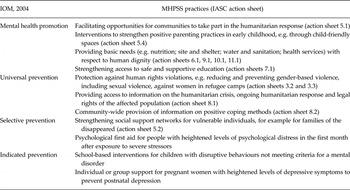
Prevention and promotion are distinct concepts with overlapping boundaries, but they are commonly divided into different types of intervention depending on which outcome and population groups they target. Many interventions can contribute both to strengthening positive aspects of mental health (promotion), and at the same time reduce the chance for developing mental disorders (prevention). In Table 1, we have provided examples of some commonly advocated and implemented MHPSS activities in accordance with the framework for prevention and promotion from the Institute of Medicine (O'Connell et al. Reference O'Connell, Boat and Warner2009).
Examples of popular MHPSS practices/case examples

Mental health promotion
Usually (but not always) targets the entire population and considers outcomes related to positive aspects of functioning (Eaton, Reference Eaton and Eaton2012; Wahlbeck, Reference Wahlbeck2015). Promotion is assumed to lower the risk of future mental disorders while enhancing positive wellbeing (Keyes et al. Reference Keyes, Dhingra and Simoes2010). A climate that respects and protects basic civil, political, socio-economic and cultural rights is fundamental to mental health promotion. Similarly, a human rights perspective is strongly emphasised in current international consensus on best practices in MHPSS (IASC, 2007). In addition, specific ways of promoting positive aspects of mental health include, for example, early childhood interventions that enhance emotion regulation or executive skills; school-based interventions that foster pro-social behaviour, self-esteem, coping behaviour or conflict resolution skills; socio-economic empowerment of women aimed at increasing decision-making capacities; housing policies aimed at facilitating ownership which has been associated with improved positive mental health; or workplace interventions that improve job satisfaction, job control and decision making, and work-life balance (World Health Organization, 2014b ). Similarly, in humanitarian settings, giving affected populations a say in how site and shelter are organised; ensuring that human rights are upheld in the provision of humanitarian aid; and activities aimed at skill building and social support in child friendly spaces are examples of mental health promotion. What unites these activities is that they are all aimed at strengthening positive aspects of mental health.
The concept of prevention literally refers ‘to keep something from happening’, in which the term ‘something’ can be seen as occurrence of a disorder. Historically, disorder prevention was divided into primary, secondary and tertiary depending on whether the strategy was aimed at reducing or eliminating the incidence of disorder (primary prevention); early identification and treatment of disorder (secondary prevention); and reduction of disorder-related impairment (tertiary prevention). Currently, public mental health practitioners favour a different terminology, mainly because of the overlap with treatment activities and tertiary prevention. Rather, the terms universal, selective and indicated prevention – introduced in the Institute of Medicine report (Mrazek & Haggerty, Reference Mrazek and Haggerty1994) are currently preferred. These terms refer to preventive activities that are aimed at different segments of the population.
Universal prevention
Targets the general public or a whole population group, regardless of whether people are at higher risk or not of developing a disorder. An example of a universal prevention intervention is a community-wide effort to reduce intimate partner violence as a critical risk factor for ill mental health. Likewise, community-wide efforts to reduce poverty as a key risk for ill mental health are an example of a universal prevention intervention (e.g. through lifting restrictions of movement and employment for everyone in a refugee camp).
Selective prevention
Selective prevention targets individuals or specific subgroups of the population whose risk of developing a mental disorder is significantly higher than that of the rest of the population. Examples include programmes to prevent depression with children whose parents suffer depression; increasing social support networks for people who experienced sudden loss or bereavement; or provision of self-help information to people who recently survived a major accident. In humanitarian settings, psychological first aid – for example, if provided to people with higher levels of psychological distress in the immediate aftermath of exposure to major stressors – (WHO et al. 2011) and teaching stress management skills to people who were recently displaced by an industrial disaster may be considered examples of selective prevention activities.
Indicated prevention
Indicated prevention targets smaller groups of the population at high-risk for mental disorders and that might already show some signs of disorder without meeting criteria of a formal diagnosis (Wahlbeck, Reference Wahlbeck2015). For example, interventions with adolescents who have started to display behavioural problems, or identifying and supporting people with early signs of substance abuse problems are examples of indicated prevention. In humanitarian settings, indicated prevention interventions may include support for widows with high levels of psychological distress or a school-based intervention with children with sub-clinical levels of depression.
Advantages of using a public mental health framework
The use of a public mental health approach would likely bring about several advantages. First, the use of a prevention and promotion terminology can assist in developing clearer theories of change for MHPSS programmes, especially at the lower levels of the IASC MHPSS pyramid. Particularly at these levels, there appears to be a continued lack of clarity on how activities across different sectors may collectively contribute to mental health and psychosocial wellbeing. Prevention and promotion interventions may be conceptualised in terms of an ultimate goal (e.g. positive aspects of mental health or prevention of new cases of mental disorders), and subsequently as addressing risk and protective factors that are predictive of this ultimate goal. Theories of change that build on prevention and promotion terminology may foster a shared understanding between diverse MHPSS stakeholders, and create stronger synergies for collaboration than is currently the norm.
Second, increased attention to a public mental health approach allows an examination of the relevance of a large body of prevention science for use with populations affected by humanitarian crises. The knowledge on prevention and promotion developed over the last decades may be useful in several ways (Mrazek & Haggerty, Reference Mrazek and Haggerty1994; O'Connell et al. Reference O'Connell, Boat and Warner2009). Knowledge from epidemiological studies on risk and protective factors may provide a strong rationale and focus for MHPSS programmes (e.g. studies linking poverty and gender-based violence with worse mental health outcomes) (Lund et al. Reference Lund, De, Plagerson, Cooper, Chisholm, Das, Knapp and Patel2011; Howard et al. Reference Howard, Oram, Galley, Trevillion and Feder2013). In addition, knowledge from effective prevention and promotion interventions may inform design of interventions for populations affected by humanitarian crises. For example, research on effective methods of violence prevention in neighbourhoods with high levels of violence in the US cities may inform design of interventions to prevent renewed violence in post-conflict settings. Similarly, lessons learned from studies that identified effective ways of building a more positive school climate (Bradshaw et al. Reference Bradshaw, Koth, Thornton and Leaf2009) or the effectiveness of policies to reduce alcohol use are likely relevant to MHPSS interventions (Furr-Holden et al. Reference Furr-Holden, Ialongo, Anthony, Petras and Kellam2004; Milam et al. Reference Milam, Furr-Holden, Cooley-Strickland, Bradshaw and Leaf2014).
Third, knowledge from prevention science may contribute research methodologies that can be applied in humanitarian settings, for example in evaluation design. For example, prevention researchers have developed indicators for community-level variables that are relevant to MHPSS practitioners. This is not to suggest that prevention research in mental health does not face important challenges, for example the problem of sufficient power in intervention evaluations (Cuijpers, Reference Cuijpers2003), but there are examples of successful prevention projects that are currently not often considered by MHPSS practitioners.
Conclusion
This paper focused on the potential utility of a public mental health approach for MHPSS interventions in humanitarian settings. There has been increasing consensus amongst MHPSS practitioners as evidenced by several published guidelines. Nevertheless, a lack of clear conceptualisation of interventions remains, and there appears to be a continued split between ‘mental health’ and ‘psychosocial support’ practitioners. Although clearly not intended as a panacea, the use of terminology, knowledge and methods from the field of public mental health could improve MHPSS intervention delivery and evaluation. Research and practitioners focused on mental health in the overall field of public health have similar concerns to psychosocial practitioners in humanitarian settings, in that they are interested in mental health as being more than the absence of mental disorder; are interested in understanding the upstream predictors of positive and ill mental health; are interested in empowering communities to take mental health and wellbeing into their own hands; and have worked with larger populations to prevent ill mental health and promote positive aspects of mental health. Similarly, prevention and promotion programmes have emphasised an approach summarised as PaCTS, combining: socio-ecological perspectives (Place); interdisciplinary activities (Collaboration); a lifespan developmental approach (Timing) and building on existing resources (Strengths). It is our hope that stronger interaction between the field of public mental health and MHPSS could assist in improved conceptualisation and evaluation of MHPSS interventions and ultimately to better mental health outcomes for populations affected by humanitarian crises.
Financial Support
This work received no financial support from funding agencies or commercial or not-for-profit sectors. Dr Marianna Purgato is funded by a 3-year fellowship by the European Commission (Marie Curie International Outgoing Fellowship – Individual Action).
Conflicts of Interest
None.
Ethical Standards
The authors assert that all procedures contributing to this work comply with the ethical standards of the relevant national and institutional committees on human experimentation and with the Helsinki Declaration of 1975, as revised in 2008.