For a quarter-century, conservative Republicans have used the “San Francisco liberal” label to place Democrats as outside the American mainstream. Imagine their dismay as the 110th Congress opened in January 2007 and Nancy Pelosi, a San Francisco Democrat well to the left of most of her party, ascended to the podium as speaker of the United States House of Representatives. This was, to be sure, a departure. Traditionally, House Democrats had selected ideological “middlemen” for top leadership posts (Truman 1959), particularly those from the “Austin-Boston alliance” that held unbroken sway in House Democratic leadership selection from the initial teaming of Speaker Sam Rayburn of Texas and Majority Leader John McCormack of Boston in 1940 to that of Tip O'Neill of Boston and Texan Jim Wright in the 1970s and 1980s.1
See Anthony Champagne, Douglas B. Harris, Garrison Nelson, and James Riddlesperger, The Austin-Boston Connection: Leadership in the House of Representatives, unpublished manuscript.
Even at the opening of the 95th Congress in 1977, when the time seemed ripe for a liberal takeover of the House,2
The post-reform House retained almost all of the previous “Watergate babies” from the 94th Congress who had voted out three conservative Democratic chairs two years earlier, Democrats had just captured the White House, and O'Neill had just been selected speaker.
For recent scholarly examinations of individual choice in leadership races, see Green 2006; Green and Harris 2007; Harris 2006; Kelly 1995. Examples of this type of analysis can also be found in the Frisch and Kelly and the Green contributions to this symposium.
If the growing unpopularity of this decade's war, plummeting presidential approval, and congressional corruption and sex scandals beg historical analogy between the Reform Era and 2006, there is at least one indisputable difference: in 2006, the “San Francisco liberal” with a reputation for outspoken leadership as well as toughness in internal congressional fights won the party leadership post she sought. With Nancy Pelosi's unopposed succession from her post as Democratic minority leader to become the first female speaker, it is clear that congressional party leaders are no longer exclusively middlemen.
Despite the historic and unique nature of Pelosi's selection as speaker, key elements of her rise within the House Democratic Caucus exemplify broader changes in congressional party politics and leadership selection that have long been underway. In addition to Pelosi's election, all four congressional parties selected their leaders for the 110th Congress: in triumph, new Democratic majorities chose leaders who would control key levers of power in the House and Senate while Republicans selected leaders to cope with intra-party acrimony, charges of ideological infidelity and “drift,” and, more generally, to deal with the difficulties of minority leadership in a partisan era. This essay examines the cases of intra-party leadership selection that took place to organize the 110th Congress with an eye toward testing extant theories of leadership selection and answering, preliminarily and speculatively at least, the following questions: First, to what extent do contemporary legislative leaders come from the middle of their legislative parties and to what extent do they represent their parties' ideological extremes? And, second, how competitive and prone to conflict are contemporary leadership races in the four legislative parties (House and Senate, Democrat and Republican)?
The Ideological Positioning of Legislative Leaders
The classic academic debates on the ideological positioning of legislative leaders highlighted the contextual underpinnings of a party's leadership choice. Comparing legislatures with vastly different partisan contexts, Patterson (1963) found evidence that ideologically extreme members were selected to lead in highly partisan legislatures (e.g., the Massachusetts and Wisconsin legislatures) while ideological middlemen were selected in less partisan legislative settings like the Oklahoma House and the U.S. Congress.4
Patterson's reference to the Massachusetts House cites MacRae 1956.
Considering the selection of a legislative leader as a strategic choice party members make about how best to advance collective goals suggests the importance of broader contextual factors that are likely to vary by legislative party and over time. In some contexts where deep intra-party divisions predominate and where relatively large, but internally divided, majorities control a legislative chamber (like the Oklahoma House or the “Textbook Congress”), party success hinges on the ability of leaders to bridge intra-party gaps; the need to straddle the divide between the party's ideological camps and to build broad—sometimes bipartisan—coalitions counsels choosing middlemen. By contrast, in contexts where intra-party divisions are less prominent and partisanship is high (like Patterson's more partisan legislatures and, arguably, the contemporary Congress), the ability to advance the more or less unified goals of party followers takes center stage, making legislative parties more likely to select leaders closer to the party's edge. These leaders can then sharpen inter-party divides, make the party's case to friendly interest groups, the press, and the public, and negotiate inter-party differences by “counter-punching” across the partisan aisle, all tasks that are arguably better performed by more extreme partisans than by moderates (King and Zeckhauser 2002).5
Broader historical scope might shed important light on this debate; examining both parties throughout the twentieth century, King and Zeckhauser (2002) find that parties are more likely to select overall leadership “teams” that were to the ideological extreme of their party's median.
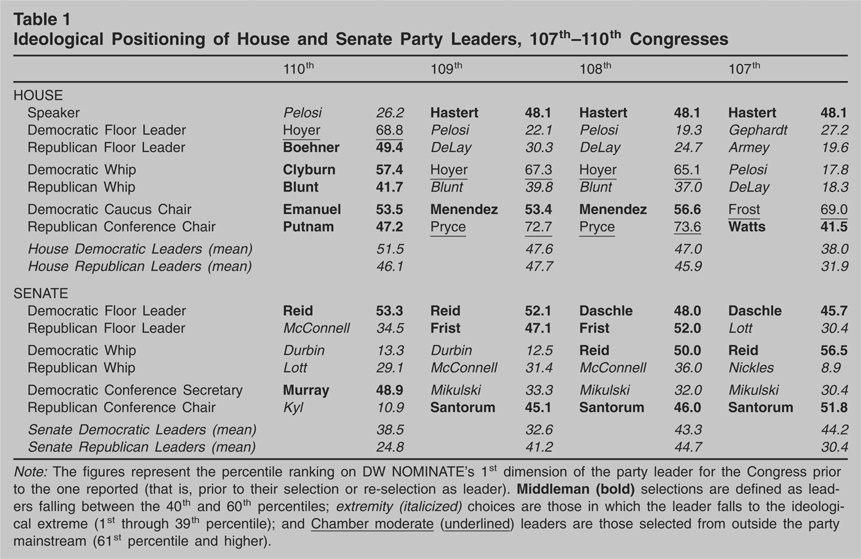
Do contemporary parties, particularly those in the 110th Congress, seek “middleman” brokers or extreme counter-punchers? Contrary to the middleman expectation, in recent years, the legislative parties frequently have selected leaders from their more ideological wings. Table 1 reports the ideological positioning of top House and Senate leaders from the 107th to the 110th Congresses as measured by the percent of a leader's party's membership to his or her ideological extreme.6
This measure is adapted from King and Zeckhauser (2002) who used such percentile rankings to measure the relative position of leadership “teams” within their parties.
Ideological Positioning of House and Senate Party Leaders, 107th–110th Congresses

Table 1 points up a third category of leaders: those selected well on the moderate side of their parties' caucus or conference. This, as Peabody (1976) noted, is an unusual occurrence: “With only a rare exception or two, a potential candidate cannot deviate far from the mainstream of his party's ideological orientation if he hopes to become a leader” (470). While recent party officials, like Democratic Caucus Chair Martin Frost (D-TX) and Republican Conference Chair Deborah Pryce (R-OH), were in the moderate portion of their parties when selected, the only true moderate among the top party leaders of either party in the 110th is Democratic Floor Leader Steny Hoyer (D-MD), who is positioned with 68.8% of the caucus to his left.7
Of the two candidates who vied for the Democrats' majority leader post in the 110th Congress—Hoyer and John Murtha (D-PA)—Hoyer was both closer to the middle of the party and the more liberal (93% of the caucus was more liberal than Murtha). Despite Murtha's close association with Speaker Pelosi and his outspokenness on the Iraq War, he could not overcome either Hoyer's leadership experience or deep ties throughout the caucus.
Placing recent leaders (those from the 107th to 110th Congress) in the middleman, extremity, and chamber moderate categories, the legislative parties have been just as likely to have “extremity” leaders as they are to have “middlemen.” There are exactly 11 examples of each on the House side with six chamber moderates and 12 examples of each on the Senate side with no chamber moderates. Thus, if the evidence does not point to a complete displacement of “middlemen” selections with “extremity” choices, it does suggest that would-be leaders from both parties' extreme wings are increasingly likely to win intra-party contests and to serve as top leaders. But these examples of “extremity” leadership selection and new developments are not so much disconfirmation of the prior middleman hypothesis as they are reminders of the contextual underpinnings of the leadership choices that parties make and how dramatically the party context in Congress has changed in recent decades. Republican gains in the South and the diminished influence of Northern moderates have made the Republican Party more conservative and the loss of Southern conservatives has made the Democratic party more dominated by Northern (and Western) liberals. Those changes have made the United States Congress both more partisan and more ideological, contributing to the intra-party preference homogeneity of both parties and the polarization between the parties (Rohde 1991; Sinclair 2006). While the U.S. Congress in the Textbook Era—overwhelmingly Democratic with deep internal divisions in the majority party—led to the selection of moderate leaders, increasing partisanship has made the contemporary Congress more like the partisan state legislatures that Patterson (1963) found selected “extreme” and “highly partisan” leaders precisely because “the two parties were relatively cohesive” (405). As congressional Democrats and Republicans became more internally homogeneous and polarized, the need for “middlemen” lessened while the need for “counter-punching” in the inter-party context increased. However, the inherent organizational weakness of American parties and, perhaps, the narrowness of contemporary House and Senate majorities may keep some middlemen on the premises, albeit in diminished numbers.
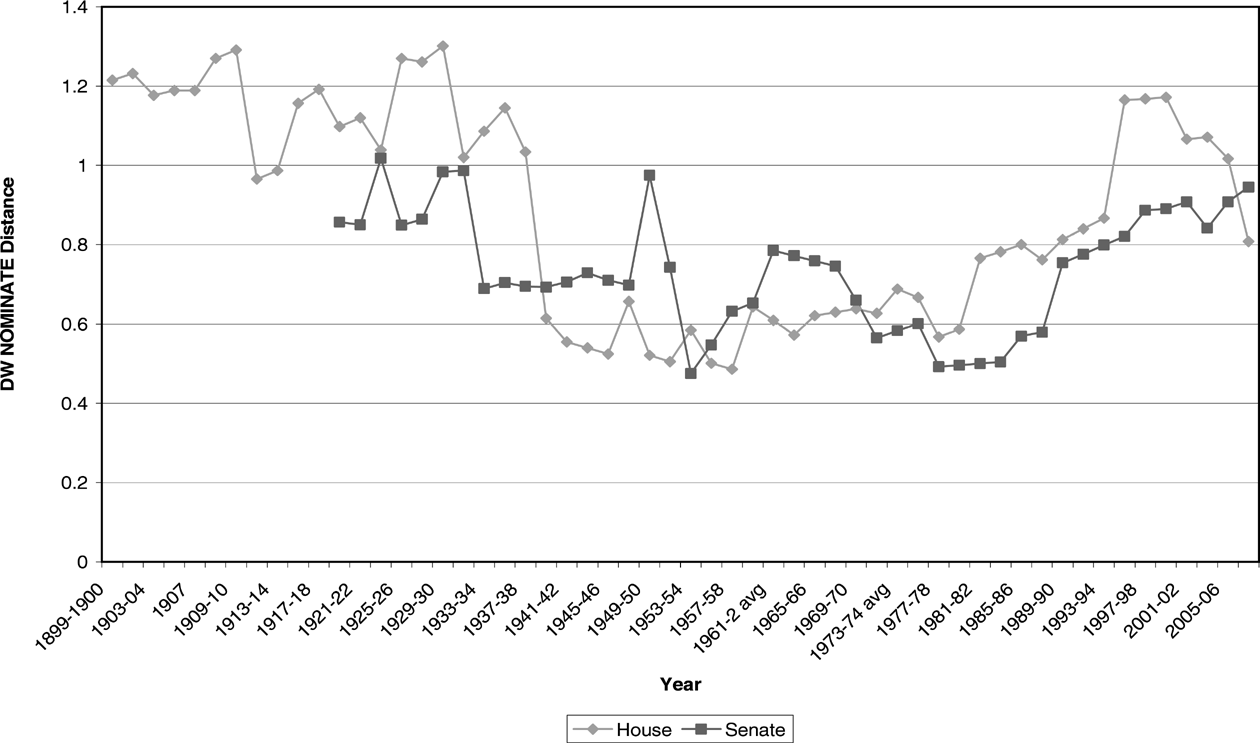
It is important to note that extremity selections would yield even deeper divisions between the two parties' top leaders given this increased inter-party polarization and intra-party homogeneity; indeed, even the respective parties' middlemen would be more ideological and divided than in the past. Figure 1 displays data on the ideological distances between Democratic and Republican floor leaders in the House and Senate, respectively.8
Data in Figure 1 is from Keith Poole's DW-NOMINATE scores on Congressional Leaders, 1789–2000 as presented in Nelson 2007. Updated scores are from Poole's web site, www.voteview.com/dwnl.htm.
The alliance officially gave way when Thomas Foley became majority leader in the 100th Congress, though Texan Jim Wright was speaker until mid-way through the 101st Congress.
Wright moved leftward both in his 1st dimension NOMINATE score (from −.352 in the 95th Congress to −.417 in the 99th Congress) and his relative positioning in the caucus: a middleman with 43% of the caucus to his left in the 94th Congress, only 27% was to Wright's left in the 99th Congress (and in a caucus that overall was becoming more liberal).

Ideological Differences Between Floor Leaders, 1899–2007
Source: Nelson 2007.
The ideological distances between Senate floor leaders follow a similar but not identical pattern. Relatively high levels of inter-party disagreement from 1920 to the mid-1930s gave way to a drop after the 2nd New Deal with a spike both at the end of the 1940s (though briefly) and a steep decline in the closely balanced Senate of the 1950s. Despite a period of increased inter-party difference in the 1960s—the pairing of Democratic leader Mike Mansfield (D-MT) and Republican leader Everett Dirksen (R-IL)—the low levels of inter-party difference in the 1970s House are mirrored in the Senate, particularly when moderate-liberal Republican Hugh Scott (R-PA) succeeded Dirksen as Republican leader and continued as moderates Robert Byrd (D-WV) and Howard Baker (R-TN) became their parties' floor leaders from the 95th to the 98th Congresses, 1977–1985. If choosing middlemen and cross-party cooperation was predominant in Senate leadership in the Textbook Era and especially in the 1970s, that, too, has given way to more polarization in the post-Reagan era. And, since the late 1980s, there has been a steady increase in the polarization of the two parties' Senate floor leaders reaching, in the current match-up, its highest point in over half a century.
Finally, the broad similarities between the House and Senate represented in Figure 1 are noteworthy in and of themselves. Despite the fact that the four congressional parties are independent of one another and have developed different internal selection patterns, the ideological distances between both parties' floor leaders are, at least in broad contour, similar in the House and Senate following (and perhaps doing their own part to reinforce) the same broad partisan directions of American national politics over time.11
Legislative leaders are by no means perfectly representative of ideological shifts in America: their representativeness may be muted by the personal factors traditionally associated with legislative leadership races as well as by the framed choice (including the “pool of announced candidates”) offered candidates in any particular leadership race; see Green and Harris 2007.
Partisan Patterns of Competition and Conflict
Although stability (that is, the tendency for leaders to remain in their positions) is the predominant characteristic of congressional leadership selection, there are occasional revolts against sitting leaders and, when vacancies occur, legislative parties exhibit varying degrees of consensus and conflict to fill their posts. Prior studies of such patterns of competition and conflict in leadership races have differed as to whether there were patterns across the parties and chambers or party-specific factors that best explained leadership choice. Whereas Canon (1989), for example, found “institutionalizing” patterns across parties and chambers, Nelson (1977, 920, 932) warned against neglecting “the impact of party identity” and “the party variable” in predicting patterns of competition and conflict in leadership selection. Are there institutional patterns across parties and chambers or are there distinct partisan patterns reflecting the different calculations associated with majority and minority status and the varying institutional contexts and strategic choices faced by Democrats and Republicans in both chambers?12
Peabody (1976) stressed majority/minority status, while Nelson (1977) emphasized Democrat/Republican differences, though long-time Democratic control precluded a clear test.
Again viewing leadership selection as a strategic choice parties make, we would expect the four legislative parties to exhibit different tendencies toward conflict and consensus in leadership selection. Nelson (1977), for example, argued that House Democrats had established orderly succession patterns precisely because of the potential for their deep internal divisions to be exacerbated by open conflict, and he predicted that “As the Democratic party becomes more philosophically united, and as the ancient regional conflicts recede, it is likely that the Democratic leadership will no longer need their controlled succession system and that the membership will no longer tolerate it” (939). By the 1980s, Nelson's predictions were already coming true as the Democrats' patterns of succession weakened and conflict was on the rise. And, intra-party competition in Democratic leadership contests skyrocketed during their 12 years in the minority, though conflict was diminished somewhat in Republican ranks. If Canon (1989) revealed emerging patterns across chambers and parties in the 1980s, extending analysis into the 1990s revealed that the two parties were “moving in different directions with Republicans slightly mitigating their tendencies toward conflict and Democrats becoming more prone to intra-party conflict over time” (Harris 2006, 200).
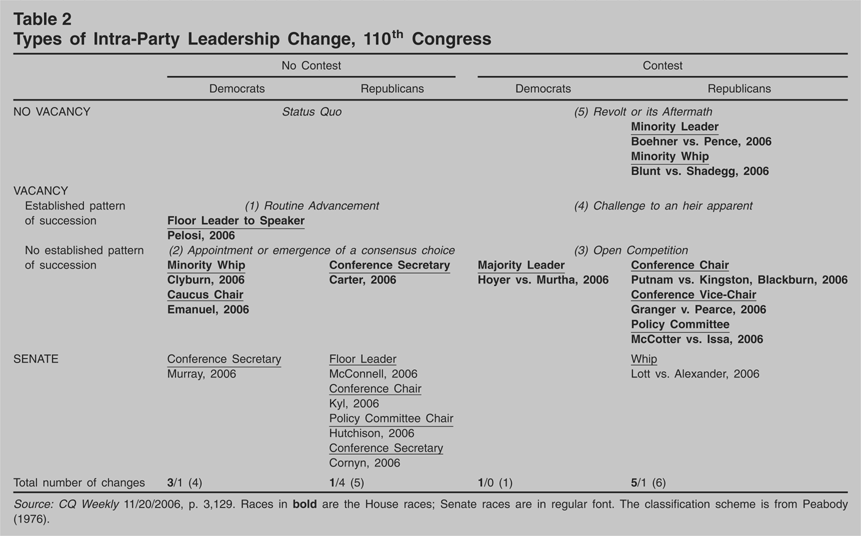
Organizing for the 110th provides new support for these observed differences between Democrats and Republicans, majorities and minorities (see Table 2). If Nelson's predictions of increased Democratic conflict in the 1970s and 1980s were correct and that conflict was exacerbated during their 12 years in the minority, the return to majority status in 2006 seems to agree with Democrats. On the House side, Democrats demonstrated far more stability than conflict in their late 2006 leadership selections. Deftly clearing the way for successful DCCC Chairman Rahm Emanuel (D-IL) to become the consensus choice for caucus chairman (even though Representative John Larson (D-CT) had been elected caucus vice-chairman earlier in the year) and watching as Jim Clyburn (D-SC) succeeded without opposition from caucus chair to the party's whip post, House Democrats also advanced Minority Leader Pelosi to the speakership without even the hint of intra-party challenge, thus returning Democrats to that pattern of succession from floor leader to speaker that had existed in the party for most of the twentieth century.13
Newt Gingrich was minority whip and not floor leader prior to becoming speaker in the 104th Congress (Bob Michel retired at the end of the 103rd Congress) and neither Bob Livingston (R-LA) nor Dennis Hastert (R-IL) was floor leader when they wrapped up the speakership nomination in 1998; Livingston withdrew his candidacy and resigned the House prior to assuming the speakership. Prior to these exceptions, the last such deviation was when Frederick Gillett (R-MA) successfully challenged Floor Leader James R. Mann (R-IL) for the speakership when Republicans regained control of the House in 1919.
Types of Intra-Party Leadership Change, 110th Congress

This recent harmony notwithstanding, there is little reason to expect that House Democrats have returned to the stability of the Austin-Boston years. If Pelosi advanced unopposed to the speakership, her overall rise in the leadership was not without opposition. She bested Steny Hoyer 118 to 95 in a titanic 2001 battle for minority whip; and her elevation a year later from whip to minority leader was slightly challenged as she rolled (177 to 29) over Harold Ford (TN) who had argued that Pelosi was too liberal to be the House Democrats' top leader.14
On the 2001 vote, see Foerstel 2001; on the 2002 vote, see CQ Almanac 2002, 1–9.
The Republicans, it seems, continue to be more prone to competitive leadership selections and to revolt. The 2006 leadership elections displayed a great deal of intra-party conflict for leadership posts: with Tom DeLay's resignation from the House, an early February race where John Boehner (R-MO) and John Shadegg (R-AZ) challenged acting Majority Leader Roy Blunt (R-MO) to replace DeLay was but one of several competitive Republican races in 2006. Such open competition, and particularly against a sitting whip and acting majority leader, was, in part, a response to Republicans' dire political situation as it was shaping up in early 2006 (Ota 2006a; 2006b; 2006c). After the election returned House Republicans to minority status for the first time since 1994, Republicans' higher tendencies for intra-party conflict coupled with minority-party frustrations led to even more conflict. Conservatives Mike Pence (R-IN) and John Shadegg (R-AZ) led unsuccessful “revolts” against Boehner and Blunt, respectively, arguing that Republican losses were to be blamed on the party's infidelity to conservative principles. Deborah Pryce's (R-OH) narrow re-election in her Ohio district and the likelihood of an internal challenge led her to vacate the Conference chair post producing two of House Republicans' three “open competition” races (one for Pryce's old job and the other for the chair of the Republican Policy Committee which was vacated by Adam Putnam [R-FL], who sought and eventually won the Conference post). If things were somewhat more tame on the Republican Senate side with Mitch McConnell (R-KY) succeeding unopposed from whip to floor leader and three other “consensus choice” selections for lower party posts, there was one late surprise “open competition” race as Trent Lott (R-MS) beat Lamar Alexander (R-TN) for whip (again by one vote) to return to the leadership after his 2002 resignation as floor leader.
In all, it seems that intra-party conflict for leadership posts is alive and well in both parties (the Democrats' recent harmony notwithstanding) and the predictability of leadership selection has been lessened. Since the Republican takeover in 1995, only one instance of an established pattern of succession—Pelosi's moving from floor leader to speaker—has occurred and there have been no “challenges to an heir apparent” since 1969 (largely because there have been few heirs apparent for any leadership post).15
Peabody (1976) characterized Senator Howard Baker's (R-TN) 1969 challenge to Whip Hugh Scott (R-PA) as a “challenge to an heir apparent” (450).
Conclusions: New Roles, New Leaders
What does this recent spate of leadership selections reveal about followers' expectations of their leaders and the emerging prerequisites of the key party posts in Congress? In addition to dealing with intra-party factions and the party's overall strategic context, parties' choices of their legislative leaders are also about “casting” the right actor to fulfill the many roles that leaders perform throughout a Congress. If middlemen were particularly appropriate and effective for a bargaining era and bipartisan Congress, new leadership roles, including leaders' public, media-oriented roles (Harris 1998; Sinclair 2006) might advise selecting different, more ideological and aggressive leaders. In addition, demands for fundraising are increasingly important in leadership selection. Indeed, Pelosi's advance to the speakership as well as Boehner's rise to the Republican floor leadership (Green and Harris 2007), aided in large part by prodigious fundraising, exemplify significant changes in the campaigns legislators wage for leadership positions. If the narrowness of recent congressional majorities somewhat maintains the value and importance of “middlemen” and chamber moderates who can bridge intra- and inter-party divides, the twin needs to “go public” and to court a party's donor base (which is often extraordinarily partisan) increase the need to select leaders from the party extremes as well.
Moreover, as party leaders (middlemen and extremity leaders alike) represent their polarized parties, their increased control over agenda-setting and legislative issue-framing define debates both in Congress and in the broader public. Thus, ideologically extreme party leaders and the more general polarization of the House and Senate parties may not only be the result of a partisan legislature, they may also be reciprocal, contributing factors to partisanship as well. To the extent that this is true, match-ups between Pelosi and Hoyer, on the one hand, against Boehner and Blunt, on the other hand, as well as the very conservative Senate Republican leadership team of McConnell and Lott (particularly when pitted against outspoken liberal leader Dick Durbin) suggests that America's deep partisan divisions are likely to continue to be reflected in and, perhaps, exacerbated by what takes place in Congress. Indeed, if Harry Reid was almost the exact middleman among Senate Democrats, he certainly has led the 110th in an aggressive manner, repeatedly challenging the Bush administration on Iraq and other issues. In the contemporary partisan-polarized Congress, even the middlemen counterpunch.