Introduction
The growing tolerance of cohabitation as a stage in the marriage process has made it a conventional step in the process of marriage, as has been demonstrated in the United States and sub-Saharan Africa (Budinski & Trovato, Reference Budinski and Trovato2005; Mokomane, Reference Mokomane2005). This argument is based on the premise that couples use cohabitation, rather than traditional engagement, as a phase to test for compatibility in a relationship, thus improving marital stability (Oppenheimer, Reference Oppenheimer1988; Budinski & Trovato, Reference Budinski and Trovato2005). However, previous research in the United States has indicated that the risk of union dissolution among cohabiting relationships is higher than it is in marriages with a traditional engagement (Thomson & Colella, Reference Thomson and Colella1992; Teachman, Reference Teachman2003; Budinski & Trovato, Reference Budinski and Trovato2005; Phillips & Sweeney, Reference Phillips and Sweeney2005; Lichter et al., Reference Lichter, Qian and Mellott2006; Stanley et al., Reference Stanley, Rhoade and Markman2006). These authors suggested that cohabitees see themselves as individuals, not as couples, and are less committed to each other, thus increasing the risk of union dissolution.
Nonetheless, such arguments may not apply to rural areas in the developing world. Other authors have argued that women who cohabit have a greater chance of having characteristics related to higher risk of union breakdown than those who marry without first cohabiting. Examples include entering union while young, poor family background, experience of prior cohabitations, not being affiliated to the Catholic Church, having fewer living children, being employed, being more educated and having parents either cohabiting or of single status (Becker, Reference Becker1974; Teachman, Reference Teachman2003; Kalmijn et al., Reference Kalmijn, Loeve and Manting2007). However, it is not uncommon to find women affiliated to the Catholic Church in cohabiting relationships in Uganda.
In Africa, where research on union dissolution is relatively new, past research on the relationship between cohabitation and union dissolution has been limited. In addition, such studies typically involved examining causes of union instability and not the relationship between cohabitation and union dissolution. In Ghana, for instance, it was noted that by the 20th year of marriage about a third of women dissolve their marriages (Amoateng & Heaton, Reference Amoateng and Heaton1989; Oheneba-Sakyi, Reference Oheneba-Sakyi1989). The authors found an association between the risk of union dissolution and women’s age at first marriage, educational level, employment status, place of residence, marriage cohort, birth cohort, kinship and number of living children. However, less studied has been the association between birth cohort and marital dissolution, and marital dissolution may vary across birth cohorts because of historical differences.
In Uganda, data from the Uganda Demographic Health Survey (UDHS) indicate that more women than men tend to dissolve their unions and the trend increases with age. Despite the growing interest in the effect of cohabitation as a form of first union on union dissolution, previous studies have been based on women from developed countries, mainly the United States. Otiso (Reference Otiso2006), who focused on gender roles, marriage and the family, provided evidence of the rising prevalence of cohabitation in Uganda but could not relate the risk of union dissolution to cohabitors and non-cohabitors. In central Uganda, just like elsewhere in Uganda, marriage was, and still is, a central aspect of society. In the past, parents would initiate the marriage process for their children by choosing a spouse for them without their involvement. This process was followed by payment of a dowry and marriage; as a result divorce was not common (Otiso, Reference Otiso2006). Over time, however, boys started choosing their spouses with minimal involvement of their parents. Otiso (ibid) argued that this paradigm shift, in addition to high poverty levels and the desire to try out marriage before commitment, has contributed to a rising number of cohabiting households and high dissolution rates.
In demographic studies, however, cohabitation as a form of first union and dissolution as a form of marital instability are key proximate determinants of fertility (Bongaarts & Potter, Reference Bongaarts and Potter1983). The vital registration system is, to a great extent, incomplete and marital history data are poorly covered in censuses and surveys. For instance, the UDHS only records marital status at the time of the survey. The existence of survey data on cohabitation and its implications for marital stability and first birth in the central region of Uganda therefore offers the opportunity to analyse the link between cohabitation and union dissolution in this region.
Analysing marital history data using the lifetable approach provides information on whether women who marry after cohabitation experience a continually greater risk of union breakdown than women who marry directly (without first cohabiting) or those who are still cohabiting. This paper addresses two questions. First, does the difference in union dissolution risk between women who married directly, those who married following cohabitation and those who were still cohabiting converge or diverge over union duration? Second, what other factors influence the risk of union dissolution?
Methods
Event history data were drawn from a cross-sectional study conducted in Uganda in 2013. The survey used a multistage random sampling method to collect data from a sample of 1200 female respondents. The first stage involved randomly selecting Luwero and Wakiso districts from a list of 24 districts in the central region of Uganda. In the second stage, twenty enumeration areas (EAs) were selected from each district, and in the third stage 30 households were selected from each EA. For each selected household one woman aged 15–49 years was selected for interview. The study restricted data collection to women aged 15–49 because age of entry into union and type of union have implications for fertility and union stability. The event history questionnaire was designed to seek information on nuptiality, fertility and socioeconomic background of respondents, their parents and their partners.
It is worth mentioning that a union or marriage, as conceptualized in Uganda, involves a process not a single legal act, as it is in the Western world (Otiso, Reference Otiso2006). The present study used a definition of marriage to cover all types of unions between a man and a woman, which include regularized (customary, legal marriage and civil marriage) and non-regularized unions, namely cohabitation. Non-regularized unions were included because they might be susceptible to dissolution and more likely to be mentioned in this society. Therefore, it might be used to explain noticeable differences over duration of union. Of the 1200 respondents 839 were in a union. Of those in a union, 19.4% of all first unions had been dissolved by the time of the survey.
Variables
The dependent variable was the time to union dissolution following first union. It was computed from two questions: When did you enter first union? and When did separation or divorce take place? The independent variables were the socio-demographic chacteristics of women. These were women’s union status, categorized as: married directly (without first cohabitating), married following cohabitation and still cohabiting; highest level of education, categorized as: below secondary and secondary education or higher; religious affiliation, categorized as: Catholic, Anglican, Muslim, Seventh-Day Adventist (SDA) and Orthodx Christian; employment status, categorized as: working and not working; expectation about union stability, categorized as: cohabiting first leads to stability and cohabiting does not lead to stability; number of children, categorized as: up to 2 children and 3+ children; union type, categorized as: monogamous and polygynous; parental union status was treated as time-varying and categorized as: cohabiting, married and other. The demographic measures included were age at first union, grouped as <20 years and 20 years or older, and the birth cohort, which was categorizd as 1970–1979, 1980–1989 and 1990–2000.
Statistical analysis
Lifetable estimates, Kaplan–Meier survival curves and the Cox proportional hazard model were used to estimate the timing of union dissolution and also to identify the risk factors for union dissolution following first union. The lifetable approach was used to estimate the proportion of women who dissolved their first union at the end of each year (interval) (Preston et al., Reference Preston, Heuveline and Guillot2001). In addition, it was used to examine whether differences in union dissolution risks resulting from differences in union type converged overtime. Women’s first union outcomes were tracked for up to nine years after first union. A generalized Wilcoxon test, which is a non-parametric statistical test set at p<0.05, was used to test for the differences between survival functions for different groups.
The Kaplan–Meier survival curve was used at bivariate level to estimate the mean time to union dissolution and also partially test whether the proportional hazard assumption is not violated. The log rank χ 2 test, set at p<0.05, was used to test for the significance of the differences in the mean time to dissolution resulting from differences in socio-demographic characteristics. The Cox proportional hazard model was used to identify the risk factors for union dissolution, usually estimated as the ratio of women who dissolved their union at the end of the year (interval) to the number of women exposed to the risk of union dissolution. The proportional hazard assumption was evaluated using the scaled Schoenfeld residuals approach, while the overall predictive power of the model was diagnosed using the Cox–Snell residual method and the link-test (Cleves et al., Reference Cleves, Gould, Gutierrez and Marchenko2010). The results are presented as risk ratios indicating the relative likelihood of a woman in a given group of a covariate dissolving first union relative to a woman in a reference category.
Results
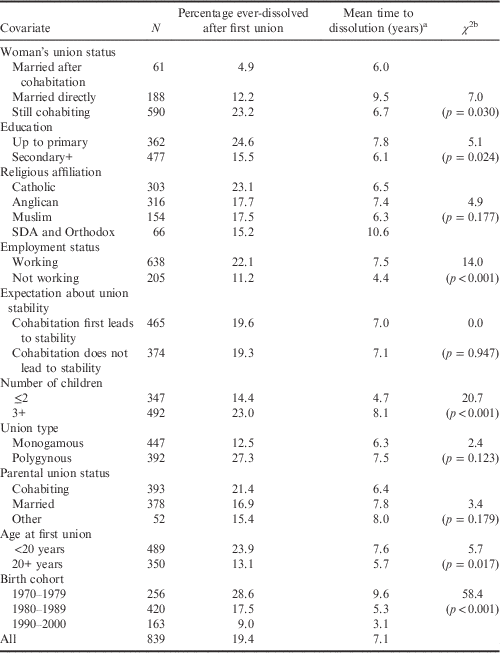
Table 1 presents the prevalence and timing of union dissolution of the sample women by socio-demographic characteristics. This shows that the majority of women who dissolved their first union were still cohabiting (23.2%), followed by women who married directly (about 12.2%), and those who married after cohabitation accounted for nearly 5%. Of women with a dissolved first union, 24.6% had up to primary education and 15.5% had at least secondary education. Approximately 23%, 18%, 18% and 15% of the women who dissolved their first union were affiliated to the Catholic, Anglican, Muslim and other minority religious groups, respectively. Slightly over a fifth (22%) of the women with dissolved first unions were doing some work, and about 20% contended that cohabiting first leads to union stability. The proportion of women who dissolved their first union by the number of children shows that nearly 23% had three or more children and approximately 27% were in polygynous unions. With regard to their parents’ union status, slightly over a fifth (21%) had parents who were cohabiting and about 17% had parents who were married. With regard to age at first union, nearly 24% were aged less than 20. Nearly 29%, 18% and 9% of the women were born in the 1970–1979, 1980–1989 and 1990–2000 birth cohorts, respectively.
Proportion of first unions that were ever-dissolved by background characteristics, and mean time to first union dissolution, central Uganda
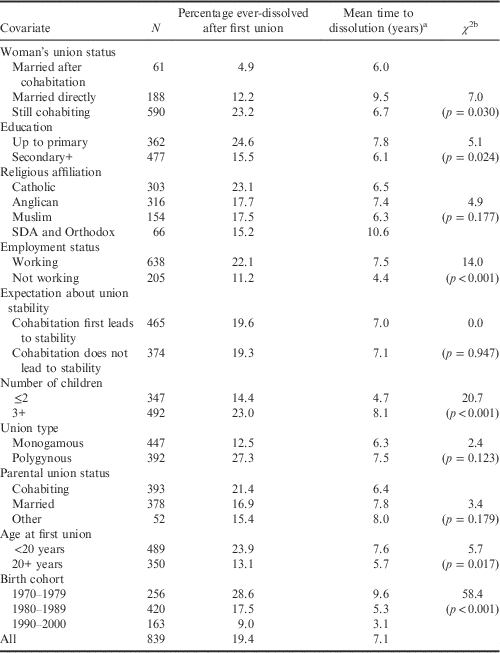
aKaplan–Meier estimates; blog rank χ 2 test.
Mean time to first union dissolution
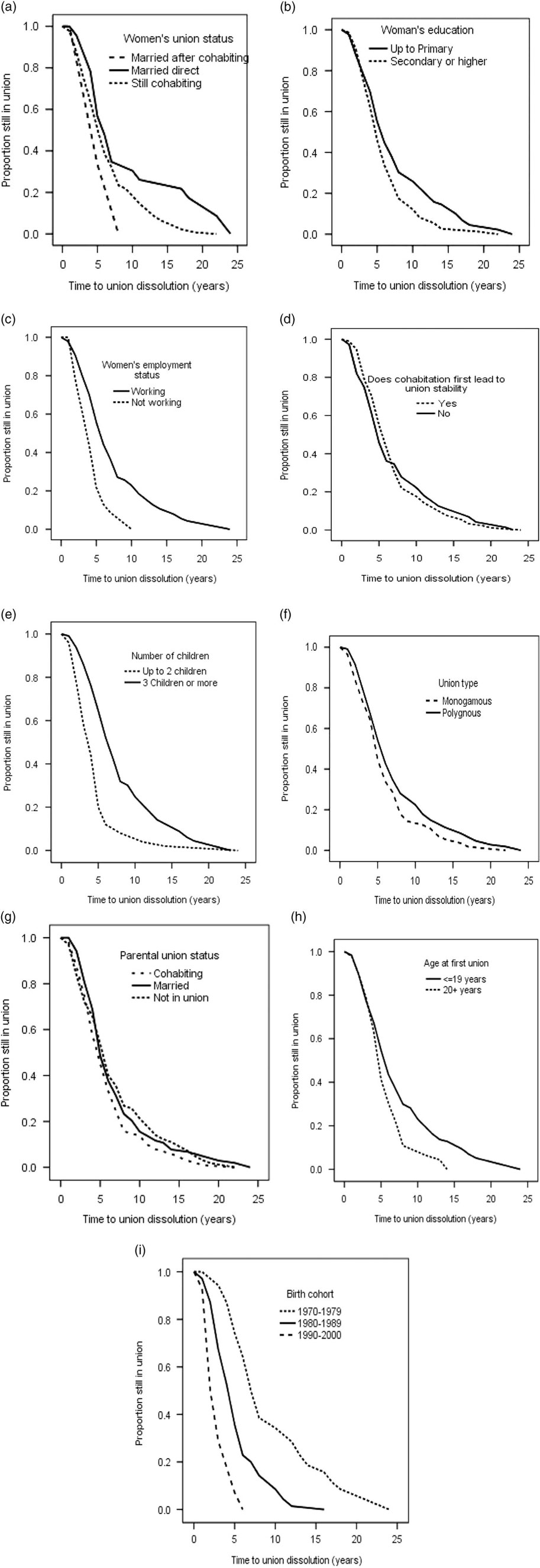
Table 1 and Fig. 1 present the Kaplan–Meier plots and estimates for woman’s union status by socio-demographic characteristics. Figure 1 shows that union dissolution started at about 3 years after first union and increased over time with an overall mean time to union dissolution of nearly 7.1 years (see Table 1). In addition, the plots partially show that the proportionality condition of the Cox regression model was observed suggesting that the data were adequate to be used. The mean time to union dissolution varied by type of union, with women who married directly, on average, spending longer in union than women who either married after cohabitation or those still at the cohabiting stage. Additionally, women who had secondary education or higher dissolved their union a year earlier than those who had primary or no education; non-working women dissolved their union 3 years earlier than working women; and women who had fewer than three children in a union dissolved their union 3 years earlier than those who had three or more children. Regarding age at first union, women who entered union while aged 20 or more years dissolved their union nearly 2 years earlier than those who entered union aged less than 20. Younger cohorts were observed to consistently spend less time in their first union. For instance, the mean time to first union dissolution was about 3 years for women born between 1990 and 2000. Corresponding figures for the 1980–1989 and 1970–1979 birth cohorts were 5.3 years and 9.6 years, respectively.
Kaplan–Meier plots showing the proportion of women still in union by selected background characteristics: a) women’s union status; b) women’s education; c) women’s employment status; d) does cohabitation first lead to union stability?; e) number of children; f) union type; g) parental union status; h) age at first union; i) birth cohort.

Union dissolution timing since first union
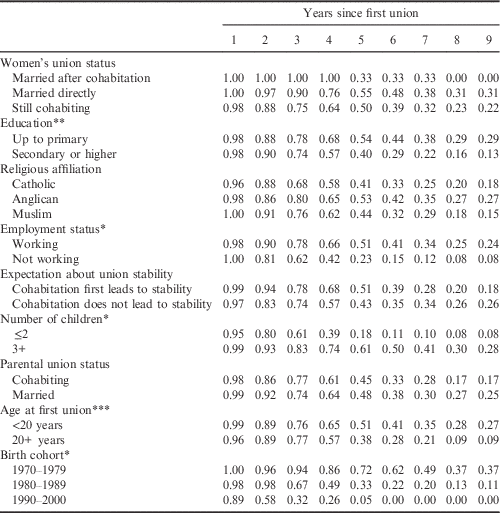
Table 2 present the lifetable estimates. The table shows that cohabiting unions are slightly more likely to be short-lived compared with direct marriage. By the third year, 25% of cohabiting couples had dissolved their union compared with 10% for women who married directly. These analyses show no evidence that the difference in union dissolution between women who married directly, married following cohabitation or who were still cohabiting converged over a 9-year period after first union (Wilcoxon–Gehan=2.535, p=0.282). These data also reinforce the view that, in general, cohabiting unions do not continue for life. The relationship between education and time to union dissolution showed a significant difference between women with less than secondary education and those with secondary education or higher. Almost 71% of all women with at least secondary education dissolved their first union by the end of the sixth year compared with 56% for women with less than secondary education (Wilcoxon–Gehan=4.319, p=0.038). Table 2 shows that 82% of Catholic women, 73% of Anglican women and 85% of Muslim women seemed to have dissolved their first union in the 9-year period after first union. With respect to employment, not working significantly accelerated the timing of first union dissolution. By the fifth year, 77% of non-working women had dissolved their first union compared with 49% of working women; and by the ninth year, the corresponding figures were 92% and 76%, respectively (Wilcoxon–Gehan=8.076, p=0.004). Table 2 also indicates that having fewer children significantly accelerated the timing of first union dissolution. By the end of the fifth year, 82% of women with up to two children had dissolved their first union compared with 39% of women who had three children or more (Wilcoxon–Gehan=28.256, p<0.001). Age at first union and the timing of union dissolution showed a weak association (Wilcoxon–Gehan=2.869, p=0.09).
Decremental lifetable estimates showing the proportion of women still in first union by selected background characteristics, central Uganda, 2013

Wilcoxon–Gehan; *p<0.001; **p<0.05; ***p<0.10.
No statistics were computed for SDA and Orthodox Christians because there were no valid cases.
Table 2 reveals that more women in union aged 20 or over dissolved their first union than those aged less than 19 years. The proportions by the end of the fifth year were 62% and 49%, respectively; and 91% and 73% respectively by the end of the ninth year. Regarding birth cohort analysis, 95% of the women born in the 1990–2000 cohort had, by the end of the fifth year, dissolved their first unions. The corresponding figures for the 1980–1989 and 1970–1979 birth cohorts were 67% and 28%. Overall, first unions for recent cohorts were short-lived and these results were highly significant (Wilcoxon–Gehan=51.533, p<0.001).
Risk factors for time to union dissolution
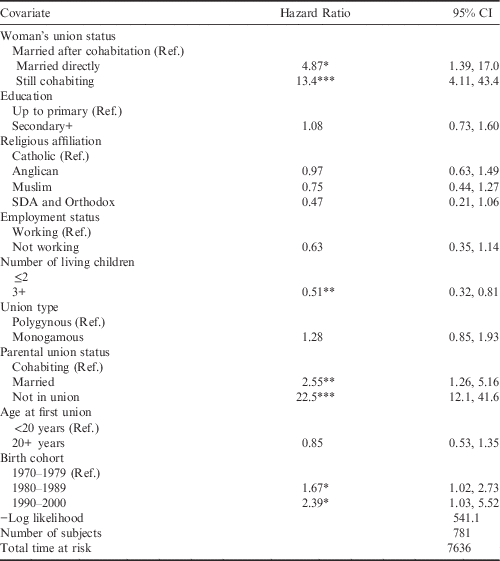
To isolate the net effect of independent variables on the survival time to first union dissolution, the results of the Cox proportional hazard model are presented in Table 3. The model shows a significant effect of woman’s first union status on union dissolution. The model shows that compared with marrying after cohabitation, marrying directly or still cohabiting significantly increased the risk of first union dissolution. Contrary to expectation, there is convincing evidence that women who married directly are about five times more likely to dissolve their first union compared with those who first cohabited and then married. This seems to contradict the Kaplan–Meier estimates. This could be due to outliers among women who married directly that were not removed from the analysis because they represented actual results and in the analysis, non-parametric methods were used.
Results of Cox proportional hazards regression showing the relative risk of time to first union dissolution by background characteristics, central Uganda, 2013
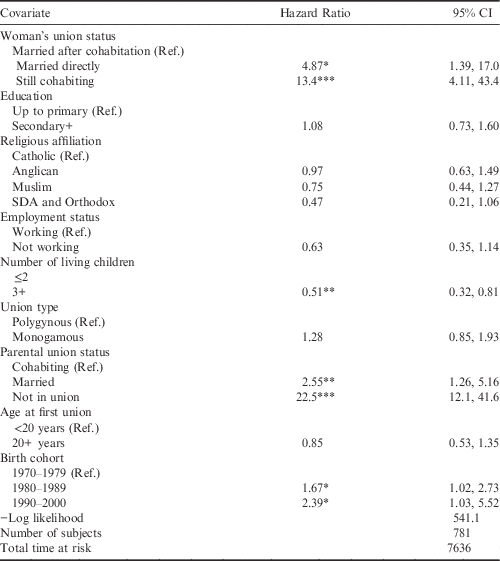
Ref., reference category.
*p<0.05, **p<0.01, ***p<0.001.
Having many children in a relationship significantly reduces the risk of dissolving a union. There was a marked decrease in the risk of dissolving a first marriage or union for women who had three or more children. Women having three children or more were significantly (49%) less likely to dissolve their first marriage or union than women who had no, one or two children. The effect of parental union status on women’s likelihood to dissolve her marriage or union was also investigated. Although being raised by parents who are married is expected to have a negative effect on dissolution of a woman’s first union because of the benefits associated with marriage that children observe while growing up, evidence from this study shows the opposite. Table 3 shows that the risk of dissolving a marriage was significantly increased by nearly 2.6 times for women who reported that their parents were married compared with women who reported that their parents were cohabiting, which is rather surprising. The increase in the risk, however, was higher for women whose parents were not in a union. It is worth mentioning that the analysis showed differentials with some inflated estimates and wide confidence intervals. This is because of the small sample size for these categories, which resulted in a small number of observed events. The effect of the small numbers is the large standard errors and thus wide confidence interval. Further investigation using a bigger sample would therefore be required to come up with a definite conclusion.
Birth cohort is another factor that affects first union dissolution. Young women were observed to have an increased risk of dissolving their first union compared with older women. For instance, women in the 1980–1989 birth cohort were 67% more likely to dissolve their first union compared to women born in the 1970–1979 cohort. The risk was significantly higher for women in the 1990–2000 birth cohort, with a 2.39 times increased risk of first union dissolution than that of women born between 1970 and 1979.
Other factors, for instance, education, religion, employment and age at first union, were found not be significant determinants of union dissolution. The results show that neither the global (0.7660) nor the detailed test (p>0.05) was significant, suggesting that the proportionality condition was observed; this is in conformity with the Kaplan–Meier curves. The specification error results demonstrate that the Cox model was well specified, as predicted by the ‘hat’ and ‘hatsq’ statistics (hat: p=0.006; hatsq: p=0.776). Because the Cox model has a time-varying variable, the overall fit of the Cox model was examined using the Cox–Snell residuals technique (Cleves et al., Reference Cleves, Gould, Gutierrez and Marchenko2010). The fitted line followed a 45 degree line beginning at the origin, which suggests that the model fitted the data well. The fitted line, however, has a kink at the end of the right-hand side. This was probably due to the small number of cases resulting from a drop in the effective sample, usually caused by prior failures and censoring.
Discussion
This study addressed two questions: Does the difference in union dissolution risk observed between women who marry directly (without first cohabiting), those who marry following cohabitation and those still at the cohabiting stage in central Uganda diverge over union duration? What other factors influence the risk of first union dissolution? The study found that women who married directly and those who were still cohabiting had an increased risk of dissolving their marriage or union compared with women who married after cohabitation. The risk was markedly higher for women who were still cohabiting, indicating that lifetime cohabitation is inherently unstable. These results are consistent with the findings of Manning and Cohen (Reference Manning and Cohen2012) in the United States, who found that premarital cohabitation was not associated with marital instability. However, the results are contrary to the hypothesis of Stanley et al. (Reference Stanley, Rhoade and Markman2006), which linked premarital cohabitation to marital instability. These results further support the notion that premarital cohabitation provides a way through which those who intend to marry get to know each other and incompatible partners are weeded out before marriage (Oppenheimer, Reference Oppenheimer1988). This could be the reason why cohabiting first before marriage has been found to be associated with a reduced risk of marital instability compared with marrying directly (Reinhold, Reference Reinhold2010).
Another explanation for the observed results could be that women who marry directly at first union usually have high expectations before marriage, and failure to realize those expectations increases the risk factors for union dissolution. Besides, such women are usually young and don’t know their husbands very well. In addition, women in this study who were still at the cohabiting stage had a sharper increase in the risk of dissolving their first union, something that is not surprising. The reason for this dissimilarity could be explained in four ways. First, cohabiting relationships are inherently unstable because they lack commitment and respect, and although they are tolerated by society they are not protected by the law; second, women who cohabit without formerly marrying are less likely to have long-term happiness and satisfaction than married women (Thomson & Colella, Reference Thomson and Colella1992); third, although in central Uganda cohabitors appear to perform similar conjugal obligations, they usually see themselves as individuals rather than couples; and fourth, whereas kin networks are important in stabilizing struggling or problematic relationships in Uganda, these networks do not work for cohabiting unions because they lack parental approval and a similar reflection was reported in the qualitative study. These results are consistent with the argument behind the ‘trial marriage’ theory, in which cohabitation filters incompatible partners (J. Brudel et al., unpublished).
Consistent with studies done in other countries, for instance Ghana (Takyi, Reference Takyi2001) and Canada (Budinski & Trovato, Reference Budinski and Trovato2005), one of the interesting substantive finding of this study is that having children in a marriage or union increases the cost of marital or union dissolution. A study conducted using 1993/94 Ghana Demographic and Health Survey (GDHS-93) data indicated that the propensity for union dissolution declined with increasing number of children (Takyi, Reference Takyi2001). This may be explained by two arguments. First, staying longer in a relationship implies that partners are likely to have many children as well as other assets. Children in a relationship are considered as marital-specific capital (Brüderl & Kalter, Reference Brüderl and Kalter2001), and therefore the accumulation of marital-specific capital and other assets increases the cost of dissolving a marriage or union thereby stabilizing unstable unions. Second, in terms of demography, this finding has implications for researchers in fertility as it may be used to explain why fertility and birth rates remain high or stalled in Uganda, at the time when fertility in other countries in the region is falling. Furthermore, these results are in conformity with the finding that a woman’s failure to produce children can contribute to union dissolution (Ntozi & Kabera, Reference Ntozi and Kabera1988).
An interesting finding in conformity with results from other studies is the significant association between parental union status and the time taken by the daughter to dissolve her marriage or union (Budinski & Trovato, Reference Budinski and Trovato2005). Compared with women whose parents were cohabiting by the time they were growing up, women whose parents were married had increased risks of marital or union breakdown. In part, the finding is contrary to what was expected of women whose parents were married. On the one hand, this sample from central Uganda suggests that reproductive pairing of individuals is a random process. Thus the situation described by social learning theory – that children model the behaviour of their parents (Manning et al., 2011) – may not be representative of women in central Uganda. It may also imply that women, being rational human beings, make choices regarding their private life despite constraints from structures – thus the possibility of behaving differently from their parents. On the other hand, having a parent not in union markedly increased the risk of union breakdown for a daughter. Furthermore, it suggests that women who experienced turbulent upbringing are affected by the inter-generational transmission of marital or union dissolution (Amato, Reference Amato1996; Wolfinger, Reference Wolfinger2001). Nonetheless, caution should be taken when generalizing this effect because the estimate seems to be inflated with wide confidence intervals. The inflated estimate is due to a small effective sample, resulting from prior failures and censoring. Thus, further investigation using a bigger effective sample size would be required in order to generalize the findings.
Women of more recent birth cohorts had significantly increased risk of dissolving first marriage or union compared with women born in earlier cohorts. The reason for this may lie in changes in the attitudes of the population over time. The study population might have been influenced by socioeconomic and cultural changes, and changes in gender roles (Otiso, Reference Otiso2006; Kuperberg, Reference Kuperberg2014). These changes could have had significant effects on the risk factors for union dissolution, which is consistent with marriage failure trends (Oheneba-Sakyi, Reference Oheneba-Sakyi1989).
There are several limitations that could be addressed in future studies when the appropriate data become available. Besides being limited to central Uganda, some variables, namely timing of union dissolution and age at first union, are usually affected by social desirability biases. Some women could have wanted to look as if they were submissive to social norms and reported themselves as being in union at a certain point when in fact they were not, thus leading to systematic biased data. Furthermore, a common problem in survival data is prior failures and censoring, which usually lead to a smaller effective sample thus resulting in inflated estimates. The study only included women and there might be a lot that is not known among males.
In summary this study used event history data and decrement lifetables to assess the relationship between direct marriage, marriage following cohabitation and still cohabiting and the timing of first union dissolution in central Uganda. The results will be useful to inform policy dialogue and formulation, given the rising trend in cohabiting unions and the ongoing debate on the Marriage and Divorce Bill of 2009 in Uganda.
Acknowledgments
The authors thank Dr Robert Wamala, Professor James Ntozi and Dr Cyprian Misinde from the School of Statistics and Planning, Makerere University, Kampala Uganda, for their very useful comments on an initial draft. The authors extend their sincere gratitude to the women who participated in the study for their co-operation. Charles Lwanga gratefully acknowledges the financial support of the Population and Health Niche Area/Focus Area of North-West University (Mafikeng Campus), South Africa, as a postgraduate student.