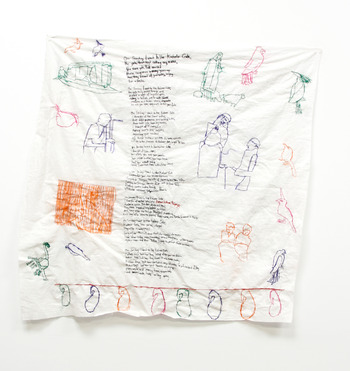
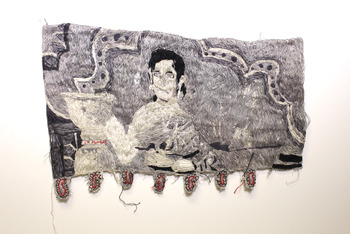
Over the past seven years, a central component of my artistic practice has been working with personal and public archives that trace transnational migration. Through figurative drawing, writing, embroidered tapestries, and – more recently – film, I illustrate and reimagine imagery and narratives from these archives and use strategies of reproduction to underscore the archive as a living object. By disrupting the perceived fixity of the archive and recovering its heterogeneity, my work reveals hierarchies of power that play out across class, gender, sexuality, caste, race, and geography. This has been illustrated through multiple intensive research projects I have explored throughout my oeuvre. One current body of work combines archival documentation on immigration and textile production in South Asia. South Asia is home to the most widely sought textiles in the modern world. These textiles have been heirlooms and community symbols for centuries – but despite these intimate histories, they also serve as material remnants of violent imperialist histories in South Asia. This is particularly true for the Kashmiri shawl. During the 18th century, French imperial fascination with the Kashmiri shawl led agents to exploit Kashmiri weavers and contributed to the decline of an otherwise lucrative trade.
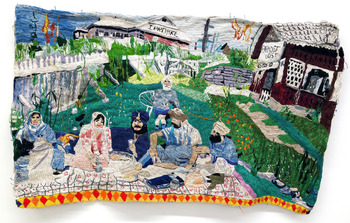
Jagdeep Raina, Distributing Langar, mixed media on paper, 2019. Photo by the artist.

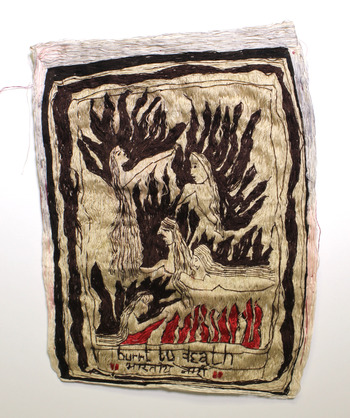
Jagdeep Raina, Burnt to Death, Living on in These Sacred Hallways of Avenue Road, embroidered tapestry on muslin, 2019. Photo by the artist.

In the present-day, while it's one of the most beautiful regions in the world, Kashmir is also home to one of the largest international boundary disputes which political pundits suggest could one day contribute to nuclear war. Yet in the midst of turmoil and decline, the Kashmiri shawl has figured as a residual remnant and artifact of South Asian history bearing the imprint of a global region and local landscape. Over the last three years, I have worked in the textile storage rooms of the Royal Ontario Museum and Minneapolis Institute of Art and, importantly, the homes of Kashmiri families, to study the historical development of Kashmiri shawls.
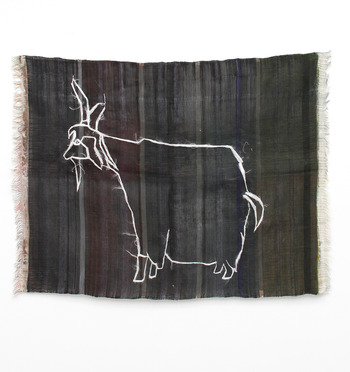
Jagdeep Raina, Pashmina Goat, woven tapestry with silk embroidery, 2020–2021. Photo by the artist.

Jagdeep Raina, Paradise Lost, Embroidered tapestry, phulkari border, 2020. Photo by the artist.

My research has occurred parallel with my study of artists who have used archival research and textiles to reproduce historical narratives. Emily Jacir's 2001 piece, Memorial to 418 Palestinian villages destroyed, depopulated and occupied by Israel in 1948 Footnote 1 – for which she sewed a large piece of fabric to reassemble a refugee tent with 418 Palestinian village names embroidered on it – has been exceptionally important for me. This work made me reconsider how to engage with traumatic historical narratives when working with textiles. In this vein, I am currently collaborating with the photographs of Nanky Rai, a physician of Kashmiri descent who has documented the militarized landscape of Kashmir – particularly the villages of Kanihama and Baramulla – from which the ancient Kashmiri shawl industry hails. Using these photographs as an entry point, I have been weaving broken twill tapestry ombre shawls. I am also drawing from traditional Kashmiri embroidery techniques to embroider a single butah (kashmiri flower) over top of the photographs that have been sewn into the shawls. The embroidered fragment can then be lifted to expose the concealed photograph of Kashmir's militarized landscape. My primary and secondary research have complimented my material skill with textiles. I hope to use this as a foundation for further engaging with the current issues with Kashmiri shawl production: the severe winters that led to the death of thousands of goats and drove up the price of yarn, the low pay being given to Kashmiri weavers driving away interest in the craft, and the market being flooded with cheap, machine-made domestic substitutes.
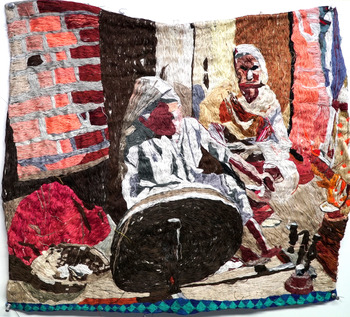
Jagdeep Raina, Remember How My Grandmother Spun Her Wooden Charkha? Remember How She Spun Your Soft, Supple Cotton Into Luxurious Thread? Embroidered tapestry, phulkari on muslin, 2020. Photo by the artist.

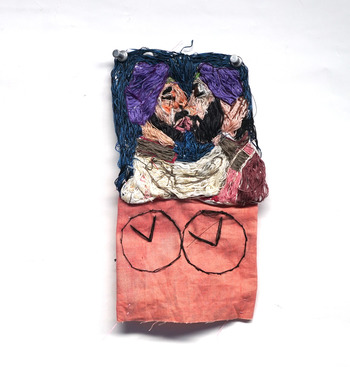
Jagdeep Raina, Two Lovers, embroidered tapestry, 2020. Photo by the artist.

My focus on the archive developed during my graduate studies at the Rhode Island School of Design (RISD). There, I thought about the potential of archival sources to map historical memory and societal transformation. I explored these ideas in my graduate seminars at RISD, which included a seminar on contemporary South Asian art with Professor Chitra Ganesh, where I studied texts related to archival studies, including Gayatri Spivak's ‘The Rani of Sirmur: An Essay in Reading the Archives.’Footnote 2 Spivak's text allowed me to learn about the archive operating as a site of fiction, particularly when understanding how the idea of India has been created. I also studied with the Raqs Media Collective, and examined the relationship between marginalia and history. These seminars not only recast questions of authenticity and history – they also made me consider the deep challenges of working with archival materials as representations of the ‘real’ in an art space. For my RISD thesis work, I drew from this archival material to create works on paper depicting historic South Asian establishments in the U.S. and Canada. These included the Punjabi Deli in New York's East Village, the former beer store-turned-Sikh temple in my hometown of Guelph, Ontario, and the industrial factories of Britain, where working-class migrant labourers birthed bhangra music: Punjabi folk remixed with hip-hop and reggae.
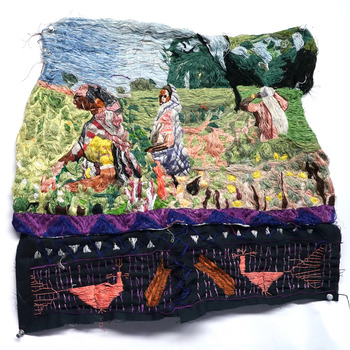
Jagdeep Raina, Let Me Taste Purple Silk Monsoons in These Bathinda Fields, embroidered tapestry phulkari border on muslin, 2020. Photo by the artist.

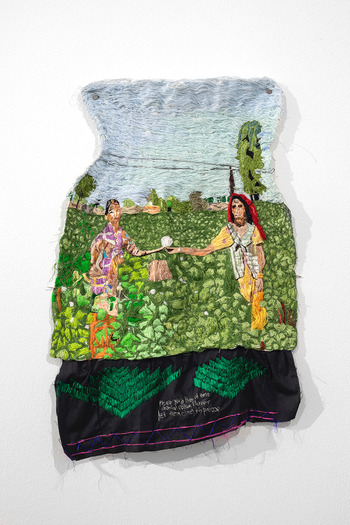
Jagdeep Raina, Chemical Cotton Flowers, embroidered tapestry, phulkari border on muslin, 2021. Photo by the artist.

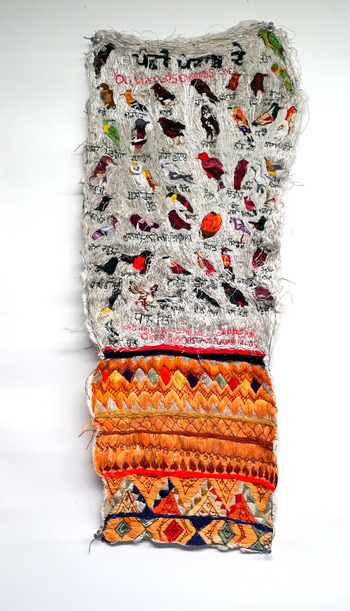
Jagdeep Raina, Moon Garden Punjabi Birds, embroidered tapestry, phulkari border on muslin, 2020. Photo by the artist.

After completing my MFA, I began a residency at the Camden Arts Centre and Slade School of Fine Art in London. During my residency, I honed my engagement with archival materials to study immigration histories. In London, I turned specifically to the databases of the Southall Black Sisters and the writings of Stuart Hall.Footnote 3 More generally, my time in London also influenced me to critically reflect on the diversity within immigrant communities and to take seriously the hierarchies of class, gender, caste, and region that exist within these very communities. To this end, I collaborated with the Southall Black Sisters in order to make drawings of homes in London that were marked by incidents of domestic violence and create embroidered tapestries to highlight the epidemic of honour killings during the 1980s. I left London realizing, as Stuart Hall tells us, ‘no identities survive the diasporic process intact and unchanged, or maintain their connections with their past undisturbed.’Footnote 4
Since graduate school, I have continued to utilize the archive to trace history and transnational migration. A recent collaboration that has utilized archival research has been an ongoing project with Satinder Chohan, a playwright based in London, on a project that explores the Green Revolution in Punjab. The Green Revolution – a U.S. sponsored agricultural framework based on high-yield seed varieties, intensive irrigation and drainage, and chemical fertilizers and pesticides – has damaged the landscape in Punjab by causing declining water tables, widespread soil erosion, low forest cover, and an epidemic of farmer suicides. David Harvey has also informed my thoughts on this project, helping me to further understand how globalization, corporate involvement in agriculture, and neoliberal policies in India has led to structures like the Green Revolution which has also led to India's rapid, uncontrolled expansion of consumption and increased pressure on natural resource exploitation. I will be drawing from Chohan's archive of the Green Revolution containing hundreds of photographs and over 20 hours of taped interviews of Punjabi farmersFootnote 5 to create a series of embroidered tapestries, animated films, and works on paper. Satinder will also create a new body of writing informed by my resurrection of her archival research.
I've once again employed archival documentation on colonialism and globalization and its effects on textile Production in South Asia to examine the history of the Phulkari. The Phulkari, woven out of hand-spun cotton and then naturally dyed, is an embroidered textile created in the villages of Punjab. Following the fall of the Empire, the relinquishing of control over India by the British and the violent upheaval of the Partition, the state of Punjab was dramatically altered, leading to the disappearance and heavy destruction of many Phulkari pieces. Globalization, the breakdown of Punjabi villages, and workplace exploitation of Punjabi women have led to difficulties in the Phulkari's renewal as a collective and collaborative form of art. Each of the tapestries created from the green revolution project has an added phulkari border.
Currently, I am working on two archival research projects. The first one has been to start thinking about the way caste, class, and labor is both reflected and repressed in the archive.
I have been working on examining the history of the 1970s and 80s farm worker movements that had engulfed the lower mainland in British Columbia, Canada. Immigrant farm workers were unionizing and protesting to fight back against the exploitative working and living conditions. I have been collaborating with the film-maker Anand Patwardhan and the photographer Craig Berggold to work with their visual documentation of the farm worker movements to create a series of works on paper, animated films, tapestries, and musical scores. I have also built an independent archive of this research myself, traveling to British Columbia twice over the summer of 2021 to photograph farm workers and conduct oral history interviews with union organizers, artists, writers and activists that had fought for the rights of farm workers and continue to be involved with human and environmental rights in British Columbia today.
I am interested in spending time doing archival research and conducting oral history interviews with taxi drivers living and working in New York City today. Drawing upon the South Asian American Digital Archive,Footnote 6 I would study the histories of this community, which is largely comprised of immigrants from South Asia, East Africa, and West Africa. Firstly, I will search for residues of the violence, racism, and hateful vitriol that immigrant taxi drivers faced following the 9/11 attacks. I will also trace patterns of taxi drivers committing suicide by examining how Wall Street-backed apps such as Uber and the soaring number of for-hire cars has created their present precarious economic circumstances. Finally, I will examine how the ongoing COVID-19 pandemic has exacerbated these drivers’ long-standing debt I would also like to study this history at NYU's Tamiment Library and the Robert F. Wagner Labor Archives, and facilitate conversations with Biju Mathew, author of Cabs and Capitalism in New York City; Vivek Bald, director of the 1992 film, Taxi Vala; and Bhairavi Desai, Executive Director of the New York Taxi Workers Alliance. From this research, I will create a series of animated films, works on paper, and hand-embroidered tapestries that render the lives of the taxi drivers and their labor with dignity and intimacy.
Finally, I have been exploring the archive through film. Set in the backdrop of a rural punjabi village devastated by the effects of globalization, a current film I am working on (entitled Charkha) tells the story of a young woman grieving the loss of her grandmother and the solace she finds through an ancient spinning wheel her grandmother left behind for her. A second short film I am working on is titled Daytimers and is set in the backdrop of Southall – a working class immigrant enclave in the outskirts of London. This film tells the story of a young woman named Henna, who finds a way of reclaiming a sense of self pride and joy by temporarily escaping the humdrum of her daily life to go dancing with her friends. In both films, I employ archival footage alongside stop motion animation, poetry, and music to tell the stories. In Charkha, I incorporate footage of Punjabi villages from the early 1920s obtained from the Davy Collection located within the Centre for South Asian Studies at Cambridge University,Footnote 7 and in Daytimers, I employed archival footage of dance clubs from the groundbreaking 1988 documentary I'm British But Footnote 8 which explores the lives of South Asians in Britain who discuss the importance of expanding “Britishness” to include all kinds of cultural identities.
Jagdeep Raina, Vale, silk and cotton embroidery on muslin, 2021. Photo by the artist.

Jagdeep Raina, Promise Me You'll Stay Beautiful, mixed media on paper, sewn into a quilt with block printed cotton fabric and embroidered silk, 2021. Photo by the artist.

Jagdeep Raina, Double Lovers, mixed media on paper, sewn into a quilt with embroidered silk, 2021. Photo by the artist.

Jagdeep Raina, In Memoriam, embroidered tapestry with kashmiri sozni on muslin, 2019. Photo by the artist.

I believe I have reached the point in my artistic practice where archival research has helped me to build a foundation for a sustained career. Archival research has allowed me to continue to rigorously pursue my independent studio practice while additionally being surrounded by colleagues, critics, and visiting artists who challenge me and help me to develop my ideas far more than if I were only working independently. Working with the archive allows me to realize the cyclical nature of history. It allows me to be a part of a never-ending environment of immersion and dialogue that brings forth new ideas that challenge and expand my current ways of thinking and modes of making as an artist and sharpens my critical mind.