

Introduction
6-Phosphomannose-isomerase (PMI) catalyses the reversible interconversion from mannose-6-phosphate to fructose-6-phosphate. When plant cells are cultured in a medium supplemented with mannose as a carbon source, mannose is phosphorylated by endogenous hexokinases to mannose-6-phosphate. However, because most plants in nature don't have the PMI gene (manA), mannose-6-phosphate in cells can't be metabolized and utilized further, and thus non-transformed cells have their growth and development arrested by carbohydrate starvation. Transformed cells that express the manA gene can therefore utilize mannose as a carbon source and survive in media containing mannose. A PMI/mannose selection system is a so-called ‘positive selection’ system (Weisser et al., Reference Weisser, Kramer and Sprenger1996).
Using manA as the selection gene in genetic transformation is considered to be bio-safe and eliminates the inhibition of differentiation and rooting of regenerated plants caused by antibiotics, such as kanamycin. ManA has been tested in a variety of crops such as apples (Degenhardt et al., Reference Degenhardt, Poppe, Montag and Szankowski2006), cotton (Yue et al., Reference Yue, Meng, Zhang, Han, Ling and Wang2005), tomatoes (Peng and Chen, Reference Peng and Chen2005) and sweet oranges (Boscariol et al., Reference Boscariol, Almeida, Derbyshire, Mourão Filho and Mendes2003).
The Xuegan sweet orange (Citrus sinensis L. Osbeck) is an important cultivar in southern China. We report here the construction of a plant expression vector with manA and the utilization in Xuegan transformation to establish a bio-safe transgenic system for the improvement of Xuegan sweet oranges.
Materials and methods
Plant materials
Epicotyl segments of in vitro germinated seedlings of Xuegan sweet oranges were used as plant materials. Preparation of seedlings was as described previously (Xu et al., Reference Xu, Luan, Zeng and Wu2007). Epicotyl stems were cut into 1 cm segments, and then were cut longitudinally into two halves to yield two explants for transformation.
Vectors
The pMD18-T vector was purchased from Takara Bio, Inc. The pGEM-T Easy Vector was brought from Promega Corporation (Beijing, China). Plasmid pZMLR14 containing manA was provided by Professor M.Q. Zhang of Fujian Agricultural and Forestry University.
Construction of pBIPMI plasmid
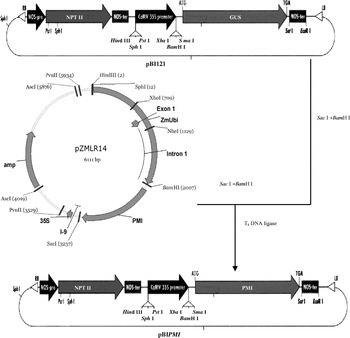
Both plasmid pZMLR14 and pBI121 were digested with SacI and BamHI. The manA fragments from pZMLR14 were purified and cloned into vector pBI121 replacing their gus gene. The expression vector pBIPMI was constructed as shown in Fig. 1.
Construction of pBIPMI.

Construction of pCAMBIA1301PMI plasmid
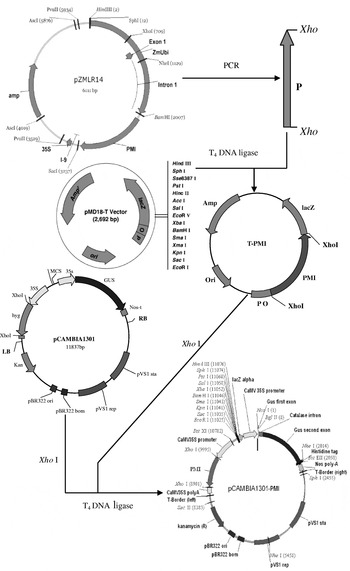
The construction of pCAMBIA1301PMI (pC1301PMI) is shown in Fig. 2. A pair of primers containing XhoI cutting sites (underlined) at 5′ ends were designed to amplify the manA gene, based on the manA sequence in GenBank:
P1: 5′-GGGCTCGAGATGCAAAAACTCATTAACT-3′;
P2: 5′-ATACTCGAGCAGCTTGTTGTAAACACGCGCTA-3′.
Then manA was subcloned into pMD18-T (T-PMI). After being digested with XhoI, the manA gene from T-PMI was cloned into vector pCAMBIA1301 which was predigested with the same restriction enzyme, and substituted for the hpt gene.
Construction of pCAMBIA1301PMI.

Identification of recombinant vectors
Recombinant vector pBIPMI was identified by SacI and BamHI double enzyme digestion. Recombinant vector pC1301PMI was digested first with XhoI to confirm the insertion of manA. The inserting orientation of manA was analysed by PCR amplification. The upstream primer was designed according to the sequence of plasmid pC1301; the downstream primer was designed according to the sequence inside the manA gene
P1: 5′-CACTATCCTTCGCAAGACCT-3′;
P2: 5′-GCAGCACGTTATCGGAGT-3′.
If the manA gene is inserted in the right orientation, a 960 bp fragment would be amplified. If the insertion was in the reverse orientation, no band would be produced.
Determination of mannose concentration for efficient selection
Epicotyl explants with the longitudinally cut surface facing upwards were placed on to a shoot-inducing medium (SIM: MS basal medium with 3 mg/l 6-benzyladenine (BA) and 7 g/l agar, pH 5.7) supplemented with seven combinations of mannose and sucrose (g/l): 0/30, 5/25,10/20,15/15, 20/10, 25/5 and 30/0, to determine the best ratio for transgenic plant selection. The number of explants with buds was determined after 30 days of culture. Thirty explants were used in each treatment, the experiment was repeated three times, and an average was calculated.
Transformation
Recombinant vectors pBIPMI and pC1301PMI were introduced into Agrobacterium tumefaciens strain EHA105 separately using the freeze-thaw method (Zeng, Reference Zeng2001). A. tumefaciens containing recombinant vector was streaked on to YEP medium (5 g/l yeast extract, 10 g/l peptone, 5 g/l NaCl and 15 g/l agar). One single colony was inoculated in YEP liquid medium supplemented with 100 mg/l kanamycin and 100 mg/l streptomycin for bacterial selection, and cultured at 28 °C, 180 rpm overnight until it reached 0.5–1.0 at OD600. The bacterial suspension was centrifuged and re-suspended in the same volume of MS liquid medium, and cultured at 28 °C, 180 rpm for 2 h again, then diluted with MS liquid medium until reaching a density of 0.5 (OD600).
Epicotyl explants of Xuegan sweet oranges were incubated with two kinds of bacterial suspension separately for 20 min, blotted dry with sterile filter paper, and placed horizontally (with the longitudinally cut surface facing upwards) on a solid co-culture medium (CM: MS basal medium with 3 mg/l BA, 1 mg/l 2,4-dichlorophenoxyacetic acid (2,4-D), 30 g/l sucrose and 7 g/l agar, pH 5.7) and kept in darkness for 3 days at 25 °C. Following co-cultivation, explants were transferred to selection medium (SM), which consisted of MS basal medium, 3 mg/l BA, 25 g/l mannose, 5 g/l sucrose, 500 mg/l cefotaxime and 7 g/l agar (pH 5.7). Cultures in SM medium were maintained under a 16/8-h (day/night) photoperiod. After 30 days, regeneration frequency was calculated. Regeneration frequency was defined as: (the total number of shoots produced/total number of explants evaluated)×100%.
Chlorophenol red and PCR assays
A chlorophenol red (CPR) assay was conducted to verify manA expression (Boscariol et al. Reference Boscariol, Almeida, Derbyshire, Mourão Filho and Mendes2003). Leaf segments of regenerated shoots (or the whole regenerated little shoot) were incubated for 4 days in the dark at 27 °C in MS liquid medium supplemented with 2.5 g/l mannose and 50 mg/l chlorophenol red, pH 6.4. Leaf segments of the Xuegan seedlings were used as a control. Evaluation was based on the colour reaction. Red or purple indicated no enzyme activity of the sample, and yellow or orange indicated PMI activity. Positive plantlet frequency was defined as: (the number of CPR-positive shoots/the total shoots evaluated)×100%. Transformation frequency was equal to: (the total number of CPR positive shoots/the total explants of transformation)×100%.
DNA of CPR-positive shoots was isolated for polymerase chain reaction (PCR) assay. A pair of primers were designed to amplify a 820 bp fragment of the manA gene:
P1: 5′-CACTGCGTGATGTGATTGAGAGTG-3′;
P2: 5′-ACTAAGGTCATGCAGCGAGAAGGC-3′.
Duncan's multiple range test was used to analyse the statistical significance of differences among treatment mean values (P=0.05).
Results
Construction of plant expression vector pBIPMI and pC1301PMI
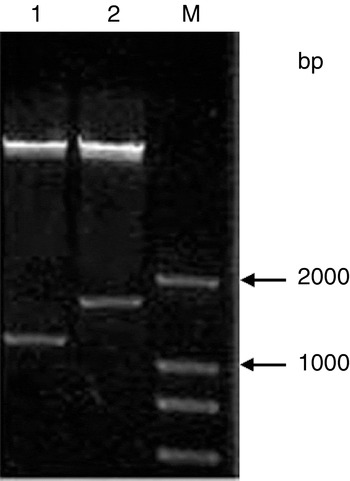
Figure 3 shows the identification results of recombinant vector pBIPMI. Digested with SacI and BamHI, pBIPMI produced an expected 1.2 kb band, illustrating manA (about 1.2 kb) has been substituted for the gus gene (about 1.8 kb).
Identification of recombinant vector pBIPMI with SacI and BamHI digestion. Lanes: M, marker; 1, recombinant plasmid pBIPMI; 2, control plasmid pBI121.

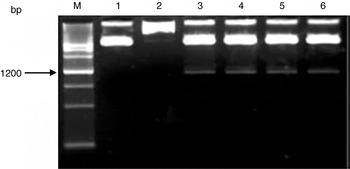
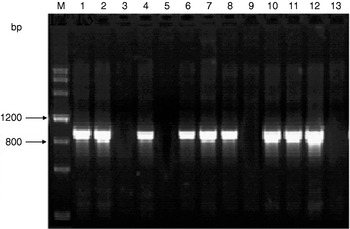
pC1301PMI was first identified to determine whether manA had been inserted in pC1301 by XhoI enzyme pattern analysis, which would produce one expected 1.2 kb band of manA gene (Fig. 4). Lanes 3–6, analysis of recombinant clones, showed the expected band, whereas lanes 1 and 2, analysis of the vector pC1301 without manA insertion, did not. Subsequently, clones with manA insertion were assayed by PCR amplification to detect the insertion orientation. As shown in Fig. 5, among the 12 clones, nine clones had the correct insertion.
Identification of recombinant vector pC1301PMI with XhoI digestion. Lanes: M, marker; 1 and 2, non-recombinant clones; 3–6, recombinant clones.

PCR analysis of recombinant vector pC1301PMI. Lanes: M, marker; 1–12, clones with manA insertion identified by XhoI digestion; 13, plasmid pC1301 (control).

Effect of mannose on organogenesis
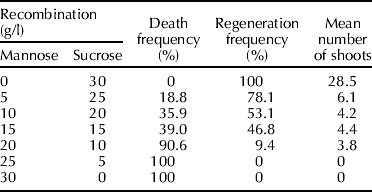
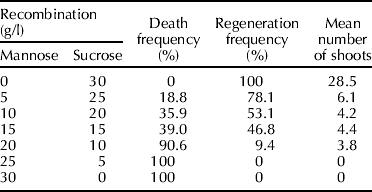
Ten days after epicotyl explants were cultured in the SIM medium without mannose, regenerated green buds were observed. Green buds also formed in the SIM medium with 5 or 10 g/l mannose, but the number was fewer. An increase in mannose concentration resulted in the inhibition of in vitro organogenesis in Xuegan epicotyl explants. Explants in the SIM medium with 15 or 20 g/l mannose began to differentiate after 20 days. After 30 days, no organogenesis was found in the medium with 25 or 30 g/l mannose and the explants turned yellow. Table 1 shows the number of regenerated plants obtained using different concentrations of mannose combined with sucrose. The combination of 25 g/l mannose with 5 g/l sucrose was selected as the carbohydrate source for transgenic plantlet selection.
Effect of different concentration combinations of mannose and sucrose on adventitious shoot induction from epicotyl explants of Xuegan sweet oranges
Transformation of Xuegan with pBIPMI and pC1301PMI
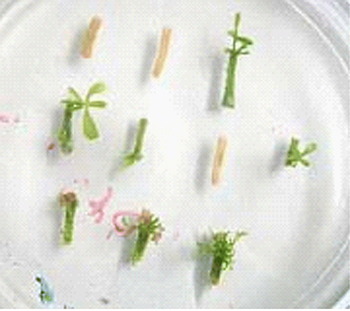
In the SM medium, most explants turned yellow gradually. Adventitious buds regenerated from the longitudinally cut surface of some explants after 10 days. Two types of regenerated shoots formed. One type comprised one or two tall shoots individually which grew quickly on one explant. Beside tall shoots, there were usually several little buds, and these little buds had difficulty growing further. The other type comprised fascicular shoots which regenerated. If fascicular shoots were separated individually to subculture in an SM medium, some of them could grow further (Fig. 6).
Adventitious shoot formation from epicotyl explants of Xuegan. (See online for a colour version of this figure.)

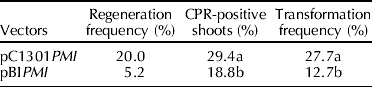
Transformation frequency was 27.7% when the Xuegan sweet orange was inoculated with EHA105/pC1301PMI and 12.7% with EHA105/pBIPMI. Comparing the two recombinant vectors, EHA105/pC1301PMI had a higher efficiency rate (Table 2). The success of transformation also indicated the correct construction of the two recombinant vectors.
Transformation of Xuegan sweet orange using recombinant vectors pBIPMI and pC1301PMI
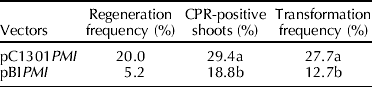
Numbers with different letters within a column were significantly different at P<0.05 according to Duncan's multiple range test.
Assays of transgenic plants
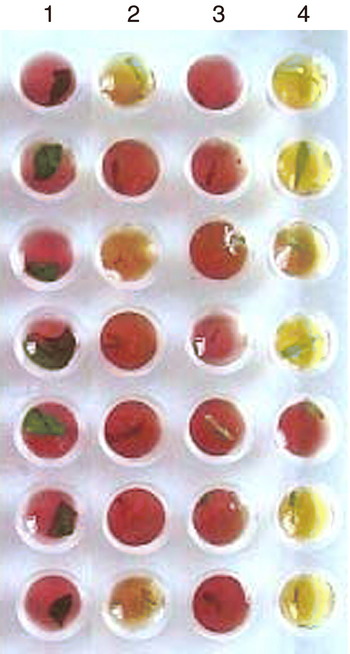
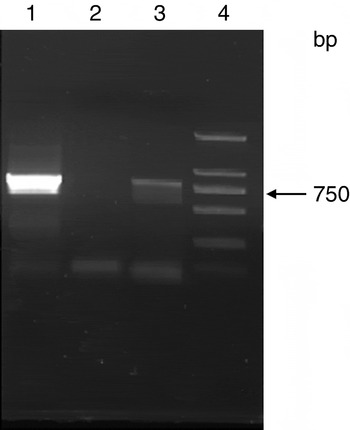
A CPR assay testing PMI activity in regenerated shoots is shown in Fig. 7. The first line is the control, where the red colour of the solution didn't change. Samples in the second line were regenerated fascicular shoots, where the colour of some turned to yellow or orange, suggesting that among fascicular shoots there existed positive shoots. Six of seven samples in the fourth line changed colour, indicating that almost all regenerated tall shoots were transformed, while in the third line, in which the samples were little buds beside the tall shoots, no colour changes were observed. Little buds were ‘escaped shoots’. The results of PCR amplification confirmed that CPR-positive shoots were transgenic shoots (Fig. 8).
CPR assay of regenerated shoots. Lines: 1, control; 2, fascicular shoots; 3, little buds beside tall shoots; 4, tall shoots. (See online for a colour version of this figure.)

PCR analysis of CPR-positive shoots. Lanes: 1, positive control; 2, negative control; 3, CPR-positive shoot; 4, marker.

Discussion
In the same A. tumefaciens strain, two recombinant vectors had different transformation efficiency. pC1301 is smaller in size than pBI121, and has more copies in A. tumefaciens, so we think pC1301PMI is more stable in A. tumefaciens than pBIPMI, which is favourable to the activity of A. tumefaciens. That is why pC1301PMI had a higher transformation efficiency than pBIPMI.
An efficient method for obtaining transgenic Xuegan sweet orange plants was developed in which positive selection based on the Escherichia coli phosphomannose-isomerase (PMI) gene as the selectable marker gene and mannose as the selective agent was used. This system provides a means of selecting transgenic plants without using antibiotics or herbicides, which is considered as bio-safe. Using this system, we recovered shoots only when the explants were cultured under a 16/8-hour (day/night) photoperiod and shoots grew by direct organogenesis without callus formation from the wound surface, which reduced the variation of regenerated plants. Our results are similar to those reported for other sweet oranges (Boscariol et al., Reference Boscariol, Almeida, Derbyshire, Mourão Filho and Mendes2003).
The assay method of CPR is simple and inexpensive. Detection using this method can screen transgenic plants in the early stages of transformation because the CPR reaction identifies not only the introduction of the PMI gene but also the expression of the gene. The difference of colour change (from yellow to orange) demonstrated the different PMI expression level, which may have been caused by differences either in the position of the insertion site or in gene copy number (Degenhardt et al., Reference Degenhardt, Poppe, Montag and Szankowski2006).
Yu et al. (Reference Yu, Huang, Chen, Deng, Ling and Gmitter2002) reported that transformation frequency was 12% on a selection medium containing kanamycin as the selective agent, using the same epicotyl segments of Xuegan cut longitudinally as explants. This transformation frequency was lower than our results. We think this is due to the character of the positive selection system. Transformed cells are easier to regenerate in a positive selection medium, so the number of transgenic plants increases. However, at the same time, mannose has weaker inhibition to non-transformed cells than antibiotics, which leads to regeneration of more fascicular shoots and increasing the number of escaped shoots. Thus, optimization of selection conditions to decrease the escapes should be studied further. Boscariol et al. (Reference Boscariol, Almeida, Derbyshire, Mourão Filho and Mendes2003) reported a similar efficiency rate of recovery of transgenic plants of four sweet oranges using the PMI/mannose selection system, compared with traditional selection methods. In those experiments, uncut epicotyl segments were used as explants. The use of longitudinally cut epicotyl explants increased regeneration frequency (Yu et al., Reference Yu, Huang, Chen, Deng, Ling and Gmitter2002). Our results demonstrate that transformation frequency of Xuegan sweet oranges can be improved by using the PMI/mannose selection system and longitudinally cut epicotyl explants.
Acknowledgements
This work was supported by the Natural Science Foundation of Fujian Province, China (B0510018) and the Scientific Research Foundation for Returned Overseas Chinese Scholars of State Education Ministry.