
Introduction
Doped manganites have been intensively investigated for decades due to their rich structural, electronic, and magnetic phase diagrams, which is a consequence of the interplay among charge, spin, orbital, and lattice degrees of freedom.[ Reference Tokura 1 ] For instance, the fascinating colossal magnetoresistance (CMR) effect is found resulting from the coexistence and competition between ferromagnetic (FM) metal and charge-ordered antiferromagnetic (AF) insulator, which produce electronic phase separation (PS) phenomenon.[ Reference Ahn, Lookman and Bishop 2 , Reference Uehara, Mori, Chen and Cheong 3 ] Apart from by controlling the doping level, ionic radii, and oxygen stoichiometry to adjust the electrical and magnetic properties of manganites,[ Reference Yan, Fan, Chen, Sun, Wei, Li, Pan and Yu 4 – Reference Santos, May, Robertson and Bhattacharya 6 ] it is a common method to induce epitaxial strain by mismatched substrates.[ Reference Tebano, Aruta, Medaglia, Tozzi, Balestrino, Sidorenko, Allodi, De Renzi, Ghiringhelli, Dallera, Braicovich and Brookes 7 – Reference Muduli, Bose and Budhani 9 ] The strain induced MnO6 octahedral distortion can result in the crystal-field splitting of the e g levels and modify the in-plane and out-of-plane orbital occupancy, leading to strong modifications in the magnetic properties.[ Reference Tebano, Aruta, Sanna, Medaglia, Balestrino, Sidorenko, De Renzi, Ghiringhelli, Braicovich, Bisogni and Brookes 10 , Reference Tokura 1 Reference Tokura 1 ]
Among the CMR materials, La1–xSrxMnO3 is one of the most widely studied systems due to its relatively high Curie temperature (T C = 360 K for x = 0.3) and high carrier spin polarization.[ Reference Majumdar and van Dijken 12 , Reference Vaz, Walker, Ahn and Ismail-Beigi 13 ] The Sr doping level at x = 0.5 is near the phase boundary of FM and AF phases, and its rich magnetic properties have been reported by many groups.[ Reference Santos, May, Robertson and Bhattacharya 6 , Reference Shi, Yang and Zhou 14 – Reference Vaz, Moyer, Arena, Ahn and Henrich 16 ] The variation and modulation of magnetic properties of La0.5Sr0.5MnO3 (LSMO) can be easily realized and could be potentially used in devices such as the width adjustable tunneling barrier in the tunneling junctions.[ Reference Jiang, Choi, Jeen, Dong, Kim, Han, Zhu, Kalinin, Dagotto and Egami 17 , Reference Yin, Burton, Kim, Borisevich, Pennycook, Yang, Noh, Gruverman, Li, Tsymbal and Li 18 ] Although the strain-induced PS and magnetic ordering have been widely investigated in La1–x Sr x MnO3 films on different substrates,[ Reference Tebano, Aruta, Medaglia, Tozzi, Balestrino, Sidorenko, Allodi, De Renzi, Ghiringhelli, Dallera, Braicovich and Brookes 7 , Reference Pesquera, Herranz, Barla, Pellegrin, Bondino, Magnano, Sánchez and Fontcuberta 8 ] the oxygen-vacancy dependence of these properties is not paid enough attention to the Sr doping level at 0.5. It has been found that the fully strained and partial relaxation state can be realized by varying the film thickness and the strained films should show very different physical properties due to the variation of interface, structure, and stoichiometry.[ Reference Aschauer, Pfenninger, Selbach, Grande and Spaldin 19 , Reference Petrie, Mitra, Jeen, Choi, Meyer, Reboredo, Freeland, Eres and Lee 20 ] Thus, it is interesting from either the fundamental or the device aspect to study the modulation of magnetic properties by oxygen vacancies in LSMO films.
In this paper, LSMO thin films with different thickness were grown on SrTiO3 (STO) substrates. We find that FM and AF phase proportion can be manipulated by Mn valence state content through the changing of oxygen vacancy, inducing the depressed magnetization and enhanced exchange bias (EB) effect in the single LSMO film with the increase of thickness. Spectroscopic as well as electrical transport measurements demonstrated that the dominant mechanism is Mn valence variation induced by oxygen vacancy.
Experiment
The LSMO thin films with different thickness were deposited on the (001) STO and LaAlO3 (LAO) substrate using a KrF excimer pulsed laser deposition from a stoichiometric LSMO target. During the deposition, the substrate was held at 800 °C with an oxygen pressure of 200 mTorr. After deposition, the samples were cooled to room temperature at a rate of 10 °C/min under 200 Torr oxygen pressure. The magnetization and magnetotransport properties were measured by superconducting quantum interference device magnetometry (SQUID, MPMS-7, Quantum Design) and physical property measurement system (PPMS-9, Quantum Design), respectively, with the magnetic field applied in-plane along the 〈100〉 azimuth of the substrate. The magnetization versus temperature (M–T) measurements were performed in the temperature range of 5–400 K during the warming process after cooling down to 5 K from room temperature with the cooling filed of 2 kOe. The magnetization versus magnetic field (M–H) curves were measured at 10 K after the same field-cooling process from room temperature. Mn 2p core-level spectra were examined by x-ray photoelectron spectrometer (XPS, ESCALAB 250Xi, Thermo Fisher Scientific, USA). Mn L-edge x-ray absorption spectroscopy (XAS) measurements were carried out at Beamline BL08U1A of the Shanghai Synchrotron Radiation Facility (SSRF). The spectra were acquired in the total electron yield mode at room temperature using linearly polarized light at the Mn L 2,3 edge (633–670 eV). The energy scale was calibrated via the reference sample MnO2, which is measured in the same condition as that of the LSMO films. The microstructures of LSMO films were carefully examined by the reciprocal space maps (RSM, Smartlab, Rigaku, Japan) and the high-resolution transmission electron microscopy (HRTEM, JEOL2011, Japan).
Results and discussion
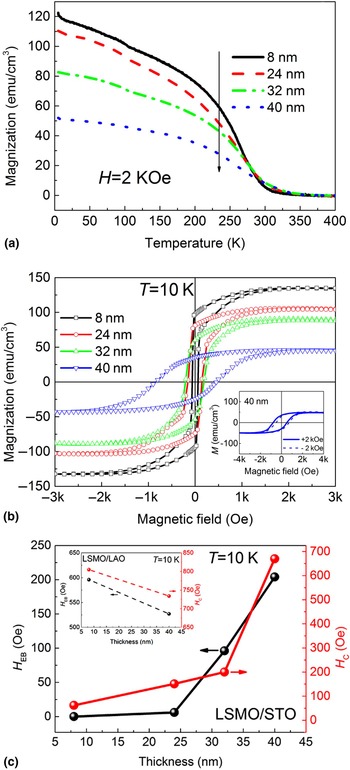
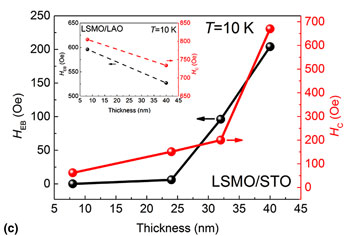
The dependence of LSMO films’ magnetization grown on the STO substrate as a function of temperature (at 2 kOe) and magnetic field (at 10 K) are shown in Figs 1(a) and 1(b), The Curie temperature (T C) of all the films are near 300 K. However, with the thickness increased, the saturation magnetization reduces apparently. The 8 nm film has the largest magnetization of ~120 emu/cm3 at 10 K, whereas the magnetization of the 40 nm film is only ~50 emu/cm3. By carefully examining the M–H loops, the 8 nm film does not exhibit the EB, while all the thicker films exhibit a shift of loop. Usually the EB field (H EB) and coercive field (H c) are defined as H EB = (H a + H b)/2 and H C = (H a–H b)/2, respectively, where H a and H b are the positive and negative magnetic fields when the magnetization is zero.[ Reference Ding, Lebedev, Turner, Tian, Hu, Seo, Panagopoulos, Prellier, Van Tendeloo and Wu 21 ] Figure 1(c) shows the thickness dependence of EB and coercivity of LSMO films; both H EB and H c get larger with the increased thickness. According to the phase diagram of La1–x Sr x MnO3, the material exhibits a mixed ground state with the FM state, AFM state, and/or charge ordering state at x = 0.5,[ Reference Patil, Bhagat, Shu, Lofland, Ogale, Smolyaninova, Zhang, Palmer, Decca, Brown, Drew, Greene, Troyanchuk and McCarroll 15 ] which are supposed to lead to the EB effect. However, the 8 nm LSMO film grown on STO in our experiment does not show the EB field.
(a) M–T curves of LSMO films with different thickness. (b) M–H loops of the LSMO films. Inset shows the M–H loops of the 40 nm film measured at 10 K after field cooling from room temperature in +2 kOe (full line) and −2 kOe (dashed line). The loop is biased in the positive direction on cooling in the presence of −2 kOe field, proves the existence of EB. (c) Thickness dependence of H C (right axis) and H EB (left axis). For comparison, inset shows H C and H EB of LSMO films grown on the LAO substrate with the thickness of 8 and 40 nm.

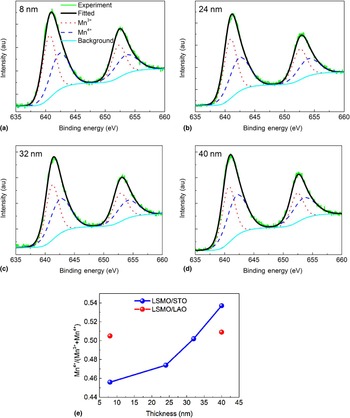
To get a further insight into the variation of magnetic properties we investigated Mn valence state by XPS and XAS. Figure 2 presents the Mn 2p core-level spectral of the films with different thickness. Multiple-peak fittings for the spectral were performed to study the Mn valence evolution.[ Reference Hishida, Ohbayashi and Saitoh 22 ] The proportion of the Mn4+/(Mn3++Mn4+) can be estimated by the areas of the Mn3+ and Mn4+ peaks, which is summarized in Fig. 2(e). For LSMO/STO films, the Mn4+/(Mn3++Mn4+) ratio remarkably changes from 0.45 to 0.54 as the film thickness increases from 8 to 40 nm, suggesting that the thickness variation has a profound effect on the distribution of Mn valence state, which can be account for the oxygen vacancies.[ Reference Peng, Song, Cui, Li, Mao, Wang, Wang and Pan 23 , Reference Zhao, Jin, Xu, Guo, Wang, Ge, Lu and Yang 24 ] As the ratio of 0.5 is very close to the FM–AF phase boundary,[ Reference Hemberger, Krimmel, Kurz, Krug von Nidda, Yu, Mukhin, Balbashov and Loidl 25 , Reference Ahn, Lookman and Bishop 2 Reference Santos, May, Robertson and Bhattacharya 6 ] the film properties are extremely sensitive to external stimuli. Using the STO substrate (lattice constant is 3.905 Å), the in-plane tensile strain for epitaxial LSMO film is 1.4%. It has been proved both theoretically and experimentally that tensile strain can reduce the oxygen-vacancy formation energy and induce oxygen non-stoichiometry.[ Reference Aschauer, Pfenninger, Selbach, Grande and Spaldin 19 , Reference Petrie, Mitra, Jeen, Choi, Meyer, Reboredo, Freeland, Eres and Lee 20 ] In addition, the STO substrate with strong oxygen diffusion coefficient will also contribute to the oxygen vacancies to the film near the STO interface.[ Reference Pasierb, Komornicki and Rekas 27 ] In this case, the oxygen vacancy induced by the tensile strain changes the Mn4+/(Mn3+ + Mn4+) ratio lower than 0.5 and drives LSMO into the adjacent FM phase in the phase diagram, so EB effect was not observed in the 8 nm film. When the film gets thicker (24 nm), the part far away from the interface will have less oxygen vacancies and may be easier oxidized during the longer growth process. This drives the film closer to the phase boundary, and small amount of the AF phase start appearing, which reduce the magnetization and lead to EB effect. Further increase the film thickness (32 and 40 nm) the upper part of the film will be at higher oxidation states and the Mn4+/(Mn3+ + Mn4+) ratio moves to 0.5 and then above, entering into the AF region and produces more AF phase. Thus, the magnetization become smaller and the coercive field and EB field become larger. To the contrast, when the LSMO film is grown on LAO substrate (lattice constant is 3.787 Å), the in-plane compressive strain for epitaxial LSMO film is −1.6%. First-principles calculations indicated that that compressive strain nearly had no net effect on oxygen-vacancy formation energy, and correspondingly had no significant effect on the oxygen non-stoichiometry of perovskite manganite.[ Reference Aschauer, Pfenninger, Selbach, Grande and Spaldin 19 , Reference Petrie, Mitra, Jeen, Choi, Meyer, Reboredo, Freeland, Eres and Lee 20 ] The inset of Figs. 1(c) and 2(e) show the representative properties of LSMO grown on the LAO substrate with the thickness of 8 and 40 nm. Different from the LSMO/STO system, the thicker LSMO film on LAO has smaller coercive field and EB field, and the Mn4+/(Mn3+ + Mn4+) ratio has negligible change, agree with the calculation.[ Reference Aschauer, Pfenninger, Selbach, Grande and Spaldin 19 ] The decreases in H C and H EB with increased thickness may come from the decreased Jahn–Teller distortions of the MnO6 octahedral induced by the gradually released compressive strain state, which is different from the changes in concentration of oxygen vacancy in LSMO/STO.
(a–d) Mn 2p spectra of LSMO films with different thickness. (e) The thickness dependence of Mn4+/(Mn3+ + Mn4+) ratio in LSMO films grown on the STO substrate. The red dots correspond to the data of LSMO films grown on the LAO substrate for comparison.

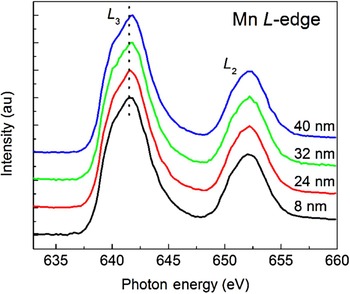
To further examine the valence state variation of Mn in LSMO/STO, the sensitive XAS at Mn L-edge, which corresponds to Mn 2p 3/2,1/2→3d resonant transition,[ Reference Balasubramanian, Melendres and Mini 28 ] is performed. The spin–orbit interaction of the Mn 2p core-hole splits the spectrum into two broad multiples generally defined as Mn L 3 edge at lower photon energy and the L 2 edge at higher photon energy.[ Reference Gao, Wang, Wu, Bao, Shen, Lin and Nan 11 ] Figure 3 shows that L 3 peak shifts toward high-energy direction by 0.2 eV with the LSMO thickness increased from 8 to 40 nm, indicating the increase of Mn valence states,[ Reference Abbate, de Groot, Fuggle, Fujimori, Strebel, Lopez, Domke, Kaindl, Sawatzky, Takano, Takeda, Eisaki and Uchida 29 ] which confirms the XPS results. Since the probing depth of both XPS and XAS measurement is about a few nanometers,[ Reference Peng, Song, Cui, Li, Mao, Wang, Wang and Pan 23 ] the variation of Mn valence with thickness means that the ratio of Mn3+ ions decreases and Mn4+ ions increases for thicker films. As the FM is favored by the double exchange (DE) between Mn3+ and Mn4+ via oxygen ions, while AF is favored by the super exchange (SE) between the Mn4+ ions, the above magnetization depression can be explained in terms of competition between Mn3+ (Jahn–Teller ion) related DE and Mn4+ (non-Jahn–Teller ion) dominated SE. The increased Mn4+ ratio with increasing film thickness can enhance the SE and suppress the DE, as a result, the magnetization decreases.
Mn L-edge XAS curves of LSMO films with different thickness.

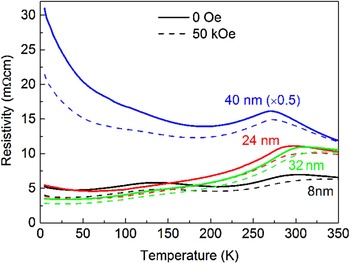
Electrical transport measurements provide another proof for above discussions. The resistivity versus temperature curves at measured magnetic field of 0 Oe and 50 kOe are presented in Fig. 4. All films exhibit a metal–insulator transition at the temperature close to the corresponding Curie temperature. The transition temperature T p decreases gradually and the films display a trend of increasing resistivity with thickness increasing. This is similar to the change with increasing of electron doping,[ Reference Santos, May, Robertson and Bhattacharya 6 , Reference Vaz, Moyer, Arena, Ahn and Henrich 16 ] and in accordance with the higher Mn4+ ratio for thicker films. Under an applied magnetic field of 50 kOe, the resistance reduces and the metal–insulator transition temperature increases for all the films due to the enhanced double exchange between the more parallel Mn3+ and Mn4+ spins.[ Reference Tokura 1 ]
Resistance versus temperature curves at measured magnetic field of 0 Oe (full lines) and 50 kOe (dashed lines) for LSMO films with different thickness. For 40 nm film, the resistivity is timed by 0.5 for clarity.

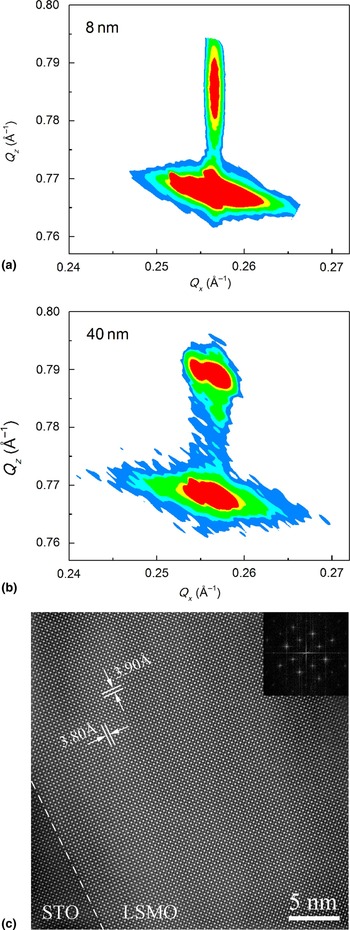
The variation of Mn valance state has a direct relation with oxygen stoichiometry change and can affect the lattice constant. RSM around the (103) Bragg reflection were performed to obtain the in-plane and out-of-plane lattice parameters of LSMO thin films. As shown in Fig. 5, for both 8 nm and 40 nm films, the diffraction spots from the film and substrate show the same in-plane scattering vector Q x but different out-of-plane scattering vector Q y . It means that the LSMO film grown on STO is still fully strained at the thickness of about 100 u.c. Fig. 5(c) shows the HRTEM image of the cross-section of the LSMO (40 nm) film grown on STO, which reveals a sharp interface and a fully epitaxial film. For LSMO, it has a high-temperature tetragonal structure and a low-temperature orthorhombic structure, and the pseudocubic lattice parameter is 3.85 Å.[ Reference Chmaissem, Dabrowski, Kolesnik, Mais, Jorgensen and Short 30 ] According to the RSM, the out-of-plane lattice parameters c result to be 3.82 and 3.80 Å for the 8 and 40 nm films, respectively. It is well known that more oxygen vacancy induces larger lattice volume.[ Reference Aschauer, Pfenninger, Selbach, Grande and Spaldin 19 ] Considering the charge neutrality, the increase of oxygen vacancy will induce the change of Mn valence state, increase the amount of larger Mn3+ (0.645 Å) and decrease the amount of smaller Mn4+ (0.53 Å). Thus, the c-axis lattice of 8 nm film is expanded compared with the 40 nm film. Therefore, it is demonstrated that tensile strain induces oxygen vacancies in the LSMO films and the vacancies decrease with film thickness increasing because of the less contribution from the STO substrate and easier oxidization. The change of O stoichiometry then inevitably modulates the Mn valance as well as the magnetic properties. The similar oxygen vacancy-induced magnetism variation has been reported previously in LaCoO3 or La0.5Sr0.5CoO3 thin films,[ Reference Aschauer, Pfenninger, Selbach, Grande and Spaldin 19 , Reference Torija, Sharma, Fitzsimmons, Varela and Leighton 31 , Reference Biskup, Salafranca, Mehta, Oxley, Suzuki, Pennycook, Pantelides and Varela 32 ] where the authors concluded that the oxygen-vacancy ordering is responsible for the electronic structure and FM state in these tensile-strained films. However, there is no obvious ordered oxygen vacancy superstructure formed in this LSMO films according to the HRTEM image [Fig. 5(c)], which indicates a different origin from the ordered superstructure.
(103) RSM of (a) 8 nm film and (b) 40 nm film, (c) HRTEM of 40 nm film, the inset shows the image Fourier transform patterns of the regions in the film and substrate.

Conclusions
In summary, we demonstrate that the epitaxial tensile strain induced oxygen non-stoichiometry has a direct influence on the Mn valence state of LSMO at half doping. Both XPS and XAS spectra suggest that with the film thickness increases from 8 to 40 nm, oxygen vacancies of the film decreases due to less contribution from the STO substrate as well as easier oxidization, and result in the increase of Mn valence, namely the change of Mn4+ ratio from below 0.5 to above. The changes in Mn valence state lead to a modulation in the magnetic ground state, from FM dominate for the thinnest film to a gradual increase of AF for the thicker films. Hence, the enhanced EB effect is observed. Our finding shows an easy way to modulate PS in the LSMO film at the phase boundary.
Acknowledgments
We thank Meng Wang for the RSM measurement and useful discussions. The authors acknowledge Beamline BL08U1A in Shanghai Synchrotron Radiation Facility (SSRF) for XAS measurements and the Center for Testing & Analyzing of Materials for technique support. This work was supported by the National Natural Science Foundation of China (Grant numbers 51332001 and 51402164) and Tsinghua University Initiative Scientific Research Program (Grant numbers 2014Z21010 and 2014Z01006).