Introduction
Vertigo is a common problem encountered in medical and otorhinolaryngological practice. Causes may be otological, neurological, medical or psychogenic. Benign paroxysmal positional vertigo (BPPV) is probably the most common cause of vestibular vertigo, accounting for approximately 31 per cent of all cases seen in dizziness clinics.Reference Philip and Prepageran1 Other causes of vertigo, in decreasing order of frequency, include recurrent vestibulopathy, Meniere's disease and central causes.
Benign paroxysmal positional vertigo is defined as an abnormal sensation of motion which is elicited by certain provocative positions. Barany first described BPPV in 1921.Reference Pearce2 In 1952, Dix and Hallpike first performed the provocative positional test named in their honour.Reference Dix and Hallpike3 In 1962, Harold Schuknecht proposed the cupulolithiasis theory (i.e. basophilic particles or densities adherent to the cupula of the posterior semicircular canal) as an explanation for BPPV. In 1980, Epley proposed that the symptoms of BPPV were due to free-moving densities (canaliths) in the posterior semicircular canal, rather than fixed densities attached to the cupula.Reference Epley4 Particles in the canal may slow or even reverse the movement of the cupula, creating new or incorrect neural signals, such that vestibular impulses are incongruous with actual head movements. This mismatch of sensory information results in the sensation of vertigo.
In 1992, Epley described a revolutionary technique for the management of BPPV, involving repositioning the patient's head in a series of manoeuvres.Reference Epley5 These manoeuvres moved the displaced particles in the posterior semicircular canal back into the utricle, resulting in resolution of symptoms.
Labyrinthine sedatives have often been used in the treatment of BPPV, with or without Epley's manoeuvre.
Our study design was based on the following rationale. The described particle repositioning manoeuvre has a very high reported cure rate.Reference Simhardi, Panda and Raghunathan6–Reference Hilton and Pinder8 Therefore, we believed it was ethically appropriate to provide all patients with this treatment. Furthermore, the treatment of BPPV with medication alone has been strongly discouraged.Reference Hain and Uddin9 However, particle repositioning manoeuvres are still not used by many clinicians.Reference Neuhauser10 Despite the condition's prevalence, considerable variation exists in the management of BPPV across different disciplines.Reference Bhattacharyya, Baugh, Orvidas, Barrs, Bronston and Cass11 Our study assessed the use of a labyrinthine sedative together with the particle repositioning manoeuvre, as there was only sparse published information on whether the addition of such medication improves the outcome of BPPV patients treated with Epley's manoeuvre.
Aim
We aimed to conduct a randomised study to compare the efficacy of Epley's manoeuvre versus Epley's manoeuvre combined with labyrinthine sedative, in the treatment of patients with BPPV.
Materials and methods
The study was approved by the Institutional Research Oversight/Ethics committee. Informed consent was obtained from all the patients prior to inclusion.
The study was conducted at Sundaram Medical Foundation, Chennai, India, a 200-bed, non-profit, teaching hospital. All patients with postural giddiness who presented to the emergency department, medical department or otorhinolaryngology department were referred for the study, for a period of six months. No prior treatment was given to these patients before referral.
Patients with BPPV often give a clear history of discrete, episodic periods of vertigo lasting one minute or less whenever the patient changes their head position relative to gravity, such as when rising from bed, rolling over in bed (onto one particular side, or both sides) or tilting the head to look upward. In the present study, BPPV was diagnosed as per published diagnostic criteria, including a positive Dix–Hallpike test.Reference Bhattacharyya, Baugh, Orvidas, Barrs, Bronston and Cass11
Patients with severe neck problems, retinal detachment, uncontrolled blood pressure or a recent history of cerebrovascular accidents were excluded from the study.
Patients were randomly assigned to one of two treatment groups, using rapid number generation.
The modified version of Epley's manoeuvre, i.e., without any pre-medication or mastoid vibration, was administered to all the patients only once.
Patients in the second treatment group were prescribed cinnarizine 25 mg thrice daily for one week, in addition to receiving a modified Epley's manoeuvre.
Standard post-procedure instructions were given to both treatment groups.
A consultant blinded to patient treatment evaluated the patients one and four weeks after treatment. Response to therapy was classified, based on the patient's symptoms (subjectively rated on a scale of 1 to 10), reported resolution (or otherwise) of vertigo, and positional nystagmus (on Dix–Hallpike testing), as follows: cured, 50 per cent improvement in symptoms, no improvement, or worsened.
Statistical analysis was performed using Stata 7.0 software. Level of probability p < 0.05 was regarded as significant.
Results
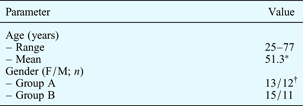
Fifty-one patients were included in the study. Twenty-five patients were treated with modified Epley's manoeuvre alone, and the remainder with Epley's manoeuvre plus labyrinthine sedative for one week. Patient demographics are shown in Table I.
Patient demographics
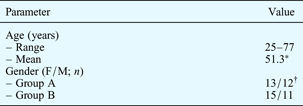
*p = 0.47, group A vs group B. †p = 0.69, group A vs group B. F = female; M = male; group A = Epley's manoeuvre; group B = Epley's manoeuvre + labyrinthine sedative
The median duration of symptoms in the total group was seven days. The duration of symptoms did not differ significantly between the groups (p = 0.19), suggesting appropriate randomisation.
In the total group, the number of previous episodes of vertigo ranged from one to 20, with a mean number of 4.85. The median number of episodes (calculated due to skewed distribution) was two. The distribution of number of previous episodes in both groups was comparable (p = 0.19), confirming that randomisation was appropriate.
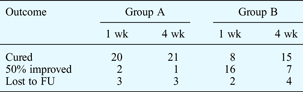
Table II shows the treatment outcomes in the two groups.
Treatment outcome
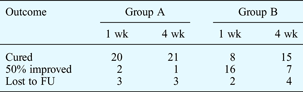
Data represent patient numbers. Group A = Epley's manoeuvre; group B = Epley's manoeuvre + labyrinthine sedative; wk = weeks; FU = follow up
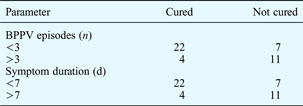
The association between the outcome at four weeks and the number of previous BPPV episodes and duration of symptoms is shown in Table III. Patients who had more than three previous episodes of BPPV, and those who had symptoms lasting more than seven days, were less likely to benefit from Epley's manoeuvre.
Four-week outcome by BPPV episodes and symptom duration
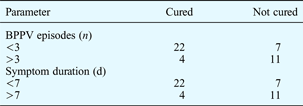
BPPV = benign paroxysmal positional vertigo; d = days
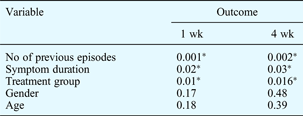
Upon univariate analysis, the variables seen to influence the outcome at one and four weeks were number of previous episodes, duration of symptoms and treatment type (Table IV). Chi-square testing indicated that treatment with modified Epley's manoeuvre alone was a much stronger predictor of improvement at one week, compared with treatment with modified Epley's manoeuvre plus labyrinthine sedative (chi-square = 14.02, p < 0.001).
Univariate analysis: variables vs outcomes
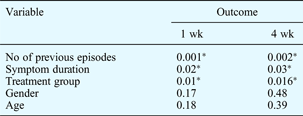
Data represent p values. *Significant at p < 0.05. Wk = weeks; no = number
Multivariate logistic regression analysis was constructed to assess the contribution of the various significant factors identified on univariate analysis. This showed that symptom duration and treatment type were significant influences on one-week outcome, while symptom duration was the only significant influence on four-week outcome.
Discussion
Our results show that, at both one and four weeks post-treatment, patients with BPPV treated with Epley's manoeuvre alone had a much higher rate of symptom resolution, compared with patients treated with Epley's manoeuvre plus labyrinthine sedative. However, the difference between the groups was less statistically significant at four weeks (chi-square = 5.8) than at one week (chi-square = 14). When the significant predictors identified by univariate analysis were subjected to multivariate logistic regression analysis, the significant factors predicting one-week outcome were symptom duration and treatment type. When the same analysis was repeated for four-week outcome, the only significant factor affecting outcome was symptom duration alone.
These results suggest that (Reference Philip and Prepageran1) Epley's manoeuvre is a very effective method for alleviating the symptoms of BPPV, and (Reference Pearce2) the use of labyrinthine sedatives in addition to Epley's manoeuvre does not improve treatment outcome.
Several reasons could explain the delay in symptom resolution in those patients treated with Epley's manoeuvre plus labyrinthine sedative, based on current knowledge of the pathophysiology of BPPV and the mechanism of action of Epley's manoeuvre and labyrinthine sedatives. Labyrinthine sedatives prolong central compensation in cases of peripheral vestibular injury, thereby delaying recovery.Reference Bhattacharyya, Baugh, Orvidas, Barrs, Bronston and Cass11 As they sedate the labyrinth, they thus attenuate the signals sent by the labyrinth to the brain, delaying the recovery process despite the particle repositioning achieved by Epley's manoeuvre.
We found that resolution of symptoms was directly related to the chronicity of illness. Our results showed that prolonged duration of symptoms (especially more than seven days) and a history of multiple previous vertigo episodes (i.e. more than three) were associated with persistence of symptoms at four weeks post-treatment. This occurred irrespective of the treatment patients received. A prolonged duration of symptoms suggests that disease may be more advanced and thus harder to treat.
None of our patients had previously undergone Epley's manoeuvre. In patients receiving this treatment alone, response was excellent. It is possible that this treatment is more useful earlier in the disease course. A poor response may indicate advanced disease or concomitant factors.
Neuhauser et al. have suggested that the incidence of BPPV is significantly greater in women and rises with age.Reference Neuhauser, von Brevern, Radtke, Lezius, Feldmann and Ziese12 However, other authors have found no association between BPPV incidence and sex or age.Reference Nunez, Cass and Furman13, Reference Korres, Balatsouras and Ferekidis14 In our study, neither age nor sex had any significant association with BPPV incidence. This could be due to either small sample size or referral bias in our centre.
Epley's manoeuvre is a relatively simple procedure which can be conducted in the clinic. Our findings indicate that this treatment should be routinely administered for the management of BPPV. In our study, a trainee ENT surgeon performed the procedure. However, it can be safely performed by primary care physicians, provided the proper sequence is followed. Training of primary care physicians in the correct performance of Epley's manoeuvre would be highly beneficial.
Study limitations
The scope of the current study was limited by several factors.
Firstly, the duration of follow up was only four weeks. Much longer follow up may have been useful to assess any recurrence of symptoms, as BPPV is an episodic disease.
Secondly, we did not include a control group receiving no treatment, although this would have provided the most appropriate comparison. However, we judged such a control group to be unnecessary, as sufficient published evidence exists to prove beyond doubt that Epley's manoeuvre is better than placebo.Reference Simhardi, Panda and Raghunathan6–Reference Hilton and Pinder8
• Epley's manoeuvre is a very effective treatment for benign paroxysmal positional vertigo (BPPV)
• The addition of a labyrinthine sedative does not improve treatment outcome
• Prolonged symptom duration (more than seven days) and multiple BPPV episodes (more than three) were independently associated with persistent BPPV
Thirdly, our results came from only one centre and may thus have been influenced by systematic bias. This possibility would have been avoided by a multi-centre study.
Conclusion
The modified Epley's manoeuvre is a very effective treatment for BPPV. It is a simple procedure which can be performed in an out-patient setting. Patient compliance is very good. The use of labyrinthine sedatives together with Epley's manoeuvre delays the recovery process. The response to Epley's manoeuvre is limited in patients with long-standing BPPV.