Introduction
A growing literature links parental wellbeing to their adult children's successes. In China, adult children are often the major source of support for older adults due to normative expectations rooted in cultural traditions (Cong and Silverstein, Reference Cong and Silverstein2012), as well as to limited government services (Feng et al., Reference Feng, Zhan, Feng, Liu, Sun and Mor2011). As such, ageing parents in China are known to benefit from adult children who achieve higher social status, given increased expectations and actual receipt of support from children (Cong and Silverstein, Reference Cong and Silverstein2014). China has traditionally been a ‘face’ (mianzi in Chinese) society, whereby adult children's achievements in social status provided psychological and social benefits to ageing parents by serving as a source of self-esteem, respect, social status and reputation (Kim and Cohen, Reference Kim and Cohen2010). However, earlier studies mostly focused on adult children's educational attainment to capture their achievements (Zimmer et al., Reference Zimmer, Martin, Ofstedal and Chuang2007; Lee, Reference Lee2018). Whether and how other dimensions of adult children's achievements (e.g. occupational and financial status) are related to ageing parents’ wellbeing in China remains underdeveloped in the literature.
The purpose of this study was to examine the association between adult children's socio-economic status (SES) achievements and ageing parents’ depressive symptoms in China. In light of the Chinese government's one-child policy (recently terminated), which had profound implications for the size and composition of ageing Chinese families, we examined whether the effect of children's achievements was different for one-child and multiple-children families. We also examined whether rural and urban residence moderated these associations.
Theoretical background
Social capital theory posits that individuals benefit from the resources of their social networks in terms of health outcomes, and empirical evidence supports this hypothesis; social capital of family members is especially important (Song and Chang, Reference Song and Chang2012). Although most studies to-date focuses on the downward transmission of parental resources to examine children's health and developmental outcomes (Grossman, Reference Grossman, Hanushek, Machin and Woessmann2006; Currie, Reference Currie2009), researchers are increasingly paying attention to the upward spillover effect of adult children's SES achievements for their ageing parents’ wellbeing. Children's SES may be associated with parents’ health and wellbeing through different mechanisms. First, adult children with higher SES may (a) offer more instrumental support to their older parents, (b) help to reduce parents’ exposure to stress, (c) provide health-related advice, and (d) facilitate better access to health services (Lee, Reference Lee2018). Second, parents often view their children as an extension of their own lives and consider children's successes as their own achievements, and also consider children's problems as their own failures (Ryff et al., Reference Ryff, Lee, Essex and Schmutte1994; Chung and Park, Reference Chung and Park2008; Levitzki, Reference Levitzki2009). As such, parents are likely to experience ambivalent feelings, disappointment and embarrassment when their adult children are deemed not successful in terms of SES attainments (Cichy et al., Reference Cichy, Lefkowitz, Davis and Fingerman2013), which in turn negatively influences parents’ psychological wellbeing (Greenfield and Marks, Reference Greenfield and Marks2006).
Findings based on studies in Western societies suggested that adult children's SES may be a protective factor for parents’ physical functioning (Yahirun et al., Reference Yahirun, Sheehan and Hayward2017), depressive symptoms (Yahirun et al., Reference Yahirun, Sheehan and Mossakowski2020) and mortality (Torssander, Reference Torssander2013; De Neve and Fink, Reference De Neve and Fink2018). However, this topic has garnered relatively limited attention in the context of Asian countries, where interdependence among family members is strongly emphasised. In general, few existing Asian studies have focused on children's education attainments and parental mortality (Zimmer et al., Reference Zimmer, Martin, Ofstedal and Chuang2007; Yang et al., Reference Yang, Martikainen and Silventoinen2016; Jiang, Reference Jiang2019).
Adult children's achievements and parents’ psychological wellbeing in China
Unlike older adults in developed countries, Chinese older adults generally depend on their adult children for social support. This is in part due to a lack of national and community-based formal support programmes for older adults, and in part, to children's filial obligations to provide support to their parents (Pei and Tang, Reference Pei, Tang, Chen and Powell2012). As a result, adult children's achievements are particularly important for Chinese older parents’ wellbeing because children's resources from their SES achievements may serve as an important safety net for older parents’ elder-care needs.
Culturally, Chinese parents’ psychological wellbeing is closely related to ‘face’ (mianzi), which is understood as ‘the respectability and/or deference which a person can claim for himself [or herself] from others by virtue of [his or her] relative position in a hierarchy’ (Ho, Reference Ho1976: 883). Face is garnered by other persons’ assessment about and reaction to the fulfilment of societal expectations regarding adult children's achievements (Kim et al., Reference Kim, Cohen and Au2010). Children's failure to achieve higher SES not only undermines parents’ normative expectations for children's care-giving obligations, but such failures may also result in their parents ‘losing face’, in part because they blame themselves for such perceived failures. In contrast, parents ‘gain face’ when adult children achieve higher SES than their peers.
The role of family structure: one-child versus multiple-children families
Research has underscored the complexity of parent–child ties within the family context, emphasising the importance of variation in relationship quality and outcomes across multiple children (Ward, Reference Ward2008; Suitor et al., Reference Suitor, Gilligan, Pillemer, Fingerman, Kim, Silverstein and Bengtson2018). Family size has important implications for children's achievements, and the likelihood of having at least one successful child and the total number of children's achievements are also likely to be greater in larger families. One study in the United States of America (USA) found that the implications of children's successes and problems for parental wellbeing did not vary by the number of children present in the family (Fingerman et al., Reference Fingerman, Cheng, Birditt and Zarit2012). Yet it remains unknown whether family size influences the association between children's achievements and older parents’ psychological wellbeing in China.
Regarding the upward spillover effect from children's achievements for parents’ health, most studies focused on educational attainment of a specific adult child (e.g. the oldest child in the family) or examined average levels of education across all adult children. In China, rapid changes in social and economic circumstances, including fertility policies, rapid economic growth and massive rural to urban migration, led to dramatic changes in family structure and living arrangements, as well as changes in intergenerational family dynamics, ultimately impacting expectations for adult children's achievements and parental support (Du, Reference Du2013). While older parents with an only child may focus singularly on their intergenerational relationships and support expectations, older parents with multiple children may experience different relationships with each child, as well as variability in support expectations across all children. For these parents, their wellbeing may depend on a specific child's achievements, or on a mixture of multiple children's achievements (Fingerman et al., Reference Fingerman, Cheng, Birditt and Zarit2012).
Traditionally, Chinese parents viewed having multiple children as ‘the more the merrier’ because adult children were expected to provide resources for extended family members. Having multiple adult children and grandchildren has been one of the most important factors for older adults’ psychological wellbeing (Chyi and Mao, Reference Chyi and Mao2012). For multiple-children families, the achievement of any child was considered to be beneficial for everyone in the family, including parents and siblings, which is captured in the Chinese saying ‘when a man gets to the top, all friends and relations get there with him’.
On the other hand, ageing families with only one child have different opportunities and challenges with respect to the adult child's achievements. Estimates indicate there are about 150 million families in China with only one child, accounting for more than one-third of all families (Feng et al., Reference Feng, Cai and Gu2013). Although the one-child policy has been officially terminated, the implications for one-child families, including intergenerational relations and social support, are long-lasting. Studies show that Chinese parents with a singleton child invested more in that child's development, especially in education, than Chinese parents with multiple children (Zhu et al., Reference Zhu, Whalley and Zhao2014). Accordingly, children from one-child families have increased chances of receiving both financial and instrumental support from their parents than their counterparts from multiple-child families (Chen and Jordan, Reference Chen and Jordan2018). For parents with one child, their wellbeing largely depends on that child's achievements (Deutsch, Reference Deutsch2006). Further, as the first cohort of singleton children enter the middle-age phase of the lifecourse, they face daunting care-giving burdens. In some cases, these adult children assume the care-giver role for two parents and four grandparents. When there is no sibling to share care-giving obligations, it is crucial for adult children to succeed, especially in terms of SES, to ensure that care can be provided to ageing family members.
The rural and urban context
One of the factors that makes China a special case for examining children's achievements for parents’ wellbeing is the context associated with living in rural versus urban areas. Access to formal support systems, such as health-care and pension systems, is more limited in rural areas (Feng et al., Reference Feng, Zhan, Feng, Liu, Sun and Mor2011). Filial piety, the traditional norm regarding children's responsibility for providing care to their older parents, frames expectations regarding intergenerational relationships. Traditionally, filial piety, especially among sons, is expressed in part by their obligations to care for older parents, including combining households, and to ensure old-age support more generally, including through emotional and financial support (Zhan, Reference Zhan2004; Chappell and Kusch, Reference Chappell and Kusch2007). Although the ideology and practices associated with filial piety have been changing over time, filial piety norms are less eroded in rural areas as compared to urban areas (Du, Reference Du2013). Therefore, rural parents are more reliant on their children for care and assistance (Cheung and Kwan, Reference Cheung and Kwan2009); ageing parents living in rural areas may expect their children to achieve higher SES so that children can provide support in times of need.
Although older urban parents are less reliant on children for care, when needed, their children's life circumstances may be closely related to parents’ wellbeing in urban areas. Compared to rural parents, urban parents tend to invest more in their children's development and provide more opportunities for their children to succeed in terms of SES (Golley and Kong, Reference Golley and Kong2013). The achievements of their adult children may be particularly important for maintaining their wellbeing in terms of ‘face’ than rural parents, with attendant psychological wellbeing implications. Thus, children's achievements are expected to improve parents’ psychological wellbeing in both rural and urban areas. However, there is still no evidence or specific expectation regarding whether rural or urban parents would benefit more from their children's achievements.
The current study
This study examined the association between adult children's achievements and ageing parents’ depressive symptoms in the context of one-child and multiple-children families living in rural and urban China. To capture adult children's achievements, we considered three indictors of adult children's SES achievements, including education, occupation status and financial characteristics (Wu and Penning, Reference Wu and Penning2019). As in previous studies of multiple-children families, there may be both an exposure effect and a cumulative effect of children's achievements for parents’ wellbeing; one successful child (exposure) may be sufficient to enhance parents’ psychological wellbeing, and more achievements (cumulative) may also bring better psychological wellbeing for ageing parents (Fingerman et al., Reference Fingerman, Cheng, Birditt and Zarit2012). Thus, we evaluated the presence of one child attaining any achievement along with the total number of achievements across all children in the family in this study. We addressed the following research questions and hypotheses:
(1) Is there an association between adult children's achievements and depressive symptoms among older parents? We hypothesised that any achievement of adult children would be associated with fewer depressive symptoms of older parents (i.e. for parents with one child, whether the child had at least one achievement; for parents with multiple children, whether at least one child had an achievement).
(2) Is there an association between the number of adult children's achievements and depressive symptoms among older parents? We hypothesised that older parents would have fewer depressive symptoms when their children had more achievements.
(3) Does the association between children's achievements and older parents’ depressive symptoms vary by family type and rural–urban residence? We hypothesised that adult children's achievements would be more important in terms of depressive symptoms when the parent was part of a one-child family compared to parents in multiple-children families. However, we did not have a specific hypothesis regarding whether rural or urban parents would benefit more from children's achievements in terms of depressive symptoms.
Methods
Data and sample
We examined data from the first wave of the China Longitudinal Ageing Social Survey (CLASS), a nationally representative survey covering a variety of social, health and economic issues about the Chinese older population. The survey was conducted by Renmin University of China in 2014 and interviewed 11,511 respondents aged 60 years and older living in 462 villages and communities. Our analysis included respondents who had at least one adult child (N = 11,345; 116 respondents reported no living children). Respondents who provided two or more incorrect answers on a cognition screening test were excluded from the study by the Renmin University survey team (N = 2,895). The final study sample consisted of 8,450 older adult parents (aged 60–113), including 6,816 older adults with multiple children (80.7%) and 1,634 older adults with only one child (19.3%). Respondents provided demographic and relationship information for up to five of their adult children (child N = 22,738). This strategy accounted for 97 per cent of all respondents’ living children, as only 411 respondents had more than five children. The influence of younger children who may have been less likely to have reached markers of SES achievement as operationalised in this study was minimal, as only about 1 per cent of children in the study were under the age 25 (N = 253; mean age of adult children in the sample = 43.02).
Measures
Children's SES achievements
Respondents reported the SES achievements for each of their first five children with three indicators: parent's perception of child's financial status (1 = wealthy, 0 = not wealthy), educational attainment (1 = college or above, 0 = less than college) and occupational status (1 = managerial or professional occupation, 0 = office worker, employee, self-employed, agriculture or unemployed), where managerial or professional occupations are assumed to have more prestige than the others (Wu and Penning, Reference Wu and Penning2019). Income information for adult children was not available in the CLASS. We considered the presence of each of achievement indicators (any) and calculated the sum of three achievement indicators (total number), respectively.
Parents’ depressive symptoms
We assessed parents’ depressive symptoms using a nine-item version of the Center for Epidemiological Studies Depression (CES-D) Scale adapted for the Chinese context (Zimmer et al., Reference Zimmer, Natividad, Ofstedal, Lin and Hermalin2002), which included items such as ‘Did you feel lonely last week?’ and ‘Did you feel it hard to sleep well last week?’ Responses were based on a three-point scale (1 = no, 2 = sometimes, 3 = yes). A depressive symptom score was created by summing responses across the nine items (range = 9–27; α = 0.76).
Rural–urban residence
Rural versus urban residence was identified based on zip code information recorded by interviewers in the primary survey unit file at the community level; that is, whether the region is rural or urban was defined by National Bureau of Statistics of the People's Republic of China (1 = rural, 0 = urban).
Covariates
We included covariates known to be associated with depressive symptoms and which were potential confounders with respect to the relationship between children's achievements and parents’ wellbeing. Parent characteristics included age (in years, centred at the mean), gender (1 = female, 0 = male), education (1 = illiterate/no formal education, 2 = elementary school, 3 = middle school, 4 = high school and above), occupation (1 = unemployed, 2 = farmer or fisherman, 3 = worker, 4 = manager, leader or specialist), annual income (in yuan, transformed by the natural log, centred at the mean), self-rated health (1 = unhealthy or very unhealthy, 0 = very healthy or healthy) and activities of daily living (ADL) limitations (summed across six items including dressing, bathing, eating, using the lavatory, getting out of bed and walking indoors; range = 0–6). We also controlled for several family-level characteristics, including number of adult children (for multiple-children families only) and gender composition of adult children (for multiple-children families, 1 = both sons and daughters, 2 = only sons, 3 = only daughters; for one-child families, 1 = had a son, 0 = had a daughter). Parent–child emotional closeness was rated at 1 = very close and 0 = not close at all or somewhat close (for parents with multiple children, we created a binary measure for emotional closeness across all children; 1 = having at least one very close child, 0 = not having a very close child).
Analytic strategy
We first examined differences in characteristics between respondents with multiple children and those with one child. We also assessed the distribution of adult children's achievements for one-child families and multiple-children families. All the statistical analyses were based on respondent sampling weight information calculated by CLASS.
Because of the multi-stage stratified sampling design of CLASS, 8,450 respondents were nested within 486 urban communities and rural villages. The intra-class correlation coefficients for parents’ depressive symptoms (from empty two-level models) revealed that 11 and 34 per cent of the variance in parental depressive symptoms reflected between-community differences (i.e. within-community similarity) for multiple-children families and one-child families, respectively. We used multilevel models to account for the nested structure of data and estimated robust standard errors.
To examine the association of adult children's achievements with parents’ depressive symptoms (Hypotheses 1 and 2), we estimated multilevel linear regression models. All models were estimated separately by family type (i.e. multiple-children versus one-child family). For families with multiple children, we considered both the presence of at least one child with any achievement and the total number of children's achievements. We controlled for parent characteristics (i.e. age, gender, marital status, education, occupation, annual income, rural/urban residence, self-rated health and ADL limitations) and family characteristics (i.e. the number of children, children's gender composition and emotional closeness). For one-child families, we considered whether the child had any achievement and the total number of achievements of the child. We also controlled for parent characteristics, as in previous models, along with family characteristics (i.e. child gender and emotional closeness).
Next, we estimated models with the full sample to determine whether family type and rural–urban residence moderated the associations between adult children's achievements and parents’ depressive symptoms (Hypothesis 3). In the full sample, we included the interaction terms for children's achievements (any achievement and total number of achievements) by family type (i.e. multiple-children versus one-child family), as well as interaction terms by residence (i.e. rural versus urban). Models included parents’ characteristics as in previous models and parent–child closeness as a family characteristic.
In our analytic sample, 89 per cent of respondents had complete data for all analytic variables. Missing data were imputed using the Multiple Imputation by Chained Equations (MICE; Schafer, Reference Schafer1997). MICE enhanced the final sample size and protected against potential bias from the use of a listwise deletion of missing cases (Johnson and Young, Reference Johnson and Young2011). A total of ten imputed datasets were created and analysed in Stata version 16.
Results
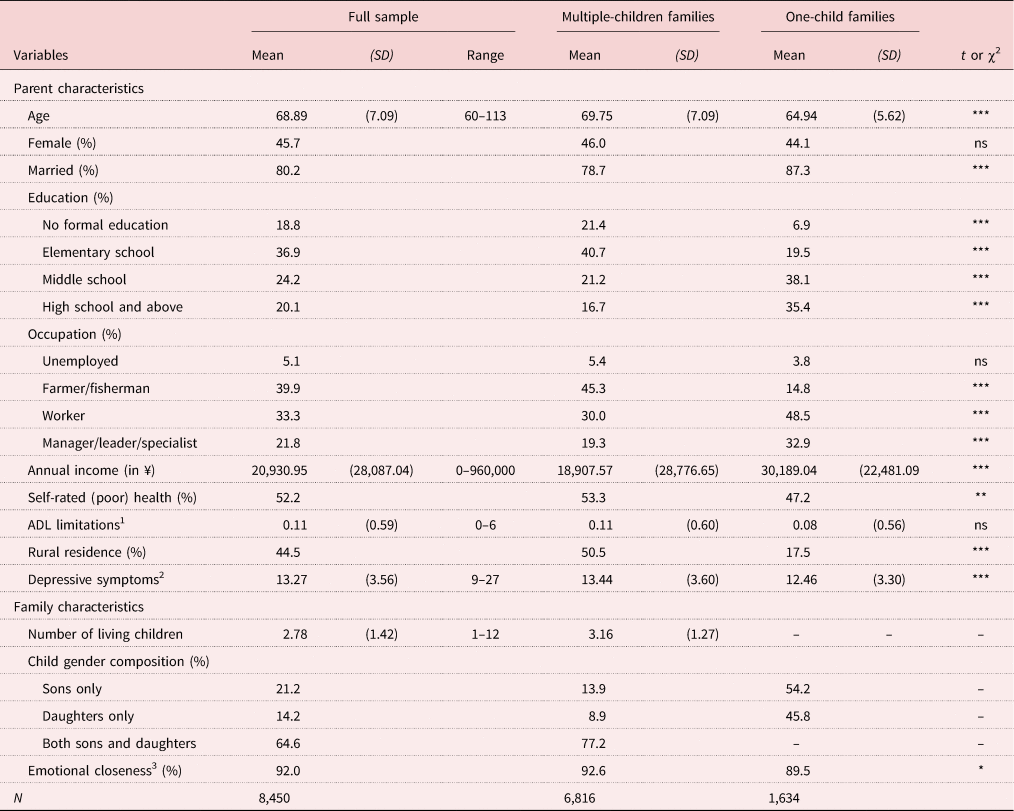
Weighted descriptive characteristics for the full CLASS study sample and bivariate analyses for the sample stratified by family type are presented in Table 1. Older parents with multiple children reported more depressive symptoms compared to their counterparts with only one child. Older parents with multiple children had lower education and income, and were more likely to live in rural areas. They also had poorer self-rated health compared to parents with only one child. In addition, older parents with multiple children were older and less likely to be married compared to one-child parents.
Characteristics of the study sample by family type

Notes: Statistics based on weighted data. SD: standard deviation. ADL: activities of daily living. 1Sum of six ADL items. 2Sum of nine items rated 1 = no, 2 = sometimes, 3 = yes. 31 = had at least one very close child, 0 = did not have a very close child.
Significance levels: *p < 0.05, **p < 0.01, ***p < 0.001. ns: not significant.
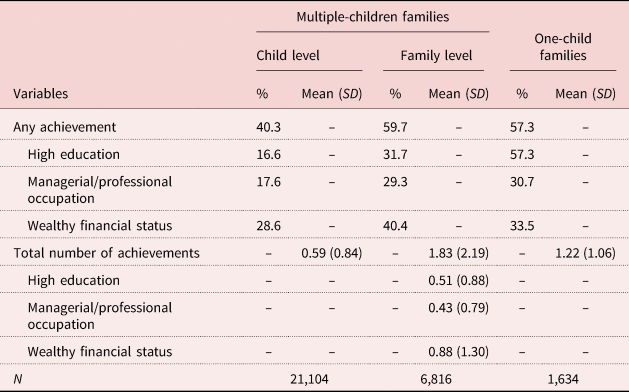
Older Chinese parents’ reports of their adult children's achievements by family type are presented in Table 2. Approximately 57.3 per cent of older Chinese parents with one child reported that their child had at least one SES achievement as defined in this study, whereas about 59.7 per cent of older parents with multiple children reported having at least one child with an achievement. As expected, the total number of achievements summed across all SES indicators was greater for multiple-children families, compared to one-child families (1.83 versus 1.22). When measured at the child level, the average number of achievements was lower (0.59 versus 1.22) for adult children from multiple-children families, as compared to adult children from one-child families.
Adult children's achievements by family type

Notes: Parent (respondent) N = 8,450 (child N = 22,738). Each achievement indicator was coded 1 = yes, 0 = no. SD: standard deviation.
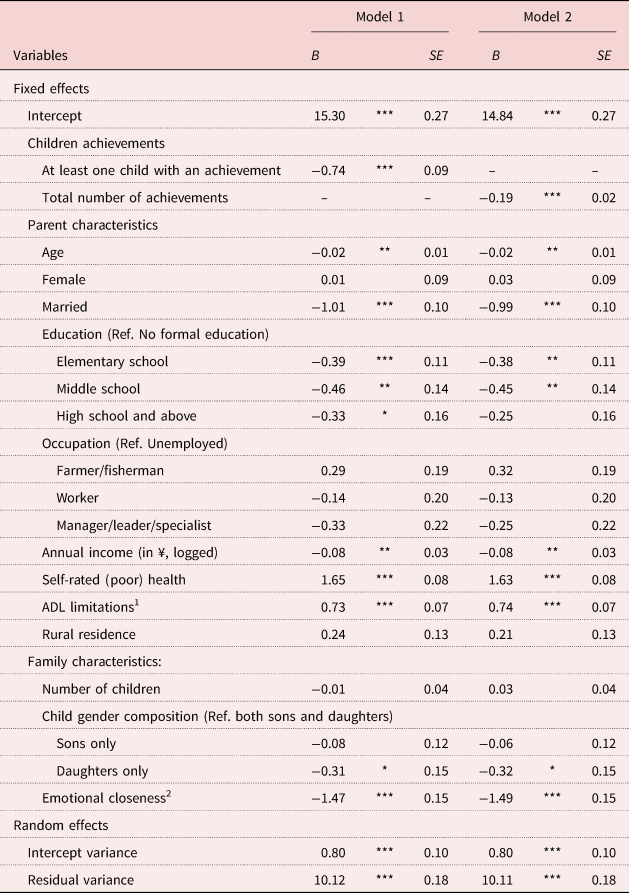
Results from multilevel models for depressive symptoms of older Chinese parents with multiple children are presented in Table 3. Having at least one child with an achievement was associated with fewer depressive symptoms (B = −0.74, p < 0.001), compared to not having any such child. The total number of children's achievements was also associated with fewer depressive symptoms (B = −0.19, p < 0.001).
Multilevel model results for depressive symptoms among older Chinese parents with multiple children

Notes: Parent (respondent) N = 6,816; community N = 462. SE: standard error. Ref.: reference category. ADL: activities of daily living.
1Sum of six ADL items. 21 = had at least one very close child, 0 = did not have a very close child.
Significance levels: *p < 0.05, **p < 0.01, ***p < 0.001.
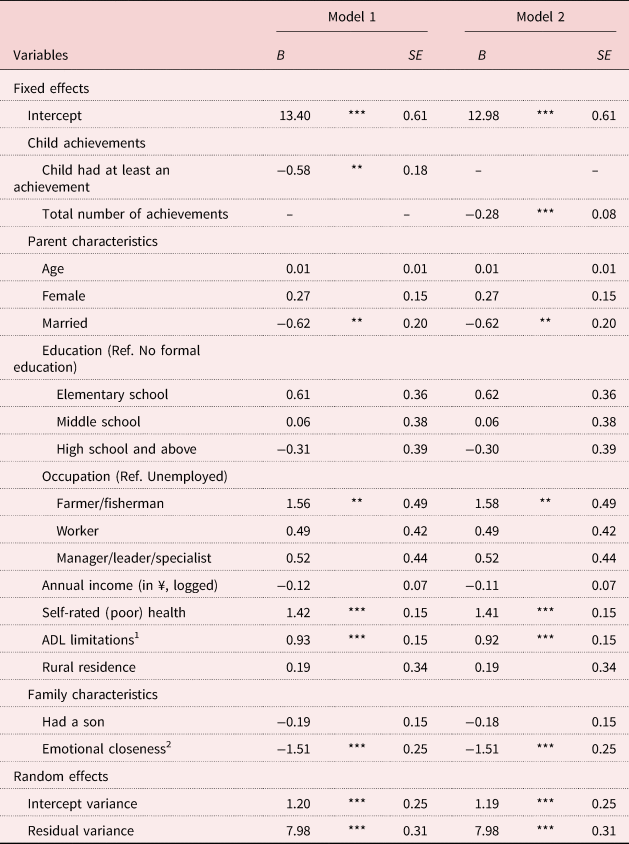
Results for the one-child families are presented in Table 4. Having a child with an achievement was associated with fewer depressive symptoms (B = −0.58, p < 0.01). Further, older adults whose child had more achievements reported fewer depressive symptoms (B = −0.28, p < 0.001) compared to their counterparts whose child had fewer SES achievements.
Multilevel model results for depressive symptoms among older Chinese parents with one child

Notes: Parent (respondent) N = 1,634; community N = 342. SE: standard error. Ref.: reference category. ADL: activities of daily living.
1Sum of six ADL items. 21 = very close, 0 = not close at all or somewhat close.
Significance levels: **p < 0.01, ***p < 0.001.
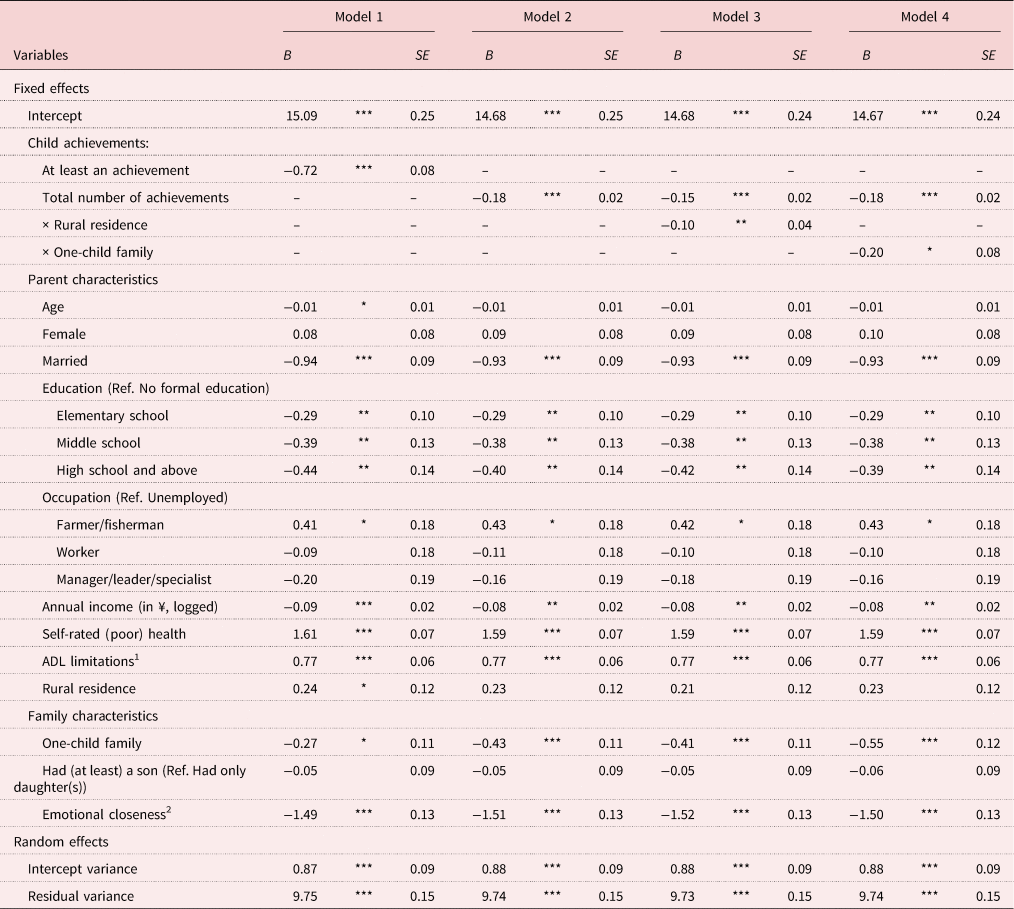
Next, we estimated multilevel models to examine how family type and rural–urban residence moderated the association between children's achievements and parents’ depressive symptoms in the full sample (Table 5). First, having a child with any achievement (B = −0.72, p < 0.001) and the total number of children's achievements (B = −0.18, p < 0.001) were associated with fewer depressive symptoms among older parents (Models 1 and 2). Next, we tested four interaction terms of children's achievements (i.e. any achievement and total number of achievements) by family type and rural–urban residence in the fully adjusted models. The findings showed that the negative association between the total number of children's achievements and depressive symptoms was more pronounced for parents living in rural areas than urban parents (Model 3; B = −0.10, p < 0.01) and for parents from one-child families compared to parents with multiple children (Model 4; B = −0.20, p < 0.05). Thus, having more child achievements was more important for parents with one child and parents who were residing in rural areas. However, we found no significant difference in the association between the presence of children's achievements and parents’ depressive symptoms by family type or rural–urban residence (not shown in the table).
Multilevel model results for depressive symptoms among older Chinese parents in the full sample

Notes: Parent (respondent) N = 8,450; community N = 462. Ref.: reference category. ADL: activities of daily living.
1Sum of six ADL items. 21 = had at least one very close child, 0 = did not have a very close child.
Significance levels: *p < 0.05, **p < 0.01, ***p < 0.001.
We also engaged in post hoc analyses where we investigated the role of family size by including the interaction terms (i.e. number of children × total number of children's achievements; number of children × any achievement from children) for older parents with multiple children. Results showed that associations between children's achievements (any achievement and total number of achievements) and parental depressive symptoms did not vary by the number of children present in multiple-children families. Moreover, we conducted sensitivity analyses by creating binary measures of depressive symptoms (0 = not depressed, 1 = depressed) at thresholds of 12 (median) and 16 (75% percentile). Results from the binary outcomes based on two cut-points of depressive symptoms revealed similar results to the original depressive symptom outcome.
Discussion
Using a large sample of national data from China, this study added a cultural perspective to the literature on adult children's achievements and older Chinese parents’ depressive symptoms. We considered achievements across multiple children within the context of multiple-children families, as well as for one-child families, living in rural and urban China. Consistent with prior studies, we found that adult children's achievements were associated with better psychological wellbeing among older Chinese parents. The relationship between children's achievements and parents’ number of depressive symptoms varied by family type and rural–urban residence.
Adult children's achievements and parental wellbeing
Regarding the upward spillover effect of adult children's achievements for parents’ wellbeing, our results suggested that in general children's achievements were associated with better psychological wellbeing among this sample of older Chinese parents. This finding was in line with prior studies utilising education as an SES indicator in both Asian and Western countries (Zimmer et al., Reference Zimmer, Martin, Ofstedal and Chuang2007; Lee et al., Reference Lee, Glei, Goldman and Weinstein2017). When examining the role of family structure for the association between children's achievements and parent psycho-social wellbeing, our results provided a similar picture for multiple-children and one-child families. For both types of Chinese families, our results showed that both any accomplishment (i.e. exposure effect) and the total number of children's achievements (i.e. cumulative effect) were related to parents’ wellbeing. Our findings were slightly different from studies using Western data (Fingerman et al., Reference Fingerman, Cheng, Birditt and Zarit2012), which demonstrated the total number, rather than the acquisition of any children's achievements, was associated with parents’ psychological wellbeing. These discrepancies may be in part due to the fact that only SES achievements were considered in our study, while Fingerman et al. (Reference Fingerman, Cheng, Birditt and Zarit2012) examined both successes and problems of adult children. Moreover, it is also possible that one successful child was sufficient to secure assistance for older parents in China because of filial obligation norms specific to the Chinese context, while US parents were only ‘as happy as the least happy child’ (Fingerman et al., Reference Fingerman, Cheng, Birditt and Zarit2012).
The mechanisms through which children's achievements may be associated with ageing parents’ wellbeing require further research. Earlier studies suggested that children's achievements may reduce ambivalence towards one or more children (Birditt et al., Reference Birditt, Fingerman and Zarit2010; Guo et al., Reference Guo, Chi and Silverstein2013); unfortunately, such information is not available in the CLASS data. Nevertheless, Chinese parents’ feelings of ambivalence towards their children may partly explain the association between children's achievements and psychological wellbeing in later life. Adult children's achievements may also have reduced parents’ feelings of anxiety or worry, subsequently contributing to better psychological wellbeing (Cichy et al., Reference Cichy, Lefkowitz, Davis and Fingerman2013). Further, ageing Chinese parents may view SES achievements of their children in terms of the children's ability to provide support, when needed, leading to a greater sense of parental accomplishment, public respect and satisfaction. In turn, this may have reduced older Chinese parents’ concerns about the future, leading to better psychological wellbeing. Another possible explanation is that adult children's achievements were associated with parents’ evaluation of their own SES and parents’ SES may be associated with levels of stress among Chinese parents (Lee et al., Reference Lee, Glei, Goldman and Weinstein2017).
We assumed that adult children's achievements were markers of parents’ ‘face’ regarding older Chinese parents’ ability to produce ‘successful’ children who respect them and who will take care of them. When children have poor achievements with respect to SES, their parents reported elevated numbers of depressive symptoms, in part due to a potential loss of ‘face’. The importance of ‘face’ may be more pronounced when parents compare the achievements of their children to other adult children in the community. In post hoc analyses, we examined the role of children's achievements using an alternative approach: comparing total achievements within families to the average number of achievements in the community. The results revealed that parents reported fewer depressive symptoms when their child(ren) had more achievements than the community average, suggesting that older Chinese parents gained psychological rewards from comparing their children's achievements to the achievements of other children in the community (results available upon request).
In addition, older Chinese parents may be particularly invested in sons, especially the eldest son's achievements, because of the patriarchal norms and son preference norms in Chinese culture. In one-child families, we conducted sensitivity analysis by introducing an interaction term for child's SES achievement by child's gender. In multiple-children families, we regressed parents’ depressive symptoms on the first-born child's achievement and then introduced interaction terms of first-born child's achievement by the child's gender. In both types of families, we found the association of children's achievements and parental depressive symptoms did not vary by the first-born child's gender. The results indicated that older Chinese parents benefited from their children's successes, regardless of the child's gender.
Family structure and rural–urban residence
The findings from the regression analyses also suggested that parents from one-child families reported better psychological wellbeing regarding their children's achievements than parents from multiple-children families. In one-child families, parents may care more about their children's achievements than those parents with multiple children, since the singleton child is presumably the major, if not the ‘only supporter’, for their needs.
Additionally, the results suggested that adult children's SES achievements may have been more beneficial in terms of parents’ depressive symptoms for those living in rural areas compared to those living in urban areas, although we cannot make any firm causal statements on the relationship. According to the descriptive characteristics of our study sample, on average, older parents living in rural areas had more depressive symptoms than those living in urban areas (14.02 versus 12.64). However, for those rural-residing parents, our results showed that the disadvantage in terms of number of depressive symptoms decreased if their children had more achievements. Due to limited resources available from parents and government programmes to provide opportunities for children's development, Chinese adult children living in rural areas were less likely to have high SES achievements. Thus, these children's achievements may have been one of the most salient factors for parents’ psychological wellbeing in rural areas.
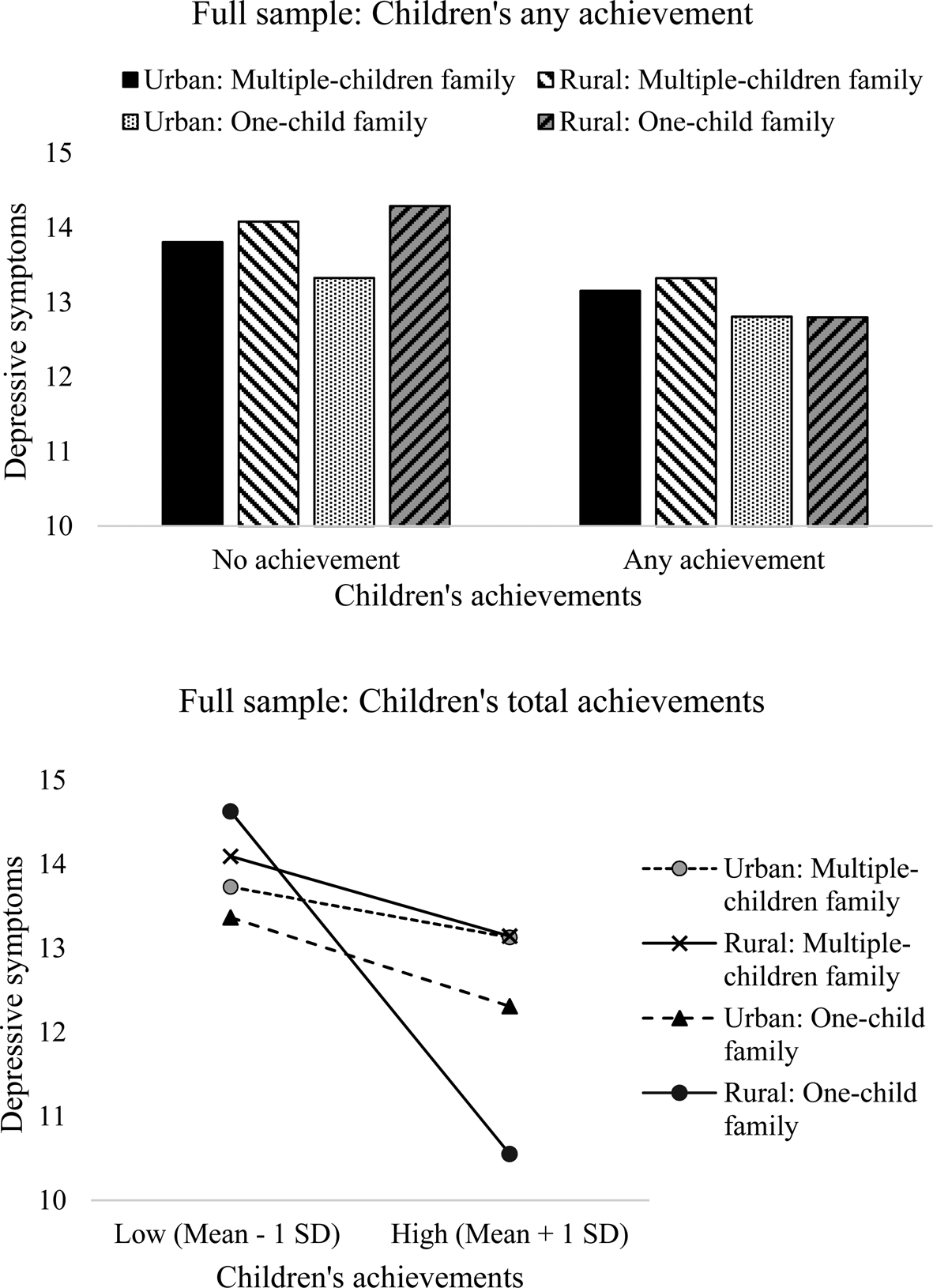
The complexity of family structure and rural–urban residence was evident for children's achievements and parents’ psychological wellbeing when we considered these factors together. In another post hoc analysis, we introduced a three-way interaction term in the regression model (i.e. child achievements × family type × rural–urban residence; see Figure 1 for the predicted depressive symptoms based on results from the full sample where the models were adjusted for participants’ characteristics). The results suggested that children's achievements were particularly important for older parents with one child living in rural areas, compared to parents living in urban areas who had only one child and parents with multiple children living in rural or urban areas. Unlike urban parents who have access to public support and rural parents who have multiple children, older parents with only one child in rural areas may face most challenges when they get older and develop diseases. Even though relatives and friends can contribute to financial or practical support, adult children play the central role in providing care. When there is only one child, parents’ wellbeing largely depends on the achievements of the singleton child in rural areas.
Predicted value of depressive symptoms of older Chinese parents by family type and rural–urban residence. The total number of children's achievements was evaluated at low (one standard deviation (SD) below the mean) and high level (one SD above the mean). Both models held covariates constant at mean values.

Also, it is likely that the social status associated with children's achievements varied by urban versus rural residence. For adult children living in rural areas, gaining an urban hukou registration status is considered an achievement in and of itself because of the additional resources and opportunities associated with this status (Guo et al., Reference Guo, Chi and Silverstein2013); while for adult children living in urban areas, obtaining political status through government employment may indicate success in terms of economic benefits and perceived power in society (Zhao et al., Reference Zhao, Zhou, Tan and Lin2018). Future studies with data on the appropriate variables should examine these issues.
Study limitations
This study had limitations that should be taken into account when interpreting the results. First, given that this is an observational study with a cross-sectional study design, it was not possible to identify whether the empirical relationships reported here were causal. Second, omitted variables may have confounded the relationship between adult children's achievements and older parents’ depressive symptoms. Future research should also consider distinct parent–child dyads within families, allowing researchers to control for stable, unobserved family variables. Third, future studies may explore how community characteristics (e.g. public facilities and welfare programmes for older adults) in rural and urban China play a role in older parents’ emotional responses to their children's achievements.
Further, the study sample is relatively healthy compared to the older Chinese population, especially in terms of cognitive health, because respondents who failed the cognition screening test were excluded, calling into question the representativeness of the sample. Also, the measures of achievement were not exhaustive and their reliability may have been affected by recall bias and social desirability response bias. Moreover, non-material aspects of children's achievements, such as being in a high-quality marriage and stable family life, are important for older Chinese parents’ psychological wellbeing (Fingerman et al., Reference Fingerman, Cheng, Birditt and Zarit2012). Future research should be conducted that considers additional indicators of adult children's achievements in China.
Study contributions
Despite these limitations, this study provided a number of contributions to the small but growing literature regarding Chinese adult children's achievements and their older parents’ wellbeing. The study used a large sample of national data from China, thereby complementing the Western literature on SES as a family-level resource of health and wellbeing. We also considered multiple indicators of adult children's achievements and compared these achievement indicators across family types and rural–urban residence. The study took into consideration the role of upward spillover effects of SES for wellbeing in the social context of China, where the importance of ‘face’ is a central feature of older Chinese parents’ lives. The results highlighted the importance of considering adult children's life circumstances for studies of healthy ageing among Chinese older adults. The results may have implications for health-care service providers in China who care for older Chinese adults. Providers should take into consideration family circumstances, including parent–child relationships, when trying to determine intervention and care strategies.
Acknowledgements
We thank the Population Development Studies Center and Institute of Gerontology at Renmin University of China for providing the China Longitudinal Ageing Social Survey (CLASS) data.