The period of adolescence involves critical milestones, transitions and dynamics that play key roles in the course of human development. For a full understanding of the complexity of human development, adolescence needs to be investigated based on such factors and the roles they play to achieve developmentally appropriate tasks (Hart, Atkins, & Fegley, Reference Hart, Atkins and Fegley2003). There are both positive and negative factors throughout adolescent development. Negative experiences in adolescence, such as prolonged ostracism, may be associated with loneliness and set barriers against healthy development by causing alienation, depression, helplessness and feelings of unworthiness among adolescents (Lou, Reference Lou2009; Nida & Saylor, Reference Nida, Saylor, Williams and Nida2017; Over & Uskul, Reference Over and Uskul2016). However, positive factors may counter the effects of such negative experiences. For example, the role played by positive self-esteem and higher levels of perceived social competence in personality and social development is known (e.g., Shek & Leung, Reference Shek, Leung, Shek, Ma and Merrick2017; Wagner & Gerstorf, Reference Wagner and Gerstorf2018). This study therefore aims to investigate the associations between self-esteem, perceived social competence, ostracism and loneliness; and specifically, the mediator roles that self-esteem and perceived social competence play in the relationship between self-esteem and loneliness.
Self-esteem manifests itself as feeling socially competent, valuable and resilient. Individuals with a tendency to organise their experiences around a positive self-concept are likely to feel that they are valuable (Fairlamb & Juhl, Reference Fairlamb and Juhl2020). Self-esteem may involve a negative or positive attitude towards the self. When the individual has a positive attitude towards the self, their self-esteem is likely to be high, or vice versa if they have a negative attitude towards the self (Rosenberg, Reference Rosenberg1965). The self refers to the sum of individuals’ views of their personality and the way they evaluate themselves and their subjective experiences (Thompson & Goodman, Reference Thompson, Goodman, Underwood and Rosen2011; Thompson, Winer, & Goodvin, Reference Thompson, Winer, Goodvin, Bornstein and Lamb2011). Self-esteem is related to individuals’ feelings of competence (Muller, Skues, & Wise, Reference Muller, Skues and Wise2017), self-value and self-appreciation (Kita & Inoue, Reference Kita and Inoue2017).
The level of self-esteem can be classified as high and low (Whelan, Haywood, & Galloway, Reference Whelan, Haywood and Galloway2007). A high level of self-esteem is an important indicator of psychological health (Saricam, Gencdogan, & Erozkan, Reference Saricam, Gencdogan and Erozkan2012). Individuals with high levels of self-esteem: (1) possess qualities such as self-confidence and entrepreneurship, feel valuable, have strong coping skills, foster positive feelings about self, and have the ability to deal with difficulties (Khezerlou, Reference Khezerlou2017); (2) are likely to be successful (Cvencek, Fryberg, Covarrubias, & Meltzoff, Reference Cvencek, Fryberg, Covarrubias and Meltzoff2018); (3) can express their creative ideas easily; and (4) are socially adaptive and competent (Curcio, Mak, & George, Reference Curcio, Mak and George2019). On the other hand, individuals with low self-esteem may possess low self-confidence, and may be aggressive, dependent on others and not open to innovations (Plummer & Harper, Reference Plummer and Harper2007). Individuals with low levels of self-esteem may possess negative self-perceptions, may not be competent enough at initiating social communication (Harris & Orth, Reference Harris and Orth2019), may be more vulnerable to threats to their dignity, and may be problem-oriented (Rosenberg, Reference Rosenberg1986). The literature reports negative outcomes of self-esteem, including aggression (Özdemir, Vazsonyi, & Çok, Reference Özdemir, Vazsonyi and Çok2017), weak psychological resilience (Karaırmak & Siviş-Çetinkaya, Reference Karaırmak and Siviş-Çetinkaya2011), addiction to social media and narcissism (Andreassen, Pallesena, & Griffiths, Reference Andreassen, Pallesena and Griffiths2017), issues in romantic affairs (Erol & Orth, Reference Erol and Orth2016), low self-efficacy (Hoe-Chang, Reference Hoe-Chang2017), and depression (Orth, Robins, Meier, & Conger, Reference Orth, Robins, Meier and Conger2016). Self-esteem is related to a perceived level of social competence due to its impact on social relationships (Sakiz, Reference Sakiz2017).
Social competence is a way of organising and communicating feelings, interacting positively with others, creating and maintaining effective and mutual social relationships, and developing positive relationships with the environment (Fabes, Gaertner, & Popp, Reference Fabes, Gaertner, Popp, McCartney and Phillips2006). Social competence requires positive social interactions with others and compatible relationships with family and peers without giving up personal goals (Raver & Zigler, Reference Raver and Zigler1997). Social competence is also associated with independence, competence (Gedviliene, Reference Gedviliene2014) and effective social communication (Giromini et al., Reference Giromini, de Campora, Brusadelli, D’Onofrio, Zennaro, Zavattini and Lang2016).
Perceived social competence is constructed from the support given by others for one’s behaviours and it depends on an individual’s belief that their socially oriented behaviours can be effective. Social competence is a vital personal feature for healthy development and has a facilitating effect on the socialisation process (Shujja, Malik, & Khan, Reference Shujja, Malik and Khan2015). Social competence is necessary to tackle challenges, maintain social relationships positively, participate in community and group activities, and be independent and active (Gedviliene, Reference Gedviliene2014). Socially competent individuals are more likely to communicate effectively with others (Giromini et al., Reference Giromini, de Campora, Brusadelli, D’Onofrio, Zennaro, Zavattini and Lang2016). A basic and universal need for a human being is to maintain positive social relationships with others (Diarof, Reference Diarof2010). When the individual is left out of social relationships or left alone, their psychological needs may not be met. The inclusion of the individual within social relationships depends both on individual and social factors.
An important psychological need for individuals is to belong to a group. People attempt to protect existing social relations with others or establish new social relationships (von Soest, Luhmann, & Gerstorf, Reference von Soest, Luhmann and Gerstorf2020). Being left alone with a lack of communication skills may cause social exclusion (Williams, Forgas, Hippel, & Zadro, Reference Williams, Forgas, Hippel, Zadro, Williams, Forgas and Hippel2005). Ostracism, defined as the exclusion of an individual by others (Robinson, O’Reilly, & Wang, Reference Robinson, O’Reilly and Wang2013), often by being ignored or overlooked, is a common situation encountered by many individuals (Williams, Reference Williams2007a). In other words, ostracism refers to psychosocial exclusion. Ostracism occurs when excluded individuals are disconnected from their social network (Spoor & Williams, Reference Spoor, Williams, Forgas, Haselton and Hoppel2006; Williams et al., Reference Williams, Forgas, Hippel, Zadro, Williams, Forgas and Hippel2005); people around them act as if they do not exist and as if their presence is pointless (Robinson et al., Reference Robinson, O’Reilly and Wang2013). Individuals who are exposed to ostracism may not give a reaction to exclusion and communicate (Ferris, Lian, Brown, & Kenney, Reference Ferris, Lian, Brown and Kenney2015). Individuals who experience ostracism during adolescence, when they are sensitive in many aspects, may feel isolated and excluded (Eisenberger, Reference Eisenberger2006) and experience feelings of inferiority (Onoda et al., Reference Onoda, Okamoto, Nakashima, Nittono, Yoshimura, Yamawaki, Yamaguchi and Ura2010).
Feelings of loneliness are often caused by negative life experiences, situational variables and personality traits (Orzeck & Rokach, Reference Orzeck and Rokach2004). Individuals who feel lonely may experience problems in communicating with people and being motivated to achieve tasks (Lou, Reference Lou2009). Various definitions of loneliness include negative emotional responses to the inconsistency between the expected and actual quality of social relationships (Perlman, Reference Perlman2004), the undesired state of subjective psychology and the presence of discomfort due to lack of social relationships (Matthews, Reference Matthews1993). Loneliness is not only an emotion caused by physical loneliness (Russell, Cutrona, McRae, & Gomez, Reference Russell, Cutrona, McRae and Gomez2012), it is also an unpleasant situation resulting from the subjective evaluations of others (De Jong-Gierveld & van Tilburg, Reference De Jong-Gierveld and van Tilburg2010) and perceived inconsistency between ideal and actual social relationships (Perlman, Reference Perlman2004). Loneliness affects the psychological health of individuals negatively as it creates difficulties in their social relationships (Mert & Özdemir, Reference Mert and Özdemir2018).
Ostracism and loneliness may cause an identity crisis during late adolescence when the personality is shaped. It is assumed that positive self-esteem and high levels of perceived social competence may organise interpersonal relationships and therefore prevent the experience of ostracism and loneliness. In the literature, self-esteem, perceived social competence, ostracism and loneliness have been studied separately. No study was found that addressed these variables together. Therefore, the current study aims to investigate the associations between these concepts among a sample of presecondary and secondary school students. To achieve the study aims, responses to the following three research questions were sought:
-
1. Do levels of self-esteem, social competence, ostracism and loneliness change significantly according to gender?
-
2. Are there significant correlations between levels of self-esteem, social competence, ostracism and loneliness?
-
3. Do social competence and ostracism have a significant mediation role in the relationship between self-esteem and loneliness?
Method
Participants
The participants in the current research included 542 students in 11 presecondary and secondary schools in Kütahya, Turkey. A hybrid method of convenience and random sampling was used to recruit students among whoever was available in the given city. The students included females (64%, n = 342) and males (36%, n = 200). The ages of the students ranged from 12 to 15 years and the mean age was 13.28 (SD = 1.22).
Instruments
Rosenberg Self-Esteem Scale (RSS)
The RSS was used in this study to measure students’ feelings of self-worth. It was developed by Rosenberg (Reference Rosenberg1965) as a unidimensional scale with five positive items (e.g., ‘On the whole, I am satisfied with myself’) and five negative items (e.g., ‘I certainly feel useless at times’). Items are rated from (1) strongly disagree to (4) strongly agree. The scores range from 10 to 40. The scale was adapted to Turkish by Çuhadaroğlu (Reference Çuhadaroğlu1986) and designed as an appropriate scale for adolescents. In the adaptation study, the correlation coefficient between the scale and clinical interview results was r = .71. The test-retest reliability was reported as r = .75. In the current study, internal reliability was α = .80.
Perceived Social Competence Scale (PSCS)
This scale was developed by Anderson-Butcher, Iachini, and Amorose (Reference Anderson-Butcher, Iachini and Amorose2007) as a six-item (e.g., ‘I get along well with others’) and one-factor scale. Responses to the items are measured on a 5-point Likert-type scale (1 = not at all to 5 = very much). Thus, scores for the PSCS range between 6 and 30. The scale was adapted to Turkish by Saricam, Akın, Akın, and Çardak (Reference Saricam, Akın, Akın and Çardak2013). Confirmatory factor analysis (CFA) showed that the one-dimensional model fit well (χ2 = 7.34, df = 7, root mean square error of approximation [RMSEA] = .010, comparative fit index [CFI] = 1.00, relative fit index [RFI] = 0.99, incremental fit index [IFI] = 1.00, adjusted goodness of fit index [AGFI] = .98, goodness of fit index [GFI] = .99, normed fit index [NFI] = .99 and standardised root mean square residual [SRMR] = .018). Factor loadings ranged from .57 to .80. The internal consistency coefficient of the scale was α = .80. According to the concurrent validity results, significant relationships were found between perceived social competence, internal self-confidence (r = .39) and external self-confidence (r = .39). Corrected item-total correlations ranged from .52 to .66. According to t-test results, differences between each item’s means of upper 27% and lower 27% points were significant. In the current study, internal reliability was α = .79.
Ostracism Experience Scale for Adolescents (OES-A)
The OES-A was developed by Gilman, Carter-Sowell, DeWall, Adams, and Carboni (Reference Gilman, Carter-Sowell, DeWall, Adams and Carboni2013) to assess adolescents’ perceptions of being ignored by or excluded from the social group. The OES-A is an 11-item (e.g., ‘… look through me as if I do not exist’) Likert-type scale (1 = never to 5 = always) focusing on being ignored (five items) and being excluded (six items) to measure general perceptions of being ostracised. The OES-A was adapted to Turkish by Akın, Uysal, and Akın (Reference Akın, Uysal and Akın2016). Results of CFA demonstrated that the 11 items loaded on two factors (ignored and excluded) and the two-dimensional model fit well (χ² = 80.64, df = 41, RMSEA = .056, NFI = .96, non-normed fit index [NNFI] = .97, CFI = .98, IFI = .98, RFI = .95, GFI = .95, SRMR = .048). Factor loadings ranged from .71 to .88 and the corrected item-total correlations ranged from .51 to .70. The internal reliability coefficients were α = .93 for ‘being ignored’, .90 for ‘being excluded’ and .89 for the whole scale. In the current study, the internal reliability was α = .82 for the whole scale.
Children’s Loneliness and Social Dissatisfaction Scale (CLSDS)
The CLSDS was developed by Asher, Hymel, and Renshaw (Reference Asher, Hymel and Renshaw1984) to measure children’s perception of loneliness and social dissatisfaction. The scale includes 24 items, including 16 primary items that measure children’s feelings of loneliness and social dissatisfaction in the school (e.g., ‘I don’t get along with other children’) and 8 filler items that measure children’s hobbies and preferred activities in school (sample item: ‘I watch TV a lot’). All items are scored on a 5-point scale ranging from 1 (not true at all) to 5 (always true). Responses on the primary items are summed and the scores range from 16 to 80. The scale was adapted to Turkish by Duyan, Var, and Kilic (Reference Duyan, Var and Kilic2015). The internal consistency coefficient of the scale was α = .81 and the test-retest reliability coefficient was r = .85. In the current study, internal reliability was α = .71.
Procedure
Before data collection, ethical permission was obtained from the Local Board of Education and the Ethical Board of the university. Researchers visited the schools and distributed the packages that involved the questionnaires in classrooms. A briefing note explaining the purpose of the study as well as the participants’ rights was added to the package. Participants were guaranteed anonymity of their responses and the confidentiality of the data. The instruments were administered to the volunteered students in classrooms. Completing the entire packet of instruments took approximately 15–20 minutes.
Data Analysis
Before analyses, a normality check was conducted. The data were distributed normally. To compare students’ self-esteem, social competence, ostracism and loneliness levels according to gender, an independent samples t test was conducted. Second, Pearson and partial correlation analyses (zero-order) were performed to explore the correlations among variables. Moreover, Cohen’s d and η2 were calculated to assess effect sizes. Cohen (Reference Cohen1977) suggested that effect sizes were small when corresponding to d = 0.2; medium when corresponding to d = 0.5, and large when corresponding to d = 0.8. Third, to examine the potential effects of independent variables on the dependent variables, multiple (stepwise) regression analyses were performed. Finally, several mediation and moderation analyses were performed via bootstrapping resembling method. The confidence level for this study was determined as .05.
Results
Preliminary Analyses
The results of descriptive statistics, skewness and kurtosis values, and Cronbach alphas obtained via RSS, PSCS, OES-A, and CLSDS are presented in Table 1.
Descriptive Statistics, Skewness, Kurtosis and Cronbach Alpha Values

The skewness (ranged between -.12 and .89) and kurtosis values (ranged between -1.08 and .70) were controlled, and all variables were in the acceptable ranges (skewness <±1, kurtosis <±1), indicating the normality of distributions for medium-sized samples (50 ≤ n < 300). Kim (Reference Kim2013) suggested that acceptable ranges for normality of distributions are skewness < 2.0, kurtosis < 7.0 at sample sizes of N = 200 and above.
Comparison of Self-Esteem, Social Competence, Ostracism, Loneliness Levels According to Gender
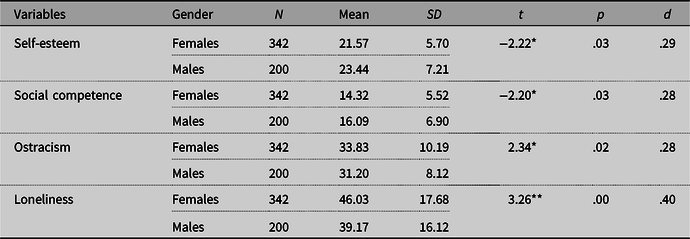
In this study the group differences for all variables were significant (Table 2). First, males had higher levels of self-esteem (M = 23.44, SD = 7.21) than females (M = 21.57, SD = 5.70), t (542) = 2.22, p < .05. Similarly males had higher social competence (M = 16.09, SD = 6.90) than females (M = 14.32, SD = 5.52), t (542) = 2.20, p < .01. Additionally, males felt lower levels of ostracism (M = 31.20, SD = 8.12) than females (M = 33.83, SD = 10.19), t (542) = 2.34, p < .05, while females felt more lonely (M = 46.03, SD = 17.68) than males (M =39.17, SD = 6.12), t (542) = 3.26, p < .01.
t Test Results Comparing Self-esteem, Social Competence, Ostracism, and Loneliness Levels According to Gender

Note: * p < .05; **p < .01.
Regarding the effect sizes, Cohen’s d was calculated for the significant group differences. Results revealed that gender explained 3% of the total variance in self-esteem (Cohen’s d = .29); 3% of the total variance in social competence (Cohen’s d = .28), 3% of the total variance in ostracism (Cohen’s d = .28), and 4% of the total variance in loneliness (Cohen’s d = .40) were explained by gender. Based on Cohen (Reference Cohen1977) and Durlak (Reference Durlak2009), self-esteem, social competence and ostracism can be interpreted to have a small effect size while loneliness possesses a medium effect size.
Correlations Between Self-Esteem, Social Competence, Ostracism, Loneliness Levels
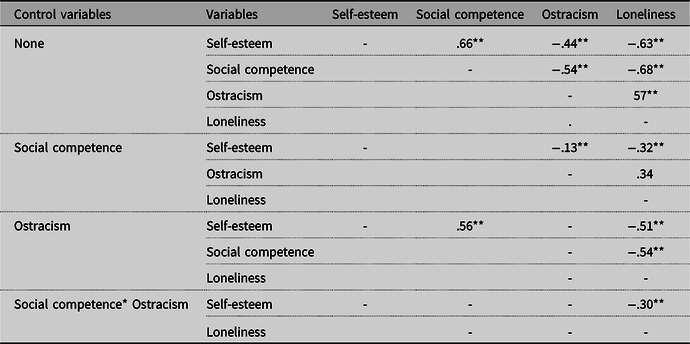
There were significant correlations between self-esteem, social competence, ostracism, and loneliness (Table 3). Self-esteem (r = −.63, p < .01, η2 = .63) and social competence (r = −.68, p < .01, η2 =.74) correlated negatively with loneliness. In contrast, ostracism (r = .57, p < .01, η2 = .35) correlated positively with loneliness. Moreover, self-esteem (r = -.44, p < .01, η2 = 55) and social competence (r = -.54, p < .01, η2 =.75) correlated negatively with ostracism. Finally, there was a significant positive correlation between self-esteem and social competence (r = .66, p < .01, η2 = .50).
Correlation Analysis Results of the Study Variables

Note: *p < .05; **p < .01.
The researchers checked whether the coefficients of relationships between self-esteem and loneliness changed when social competence and ostracism were controlled. According to the results of partial correlation analysis (see Table 3), all correlation coefficients decreased. For instance, when only social competence was controlled, the coefficient of the relationship between self-esteem and loneliness dropped from r = -.63 to r = -.32. Furthermore, when only ostracism was controlled, the coefficient of the relationship between self-esteem and loneliness dropped from r = -.63 to r = -.51. When both social competence and ostracism were controlled, the coefficient of the relationship between self-esteem and loneliness dropped from r = -.63 to r = -.30. Indeed, social competence had a significant role in this decline.
Mediation Roles of Social Competence and Ostracism in the Relationship Between Self-Esteem and Loneliness
Based on partial correlation findings, a mediation analysis was used to determine the predictive condition of variables. A simple mediation model of Preacher and Hayes (Reference Preacher and Hayes2004) and multiple mediation models of Preacher and Hayes (Reference Preacher and Hayes2008) were tested. Indirect effects were assessed for self-esteem. In the simple mediation model, loneliness was the criterion, self-esteem was the predictor, and social competence and ostracism (separately) were examined as the potential mediators. A 95% confidence interval based on 10,000 bootstrap resamples was used for testing the significance of indirect effects.
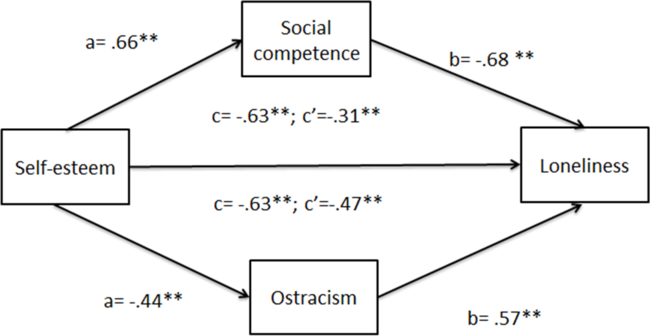
As seen in Figure 1, loneliness was predicted by self-esteem (β = -.63, t = -13.24, p < .001) and social competence (β = -.68, t = -15.38, p < .001). In other words, self-esteem and social competence contributed to loneliness with a significant amount of variance: 39%, F = 175.26, p < .001; 47%, F = 236.55, p < .001 respectively. Moreover, self-esteem predicted social competence (β = -.63, t = 14.47, p < .001); namely, self-esteem explained a significant amount of the variance in social competence: 44%, F = 209.38, p < .001. However, in the last step, loneliness was simultaneously regressed on both self-esteem (β = -.31, t = -5.55, p < .001) and social competence (β = -.48, t = -8.48, p < .001). Finally, the regression model contributed to loneliness with a significant amount of variance: 52% F = 146.75, p < .001. As seen from the mediation model, the beta weight was .63 (negative) when only self-esteem was regressed on loneliness. The beta weight dropped from .63 to .31 (negative) when social competence was added into the equation. Therefore, social competence can be considered as the partial mediating variable.
Unstandardised regression coefficients for the relationship between self-esteem and loneliness as mediated by social competence and ostracism.

On the other hand, loneliness was predicted by ostracism (β = .57, t = 11.53, p < .001). In other words, ostracism contributed to loneliness with a significant amount of variance: 33%, F = 132.84, p < .001. Moreover, self-esteem predicted ostracism (β = -.44, t = -7.96, p < .001). Namely, self-esteem explained a significant amount of the variance of ostracism: 19%, F = 63.43, p < .001. However, in the last step, loneliness was simultaneously regressed on both self-esteem (β = -.47, t = -9.76, p < .001) and ostracism (β = .37, t = 7.78, p < .001). Finally, the regression model contributed to loneliness with a significant amount of variance: 51%, F = 137.35, p < .001. As can be seen from the mediation model, the beta weight was .63 (negative) when self-esteem was regressed alone on loneliness. The beta weight dropped from .63 to .47 (negative) when ostracism was added into the equation. Therefore, ostracism can be considered as the partial mediating variable. After all, social competence is a more powerful mediator than ostracism.
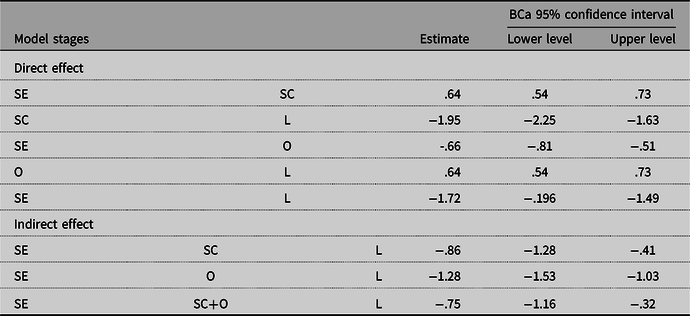
In the bootstrapping process, the aim was to find additional proof of the significance of the direct and indirect effects of the mediator models. As a result, 10,000 resampling was conducted with bootstrapping and a bootstrap coefficient was created with a 95% confidence interval. The results are shown in Table 4.
Bootstrapping Result of Partially Mediated Model

Note: SE, Self-esteem; SC, Social competence; O, Ostracism; L, Loneliness.
Statistics in Table 4 show that the bootstrapping confidence intervals in the direct and indirect effects do not include zero. As a result, all paths in the model are significant after the bootstrapping process. In sum, the results of the bootstrapping method indicate that both social competence and ostracism mediate the relationship between self-esteem and loneliness.
Discussion
In the current study, the associations between ostracism, perceived social competence, self-esteem and loneliness, as well as the mediating effect of ostracism and perceived social competence on the relationship between self-esteem and loneliness, were investigated. Findings showed that self-esteem, perceived social competence, ostracism and loneliness were related to each other among a sample of adolescent students. Both ostracism and perceived social competence had a partial mediating role in the relationship between self-esteem and loneliness. Also, there was a medium, negative and significant correlation between self-esteem and perceived social competence, and between loneliness and ostracism, while there was a medium, positive and significant correlation between ostracism and loneliness and between self-esteem and perceived social competence. Therefore, one can argue that as the levels of self-esteem and perceived social competence increase, the levels of ostracism and loneliness decrease.
Results showed that there was a medium, negative and significant correlation between perceived social competence and ostracism. Therefore, high levels of perceived social competence among adolescents imply low levels of ostracism and loneliness and vice versa. This finding is supported by similar studies (Boling, Barry, Kotchick, & Lowry, Reference Boling, Barry, Kotchick and Lowry2011; Williams & Galliher, Reference Williams and Galliher2006). As adolescents feel competent in interacting with peers in a variety of ways and contexts and maintain positive relationships with peers and adults, they are more likely to initiate and maintain constructive relationships with their social environment. Consequently, this leads to feelings of belongingness, togetherness and inclusion (Zhang et al., Reference Zhang, You, Fan, Gao, Cohen, Hsueh and Zhou2014) while decreasing the risk of being ostracised and lonely. When adolescents feel that they are socially competent, more positive social and emotional outcomes are likely to be experienced. For example, perceived social competence is related to fewer behaviour problems (Chung, Zhou, Eisenberg, & Wolchik, Reference Chung, Zhou, Eisenberg and Wolchik2019), fewer attention problems (Rabiner, Godwin, & Dodge, Reference Rabiner, Godwin and Dodge2016), less school anxiety (Campbell, Reference Campbell2003), healthy peer relationships (Romera, Cano, Garcia-Fernandez, & Ortega-Ruiz, Reference Romera, Cano, Garcia-Fernandez and Ortega-Ruiz2016), and less risk of depression (Payne & Jahoda, Reference Payne and Jahoda2004). Enhancing perceived social competence among adolescents is related to developing self-acceptance and learning to use environmental resources (Bierman & Welsh, Reference Bierman and Welsh2008).
Another finding in the current study was the negative correlation between self-esteem and ostracism. This finding is in line with past research which indicates that as the level of self-esteem increases, a decrease in the experiences of exclusion and ostracism is likely to occur (Ferris et al., Reference Ferris, Lian, Brown and Kenney2015; Gürler & Demirli, Reference Gürler and Demirli2017). Although social exclusion is a phenomenon that can be encountered in any group and environment, it is more common among individuals with low self-esteem (Williams, Reference Williams2007a). Low self-esteem can reduce the quality of a person’s life in many different ways, including social development and relationships. Low self-esteem may cause problems with friendships and romantic relationships because individuals with low self-esteem may not feel competent in fulfilling social roles about relationships, leading to gradual alienation, isolation and exclusion from the environment. When individuals are not able enough to establish positive relationships with society, their exclusion from and rejection by society means that they experience social rejection or ostracism (Diarof, Reference Diarof2010). On the other hand, experiences of ostracism imply low self-esteem among individuals because unsuccessful social experiences that lead to ostracism may reduce self-confidence and self-esteem. Ostracism is related to various social, behavioural and emotional problems (Leary, Kowalski, Smith, & Phillips, Reference Leary, Kowalski, Smith and Phillips2003; Sebastian, Viding, Williams, & Blakemore, Reference Sebastian, Viding, Williams and Blakemore2010).
In the current study, there was a negative correlation between perceived social competence and loneliness. As the perceived social competence level of adolescent students increases, their level of loneliness is expected to decrease, or vice versa. Past research also showed a negative relationship between perceived social competence and loneliness (Palmen, Vermande, Deković, & van Aken, Reference Palmen, Vermande, Deković and van Aken2011; Saricam, Yaman, & Celik, Reference Saricam, Yaman and Celik2016), in line with the findings of the current study. A factor that facilitates the socialisation process of the individual is perceived social competence (Rubin & Mills, Reference Rubin and Mills1988). Zhang et al. (Reference Zhang, You, Fan, Gao, Cohen, Hsueh and Zhou2014) found that as individuals feel social competence, they are more likely to engage in social behaviour and communication, decreasing the possibility of loneliness. Similarly, individuals who experience loneliness often report feeling of desperateness, incompetence and fear concerning the initiation and maintenance of social relationships (Zeedyk, Cohen, Eisenhower, & Blacher, Reference Zeedyk, Cohen, Eisenhower and Blacher2016).
Individuals who feel less socially competent may possess negative self-esteem and experience loneliness due to the negative feelings and perceptions towards themselves (Vanhalst, Luyckx, Scholte, Engels, & Goossens, Reference Vanhalst, Luyckx, Scholte, Engels and Goossens2013), confirming a result of the current study, which shows a positive correlation between perceived social competence and self-esteem. It is likely that as self-esteem levels of adolescent students increase, their perceived social competence level is likely to increase. Social competence is an important factor when it comes to social and emotional development (Shujja et al., Reference Shujja, Malik and Khan2015). Studies show that adolescents with perceptions of social competence are more likely to possess positive self-esteem because one aspect of evaluating the self involves assessment of social and emotional skills that are utilised to establish and maintain good relationships (Haktanır, Reference Haktanır2011).
Another finding was that there was a medium, negative and significant correlation between self-esteem and loneliness. Along similar lines, Olmstead, Guy, O’Malley, and Bentler (Reference Olmstead, Guy, O’Malley and Bentler1991) found that when adolescents felt lonely, they attributed less worth and personal value towards the self. Similarly, Saricam et al. (Reference Saricam, Gencdogan and Erozkan2012) found that students with low self-esteem often attributed fewer social and emotional skills to themselves, leading to less initiative to engage in social communication and more loneliness experiences. In their study conducted with a sample of adolescents, Dhal, Bhatia, Sharma, and Gupta (Reference Dhal, Bhatia, Sharma and Gupta2007) found that self-esteem and loneliness were negatively correlated, and secure attachment had a mediating effect in this relationship. Similarly, Ma, Liang, Zeng, Jiang, and Liu (Reference Ma, Liang, Zeng, Jiang and Liu2014) found that adolescents who had negative self-esteem tended to spend less time communicating with others and more time staying alone.
In this study, there was a medium, positive and significant correlation between ostracism and loneliness. Wesselmann, Williams, Ren, and Hales (Reference Wesselmann, Williams, Ren, Hales, Coplan and Bowker2014) found that ostracism may cause withdrawal from society and lead to pathological loneliness among individuals. Similarly, Kavakli (Reference Kavakli2019) found that as adolescents experience more loneliness, they are more prone to psychosocial isolation, unsuccessful relationships and exclusion from the environment. A reason for the increase in the loneliness of adolescents with increasing ostracism may be the reduced general sense of belongingness. Hou et al. (Reference Hou, Fan, Tan, Stuhlman, Liu and Valdez2019) stated that anxious attachment causes ostracism and this may cause serious psychopathological problems such as depression and loneliness. In a study conducted by Demir and Tarhan (Reference Demir and Tarhan2001), a positive relationship was found between loneliness and social dissatisfaction among adolescents.
Gender explained significant amounts of the total variance in self-esteem, perceived social competence, loneliness and ostracism. In the analysis conducted based on gender differences, statistically significant differences were found in favour of males in terms of self-esteem and perceived social competence, and in favour of females in terms of ostracism and loneliness. The overall differences may be explained by the social norms and gender roles attributed to males and females, especially in collectivist cultures, including Turkey. Males are expected to join the society more, spend time with others and be more self-confident, while females are expected to stay at home, take care of the house and obey the rules (Genç, Şener, Karabacak, & Üç, Reference Genç, Şener, Karabacak and Üçok2011). Both in Turkey (e.g., Koparan, Öztürk, Özkılıç, & Şenışık, Reference Koparan, Öztürk, Özkılıç and Şenışık2009) and elsewhere in the world (e.g., Bandura, Caprara, Barbaranelli, Gerbini, & Pastorelli, Reference Bandura, Caprara, Barbaranelli, Gerbini and Pastorelli2003; Payne & Jahoda, Reference Payne and Jahoda2004), studies have reported that males have higher levels of social competence and self-esteem than females. However, some studies did not reveal significant differences between genders. For example, Ateş (Reference Ateş2016) did not find significant differences between Turkish male and female adolescents. Similarly, Bayraktar, Sayıl, and Kumru (Reference Bayraktar, Sayıl and Kumru2009) found that Turkish males and females did not possess significantly different self-esteem levels.
Studies on loneliness have found that young females experience more loneliness than young males (Kim, Reference Kim2001). Although gender differences in loneliness are often assumed as with age, some evidence suggests that females report more loneliness than males, irrespective of age (Nikolaisen & Thorsen, Reference Nicolaisen and Thorsen2014). To understand how gender affects loneliness in different age groups and cultures, one needs to consider the reasons behind loneliness among males and females. Although females are sometimes socialised to develop an active social network to protect them from loneliness (Okun & Keith, Reference Okun and Keith1998), it is also clear that females tend to be affected by cultural norms that force them to stay at home and assume the role of caregiver for their family members (Barreto et al., Reference Barreto, Victor, Hammond, Eccles, Richins and Qualter2020). As such, females may be lonelier than males, suggesting that it is important to examine the effect of gender on loneliness across different age groups and cultures. While a recent meta-analysis did not support the idea of gender differences in loneliness (Maes, Qualter, Vanhalst, Van den Noortgate, & Goossens, Reference Maes, Qualter, Vanhalst, Van den Noortgate and Goossens2019), few studies in that meta-analyses examined several cultures. In case gender differences are located in loneliness, differences should also be considered in the extent to which males and females are willing to report loneliness. Indeed, research has shown that males are more reluctant than females to admit feeling lonely (Borys & Perlman, Reference Borys and Perlman1985).
Ostracism is experienced in different periods of life by both males and females (Oğurlu, Reference Oğurlu2015). In this study, adolescent females experienced more ostracism than males. In line with the outcomes of this study, numerous gender differences in ostracism-related processes have previously been reported, particularly in the adolescent literature. There is considerable evidence that males and females differ in their perception and application of ostracism in peer contexts. It has been shown, for example, that females perceive the intent of social exclusion to be more anger-driven than do males and that while males rely more on verbal confrontations to exclude peers in their presence, females rely more on nonverbal exclusionary gestures (Hawes et al., Reference Hawes, Zadro, Fink, Richardson, O’Moore, Griffiths and Williams2012). There is also evidence that the relationship between friendship features and social exclusion differs for males and females depending on the social context (Underwood & Buhrmester, Reference Underwood and Buhrmester2007).
The results of the current study revealed that perceived social competence and ostracism mediated the relationship between self-esteem and loneliness. Positive self-esteem and perceived social competence proved to decrease the level of loneliness among adolescents. Although low self-esteem and loneliness are problems that affect people of all ages, they may be particularly relevant among mid and late adolescents because of the developmental tasks they are facing (Vanhalst et al., Reference Vanhalst, Luyckx, Scholte, Engels and Goossens2013). Specifically, adolescents are expected to increasingly establish sound peer relationships and develop an integrated sense of self (Steinberg & Morris, Reference Steinberg and Morris2001). Indeed, studies have documented strong associations between low self-esteem and loneliness (e.g., Mahon, Yarcheski, Yarcheski, Cannella, & Hanks, Reference Mahon, Yarcheski, Yarcheski, Cannella and Hanks2006). Particularly in rapid developmental ages such as adolescence, adolescents may feel desperate in an increasingly deleterious process in which their low self-esteem makes them feel lonely.
The fact that perceived social competence predicted self-esteem shows that it is important in its effect on the relationship between self-esteem and loneliness. The circle between self-esteem and loneliness may harm adolescents’ psychosocial development and increase their risk for developing psychopathology. Lower levels of self-reported social competence are associated with low self-esteem, which in turn affects the will and belief to maintain social relationships (Riggio, Throckmorton, & Depaola, Reference Riggio, Throckmorton and Depaola1990). In adolescence, social competence can be demonstrated by success in social interactions with peers and adults, typically requiring the adolescent to exhibit context-appropriate social behaviours (Zeedyk et al., Reference Zeedyk, Cohen, Eisenhower and Blacher2016).
As seen in the mediating model, loneliness and ostracism decrease the level of self-esteem. Within the ostracism literature, self-esteem level has been highlighted as an important mechanism wherein experience of ostracism is responsible for low self-esteem (Williams, Reference Williams2007b). Such findings suggest the possibility of integrating the ostracism literature with principles of the self-verification theory (Swann & Brooks, Reference Swann and Brooks2012), wherein individuals attempt to confirm their positive (or negative) self-views by engaging in positive (or negative) behaviours. In particular, ostracism negatively affects our self-perceptions, and negative behaviours represent our attempts to verify or demonstrate that our negative self-perceptions are accurate (Ferris et al., Reference Ferris, Lian, Brown and Kenney2015). Williams and Galliher (Reference Williams and Galliher2006) report that after being ostracised for even a short time, individuals report lower satisfaction levels for self-esteem. Ostracised individuals are likely to worry about their value and worth, whereas people with high self-esteem generally feel liked and accepted by others. People with high self-esteem believe that people will be responsive to their needs; however, people with low self-esteem doubt their interpersonal value and tend to worry about rejection (Leary et al., Reference Leary, Kowalski, Smith and Phillips2003).
Conclusion, Limitations and Implications
In the current study, there were significant associations between ostracism, perceived social competence, self-esteem and loneliness. Also, ostracism and perceived social competence had a significant mediating effect on the relationship between self-esteem and loneliness. The results of the current study revealed that self-esteem increased perceived social competence; and self-esteem and perceived social competence decreased loneliness both separately and together. Moreover, experiences of ostracism increased loneliness. Self-esteem decreased both ostracism and loneliness. Therefore, ostracism was a partial mediator variable of self-esteem while perceived social competence was a stronger mediator than ostracism. In the gender-based analyses, there were significant differences in self-esteem and perceived social competence in favour of males, while females had significantly higher levels of ostracism and loneliness than males.
In the current study, the data were limited to presecondary and secondary school students in Turkey. Future research may expand the sample and include people from different developmental periods. The relationships can be investigated with different study groups so that the generalisability of the results can be increased. Also, data in this study were collected cross-sectionally, allowing judgments based on a single time and place. Longitudinal data collection by further research may strengthen the developmental nature of the study and enhance the reliability of the outcomes. It is beneficial to conduct longitudinal research when considering the dynamic and fragile nature of adolescence in terms of identity and personality development. Finally, since this research was carried out with self-report scales, there may be much response bias. Therefore, illuminating findings can be obtained if further diversification of the data is made available from stakeholders such as teachers, parents and school managers.
There are practical implications from this study for school counsellors and psychologists. This study showed that a long duration of ostracism may lead to feelings of loneliness and alienation among adolescents. Moreover, during the ostracism period, adolescents may not prefer to initiate social contact and may associate the cause of ostracism with their identity and personality. First, the role of school counsellors and psychologists in working with lonely adolescents may include: (1) supporting them to improve their social skills to maintain constructive relationships; (2) helping them to search for opportunities to identify social contact; and (3) preventing loneliness from causing serious issues such as marginalisation, depression, drug abuse and suicide. In the case of ostracised adolescents, school counsellors and psychologists can help them by: (1) informing adolescents about ostracism; (2) preventing conditions where they may feel helpless and a victim of ostracising behaviour; (3) strengthening resilience so that they feel empowered and move beyond ostracising situations; and (4) providing guidance on how to overcome ostracism, seek out other friendships, improve social skills and consider support where necessary. The methods of supporting lonely and ostracised adolescents may vary, from utilising psychosocial interventions within a whole school approach to applying individual and group interventions based on therapeutic services. Forming activities that aim to improve the self-esteem of adolescents can produce meaningful outcomes in the prevention of ostracism and enhancement of social competence. Finally, school counsellors and psychologists may activate relevant stakeholders within the school system and establish partnerships to prevent the discourses and actions that may lead to ostracism, loneliness, negative self-esteem and low social competence among adolescents.
Conflict of interest
None.