1. Introduction
The time it takes to perform simple language tasks like picture naming, word reading, and word translation has been studied for over a century. In experiments conducted in Wundt's psychological laboratory in Leipzig, Cattell (Reference Cattell1887) made a number of seminal observations. First, he observed that it takes longer to name colors and pictures than to read aloud words. Second, picture naming takes longer in a foreign than the native language. Third, word translation takes longer than word reading. Cattell stated that “it is not evident what mental process takes place when an object is named in a foreign language, it depending, of course, on the familiarity of the language” (p. 68). “We go a step further when a word must be translated from one language into another. The mental operation is again obscure, the process of translating and naming not being sharply defined” (p. 69). During the past few decades, a number of detailed, computationally implemented models have been developed for picture naming, word reading, and word translation (e.g., Bloem & La Heij, Reference Bloem and La Heij2003; Coltheart, Rastle, Perry, Langdon & Ziegler, Reference Coltheart, Rastle, Perry, Langdon and Ziegler2001; Dell, Schwartz, Martin, Saffran & Gagnon, Reference Dell, Schwartz, Martin, Saffran and Gagnon1997; Dijkstra & Van Heuven, Reference Dijkstra and Van Heuven2002; Levelt, Roelofs & Meyer, Reference Levelt, Roelofs and Meyer1999; Rapp & Goldrick, Reference Rapp and Goldrick2000; Roelofs, Reference Roelofs1992, Reference Roelofs2006; Starreveld & La Heij, Reference Starreveld and La Heij1996), which try to make explicit what mental processes take place in these simple language tasks. The models are similar in many respects (e.g., all assume a lexical network that is accessed by spreading activation), but there are also important differences. One difference concerns how activation spreads from concepts to lexical items in word production.
Whereas most theoretical and computational models assume a continuous flow of activation from concepts to words, one prominent model proposed by La Heij and colleagues assumes that the mapping of concepts onto words happens in a discrete fashion (e.g., Bloem & La Heij, Reference Bloem and La Heij2003; Bloem, Van den Boogaard & La Heij, Reference Bloem, Van den Boogaard and La Heij2004; La Heij, Hooglander, Kerling & Van der Velden, Reference La Heij, Hooglander, Kerling and Van der Velden1996). It seems generally accepted that after having reached some degree of proficiency in a second language (L2), bilingual speakers engage their conceptual system in translating from L2 to L1 (e.g., Kroll, Van Hell, Tokowicz & Green, Reference Kroll, Hell, Tokowicz and Green2010; La Heij et al., Reference La Heij, Hooglander, Kerling and Van der Velden1996). The model of La Heij and colleagues assumes, for example, that in translating the English written word RABBIT into the Dutch word konijn, the concept RABBIT(X) as well as related ones such as DOG(X) become activated (the latter via spreading activation through RABBIT(X)). However, whereas RABBIT(X) activates the corresponding Dutch word konijn, activation from DOG(X) will not spread to the corresponding Dutch word hond. In contrast, other models (e.g., Dell et al., Reference Dell, Schwartz, Martin, Saffran and Gagnon1997; Dijkstra & Van Heuven, Reference Dijkstra and Van Heuven2002; Rapp & Goldrick, Reference Rapp and Goldrick2000; Roelofs, Reference Roelofs1992, Reference Roelofs2006) assume that the concept RABBIT(X) as well as related ones such as DOG(X) activate the word level, so that English rabbit and dog as well as Dutch konijn and hond become activated. This continuous-flow view has been implemented in several computational models, including the WEAVER++ model (e.g., Levelt et al., Reference Levelt, Roelofs and Meyer1999; Roelofs, Reference Roelofs1992, Reference Roelofs2003, Reference Roelofs2006, Reference Roelofs2008a, Reference Roelofsb). In this model, language selectivity is achieved by condition-action production rules (see Anderson, Reference Anderson1983; Anderson & Lebiere, Reference Anderson and Lebiere1998; Just & Carpenter, Reference Just and Carpenter1992; Meyer & Kieras, Reference Meyer and Kieras1997; Newell, Reference Newell1990). Words are activated regardless of language, but the condition-action rules determine which of the activated nodes is selected depending on the goal (e.g., to translate into Dutch or English).
Although the empirical data on monolingual and bilingual word production generally seem to favor continuous-flow models (e.g., Colomé, Reference Colomé2001; Costa, Caramazza & Sebastián-Gallés, Reference Costa, Caramazza and Sebastián-Gallés2000; Cutting & Ferreira, Reference Cutting and Ferreira1999; Hermans, Bongaerts, De Bot & Schreuder, Reference Hermans, Bongaerts, De Bot and Schreuder1998; Hoshino & Thierry, Reference Hoshino and Thierry2011; Morsella & Miozzo, Reference Morsella and Miozzo2002; Navarette & Costa, Reference Navarrete and Costa2005; Peterson & Savoy, Reference Peterson and Savoy1998; Roelofs, Reference Roelofs2008a; Strijkers, Holcomb & Costa, Reference Strijkers, Holcomb and Costa2011), one particular empirical finding has been taken to be problematic for these models. In particular, La Heij and colleagues (i.e., Bloem & La Heij, Reference Bloem and La Heij2003; Bloem et al., Reference Bloem, Van den Boogaard and La Heij2004) have observed that when Dutch–English bilingual speakers (i.e., with Dutch as L1 and English as L2) vocally translate English words into Dutch (backward translation from L2 to L1: e.g., English RABBIT into the Dutch konijn), semantically related context pictures (e.g., a picture of a dog) decrease the response time (RT) compared with unrelated context pictures (e.g., a picture of a chair), whereas semantically related Dutch context words (e.g., the word HOND, meaning “dog”) increase the RT compared with unrelated Dutch context words (e.g., STOEL, meaning “chair”).
To explain this difference in polarity of semantic effects of picture and word contexts, La Heij and colleagues argued that semantically related context pictures help concept selection, but do not spread activation to the word level, hence they speed up the translation response. In contrast, semantically related context words activate their lexical representations, and hence they hinder the translation response. Thus, by assuming different functional loci for the picture and word context effects (i.e., the conceptual level for context pictures and the lexical level for context words), La Heij and colleagues explain why context pictures yield semantic facilitation (i.e., RT semantic < RT unrelated), whereas context words yield semantic interference (i.e., RT semantic > RT unrelated). Bloem and La Heij (Reference Bloem and La Heij2003) presented the results of computer simulations demonstrating that a model implementing their ideas about the different functional loci of the context effects could explain the difference in polarity of semantic effects between context pictures and words (i.e., facilitation versus interference, respectively). According to Bloem and La Heij (Reference Bloem and La Heij2003), continuous-flow models of word production in the literature, such as WEAVER++, “are able to account for semantic interference induced by a context word, but not for semantic facilitation induced by a context picture” (p. 477).
In the present article, we argue that, contrary to the claims of Bloem and La Heij (Reference Bloem and La Heij2003), it remains unclear whether their discrete-flow model can actually account for translation performance. Moreover, we demonstrate that a continuous-flow model like WEAVER++ may account for the semantic facilitation of context pictures in forward and backward translation performance. The remainder of the article is organized as follows. We start by describing the discrete-flow model of Bloem and La Heij (Reference Bloem and La Heij2003) in more detail and we indicate that the model does not solve the problem of language-selectivity in word translation. Next, we describe the continuous-flow assumption implemented in WEAVER++ in more detail and we report the results of computer simulations showing the utility of the model in accounting for the key findings on context effects of pictures and words on RTs in translating from L2 to L1 and vice versa (i.e., data from Bloem & La Heij, Reference Bloem and La Heij2003, and La Heij et al., Reference La Heij, Hooglander, Kerling and Van der Velden1996). In short, the aim of the present article is to show that the allegedly problematic finding for continuous-flow models (i.e., the semantic facilitation of context pictures in word translation) can, in fact, be captured by a continuous-flow model.
2. A discrete-flow model of word translation
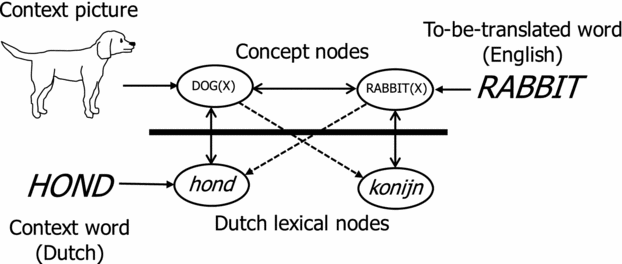
The model proposed by Bloem and La Heij (Reference Bloem and La Heij2003) assumes that the mental lexicon is a network of nodes and links, which is illustrated in Figure 1. There are two layers of nodes. One layer contains language-independent concept nodes like DOG(X) and RABBIT(X) and the other layer contains lexical nodes for Dutch words like hond and konijn. The two layers are bidirectionally connected. Furthermore, picture input nodes are unidirectionally connected to the corresponding concept nodes (e.g., DOG(X)), and Dutch orthographic input nodes (e.g., HOND) are unidirectionally connected to the corresponding lexical nodes (hond). The network is accessed by spreading activation. To account for the semantic facilitation from context pictures, the model assumes that only a selected concept node activates the corresponding lexical node. Moreover, “to account for semantic interference an additional modification has to be made: once above threshold, the target concept does not only activate its own name but also – to a small degree – semantically related words” (Bloem & La Heij, Reference Bloem and La Heij2003, p. 478). That is, the model assumes that each concept node is weakly connected to the lexical nodes of semantically related words (e.g., DOG(X) is weakly connected to konijn). This latter assumption is needed for the model to explain the semantic interference from context words, but it is not independently supported.
Illustration of the network of the discrete-flow model of Bloem and La Heij (Reference Bloem and La Heij2003). Language-independent concept nodes are connected to Dutch lexical nodes. The dashed lines indicate weak connections between concept nodes and lexical nodes of semantically related words. The thick horizontal line indicates the presence of a threshold. The words in italicized capital letters indicate orthographic input nodes for a Dutch context word (HOND) and a to-be-translated English word (RABBIT).

Although the model was designed to simulate word translation, Bloem and La Heij (Reference Bloem and La Heij2003) did not include English orthographic input nodes (e.g., DOG) and corresponding lexical nodes (dog) in the network, because “within the literature on bilingualism it is generally assumed that in word translation, bilinguals are able to ignore or suppress words in the nonresponse language” (p. 477). Moreover, they assume that L2 nodes are not needed in their model simulations, because “the L2 target word has sufficiently decayed by the time the correct L1 word has to be selected” (p. 477). Words are retrieved in the model by spreading activation. In translating an English word into Dutch (e.g., the written word RABBIT into konijn), the corresponding concept node receives external activation (as indicated, the concept node is directly activated because there are no English orthographic and lexical nodes in the network). Activation spreads from RABBIT(X) to DOG(X), but it does not automatically spread to the lexical level. Instead, only after the activation level of the concept node RABBIT(X) has exceeded a critical threshold, this concept node is selected and activation of the concept node spreads to the associated lexical nodes. Next, the highest activated lexical node will be selected as response, which will be the node for Dutch konijn. Note that a lexical node for English rabbit is not activated, simply because English lexical nodes are not part of the simulation model.
Bloem and La Heij (Reference Bloem and La Heij2003) simulated the effect of semantically related context pictures and Dutch context words by providing external activation to, respectively, the corresponding concept nodes (e.g., DOG(X) for simulating the effect of a context picture of a dog) and corresponding lexical nodes (e.g., hond for simulating the effect of the Dutch context word HOND). The effect of unrelated context pictures and words was simulated by activating lexical and concept nodes that were not connected at the conceptual level to the nodes for RABBIT(X) and DOG(X) (the unrelated nodes are not shown in Figure 1). In the simulations, semantically related context pictures (e.g., a picture of a dog) decreased the RT compared with unrelated context pictures, whereas semantically related Dutch context words (e.g., the written word HOND) increased the RT compared with unrelated context words, as empirically observed. The semantic facilitation effect of context pictures occurs in the model because semantically related pictures (e.g., of a dog) increase the activation level of the target concept node (i.e., RABBIT(X)), which therefore will exceed the concept-selection threshold earlier. However, because context pictures do not activate the corresponding lexical nodes, they do not hinder the selection of the target lexical node (konijn). In contrast, semantically related context words (e.g., HOND) activate their lexical nodes (e.g., hond), and hence they hinder the selection of the target lexical node (konijn).
Although the model correctly simulates the empirical findings on the effects of context pictures and words on word translation, there are also some concerns. Bloem and La Heij (Reference Bloem and La Heij2003, p. 477) stated that “bilinguals are able to ignore or suppress words in the nonresponse language”, but their model does not specify how this is achieved. Assume that the model includes English lexical nodes in the network. These lexical nodes would be connected to the corresponding concept nodes (e.g., rabbit would be connected to RABBIT(X)). On a trial with a context word, there would be two lexical nodes directly activated by external input (e.g., rabbit activated by the to-be-translated English written word RABBIT and hond activated by the Dutch context word HOND), whereas a lexical node that is indirectly activated via the conceptual level has to be selected (i.e., Dutch konijn). This will only result in a correct response if the activation of konijn by the conceptual level exceeds the direct activation of rabbit and hond by the external word input. Bloem and La Heij (Reference Bloem and La Heij2003) assume that the target concept node receives extra external “task activation”. It may be that this extra task activation is sufficient for konijn to overcome the direct activation of rabbit and hond by the perceived words (i.e., the to-be-translated English written word RABBIT and the Dutch context word HOND, respectively), but this is not necessarily the case. The task activation provided to the concept node RABBIT(X) will not only increase the indirectly activated lexical node konijn (the word that is intended), but also the directly activated lexical node rabbit. In short, to make a convincing case that their model can really account for translation performance, it is important to know whether the model still can simulate the effects of context pictures and words when English lexical nodes are included in the network.
Moreover, it remains unclear whether the model can simulate both backward translation (from L2 to L1) and forward translation (from L1 to L2). When the network includes English nodes, the connection between a concept node and the English lexical node (L2) will presumably be weaker than the connection between the concept node and the Dutch lexical node (L1), at least for the non-balanced Dutch–English speakers participating in the experiments of Bloem and La Heij (Reference Bloem and La Heij2003) and La Heij et al. (Reference La Heij, Hooglander, Kerling and Van der Velden1996). However, this raises the question how the model manages to select the English word as a translation response. For example, when the concept RABBIT(X) activates English rabbit and Dutch konijn, more activation will spread to the Dutch than the English lexical node, because of the difference in connection strength. Consequently, Dutch konijn rather than English rabbit will be selected, whereas the goal was to produce the English word. Thus, in its present form, the model seems to be unable to perform forward (L1 to L2) translations. La Heij et al. (Reference La Heij, Hooglander, Kerling and Van der Velden1996) observed that context pictures yielded semantic facilitation in both forward and backward translation. Given the apparent problem with forward translation, it remains unclear whether the discrete-flow model can simulate the semantic facilitation effect of context pictures in forward translation observed by La Heij et al. (Reference La Heij, Hooglander, Kerling and Van der Velden1996).
According to La Heij and colleagues, the semantic interference from context words and semantic facilitation from context pictures (observed by Bloem & La Heij, Reference Bloem and La Heij2003) indicates that pictures do not automatically activate their names. Instead, only selected concepts activate corresponding words. La Heij et al. (Reference La Heij, Hooglander, Kerling and Van der Velden1996, p. 661) stated: “The mere presentation of a picture. . . does not automatically result in the activation of the corresponding name. Activation of the picture's name occurs only when the subjects make a deliberate attempt to retrieve the corresponding word”. In the next section, we argue that this conclusion is not warranted and show that a continuous-flow model, in particular WEAVER++, can account for the findings of La Heij et al. (Reference La Heij, Hooglander, Kerling and Van der Velden1996) and Bloem and La Heij (Reference Bloem and La Heij2003).
3. A continuous-flow model of word translation
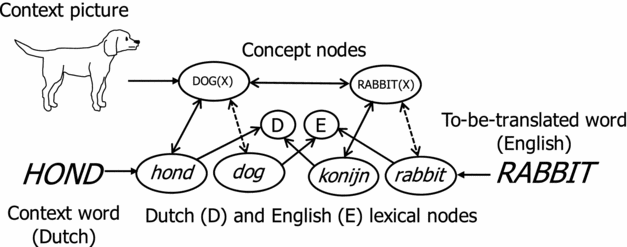
The WEAVER++ model (e.g., Levelt et al., Reference Levelt, Roelofs and Meyer1999; Roelofs, Reference Roelofs1992, Reference Roelofs2003, Reference Roelofs2006, Reference Roelofs2008a, Reference Roelofsb) also assumes that the mental lexicon is a network of nodes and links, a fragment of which is illustrated in Figure 2. Although the model assumes that there are several levels of nodes, including levels of concept, lemma, morpheme, phoneme, and motor program nodes, only two layers are relevant for current purposes. The lemma level is the lexical level in Figure 2. Each language-independent concept node is connected to Dutch and English lexical nodes. Lexical nodes are connected to nodes that indicate language membership (Dutch, D; English, E). Pictures provide external input to concept nodes and written words provide external input to the lexical nodes.
Illustration of a fragment of the lexical network of the continuous-flow model of Roelofs (Reference Roelofs1992, Reference Roelofs2003). Language-independent concept nodes are connected to Dutch and English lexical nodes and nodes indicating language membership (Dutch, D; English, E). The words in italicized capital letters indicate orthographic input nodes for a Dutch context word (HOND) and a to-be-translated English word (RABBIT).

The language-specific selection of nodes is regulated in WEAVER++ by condition-action production rules, which specify the conditions under which activated nodes in the lexical network should be selected (see Anderson, Reference Anderson1983; Anderson & Lebiere, Reference Anderson and Lebiere1998; Just & Carpenter, Reference Just and Carpenter1992; Meyer & Kieras, Reference Meyer and Kieras1997; Newell, Reference Newell1990). For example, the selection of a Dutch word for a given concept is achieved by the rule:
If the goal is to verbally express the concept x in Dutch and memory specifies that y is the Dutch lexical item for x then select y
For example, in translating the written English word RABBIT into Dutch, the concept x will be RABBIT(X) and the Dutch lexical item y will be konijn, which will be selected by the production rule.
In word translation, the lexical network is accessed by spreading activation while the condition-action rules determine what is done with the activated lexical information depending on the goal placed in working memory (e.g., to translate into Dutch or English). In translating an English word into Dutch (e.g., RABBIT into konijn), the corresponding lexical node (rabbit) receives external activation from the to-be-translated word (i.e., RABBIT). Activation then spreads freely through the network, whereby each node sends a proportion of its activation to connected nodes, including the concept node (i.e., RABBIT(X)) corresponding to the perceived word (i.e., RABBIT). A condition-action rule will select the concept node corresponding to the input word (i.e., RABBIT(X)). Next, a condition-action rule (illustrated above) will select the corresponding Dutch lexical node (i.e., konijn). In this way, backward translation (from L2 to L1) is achieved. In a similar fashion, the model performs forward translations (i.e., from L1 to L2). For example, in translating a Dutch word into English (e.g., KONIJN into rabbit), the corresponding lexical node (konijn) receives external activation from KONIJN, followed by a spread of activation through the network. Next, a condition-action rule will select the corresponding concept (i.e., RABBIT(X)), which is followed a by condition-action rule selecting the corresponding English lexical node (rabbit). Although activation spreads through the network regardless of language (i.e., the flow is not restricted to one language only), only lexical nodes from the target language (i.e., Dutch or English) compete for selection (see Costa, Miozzo & Caramazza, Reference Costa, Miozzo and Caramazza1999; Costa & Santesteban, Reference Costa and Santesteban2004; Costa, Santesteban & Ivanova, Reference Costa, Santesteban and Ivanova2006; Roelofs, Reference Roelofs1998; but see Kroll, Bobb & Wodniecka, Reference Kroll, Bobb and Wodniecka2006). The assumption of language-specific competition, at least for word translation, is discussed further below (in Section 3.3).
We ran computer simulations examining the effect of context pictures and words on word translation in the model. The simulation protocol and the parameter values were exactly the same as in earlier simulations of word production by the model (e.g., Roelofs, Reference Roelofs1992, Reference Roelofs2003, Reference Roelofs2006, Reference Roelofs2008a, Reference Roelofsb), except that each concept node was connected to a Dutch and English lexical node, as illustrated in Figure 2. The participants in the simulated experiments (i.e., Bloem & La Heij, Reference Bloem and La Heij2003, Experiment 1; La Heij et al., Reference La Heij, Hooglander, Kerling and Van der Velden1996, Experiment 4) were non-balanced but fluent Dutch-English bilinguals. To implement the fact that L1 and L2 were not equally strong, we assumed that the connection strength between concept nodes and lexical nodes in L2 was somewhat weaker than the strength of these connections in L1. In the simulations, the connection strength for L2 was 0.85 of that for L1. The lexical selection threshold was set at 1.0 activation units and the distractor duration was set at 100 ms in case of context pictures and at 125 ms in case of context words. In the General discussion section, we discuss why this parameter value was set to be different between context pictures and words. For further details of the model and simulation protocol, we refer to Roelofs (Reference Roelofs1992, Reference Roelofs2003, Reference Roelofs2006, Reference Roelofs2008a, Reference Roelofsb).
3.1 Simulating the effect of context pictures in forward and backward translation
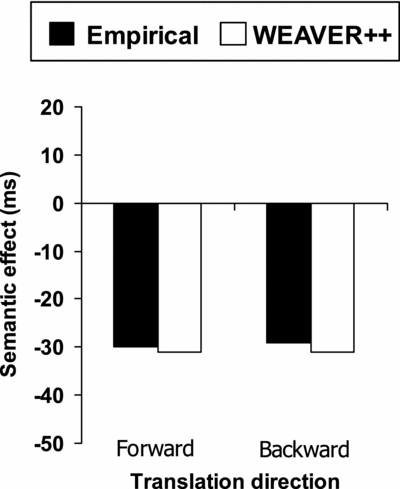
The first simulation concerned forward (L1 to L2) and backward (L2 to L1) translation in the context of semantically related and unrelated pictures. For example, the model had to translate the Dutch written word KONIJN into English rabbit (forward translation) or the English word RABBIT into Dutch konijn (backward translation). Figure 3 shows the simulation results together with the empirical data of La Heij et al. (Reference La Heij, Hooglander, Kerling and Van der Velden1996).
Semantic effect of context pictures in forward (L1 to L2) and backward (L2 to L1) translation of words: empirical data (La Heij et al., Reference La Heij, Hooglander, Kerling and Van der Velden1996, Experiment 4) and WEAVER++ simulation results. Shown is the latency in the semantically related condition minus the latency in the unrelated condition. A negative difference indicates semantic facilitation.

In the model, a semantically related context picture (e.g., a picture of a dog) will activate the target lexical node via the network connections (e.g., rabbit in the forward translation of KONIJN and konijn in the backward translation of RABBIT), whereas unrelated context pictures (e.g., a picture of a chair) will not activate the target lexical node. Lexical competition is restricted to the target language (i.e., English in forward translation and Dutch in backward translation). Because pictures activate lexical nodes regardless of language, there will be some competition induced by the picture names (e.g., English dog in forward translation and Dutch hond in backward translation). However, the simulation results shown in Figure 3 demonstrate that the facilitatory effect from the context picture may outweigh the lexical competition that it induces.
3.2 Simulating the differential effect of context pictures and words
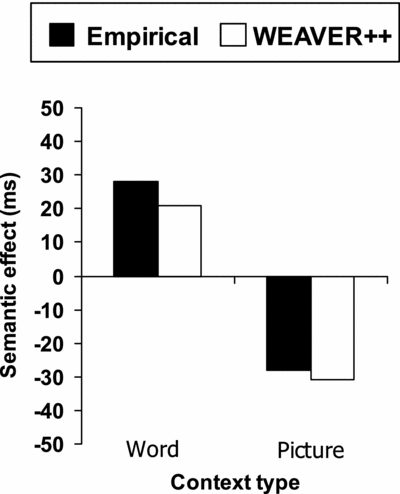
The second simulation concerned backward word translation (L2 to L1) in the context of semantically related and unrelated pictures and words. For example, the model had to translate the English word RABBIT into Dutch konijn in the context of a picture of a dog or an unrelated picture, or the model had to perform the translation in the context of the Dutch word HOND (meaning “dog”) or an unrelated word. Figure 4 shows the simulation results together with the empirical data of Bloem and La Heij (Reference Bloem and La Heij2003).
Semantic effect of context words and pictures in backward (L2 to L1) translation of words: empirical data (Bloem & La Heij, Reference Bloem and La Heij2003, Experiment 1) and WEAVER++ simulation results. Shown is the latency in the semantically related condition minus the latency in the unrelated condition. A negative difference indicates semantic facilitation and a positive difference indicates semantic interference.

In the model, a semantically related context picture (e.g., a picture of a dog) will activate the target lexical node (e.g., konijn in backward translating RABBIT), whereas unrelated context pictures (e.g., a picture of a chair) will not. Although words within a language compete, the facilitatory effect from the context picture may outweigh the interference from the lexical competition, as we just saw. This surfaces as semantic facilitation in the RTs. In contrast, a semantically related Dutch context word (e.g., HOND) will activate the target word node (e.g., konijn in backward translation of RABBIT), whereas an unrelated context word (e.g., STOEL, meaning “chair”) will not. Again, only words within a language compete. However, activation of a competitor lexical node (e.g., hond) by a context word (i.e., HOND) will be much higher than the activation of a competitor lexical node (e.g., hond) by a context picture (e.g., of a dog). The simulation results shown in Figure 4 demonstrate that the facilitatory effect of a semantically related context word may be insufficiently large to outweigh the interference from the lexical competition induced by the context word. Consequently, context words yield semantic interference in the RTs, as empirically observed.
3.3 Language selectivity
Although activation of the English lexical node (e.g., rabbit) of the to-be-translated English word (RABBIT) was always much higher than that of the Dutch target lexical node (i.e., konijn) in the simulations, the Dutch lexical node was nevertheless correctly selected. This was achieved by the condition-action rules, which restricted competition to the lexical nodes of the target language. Thus, the rules allow for the selection of words in the appropriate language even though words in the irrelevant language are more highly activated. Alternatively, it is possible to reduce or eliminate the competition of words in the irrelevant language by inhibition (e.g., Green, Reference Green1998; Kroll, Bobb, Misra & Guo, Reference Kroll, Bobb, Misra and Guo2008) rather than by language-specific selection. Costa and Santesteban (Reference Costa and Santesteban2004) argued that balanced bilinguals have developed a mechanism that allows for language-specific selection, whereas non-balanced bilingual speakers use inhibition. However, the empirical evidence for inhibition as the mechanism to achieve language selectivity is mixed (e.g., Finkbeiner, Almeida, Janssen & Caramazza, Reference Finkbeiner, Almeida, Janssen and Caramazza2006; Verhoef, Roelofs & Chwilla, Reference Verhoef, Roelofs and Chwilla2009; but see Kroll et al., Reference Kroll, Bobb, Misra and Guo2008).
La Heij and colleagues did not include an English lexicon in their simulations, thereby not addressing the issue of how a Dutch lexical node is selected in the face of the activation of the English lexical node corresponding to the to-be-translated word. In the WEAVER++ simulations, both a Dutch and an English lexicon (i.e., an integrated Dutch–English lexicon) was included (illustrated in Figure 2). Although activation of English lexical nodes (in addition to Dutch nodes) was part of the translation process (i.e., the to-be-translated English word provided the source of activation for the translation process), English lexical nodes did not compete for selection in the case of Dutch targets. The issue of how a Dutch word is selected in the face of the activation of English words was addressed by assuming that language-specific selection is achieved through production rule application. These rules only considered words of the target language for selection (based on the nodes indicating language membership).
The assumption of language-specific selection in word translation readily explains empirical findings from Miller and Kroll (Reference Miller and Kroll2002) on the effect of matching or mismatching target and context languages, although Miller and Kroll did not interpret their findings in terms of language-specific selection (i.e., Kroll and colleagues assume inhibition as the mechanism, e.g., Kroll et al., Reference Kroll, Bobb, Misra and Guo2008). Miller and Kroll asked English–Spanish bilingual speakers to translate written words from L2 to L1 (backward translation) or from L1 to L2 (forward translation) while trying to ignore written context words in the language of input (i.e., the to-be-translated word) or the language of output (i.e., the target language, as in Bloem & La Heij, Reference Bloem and La Heij2003; Bloem et al., Reference Bloem, Van den Boogaard and La Heij2004). When the language of output and the language of the context word were the same (i.e., either English or Spanish), semantic interference was obtained (i.e., RT semantic > RT unrelated), corresponding to what La Heij and colleagues obtained (i.e., Bloem & La Heij, Reference Bloem and La Heij2003; Bloem et al., Reference Bloem, Van den Boogaard and La Heij2004). However, when the language of the context word corresponded to the input language (i.e., the to-be-translated and context words were either English or Spanish), no semantic effect was obtained (i.e., RT semantic = RT unrelated). These findings are readily explained by assuming language-specific selection. The lexical node corresponding to the context word will compete for selection when the language of output and the context word are the same, yielding semantic interference. However, the lexical node corresponding to the context word will not compete for selection when the language of output and the context word are different, yielding no semantic effect.
To summarize, in the simulations, semantic facilitation was obtained from context pictures in both forward and backward translation, as empirically observed (La Heij et al., Reference La Heij, Hooglander, Kerling and Van der Velden1996). Moreover, context words yielded semantic interference, as empirically observed (Bloem & La Heij, Reference Bloem and La Heij2003; Miller & Kroll, Reference Miller and Kroll2002). The outcomes of the simulations demonstrate that an important empirical observation taken to be in favor of discrete-flow models is, in fact, only consistent with those models and equally compatible with continuous-flow models.
3.4 Cattell's legacy
As mentioned previously, Cattell (Reference Cattell1887) made a number of seminal observations on language performance. In particular, he observed that it takes longer to name pictures than to read words aloud, longer to name pictures in a foreign than the native language (depending on the familiarity with the languages), and longer to orally translate than to read words aloud. These findings have been replicated and extended in later studies (e.g., La Heij et al., Reference La Heij, Hooglander, Kerling and Van der Velden1996; Roelofs, Reference Roelofs2006). The findings are readily explained by modern models of picture naming, word reading, and word translation.
In WEAVER++, picture naming takes more time than reading, because picture naming has to proceed via the conceptual level, whereas word reading may proceed via the lexical level without engaging the conceptual level (see Roelofs, Reference Roelofs2003, Reference Roelofs2006). As a consequence, the processing pathway through the lexical network is longer for picture naming than for word reading, and naming takes more time than reading, as empirically observed. Moreover, it takes longer to name pictures in a foreign than the native language (depending on the familiarity with the languages), because of differences in the strength of connections between nodes in the lexical network. For example, if the connection strength between concept nodes and lexical nodes is weaker for a foreign than the native language in the model (as assumed for L1 and L2 in the simulations reported above), then it takes longer to name pictures in the foreign than the native language, as empirically observed. Finally, word translation takes more time than word reading, because translation proceeds via the conceptual level, whereas word reading may proceed via the lexical level without engaging the conceptual level (see Roelofs, Reference Roelofs2003, Reference Roelofs2006). Moreover, whereas word translation engages two lexical items (e.g., English rabbit and Dutch konijn, see Figure 2), word reading only involves a single lexical item. The involvement of two lexical items diminishes the activation flow somewhat. In addition, word reading may often be mediated by the application of rules mapping graphemes onto phonemes (see Coltheart et al., Reference Coltheart, Rastle, Perry, Langdon and Ziegler2001), whereas word translation may not (i.e., there are no rules that map the graphemes of English RABBIT onto the phonemes of Dutch konijn). As a consequence, word translation will take more time than word reading.
4. General discussion
As outlined previously, according to a discrete-flow model (Bloem & La Heij, Reference Bloem and La Heij2003), only selected concepts activate corresponding words, whereas according to a continuous-flow model (e.g., Roelofs, Reference Roelofs1992, Reference Roelofs2003, Reference Roelofs2006), activation spreads from concepts to words regardless of concept selection. Differential context effects of pictures and words on the time to translate from L2 to L1 have been claimed to support the discrete-flow model. In the present article, we argued that, contrary to this claim, it remains unclear whether the discrete-flow model can actually account for translation performance (because the model includes a lexicon for L1, but not for L2). Moreover, we reported the result of computer simulations using WEAVER++, which showed that a continuous-flow model accounts for key findings on context effects of pictures and words in translating from L2 to L1 and vice versa, including the finding that has been taken to challenge continuous models.
In the remainder, we first address recent evidence that the semantic interference of context words in translation is not a robust finding, whereas the semantic facilitation of context pictures is more consistently obtained. Second, we discuss evidence concerning context effects on word production in L1 that specifically supports the continuous-flow model.
4.1 Robustness of the context effects
In a recent study, Schwieter and Sunderman (Reference Schwieter and Sunderman2009) failed to replicate the semantic interference of context words obtained by Bloem and La Heij (Reference Bloem and La Heij2003). In the experiment of Schwieter and Sunderman, English–Spanish speakers translated Spanish (L2) words into English (L1) in the context of pictures or English words. They obtained semantic facilitation of context pictures, but no effect of context words, regardless of whether the participants were low- or high-proficiency English–Spanish speakers. This suggests that the semantic facilitation effect of context pictures is robust, but the semantic interference effect of context words is not. Perhaps one may argue that the failure to replicate the semantic interference of context words is due to a difference in materials or participants (i.e., Dutch–English for Bloem & La Heij vs. English–Spanish for Schwieter & Sunderman). However, this does not seem to be the case. Miller and Kroll (Reference Miller and Kroll2002) obtained semantic interference using English and Spanish context words and English–Spanish bilingual participants. Moreover, using the materials of Bloem and La Heij (Reference Bloem and La Heij2003) and testing Dutch–English bilingual participants, we obtained semantic facilitation from context pictures, but also no effect of context words (Gerakaki, Reference Gerakaki2011; Roelofs, Dijkstra, Gerakaki & Piai, Reference Roelofs, Dijkstra, Gerakaki and Piai2012). That is, like Schwieter and Sunderman (Reference Schwieter and Sunderman2009), we could not replicate the semantic interference from context words in word translation.
One special feature of the experimental design of Bloem and La Heij (Reference Bloem and La Heij2003) is that the context words were presented in red letters, whereas the context pictures were presented in gray color. The target words were presented in black letters. All materials were presented on a white background. Schwieter and Sunderman (Reference Schwieter and Sunderman2009) also adopted this way of displaying the target and context stimuli in their experiment, and we did the same. However, by presenting the context words in red and the context pictures in gray, the context words seem to be made more visually salient than the context pictures. Perhaps the participants in the experiments of Bloem and La Leij (Reference Bloem and La Heij2003), Schwieter and Sunderman (Reference Schwieter and Sunderman2009), and our own study were differentially sensitive to the visual salience of the context words. For example, the red color of the context words may have made it easier for some participants to ignore the context words, thereby reducing their impact so that they yielded no effect, as observed by Schwieter and Sunderman (Reference Schwieter and Sunderman2009) and ourselves. Alternatively, the red color of the context words may have captured attention for some participants and made it more difficult to ignore the context words, thereby increasing the words’ impact so that they yielded semantic interference, as observed by Bloem and La Heij (Reference Bloem and La Heij2003). The ease of ignoring the context words (indexed by the value of the distractor duration parameter) also influences their impact in WEAVER++. In the simulations, semantic interference was obtained when the distractor duration was set at 125 ms, but semantic interference was absent when the duration was set at 100 ms.
We further empirically examined the possibility that the visual salience of the context words is responsible, at least in part, for the varying results. In a subsequent experiment, we made the to-be-translated words more salient by presenting them in green color, whereas the context words and pictures were presented in white color on a black background. Now, we obtained semantic facilitation from both the context pictures and the words, although the facilitation from the pictures was twice as large as that from the words. These findings suggest that the differential salience of the context words and pictures in the original experiments of Bloem and La Heij (Reference Bloem and La Heij2003) may have been a determinant of the differential direction of the semantic effects of context pictures (semantic facilitation) and context words (semantic interference). In terms of the continuous-flow model, manipulating the relative salience of the target and context words may cause the priming of the target word by the context word via the conceptual level to offset the interference from lexical competition induced by the context word.
In the experiments of Miller and Kroll (Reference Miller and Kroll2002), the to-be-translated word and the context word were indicated by relative timing. The to-be-translated word was always presented first and the onset of the context word was 200 ms or 500 ms later. It is possible that when the context word is presented after the to-be-translated word, it captures attention (just as presenting the context word in red may do, as suggested above). In terms of WEAVER++, attentional capture may increase the distractor duration parameter, which may yield semantic interference, as shown above.
To conclude, whereas the semantic facilitation from context pictures is reliably found, the semantic interference from context words is not so consistently obtained. Note that the semantic facilitation from context pictures was the finding that challenges continuous-flow models according to La Heij and colleagues.
4.2 Other effects of context pictures on word production in L1
Above, we demonstrated that a continuous-flow model can account for the semantic facilitation from context pictures and the semantic interference from context words in word translation. Next, we discuss other findings on effects of picture contexts on L1 word production in the literature, which specifically support the continuous-flow model and challenge the discrete-flow model.
If pictures activate their names only if a speaker wants to name them, then concept selection in word translation is critical for obtaining the semantic facilitation effect from context pictures. The effect should not be obtained when only lexical level information, such as a word's grammatical gender, needs to be selected (in WEAVER++, grammatical gender is specified at the lemma level, which corresponds to the lexical level in Figure 2). This prediction has been tested in experiments that exploited the linguistic fact that nouns take gender-marked articles in Dutch definite noun phrases, namely het with neuter gender and de with common gender (Roelofs, Reference Roelofs2003, Reference Roelofs2006). When a written noun is presented and participants have to read aloud the noun while preceding the noun by its gender-marked article (not visually presented), the grammatical gender of the noun needs to be retrieved to determine the right article, de or het. For example, if Dutch participants have to respond to the word HOND (“dog”) by saying “de hond”, the gender of the noun hond needs to be accessed to determine the correct determiner, de. If context pictures do not activate their names, as the discrete name-flow model holds, semantic facilitation of noun phrase production should not be obtained.
However, contrary to this prediction by the discrete-flow model (Bloem & La Heij, Reference Bloem and La Heij2003), semantic facilitation from context pictures was obtained in the experiments (Roelofs, Reference Roelofs2003, Reference Roelofs2006). For example, the RTs were smaller in producing “de hond” in response to the written word HOND in the context of a semantically related picture (e.g., of a rabbit) relative to an unrelated picture (e.g., of a chair). This finding suggests that activation cascades from concepts to lexical items, as assumed by the continuous-flow model. Moreover, in other experiments, context pictures yielded a gender congruency effect. Saying “de hond” to the written word HOND went faster when a semantically unrelated context picture had a name with the same grammatical gender as the word than when the gender of context picture and word differed (Roelofs, Reference Roelofs2006). The context pictures had no effect at all when the words were simply read aloud without article. These findings challenge the discrete-flow model.
Moreover, the discrete-flow model is challenged by evidence that suggests that context pictures yield phonological facilitation effects on naming target pictures (Morsella & Miozzo, Reference Morsella and Miozzo2002; Navarette & Costa, Reference Navarrete and Costa2005; Roelofs, Reference Roelofs2008a). Participants were given pictures in green superimposed onto pictures in red. The task was to name the pictures in green while ignoring the pictures in red. The picture names were phonologically related or unrelated. It was observed that target pictures were named faster when the context picture was phonologically related than when it was unrelated. This suggests that activation spreads continuously from the context picture to the phonological form of its name, unlike what the discrete-flow model assumes.
In response to these empirical challenges, Bloem et al. (Reference Bloem, Van den Boogaard and La Heij2004) suggested that lapses of attention, leading to an erroneous selection of the concept corresponding to the context picture and to activation of its name on some of the trials, explain the context effects of the pictures. To test this account, Roelofs (Reference Roelofs2007) examined the latency distributions of the responses in the earlier experiments. If the semantic and grammatical gender effects of context pictures on producing gender-marked noun phrases are due to an inadvertent activation of the context picture name on some of the trials, followed by a covert repair, the effects should be present for only a part of the latency distribution, namely for the slow responses only. Instead, if the context effects are due to a continuous flow of activation from concepts to words, the effects are expected to be present across the whole latency distributions. The distributional analyses revealed that the magnitude of the semantic effect increased with increasing RT, but importantly, the effect was present throughout the entire latency range. Similarly, the gender congruency effect was present throughout the entire latency range, except for the longest RTs. Again, the effect was robust and not due to an occasional odd trial. Moreover, the phonological effect of context pictures in picture naming was present across the RT distribution (Roelofs, Reference Roelofs2008a). The presence of the semantic, grammatical gender, and phonological effects across the whole latency distribution challenges the suggestion by Bloem et al. (Reference Bloem, Van den Boogaard and La Heij2004) that the effects are due to occasional lapses of attention. If this were the case, the context effects should have been present for the slowest responses only. To conclude, the semantic, gender congruency, and phonological effects of context pictures support a continuous-flow model and challenge the discrete-flow model.
To recapitulate, modern theoretical and computational models of word production account for Cattell's (Reference Cattell1887) seminal findings and later replications and extensions by making explicit assumptions about the underlying mental operations. Whereas most models assume a continuous flow of activation from concepts to lexical items, one prominent model assumes that the mapping of concepts onto words happens in a discrete fashion. Differential context effects of pictures and words on the time to translate words from L2 to L1 have been claimed to support a discrete-flow model. In the present article, we argued that, contrary to this claim, it remains unclear whether the discrete-flow model can account for word translation performance. We reported the results of computer simulations showing that a continuous-flow model (i.e., WEAVER++) accounts for key findings on context effects of pictures and words in translating from L2 to L1 and vice versa. Moreover, we discussed other findings concerning effects of context pictures on word production in L1, which support the continuous-flow model and challenge the discrete-flow model.
To conclude, we demonstrated that an important empirical observation on word translation (i.e., semantic facilitation from context pictures) previously taken to be in favor of discrete models is, in fact, only consistent with those models and equally compatible with more continuous models of word production. Continuous models are specifically and independently supported by other empirical evidence on the effect of context pictures on word production in L1.