Although Frederick Lange's (Reference Lange1971) provocative model that seafood contributed a significant protein component to the Late Classic Maya diet has not been borne out by recent isotopic or faunal studies (White Reference White1999; Wright and White Reference Wright and White1996), lingering questions about the higher quality of the coastal versus inland Maya diet remain (Glassman and Garber Reference Glassman, Garber and White1999). Plant and animal remains studied from several island communities in Port Honduras of southern Belize—notably, Wild Cane Cay, Frenchman's Cay, Pelican Cay, and Tiger Mound—indicate that these island Maya had a distinctive diet from that of the inland Maya. The Late Classic and Postclassic island Maya relied more on native palm fruits and other tree crops (McKillop Reference McKillop1994, Reference McKillop and Fedick1996a) than on the suite of maize, beans, squash, and other foods of the inland Maya (Lentz Reference Lentz and White1999; Tykot et al. Reference Tykot, Van der Merwe, Hammond and Orna1996). Vertebrate faunal remains from Wild Cane Cay emphasize offshore marine and estuarine fishes, sea turtles, and manatee rather than mainland fauna (Lyons Reference Lyons2001), and the presence of shells indicates a similar marine focus (McKillop et al. Reference McKillop, Martin and Dinh1997). Shells from nearby Frenchman's Cay include a wide variety of large edible conchs and other nearby shallow-water marine species (McKillop and Winemiller Reference McKillop, Winemiller and Emery2004). This marine emphasis resembles the patterns at other offshore island sites such as Cozumel, Cancun, San Juan on Ambergris Caye, and Moho Cay near Belize City (Andrews IV et al. Reference Andrews, Wyllys, Simmons, Wing, Wyllys and Andrews1975; Hamblin Reference Hamblin1984; Lyons Reference Lyons2001; McKillop Reference McKillop1984, Reference McKillop1985, Reference McKillop and Garber2004; Shaw Reference Shaw, Guderjan and Garber1995). In contrast, Maya communities on the mainland coast, such as Cerros and Northern River Lagoon, included terrestrial and marine resources in their diet (Carr Reference Carr, Robertson and Freidel1986; Mock Reference Mock1994). Maya communities farther inland relied more heavily on land animals, such as white-tailed deer (Tykot et al. Reference Tykot, Van der Merwe, Hammond and Orna1996; White and Schwarcz Reference White and Schwarcz1989), although in some cases marine resources also had some dietary importance at inland sites, such as Cahal Pech (Powis et al. Reference Powis, Stanchly, Lentz, White, Awe, Healy and Longstaffe1999). Dental remains from Wild Cane Cay examined in this study tend to corroborate the high quality of the coastal Maya diet—both plant and animal foods—and further suggest, when considered alongside more comprehensive skeletal studies of the sample (Seidemann Reference Seidemann1999), that the Postclassic maritime Maya were likely consuming a healthier diet than their inland contemporaries.
THE FIGHTING CONCH MOUND BURIALS AT WILD CANE CAY
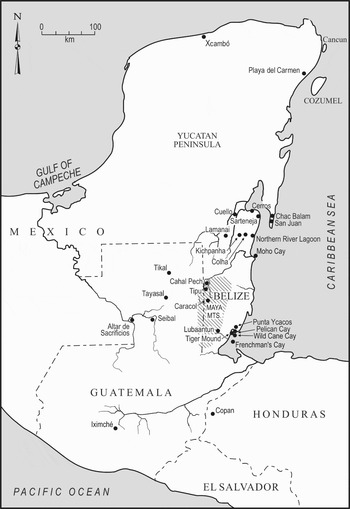
The teeth examined in this study are from burials associated with the construction and renovation of buildings, excavated from 1988 to 1992, from Fighting Conch Mound on Wild Cane Cay (see Figure 1). Wild Cane Cay is located in the Port Honduras, a small coastal bight in southern Belize. Numerous visits to the site over the past century have resulted in archaeological investigations at various levels of intensity (McKillop Reference McKillop1987, 1996b). Excavations between 1982 and 1992 indicated the island was a trading port for the long-distance transportation of obsidian and other goods along the Yucatan from the Late Classic period (a.d. 600–900) through the Postclassic period (a.d. 900–1500) and inland trade of salt from the nearby Punta Ycacos salt works and other marine resources during the Late Classic (McKillop Reference McKillop1987, 1996b, Reference McKillop2002, Reference McKillop2005). The community was a densely occupied 4.05 ha village, with orchards of native palms, calabash, avocado, and other trees (McKillop Reference McKillop1994). The maize identified from middens on the island was undoubtedly brought or traded from the mainland, as the entire island is a dense midden deposit that would have provided no room for growing field crops.
Maya sites mentioned in the text.

Excavations in Fighting Conch Mound, located on the eastern side of the central plaza, revealed the remains of six buildings and 15 graves, some including multiple interments (McKillop Reference McKillop2005). Each building was constructed sequentially over time on the demolished foundations of a previous building. The buildings had coral foundations that supported perishable pole-and-thatch structures, similar to those from nearby Frenchman's Cay (McKillop et al. Reference McKillop, Magnoni, Watson, Asher, Winemiller, Tucker, Awe, Morris and Jones2004). The coral rock foundations were faced with limestone slabs and sandstone from the adjacent mainland. Only the coral rock foundations, dirt floors, and thatch-impressed clay that had once covered the walls remained.
The burials in Fighting Conch Mound likely were the interments of members of the population at the island trading port (McKillop Reference McKillop2005). Most of the burials were placed in the coral foundations during structural rebuilding. In some cases, burial pits had been dug through floors for interments. The burials included individuals in flexed, seated, and prone positions. Additional skeletal remains and teeth in the graves indicated the practice of multiple burials, as at Caracol and other Maya sites (Chase and Chase Reference Chase and Chase1996). Some of the burials were in slab tombs or other rock enclosures. The rocks included limestone, sandstone, and mudstone. Other burials had stone markers placed above the interments, which were then covered by coral rock foundations. Exotic and valuable goods placed as offerings in the graves included obsidian, gold, and complete and smashed pottery vessels—notably, Fine Orange and Tulum Red (McKillop Reference McKillop2005).
The ages of the structures spanning the Terminal Classic through Middle Postclassic were estimated by radiocarbon dates from two floors and from pottery associated with burials. The earliest structure, Structure 1, was built on Classic-period middens. Charcoal from the floors of Structure 3 and Structure 4 dates the use of the buildings to a.d. 940–1260 and a.d. 590–990, respectively (McKillop Reference McKillop2005). The radiocarbon ages (calibrated to 2 standard deviations) overlap and suggest building construction at the Classic–Postclassic transition. A Fine Orange-type pottery vessel, typical of the Terminal Classic in the Maya Lowlands, was placed in a tomb associated with the construction of Structure 4. Vessels similar to Tulum Red were associated with burials from later structures, Structures 5 and 6.
METHODS
Skeletal preservation is poor at this site (Seidemann Reference Seidemann1999) and in general throughout the Maya region (e.g., Márquez Morfín Reference Márquez Morfín1991). Therefore, dental material is often the best source of information (Buikstra and Ubelaker Reference Buikstra and Ubelaker1994; Stojanowski et al. Reference Stojanowski, Seidemann and Doran2002). At Fighting Conch Mound, the dentition shows good preservation, thus representing the largest data set of the skeletal collection. Teeth are perhaps the most important part of the human skeleton in terms of the amount of data available for anthropological research, and they have provided important information on the ancient Maya in particular (Evans Reference Evans1973; Glassman and Garber Reference Glassman, Garber and White1999; Saul Reference Saul1972, Reference Saul and Hammond1975; Saul and Saul Reference Saul, Saul, Whittington and Reed1997; Storey Reference Storey1992; Whittington Reference Whittington and White1999). Teeth can yield information about diet, disease, and genetic affiliation of skeletal populations (Cucina et al. Reference Cucina, Blos and Sosa2003).
The preservation of the skeletal remains from Fighting Conch Mound at Wild Cane Cay is quantitatively poor; on average, only 7% of the possible diagnostic features for sex and age are available for examination (following the Seidemann et al. Reference Seidemann, Stojanowski and Sondergaard1999 method for the quantification of preservation). Because of this poor preservation, there are no sex- or age-specific examinations in this analysis. However, the dental sample was of sufficient size to allow for other analyses. In addition, the poor preservation of the sample made analyses of the dentition impossible for discrete individuals. Instead, the analysis here was undertaken on all of the available teeth as a single data set (with a few exceptions, noted later). We recognize that it is often more informative to conduct such analyses by discrete individuals and that that is often how similar analyses are done. However, such analyses cannot always be carried out in such a manner, and this research is an example of a sample that does not lend itself to such an approach.
The teeth of the Fighting Conch Mound individuals were examined for evidence of diet and health from a variety of macroscopic and microscopic observations, including dental wear, calculus, alveolar abscesses, alveolar resorption, and caries. The minimum number of individuals from the site is 26 (Seidemann Reference Seidemann1999); however, only the teeth from the 19 adults are examined in this study because deciduous teeth often lack age-accumulated indicators of diet and disease. In this study, the teeth are examined as a group to provide an overall assessment of the dental health of the population. Table 1 is an inventory of the teeth that make up the entire adult dental sample from the Fighting Conch Mound skeletal collection. As Table 1 illustrates, although there were 19 adult individuals based on a complete skeletal analysis (Seidemann Reference Seidemann1999), not every adult individual is represented by teeth in the sample analyzed. Due to the commingling and poor preservation discussed earlier, it was impossible in most cases to assign loose teeth to any one of the 19 adults.
Inventory of teeth analyzed from Fighting Conch Mound skeletal sample

Note: M = molar; P = premolar; C = canine; I = incisor.
Observations of wear, calculus, alveolar resorption, caries, and abscesses on the Wild Cane Cay teeth followed standard techniques (see generally, Buikstra and Ubelaker Reference Buikstra and Ubelaker1994). Since wear often relates to diet, it is referred to here along with the pathologies, even though it is a non-pathological dental change. The occlusal wear of the teeth was scored using the Molnar (Reference Molnar1971) eight-stage method.
Calculus is defined for this research as a mineralized form of plaque that derives from the saliva (Driessens and Verbeeck Reference Driessens, Verbeeck and ten Cate1989). Supra-gingival calculus was recorded using a four-stage scale (none, mild, moderate, considerable) based on Brothwell (Reference Brothwell Don1981).
A four-stage method (none, slight, medium, considerable) was used to document horizontal and vertical alveolar resorption (Brothwell Reference Brothwell Don1981). Horizontal resorption is characterized by a “simultaneous loss in height of all walls surrounding the tooth roots . . . and also implies that several neighboring teeth are involved, or even the whole arcade” (Hillson Reference Hillson1996:263). Vertical resorption, however, is characterized by localized bone loss around individual teeth and is not usually associated with horizontal loss (Hillson Reference Hillson1996). Only complete maxillae and mandibles could be scored accurately for alveolar changes, thereby reducing the sample size to nine dental arcades (from distinct individuals).
Dental caries rates were observed macroscopically and stereoscopically. Caries is formed by bacteria that are produced in dental plaque. These bacteria are responsible for the acid production that destroys tooth enamel, dentine, and cement, creating what are commonly referred to as “cavities,” or caries (Soams and Southam Reference Soams and Southam1993:19). Caries were only scored when they were large enough to be probed with the tip of a dental pick. The caries data were collected for each tooth individually, with a binary score (0 or 1) being assigned to each tooth for the presence or absence of caries on that tooth. The data-collection method was used to make the Fighting Conch Mound sample comparable to other published results.
The arcades were also examined macroscopically for alveolar abscesses. Alveolar abscesses are formed by infection that sets in below the gum line. These infections can be introduced in a number of ways, including through an exposed pulp cavity from attrition or caries or through food particles driven below the gum line (Dickel Reference Dickel1991). Alveolar resorption is associated with periodontal diseases that cause inflammation of the gum tissue (Brothwell Reference Brothwell Don1981). In addition, calculus can act as a significant irritant to the gums, thereby promoting alveolar resorption (Soams and Southam Reference Soams and Southam1993).
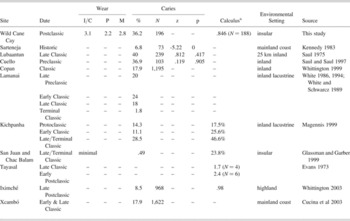
All of the observations were analyzed for side-specific and arcade-specific differences independently and then in concert for statistically significant relationships in the co-occurrence and absence of the various pathologies. For example, the amount of dental wear, frequency of caries, and calculus accretion were analyzed together because they are often related. The Fighting Conch Mound results were also compared with previously reported Maya dental studies (see Table 2).
Comparative ancient Maya dental data on wear, caries, and calculus

Note: I = incisor; C = canine; P = premolar; M = molar.
aThe percentages are the reported percentage of the sample that shows calculus, while the other figures are the overall mean calculus rate on the 0–4 scale for the entire sample.
RESULTS
Overall, the Maya from Fighting Conch Mound present a good picture of dental health. Dental wear was not severe (N = 159, χ¯ = 2.93, Standard deviation = 1.21). Most teeth showed very little wear. The minimal amount of wear observed on this sample must be tempered by the absence of age control due to the poor preservation of the skeletal remains. Because wear can be used as an aging tool (see, e.g., Lovejoy Reference Owen1985), it must be considered that minimal wear could be a function of young age at death rather than mastication of less abrasive foods. Chi-square (χ2) tests, Student's t-tests, and analysis of variance (ANOVA) tests were used to examine the relationships of individual tooth-wear characteristics. No significant difference was found (χ2 = 1.6; degree of freedom =1; p = .206) for wear differences between the maxillary and mandibular teeth.
We did find that the anterior teeth were more significantly worn (t = 2.55; df = 158; p = .012) than the posterior teeth. Breaking these results down further, we found that the incisors were the most heavily worn teeth. Although the canines were more heavily worn than the molars, and the molars were more heavily worn than the premolars, the only statistically significant difference was between the incisors and all of the other teeth using an ANOVA test (F-ratio = 2.857; p = 0.039) with post hoc tests (Tukey) showing incisors as the only significantly more worn teeth (p = .044). In addition, the squared multiple R statistic of .052 suggests that only about 5% of wear variation is related to tooth type. This is an unsurprising result, as most wear is related to age and diet, not position (Hillson Reference Hillson1996).
In addition, no significant difference was found (χ2 = .23; df = 1; p = .631) for wear between the left and right teeth of both arcades. These results are tempered by limited sample sizes, which cause suspicion in the stability of the results. That said, the data indicate little tendency for wear to differ by side or arcade. These results suggest no chewing-side preference in the Fighting Conch Mound individuals, in contrast to what has been documented among some modern Maya populations (Goldaracena et al. Reference Goldaracena, Rey and Martinez1984).
The occurrence of carious activity has been linked to the rate of occlusal wear (Meiklejohn et al. Reference Meiklejohn, Schentag, Venema, Key, Cohen and Armelagos1984). At least until the pulp cavity is exposed, as wear rates increase, carious activity decreases. This is because the caries-causing bacteria do not have time to destroy the tooth surface before it has worn away (Moore and Corbett Reference Moore and Corbett1975). Under that hypothesis, the limited dental wear of the Fighting Conch Mound Maya should suggest a greater susceptibility for caries in this sample. Indeed, the frequency of caries in the sample was high (36.2% of the teeth). However, carious and non-carious teeth in the Fighting Conch sample do not differ significantly in the level of dental wear.
We analyzed the Fighting Conch Mound data using a point-biserial correlation (Hammond and McCullagh Reference Hammond and McCullagh1978) and a Student's t-test to evaluate the association between caries presence and the severity of occlusal wear. The point-biserial correlation is a statistical technique that allows for the analysis of a binary variable (in this case, caries presence or absence) and a continuous variable (in this case, dental wear). The correlation between the wear score and caries presence was positive but small in magnitude (r = + .17; p = .045). This figure suggests some relationship between the two dental conditions in the Fighting Conch Mound sample. The relationship is positive, albeit very small, which suggests that as wear increases, carious lesions also increase in this sample, a somewhat surprising result that may be related to age (cf. Meiklejohn et al. Reference Meiklejohn, Schentag, Venema, Key, Cohen and Armelagos1984). The t-test, however, produced insignificant results (t = 1.58; df = 144.6; p = .116), indicating that the two groups (carious versus non-carious teeth) did not differ significantly in average-wear score. Although the point-biserial test did demonstrate some relationship between caries and wear, suggesting that the increase in caries with wear in this sample did not occur by mere chance, the data taken as a whole provide little support for a relationship between caries presence and wear severity for the Fighting Conch Mound teeth.
Basil Bibby (Reference Bibby1961:321) notes that “frequency of eating is an important factor in caries causation.” Unfortunately, this factor is not one that can be accounted for in the archaeological record. It is possible, however, that the high frequency of caries in the Fighting Conch Mound sample suggests repetitive eating throughout the day, as opposed to a few distinct meals. Although this cannot be corroborated in the archaeological record, it could provide an alternative explanation for a high caries rate at a site that shows lower than normal (for the Maya area) archaeological evidence of such cariogenic foods as maize. This is supported by Bibby, who, while documenting that carbohydrates are the primary causative agent for caries, noted that repetitive eating of lower-carbohydrate foods can also result in high caries frequencies.
The rate of calculus buildup in the sample was low (N = 188, χ¯ = .846, s.d. = .867). Generally, calculus was more prevalent in the expected regions, near salivary ducts (i.e., near the mandibular incisors and maxillary first molars). This occurrence was documented visually but could not be tested statistically due to small sample sizes when each area is individualized for analysis.
We examined the relationship between the frequency of carious teeth and calculus accretion in the Fighting Conch Mound sample using a point-biserial correlation and a Student's t-test. The correlation between the calculus scores and caries presence was negative but small in magnitude (r =− .22; p = .002). This figure suggests little relationship, albeit statistically significant, between caries presence and calculus accretion in the Fighting Conch Mound sample. Although weak, the correlation does demonstrate that as calculus increases, caries decreases (see also Evans Reference Evans1973). This is unsurprising, as calculus could have formed some measure of protective covering over affected areas of the teeth, restricting the opportunity for cariogenic bacteria to attack the tooth. The t-test produced significant results when comparing the presence of calculus on carious versus non-carious teeth (t = 2.31; df = 147.8; p = .023), a result that reflects the minimal, but present, correlation shown by the point-biserial correlation.
Increased alveolar resorption and calculus accretion have been intimately linked in the osteological literature (Hillson Reference Hillson1996). Alveolar resorption is the skeletal manifestation of advanced soft-tissue lesions extending between the tooth and the alveolus (Hillson Reference Hillson1996). Two types of alveolar bone loss are associated with such infections: horizontal and vertical bone loss. Only horizontal bone loss was present in the Fighting Conch Mound sample. Of the nine individuals with arcades that were complete enough to observe alveolar resorption, only 103 tooth sockets were intact enough to assess this pathology (rather than the 288 sockets that would be expected from nine complete dentitions). Alveolar bone loss was minimal in the sample (N = 103; χ¯ = 1.00; s.d. = 1.163). One individual, however, did show the rather severe pathological condition of alveolar abscessing. The abscessed area was associated with only one tooth.
Stephen Whittington (Reference Whittington, Nance, Whittington and Borg2003:278) notes that “irritation of gums by calculus is one cause of resorption of alveolar bone around teeth.” Because calculus accretion is indicative of the presence of lesion-causing plaque bacteria, we evaluated the co-occurrence of calculus buildup and alveolar bone loss in the Fighting Conch Mound sample to address the question of whether calculus is an indicator of a broader situation of poor dental health. A Spearman rank-order test yielded a moderate but positive correlation (p = 0.338).
DISCUSSION
Study of the teeth from the Postclassic burials in Fighting Conch Mound at Wild Cane Cay and from other Lowland Maya sites indicates spatial and temporal variability in ancient Maya diet and health. Frequencies of caries and dental calculus in particular provide tantalizing clues to dietary changes related to coastal versus inland diets and the varied landscape in which the ancient Maya lived. Due to the generally poor preservation of human skeletal remains from Maya sites, teeth, which are often better preserved, provide essential repositories for data on the people themselves. Dental observations of health and diet also corroborate carbon- and nitrogen-isotope signatures of bone and teeth (Coyston et al. Reference Coyston, White, Schwarcz and White1999) or provide conflicting information from faunal remains (Glassman and Garber Reference Glassman, Garber and White1999).
The recovery of abundant plant food and vertebrate and invertebrate (shell) animal remains (Lyons Reference Lyons2001; McKillop Reference McKillop1994, Reference McKillop and Fedick1996a; McKillop et al. Reference McKillop, Martin and Dinh1997) from Classic and Postclassic middens at Wild Cane Cay provides important clues to the diet suggested here from the dentition. If the Wild Cane Cay Maya had a diet rich in aquatic proteins, it should have assisted in protecting their teeth from carious activity. Such a supposition is based on the caries-retardant nature of high-protein foods (Alfano Reference Alfano and Menaker1980; Bibby Reference Bibby1961). It is thus somewhat perplexing that, at Fighting Conch Mound, the frequency of carious teeth is fairly high. It should be noted that simply having a high-protein diet does not preclude the development of caries. Perhaps this Caribbean island population relied more heavily on carbohydrate-rich agricultural products than is indicated by the plant-food remains.
It is altogether possible, at virtually any archaeological site, that the traditional evidence of plant foods (e.g., charred corn cobs) is absent because the initial preparation occurred off-site. It is impossible to account for this possibility using current archaeological methods. Thus, we must assume that what is in evidence in the site record is representative of the food that was consumed at the site during its existence.
This considered, the floral and faunal remains from Wild Cane Cay support reliance on marine fauna and a low reliance on maize (Lyons Reference Lyons2001; McKillop Reference McKillop1994, Reference McKillop and Fedick1996a; McKillop et al. Reference McKillop, Martin and Dinh1997). Besides the maize, plant remains include palm fruits—notably, cohune (Orbignya cohune); supa (coyol; Acrocomia mexicana); and poknoboy (Bactris major), which were recovered from middens in a greater abundance than maize at Wild Cane Cay. The heavy reliance of the Wild Cane Cay inhabitants on tree crops, which are soft foods that presumably adhere to the teeth, could account for the high caries rate, which would be exacerbated by the low amount of dental wear.
Cognizant of the potential hazards involved in oversimplifying dietary reconstructions and dental health based on observations of dental calculus (Lieverse Reference Lieverse1999), we feel that it is nevertheless important to report the data collected from this sample and to draw careful conclusions from these data according to the current understanding of calculus in anthropology, combined with the specific archaeological evidence from the individual area of Wild Cane Cay. Diet plays a role in the formation of calculus, although no one-to-one correlation exists between the two (Lieverse Reference Lieverse1999). Calculus formation is facilitated by an alkaline oral environment, a factor that can be caused by high levels of protein or high levels of carbohydrates, among other factors (see Lieverse Reference Lieverse1999 for a comprehensive review of dental calculus). Due to the generally slight amount of calculus present in the Fighting Conch Mound sample (N = 188; χ¯ = .846; s.d. = .867), one conclusion may be a less alkaline oral environment than other populations (e.g., Evans Reference Evans1973), perhaps indicating a more varied diet, with no overabundance of proteins or carbohydrates. Such a conclusion is supported by the plant-food remains from Wild Cane Cay (McKillop Reference McKillop1994), in which only moderate levels of proteins or carbohydrates are present in the most common plant foods, the palm fruits. Assuming that calculus levels are one of many indicators of the diet, the low general frequency in the Fighting Conch Mound sample may suggest a higher reliance on moderate carbohydrate plant foods and a lower reliance on the abundant fish and other marine fauna than is suggested by the archaeological findings. Such a scenario would reduce alkaline-causing proteins and carbohydrates, presumably leading to lower levels of calculus.
The variability in the Lowland Maya landscape provided the ancient Maya with access to different plant and animal foods, and this diversity is evident in a comparison of Maya teeth. The decision to exploit different wild or domesticated animals, fish, and plants was, of course, complex. Important factors included available technology (such as use of boats), social status, population size, and access to trade routes (Coyston et al. Reference Coyston, White, Schwarcz and White1999; Emery Reference Emery and White1999; McKillop Reference McKillop1985; Shaw Reference Shaw and White1999; Whittington Reference Whittington and White1999). The conditions that precipitated the collapse of many large inland Maya cities caused dietary and other stresses that are reflected in dental and skeletal remains (Whittington Reference Whittington and White1999). By way of contrast, there was continuity in settlement at many coastal communities, such as Wild Cane Cay, as well as at some inland communities connected to the Caribbean by inland waterways—notably, Lamanai. What were the dental and skeletal consequences of life for the Maya living at communities that persisted into the Postclassic? At Wild Cane Cay, there was an increased participation in long-distance sea trade and greater affluence of the island community, as shown by stone buildings, compared with earlier times (McKillop 1996b, Reference McKillop2005). The Caribbean island setting of Wild Cane Cay provided the ancient Maya people living there with a specific suite of nearby plant and animal foods. The Maya on Wild Cane Cay and other nearby islands—notably, Frenchman's Cay, Tiger Mound, and Pelican Cay—had limited land for agricultural fields; instead, they had tree crops and kitchen gardens, as shown by the abundant and well-preserved plant-food remains recovered from Late Classic and Postclassic middens (McKillop Reference McKillop1994, Reference McKillop and Fedick1996a, Reference McKillop2005).
Identification of plant and animal remains, as well as isotopic signatures of human bone and tooth enamel, suggests that there were different dietary strategies at coastal and inland Maya communities. Maize was important at most inland communities (Lentz Reference Lentz and White1999), but plant-food remains identified from Cerros and Cuello indicate that a variety of vegetal and tree crops contributed to the diet (Cliff and Crane Reference Cliff, Crane, McAnany and Isaac1989; Miksicek Reference Miksicek and Hammond1991). Animals in the Maya Lowlands were not uniformly distributed across the region, and this is reflected in the different compositions of coastal versus inland diets (McKillop Reference McKillop1984, Reference McKillop1985) and even inland communities located along lakes such as Lamanai and those farther inland, such as Tipu (Emery Reference Emery and White1999).
Although relatively few dental studies have been published on the ancient Maya, available evidence indicates that the frequency of caries varied temporally and spatially—and, at least in some cases, by social class, as well. The relatively high frequency of caries for the Postclassic Maya interred in Fighting Conch Mound on Wild Cane Cay is similar to Late Classic Lubaantun and Preclassic Cuello but significantly higher than other Maya sites. Other coastal sites, including San Juan and Chac Balam on northern Ambergris Cay and Sarteneja on the northern Belize coast, have much lower frequencies of caries, despite a similar opportunity to gain access to marine resources (Glassman and Garber Reference Glassman, Garber and White1999; Kennedy Reference Kennedy and Sidrys1983). Whittington (Reference Whittington and White1999) attributes a high frequency of caries at Copan to a heavy reliance on maize agriculture, corroborating the chemical isotope data (Whittington and Reed Reference Whittington, Reed, Whittington and Reed1997). Some 17.9% of the permanent teeth at Copan had caries. Most lower-class individuals at Copan had dental caries, including 68.2% of adults (Whittington Reference Whittington and White1999). Caries frequency was higher in the posterior teeth than in the anterior teeth. This pattern of dental caries is often associated with stone-ground maize (Whittington Reference Whittington and White1999). In addition, at the Late Postclassic highland site of Iximché, Whittington (Reference Whittington, Nance, Whittington and Borg2003) reports a comparatively low rate of caries. At Iximché, 8.5% of the teeth examined were carious.
Caries rates changed over time, but there is no pan-Lowland Maya pattern (see Table 2). Caries frequency at Copan was highest following the Classic-period collapse (Whittington Reference Whittington and White1999). By way of contrast, at Altar de Sacrificios and Lamanai, the caries rate was highest in the Early Classic (Saul Reference Saul1972; White Reference White, Kennedy and Lemoine1988, Reference White, Herring and Chan1994). At Lamanai, there was a 20% frequency of caries in the Late Preclassic, 24% in the Early Classic, 18% in the Late Classic, and 1.8% in the Terminal Classic (White Reference White1986, Reference White, Herring and Chan1994; White and Schwarcz Reference White and Schwarcz1989). The Terminal Classic drop in caries is attributed to a decline in maize consumption, which is consistent with chemical-isotope data suggesting that the Terminal Classic Lamanai Maya relied on kitchen gardening or a variety of field crops not dominated by maize. Isotope data from Lamanai skeletal remains indicate that the Postclassic Maya diet changed dramatically, with an increase in carbon-isotope values (especially of dietary collagen that is mainly due to dietary protein) and a decrease in nitrogen isotopes, suggesting more maize and/or reef fish, corroborated by the recovery of reef-fish bones from Postclassic deposits (Coyston et al. Reference Coyston, White, Schwarcz and White1999; Emery Reference Emery and White1999). The highest frequencies of caries are in the Maya Lowlands (Evans Reference Evans1973; Peña Saint Martin Reference Peña Saint1985). At Kichpanha in northern Belize, there was a decline in the frequency of caries from 14.3% in the Protoclassic to 11.1% during the Early Classic, followed by a dramatic increase to 28.5% in the Late to Terminal Classic (Magennis Reference Magennis and White1999). Andrea Cucina and colleagues (Reference Cucina, Blos and Sosa2003) report a frequency of caries of 17.9% at the coastal site of Xcambó for the Early Classic and Late Classic periods. The authors examined sex differences in oral pathologies and linked the higher frequencies of caries in females to a greater reliance on carbohydrates. The frequency of caries was much lower for Late to Terminal Classic adults at San Juan and Chac Balam on northern Ambergris Caye, with an overall caries rate of 4.9% (Glassman and Garber Reference Glassman, Garber and White1999). Glassman and Garber (Reference Glassman, Garber and White1999:125) explain that “the relatively low caries rate among the Ambergris Maya was due to the concentration of marine resources in the diet, which would have been less progressive in the decalcification of enamel than sticky, high-carbohydrate plant foods.”
Frank Saul and Julie Saul (Reference Saul, Saul and Hammond1991) report an almost identical frequency of caries for the Preclassic at Cuello (36.9%) to that present in the Fighting Conch Mound sample (36.2%). This similarity may be explained archaeologically as being due to the co-occurrence of tree-cropped products at both sites, a feature not commonly observed elsewhere in the Maya area (McKillop Reference McKillop1994, Reference McKillop1996b), although maize was certainly a popular food at Cuello (Miksicek Reference Miksicek and Hammond1991) and was present at Wild Cane Cay. As noted earlier, we cannot account for frequency of eating as a factor in caries occurrence. Thus, some amount of the higher frequency of caries at Fighting Conch Mound and Cuello could simply be explained by more frequent eating at those sites, a reality that we cannot verify archaeologically.
The following general relationship of maize consumption and dental wear and caries emerges from all of the Maya samples cited here: if maize consumption is high, then caries frequency will likely also be high. It is possible that some amount of caries frequency may be affected by stone grit in processed maize by causing increased dental wear and a correlative decrease in caries. However, a decrease in the frequency of caries does not necessarily mean that there was a comparatively higher reliance on stone-ground maize at one site over another, as nondietary factors (e.g., bruxism) may cause some of the wear (Hillson Reference Hillson1996). In addition, some amount of caries frequency may result from frequent eating more so than a higher overall concentration of carbohydrates in a diet (Bibby Reference Bibby1961). These factors make drawing conclusions regarding diet from caries and wear problematic, but not completely useless. Angela Lieverse (Reference Lieverse1999) notes, with respect to calculus, that a one-to-one relationship between diet and calculus does not exist. The same may be said of the relationship between diet and caries/wear. Although the correlation of these pathologies cannot directly provide definitive evidence of diet, they are a substantial factor that can certainly suggest past diet. Nonetheless, all of these pathologies are informative indicators of dental health and continue to provide some measure of insight into diet (the latter of which must be tempered by the aforementioned warnings).
Previous researchers have noted the negative association of calculus with caries and their role in interpreting ancient Maya diet (see, e.g., Evans Reference Evans1973; Whittington Reference Whittington, Nance, Whittington and Borg2003; Table 2). High rates of calculus and caries are often attributed to a diet rich in carbohydrates, such as maize (Goodman et al. Reference Goodman, Martin, Armelagos, Clark, Cohen and Armelagos1984; Schwartz Reference Schwartz1995) or a high protein/high carbohydrate diet (Lieverse Reference Lieverse1999). Other factors that increase the likelihood of caries are consumption of soft, sticky foods such as maize; consumpution of sugary foods; and characteristics of the dentition, such as deep grooves in the molars (Bibby Reference Bibby1961).
For the Maya region, there are reports on dental calculus at Tayasal (Evans Reference Evans1973), San Juan and Chac Balam (Glassman and Garber Reference Glassman, Garber and White1999), Kichpanha (Magennis Reference Magennis and White1999), and Iximché (Whittington Reference Whittington, Nance, Whittington and Borg2003). Although not all of these reports employ methods comparable to those used for the Fighting Conch Mound individuals, they do provide useful insight into this indicator of dental health.
David Evans's method for his study of Tayasal teeth is on a comparable (0–3) scale to the data collected for this study. Whittington (Reference Whittington, Nance, Whittington and Borg2003) similarly used Evans's results for comparison to the Iximché data. Evans (Reference Evans1973) found the mean rate of calculus for Late Classic individuals to be 1.7 (N = 4) and 2.4 (N = 6) for Early Postclassic individuals. Although some amount of calculus was observed on most of the Fighting Conch Mound individuals, the mean rate of calculus on the dentition is considerably lower (N = 188; χ¯ = .846; s.d. = .867) than both periods discussed by Evans (Reference Evans1973). A possible reason for the difference in means is the difference in the sample sizes. However, Evans (Reference Evans1973) suggests that the high rate of calculus in the Late Classic and Early Postclassic periods is a result of high carbohydrate levels and low protein levels in the diets of these individuals. In a collection with sample sizes larger than were recovered from Fighting Conch Mound, Whittington (Reference Whittington, Nance, Whittington and Borg2003) used the Evans (Reference Evans1973) scale for recording calculus accretion on the teeth excavated from Iximché. The mean calculus rate for the site was .98, a similar amount to that recorded on the individuals from Fighting Conch. This finding by Whittington (Reference Whittington, Nance, Whittington and Borg2003) appears to undermine the hypothesis that smaller sample sizes at Tayasal than that at Fighting Conch can be blamed for the difference in calculus rates at these sites, since the Iximché sample is much larger than that of Fighting Conch. Instead, Whittington's (Reference Whittington, Nance, Whittington and Borg2003) finding supports the hypothesis that variations in calculus rates between sites are related to differences in diet (Evans Reference Evans1973), despite the warnings of Lieverse (Reference Lieverse1999). Indeed, Whittington (Reference Whittington, Nance, Whittington and Borg2003:300) states that the individuals that he analyzed from Iximché “were more dependent on dietary maize” than individuals similarly analyzed from other Maya sites (particularly lowland sites). The similarity in the calculus rates from Iximché and Fighting Conch, where maize was a secondary dietary component to tree crops, may be explainable by the similarly varied diets of the Maya from these two sites. Whittington (Reference Whittington, Nance, Whittington and Borg2003) suggests, based on stable isotope analysis, that the Iximché diet was not deficient in protein. A similar diet (albeit one composed of tree crops and marine resources rather than maize and highland proteins) is in evidence from the floral and faunal remains of Wild Cane Cay.
Ann Magennis (Reference Magennis and White1999) examined the rate of calculus on Kichpanha teeth using a four-point scale (Dobney and Brothwell Reference Dobney and Brothwell1987) similar to that used for the Wild Cane Cay teeth. However, she recorded trace amounts of calculus as “none,” and since there was little variation in the amount of calculus on the Kichpanha teeth, Magennis (Reference Magennis and White1999) summarized the results as present or absent calculus. This difference in reporting makes it difficult to compare her results with those from Wild Cane Cay. At Kichpanha, there was an increase in the presence of calculus on teeth from 17.5% in the Protoclassic, to 25.6% in the Early Classic, to 46.6% in the Late/Terminal Classic. The low rates of both caries and calculus in the Protoclassic and Early Classic were attributed to a mixed diet of maize and other plant foods, as well as animal protein. Magennis suggests that maize was more important during the Late/Terminal Classic, as measured by an increase in caries and calculus at that time. A change in maize processing—one that resulted in phytate removal from the food—either in the Late/Terminal Classic (Magennis Reference Magennis and White1999) or during the Postclassic (White and Schwarcz Reference White and Schwarcz1989) may have contributed to a reduction in calculus formation on teeth. Since trace amounts of calculus on Kichpanha teeth were recorded as absence of calculus, the actual rate of dental calculus at that site may be higher. Perhaps the low rate of calculus for the Fighting Conch Mound teeth at Wild Cane Cay may be attributed to a change in corn processing in the Postclassic period.
Glassman and Garber (Reference Glassman, Garber and White1999) scored calculus as present or absent for their Late to Terminal Classic Ambergris Caye sample, so their results are not directly comparable to the four-stage scale used for the Fighting Conch Mound teeth or to Evans (Reference Evans1973). They found that 23.8% teeth had calculus deposits. The high rate of calculus coincided with low rate of caries, a pattern they compare to Tayasal and Lamanai (White Reference White1986). Glassman and Garber (Reference Glassman, Garber and White1999) find the high rate of calculus inconsistent with their interpretation of a diet high in marine-animal protein and low in starchy carbohydrates such as maize. Elsewhere in the Maya area, Julie Saul and Frank Saul (Reference Saul, Saul, Whittington and Reed1997:42–43) report that dental calculus was present on “virtually all individuals” in the Cuello sample and was associated with alveolar bone loss.
There are few data for the Lowland Maya on alveolar resorption and abscesses, although they have clear associations with caries, calculus, and dental health and diet (see Table 2). Saul (Reference Saul and Culbert1973) reports alveolar resorption in 71% of the individuals from the site of Altar de Sacrificios. This figure is lower than the presence in 100% of the nine Fighting Conch individuals examined. However, Whittington (Reference Whittington, Nance, Whittington and Borg2003) also reported alveolar resorption in 100% of the individuals from Iximché. Lourdes Márquez and colleagues (Reference Márquez, Peraza, Gamboa and Miranda1982) and Márquez Morfín (Reference Márquez Morfín1991) also note a fairly high amount of resorption (90%) in a skeletal sample from Playa del Carmen. We were able to calculate a Spearman correlation test to examine the relationship between alveolar resorption and calculus accretion in the Altar de Sacrificios sample. The data from Altar yielded a moderate positive correlation (p = 0.409) of alveolar resorption and calculus accretion.
Few data exist on the rates of alveolar abscesses in the Maya area. For that reason, only the percentages from other sites are shown to place the Fighting Conch Mound individuals into perspective. Abscesses were identified at Colha in 30% of the population (Massey and Steele Reference Massey, Steele, Whittington and Reed1997), at Altar de Sacrificios in 13.3% of the population (Saul Reference Saul1972), and at Cuello in 4.2% of the population (Saul and Saul Reference Saul, Saul, Whittington and Reed1997). In Rebecca Storey's (Reference Storey and White1999) study of the Late Classic Copan elites, 35–57% of females and 27–33% of males have abscesses. Fighting Conch Mound ranks among the lowest of these sites for alveolar abscesses (5.3% of the population, by individual), suggesting generally better periodontal health at Wild Cane Cay. Such a conclusion, based on alveolar abscesses, is a reflection of other dental problems, such as caries frequency and dental wear.
CONCLUSION
The teeth provide valuable insights into the life ways of the ancient inhabitants of Wild Cane Cay. In general, the condition of the dentition indicates that the Fighting Conch Mound people had healthier teeth than those of other people in the Maya area.
Conclusions regarding the diet of past peoples based on pathological conditions observed, as noted earlier, are often difficult. Despite the limitations of such interpretations, some evidence of diet does exist in the pathological record of the teeth. Diet does, to some degree, affect caries frequency, dental wear, alveolar resorption, and calculus accretion (Bibby Reference Bibby1961; Hillson Reference Hillson1996; Lieverse Reference Lieverse1999), and to the extent that it does, the following conclusions regarding diet from the Fighting Conch Mound teeth are made.
The high frequency of caries likely suggests that these individuals were subsisting on a mixed diet. In addition, because most of these caries were small, it is unlikely that they detrimentally affected the general health of the Fighting Conch Mound people.
Although the archaeological record suggests that a higher concentration of faunal (presumably marine) resources were consumed by the Fighting Conch people when compared with their inland Maya contemporaries, the high frequency of caries also suggests their subsistence on an array of plant foods—notably, palm fruits and other tree crops—rather than the inland staple of maize. This proportion may be better reflected from the dental findings than in the archaeological record.
The low rate of dental calculus among the Fighting Conch people (compared with inland Maya) suggests that they were probably subsisting on fewer carbohydrate-rich crops (notably, maize) than their inland contemporaries. The generally low incidence of calculus is inconsistent with Evans's (Reference Evans1973) contention that low wear may result in higher calculus rates.
The overall picture of the population excavated from Fighting Conch Mound is of good dental health. Evidently, these island Maya had access to less destructive foods, resulting in less dental wear and less calculus compared with the inland Maya. In contrast to a heavy inland reliance on maize, with its associated high caries, the Wild Cane Cay Maya had access to seafood but also relied heavily on tree crops. In this regard, the low frequency of caries and high calculus at San Juan and Chac Balam are surprising, given access to similar maritime resources and similar island settings—although Wild Cane Cay is located on a significantly smaller island. Perhaps Ambergris Cay provided enough land to grow maize instead of the pattern of tree-cropping at Wild Cane Cay and other small islands in the Port Honduras of southern Belize. The lack of plant-food remains at Chac Balam and San Juan is unfortunate.
While most inland cities in the southern Maya Lowlands were abandoned with the Classic Maya collapse, the trading port on Wild Cane Cay continued and even expanded long-distance sea trade during the Terminal and Postclassic periods (McKillop Reference McKillop, McAnany and Isaac1989, 1996b, Reference McKillop2005). With abandonment of nearby inland Classic-period cities, coastal-inland trade of salt and other materials ended, but the Wild Cane Cay people continued and even expanded their participation in long-distance trade during the Terminal Classic and Postclassic periods (McKillop Reference McKillop, McAnany and Isaac1989, 1996b, Reference McKillop2005). The good dental health and dental indicators of diet suggest that the Classic Maya collapse probably had little deleterious impact on the diet of the Wild Cane Cay Maya.
RESUMEN
En este estudio se examinaron indicadores dentales de salud y subsistencia de los Mayas del período posclásico localizados en la isla Wild Cane Cay en Belice. Un total de 213 dientes pertenecientes a 26 individuos fueron recobrados de la colina de Fighting Conch. Debido a que los dientes de leche no poseen indicadores acumulativos de dieta o enfermedades, estos fueron excluidos del estudio reduciendo la muestra a 188 dientes provenientes de adultos. Estudios paleodontales demostraron desgaste dental, sarro, recesión alveolar, caries, y abscesos alveolares en dichas piezas dentales. La menor cantidad de patologías encontradas en los mayas residentes de la colina de Fighting Conch sugirieron que esta comunidad poseía una dieta más sana que sus contemporáneos del interior de la región centroamericana. El mejor estado de salud dental de los Mayas de Wild Cane Cay se debió principalmente a su ubicación isleña en el Caribe. El abandono de las ciudades mayas en el interior de la región centroamericana, conjuntamente con el colapso de su cultura clásica condujo al fin del comercio en el sur de Belice; sin embargo, la colonia de Wild Cane Cay no solo sobrevivió sino que expandió y prosperó debido a la participación de la isla en el comercio marítimo durante el período posclásico. Los restos animales y vegetales encontrados indican una continúa explotación de productos agrícolas y marinos.
ACKNOWLEDGMENTS
The skeletal material was excavated with permits and assistance from the Belize government, Department of Archaeology, for which we are grateful. Funding for the excavations was generously provided by Earthwatch and Louisiana State University. The authors thank Christopher M. Stojanowski, School of Human Evolution and Social Change, Center for Bioarchaeological Research, Arizona State University, for considerable donations of time to assist in the statistical analyses contained in this paper; Mary Lee Eggart, Department of Geography and Anthropology, Louisiana State University, for creating the map; and Angelica Giraldo, Nicolas and Hilda Kariouk, and Michael Brooks for assistance with the Spanish abstract. We also acknowledge the thoughtful commentary of Rafael Cobos, Rebecca Storey, Stephen Whittington, and one anonymous reviewer. Their insight was helpful in refining this manuscript. Seidemann is grateful to his thesis committee members, Mary Manhein and Rebecca Saunders, for their insightful comments. Thanks also to Ericka, Michael, and Diane Seidemann for their support, both financial and moral.