Introduction
A consanguineous marriage is usually defined as a marriage between people who are related as second cousins or closer (Bittles, Reference Bittles2001). Close-kin marriages occur among diverse ethnic groups, numbering over a billion persons worldwide. It is estimated that at least one-fifth of the human population live in communities with a preference for consanguineous marriages and some 10.4% of the 6.7 billion global population are related as second cousins or closer (inbreeding coefficient, F≥0.0156) (Bittles & Black, Reference Bittles and Black2010). The proportion of consanguineous marriages varies from one population to another, depending on religious, cultural and geographical conditions. Noticeably, many Middle Eastern, Arab and North African countries display some of the highest rates of consanguineous marriages in the world, ranging from 20 to 50% of all marriages (Bittles, Reference Bittles2011), with first-cousin marriages being the most frequent type of close-kin marriages, showing an average rate in some countries of about 20–30% among all marriages (Tadmouri et al., Reference Tadmouri, Nair, Obeid, Al Ali, Al Khaja and Hamamy2009).
Traditional societies, known for their clan/tribe endogamy and high consanguinity rates, are also distinguished by a large family size; endogamy and consanguinity may result in congenital and genetic disorders. Several studies have been conducted on the effect of consanguineous marriages on early-onset diseases, mostly autosomal recessive disorders (ARDs). Inbreeding has also been investigated for playing a role in the aetiology of some multifactorial disorders (Rudan et al., Reference Rudan and Campbell2006; Bener et al., Reference Bener, Hussain and Teebi2007).
Consanguinity increases the level of homozygosity in the offspring of related couples (Ben Arab et al., Reference Ben Arab, Masmoudi, Beltaief, Hachicha and Ayadi2004). As a result, ARDs such as rare and previously unreported syndromes and metabolic defects occur at higher frequencies (Bittles & Hamamy, Reference Bittles, Hamamy and Teebi2010). Chromosomal aberrations are also a frequent type of genetic disorder, with Down syndrome being the most common chromosomal abnormality in humans. While the relationship between consanguinity and ARDs is well defined, an association between inbreeding and the occurrence of the non-disjunction mechanism causing Down syndrome has not been established (De Braekeleer et al., Reference De Braekeleer, Landry and Chalotte1994).
As in many Middle Eastern and North African countries, consanguineous and endogamous marriages are a common and respected practice in Tunisia, associated with cultural, social, economic, religious, geographical and demographic factors (Chaabouni-Bouhamed, Reference Chaabouni-Bouhamed2008). Several studies have been conducted in the country showing that the average level of consanguinity ranges from 24.81% to 32% (Riou et al., Reference Riou, El Younsi and Chaabouni1989; Ben Halim et al., Reference Ben Halim, Ben Alaya Bouafif, Romdhane, Kefi Ben Atig, Chouchane, Bouyacoub and Arfa2013). These relatively high rates have led to the emergence of several genetic disorders, as shown by Romdhane & Abdelhak (Reference Romdhane and Abdelhak2011), who found that among 346 genetic disorders described in Tunisia, 63% had an autosomal recessive character, leading to the question of to what extent marriage practices influence the relatively high frequency of ARDs. The aim of this study was to evaluate (1) the proportion of consanguinity among Tunisian patients affected by an ARD confirmed by molecular diagnosis compared with Tunisian patients affected by Down syndrome; and (2) the mutational profile (homozygosity vs compound heterozygosity) when comparing patients of related and unrelated parents, to gain more insight into the effect of marriage patterns on genetic variation.
Methods
The study was carried out at the department of Congenital and Hereditary Disorders, Charles Nicolle Hospital, Tunis and at the laboratory of Human Genetics (LR99ES10) in the Faculty of Medicine of Tunis, University of Tunis El Manar. A total of 290 children affected by one of the following ARDs were included in the study: Familial Mediterranean Fever (FMF) (MIM #249100; 72 patients), Congenital Adrenal Hyperplasia (CAH) (MIM #201910; 94 patients), Spinal Muscular Atrophy (SMA) (MIM #253300; 64 patients), hearing loss due to mutations in the connexine 26 gene (DFNB1) (MIM #220290; 24 patients) and Bardet-Biedel Syndrome (BBS) (MIM #209900; 36 patients). All affected patients that were referred to the Department of Hereditary Disorders by physicians from different regions of the country up until 2010 with a detailed clinical file were included in this study. Genetic testing confirmed the molecular basis of the disease and the genotype status was established for all patients. As a control group, 248 couples with a child affected by Down syndrome (confirmed by cytogenetic analysis) were included in the study.
Information on the patients was taken directly from the parents and from medical files. This included: type of disorder, results of molecular or cytogenetic analysis, and pedigree. Related parents were defined as: related as second cousins or closer (F≤1/64), and couples were recorded as either double first cousins (F=0.125), first cousins (F= 0.0625), first cousins once removed (F=0.03125) and second cousins (F=0.0156). The inbreeding coefficient F was calculated based on the pedigree described by Wright (Reference Wright1922). Patients whose parents were born in the same village were considered to share the same geographical origin. The statistical package SPSS-20.0 was used to analyse the data. Descriptive analyses were done to describe the sample and a chi-squared test was performed to assess association between consanguinity and homozygosity; p-values less than 0.05 were considered statistically significant.
Results
The analysis of the first set of data concerning patients affected by an ARD showed that among the 290 patients 58% (168/290) were the offspring of consanguineous parents (Table 1). As expected, marriages between first cousins represented the largest group, constituting 70% (117/168) of all consanguineous marriages. Analysis of the group of patients with Down syndrome revealed that 22% of patients had consanguineous parents (54/248), of which 56% (30/54) were first-cousin marriages.
Consanguinity rates among patients affected by an autosomal recessive disorder

It was also found that among the parents of the 122 non-consanguineous parents of patients affected by an ARD, 63% (77/122) shared the same geographical origin. Information on geographical origin of two patients was not available. Of the unrelated parents of patients affected with Down syndrome, 58% (112/194) shared the same geographical origin.
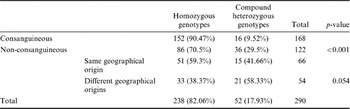
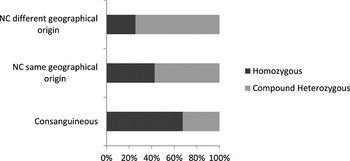
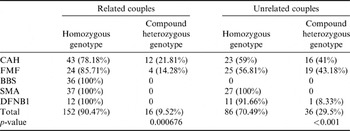
Among patients born to consanguineous parents, 90.47% (152/168) were found to be homozygous and 9.52% (16/168) of the patients were compound heterozygous for the identified mutations. Among the group of patients born to unrelated parents, 70.5% (86/122) were homozygous for their identified mutation and 29.5% (36/122) were found to be compound heterozygous (Table 2). Figure 1 shows the different percentages for homozygous and compound heterozygous mutations comparing children from consanguineous parents, unrelated parents with the same geographical origin, and unrelated parents with a different geographical origin. The relative frequency of heterozygosity is greater in the offspring of consanguineous parents compared with those of unrelated parents. Furthermore, the frequency is greater in the offspring of unrelated parents from similar geographical backgrounds compared with those with different origins. Detailed data are shown in Table 3.
Frequencies of homozygous and compound heterozygous genotypes among total patients with an autosomal recessive disorder

Percentages of homozygosity and compound heterozygosity among different patient groups: non-consanguineous (NC) parents with different origins; non-consanguineous parents with the same geographical origin and consanguineous parents.

Frequencies of homozygous and compound heterozygous genotypes among patients with each autosomal recessive disorder separately born to consanguineous and non-consanguineous parents

Discussion
This study found the proportion of consanguineous marriages among a sample of Tunisian patients affected by an ARD to be 58%. The proportion of consanguineous marriages among patients affected by Down syndrome was 22%, approximating the level of consanguinity previously estimated in the population (24–32%). The results once more show the positive association between consanguinity and ARDs, supporting previous studies that describe the high rates of consanguineous marriages among patients with ARDs – particularly in North African and Middle Eastern populations (Mokhtar et al., Reference Mokhtar, Kotb and Ismail1998; Bener & Alali, Reference Bener and Alali2006; Jaouad et al., Reference Jaouad, Elalaoui, Sbiti, Elkerh, Belmahi and Sefiani2009). While previous studies have suggested a relationship between consanguinity and Down syndrome (Maximilian et al., Reference Maximilian, Pop, Duca, Simionescu, Danielescu and Ioan1981), a few studies have established a lack of association between the two (Chéhab et al., Reference Chéhab, Chokor, Fakhouri, Hage, Saliba and El-Rassi2007). The present study found no indication of a relationship between consanguinity and Down syndrome.
The frequency of compound heterozygosity among patients is dependent on the inbreeding coefficient F of the parents. In this study, a tendency was discovered towards an increase in homozygosity when parents were more closely related: among consanguineous parents, percentages of homozygosity are highest, while among parents with non-similar geographical backgrounds they are lowest, reflecting the high rate and extended practice of consanguineous marriages, namely the redistribution of the disease alleles and the increase in the proportion of homozygosity with a reduction of the proportion of the heterozygosity. As mentioned above, this study showed rather restricted inter-community marital behaviour, which has seemingly led to an increase in the proportion of homozygous genotypes among patients with ARDs. The effects of marrying within the same community or locality on genetic variation patterns are understudied. However, a recent study conducted in India on a caste known for avoiding both consanguineous and exogamous marriages showed that individuals from these communities are genetically very similar (Pemberton et al., 2012). Intra-community marriages are the custom where consanguineous marriages are favoured (Bittles, Reference Bittles2009). The data presented in this study show that the proportion of marriages between individuals sharing the same geographical origin represented 63% of all non-consanguineous parents of children with an ARD in this population. This result was found to be not significantly different from the proportion of marriages between parents sharing the same geographical origin among Down syndrome patients. Those observations show restricted inter-community marital behaviour among the parents, a behaviour that is indeed typical in most North African and Middle Eastern countries (Bittles, Reference Bittles2005).
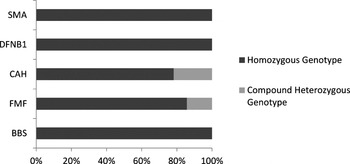
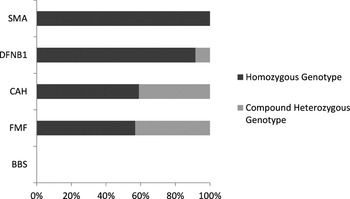
However, the proportion of homozygosity/compound heterozygosity also depends on the number of disease alleles (n) and their relative frequencies (q). When displayed for the different disorders this becomes clear, and detailed results are summarized in Table 3. Figures 2 and 3 show how the proportion of homozygosity is high among consanguineous and non-consanguineous patients affected with SMA – a less frequent disease caused by a single frequent disease allele. The picture becomes more understandable with FMF and CAH patients. Differences in the proportions of homozygous and compound heterozygous could be seen between consanguineous and non-consanguineous patients for these two frequent diseases with several disease-causing mutations. A recent study has indeed explored the relationship between the inbreeding coefficient F, n and q (Petukhova et al., Reference Petukhova, Shimomura, Wajid, Gorroochurn, Hodge and Christiano2009). The work showed how among inbred individuals, the probability that an affected person is homozygous for the single disease allele approaches 1 as F approaches 1 and consequently the probability that this patient is compound heterozygous approaches 0. In the same study the authors reported that among a randomly mating population the proportion of people carrying a recessive disease due to a compound heterozygous mutation depends on the number of disease alleles as well as their frequencies in the population. It has been shown that in the case of a gene with n disease-causing mutations the probability that a patient carries a compound heterozygous mutation converges to 1 as n approaches infinity. For example, in the case of a locus that has ten different disease alleles, the probability of a patient carrying a compound heterozygous mutation is 0.9, and thus the probability of that patient being homozygous is 0.1. In the case of a more frequent disease caused by several frequent mutations, the proportion of compound heterozygous drops dramatically with the smallest increase in F. For example, in the case of a recessive condition caused by ten disease alleles the probability that a patient carries two different mutations goes from 90% when F approaches 0 to 7.5% when F=0.1. Patients affected by rarer diseases caused eventually by several rare alleles are likely to be homozygous born to consanguineous parents since homozygous mutations are more likely to be carried by alleles identical by descent inherited from the same ancestor.
The distribution of homozygosity and heterozygosity among the five different studied diseases for consanguineous patients. See Methods for definition of abbreviations.

The distribution of homozygosity and heterozygosity among the five different studied diseases for non-consanguineous patients. See Methods for definition of abbreviations.

A limitation of this study is first that the list of diseases is not exhaustive, representing some of the more common disorders in the population. Second, even though the study department is considered the primary centre for genetic testing and counselling in Tunisia, it is not unique in the country so it is not possible to know which selection of patients may have been missed. Third, by looking solely at the genotypes it is in fact difficult to predict whether homozygous alleles are actually identical by descent or, rather, are identical by state and have been by chance the same because they are frequent in the Tunisian population. Fourth, the notable excess of homozygosity among the patients could be assigned, in addition to consanguinity, to possible population substructure – an aspect that was not taken into account in this study.
This study found that consanguinity was prevalent among the study sample of Tunisian patients affected by ARDs, and also found a restricted inter-community marital pattern among both groups of patients. The results suggest that both marital patterns have probably led to a reduction in genetic heterogeneity and thus a homogenization of the genetic pool of the patients. Further studies are needed for a better understanding of the way in which marriage practices affect patterns of genetic variation.
Acknowledgments
The authors would like to thank all the patients and their families and to acknowledge all the members of the Laboratory (LR99ES10) and the Department of Hereditary and Congenital Disorders collaborators for their contribution to this work. They would like also to express their sincere gratitude to Professor Leo P. Ten Kate and to Marieke Teeuw for their valuable comments and suggestions. This work was supported by the Tunisian Ministry of Higher Education and Scientific Research (Research Laboratory on Human Genetics Faculty of Medicine of Tunis) and the Ministry of Health (Department of Congenital and Hereditary Disorders, Charles Nicolle Hospital, Tunis).