




No CrossRef data available.
Article contents
Persistent electrical and morphological atrial abnormalities after early closure of atrial septal defect
Published online by Cambridge University Press: 21 January 2005
Abstract
Atrial arrhythmias are associated with enlarged atrial chambers and an increased duration of the P wave. Repair of atrial defects within the oval fossa is expected to normalize atrial size. Few studies, however, have evaluated electrical and morphological atrial features after repair. Our study was performed to determine if atrial abnormalities exist after surgical closure of such atrial septal defects, and whether early closure improves outcome. We recruited patients who had undergone surgical closure of a defect within the oval fossa, so-called “secundum” atrial septal defects. Electrocardiograms, signal averaged electrocardiograms, and echocardiograms were performed. Two-tailed test and Pearson correlation was utilized for statistical analysis. The population consisted of 20 patients and 27 controls, with the mean age of the patient being 11.25 ± 5.10 years, their age at surgery 6.55 ± 5.10 years, and the time since surgery 4.70 ± 2.61 years. The size of the right (23.88 ± 6.35 ml/m2 versus 18.84 ± 4.43 ml/m2) and left (21.91 ± 12.47 ml/m2 versus 17.72 ± 4.83 ml/m2) atrium were significantly larger in the patients. The duration of the P wave (108 ± 16 ms versus 96 ± 8 ms) and the duration of the PR interval (155 ± 18 ms versus 138 ± 23 ms) were longer. No correlation existed between age or interval since surgery with atrial sizes or measurements of the signal averaged electrocardiogram. We conclude that, despite surgical repair, abnormalities exist in patients with an atrial septal defect. Early surgery does not appear to prevent the atrial abnormalities.
Information
- Type
- Original Article
- Information
- Copyright
- © 2004 Cambridge University Press
Interatrial communications account for one-tenth to one-sixth of all congenital cardiac defects. In many cases, the atrial septal defect is discovered as an incidental finding on physical examination, with the patient having little to no clinical symptoms of cardiac compromise.1 Referral to the cardiologist for assessment of a murmur may be the only sign. Recommendations for closure of such defects vary depending on clinical findings and age of the patient.2, 3 It is generally agreed that patients with large ratios of pulmonary to systemic flows of blood, enlarging right-sided chambers, or clinical symptoms of congestive cardiac failure, should have the defect closed in childhood or when the diagnosis is made. In the asymptomatic adult with an atrial septal defect, recommendations for closure are more controversial. Risks for surgically closing a small atrial septal defect in adults may not outweigh the benefits, but more studies are showing improvement in clinical symptoms, even with small defects, after repair.4, 5 With interventional closure of an atrial septal defect using catheterization becoming more prevalent, recommendations for patients with an asymptomatic defect will continue to change.6, 7
Patients with open atrial septal defects have an increased incidence of atrial tachyarrhythmias,8 with prevalence ranging from one-fifth to half of patients greater than 40 years of age. By comparison, only one-tenth of the normal population have such arrhythmias by their seventh decade. Electrophysiological abnormalities, such as prolonged sinu-atrial conduction, and increased atrial functional refractory periods, have been reported in pre-operatively in patients with an atrial septal defect.9, 10 In adults, pre-operative atrial fibrillation tends to have persisted after closure, albeit that other atrial tachyarrhythmias may resolve. A higher incidence of arrhythmias has also been reported in children after closure.11–14
Dilation of the atrial chambers may increase the dispersion of atrial refractoriness, which is a known risk factor for atrial arrhythmias. Canine models have shown abnormal electrophysiologic properties when the atriums are stretched.15 Dilation of the atriums most likely increases the substrate for atrial fibrillation.16, 17 Good correlation by cross-sectional echocardiographic measurements of linear dimensions or volumes with the prevalence of atrial fibrillation has also been reported.18, 19
The signal averaged electrocardiogram provides a means of examining electrical activity of the myocardium beyond the ability of standard electrocardiogram. Such signal averaging essentially improves the ratio of signal to noise by averaging the cycles recorded. Random signals produced by contraction of peripheral and respiratory muscles, electronic noise from recording equipment, and various harmonics, are minimized. Both in adults and children with congenital cardiac malformations, signal averaged electrocardiograms showed an increased duration of the filtered P wave that was statistically significant between those with versus those without atrial tachyarrhythmias.20–25 Our study was performed to determine if atrial abnormalities exist after closure of atrial septal defects, and whether early surgery improves outcome.
Methods
The Investigational Review Board at our institution approved the following protocol. Patients who had undergone surgery from July 1991 to 2001 for a closure of an atrial septal defect in the oval fossa with no other cardiac malformations were contacted by letters. All patients with systemic illnesses or with pre-operative arrhythmias were excluded. Charts were reviewed on eligible patients who enroled. Age at the time of surgical repair and interval since surgery were documented. Patients underwent surgery because of worsening clinical symptoms, increasing right-sided enlargement, or both. All patients had a bi-caval cannulation. The defects had been described as moderate to large, and all were closed with a patch. No complications were reported during or after the surgical procedure. All patients were in good health at follow-up.
A 1200 EPX high-resolution electrocardiograph (Arrhythmia Research Technology, Inc., Fitchburg, MA, USA) was used for all data recordings and analysis. Leads were placed to obtain three orthogonal vectors in the x (fourth intercostal space in both mid-axillary lines), y (left iliac crest and superior aspect of the manubrium), and z (standard V2 and posterior, between clavicles) axis. The QRS complex was used as the trigger for the signal averaging process. Recordings were made until the level of noise was less than 0.3 μV. Band pass filtering was from 40 to 100 Hz. Measurements were made by hand. The duration of the filtered P wave was measured from onset of initial deflection from baseline, disregarding baseline noise, to return to baseline. The amplitude was measured from baseline to peak signal (Fig. 1). The axis that contained the longest and largest signal, respectively, was used for subsequent analysis. This would correspond to the vector that was most parallel to the signal. If inadequate signals were obtained, we excluded the reading. One single blinded observer evaluated signal averaged electrocardiograms of all controls and patients.

Figure 1. Example of the tracing of a signal averaged electrocardiogram and the intervals that were measured. FPRD: duration of filtered PR interval; FPWD: duration of filtered P wave; FPWV: voltage of filtered P wave.
Echocardiographic images were obtained using either a Hewlett-Packard Sonos model 4500 or 5500 machine. Standard apical four-chamber views were obtained to measure right and left atrial volumes, and two-chamber views were obtained to measure left atrial volumes.26 Sizes were traced and the modified Simpson method using a single plane was used to calculate atrial volumes. When possible, both right and left atrial volumes were imaged simultaneously. Atrial volumes were measured at maximal dimensions and at the onset of the P wave, and minimal volumes in the two- and four-chamber views (Fig. 2). The maximal atrial volume was defined as point of atrioventricular valvar opening. The P wave volume was at the onset of the wave, and minimal volume was at atrioventricular valvar closure. We excluded measurements if the endocardial border could not adequately be visualized. The echocardiographic measurements for both groups were made by two non-blinded observers.

Figure 2. (a) Two-chamber view of left atrium with measurements of maximal atrial volume as well as (b) four-chamber view of right and left atrium with corresponding measurement of right atrial volume.
The two-tailed t-test was used to compare controls and patients, using the Pearson correlation method with linear regression analysis if significant relationships were present between continuous variables. Values are given as means with their corresponding standard deviations unless otherwise stated. Significant values were defined as having a p value of <0.05.
Results
Demographics
Surgical closure had been undertaken in 198 patients over the 10-year time span. Of these, 41 responded to the initial inquiry for participation, with 19 subsequently being unable to participate because of various logistical issues. The population, therefore, consisted of 22 patients. We excluded two of these, one because of junctional rhythm present pre- and post-operatively, and the other because of a new diagnosis of juvenile rheumatoid arthritis treated with multiple medications. Thus, we studied a total of 20 patients and 27 controls. There was no significant difference between patients and controls for gender, age, or body surface area. No patient was on anti-arrhythmic medications, nor did any have documented episodes of atrial tachyarrhythmias. Age at surgery had been 6.55 ± 5.10 years, the interval since surgery was 4.7 ± 2.61 years, and the age at follow-up was 11.25 ± 5.10 years.
Signal-averaged electrocardiograms
Signal averaged electrocardiograms values were measured for 17 patients and 16 controls. The durations and amplitudes of the filtered P wave were consistently longest and largest, respectively, in the y-axis (Table 1). This signifies the most parallel axis to the P wave vector; and subsequent calculations, therefore, used these values. There was no significant difference in the voltages between patients and controls (0.16 ± 0.07 mV versus 0.13 ± 0.05 mV – Table 1). The durations of the PR interval (155 ± 18 ms versus 138 ± 23 ms) and the P wave itself (108 ± 16 ms versus 96 ± 8 ms) were significantly longer in the patients versus their controls (Table 1). There continued to be a significant difference between patients and controls when taking the root mean square of these values.
Table 1. Results with the signal-averaged electrocardiogram.

Echocardiogram
Adequate images of the left and right atrial chambers were obtained from a minimum of 18 controls and of 20 patients (Table 2). No patient had a residual shunt. Only trivial tricuspid and/or pulmonary insufficiency was seen. The volumes of the right and left atrial chambers indexed to body surface area were significantly larger in the patients for all measurements in the apical four-chamber view (Table 2). There was no significant difference between the patients and their controls in the standard two-chamber view.
Table 2. Echocardiographic results.

Correlations
There was no significant correlation between indexed right or left atrial volume sizes and either the age at the initial surgery or the interval since surgery. Similarly, no significant correlation existed for the measured values of the P wave in the y-axis with the initial age of surgery or the interval since surgery, though trends were seen. A positive correlation existed between the minimal and maximal indexed right atrial dimensions (r = 0.44, p = 0.03; r = 0.39, p = 0.05, respectively) and the filtered amplitude of the filtered P wave (Fig. 3).

Figure 3. Correlations of the right atrial volumes with the voltage of the filtered P wave.
Discussion
A dilated atrium is known risk factor for atrial tachyarrhythmias.17 In addition, dilation may decrease the effectiveness of cardiac hemodynamics and, therefore, worsen clinical state. There are contradictory data in adults concerning the effectiveness of early versus late closure of atrial septal defects on atrial tachyarrhythmias, as well as exercise tolerance.3, 5, 12 In children, the hope was that closure of the defect would minimize the risks for development of arrhythmias, as well as improve the clinical state. One study showed improvement of electrophysiological parameters after closure of an atrial septal defect when compared to pre-operative values.27 That population, however, consisted of patients with sinus venosus defects, as well as those in the oval fossa, and repair was either by direct suture or closure with a patch, so comparisons with our study are difficult. We found significantly larger values for the signal averaged electrocardiogram, as well as increased indexed right and left atrial volumes in patients versus controls. No significant correlation was seen, however, between these electrocardiographic values and indexed volumes with either the age at surgery or the interval since surgery. Positive correlation was seen between indexed right atrial volumes and filtered P wave voltages. Use of such measurements may be one way non-invasively to stratify patients who have increased risks for atrial arrhythmias.
The values of the signal averaged electrocardiogram were significantly larger in patients versus controls despite good surgical results. Previous studies have shown correlations between the duration of the filtered P wave and atrial tachyarrhythmias.20–25 No patient in our study had an atrial tachyarrhythmia. It would be difficult, therefore, to define a specific duration that would confer an increased risk for arrhythmia. Despite this fact, these patients may deserve closer evaluation than originally thought and increasing durations of the P wave may possibly act as a marker for increased arrhythmic risk. Longer follow-up will be needed to determine if this duration has clinical significance for this population. Differences seen in the signal averaged electrocardiograms were not observed in standard electrocardiograms, and hence signal averaging may be needed to determine the presence of abnormalities.
Indexed right and left atrial volumes were also seen to be larger in our patients than in their controls. Studies in adults have shown that increased atrial sizes correlate well with the incidence of atrial tachyarrhythmias.18, 19 Our findings correlate with a recent study that showed persistence of enlargement of the right atrium after catheter closure of atrial septal defects.7 Measurements were not blinded, and bias cannot be excluded, but every attempt to make accurate and precise measurements was made. Left atrial sizes in patients were also significantly larger than controls in the apical four-chamber view. Lack of significance for measurements made using the left atrial two-chamber view may be due to decreased distensibility of the left atrium in the anterior–posterior view.28 The enlarged left atrium in the patients compared to controls may be due to the volume load imposed previously by the atrial septal defect. Because of our short period of follow-up, the left atrium may not have had time to remodel itself after the volume load was removed. Left atrial enlargement may explain the prolongation in the duration of the filtered P wave, as the left atrium contributes to the latter part of this wave.
We could not find any correlation between the signal averaged electrocardiograms or atrial volumes and either the age at surgery or the interval since surgery. This differs from a previous study that showed decreasing right atrial size after catheter closure.7 That study had the advantage of following a cohort of patients longitudinally before and after closure of the atrial septal defect, and could explain the difference in their findings compared to our study. Electrophysiologic tests in other studies have shown persistent abnormalities in patients after closure of an atrial septal defect closure unless repair had occurred before the age of two and half years.9 We could not reproduce these findings, albeit that only two of our patients were less than two and half years of age at time of their surgery. A larger population of younger children will need to be studied to determine if closure performed earlier in childhood will alter abnormalities despite good surgical results. An alternative explanation is that remodeling of the atriums may take longer than expected.
All of our patients underwent closure of the defect using a patch because of the size of the defect and the preference of the surgeon. The extensive suturing and placement of artificial material required for closure with a patch compared to direct suture would cause scarring in the atrium, and could be one reason that there were differences between the controls and patients. It might be possible that, if these patients had been repaired by direct suture, the differences would no longer exist. It is also possible that values that did not meet statistical significance, or correlation may have become significant if a larger sample of patients with a wider range of ages was available, or a longer period of follow-up was achieved.
Our study is limited by the fact that echocardiographic measurements were not blinded, the study was not longitudinal, we used a small sample of patients, and we followed them for a relatively short time. We are also unable to rule out selection bias because of the voluntary nature of the study and the small number of patients studied.
Despite these limitations, we conclude that electrical and morphological differences persist in patients after closure of an atrial septal defect compared to age-matched controls. No correlation was observed between these values and either age at surgery or the interval since surgery. With the advent of catheter closure of atrial septal defects, further studies of this kind will be needed. These should include longer follow-up if we are to discover with certainty whether prolonged duration of the filtered P wave, or increases in indexed atrial size, serve as markers for an increased risk for atrial tachyarrhythmias.
Acknowledgement
We would like to thank John Hayes, PhD, for his invaluable help with the statistical analysis.
References
Campbell M, Neill C, Suzman S. The prognosis of atrial septal defect. BMJ 1957; 1: 1375–1383.Google Scholar
Konstantinides S, Geibel A, Olschewski M, et al. A comparison of surgical and medical therapy for atrial septal defect in adults. N Engl J Med 1995; 333: 469–473.Google Scholar
Gatzoulis MA, Redington AN, Somerville J, Shore DF. Should atrial septal defects in adults be closed? Ann Thorac Surg 1996; 61: 657–659.Google Scholar
Meijboom F, Hess J, Szatmari A, et al. Long-term follow-up (9 to 20 years) after surgical closure of atrial septal defect at a young age. Am J Cardiol 1993; 72: 1431–1434.Google Scholar
Esscher E, Michaelsson M. Long-term results following closure of isolated ostium secundum atrial septal defect in children and adults. Europ J Cardiol 1977; 6: 109–116.Google Scholar
O’Laughlin MP. Catheter closure of secundum atrial septal defects. Tex Heart Inst J 1997; 24: 287–292.Google Scholar
Kort HW, Balzer DT, Johnson MC. Resolution of right heart enlargement after closure of secundum atrial septal defect with transcatheter technique. J Am Coll Cardiol 2001; 38: 1528–1532.Google Scholar
Berger F, Vogel M, Kramer A, et al. Incidence of atrial flutter/fibrillation in adults with atrial septal defect before and after surgery. Ann Thorac Surg 1999; 68: 75–78.Google Scholar
Ruschhaupt DG, Khoury L, Thilenius OG, Repogle RL, Arcilla RA. Electrophysiologic abnormalities of children with ostium secundum atrial septal defect. Am J Cardiol 1984; 53: 1643–1647.Google Scholar
Bagger JP, Thomsen PE, Bjerregaard P, Gotzsche H, Rasmussen K. Intracardiac electrography in patients before and after surgical repair of secundum atrial septal defect. J Electrocardiology 1984; 17: 347–352.Google Scholar
Brandenburg Jr RO, Holmes DR, Brandenburg RO, McGoon DC. Clinical follow-up study of paroxysmal supraventricular tachyarrhythmias after operative repair of a secundum Type atrial septal defect in adults. Am J Cardiol 1983; 51: 273–276.Google Scholar
Gatzoulis MA, Freeman MA, Siu SC, Webb GD, Harris L. Atrial arrhythmia after surgical closure of atrial septal defects in adults. N Engl J Med 1999; 340: 839–846.Google Scholar
Bricker JT, Gillette PC, Cooley DA, McNamara DG. Dysrhythmias after repair of atrial septal defect. Tex Heart Inst J 1986; 13: 203–208.Google Scholar
Bink-Boelkens M, Velvis H, Homan van der Heide JJ, Eygelaar A, Hardjowijono RA. Dysrhythmias after atrial surgery in children. Am Heart J 1983; 106: 125–130.Google Scholar
Satoh T, Zipes DP. Unequal atrial stretch in dogs increase dispersion of refractoriness conducive to developing atrial fibrillation. J Cardiovasc Electrophysiol 1996; 9: 833–842.Google Scholar
Moe GK. On the multiple wavelet hypothesis of atrial fibrillation. Arch Int Pharmacodyn Ther 1962; 140: 183–188.Google Scholar
Alessie MA, Lammers WJEP, Bonke FIM, Hollen J. Experimental evaluation of Moe's multiple wavelet hypothesis of atrial fibrillation. In: Zipes DP, Jalife J (eds). Cardiac Arrhythmias. Grune and Stratton, Orlando, FL, 1985, pp 265–276.
Aronow WS, Ahn C, Kronzon I. Echocardiographic findings associated with atrial fibrillation in 1699 patients aged >60 years. Am J Cardiol 1995; 76: 1191.Google Scholar
Tsang TSM, Barnes ME, Bailey KR, et al. Left atrial volume: important risk marker of incident atrial fibrillation in 1655 older men and women. Mayo Clin Proc 2001; 76: 467–475.Google Scholar
Steinberg JS, Zelenkofske S, Wong SC, Gelernt M, Sciacca R, Menchavez E. Value of the P-wave signal-averaged ECG for predicting atrial fibrillation after cardiac surgery. Circulation 1993; 88: 2619–2622.Google Scholar
Tuzcu V, Ozkan B, Sullivan N, Karpawich P, Epstein ML. P wave signal-averaged electrocardiogram as a new marker for atrial tachyarrhythmia in postoperative Fontan patients. J Am Coll Cardiol 2000; 36: 602–607.Google Scholar
Ishimoto N, Ito M, Kinoshita M. Signal-averaged P-wave abnormalities and atrial size in patients with and without idiopathic paroxysmal atrial fibrillation. Am Heart J 2000; 139: 684–689.Google Scholar
Fukunami M, Yamada T, Ohmori M, et al. Detection of patients at risk for paroxysmal atrial fibrillation during sinus rhythm by P wave-triggered signal-averaged electrocardiogram. Circulation 1991; 83: 162–169.Google Scholar
Dhala A, Underwood D, Leman R, et al. Signal-averaged P-wave analysis of normal controls and patients with paroxysmal atrial fibrillation: a study in gender differences, age dependence, and reproducibility. Clin Cardiol 2002; 25: 525–531.Google Scholar
Darber D, Jahangir A, Hammill SC, Gersh BJ. P-wave signal-averaged electrocardiography to identify risk for atrial fibrillation. PACE 2002; 25: 1447–1453.Google Scholar
Triposkiadis F, Wooley CF, Boudoulas H. Mitral stenosis: left atrial dynamics reflect altered passive and active emptying. Am Heart J 1990; 120: 124–132.Google Scholar
Bolens M, Friedli B. Sinus node function and conduction system before and after surgery for secundum atrial septal defect: an electrophysiologic study. Am J Cardiol 1984; 53: 1415–1420.Google Scholar
Lester SJ, Ryan EW, Schiller NB, Foster E. Best method in clinical practice and in research studies to determine left atrial size. Am J Cardiol 1999; 84: 829–832.Google Scholar

Example of the tracing of a signal averaged electrocardiogram and the intervals that were measured. FPRD: duration of filtered PR interval; FPWD: duration of filtered P wave; FPWV: voltage of filtered P wave.

(a) Two-chamber view of left atrium with measurements of maximal atrial volume as well as (b) four-chamber view of right and left atrium with corresponding measurement of right atrial volume.
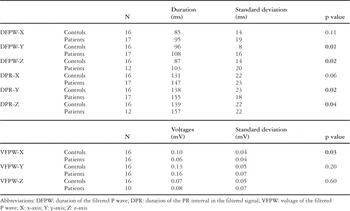
Table 1.
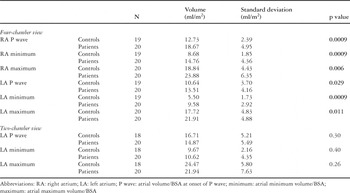
Table 2.

Correlations of the right atrial volumes with the voltage of the filtered P wave.
 You have
Access
- 2
- Cited by