Introduction
Natural regeneration is a crucial process in the dynamics of forests and allows for evaluation of the evolution and stability of the populations of tree species (Jadán et al. Reference Jadán, Cedillo, Pillacela, Guallpa, Gordillo and Zea2019). Successful regeneration of a species is achieved when individuals can develop from seedlings, through juveniles, to reproductive adults to maintain viable populations (Correa-Goméz & Vargas Reference Correa-Gómez and Vargas-Ríos2009). The success of regeneration depends on many factors, and determining the causes limiting this process allows (amongst other things) modelling of the current and future potential distributions of tree populations with eventual changes in climatic or management conditions (Guisan & Zimmermann Reference Guisan and Zimmermann2000, Naoky et al. Reference Naoki, Gómez, López, Meneses and Vargas2006, Urbieta et al. Reference Urbieta, García, Zavala and Marañón2011). The distribution of adult trees within a forest is primarily a reflection of responses to past climatic or management conditions, while the presence of seedlings represents a response to the current environment (Urbieta et al. Reference Urbieta, García, Zavala and Marañón2011). Changes in the distributions of species can be due to both large-scale climatic variables (top-down processes) and biotic interactions at the local scale (bottom-up processes; Lenoir et al. Reference Lenoir, Gégout, Pierrat, Bontemps and Dhôte2009, Laundré et al. Reference Laundré, Hernández, López Medina, Campanella, López-Portillo and González-Romero2014).
Global warming is the most reliable driver of species distribution change and is capable of acting on multiple species and in different ways (Lenoir et al. Reference Lenoir, Gégout, Pierrat, Bontemps and Dhôte2009). Global warming modifies the suitable environments for plant growth, determining changes in their future distribution (Higgins et al. Reference Higgins, Lavorel and Revilla2003). In French mountain forests, change in distribution as a result of rising temperature have been detected in 13 of the 17 tree species studied; the seedlings of those tree species were present at a higher altitude than the adults (Lenoir et al. Reference Lenoir, Gégout, Pierrat, Bontemps and Dhôte2009). In the forests of California (USA), regeneration reached altitudes lower than the occurrence of adults for 9 of the 13 tree species studied; this change was related to warmer and drier macroclimatic conditions (Serra-Diaz et al. Reference Serra-Diaz, Franklin, Dillon, Syphard, Davis and Meentemeyer2016). The sensitivity to environmental changes of the early regeneration of tree species makes regeneration a critical stage in understanding the responses of species to climate change (Mok et al. Reference Mok, Arndt and Nitschke2012). Displacement of the distribution of seedlings from that of the adults is an early indication of a change in tree species distribution (Serra-Diaz et al. Reference Serra-Diaz, Franklin, Dillon, Syphard, Davis and Meentemeyer2016). Climate-induced migration of tree species often results in a change in the range boundary of a tree species (Liang et al. Reference Liang, Duveneck, Gustafson, Serra-Diaz and Thompson2018).
There is little information available on tree species distribution in Neotropical dry forests. This is worrying as these forests are highly threatened, with less than 10% of their original extent remaining in many countries and the area protected being small (Banda et al. Reference Banda, Delgado-Salinas, Dexter, Linares-Palomino, Oliveira-Filho and Prado2016). In Argentina, the Neotropical dry forests are represented by the Piedmont Forest located in the north-western region of the country, where the representative tree species are Calycophyllum multiflorum Griseb., Phyllostylon rhamnoides Taub., Handroanthus impetiginosus Mattos, Anadenanthera colubrina Brenan, Myroxylon peruiferum L. f., Cordia trichotoma Vell., Cordia americana, Enterolobium contortisiliquum Morong and Myracrodruon urundeuva Allemão (Cabrera Reference Cabrera1976). The Piedmont Forest has historically been under intense logging (30 000 m3/year) targeting 12 timber tree species (Balducci et al. Reference Balducci, Eliano, Iza and Sosa2012). Unplanned selective logging focused on the best individuals of economically valuable tree species in the Piedmont Forest caused a reduction between 1975 and 2000 of c. 30% in the volume of the main commercial timber tree species and some of these species are now no longer commercially viable (Minetti et al. Reference Minetti, Bessonart and Balducci2009, Politi & Rivera Reference Politi and Rivera2019). Currently, the conservation status of 8 of 12 valuable timber tree species in the Piedmont Forest is poor (<50% occurrence in sampled plots, density of large trees <1 large tree/ha, density of regeneration <30 seedlings/ha; Názaro et al. Reference Názaro, Rivera, Martínez Pastur, Alabar and Politi2021). Projections of the community climate model of the National Center for Atmospheric Research predict a retraction and displacement of the potential distribution of adults of six timber tree species of the Piedmont Forest to higher altitudes (Pacheco et al. Reference Pacheco, Malizia and Cayuela2010).
This study aimed for the first time to: (1) determine the potential distribution of the regeneration of eight timber tree species in the Piedmont Forest; and (2) assess the overlap of this distribution with that of the adults for the eight timber tree species. Any changes in distribution should help to inform forest management plans and conservation strategies for the species involved.
Materials and methods
Study area
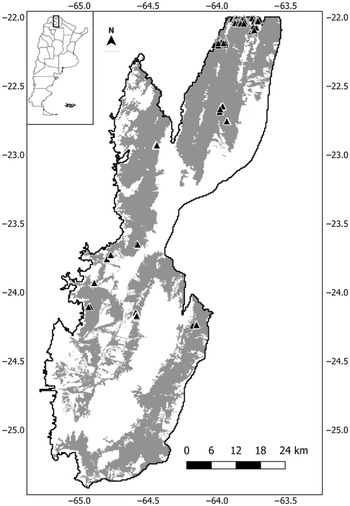
Located in the foothills of the eastern slopes of the Andes mountain range (Pidgeon et al. Reference Pidgeon, Rivera, Martinuzzi, Politi and Bateman2015), the Piedmont Forest plays a key ecological role due to its high biodiversity, its timber resources of high economic value and its strategic connection to the forested ecoregions of the Southern Yungas and the Chaco (Pacheco et al. Reference Pacheco, Malizia and Cayuela2010). The study area is the Piedmont Forest of the provinces of Jujuy and Salta (Argentina) and is 1.5 million ha in extent (Fig. 1). The Piedmont Forest is a seasonal dry forest with >80% of the tree species being deciduous (Sarmiento Reference Sarmiento1972). The climate of the study area is subtropical with a marked dry season (April–October), a mean annual rainfall of 820 mm concentrated in the rainy season (November–March) and a mean annual temperature of 21.5°C (Bianchi & Yañez Reference Bianchi and Yañez1992, Arias & Bianchi Reference Arias and Bianchi1996). The elevational limits were 400 and 900 m obtained from a digital elevation model (National Geographic Institute 2019) and transformed forest areas were excluded (Martinuzzi et al. Reference Martinuzzi, Rivera, Politi, Bateman, de Los Llanos and Lizarraga2018). Of the total of 104 tree species that comprise the Piedmont Forest, the following species were selected as they are canopy dominant and have high economic value (Brown et al. Reference Brown2009, Blundo et al. Reference Blundo, Malizia, Blake and Brown2012, Reference Blundo, Gasparri, Malizia, Clark, Gatti and Campanello2018, Vela Diaz et al. Reference Vela Diaz, Blundo, Cayola, Fuentes, Malizia and Myers2020): P. rhamnoides, M. peruiferum, A colubrina, H. impetiginosus, C. multiflorum, Parapiptadenia excelsa Burkart, C. trichotoma and M. urundeuva.
Location of the Piedmont Forest (grey areas) in north-western Argentina and locations of plots (triangles) where adults and seedlings of eight tree species were sampled between the years 2016 and 2019. The boundary of the study area is shown with a black line and other forest types and transformed areas are shown in white.

Brief description of the selected tree species
A typical species of the xerophytic and seasonally dry forests is P. rhamnoides, which is distributed from Mexico to northern Argentina (Killeen et al. Reference Killeen, García and Beck1993). Tree height ranges from 8 to 15 m and diameter at breast height (DBH) can be up to 50 cm. The species is considered moderately shade tolerant and is used for timber (Mostacedo & Fredericksen Reference Mostacedo and Fredericksen1999).
A species with a wide distribution in South America is M. peruiferum, but its vulnerability to extinction has increased due to unsustainable logging (Silvestre et al. Reference Silvestre, Schwarcz, Grando, Bueno de Campos, Sujii and Tambarussi2018). The species height can reach up to 30 m and DBH ranges from 20 to 70 cm. It is considered a shade-tolerant species (Mangueira et al. Reference Mangueira, Holl and Rodrigues2019).
The species A. colubrina can be found in the tropical and subtropical forests of the Neotropics, where it is one of the most common tree species (Martinez et al. Reference Martínez, Barrandeguy, García, Cacharani and Prado2013). In the mid-1990s, the species began to be used in the forestry industry (Justiniano & Fredericksen Reference Justiniano and Fredericksen1998). It can reach up to 15 m in height and 100 cm in DBH. It is considered a shade-intolerant species (Kennard Reference Kennard2004).
The species H. impetiginosus is widely distributed throughout the tropical and subtropical forests of South America (Schulze et al. Reference Schulze, Grogan, Uhl, Lentini and Vidal2008). It has a height of 20–30 m and a DBH of 60 cm. It is used for timber and is considered a shade-intolerant species (Mostacedo & Fredericksen Reference Mostacedo and Fredericksen1999).
A species with a restricted range through Bolivia, south-western Brazil, Paraguay and northern Argentina along the narrow belt of Neotropical dry forests is C. multiflorum (Santos Biloni Reference Santos Biloni1990). The species can reach up to 30 m in height and 70 cm in DBH. It is considered a moderately shade-tolerant species and is used for timber (Mostacedo & Fredericksen Reference Mostacedo and Fredericksen1999).
The tree species P. excelsa has a wide distribution in the tropical and subtropical forests of South America (Názaro et al. Reference Názaro, Rivera, Martínez Pastur, Alabar and Politi2021). It has a height of 10–20 m and a DBH of up to 60 cm. It is a shade-intolerant species and is used for timber (Easdale et al. Reference Easdale, Healey, Grau and Malizia2007).
A species distributed widely throughout the tropical and subtropical forests of South America is C. trichotoma. It is considered to be shade intolerant and has a mean height of 20 m and a DBH of 60 cm (Bohren et al. Reference Bohren, Gartland, Keller and Grance2007). It is a species that is used for timber.
The species M. urundeuva can be found throughout the seasonal dry forests of Brazil, Bolivia, Paraguay and north-western Argentina. This species requires priority conservation actions as it is considered to be one of the most threatened species in the Neotropics due to its overexploitation, and if unsustainable logging operations continue the remaining populations could approach critical extinction levels (Leite Reference Leite2002). It can reach up to 30 m in height and 80 cm in DBH. It is considered to be a shade-intolerant species (Mostacedo & Fredericksen Reference Mostacedo and Fredericksen1999).
Field sampling
In the study area, 180 circular plots of 0.05 ha and 720 circular subplots (i.e., nested within the plots) of 0.001 ha were set up between the years 2017 and 2019, and 60 circular plots of 0.1 ha and 144 circular subplots of 0.004 ha were set up from 2016 to 2017. The plots were surveyed from September to March to determine the presence of individuals of the selected tree species. Individuals with a DBH >10 cm were considered to be adults and were surveyed in the plots. Individuals >30 cm in height and <5 cm in DBH were considered seedlings and were surveyed in the subplots (Fig. 1). Although some plots and subplots differed in size, this was not considered problematic because the purpose of the study was to use the occurrence of the tree species (Tu et al. Reference Tu, Xiong, Qiu and Zhang2021). The positions of all occurrence records of both size categories and species were recorded.
Environmental variables
The bioclimatic variables were calculated using the biovars function of the dismo library (Hijmans et al. Reference Hijmans, Phillips, Leathwick and Elith2020) of the R software along with the mean monthly precipitation values and maximum and minimum temperatures downloaded from the WorldClim database (https://worldclim.org; Supplementary Table S1, available online). A rescaling of the bioclimatic variables was performed from 2.5' (∼21 km2) to 30'' (1 km2; Lloyd et al. Reference Lloyd, Sorichetta and Tatem2017). For seedlings, the average value of the bioclimatic variables used was from the year 2000 to the year 2018 and for adults the average value of the bioclimatic variables used was from the year 1970 to the year 2018. The time period used to calculate the bioclimatic variables of seedlings and adults represents the approximate number of years in which the species reached 5 and 10 cm in DBH, respectively, according to the growth rate of the tree species studied (Humano Reference Humano2020). Multicollinearity of the bioclimatic variables for seedlings and adults in the study area was evaluated using Pearson’s correlation analysis with the Remove Highly Correlated Variables function of the SDM Toolbox v2.0 package (Brown Reference Brown2014) in ArcGIS 10.4.1 (Tables S2 & S3). For seedlings and adults, the variables that presented a Pearson’s correlation coefficient of <0.6 were (Manish et al. Reference Manish, Telwala, Nautiyal and Pandit2016): annual mean monthly temperature (bio01), diurnal mean range (bio02) and temperature seasonality (bio04). Finally, the differences in the climatic variables bio01, bio02 and bio04 amongst the five decades (i.e., 1970–1979, 1980–1989, 1990–1999, 2000–2009 and 2010–2018) were analysed using analysis of variance (ANOVA) as the data met the assumptions for normality and homogeneity (Quinn & Keough Reference Quinn and Keough2002). When ANOVA indicated significant differences amongst the values for each decade, a Tukey post hoc test was conducted (Quinn & Keough Reference Quinn and Keough2002). The statistical analyses were run in R software (R Core Team 2021).
Species distribution models
The potential distributions of seedlings and adults were modelled separately for each tree species using MaxEnt software version 3.4.1 (Phillips et al. Reference Phillips, Dudík and Schapire2020). The MaxEnt software was configured using the criteria of Young et al. (Reference Young, Carter and Evangelista2011). Only one occurrence record of the same species in the same category (adult or seedling) was used within a 1km radius; overlapping records were removed using the Remove Duplicate Presence Records function in MaxEnt (Phillips et al. Reference Phillips, Dudík and Schapire2020). The performance of the models was evaluated using 15-fold bootstrap and the area under the receiver operating curve (AUC) was calculated (Phillips et al. Reference Phillips, Dudík and Schapire2020). The MaxEnt software requires background data for model training, so 10 000 pseudo-absences were generated within the species records’ 150km buffer area. Different sizes of the buffer area (50, 100, 150 and 200 km) were tested, and the distance of 150 km provided the highest and most biologically significant AUC values (VanDerWal et al. Reference VanDerWal, Shoo, Graham and Williams2009, Martinuzzi et al. Reference Martinuzzi, Rivera, Politi, Bateman, de Los Llanos and Lizarraga2018). The jack-knife test was used to determine the importance of each variable, evaluating the training gain for each factor if the model was executed using that factor in isolation, thus enabling the identification of the variables that contributed most significantly to the models (Stephan et al. Reference Stephan, Bercachy, Bechara, Charbel and López-Tirado2020). To convert the models into binary probability values (absence/presence), the logistic threshold of the average 10th percentile training presence was used for each tree species and for each category (adult or seedling; Martinuzzi et al. Reference Martinuzzi, Rivera, Politi, Bateman, de Los Llanos and Lizarraga2018). For each species, the potential distribution area occupied by adults and seedlings was calculated, then the areas potentially occupied by the adults and seedlings of each species were superimposed and the percentage of overlap of seedlings with respect to the adults of each species was determined.
Results
The annual mean monthly temperature (bio01) was significantly higher in 2010–2018 than in 1970–1979 (F = 2.94, p = 0.03). The mean diurnal temperature range (bio02) and temperature seasonality (bio04) did not differ significantly amongst the decades (F = 0.42, p = 0.79 and F = 1.36, p = 0.26, respectively).
For all tree species, the mean diurnal temperature range (bio02) contributed >59% to the potential distribution with AUC values >0.97 (Table 1). The contributions of the variables annual mean monthly temperature (bio01) and temperature seasonality (bio04) were <25% and <17%, respectively (Table 1).
Contribution of the bioclimatic variables (%) in the distribution models of seedlings and adults for eight tree species in the Piedmont Forest. The area under the receiver operating curve (AUC) values of each model are shown and the numbers of occurrence records of each species and category used are indicated in parentheses.

bio01 = annual mean monthly temperature; bio02 = diurnal mean range; bio04 = temperature seasonality.
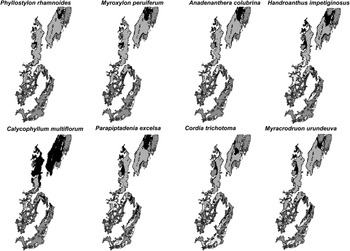
The potential distribution area of all adult tree species was 694 457 ± 62 535 ha and for seedlings it was 656 564 ± 194 769 ha (Table 2). The overlap of all of the distributions of seedlings and adults was 503 974 ± 163 776 ha and the potential distribution of adults overlapped by 73% ± 23% with that of seedlings (Table 2). The species with the largest potential distribution area for adults was M. peruiferum and for seedlings it was P. excelsa (Fig. 2 & Table 2). The species with the least overlap between seedlings and adults was C. multiflorum and the species with the greatest overlap between seedlings and adults was P. rhamnoides (Fig. 2 & Table 2). The potential distribution areas of seedlings were smaller than those of adults in three species (P. rhamnoides, M. peruiferum and C. multiflorum), while for the other species the potential distribution areas of seedlings were greater than those of adults (Fig. 2 & Table 2).
Area (ha) of the potential distributions of adults and seedlings and the overlap of adults and seedlings of eight tree species in the Piedmont Forest. The percentages of the areas of overlap of seedlings concerning adults are indicated in parentheses.

Potential distributions of adults (black infill), seedlings (white infill, black dots) and the overlap of seedlings and adults (white infill, black stripes) of eight tree species in the Piedmont Forest (grey infill) of north-western Argentina.

Discussion
All of the tree species studied showed a difference in the overlap of the potential distributions of seedlings and adults, especially in the northernmost sector of the study area. The changes in the potential distribution of seedlings could be due to changes in climatic conditions. Our result that annual mean monthly temperature (bio01) showed a significant increase from the decade 1970–1979 to 2010–2018 corroborates another study that reports on the northernmost sector of the Piedmont Forest of Argentina (Jujuy and Salta provinces) demonstrating an increase of 0.7°C in the annual mean temperature and a slight increase in annual rainfall from the year 1950 to 2010 (Barros et al. Reference Barros, Carlinom, Magnasco and Magrin2014). Furthermore, the difference in the potential distributions of seedlings with respect to the distributions of adults could also be attributed to the droughts that occurred between 2005 and 2016 (Fig. S1), the impacts of which were more severe in the northern region of the Piedmont Forest. An increase in temperature and in seasonal rainfall (or droughts) could change the evapotranspiration rate and thus decrease the availability of water for tree species (Lenoir et al. Reference Lenoir, Gégout, Pierrat, Bontemps and Dhôte2009).
The low percentage of overlap and the smaller potential distribution area of the C. multiflorum seedlings with respect to the adults could be related to the droughts that occurred during 2000–2018 (Fig. S1). The monthly precipitation anomalies were negative during 2000–2018 and occurred in the months of March and April (Table S4), which could severely affect the regeneration of C. multiflorum as this species blooms and begins fruiting in March and April (Giménez & Moglia Reference Giménez and Moglia2003). In addition, droughts may have affected individuals of C. multiflorum as they present leaves with a stomatal index of >10%, which indicates a low tolerance to water stress (Arambarri et al. Reference Arambarri, Novoa, Bayón, Hernández, Colares and Monti2011). C. multiflorum will be one of the species most affected by climate change according to the projections of climate change scenarios, exhibiting a retraction of its current distribution and maintaining less than 25% of its historical distribution area (Pacheco et al. Reference Pacheco, Malizia and Cayuela2010). This result is alarming given that C. multiflorum and P. rhamnoides are the species that define the environmental unit of the Piedmont Forest (Brown 2009). Temperature change has been proposed to be the most significant driver of restructuring tree communities by modifying the spatial organization of species (Serra-Diaz et al. Reference Serra-Diaz, Franklin, Dillon, Syphard, Davis and Meentemeyer2016, Verrico et al. Reference Verrico, Weiland, Perkins, Beckage and Keller2020), and this may very well be the case in the Piedmont Forest.
Our models identify the southern sector of the study area as being important for the potential distribution of seedlings. This pattern (i.e., change in latitudinal distribution) coincides with other works in which a southwards shift is recorded in the potential distribution of the regeneration of tree species following their climatic niches (Serra-Diaz et al. Reference Serra-Diaz, Franklin, Dillon, Syphard, Davis and Meentemeyer2016, Tu et al. Reference Tu, Xiong, Qiu and Zhang2021). In the provinces of Jujuy and Salta, increases in both maximum and minimum temperatures have been detected, but this was more marked in terms of minimum temperatures, with a general decrease in parameters related to extremely cold temperatures, such as the number of days with frost and the frequency of cold nights in the period from 1950 to 2010 (Barros et al. Reference Barros, Carlinom, Magnasco and Magrin2014). The marked increasing trend in minimum temperatures causes a decrease in the mean diurnal range (bio02), and this was the variable that contributed most significantly to the models of the potential distribution of seedlings and adults in this study. Such an increase also increases heat stress, which can limit the onset of regeneration (Lenoir et al. Reference Lenoir, Gégout, Pierrat, Bontemps and Dhôte2009). This result suggests that, in the future, the composition of the tree species that are characteristic of the Piedmont Forest could be different from that of the contemporary forest depending on the response of each species to changes in climatic variables (Pacheco et al. Reference Pacheco, Malizia and Cayuela2010). It is interesting to note that the variables used in the species distribution modelling are thermal (bio02: mean diurnal range; bio01: mean annual temperature; and bio04: temperature seasonality) and are projected to change by the end of the century in this area (Fig. S2a,b; Barros et al. Reference Barros, Carlinom, Magnasco and Magrin2014).
The changes in the potential distribution of seedlings recorded in the present study may be due not only to the effects of climate change but also to logging (Gustafson et al. Reference Gustafson, Shvidenko, Sturtevant and Scheller2010). Selective logging removes large individuals from commercially valuable species and, in general, these large individuals are those that produce the most seeds (Chaudhary et al. Reference Chaudhary, Burivalova, Koh and Hellweg2016). Therefore, logging influences the recruitment of new individuals, thus affecting the possibility that species will vary their ranges of distribution following climatic changes (Gustafson et al. Reference Gustafson, Shvidenko, Sturtevant and Scheller2010, Lo et al. Reference Lo, Blanco and Kimmins2010). Tree species sensitive to climate change and logging (e.g., C. multiflorum) may be more susceptible to ecological extinction when levels of forest use are high (Steenberg et al. Reference Steenberg, Duinker and Bush2013). Indirectly, tree species with no commercial value will be advantaged by logging as logging benefit the abundances of these competitors (Steenberg et al. Reference Steenberg, Duinker and Bush2013). Climate change and forest use generally have a combined influence on the distributions of tree species, resulting in the restructuring of tree communities (Lo et al. Reference Lo, Blanco and Kimmins2010, Steenberg et al. Reference Steenberg, Duinker and Bush2013). In the present case, greater understanding of the combined effects of these forces is needed.
Our study has direct implications for the conservation of forest species and ecosystems. Given that climate change imposes new challenges, static approaches to the conservation of biodiversity need to be reassessed and refined (Milad et al. Reference Milad, Schaich, Bürgi and Konold2011). Our results anticipate tree species distribution range shifts, and this finding could aid policymakers in their delineation of conservation strategies (Hulme Reference Hulme2005). To facilitate species movement and establishment, it will be necessary to place protected areas strategically, increase connectivity and maximize the permeability of forest landscapes (Gillson & Willis Reference Gillson and Willis2004). Furthermore, conservation strategies should aim to minimize other anthropogenic stresses such as forest degradation, loss and fragmentation that aggravate the impacts of climate change on forest species (Milad et al. Reference Milad, Schaich, Bürgi and Konold2011). Climate change already affects species ranges and threatens many species; moreover, it is responsible for community reorganizations (Walther Reference Walther2010). It is expected that climate change effects will be accelerate by the end of the century, with considerable consequences for ecosystem functioning (Walther Reference Walther2010). Therefore, practical applications of strategies for adapting to climate change must rapidly be set in order to allow species to respond under the current climate scenario and future climate predictions (Hulme Reference Hulme2005).
Supplementary material
To view supplementary material for this article, please visit https://doi.org/10.1017/S0376892922000133
Acknowledgements
We thank Daniel Herrera and all of the assistants who helped during fieldwork, the administrations of the national and provincial park and landowners who granted us permission to carry out this study and the CEBio Foundation (www.cebio.org.ar) for logistical support. We are grateful to Professor Nicholas Polunin and two anonymous reviewers for their valuable comments on the manuscript.
Financial support
This work was supported by the CEBio Foundation and by the National Council for Scientific and Technical Research (CONICET PIO 1402014100133), of which PN and FA are doctoral fellows.
Competing interests
The authors declare none.
Ethical standards
None.