1 Introduction
Let  $Y$ be a closed, oriented three-manifold with
 $b_{1}=0$ and spin structure
 $\mathfrak{s}$, and let
 $G=\text{Pin}(2)$, the subgroup
 $S^{1}\cup jS^{1}$ of the unit quaternions. Manolescu introduced the
 $G$-equivariant Seiberg–Witten Floer homology
 $\mathit{SWFH}^{G}(Y,\mathfrak{s})$ in [Reference ManolescuMan16], and with it the suite of homology cobordism invariants
 $\unicode[STIX]{x1D6FC},\unicode[STIX]{x1D6FD},\unicode[STIX]{x1D6FE}$. These are defined analogously to the Frøyshov invariant of the usual,
 $S^{1}$-equivariant, Seiberg–Witten Floer homology. To construct the
 $\text{Pin}(2)$-equivariant Floer theory, Manolescu does finite-dimensional approximation of the Seiberg–Witten equations for
 $(Y,\mathfrak{s})$, and obtains a
 $G$-equivariant homotopy type
 $\mathit{SWF}(Y,\mathfrak{s})$. The invariant
 $\mathit{SWFH}^{G}(Y,\mathfrak{s})$ is then the
 $G$-equivariant Borel homology of
 $\mathit{SWF}(Y,\mathfrak{s})$. As the
 $G$-equivariant homology of some stable homotopy type,
 $\mathit{SWFH}^{G}(Y,\mathfrak{s})$ comes with the structure of a module over
 $H^{\ast }(BG;\mathbb{F})\simeq \mathbb{F}[q,v]/(q^{3}),$ where
 $\mathbb{F}$ is the field of two elements. The invariants
 $\unicode[STIX]{x1D6FC},\unicode[STIX]{x1D6FD}$, and
 $\unicode[STIX]{x1D6FE}$ are defined using the module structure.
The invariant  $\unicode[STIX]{x1D6FD}$ was then used to disprove the triangulation conjecture. Let
 $\unicode[STIX]{x1D703}_{3}^{H}$ denote the homology cobordism group of integral homology three-spheres. By the work of Galewski and Stern [Reference Galewski and SternGS80] and Matumoto [Reference MatumotoMat78], there exist nontriangulable manifolds in dimension at least
 $5$ if and only if
 $\unicode[STIX]{x1D703}_{3}^{H}$ does not contain an element
 $[Y]$ of order
 $2$, with
 $\unicode[STIX]{x1D707}(Y)=1$. However, the invariant
 $\unicode[STIX]{x1D6FD}:\unicode[STIX]{x1D703}_{3}^{H}\rightarrow \mathbb{Z}$ satisfies
 $\unicode[STIX]{x1D6FD}(Y,\mathfrak{s})=-\unicode[STIX]{x1D6FD}(-Y,\mathfrak{s})$ and
 $\unicode[STIX]{x1D6FD}(Y,\mathfrak{s})\equiv \unicode[STIX]{x1D707}(Y,\mathfrak{s})\hspace{0.2em}{\rm mod}\hspace{0.2em}2$, from which Manolescu concludes that there exist manifolds of all dimensions at least
 $5$ which cannot be triangulated.
Let  $Y$ be a Seifert rational homology sphere with spin structure
 $\mathfrak{s}$, such that the base orbifold of the Seifert fibration of
 $Y$ has
 $S^{2}$ as underlying space.Footnote 1 In the present paper, we use the description of the Seiberg–Witten moduli space given by Mrowka, Ozsváth and Yu [Reference Mrowka, Ozsváth and YuMOY97] to compute
 $\mathit{SWFH}^{G}(Y,\mathfrak{s})$, as a module over
 $\mathbb{F}[q,v]/(q^{3})$ (here, the action of
 $v$ decreases grading by
 $4$, and that of
 $q$ decreases grading by
 $1$). The description is in terms of the Heegaard Floer homology
 $\mathit{HF}^{+}(Y,\mathfrak{s})$, defined in [Reference Ozsváth and SzabóOS04a, Reference Ozsváth and SzabóOS04b]. In particular, this description makes
 $\mathit{SWFH}^{G}(Y,\mathfrak{s})$ quickly computable, as Ozsváth-Szabó, Némethi, and Can and Karakurt [Reference Ozsváth and SzabóOS03b, Reference NémethiNém05, Reference Can and KarakurtCK14] have developed algorithms to calculate
 $HF^{+}(Y,\mathfrak{s})$ for
 $Y$ a Seifert space. In order to obtain
 $\mathit{SWFH}^{G}(Y,\mathfrak{s})$ in terms of
 $HF^{+}(Y,\mathfrak{s})$, we use both the equivalence of
 $\mathit{HF}^{+}$ and
 $\check{HM}$ due to Kutluhan, Lee and Taubes [Reference Kutluhan, Lee and TaubesKLT10], and Colin, Ghiggini and Honda [Reference Colin, Ghiggini and HondaCGH11] and Taubes [Reference TaubesTau07], and the equivalence of
 $\check{HM}$ and
 $\mathit{SWFH}^{S^{1}}$ due to Lidman and Manolescu [Reference Lidman and ManolescuLM18]. Here
 $\mathit{SWFH}^{S^{1}}(Y,\mathfrak{s})$ denotes the
 $S^{1}$-equivariant Borel homology of the stable homotopy type
 $\mathit{SWF}(Y,\mathfrak{s})$.
We will need to relate  $\mathit{SWFH}^{S^{1}}(Y,\mathfrak{s})$ and
 $\mathit{SWFH}^{G}(Y,\mathfrak{s})$ when the underlying homotopy type
 $\mathit{SWF}(Y,\mathfrak{s})$ is simple enough. This should be compared with [Reference LinLin17], in which Lin calculates the
 $\text{Pin}(2)$-monopole Floer homology in the setting of [Reference LinLin18] for many classes of three-manifolds
 $Y$ obtained by surgery on a knot. The approach there is based, similarly, on extracting information from the
 $S^{1}$-equivariant theory
 $\check{HM}(Y,\mathfrak{s})$ of [Reference Kronheimer and MrowkaKM07], when
 $\check{HM}(Y,\mathfrak{s})$ is simple enough.
To state the calculation of  $\mathit{SWFH}^{G}(Y,\mathfrak{s})$, let
 ${\mathcal{T}}^{+}$ denote
 $\mathbb{F}[U,U^{-1}]/U\mathbb{F}[U]$, and
 ${\mathcal{T}}^{+}(i)=\mathbb{F}[U^{-i+1},U^{-i+2},\ldots ]/U\mathbb{F}[U]$, with
 $\deg (U)=-2$. We also introduce the notation
 ${\mathcal{V}}^{+}$ to denote
 $\mathbb{F}[v,v^{-1}]/v\mathbb{F}[v]$, and
 ${\mathcal{V}}^{+}(i)=\mathbb{F}[v^{-i+1},v^{-i+2},\ldots ]/v\mathbb{F}[v]$, with
 $\deg (v)=-4$. For any graded module
 $M$, let
 $M_{n}$ denote the submodule of homogeneous elements of degree
 $n$, and define
 $M[k]$ by
 $M[k]_{n}=M_{n+k}$. Let
 ${\mathcal{T}}_{d}^{+}(n)={\mathcal{T}}^{+}(n)[-d]$ and
 ${\mathcal{V}}_{d}^{+}(n)={\mathcal{V}}^{+}(n)[-d]$. The module
 ${\mathcal{T}}_{d}^{+}(n)$ is then supported in degrees from
 $d$ to
 $d+2(n-1)$, with the parity of
 $d$.
Fix  $Y$ a Seifert rational homology three-sphere with negative fibration; that is, the orbifold line bundle of
 $Y$ is of negative degree (see § 5). For example, the Brieskorn sphere
 $\unicode[STIX]{x1D6F4}(a_{1},\ldots ,a_{n})$, for coprime
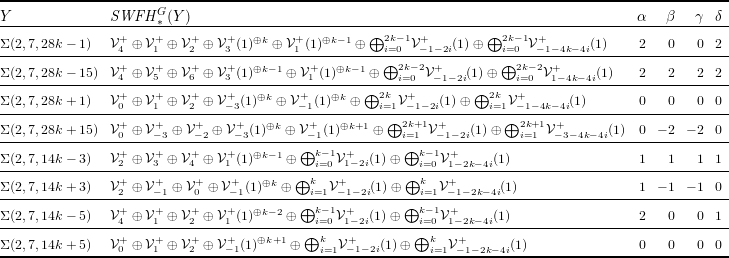
 $a_{i}$, is of negative fibration. Using Corollary 5.4 we may write
 $$\begin{eqnarray}\mathit{HF}^{+}(Y,\mathfrak{s})={\mathcal{T}}_{s+d_{1}+2n_{1}-1}^{+}\oplus \bigoplus _{i=1}^{N}{\mathcal{T}}_{s+d_{i}}^{+}\biggl(\frac{d_{i+1}+2n_{i+1}-d_{i}}{2}\biggr)\oplus \bigoplus _{i=1}^{N}{\mathcal{T}}_{s+d_{i}}^{+}(n_{i})\,\oplus \,J^{\oplus 2}[-s],\end{eqnarray}$$
for some constants  $s,d_{i},n_{i},N$ and some
 $\mathbb{F}[U]$-module
 $J$, all determined by
 $(Y,\mathfrak{s})$. Moreover,
 $d_{i+1}>d_{i},n_{i+1}<n_{i}$ for all
 $i$. Roughly, in terms of Seiberg–Witten theory, the term
 ${\mathcal{T}}_{s+d_{1}+2n_{1}-1}^{+}$ accounts for the reducible critical point, and the modules
 $$\begin{eqnarray}{\mathcal{T}}_{s+d_{i}}^{+}(n_{i})\quad \text{and}\quad {\mathcal{T}}_{s+d_{i}}^{+}\biggl(\frac{d_{i+1}+2n_{i+1}-d_{i}}{2}\biggr)\end{eqnarray}$$
account for the irreducibles which cancel against the bottom of the infinite  $U$-tower. The term
 $J^{\oplus 2}$ accounts for the other irreducibles.
Let us denote by  $\text{res}_{\mathbb{F}[v]}^{\mathbb{F}[U]}$ the restriction functor from the map of modules
 $\mathbb{F}[v]\rightarrow \mathbb{F}[U]$ given by
 $v\rightarrow U^{2}$. The restriction functor converts
 ${\mathcal{T}}_{d}^{+}(n)$ to
 ${\mathcal{V}}_{d}^{+}(\lfloor (n+1)/2\rfloor )\oplus {\mathcal{V}}_{d+2}^{+}(\lfloor n/2\rfloor )$.
Theorem 1.1. Let  $Y$ be a Seifert rational homology three-sphere of negative fibration, fibering over an orbifold with underlying space
 $S^{2}$, and let
 $\mathfrak{s}$ be a spin structure on
 $Y$. Let
 $\mathit{HF}^{+}(Y,\mathfrak{s})$ be as in (1). Then there exist constants
 $(a_{i},b_{i})$ and an
 $\mathbb{F}[q,v]/(q^{3})$-module
 $J^{\prime \prime }$, specified in Corollary 5.4 and depending only on the sequence
 $(d_{i},n_{i})$, so that, as an
 $\mathbb{F}[v]$-module,
 $$\begin{eqnarray}\displaystyle \mathit{SWFH}^{G}(Y,\mathfrak{s}) & = & \displaystyle {\mathcal{V}}_{s+4\lfloor (d_{1}+2n_{1}+1)/4\rfloor }^{+}\oplus {\mathcal{V}}_{s+1}^{+}\oplus {\mathcal{V}}_{s+2}^{+}\nonumber\\ \displaystyle & & \displaystyle \oplus \mathop{\bigoplus }_{i=1}^{N^{\prime }}{\mathcal{V}}_{s+a_{i}}^{+}\biggl(\frac{a_{i+1}+4b_{i+1}-a_{i}}{4}\biggr)\oplus J^{\prime \prime }[-s]\oplus \text{res}_{\mathbb{ F}[v]}^{\mathbb{F}[U]}J[-s].\nonumber\end{eqnarray}$$
The  $q$-action is given by the isomorphism
 ${\mathcal{V}}_{s+2}^{+}\rightarrow {\mathcal{V}}_{s+1}^{+}$ and the map
 ${\mathcal{V}}_{s+1}^{+}\rightarrow {\mathcal{V}}_{s+4\lfloor (d_{1}+2n_{1}+1)/4\rfloor }^{+}$, which is an
 $\mathbb{F}$-vector space isomorphism in all degrees at least
 $s+4\lfloor (d_{1}+2n_{1}+1)/4\rfloor$ and vanishes otherwise. Further,
 $q$ annihilates
 $\text{res}_{\mathbb{F}[v]}^{\mathbb{F}[U]}J[-s]$ and
 $\bigoplus _{i=1}^{N^{\prime }}{\mathcal{V}}_{s+a_{i}}^{+}((a_{i+1}+4b_{i+1}-a_{i})/4)$. The action of
 $q$ on
 $J^{\prime \prime }$ is specified in Corollary 5.4.
Theorem 1.1 specifies  $\unicode[STIX]{x1D6FC},\unicode[STIX]{x1D6FD},$ and
 $\unicode[STIX]{x1D6FE}$, which we state as Corollary 1.2. For
 $Y$ an integral homology three-sphere, let
 $d(Y)$ be the Heegaard Floer correction term [Reference Ozsváth and SzabóOS03a]. Using Theorems 1.1 and 1.3 below we obtain the following.
(a) Let
 $Y$ be a Seifert integral homology sphere of negative fibration. Then $\unicode[STIX]{x1D6FD}(Y)=\unicode[STIX]{x1D6FE}(Y)=-\bar{\unicode[STIX]{x1D707}}(Y)$, and $$\begin{eqnarray}\unicode[STIX]{x1D6FC}(Y)=\left\{\begin{array}{@{}ll@{}}d(Y)/2\quad & \text{if }d(Y)/2\equiv -\bar{\unicode[STIX]{x1D707}}(Y)\hspace{0.2em}{\rm mod}\hspace{0.2em}2,\\ d(Y)/2+1\quad & \text{otherwise.}\end{array}\right.\end{eqnarray}$$
(b) Let
$Y$ be a Seifert integral homology sphere of positive fibration. Then $\unicode[STIX]{x1D6FC}(Y)=\unicode[STIX]{x1D6FD}(Y)=-\bar{\unicode[STIX]{x1D707}}(Y),$ and $$\begin{eqnarray}\unicode[STIX]{x1D6FE}(Y)=\left\{\begin{array}{@{}ll@{}}d(Y)/2\quad & \text{if }d(Y)/2\equiv -\bar{\unicode[STIX]{x1D707}}(Y)\hspace{0.2em}{\rm mod}\hspace{0.2em}2,\\ d(Y)/2-1\quad & \text{otherwise. }\end{array}\right.\end{eqnarray}$$




From Corollary 1.2, we see that for Seifert integral homology spheres the Manolescu invariants  $\unicode[STIX]{x1D6FC},\unicode[STIX]{x1D6FD}$, and
 $\unicode[STIX]{x1D6FE}$ are all determined by
 $d$ and
 $\bar{\unicode[STIX]{x1D707}}$. In particular,
 $\unicode[STIX]{x1D6FC}$,
 $\unicode[STIX]{x1D6FD}$, and
 $\unicode[STIX]{x1D6FE}$ provide no new obstructions to Seifert spaces bounding acyclic four-manifolds.
In [Reference ManolescuMan16], Manolescu also conjectured that for all spin Seifert rational homology spheres  $\unicode[STIX]{x1D6FD}(Y,\mathfrak{s})=-\bar{\unicode[STIX]{x1D707}}(Y,\mathfrak{s})$, where
 $\bar{\unicode[STIX]{x1D707}}$ is the Neumann–Siebenmann invariant defined in [Reference NeumannNeu80, Reference SiebenmannSie80]. We are able to prove part of this conjecture.
Theorem 1.3. Let  $Y$ be a Seifert integral homology three-sphere. Then
 $\unicode[STIX]{x1D6FD}(Y)=-\bar{\unicode[STIX]{x1D707}}(Y)$.
We prove Theorem 1.3 by showing that  $\unicode[STIX]{x1D6FD}$ is controlled by the degree of the reducible, and by using a result of Ruberman and Saveliev [Reference Ruberman and SavelievRS11] that gives
 $\bar{\unicode[STIX]{x1D707}}$ as a sum of eta invariants.
Fukumoto, Furuta and Ue showed in [Reference Fukumoto, Furuta and UeFFU01] that  $\bar{\unicode[STIX]{x1D707}}$ is a homology cobordism invariant for many classes of Seifert spaces, and Saveliev [Reference SavelievSav02] extended this to show that Seifert integral homology spheres with
 $\bar{\unicode[STIX]{x1D707}}\neq 0$ have infinite order in
 $\unicode[STIX]{x1D703}_{3}^{H}$. Theorem 1.3 generalizes the result of Fukumoto, Furuta and Ue, showing that the Neumann–Siebenmann invariant
 $\bar{\unicode[STIX]{x1D707}}$, restricted to Seifert integral homology spheres, is a homology cobordism invariant.
For Seifert spaces with  $\mathit{HF}^{+}(Y,\mathfrak{s})$ of a special form,
 $\mathit{SWFH}^{G}(Y,\mathfrak{s})$ may be expressed more compactly than is evident in the statement of Theorem 1.1. If
 $Y$ is of negative fibration and
 $$\begin{eqnarray}\mathit{HF}^{+}(Y,\mathfrak{s})={\mathcal{T}}_{d}^{+}\oplus {\mathcal{T}}_{-2n+1}^{+}(m)\oplus \bigoplus _{i\in I}{\mathcal{T}}_{a_{i}}^{+}(m_{i})^{\oplus 2},\end{eqnarray}$$
for some index set  $I$, we say that
 $(Y,\mathfrak{s})$ is of projective type. We will say that
 $Y$ is of projective type if
 $Y$ is an integral homology sphere such that (2) holds. There are many examples of such Seifert spaces, among them
 $\unicode[STIX]{x1D6F4}(p,q,pqn\pm 1)$, by work of Némethi and Borodzik [Reference NémethiNém07, Reference Borodzik and NémethiBN13] and Tweedy [Reference TweedyTwe13]. The condition (2) also admits a natural expression in terms of graded roots; see § 5.2.
Theorem 1.4. If  $(Y,\mathfrak{s})$ is of projective type, as in (2), with
 $m\neq 0$, then we have the following.
If  $d\equiv 2n+2$ mod
 $4$,
 $$\begin{eqnarray}\displaystyle \mathit{SWFH}^{G}(Y,\mathfrak{s}) & = & \displaystyle {\mathcal{V}}_{d+2}^{+}\oplus {\mathcal{V}}_{-2n+1}^{+}\oplus {\mathcal{V}}_{-2n+2}^{+}\nonumber\\ \displaystyle & & \displaystyle \oplus {\mathcal{V}}_{-2n+3}^{+}\biggl(\biggl\lfloor\frac{m}{2}\biggr\rfloor\biggr)\oplus \bigoplus _{i\in I}{\mathcal{V}}_{a_{i}}^{+}\biggl(\biggl\lfloor\frac{m_{i}+1}{2}\biggr\rfloor\biggr)\oplus \bigoplus _{i\in I}{\mathcal{V}}_{a_{i}+2}^{+}\biggl(\biggl\lfloor\frac{m_{i}}{2}\biggr\rfloor\biggr).\end{eqnarray}$$
If  $d\equiv 2n$ mod
 $4$,
 $$\begin{eqnarray}\displaystyle \mathit{SWFH}^{G}(Y,\mathfrak{s}) & = & \displaystyle {\mathcal{V}}_{d}^{+}\oplus {\mathcal{V}}_{-2n+1}^{+}\oplus {\mathcal{V}}_{-2n+2}^{+}\oplus {\mathcal{V}}_{-2n+3}^{+}\biggl(\biggl\lfloor\frac{m}{2}\biggr\rfloor\biggr)\nonumber\\ \displaystyle & & \displaystyle \oplus \mathop{\bigoplus }_{i\in I}{\mathcal{V}}_{a_{i}}^{+}\biggl(\biggl\lfloor\frac{m_{i}+1}{2}\biggr\rfloor\biggr)\oplus \bigoplus _{i\in I}{\mathcal{V}}_{a_{i}+2}^{+}\biggl(\biggl\lfloor\frac{m_{i}}{2}\biggr\rfloor\biggr).\end{eqnarray}$$
The  $q$-action is given by the isomorphism
 ${\mathcal{V}}_{-2n+2}^{+}\rightarrow {\mathcal{V}}_{-2n+1}^{+}$ and the map
 ${\mathcal{V}}_{-2n+1}^{+}\rightarrow {\mathcal{V}}_{d+2}^{+}$ (if
 $d\equiv 2n+2\;\text{mod}\;4$), or
 ${\mathcal{V}}_{-2n+1}^{+}\rightarrow {\mathcal{V}}_{d}^{+}$ (if
 $d\equiv 2n\;\text{mod}\;4$), which is an
 $\mathbb{F}$-vector space isomorphism in all degrees at least
 $d+2$ (respectively,
 $d$), and vanishes otherwise. In (3) and (4),
 $q$ acts on
 ${\mathcal{V}}_{-2n+3}^{+}(\lfloor m/2\rfloor )$ as the unique nonzero map
 ${\mathcal{V}}_{-2n+3}^{+}(\lfloor m/2\rfloor )\rightarrow {\mathcal{V}}_{-2n+2}^{+}$ if
 $m\geqslant 2$. The action of
 $q$ annihilates
 $\bigoplus _{i\in I}{\mathcal{V}}_{a_{i}}^{+}(\lfloor (m_{i}+1)/2\rfloor )\oplus \bigoplus _{i\in I}{\mathcal{V}}_{a_{i}+2}^{+}(\lfloor m_{i}/2\rfloor )$.
If  $m=0$, we define
 $n$ by
 $d=-2n$, in which case (4) again holds, and the
 $q$ action is as before.
To prove Theorem 1.1, we use [Reference Mrowka, Ozsváth and YuMOY97] to show that a space representative of the stable homotopy type  $\mathit{SWF}(Y,\mathfrak{s})$, away from the reducible, naturally splits into two disjoint pieces, which are interchanged by the action of
 $j\in G$. For
 $Z$ a topological space with
 $G$-action let
 $Z^{S^{1}}\subset Z$ denote the subset fixed by
 $S^{1}\subset G$. Say
 $$\begin{eqnarray}X=\mathit{SWF}(Y,\mathfrak{s})/(\mathit{SWF}(Y,\mathfrak{s})^{S^{1}}).\end{eqnarray}$$
Then
 $$\begin{eqnarray}X=X_{+}\vee jX_{+}.\end{eqnarray}$$
That is,  $X$ is a wedge sum of two components related by the action of
 $j$. Then the chain complex of
 $EG\wedge _{G}\mathit{SWF}(Y,\mathfrak{s})$, used to compute the
 $G$-Borel homology, is closely related to the chain complex of
 $ES^{1}\wedge _{S^{1}}\mathit{SWF}(Y,\mathfrak{s})$, whose homology is the
 $S^{1}$-Borel homology of
 $\mathit{SWF}(Y,\mathfrak{s})$. A careful, but entirely elementary, analysis of the differentials in these two complexes then yields Theorem 1.1.
1.1 Local equivalence
We call rational homology three-spheres  $Y_{1}$ and
 $Y_{2}$ (integral) homology cobordant if there exists a compact oriented four-manifold
 $W$ with
 $\unicode[STIX]{x2202}W=Y_{1}\amalg -Y_{2}$ so that the maps induced by inclusion
 $H_{\ast }(Y_{i};\mathbb{Z})\rightarrow H_{\ast }(W;\mathbb{Z})$ are isomorphisms for
 $i=1,2$.
Manolescu’s construction of  $\mathit{SWF}(Y,\mathfrak{s})$ contains more information about homology cobordism than the invariants
 $\unicode[STIX]{x1D6FC},\unicode[STIX]{x1D6FD},$ and
 $\unicode[STIX]{x1D6FE}$. Namely, a spin cobordism
 $W$ from
 $Y_{1}$ to
 $Y_{2}$ with
 $b_{2}(W)=0$ induces a map
 $\mathit{SWF}(Y_{1},\mathfrak{s}_{1})\rightarrow \mathit{SWF}(Y_{2},\mathfrak{s}_{2})$ which is a homotopy equivalence on
 $S^{1}$-fixed point sets. We call two
 $G$-spaces
 $X_{1},X_{2}$locally equivalent if there exist
 $G$-equivariant stable maps
 $X_{1}\rightarrow X_{2}$ and
 $X_{2}\rightarrow X_{1}$ which induce homotopy equivalences on fixed point sets. The local equivalence class
 $[\mathit{SWF}(Y,\mathfrak{s})]_{\text{l}}$ is then a homology cobordism invariant of
 $(Y,\mathfrak{s})$. The local equivalence class
 $[\mathit{SWF}(Y,\mathfrak{s})]_{\text{l}}$ determines
 $\unicode[STIX]{x1D6FC}(Y,\mathfrak{s}),\unicode[STIX]{x1D6FD}(Y,\mathfrak{s})$ and
 $\unicode[STIX]{x1D6FE}(Y,\mathfrak{s})$.
For a more computable version of local equivalence, we introduce chain local equivalence, using the  $C_{\ast }(G)$-equivariant chain complex associated to a
 $G$-CW complex. The chain local equivalence class of a
 $G$-space
 $X$, denoted
 $[X]_{\text{cl}}$, takes values in the set
 $\mathfrak{CE}$ of homotopy-equivalence classes of chain complexes of a certain form. In particular, using the chain local equivalence class we have the following result.
Corollary 1.5. Let  $Y$ be a rational homology three-sphere with spin structure
 $\mathfrak{s}$. Then there is a homology-cobordism invariant,
 $\mathit{SWFH}_{\text{conn}}(Y,\mathfrak{s})$, the connected Seiberg–Witten Floer homology of
 $(Y,\mathfrak{s})$, taking values in isomorphism classes of
 $\mathbb{F}[U]$-modules. More specifically,
 $\mathit{SWFH}_{\text{conn}}(Y,\mathfrak{s})$ is the isomorphism class of a summand of
 $\mathit{HF}_{\text{red}}(Y,\mathfrak{s})$.
The connected Seiberg–Witten Floer homology is constructed using the CW chain complex of a space representative  $X$ of
 $\mathit{SWF}(Y,\mathfrak{s})$. The CW chain complex
 $C_{\ast }^{\text{CW}}(X)$ splits, as a module over
 $C_{\ast }^{\text{CW}}(G)$, into a direct sum of two subcomplexes, with one summand attached to the
 $S^{1}$-fixed-point set, and the other a free
 $C_{\ast }^{\text{CW}}(G)$-module. Roughly, the
 $S^{1}$-Borel homology of the former component is
 $\mathit{SWFH}_{\text{conn}}(Y,\mathfrak{s})$.
In the calculation of  $\mathit{SWFH}^{G}(Y,\mathfrak{s})$ for Seifert spaces, we provide enough information about the
 $G$-equivariant chain complex of
 $\mathit{SWF}(Y,\mathfrak{s})$ to calculate the chain local equivalence class
 $[\mathit{SWF}(Y,\mathfrak{s})]_{\text{cl}}$ of Seifert spaces. As a corollary, we obtain the following.
Corollary 1.6. The sets  $\{{d_{i}\}}_{i},\{{n_{i}\}}_{i}$ in Theorem 1.1 are integral homology cobordism invariants of negative Seifert fiber spaces. That is: say
 $Y_{1}$ and
 $Y_{2}$ are negative Seifert integral homology spheres with
 $Y_{1}$ homology cobordant to
 $Y_{2}$; let
 $S_{i}$ be the set of isomorphism classes of simple summands of
 $\mathit{HF}^{+}(Y_{i})$ that occur an odd number of times in the decomposition (1); then
 $S_{1}=S_{2}$.
We obtain Corollary 1.6 by showing that  $\{{d_{i}\}}_{i}$ and
 $\{{n_{i}\}}_{i}$ determine
 $[\mathit{SWF}(Y,\mathfrak{s})]_{\text{cl}}$.
Corollary 1.7. Let  $(Y_{1},\mathfrak{s}_{1})$ be a negative Seifert rational homology three-sphere with spin structure, with
 $\mathit{HF}^{+}(Y_{1},\mathfrak{s}_{1})$ as in (1). Then
 $$\begin{eqnarray}\mathit{SWFH}_{\text{conn}}(Y_{1},\mathfrak{s}_{1})=\bigoplus _{i=1}^{N}{\mathcal{T}}_{s+d_{i}}^{+}\biggl(\frac{d_{i+1}+2n_{i+1}-d_{i}}{2}\biggr)\oplus \bigoplus _{i=1}^{N}{\mathcal{T}}_{s+d_{i}}^{+}(n_{i}).\end{eqnarray}$$
In particular, if  $Y_{1}$ is an integral homology sphere and
 $Y_{2}$ is any integral homology sphere homology cobordant to
 $Y_{1}$, then
 $\check{HM}(Y_{2})\cong \mathit{HF}^{+}(Y_{2})$ contains a summand isomorphic to (6), as
 $\mathbb{F}[U]$-modules.
Remark 1.8. In fact,  $\mathit{SWFH}_{\text{conn}}(Y,\mathfrak{s})$ is an invariant of spin rational homology cobordism, for
 $Y$ a rational homology three-sphere.
From Corollary 1.7 and (1), we see that for Seifert integral homology spheres  $Y$,
 $\mathit{SWFH}_{\text{conn}}(Y,\mathfrak{s})=0$ if and only if
 $d(Y,\mathfrak{s})/2=-\bar{\unicode[STIX]{x1D707}}(Y,\mathfrak{s})$. As an application of the Corollaries 1.5 and 1.7, we have the following result.
Corollary 1.9. The spaces  $\unicode[STIX]{x1D6F4}(5,7,13)$ and
 $\unicode[STIX]{x1D6F4}(7,10,17)$ satisfy
 $$\begin{eqnarray}\displaystyle & \displaystyle d(\unicode[STIX]{x1D6F4}(5,7,13))=d(\unicode[STIX]{x1D6F4}(7,10,17))=2, & \displaystyle \nonumber\\ \displaystyle & \displaystyle \bar{\unicode[STIX]{x1D707}}(\unicode[STIX]{x1D6F4}(5,7,13))=\bar{\unicode[STIX]{x1D707}}(\unicode[STIX]{x1D6F4}(7,10,17))=0. & \displaystyle \nonumber\end{eqnarray}$$
However,  $\mathit{SWFH}_{\text{conn}}(\unicode[STIX]{x1D6F4}(5,7,13))={\mathcal{T}}_{1}^{+}(1)$, while
 $$\begin{eqnarray}\mathit{SWFH}_{\text{conn}}(\unicode[STIX]{x1D6F4}(7,10,17))={\mathcal{T}}_{-1}^{+}(2)\oplus {\mathcal{T}}_{-1}^{+}(1).\end{eqnarray}$$
Thus  $\unicode[STIX]{x1D6F4}(5,7,13)$ and
 $\unicode[STIX]{x1D6F4}(7,10,17)$ are not homology cobordant, despite having the same
 $d$,
 $\bar{\unicode[STIX]{x1D707}}$,
 $\unicode[STIX]{x1D6FC}$,
 $\unicode[STIX]{x1D6FD}$, and
 $\unicode[STIX]{x1D6FE}$ invariants.
There are many other examples of homology cobordism classes that are distinguished by  $d_{i},n_{i}$, but not by
 $d$ and
 $\bar{\unicode[STIX]{x1D707}}$. As an example, we have the following corollary.
Corollary 1.10. The Seifert space  $\unicode[STIX]{x1D6F4}(7,10,17)$ is not homology cobordant to
 $\unicode[STIX]{x1D6F4}(p,q,pqn\pm 1)$ for any
 $p,q,n$.
This result follows from Corollary 1.6. Indeed, since  $\unicode[STIX]{x1D6F4}(p,q,pqn\pm 1)$ are of projective type,
 $\mathit{SWFH}_{\text{conn}}(\unicode[STIX]{x1D6F4}(p,q,pqn\pm 1))$ is a simple
 $\mathbb{F}[U]$-module, using the definition (2) and equation (6). Using (7), Corollary 1.10 follows.
Moreover, using a calculation from [Reference ManolescuMan13], we are able to show the existence of three-manifolds not homology cobordant to any Seifert fiber space. This result is also due to Frøyshov using instanton homology, and has been independently proved by Lin [Reference LinLin17]. For example, we have the following.
Corollary 1.11. The connected sum  $\unicode[STIX]{x1D6F4}(2,3,11)\#\unicode[STIX]{x1D6F4}(2,3,11)$ is not homology cobordant to any Seifert fiber space.
Proof. In [Reference ManolescuMan13], Manolescu shows  $\unicode[STIX]{x1D6FC}(\unicode[STIX]{x1D6F4}(2,3,11)\#\unicode[STIX]{x1D6F4}(2,3,11))=\unicode[STIX]{x1D6FD}(\unicode[STIX]{x1D6F4}(2,3,11)\#\unicode[STIX]{x1D6F4}(2,3,11))=2$, while
 $\unicode[STIX]{x1D6FE}(\unicode[STIX]{x1D6F4}(2,3,11)\#\unicode[STIX]{x1D6F4}(2,3,11))=0$. In addition,
 $d(\unicode[STIX]{x1D6F4}(2,3,11))=2$, so
 $d(\unicode[STIX]{x1D6F4}(2,3,11)\#\unicode[STIX]{x1D6F4}(2,3,11))=4$. To obtain a contradiction, say first that
 $\unicode[STIX]{x1D6F4}(2,3,11)\#\unicode[STIX]{x1D6F4}(2,3,11)$ is homology cobordant to a negative Seifert space
 $Y$. Corollary 1.2 implies
 $$\begin{eqnarray}2=\unicode[STIX]{x1D6FD}(\unicode[STIX]{x1D6F4}(2,3,11)\#\unicode[STIX]{x1D6F4}(2,3,11))=\unicode[STIX]{x1D6FD}(Y)=\unicode[STIX]{x1D6FE}(Y)=\unicode[STIX]{x1D6FE}(\unicode[STIX]{x1D6F4}(2,3,11)\#\unicode[STIX]{x1D6F4}(2,3,11))=0,\end{eqnarray}$$
a contradiction. Say instead that  $\unicode[STIX]{x1D6F4}(2,3,11)\#\unicode[STIX]{x1D6F4}(2,3,11)$ is homology cobordant to a positive Seifert space
 $Y$. Then by Corollary 1.2,
 $\unicode[STIX]{x1D6FE}(Y)=d(Y)/2=d(\unicode[STIX]{x1D6F4}(2,3,11)\#\unicode[STIX]{x1D6F4}(2,3,11))/2=2$. However,
 $\unicode[STIX]{x1D6FE}(Y)=0$. Again we have a contradiction, completing the proof.◻
Note that Corollary 1.11 readily implies the following statement for knots.
Corollary 1.12. There exist knots, such as the connected sum of torus knots  $T(3,11)\#T(3,11)$, which are not concordant to any Montesinos knot.
We also have that many Seifert integral homology spheres of negative fibration are not homology cobordant to any Seifert integral homology sphere of positive fibration. For instance we have the following.
Corollary 1.13. The Seifert spaces  $\unicode[STIX]{x1D6F4}(2,3,12k+7)$, for
 $k\geqslant 0$, are not homology cobordant to
 $-\unicode[STIX]{x1D6F4}(a_{1},a_{2},\ldots ,a_{n})$ for any choice of relatively prime
 $a_{i}$.
This corollary is a direct consequence of Corollary 1.2, which shows that if  $Y$ is a negative Seifert space with
 $d(Y)/2\neq -\bar{\unicode[STIX]{x1D707}}(Y)$, then
 $Y$ is not homology cobordant to any positive Seifert space. We note
 $d(\unicode[STIX]{x1D6F4}(2,3,12k+7))=0$ and
 $\bar{\unicode[STIX]{x1D707}}(\unicode[STIX]{x1D6F4}(2,3,12k+7))=1$, and the corollary follows. This should be compared with a result of Fintushel and Stern [Reference Fintushel and SternFS85] that gives a similar conclusion: if
 $R(a_{1},\ldots ,a_{n})>0$, then
 $\unicode[STIX]{x1D6F4}(a_{1},\ldots ,a_{n})$ is not oriented cobordant to any connected sum of positive Seifert homology spheres by a positive definite cobordism
 $W$, where
 $H_{1}(W;\mathbb{Z})$ contains no
 $2$-torsion. However, there are examples with
 $R<0$, but
 $d/2\neq -\bar{\unicode[STIX]{x1D707}}$, so we can apply Corollary 1.2. For instance,
 $\unicode[STIX]{x1D6F4}(2,3,7)$ has
 $R$-invariant
 $-1$, but
 $d/2\neq -\bar{\unicode[STIX]{x1D707}}$. Thus, Corollary 1.13 is not detected by the
 $R$-invariant, nor the
 $d$-invariant, since
 $d(\unicode[STIX]{x1D6F4}(2,3,12k+7))=0$.
The organization of the paper is as follows. In § 2 we provide the necessary equivariant topology constructions and define local and chain local equivalence. We also provide means for computing chain local equivalence class, particularly Lemma 2.24, as well as the definition of connected homology. In § 3 we compute the  $G$-Borel homology of
 $j$-split spaces. In § 4 we review the finite-dimensional approximation of [Reference ManolescuMan16]. In § 5 we recall the results of [Reference Mrowka, Ozsváth and YuMOY97] and prove Theorems 1.1, 1.3, and 1.4. In § 6 we provide applications and examples of the homology calculation. Throughout the paper all homology will be taken with
 $\mathbb{F}=\mathbb{Z}/2$ coefficients, unless stated otherwise.
2 Spaces of type SWF
2.1 $G$-CW complexes

In this section we recall the definition of spaces of type SWF from [Reference ManolescuMan16], and introduce local equivalence. Spaces of type SWF are the output of the construction of the Seiberg–Witten Floer stable homotopy type of [Reference ManolescuMan03] and [Reference ManolescuMan16]; see § 4.
First, we recall some basics of equivariant algebraic topology from [Reference tom DiecktDie87]. The reader is encouraged to consult both [Reference ManolescuMan16] and [Reference tom DiecktDie87] for a fuller discussion. For now,  $G$ will denote a compact Lie group. We define a
 $G$-equivariant
 $k$-cell as a copy of
 $G/H\times D^{k}$, where
 $H$ is a closed subgroup of
 $G$. A (finite) equivariant
 $G$-CW decomposition of a relative
 $G$-space
 $(X,A)$, where the action of
 $G$ takes
 $A$ to itself, is a filtration
 $(X_{n}|n\in \mathbb{Z}_{{\geqslant}0})$ such that:
∙
$A\subset X_{0}$ and $X=X_{n}$ for $n$ sufficiently large;∙ the space
$X_{n}$ is obtained from $X_{n-1}$ by attaching $G$-equivariant $n$-cells.


When  $A$ is a point, we call
 $(X,A)$ a pointed
 $G$-CW complex. We always assume that
 $G$ acts on the left.
Let  $EG$ be the total space of the universal bundle of
 $G$. For two pointed
 $G$-spaces
 $X_{1}$ and
 $X_{2}$, write
 $$\begin{eqnarray}X_{1}\wedge _{G}X_{2}=(X_{1}\wedge X_{2})/(gx_{1}\times x_{2}\sim x_{1}\times g^{-1}x_{2}).\end{eqnarray}$$
The Borel homology of a pointed  $G$-space
 $X$ is given by
 $$\begin{eqnarray}\tilde{H}_{\ast }^{G}(X)=\tilde{H}_{\ast }(EG_{+}\wedge _{G}X),\end{eqnarray}$$
where  $EG_{+}$ is
 $EG$ with a disjoint basepoint. Similarly, we define Borel cohomology:
 $$\begin{eqnarray}\tilde{H}_{G}^{\ast }(X)=\tilde{H}^{\ast }(EG_{+}\wedge _{G}X).\end{eqnarray}$$
Additionally, we have a map given by projecting to the first factor:
 $$\begin{eqnarray}f:EG_{+}\wedge _{G}X\rightarrow BG_{+}.\end{eqnarray}$$
From  $f$ we have a map
 $p_{G}=f^{\ast }:H^{\ast }(BG)\rightarrow \tilde{H}_{G}^{\ast }(X)$. Then
 $H^{\ast }(BG)$ acts on
 $\tilde{H}_{\ast }^{G}(X)$, by composing
 $p_{G}$ with the cap product action of
 $\tilde{H}_{G}^{\ast }(X)$ on
 $\tilde{H}_{\ast }^{G}(X)$. We may also define the unpointed version of the above constructions in an apparent way.
As an example, consider the case  $G=S^{1}$. Here
 $BS^{1}=\mathbb{C}P^{\infty }$, so
 $H^{\ast }(BS^{1})=\mathbb{F}[U]$, with
 $\text{deg}\,U=2$. Then
 $\mathbb{F}[U]$ acts on
 $H_{\ast }^{S^{1}}(X)$, for
 $X$ any
 $S^{1}$-space.
From now on we let  $G=\text{Pin}(2)$. The group
 $G=\text{Pin}(2)$ is the set
 $S^{1}\cup jS^{1}\subset \mathbb{H}$, where
 $S^{1}$ is the unit circle in the
 $\langle 1,i\rangle$ plane. The group action of
 $G$ is induced from the group action of the unit quaternions. Manolescu shows in [Reference ManolescuMan16] that
 $H^{\ast }(BG)=\mathbb{F}[q,v]/(q^{3})$, where
 $\text{deg}\,q=1$ and
 $\text{deg}\,v=4$, so
 $\tilde{H}_{\ast }^{G}(X)$ is naturally an
 $\mathbb{F}[q,v]/(q^{3})$-module for
 $X$ a pointed
 $G$-space. Moreover
 $S^{\infty }=S(\mathbb{H}^{\infty })$ has a free action by the quaternions, making
 $S^{\infty }$ a free
 $G$-space. Since
 $S^{\infty }$ is contractible, we identify
 $EG=S^{\infty }$. We may view
 $EG=S^{\infty }$ also as
 $ES^{1}$ (as an
 $S^{1}$-space) by forgetting the action of
 $j$.
We will also need to relate  $G$-Borel homology and
 $S^{1}$-Borel homology. Consider
 $$\begin{eqnarray}f:\mathbb{C}P^{\infty }=BS^{1}\rightarrow BG,\end{eqnarray}$$
the map given by quotienting by the action of  $j\in G$ on
 $BS^{1}=ES^{1}/S^{1}$. Then we have the following fact (for a proof, see [Reference ManolescuMan16, Example 2.11]).
Fact 2.1. The natural map
 $$\begin{eqnarray}f^{\ast }=\text{res}_{S^{1}}^{G}:H^{\ast }(BG)\rightarrow H^{\ast }(BS^{1})\end{eqnarray}$$
is an isomorphism in degrees divisible by  $4$, and zero otherwise. In particular,
 $v\rightarrow U^{2}$.
Moreover, for  $X$ a
 $G$-space, we have a natural map
 $$\begin{eqnarray}g:EG_{+}\wedge _{S^{1}}X\rightarrow EG_{+}\wedge _{G}X.\end{eqnarray}$$
The map  $g$ induces a map
 $$\begin{eqnarray}g_{\ast }=\text{cor}_{G}^{S^{1}}:\tilde{H}_{\ast }^{S^{1}}(X)\rightarrow \tilde{H}_{\ast }^{G}(X),\end{eqnarray}$$
called the corestriction map. As a Corollary of Fact 2.1, we have a relationship between the action of  $U$ and
 $v$ (see [Reference tom DiecktDie87, § III.1]).
Fact 2.2. Let  $X$ be a
 $G$-space. Then, for every
 $x\in H_{\ast }^{S^{1}}(X)$,
 $$\begin{eqnarray}v(\text{cor}_{G}^{S^{1}}(x))=\text{cor}_{G}^{S^{1}}(U^{2}x).\end{eqnarray}$$
We shall use that Borel homology with  $\mathbb{F}$ coefficients behaves well with respect to suspension. If
 $V$ is a finite-dimensional (real) representation of
 $G$, let
 $V^{+}$ be the one-point compactification, where
 $G$ acts trivially on
 $V^{+}-V$. Then
 $\unicode[STIX]{x1D6F4}^{V}X=V^{+}\wedge X$ will be called the suspension of
 $X$ by the representation
 $V$.
We mention the following representations of  $G$:
∙ let
$\tilde{\mathbb{R}}^{s}$ be the vector space $\mathbb{R}^{s}$ on which $j$ acts by $-1$, and $e^{i\unicode[STIX]{x1D703}}$ acts by the identity, for all $\unicode[STIX]{x1D703}$;∙ we let
$\tilde{\mathbb{C}}$ be the representation of $G$ on $\mathbb{C}$ where $j$ acts by $-1$, and $e^{i\unicode[STIX]{x1D703}}$ acts by the identity for all $\unicode[STIX]{x1D703}$;∙ the quaternions
$\mathbb{H}$, on which $G$ acts by multiplication on the left.


Definition 2.3. Let  $s\in \mathbb{Z}_{{\geqslant}0}$. A space of type SWF at level
 $s$ is a pointed finite
 $G$-CW complex
 $X$ with:
∙ the
$S^{1}$-fixed-point set $X^{S^{1}}$ is $G$-homotopy equivalent to $(\tilde{\mathbb{R}}^{s})^{+}$;∙ the action of
$G$ on $X-X^{S^{1}}$ is free.


Remark 2.4. We list some examples of spaces of type SWF. The simplest space of type SWF is  $S^{0}$. More interesting examples may be produced as follows. Let
 $X$ be a free, finite
 $G$-CW complex. Define
 $$\begin{eqnarray}\tilde{\unicode[STIX]{x1D6F4}}X=X\times [0,1]/(0,x)\sim (0,x^{\prime })\quad \text{and}\quad (1,x)\sim (1,x^{\prime })\quad \text{for}\;\text{all}\;x,x^{\prime }\in X.\end{eqnarray}$$
We call  $\tilde{\unicode[STIX]{x1D6F4}}X$ the unreduced suspension of
 $X$. Here
 $G$ acts on
 $\tilde{\unicode[STIX]{x1D6F4}}X$ by multiplication on the first factor. We fix one of the cone points as the base point. Then the
 $S^{1}$-fixed-point set is precisely
 $S^{0}\subset \tilde{\unicode[STIX]{x1D6F4}}X$, and
 $\tilde{\unicode[STIX]{x1D6F4}}X$ is a space of type SWF. As a particular example, let
 $X=G$, where
 $G$ acts on
 $X$ by multiplication on the left, as usual. Then
 $\tilde{\unicode[STIX]{x1D6F4}}X$ is, topologically, the suspension of two disjoint circles.
We also find it convenient to recall the definition of reduced Borel homology, for spaces  $X$ of type SWF:
 $$\begin{eqnarray}\tilde{H}_{\ast ,\text{red}}^{S^{1}}(X)=\tilde{H}_{\ast }^{S^{1}}(X)/\text{Im}\,U^{N},\end{eqnarray}$$
for  $N\gg 0$. Indeed, for all
 $N$ sufficiently large
 $\text{Im}\,U^{N}=\text{Im}\,U^{N+1}$, so
 $\tilde{H}_{\ast ,\text{red}}^{S^{1}}(X)$ is well defined.
Associated to a space  $X$ of type SWF at level
 $s$, we take the Borel cohomology
 $\tilde{H}_{G}^{\ast }(X)$, from which we define
 $a(X),b(X),$ and
 $c(X)$ as in [Reference ManolescuMan16]:
 $$\begin{eqnarray}\displaystyle \begin{array}{@{}c@{}}a(X)=\text{min}\{r\equiv s\;\text{mod}\;4\mid \exists \,x\in \tilde{H}_{G}^{r}(X),v^{l}x\neq 0\;\text{for}\;\text{all}\;l\geqslant 0\},\\[2.0pt] b(X)=\text{min}\{r\equiv s+1\;\text{mod}\;4\mid \exists \,x\in \tilde{H}_{G}^{r}(X),v^{l}x\neq 0\;\text{for}\;\text{all}\;l\geqslant 0\}-1,\\[2.0pt] c(X)=\text{min}\{r\equiv s+2\;\text{mod}\;4\mid \exists \,x\in \tilde{H}_{G}^{r}(X),v^{l}x\neq 0\;\text{for}\;\text{all}\;l\geqslant 0\}-2.\end{array} & & \displaystyle\end{eqnarray}$$
The well-definedness of  $a,b$, and
 $c$ follows from the equivariant localization theorem (see [Reference tom DiecktDie87] § III). We also list an equivalent definition of
 $a,b$, and
 $c$ from [Reference ManolescuMan16], using homology:
 $$\begin{eqnarray}\displaystyle \begin{array}{@{}c@{}}a(X)=\text{min}\;\{r\equiv s\;\text{mod}\;4\mid \exists \,x\in \tilde{H}_{r}^{G}(X),x\in \text{Im}\,v^{l}\;\text{for}\;\text{all}\;l\geqslant 0\},\\[2.0pt] b(X)=\text{min}\;\{r\equiv s+1\;\text{mod}\;4\mid \exists \,x\in \tilde{H}_{r}^{G}(X),x\in \text{Im}\,v^{l}\;\text{for}\;\text{all}\;l\geqslant 0\}-1,\\[2.0pt] c(X)=\text{min}\;\{r\equiv s+2\;\text{mod}\;4\mid \exists \,x\in \tilde{H}_{r}^{G}(X),x\in \text{Im}\,v^{l}\;\text{for}\;\text{all}\;l\geqslant 0\}-2.\end{array} & & \displaystyle\end{eqnarray}$$
Remark 2.5. The Manolescu invariants of [Reference ManolescuMan16] are defined in terms of  $a,b$, and
 $c$, as we will review in § 4.
Definition 2.6 (see [Reference ManolescuMan14]).
Let  $X$ and
 $X^{\prime }$ be spaces of type SWF,
 $m,m^{\prime }\in \mathbb{Z}$, and
 $n,n^{\prime }\in \mathbb{Q}$. We say that the triples
 $(X,m,n)$ and
 $(X^{\prime },m^{\prime },n^{\prime })$ are stably equivalent if
 $n-n^{\prime }\in \mathbb{Z}$ and there exists a
 $G$-equivariant homotopy equivalence, for some
 $r\gg 0$ and some nonnegative
 $M\in \mathbb{Z}$ and
 $N\in \mathbb{Q}$:
 $$\begin{eqnarray}\unicode[STIX]{x1D6F4}^{r\mathbb{R}}\unicode[STIX]{x1D6F4}^{(M-m)\tilde{\mathbb{R}}}\unicode[STIX]{x1D6F4}^{(N-n)\mathbb{H}}X\rightarrow \unicode[STIX]{x1D6F4}^{r\mathbb{R}}\unicode[STIX]{x1D6F4}^{(M^{\prime }-m^{\prime })\tilde{\mathbb{R}}}\unicode[STIX]{x1D6F4}^{(N-n^{\prime })\mathbb{H}}X^{\prime }.\end{eqnarray}$$
Let  $\mathfrak{E}$ be the set of equivalence classes of triples
 $(X,m,n)$ for
 $X$ a space of type
 $\text{SWF}$,
 $m\in \mathbb{Z}$,
 $n\in \mathbb{Q}$, under the equivalence relation of stable
 $G$-equivalence.Footnote 2 The set
 $\mathfrak{E}$ may be considered as a subcategory of the
 $G$-equivariant Spanier–Whitehead category [Reference ManolescuMan16], by viewing
 $(X,m,n)$ as the formal desuspension of
 $X$ by
 $m$ copies of
 $\tilde{\mathbb{R}}^{+}$ and
 $n$ copies of
 $\mathbb{H}^{+}$. For
 $(X,m,n),(X^{\prime },m^{\prime },n^{\prime })\in \mathfrak{E}$, a map
 $(X,m,n)\rightarrow (X^{\prime },m^{\prime },n^{\prime })$ is simply a map as in (11) that need not be a homotopy equivalence. We define Borel homology for
 $(X,m,n)\in \mathfrak{E}$ by
 $$\begin{eqnarray}\tilde{H}_{\ast }^{G}((X,m,n))=\tilde{H}_{\ast }^{G}(X)[m+4n].\end{eqnarray}$$
In (12), we needed to use the suspension-invariance  $\tilde{H}_{\ast }^{G}(\unicode[STIX]{x1D6F4}^{\tilde{\mathbb{R}}}X)=\tilde{H}_{\ast }^{G}(X)[-1]$, which only holds with
 $\mathbb{Z}/2$-coefficients. For
 $\mathbb{Z}$-coefficients and other cohomology theories there need not be suspension-invariance of the same form and
 $\mathfrak{E}$ must be replaced with a category involving suspension only by certain representations (cf. [Reference ManolescuMan14, Remark 4.4]).
Definition 2.7. We call  $X_{1},X_{2}\in \mathfrak{E}$locally equivalent if there exist
 $G$-equivariant (stable) maps
 $$\begin{eqnarray}\displaystyle & \displaystyle \unicode[STIX]{x1D719}:X_{1}\rightarrow X_{2}, & \displaystyle \nonumber\\ \displaystyle & \displaystyle \unicode[STIX]{x1D713}:X_{2}\rightarrow X_{1}, & \displaystyle \nonumber\end{eqnarray}$$
which are  $G$-homotopy equivalences on the
 $S^{1}$-fixed-point set. For such
 $X_{1},X_{2}$, we write
 $X_{1}\equiv _{l}X_{2}$, and let
 $\mathfrak{LE}$ denote the set of local equivalence classes.
Local equivalence is easily seen to be an equivalence relation. The set  $\mathfrak{LE}$ comes with an abelian group structure, with multiplication given by smash product. One may check that inverses are given by Spanier–Whitehead duality.
2.2 $G$-CW decompositions of $G$-spaces


Throughout this section  $X$ will denote a space of type SWF. Here we will give example
 $G$-CW decompositions and construct a
 $G$-CW structure on smash products of
 $G$-spaces.
For  $W$ a CW complex, we write
 $C_{\ast }^{\text{CW}}(W)$ for the corresponding cellular (CW) chain complex. We fix a convenient CW decomposition of
 $G$. The
 $0$-cells are the points
 $1,j,j^{2},j^{3}$ in
 $G$, and the
 $1$-cells are
 $s,js,j^{2}s,j^{3}s$, where
 $s=\{e^{i\unicode[STIX]{x1D703}}\in S^{1}\mid \unicode[STIX]{x1D703}\in (0,\unicode[STIX]{x1D70B})\}$. We identify each of the cells of this CW decomposition with its image in
 $C_{\ast }^{\text{CW}}(G)$, the corresponding
 $CW$ chain complex of
 $G$. Then
 $\unicode[STIX]{x2202}(s)=1+j^{2}$. To ease notation, we will refer to
 $C_{\ast }^{\text{CW}}(G)$ by
 ${\mathcal{G}}$.
We will use that this CW decomposition also induces a CW decomposition of  $S^{1}$, for which
 $C_{\ast }^{\text{CW}}(S^{1})$ is the subcomplex of
 ${\mathcal{G}}$ generated by
 $1,j^{2},s,j^{2}s$.
A  $G$-CW decomposition of
 $X$ also induces a CW decomposition of
 $X$, using the decomposition of
 $G$ into cells as above, which we will call a
 $G$-compatible CW decomposition of
 $X$.
Example 2.8. Note that the representation  $(\tilde{\mathbb{R}}^{s})^{+}$ admits a
 $G$-CW decomposition with
 $0$-skeleton a copy of
 $S^{0}$ on which
 $G$ acts trivially, and an
 $i$-cell
 $c_{i}$ of the form
 $D^{i}\times \mathbb{Z}/2$ for
 $i\leqslant s$. One of the two points of the
 $0$-skeleton of
 $(\tilde{\mathbb{R}}^{s})^{+}$ is fixed as the basepoint.
Example 2.9. We find a CW decomposition for  $\mathbb{H}^{+}$ as a
 $G$-space. We write elements of
 $\mathbb{H}$ as pairs of complex numbers
 $(z,w)=(r_{1}e^{i\unicode[STIX]{x1D703}_{1}},r_{2}e^{i\unicode[STIX]{x1D703}_{2}})$ in polar coordinates. The action of
 $j$ is then given by
 $j(z,w)=(-\bar{w},\bar{z})$. Fix the point at infinity as the base point. We let
 $(0,0)$ be the (
 $G$-invariant)
 $0$-cell labeled
 $r_{0}$. We let
 $y_{1}$ be the
 $G$-
 $1$-cell given by the orbit of
 $\{(r_{1},0)\mid r_{1}>0\}$:
 $$\begin{eqnarray}\{(r_{1}e^{i\unicode[STIX]{x1D703}},r_{2}e^{i\unicode[STIX]{x1D703}})\mid \,r_{1}r_{2}=0\}.\end{eqnarray}$$
We take  $y_{2}$ the
 $G$-
 $2$-cell given by the orbit of
 $\{(r_{1},r_{2})\mid r_{1}r_{2}\neq 0\}$:
 $$\begin{eqnarray}\{(r_{1}e^{i\unicode[STIX]{x1D703}_{1}},r_{2}e^{i\unicode[STIX]{x1D703}_{2}})\mid \,\unicode[STIX]{x1D703}_{1}=\unicode[STIX]{x1D703}_{2}\hspace{0.2em}{\rm mod}\hspace{0.2em}\unicode[STIX]{x1D70B},r_{1}r_{2}\neq 0\}.\end{eqnarray}$$
Finally,  $y_{3}$ consists of the orbit of
 $\{(r_{1}e^{i\unicode[STIX]{x1D703}_{1}},r_{2})\mid \unicode[STIX]{x1D703}_{1}\in (0,\unicode[STIX]{x1D70B}),\;r_{1}r_{2}\neq 0\}$:
 $$\begin{eqnarray}\{(r_{1}e^{i\unicode[STIX]{x1D703}_{1}},r_{2}e^{i\unicode[STIX]{x1D703}_{2}})\mid \,\unicode[STIX]{x1D703}_{1}\neq \unicode[STIX]{x1D703}_{2}\;\text{mod}\;\unicode[STIX]{x1D70B},r_{1}r_{2}\neq 0\}.\end{eqnarray}$$
We now give  $X_{1}\wedge X_{2}$ a
 $G$-CW structure for
 $X_{1}$ and
 $X_{2}$ spaces of type SWF. To do so, we proceed cell by cell on both factors, so we need only find a
 $G$-CW structure on
 $G\times G$,
 $\mathbb{Z}/2\times G$, and
 $\mathbb{Z}/2\times \mathbb{Z}/2$, each with the diagonal
 $G$-action. The space
 $\mathbb{Z}/2\times G$ has a
 $G$-CW decomposition as
 $G\amalg G$, as may be seen directly, and
 $\mathbb{Z}/2\times \mathbb{Z}/2$ may be written as a disjoint union of
 $G$-
 $0$-cells
 $\mathbb{Z}/2\amalg \mathbb{Z}/2$.
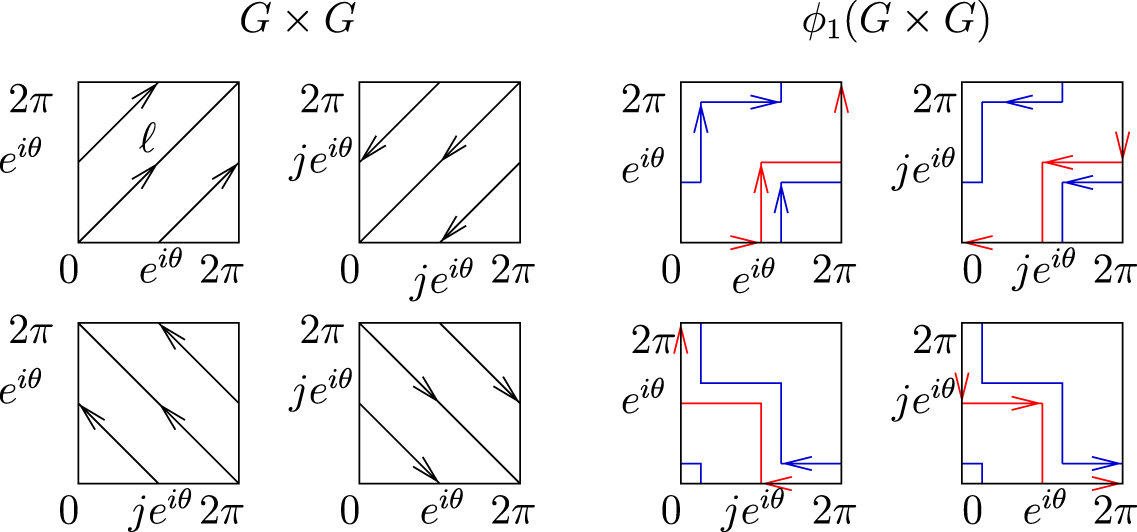
Example 2.10. The  $G$-CW structure on
 $G\times G$ is more complicated. Note that the product CW decomposition on
 $G\times G$ is not equivariant. We choose a homotopy
 $\unicode[STIX]{x1D719}_{t}:G\times G\rightarrow G\times G$ as in Figure 1, with
 $t\in [0,1]$,
 $\unicode[STIX]{x1D719}_{0}=\text{Id},$ and
 $\unicode[STIX]{x1D719}_{1}(G\times G)$ shown. The arrows depict the action of
 $S^{1}$. On the left, the diagonal lines show the
 $G$-action before homotopy. For example, the homotopy
 $\unicode[STIX]{x1D719}$ takes the line
 $\ell =\{(e^{i\unicode[STIX]{x1D703}}\times e^{i\unicode[STIX]{x1D703}})\mid \unicode[STIX]{x1D703}\in (0,\unicode[STIX]{x1D70B})\}$, the first half of the diagonal in
 $S^{1}\times S^{1}$, to the sum of CW cells:
 $$\begin{eqnarray}s\otimes 1+j^{2}\otimes s.\end{eqnarray}$$
The arrows on the right show the  $G$-action on
 $G\times G$ given by
 $$\begin{eqnarray}g(g_{1}\times g_{2})=\unicode[STIX]{x1D719}_{1}(g\unicode[STIX]{x1D719}_{1}^{-1}(g_{1}\times g_{2})).\end{eqnarray}$$
The action (13) is clearly cellular with respect to the product CW structure of  $G\times G$. Then
 $G\times G$ admits a
 $G$-CW-decomposition so that the induced CW decomposition is the product CW decomposition of
 $G\times G$.
Now, let  $X_{1}$ and
 $X_{2}$ be spaces of type SWF. We then give
 $X_{1}\wedge X_{2}$ a
 $G$-CW decomposition proceeding cell-by-cell. That is, for
 $G$-cells
 $e_{1}\subseteq X_{1},e_{2}\subseteq X_{2}$ we give
 $e_{1}\wedge e_{2}$ the appropriate
 $G$-CW decomposition as constructed above. This is possible because the cells
 $e_{i}$ are necessarily of the form
 $D^{k}$,
 $\mathbb{Z}/2\times D^{k}$, or
 $G\times D^{k}$. In particular, the construction of a
 $G$-CW structure on
 $X_{1}\wedge X_{2}$ gives us a
 $G$-CW structure for suspensions. For
 $V$ a finite-dimensional
 $G$-representation which is a direct sum of copies of
 $\mathbb{R},\tilde{\mathbb{R}},$ and
 $\mathbb{H}$, we have
 $\unicode[STIX]{x1D6F4}^{V}X=V^{+}\wedge X$, and so we give
 $\unicode[STIX]{x1D6F4}^{V}X$ the smash product
 $G$-CW decomposition.
Homotopy of the action of  $G$ on
 $G\times G$.

Finally, we construct a CW structure for the  $G$-smash product
 $X_{1}\wedge _{G}X_{2}=(X_{1}\wedge X_{2})/G$ (where
 $G$ acts diagonally). More generally, we describe a CW structure for the quotient
 $W/G$ for
 $W$ a
 $G$-CW complex. Indeed, let
 $W=\bigcup e_{i}$ a
 $G$-CW complex, where
 $e_{i}=G/H_{i}\times D^{k(i)}$ are equivariant
 $G$-cells for some function
 $k$, and
 $H_{i}\subseteq G$ are subgroups. Then
 $W/G$ admits a CW decomposition given by
 $W/G=\bigcup e_{i}/G=\bigcup D^{k(i)}$.
2.3 Modules from $G$-CW decompositions

Throughout this section  $X$ will denote a space of type SWF. Here we will show that the CW chain complex of
 $X$ inherits a module structure from the action of
 $G$, and we will define chain local equivalence.
From the group structure of  $G$,
 $C_{\ast }^{\text{CW}}(G)={\mathcal{G}}$ acquires an algebra structure. Namely, the multiplication map
 $G\times G\rightarrow G$ gives a map
 $C_{\ast }^{\text{CW}}(G)\otimes _{\mathbb{F}}C_{\ast }^{\text{CW}}(G)\rightarrow C_{\ast }^{\text{CW}}(G)$. Here, we have used the product
 $G$-CW decomposition of
 $G\times G$, from Example 2.10, for which the multiplication map is cellular. A small calculation yields
 $$\begin{eqnarray}C_{\ast }^{\text{CW}}(G)\cong \mathbb{F}\langle s,j\rangle /(sj=j^{3}s,s^{2}=0,j^{4}=1).\end{eqnarray}$$
For any  $G$-compatible decomposition of
 $X$, the relative CW chain complex
 $C_{\ast }^{\text{CW}}(X,\text{pt})$, which we will call the reduced
 $G$-CW chain complex of
 $X$, inherits the structure of a
 ${\mathcal{G}}$-chain complex, as the (cellular) map
 $G\times X\rightarrow X$ gives a map
 ${\mathcal{G}}\times C_{\ast }^{\text{CW}}(X,\text{pt})\rightarrow C_{\ast }^{\text{CW}}(X,\text{pt})$. That is,
 $C_{\ast }^{\text{CW}}(X,\text{pt})$ is a module over
 ${\mathcal{G}}$, such that, for
 $z\in C_{\ast }^{\text{CW}}(X,\text{pt})$, and
 $a\in {\mathcal{G}}$,
 $\unicode[STIX]{x2202}(az)=a\unicode[STIX]{x2202}(z)+\unicode[STIX]{x2202}(a)z$. The assertion that
 $(gh)x=g(hx)$ for
 $g,h\in {\mathcal{G}}$ and
 $x\in C_{\ast }^{\text{CW}}(X,\text{pt})$ follows from the fact that the map
 $G\times X\rightarrow X$ is a group action. More concretely, having fixed a
 $G$-compatible CW decomposition of
 $X$,
 $C_{\ast }^{\text{CW}}(X)$ is a
 ${\mathcal{G}}$-module with basis (over
 ${\mathcal{G}}$) given by the set of
 $G$-cells.
We find the module structure for the Examples 2.8–2.10 of § 2.2.
Example 2.11. Consider the  ${\mathcal{G}}$-chain complex structure of
 $C_{\ast }^{\text{CW}}((\tilde{\mathbb{R}}^{s})^{+},\text{pt})$ from Example 2.8. Each equivariant cell
 $c_{i}$ is itself the
 $\mathbb{Z}/2$-orbit of a nonequivariant cell
 $c_{i}^{\prime }=D^{i}\times 0$. Identifying
 $c_{i}^{\prime }$ with its image in
 $C_{\ast }^{\text{CW}}((\tilde{\mathbb{R}}^{s})^{+},\text{pt})$, we have
 $\unicode[STIX]{x2202}(c_{0}^{\prime })=0,\unicode[STIX]{x2202}(c_{1}^{\prime })=c_{0}^{\prime },$ and
 $\unicode[STIX]{x2202}(c_{i}^{\prime })=(1+j)c_{i-1}^{\prime }$ for
 $i\geqslant 2$. One may check that the action of
 ${\mathcal{G}}$ is given by the relations
 $jc_{0}^{\prime }=c_{0}^{\prime }$,
 $j^{2}c_{i}^{\prime }=c_{i}^{\prime }$ for
 $i\geqslant 1$, and
 $sc_{i}^{\prime }=0$ for all
 $i$ (in particular, the CW cells of
 $((\tilde{\mathbb{R}}^{s})^{+},\text{pt})$ are precisely
 $c_{0}^{\prime },c_{1}^{\prime },\ldots ,c_{s}^{\prime }$ and
 $jc_{1}^{\prime },\ldots ,jc_{s}^{\prime }$, and all of these are distinct).
Example 2.12. We also find the  ${\mathcal{G}}$-chain complex structure of
 $C_{\ast }^{\text{CW}}(\mathbb{H}^{+},\text{pt})$ from Example 2.9. We choose CW cells
 $r_{0}^{\prime },y_{i}^{\prime }$, as in Example 2.9, whose orbits are
 $r_{0},y_{i}$. One may check that the differentials are given by
 $$\begin{eqnarray}\unicode[STIX]{x2202}(r_{0}^{\prime })=0,\quad \unicode[STIX]{x2202}y_{1}^{\prime }=r_{0}^{\prime },\quad \unicode[STIX]{x2202}y_{2}^{\prime }=(1+j)y_{1}^{\prime },\quad \text{and}\quad \unicode[STIX]{x2202}y_{3}^{\prime }=sy_{1}^{\prime }+(1+j)y_{2}^{\prime }.\end{eqnarray}$$
The  ${\mathcal{G}}$-action on the fixed-point set,
 $r_{0}^{\prime }$, is necessarily trivial. However, elsewhere the
 $G$-action on
 $(\mathbb{H}^{+},\text{pt})$ is free, and so the submodule (not a subcomplex, however) of
 $C_{\ast }^{\text{CW}}(\mathbb{H}^{+},\text{pt})$ generated by
 $y_{1}^{\prime },y_{2}^{\prime },y_{3}^{\prime }$ is
 ${\mathcal{G}}$-free, specifying the
 ${\mathcal{G}}$-module structure of
 $C_{\ast }^{\text{CW}}(\mathbb{H}^{+},\text{pt})$.
Example 2.13. The CW chain complex of the usual product CW structure on  $G\times G$ becomes a
 ${\mathcal{G}}$-module via
 $$\begin{eqnarray}C_{\ast }^{\text{CW}}(G\times G)=C_{\ast }^{\text{CW}}(G)\otimes _{\mathbb{ F}}C_{\ast }^{\text{CW}}(G),\end{eqnarray}$$
where the action of  ${\mathcal{G}}$ is given by
 $$\begin{eqnarray}\displaystyle \begin{array}{@{}c@{}}s(a\otimes b)=sa\otimes b+j^{2}a\otimes sb,\\ j(a\otimes b)=ja\otimes jb.\end{array} & & \displaystyle\end{eqnarray}$$
The differentials are induced by those of the usual product CW structure on  $G\times G$.
For  $X_{1}\wedge X_{2}$ with the
 $G$-CW decomposition described in § 2.2, we have
 $$\begin{eqnarray}C_{\ast }^{\text{CW}}(X_{1}\wedge X_{2},\text{pt})=C_{\ast }^{\text{CW}}(X_{1},\text{pt})\otimes _{\mathbb{F}}C_{\ast }^{\text{CW}}(X_{2},\text{pt}),\end{eqnarray}$$
as  ${\mathcal{G}}$-chain complexes, using (15).
Furthermore the CW chain complex for the  $G$-smash product
 $X_{1}\wedge _{G}X_{2}$ is given by
 $$\begin{eqnarray}C_{\ast }^{\text{CW}}(X_{1}\wedge _{G}X_{2},\text{pt})\simeq C_{\ast }^{\text{CW}}(X_{1}\wedge X_{2},\text{pt})/{\mathcal{G}}.\end{eqnarray}$$
Here, the right-hand side is defined by quotienting by the action of  $(1+j)$ and
 $s$. One may check directly that the result is a chain complex.
We will write elements of the latter as  $x_{1}\otimes _{{\mathcal{G}}}x_{2}$. Note that Borel homology
 $\tilde{H}_{\ast }^{G}(X)$ is calculated using a
 $G$-smash product, and so may be computed from the following chain complex:
 $$\begin{eqnarray}\tilde{H}_{\ast }^{G}(X)=H((C_{\ast }^{\text{CW}}(EG)\otimes _{\mathbb{ F}}C_{\ast }^{\text{CW}}(X,\text{pt}))/{\mathcal{G}},\unicode[STIX]{x2202}).\end{eqnarray}$$
In (18), we choose some fixed  $G$-CW decomposition of
 $EG$ to define
 $C_{\ast }^{\text{CW}}(EG)$. Following (18), we make a definition.
Definition 2.14. Let  $Z$ a
 ${\mathcal{G}}$-chain complex. We define the
 $G$-Borel homology of
 $Z$ by
 $$\begin{eqnarray}H_{\ast }^{G}(Z)=H(C_{\ast }^{\text{CW}}(EG)\otimes _{{\mathcal{G}}}Z,\unicode[STIX]{x2202}),\end{eqnarray}$$
and similarly for  $S^{1}$-Borel homology:
 $$\begin{eqnarray}H_{\ast }^{S^{1}}(Z)=H(C_{\ast }^{\text{CW}}(EG)\otimes _{C_{\ast }^{\text{CW}}(S^{1})}Z,\unicode[STIX]{x2202}),\end{eqnarray}$$
where  $C_{\ast }^{\text{CW}}(S^{1})$ is viewed as a subcomplex of
 ${\mathcal{G}}$.
Note then that the  ${\mathcal{G}}$-module
 $C_{\ast }^{\text{CW}}(X,\text{pt})$ determines
 $\tilde{H}_{\ast }^{G}(X)$ for
 $X$ a space of type SWF.
Definition 2.15. A  ${\mathcal{G}}$-chain complex
 $Z$of type SWF at level
 $s$ is a
 ${\mathcal{G}}$-chain complex
 $Z$ generated by
 $$\begin{eqnarray}\{c_{0},c_{1},c_{2},\ldots ,c_{s}\}\,\cup \,\mathop{\bigcup }_{i\in I}\{x_{i}\},\end{eqnarray}$$
subject to the following conditions (perhaps with an overall grading shift). The element  $c_{i}$ is of degree
 $i$, and
 $I$ is some finite index set. The only relations are
 $j^{2}c_{i}=c_{i},sc_{i}=0,jc_{0}=c_{0}$. The differentials are given by
 $\unicode[STIX]{x2202}c_{0}=0$,
 $\unicode[STIX]{x2202}c_{1}=c_{0}$, and
 $\unicode[STIX]{x2202}c_{i}=(1+j)c_{i-1}$ for
 $2\leqslant i\leqslant s$. The submodule generated by
 $\{{x_{i}\}}_{i\in I}$ is free under the action of
 ${\mathcal{G}}$. We call the submodule generated by
 $\{{c_{i}\}}_{i}$ the fixed-point set (or fixed-point subcomplex) of
 $Z$.
Note that the fixed-point subcomplex is part of the data of a complex of type SWF.
Chain complexes of type SWF are to be thought of as reduced  $G$-CW chain complexes of spaces of type SWF. Indeed, all spaces
 $X$ of type SWF have reduced
 $G$-CW chain complex homotopy equivalent to a complex of type SWF. To see this, we first choose a homotopy equivalence
 $X^{S^{1}}\simeq (\tilde{\mathbb{R}}^{s})^{+}$ and decompose the latter according to the CW decomposition of Example 2.8. We note that
 $X^{S^{1}}$ is a
 $G$-CW subcomplex of
 $X$, and all cells of
 $(X,X^{S^{1}})$ are free
 $G$-cells, since
 $X$ is a space of type SWF. Then
 $X$ is homotopy-equivalent to a space obtained by attaching
 $X/X^{S^{1}}$ to
 $(\tilde{\mathbb{R}}^{s})^{+}$. By a cellular approximation we obtain a chain map,
 $$\begin{eqnarray}C_{\ast }^{\text{CW}}(X/X^{S^{1}},\text{pt})\rightarrow C_{\ast }^{\text{CW}}(\unicode[STIX]{x1D6F4}^{\mathbb{R}}(\tilde{\mathbb{R}}^{s})^{+},\text{pt}),\end{eqnarray}$$
whose mapping cone is homotopy equivalent to  $C_{\ast }^{\text{CW}}(X,\text{pt})[-1]$. However, any two equivariant CW complexes for
 $(\tilde{\mathbb{R}}^{s})^{+}$ are chain homotopy equivalent. To see this, first note that for any such CW decomposition, the standard CW chain complex
 $\langle c_{0},\ldots ,c_{s}\rangle$ admits a quasi-isomorphism to
 $C_{\ast }^{\text{CW}}((\tilde{\mathbb{R}}^{s})^{+},\text{pt})$. This induces a quasi-isomorphism
 $\langle c_{1},\ldots ,c_{s}\rangle \rightarrow C_{\ast }^{\text{CW}}((\tilde{\mathbb{R}}^{s})^{+},S^{0})$. That is, we have a quasi-isomorphism between free
 $\mathbb{Z}_{2}$-complexes. By [Reference WeibelWei94, Theorem 10.4.8], these complexes are in fact homotopy equivalent, from which it also follows that
 $C_{\ast }^{\text{CW}}((\tilde{\mathbb{R}}^{s})^{+},\text{pt})\simeq \langle c_{0},\ldots ,c_{s}\rangle$. Similarly, we obtain that any two equivariant CW complexes for
 $\unicode[STIX]{x1D6F4}^{\mathbb{R}}(\tilde{\mathbb{R}}^{s})^{+}$ are chain homotopy equivalent. Then we may replace (22) with the same sequence, using the standard CW complex structure on
 $(\tilde{\mathbb{R}}^{s})^{+}$, and we see that
 $C_{\ast }^{\text{CW}}(X,\text{pt})$ is homotopy-equivalent to a chain complex of type SWF.
Let  $\tilde{\oplus }$ denote a direct sum of
 ${\mathcal{G}}$-modules that need not be a direct sum of chain complexes. Note that a choice of decomposition
 $R\,\tilde{\oplus }\,F$ of a chain complex of type SWF, where
 $R=\langle c_{0},\ldots ,c_{s}\rangle$ and
 $F=\text{span}_{i}\{x_{i}\}$, is not part of the data in the definition. However, for a space
 $X$ of type SWF,
 $C_{\ast }^{\text{CW}}(X,\text{pt})$ comes with a preferred fixed-subset (from fixed cells), and much of what follows could be rephrased where the decomposition is part of the data of a complex of type SWF (this will turn out to be somewhat immaterial; cf. Lemma 2.24).
To introduce chain local equivalence, we will consider the CW chain complexes coming from suspensions. For a module  $M$ and a submodule
 $S\subseteq M$, we let
 $\langle S\rangle \subseteq M$ denote the subset generated by
 $S$.
Note that, by Example 2.11 and the  $G$-CW decomposition constructed in § 2.2 for suspensions, for
 $X$ a space of type SWF:
 $$\begin{eqnarray}C_{\ast }^{\text{CW}}(\unicode[STIX]{x1D6F4}^{\tilde{\mathbb{R}}}X,\text{pt})=\langle c_{0},c_{1}\rangle \,\otimes _{\mathbb{F}}\,C_{\ast }^{\text{CW}}(X,\text{pt}),\end{eqnarray}$$
with relations  $\unicode[STIX]{x2202}c_{1}=c_{0}$,
 $j^{2}c_{1}=c_{1},jc_{0}=c_{0},sc_{0}=sc_{1}=0$. The differential on the right is given by
 $\unicode[STIX]{x2202}(a\otimes b)=\unicode[STIX]{x2202}(a)\otimes b+a\otimes \unicode[STIX]{x2202}(b)$. Similarly, using Example 2.12:
 $$\begin{eqnarray}C_{\ast }^{\text{CW}}(\unicode[STIX]{x1D6F4}^{\mathbb{H}}X,\text{pt})=\langle r_{0},y_{1},y_{2},y_{3}\rangle \,\otimes _{\mathbb{F}}\,C_{\ast }^{\text{CW}}(X,\text{pt}),\end{eqnarray}$$
with the product differential on the right, and differentials for the  $y_{i}$ given as in Example 2.12.
For  $V=\mathbb{H}$,
 $\tilde{\mathbb{R}}$, or
 $\mathbb{R}$, and
 $Z$ a
 ${\mathcal{G}}$-chain complex, we set
 $$\begin{eqnarray}\unicode[STIX]{x1D6F4}^{V}Z=C_{\ast }^{\text{CW}}(V^{+},\text{pt})\,\otimes _{\mathbb{ F}}\,Z,\end{eqnarray}$$
with  ${\mathcal{G}}$-action given by
 $$\begin{eqnarray}\displaystyle \begin{array}{@{}c@{}}s(a\otimes b)=(sa\otimes b)+(j^{2}a\otimes sb),\\[2.0pt] j(a\otimes b)=ja\otimes jb.\end{array} & & \displaystyle\end{eqnarray}$$
The chain complexes  $C_{\ast }^{\text{CW}}(\mathbb{H}^{+},\text{pt})$ and
 $C_{\ast }^{\text{CW}}(\tilde{\mathbb{R}}^{+},\text{pt})$ were given in Examples 2.11 and 2.12, respectively. Also,
 $C_{\ast }^{\text{CW}}(\mathbb{R}^{+},\text{pt})=\langle c_{1}\rangle$, where
 $jc_{1}=c_{1},sc_{1}=0$, and
 $\text{deg}\,c_{1}=1$. Hence, for example,
 $$\begin{eqnarray}\unicode[STIX]{x1D6F4}^{\mathbb{R}}Z=Z[-1].\end{eqnarray}$$
Lemma 2.16. Let  $V=\mathbb{H}$,
 $\tilde{\mathbb{R}}$, or
 $\mathbb{R}$. If
 $Z=C_{\ast }^{\text{CW}}(X,\text{pt})$ for
 $X$ a space of type SWF, then
 $\unicode[STIX]{x1D6F4}^{V}Z=C_{\ast }^{\text{CW}}(\unicode[STIX]{x1D6F4}^{V}X,\text{pt})$.
For  $V=\mathbb{H}^{i}\oplus \tilde{\mathbb{R}}^{j}\oplus \mathbb{R}^{k}$ for some constants
 $i,j,k$, we define
 $\unicode[STIX]{x1D6F4}^{V}Z$ by
 $$\begin{eqnarray}\unicode[STIX]{x1D6F4}^{V}Z=(\unicode[STIX]{x1D6F4}^{\mathbb{H}})^{i}(\unicode[STIX]{x1D6F4}^{\tilde{\mathbb{R}}})^{j}(\unicode[STIX]{x1D6F4}^{\mathbb{R}})^{k}Z,\end{eqnarray}$$
where  $(\unicode[STIX]{x1D6F4}^{\mathbb{H}})^{i}$ denotes applying
 $\unicode[STIX]{x1D6F4}^{\mathbb{H}}$
 $i$ times, and so for
 $\tilde{\mathbb{R}}$ and
 $\mathbb{R}$. Then
 $$\begin{eqnarray}\unicode[STIX]{x1D6F4}^{V}\unicode[STIX]{x1D6F4}^{W}Z\simeq \unicode[STIX]{x1D6F4}^{W}\unicode[STIX]{x1D6F4}^{V}Z,\end{eqnarray}$$
for two  $G$-representations
 $V,W$, each a direct sum of copies of
 $\mathbb{H},\mathbb{R},\tilde{\mathbb{R}}$.
Definition 2.17. Let  $Z_{i}$ be chain complexes of type SWF,
 $m_{i}\in \mathbb{Z},n_{i}\in \mathbb{Q}$, for
 $i=1,2$. We call
 $(Z_{1},m_{1},n_{1})$ and
 $(Z_{2},m_{2},n_{2})$chain stably equivalent if
 $n_{1}-n_{2}\in \mathbb{Z}$ and there exist
 $M\in \mathbb{Z},N\in \mathbb{Q}$ and maps
 $$\begin{eqnarray}\displaystyle & \displaystyle \unicode[STIX]{x1D6F4}^{(N-n_{1})\mathbb{H}}\unicode[STIX]{x1D6F4}^{(M-m_{1})\tilde{\mathbb{R}}}Z_{1}\rightarrow \unicode[STIX]{x1D6F4}^{(N-n_{2})\mathbb{H}}\unicode[STIX]{x1D6F4}^{(M-m_{2})\tilde{\mathbb{R}}}Z_{2}, & \displaystyle\end{eqnarray}$$
 $$\begin{eqnarray}\displaystyle & \displaystyle \unicode[STIX]{x1D6F4}^{(N-n_{1})\mathbb{H}}\unicode[STIX]{x1D6F4}^{(M-m_{1})\tilde{\mathbb{R}}}Z_{1}\leftarrow \unicode[STIX]{x1D6F4}^{(N-n_{2})\mathbb{H}}\unicode[STIX]{x1D6F4}^{(M-m_{2})\tilde{\mathbb{R}}}Z_{2}, & \displaystyle\end{eqnarray}$$
which are chain homotopy equivalences.
Remark 2.18. We do not consider suspensions by  $\mathbb{R}$, unlike in the case of stable equivalence for spaces, since by (26), no new maps are obtained by suspending by
 $\mathbb{R}$.
Chain stable equivalence is an equivalence relation, and we denote the set of chain stable equivalence classes by  $\mathfrak{CE}$.
Lemma 2.19. Associated to an element  $(X,m,n)\in \mathfrak{C}$ there is a well-defined element
 $(C_{\ast }^{\text{CW}}(X,\text{pt}),m,n)\in \mathfrak{CE}$.
Proof. Say that  $[(X_{1},m_{1},n_{1})]=[(X_{2},m_{2},n_{2})]\in \mathfrak{C}$ with
 $G$-CW decompositions
 $C_{i}$ of
 $X_{i}$. We will show that
 $$\begin{eqnarray}[(C_{\ast }^{\text{CW}}(X_{1},\text{pt}),m_{1},n_{1})]=[(C_{\ast }^{\text{CW}}(X_{2},\text{pt}),m_{2},n_{2})]\in \mathfrak{CE},\end{eqnarray}$$
where  $C_{\ast }^{\text{CW}}(X_{i},\text{pt})$ is the
 ${\mathcal{G}}$-chain complex associated to the
 $G$-CW decomposition
 $C_{i}$ of
 $X_{i}$. (In the case
 $X_{1}\simeq X_{2}$, and
 $m_{1}=m_{2},n_{1}=n_{2}$, we are showing that the corresponding element in
 $\mathfrak{CE}$ does not depend on the choice of
 $G$-CW decomposition.) By hypothesis, there are homotopy equivalences
 $f$ and
 $g$:
 $$\begin{eqnarray}\displaystyle & \displaystyle f:\unicode[STIX]{x1D6F4}^{(N-n_{1})\mathbb{H}}\unicode[STIX]{x1D6F4}^{(M-m_{1})\tilde{\mathbb{R}}}X_{1}\rightarrow \unicode[STIX]{x1D6F4}^{(N-n_{2})\mathbb{H}}\unicode[STIX]{x1D6F4}^{(M-m_{2})\tilde{\mathbb{R}}}X_{2}, & \displaystyle \nonumber\\ \displaystyle & \displaystyle g:\unicode[STIX]{x1D6F4}^{(N-n_{2})\mathbb{H}}\unicode[STIX]{x1D6F4}^{(M-m_{2})\tilde{\mathbb{R}}}X_{2}\rightarrow \unicode[STIX]{x1D6F4}^{(N-n_{1})\mathbb{H}}\unicode[STIX]{x1D6F4}^{(M-m_{1})\tilde{\mathbb{R}}}X_{1}. & \displaystyle \nonumber\end{eqnarray}$$
By the equivariant cellular approximation theorem (see [Reference WanerWan80]), we may homotope  $f$ and
 $g$ to cellular maps (where the cell structures of suspensions are given as in (24)):
 $$\begin{eqnarray}\displaystyle & \displaystyle f^{\text{CW}}:\unicode[STIX]{x1D6F4}^{(N-n_{1})\mathbb{H}}\unicode[STIX]{x1D6F4}^{(M-m_{1})\tilde{\mathbb{R}}}C_{1}\rightarrow \unicode[STIX]{x1D6F4}^{(N-n_{2})\mathbb{H}}\unicode[STIX]{x1D6F4}^{(M-m_{2})\tilde{\mathbb{R}}}C_{2}, & \displaystyle \nonumber\\ \displaystyle & \displaystyle g^{\text{CW}}:\unicode[STIX]{x1D6F4}^{(N-n_{2})\mathbb{H}}\unicode[STIX]{x1D6F4}^{(M-m_{2})\tilde{\mathbb{R}}}C_{2}\rightarrow \unicode[STIX]{x1D6F4}^{(N-n_{1})\mathbb{H}}\unicode[STIX]{x1D6F4}^{(M-m_{1})\tilde{\mathbb{R}}}C_{1}. & \displaystyle \nonumber\end{eqnarray}$$
Since  $f$ and
 $g$ are homotopy equivalences, so are
 $f^{\text{CW}}$ and
 $g^{\text{CW}}$. The cellular maps
 $f^{\text{CW}}$ and
 $g^{\text{CW}}$ induce maps
 $f_{\ast }$ and
 $g_{\ast }$:
 $$\begin{eqnarray}\displaystyle & \displaystyle f_{\ast }:\unicode[STIX]{x1D6F4}^{(N-n_{1})\mathbb{H}}\unicode[STIX]{x1D6F4}^{(M-m_{1})\tilde{\mathbb{R}}}C_{\ast }^{\text{CW}}(X_{1},\text{pt})\rightarrow \unicode[STIX]{x1D6F4}^{(N-n_{2})\mathbb{H}}\unicode[STIX]{x1D6F4}^{(M-m_{2})\tilde{\mathbb{R}}}C_{\ast }^{\text{CW}}(X_{2},\text{pt}), & \displaystyle \nonumber\\ \displaystyle & \displaystyle g_{\ast }:\unicode[STIX]{x1D6F4}^{(N-n_{2})\mathbb{H}}\unicode[STIX]{x1D6F4}^{(M-m_{2})\tilde{\mathbb{R}}}C_{\ast }^{\text{CW}}(X_{2},\text{pt})\rightarrow \unicode[STIX]{x1D6F4}^{(N-n_{1})\mathbb{H}}\unicode[STIX]{x1D6F4}^{(M-m_{1})\tilde{\mathbb{R}}}C_{\ast }^{\text{CW}}(X_{1},\text{pt}). & \displaystyle \nonumber\end{eqnarray}$$
These are chain homotopy equivalences, by construction, and so we obtain (31), as needed. ◻
Definition 2.20. Let  $Z_{i}$ be chain complexes of type SWF,
 $m_{i}\in \mathbb{Z},n_{i}\in \mathbb{Q}$, for
 $i=1,2$. We call
 $(Z_{1},m_{1},n_{1})$ and
 $(Z_{2},m_{2},n_{2})$chain locally equivalent, written
 $(Z_{1},m_{1},n_{1})\equiv _{cl}(Z_{2},m_{2},n_{2})$, if there exist
 $M\in \mathbb{Z},N\in \mathbb{Q}$ and maps
 $$\begin{eqnarray}\displaystyle & \displaystyle \unicode[STIX]{x1D6F4}^{(N-n_{1})\mathbb{H}}\unicode[STIX]{x1D6F4}^{(M-m_{1})\tilde{\mathbb{R}}}Z_{1}\rightarrow \unicode[STIX]{x1D6F4}^{(N-n_{2})\mathbb{H}}\unicode[STIX]{x1D6F4}^{(M-m_{2})\tilde{\mathbb{R}}}Z_{2}, & \displaystyle\end{eqnarray}$$
 $$\begin{eqnarray}\displaystyle & \displaystyle \unicode[STIX]{x1D6F4}^{(N-n_{1})\mathbb{H}}\unicode[STIX]{x1D6F4}^{(M-m_{1})\tilde{\mathbb{R}}}Z_{1}\leftarrow \unicode[STIX]{x1D6F4}^{(N-n_{2})\mathbb{H}}\unicode[STIX]{x1D6F4}^{(M-m_{2})\tilde{\mathbb{R}}}Z_{2}, & \displaystyle\end{eqnarray}$$
which are chain homotopy equivalences on fixed-point sets.
We call a map as in (32) or (33) a chain local equivalence. By the condition ‘is a homotopy equivalence on fixed-point sets’ we mean that the maps restrict to homotopy equivalences of  $\langle c_{0},\ldots ,c_{s}\rangle$ (in particular, we require that the chain maps in (32)–(33) send fixed-point sets to fixed-point sets).
Elements  $Z_{1},Z_{2}\in \mathfrak{CE}$ are chain locally equivalent if and only if there are chain local equivalences
 $Z_{1}\rightarrow Z_{2}$ and
 $Z_{2}\rightarrow Z_{1}$. There are pairs of chain complexes with a chain local equivalence in one direction but not the other; these are not chain locally equivalent complexes. Chain local equivalence is an equivalence relation. Denote the set of chain local equivalence classes by
 $\mathfrak{CLE}$. The set
 $\mathfrak{CLE}$ is naturally an abelian group, with multiplication given by the tensor product (over
 $\mathbb{F}$, with
 ${\mathcal{G}}$-action as above). To discuss inverses in
 $\mathfrak{CLE}$, we take a brief discursion.
Note that it is not obvious that chain homotopy equivalent complexes of type SWF are chain locally equivalent, as there may be self-homotopy-equivalences of a complex that do not take fixed-point sets to fixed-point sets. Note, however, that any two  ${\mathcal{G}}$-chain complexes coming from a space of type SWF with different
 $G$-CW decompositions are necessarily homotopy-equivalent by a chain map preserving the subcomplex of the fixed point set (coinciding with the notion of the ‘fixed-point set’ of a chain complex of type SWF), by the equivariant cellular approximation theorem. For more general
 ${\mathcal{G}}$-chain complexes, we have Lemma 2.26 below, which states that the chain homotopy type determines the chain local equivalence class.
Inverses are given by dual chain complexes. Note that  $\text{Hom}(Z;\mathbb{F})$ will not usually be a chain complex of type SWF; however, some suspension of it will be chain homotopy equivalent to a chain complex of type SWF; see Lemma 2.27. In the case of chain complexes of type SWF arising as CW-chain complexes, inverses are more readily understood. Here, we recall from [Reference ManolescuMan16] that the Spanier–Whitehead dual of a space of type SWF is again a space of type SWF, from which the existence of group inverses (for chain complexes coming from spaces) follows.
2.4 Calculating the chain local equivalence class
In this section we will obtain a description of  $\mathfrak{CLE}$ more amenable to calculations than the definition. Throughout this section
 $Z$ will denote a chain complex of type SWF. The main result is Lemma 2.24, which allows us to determine if
 $(Z_{1},m_{1},n_{1})$ and
 $(Z_{2},m_{2},n_{2})$ are chain locally equivalent without checking all possible
 $M,N$.
For  $Z$ a chain complex of type SWF, we will let
 $Z$ also denote the element
 $(Z,0,0)\in \mathfrak{CE}$.
Definition 2.21. Let  $R$ be the fixed-point set of
 $Z$. If
 $\text{deg}\,r<\text{deg}\,x$ for all nonzero homogeneous
 $x\in (Z/R)$ and
 $r\in R$, we say that the chain complex
 $Z$ is a suspensionlike complex.
Remark 2.22. Let  $X$ be a free, finite
 $G$-CW complex. Then the reduced
 $G$-CW chain complex of
 $\tilde{\unicode[STIX]{x1D6F4}}X$, the unreduced suspension of
 $X$, is a suspensionlike chain complex.
For  $Z_{1},Z_{2}\in \mathfrak{CLE}$, we call a local equivalence
 $Z_{1}\rightarrow Z_{2}$ (without needing to suspend either complex) an unstable local map.
Lemma 2.23. Let  $Z_{i}=R_{i}\,\tilde{\oplus }\,F_{i}$ for
 $i=1,2$ be suspensionlike chain complexes at level
 $s$ with unstable local maps
 $Z_{1}\leftrightarrow Z_{2}$. Then there exist suspensionlike chain complexes
 $Z_{i}^{\prime }$ at level
 $0$ with
 $\unicode[STIX]{x1D6F4}^{\tilde{\mathbb{R}}^{s}}Z_{i}^{\prime }\simeq Z_{i}$, and unstable local maps
 $Z_{1}^{\prime }\leftrightarrow Z_{2}^{\prime }$.
Proof. We may assume  $s>0$, as otherwise the statement is vacuous. To construct
 $Z_{i}^{\prime }$, observe that the image
 $\text{Im}\,\unicode[STIX]{x2202}|_{F_{i}}\cap R_{i}$, must be either
 $\{(1+j)c_{s}\}$ or empty, and in the latter case the lemma is trivial, so we assume that the former holds. Then, construct a new complex
 $Z_{i}^{\prime }=\langle f\rangle \,\tilde{\oplus }\,F_{i}[s]$, where the boundary map
 $F_{i}[s]\rightarrow \langle f\rangle$ is obtained as the boundary map
 $F_{i}\rightarrow \langle (1+j)c_{s}\rangle$. It is clear that an unstable local map
 $Z_{1}\rightarrow Z_{2}$ induces an unstable local map
 $Z_{1}^{\prime }\rightarrow Z_{2}^{\prime }$, and we are left with showing
 $Z_{i}\simeq \unicode[STIX]{x1D6F4}^{\tilde{\mathbb{R}}^{s}}Z_{i}^{\prime }$.
To see this, we view  $\unicode[STIX]{x1D6F4}^{\tilde{\mathbb{R}}^{s}}Z_{i}^{\prime }$ as the mapping cone of
 $$\begin{eqnarray}\unicode[STIX]{x1D6F4}^{\tilde{\mathbb{R}}^{s}}F_{i}[s]\rightarrow \unicode[STIX]{x1D6F4}^{\tilde{\mathbb{R}}^{s}}\langle f\rangle [-1].\end{eqnarray}$$
We claim  $\unicode[STIX]{x1D6F4}^{\tilde{\mathbb{R}}^{s}}F_{i}[s]\simeq F_{i}$. To see this, construct a map
 $F_{i}\rightarrow \unicode[STIX]{x1D6F4}^{\tilde{\mathbb{R}}^{s}}F_{i}[s]$ by
 $x\rightarrow (1+j)c_{s}\otimes x[s]$; it is straightforward to check that this map is a quasi-isomorphism. By [Reference WeibelWei94, Theorem 10.4.8], and using that
 $\unicode[STIX]{x1D6F4}^{\tilde{\mathbb{R}^{s}}}F_{i}$ is free, this map admits a homotopy inverse, establishing the claim. Then, the mapping cone (34) is homotopy equivalent to the mapping cone of some
 $F_{i}\rightarrow \unicode[STIX]{x1D6F4}^{\tilde{\mathbb{R}}^{s}}\langle f\rangle [-1]\cong R_{i}[-1]$. In particular, the map
 $F_{i}\rightarrow \unicode[STIX]{x1D6F4}^{\tilde{\mathbb{R}}^{s}}F_{i}[s]$ constructed above commutes with the boundary maps in the construction of
 $Z_{i}^{\prime }$ and in (34). Then we have a map
 $\unicode[STIX]{x1D719}:Z_{i}\rightarrow \unicode[STIX]{x1D6F4}^{\tilde{\mathbb{R}}^{s}}Z_{i}^{\prime }$, which is a quasi-isomorphism; that is, the mapping cone
 $\text{Cone}(\unicode[STIX]{x1D719})$ is trivial in the derived category. Since
 $\text{Cone}(\unicode[STIX]{x1D719})$ is homotopy-equivalent to a free complex, it is also trivial in the homotopy category, and so
 $\unicode[STIX]{x1D719}$ is a homotopy equivalence, as needed.◻
Lemma 2.24. Let  $Z_{1}$ and
 $Z_{2}$ be locally equivalent suspensionlike chain complexes of type SWF. Then there exist unstable local maps
 $$\begin{eqnarray}Z_{1}\leftrightarrow Z_{2},\end{eqnarray}$$
without needing to suspend  $Z_{i}$.
Proof. By Lemma 2.23, we may assume that  $Z_{1}$ and
 $Z_{2}$ are level
 $0$ and suspensionlike. It then suffices to show that if there are unstable local maps
 $\unicode[STIX]{x1D6F4}^{\mathbb{H}}Z_{1}\leftrightarrow \unicode[STIX]{x1D6F4}^{\mathbb{H}}Z_{2}$, then there are unstable local maps
 $Z_{1}\leftrightarrow Z_{2}$.
Let  $Z_{i}=R_{i}\,\tilde{\oplus }\,F_{i}$. That is,
 $Z_{i}$ is the mapping cone of a map
 $F_{i}\rightarrow R_{i}[-1]$. Now,
 $\unicode[STIX]{x1D6F4}^{\mathbb{H}}Z_{i}=\unicode[STIX]{x1D6F4}^{\mathbb{H}}R_{i}\,\tilde{\oplus }\,\unicode[STIX]{x1D6F4}^{\mathbb{H}}F_{i}$. We claim
 $\unicode[STIX]{x1D6F4}^{\mathbb{H}}F_{i}\simeq F_{i}[-4]$. First, we have a quasi-isomorphism
 $F_{i}[-4]\rightarrow \unicode[STIX]{x1D6F4}^{\mathbb{H}}F_{i}$ by
 $x[-4]\rightarrow s(1+j)^{3}y_{3}\otimes x$. Further, any free finite
 ${\mathcal{G}}$-chain complex
 $F$ with
 $H(F)=0$ is nullhomotopic (the verification of this is similar to the construction of projective resolutions in abelian categories). It follows that free finite quasi-isomorphic
 ${\mathcal{G}}$-chain complexes are in fact homotopy equivalent, giving the claim. In particular,
 $\unicode[STIX]{x1D6F4}^{\mathbb{H}}Z_{i}$ is homotopy equivalent to the mapping cone of a map
 $F_{i}[-4]\rightarrow \unicode[STIX]{x1D6F4}^{\mathbb{H}}R_{i}[-1]$. However, since
 $Z_{i}$ is suspensionlike, we have that
 $F_{i}[-4]$ is concentrated in degree at least
 $5$, while
 $s(1+j)^{3}y_{3}[-1]$ is the only cycle in degree
 $5$. It is then readily checked that the map
 $F_{i}[-4]\rightarrow \langle s(1+j)^{3}y_{3}[-1]\rangle$ defining (a complex homotopy equivalent to)
 $\unicode[STIX]{x1D6F4}^{\mathbb{H}}Z_{i}$ is identical to the map
 $F_{i}\rightarrow R_{i}$ defining
 $Z_{i}$.
Now, say we have local equivalences  $\unicode[STIX]{x1D719}:\unicode[STIX]{x1D6F4}^{\mathbb{H}}R_{1}\,\tilde{\oplus }\,F_{1}[-4]\rightarrow \unicode[STIX]{x1D6F4}^{\mathbb{H}}R_{2}\,\tilde{\oplus }\,F_{2}[-4]$. For grading reasons,
 $\unicode[STIX]{x1D719}$ must send
 $\unicode[STIX]{x1D6F4}^{\mathbb{H}}R_{1}\rightarrow \unicode[STIX]{x1D6F4}^{\mathbb{H}}R_{2}$. In particular, there is then a map of exact sequences as follows.

Any local map  $\unicode[STIX]{x1D719}$ sends
 $s(1+j)^{3}y_{3}\otimes c_{0}\in \unicode[STIX]{x1D6F4}^{\mathbb{H}}R_{1}\rightarrow s(1+j)^{3}y_{3}\otimes c_{0}\in \unicode[STIX]{x1D6F4}^{\mathbb{H}}R_{2}$, as is a straightforward check. Then we inherit a local map
 $\unicode[STIX]{x1D713}:Z_{1}\rightarrow Z_{2}$ by defining it separately on the fixed point set and on
 $F_{1}$. That is, set
 $\unicode[STIX]{x1D713}(c_{0})=c_{0}$, and for
 $x\in F_{1}$, set
 $\unicode[STIX]{x1D713}(x)=\unicode[STIX]{x1D719}(x[-4])$. The map
 $\unicode[STIX]{x1D713}$ commutes with the boundary
 $F_{i}\rightarrow R_{i}[-1]$ using
 $\unicode[STIX]{x1D719}(s(1+j)^{3}y_{3}\otimes c_{0})=s(1+j)^{3}y_{3}\otimes c_{0}$ and the construction of the boundary map
 $F_{i}[-4]\rightarrow \langle s(1+j)^{3}y_{3}\rangle [-1]$. Then,
 $\unicode[STIX]{x1D713}$ is a local map, and we similarly construct a local map going the other direction, completing the proof.◻
Lemma 2.24 states that if  $\unicode[STIX]{x1D6F4}^{(N_{0}-n_{i})\mathbb{H}}\unicode[STIX]{x1D6F4}^{(M_{0}-m_{i})\tilde{\mathbb{R}}}Z_{i}$ are suspensionlike, then if
 $(Z_{1},m_{1},n_{1})$ and
 $(Z_{2},m_{2},n_{2})$ are (stably) locally equivalent, there is a local equivalence realized by genuine (unstable) chain maps after suspending the complexes
 $Z_{i}$ by
 $(N_{0}-n_{i})\mathbb{H}\oplus (M_{0}-m_{i})\tilde{\mathbb{R}}$.
Finally, to take advantage of Lemma 2.24, we need to know that many complexes admit suspensionlike representatives.
Lemma 2.25. Let  $Z$ a chain complex of type SWF. Then some suspension
 $\unicode[STIX]{x1D6F4}^{V}Z$ is homotopy equivalent (in fact, locally equivalent) to a suspensionlike chain complex.
Proof. This is much as the proof of Lemma 2.24. We express  $Z=R\,\tilde{\oplus }\,F$, with fixed point set
 $R$. Then
 $\unicode[STIX]{x1D6F4}^{\mathbb{H}^{n}}Z$ is a chain complex homotopy equivalent to
 $\unicode[STIX]{x1D6F4}^{\mathbb{H}^{n}}R\,\tilde{\oplus }\,F[-4n]$, and moreover the chain homotopy equivalence is the identity on
 $\unicode[STIX]{x1D6F4}^{\mathbb{H}^{n}}R$ (whence, a local equivalence). In the case
 $s=0$,
 $\unicode[STIX]{x1D6F4}^{\mathbb{H}^{n}}R$ is a suspensionlike chain complex, and so then is
 $\unicode[STIX]{x1D6F4}^{\mathbb{H}^{n}}R\,\tilde{\oplus }\,F[-4n]$, finishing the proof.
For  $s>0$, there is a subcomplex, inducing a quasi-isomorphism,
 $H_{n}\subset \unicode[STIX]{x1D6F4}^{\mathbb{H}^{n}}R$ given by
 $R$ along with generators
 $y_{4k+1},y_{4k+2},y_{4k+3}$ for
 $0\leqslant k\leqslant n-1$, that satisfy relations as in Example 2.9. In fact,
 $H_{n}$ and
 $\unicode[STIX]{x1D6F4}^{\mathbb{H}^{n}}R$ are two different CW chain complexes coming from different
 $G$-CW decompositions of
 $(\tilde{\mathbb{R}}^{s}\oplus \mathbb{H}^{n})^{+}$. The cone of
 $H_{n}\rightarrow \unicode[STIX]{x1D6F4}^{\mathbb{H}^{n}}R$ is zero in the derived category, and is homotopy equivalent to a free complex, so is nullhomotopic, as in the proof of Lemma 2.24. Using that
 $H_{n}$ is suspensionlike, we obtain that
 $\unicode[STIX]{x1D6F4}^{\mathbb{H}^{n}}Z$ is homotopy equivalent to a suspensionlike chain complex
 $H_{n}\,\tilde{\oplus }\,F[-4n]$.◻
Similarly, we can show the following result.
Lemma 2.26. Let  $Z_{1}=Z_{2}\in \mathfrak{CE}$. Then
 $Z_{1}=Z_{2}\in \mathfrak{CLE}$.
Proof. We may assume that  $Z_{1},Z_{2}$ are chain complexes of type SWF (that is, we have already suspended suitably). By Lemma 2.25, after further suspending, we can assume that
 $Z_{1},Z_{2}$ are chain homotopy equivalent suspensionlike complexes. We have used in this step that the suspensionlike representatives of the (stable) chain homotopy equivalence class generated by Lemma 2.25 are locally equivalent to the original complexes. Now, any chain map
 $\unicode[STIX]{x1D719}:Z_{1}\rightarrow Z_{2}$, for
 $Z_{i}$ suspensionlike, sends
 $R_{1}\rightarrow R_{2}$ for grading reasons. In particular, a chain homotopy equivalence
 $\unicode[STIX]{x1D719}:Z_{1}\rightarrow Z_{2}$ must induce a homotopy equivalence on fixed-point sets, as needed.◻
We have a result similar to Lemma 2.25 relating to duality.
Lemma 2.27. Let  $Z$ be a chain complex of type SWF. Then
 $\unicode[STIX]{x1D6F4}^{V}\text{Hom}(Z;\mathbb{F})$ is chain-homotopy equivalent to a complex of type SWF for
 $V$ sufficiently large.
Proof. Write  $Z=R\,\tilde{\oplus }\,F$. Then
 $\text{Hom}(Z;\mathbb{F})=R^{\vee }\,\tilde{\oplus }\,F^{\vee }$, but where the differential is now from
 $R^{\vee }$ to
 $F^{\vee }$. We identify
 $R^{\vee }$ with
 $R$ by sending
 $((1+j)c_{i})^{\vee }\rightarrow c_{i}$. Let
 $V=\mathbb{H}^{n}$ for some
 $n$ sufficiently large. Then
 $\unicode[STIX]{x1D6F4}^{V}\text{Hom}(Z;\mathbb{F})$ is the mapping cone
 $\unicode[STIX]{x1D6F4}^{V}R^{\vee }\rightarrow \unicode[STIX]{x1D6F4}^{V}F^{\vee }[-1]$, which is homotopy equivalent to a mapping cone
 $\unicode[STIX]{x1D6F4}^{V}R\rightarrow F[-1-4n]$. Then, for
 $n$ sufficiently large, the connecting morphism restricted to
 $R\subset \unicode[STIX]{x1D6F4}^{V}R$ must vanish for grading reasons. The resulting complex is then of type SWF.◻
Finally, we remark that we could simplify the discussion of duality by defining a variant of  $\mathfrak{CLE}$ using only chain complexes that are homotopy-equivalent to the CW chain complex associated to actual
 $G$-spaces of type SWF.
2.5 Inessential subcomplexes and connected quotient complexes
In this section, we show how Lemma 2.24 allows for a convenient characterization of chain locally equivalent complexes. We then define connected  $S^{1}$-homology of spaces of type SWF, which we will use later to define
 $\mathit{SWFH}_{\text{conn}}$ as in Corollary 1.5.
Definition 2.28. Take  $Z$ a chain complex of type SWF, and let
 $R\subset Z$ be the fixed-point set. For any subcomplex
 $M\subset Z$ such that
 $M\cap R=\{0\}$, the projection
 $Z\rightarrow Z/M$ is a chain homotopy equivalence on
 $R$. If there exists a map of chain complexes
 $Z/M\rightarrow Z$ that is a chain homotopy equivalence on
 $R$, we say that
 $M$ is an inessential subcomplex.
If  $M$ is inessential, then
 $Z/M\equiv _{cl}Z$. We order inessential subcomplexes by inclusion,
 $N\leqslant M$ if
 $N\subseteq M$. We show that there is a unique ‘minimal’ model
 $Z/N$ locally equivalent to
 $Z$.
Lemma 2.29. Let  $M\subset Z$ be an inessential subcomplex, maximal with respect to inclusion. Then a map
 $f:Z/M\rightarrow Z$ which is a homotopy equivalence on fixed-point sets is injective.
Proof. Indeed, say  $f:Z/M\rightarrow Z$ is a local equivalence with nonzero kernel. Let
 $R_{1}$ denote the fixed-point set of
 $Z/M$ and
 $R_{2}$ denote the fixed-point set of
 $Z$. Since
 $f$ restricts to a homotopy equivalence on the fixed-point sets, then
 $(\text{ker}\,f)\cap R_{1}=\{0\}$. Let
 $\unicode[STIX]{x1D70B}:Z\rightarrow Z/M$ be the projection map. Then
 $f$ induces a map
 $Z/(\unicode[STIX]{x1D70B}^{-1}(\text{ker}\,f))\rightarrow Z$, and by
 $(\text{ker}\,f)\cap R_{1}=\{0\}$, this map is a homotopy-equivalence on fixed-point sets. Additionally, we have
 $\unicode[STIX]{x1D70B}^{-1}(\text{ker}\,f)\cap R_{2}=\{0\}$. Then
 $\unicode[STIX]{x1D70B}^{-1}(\text{ker}\,f)$ is an inessential submodule, and it (strictly) contains
 $M$, contradicting that
 $M$ was maximal. Then
 $f$ was injective, as needed.◻
Lemma 2.30. Let  $Z$ be a chain complex of type SWF and let
 $M,N\subset Z$ be inessential subcomplexes, with
 $M$ and
 $N$ maximal with respect to inclusion. Then
 $Z/M\cong Z/N$, where
 $\cong$ denotes isomorphism of
 ${\mathcal{G}}$-chain complexes.
Proof. Indeed, if there exist maps  $\unicode[STIX]{x1D6FC}:Z/M\rightarrow Z,$ and
 $\unicode[STIX]{x1D6FD}:Z/N\rightarrow Z$ as above, consider the composition
 $$\begin{eqnarray}\unicode[STIX]{x1D719}:Z/N\rightarrow Z\rightarrow Z/M.\end{eqnarray}$$
In particular, we have a map  $\unicode[STIX]{x1D6FC}\unicode[STIX]{x1D719}:Z/N\rightarrow Z$, which is injective by Lemma 2.29. It then follows that
 $\unicode[STIX]{x1D719}$ is injective. We also have
 $$\begin{eqnarray}\displaystyle \unicode[STIX]{x1D713}:Z/M\rightarrow Z\rightarrow Z/N. & & \displaystyle \nonumber\end{eqnarray}$$
As before,  $\unicode[STIX]{x1D713}$ is injective. Then, since we have injective chain maps between
 $Z/N$ and
 $Z/M$, finite-dimensional
 $\mathbb{F}$-complexes, the two chain complexes must have the same dimension. An injective map between complexes of the same dimension is bijective, and, finally, a bijective
 ${\mathcal{G}}$-chain complex map is a
 ${\mathcal{G}}$-chain complex isomorphism.◻
Lemma 2.31. Let  $Z$ be a chain complex of type SWF and
 $M$ a maximal inessential subcomplex of
 $Z$. We have a (noncanonical) decomposition of
 $Z$:
 $$\begin{eqnarray}Z=(Z/M)\oplus M,\end{eqnarray}$$
where the isomorphism class of  $Z/M$ is an invariant of
 $Z$, independent of the choice of maximal inessential subcomplex
 $M\subseteq Z$.
Proof. Let  $\unicode[STIX]{x1D6FD}:Z/M\rightarrow Z$ be a homotopy equivalence on fixed-point sets. The map
 $\unicode[STIX]{x1D6FD}$ is injective by Lemma 2.29. Let
 $\unicode[STIX]{x1D70B}$ be the projection
 $Z\rightarrow Z/M$. We note that
 $\unicode[STIX]{x1D6FD}\unicode[STIX]{x1D70B}\unicode[STIX]{x1D6FD}$ is a map
 $Z/M\rightarrow Z$ which is a homotopy equivalence on the fixed point set, and so by Lemma 2.29,
 $\unicode[STIX]{x1D6FD}\unicode[STIX]{x1D70B}\unicode[STIX]{x1D6FD}$ is injective. Then
 $\unicode[STIX]{x1D70B}\unicode[STIX]{x1D6FD}$ is also injective.
We have a map  $\unicode[STIX]{x1D6FD}\oplus i:(Z/M)\oplus M\rightarrow Z$, where
 $i$ is the inclusion
 $i:M\rightarrow Z$. We check that
 $\unicode[STIX]{x1D6FD}\oplus i$ is injective. Indeed, if
 $(\unicode[STIX]{x1D6FD}\oplus i)(z\oplus m)=0$, we have
 $\unicode[STIX]{x1D6FD}(z)=m$. By definition,
 $\unicode[STIX]{x1D70B}(m)=0$, while
 $\unicode[STIX]{x1D70B}\unicode[STIX]{x1D6FD}$ is injective. It follows that
 $m=z=0$, and
 $\unicode[STIX]{x1D6FD}\oplus i$ is injective. Then
 $Z/M\oplus M\rightarrow Z$ is an injective map of
 $\mathbb{F}$-vector spaces of the same dimension, and so is an isomorphism (of
 ${\mathcal{G}}$-chain complexes). Since, by Lemma 2.30, the isomorphism class of
 $Z/M$ is independent of
 $M$, we obtain that the isomorphism class of
 $Z/M$ is a well-defined invariant of
 $Z$.◻
Definition 2.32. For  $Z$ a chain complex of type SWF, let
 $Z_{\text{conn}}$ denote
 $Z/Z_{\text{iness}}$, for
 $Z_{\text{iness}}\subseteq Z$ a maximal inessential subcomplex. We call
 $Z_{\text{conn}}$ the connected complex of
 $Z$.
Theorem 2.33. Let  $Z$ be a suspensionlike chain complex of type SWF. Then for
 $W$ another suspensionlike complex of type SWF,
 $Z\equiv _{cl}W$ if and only if
 $Z_{\text{conn}}\simeq W_{\text{conn}}$.
Proof. By Lemma 2.31, we may write  $Z=Z_{\text{conn}}\oplus Z_{\text{iness}},W=W_{\text{conn}}\oplus W_{\text{iness}}$, with
 $Z_{\text{iness}},W_{\text{iness}}$ maximal inessential subcomplexes. Say we have local equivalences (we need not consider suspensions, by Lemma 2.24)
 $$\begin{eqnarray}\displaystyle & \displaystyle \unicode[STIX]{x1D719}:Z_{\text{conn}}\oplus Z_{\text{iness}}\rightarrow W_{\text{conn}}\oplus W_{\text{iness}}, & \displaystyle \nonumber\\ \displaystyle & \displaystyle \unicode[STIX]{x1D713}:W_{\text{conn}}\oplus W_{\text{iness}}\rightarrow Z_{\text{conn}}\oplus Z_{\text{iness}}. & \displaystyle \nonumber\end{eqnarray}$$
We restrict  $\unicode[STIX]{x1D719}$ and
 $\unicode[STIX]{x1D713}$ to
 $Z_{\text{conn}}$ and
 $W_{\text{conn}}$, since it is clear that
 $Z_{\text{conn}}\oplus Z_{\text{iness}}$ is chain locally equivalent to
 $Z_{\text{conn}}$, and likewise for
 $W_{\text{conn}}$. Further, we project the image of
 $\unicode[STIX]{x1D719}$ and
 $\unicode[STIX]{x1D713}$ to
 $W_{\text{conn}}$ and
 $Z_{\text{conn}}$, respectively. Call the resulting maps
 $\unicode[STIX]{x1D719}_{0}$ and
 $\unicode[STIX]{x1D713}_{0}$. If
 $\unicode[STIX]{x1D719}_{0}$ had a nontrivial kernel, then we would obtain by composition a local equivalence:
 $$\begin{eqnarray}\unicode[STIX]{x1D713}_{0}\unicode[STIX]{x1D719}_{0}:Z_{\text{conn}}/\text{ker}\,\unicode[STIX]{x1D719}_{0}\rightarrow Z_{\text{conn}}.\end{eqnarray}$$
Composing with the inclusion  $\unicode[STIX]{x1D704}:Z_{\text{conn}}\rightarrow Z$ gives a chain local map
 $\unicode[STIX]{x1D704}\unicode[STIX]{x1D713}_{0}\unicode[STIX]{x1D719}_{0}:Z_{\text{conn}}/\text{ker}\;\unicode[STIX]{x1D719}_{0}\rightarrow Z$, so by Lemma 2.29,
 $\unicode[STIX]{x1D704}\unicode[STIX]{x1D713}_{0}\unicode[STIX]{x1D719}_{0}$ is injective. Thus,
 $\unicode[STIX]{x1D719}_{0}$ is injective. Similarly
 $\unicode[STIX]{x1D713}_{0}$ is injective, so we obtain an isomorphism of chain complexes
 $Z_{\text{conn}}\cong W_{\text{conn}}$. Conversely, a homotopy equivalence
 $Z_{\text{conn}}\rightarrow W_{\text{conn}}$ yields a local equivalence
 $Z\rightarrow W$ by the composition
 $$\begin{eqnarray}Z\xrightarrow[{}]{\unicode[STIX]{x1D70B}}Z_{\text{conn}}\rightarrow W_{\text{conn}}\rightarrow W,\end{eqnarray}$$
where  $\unicode[STIX]{x1D70B}:Z\rightarrow Z_{\text{conn}}$ is projection to the first summand.◻
The next corollary allows us to view the chain local equivalence type of a space of type SWF in  $\mathfrak{CE}$ instead of
 $\mathfrak{CLE}$.
Corollary 2.34. In the language of Theorem 2.33, there is an injection  $B:\mathfrak{CLE}\rightarrow \mathfrak{CE}$ given by
 $[(Z,m,n)]\rightarrow [(Z_{\text{conn}},m,n)]$, for
 $(Z,m,n)$ a representative of the class
 $[(Z,m,n)]$ with
 $Z$ suspensionlike.
Proof. Fix  $[(Z,m,n)]=[(Z^{\prime },m^{\prime },n^{\prime })]\in \mathfrak{CLE}$ with
 $Z$ and
 $Z^{\prime }$ suspensionlike; we will show that
 $[(Z_{\text{conn}},m,n)]=[(Z_{\text{conn}}^{\prime },m^{\prime },n^{\prime })]$ in
 $\mathfrak{CE}$. First, we observe that, for
 $V=\mathbb{H},\tilde{\mathbb{R}}$:
 $$\begin{eqnarray}\unicode[STIX]{x1D6F4}^{V}Z_{\text{conn}}\simeq (\unicode[STIX]{x1D6F4}^{V}Z)_{\text{conn}}.\end{eqnarray}$$
We have, for  $M,N$ sufficiently large,
 $$\begin{eqnarray}\unicode[STIX]{x1D6F4}^{(M-m)\tilde{\mathbb{R}}}\unicode[STIX]{x1D6F4}^{(N-n)\mathbb{H}}Z\leftrightarrows \unicode[STIX]{x1D6F4}^{(M-m^{\prime })\tilde{\mathbb{R}}}\unicode[STIX]{x1D6F4}^{(N-n^{\prime })\mathbb{H}}Z^{\prime }.\end{eqnarray}$$
Here the maps in both directions are local equivalences. Choosing  $M\geqslant \text{max}\{m,m^{\prime }\}\,$ and
 $N\geqslant \text{max}\,\{n,n^{\prime }\}$ guarantees that both
 $$\begin{eqnarray}\unicode[STIX]{x1D6F4}^{(M-m)\tilde{\mathbb{R}}}\unicode[STIX]{x1D6F4}^{(N-n)\mathbb{H}}Z\quad \text{and}\quad \unicode[STIX]{x1D6F4}^{(M-m^{\prime })\tilde{\mathbb{R}}}\unicode[STIX]{x1D6F4}^{(N-n^{\prime })\mathbb{H}}Z^{\prime }\end{eqnarray}$$
are suspensionlike. Then, by Theorem 2.33, we have a homotopy equivalence:
 $$\begin{eqnarray}(\unicode[STIX]{x1D6F4}^{(M-m)\tilde{\mathbb{R}}}\unicode[STIX]{x1D6F4}^{(N-n)\mathbb{H}}Z)_{\text{conn}}\rightarrow (\unicode[STIX]{x1D6F4}^{(M-m^{\prime })\tilde{\mathbb{R}}}\unicode[STIX]{x1D6F4}^{(N-n^{\prime })\mathbb{H}}Z^{\prime })_{\text{conn}}.\end{eqnarray}$$
However, by (37), we obtain a homotopy equivalence:
 $$\begin{eqnarray}\unicode[STIX]{x1D6F4}^{(M-m)\tilde{\mathbb{R}}}\unicode[STIX]{x1D6F4}^{(N-n)\mathbb{H}}(Z_{\text{conn}})\rightarrow \unicode[STIX]{x1D6F4}^{(M-m^{\prime })\tilde{\mathbb{R}}}\unicode[STIX]{x1D6F4}^{(N-n^{\prime })\mathbb{H}}(Z_{\text{conn}}^{\prime }).\end{eqnarray}$$
Then  $[(Z_{\text{conn}},m,n)]=[(Z_{\text{conn}}^{\prime },m^{\prime },n^{\prime })]\in \mathfrak{CE}$, as needed. Finally, we show
 $B$ is injective. If
 $(Z_{\text{conn}},m,n)$ is stably equivalent to
 $(Z_{\text{conn}}^{\prime },m^{\prime },n^{\prime })$, then
 $(Z,m,n)$ and
 $(Z^{\prime },m^{\prime },n^{\prime })$ are locally equivalent, by Theorem 2.33 and (37).◻
By Corollary 2.34, instead of considering the relation given by chain local equivalence, we need only consider chain homotopy equivalences.
Definition 2.35. The connected  $S^{1}$-homology of
 $(Z,m,n)\in \mathfrak{CE}$, denoted by
 $H_{\text{conn}}^{S^{1}}((Z,m,n))$, for
 $Z$ a suspensionlike chain complex of type SWF, is the quotient
 $(H_{\ast }^{S^{1}}(Z)/(H_{\ast }^{S^{1}}(Z^{S^{1}})+H_{\ast }^{S^{1}}(Z_{\text{iness}})))[m+4n]$, where
 $Z_{\text{iness}}\subseteq Z$ is a maximal inessential subcomplex. By Theorem 2.33, the graded
 $\mathbb{F}[U]$-module isomorphism class of
 $H_{\text{conn}}^{S^{1}}((Z,m,n))$ is an invariant of the chain local equivalence class of
 $(Z,m,n)$.
Remark 2.36. We could have instead considered the quotient  $(H_{\ast }^{S^{1}}(Z)/H_{\ast }^{S^{1}}(Z_{\text{iness}}))[m+4n]$, which is isomorphic to
 $H_{\text{conn}}^{S^{1}}((Z,m,n))\oplus {\mathcal{T}}_{d}^{+}$, for some
 $d$. As defined above,
 $H_{\text{conn}}^{S^{1}}((Z,m,n))$ has no infinite
 $\mathbb{F}[U]$-tower.
3 $j$-split spaces

In this section we introduce  $j$-split spaces of type SWF, and compute their
 $G$-Borel homology. We will see in Lemma 5.3 that the Seiberg–Witten Floer spectra of Seifert spaces are
 $j$-split. The computation of this section will then provide the
 $G$-equivariant Seiberg–Witten Floer homology of Seifert spaces.
Definition 3.1. We call a space  $X$ of type SWF
 $j$-split if
 $X/X^{S^{1}}$ may be written
 $$\begin{eqnarray}X/X^{S^{1}}=X_{+}\vee X_{-},\end{eqnarray}$$
for some  $S^{1}$-space
 $X_{+}$, where
 $j$ acts on the right-hand side by interchanging the factors (that is,
 $jX_{+}=X_{-}$). Similarly, we call a
 ${\mathcal{G}}$-chain complex
 $(Z,\unicode[STIX]{x2202})$ of type SWF
 $j$-split if (i)–(iii) below are satisfied.
(i) There exists
$f_{\text{red}}\in Z$ such that $\langle f_{\text{red}}\rangle$ is the fixed-point set, $Z^{S^{1}}$, of $Z$. Furthermore $sf_{\text{red}}=0,jf_{\text{red}}=f_{\text{red}}$. In particular, $Z$ is of type SWF at level $0$.(ii) The fixed-point set
$Z^{S^{1}}$ is a subcomplex of $Z$ (that is, $\unicode[STIX]{x2202}(f_{\text{red}})=0$).(iii) We have
where$$\begin{eqnarray}Z/Z^{S^{1}}=(Z_{+}\oplus jZ_{+}),\end{eqnarray}$$$Z_{+}$ is a $C_{\ast }^{\text{CW}}(S^{1})$ chain complex, and $j$ acts on the right-hand side by interchanging the factors.


Recall that  $\tilde{\oplus }$ denotes a direct sum of
 ${\mathcal{G}}$-modules that is not necessarily a direct sum of chain complexes. For a
 $j$-split chain complex
 $Z$ we may write, referring to
 $jZ_{+}$ by
 $Z_{-}$,
 $$\begin{eqnarray}Z=(Z_{+}\oplus Z_{-})\,\tilde{\oplus }\,\langle f_{\text{red}}\rangle .\end{eqnarray}$$
In the above,  $Z$ is to be thought of as the reduced CW chain complex of a
 $G$-space
 $X$, and
 $f_{\text{red}}$ is to be thought of as the chain corresponding to the
 $S^{1}$-fixed subset of
 $X$. The requirement that
 $Z$ be a chain complex of type SWF at level
 $0$ will be used in § 3.2 to calculate the chain local equivalence class of
 $j$-split chain complexes.
A  $j$-split space
 $X$ with
 $X^{S^{1}}=S^{0}$ admits a CW chain complex which is a
 $j$-split chain complex. For
 $X$ a
 $j$-split space of type SWF at level
 $s$, we use the following lemma to relate the CW chain complex of
 $X$ to
 $j$-split complexes.
Lemma 3.2. Let  $X$ be a
 $j$-split space of type SWF at level
 $s$. Then
 $$\begin{eqnarray}[C_{\ast }^{\text{CW}}(X,\text{pt})]=[(Z,-s,0)]\in \mathfrak{CE},\end{eqnarray}$$
for some  $j$-split chain complex
 $Z$.
Proof. The chain complex  $C_{\ast }^{\text{CW}}(X,\text{pt})$ may be written
 $$\begin{eqnarray}C_{\ast }^{\text{CW}}(X,\text{pt})=R\,\tilde{\oplus }\,F,\end{eqnarray}$$
where  $R=C_{\ast }^{\text{CW}}(X^{S^{1}},\text{pt})\cong C_{\ast }^{\text{CW}}((\tilde{\mathbb{R}}^{s})^{+},\text{pt})$ is a subcomplex and
 $F$ is a free
 ${\mathcal{G}}$-chain complex. Since
 $X$ is
 $j$-split, the decomposition (38) may be chosen so that
 $$\begin{eqnarray}F=F_{+}\oplus jF_{+},\end{eqnarray}$$
where  $F_{+}$ is a
 $C_{\ast }^{\text{CW}}(S^{1})$-chain complex, and
 $j$ acts on
 $F$ by interchanging
 $F_{+}$ and
 $jF_{+}$.
We first show that we may choose  $F$ satisfying (38) and (39) and so that, for
 $x\in F$ homogeneous,
 $$\begin{eqnarray}(\unicode[STIX]{x2202}x)|_{R}=0,\end{eqnarray}$$
if  $\text{deg}\,x\neq s+1$.
Indeed, fix some  $F$ satisfying (38) and (39), and let
 $\{x_{i}\}$ be a homogeneous basis for
 $F$. Let
 $F(n)$ denote the
 ${\mathcal{G}}$-chain complex generated by
 $x_{i}$ of degree less than or equal to
 $n$. We define new chain complexes
 $F^{\prime }(n)$ so that
 $R\,\tilde{\oplus }\,F^{\prime }(n)=R\,\tilde{\oplus }\,F(n)$, and so that
 $F^{\prime }=\bigcup _{n}F^{\prime }(n)$ satisfies (38)–(40). Let
 $\unicode[STIX]{x1D70B}_{n}$ denote projection
 $\unicode[STIX]{x1D70B}_{n}:R\,\tilde{\oplus }\,F^{\prime }(n)\rightarrow R$ onto the first factor. Set
 $F^{\prime }(0)=F_{{\leqslant}0}$, the chain complex generated by all homogeneous elements of
 $F$ of degree at most
 $0$. Assume we have defined
 $F^{\prime }(n)$ for
 $n\leqslant N<s$, so that (40) holds for all
 $x\in F^{\prime }(n)$.
We define  $F^{\prime }(N+1)$ by defining generators
 $x_{i}^{\prime }$ of
 $F^{\prime }(N+1)/F^{\prime }(N)$ corresponding to the generators
 $x_{i}$ of
 $F(N+1)/F(N)$. For each
 $x_{i}$ of degree
 $N+1$ so that
 $\unicode[STIX]{x1D70B}_{N}(\unicode[STIX]{x2202}x_{i})=0$, let
 $x_{i}^{\prime }=x_{i}$. If instead
 $x_{i}$ is of degree
 $N+1$ and
 $\unicode[STIX]{x1D70B}_{N}(\unicode[STIX]{x2202}x_{i})\neq 0$, then
 $$\begin{eqnarray}\unicode[STIX]{x2202}(\unicode[STIX]{x1D70B}_{N}(\unicode[STIX]{x2202}x_{i}))=\unicode[STIX]{x1D70B}_{N}(\unicode[STIX]{x2202}^{2}(x_{i}))=0.\end{eqnarray}$$
So,  $\unicode[STIX]{x1D70B}_{N}(\unicode[STIX]{x2202}x_{i})=(1+j)c_{N}$, since
 $(1+j)c_{N}$ is the only nonzero cycle of
 $R$ in grading
 $N$ (or, when
 $N=0$,
 $\unicode[STIX]{x1D70B}_{N}(\unicode[STIX]{x2202}x_{i})=c_{0}$). However, by assumption,
 $N<s$, so
 $\unicode[STIX]{x1D70B}_{N}(\unicode[STIX]{x2202}x_{i})=\unicode[STIX]{x2202}c_{N+1}$. Then, we let
 $x_{i}^{\prime }=x_{i}+c_{N+1}$.
Let
 $$\begin{eqnarray}F^{\prime }(N+1)=\langle F^{\prime }(N),\mathop{\bigcup }_{\{i\mid \text{deg}\,x_{i}=N+1\}}x_{i}^{\prime }\rangle .\end{eqnarray}$$
By construction  $R\,\tilde{\oplus }\,F^{\prime }(N+1)=R\,\tilde{\oplus }\,F(N+1)$, and (40) holds for all
 $x\in F^{\prime }(N+1)$.
For  $N\geqslant s$, define
 $F^{\prime }(N+1)$ by
 $F^{\prime }(N+1)=\langle F^{\prime }(N),\bigcup _{\{i\mid \text{deg}\,x_{i}=N+1\}}x_{i}\rangle$.
From the construction, it is clear that  $F^{\prime }$ satisfies (38)–(40), as needed.
Take  $F$ satisfying (38)–(40). Consider the
 ${\mathcal{G}}$-chain complex
 $Z=C_{\ast }^{\text{CW}}(S^{0},\text{pt})\,\tilde{\oplus }\,F[s]$, where
 $C_{\ast }^{\text{CW}}(S^{0},\text{pt})=\langle c_{0}\rangle$ is a subcomplex. To define the differentials from
 $F[s]$ to
 $C_{\ast }^{\text{CW}}(S^{0},\text{pt})$ in
 $Z$, we set, for
 $x[s]\in F[s]$,
 $$\begin{eqnarray}(\unicode[STIX]{x2202}x[s])|_{C_{\ast }^{\text{CW}}(S^{0},\text{pt})}=c_{0},\end{eqnarray}$$
if  $(\unicode[STIX]{x2202}x)|_{R}=(1+j)c_{s},$ and
 $$\begin{eqnarray}(\unicode[STIX]{x2202}x[s])|_{C_{\ast }^{\text{CW}}(S^{0},\text{pt})}=0\end{eqnarray}$$
if  $(\unicode[STIX]{x2202}x)|_{R}=0$.
By the construction of  $F$, (41) and (42) determine the differential on
 $Z$.
Finally, consider the suspension
 $$\begin{eqnarray}\unicode[STIX]{x1D6F4}^{\tilde{\mathbb{R}}^{s}}Z=\unicode[STIX]{x1D6F4}^{\tilde{\mathbb{R}}^{s}}(C_{\ast }^{\text{CW}}(S^{0},\text{pt}))\,\tilde{\oplus }\,\unicode[STIX]{x1D6F4}^{\tilde{\mathbb{R}}^{s}}(F[s])\simeq R\,\tilde{\oplus }\,\unicode[STIX]{x1D6F4}^{\tilde{\mathbb{R}}^{s}}F[s].\end{eqnarray}$$
We note, as in the proof of Lemma 2.23, that  $\unicode[STIX]{x1D6F4}^{\tilde{\mathbb{R}}^{s}}F[s]\simeq F[0]=F.$ Then, there is a homotopy equivalence, constructed exactly as in the proofs of Lemmas 2.23 and 2.24:
 $$\begin{eqnarray}\unicode[STIX]{x1D6F4}^{\tilde{\mathbb{R}}^{s}}Z\simeq R\,\tilde{\oplus }\,F.\end{eqnarray}$$
It follows that  $[(Z,-s,0)]=[C_{\ast }^{\text{CW}}(X,\text{pt})]\in \mathfrak{CE}$, as needed.◻
Note also that any  $j$-split chain complex occurs as the CW chain complex of some
 $j$-split space.
Remark 3.3.  $j$-splitness is not the same as Floer
 $K_{G}$-splitness of [Reference ManolescuMan14].
3.1 Calculation of $\tilde{H}_{\ast }^{G}(X)$

In this section we will compute the  $G$-equivariant homology of a
 $j$-split space in terms of its
 $S^{1}$-homology.
Let  $X$ be a
 $j$-split space of type SWF at level
 $m$ with
 $X/X^{S^{1}}=X_{+}\vee X_{-}$. The Puppe sequence
 $$\begin{eqnarray}X^{S^{1}}\rightarrow X\rightarrow X/X^{S^{1}}\rightarrow \unicode[STIX]{x1D6F4}X^{S^{1}}\end{eqnarray}$$
leads to a commutative diagram, where the rows are cofibration sequences.

In (
44) the vertical maps are obtained by taking the quotient by the action of  $j\in G$. The diagram (
) itself yields a commutative diagram for Borel homology, where the rows are exact.

Specifically, we view (
45) as a diagram of  $\mathbb{F}[q,v]/(q^{3})$ modules, where
 $v$ acts on the top row by
 $U^{2}$ and
 $q$ annihilates the top row. An
 $\mathbb{F}[U]$-module
 $M$ viewed as an
 $\mathbb{F}[q,v]/(q^{3})$-module this way is denoted
 $\text{res}_{\mathbb{F}[q,v]/(q^{3})}^{\mathbb{F}[U]}M$. More precisely, let
 $\unicode[STIX]{x1D719}:\mathbb{F}[q,v]/(q^{3})\rightarrow \mathbb{F}[U]$ be
 $v\rightarrow U^{2},\,q\rightarrow 0$, and let
 $\text{res}_{\mathbb{F}[q,v]/(q^{3})}^{\mathbb{F}[U]}$ be the corresponding restriction functor.
Recall the notation  ${\mathcal{T}}^{+}(i)=\mathbb{F}[U^{-i+1},U^{-i+2},\ldots ]/U\mathbb{F}[U]$ and
 ${\mathcal{V}}^{+}(i)=\mathbb{F}[v^{-i+1},v^{-i+2},\ldots ]/v\mathbb{F}[v]$, and set
 ${\mathcal{T}}_{d}^{+}(n)={\mathcal{T}}^{+}(n)[-d]$ and
 ${\mathcal{V}}_{d}^{+}(n)={\mathcal{V}}^{+}(n)[-d]$. The restriction takes the simple
 $\mathbb{F}[U]$-module
 ${\mathcal{T}}_{d}^{+}(n)$ to
 $$\begin{eqnarray}\text{res}_{\mathbb{F}[q,v]/(q^{3})}^{\mathbb{F}[U]}{\mathcal{T}}_{d}^{+}(n)={\mathcal{V}}_{d}^{+}\biggl(\biggl\lfloor\frac{n+1}{2}\biggr\rfloor\biggr)\oplus {\mathcal{V}}_{d+2}^{+}\biggl(\biggl\lfloor\frac{n}{2}\biggr\rfloor\biggr).\end{eqnarray}$$
We define the maps  $d_{S^{1}}:\tilde{H}_{\ast }^{S^{1}}(X_{+})\oplus \tilde{H}_{\ast }^{S^{1}}(X_{-})\rightarrow \tilde{H}_{\ast }^{S^{1}}(X^{S^{1}})$ and
 $d_{G}:\tilde{H}_{\ast }^{G}(X/X^{S^{1}})\rightarrow \tilde{H}_{\ast }^{G}(X^{S^{1}})$ by shifting by
 $1$ the degree of the horizontal maps on the right of diagram (45). (So that
 $d_{S^{1}}$ and
 $d_{G}$ are maps of degree
 $-1$.) Write
 $d_{S^{1}}^{\pm }$ for the restriction of
 $d_{S^{1}}$ to the
 $X^{\pm }$ components.
Fact 3.4. The map  $\unicode[STIX]{x1D719}_{1}$ in (45) is precisely the corestriction map
 $\text{cor}_{G}^{S^{1}}$, and is an isomorphism in degrees congruent to
 $m$ modulo
 $4$, and vanishes otherwise.
Proof. This follows from the construction of the  $\unicode[STIX]{x1D719}_{i}$ and the dual of Fact 2.1.◻
Fact 3.5. We have that
 $$\begin{eqnarray}\unicode[STIX]{x1D719}_{3}|_{\tilde{H}_{\ast }^{S^{1}}(X_{+})}:\tilde{H}_{\ast }^{S^{1}}(X_{+})\rightarrow \tilde{H}_{\ast }^{G}(X/X^{S^{1}})\end{eqnarray}$$
is an isomorphism (of  $\mathbb{F}[q,v]/(q^{3})$-modules).
Proof. Since  $X$ is
 $j$-split, both domain and target are isomorphic, as vector spaces, to
 $\tilde{H}_{\ast }(X_{+}/S^{1})$. The map
 $\unicode[STIX]{x1D719}_{3}$ is a bijection and an
 $\mathbb{F}[q,v]/(q^{3})$-module map, and so is an isomorphism.◻
In particular, Fact 3.5 shows that the  $q$-action on
 $\tilde{H}_{\ast }^{G}(X/X^{S^{1}})$ is trivial. Since
 $\unicode[STIX]{x1D719}_{3}|_{\tilde{H}^{S^{1}}(X_{+})}$ is an isomorphism, we have
 $$\begin{eqnarray}\text{res}_{\mathbb{F}[q,v]/(q^{3})}^{\mathbb{F}[U]}\tilde{H}_{\ast }^{S^{1}}(X_{+})=\tilde{H}_{\ast }^{G}(X/X^{S^{1}}).\end{eqnarray}$$
Fact 3.6. The maps  $d_{S^{1}}$ and
 $d_{G}$ are
 $\mathbb{F}[U]$ and
 $\mathbb{F}[q,v]/(q^{3})$-equivariant, respectively.
Proof. The fact follows since the maps  $d_{S^{1}}$ and
 $d_{G}$ are induced on Borel homology, respectively, from
 $S^{1}$ and
 $G$-equivariant maps.◻
By (45),
 $$\begin{eqnarray}d_{G}\unicode[STIX]{x1D719}_{3}=\unicode[STIX]{x1D719}_{1}d_{S^{1}}.\end{eqnarray}$$
Lemma 3.7. We have
 $$\begin{eqnarray}\tilde{H}_{\ast }^{S^{1}}(X)=\text{coker}\,d_{S^{1}}\oplus \text{ker}\,d_{S^{1}}.\end{eqnarray}$$
Proof. Using the top row of (45), we have an exact sequence,
 $$\begin{eqnarray}0\rightarrow \text{coker}\,d_{S^{1}}\rightarrow \tilde{H}_{\ast }^{S^{1}}(X)\rightarrow \text{ker}\,d_{S^{1}}\rightarrow 0,\end{eqnarray}$$
so  $\tilde{H}_{\ast }^{S^{1}}(X)$ is an extension of
 $\text{ker}\;d_{S^{1}}$ by
 $\text{coker}\,d_{S^{1}}$. Note that
 $\text{coker}\,d_{S^{1}}$ is isomorphic to
 ${\mathcal{T}}_{d}^{+}$ for some integer
 $d$. A calculation shows
 $\text{Ext}_{\mathbb{F}[U]}^{1}({\mathcal{T}}_{d_{i}}^{+}(n_{i}),{\mathcal{T}}_{d}^{+})=0$ for all
 $d,d_{i},n_{i}$. Thus, any extension of
 $\text{ker}\;d_{S^{1}}$ by
 $\text{coker}\,d_{S^{1}}$ is trivial, and we obtain the lemma.◻
We also write (50) as the homology of the complex  $\tilde{H}_{\ast }^{S^{1}}(X^{S^{1}})\oplus \tilde{H}_{\ast }^{S^{1}}(X/X^{S^{1}})$ with differential
 $d_{S^{1}}$.
Lemma 3.8. We have
 $$\begin{eqnarray}\tilde{H}_{\ast }^{G}(X)\cong \text{coker}\,d_{G}\oplus \text{ker}\,d_{G},\end{eqnarray}$$
as  $\mathbb{F}[v]$-modules. The subspace
 $\text{coker}\,d_{G}$ is a
 $\mathbb{F}[q,v]/(q^{3})$-submodule, and
 $q$ acts on
 $x\in \text{ker}\,d_{G}$ by
 $qx=0$ if
 $x\in \text{Im}\,\unicode[STIX]{x1D719}_{2}|_{\text{ker}\,d_{S^{1}}}$ (using the decomposition of
 $\tilde{H}_{\ast }^{S^{1}}(X)$ in Lemma 3.7). Also,
 $qx\neq 0\in \text{coker}\,d_{G}$ if
 $x\in \text{ker}\,d_{G}$ but
 $x\not \in \text{Im}\,\unicode[STIX]{x1D719}_{2}|_{\text{ker}\,d_{S^{1}}}$. As there is at most one homogeneous element of each degree in
 $\text{coker}\,d_{G}$,
 $qx$ is uniquely specified for all
 $x\in \text{ker}\,d_{G}$ in the decomposition (51).
Proof. As in the proof of Lemma 3.7, we see that  $\tilde{H}_{\ast }^{G}(X)$ is an extension of
 $$\begin{eqnarray}\text{ker}\,d_{G}\subseteq \text{res}_{\mathbb{F}[q,v]/(q^{3})}^{\mathbb{F}[U]}\tilde{H}_{\ast }^{S^{1}}(X_{+})\end{eqnarray}$$
by  $\text{coker}\,d_{G}=\tilde{H}_{\ast }^{G}(X^{S^{1}})/(\text{Im}\,d_{G})$. We will first show that the extension is trivial as an
 $\mathbb{F}[v]$-extension.
We construct  $M\subset \tilde{H}_{\ast }^{G}(X)$ a vector space lift of
 $\text{ker}\;d_{G}\subset \tilde{H}_{\ast }^{G}(X/X^{S^{1}})$, so that
 $\unicode[STIX]{x1D719}_{2}(\text{ker}\;d_{S^{1}}^{+})\subseteq M$, using the decomposition of
 $\tilde{H}_{\ast }^{S^{1}}(X)$ in (50).
Specifically, we define  $M$ in each degree
 $i$ by
 $$\begin{eqnarray}M_{i}=\left\{\begin{array}{@{}l@{}}(\unicode[STIX]{x1D719}_{2}(\text{ker}\;d_{S^{1}}^{+}))_{i}\;\text{for}\;i\not \equiv 3+m\;\text{mod}\;4,\quad \\ \tilde{H}_{i}^{G}(X)\;\text{for}\;i\equiv 3+m\;\text{mod}\;4.\quad \end{array}\right.\end{eqnarray}$$
We next show that  $\unicode[STIX]{x1D70B}_{G}|_{M}:M\rightarrow \text{ker}\,d_{G}$ is an isomorphism.
We have  $(\text{coker}\,d_{G})_{i}=0$ for
 $i\equiv 3+m\;\text{mod}\;4$, since
 $\tilde{H}_{\ast }^{G}(X^{S^{1}})\cong H_{\ast }(BG)[-m]$, so
 $$\begin{eqnarray}\unicode[STIX]{x1D70B}_{G}:\tilde{H}_{i}^{G}(X)\rightarrow (\text{ker}\;d_{G})_{i}\end{eqnarray}$$
is an isomorphism for all  $i\equiv 3+m\;\text{mod}\;4$.
We now show that  $\unicode[STIX]{x1D70B}_{G}:(\text{Im}\,\unicode[STIX]{x1D719}_{2}|_{\text{ker}\;d_{S^{1}}^{+}})_{i}\rightarrow (\text{ker}\;d_{G})_{i}$ is an isomorphism for
 $i\not \equiv 3+m\;\text{mod}\;4.$ It suffices to show
 $\text{ker}\,d_{G}\subseteq \text{Im}\,\unicode[STIX]{x1D719}_{3}|_{\text{ker}\,d_{S^{1}}^{+}}$ in degrees not congruent to
 $3+m$ modulo
 $4$. Indeed,
 $\unicode[STIX]{x1D719}_{3}$ is surjective by (47). Furthermore, by Fact 3.4,
 $\unicode[STIX]{x1D719}_{1}$ is injective in degrees not congruent to
 $2+m$ modulo
 $4$. By (49), if
 $y\in \text{ker}\,d_{G}$ with
 $\text{deg}\,(y)\not \equiv 3+m\;\text{mod}\;4$, and
 $y=\unicode[STIX]{x1D719}_{3}(x)$, for
 $x\in \tilde{H}_{\ast }^{S^{1}}(X_{+})\subset \tilde{H}_{\ast }^{S^{1}}(X/X^{S^{1}})$, then
 $\unicode[STIX]{x1D719}_{1}(d_{S^{1}}x)=0$. By the injectivity of
 $\unicode[STIX]{x1D719}_{1}$, we have
 $d_{S^{1}}x=0$, and we obtain
 $$\begin{eqnarray}y\in \text{Im}\,(\unicode[STIX]{x1D719}_{3}|_{\text{ker}\,d_{S^{1}}^{+}}).\end{eqnarray}$$
That is,  $(\text{Im}\,\unicode[STIX]{x1D719}_{3}|_{\text{ker}\,d_{S^{1}}^{+}})_{i}=(\text{ker}\;d_{G})_{i}$ for
 $i\not \equiv 3+m\;\text{mod}\;4$. Then,
 $\unicode[STIX]{x1D70B}_{G}(\text{Im}\,\unicode[STIX]{x1D719}_{2}|_{\text{ker}\;d_{S^{1}}^{+}})_{i}=(\text{ker}\;d_{G})_{i}$, as needed.
We have then established that  $\tilde{H}_{\ast }^{G}(X)=\text{coker}\,d_{G}\oplus M$ as
 $\mathbb{F}$-vector spaces.
We next determine the  $\mathbb{F}[q,v]/(q^{3})$-action on
 $M\subset \tilde{H}_{\ast }^{G}(X)$. Since
 $\text{ker}\;d_{S^{1}}^{+}\subset \tilde{H}_{\ast }^{S^{1}}(X)$ is an
 $\mathbb{F}[q,v]/(q^{3})$-submodule, so is its image in
 $\tilde{H}_{\ast }^{G}(X)$. Then, for
 $x\in M$ homogeneous of degree not congruent to
 $3+m$ modulo
 $4$, we have
 $qx,vx\in M$. In fact,
 $qx=0$, since
 $q$ acts trivially on
 $\tilde{H}_{\ast }^{S^{1}}(X)$. Moreover, for
 $x\in M$ of degree congruent to
 $3+m$ modulo
 $4$,
 $vx\in \tilde{H}_{\ast }^{G}(X)$ is also of degree congruent to
 $3+m$, and, in particular, we see
 $vx\in M$. So we need only determine
 $qx$ for
 $x\in M$ with
 $\text{deg}\,x\equiv 3+m\;\text{mod}\;4$.
As in [Reference tom DiecktDie87, § III.2] there exists a Gysin sequence:

where  $q\cup -$ denotes cup product with
 $q$. Dualizing, we obtain an exact sequence:

where  $(1+j)\cdot -$ denotes the map obtained from multiplication (on the chain level) by
 $1+j\in {\mathcal{G}}$, and
 $q\cap -$ denotes cap product with
 $q$.
From (54), we have that if  $x\in M\subset \tilde{H}_{\ast }^{G}(X)$ is not in
 $\text{Im}\,\unicode[STIX]{x1D719}_{2}|_{\text{ker}\,d_{S^{1}}}$, then
 $qx\neq 0$. We will show that
 $qx\in \text{coker}\,d_{G}$.
First, we see
 $$\begin{eqnarray}(1+j)\cdot \text{coker}\,d_{G}\subset \text{coker}\,d_{S^{1}}.\end{eqnarray}$$
Indeed, (55) follows from the commutativity of the following diagram.

Additionally, we see that

is injective by the  $j$-splitness condition (Definition 3.1). Then
 $\text{ker}\;(1+j)\subset \tilde{H}_{\ast }^{G}(X)$ is, in fact, a subset of
 $\text{coker}\,d_{G}$. Thus, if
 $x\not \in \text{Im}\;\unicode[STIX]{x1D719}_{2}|_{\text{ker}\;d_{S^{1}}}$,
 $qx$ must be the unique nonzero element in grading
 $\text{deg}\,x-1$ in
 $\text{coker}\,d_{G}$, completing the proof.◻
Our goal will be to relate (50) and (51), relying on (48) and (49). From this relationship we will be able to show that the  $S^{1}$-homology (50) determines the
 $G$-homology (51). In Lemmas 3.10 and 3.11 we compute
 $\tilde{H}_{\ast }^{S^{1}}(X)$ from
 $\tilde{H}_{\ast }^{S^{1}}(X/X^{S^{1}})$ and
 $d_{S^{1}}$. In Lemmas 3.12–3.15, we show how to compute
 $\tilde{H}_{\ast }^{G}(X)$ from the same information. Then in Theorem 3.16 we compute
 $\tilde{H}_{\ast }^{G}(X)$ directly from
 $\tilde{H}_{\ast }^{S^{1}}(X)$.
We begin by noting that any finite graded  $\mathbb{F}[U]$-module may be written as a direct sum of copies of
 ${\mathcal{T}}_{d_{i}}^{+}(n_{i})$, as
 $\mathbb{F}[U]$ is a principal ideal domain. In particular,
 $\tilde{H}_{\ast }^{S^{1}}(X/X^{S^{1}})$, since it has finite rank as an
 $\mathbb{F}$-module, is a direct sum of copies of the
 ${\mathcal{T}}_{d_{i}}^{+}(n_{i})$.
Lemma 3.9. On  ${\mathcal{T}}_{d}^{+}(n)\subset \tilde{H}_{\ast }^{S^{1}}(X/X^{S^{1}})$, the differential
 $d_{S^{1}}$ vanishes unless
 $2n+d\geqslant 3+m$ and
 $d\leqslant m+1$.
Proof. Let  $U^{-k}$ denote the unique nonzero element of
 ${\mathcal{T}}_{m}^{+}$ in degree
 $m+2k$. Let
 $x_{d+2n-2}$ be an
 $\mathbb{F}[U]$-module generator of
 ${\mathcal{T}}_{d}^{+}(n)$, with
 $\deg (x_{d+2n-2})=d+2n-2$. Then either
 $d_{S^{1}}$ vanishes on
 ${\mathcal{T}}_{d}^{+}(n)$ or
 $d_{S^{1}}(x_{d+2n-2})$ is nonzero. In this latter case, because of the grading,
 $d_{S^{1}}(x_{d+2n-2})=U^{-(d+2n-m-3)/2}$. If
 $2n+d<3+m$, then
 ${\mathcal{T}}_{d}^{+}(n)$ has no elements in degree greater than
 $m$, and so has no nontrivial maps to
 ${\mathcal{T}}_{m}^{+}$. Similarly, for
 $d>m+1$,
 $d_{S^{1}}({\mathcal{T}}_{d}^{+}(n))=0$. Indeed, if
 $d_{S^{1}}({\mathcal{T}}_{d}^{+}(n))\neq 0$, then
 $$\begin{eqnarray}d_{S^{1}}x_{d+2n-2}=U^{-(d+2n-m-3)/2}.\end{eqnarray}$$
Then, by Fact 3.6,  $d_{S^{1}}(U^{(d+2n-m-3)/2}x_{d+2n-2})=U^{0}\neq 0\in {\mathcal{T}}_{m}^{+}$; however, if
 $d>m+1$, then
 $U^{(d+2n-m-3)/2}x_{d+2n-2}=0$, a contradiction.◻
Lemma 3.10. There exists a decomposition
 $$\begin{eqnarray}\tilde{H}_{\ast }^{S^{1}}(X_{+})=J_{1}\oplus J_{2},\end{eqnarray}$$
as a direct sum of  $\mathbb{F}[U]$-modules
 $J_{1}$ and
 $J_{2}$, where
 $d_{S^{1}}$ vanishes on
 $J_{2}$ and
 $$\begin{eqnarray}J_{1}=\bigoplus _{i=1}^{N}{\mathcal{T}}_{d_{i}}^{+}(n_{i}),\end{eqnarray}$$
with  $2n_{i}+d_{i}>2n_{i+1}+d_{i+1}$, and
 $d_{i+1}>d_{i}$, for some
 $N$. Moreover,
 $d_{N}\leqslant 1+m,2n_{N}+d_{N}\geqslant 3+m$, and
 $d_{S^{1}}$ is nonvanishing on each summand
 ${\mathcal{T}}_{d_{i}}^{+}(n_{i})$.
Proof. To begin, set  $\tilde{H}_{\ast }^{S^{1}}(X_{+})=J_{1}\oplus J_{2}$ for some choices of
 $J_{1}$ and
 $J_{2}$ so that
 $d_{S^{1}}|_{J_{2}}=0$, possibly by setting
 $J_{2}=0$. We introduce a partial ordering
 $\succcurlyeq$ of (graded)
 $\mathbb{F}[U]$-modules. We say
 $$\begin{eqnarray}{\mathcal{T}}_{d_{1}}^{+}(n_{1})\succcurlyeq {\mathcal{T}}_{d_{2}}^{+}(n_{2})\end{eqnarray}$$
if  $2n_{1}+d_{1}\geqslant 2n_{2}+d_{2}$ and
 $d_{1}\geqslant d_{2}$. Our goal is to arrange that the summands of
 $J_{1}$ are not comparable under this relation. Suppose we have
 ${\mathcal{T}}_{d_{1}}^{+}(n_{1})\oplus {\mathcal{T}}_{d_{2}}^{+}(n_{2})$ a summand of
 $J_{1}$, and
 ${\mathcal{T}}_{d_{1}}^{+}(n_{1})\succcurlyeq {\mathcal{T}}_{d_{2}}^{+}(n_{2})$. If one of the
 ${\mathcal{T}}_{d_{i}}^{+}(n_{i})$ has
 $d_{S^{1}}|_{{\mathcal{T}}_{d_{i}}^{+}(n_{i})}=0$, we move it to
 $J_{2}$. Otherwise, we have that
 $d_{S^{1}}$ is nontrivial on both
 ${\mathcal{T}}_{d_{i}}^{+}(n_{i})$. Let
 ${\mathcal{T}}_{d_{i}}^{+}(n_{i})$ be generated by
 $x_{i}$ for
 $i=1,2$. Then
 $\langle x_{1},U^{n_{1}-n_{2}+(d_{1}-d_{2})/2}x_{1}+x_{2}\rangle$ are new
 $\mathbb{F}[U]$-generators for
 ${\mathcal{T}}_{d_{1}}^{+}(n_{1})\oplus {\mathcal{T}}_{d_{2}}^{+}(n_{2})\subset J_{1}$, such that
 $d_{S^{1}}$ vanishes on
 $U^{n_{1}-n_{2}+(d_{1}-d_{2})/2}x_{1}+x_{2}$, i.e. so that
 $d_{S^{1}}$ vanishes on the
 ${\mathcal{T}}_{d_{2}}^{+}(n_{2})$ summand. So we may choose a new decomposition
 $\tilde{H}_{\ast }^{S^{1}}(X_{+})=J_{1}^{\prime }\oplus J_{2}^{\prime }$, where
 $J_{2}^{\prime }\cong J_{2}\oplus {\mathcal{T}}_{d_{2}}^{+}(n_{2})$. Thus, we may choose
 $J_{1}$ such that there is no summand
 $X\oplus Y$ of
 $J_{1}$ with
 $X\succcurlyeq Y$. Say
 $J_{1}=\bigoplus _{i=1}^{N}{\mathcal{T}}_{d_{i}}^{+}(n_{i})$ has been chosen so that all its summands are incomparable under
 $\succcurlyeq$ (and so that
 $d_{S^{1}}$ is nonvanishing on each
 ${\mathcal{T}}_{d_{i}}^{+}(n_{i})$). Perhaps by reordering, let
 $d_{i+1}\geqslant d_{i}$. If
 $d_{i+1}=d_{i}$,
 ${\mathcal{T}}_{d_{i}}^{+}(n_{i})$ and
 ${\mathcal{T}}_{d_{i+1}}^{+}(n_{i+1})$ would be comparable, contradicting our choice of
 $J_{1}$. Thus
 $d_{i+1}>d_{i}$. Again using that the
 ${\mathcal{T}}_{d_{i}}^{+}(n_{i})$ are incomparable, we obtain
 $2n_{i}+d_{i}>2n_{i+1}+d_{i+1}$. Finally, we saw in Lemma 3.9 that
 $d_{S^{1}}$ vanishes on any summand
 ${\mathcal{T}}_{d}^{+}(n)$ with
 $d>1+m$ or
 $2n+d<3+m,$ so by the condition that
 $d_{S^{1}}$ is nonvanishing, we have
 $d_{N}\leqslant 1+m,2n_{N}+d_{N}\geqslant 3+m$.◻
Lemma 3.11. Let  $\tilde{H}_{\ast }^{S^{1}}(X_{+})=J_{1}\oplus J_{2}$, with
 $J_{1}$ as in Lemma 3.10. Then
 $$\begin{eqnarray}\tilde{H}_{\ast }^{S^{1}}(X)={\mathcal{T}}_{d_{1}+2n_{1}-1}^{+_{}^{}\oplus \bigoplus }{\mathcal{T}}_{d_{i}}^{+}\biggl(\frac{d_{i+1}+2n_{i+1}-d_{i}}{2}\biggr)\oplus \bigoplus _{i=1}^{N}{\mathcal{T}}_{d_{i}}^{+}(n_{i})\oplus J_{2}^{\oplus 2}.\end{eqnarray}$$
We interpret  $d_{N+1}=m+1,n_{N+1}=0$. The expression
 $(d_{N+1}+2n_{N+1}-d_{N})/2$ may vanish, in which case
 ${\mathcal{T}}_{d_{N}}^{+}((d_{N+1}+2n_{N+1}-d_{N})/2)$ is the zero module.
Proof. In the decomposition of Lemma 3.10, we write  $x_{i}$ for the generator of
 ${\mathcal{T}}_{d_{i}}^{+}(n_{i})$. We choose a basis for
 $\text{ker}\,d_{S^{1}}$, given by
 $\{{y_{i}\}}_{i}$ for
 $y_{i}=x_{i+1}+U^{n_{i}-n_{i+1}+(d_{i}-d_{i+1})/2}x_{i}$ for
 $i=1,\ldots ,N-1,$ and
 $y_{N}=U^{(d_{N}+2n_{N}-m-1)/2}x_{N}$. Note that
 $y_{N}$ may be zero.
We have seen that  $J_{2}\subset \text{ker}\,d_{S^{1}}$, and also
 $jJ_{2}\subset \text{ker}\,d_{S^{1}}$, giving the two copies of the
 $J_{2}$ summand in (57). We see that
 $\mathbb{F}[U]U^{-(d_{1}+2n_{1}-m-3)/2}=\text{Im}\;d_{S^{1}}\subset {\mathcal{T}}_{m}^{+}$, by Lemma 3.10. Then
 ${\mathcal{T}}_{d_{1}+2n_{1}-1}^{+}=\text{coker}\,d_{S^{1}}$. Further,
 $(1+j)J_{1}$ contributes the summand
 $\bigoplus _{i=1}^{N}{\mathcal{T}}_{d_{i}}^{+}(n_{i})$, since
 $d_{S^{1}}$ is
 $j$-invariant, and so vanishes on multiples of
 $(1+j)$. Finally, the set
 $\{y_{i}\}$ generates the
 $\bigoplus _{i=1}^{N}{\mathcal{T}}_{d_{i}}^{+}((d_{i+1}+2n_{i+1}-d_{i})/2)$ summand.
An example of  $\tilde{H}_{\ast }^{S^{1}}(X)$ as in Lemma 3.11. The first four (finite) towers are
 ${\mathcal{T}}_{-1}^{+}(3)^{\oplus 2}\oplus {\mathcal{T}}_{1}^{+}(1)^{\oplus 2}$. Then
 $J_{1}={\mathcal{T}}_{-1}^{+}(3)\oplus {\mathcal{T}}_{1}^{+}(1)$ and
 $J_{2}={\mathcal{T}}_{-1}^{+}(1)$ in (56) (keeping in mind that the action of
 $j$ interchanges the pairs of copies
 ${\mathcal{T}}_{d_{i}}^{+}(n_{i})$, so
 $\tilde{H}_{\ast }^{S^{1}}(X/X^{S^{1}})\cong J_{1}\oplus J_{2}\oplus J_{1}\oplus J_{2}$ as an
 $\mathbb{F}[U]$-module). In particular,
 $d_{1}=-1,n_{1}=3,d_{2}=1,n_{2}=1$. Here
 $m=0$. The shaded-head arrows denote differentials while the open-head arrows denote
 $U$-actions.


For an example of how the new basis gives the lemma, see Figures 2 and 3. ◻
We now compute  $\tilde{H}_{\ast }^{G}(X/X^{S^{1}})$. To find
 $\text{ker}\,d_{G}$, we write
 $\tilde{H}_{\ast }^{G}(X/X^{S^{1}})=J_{1}^{\prime }\oplus J_{2}^{\prime }$, where
 $d_{G}$ vanishes on
 $J_{2}^{\prime }$ (
 $J_{2}^{\prime }$ need not be maximal, currently). To find
 $J_{1}^{\prime }$ and
 $J_{2}^{\prime }$ in terms of
 $J_{1}$ and
 $J_{2}$, we use the following lemma.
Lemma 3.12. Let  $J_{1},J_{2}$ and
 $d_{i},n_{i}$ be as in Lemma 3.10. Then we may set
 $\tilde{H}_{\ast }^{G}(X/X^{S^{1}})=J_{1}^{\prime }\oplus J_{2}^{\prime }$, where
 $$\begin{eqnarray}\displaystyle & \displaystyle J_{1}^{\prime }=\bigoplus _{\{i\mid d_{i}\equiv m+1\,\text{mod}\,4\}}{\mathcal{V}}_{d_{i}}^{+}\biggl(\biggl\lfloor\frac{n_{i}+1}{2}\biggr\rfloor\biggr)\oplus \bigoplus _{\{i\mid d_{i}\equiv m+3\,\text{mod}\,4\}}{\mathcal{V}}_{d_{i}+2}^{+}\biggl(\biggl\lfloor\frac{n_{i}}{2}\biggr\rfloor\biggr), & \displaystyle \nonumber\\ \displaystyle & \displaystyle J_{2}^{\prime }=\text{res}_{\mathbb{F}[v]}^{\mathbb{F}[U]}{J_{2}\oplus \bigoplus }_{\{i\mid d_{i}\equiv m+1\,\text{mod}\,4\}}{\mathcal{V}}_{d_{i}+2}^{+}\biggl(\biggl\lfloor\frac{n_{i}}{2}\biggr\rfloor\biggr)\oplus \bigoplus _{\{i\mid d_{i}\equiv m+3\,\text{mod}\,4\}}{\mathcal{V}}_{d_{i}}^{+}\biggl(\biggl\lfloor\frac{n_{i}+1}{2}\biggr\rfloor\biggr). & \displaystyle \nonumber\end{eqnarray}$$
Moreover,  $d_{G}$ is nonvanishing on each nontrivial summand of
 $J_{1}^{\prime }$, and
 $d_{G}(J_{2}^{\prime })=0$.
Proof. We use (46) and (48) to conclude that
 $$\begin{eqnarray}\unicode[STIX]{x1D719}_{3}J_{1}=\bigoplus _{i=1}^{N}{\mathcal{V}}_{d_{i}}^{+}\biggl(\biggl\lfloor\frac{n_{i}+1}{2}\biggr\rfloor\biggr)\oplus \bigoplus _{i=1}^{N}{\mathcal{V}}_{d_{i}+2}^{+}\biggl(\biggl\lfloor\frac{n_{i}}{2}\biggr\rfloor\biggr).\end{eqnarray}$$
We also use
 $$\begin{eqnarray}\text{cor}_{G}^{S^{1}}d_{S^{1}}=d_{G}\unicode[STIX]{x1D719}_{3},\end{eqnarray}$$
as in (49) to obtain that  $d_{G}$ is nonvanishing on each of
 ${\mathcal{V}}_{d_{i}}^{+}(\lfloor (n_{i}+1)/2\rfloor )$, with
 $d_{i}\equiv m+1\;\text{mod}\;4$ and
 ${\mathcal{V}}_{d_{i}+2}^{+}(\lfloor n_{i}/2\rfloor )$ with
 $d_{i}\equiv m+3\;\text{mod}\;4$. To find
 $J_{2}^{\prime }$ we apply (48) again, to
 $J_{2}$, and we observe that
 $d_{G}$ is vanishing on each of
 ${\mathcal{V}}_{d_{i}}^{+}(\lfloor (n_{i}+1)/2\rfloor )$, with
 $d_{i}\equiv m+3\;\text{mod}\;4$ and
 ${\mathcal{V}}_{d_{i}+2}^{+}(\lfloor n_{i}/2\rfloor )$ with
 $d_{i}\equiv m+1\;\text{mod}\;4$.◻
Fact 3.13. The generators of the  $\mathbb{F}[v]$-submodule
 $$\begin{eqnarray}\bigoplus _{\{i\mid d_{i}\equiv m+1\,\text{mod}\,4\}}{\mathcal{V}}_{d_{i}+2}^{+}\biggl(\biggl\lfloor\frac{n_{i}}{2}\biggr\rfloor\biggr)\oplus \bigoplus _{\{i\mid d_{i}\equiv m+3\,\text{mod}\,4\}}{\mathcal{V}}_{d_{i}}^{+}\biggl(\biggl\lfloor\frac{n_{i}+1}{2}\biggr\rfloor\biggr)\end{eqnarray}$$
described in Lemma 3.12 are not in the image of  $\unicode[STIX]{x1D719}_{2}|_{\text{ker}\,d_{S^{1}}}$, while
 $\text{res}_{\mathbb{F}[v]}^{\mathbb{F}[U]}J_{2}$ is in the image of
 $\unicode[STIX]{x1D719}_{2}|_{\text{ker}\,d_{S^{1}}}$.
For an example of Lemma 3.12, see Figure 4. We define a partial order  $\succcurlyeq$ on modules
 ${\mathcal{V}}_{d}^{+}(n)$ with
 $d\equiv m+1\;\text{mod}\;4$. Note that all simple submodules
 ${\mathcal{V}}_{d}^{+}(n)$ of
 $J_{1}^{\prime }$ in Lemma 3.12 have
 $d\equiv m+1\,\text{mod}\,4$. Let
 ${\mathcal{V}}_{d_{1}}^{+}(n_{1})\succcurlyeq {\mathcal{V}}_{d_{2}}^{+}(n_{2})$ if
 $d_{1}\geqslant d_{2}$ and
 $d_{1}+4n_{1}\geqslant d_{2}+4n_{2}$. Let
 ${\mathcal{J}}$ denote the set of distinct pairs
 $(a,b)$ for which
 ${\mathcal{V}}_{a}^{+}(b)$ is a maximal summand of
 $J_{1}^{\prime }$ as in Lemma 3.12. If
 $(a,b)\in {\mathcal{J}}$, set
 $m(a,b)+1$ to be the multiplicity with which
 ${\mathcal{V}}_{a}^{+}(b)$ occurs as a summand of
 $J_{1}^{\prime }$. If
 $(a,b)\not \in {\mathcal{J}}$, set
 $m(a,b)$ to be the multiplicity with which
 ${\mathcal{V}}_{a}^{+}(b)$ occurs in
 $J_{1}^{\prime }$. Then we define
 $$\begin{eqnarray}J_{\text{rep}}=\bigoplus _{(a,b)}{\mathcal{V}}_{a}^{+}(b)^{\oplus m(a,b)},\end{eqnarray}$$
where summands of multiplicity  $0,-1$ do not contribute to the sum. That is,
 $J_{\text{rep}}$ counts the repeated summands (whence the ‘rep’) in
 $J_{1}^{\prime }$, as well as those which are not contributing ‘new’ differentials targeting the reducible. In the example of Figure 4,
 $J_{\text{rep}}={\mathcal{V}}_{1}^{+}(1)$.


Arguing as in Lemma 3.10, we obtain the following result.
Lemma 3.14. Let  $\tilde{H}_{\ast }^{S^{1}}(X_{+})$ be decomposed as in Lemma 3.10, and let
 ${\mathcal{J}}$ be as in the preceding paragraphs. Then we may set
 $\tilde{H}_{\ast }^{G}(X/X^{S^{1}})=J_{1}^{\prime \prime }\oplus J_{2}^{\prime \prime }$ with
 $$\begin{eqnarray}\displaystyle & \displaystyle J_{1}^{\prime \prime }\cong \bigoplus _{(a_{i},b_{i})\in {\mathcal{J}}}{\mathcal{V}}_{a_{i}}^{+}(b_{i}), & \displaystyle \nonumber\\ \displaystyle & \displaystyle J_{2}^{\prime \prime }\cong \text{res}_{\mathbb{F}[v]}^{\mathbb{F}[U]}{J_{2}\oplus \bigoplus }_{\{i\mid d_{i}\equiv m+1\,\text{mod}\,4\}}{\mathcal{V}}_{d_{i}+2}^{+}\biggl(\biggl\lfloor\frac{n_{i}}{2}\biggr\rfloor\biggr)\oplus \bigoplus _{\{i\mid d_{i}\equiv m+3\,\text{mod}\,4\}}{\mathcal{V}}_{d_{i}}^{+}\biggl(\biggl\lfloor\frac{n_{i}+1}{2}\biggr\rfloor\biggr)\oplus J_{\text{rep}}. & \displaystyle \nonumber\end{eqnarray}$$
Moreover,  $d_{G}$ is nonvanishing on each nontrivial summand of
 $J_{1}^{\prime \prime }$, and
 $d_{G}(J_{2}^{\prime \prime })=0$. Further,
 $a_{i}<a_{i+1}$ and
 $a_{i}+4b_{i}>a_{i+1}+4b_{i+1}$ for
 $i=1,\ldots ,N_{0}-1$, where
 $N_{0}=|{\mathcal{J}}|$.
Proof. We argue as in Lemma 3.10, starting with the decomposition
 $$\begin{eqnarray}\tilde{H}_{\ast }^{G}(X/X^{S^{1}})=J_{1}^{\prime }\oplus J_{2}^{\prime }\end{eqnarray}$$
given in Lemma 3.12. We will show that we may choose  $J_{1}^{\prime \prime }=\bigoplus _{(a_{i},b_{i})\in {\mathcal{J}}}{\mathcal{V}}_{a_{i}}^{+}(b_{i})$, so that
 $\tilde{H}_{\ast }^{G}(X/X^{S^{1}})=J_{1}^{\prime \prime }\oplus J_{2}^{\prime \prime }$ with
 $d_{G}J_{2}^{\prime \prime }=0$. Fix a direct sum decomposition
 $J_{1}^{\prime }=\bigoplus _{i}{\mathcal{V}}_{a_{i}}^{+}(b_{i})$, for some
 $a_{i},b_{i}$. Say that
 ${\mathcal{V}}_{e_{1}}^{+}(f_{1})\subseteq J_{1}^{\prime }$, where
 $(e_{1},f_{1})\not \in {\mathcal{J}}$ and choose
 $(e_{2},f_{2})\in {\mathcal{J}}$, with
 ${\mathcal{V}}_{e_{2}}^{+}(f_{2})\succcurlyeq {\mathcal{V}}_{e_{1}}^{+}(f_{1})$ and
 ${\mathcal{V}}_{e_{1}}^{+}(f_{1})\oplus {\mathcal{V}}_{e_{2}}^{+}(f_{2})\subseteq J_{2}^{\prime }$. Further, assume that
 $d_{G}$ is nontrivial on
 ${\mathcal{V}}_{e_{1}}^{+}(f_{1})$; if it were trivial, then we enlarge
 $J_{2}^{\prime }$ by setting
 $J_{2}^{\prime \prime }=J_{2}^{\prime }\oplus {\mathcal{V}}_{e_{1}}^{+}(f_{1})$. Let
 $x_{i}$ be the generator of
 ${\mathcal{V}}_{e_{i}}^{+}(f_{i})$. We choose new
 $\mathbb{F}[v]$-generators,
 $x_{2}$ of
 ${\mathcal{V}}_{e_{2}}^{+}(f_{2})$ and
 $v^{f_{2}-f_{1}+(e_{2}-e_{1})/4}x_{2}+x_{1}$ of
 ${\mathcal{V}}_{e_{1}}^{+}(f_{1})$ so that
 $d_{G}$ vanishes on
 ${\mathcal{V}}_{e_{1}}^{+}(f_{1})$. Again, then we may enlarge
 $J_{2}^{\prime }$ by adding the
 ${\mathcal{V}}_{e_{1}}^{+}(f_{1})$ factor. This shows that we can remove all summands
 ${\mathcal{T}}_{a}^{+}(b)$ with
 $(a,b)\not \in {\mathcal{J}}$ from
 $J_{1}^{\prime }$. Similarly, if
 ${\mathcal{V}}_{a}^{+}(b)\oplus {\mathcal{V}}_{a}^{+}(b)\subseteq J_{1}^{\prime }$, with
 $(a,b)\in {\mathcal{J}}$ and with generators
 $x_{1}$ and
 $x_{2}$ such that
 $d_{G}(x_{1})=d_{G}(x_{2})\neq 0$, we choose the new basis
 $\langle x_{1},x_{2}+x_{1}\rangle$. The differential
 $d_{G}$ is nonzero on the copy of
 ${\mathcal{V}}_{a}^{+}(b)$ generated by
 $x_{1}$, while
 $d_{G}$ vanishes on the copy of
 ${\mathcal{V}}_{a}^{+}(b)$ generated by
 $x_{1}+x_{2}$, and
 $J_{2}^{\prime }$ may be enlarged. Then we may choose
 $J_{1}^{\prime \prime }\cong \bigoplus _{(a,b)\in {\mathcal{J}}}{\mathcal{V}}_{a}^{+}(b)$. The formula for
 $J_{2}^{\prime \prime }$ also follows once
 $J_{1}^{\prime \prime }$ is specified.◻
In Figures 5 and 6, we provide an example illustrating the proof of Lemma 3.14. We may now compute  $\tilde{H}_{\ast }^{G}(X)$ in terms of
 $\tilde{H}_{\ast }^{S^{1}}(X/X^{S^{1}})$ and the map
 $d_{S^{1}}$.
Lemma 3.15. Let  $\tilde{H}_{\ast }^{S^{1}}(X_{+})$ be decomposed as in Lemma 3.10 and let
 $J_{1}^{\prime \prime },J_{2}^{\prime \prime }$ be as in Lemma 3.14. Then
 $$\begin{eqnarray}\displaystyle \tilde{H}_{\ast }^{G}(X)={\mathcal{V}}_{a_{1}+4b_{1}-1}^{+}\oplus {\mathcal{V}}_{1+m}^{+}\oplus {\mathcal{V}}_{2+m}^{+}\oplus \mathop{\bigoplus }_{i=1}^{N_{0}}{\mathcal{V}}_{a_{i}}^{+}\biggl(\frac{a_{i+1}+4b_{i+1}-a_{i}}{4}\biggr)\oplus J_{2}^{\prime \prime }, & & \displaystyle\end{eqnarray}$$
as an  $\mathbb{F}[v]$-module. The
 $q$-action is given by the isomorphism
 $q:{\mathcal{V}}_{2+m}^{+}\rightarrow {\mathcal{V}}_{1+m}^{+}$ and the map
 ${\mathcal{V}}_{1+m}^{+}\rightarrow {\mathcal{V}}_{a_{1}+4b_{1}-1}^{+}$, which is an
 $\mathbb{F}$-vector space isomorphism in all degrees at least
 $a_{1}+4b_{1}-1$. The action of
 $q$ annihilates
 $\bigoplus _{i=1}^{N_{0}}{\mathcal{V}}_{a_{i}}^{+}((a_{i+1}+4b_{i+1}-a_{i})/4)$ and
 $\text{res}_{\mathbb{F}[v]}^{\mathbb{F}[U]}J_{2}\oplus J_{\text{rep}}\subseteq J_{2}^{\prime \prime }$.
An example  $\mathbb{F}[U]$-module
 $\tilde{H}_{\ast }^{S^{1}}(X^{S^{1}})\oplus \tilde{H}_{\ast }^{S^{1}}(X/X^{S^{1}})$ for
 $X$ with
 $m=0$. Here
 $d_{1}=-5,n_{1}=7$ and
 $d_{2}=-3,n_{2}=5$, and
 $J_{2}=0$.

Here we show how to compute  $(\tilde{H}_{\ast }^{G}(X^{S^{1}})\oplus \tilde{H}_{\ast }^{G}(X/X^{S^{1}}),d_{G})$, given
 $(\tilde{H}_{\ast }^{S^{1}}(X^{S^{1}})\oplus \tilde{H}_{\ast }^{S^{1}}(X/X^{S^{1}}),d_{S^{1}})$, for the example complex given in Figure 5. The curved arrows denote the
 $v$-action. Here,
 $J_{\text{rep}}$ is
 ${\mathcal{V}}_{-3}^{+}(3)$, and
 $J_{1}^{\prime \prime }={\mathcal{V}}_{-3}^{+}(3)$. Then we have also
 $J_{2}^{\prime \prime }={\mathcal{V}}_{-3}^{+}(3)\oplus {\mathcal{V}}_{-1}^{+}(2)\oplus {\mathcal{V}}_{-5}^{+}(4)$. If we have a basis of
 $\text{cor}_{G}^{S^{1}}Ux_{1}$,
 $\text{cor}_{G}^{S^{1}}x_{2}$ for
 $J_{1}^{\prime }$, then
 $\text{cor}_{G}^{S^{1}}Ux_{1}+\text{cor}_{G}^{S^{1}}x_{2}$ would be a basis for
 $J_{\text{rep}}$ produced by Lemma 3.14.

To finish specifying the  $q$-action, let
 $x_{i}$ be a generator of
 ${\mathcal{V}}_{d_{i}+2}^{+}(\lfloor n_{i}/2\rfloor )$ for
 $i$ such that
 $d_{i}\equiv m+1\;\text{mod}\;4$ (respectively, let
 $x_{i}$ be a generator of
 ${\mathcal{V}}_{d_{i}}^{+}(\lfloor (n_{i}+1)/2\rfloor )$ if
 $d_{i}\equiv m+3\;\text{mod}\;4$). Then
 $qx_{i}$ is the unique nonzero element of
 $\text{coker}(d_{G})\subset H_{\ast }^{G}(X/X^{S^{1}})$ in grading
 $\text{deg}\,x_{i}-1$, for all
 $i$. In particular,
 $\tilde{H}_{\ast }^{S^{1}}(X/X^{S^{1}})$ and
 $d_{S^{1}}$ determine
 $\tilde{H}_{\ast }^{G}(X)$. Here
 $a_{N_{0}+1}=m+1,b_{N_{0}+1}=0$.
Proof. The proof is analogous to that of Lemma 3.11. We choose a basis for  $\text{ker}\,d_{G}$ as follows. Write the generator of
 ${\mathcal{V}}_{a_{i}}^{+}(b_{i})$ as
 $x_{i}$. Then set
 $y_{i}=x_{i+1}+v^{b_{i}-b_{i+1}+(a_{i}-a_{i+1})/4}x_{i}$ for
 $i=1,\ldots ,N_{0}-1,$ and
 $y_{N_{0}}=v^{(a_{N_{0}}+4b_{N_{0}}-m-1)/4}x_{N_{0}}$. It is clear that
 $y_{i}\in \text{ker}\,d_{G}$ for all
 $i$, and it is straightforward to check that
 $\{y_{i}\}$ generates
 $\text{ker}\,d_{G}\cap J_{1}^{\prime \prime }$. The
 $y_{i}$ generate the term
 $\bigoplus _{i=1}^{N_{0}}{\mathcal{V}}_{a_{i}}^{+}((a_{i+1}+4b_{i+1}-a_{i})/4)$ in (59). Since
 $d_{G}$ is
 $q$-equivariant and
 $q$ annihilates
 $\tilde{H}_{\ast }^{G}(X/X^{S^{1}})$, the modules
 ${\mathcal{V}}_{1+m}^{+}$ and
 ${\mathcal{V}}_{2+m}^{+}\subset H_{\ast }(BG)$ are disjoint from the image of
 $d_{G}$. Moreover,
 $v^{-(a_{1}+4b_{1}-5-m)/4}=d_{G}(x_{1})$, where
 $v^{-k}$ is the unique element
 $x$ of
 $H_{\ast }(BG)[-m]$ with
 $v^{k}x$ an
 $\mathbb{F}$-generator of
 $H_{0}(BG)[-m]$. Since there are no elements
 $x\in J_{1}^{\prime \prime }$ with grading greater than
 $a_{1}+4b_{1}-4$, the maximal
 $k$ for which
 $v^{-k}\in \text{Im}\;d_{G}$ is
 $(a_{1}+4b_{1}-5-m)/4$. It follows that
 $$\begin{eqnarray}\text{coker}\,d_{G}={\mathcal{V}}_{a_{1}+4b_{1}-1}^{+}\oplus {\mathcal{V}}_{1+m}^{+}\oplus {\mathcal{V}}_{2+m}^{+}.\end{eqnarray}$$
Furthermore,  $J_{2}^{\prime \prime }\subseteq \text{ker}\,d_{G}$ by definition, contributing the
 $J_{2}^{\prime \prime }$ term of (59). To determine the
 $q$-action on
 $\text{ker}\,d_{G}$, we use Lemma 3.8. Indeed,
 $q$ takes elements not in the image of
 $\unicode[STIX]{x1D719}_{2}|_{\text{ker}\,d_{S^{1}}}$ to nontrivial elements of
 $\text{coker}\,d_{G}$, and
 $q$ vanishes on
 $\text{Im}\,\unicode[STIX]{x1D719}_{2}|_{\text{ker}\,d_{S^{1}}}$. Using Fact 3.13, we obtain the
 $q$-action on
 $J_{2}^{\prime \prime }$ as in the Lemma. The
 $q$-action on
 $\text{coker}\,d_{G}$ is given by that on
 $H_{\ast }(BG)$.◻
We combine Lemmas 3.10–3.15 to determine  $\tilde{H}_{\ast }^{G}(X)$ from
 $\tilde{H}_{\ast }^{S^{1}}(X)$. We record this as the following theorem.
Theorem 3.16. Let  $X=(X^{\prime },p,h/4)\in \mathfrak{E}$ and
 $X^{\prime }$ be a
 $j$-split space of type SWF. Then
 $$\begin{eqnarray}\tilde{H}_{\ast }^{S^{1}}(X)={\mathcal{T}}_{s+d_{1}^{\prime }+2n_{1}-1}^{+_{}^{}\oplus \bigoplus }{\mathcal{T}}_{s+d_{i}^{\prime }}^{+}\biggl(\frac{d_{i+1}^{\prime }+2n_{i+1}-d_{i}^{\prime }}{2}\biggr)\oplus \bigoplus _{i=1}^{N}{\mathcal{T}}_{s+d_{i}^{\prime }}^{+}(n_{i})\oplus J^{\oplus 2}[-s],\end{eqnarray}$$
for some constants  $s,d_{i}^{\prime },n_{i},N$ and some
 $\mathbb{F}[U]$-module
 $J$, where
 $2n_{i}+d_{i}^{\prime }>2n_{i+1}+d_{i+1}^{\prime }$ and
 $d_{i}^{\prime }<d_{i+1}^{\prime }$ for all
 $i$,
 $2n_{N}+d_{N}^{\prime }\geqslant 3$,
 $d_{N}^{\prime }\leqslant 1$, and
 $d_{N+1}^{\prime }=1,n_{N+1}=0$. Let
 ${\mathcal{J}}_{0}=\{(a_{k},b_{k})\}_{k}$ be the collection of pairs consisting of all
 $(d_{i}^{\prime },\lfloor (n_{i}+1)/2\rfloor )$ for
 $d_{i}^{\prime }\equiv 1\;\text{mod}\;4$ and all
 $(d_{i}^{\prime }+2,\lfloor n_{i}/2\rfloor )$ for
 $d_{i}^{\prime }\equiv 3\;\text{mod}\;4$, counting multiplicity. Let
 $(a,b)\succcurlyeq (c,d)$ if
 $a+4b\geqslant c+4d$ and
 $a\geqslant c$, and let
 ${\mathcal{J}}$ be the subset of
 ${\mathcal{J}}_{0}$ consisting of pairs maximal under
 $\succcurlyeq$ (not counted with multiplicity). If
 $(a,b)\in {\mathcal{J}}$, set
 $m(a,b)+1$ to be the multiplicity of
 $(a,b)$ in
 ${\mathcal{J}}_{0}$. If
 $(a,b)\not \in {\mathcal{J}}$, set
 $m(a,b)$ to be the multiplicity of
 $(a,b)$ in
 ${\mathcal{J}}_{0}$. Let
 $|{\mathcal{J}}|=N_{0}$ and order the elements of
 ${\mathcal{J}}$ so that
 ${\mathcal{J}}=\{(a_{i},b_{i})\}_{i}$, with
 $a_{i}+4b_{i}>a_{i+1}+4b_{i+1}$. We interpret
 $a_{N_{0}+1}=1,b_{N_{0}+1}=0$. Then
 $$\begin{eqnarray}\displaystyle \tilde{H}_{\ast }^{G}(X) & = & \displaystyle ({\mathcal{V}}_{4\lfloor (d_{1}^{\prime }+2n_{1}+1)/4\rfloor }^{+}\oplus {\mathcal{V}}_{1}^{+}\oplus {\mathcal{V}}_{2}^{+}\nonumber\\ \displaystyle & & \displaystyle \oplus \mathop{\bigoplus }_{i=1}^{N_{0}}{\mathcal{V}}_{a_{i}}^{+}\biggl(\frac{a_{i+1}+4b_{i+1}-a_{i}}{4}\biggr)\oplus \bigoplus _{(a,b)\in {\mathcal{J}}_{0}}{\mathcal{V}}_{a}^{+}(b)^{\oplus m(a,b)}\oplus \text{res}_{\mathbb{F}[v]}^{\mathbb{F}[U]}J\nonumber\\ \displaystyle & & \displaystyle \oplus \mathop{\bigoplus }_{\{i\mid d_{i}^{\prime }\equiv 1\;\text{mod}\;4\}}{\mathcal{V}}_{d_{i}^{\prime }+2}^{+}\biggl(\biggl\lfloor\frac{n_{i}}{2}\biggr\rfloor\biggr)\oplus \bigoplus _{\{i\mid d_{i}^{\prime }\equiv 3\;\text{mod}\;4\}}{\mathcal{V}}_{d_{i}^{\prime }}^{+}\biggl(\biggl\lfloor\frac{n_{i}+1}{2}\biggr\rfloor\biggr)\!)[-s].\end{eqnarray}$$
The  $q$-action is given by the isomorphism
 $q:{\mathcal{V}}_{2}^{+}[-s]\rightarrow {\mathcal{V}}_{1}^{+}[-s]$ and the map
 $q:{\mathcal{V}}_{1}^{+}[-s]\rightarrow {\mathcal{V}}_{4\lfloor (d_{1}^{\prime }+2n_{1}+1)/4\rfloor }^{+}[-s]$ which is an
 $\mathbb{F}$-vector space isomorphism in all degrees (in
 ${\mathcal{V}}_{1}^{+}[-s]$) greater than or equal to
 $4\lfloor (d_{1}^{\prime }+2n_{1}+1)/4\rfloor +s+1$, and vanishes on elements of
 ${\mathcal{V}}_{1}^{+}[-s]$ of degree less than
 $4\lfloor (d_{1}^{\prime }+2n_{1}+1)/4\rfloor +s+1$.
The action of  $q$ annihilates
 $\bigoplus _{i=1}^{N_{0}}{\mathcal{V}}_{a_{i}}^{+}((a_{i+1}+4b_{i+1}-a_{i})/4)[-s]$ and
 $(\bigoplus _{(a,b)\in {\mathcal{J}}_{0}}{\mathcal{V}}_{a}^{+}(b)^{\oplus m(a,b)}\oplus \text{res}_{\mathbb{F}[v]}^{\mathbb{F}[U]}J)[-s]$.
To finish specifying the  $q$-action, let
 $x_{i}$ be a generator of
 ${\mathcal{V}}_{d_{i}^{\prime }+2}^{+}(\lfloor n_{i}/2\rfloor )[-s]$ for
 $i$ such that
 $d_{i}^{\prime }\equiv 1\;\text{mod}\;4$ (respectively, let
 $x_{i}$ be a generator of
 ${\mathcal{V}}_{d_{i}^{\prime }}^{+}(\lfloor (n_{i}+1)/2\rfloor )[-s]$ if
 $d_{i}^{\prime }\equiv 3\;\text{mod}\;4$). Then
 $qx_{i}$ is the unique nonzero element of
 $({\mathcal{V}}_{4\lfloor (d_{1}^{\prime }+2n_{1}+1)/4\rfloor }^{+}\oplus {\mathcal{V}}_{1}^{+}\oplus {\mathcal{V}}_{2}^{+})[-s]$ in grading
 $\text{deg}\,x_{i}-1$, for all
 $i$.
Proof. We show that for  $M$ an
 $\mathbb{F}[U]$-module of the form (57), the sets
 $\{n_{i}\}$,
 $\{d_{i}^{\prime }\}$, and the module
 $J_{2}$, are determined by the (graded) isomorphism type of
 $M$, to establish that all the constants in (60) are well defined (independent of the choice of direct sum decomposition of
 $\tilde{H}_{\ast }^{S^{1}}(X)$). For a fixed
 $d$, there are at most two distinct isomorphism classes
 ${\mathcal{T}}_{d}^{+}(x)$, each appearing as summands of
 $M$ that occur an odd number of times in the decomposition of
 $M$ into simple submodules (not including the infinite tower). Such a submodule
 ${\mathcal{T}}_{d}^{+}(x)$ will be called a submodule occurring with odd multiplicity. For any
 $d$ such that there is at least one isomorphism class
 ${\mathcal{T}}_{d}^{+}(x)$ with odd multiplicity, then
 $d=s+d_{i}^{\prime }$ for some
 $i$, using (57). Consider the case that there are exactly two such isomorphism classes
 ${\mathcal{T}}_{d}^{+}(x_{1})$ and
 ${\mathcal{T}}_{d}^{+}(x_{2})$ with, say,
 $x_{1}<x_{2}$. Setting
 $d=s+d_{i}^{\prime }$ for a fixed
 $i$, and using (57), we see that
 $x_{2}=n_{i}$, since
 $n_{i}>n_{i+1}+(d_{i+1}^{\prime }-d_{i}^{\prime })/2$ for all
 $i$. If instead there is one (graded) isomorphism class
 $T_{d}(x)$ with odd multiplicity, Lemma 3.11 shows
 $x=n_{N}$. If, for a fixed
 $d$, there are no isomorphism classes
 ${\mathcal{T}}_{d}^{+}(x)$ occurring with odd multiplicity, then
 $d\not \in \{s+d_{i}^{\prime }\}$. Thus, we see that
 $\{d_{i}^{\prime }\}$ and
 $\{n_{i}\}$ are determined by the isomorphism type of
 $M$ as a graded
 $\mathbb{F}[U]$-module. It is then easy to see that
 $J_{2}$ is also determined by the isomorphism type of
 $M$.
In addition, we find that  $s$ in (60) exists and is uniquely determined. First, we check that there is an
 $s$ so that (60) holds. Observe that
 $\tilde{H}_{\ast }^{S^{1}}(X)=\tilde{H}_{\ast }^{S^{1}}(X^{\prime })[p+h]$. Say that
 $X^{\prime }$ is a space of type SWF at level
 $m$, and set
 $d_{i}^{\prime }=d_{i}-m$, where
 $d_{i}$ is as in (57). Then Lemma 3.11 shows that (60) holds for this choice of
 $d_{i}^{\prime }$, and
 $s=m-p-h$. We next show that there is a unique
 $s$ so that (60) holds. To see this, observe that
 $\tilde{H}_{\ast ,\text{red}}^{S^{1}}(X)$, as in (60), is an
 $\mathbb{F}$-module of odd rank in degrees
 $d$ such that
 $d\equiv s+1\,\text{mod}\,2$, with
 $s<d<s+d_{1}^{\prime }+2n_{1}$, and of even rank (possibly zero) in all other degrees (recall from (8) the definition of
 $\tilde{H}_{\ast ,\text{red}}^{S^{1}}$). Then, for
 $M$ an
 $\mathbb{F}[U]$-module that is the homology of
 $(X^{\prime },p,h/4)$ with
 $X^{\prime }$
 $j$-split, we have that
 $s=m-p-h$ is determined by
 $M$.
As in (50),
 $$\begin{eqnarray}\tilde{H}_{\ast }^{S^{1}}(X)=\text{coker}\,d_{S^{1}}\oplus \text{ker}\,d_{S^{1}}.\end{eqnarray}$$
Additionally, given  $M$, we have determined the sets
 $\{d_{i}^{\prime }\},\{n_{i}\}$ appearing in Lemma 3.10. Then Lemmas 3.12 and 3.14 show that
 $J_{1}^{\prime \prime }=\bigoplus _{(a_{i},b_{i})\in {\mathcal{J}}}{\mathcal{V}}_{a_{i}}^{+}(b_{i})$, for
 $a_{i},b_{i}$ as in the statement of the theorem, and that
 $$\begin{eqnarray}J_{2}^{\prime \prime }=\text{res}_{\mathbb{ F}[v]}^{\mathbb{F}[U]}J\oplus \bigoplus _{\{i|d_{i}\equiv 1\,\text{mod}\,4\}}{\mathcal{V}}_{d_{i}+2}^{+}\biggl(\biggl\lfloor\frac{n_{i}}{2}\biggr\rfloor\biggr)\oplus \bigoplus _{\{i|d_{i}\equiv 3\,\text{mod}\,4\}}{\mathcal{V}}_{d_{i}}^{+}\biggl(\biggl\lfloor\frac{n_{i}+1}{2}\biggr\rfloor\biggr)\oplus \bigoplus _{(a,b)\in {\mathcal{J}}_{0}}{\mathcal{V}}_{a}^{+}(b)^{\oplus m(a,b)}.\end{eqnarray}$$
Here we have replaced the notation  $\text{res}_{\mathbb{F}[q,v]/(q^{3})}^{\mathbb{F}[U]}$ by
 $\text{res}_{\mathbb{F}[v]}^{\mathbb{F}[U]}$ since
 $q$ acts by
 $0$. Finally, Lemma 3.15 determines
 $\tilde{H}_{\ast }^{G}(X)$ given
 $J_{1}^{\prime \prime }$ and
 $J_{2}^{\prime \prime }$. This completes the proof of the theorem.◻
Remark 3.17. Since every  $j$-split chain complex of type SWF is the cellular chain complex of some space of type SWF, Theorem 3.16 also applies to
 $j$-split chain complexes.
We give an example illustrating the steps of the proof of Theorem 3.16. Let  $X$ be a
 $j$-split space, and say that
 $\tilde{H}_{\ast }^{S^{1}}((X,p,h/4))$ is given as in Figure 7; that is,
 $$\begin{eqnarray}\tilde{H}_{\ast }^{S^{1}}((X,p,h/4))\cong {\mathcal{T}}_{6}^{+}\oplus {\mathcal{T}}_{-5}^{+}(6)\oplus {\mathcal{T}}_{-5}^{+}(5)\oplus {\mathcal{T}}_{-3}^{+}(4)\oplus {\mathcal{T}}_{-3}^{+}(3)\oplus {\mathcal{T}}_{-1}^{+}(2)\oplus {\mathcal{T}}_{-1}^{+}(1).\end{eqnarray}$$
The  $S^{1}$-Borel homology of
 $(X,p,h/4)\in \mathfrak{E}$. The variables
 $t_{i}$ stand for entries of the infinite tower in grading
 $i$.

We calculate  $d_{i}^{\prime },n_{i}$. As specified in the proof of Theorem 3.16, we see
 $\{d_{i}^{\prime }+m-p-h\}=\{-5,-3,-1\}$, and
 $\{n_{i}\}=\{6,4,2\}$. We see that
 $m-p-h=0$ because
 $\tilde{H}_{-1,\text{red}}^{S^{1}}((X,p,h/4))$ (i.e. the contribution in degree
 $-1$ not coming from the tower) is of even rank, while
 $\tilde{H}_{1,\text{red}}^{S^{1}}((X,p,h/4))$ has odd rank. So
 $s=0$ in Theorem 3.16. Then
 $\{d_{i}^{\prime }\}=\{-5,-3,-1\}$. Furthermore, we see
 $J_{2}=0$. Then we recover
 $(\tilde{H}_{\ast }^{S^{1}}((X/X^{S^{1}},p,h/4))\oplus \tilde{H}_{\ast }^{S^{1}}((X^{S^{1}},p,h/4)),d_{S^{1}})$, as in Figure 8.
The complex  $(\tilde{H}_{\ast }^{S^{1}}(X/X^{S^{1}})[p+h]\oplus \tilde{H}_{\ast }^{S^{1}}((X^{S^{1}},p,h/4)),d_{S^{1}})$ corresponding to Figure 7.

Using Lemma 3.12, we have  $J_{1}^{\prime }={\mathcal{V}}_{-3}^{+}(3)\oplus {\mathcal{V}}_{-3}^{+}(2)\oplus {\mathcal{V}}_{1}^{+}(1)$ and
 $J_{2}^{\prime }={\mathcal{V}}_{-5}^{+}(3)\oplus {\mathcal{V}}_{-1}^{+}(2)\oplus {\mathcal{V}}_{-1}^{+}(1)$, as in Figure 9. We see that
 ${\mathcal{V}}_{-3}^{+}(2)$ is not maximal in
 $J_{1}^{\prime }$, so
 $m(-3,2)=1$, while
 $m(-3,3)=0$, since
 ${\mathcal{V}}_{-3}^{+}(3)$ is maximal under
 $\succcurlyeq$. Similarly,
 ${\mathcal{V}}_{1}^{+}(1)$ is maximal, so
 $m(1,1)=0$. Then
 $J_{\text{rep}}={\mathcal{V}}_{-3}^{+}(2)$, using (58).
The complex  $(\tilde{H}_{\ast }^{G}(X/X^{S^{1}})[p+h]\oplus \tilde{H}_{\ast }^{G}((X^{S^{1}},p,h/4)),d_{G})$ corresponding to Figure 7.

In Figure 9,  $J_{1}^{\prime \prime }={\mathcal{V}}_{-3}^{+}(3)\oplus {\mathcal{V}}_{1}^{+}(1)$. Then Lemma 3.15 allows us to compute
 $\tilde{H}_{\ast }^{G}(X)$, as in Figure 10.
Finishing the calculation of  $\tilde{H}_{\ast }^{G}(X)$ for the example of Figure 7. The curved arrows again represent the
 $v$-action. The straight arrows indicate a nontrivial
 $q$-action.

We find  $\tilde{H}_{\ast }^{G}(X)={\mathcal{V}}_{8}^{+}\oplus {\mathcal{V}}_{1}^{+}\oplus {\mathcal{V}}_{2}^{+}\oplus {\mathcal{V}}_{-5}^{+}(3)\oplus {\mathcal{V}}_{-3}^{+}(2)^{\oplus 2}\oplus {\mathcal{V}}_{-1}^{+}(2)\oplus {\mathcal{V}}_{-1}^{+}(1)$, in accordance with Theorem 3.16.
3.2 Chain local equivalence and $j$-split spaces

Using Theorem 3.16, we can determine the chain local equivalence class of  $j$-split spaces. We start with some results on
 $j$-split chain complexes. First, write
 ${\mathcal{S}}_{d}(n)$ for the free
 ${\mathcal{G}}$-module generated by
 $$\begin{eqnarray}\langle x_{d},x_{d+2},\ldots ,x_{d+2n-2}\rangle ,\end{eqnarray}$$
with  $x_{i}$ of degree
 $i$ and
 $\unicode[STIX]{x2202}(x_{i})=s(1+j^{2})x_{i-2}$. A quick computation gives
 $H_{\ast }^{S^{1}}({\mathcal{S}}_{d}(n))={\mathcal{T}}_{d}^{+}(n)^{\oplus 2}$ as
 $\mathbb{F}[U]$-modules, where
 $H_{\ast }^{S^{1}}(Z)$ is defined as in (20). Moreover, for an
 $\mathbb{F}[U]$-module
 $J=\bigoplus _{i}{\mathcal{T}}_{e_{i}}^{+}(m_{i})$, let
 $S(J)=\bigoplus _{i}{\mathcal{S}}_{e_{i}}(m_{i})$.
Proposition 3.18. Let  $C=\langle f_{\text{red}}\rangle \,\tilde{\oplus }\,(C_{+}\oplus C_{-})$ be a
 $j$-split chain complex and
 $$\begin{eqnarray}H_{\ast }^{S^{1}}(C)={\mathcal{T}}_{d_{1}+2n_{1}-1}^{+_{}^{}\oplus \bigoplus }{\mathcal{T}}_{d_{i}}^{+}\biggl(\frac{d_{i+1}+2n_{i+1}-d_{i}}{2}\biggr)\oplus \bigoplus _{i=1}^{N}{\mathcal{T}}_{d_{i}}^{+}(n_{i})\oplus J^{\oplus 2},\end{eqnarray}$$
where  $d_{i+1}>d_{i}$ and
 $2n_{i}+d_{i}>2n_{i+1}+d_{i+1}$,
 $2n_{N}+d_{N}\geqslant 3$, and
 $d_{N}\leqslant 1$. We interpret
 $d_{N+1}=1$,
 $n_{N+1}=0$. Then
 $C$ is homotopy equivalent to the chain complex
 $$\begin{eqnarray}\biggl(\langle f_{\text{red}}\rangle \,\tilde{\oplus }\,\biggl(\mathop{\bigoplus }_{i}{\mathcal{S}}_{d_{i}}(n_{i})\biggr)\biggr)\oplus S(J),\end{eqnarray}$$
where  $\unicode[STIX]{x2202}(f_{\text{red}})=0$,
 $jf_{\text{red}}=f_{\text{red}},\,sf_{\text{red}}=0$, and
 $\text{deg}\,(f_{\text{red}})=0$. Furthermore, let each factor
 ${\mathcal{S}}_{d_{i}}(n_{i})$ have generators
 $x_{j}^{i}$, with
 $\text{deg}\,x_{j}^{i}=j$. Then
 $\unicode[STIX]{x2202}x_{1}^{i}=f_{\text{red}}+s(1+j^{2})x_{-1}^{i}$ for all
 $i$.
Remark 3.19. By Lemma 3.10, for  $C$ any
 $j$-split chain complex, a decomposition as in (63) is possible.
Before giving the proof we establish a lemma.
Lemma 3.20. Let  $F_{1},F_{2}$ be two free, finite
 $C_{\ast }^{\text{CW}}(S^{1})$-complexes such that
 $H_{\ast }^{S^{1}}(F_{1})\cong H_{\ast }^{S^{1}}(F_{2})$ as
 $\mathbb{F}[U]$-modules. Then
 $F_{1}\simeq F_{2}$, where
 $\simeq$ denotes homotopy equivalence.
Proof. First, we note that  $C_{\ast }^{\text{CW}}(S^{1})$ is quasi-isomorphic to the algebra
 $\mathbb{F}[\bar{s}]/(\bar{s}^{2})$ where
 $\text{deg}(\bar{s})=1$ and
 $\unicode[STIX]{x2202}(\bar{s})=0$. Koszul duality (see [Reference Goresky, Kottwitz and MacPhersonGKM98, Theorem 8.4]; there it is stated with
 $\mathbb{Z}$-coefficients, but also holds over
 $\mathbb{F}$) is an equivalence of categories
 $t$ from the derived category of bounded-below
 $\mathbb{F}[s]/(s^{2})$-dgmodules to the derived category of bounded-below
 $\mathbb{F}[U]$-dgmodules, so that
 $H_{S^{1}}^{\ast }(X)=H^{\ast }(t(X))$ for
 $X$ a
 $\mathbb{F}[s]/(s^{2})$-dgmodule. Then
 $F_{1}$ and
 $F_{2}$ are quasi-isomorphic as
 $\mathbb{F}[\bar{s}]/(\bar{s}^{2})$ modules if and only if their Koszul duals
 $t(F_{1})$ and
 $t(F_{2})$ are quasi-isomorphic. However,
 $t(F_{i})$ are, by construction, free, finitely-generated bounded-below
 $\mathbb{F}[U]$-dgmodules; such are quasi-isomorphic if and only if they have the same homology (as may be checked directly). By our original hypothesis,
 $H_{\ast }^{S^{1}}(F_{1})$ and
 $H_{\ast }^{S^{1}}(F_{2})$ are isomorphic as
 $\mathbb{F}[U]$-modules which also implies
 $H_{S^{1}}^{\ast }(F_{1})\cong H_{S^{1}}^{\ast }(F_{2})$, so we see that
 $F_{1}$ and
 $F_{2}$ are quasi-isomorphic. Finally, by [Reference WeibelWei94, Theorem 10.4.8], quasi-isomorphic free chain complexes are chain homotopy equivalent, and so
 $F_{1}$ and
 $F_{2}$ are chain homotopy equivalent. This establishes the lemma.◻
Proof of Proposition 3.18.
The proof is in two steps: first, we show that  $C_{+}$ is chain homotopy equivalent to a chain complex of a certain form, and then we investigate differentials from
 $C_{+}$ to
 $\langle f_{\text{red}}\rangle$.
Note that the complex  $C_{+}$ is a
 $C_{\ast }^{\text{CW}}(S^{1})$-complex. Let
 ${\mathcal{S}}_{d}^{S^{1}}(n)$ be the
 $C_{\ast }^{\text{CW}}(S^{1})$-submodule of
 ${\mathcal{S}}_{d}(n)$ generated (as a
 $C_{\ast }^{\text{CW}}(S^{1})$-module) by
 $\langle x_{d},x_{d+2},\ldots ,x_{d+2n-2}\rangle$. As for
 ${\mathcal{S}}_{d}(n)$, a quick calculation shows
 $H_{\ast }^{S^{1}}({\mathcal{S}}_{d}^{S^{1}}(n))={\mathcal{T}}_{d}^{+}(n)$. Similarly, for an
 $\mathbb{F}[U]$-module
 $J=\bigoplus _{i}{\mathcal{T}}_{e_{i}}^{+}(m_{i})$, let
 $S^{S^{1}}(J)=\bigoplus _{i}{\mathcal{S}}_{e_{i}}^{S^{1}}(n_{i})$. We see
 $$\begin{eqnarray}S(J)\cong S^{S^{1}}(J)\oplus S^{S^{1}}(J),\end{eqnarray}$$
as  ${\mathcal{G}}$-complexes, for all
 $\mathbb{F}[U]$-modules
 $J$, where the action of
 $j$ on the right is given by interchanging the factors.
Recall, by the proof of Theorem 3.16, that  $H_{\ast }^{S^{1}}(C_{+}\oplus C_{-})$ is determined by
 $H_{\ast }^{S^{1}}(C)$ for
 $C$ a
 $j$-split chain complex (see Remark 3.17). That is, from (63),
 $$\begin{eqnarray}H_{\ast }^{S^{1}}(C_{+})=\bigoplus _{i=1}^{N}{\mathcal{T}}_{d_{i}}^{+}(n_{i})\oplus J.\end{eqnarray}$$
Lemma 3.20 then implies  $C_{+}=\bigoplus _{i=1}^{N}\,{\mathcal{S}}_{d_{i}}^{S^{1}}(n_{i})\,\oplus \,S^{S^{1}}(J)$ as a
 $C_{\ast }^{\text{CW}}(S^{1})$-complex. Since
 $j:C_{+}\rightarrow C_{-}$ is an isomorphism, we have, from (65),
 $$\begin{eqnarray}C_{+}\oplus C_{-}\cong \bigoplus _{i}{\mathcal{S}}_{d_{i}}(n_{i})\oplus S(J).\end{eqnarray}$$
Moreover,  $H_{\ast }^{S^{1}}(C)$ determines the map
 $d_{S^{1}}:H_{\ast }^{S^{1}}(C_{+})\rightarrow H_{\ast }^{S^{1}}(\langle f_{\text{red}}\rangle )$. We compute
 $d_{S^{1}}$ a different way, by using the differential from
 $C_{+}$ to
 $\langle f_{\text{red}}\rangle$, and the form of
 $C_{+}$ determined by (66). Fix a pair of integers
 $(d,n)$. If
 $x_{i}$ is the generator of a copy of
 ${\mathcal{S}}_{d}(n)$ in degree
 $i$ and
 $x_{i}\in C_{+}$, then
 $d_{S^{1}}:H_{\ast }^{S^{1}}({\mathcal{S}}_{d}(n))\cong {\mathcal{T}}_{d}^{+}(n)\rightarrow {\mathcal{T}}^{+}$ is nontrivial if and only if
 $\unicode[STIX]{x2202}(x_{1})=f_{\text{red}}+s(1+j^{2})x_{-1}$. Thus, since
 $d_{S^{1}}$ is nonvanishing on the factors
 ${\mathcal{T}}_{d_{i}}^{+}(n_{i})\subset H_{\ast }^{S^{1}}(C_{+})$ and vanishing elsewhere, each generator
 $x_{1}^{i}$, with
 $\text{deg}\,x_{1}^{i}=1$ of
 ${\mathcal{S}}_{d_{i}}(n_{i})$ in (66) must have
 $\unicode[STIX]{x2202}(x_{1}^{i})=f_{\text{red}}+s(1+j^{2})x_{-1}^{i}$, and all other differentials
 $C_{+}\rightarrow \langle f_{\text{red}}\rangle$ vanish. Thus, in particular,
 $\unicode[STIX]{x2202}(S(J))\subset S(J)$. The decomposition (64) follows.◻
Proposition 3.21. Let  $(X,p,h/4)\in \mathfrak{E}$ with
 $X$ a
 $j$-split space of type SWF at level
 $m$, and
 $$\begin{eqnarray}\hspace{-5.0pt}\tilde{H}_{\ast }^{S^{1}}((X,p,h/4))={\mathcal{T}}_{s+d_{1}+2n_{1}+1}^{+}\,\oplus \,\bigoplus _{i=1}^{N}{\mathcal{T}}_{s+d_{i}}^{+}\biggl(\frac{d_{i+1}+2n_{i+1}-d_{i}}{2}\biggr)\oplus \bigoplus _{i=1}^{N}{\mathcal{T}}_{s+d_{i}}^{+}(n_{i})\,\oplus \,J^{\oplus 2}[-s],\hspace{-3.0pt}\end{eqnarray}$$
where  $d_{i+1}>d_{i}$ and
 $2n_{i}+d_{i}>2n_{i+1}+d_{i+1}$, as well as
 $2n_{N}+d_{N}\geqslant 3$, and
 $d_{N}\leqslant 1$. Then the chain local equivalence type
 $[(C_{\ast }^{\text{CW}}(X,\text{pt}),p,h/4)]_{\text{cl}}\in \mathfrak{CLE}$ is the equivalence class of
 $$\begin{eqnarray}C(p-m,h/4,\{{d_{i}\}}_{i},\{{n_{i}\}}_{i}):=\biggl(\biggl(\langle f_{\text{red}}\rangle \,\tilde{\oplus }\,\biggl(\bigoplus _{i}{\mathcal{S}}_{d_{i}}(n_{i})\biggr)\biggr),p-m,h/4\biggr)\in \mathfrak{CLE}.\end{eqnarray}$$
The connected  $S^{1}$-homology of
 $(X,p,h/4)$ is given by
 $$\begin{eqnarray}H_{\text{conn}}^{S^{1}}((X,p,h/4))=\bigoplus _{i=1}^{N}{\mathcal{T}}_{s+d_{i}}^{+}\biggl(\frac{d_{i+1}+2n_{i+1}-d_{i}}{2}\biggr)\oplus \bigoplus _{i=1}^{N}{\mathcal{T}}_{s+d_{i}}^{+}(n_{i}).\end{eqnarray}$$
Further,  $s$ in (67) is
 $m-p-h$. Moreover,
 $C(p,h/4,\{d_{i}\},\{n_{i}\})$ is chain locally equivalent to
 $C(p^{\prime },h^{\prime }/4,\{d_{i}^{\prime }\},\{n_{i}^{\prime }\})$ if and only if
 $p=p^{\prime }$,
 $h=h^{\prime }$,
 $\{d_{i}\}=\{d_{i}^{\prime }\}$, and
 $\{n_{i}\}=\{n_{i}^{\prime }\}$.
Proof. Write  $[(A,b,c)]_{\text{cl}}$ for the chain local equivalence class of
 $(A,b,c)\in \mathfrak{CE}$. Let
 $[(Z,-m,0)]=[C_{\ast }^{\text{CW}}(X,\text{pt})]\in \mathfrak{CE}$ where
 $Z$ is a
 $j$-split chain complex, as allowed by Lemma 3.2. Using Proposition 3.18, we see
 $$\begin{eqnarray}[(Z,p,h/4)]_{\text{cl}}=\big(\big(\langle f_{\text{red}}\rangle \,\tilde{\oplus }\,\bigoplus {\mathcal{S}}_{d_{i}}(n_{i})\big),p,h/4\big).\end{eqnarray}$$
We have then
 $$\begin{eqnarray}C(p-m,h/4,\{d_{i}\},\{n_{i}\})=[(Z,p-m,h/4)]_{\text{cl}}=[(C_{\ast }^{\text{CW}}(X,\text{pt}),p,h/4)]_{\text{cl}},\end{eqnarray}$$
as in (68).
To prove (69) we consider the complex  $\unicode[STIX]{x1D6F4}^{\mathbb{H}^{\lfloor (-d_{1}+3)/4\rfloor }}C(0,0,\{d_{i}\},\{n_{i}\})[4\lfloor (-d_{1}+3)/4\rfloor ]$ (we include the grading shift for convenience). We will see that it is homotopy equivalent to a suspensionlike complex, so we may apply the results of § 2.5. First, recall that
 $\unicode[STIX]{x1D6F4}^{\mathbb{H}^{N}}\langle f_{\text{red}}\rangle \simeq H_{n}$, as in the proof of Lemma 2.25, for a complex
 $H_{n}$ on generators
 $f,y_{4k+i}$ for
 $0\leqslant k\leqslant N-1$,
 $i=1,2,3$. Also, recall that for a free
 ${\mathcal{G}}$-module
 $M$,
 $\unicode[STIX]{x1D6F4}^{\mathbb{H}^{N}}M\simeq M[-4N]$. Putting this together, there is then a homotopy equivalence:
 $$\begin{eqnarray}\displaystyle & & \displaystyle \unicode[STIX]{x1D6F4}^{\mathbb{H}^{\lfloor (-d_{1}+3)/4\rfloor }}C(0,0,\{d_{i}\},\{n_{i}\})\bigg[4\biggl\lfloor\frac{-d_{1}+3}{4}\biggr\rfloor\bigg]\nonumber\\ \displaystyle & & \displaystyle \qquad \simeq \langle f_{\text{red}}\rangle \,\tilde{\oplus }\,\mathop{\bigoplus }_{k}\langle y_{k}\rangle \,\tilde{\oplus }\,\mathop{\bigoplus }_{i=1}^{N}\mathop{\bigoplus }_{\{k\equiv 1\;\text{mod}\;2,\;d_{i}\leqslant k\leqslant d_{i}+2n_{i}-2\}}\langle z_{k}^{i}\rangle ,\end{eqnarray}$$
where
 $$\begin{eqnarray}\langle f_{\text{red}}\rangle \,\tilde{\oplus }\,\mathop{\bigoplus }_{k}\langle y_{k}\rangle \simeq \unicode[STIX]{x1D6F4}^{\mathbb{H}^{\lfloor (-d_{1}+3)/4\rfloor }}\langle f_{\text{red}}\rangle ,\end{eqnarray}$$
and  $\text{deg}\,z_{k}^{i}=\text{deg}\,y_{k}=k$. Additionally,
 $\unicode[STIX]{x2202}(z_{k}^{i})=s(1+j^{2})z_{k-2}^{i}$ if
 $k\neq 1$, and
 $\unicode[STIX]{x2202}(z_{1}^{i})=s(1+j^{2})z_{-1}^{i}+s(1+j)^{3}y_{-1}$. The
 $y_{k}$ are defined for
 $k$ such that
 $k\not \equiv 0\;\text{mod}\;4$ and
 $-4\lfloor (-d_{1}+3)/4\rfloor +1\leqslant k\leqslant -1$. Also,
 $$\begin{eqnarray}\displaystyle \unicode[STIX]{x2202}(y_{4k+1}) & = & \displaystyle s(1+j)^{3}y_{4k-1},\quad k\neq -\biggl\lfloor\frac{-d_{1}+3}{4}\biggr\rfloor,\end{eqnarray}$$
 $$\begin{eqnarray}\displaystyle \unicode[STIX]{x2202}(y_{4k+2}) & = & \displaystyle (1+j)y_{4k+1},\end{eqnarray}$$
 $$\begin{eqnarray}\displaystyle \unicode[STIX]{x2202}(y_{4k+3}) & = & \displaystyle (1+j)y_{4k+2}+sy_{4k+1},\end{eqnarray}$$
 $$\begin{eqnarray}\displaystyle \unicode[STIX]{x2202}(y_{-4\lfloor (-d_{1}+3)/4\rfloor +1}) & = & \displaystyle f_{\text{red}}.\end{eqnarray}$$
According to (71), the first two terms on the right of (70) account for the suspension of the reducible tower, and the  $z_{k}^{i}$ correspond to the suspension of the free part. The
 $z_{k}^{i}$ are suspensions of
 $x_{k}^{i}\in {\mathcal{S}}_{d_{i}}(n_{i})\subset C(0,0,\{d_{i}\},\{n_{i}\})$. From this presentation, it is clear that the chain complex
 $\unicode[STIX]{x1D6F4}^{\mathbb{H}^{\lfloor (-d_{1}+3)/4\rfloor }}C(0,0,\{d_{i}\},\{n_{i}\})[4\lfloor (-d_{1}+3)/4\rfloor ]$ is irreducible (that is, it may not be written as a nontrivial direct sum of
 ${\mathcal{G}}$-chain complexes). Then by Lemma 2.31 and Definition 2.32,
 $$\begin{eqnarray}\displaystyle & & \displaystyle \biggl(\unicode[STIX]{x1D6F4}^{\mathbb{H}^{\lfloor (-d_{1}+3)/4\rfloor }}C(0,0,\{d_{i}\},\{n_{i}\})\bigg[4\biggl\lfloor\frac{-d_{1}+3}{4}\biggr\rfloor\bigg]\biggr)_{\text{conn}}\nonumber\\ \displaystyle & & \displaystyle \qquad =\unicode[STIX]{x1D6F4}^{\mathbb{H}^{\lfloor (-d_{1}+3)/4\rfloor }}C(0,0,\{d_{i}\},\{n_{i}\})\bigg[4\biggl\lfloor\frac{-d_{1}+3}{4}\biggr\rfloor\bigg].\end{eqnarray}$$
Then (69) follows from the definition of  $H_{\text{conn}}^{S^{1}}$, applied to
 $C(0,0,\{d_{i}\},\{n_{i}\})$. The calculation of
 $H_{\text{conn}}^{S^{1}}((X,p,h/4))$ for nonzero
 $m,p,h$ follows, since
 $$\begin{eqnarray}C(p-m,h/4,\{d_{i}\},\{n_{i}\})=\unicode[STIX]{x1D6F4}^{(m-p)\tilde{\mathbb{R}}}\unicode[STIX]{x1D6F4}^{-(h/4)\mathbb{H}}C(0,0,\{d_{i}\},\{n_{i}\}).\end{eqnarray}$$
The assertion that  $s=m-p-h$ follows from the homology calculation of Theorem 3.16.
Recall that  $H_{\text{conn}}^{S^{1}}$ is a chain local equivalence invariant. Hence, if
 $[C(p,h/4,\{d_{i}\},\{n_{i}\})]_{\text{cl}}=[C(p^{\prime },h^{\prime }/4,\{d_{i}^{\prime }\},\{n_{i}^{\prime }\})]_{\text{cl}}$, we see from (69) that
 $\{d_{i}\}=\{d_{i}^{\prime }\},$
 $\{n_{i}\}=\{n_{i}^{\prime }\}$, and
 $p+h=p^{\prime }+h^{\prime }$. Furthermore, if
 $C(p,h/4,\{d_{i}\},\{n_{i}\})$ and
 $C(p^{\prime },h^{\prime }/4,\{d_{i}^{\prime }\},\{n_{i}^{\prime }\})$ are chain locally equivalent, they must have chain homotopy equivalent fixed-point sets. That is,
 $p=p^{\prime }$ and so also
 $h=h^{\prime }$, completing the proof.◻
4 Seiberg–Witten Floer spectra and Floer homologies
4.1 Finite-dimensional approximation
In this section we review the finite-dimensional approximation to the Seiberg–Witten equations from Manolescu [Reference ManolescuMan03, Reference ManolescuMan16].
Let  $\mathbb{S}$ be the spinor bundle of the three-manifold with spin structure
 $(Y,\mathfrak{s})$, and
 $\unicode[STIX]{x1D6E4}(\mathbb{S})$ its space of sections. Let
 $D$ denote the Dirac operator. Let
 $W=\text{ker}\,d^{\ast }\oplus \unicode[STIX]{x1D6E4}(\mathbb{S})$ be the global Coulomb slice, a vector subspace of an appropriate Sobolev completion of
 $\unicode[STIX]{x1D6FA}^{1}(Y,i\mathbb{R})\oplus \unicode[STIX]{x1D6E4}(\mathbb{S})$. For
 $\unicode[STIX]{x1D706}\in (0,\infty )$, the Seiberg–Witten equations of
 $(Y,\mathfrak{s},g)$ determine a sequence of vector fields
 ${\mathcal{X}}_{\unicode[STIX]{x1D706}}^{\text{gC}}$ on finite-dimensional vector spaces
 $W^{\unicode[STIX]{x1D706}}$. Here
 $W^{\unicode[STIX]{x1D706}}$ is the span of eigenvectors of the elliptic operator
 $\ell =\ast d+D$ acting on
 $W$, with eigenvalue in
 $(-\unicode[STIX]{x1D706},\unicode[STIX]{x1D706})$. The vector field
 ${\mathcal{X}}_{\unicode[STIX]{x1D706}}^{\text{gC}}$ on
 $W^{\unicode[STIX]{x1D706}}$ is an approximation of the Seiberg–Witten equations restricted to
 $W^{\unicode[STIX]{x1D706}}$. The action of
 $G=\text{Pin}(2)$ on
 $\unicode[STIX]{x1D6E4}(\mathbb{S})$ restricts to a smooth action on
 $W^{\unicode[STIX]{x1D706}}$ that commutes with the flow defined by
 ${\mathcal{X}}_{\unicode[STIX]{x1D706}}^{\text{gC}}$, and we define an action of
 $G$ on
 $\unicode[STIX]{x1D6FA}^{1}$ by letting
 $j$ act by
 $-1$ and
 $S^{1}$ act trivially. There is a distinguished subspace
 $W(-\unicode[STIX]{x1D706},0)\subset W^{\unicode[STIX]{x1D706}}$ consisting of the span of the eigenvectors with eigenvalue in
 $(-\unicode[STIX]{x1D706},0)$. Following [Reference ManolescuMan03], we will use the sequence of flows on the spaces
 $W^{\unicode[STIX]{x1D706}}$ to define an invariant of
 $(Y,\mathfrak{s})$.
We next recall a few properties of the Conley Index. For a one-parameter family  $\unicode[STIX]{x1D719}_{t}$ of diffeomorphisms of a manifold
 $M$ and a compact subset
 $A\subset M$, we define
 $$\begin{eqnarray}\text{Inv}(A,\unicode[STIX]{x1D719})=\{x\in A\mid \unicode[STIX]{x1D719}_{t}(x)\in A\;\text{for}\;\text{all}\;t\in \mathbb{R}\}.\end{eqnarray}$$
Then we say that a set  $S\subset M$ is an isolated invariant set if there is some
 $A$ as above such that
 $S=\text{Inv}(A,\unicode[STIX]{x1D719})\subset \text{int}(A)$. Conley proved in [Reference ConleyCon78] that one may associate to any isolated invariant set
 $S$ a pointed homotopy type
 $I(S)$, an invariant of the triple
 $(M,\unicode[STIX]{x1D719}_{t},S)$. Floer [Reference FloerFlo87] and Pruszko [Reference PruszkoPru99] defined an equivariant version, so that if a compact Lie group
 $K$ acts smoothly on
 $M$ preserving the flow
 $\unicode[STIX]{x1D719}_{t}$, then we may associate a pointed
 $K$-equivariant homotopy type
 $I_{K}(S)$. The Conley Index, as well as its equivariant refinement, are invariant under continuous changes of the flow, if
 $S$ is isolated in an appropriate sense.
For  $\unicode[STIX]{x1D706}$ sufficiently large, Manolescu showed in [Reference ManolescuMan16] that
 $S^{\unicode[STIX]{x1D706}}$, the set of all critical points of
 ${\mathcal{X}}_{\unicode[STIX]{x1D706}}^{\text{gC}}$, along with all trajectories of finite type between them contained in a certain sufficiently large ball in
 $W^{\unicode[STIX]{x1D706}}$, is an isolated invariant set, and that the flow
 ${\mathcal{X}}_{\unicode[STIX]{x1D706}}^{\text{gC}}$ is
 $G$-equivariant. We then write
 $I^{\unicode[STIX]{x1D706}}(Y,\mathfrak{s},g)=I_{G}(S^{\unicode[STIX]{x1D706}})$. To make this construction independent of
 $\unicode[STIX]{x1D706}$, we desuspend by
 $W(-\unicode[STIX]{x1D706},0)$. Then we can define a pointed stable homotopy type associated to a tuple
 $(Y,\mathfrak{s},g)$:
 $$\begin{eqnarray}\mathit{SWF}(Y,\mathfrak{s},g)=\unicode[STIX]{x1D6F4}^{-W(-\unicode[STIX]{x1D706},0)}I^{\unicode[STIX]{x1D706}}(Y,\mathfrak{s},g).\end{eqnarray}$$
The desuspension in (77) is interpreted in  $\mathfrak{E}$. That is,
 $$\begin{eqnarray}\mathit{SWF}(Y,\mathfrak{s},g)=(I^{\unicode[STIX]{x1D706}}(Y,\mathfrak{s},g),\text{dim}_{\mathbb{R}}\;W(-\unicode[STIX]{x1D706},0)(\tilde{\mathbb{R}}),\text{dim}_{\mathbb{H}}\;W(-\unicode[STIX]{x1D706},0)(\mathbb{H})),\end{eqnarray}$$
where  $W(-\unicode[STIX]{x1D706},0)\cong W(-\unicode[STIX]{x1D706},0)(\tilde{\mathbb{R}})\oplus W(-\unicode[STIX]{x1D706},0)(\mathbb{H})$, and
 $W(-\unicode[STIX]{x1D706},0)(\tilde{\mathbb{R}})$ is a direct sum of copies of
 $\tilde{\mathbb{R}}$. Similarly,
 $W(-\unicode[STIX]{x1D706},0)(\mathbb{H})$ is a direct sum of copies of
 $\mathbb{H}$.
Manolescu showed in [Reference ManolescuMan16] that  $\mathit{SWF}(Y,\mathfrak{s},g)$ is well defined, for
 $\unicode[STIX]{x1D706}$ sufficiently large. Further, we must remove the dependence on the choice of metric
 $g$. We use
 $n(Y,\mathfrak{s},g)$, a rational number which controls the spectral flow of the Dirac operator and may be expressed as a sum of eta invariants; for its definition, see [Reference ManolescuMan03]. We have
 $$\begin{eqnarray}\mathit{SWF}(Y,\mathfrak{s})=\unicode[STIX]{x1D6F4}^{-(1/2)n(Y,\mathfrak{s},g)\mathbb{H}}\mathit{SWF}(Y,\mathfrak{s},g).\end{eqnarray}$$
Interpreted in  $\mathfrak{E}$, if
 $\mathit{SWF}(Y,\mathfrak{s},g)=(X,m,n)$, then
 $\mathit{SWF}(Y,\mathfrak{s})=(X,m,n+\frac{1}{2}n(Y,\mathfrak{s},g))$.
In addition to the approximate flow above, we may also consider perturbations of the flow as in [Reference Kronheimer and MrowkaKM07].
For fixed  $k\geqslant 1$, we call
 $$\begin{eqnarray}{\mathcal{C}}(Y,\mathfrak{s})=L_{k}^{2}\unicode[STIX]{x1D6FA}^{1}(Y,i\mathbb{R})\oplus L_{k}^{2}(Y;\mathbb{S})\end{eqnarray}$$
the configuration space for the Seiberg–Witten equations, where  $L_{k}^{2}\unicode[STIX]{x1D6FA}^{1}(Y,i\mathbb{R})$ is the space of
 $L_{k}^{2}$
 $1$-forms. We write
 ${\mathcal{L}}$ for the Chern–Simons–Dirac functional and
 ${\mathcal{G}}$ for the
 $L_{k+1}^{2}$-gauge transformations. Let
 ${\mathcal{X}}$ be the
 $L^{2}$-gradient of
 ${\mathcal{L}}$ on
 ${\mathcal{C}}(Y,\mathfrak{s})$. A map
 $$\begin{eqnarray}\mathfrak{q}:{\mathcal{C}}(Y,\mathfrak{s})\rightarrow {\mathcal{T}}_{0},\end{eqnarray}$$
where  ${\mathcal{T}}_{j}$ denotes the
 $L_{j}^{2}$ completion of the tangent bundle to
 ${\mathcal{C}}(Y,\mathfrak{s})$, is called a perturbation; we will only deal with very tame perturbations, in the sense of [Reference Lidman and ManolescuLM18]. Write
 $$\begin{eqnarray}{\mathcal{X}}_{\mathfrak{q}}={\mathcal{X}}+\mathfrak{q}:{\mathcal{C}}(Y,\mathfrak{s})\rightarrow {\mathcal{T}}_{0}.\end{eqnarray}$$
Let  $W$ denote the global Coulomb slice in
 ${\mathcal{C}}(Y,\mathfrak{s})$ and
 ${\mathcal{T}}_{k}^{\text{gC}}$ the
 $L_{k}^{2}$ completion of the tangent bundle to
 $W$. Lidman and Manolescu also consider a version of
 ${\mathcal{X}}_{\mathfrak{q}}$, obtained by projecting trajectories of
 ${\mathcal{X}}_{\mathfrak{q}}$ to
 $W$:
 $$\begin{eqnarray}{\mathcal{X}}_{\mathfrak{q}}^{\text{gC}}:W\rightarrow {\mathcal{T}}_{0}^{\text{gC}}.\end{eqnarray}$$
Lidman and Manolescu [Reference Lidman and ManolescuLM18] prove that there is a bijective correspondence between finite-energy trajectories of  ${\mathcal{X}}_{\mathfrak{q}}^{\text{gC}}$ and those of
 ${\mathcal{X}}_{\mathfrak{q}}$, modulo the appropriate gauges, for
 $\mathfrak{q}$ a very tame perturbation.
We write  ${\mathcal{X}}_{\mathfrak{q},\unicode[STIX]{x1D706}}^{\text{gC}}$ for the finite-dimensional approximation of
 ${\mathcal{X}}_{\mathfrak{q}}^{\text{gC}}$ in
 $W^{\unicode[STIX]{x1D706}}$ (recalling that
 $W^{\unicode[STIX]{x1D706}}$ are finite-dimensional subspaces of
 $W$). For very tame perturbations, we may define
 $I^{\unicode[STIX]{x1D706}}(Y,\mathfrak{s},g,\mathfrak{q})$ as above using
 ${\mathcal{X}}_{\mathfrak{q},\unicode[STIX]{x1D706}}^{\text{gC}}$ in place of
 ${\mathcal{X}}_{\unicode[STIX]{x1D706}}^{\text{gC}}$. Furthermore, from
 $I^{\unicode[STIX]{x1D706}}(Y,\mathfrak{s},g,\mathfrak{q})$ we may also define
 $\mathit{SWF}(Y,\mathfrak{s},g,\mathfrak{q})$ analogously to the unperturbed case. Proposition 6.1.6 of [Reference Lidman and ManolescuLM18] shows that the spectrum is independent of
 $\mathfrak{q}$. That is,
 $$\begin{eqnarray}\mathit{SWF}(Y,\mathfrak{s},g,\mathfrak{q})=\mathit{SWF}(Y,\mathfrak{s},g).\end{eqnarray}$$
We also have the attractor-repeller sequence of [Reference ManolescuMan16]. For a generic perturbation  $\mathfrak{q}$ we may arrange that the reducible critical point of
 ${\mathcal{X}}_{\mathfrak{q}}$, call it
 $\unicode[STIX]{x1D6E9}$, is unique and nondegenerate and that there are no irreducible critical points
 $x$ with
 ${\mathcal{L}}_{\mathfrak{q}}(x)\in (0,\unicode[STIX]{x1D716})$ for some
 $\unicode[STIX]{x1D716}>0$, where
 ${\mathcal{L}}_{\mathfrak{q}}$ is the perturbed Chern–Simons–Dirac functional, and where we have imposed that
 ${\mathcal{L}}_{\mathfrak{q}}(\unicode[STIX]{x1D6E9})=0$. Let
 $T=T^{\unicode[STIX]{x1D706}}$ be the set of all critical points of
 ${\mathcal{X}}_{\mathfrak{q},\unicode[STIX]{x1D706}}^{\text{gC}}$ and points on flows of finite type between them. Then, for all
 $\unicode[STIX]{x1D714}>0$, we have the following isolated invariant sets:
∙
$T_{{>}\unicode[STIX]{x1D714}}^{\text{irr}}$, the set of irreducible critical points $x$ with ${\mathcal{L}}_{\mathfrak{q}}(x)>\unicode[STIX]{x1D714}$, together with all points on the flows between critical points of this type;∙
$T_{{\leqslant}\unicode[STIX]{x1D714}}$, the same, but with ${\mathcal{L}}_{\mathfrak{q}}(x)\leqslant \unicode[STIX]{x1D714}$, and allowing $x$ to be reducible.


Then we have the coexact sequence
 $$\begin{eqnarray}I(T_{{\leqslant}\unicode[STIX]{x1D714}})\rightarrow I(T)\rightarrow I(T_{{>}\unicode[STIX]{x1D714}}^{\text{irr}})\rightarrow \unicode[STIX]{x1D6F4}I(T_{{\leqslant}\unicode[STIX]{x1D714}})\rightarrow \cdots\end{eqnarray}$$
We record a theorem of [Reference ManolescuMan16].
Theorem 4.1 (Manolescu [Reference ManolescuMan16], [Reference ManolescuMan14]).
Associated to a three-manifold with  $b_{1}=0$ and a choice of spin structure
 $(Y,\mathfrak{s})$ there is an invariant
 $\mathit{SWF}(Y,\mathfrak{s})$, the Seiberg–Witten Floer spectrum class, in
 $\mathfrak{E}$. A spin cobordism
 $(W,\mathfrak{t})$ from
 $Y_{1}$ to
 $Y_{2}$, with
 $b_{2}(W)=0$, induces a map
 $\mathit{SWF}(Y_{1},\mathfrak{t}|_{Y_{1}})\rightarrow \mathit{SWF}(Y_{2},\mathfrak{t}|_{Y_{2}})$. The induced map is a homotopy-equivalence on the
 $S^{1}$-fixed-point set.
Remark 4.2. The three-manifold  $Y$ in Theorem 4.1 may be disconnected.
Definition 4.3. For  $[(X,m,n)]\in \mathfrak{E}$, we set
 $$\begin{eqnarray}\displaystyle \begin{array}{@{}c@{}}\unicode[STIX]{x1D6FC}((X,m,n))={\displaystyle \frac{a(X)}{2}}-{\displaystyle \frac{m}{2}}-2n,\quad \unicode[STIX]{x1D6FD}((X,m,n))={\displaystyle \frac{b(X)}{2}}-{\displaystyle \frac{m}{2}}-2n,\\[5.0pt] \unicode[STIX]{x1D6FE}((X,m,n))={\displaystyle \frac{c(X)}{2}}-{\displaystyle \frac{m}{2}}-2n.\end{array} & & \displaystyle\end{eqnarray}$$
The invariants  $\unicode[STIX]{x1D6FC},\unicode[STIX]{x1D6FD}$ and
 $\unicode[STIX]{x1D6FE}$ do not depend on the choice of representative of the class
 $[(X,m,n)]$.
The Manolescu invariants  $\unicode[STIX]{x1D6FC}(Y,\mathfrak{s}),\unicode[STIX]{x1D6FD}(Y,\mathfrak{s}),\unicode[STIX]{x1D6FE}(Y,\mathfrak{s})$ of a pair
 $(Y,\mathfrak{s})$ are then given by
 $\unicode[STIX]{x1D6FC}(\mathit{SWF}(Y,\mathfrak{s}))$,
 $\unicode[STIX]{x1D6FD}(\mathit{SWF}(Y,\mathfrak{s}))$, and
 $\unicode[STIX]{x1D6FE}(\mathit{SWF}(Y,\mathfrak{s}))$, respectively.
From Theorem 4.1, the local and chain local equivalence classes of  $\mathit{SWF}(Y,\mathfrak{s})$,
 $[\mathit{SWF}(Y,\mathfrak{s})]_{\text{l}}$ and
 $[\mathit{SWF}(Y,\mathfrak{s})]_{\text{cl}}$, respectively, are homology cobordism invariants of the pair
 $(Y,\mathfrak{s})$. Since a chain local equivalence induces a map of Borel homology which is an isomorphism in sufficiently high degrees, it is straightforward to check that
 $\unicode[STIX]{x1D6FC}(Y,\mathfrak{s}),\unicode[STIX]{x1D6FD}(Y,\mathfrak{s}),$ and
 $\unicode[STIX]{x1D6FE}(Y,\mathfrak{s})$ depend only on the chain local equivalence class
 $[\mathit{SWF}(Y,\mathfrak{s})]_{\text{cl}}$.
Fact 4.4. Let  $Y_{1},Y_{2}$ be rational homology three-spheres with spin structures
 $\mathfrak{t}_{1},\mathfrak{t}_{2}$ and
 $(X_{i},m_{i},n_{i})=\mathit{SWF}(Y_{i},\mathfrak{t}_{i})$ for
 $i=1,2$. Then
 $$\begin{eqnarray}\mathit{SWF}(Y_{1}\#Y_{2},\mathfrak{t}_{1}\#\mathfrak{t}_{2})\equiv _{l}(X_{1}\wedge X_{2},m_{1}+m_{2},n_{1}+n_{2}).\end{eqnarray}$$
Proof. According to [Reference ManolescuMan16], the Seiberg–Witten Floer spectrum class of the disjoint union  $Y_{1}\amalg Y_{2}$ is given by
 $$\begin{eqnarray}\mathit{SWF}(Y_{1}\amalg Y_{2})\equiv _{l}(X_{1}\wedge X_{2},m_{1}+m_{2},n_{1}+n_{2}).\end{eqnarray}$$
On the other hand  $Y_{1}\amalg Y_{2}$ is homology cobordant to the connected sum
 $Y_{1}\#Y_{2}$. Since the local equivalence class is a homology cobordism invariant, we obtain the claim.◻
By Theorem 4.1 and Fact 4.4, we have a sequence of homomorphisms:
 $$\begin{eqnarray}\unicode[STIX]{x1D703}_{3}^{H}\xrightarrow[{}]{\mathit{SWF}}\mathfrak{LE}\xrightarrow[{}]{C_{\ast }}\mathfrak{CLE}.\end{eqnarray}$$
4.2 Approximate trajectories
Fix  $\mathfrak{q}$ a very tame admissible perturbation, as in Definitions 4.9 and 4.19 of [Reference Lidman and ManolescuLM18]. Here we will record several results of Lidman and Manolescu [Reference Lidman and ManolescuLM18] for use in § 5. First, choose a sequence of real numbers
 $\unicode[STIX]{x1D706}_{i}$, none an eigenvalue of
 $\ell$, as in [Reference Lidman and ManolescuLM18, § 3.4]. The first result is a corollary of Proposition 9.11 of [Reference Lidman and ManolescuLM18].
Proposition 4.5 [Reference Lidman and ManolescuLM18].
For  $R>0$ large and fixed, and for
 $\unicode[STIX]{x1D706}=\unicode[STIX]{x1D706}_{i}$ sufficiently large, there is a grading-preserving isomorphism between the set of irreducible critical points of the finite-dimensional approximation
 ${\mathcal{X}}_{\mathfrak{q},\unicode[STIX]{x1D706}}^{\text{gC}}/S^{1}$ in
 $(B(R)\cap W^{\unicode[STIX]{x1D706}})/S^{1}$ and the set of irreducible critical points of
 ${\mathcal{X}}_{\mathfrak{q}}$ on
 ${\mathcal{C}}(Y,\mathfrak{s})/{\mathcal{G}}$.
For  $x,y$ critical points of
 ${\mathcal{X}}_{\mathfrak{q},\unicode[STIX]{x1D706}}^{\text{gC}}$, let
 $M_{\unicode[STIX]{x1D706}}([x],[y])$ denote the set of unparameterized trajectories of
 ${\mathcal{X}}_{\mathfrak{q},\unicode[STIX]{x1D706}}^{\text{gC}}/S^{1}$ from
 $[x]$ to
 $[y]$ contained in the ball used to define
 $S^{\unicode[STIX]{x1D706}}$. Similarly, we let
 $M([x],[y])$ be the set of unparameterized trajectories between critical points of
 ${\mathcal{X}}_{\mathfrak{q}}$ on
 ${\mathcal{C}}(Y,\mathfrak{s})/{\mathcal{G}}$.
Proposition 4.6 [Reference Lidman and ManolescuLM18, Proposition 13.1].
For  $\unicode[STIX]{x1D706}=\unicode[STIX]{x1D706}_{i}$ sufficiently large, there is a correspondence of degree
 $1$ trajectories compatible with Proposition 4.5. That is, if
 $[x_{\unicode[STIX]{x1D706}}],[y_{\unicode[STIX]{x1D706}}]$ are irreducible critical points, with
 $\text{gr}(x_{\unicode[STIX]{x1D706}})=\text{gr}(y_{\unicode[STIX]{x1D706}})+1$, of
 ${\mathcal{X}}_{\mathfrak{q},\unicode[STIX]{x1D706}}^{\text{gC}}$ corresponding to irreducible critical points
 $[x],[y]$ of
 ${\mathcal{X}}_{\mathfrak{q}}$, respectively, then there is an identification
 $$\begin{eqnarray}M([x],[y])=M_{\unicode[STIX]{x1D706}}([x_{\unicode[STIX]{x1D706}}],[y_{\unicode[STIX]{x1D706}}]).\end{eqnarray}$$
The condition  $\text{gr}(x)=\text{gr}(y)+1$ allows the application of an inverse function theorem. However, without the grading assumption, a compactness result still holds. That is, [Reference Lidman and ManolescuLM18, Proposition 12.17] implies the following.
Proposition 4.7 [Reference Lidman and ManolescuLM18].
For  $\unicode[STIX]{x1D706}=\unicode[STIX]{x1D706}_{i}$ sufficiently large, let
 $[x]$ and
 $[y]$ be critical points of
 ${\mathcal{X}}_{\mathfrak{q}}$ corresponding to critical points
 $[x_{\unicode[STIX]{x1D706}}],[y_{\unicode[STIX]{x1D706}}]$ of
 ${\mathcal{X}}_{\mathfrak{q},\unicode[STIX]{x1D706}}^{\text{gC}}$. If
 $M([x],[y])=\emptyset$, then
 $M_{\unicode[STIX]{x1D706}}([x_{\unicode[STIX]{x1D706}}],[y_{\unicode[STIX]{x1D706}}])=\emptyset$.
We will also need the following Theorem from [Reference Lidman and ManolescuLM18].
Theorem 4.8 [Reference Lidman and ManolescuLM18].
Let  $(Y,\mathfrak{s})$ be a rational homology three-sphere with
 $\text{spin}^{c}$ structure. Then
 $$\begin{eqnarray}\check{HM}(Y,\mathfrak{s})=\mathit{SWFH}^{S^{1}}(Y,\mathfrak{s}),\end{eqnarray}$$
as absolutely graded  $\mathbb{F}[U]$-modules, where
 $\check{HM}(Y,\mathfrak{s})$ denotes the ‘to’ version of monopole Floer homology defined in [Reference Kronheimer and MrowkaKM07].
4.3 Connected Seiberg–Witten Floer homology
Definition 4.9. Let  $(Y,\mathfrak{s})$ be a rational homology three-sphere with spin structure, and
 $$\begin{eqnarray}[\mathit{SWF}(Y,\mathfrak{s})]=(Z,m,n)\in \mathfrak{CE},\end{eqnarray}$$
with  $Z$ suspensionlike. The connected Seiberg–Witten Floer homology of
 $(Y,\mathfrak{s})$,
 $\mathit{SWFH}_{\text{conn}}(Y,\mathfrak{s})$, is the quotient
 $(H_{\ast }^{S^{1}}(Z)/(H_{\ast }^{S^{1}}(Z^{S^{1}})+H_{\ast }^{S^{1}}(Z_{\text{iness}})))[m+4n]$, where
 $Z_{\text{iness}}\subset Z$ is a maximal inessential subcomplex. By Theorems 2.33 and 4.1, the isomorphism class of
 $\mathit{SWFH}_{\text{conn}}(Y,\mathfrak{s})$ is a homology cobordism invariant.
Remark 4.10. We could have instead considered the quotient  $(H_{\ast }^{S^{1}}(Z)/H_{\ast }^{S^{1}}(Z_{\text{iness}}))[m+4n]$, which is isomorphic to
 $\mathit{SWFH}_{\text{conn}}(Y,\mathfrak{s})\oplus {\mathcal{T}}_{d}^{+}$ where
 $d$ is the Heegaard Floer correction term of
 $(Y,\mathfrak{s})$. As defined above,
 $\mathit{SWFH}_{\text{conn}}(Y,\mathfrak{s})$ has no infinite
 $\mathbb{F}[U]$-tower, because of the quotient by
 $H_{\ast }^{S^{1}}(Z^{S^{1}})$. Further, let
 $Z_{\text{conn}}$ denote the connected complex (Definition 2.32) of
 $Z$. It is clear from the construction that
 $$\begin{eqnarray}\mathit{SWFH}_{\text{conn}}(Y,\mathfrak{s})=(H_{\ast }^{S^{1}}(Z_{\text{conn}})/H_{\ast }^{S^{1}}(Z^{S^{1}}))[m+4n].\end{eqnarray}$$
Remark 4.11. Using Theorem 4.8 and  $\check{HM}(Y,\mathfrak{s})\cong \mathit{HF}^{+}(Y,\mathfrak{s})$, as is shown by [Reference Colin, Ghiggini and HondaCGH11] and [Reference Kutluhan, Lee and TaubesKLT10], we have that
 $\mathit{SWFH}_{\text{conn}}(Y,\mathfrak{s})$ can be viewed as an
 $\mathbb{F}[U]$-summand of
 $HF_{\text{red}}(Y,\mathfrak{s})$.
5 Floer spectra of Seifert fiber spaces
5.1 The Seiberg–Witten equations on Seifert spaces
In this section we record some results of [Reference Mrowka, Ozsváth and YuMOY97] to describe explicitly the monopole moduli space on Seifert fiber spaces. First we recall some notation associated with Seifert fiber spaces.
The standard fibered torus corresponding to a pair of integers  $(a,b)$, for
 $a>0$, is the mapping torus of the automorphism of the disk
 $D^{2}$ given by rotation by
 $2\unicode[STIX]{x1D70B}b/a$. Let
 $D_{a}^{2}$ be the standard disk, given an orbifold structure by letting
 $\mathbb{Z}/a$ act by rotation by
 $2\unicode[STIX]{x1D70B}/a$; the origin is then an orbifold point, with multiplicity
 $a$. The standard fibered torus is naturally a circle bundle over the orbifold
 $D_{a}^{2}$.
Let  $f:Y\rightarrow P$ be a circle bundle over an orbifold
 $P$, and
 $x\in P$ an orbifold point with multiplicity
 $a$. If a neighborhood of the fiber over
 $x$ is equivalent, as an orbifold circle bundle, to the standard fibered torus corresponding to
 $(a,b)$, we say that
 $Y$ has local invariant
 $b$ at
 $x$.
For  $a_{i}\in \mathbb{Z}_{{\geqslant}1}$, let
 $S(a_{1},\ldots ,a_{k})$ denote the orbifold with underlying space
 $S^{2}$ and
 $k$ orbifold points, with corresponding multiplicities
 $a_{1},\ldots ,a_{k}$. Fix
 $b_{i}\in \mathbb{Z}$ with
 $\gcd (a_{i},b_{i})=1$ for all
 $i$. We let
 $\unicode[STIX]{x1D6F4}(b,(b_{1},a_{1}),\ldots ,(b_{k},a_{k}))$ denote the circle bundle over
 $S(a_{1},\ldots ,a_{k})$ with first Chern class
 $b$ and local invariants
 $b_{i}$. We define the degree of the Seifert space
 $\unicode[STIX]{x1D6F4}(b,(b_{1},a_{1}),\ldots ,(b_{k},a_{k}))$ by
 $b+\sum (b_{i}/a_{i})$. Finally, we call a space
 $\unicode[STIX]{x1D6F4}(b,(b_{1},a_{1}),\ldots ,(b_{k},a_{k}))$ negative (positive) if
 $b+\sum (b_{i}/a_{i})$ is negative (positive). The spaces
 $\unicode[STIX]{x1D6F4}(b,(b_{1},a_{1}),\ldots ,(b_{k},a_{k}))$ of nonzero degree are rational homology spheres. As orbifold circle bundles, the orientation reversal
 $-\unicode[STIX]{x1D6F4}(b,(b_{1},a_{1}),\ldots ,(b_{k},a_{k}))$ is isomorphic to
 $\unicode[STIX]{x1D6F4}(-b,(-b_{1},a_{1}),\ldots ,(-b_{k},a_{k}))$. We write
 $\unicode[STIX]{x1D6F4}(a_{1},\ldots ,a_{k})$ for the unique negative Seifert integral homology sphere fibering over
 $S^{2}(a_{1},\ldots ,a_{k})$.
Let  $Y$ be a negative Seifert rational homology three-sphere fibering over a base orbifold
 $P$ with underlying space
 $S^{2}$. Equipping
 $Y$ with the metric for which
 $Y$ has the Seifert geometry, Mrowka, Ozsváth and Yu [Reference Mrowka, Ozsváth and YuMOY97] show that the Seiberg–Witten moduli space
 ${\mathcal{M}}(Y)$ is composed of the following:
∙ a finite set of points forming the reducible critical set, in bijection with
$\mathit{Hom}(H_{1}(Y),S^{1})$; and∙ for each
$(k+1)$-tuple of nonnegative integers $\text{}\text{e}=(e,\unicode[STIX]{x1D716}_{1},\ldots ,\unicode[STIX]{x1D716}_{k})$, such that $0\leqslant \unicode[STIX]{x1D716}_{i}<a_{i}$ and two components, labeled$$\begin{eqnarray}e+\mathop{\sum }_{i=1}^{k}\frac{\unicode[STIX]{x1D716}_{i}}{a_{i}}\leqslant \biggl(\frac{k}{2}-1\biggr)-\mathop{\sum }_{i=1}^{k}\frac{1}{2a_{i}},\end{eqnarray}$$$C^{+}(\text{}\text{e})$ and $C^{-}(\text{}\text{e})$, in ${\mathcal{M}}(Y)$.





Here we work with the configuration space  $W/S^{1}$, with
 $W$ as in § 4. The critical sets lying upstairs in
 $W$, which we denote by
 ${\hat{C}}^{\pm }(\text{}\text{e})$, come with an
 $S^{1}$-action whose quotient is the moduli space as identified in [Reference Mrowka, Ozsváth and YuMOY97]. Each component
 $C^{+}(\text{}\text{e}),C^{-}(\text{}\text{e})$ is a copy of
 $Sym^{e}(|\unicode[STIX]{x1D6F4}|)$, where
 $\unicode[STIX]{x1D6F4}$ is the base orbifold and
 $|\unicode[STIX]{x1D6F4}|$ its underlying manifold. Furthermore,
 $C^{+}(\text{}\text{e})$ and
 $C^{-}(\text{}\text{e})$ are related by the action of
 $j\in \text{Pin}(2)$. That is, the restriction of
 $j$ to
 $C^{+}(\text{}\text{e})$ acts as a diffeomorphism
 $C^{+}(\text{}\text{e})\rightarrow C^{-}(\text{}\text{e})$, and vice versa.
Fact 5.1. All reducible critical points  $x$ have
 ${\mathcal{L}}(x)=0$, where
 ${\mathcal{L}}$ is the Chern–Simons–Dirac functional. All irreducible critical points have
 ${\mathcal{L}}>0$.
Mrowka, Ozsváth and Yu do not use the Seiberg–Witten equations as in [Reference Kronheimer and MrowkaKM07]. Instead, they replace the Dirac operator  $\hat{D}$ associated to the Seifert metric in the equations with
 $D=\hat{D}-\frac{1}{2}\unicode[STIX]{x1D709}$ for
 $\unicode[STIX]{x1D709}$ some constant depending on the Seifert fibration. It is then clear that the Seiberg–Witten equations they consider differ from the usual equations by a very tame perturbation
 $\mathfrak{q}_{0}$ in the sense of [Reference Kronheimer and MrowkaKM07]. Abusing notation somewhat, we call the Seiberg–Witten equations as in [Reference Mrowka, Ozsváth and YuMOY97] simply the Seiberg–Witten equations, or the unperturbed Seiberg–Witten equations subsequently.
We will further need the following.
Fact 5.2. There are no trajectories between  $C^{+}(\text{}\text{e})$ and
 $C^{-}(\text{}\text{f})$ for any
 $\text{}\text{e},\text{}\text{f}$. The Seiberg–Witten equations on
 $Y$ is Morse-Bott, and if
 $Y$ has four or fewer singular fibers, the critical points are isolated.
Combining Propositions 4.5, 4.6, and Fact 5.2, we have the following result.
Lemma 5.3. Let  $Y=\unicode[STIX]{x1D6F4}(b,(b_{1},a_{1}),\ldots ,(b_{k},a_{k}))$ be a negative Seifert rational homology three-sphere. Then
 $\mathit{SWF}(Y,\mathfrak{s})$ has a representative
 $(X,m,n)\in \mathfrak{E}$ with
 $X$ a
 $j$-split space.
Proof. Throughout the proof, we work with the moduli spaces in  $W$, so that the critical sets admit an
 $S^{1}$-action.
We first treat the case where  $Y$ has at most four singular fibers. Then the
 $S^{1}$ orbits of irreducibles are isolated, by Fact 5.2, and we make a perturbation away from the critical points to obtain that the flow lines are cut out transversely (in the case of five or more singular fibers to follow, we will explain how such a perturbation may be chosen, preserving the first property of Fact 5.2).
We recall the attractor–repeller sequence (80), which shows that  $\mathit{SWF}(Y,\mathfrak{s})$ is obtained by successively attaching stable cells
 $G\times D^{\text{ind}\,C^{+}(\text{}\text{e})}$, corresponding to the irreducible critical point
 $C^{+}(\text{}\text{e})$, to the union of cells of lower
 ${\mathcal{L}}$, and where the initial cell is that corresponding to the reducible (which has lowest
 ${\mathcal{L}}$). Let
 $S$ be set of all critical points and finite-energy trajectories between them, let
 $S_{\text{irr}}$ be the subset consisting of irreducible critical points and finite-energy trajectories between them, and let
 $S_{\text{red}}$ be the set of reducible critical points and trajectories between them. In particular,
 $I(S)$ is obtained by attaching
 $I(S_{\text{irr}})$ to
 $I(S_{\text{red}})$. To show that
 $I(S)$ has a
 $j$-split representative, we need only show that
 $I(S_{\text{irr}})$ is homotopy equivalent to a wedge of free
 $S^{1}$-CW complexes
 $X_{+}\vee X_{-}$, so that
 $j$ interchanges
 $X_{+}$ and
 $X_{-}$. For this, we may choose an equivariant isolating neighborhood
 $N$ of
 $S_{\text{irr}}$ so that
 $N$ is a disjoint union
 $N_{+}\amalg N_{-}$ with
 $j$ interchanging
 $N_{+}$ and
 $N_{-}$. Then
 $I(S_{\text{irr}})=N_{+}/L_{+}\vee N_{-}/jL_{+}$ for
 $(N_{+},L_{+})$ some choice of index pair. Then
 $I(S)$ is homotopy-equivalent to a CW complex obtained by attaching
 $X_{+}\vee X_{-}$ to
 $I(S)^{S^{1}}$, and in particular
 $\mathit{SWF}(Y,\mathfrak{s})=(X,m,n)$ with
 $X$ a
 $j$-split space.
In the case of five or more singular fibers, we perturb the Seiberg–Witten equations to be nondegenerate. We can arrange that for a small perturbation  $\mathfrak{q}$ the analogue of Fact 5.2 continues to hold. That is, there exists some very tame admissible perturbation
 $\mathfrak{q}$ such that the set of irreducible critical points of
 ${\mathcal{X}}_{\mathfrak{q}}$ may be partitioned into two sets
 $C^{+}$ and
 $C^{-}$, interchanged by the action of
 $j$, so that for all
 $x\in C^{+},y\in C^{-}$, we have
 $M(x,y)=\emptyset$.
We show the existence of such a  $j$-equivariant perturbation
 $\mathfrak{q}$. Choose a sequence of small
 $j$-equivariant very tame admissible perturbations
 $\mathfrak{q}_{i}$, converging to
 $0$ in
 $C^{\infty }$, so that for each
 $i$ the perturbed Seiberg–Witten equations have nondegenerate irreducible critical points. Lin establishes the existence of such perturbations in [Reference LinLin18]. Choose disjoint neighbourhoods
 ${\mathcal{U}}^{\pm }(\text{}\text{e})$ of
 $C^{\pm }(\text{}\text{e})$ such that for
 $i$ sufficiently large all irreducible critical points of
 ${\mathcal{L}}_{\mathfrak{q}_{i}}$ lie in
 $$\begin{eqnarray}\mathop{\bigcup }_{\text{}\text{e}}({\mathcal{U}}^{+}(\text{}\text{e})\cup {\mathcal{U}}^{-}(\text{}\text{e})).\end{eqnarray}$$
Let  $C_{i}^{+}$ denote the set of irreducible critical points of
 ${\mathcal{L}}_{\mathfrak{q}_{i}}$ in
 $\bigcup _{\text{}\text{e}}{\mathcal{U}}^{+}(\text{}\text{e})$ and let
 $C_{i}^{-}$ denote the set of irreducible critical points of
 ${\mathcal{L}}_{\mathfrak{q}_{i}}$ in
 $\bigcup _{\text{}\text{e}}{\mathcal{U}}^{-}(\text{}\text{e})$. Let
 $C^{\pm }$ denote the union
 $\bigcup _{\text{}\text{e}}C^{\pm }(\text{}\text{e})$.
Say, to obtain a contradiction, that for all  $i$ there exists some pair of critical points
 $x_{i}\in C_{i}^{+}$,
 $y_{i}\in C_{i}^{-}$, such that
 $M(x_{i},y_{i})$ is nonempty. The sequences
 $x_{i},y_{i}$ have limit points
 $x\in C^{+}(\text{}\text{e})$ and
 $y\in C^{-}(\text{}\text{f})$, by Proposition 11.6.4 of [Reference Kronheimer and MrowkaKM07]. Theorem 16.1.3 of [Reference Kronheimer and MrowkaKM07] shows that the moduli space of unparameterized broken trajectories (for a fixed perturbation) is compact. The proof of Theorem 16.1.3 can be applied to a sequence of trajectories
 $\breve{\unicode[STIX]{x1D6FE}}_{i}$ for perturbations
 $\mathfrak{q}_{i}$ with
 $\mathfrak{q}_{i}\rightarrow 0$. That is, the sequence
 $\breve{\unicode[STIX]{x1D6FE}}_{i}$ has a limit point a broken trajectory
 $(\breve{\unicode[STIX]{x1D70F}}_{1},\ldots ,\breve{\unicode[STIX]{x1D70F}}_{n})$ from
 $x$ to
 $y$, for the perturbation
 $\mathfrak{q}=0$. Since
 $x\in C^{+},y\in C^{-}$, there exists a trajectory
 $\breve{\unicode[STIX]{x1D70F}}_{k}$ from
 $C^{+}$ to
 $C^{-}$, or there exists a trajectory
 $\breve{\unicode[STIX]{x1D70F}}_{k}$ from
 $C^{+}$ to the reducible and a trajectory
 $\breve{\unicode[STIX]{x1D70F}}_{l}$ from the reducible to
 $C^{-}$. The first case contradicts Fact 5.2. The second case contradicts the minimality of
 ${\mathcal{L}}$ on the reducible (Fact 5.1). Thus, for some perturbation
 $\mathfrak{q}$ as above we have the desired partition.
The lemma then follows as in the case of three or four singular fibers. ◻
By Lemma 5.3, Theorem 3.16 applies to  $\mathit{SWF}(Y,\mathfrak{s})$ for
 $Y$ a Seifert rational homology sphere, and we obtain the following corollary, from which Theorems 1.1 and 1.4 of the Introduction follow.
Corollary 5.4. Let  $Y=\unicode[STIX]{x1D6F4}(b,(\unicode[STIX]{x1D6FD}_{1},\unicode[STIX]{x1D6FC}_{1}),\ldots ,(\unicode[STIX]{x1D6FD}_{k},\unicode[STIX]{x1D6FC}_{k}))$ be a negative Seifert rational homology sphere with a choice of spin structure
 $\mathfrak{s}$. Then
 $$\begin{eqnarray}\mathit{HF}^{+}(Y,\mathfrak{s})={\mathcal{T}}_{s+d_{1}+2n_{1}-1}^{+_{}^{}\oplus \bigoplus }{\mathcal{T}}_{s+d_{i}}^{+}\biggl(\frac{d_{i+1}+2n_{i+1}-d_{i}}{2}\biggr)\oplus \bigoplus _{i=1}^{N}{\mathcal{T}}_{s+d_{i}}^{+}(n_{i})\oplus J^{\oplus 2}[-s],\end{eqnarray}$$
for some constants  $s,d_{i},n_{i},N$ and some
 $\mathbb{F}[U]$-module
 $J$, all determined by
 $(Y,\mathfrak{s})$. Furthermore,
 $2n_{i}+d_{i}>2n_{i+1}+d_{i+1}$ for all
 $i$,
 $2n_{N}+d_{N}\geqslant 3$,
 $d_{N}\leqslant 1$, and
 $d_{N+1}=1$,
 $n_{N+1}=0$. Let
 ${\mathcal{J}}_{0}=\{(a_{k},b_{k})\}_{k}$ be the collection of pairs consisting of all
 $(d_{i},\lfloor (n_{i}+1)/2\rfloor )$ for
 $d_{i}\equiv 1\;\text{mod}\;4$ and all
 $(d_{i}+2,\lfloor n_{i}/2\rfloor )$ for
 $d_{i}\equiv 3\;\text{mod}\;4$, counting multiplicity. Let
 $(a,b)\succcurlyeq (c,d)$ if
 $a+4b\geqslant c+4d$ and
 $a\geqslant c$, and let
 ${\mathcal{J}}$ be the subset of
 ${\mathcal{J}}_{0}$ consisting of pairs maximal under
 $\succcurlyeq$ (not counted with multiplicity). If
 $(a,b)\in {\mathcal{J}}$, set
 $m(a,b)+1$ to be the multiplicity of
 $(a,b)$ in
 ${\mathcal{J}}_{0}$. If
 $(a,b)\not \in {\mathcal{J}}$, set
 $m(a,b)$ to be the multiplicity of
 $(a,b)$ in
 ${\mathcal{J}}_{0}$. Let
 $|{\mathcal{J}}|=N_{0}$ and order the elements of
 ${\mathcal{J}}$ so that
 ${\mathcal{J}}=\{(a_{i},b_{i})\}_{i}$, with
 $a_{i}+4b_{i}>a_{i+1}+4b_{i+1}$. Then
 $$\begin{eqnarray}\displaystyle \mathit{SWFH}_{\ast }^{G}(Y,\mathfrak{s}) & = & \displaystyle ({\mathcal{V}}_{4\lfloor (d_{1}+2n_{1}+1)/4\rfloor }^{+}\oplus {\mathcal{V}}_{1}^{+}\oplus {\mathcal{V}}_{2}^{+}\nonumber\\ \displaystyle & & \displaystyle \oplus \mathop{\bigoplus }_{i=1}^{N_{0}}{\mathcal{V}}_{a_{i}}^{+}\biggl(\frac{a_{i+1}+4b_{i+1}-a_{i}}{4}\biggr)\oplus \mathop{\bigoplus }_{(a,b)\in {\mathcal{J}}_{0}}{\mathcal{V}}_{a}^{+}(b)^{\oplus m(a,b)}\oplus \text{res}_{\mathbb{F}[v]}^{\mathbb{F}[U]}J\nonumber\\ \displaystyle & & \displaystyle \oplus \mathop{\bigoplus }_{\{i\mid d_{i}\equiv 1\;\text{mod}\;4\}}{\mathcal{V}}_{d_{i}+2}^{+}\biggl(\biggl\lfloor\frac{n_{i}}{2}\biggr\rfloor\biggr)\oplus \mathop{\bigoplus }_{\{i\mid d_{i}\equiv 3\;\text{mod}\;4\}}{\mathcal{V}}_{d_{i}}^{+}\biggl(\biggl\lfloor\frac{n_{i}+1}{2}\biggr\rfloor\biggr))[-s].\end{eqnarray}$$
The  $q$-action is given by the isomorphism
 ${\mathcal{V}}_{2}^{+}[-s]\rightarrow {\mathcal{V}}_{1}^{+}[-s]$ and the map
 ${\mathcal{V}}_{1}^{+}[-s]\rightarrow {\mathcal{V}}_{4\lfloor (d_{1}+2n_{1}+1)/4\rfloor }^{+}[-s]$ which is an
 $\mathbb{F}$-vector space isomorphism in all degrees (in
 ${\mathcal{V}}_{1}^{+}[-s]$) greater than or equal to
 $4\lfloor (d_{1}+2n_{1}+1)/4\rfloor +s+1$, and vanishes on elements of
 ${\mathcal{V}}_{1}^{+}[-s]$ of degree less than
 $4\lfloor (d_{1}+2n_{1}+1)/4\rfloor +s+1$. We interpret
 $a_{N_{0}+1}=1,b_{N_{0}+1}=0$.
The action of  $q$ annihilates
 $\bigoplus _{i=1}^{N_{0}}{\mathcal{V}}_{a_{i}}^{+}((a_{i+1}+4b_{i+1}-a_{i})/4)[-s]$ and
 $(\bigoplus _{(a,b)\in {\mathcal{J}}_{0}}{\mathcal{V}}_{a}^{+}(b)^{\oplus m(a,b)}\oplus \text{res}_{\mathbb{F}[v]}^{\mathbb{F}[U]}J)[-s]$.
To finish specifying the  $q$-action, let
 $x_{i}$ be a generator of
 ${\mathcal{V}}_{d_{i}+2}^{+}(\lfloor n_{i}/2\rfloor )[-s]$ for
 $i$ such that
 $d_{i}\equiv 1\;\text{mod}\;4$ (respectively, let
 $x_{i}$ be a generator of
 ${\mathcal{V}}_{d_{i}}^{+}(\lfloor (n_{i}+1)/2\rfloor )[-s]$ if
 $d_{i}\equiv 3\;\text{mod}\;4$). Then
 $qx_{i}$ is the unique nonzero element of
 $({\mathcal{V}}_{4\lfloor (d_{1}+2n_{1}+1)/4\rfloor }^{+}\oplus {\mathcal{V}}_{1}^{+}\oplus {\mathcal{V}}_{2}^{+})[-s]$ in grading
 $\text{deg}\,x_{i}-1$, for all
 $i$.
Theorem 1.4 follows by setting  $N=1$ and
 $d_{1}=1$; these conditions imply that
 $d_{2}+2n_{2}-d_{1}=0$, and so the term
 $\bigoplus _{i=1}^{N}{\mathcal{T}}_{s+d_{i}}^{+}((d_{i+1}+2n_{i+1}-d_{i})/2)$ in (83) is the zero module in this case.
The constant  $s$ is the grading of the reducible critical point, where the metric on
 $Y$ is that associated to the Seifert geometry on
 $Y$.
Proof. Let  $(X^{\prime },p,h/4)$ be a
 $j$-split representative for
 $\mathit{SWF}(Y,\mathfrak{s})$ at level
 $m$, and let
 $s=m-p-h$. We may choose such a representative for
 $\mathit{SWF}(Y,\mathfrak{s})$ by Lemma 5.3. Then, using Lemma 3.11, we have
 $$\begin{eqnarray}\displaystyle \mathit{SWFH}_{\ast }^{S^{1}}(Y,\mathfrak{s}) & = & \displaystyle \tilde{H}_{\ast }^{S^{1}}(X^{\prime })[-p-h]\nonumber\\ \displaystyle & = & \displaystyle \biggl(\mathop{\bigoplus }_{i=1}^{N}{\mathcal{T}}_{d_{i}}^{+}\biggl(\frac{d_{i+1}+2n_{i+1}-d_{i}}{2}\biggr)\oplus \mathop{\bigoplus }_{i=1}^{N}{\mathcal{T}}_{d_{i}}^{+}(n_{i})\oplus J_{2}^{\oplus 2}\oplus {\mathcal{T}}_{d_{1}+2n_{1}-1}^{+}\biggr)[-s].\nonumber\end{eqnarray}$$
Applying the equivalence of  $\check{HM}$ and
 $\mathit{SWFH}^{S^{1}}$ of [Reference Lidman and ManolescuLM18], and the equivalence of
 $\check{HM}$ and
 $\mathit{HF}^{+}$ of [Reference Colin, Ghiggini and HondaCGH11] and [Reference Kutluhan, Lee and TaubesKLT10], we obtain the expression (83). Then we apply Theorem 3.16 to obtain the calculation of
 $\mathit{SWFH}_{\ast }^{G}$ of the corollary.◻
Further, using the results of § 3.2, we prove the results of the Introduction on homology cobordisms of Seifert spaces. Corollaries 1.6 and 1.7 of the Introduction follow from Proposition 5.5 below.
Proposition 5.5. Let  $Y=\unicode[STIX]{x1D6F4}(b,(b_{1},a_{1}),\ldots ,(b_{k},a_{k}))$ be a negative Seifert rational homology three-sphere with a choice of spin structure
 $\mathfrak{s}$, and
 $$\begin{eqnarray}\mathit{HF}^{+}(Y,\mathfrak{s})={\mathcal{T}}_{s+d_{1}+2n_{1}-1}^{+_{}^{}\oplus \bigoplus }{\mathcal{T}}_{s+d_{i}}^{+}\biggl(\frac{d_{i+1}+2n_{i+1}-d_{i}}{2}\biggr)\oplus \bigoplus _{i=1}^{N}{\mathcal{T}}_{s+d_{i}}^{+}(n_{i})\oplus J^{\oplus 2}[-s],\end{eqnarray}$$
where  $d_{i+1}>d_{i}$ and
 $2n_{i}+d_{i}>2n_{i+1}+d_{i+1}$, as well as
 $2n_{N}+d_{N}\geqslant 3$ and
 $d_{N}\leqslant 1$. Then the chain local equivalence type
 $[\mathit{SWF}(Y,\mathfrak{s})]_{\text{cl}}\in \mathfrak{CLE}$ is the equivalence class of
 $$\begin{eqnarray}C(s,\{{d_{i}\}}_{i},\{{n_{i}\}}_{i})=\biggl(\biggl(\langle f_{\text{red}}\rangle \,\tilde{\oplus }\,\biggl(\bigoplus _{i}{\mathcal{S}}_{d_{i}}(n_{i})\biggr)\biggr),0,-s/4\biggr)\in \mathfrak{CLE}.\end{eqnarray}$$
Further, the connected Seiberg–Witten Floer homology of  $(Y,\mathfrak{s})$ is
 $$\begin{eqnarray}\mathit{SWFH}_{\text{conn}}(Y,\mathfrak{s})=\bigoplus _{i=1}^{N}{\mathcal{T}}_{s+d_{i}}^{+}\biggl(\frac{d_{i+1}+2n_{i+1}-d_{i}}{2}\biggr)\oplus \bigoplus _{i=1}^{N}{\mathcal{T}}_{s+d_{i}}^{+}(n_{i}).\end{eqnarray}$$
Moreover, if  $s\neq t$, or
 $\{{d_{i}\}}_{i}\neq \{{e_{i}\}}_{i}$, or
 $\{{n_{i}\}}_{i}\neq \{{m_{i}\}}_{i}$, the complexes
 $C(s,\{{d_{i}\}}_{i},\{{n_{i}\}}_{i})$ and
 $C(t,\{{e_{i}\}}_{i},\{{m_{i}\}}_{i})$ are not locally equivalent.
Proof. Let  $\mathit{SWF}(Y,\mathfrak{s})=(X,p,h/4)\in \mathfrak{E}$ with
 $X$ a
 $j$-split space of type SWF. By the construction of
 $\mathit{SWF}(Y,\mathfrak{s})$,
 $X^{S^{1}}\simeq (\tilde{\mathbb{R}}^{p})^{+}$. By Lemma 3.2,
 $[(X,p,h/4)]\in \mathfrak{CE}$ admits a representative
 $(Z,p^{\prime },h^{\prime }/4)$ with
 $Z$ a
 $j$-split chain complex, for some
 $p^{\prime },h^{\prime }$. Since
 $[(X,p,h/4)]\in \mathfrak{CE}$ and
 $(Z,p^{\prime },h^{\prime }/4)$ must have chain homotopy equivalent fixed-point sets, we have
 $$\begin{eqnarray}\unicode[STIX]{x1D6F4}^{-\tilde{\mathbb{R}}^{p}}((\tilde{\mathbb{R}}^{p})^{+})=[(X^{S^{1}},p,0)]=(Z^{S^{1}},p^{\prime },0)\in \mathfrak{CE}.\end{eqnarray}$$
However, by the requirement that  $Z$ is
 $j$-split,
 $Z^{S^{1}}\simeq \langle f_{\text{red}}\rangle$, where
 $jf_{\text{red}}=sf_{\text{red}}=\unicode[STIX]{x2202}(f_{\text{red}})=0$. Thus,
 $p^{\prime }=0$. Furthermore, by the proof of Corollary 5.4,
 $-p^{\prime }-h^{\prime }=-h^{\prime }=s$. Proposition 3.21 applied to
 $(Z,0,-s/4)$ yields (86) from (68) and (87) from (69).◻
5.2 Spaces of projective type
Let  $Y=\unicode[STIX]{x1D6F4}(b,(b_{1},a_{1}),\ldots ,(b_{k},a_{k}))$ be a negative Seifert rational homology three-sphere. Consider the case that
 $\mathit{HF}^{+}(Y,\mathfrak{s})$ is given by
 $$\begin{eqnarray}\mathit{HF}^{+}(Y,\mathfrak{s})={\mathcal{T}}_{2\unicode[STIX]{x1D6FF}}^{+}\oplus {\mathcal{T}}_{d}^{+}(n)\oplus J^{\oplus 2},\end{eqnarray}$$
for some  $\mathbb{F}[U]$-module
 $J$, where possibly
 $n=0$. In particular, by Corollary 5.4, this implies
 $d+2n-1=2\unicode[STIX]{x1D6FF}$. Let
 $(Z,0,-s/4)=\mathit{SWF}(Y,\mathfrak{s})\in \mathfrak{CE}$. Then by Proposition 3.18, we may write
 $$\begin{eqnarray}Z=(\langle f_{\text{red}}\rangle \,\tilde{\oplus }\,{\mathcal{S}}_{1}(n))\oplus S(J)\end{eqnarray}$$
as a direct sum of  $C_{\ast }^{\text{CW}}(S^{1})$-chain complexes, with
 $\unicode[STIX]{x2202}(x_{1})=f_{\text{red}}$,
 $\unicode[STIX]{x2202}(x_{2i+1})=s(1+j^{2})x_{2i-1}$ for
 $i=1,\ldots ,n-1$. Here
 $d=s+1$, by Corollary 5.4. The complex
 $Z$ is evidently chain locally equivalent to
 $\langle f_{\text{red}}\rangle \,\tilde{\oplus }\,{\mathcal{S}}_{1}(n)$. For
 $X$ a
 $G$-space, let
 $\tilde{\unicode[STIX]{x1D6F4}}X$ denote the unreduced suspension of
 $X$. The complex (89) with
 $J=0$, for
 $\unicode[STIX]{x1D6FF}>0$, may be realized as the
 $G$-CW complex associated to
 $$\begin{eqnarray}(\tilde{\unicode[STIX]{x1D6F4}}(S^{2n-1}\amalg S^{2n-1}),0,-s/4),\end{eqnarray}$$
where  $S^{1}$ acts by complex multiplication on each of the two factors, and
 $j$ interchanges the factors. Then
 $$\begin{eqnarray}[\mathit{SWF}(Y,\mathfrak{s})]_{\text{cl}}\equiv [(\tilde{\unicode[STIX]{x1D6F4}}(S^{2n-1}\amalg S^{2n-1}),0,-s/4)]_{\text{cl}}.\end{eqnarray}$$
We call a negative Seifert rational homology sphere with spin structure  $(Y,\mathfrak{s})$of projective type if (90) holds or if the chain local equivalence class of
 $\mathit{SWF}(Y,\mathfrak{s})$ is
 $[\langle f_{\text{red}}\rangle ]_{\text{cl}}$. Indeed, we have established that
 $(Y,\mathfrak{s})$ is of projective type if and only if
 $\mathit{HF}^{+}(Y,\mathfrak{s})$ takes the form (88) (where perhaps
 $n=0$). The term of projective type refers to the fact
 $$\begin{eqnarray}(S^{2n-1}\amalg S^{2n-1})/G\simeq \mathbb{C}P^{n-1}.\end{eqnarray}$$
We can rephrase the projective type condition (88) in terms of the graded roots of [Reference NémethiNém05]. A graded root  $(\unicode[STIX]{x1D6E4},\unicode[STIX]{x1D712})$ is an infinite tree
 $\unicode[STIX]{x1D6E4}$ with an action of
 $\mathbb{F}[U]$, together with a grading function
 $\unicode[STIX]{x1D712}:\unicode[STIX]{x1D6E4}\rightarrow \mathbb{Z}$. Associated to any positive Seifert rational homology sphere with spin structure there is a graded root, which, additionally, has an involution
 $\unicode[STIX]{x1D704}:\unicode[STIX]{x1D6E4}\rightarrow \unicode[STIX]{x1D6E4}$ that preserves the grading.
We have the following characterization of spaces of projective type in terms of graded roots as a consequence of Corollary 5.4.
Fact 5.6. Let  $Y=\unicode[STIX]{x1D6F4}(b,(b_{1},a_{1}),\ldots ,(b_{k},a_{k}))$ be a negative Seifert rational homology sphere with spin structure
 $\mathfrak{s}$. Let
 $(\unicode[STIX]{x1D6E4}_{Y},\unicode[STIX]{x1D712})$ be the graded root associated to
 $(-Y,\mathfrak{s})$, and let
 $\unicode[STIX]{x1D704}$ be the associated involution of
 $\unicode[STIX]{x1D6E4}_{Y}$. Let
 $v\in \unicode[STIX]{x1D6E4}_{Y}$ be the vertex of minimal grading which is invariant under
 $\unicode[STIX]{x1D704}$. The space
 $(Y,\mathfrak{s})$ is of projective type if and only if there exists a vertex
 $w$, and a path from
 $v$ to
 $w$ in
 $\unicode[STIX]{x1D6E4}_{Y}$ which is grading-decreasing at each step, with
 $\unicode[STIX]{x1D712}(w)=\text{min}_{x\in \unicode[STIX]{x1D6E4}_{Y}}\unicode[STIX]{x1D712}(x)$. Moreover,
 $\unicode[STIX]{x1D6FF}(Y,\mathfrak{s})-\unicode[STIX]{x1D6FD}(Y,\mathfrak{s})=\unicode[STIX]{x1D712}(v)-\unicode[STIX]{x1D712}(w)$.
For instance, we refer to Figure 11. We call a graded root of projective type if its homology is of the form (88), so that a Seifert integral homology sphere is of projective type if and only if its graded root is.
Three graded roots. The roots  $(a)$ and
 $(b)$ are of projective type, while
 $(c)$ is not.

More generally, the sets  $\{d_{i}\}$ and
 $\{n_{i}\}$ may be read from the graded root, in terms of the minimal grading elements
 $w$ that are leaves of vertices
 $v$ that are invariant under
 $\unicode[STIX]{x1D704}$.
For spaces  $Y$ of projective type, the homology cobordism invariants
 $(d_{i},n_{i})$ are determined by
 $d(Y),\bar{\unicode[STIX]{x1D707}}(Y)$. The nice topological description of the Seiberg–Witten Floer spectrum of spaces of projective type simplifies calculations.
The spaces  $\unicode[STIX]{x1D6F4}(p,q,pqn+1)$ and
 $\unicode[STIX]{x1D6F4}(p,q,pqn-1)$ are of projective type for all
 $p,q,n$, as shown by Némethi [Reference NémethiNém07] and Tweedy [Reference TweedyTwe13], respectively, building on work of Borodzik and Némethi [Reference Borodzik and NémethiBN13].
However, not all Seifert fiber spaces are of projective type. The Brieskorn sphere  $\unicode[STIX]{x1D6F4}(5,8,13)$ is a Seifert space not of projective type, for instance, as one may confirm using graded roots. Indeed,
 $\mathit{SWFH}_{\text{conn}}(\unicode[STIX]{x1D6F4}(5,8,13))={\mathcal{T}}_{1}^{+}(2)\oplus {\mathcal{T}}_{1}^{+}(1)$. By Corollary 1.6, any space not of projective type is not homology cobordant to a space of projective type. In particular,
 $\unicode[STIX]{x1D6F4}(5,8,13)$ is not homology cobordant to any
 $\unicode[STIX]{x1D6F4}(p,q,pqn\pm 1)$.
5.3 Calculation of beta
By the construction of  $\mathit{SWF}(Y,\mathfrak{s})$, the grading of the reducible element is
 $-2n(Y,\mathfrak{s},g)$. We also saw that the constant
 $s$ (depending on
 $(Y,\mathfrak{s})$) in Corollary 5.4 is the grading of the reducible (with respect to the Seifert metric). Also in Corollary 5.4, we saw
 $s/2=\unicode[STIX]{x1D6FD}(Y,\mathfrak{s})$ for Seifert rational homology spheres. We then obtain the following result.
Corollary 5.7. Let  $Y=\unicode[STIX]{x1D6F4}(b,(b_{1},a_{1}),\ldots ,(b_{k},a_{k}))$ be a negative Seifert rational homology sphere and
 $\mathfrak{s}$ a spin structure on
 $Y$. Then
 $\unicode[STIX]{x1D6FD}(Y,\mathfrak{s})=-n(Y,\mathfrak{s},g)$, where
 $g$ is a metric for which
 $Y$ has the Seifert geometry.
Ruberman and Saveliev [Reference Ruberman and SavelievRS11] show  $n(Y,g)=\bar{\unicode[STIX]{x1D707}}(Y)$ for Seifert integral homology spheres for the Seifert metric, from which we establish Theorem 1.3.
We have established that  $\bar{\unicode[STIX]{x1D707}}$ restricted to Seifert integral homology three-spheres extends to a homology cobordism invariant, but not necessarily that
 $\bar{\unicode[STIX]{x1D707}}$ extends to a homology cobordism invariant. In [Reference ManolescuMan13] it is shown that
 $\unicode[STIX]{x1D6FD}$ is not additive; on the other hand,
 $\bar{\unicode[STIX]{x1D707}}$ is additive. Similarly,
 $\unicode[STIX]{x1D6FD}$ does not agree with the Saveliev
 $\unicode[STIX]{x1D708}$ invariant of [Reference SavelievSav98, Reference SavelievSav99], although the two agree on Seifert fiber spaces.
6 Applications and examples
First, we see that Corollary 1.2 follows from Corollary 5.4 and Theorem 1.3. Indeed, the negative fibration case follows immediately, and the positive fibration statement follows by using the properties of  $\unicode[STIX]{x1D6FC},\unicode[STIX]{x1D6FD},\unicode[STIX]{x1D6FE},\bar{\unicode[STIX]{x1D707}}$, and
 $d$ under orientation reversal.
We also obtain the following result.
Theorem 6.1. Let  $Y$ be a Seifert integral homology sphere. If
 $\bar{\unicode[STIX]{x1D707}}(Y)\neq -d(Y)/2$, then
 $Y$ is not homology cobordant to any Seifert integral homology sphere with fibration of sign opposite that of
 $Y$.
Proof. If  $Y$ is a negative Seifert fibration, and
 $\bar{\unicode[STIX]{x1D707}}(Y)\neq -d(Y)/2$, then
 $\unicode[STIX]{x1D6FC}(Y)\neq \unicode[STIX]{x1D6FD}(Y)$, but for all positive fibrations
 $\unicode[STIX]{x1D6FC}=\unicode[STIX]{x1D6FD}$. One performs a similar check for positive fibrations.◻
This statement is expressed only in terms of  $\bar{\unicode[STIX]{x1D707}}$ and
 $d$, but the proof comes from the properties of
 $\unicode[STIX]{x1D6FC},\unicode[STIX]{x1D6FD},\unicode[STIX]{x1D6FE}$. As a particular example, we have
 $\unicode[STIX]{x1D6F4}(2,3,12k-5)$ and
 $\unicode[STIX]{x1D6F4}(2,3,12k-1)$, for all
 $k\geqslant 1$, have
 $\unicode[STIX]{x1D6FC}\neq \unicode[STIX]{x1D6FD}$ and so are not homology cobordant to any positive Seifert fibration.
We remark that Némethi’s algorithm [Reference NémethiNém05] for Heegaard Floer homology of Seifert fiber spaces makes  $\mathit{SWFH}_{\ast }^{G}$ of Seifert spaces computable. Using Tweedy’s computations in [Reference TweedyTwe13], we provide calculations of
 $\mathit{SWFH}_{\ast }^{G}$ for the following infinite families as an example. In Tables 1 and 2, there are nontrivial
 $q$-actions between infinite towers. The only other nontrivial
 $q$-actions are for
 $\unicode[STIX]{x1D6F4}(2,7,28k-1)$ and
 $\unicode[STIX]{x1D6F4}(2,7,28k+15)$, where
 $q$ sends each summand of
 ${\mathcal{V}}_{3}^{+}(1)^{\oplus k}$ (respectively
 ${\mathcal{V}}_{-1}^{+}(1)^{\oplus k+1}$) to
 ${\mathcal{V}}_{2}^{+}$ (respectively
 ${\mathcal{V}}_{-2}^{+}$).
The Seiberg–Witten Floer homology for some families of Brieskorn spheres  $Y$.

The Seiberg–Witten Floer homology for additional families of Brieskorn spheres.

Acknowledgements
The author is particularly grateful to Ciprian Manolescu for his guidance and constant encouragement. The author would also like to thank Cagri Karakurt, Tye Lidman, and Francesco Lin for helpful conversations, and an anonymous referee for several helpful suggestions on a previous version of this paper.