Introduction
Aggregation pheromones elicit behavioural responses in receivers, which result in clustering at the site of pheromone release. Receivers can be attracted to, or arrested by, aggregation pheromones. Arrestment responses are mediated by encounter of the pheromone source and are manifest in the cessation of an animal's locomotion through undirected kinetic responses, such as altered speed of locomotion (orthokinesis) or altered rate of turning (klinokinesis) (Fraenkel, Reference Fraenkel1961; Shorey, Reference Shorey1976; Wyatt, Reference Wyatt2003). The concentration of arrestant pheromone affects the animal's movements but not direction of movement (Shorey, Reference Shorey1976; Kennedy, Reference Kennedy1978, Reference Kennedy, Payne, M.C. and Kennedy1986; Wyatt, Reference Wyatt2003). Attractant aggregation pheromones, in contrast, attract receivers from a distance and induce oriented movements towards the pheromone source (Shorey, Reference Shorey1976; Wyatt, Reference Wyatt2003). Such tactic or direct-guiding responses, in which the receiver's direction and orientation are related to the concentration gradient of the pheromone (Kennedy, Reference Kennedy, Payne, M.C. and Kennedy1986; Wyatt, Reference Wyatt2003) can also be mediated by other stimuli, such as wind (anemotaxis) (Wyatt, Reference Wyatt2003) or sound (phonotaxis) (Müller & Robert, Reference Müller and Robert2001).
Larvae of the codling moth, Cydia pomonella (L.) (Lepidoptera: Tortricidae), are primary pests of apple and other pome fruits. Fifth-instar larvae exit the host fruit and seek concealed pupation sites in which to spin a cocoon and pupate. Foraging fifth-instar larvae aggregate in such sites due to aggregation pheromones emanating from the silk of cocoon-spinning conspecifics (Duthie et al., Reference Duthie, Gries, Gries, Krupke and Derksen2003; Jumean et al., Reference Jumean, Rowland, Judd and Gries2004, Reference Jumean, Gries, Unruh, Rowland and Gries2005a,Reference Jumean, Unruh, Gries and Griesb, Reference Jumean, Lafontaine, Wood, Judd and Gries2007).
The mechanisms of larval aggregation were unknown, and thus, we tested the hypothesis that foraging larvae are attracted to, rather than arrested by, aggregation pheromone. Specifically, we predicted that foraging larvae: (i) travel faster and farther in response to aggregation pheromone; and (ii) orient to pheromone as a first choice in both still-air and moving-air olfactometers.
Materials and methods
Experimental insects
All instar larvae were reared on an artificial diet and shipped from the rearing facility of the Okanagan-Kootenay Sterile Insect Release Program (Osoyoos, BC, Canada). This mass rearing has taken place since 1992 with several introductions of feral specimens, the last of which occurred in 2006. Trays were stored in Rubbermaid™ containers (53×38×14 cm) and kept at 15°C in complete darkness. Non-diapausing fifth-instar larvae were removed from the diet as needed and either deployed as a test stimulus or a bioassay insect. Larvae used as a test stimulus were allowed to cocoon 2–3 days in Petri dishes containing corrugated cardboard strips (2.5 cm2 or 6-cm dia.) as pupation sites.
Olfactometer experiments
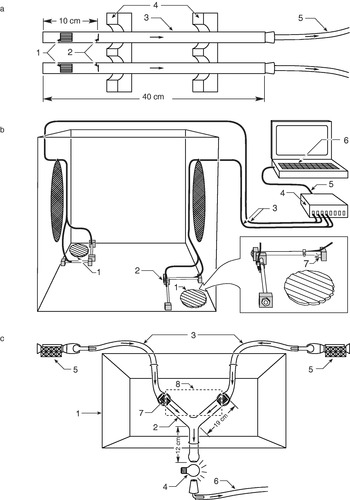
Experiment 1 tested both the velocity and distance a larva traveled in response to either a cardboard strip with ten cocooned larvae (treatment) or an empty strip (control). In each replicate (n=30), stimuli were randomly assigned to, and inserted into, the distal end of one of two straight Pyrex® glass tubes (40×2.3 cm i.d.) in parallel placement (fig. 1a). One fifth-instar larva was gently placed at the mouth of each tube and aspirator-driven air was drawn through the tube at a rate of ~0.5 l min−1. Both the distance a larva traveled upwind before reversing its orientation 180° or crossing a 30-cm marker line from the mouth of the tube and the time elapsed to travel this distance were recorded.
Set-up for experiments 1–3: (a) (1) test stimuli; (2) marker line 30 cm from mouth of tube; (3) 40 cm straight tube; (4) tube rack; (5) water-driven aspirator. (b) (1) test stimuli; (2) electronic optical gate; (3) gate-to-data logger cable; (4) data logger; (5) data logger-to-computer cable; (6) computer; (7) light-emitting diode or phototransistor. (c) (1) Styrofoam box; (2) Y-tube; (3) Nalgene® tubes; (4) 25-W light source 1 m below Y-tube stem; (5) activated-charcoal filter; (6) water-driven aspirator; (7) test stimulus; (8) red cellophane viewing window in Styrofoam box.

Experiment 2 tested whether a larva orients towards aggregation pheromone as a first choice in still-air olfactometers. Test stimuli consisted either of a cardboard strip (6-cm dia.) harbouring 25 cocoons (treatment) or an empty strip (control) and were randomly assigned to, and placed in, opposite corners on the floor of a Plexi-glass cage (30×30×40 cm). Each stimulus was surrounded by two electronic optical gates (9×1.5×1.5 cm) affixed to the floor of the cage (fig. 1b). Each gate consisted of two opaque polyvinyl chloride blocks (1×1.5×1.5 cm) separated by a metal rod so that the blocks were held 9 cm apart. Each block on each gate had mounted on it either a light-emitting diode (LED) (Stanley Electric Co. Ltd., CN305 880 nm, Deskin Sales, Vancouver, Canada) or its matching phototransistor (Stanley Electric Co. Ltd., PS302 peak sensitivity 800 nm, Deskin Sales, Vancouver, Canada) so that the optical centre was 0.3 cm above the cage floor. Each gate was connected via a four-wire cable to a programmable data logging device, which recorded when the IR light beam was interrupted by a larva crossing the optical gate. The data-logging system, in turn, was connected to a Texas Instruments TravelMate™ 486 notebook computer, which saved all recordings as a text file via a custom-made DOS-based program (Ray Holland, Science Technical Centre, Simon Fraser University, Burnaby, Canada). For each replicate, one fifth-instar larva was gently placed in the centre of the cage floor and allowed 24 h to select a pupation site. Crossing a gate by a larva in response to a stimulus was recorded by the computer, and first and final choice of larvae were analyzed (n=31 and n=50, respectively). For a subset of the replicates, the larva's movement and first choice of stimulus was observed for up to 2 h.
Experiment 3 tested anemotactic responses of larvae in Y-tube olfactometers (stem=12 cm; arms=19 cm; i.d.=2.3 cm). Olfactometers were housed in a Styrofoam box (fig 1c; modified from Derksen, Reference Derksen2006) with a light-to-dark gradient from the stem to the arms, encouraging a response from negatively phototactic larvae. Test stimuli consisted either of a cardboard strip (2.5 cm2) harbouring ten cocooned larvae (treatment) or an empty strip (control) and were randomly assigned to, and placed within, the distal 5 cm of the Y-tube arms. For each replicate (n=21), a single fifth-instar larva was gently inserted into the stem of the tube and aspirator-driven air was drawn through the tube at a rate of ~0.5 l min−1. Larvae that penetrated >5 cm into either arm were classed as responders.
In experiments 1–3, all replicates were carried out at 20–23°C and ~50% RH. Experiments 1 and 3 were conducted under red light, whereas experiment 2 was conducted in complete darkness or under red light to facilitate observations. For each replicate, a new fifth-instar larva was employed as a bioassay insect.
Statistical analyses
The mean distance and velocity that larvae traveled in experiment 1 were compared with a two-sample Student's t-test. Numbers of larvae responding to stimuli in experiments 2 and 3 were analyzed with the χ2 goodness-of-fit test with Yates correction for continuity. The experimental error rate in all experiments was set at α=0.05 (Zar, Reference Zar1999).
Results and discussion
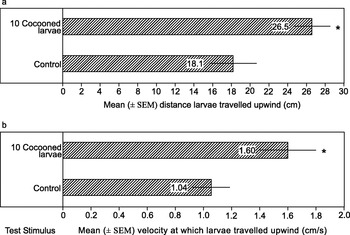
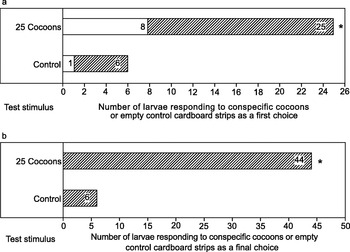
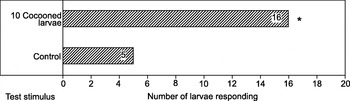
In experiment 1, fifth-instar larvae moved farther and faster in response to aggregation pheromone from cocooning larvae than in response to blank controls (fig. 2). In experiment 2, fifth-instar larvae selected pupation sites with pheromone-emitting cocoons as first and final choices significantly more often than empty pupation sites (fig. 3). In experiment 3, significantly more fifth-instar larvae responded anemotactically to pupation sites with pheromone-emitting cocooning larvae than to empty pupation sites (fig. 4).
Mean (±SEM) distance (a) and velocity (b) fifth-instar codling moth traveled upwind in paired straight-tube olfactometer experiment 1 towards a cardboard strip either with ten codling moth larvae cocooned for three days (treatment) or empty (control). An asterisk (*) denotes treatments that are significantly different by Student's t-test. Mean value is shown within bars for each treatment; n=30.

First-choice (a) and final-choice (b) responses of fifth-instar codling moth in cage experiment 2 to a cardboard strip either with 25 codling moth larval cocoons (three days old) (treatment) or empty (control). An asterisk (*) denotes treatments that are significantly different by χ2 goodness-of-fit test using Yates correction for continuity. Numbers of larvae observed responding and total number of larvae responding are shown in white and hatched bars, respectively; (a) n=31 and (b) n=50.

Anemotactic response of fifth-instar codling moth in Y-tube olfactometer experiment 3 to a cardboard strip either with ten codling moth larvae cocooned for three days (treatment) or empty (control). An asterisk (*) denotes treatments that are significantly different by χ2 goodness-of-fit test using Yates correction for continuity. Numbers of larvae responding to each stimulus are shown within bars; n=21.

Farther and faster movement toward a pheromone source than toward a control (fig. 2) indicated perception of pheromone over a distance of >30 cm and suggested an attraction response. First-choice preference of foraging larvae for pupation sites with, rather than without, cocooning conspecifics (fig. 3a) also implies orientation and directed movements towards the source of the aggregation pheromone, indicative of attraction responses. That the final-choice preference for pheromone-emitting sites was even more pronounced than the first-choice preference (fig. 3b) can be attributed to some larvae crawling around, instead of through, the gates or crossing them without data-logging the event. In the latter cases, first-choice preference of the larvae remained unknown.
Significantly stronger anemotactic responses by larvae in Y-tube olfactometers to pupation sites with cocooning conspecifics than to control sites (fig. 4) demonstrated unambiguously that cocoon-spinning codling moth larvae emit aggregation pheromone that triggers attraction, not just arrestment, responses by foraging larvae.
The combination of chemo-orthokinetic responses or activating effects (i.e. increased speed (experiment 1)) coupled with oriented tactic responses (experiments 2 and 3) results in attraction of the receivers toward attractive stimuli (Shorey, Reference Shorey1976; Kennedy, Reference Kennedy1978). Based on our data, the active range of the pheromone appears to be at least 20 cm. It may not need to be greater because larvae seeking pupation sites are very mobile and repeatedly traverse the tree trunk. This displacement phase (Geier, Reference Geier1963) is punctuated by an area-searching phase, often when larvae encounter a trunk section with suitable pupation sites (Geier, Reference Geier1963). In this area-searching phase, larvae typically stop and display characteristic head thrusts (Geier, Reference Geier1963), possibly testing for the presence of aggregation pheromone at prospective pupation sites.
Our data clearly demonstrate that cocoon-spinning codling moth larvae produce an aggregation pheromone that triggers attraction responses by pupation site-seeking larvae. These results help explain reported aggregations or clumped distributions of larvae on tree trunks (Duthie et al., Reference Duthie, Gries, Gries, Krupke and Derksen2003; Z. Jumean, personal observation), which would not likely occur if they were based merely on chance encounter of cocoon-spinning larvae by foraging larvae.
Acknowledgements
We thank L. Fazel for her assistance with experiments, G.J.R. Judd for helpful discussions, R. Holland, E. Siljander and N. Woodbury for constructive comments on an earlier draft of the manuscript, and R. Birtch for preparation of fig. 1. Financial support was provided by a Natural Sciences and Engineering Research Council (NSERC) – Canada Graduate Scholarship to ZJ and a NSERC – Industrial Research Chair to GG, with Pherotech International Inc., SC Johnson Canada, and Global Forest Science (GF-18-2007 and GF-18-2007-227) as industrial sponsors.