Generative linguistics views language as a specialized human cognitive faculty that follows a small set of universal principles and operations known as Universal Grammar (UG), which constitutes the initial state of language acquisition and guides the development of first language (L1) grammars (Chomsky, 1986). SLA research raises many of the same questions posed by L1 acquisition research with respect to the initial state and the nature of developing grammars plus additional discussion on the role of the L1. A whole spectrum of proposals has considered the role of UG. Some researchers claim that UG is only partially available in SLA and that those aspects of the grammar of a second language (L2) that are not instantiated in the L1 cannot be acquired (Hawkins & Chan, 1997; Smith & Tsimpli, 1995; among others). Bley-Vroman's (1990) fundamental difference hypothesis (FDH) argued that adult learners have to face the task of acquiring a L2 equipped solely with the knowledge of their L1 and by resorting to general—not linguistic-specific—cognitive strategies. Therefore, interlanguage grammars can potentially be inconsistent with UG in aspects in which the target language differs from the L1; generalizations that make use of linguistically relevant notions not present in the L1 are not expected.
The full access position argues that UG is fully operative in SLA and, as a result, interlanguage grammars are natural, UG-constrained grammars and that, in principle, the final steady state of the L2 grammar can be nativelike (Epstein, Flynn, & Martohardjono, 1998; Montrul, 2000; Schwartz & Sprouse, 1996; White, 1989; among others). Within the full access model, researchers differ mainly with respect to their positions on the role of the L1 in the initial state and in interlanguage grammars. Epstein, Flynn, and Martohardjono (1996) argued that UG is the initial state of SLA, whereas others have claimed that the L1 grammar, as a whole or in part, is the initial state of SLA. Schwartz and Sprouse's full transfer–full access hypothesis maintained that L1 is the initial state of SLA and that an interlanguage grammar instantiates properties of the L1 until it cannot accommodate the L2 input and restructuring, guided by UG, takes place.
Recently, Montrul (2000) argued that modularity of grammar can be reflected in SLA. She claimed that transfer does not necessarily apply to all modules of the L1 grammar as a block and that “transfer can be more pervasive in some domains than in others” (Montrul, p. 233). Reorganization of interlanguage in one domain (e.g., syntax) earlier than in others (e.g., morphophonology) might follow from the L1 not acting as a block in the initial state or because, even if it does, different modules restructure at different times.
Argument structure alternations (such as the dative alternation) crucially involve knowledge of regularities and exceptions in the relations between the meaning of a verb and the interpretation (thematic roles) and morphosyntactic realization of its arguments. These alternations can pose special challenges to the L2 learner, given that there are crosslinguistic differences not only in their availability but also in the semantic restrictions that regulate them and in the morphosyntactic properties of the variants. Thus, argument structure alternations constitute an interesting ground for the investigation of the role of UG, L1 transfer, and modularity in SLA.
The acquisition of the morphosyntactic and semantic properties of the dative alternation in Spanish by adult speakers of English is considered in the current study. Whereas the prepositional variant of the dative alternation (I sent a letter to Daniel) has similar properties in both languages, the double-object construction (DOC; I sent Daniel a letter) differs both in its semantic aspects (restrictions to verb classes and thematic roles) and in its morphosyntactic expression in the two languages. This contrast between L1 and L2 is an ideal domain to look for evidence of acquisition of properties not instantiated in the L1—that is, acquisition based on linguistic analysis of the input and generalizations guided by UG rather than on verb-by-verb learning. Another important question is whether acquisition proceeds in a modular fashion, with semantics acquired before morphosyntax, or vice versa.
This study presents data from young adults studying Spanish as a foreign language at the intermediate level. By comparing the behavior of these L2 learners with the results of a previous study of near-native and advanced learners of Spanish (Bruhn de Garavito, 2000, 2006), I will show that there are common stages in the acquisition of the DOC and, furthermore, that UG effects can be traced in the developmental path. A dissociation between the early acquisition of morphosyntactic properties and delayed acquisition of semantics accords with Montrul's (2000) claim that there can be modularity effects in interlanguage grammars. I will propose, however, that this effect does not necessarily depend on properties of L1 transfer but, rather, that it is a general phenomenon common to both L1 acquisition and SLA.
This article is organized as follows: The first section describes the semantic and morphosyntactic properties of the dative alternation in English and Spanish, followed by the linguistic analysis assumed throughout the study. The next section reviews relevant previous work on SLA of argument structure alternations. The hypotheses, design, and results of the experiment are presented next. Finally, results are discussed in light of the competing ideas concerning the roles of UG, L1, and modularity in SLA.
DITRANSITIVES IN ENGLISH AND IN SPANISH
In English, the dative alternation refers to the possibility of expressing a relation between a theme and a goal or recipient in two alternative ways. The sentence in (1a) illustrates a prepositional construction (PPC) with an indirect object interpreted as goal in the presence of the preposition to, whereas (1b) shows the alternative DOC in which Peter is interpreted as the intended recipient of the theme a package.

In the English DOC, there are two object determiner phrases (DPs) whose order is reversed with respect to the order in the PPC: The dative recipient appears before the theme. The recipient usurps (i.e., takes on) some of the direct-object properties of the theme in the PPC. In the DOC, it is the recipient, not the theme, that must be adjacent to the verb, gets case from the verb, and moves to subject position in the passive, as in (2a). For most speakers, wh-extraction of the recipient in the DOC, as in (3a), is not acceptable, in contrast with acceptable wh-extraction of the DP from inside the goal prepositional phrase (PP), as in (3b). Syntactic tests (binding and weak crossover) show that the relative hierarchy between the arguments is different in the two constructions. In the PPC, the theme is structurally higher than the goal, but in the DOC, the recipient or goal is higher than the theme (see, among others, Aoun & Li, 1989; Barss & Lasnik, 1986; Larson, 1988; Pesetsky, 1995).

With respect to the meanings of the construction, the indirect object must be an intended possessor. Pure locative goals cannot appear in the DOC, as illustrated in (4b). The DOC also alternates with the benefactive for-PPC with transitive verbs of creation. The dative is understood, again, as the recipient of the direct object, as in (5b).

That the dative is understood as the recipient of the theme even in the alternate of for-PPCs is proven by the fact that there is no double-object alternate for so-called benefactive for-PPCs in which the transitive verb is not a verb of creation, as in (6a), or if there is no direct object, as in (6b).

Beyond these general restrictions on the meaning of the DOC, there are other, more idiosyncratic restrictions on the English DOC. Verbs of communication that denote a manner of speaking do not participate in the DOC, as illustrated in (7a), nor do Latinate verbs, as shown in (7b).

What defines the dative alternation is the hierarchical relation between the argument DPs. Specifically, the DOC is characterized as the structure in which the recipient or goal is in a syntactic position higher than the theme. Crosslinguistically, however, DOCs can vary in their morphosyntactic properties as well as in some aspects of their meaning. As we will see, whereas the semantic and morphosyntactic properties of the PPC are the same in both languages, the properties of the DOC in English and in Spanish are quite different. From a more general perspective, however, Spanish might be considered to have a DOC and, in terms of possible meanings, the English DOC is actually a subset of the Spanish DOC.
Only recently has Spanish been argued to have a DOC (Bruhn de Garavito, 2000; Cuervo, 2003b; Demonte, 1995; Kempchinsky, 2004; Masullo, 1992). Beyond different analyses of the base structure and the relation between the alternates, the common claim is that there is a dative alternation in Spanish and that the clitic-doubled dative variant of transitive predicates corresponds to the English recipient-theme DOC, as illustrated in (8).1
Abbreviations used in glosses: 1 = first-person singular; 2 = second-person singular; 3 = third-person singular; acc = accusative; appl = applicative; cl = clitic; dat = dative; fem = feminine; masc = masculine; nom = nominative; s = singular, pl = plural.

When the goal is not doubled by a clitic, the a-phrase is a PP, as in (8a). In contrast, when the a-phrase is doubled by a clitic, the structure corresponds to the DOC and, although its surface form is the same as in the PPC, the recipient is a DP and the particle a is a pseudopreposition, the expression of the dative case, as in (8b) (see Cuervo, 2003a; Demonte; Masullo).2
It has often been claimed that clitic doubling of datives is optional in Spanish, in contrast with restricted doubling of accusative arguments (e.g., Jaeggli, 1986; Suñer, 1988; Torrego, 1998). Other researchers (Cuervo, 2003a; Demonte, 1995; Masullo, 1992) have contrasted this optionality with obligatory doubling of dative arguments with other kinds of predicate and have claimed that optionality is only apparent. In contrast with accusatives, there are no specificity or animacy restrictions on doubling of datives, and clitic doubling is obligatory in all other cases of dative arguments, including datives with psych predicates, se-unaccusatives, two-argument unergatives, datives of interest, possessor raising, and benefactive datives. Given these facts, optionality of the clitic in ditransitives would be surprising.

Turning to the semantic properties of the Spanish DOC, the sentence in (10) shows that the double-object variant in Spanish displays one of the restrictions that it has in English: A pure locative goal cannot be the clitic-doubled dative argument in the DOC, which strongly suggests that, as in English, the semantic role of the indirect object is not the same across the two constructions.

The role of recipient in DOCs is similar in both languages. There are, however, two meanings the construction can have in Spanish but not in English: The dative can be a source or a possessor. A dative argument that appears with a transitive verb that expresses a transfer of possession focusing on the original possessor rather than on the recipient (i.e., transfer from) is interpreted as the possessive source of the theme expressed as the direct object, as illustrated in (11). Additionally, the Spanish DOC expresses a static relation of possession when the verb is an activity verb that does not express a transfer (either literal or metaphorical), as in (12a), or is stative, as in (12b).

The possessive relation can be alienable or inalienable if the dative DP is animate, as in (12); if the dative is inanimate, the construction is restricted to cases of inalienable possession (which can be somewhat metaphorical). The sentences in (13) illustrate possible and impossible DOCs with inanimates [also recall the restriction on pure locatives in (10)].

As a result of its broader set of meanings, the Spanish DOC alternates with PPCs in which the preposition is not only a “to” or para “for” but also en “in/into,” de “from/of,” or others.

To summarize, the English DOC is restricted to the expression of a dynamic transfer of possession relation in which the dative is the recipient of the direct object. The role of recipient involves a notion of intended possession, commonly referred to as the possession constraint, which excludes pure locatives and inanimate objects, immediately restricting the class of verbs that can participate in the dative alternation. This class is further restricted by what Pinker (1989) called the narrow range rules (which exclude verbs of manner of communication, such as whisper and shout) and a morphophonological rule that excludes most Latinate verbs.
In Spanish, DOCs can express a dynamic transfer of possession or a static possession relation. In a dynamic relation, the dative argument is interpreted as the recipient or the source of the theme; in a static relation, the dative is the possessor. Although there is a possession constraint—recall the sentences in (10) and (13b)—the notion of possession relevant for Spanish includes not only humans and animate dative arguments but inalienable possession relations between two inanimate entities as well; there are no restrictions comparable to the narrow range rules.
THEORETICAL ANALYSIS
Analyses of the dative alternation can be broadly divided between those that take the alternates to be derivationally related and those that claim the PPC and the DOC have different base structures (i.e., are not derivationally related). Within derivational approaches, the PPC has usually been taken as the base structure, with the DOC derived either by an operation of incorporation (Baker, 1988; Bruhn de Garavito, 2006; Masullo, 1992) or by a passivelike movement of dative shift (Demonte, 1995; Larson, 1988).3
See Aoun and Li (1989) for the proposal that the DOC is the base structure and the PPC derives from it.
The current analysis will follow, instead, a nonderivational approach that analyzes the DOC as a low applicative (Pylkkänen, 2002), defined syntactically and semantically as a relation between two individuals (for analysis of the PPC, see, among others, Larson, 1988; Pesetsky, 1995). In this view, the recipient is introduced by an applicative head that licenses the so-called applied argument semantically and syntactically in its specifier. The applicative head merges below the verb (hence, low applicative) and relates the applied argument DP to the theme DP that it takes as its complement.

Pylkkänen argued that a low applicative head expresses a dynamic possessive relation between two individuals. This relation is directional, and the applied argument is interpreted either as a recipient or a source, depending on the verb and on the subtype of low applicative(s) a language can have: Low-applicative-to and low-applicative-from. English, for instance, is a language that selects only low-applicative-to; Hebrew has both subtypes and therefore the applied argument can be interpreted as recipient or (possessive) source. Cuervo (2003a) extended the low applicative analysis to dative possessors (the so-called possessor raising construction, as in Demonte, 1995, and Landau, 1999) by proposing a third subtype of low applicative, low-applicative-at, which expresses a static relation of possession between two individuals.
Because the PPC and the DOC (low applicative) are not derivationally related, nothing is needed to account for cases of verbs that can participate in only one of the two constructions.4
Under Pinker's (1989) approach to the dative alternation in terms of a semantic rule that applies to the PPC, language-internal cases of the DOC without a PPC alternate (e.g., British English I envy Peter his sister, *I envy his sister to/for/from Peter; Spanish Le ganaste la carrera a Pablo “You beat Pablo at the race,” lit. “You won Pablo the race,” *Ganaste la carrera de/a/para/por Pablo) are not predicted. The same applies to languages that have double objects (in the relevant sense—that is, low applicatives) but no prepositional variant (e.g., Bantu languages).
The low applicative approach provides a unified analysis of the morphosyntax and semantics of the contrasting Spanish and English DOCs. Languages can differ not only in the subtypes of applicatives they allow (and therefore in the types of verbs that can appear in the DOC) but also in the morphosyntactic properties of the construction, such as the morphological spell-out of the applicative head and in what Levin and Rappaport-Hovav (2001) termed the coding properties of the objects (e.g., case, surface word order, agreement, the ability to passivize). The view taken here is that the English DOC and the Spanish dative construction are the same type of construction—low applicatives; it is coding properties that make the constructions appear so different (thereby posing a challenge to the L2 learner).
Low Applicatives in English
From a crosslinguistic perspective, the DOC in English is very restricted: It can express just one of the three meanings of the applied argument, and there are restrictions on the classes of verbs that can participate in it. Some of these follow directly from the nature of the construction (e.g., the possession constraint), whereas others are language-specific. If a verb does not express a directional transfer of possession (or the creation of an object) focused on the goal, it will automatically be barred from the construction, as is the case of (a) push-type verbs (which, although they express movement, are not directional), (b) steal-type verbs (which involve directionality focused on the source, and English does not have low-applicative-from), and (c) any other verb that does not involve directionality, including activity verbs (e.g., dance, correct, wash) and stative verbs (e.g., hold, admire), because such predicates require a low-applicative-at. The restriction on verbs that express a manner of communication (e.g., whisper) does not follow from the construction and is language-specific. The Latinate constraint is also language-specific, and nothing in the semantics of the construction predicts it.
As we have seen, the theme DP is the direct object in the PPC, whereas it is the applicative DP that has direct object properties in the English DOC. The object properties exhibited by the applicative concern word order and case: The applicative is adjacent to the verb, from which it receives structural accusative case, and the theme object must get case in some other way (see Pesetsky, 1995, and Pylkkänen, 2002, for proposals).
Low Applicatives in Spanish
Although the dative alternation in Spanish has previously been observed, the double-object alternate has invariably been analyzed as derivationally related to the prepositional configuration by movement or incorporation (Bruhn de Garavito, 2006; Demonte, 1995; Masullo, 1992). Building on Pylkkänen (2002), Cuervo (2003a) treated the clitic-doubled dative as an applicative argument. The full range of syntactic data as well as the semantic restrictions and interpretations follow from this nonderivational approach to the alternation. Once Spanish is assumed to have the three types of low applicatives (to, from, and at), the semantics follows: A dative argument in the DOC can be interpreted as a recipient, a source, or a possessor. As in other languages, the DOC is subject to the possession restriction, the difference from other languages being that in Spanish the relation between an inanimate object and its parts (i.e., inalienable possession) qualifies as the required notion of possession.
The Spanish DOC also appears to be very different from the English equivalent because of its morphosyntactic properties. In Spanish, the theme has direct-object properties in both the PPC and the DOC: It gets accusative case from the verb, appears linearly between the verb and the dative DP (accusative-dative is the nonmarked order in both constructions), and it is the argument that receives nominative case (and might move to subject position) in the passive. As opposed to English, a dative DP in the Spanish DOC can be fronted by wh-movement (as the PP in the PPC), as illustrated in (16).

In cases of dative recipients, the only surface difference between the PPC and the DOC is the presence of the clitic, as illustrated in (8a) and (8b). The structure of the clitic-doubled DOCs, however, satisfies the semantic and syntactic criteria of low applicatives. The alternation with and without the clitic correlates with syntactic and semantic phenomena that cannot be attributed to the mere presence of a clitic. Demonte (1995) and Cuervo (2003b) convincingly argued that sentences without a clitic correspond to a structure formed with a DP theme structurally higher than the goal or locative PP, whereas sentences with clitic-doubling correspond to the DOC (i.e., to a structure in which the dative argument is higher than the theme). The diagram in (17) represents the structure of (8b), Emilio le entregó el informe a Andreína “Emilio gave Andreína the report,” before verb and clitic movement and before the direct object el informe moves to a higher position (specifier of vP) where it checks case (Cuervo 2003b).

Similar to languages in which the applicative head is spelled out by a verbal affix (e.g., Bantu languages), the dative clitic is the morphological spellout of the applicative head. This accounts for the obligatoriness of clitic-doubling when there is a true dative argument as well as eliminating additional structure such as clitic phrases (as proposed by Demonte, 1995), which are not independently required. The applicative head is also responsible for the inherent case of the dative DP, as dative a is not a preposition but a case marker in the DOC.5
See Miyagawa (1997), who argued that Japanese ni is similarly ambiguous between a (directional) postposition and a dative case marker.
EXPERIMENTAL BACKGROUND
Argument structure alternations pose a learnability problem both in L1 acquisition and SLA, as the learner has to discover the rules that restrict the alternation as well as the morphological and syntactic expression of the alternates. How does a child or a L2 learner come to know which verbs participate in the alternation and which do not, given that verbs do not appear in the input in all their possible forms?
Baker (1979) suggested that children acquire the argument structure of verbs by relying solely on input, proceeding from a conservative attitude and learning on a case-by-case basis. Contrary to this proposal, it has been found that children tend to produce overgeneralization errors in the area of argument structure. This is the case, for instance, for English-speaking children who produce the DOC with verbs that are not allowed in the adult DOC (see Bowerman, 1988; Gropen, Pinker, Hollander, Goldberg, & Wilson, 1989; Mazurkewich & White, 1984). In order to explain these overgeneralizations, we must assume that children apply general linguistic principles to their analysis of the input, and only later do they acquire the narrower, language-specific rules that restrict the alternations. Demuth, Machobane, Moloi, and Odato (2005) presented evidence of early knowledge of animacy hierarchy restrictions in L1 acquisition of Sesotho double-object applicatives, showing that children make appropriate syntactic generalizations that they apply even to low-frequency constructions.
Even if there is evidence of UG-based learning in L1 acquisition of argument structure alternations, the question arises again for SLA, and several studies have looked at the acquisition of the dative alternation in L2 English. Mazurkewich (1984) compared the acquisition of the alternates and knowledge of the Latinate constraint, finding that L2 learners at three proficiency levels acquired the PPC before the DOC and that they made overgeneralizations, allowing the DOC with Latinate verbs. Subjects also accepted illicit DOCs that, due to the fact that they are not part of the input, cannot have been learned on a verb-by-verb basis. White (1987) found L1 transfer in a study of English L1 children and adults learning French, who accepted double objects although they are not allowed in the target language.
Some recent studies have focused on the role of L1 transfer and whether verb-by-verb or UG-constrained learning occurs. Bley-Vroman and Yoshinaga's (1992) study of Japanese learners of English showed that although L2 learners were sensitive to the possession constraint and the narrow range rules for real verbs, they failed to distinguish between nonce verbs that belong to a class that can participate in the DOC and those that cannot (e.g., the tell type vs. the whisper type), rejecting them all. This is evidence, according to the authors, that the Japanese group knew the possession constraint due to L1 transfer but could not learn the narrow range rules, which are not instantiated in their L1. As Whong-Barr and Schwartz (2002) observed, however, the FDH to which Bley-Vroman and Yoshinaga subscribed would predict acceptance of all nonce verbs, not rejection. Inagaki (1997) conducted a similar study but included Chinese as well as Japanese speakers and native controls. He grouped verbs in four classes: The tell and throw types, which participate in the dative alternation in English, and the whisper and push types, which do not. According to the author, DOCs are allowed in Japanese with all but the push type; in Chinese, only the tell type can appear in DOCs. For real verbs, both groups accepted DOCs only with the tell type. For nonce verbs, the two experimental groups accepted the tell type; although the Japanese speakers rejected the rest, the Chinese speakers tended to accept them all.
Performance on nonce verbs should be crucial as a test for having learned the narrow range rules guided by UG rather than by relying on verb-by-verb learning. Results are, however, difficult to evaluate because native controls—who are hypothesized to have acquired these rules relying on UG—performed similarly to the Chinese group, overgeneralizing DOCs to illicit types (although at different rates). If L1 is the only source of UG-constrained generalizations, these results are unexplained. Whong-Barr and Schwartz (2002) argued that Chinese speakers' results provided “unambiguous support for L1 transfer” (p. 591). This conclusion might be too strong, however, because the Japanese speakers, in spite of L1 differences, made the same distinctions the Chinese speakers did, for both real and nonce verbs. Under any hypothesis, some learning would have been expected for the real throw-type verbs. Inagaki (1997) argued that lack of learning might be due to L2 subjects having to rely exclusively on (frequency of the) input to learn that throw-type verbs can appear in the DOC. (The frequency of the tell class was much higher than the frequency of the throw type, which included very infrequent verbs like fling and slap.) Without a careful study of lexical frequency, however, it is not possible to do more than speculate.6
See Demuth et al. (2005) for evidence that construction frequency but not lexical frequency affects L1 acquisition of double-object applicatives in Sesotho.
Transfer of the English dative alternation in SLA was also investigated by Whong-Barr and Schwartz (2002), who studied the acquisition of to- and for-datives by three groups of children with L1 English, L1 Korean, and L1 Japanese backgrounds. There were four types of DOCs made up of licit and illicit to- and for-datives. Whong-Barr and Schwartz found evidence of overgeneralization of to-datives to illicit verbs in all three groups of children, consistent with previous findings in L1 acquisition. Only the Japanese children overgeneralized with for-datives, accepting them 70% of the time. Thus, there is evidence of both L1-like acquisition that is UG-constrained as well as L1 influence (the difference between the Japanese and Korean children). The authors concluded that results support the full transfer–full access model. These conclusions crucially rest on their definition of double objects based solely on the surface case marking of the two objects rather than on hierarchical properties, semantic properties, or both: Only when the two objects have the same case marking is the construction considered a DOC. The authors assumed, then, that Japanese has no double objects and that Korean's only double objects are those with overt verbal morphology (the applicative head) that allows for two accusative DPs. The Japanese speakers, having nothing to transfer, overgeneralized with the two types, evidencing L1-like acquisition.7
It is not clear in their article why, if both Japanese and English children are solely constrained by UG (no transfer from any other language), the results with for-datives are in contrast. In particular, the authors do not explain why English children do not overgeneralize with for-datives as they do with to-datives.
In sum, there is evidence of L2 learning guided by UG in cases of overgeneralizations on verb classes. However, there seems to be some undergeneration or lack of overgeneralization in some of the subclasses distinguished by the English narrow range rules—in particular, the push class and the (mostly) stative verbs in Whong-Barr and Schwartz's (2002) illicit for-dative class. Interestingly, these verbs—as opposed to the whisper type, governed by a more language-specific rule—do not express transfer of possession, and a dative argument cannot be interpreted as a recipient of the direct object, as required by any language that only has directional low applicatives. Evidence for L1 transfer is more difficult to find and depends crucially on the linguistic analyses L2 researchers adopt.
Turning to work on Spanish as the target language, Slabakova (2002) investigated Spanish ditransitive constructions as part of her study on the acquisition of the compounding parameter (Snyder, 1995). Slabakova found that 77% of the English L1 advanced learners of Spanish in her study correctly rejected DOCs that were a literal translation from English, providing evidence that L2 learners can go beyond the grammar of their L1.
Bruhn de Garavito (2000, 2006) seemed to be the first to examine the acquisition of ditransitive predicates attending to both their semantics and syntax, although she provided no direct comparison of L2 knowledge in the two areas of grammar.8
See Montrul (2004) for a discussion of this and related work.
The behavior of a group of advanced learners of Spanish (L1 English) was also analyzed. These learners displayed considerable group variability and tended to have weaker judgments. Despite showing significant differences with respect to native controls, they were also sensitive to aspects of the DOC, such as the restrictions on incorporation, clitic agreement, and thematic role of the dative argument, which could not have been transferred from English.
The present study focuses on adult learners of Spanish as a L2 at an earlier stage of development. In addition to investigating the hypotheses described in the next section, this study also compares results with those of Bruhn de Garavito (2006), with the aim of observing stages in the patterns of acquisition of the properties of the DOC.
THE EXPERIMENT
The comparative analysis of the English and Spanish dative alternations presented in the previous section highlights the complex task faced by English speakers acquiring Spanish as a L2. Acquiring the properties of the dative alternation presents a learnability problem, meeting the criteria, as stated by White (2003), of being derivable neither from the learners' L1 grammar nor on the basis of L2 input alone. First, although it has double objects, English does not have clitics, clitic doubling, or distinctive overt morphology for dative case. Moreover, the applicative argument in English DOCs usurps some direct-object-like properties from the theme, properties that stay with the theme in Spanish. In terms of semantics, English speakers have to learn the wider range of meanings the construction can express in Spanish and that the English narrow range rules do not apply. Transfer from L1 would make learners of Spanish massively undergenerate. Second, Spanish input underdetermines the subtle properties of the construction. In many cases, the PPC and the DOC are expressed by almost identical strings. Dative arguments appear not only in DOCs but also with many other types of predicate and construction, such as psychological, existential, and change-of-state. Whereas dative case marking remains constant, word order, obligatoriness of clitic doubling, and meaning differ across these constructions. Many instances of DOCs do not contain a full a-DP, because dative arguments can be null and their reference recovered from the clitic and the context (as subjects can be null and recovered from agreeing verbal morphology and the context). Additionally, only third-person clitics have a distinct morphology for dative and accusative cases. There is also dialectal variation in the use of the form le: In Spain and many areas of Latin America, le is used not only for dative DPs but also for human masculine objects, second-person formal objects, or both. Finally, the status of the particle a is not straightforward either: It not only marks dative DPs, but it also precedes animate accusative direct objects, and it can be a preposition or a complementizer.
This study investigates the SLA of the Spanish dative alternation, focusing on the properties of the interlanguage and addressing questions on availability of UG, L1 transfer effects, and dissociation between knowledge of morphosyntax and semantics as an effect of modularity of grammar in SLA.
Hypotheses
The partial access and the full access positions make different predictions with respect to the interlanguage of adult English speakers learning Spanish as a L2. Within the partial access position, the FDH (Bley-Vroman, 1990; Bley-Vroman & Yoshinaga, 1992) predicts that English speakers should have difficulty learning the properties of the Spanish DOC that are not instantiated in their L1. Devoid of access to UG and given that the input underdetermines the morphosyntactic properties of the construction, L2 learners should have difficulty with clitic agreement and doubling, word order, dative case marking, and the role of a. L2 learners should transfer the semantic constraints of the English DOC to Spanish, rejecting the construction with verbs that disallow it in English and in cases in which the dative argument is not a recipient. Under this view, acceptance of DOCs disallowed in English could only stem from case-by-case learning, and L2 learners are not expected to make linguistically relevant generalizations on the semantic restrictions that govern Spanish DOCs.
In contrast, the full access approach (as represented in Epstein et al., 1996, and Schwartz & Sprouse, 1996) predicts that L2 learners should, in principle, be able to acquire the morphosyntactic and semantic properties of Spanish DOCs even if those properties are underdetermined by positive input. Specifically, L2 learners should make appropriate generalizations with respect to clitic doubling and agreement, word order, dative case marking, and the role of the particle a. L2 learners should be able to go beyond the restrictions that affect English DOCs, accepting a wider range of meanings and making UG-licit generalizations for the Spanish construction.
Although the hypothesis of L1 as the initial state in SLA cannot be directly tested with intermediate learners, it is possible to test for L1 transfer effects at this stage of development and as a source of nontargetlike behavior. If there is transfer, English speakers learning Spanish should initially be conservative and undergeneralize the use of the DOC. They should also have problems with its morphosyntactic properties, particularly with those they could transfer from English: case marking, word order, and wh-extraction possibilities.
An additional issue investigated in this study is the effect of modularity of grammar in interlanguages. According to the analysis of the dative alternation adopted here, most regularities in the interpretation of and restrictions on the DOC arise directly from the syntactic properties of the construction and the availability of the different subtypes of low applicative; knowledge of these regularities is unrelated to knowledge of the prepositional variant. In this syntax-before-semantics approach, it is predicted that L2 learners should recognize the morphosyntactic properties of the DOC (i.e., identify the construction as such) before they can learn the semantics. In particular, if at this stage of development there is a dissociation between acquisition of morphosyntax and of semantics, then L2 learners are predicted to perform better at morphosyntax than at semantics. Montrul (2000) proposed that transfer from L1 might be a modular rather than an all-or-nothing phenomenon and that some aspects of L1 grammar are more pervasive than others. Under this view, we also expect a dissociation between acquisition of the syntax and of the semantics of the Spanish construction in L2 learners, although there is no prediction of directionality (whether L2 grammars should be more targetlike in syntax or in semantics).
Tasks and Materials
To investigate the hypotheses concerning the knowledge of the semantic and morphosyntactic properties of the Spanish dative alternation by L2 speakers, a grammaticality judgment task was employed. The test consisted of 13 conditions that belonged to one of three main components: the PPC, the semantics of the DOC, and the morphosyntax of double objects. The PPC component tested knowledge of the prepositional variant of the Spanish dative alternation (which does not differ from the corresponding structure in English) in order to compare it to knowledge of the DOC variant. In this component, there were three grammatical conditions of the form V-DP-PP (which varied according to whether the PP was human, inanimate, or a genitive possessor) and one ungrammatical condition (in which sentences used the wrong preposition). A second component manipulated semantic variables in the DOC and consisted of three grammatical conditions of the form CL+V-DP-a-DP (the double-object variants of the PPCs in the PPC component), varying according to whether the dative argument was human, inanimate, or a possessor, as well as a condition consisting of ungrammatical sentences that violate the possession constraint. The third component manipulated morphosyntactic properties of the DOC: It consisted of five conditions (four ungrammatical, one grammatical) that tested knowledge of agreement, clitic doubling, case and word order, role of the particle a, and wh-extraction of the dative phrase. Details and sample stimuli for each condition are presented with the results.
The test consisted of a list of 38 grammatical sentences and 29 ungrammatical sentences plus 20 distracters. Of the 13 conditions, 7 were grammatical and 6 were ungrammatical (except that 1 condition, double-a, consisted of three grammatical and three ungrammatical sentences). Most conditions had five tokens, and most of the sentences were those designed by Bruhn de Garavito (2000). However, because the properties under investigation follow from a different analysis of Spanish ditransitive constructions and a different set of research questions, some of her materials were altered: Some token sentences and conditions were excluded, added, or modified, and different comparisons were performed.9
Bruhn de Garavito's (2000) study included two conditions that tested knowledge of the ungrammaticality of incorporation with intransitive predicates. The analysis of double-object constructions as low applicative constructions makes different predictions with respect to the availability of low applicative with a subtype of intransitive predicates. In the absence of special restrictions, low applicatives should be compatible with unaccusative predicates, under the assumption that the nominative argument is merged in the structure as the complement of the verb (Cuervo, 2003a). This is in fact the case, as illustrated with an unaccusative predicate of change:

First, all participants answered a questionnaire on their language history. Then they were presented with a list of sentences and asked to judge their acceptability on a Likert scale from −2, for completely unacceptable, to +2, for perfectly acceptable, according to their first impression. They were instructed that although the option 0 was available for cases for which they could not make a decision, they should try to avoid that response. There was also a set of four sentences for practice. Participants in the experiment took 25–40 min in one session to complete the task. Each subject was presented with the sentences in one of two random orders.
After removing responses of 0 (following White, 2003), statistical analyses were performed on raw scores (−2 to +2), except when an analysis was made on contrasts that included both grammatical and ungrammatical conditions. For these cases, raw scores were converted into an accuracy scale from 1 to 4 according to whether participants accurately recognized the grammatical or ungrammatical character of the sentences. A value of 1 or 2 was assigned to inaccurate responses and 3 or 4 to accurate responses.
Subjects
An experimental group and a control group participated in this study. The experimental group consisted of 52 students of Spanish as a foreign language, aged 19–29 years. They were recruited among undergraduate students enrolled in intermediate Spanish classes at two universities in Boston, Massachusetts. Language courses at both institutions use a communicative approach, and grammatical notions are rarely addressed explicitly, except for a general description of some constructions. Five participants were excluded because their L1 was not English (as stated in the language history questionnaire). Seventeen native speakers (NSs) of Spanish of similar ethnographic characteristics acted as controls; they represented several varieties of Spanish. All were also speakers of English as a L2 but had lived in a Spanish-speaking country until they were at least 15 years old.
To select only those L2 learners with a certain level of lexical knowledge and to reduce sources of variability, accuracy of responses to the sentences in the PPC component was used as a baseline (recall that the prepositional variant of the alternation is the same in both L1 and the target language). Four of the 47 L1 English subjects were excluded because they had an average of less than 73% correct responses to the baseline sentences.10
The lowest average in the NS control group, 73%, was established as the cutoff point.
RESULTS
Prepositional Construction
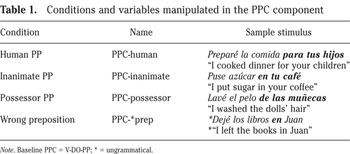
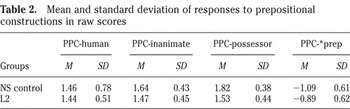
Knowledge of the PPC, the prepositional variant of the dative alternation, tested in four conditions, was used as a baseline. Three conditions consisted of grammatical sentences containing a variety of prepositions, such as para “for,” a “to,” con “with,” en “in/on,” and de “of.” The fourth condition consisted of sentences that were ungrammatical due to the use of an incorrect preposition. Table 1 summarizes the conditions in the PPC component and presents sample stimuli. Naturally, there were no significant differences between the two groups in their responses to the conditions in the PPC component. Table 2 shows the results in raw scores. An ANOVA shows no main effect of group or condition or interaction for the three grammatical conditions. An ANOVA calculated on the accuracy scale for the four conditions reveals no main effect for group or interaction. A main effect for construction was found, F(3, 58) = 9.92, p < .0001; Fisher's posttest confirms the effect is due only to the lower scores for the ungrammatical condition. These results show that L2 speakers knew the vocabulary, including the prepositions. The animacy and thematic role of the PPs did not have a significant impact on their responses, as expected.
Conditions and variables manipulated in the PPC component

Mean and standard deviation of responses to prepositional constructions in raw scores

Double Objects: Basic Structure and Semantics
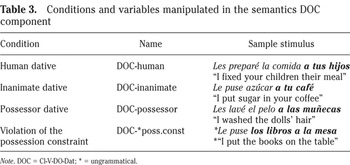
In parallel to PPCs, the four conditions manipulated semantic properties of the dative argument. At issue here is the knowledge of the possible interpretations of and restrictions on the Spanish DOC. We wanted to know if English speakers recognize DOCs in Spanish and whether they transfer the restrictions from their L1 or if they accept the construction in new domains. If L2 subjects go beyond their L1, there should be no differences in their responses to the conditions. The conditions and sample stimuli in this component appear in Table 3.
Conditions and variables manipulated in the semantics DOC component

To test whether L2 speakers make distinct judgments according to animacy, the dative argument was human in one condition (DOC-human) and inanimate in another (DOC-inanimate). The dative argument in a third condition was the static possessor of the direct object (in the DOC-possessor condition). This is the only interpretation available for a DOC in which the verb is not a dynamic transfer of possession verb (as in the two previous conditions) and, therefore, the dative argument cannot be interpreted either as a recipient or a source. Sentences include human and inanimate possessors.11
For human datives, the possession relation was alienable or inalienable. In the case of inanimate datives, the possessive relation was the required inalienable or part-whole relation.
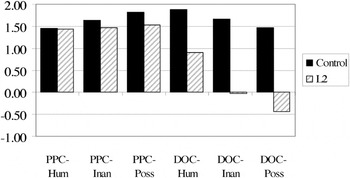
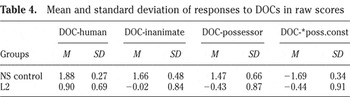
Despite the homogeneity in responses to the PPC sentences (see Table 2), L2 learners performed quite differently from NS controls in the DOC conditions. Figure 1 shows mean averages for the three types of PPCs and their corresponding DOCs. Although L2 subjects accepted double objects if the dative argument was human (at a score of +0.90), they did not accept them with inanimate datives (mean score of −0.02), and they rejected possessor datives (score of −0.43). Scores for controls were 1.88, 1.66, and 1.47 for human, inanimate, and possessors, respectively. The contrast among types of arguments is relevant for DOCs but not for PPCs. This contrast can be seen for the two groups in terms of tendencies; however, NSs accepted all of the conditions at a high level, whereas the contrast triggered a larger difference in L2 subjects, from acceptance to rejection. An ANOVA on DOCs revealed main effects for group, F(1, 58) = 85.92, p < .0001, type of dative argument, F(2, 58) = 30.73, p < .0001, and interaction, F(2, 58) = 9.02, p < .0002. Posttests revealed significant differences among the three DOC conditions for L2 speakers but only between human and possessors for NS controls.

Mean scores for PPCs and DOCs with human, inanimate, and possessor arguments.
In sum, English speakers accepted Spanish double objects (although at a lower degree than NSs) only when the dative was human, either a recipient or a source. They were at chance level for inanimate datives (also recipients or sources), and they rejected possessor datives irrespective of whether they were human or inanimate.
Grammatical DOCs were contrasted with DOCs that are not acceptable because they violate the possession constraint on double objects, as illustrated by the final sample stimulus in Table 3. This condition included human and inanimate dative arguments. The possession constraint is also active in English; this condition was designed to test whether the L2 subjects transfered this L1 knowledge to their analysis of Spanish. The L2 speakers performed above chance, judging the sentences unacceptable, but their rejection was significantly weaker than the rejection by the NS control group: a mean score of −0.44 (2.80 on the accuracy scale) for L2 and −1.69 (3.75 on the accuracy scale) for NS controls. However, if we analyze the L2 accuracy scores for the three items with a human dative and the two items with an inanimate dative separately, we obtain accuracy levels that parallel those of the corresponding grammatical DOCs: a score of 3.02 for human datives (raw score of −0.75) and 2.45 (chance level, raw score of 0.06) for inanimate datives.
Table 4 summarizes the results for the two groups in raw scores for the four semantic conditions. Overall, these results suggest that L2 speakers recognize the clitic-doubled ditransitive sentences as the DOC (distinct from the PPC) but have not yet fully acquired its semantic properties. They show some signs of overgeneralization with respect to the English DOC: In particular, they tend to accept dative arguments that are not only recipients but also sources (Le quité el balón a mi hijo, lit. “I took-away my son the ball”) and those with verbs whose English translation does not allow the DOC (Le dejé los libros a Juan, lit. “I left Juan the books”). They do not reject inanimate datives but do not accept them either: The L2 learners perform at chance level as a group. They have not learned that the Spanish DOC is also available for static possessors, both human and nonhuman. They tend to recognize that the possession constraint applies to Spanish only when the dative DP is human, but they are at a loss when it is inanimate. This is surprising under the assumption that this constraint, as part of their L1, should transfer to their interlanguage. It can be said that although the subjects of the L2 group recognize the Spanish DOC and show some learning beyond their L1, they have not yet learned the relevant notion of possession: They do not know that it includes inalienable possession by inanimate objects and static possession.
Mean and standard deviation of responses to DOCs in raw scores

The group tendency is confirmed by individual analysis of acceptance of the three types. A total of 38 subjects accepted human datives (rates +0.2 to +2). Fourteen out of the 16 subjects who accepted inanimate datives and all of the 10 subjects who accepted possessor datives accepted human datives as well. Out of the 43 subjects, only 4 did not rate human datives higher or equal to inanimates, and only 2 rated possessors higher than humans (but rejected them both).
Double Objects: Morphosyntactic Properties
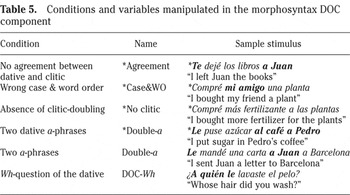
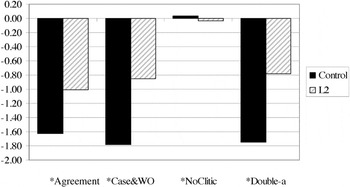
To test the L2 learners' knowledge of the main morphosyntactic properties of the Spanish DOC, four ungrammatical and two grammatical sentence types were tested. These properties are related to agreement, word order, case, clitic doubling, the role of the particle a, and wh-movement, as summarized in Table 5 In *agreement, the clitic does not agree in person or number with the dative DP, which renders the sentences ungrammatical. The *case&WO condition consists of ungrammatical sentences in which the dative DP is not preceded by the particle a, and it appears before the direct object rather than in its normal position after it. These sentences, which reproduce two characteristics of the DOC in English, are designed to test whether the superficial cues would prompt L2 subjects to accept them in spite of their ungrammaticality (in other words, they test for L1 transfer). The *no clitic condition is comprised of ungrammatical DOC sentences built with nonditransitive predicates (such as comprar “to buy,” desprender “to tear off,” dejar “to leave”) in which the dative a-DP should be doubled by a clitic but it is not (the corresponding PPCs of these sentences take a preposition other than a; e.g., para “for” or con “with”). Another ungrammatical DOC condition, *double-a, was designed to test whether subjects know that two dative DPs cannot appear in one sentence. Figure 2 shows results for these four ungrammatical double-object conditions.
Conditions and variables manipulated in the morphosyntax DOC component


Mean scores for ungrammatical double-object conditions.
Figure 2 shows that the experimental group rejected the same three ungrammatical conditions that NSs controls rejected. They correctly rejected sentences with clitic agreement mismatches (*agreement: −1.00 for L2, −1.62 for NS controls), sentences in which the dative DP appeared without a before the theme object (*case&WO: −0.85 for L2, −1.78 for NS controls), and sentences with two dative a-DPs (*double-a: −0.78 for L2, −1.75 for NS controls). Performance was at a lower chance level only in sentences in which the required clitic was missing (mean score of 0.04). An ANOVA showed main effects for group, F(1, 58) = 13.34, p < .0006, type of ungrammaticality, F(3, 58) = 58.37, p < .0001, and interaction, F(3, 58) = 7.95, p < .0001. Posttests (Fisher's) revealed the significance of type of ungrammaticality and the interaction is only due to the condition *no clitic (none of the other comparisons are significant for either group). It must be noted that NS controls also failed to reject the sentences in *no clitic, performing at the same level as the L2 group (score of −0.03) and displaying a great deal of individual and item variability. Both groups were at chance in this condition, possibly signaling dialectal variability within NS controls and indeterminacy in the L2 group. At this point, there are no means to evaluate this issue, and this condition is excluded from further analyses.
In sum, although they rejected ungrammatical sentences at significantly lower rates than NSs, the group of L2 learners showed sensitivity to the same morphosyntactic factors that NSs did, and the different types of ungrammaticality had no effect in either group. This is true even when ungrammatical sentences included both human and inanimate datives. The L2 learners' rejection of clitic mismatches shows that they know the clitic corefers and must agree in person and number with the dative argument, suggesting that in grammatical DOCs, they also recognize that the clitic doubles the dative a-phrase. It is not the case that L2 learners think dative clitic doubling applies to humans only, because they rejected doubled human possessors and they rejected inanimate datives without a clitic (rated at −0.24) more than they did nondoubled human datives (rated at 0.28). Correct rejection of sentences that mimic morphosyntactic properties of the English DOC not only indicates their knowledge of case and word order properties but also shows that English speakers are not transferring these properties from their L1 or, if they transferred them initially, they are in the process of restructuring their interlanguage grammar.
In Bruhn de Garavito's (2000) study, all Spanish L2 and control groups performed equally with ungrammatical sentences that contained two a-dative phrases: All groups rejected them and distinguished them from grammatical DOCs. One could argue, however, that L2 learners employ a surface strategy of rejecting sentences with two a-phrases without analyzing their underlying structure. In order to test this account, the ungrammatical cases of two dative a-phrases (condition *double-a) were contrasted to grammatical sentences containing two a-phrases, only one of which was a dative a-phrase (the other being a locative PP or a human direct object with personal a, as in the example for double-a in Table 5).12
Bruhn de Garavito (2000) analyzed the ungrammaticality of two dative a-phrases as a restriction on double incorporation. She found that all L2 speakers in her study rejected sentences with two dative a-phrases in spite of the existence of grammatical, superficially similar sentences in the learners' input. She contrasted the rejection of ungrammatical cases of double incorporation (double dative-a) with their reaction to grammatical cases of incorporation (the double-object construction), but she did not directly test the learners' response to grammatical cases of double-a. This direct comparison is performed in this study.
The last condition that tested knowledge of syntactic properties of Spanish DOCs consisted of interrogative sentences that questioned the dative argument, which appeared as a fronted wh-phrase.

Recall that whereas wh-extraction of the dative argument is perfectly grammatical in Spanish, it is ungrammatical in English (*Who did you send a letter?); therefore, if L2 learners transfer the syntax of wh-extraction in DOCs from their L1, they should reject these sentences.
The L2 group did not reject the grammatical interrogative sentences, although their acceptance rate was very low (0.25 in raw scores, 2.69 accuracy) compared to that of NS controls (mean score of 1.65, 3.74 in accuracy). Interestingly, both groups accepted wh-extraction at the same level they rated grammatical declarative DOCs.13
These results are consistent with those found by Bruhn de Garavito's study (2000), in which English L1 advanced and near-native groups accepted the grammatical extraction of dative a-phrases (at higher levels than the intermediate L2 group in this study). Bruhn de Garavito compared wh-extraction of dative a-phrases with the ungrammatical wh-extraction of genitive possessors (de-phrases). However, the group of 10 controls did not find genitive extraction ungrammatical (they weakly accepted it), which makes the comparison more difficult to interpret.
The experimental group thus evidenced subtle analysis of morphosyntactic properties such as case, word order, clitic agreement, and wh-movement, which are different or not instantiated in their L1. They reliably distinguished between grammatical and ungrammatical conditions.
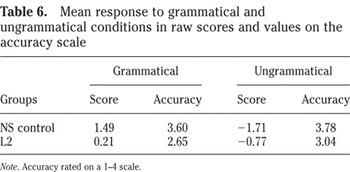
Table 6 shows that the L2 group rejected ungrammatical conditions more strongly than they accepted grammatical ones; their mean accuracy was also higher for ungrammatical (3.04) than for grammatical conditions (2.65). NS controls displayed the same tendency. The significant interaction of grammaticality by group, F(1, 58) = 118.05, p < .0001, indicates that the contrast between grammatical and ungrammatical conditions had a different impact in the two groups. As expected, analysis performed on accuracy rates shows that the NS control group was significantly more accurate than the L2 group, F(1, 58) = 120.36, p < .0001. The t tests confirmed that the L2 group was more accurate in rejecting ungrammatical sentences than accepting grammatical DOCs (p < .0009), whereas the same tendency in NS controls did not reach statistical significance.
Mean response to grammatical and ungrammatical conditions in raw scores and values on the accuracy scale

Modularity Effects
One of the main research questions is whether modularity of grammar plays a role in SLA. This issue is addressed with respect to the acquisition of DOCs by investigating whether the L2 group was reliably more accurate at assessing morphosyntactic properties than at recognizing the semantic properties and restrictions of the Spanish DOC. A comparison was made between the four conditions that manipulated semantic variables (semantics module) and the five conditions that tested for morphosyntactic knowledge (morphosyntax module).
The NS control group was more accurate than the L2 group in both modules; however, whereas they scored higher in semantics (3.74) than in morphosyntax (3.64), the reverse was true for the L2 learners (2.65 in semantics and 2.96 in morphosyntax). An ANOVA confirmed that NS controls were significantly more accurate than L2 learners, F(1, 58) = 135.94, p < .0001, and that module of grammar had a different effect for the groups, Group × Module interaction, F(1, 58) = 21.76, p < .0001, but no main effect for the module of grammar. The higher accuracy of the L2 group in morphosyntax compared to the semantics module was highly significant (Fisher's posttest, p < .0001). What these results suggest, then, is that the L2 group is sensitive to and has acquired relevant syntactic properties but is far behind with respect to the semantics of the construction.
To investigate whether this difference in accuracy across modules of grammar was just the result of group averaging or if it reflected individual performance, subjects were classified according to their level of accuracy in each module. A score of 2.90, the lowest accuracy within the NS control group, was set as the cutoff point between high and low performers.
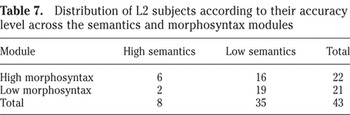
Table 7 shows that in morphosyntax, subjects were divided equally between high and low; that is, half the participants were as accurate as at least one NS control subject. In contrast, less than 20% had high accuracy in semantics. Another revealing difference is that 16 L2 participants were high in morphosyntax and low in semantics, whereas only 2 displayed the opposite pattern. These differences in distribution, however, miss significance, χ2 = 2.235, p = .1349.
Distribution of L2 subjects according to their accuracy level across the semantics and morphosyntax modules

Animacy Effects
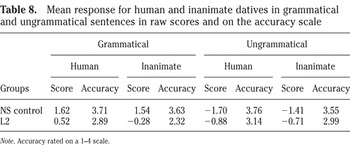
The last issue to explore is the independent and overall effect of animacy in the interlanguage grammar. In order to investigate this issue beyond the comparison between the grammatical declarative DOC-human and DOC-inanimate conditions (Table 4), token sentences were divided into two sets according to their grammaticality. Within each set, sentences were subdivided into two groups according to the animacy of the dative argument (human or inanimate). Mean scores (and values on the accuracy scale) were calculated for each of the four subcategories. As Table 8 shows, the difference in means between NS controls and L2 learners is widest for grammatical sentences with inanimate datives (1.82) and much smaller for ungrammatical sentences, both human and inanimate (0.82 and 0.70, respectively).14
Similar results in descriptive and ANOVA analyses obtain when level of accuracy is considered.
Mean response for human and inanimate datives in grammatical and ungrammatical sentences in raw scores and on the accuracy scale

Two ANOVAs for grammatical and ungrammatical sentences were performed on raw scores comparing animacy effects. Grammatical sentences showed main effects for group, F(1, 58) = 51.93, p < .0001, animacy, F(1, 58) = 22.30, p < .0001, and Group × Animacy interaction, F(1, 58) = 14.45, p < .0003. A posttest on animacy split by group reveals that animacy was a factor for the L2 group (Fisher's, p < .0001), who did not consider inanimate datives acceptable, but not for the NS control group (p = .3472). A different pattern emerged from the analysis of animacy in ungrammatical sentences: NS controls rejected ungrammatical sentences more than the L2 group, group main effect F(1, 58) = 18.28, p < .0001, and both groups tended to reject the ungrammatical sentences with human datives more than those with an inanimate dative, animacy main effect F(1, 58) = 5.94, p < .0179. The effect was significant for NS controls (Fisher's p < .05) but not for L2 learners (p = .1232). In sum, animacy of the dative argument played a role for the experimental group in grammatical sentences, but the effect of animacy disappeared in ungrammatical sentences; ungrammaticality was a stronger factor than animacy.
DISCUSSION AND CONCLUSION
This study investigated the SLA of the Spanish dative alternation, with special focus on how English speakers learn the semantic and morphosyntactic properties of the DOC in Spanish. The lack of differences between L2 learners and NS controls in their knowledge of the prepositional variant of the dative alternation does not correlate with lack of differences in their knowledge of the properties of double objects, as evidenced in their response to various sentence types. However, the L2 speakers in this study are not performing at chance or in unpredictable ways. The properties of the L2 interlanguage revealed patterns of acquisition that can only be explained within an approach that assumes a central role for linguistic mechanisms in SLA. L2 classroom speakers, even at intermediate levels of proficiency, are sensitive to subtle morphosyntactic characteristics of the target language, even when these are absent in or differ from their L1. They also show evidence of some generalizations in the semantic possibilities of the DOC beyond the restrictions that regulate double objects in English.
These L2 subjects recognized double objects in Spanish as distinct from the prepositional variant and showed sensitivity to certain semantic properties. They accepted DOCs in cases in which they are possible in English; they also accepted them or failed to reject them with some verbs or meanings that are impossible in the English DOC, showing overgeneralization of the construction with respect to their L1. Overgeneralizations were mostly restricted to DOCs in which a human dative argument could be understood as the recipient or source of the theme DP. L2 learners performed at chance levels when the dative argument was inanimate, and they rejected possessor datives. It is interesting to note that they only rejected violations of the possession constraint (part of their L1 grammar) when the dative was human, performing at chance with inanimates; that is, even when they fall short of having acquired its full semantics, L2 learners are already aware that the Spanish DOC expresses a wider range of meanings than the English counterpart. They have misanalyzed the requirement of the construction, considering it to be restricted by the animacy of the dative, not admitting a wider notion of possession that includes alienable possession between two inanimate entities. These data show that L2 learners' interlanguage is constrained by a linguistic generalization on a notion that affects licensing of arguments and their morphosyntactic properties in many languages: animacy.15
One might argue that animacy is used by L2 learners because this notion is syntactically active in Spanish (syntactic expression of animacy in Spanish includes personal a that precedes animate direct objects DPs, use of dative clitics for animate direct objects in several dialects, etc.), and L2 learners are overapplying this notion to dative arguments. In any case, L2 learners are employing a category made available by UG that is not fully relevant for DOCs either in English or Spanish, so the point still holds.
Group and individual responses in this study suggest a pattern of acquisition: Human dynamic datives are acquired first, followed by inanimates and, finally, static possessors. In Bruhn de Garavito's (2000) study, however, the English L1 advanced group accepted human and possessor datives (rating them lower than NS controls) but found inanimate possessors marginal. The near-native group showed no differences with respect to NS controls for human and possessor datives but performed significantly different from NS controls for inanimate datives. Neither of the two groups differed from the NS controls in their rejection of violations of the possessive constraint. Considering all of these data together, then, the early generalization that double objects in Spanish are restricted by animacy seems to remain active even at a high level of proficiency and exposure to the language. The acquisition of static dative possessors seems to be dissociated from this, and they are acquired progressively until near-NSs do not differ from NS controls.
In the domain of morphosyntax of the Spanish DOC, although their accuracy was usually lower, L2 learners correctly rejected all of the ungrammatical conditions rejected by NS controls, showing sensitivity to the morphosyntactic properties tested: clitic agreement, case, word order, the status of the element a, and wh-extraction. These results are consistent with those from the two more proficient English-speaking L2 groups in Bruhn de Garavito's (2000) study.
Second language learners' rejection of agreement mismatches provides evidence of knowledge of the role of the clitic, a structure not part of their L1 grammar: Subjects understood that the clitic doubles the dative a-phrase and that doubling is not restricted to human datives. The significant difference in responses to the two double-a conditions provides evidence that L2 subjects analyzed the grammatical structure of the input and were not following surface cues in the rejection of ungrammatical sentences. Their high accuracy at rejecting sentences that mimic surface case and word order properties of the English DOC as well as their acceptance of wh-extraction of human datives (which is ungrammatical in English) also constitute evidence of linguistic analysis of the input and of acquisition of properties not instantiated in the L1 grammar. These results go against the theory of unavailability or partial availability of UG in SLA and the idea that the L1 is the only source of UG-constrained knowledge. Thus, results support the full access position and constitute evidence against the FDH and the partial access position.
With respect to L1 transfer, results do not provide conclusive evidence for or against, because L2 subjects performed at similar levels with respect to morphosyntactic properties that differ in the native and target languages (i.e., properties that could transfer, such as case, word order, and wh-extraction) and with respect to properties not instantiated in their L1 (i.e., properties that could not transfer, such as clitic agreement and double a-phrases).
Performance in morphosyntax and semantics, the two modules of grammar in which double objects differ in important ways between English and Spanish, was directly compared in this study. The theoretical analysis of the dative alternation adopted here favors a syntax-determines-semantics view that can be translated as syntax-before-semantics in acquisition. Indeed, the comparison showed that L2 subjects were significantly more accurate at judging morphosyntactic than semantic properties of Spanish double objects. This contrast between a delayed acquisition of the semantics and earlier acquisition of the morphosyntax was reproduced as a tendency at the individual level.16
This conclusion is also supported by considering results of this study together with performance reported by Bruhn de Garavito (2000, 2006). Acquisition of the Spanish dative alternation by English speakers seems to begin with its morphosyntactic properties for restricted meanings, first generalizing the construction to dynamic possession relations and then accepting static possessive relations as well.
Montrul (2000) suggested that the interaction of L1 and UG in SLA might differ across levels of linguistic representation. She suggested that this can be due to differences in the initial state (L1 being the initial state for some module of grammar but not for others) or that L1 as a whole is the initial state but different modules restructure earlier than others (see Whong-Barr & Schwartz, 2002, for further support). The present study supports a similar view, suggesting that morphosyntactic aspects are acquired early, whereas semantic properties and restrictions require more time. This difference in timing, however, is not necessarily evidence that it is areas of L1 grammar that take longer to restructure, as a phenomenon specific to SLA and dependent on a theory of transfer. Demuth et al. (2005) presented evidence that correct syntactic generalizations concerning argument structure in L1 acquisition appear early if there are no confounding lexical semantic restrictions involved. The findings of the present study offer further evidence that modularity plays a central role in language acquisition in general for both L1 and L2, as acquisition of syntax can be seen to precede other areas. This conclusion is not unexpected within a theory that takes syntax as the engine of our language capacity.