Implications
Moroccan breeds are adapted to various climatic conditions, generally hotter and drier than the breeds of European temperate countries. They represent a genetic reservoir to improve European sheep breeds to resist to global warming. Here we evaluate their tolerance to climatic constraints from their present distribution. We also predict the problems they will face in their own respective breeding area.
Introduction
In the context of global changes that affect temperate countries in different ways, particularly drought and heat, the local breeds will face environmental conditions never met before. It is important to characterize as accurately as possible the environmental constraints that can be supported by breeds selected for hundreds of years in countries with more arid climates (Hoffmann, Reference Hoffmann2013). The conditions observed in nowadays North African countries will look like those predicted in certain parts of Europe in 50 or 100 years, and particularly concern an increasing proportion of degraded pastures. Therefore, North African sheep breeds are good candidates to be introduced or crossed to European local breeds, to improve their resistance to harsh environments. Morocco is a remarkable country to find interesting sheep breeds for two reasons. First, there is a wide range of climatic conditions found; the Atlantic coast, the humid high plateaus, the steppes, and the desert southward. Moreover, the population of sheep in Morocco, currently estimated to 17.1 million, can be divided to around 20 different breeds (Mason, Reference Mason1996). All of them are thin-tailed and rams have fairly well developed spiral horns, except those of D’man breed that are polled (Boujenane, Reference Boujenane2005). Of these breeds, Sardi, Timahdite, Béni Guil, D’man, Boujaâd and Béni Ahsen are the most important numerically and the best phenotypically characterized (Boujenane and Petit, Reference Boujenane and Petit2016). Second, the geographic areas of these breeds are well defined (De Pauw et al., Reference De Pauw, Rischkowsky, Abou-Naga, Ansari-Renani, Boujenane and Gursoy2011), as a result of the sheep plan called ‘Plan Moutonnier’ (MARA, 1980) and the politics driven by the breeders’ association named ‘Association Nationale Ovine et Caprine, ANOC.’ The breeders who joined the ANOC received facilities for veterinary care, mating assistance and advices to conduct their flocks, if they reared the right breed in the right area. This incentive policy reinforced the stability of breed location in the breeding area that was assessed for more than 80 years (Eyraud, Reference Eyraud1934). Of course, their adaptation to the breeding area is more complete than in the rest of the geographic area. There is a dense network of meteorological stations on the Moroccan territory that provides useful data. The National Agency of Meteorology releases in the recent period (1983 to 2010) an even denser source of data, allowing comparisons between the two periods and the base to forecast the trends of climatic changes in a close future.
The objectives of the paper were first to describe the ranges of main climatic parameters in which each major sheep breed can be found. Second, we will try to understand how the breeds share the whole ‘climatic space’ available on the national territory and if there is an overlap between the climatic domains of different breeds. The third objective was to present the climatic plasticity of each breed, indicative of their possible adaptations to climate changes, providing useful data for the management of this invaluable resource of the country.
Material and methods
Studied breeds
The study was carried out on Béni Ahsen, Béni Guil, Boujaâd, D’man, Sardi and Timahdite breeds that are the major Moroccan local sheep breeds owing to their high number and extended geographic areas (Boujenane, Reference Boujenane1999; De Pauw et al., Reference De Pauw, Rischkowsky, Abou-Naga, Ansari-Renani, Boujenane and Gursoy2011). Béni Guil is a breed spread from the Moulouya valley westward to the steppes of eastern plateaus of Morocco, in continuity to the Algerian counterpart breed Hamra, at altitudes between 450 and 1450 m. Its population is around 1.50 million heads. The population of Boujaâd breed is moderate with <0.24 million heads, and settled in the plateau at the north of Middle Atlas from Kasba-Tadla to Oued-Zem, between 500 and 800 m. Béni Ahsen is a breed developed in the Atlantic coast in the Gharb plain, mostly under 50 m above sea level (A.S.L.). The number of animals is about 0.38 million heads. It has been neglected from selection due to its poor growth development, resulting in an endangered status. Sardi is one of the major breeds in Morocco, of about 2.15 million heads, living in the arid plain of western plateaus of Chaouia, Tadla, Abda and Sraghna, between 200 and 850 m. Timahdite is the main breed of Middle Atlas, with a population estimated around 1.91 million heads, characterized by its hardiness. Its breeding area is centered on Ain-Leuh, Azrou and Timahdite, above 1200 m A.S.L. However, its geographic area extends to regions devoted to cereal crops, mostly between 300 and 800 m. D’man is a polled breed, prolific and close to several breeds of Sub-Saharian countries. Its population is over 0.6 million heads. It is reared in the south of Atlas Mountain, mainly in the oases of Ziz, Draâ and Dadès valleys, under desert climate, and altitudes between 700 and 1450 m.
Data collection
Several climatic parameters corresponding to 85 stations were documented for the period 1983 to 2013, and 45 stations for the period 1933 to 1962. These stations were selected to represent the geographical distribution of the major six Moroccan sheep breeds (Table 1). For each breed geographic distribution synthetized in De Pauw et al. (Reference De Pauw, Rischkowsky, Abou-Naga, Ansari-Renani, Boujenane and Gursoy2011), the localities hosting climatic stations were chosen to be as regularly distributed as possible on the whole area, to avoid an over-representation of close stations and an under-representation of vast surfaces. For each station, we recorded the altitude (in m), the minima mean of the coldest month (m, in °C), the maxima mean of the hottest month (M, in °C), the annual rainfall (R, in mm), the annual maxima mean (T
max, in °C), and the annual minima mean (T
min, in °C) for the period 1983 to 2013. We added the pluviothermic coefficient of Emberger Q
2 where
 $$Q_{2} {\equals}\,{\textstyle{{3.43\,R} \over {M{\minus}m}}}$$
(Sauvage, Reference Sauvage1963) because it is an integrative index constructed to identify vegetation series in a Mediterranean context, as it takes into account the annual rainfall and M−m, which is a function of evaporation. To compare this data set to the ancient period, we took into account the parameters m, M and R for the period 1933 to 1962 and for the corresponding climatic stations recorded in the work of Sauvage (Reference Sauvage1963).
Number of climatic stations for the periods 1933 to 1963 and 1983 to 2013 for each sheep breed

To substantiate the climatic distribution of each breed, we used the two-dimension (2D) projection system of Emberger’s climatogram, relevant for plants and animals of Mediterranean countries. Using SYSTAT 12.0 (SPSS Inc, 1997), for each climatic station within a breed geographical area, the scatterplot with 2D contour considers m and Q 2 as x and y axes, respectively, while the presence of sheep breed constitutes z-axis. The resulting graph identifies gradients of frequency of each breed, and points out the climatic domain with the highest probability of presence (Benfekih et al., Reference Benfekih, Foucart and Petit2011).
Statistical analyses
To identify which climatic parameters have more discriminant power than others in separating the six climatic spaces of the breeds, we conducted a stepwise discriminant analysis using PROC STEPDISC implemented in the SAS/STAT package (2002). The significance level applied for retaining or adding a variable was 0.05. The CANDISC procedure was used to perform canonical discriminant analysis for deriving canonical functions, which are linear combinations of climatic parameters that summarize variation between climatic spaces of breeds, and for calculating the squared Mahalanobis distance matrix necessary for the differentiation between climatic spaces of breeds. The PROC GPLOT was used to plot the climatic stations onto the canonical variables.
To estimate the overlap between the climatic domains of the different breeds, we further applied the projection of the DISCRIM procedure of the same software to perform discriminant analysis. The expected result is to give the proportion of climatic stations that were properly classified into the climatic space of the original breed, or in other words the percentage of misclassified stations.
The amplitude of each climatic parameter underwent by each breed was estimated by their variance. If there were eight climatic stations for example within the breeding area of a given breed, the variance of each parameter among the eight stations was calculated using ExcelTM from OfficeTM package. To compare the variances between all the combinations of breeds, we calculated their ratio. We then considered the corresponding degrees of freedom of each member of these ratios to compare these ratios with the critical values in F-Snedecor tables (at P-value=5% and 1%).
To compare the values of climatic parameters between the 1933 to 1962 and 1983 to 2013 periods for each breed, we conducted Wilcoxon tests (station by station). It should be noted the small numbers of data available for each breed (between 2 and 12).
Results
Climatic domain of the six breeds
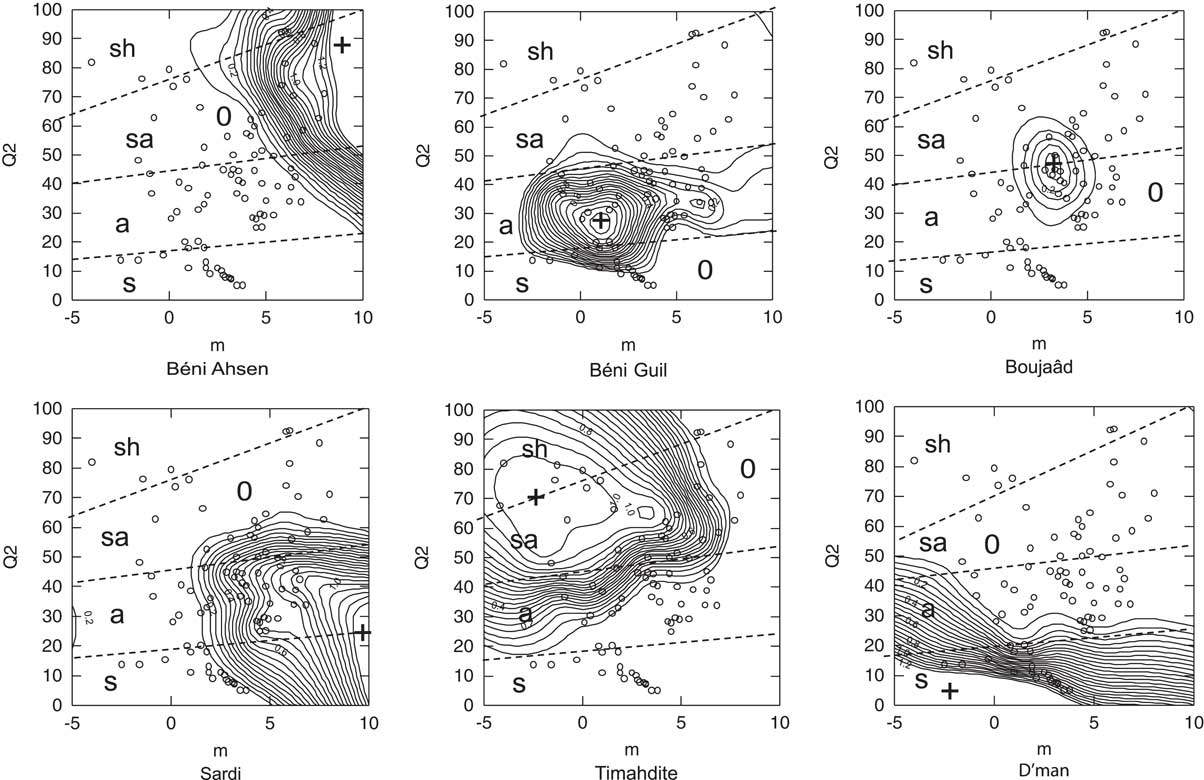
According to the climagrams of Figure 1, it is possible to assign a stage and a sub-stage to each breed, according to the values of Q 2 coefficient and the minima temperature mean of the coldest month m. It appears that Béni Ahsen breed is mainly developed under semi-arid and sub-humid stages with mild to hot winter. This distribution looks like Sardi breed which also prefers temperate to hot winters, but under an arid stage. Béni Guil breed is also spread in arid stage, but with a fresher winter. As for Boujaâd breed, its climatic area is reduced and concentrated between the arid and semi-arid stages, with temperate winter. Timahdite breed is characterized by higher frequencies in semi-arid and sub-humid stages with cold to fresh winter. D’man breed occupies a unique climatic condition represented by the Saharian stage with cold to temperate winter. It can be concluded that the climatic domains of these six breeds seem to be rather separated and moderately overlapping.
Emberger’s pluviothermic diagrams of the geographic areas of the six sheep breeds. 0 and + relate to the minimum and maximum probabilities of presence in the climatic gradients. s=Saharian stage, a=arid stage, sa=semi-arid stage, sh=sub-humid stage; +=area of maximum values.

Separation between sheep breed climatic domains using all the variables
The stepwise discriminant analysis showed that all the eight climatic variables were significant (P<0.001). Their partial R 2 were comprised between 0.41 for to 0.84 for Q 2. This suggests that all these variables had a discriminant power in differentiating between sheep breed climatic domains. However, the STEPDISC procedure selected four variables highly significant (P<0.001), namely Q 2, M, R and m, in decreasing order.
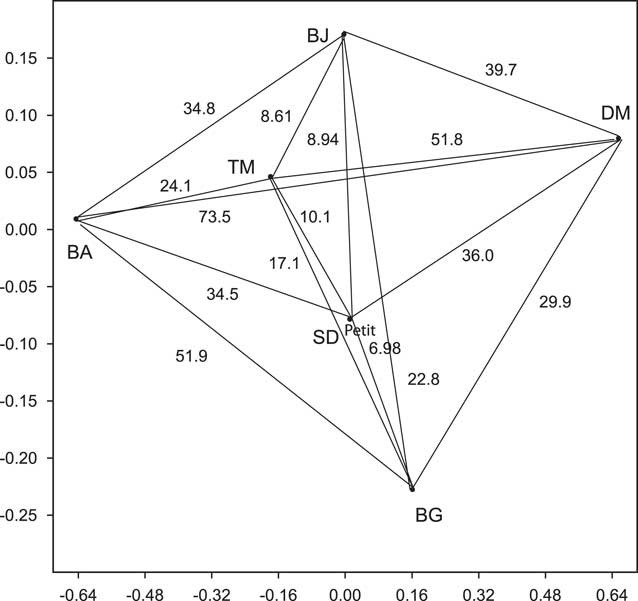
The squared Mahalanobis distances among the six sheep breed climatic domains are presented in Figure 2. All pairwise distances, as shown by the multivariate test for differences between the breeds (Wilks’ Lambda, Pillai’s Trace), were revealed significant (P<0.05), indicating that the differences among breeds are important. The largest divergence was shown between Béni Ahsen and D’man (73.5) and the smallest one was between Béni Guil and Sardi breeds (6.98). Two couples of breed climatic domains were shown to have long distances around 52, Béni Ahsen and Béni Guil breeds on one hand, and Timahdite and D’man breeds on the other hand. Other distances can be qualified as moderate or short.
Mahalanobis distances between climatic space of the six sheep breeds. BA=Béni Ahsen; BG=Béni Guil; BJ=Boujaâd; DM=D’man; SA=Sardi; TM=Timahdite.

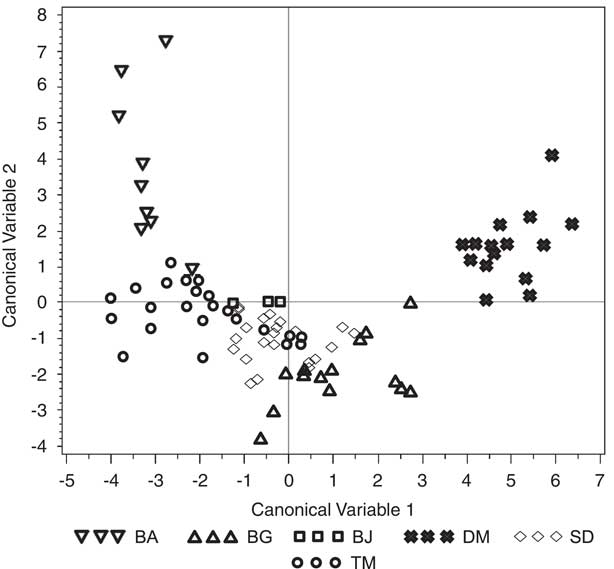
The canonical discriminant analysis identified four statistically significant (P<0.001) canonical variables CAN1, CAN2, CAN3 and CAN4 that accounted for 60%, 25%, 8% and 5% of the total variation, respectively. The canonical correlations were 0.93, 0.87, 0.72 and 0.64 for CAN1, CAN2, CAN3 and CAN4, respectively. Raw canonical coefficients were used to derive canonical functions. CAN1, CAN2, CAN3 and CAN4 provided the greatest difference between the breed climatic domain means. The breed means on CAN1 were −3.4, 0.91, −0.82, 4.7, −0.4 and −2.1 for Béni Ahsen, Béni Guil, Boujaâd, D’man, Sardi and Timahdite, respectively. These values indicate that D’man breed was best discriminated by CAN1, and differed markedly in climatic domain from Béni Ahsen and Timahdite breeds, as illustrated in Figure 3. The climatic domains of these two last breeds are well separated by canonical variable CAN2 as their means were 3.7 and −0.3 for Béni Ahsen and Timahdite, respectively. CAN3 discriminates the climatic domain of Boujaâd breed (mean 1.5) from those of Béni Guil and Sardi (means −0.78 and −0.85, respectively). The climatic domains of these last two breeds are well separated by CAN4 for Béni Guil and Sardi (means 1.1 and −1.0, respectively).
Representation of canonical analysis of climatic space of the six sheep breeds. BA=Béni Ahsen; BG=Béni Guil; BJ=Boujaâd; DM=D’man; SA=Sardi; TM=Timahdite.

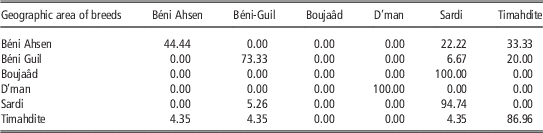
The discriminant analysis to determine the percentage of stations correctly grouped into the climatic domain of their own breeds is presented in Table 2. It revealed that 44.4%, 73.3%, 100%, 94.7% and 86.9% of climatic stations for Béni Ahsen, Béni Guil, D’man, Sardi and Timahdite, respectively were correctly classified in their original breed climatic domain. Unexpectedly, 100% of the stations corresponding to Boujaâd breed were misclassified in the domain of Sardi. Over the 56% of stations misclassified in Béni Ahsen climatic domain, 22% and 33% were attributed to Sardi and Timahdite breed climatic domains, respectively.
Percentages of climatic stations (in column) classified in the own geographic areas (in line) of the six sheep breeds (1983 to 2013 period), obtained by discriminant analysis

Climatic parameter amplitudes for the sheep breeds
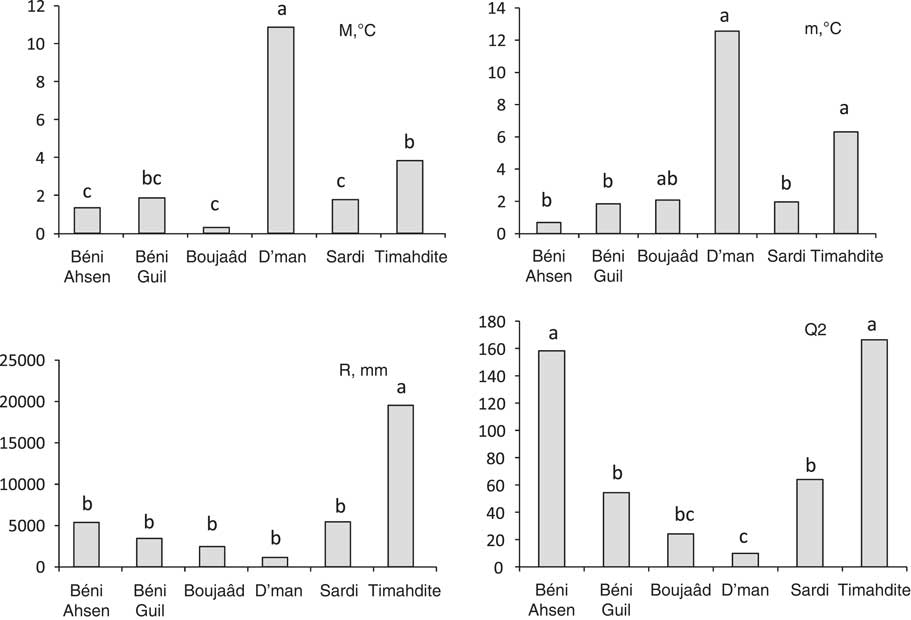
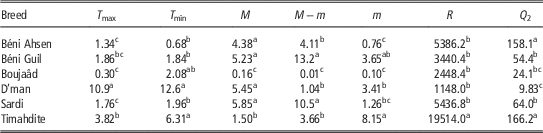
Among the amplitudes for annual mean T max and T min, the D’man showed significant higher values than those of Timahdite breed, which in turn was greater than most of the remaining breeds (Table 3 and Figure 4). However, the D’man breed had not a more powerful ability to support the highest temperatures (M) like Béni Ahsen, Béni Guil and Sardi breeds. The same tendency was observed for m, as D’man and Timahdite breeds had higher amplitudes than most of the other breeds. Regarding the annual rainfalls, Timahdite can suffer a higher range of values than the other breeds. The amplitude for pluviothermic parameter Q 2 was more elevated in Timahdite and Béni Ahsen breeds than in the other ones, and particularly than D’man.
Variances of climatic parameters for each sheep breed for the period 1983 to 2013. The different letters correspond to significant differences (P<0.05).

Variances of climatic parameters in the different geographic areas of the six sheep breeds

M=maxima mean of the hottest month in °C; m=minima mean of the coldest month in °C; R=annual rainfall in mm;
$$Q_{2} {\equals}\,{\textstyle{{3.43\,R} \over {M{\minus}m}}}$$
=pluviothermic coefficient of Emberger; T
max=annual maxima mean in °C; T
min=annual minima mean in °C for the period 1983 to 2013.
Variances within a column that do not have a common superscript (a, b, c) are significantly different (P<0.05).
Variations in climatic parameters between the two periods
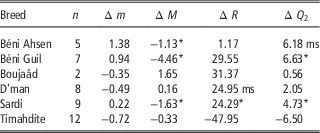
If we compare the climatic parameters for the sheep climatic domains between the periods 1933 to 1962 and 1983 to 2014, we find three contrasted situations (Table 4). For the Béni Guil, Boujaâd, Sardi and D’man breeds, we observed an increase in annual rainfalls of around 24 to 30 mm, whilst there was a strong decrease of around 50 mm for Timahdite breed. In the case of Béni Ahsen, the annual rainfall was fairly constant. However, the Q 2 coefficient had increased, due to lower M and higher m. The difference between M and m had changed in the same manner for Béni Guil and Sardi breeds, contributing to an elevation in Q 2 coefficient. In contrast, the opposite trend was recorded for Boujaâd and D’man breeds, leading to a moderate increase of Q 2. Timahdite was the only breed that clearly underwent a reduction of Q 2 coefficient, as a result of rainfall shortage.
Variation in the climatic parameters between the periods 1933 to 1962 and 1983 to 2013 of the six sheep breeds

n=Climatic station number; Δ m=difference in minima means of the coldest month, in °C; Δ M=difference in maxima means of the hottest month, in °C; Δ R=difference in annual rainfalls, in mm; Δ Q 2=difference in the Emberger’s pluviothermic coefficient.
The significance of differences was obtained using Wilcoxon test, ms=marginally significant with P<0.07, *P<0.05.
Discussion
As explained in the introduction, the geographical distribution of the six main sheep breeds in Morocco has been established and maintained for more than 30 years. In the particular case of D’man breed, its presence in the oases of South Morocco was noted as far as in the 12th century (Boujenane, Reference Boujenane1999). Concerning the other breeds, the phenotype was not so well characterized and it is hard to retrieve with certainty in old writings. Our hypothesis is that the six breeds are settled in their geographic location for long, and hence have had time to adapt to their present location. The consequences of this will be explored through several points. The first one deals with an assessment of separation between the climatic domains of the six breeds. The second one concerns the range of climatic parameters that can tolerate each breed (Hoffmann, Reference Hoffmann2013). This last point is useful to help in predicting how the sheep breeds will cope with climatic changes in the 50 next years (Seo et al., Reference Seo, McCarl and Mendelsohn2010).
Comparison between the climatic domains of the sheep breeds
As illustrated by the climatograms, each Moroccan sheep breed has its own climatic domain. This approach has been verified by canonical discriminant analysis, where we showed that the canonical axes significantly separated the climatic domains of the six breeds.
If we sort the domains by winter temperatures, hot conditions, that is, minima mean of the coldest month over 3°C, are shared by Béni Ahsen and Sardi breeds, due to their Atlantic distribution. However, Béni Ahsen breed needs higher rainfall than Sardi as Béni Ahsen is centered in semi-arid and sub-humid stages, whereas Sardi breed is typically settled in arid stage. Indeed, more than 20% of the locations corresponding to Béni Ahsen could be attributed to Sardi breed.
Béni Ahsen climatic domain is also related to Timahdite one, as a third of its location is attributed to Timahdite breed. It is due to the common need of annual rainfall. Both breeds are mainly distributed in semi-arid and sub-humid stages, although Timahdite breed is mostly developed in the mountains of Middle Atlas, with m <4°C. The climatic domain of Boujaâd was entirely included in Sardi’s one as demonstrated by the classification following discriminant analysis. With regard to Béni Guil breed, its distribution in the oriental part of the country, thus far from the Atlantic coast, was correlated with a more continental climate, in the arid stage with fresh winters.
D’man is the only one breed perfectly classified by its locations, in reason of its strict settlement in desert stage. This breed is raised in a sedentary oasis system contrarily to the previously cited ones, which are managed in the agro-pastoral system (Boulanouar and Paquay, Reference Boulanouar and Paquay2005). In its habitat, the D’man breed is usually placed under the shadow of palm date trees and receives feed (mainly alfalfa and dates residues) at troughs. It is why this breed does not tolerate heat stress unlike the other local breeds that are used to graze under various climate conditions.
Tolerance of breeds toward climatic variations
If we consider the variances of climatic parameters as a surrogate for resistance toward climatic changes, two breeds showed particularly high potentials: Timahdite and Beni Ahsen. This view cannot be applied to D’man breed which is settled in the valleys in the south of High Atlas. If we consider its distribution, we can deduce that this breed can tolerate high variations in extreme temperatures, as for m and M. This view needs to be qualified in relation to its special rearing, as explained previously. Indeed, experiments in controlled temperatures showed its weak resistance toward elevated temperatures by comparison with breeds reared in semi-extensive conditions, as Béni Guil and Sardi (Zine-Filali, Reference Zine-Filali1978; Ashour and Benlemlih, Reference Ashour and Benlemlih2001).
First, the Timahdite breed located mainly in Middle Atlas Mountains above 1000 m A.S.L. can support a great range of variations in annual rainfalls, and hence in Q 2 coefficient, and at a lesser extent in m and M values. Its moderate tolerance toward heat increase had been experimentally verified by Zine-Filali (Reference Zine-Filali1978) who compared the physiological behavior of sheep individuals placed at 38°C and at 18°C. Even if in the natural pastures, sustained temperatures of 38°C are unlikely in the distribution area of Timahdite breed, our findings seem to be promising in a context of global change as it will be discussed later. The second interesting breed is Béni Ahsen, able to suffer variations in Q 2, hence variations in vegetation productivity (Daget, Reference Daget1977). This property is due to a combination of moderate variations in M−m values rather than of high variations in annual rainfalls. Due to the recent decrease of populations, this breed did not experience physiological tests of resistance toward water deprivation or heat stress. In contrast, Boujaâd breed showed the more restricted climatic domain, due to its narrow distribution.
These data have to be compared with the temporal climatic variations observed for 50 years, and hence help to provide predictions for the next 50 years (Hoffmann, Reference Hoffmann2010). As shown by different authors (Parish and Funnell, Reference Parish and Funnell1999; Driouech et al., Reference Driouech, Déqué and Sánchez-Gómez2010; Schilling et al., Reference Schilling, Freier, Hertig and Scheffran2012), simulations forecast a shortage of rainfalls in Moroccan mountains and regions south of Atlas. Our simple calculations confirm partially this trend. With a more detailed scale, we observed an increase in annual rainfalls in the regions north to Atlas Mountains (plains and plateaus), and as a result in pluviothermic coefficients, but a decrease in Middle Atlas. In turn, a shortage of rain in these regions will affect the water flow on the different rivers of Morocco, and hence in corresponding watersheds (Chaponniere and Smakhtin, Reference Chaponniere and Smakhtin2006). As the contribution of pasture to food source of flocks is estimated to be <50% in the case of Béni Guil at least (Boulanouar and Paquay, Reference Boulanouar and Paquay2005), the decrease of rainfalls in mountains alone indirectly affects the rearing of flocks in the plains. Taken together, these data indicate that the future of Moroccan sheep breeds is not problematic, except for Timahdite breed. In this particular case, the threat due to rainfall shortage is more indirect through the decrease of pasture production than through direct effects. The D’man breed will be affected at a lesser extent as the humidity of oases is not independent from rivers coming from Atlas in the north of its distribution area.
Conclusions
Morocco is a remarkable country owing the diversified environmental conditions observed, and the adaptation of the local sheep breeds settled from hundred years in well-defined areas. These breeds represent an invaluable reservoir of genetic richness to improve other breeds submitted to degraded conditions. What we have demonstrated is that the different Moroccan breeds are not adapted to subtle differences in climatic conditions, but clear-cut ones: their climatic domains are not overlapping and they show complementary resistances to different constraints. Of note, we pointed out two breeds: Timahdite, adapted to fresh winters and Béni Ahsen, preferring mild winters. Another question is whether they could adapt to climatic changes in their native country. The main remarkable event is a shortage in rainfall in the Middle Atlas, resulting in a decrease in pasture productivity and in water flow of rivers that originate from Mountains. Both consequences will affect the Moroccan sheep flocks in the future.
Acknowledgments
This work, part of the project Westmedsheep (project AOI), was financially supported by the University of Limoges.