Introduction
Behavioral and psychological symptoms of dementia (BPSD) are common in Alzheimer's disease (AD), affecting almost 90% of patients at some stage of the illness (Rovner et al., Reference Rovner, Kafonek, Filipp, Lucas and Folstein1986; Tariot et al., Reference Tariot, Podgorski, Blazina and Leibovici1993). The umbrella term of BPSD encompasses a broad range of symptoms and signs, including apathy, mood changes, agitation, aggression, delusions and hallucinations. BPSD are a major cause of caregiver distress (Coen et al., Reference Coen, Swanwick, O'Boyle and Coakley1997) and are associated with an earlier move to institutional care (Steele et al., Reference Steele, Rovner, Chase and Folstein1990).
Several studies have shown benefit from non-pharmacological interventions in the management of BPSD (for a review, see Livingston et al., Reference Livingston, Johnston, Katona, Paton and Lyketsos2005). However, these strategies alone are not always effective. Furthermore, provision of certain interventions in community settings can be impractical.
Clinicians are often placed under considerable pressure to find a pharmacological solution to distressing behavioral disturbances. However, the best course of action in these situations is often unclear, and the evidence on which to base clinical decisions is complex. The use of antipsychotic drugs may provide modest short-term benefit in severe BPSD (Ballard and Waite, Reference Ballard and Waite2006) but this may not outweigh the risks associated with their use in elderly patients with dementia (Schneider et al., Reference Schneider, Dagerman and Insel2006). Based on pooled data from several randomized controlled trials (RCTs), the Committee on Safety of Medicines (CSM) issued a statement in 2004 regarding the increased risk of stroke with risperidone and olanzapine in dementia (Committee on Safety of Medicines, 2004). In 2005 a warning was issued by the U.S. Food and Drug Administration (FDA) regarding increased mortality when atypical antipsychotic drugs were used in dementia (FDA Public Health Advisory Centre for Drug Evaluation and Research, 2005). More recent evidence and warnings have highlighted safety concerns regarding both typical and atypical antipsychotic drugs (Gill et al., Reference Gill2007; Schneeweiss et al., Reference Schneeweiss, Setoguchi, Brookhart, Dormuth and Wang2007; U.S. Food and Drug Administration Centre for Drug Evaluation and Research, 2008).
There is some evidence to suggest that memantine may be of benefit in the management of BPSD. A recent pooled analysis of data from six placebo-controlled RCTs found a small but significant benefit from memantine in terms of behavioral outcome scores (Gauthier et al., Reference Gauthier, Loft and Cummings2008). More limited evidence is available for mood stabilizers, benzodiazepines and antidepressant drugs. Interpretation of these data is made more complex by the differences between studies in terms of symptoms and severity of dementia studied, as well as the study setting and duration. Carbamazepine (Tariot et al., Reference Tariot1998; Olin et al., Reference Olin, Fox, Pawluczyk, Taggart and Schneider2001) and valproate (Lonergan et al., Reference Lonergan, Cameron and Luxenberg2004) may have some effect on BPSD but the benefits may not outweigh the risks of adverse effects. Lorazepam has been shown to reduce acute agitation (Meehan et al., Reference Meehan2002); evidence for the effect of benzodiazepines on other neuropsychiatric symptoms is more limited and side effects are again an important concern (Glass et al., Reference Glass, Lanctôt, Herrmann, Sproule and Busto2005). In terms of antidepressant drugs, evidence for trazodone is equivocal (Martinon-Torres et al., Reference Martinon-Torres, Fioravanti and Grimley2004) and whilst there is evidence that selective serotonin reuptake inhibitors (SSRIs) are of limited benefit (Nyth and Gottfries, Reference Nyth and Gottfries1990; Pollock et al., Reference Pollock2002; Lanctôt et al., Reference Lanctôt, Herrmann, Van, Eryavec and Naranjo2002), there are few studies and sample sizes are generally small.
The efficacy of cholinesterase inhibitors in the management of cognitive symptoms of AD has been a controversial issue for many years. The widespread availability of these drugs has been received as a landmark in Alzheimer's disease treatment by some. However, others are more skeptical and argue that modest improvements in scores on assessment scales do not translate into clinical benefit (e.g. Kaduszkiewicz et al., Reference Kaduszkiewicz, Zimmermann, Beck-Bornholdt and Van Den2005). In the U.K., the debate surrounding the use of cholinesterase inhibitors intensified following the release of NICE guidance in 2006 (National Institute for Health and Clinical Excellence/Social Care Institute for Excellence, 2006), which limited their use to those with moderately severe Alzheimer's disease and was seen by many as overly restrictive.
Cholinergic deficits have been shown to be linked to cognitive as well as neuropsychiatric symptoms of AD (Mega et al., Reference Mega, Cummings, Fiorello and Gornbein1996; Cummings and Back, Reference Cummings and Back1998; Minger et al., Reference Minger2000), providing a neurobiological basis for the use of cholinesterase inhibitors in the management of BPSD. The aim of this review was to examine systematically the evidence from randomized, placebo-controlled trials of the cholinesterase inhibitors donepezil, rivastigmine and galantamine to determine whether or not they are effective in the management of BPSD in AD.
Methods
Electronic database searches of MEDLINE, EMBASE and the Cochrane Central Register of Controlled Trials were performed in November 2008 using the search terms “cholinesterase inhibitor” OR “donepezil” OR “galantamine” OR “rivastigmine” AND “Alzheimer's” in title or abstract with the limitation of English language (additional searches substituted “Alzheimer” and “AD” for “Alzheimer's”). The bibliographies of studies of interest and of recent relevant reviews and meta-analyses were searched manually.
Studies were included if they met the following criteria: (1) participants had a diagnosis of possible or probable Alzheimer's disease according to NINCDS-ADRDA or DSM-IV criteria; (2) the paper was an original report of a randomized, placebo-controlled trial; (3) the trial included at least one arm of donepezil, rivastigmine or galantamine monotherapy; (4) outcomes included a robust measure of global or individual BPSD using a validated assessment instrument; (5) study design was parallel or crossover; and (6) study duration was at least 12 weeks.
Studies of AD in people with Down's syndrome or cerebrovascular disease were excluded. Secondary analyses of previously reported data were also excluded.
Results
Literature search
Electronic database searches yielded 2473 unduplicated records. Review of titles and abstracts yielded 52 studies of interest, for which complete papers were obtained. Manual searching of the bibliographies of all included articles and of recent reviews and meta-analyses identified no further studies of interest.
Further review of the 52 selected articles identified 14 studies that met inclusion criteria. Other studies were excluded because they were not RCTs (n = 9), they were retrospective analyses of previously published data (n = 4), they lacked any robust measure of behavioral and psychological outcome (n = 21), study duration was less than 12 weeks (n = 1), or because they were head-to-head comparisons of two drugs with no placebo arm (n = 2).
Trial procedures
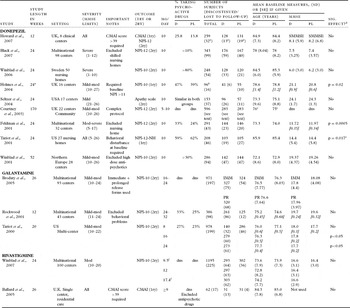
A summary of methodology and baseline data from the reviewed studies is given in Table 1.
Summary of all studies and baseline characteristics of studies of donepezil, rivastigmine and galantamine

AD = Alzheimer's disease; VaD = vascular dementia; CVD = cerebrovascular disease; D = active drug group; PL = placebo group; NH = nursing home; NPI = Neuropsychiatric Inventory (10 and 12 refer to number of items); NPI-NH = Neuropsychiatric inventory – Nursing Home; CMAI = Cohen-Mansfield Agitation Inventory; IMM = immediate release form of galantamine; PR = prolonged release form of galantamine; dns = data not shown; SMMSE = standardized Mini-mental State Examination.
aData refer to loss to follow-up, discontinuation data not presented.
bThe first 12 weeks of this study was open-label, not all patients continued into the randomization phase.
cMedian.
dSig. effect: finding of significant difference in change of total NPI score between drug and placebo groups at post-treatment assessment in favor of the drug.
eIn this study a significant difference in the score on agitation/aggression item of the NPI only was identified.
fRivastigmine patch, approximate daily dose delivered.
Drugs investigated and participant numbers
The total number of participants in all trials was 6110. There were 2518 participants enrolled in nine studies of donepezil (Black et al., Reference Black2007; Courtney et al., Reference Courtney2004; Feldman et al., Reference Feldman, Gauthier, Hecker, Vellas, Subbiah and Whalen2001; Holmes et al., Reference Holmes2004; Tariot et al., Reference Tariot2001; Winblad et al., Reference Winblad2001; Howard et al., Reference Howard2007; Seltzer et al., Reference Seltzer2004; Winblad et al., Reference Winblad2006), 2335 participants in three studies of galantamine (Rockwood et al., Reference Rockwood, Mintzer, Truyen, Wessel and Wilkinson2001; Brodaty et al., Reference Brodaty, Corey-Bloom, Potocnik, Truyen, Gold and Damaraju2005; Tariot et al., Reference Tariot, Solomon, Morris, Kershaw, Lilienfeld and Ding2000) and 1257 participants in two studies of rivastigmine (Ballard et al., Reference Ballard2005; Winblad et al., Reference Winblad2007).
Duration and setting
The median study length was 24 weeks (range 12–170 weeks). All studies except one (Ballard et al., Reference Ballard2005) were multi-center, ranging from 16 centers (Holmes et al., Reference Holmes2004) to 100 centers (Black et al., Reference Black2007) with a median of 32 centers (Feldman et al., Reference Feldman, Gauthier, Hecker, Vellas, Subbiah and Whalen2001). Six were multinational and of the others, three were based in the U.S.A. (Tariot et al., Reference Tariot, Solomon, Morris, Kershaw, Lilienfeld and Ding2000; Reference Tariot2001; Seltzer et al., Reference Seltzer2004), four in the U.K. (Courtney et al., Reference Courtney2004; Holmes et al., Reference Holmes2004; Ballard et al., Reference Ballard2005; Howard et al., Reference Howard2007) and one in Sweden (Winblad et al., Reference Winblad2006). Three studies recruited subjects in residential care or nursing homes only (Tariot et al., Reference Tariot2001; Ballard et al., Reference Ballard2005; Winblad et al., Reference Winblad2006) whilst in three other studies, nursing homes (Feldman et al., Reference Feldman, Gauthier, Hecker, Vellas, Subbiah and Whalen2001; Black et al., Reference Black2007) or any institutional setting (Courtney et al., Reference Courtney2004) were specifically excluded. All protocols specified that participants required a reliable informant.
Level of behavioral disturbance at baseline
Four studies specified a minimum baseline level of behavioral disturbance for inclusion (Tariot et al., Reference Tariot2001; Holmes et al., Reference Holmes2004; Ballard et al., Reference Ballard2005; Howard et al., Reference Howard2007). Conversely, Rockwood et al. (Reference Rockwood, Mintzer, Truyen, Wessel and Wilkinson2001) excluded subjects with moderate, severe or uncontrollable behavioral disturbances at initial screening. Most studies had low behavioral scores at baseline.
Concomitant medication use
In all studies a high percentage of subjects were taking concomitant medication and protocols for managing this varied. In all cases, cholinomimetic or anticholinergic medications were avoided or not permitted. Three studies excluded subjects who had previously been treated with a cholinesterase inhibitor for dementia (Rockwood et al., Reference Rockwood, Mintzer, Truyen, Wessel and Wilkinson2001; Seltzer et al., Reference Seltzer2004; Holmes et al., Reference Holmes2004).
All studies allowed the use of psychotropic medication during the trial. One trial excluded patients on high-dose antipsychotic medication (Winblad et al., Reference Winblad2001), one did not allow the use of any antipsychotic medication (Ballard et al., Reference Ballard2005) and one did not allow use of sedative-hypnotics (Tariot et al., Reference Tariot, Solomon, Morris, Kershaw, Lilienfeld and Ding2000). All except four (Tariot et al., Reference Tariot, Solomon, Morris, Kershaw, Lilienfeld and Ding2000; Courtney et al., Reference Courtney2004; Brodaty et al., Reference Brodaty, Corey-Bloom, Potocnik, Truyen, Gold and Damaraju2005; Winblad et al., Reference Winblad2007) provided some detail on psychotropic drug use during the trial.
Outcome measures
The Neuropsychiatric Inventory (NPI) (Cummings et al., Reference Cummings, Mega, Gray, Rosenberg-Thompson, Carusi and Gornbein1994; Cummings, Reference Cummings1997) is a global measure of BPSD and was used as a primary outcome measure in one study (Holmes et al., Reference Holmes2004) and as a secondary outcome measure in 10 studies (Black et al., Reference Black2007; Courtney et al., Reference Courtney2004; Feldman et al., Reference Feldman, Gauthier, Hecker, Vellas, Subbiah and Whalen2001; Howard et al., Reference Howard2007; Rockwood et al., Reference Rockwood, Mintzer, Truyen, Wessel and Wilkinson2001; Tariot et al., Reference Tariot, Solomon, Morris, Kershaw, Lilienfeld and Ding2000; Winblad et al., Reference Winblad2001; Reference Winblad2006; Reference Winblad2007; Brodaty et al., Reference Brodaty, Corey-Bloom, Potocnik, Truyen, Gold and Damaraju2005). One study (Tariot et al., Reference Tariot2001) used the NPI-Nursing Home version (NPI-NH) (Wood et al., Reference Wood2000) as a primary outcome measure. Two studies (Holmes et al., Reference Holmes2004; Tariot et al., Reference Tariot2001) reported sub-analyses of individual items of the NPI or NPI-NH.
The NPI is a well-recognized and validated instrument for the assessment of neuropsychiatric disturbance in dementia. During a carer-based interview, 10 items (delusions, hallucinations, aggression/agitation, dysphoria, anxiety, euphoria, disinhibition, irritability/lability, apathy and aberrant motor behavior) are rated from 1 to 12 based on severity and frequency, giving a maximum score of 120. In some studies (Feldman et al., Reference Feldman, Gauthier, Hecker, Vellas, Subbiah and Whalen2001; Courtney et al., Reference Courtney2004; Black et al., Reference Black2007; Howard et al., Reference Howard2007), a 12-item version assessing two additional domains (night-time behaviors and appetite/eating behaviors) with a maximum score of 144 was used. The NPI-NH is a modified version of the 12-item NPI that has been validated for use by professional caregivers in a nursing home setting.
Two studies (Ballard et al., Reference Ballard2005; Howard et al., Reference Howard2007) used the Cohen-Mansfield Agitation Inventory (CMAI; Cohen-Mansfield, Reference Cohen-Mansfield1986; Cohen-Mansfield et al., Reference Cohen-Mansfield, Marx and Rosenthal1989) as a primary outcome and one study (Seltzer et al., Reference Seltzer2004) used the Apathy Scale as a secondary outcome measure. The CMAI is a validated and standardized measure of agitation in dementia, rating carer perception of the frequency of 29 types of agitated behavior. The Apathy Scale is a 14-item carer-rated scale that has been validated in AD (Starkstein et al., Reference Starkstein, Mayberg, Preziosi, Andrezejewski, Leiguarda and Robinson1992; Reference Starkstein, Petracca, Chemerinski and Kremer2001).
Participant flow and attrition
All studies gave details of baseline characteristics and participant flow through the trial. The median rate of discontinuation or loss to follow-up was 22% (range 15–33%), this excludes one trial for which participant flow was complex (Courtney et al., Reference Courtney2004) and one where discontinuation data was not given (Howard et al., Reference Howard2007). The most common reason for discontinuation in both placebo and drug arms was adverse effects.
Statistical analyses
In four studies (Tariot et al., Reference Winblad2001; Holmes et al., Reference Holmes2004; Ballard et al., Reference Ballard2005; Howard et al., Reference Howard2007), power calculations were based on behavioral outcomes. Intention to treat (ITT) analysis using the last observation carried forward (LOCF) was presented in all except two studies (Tariot et al., Reference Tariot2001; Howard et al., Reference Howard2007) where data from observed case (OC) analyses were shown.
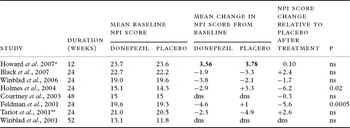
Studies of donepezil (Table 2)
Winblad et al., Reference Winblad2001
This study investigated 286 subjects with mild to moderate possible or probable AD in 28 centers across northern Europe in a 52-week trial. No significant differences in change of NPI score between donepezil and placebo groups were found at any of the assessment points (weeks 4, 12, 24 36 or 52). Behavioral outcome measures were secondary and the mean NPI scores at baseline were the lowest of all the studies of donepezil (13.05 and 11.78 in donepezil and placebo groups respectively).
Summary of NPI scores at baseline and post treatment in studies of donepezil

dns = data not shown; ns = not significant.
*The primary outcome measure in this study was the Cohen-Mansfield Agitation Inventory and change in score on this instrument was also non-significant.
**This study used the NPI-NH.
Tariot et al., Reference Tariot2001
In a 24-week study specifically designed to investigate the effect of donepezil on BPSD, Tariot et al. recruited 208 subjects with a range of severities of possible or probable AD +/− cerebrovascular disease from 27 nursing homes in the U.S.A. (Mini-mental State Examination (MMSE) 5–26; mean MMSE score 14.4). Subjects were required to have a reported frequency of at least 3–4 times per week of one or more item on the NPI-NH at baseline. No significant differences in post-treatment score change between the groups were identified. There were high levels of concomitant psychotropic drug use (59% in donepezil arm, 62% in placebo arm). Planned secondary analysis of individual NPI items using categorical variables (improved, no response or worsened) found a significant difference in response pattern for agitation/aggression only, favoring donepezil (p = 0.044). For the subgroup of subjects with agitation/aggression at baseline (64%) the significance level was higher (p = 0.017).
Feldman et al., Reference Feldman, Gauthier, Hecker, Vellas, Subbiah and Whalen2001
This study randomized 290 subjects with moderate to severe possible or probable AD from 32 centers internationally to treatment with donepezil or placebo for 24 weeks. At week 24 there was a 5.6 point difference in NPI score in favor of donepezil (improvement of 4.6 points from baseline in donepezil group vs deterioration of 1 point in placebo group; p = 0.0005). A significant difference between the groups was also detected at week 4 but not weeks 8, 12 or 18.
Sub-analyses of individual NPI items were also performed and published retrospectively (Gauthier et al., Reference Gauthier2002). The trend across all items of the NPI at 24 weeks favored donepezil over placebo, with significant differences in scores for apathy (p = 0.002), anxiety (p = 0.013) and depression (p = 0.017).
Courtney et al., Reference Courtney2004
The AD2000 study has attracted a great deal of debate. Unlike most RCTs of cholinesterase inhibitors, this trial was funded by the National Health Service (NHS) and local health authorities in the U.K. and used relatively flexible inclusion criteria. Behavioral outcomes were secondary.
The study was community based and excluded those in institutions; moving into institutional care was one of the primary endpoints. The authors aimed to include a sample that was representative of patients seen in everyday practice, requiring only that DSM-IV (not NINCDS-ADRDA) criteria were met for AD with or without coexisting cerebrovascular disease or vascular dementia.
Five hundred and sixty-six participants were randomized to donepezil or placebo for 12 weeks from baseline. At the end of this phase subjects were re-randomized to long-term donepezil or placebo for multiple 48 week phases with washout periods of 4–6 weeks in between. At week 170 there were seven patients left in the trial. Subject data was censored after the endpoint of each phase if they died, moved into institutional care, or withdrew from the study (including into NHS open-label prescribing). This introduced potential for bias related to differing patient characteristics between those offered and not offered NHS prescribing; data from all centers offering NHS prescribing was therefore censored.
Attrition rates were high although similar in both arms. Overall, 194 of the initial 565 patients entered the second 48-week block. The high attrition rates were blamed to a great extent on the release of NICE guidance early in the trial which approved the use of donepezil. This resulted in the withdrawal of many patients into open-label NHS prescribing.
Overall, no significant differences in NPI scores between donepezil and placebo were identified at any time point. There are a number of difficulties in applying the behavioral outcomes of this study to clinical practice. First, behavioral outcomes were not the primary outcome measure. Secondly, a large number of patients had zero or low NPI scores at baseline. Thirdly, those patients entering institutional care may have represented a group with high levels of behavioral disturbance, but they were censored. Finally, the high rates of attrition reduce the impact of the longer-term findings.
Holmes et al., Reference Holmes2004
Holmes et al. (Reference Holmes2004) investigated the efficacy of donepezil in the treatment of neuropsychiatric disturbance in mild to moderate probable AD. A baseline score of ≥11 on the NPI was required for inclusion. In this 24-week trial, 134 subjects from 16 centers in the U.K. entered an initial 12-week open-label donepezil phase. At the end of this phase subjects were randomized to donepezil 10 mg daily (n = 41) or to placebo (n = 55). 38 patients dropped out before reaching the randomization stage of the study.
Subjects prescribed donepezil were therefore compared to subjects withdrawn from donepezil, rather than a straightforward placebo group. This was intended to reduce the placebo effect that is common in studies involving behavioral change. Patients randomized to donepezil at 12 weeks had lower NPI scores at follow-up compared to the group who switched to placebo, and between-group differences were statistically significant at 18 and 24 weeks on ITT LOCF (but not OC) analysis.
Subjects were withdrawn from the randomized phase of the study if there was a drop in MMSE score of ≥2 points. The authors suggest that these patients were also likely to have worse behavioral scores, and that the withdrawal of six subjects from the placebo group on this basis (vs. two in the donepezil group) may explain why the significant results from ITT LOCF analysis were not replicated in OC analysis.
Seltzer et al., Reference Seltzer2004
This 24-week, multi-center U.S. trial randomized 153 participants with mild AD to donepezil or placebo groups in an approximately 2:1 ratio. The apathy scale was used as a secondary outcome measure, and baseline scores were low. Whilst there was a trend in favor of the donepezil group, no significant difference was detected.
Winblad et al., Reference Winblad2006
This study of subjects with severe AD from 50 nursing homes in Sweden randomized 248 subjects to placebo or donepezil 10 mg daily for 24 weeks. No significant between-group differences in change of NPI score were found at any point. The study was not optimized to detect differences in behavioral outcomes; more than 80% of subjects were prescribed concomitant psychotropic medication and NPI score was a secondary outcome measure.
Black et al., Reference Black2007
This multinational study of 343 subjects investigated the efficacy of donepezil in severe AD over 24 weeks. Primary outcome measures were cognitive, and patients in skilled nursing homes (who may have represented a group with more severe behavioral disturbance) were excluded. Attrition rates were relatively high, with 66.5% and 76% of the donepezil and placebo arms respectively completing the study. Both groups showed a trend for improvement in NPI scores, with slightly better scores in the placebo arm.
Howard et al., Reference Howard2007
One hundred and fifty-nine participants with AD received donepezil or placebo for 12 weeks. The primary outcome measure was the CMAI whilst the NPI-NH was used as a secondary outcome measure. No between-group differences in change of score on either measure were observed. Before randomization, patients entered a four-session psychosocial treatment program; those with a CMAI score of ≥39 following this intervention were eligible for randomization.
It is possible that recruitment mostly from nursing homes and inclusion only of participants whose agitation remained significant after psychosocial treatment resulted in a group of participants whose agitation was difficult to treat, which may have contributed to the negative findings. It is also possible that cholinesterase inhibitors are more effective in behavioral domains other than agitation.
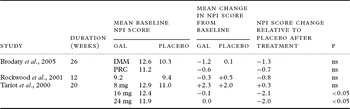
Studies of galantamine (Table 3)
Tariot et al., Reference Tariot, Solomon, Morris, Kershaw, Lilienfeld and Ding2000
The primary aim of this U.S.-based multi-center study was to evaluate the efficacy and tolerability of galantamine using a slow dose escalation schedule. Nine hundred and seventy-eight subjects with mild to moderate AD were randomized to placebo or 8, 16 or 24 mg galantamine daily. The study was powered to detect differences in cognitive and global outcome measures. At five months, subjects in the placebo arm showed a deterioration in NPI scores of 2.0 (SE 0.7) points whereas there was little change in score in the 16 mg (mean change 0.1; SE 0.7) and 24 mg (mean change 0.1; SE 0.8) groups. These differences were statistically significant (p < 0.001).
Summary of NPI scores at baseline and post treatment in studies of galantamine

GAL = galantamine; IMM = immediate-release form; PRC = prolonged release capsule; ns = not significant.
Rockwood et al., Reference Rockwood, Mintzer, Truyen, Wessel and Wilkinson2001
This study investigated the effects of galantamine 24–32 mg vs. placebo in 386 subjects with probable mild to moderate AD. NPI score was a secondary outcome measure and no significant difference in change of score between the two groups was observed. However, subjects with moderate, severe or uncontrollable behavioral disturbances were excluded from the study.
Brodaty et al., Reference Brodaty, Corey-Bloom, Potocnik, Truyen, Gold and Damaraju2005
In this multinational study, 324 subjects with probable mild to moderate AD were randomized to placebo, galantamine prolonged-release capsule (PRC) or ordinary galantamine (immediate release formulation) for 26 weeks. NPI score was a secondary outcome measure and no significant differences in change of score from baseline were found in either galantamine group compared to placebo.
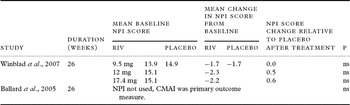
Studies of rivastigmine (Table 4)
Ballard et al., Reference Ballard2005
This 26-week study randomized 93 patients with AD (mostly severe) and clinically significant agitation to receive rivastigmine, quetiapine or placebo. The CMAI score at 6 weeks was the primary outcome measure although data were also reported from assessments at 26 weeks. No significant between-group differences in CMAI change in score at either time point were reported, although the study is somewhat limited by its small sample size.
Summary of NPI scores at baseline and post treatment in studies of rivastigmine

RIV = rivastigmine; ns = not significant.
Winblad et al., Reference Winblad2007
This large multinational study investigated the effects of two different strengths of rivastigmine transdermal patches and oral rivastigmine (12 mg) compared to placebo in moderate probable AD. There were no differences in change of NPI score between the two groups identified.
Severity of dementia
Significant effects of cholinesterase inhibitors on overall NPI score were found in two of the six studies of mild to moderate dementia (Tariot et al., Reference Tariot, Solomon, Morris, Kershaw, Lilienfeld and Ding2000; Holmes et al., Reference Holmes2004) and in the only study of moderate to severe dementia (Feldman et al., Reference Feldman, Gauthier, Hecker, Vellas, Subbiah and Whalen2001). No effect was found in either of the two studies of severe dementia (Winblad et al., Reference Winblad2006; Black et al., Reference Black2007) or in studies including moderate dementia only (Winblad et al., Reference Winblad2007) or all severities of dementia (Feldman et al., Reference Feldman, Gauthier, Hecker, Vellas, Subbiah and Whalen2001; Tariot et al., Reference Tariot2001; Ballard et al., Reference Ballard2005; Howard et al., Reference Howard2007).
Individual behavioral symptoms
Data from individual NPI items was available from two studies. Tariot et al. (Reference Tariot2001) reported a significant difference in terms of agitation and aggression, although not in other individual domains or in overall NPI score. Gauthier et al. (Reference Gauthier2002) presented sub-analyses of individual NPI items from the Feldman et al. Reference Feldman, Gauthier, Hecker, Vellas, Subbiah and Whalen2001 study, and reported significant differences for apathy, anxiety, and depression.
Howard et al. (Reference Howard2007) and Ballard et al. (Reference Ballard2005) used the CMAI score as their primary outcome measure, and both required a minimum score of ≥39 at baseline. Despite this design, no significant effect was identified in either study. Seltzer et al. (Reference Seltzer2004) used the apathy scale as a secondary outcome measure and found no significant effect.
Overall outcomes
Overall, three of the fourteen studies reviewed reported either a statistically significant improvement in overall NPI score (Tariot et al., Reference Tariot, Solomon, Morris, Kershaw, Lilienfeld and Ding2000; Feldman et al., Reference Feldman, Gauthier, Hecker, Vellas, Subbiah and Whalen2001) or in the agitation/aggression item of the NPI only (Tariot et al., Reference Tariot2001). In addition, one study demonstrated a significant difference in NPI score between groups randomized to either continuation or discontinuation of donepezil (placebo) (Holmes et al., Reference Holmes2004) following an initial open label treatment phase. Of these four positive studies, two specified a minimum level of behavioral disturbance at baseline and used behavioral scores as a primary outcome measures (Tariot et al., 49; Holmes et al., Reference Holmes2004).
Whilst ten studies did not find a significant improvement in BPSD with cholinesterase inhibitors, the majority were not specifically designed or powered to detect changes in neuropsychiatric outcomes. Many had low behavioral scores at baseline and one specifically excluded patients with behavioral disturbance (Rockwood et al., Reference Rockwood, Mintzer, Truyen, Wessel and Wilkinson2001). The exclusion of patients living in nursing homes (Black et al., Reference Black2007; Feldman et al., Reference Feldman, Gauthier, Hecker, Vellas, Subbiah and Whalen2001) or in any institution (Courtney et al., Reference Courtney2004) may also have biased the samples in these studies towards a less behaviorally disturbed population.
All studies (both positive and negative) had a high rate of concomitant psychotropic drug prescription. In the Feldman et al. (Reference Feldman, Gauthier, Hecker, Vellas, Subbiah and Whalen2001) study, sub-analysis of the group taking concomitant psychotropic medication (n = 47 in donepezil, n = 35 in placebo group) found no significant differences in NPI scores between donepezil and placebo at any assessment point. Conversely, sub analysis of the group not taking psychotropic medication found a significant difference in overall NPI scores at all assessment points. The high rate of concomitant psychotropic medication use in most studies may have had a significant impact on the likelihood of identifying any effect of cholinesterase inhibitors on BPSD, especially when it is considered that this effect (if present) is likely to be modest.
A further consideration is that in general, the timing of assessments points in studies of cholinesterase inhibitors are designed to detect significant differences in cognitive outcomes. It is possible that a different time frame is more appropriate for behavioral outcomes.
Clinical significance of NPI score change
In the studies where the mean difference in NPI score change between drug and placebo reached statistical significance, the mean differences were 5.6 points (Feldman et al., Reference Feldman, Gauthier, Hecker, Vellas, Subbiah and Whalen2001), 6.2 points (Holmes et al., Reference Holmes2004) and 2.1 points (Tariot et al., Reference Tariot, Solomon, Morris, Kershaw, Lilienfeld and Ding2000). The statistically significant findings in two of these studies may therefore translate into a modest clinical benefit; previous authors have defined clinical response as a minimum change of 4 points (Mega et al., Reference Mega, Cummings, Fiorello and Gornbein1996) and 9 points (Kaufer et al., Reference Kaufer, Cummings and Christine1996) on the NPI. However, these figures are arbitrary and the true relationship between NPI score change and clinical benefit is still a matter for debate.
The NPI does not replicate a comprehensive assessment conducted by trained and experienced clinical staff. Whilst this point is relevant to all studies using assessment scales, it is perhaps particularly relevant in studies of BPSD, which is a complex cluster of symptoms and signs. However, given that large RCTs must rely on objective outcome measures based on practical and feasible methods that produce robust and reproducible results, this issue is difficult to resolve.
Neurobiological considerations
Not all patients will experience the same neuropsychiatric features and there are likely to be a number of different neurobiological processes underlying the variety of BPSD. In addition to the involvement of cholinergic systems, impaired transmission of several other neurotransmitters including GABA and serotonin may underlie specific domains of behavioral and psychological disturbance (Jost and Grossberg, Reference Jost and Grossberg1996; Maelicke, Reference Maelicke2000). Therefore, studies based on global measures of behavior may be less sensitive at detecting meaningful change than investigation of specific domains which may be more likely to be associated with cholinergic systems, for example agitation (Cummings and Back, Reference Cummings and Back1998). However, two studies of the effects of cholinesterase inhibitors that specifically investigated agitation have reported negative results (Ballard et al., Reference Ballard2005; Winblad et al., Reference Winblad2007).
Conclusions
Based on the evidence available, cholinesterase inhibitors appear to have, at best, a modest impact on the broad spectrum of neuropsychiatric symptoms in AD. However, given the lack of safe and effective alternative options, a trial of a cholinesterase inhibitor is an appropriate pharmacological strategy in the management of BPSD in AD and may be suitable as first line pharmacotherapy.
The majority of studies that have reported behavioral outcomes of treatment with cholinesterase inhibitors have primarily been designed with the focus on cognitive symptoms. There were very few studies specifically powered to detect differences in individual behavioral symptoms, and this may represent the most appropriate avenue for further study.
Conflict of interest declaration
Our research group has previously received an unrestricted research donation from Novartis Pharmaceuticals. ZW has received honoraria from Novartis.
Description of authors' roles
JR designed the review and wrote the first draft of the manuscript. JR and SM performed the literature searches and data extraction. ZW assisted in design of the review and selection of articles. All authors contributed to preparation of the final paper.