Introduction
In recent years, adoption of cover crops has increased across the United States. According to the 2017 Census of Agriculture, cover crops were planted on approximately 15.4 million acres (~6.2 million hectares), representing an increase of 50% relative to the previous census of 2012 (USDA-NASS 2019). A survey from the Indiana State Department of Agriculture showed an increase in cover crop acreage in Indiana from 184,000 acres in 2011 to 983,119 acres in 2018 for both corn and soybean [Glycine max (L.) Merr.], which represents a 5.3-fold increase since 2011 (ISDA 2020).
Cover crops compete for light, water, and nutrients, create a physical barrier that inhibits weed emergence, and may have allelopathic properties that suppress weeds (Barnes and Putnam Reference Barnes and Putnam1986; Chase et al. Reference Chase, Nair and Putnam1991; Teasdale et al. Reference Teasdale, Abdul-Baki, Mill and Thorpe2004; Teasdale and Mohler Reference Teasdale and Mohler1993). Furthermore, cover crops can protect the soil from erosion (Kaspar et al. Reference Kaspar, Radke and Laflen2001), decrease nitrogen (N) leaching (Strock et al. Reference Strock, Porter and Russelle2004), and increase soil available water (Liebl et al. Reference Liebl, Simmons, Wax and Stoller1992) and organic carbon (Kaspar and Singer Reference Kaspar and Singer2015).
Many studies have shown that cover crops can provide suppression of troublesome weeds such as horseweed (Erigeron canadensis L.) (Wallace et al. Reference Wallace, Curran and Mortensen2019), waterhemp [Amaranthus tuberculatus (Moq.) J.D. Sauer], and Palmer amaranth (Amaranthus palmeri S. Watson) (Palhano et al. Reference Palhano, Norsworthy and Barber2018; Price et al. Reference Price, Balkcom, Duzy and Kelton2012; Wiggins et al. Reference Wiggins, McClure, Hayes and Steckel2015). In studies conducted by Werle et al. (Reference Werle, Burr and Blanco-Canqui2017), cereal rye used as a cover crop resulted in greater than 90% reduction of winter annual weed density and biomass in late spring. However, other studies have also indicated that weed suppression by cover crops is variable depending on cover crop species and termination timing. Creech et al. (Reference Creech, Westphal, Ferris, Faghihi, Vyn, Santini and Johnson2008) reported that annual ryegrass (Lolium multiflorum L.) used as a cover crop was not effective at suppressing winter annual weeds such as henbit (Lamium amplexicaule L.) and purple deadnettle (Lamium purpureum L.). Furthermore, early-spring cover crop termination may not provide complete weed control later in the season, when many summer annual weeds germinate (Teasdale Reference Teasdale1996). Webster et al. (Reference Webster, Scully, Grey and Culpepper2013) reported that cereal rye reduced Palmer amaranth densities more than 40% in cotton (Gossypium hirsutum L.), but crop yield loss still occurred due to weed emergence later in the growing season. Weed suppression provided by cover crops occurs primarily through decreased light transmittance to the soil (Teasdale Reference Teasdale1996). Cereal rye and canola are two winter-hardy cover crop species promoted in Indiana as beneficial cover crops for reducing soil erosion and providing weed suppression (MCCC 2020).
Cereal rye is among the most utilized cover crop species in the United States and is the most winter hardy (Teasdale Reference Teasdale1996). The benefits of cereal rye to cropping systems include reduced soil erosion, weed suppression, and N scavenging in quantities up to 112 kg ha–1 (Bowman et al. Reference Bowman, Shirley and Cramer1998). Fall-planted cereal rye can absorb anywhere between 60% and 80% of fall-applied N, reducing the risk of N runoff (Lacey and Armstrong Reference Lacey and Armstrong2015). However, cereal rye continues to immobilize N in the spring if not terminated early, resulting in nutrient deficiencies for the following crop. Corn yield reduction following cereal rye has been linked to N deficiency (Tollenaar et al. Reference Tollenaar, Mihajlovic and Vyn1993). Other studies have associated corn yield reductions to the allelopathic properties of cereal rye (Raimbault et al. Reference Raimbault, Vyn and Tollenaar1990, Tollenaar et al. Reference Tollenaar, Mihajlovic and Vyn1992). Numerous studies have also demonstrated the utility of cereal rye for weed suppression. Norsworthy et al. (Reference Norsworthy, McClelland, Griffith, Bangarwa and Still2011) observed 91% control of Palmer amaranth without herbicide application when cereal rye biomass reached 8,460 kg ha–1. Similarly, Teasdale et al. (Reference Teasdale, Beste and Potts1991) reported an average of 78% reduction in weed density on cereal rye treatments that reached 90% coverage, relative to the no cover crop treatment.
Canola belongs to the Brassicaceae (mustard family) and has potential to be used as a cover crop. However, canola growers have focused primarily on the production of oil (USDA-NASS 2020). Much like cereal rye, canola can produce sufficient biomass to reduce soil erosion, with some studies reporting more than 80% ground cover during winter (Eberlein et al. Reference Eberlein, Morra, Guttieri, Brown and Brown1998). However, canola is more sensitive to low temperatures than cereal rye and will only survive the winter if sufficient fall growth occurred and it has reached the rosette stage or has fully developed six leaves (Great Lakes Canola Association 2016). Canola has the potential to immobilize N, and that has been proposed by Waddington (Reference Waddington1978) as one of the causes of reduced yield from subsequent crops.
Cover crops can also become weeds during the cash crop growing season if not terminated properly. Research evaluating the effect of cover crop termination timing on corn grain yield is limited. However, research by Acharya et al. (Reference Acharya, Bakker, Moorman, Kaspar, Lenssen and Robertson2017) and Bakker et al. (Reference Bakker, Acharya, Moorman, Robertson and Kaspar2016) indicates that late termination of cover crops may increase the risk of corn seedling diseases such as Fusarium graminearum, F. oxysporum, Pythium sylvaticum, and P. torulosum. Acharya et al. (Reference Acharya, Bakker, Moorman, Kaspar, Lenssen and Robertson2017) reported that when cereal rye was terminated 1 d after corn planting, corn grain yield was reduced by 1,800 kg ha–1 and corn seedling disease infection increased approximately 9-fold relative to cereal rye termination 25 d before planting. Corn is sensitive to cold, moist soils in early spring (Schneider and Gupta Reference Schneider and Gupta1985), and both cereal rye and canola’s dense canopies reduce light from penetrating to the soil, potentially delaying soil drying and corn germination.
Herbicide application is the most common way of terminating cover crops. Cereal rye can be effectively terminated with glyphosate applied alone, whereas canola is usually controlled using synthetic auxin herbicides such as 2,4-D and MCPA. However, effective canola termination may require multiple herbicide modes of action, especially for applications after the five- to six-leaf stage, when plants are more tolerant to herbicides (Beckie et al. Reference Beckie, Séguin-Swartz, Nair, Warwick and Johnson2004; Légère et al. Reference Légère, Simard, Johnson, Stevenson, Beckie and Blackshaw2006). Previous reports have also indicated that certain cover crop mixes containing canola were contaminated with glyphosate-resistant canola seeds, thus requiring more than just glyphosate as a burndown (Unglesbee Reference Unglesbee2017). Therefore, the herbicide program selected must always consider both the cover crop and weed species present. Furthermore, the herbicide selection can become more complex in the presence of glyphosate-resistant weeds such as giant ragweed and horseweed.
Giant ragweed is a large-seeded broadleaf in the Asteraceae family that germinates in Indiana from March through August and grows rapidly to heights of 1.8 m in soybeans to 2.7 m in corn (Johnson et al. Reference Johnson, Loux, Nordby, Sprague, Nice, Westhoven and Stachler2007). Each plant can produce up to 5,100 seeds, which can persist in the soil seedbank for many years. Giant ragweed is highly competitive (Harrison et al. Reference Harrison, Regnier, Schmoll and Webb2001) and has the potential to cause greater yield loss than any other summer annual weed (Moechnig Reference Moechnig2003; Schutte Reference Schutte2007). Herbicide-resistant giant ragweed is widely documented and includes cases of resistance to acetolactate synthase (ALS)–inhibiting herbicides (Group 2) and to glyphosate (Group 9) (Heap Reference Heap2019; Johnson et al. Reference Johnson, Loux, Nordby, Sprague, Nice, Westhoven and Stachler2007; Patzoldt and Tranel Reference Patzoldt and Tranel2002). According to a survey of certified crop advisors from 2013, giant ragweed biotypes with either suspected or confirmed resistance to both ALS-inhibiting herbicides and glyphosate were reported in 57% of responding counties within the Corn Belt (Regnier et al. Reference Regnier, Harrison, Loux, Holloman, Venkatesh, Diekmann, Taylor, Ford, Stoltenberg, Hartzler, Davis, Schutte, Cardina, Mahoney and Johnson2016), thus limiting herbicide options for giant ragweed control. However, little research has been conducted on the effect of cover crops on giant ragweed suppression to date.
Horseweed is a small-seeded broadleaf weed of the Asteraceae family. Horseweed is persistent in two ways. It can either germinate in the fall and survive through winter as a rosette until early spring, when it bolts, or germinate in the spring, finishing its life cycle as a summer annual (Davis and Johnson Reference Davis and Johnson2008; Regehr and Bazzaz Reference Regehr and Bazzaz1979; Weaver Reference Weaver2001). Each horseweed plant can produce anywhere from 200,000 to 500,000 seeds (Kruger et al. Reference Kruger, Johnson, Weller, Owen, Shaw, Wilcut, Jordan, Wilson and Young2009), which germinate near the soil surface. Increased adoption of no-till crop production systems coupled with the introduction of glyphosate-resistant soybeans in 1996 resulted in increased horseweed prevalence across the Midwest (CTIC 2004; Davis et al. Reference Davis, Gibson and Johnson2008).
Herbicide resistance in horseweed has been documented for six site-of-action groups: bipyridiliums (Group 22), ureas and amides (Group 7), photosystem II inhibitors (Groups 5 and 6), 5-enolpyruvyl shikimate-3-phosphate synthase (EPSPS) inhibitors (Group 9), and ALS inhibitors (Group 2) (Heap Reference Heap2019). Previous research indicates that cover crops can reduce horseweed density and size in cover crop monocultures or mixtures, especially if cover crop species that accumulate high levels of biomass such as cereal rye are used (Pittman et al. Reference Pittman, Barney and Flessner2019; Wallace et al. Reference Wallace, Curran and Mortensen2019). Additionally, Cholette et al. (Reference Cholette, Soltani, Hooker, Robinson and Sikkema2018) reported up to 95% reduction in horseweed density after corn planting using grass, legume, and brassica cover crop species.
Considering the continuous development of weed resistance to herbicides and the increased limitations for herbicide use, it is of utmost importance to investigate the utility and risks of alternative weed control methods such as cover crops for integrated weed management programs. The objectives of this research were to evaluate the influence of cover crop species, termination timing, and herbicide treatment on weed suppression and corn grain yield.
Materials and Methods
Field trials were initiated in 2016 and 2017 at two locations in Indiana: the Throckmorton Purdue Agricultural Center (TPAC) near Lafayette (40.29°N, 86.91°W) and the Southeast Purdue Agricultural Center (SEPAC) near Butlerville (39.03°N, 85.53°W). The soil at TPAC consisted of a Drummer soil series with silty clay loam texture, 3.0% organic matter content, and pH of 6.8. The soil at SEPAC consisted of a Cobbsfork soil series with silt loam soil texture, 1.5% organic matter content, and pH of 6.4.
Weed species present at both sites consisted of common winter and summer annual weed species such as horseweed, chickweed [Stellaria media (L.) Vill.], henbit, purple deadnettle, giant ragweed, morningglory (Ipomoea spp.), yellow and giant foxtail [Setaria pumila (Poir.) Roem. & Schult.; Setaria faberi R.A.W. Herrm.], large crabgrass [Digitaria sanguinalis (L.) Scop.], goosegrass [Eleusine indica (L.) Gaertn.], and fall panicum (Panicum dichotomiflorum Michx.). Giant ragweed was the predominant summer annual weed species at TPAC, and horseweed was the predominant weed species at SEPAC. Trials were implemented utilizing a split-plot design, with cover crop (cereal rye, canola, or fallow) as the whole-plot factor, and termination timing and herbicide treatment as subplot factors. Plot dimensions were 3 m wide by 8 m long.
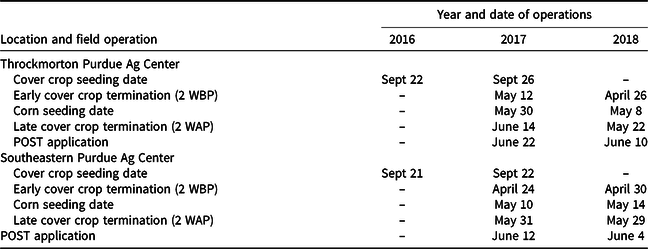
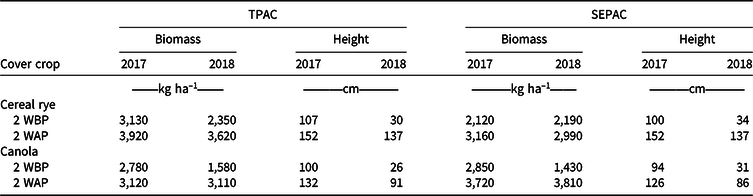
Prior to trial initiation in the fall, paraquat (Gramoxone® SL 2.0, Syngenta Crop Protection LLC, Greensboro, NC 27419, USA) was applied at 840 g ai ha–1 to control existing vegetation. Cereal rye and canola were planted at both locations at the end of September in 2016 and 2017 (Table 1). A winter-hardy, conventional canola variety (Baldur), was mixed with 0.03% glyphosate-resistant canola (STAR 915W) to simulate seed contamination, and the mixture was planted at 6 kg ha–1 on 18-cm rows using a 4.5-m drill. Glyphosate-resistant canola was mixed with conventional canola seeds because of reports of seed contamination in 2016 (Unglesbee Reference Unglesbee2017). Cereal rye was seeded at 90 kg ha–1 on 18-cm rows using a 4.5-m drill. Cover crop height and aboveground biomass data at termination for all site-years can be found in Table 2.
Dates of major field operations and herbicide applications in 2017 and 2018 at the two experimental locations. a

a Abbreviations: 2 WAP, 2 wk after corn planting; 2 WBP, 2 wk before corn planting.
Cover crop height and aboveground biomass at termination in 2017 and 2018 at Throckmorton Purdue Agricultural Center (TPAC) and Southeast Purdue Agricultural Center (SEPAC).a
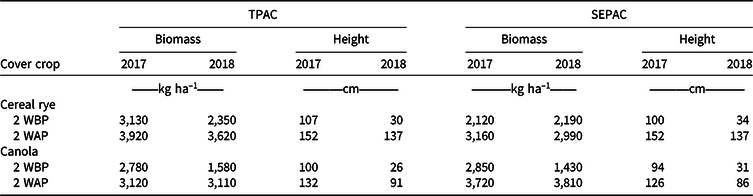
a Abbreviations: 2 WAP, 2 wk after corn planting; 2 WBP, 2 wk before corn planting.
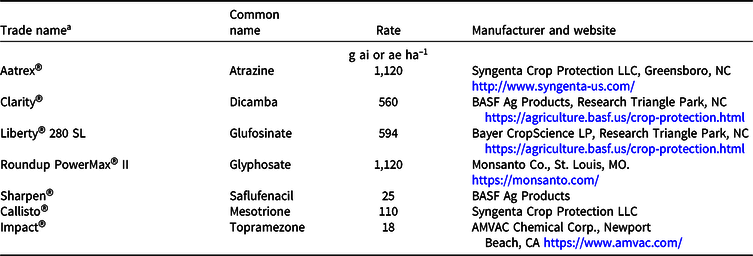
Herbicide treatments were applied at either an early- or a late-termination timing, relative to corn planting date. Early termination occurred 2 wk before corn planting, and late termination occurred 2 wk after corn planting. Herbicide treatments were selected according to each cover crop species to achieve effective termination of cover crops and weed control (Tables 3 and 4). All treatments were applied with a CO2-pressurized backpack sprayer equipped with a 3-m boom and XR11002 nozzles calibrated to deliver 140 L ha–1 at 138 kPa. Dates of major field operations and herbicide application timings can be found in Table 1.
List of herbicides and rates used for termination of cover crops, herbicide manufacturers, and websites.

a Ammonium sulfate and methylated seed oil were included according to label recommendations.
Herbicide treatments applied at two termination timings for cover crop termination in 2017 and 2018 at Throckmorton Purdue Agricultural Center and Southeast Purdue Agricultural Center.a

a Abbreviations: 2 WAP, 2 wk after corn planting; 2 WBP, 2 wk before corn planting; atraz, atrazine; Gluf, glufosinate; Gly, glyphosate; meso, mesotrione; safl, saflufenacil.
Glyphosate- and glufosinate-resistant corn (SmartStax®, DKC62-08RIB, Monsanto Co., 800 N. Lindbergh Boulevard, St Louis, MO 63167, USA) was planted at 80,000 seeds ha–1 in 76-cm rows and at 5 cm depth (see Table 1 for planting dates). Each plot consisted of four rows of corn. On July 2, 2017 and July 6, 2018, corn was side-dressed with liquid UAN (28-0-0) at the V6 growth stage at a rate of 168 kg N ha–1. It is important to note that N was not applied preplant to the cereal rye plots in 2017 because of excessive rainfall before and right after planting. The same fertility program was used in 2018 for consistency. Therefore, N deficiency and corn yield reduction probably occurred in the cereal rye plots as a result of N sequestration early in the growing season (Tollenaar et al. Reference Tollenaar, Mihajlovic and Vyn1993). All plots were maintained weed-free via a POST application of atrazine (1,120 g ai ha–1) + glyphosate (1,120 g ae ha–1) + dicamba (560 g ae ha–1) + topramezone (18 g ai ha–1) to the entire trial area and hand weeding.
Evaluations of weed species density and total weed biomass were conducted at the early-and late-termination timings and also at the POST application timing. Weed species density was estimated by counting individual plants within two 0.25-m2 quadrats, one placed in the front and one in the back of each plot. Total weed biomass was collected in 0.25-m2 quadrats placed in the front and back of the plot by clipping the plants at the soil surface and placing them in separate paper bags. Cover crop biomass at termination was collected by placing a 0.25-m2 quadrat within each plot and then clipping all plants within the quadrat at the soil surface. The plant material collected from each plot was placed into paper bags that were subsequently placed into forced-air driers set at 50 C for 1 wk. Dry weights were recorded when samples reached constant weight. Corn yield was estimated by harvesting the center two rows within each plot and adjusting yield to 15.5% moisture.
Data were subjected to ANOVA using PROC GLIMMIX procedure in SAS (Version 9.4, SAS® Institute Inc., Cary, NC 27513). All data were checked for normality and tested for appropriate interactions. For normality, weed biomass was transformed using a square root transformation. ANOVA was used to test for significant main effects and interactions. Means were separated using Tukey’s Honest Significant Difference (HSD) test at α = 0.05. Total aboveground weed biomass, horseweed density, giant ragweed density, and corn yield data were analyzed. Cover crop species, termination timing, and herbicide treatments were fixed effects. Replication was considered a random effect.
Results and Discussion
Total Weed Biomass
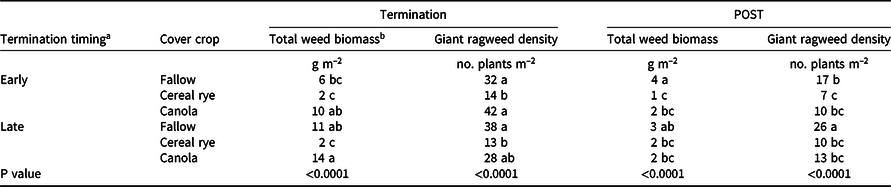
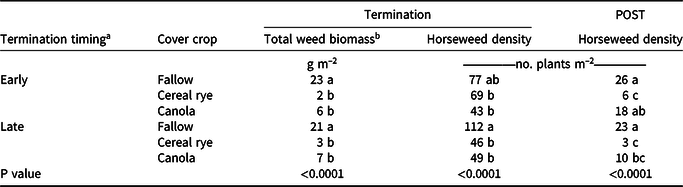
Predominant weed species at cover crop termination consisted of henbit, purple deadnettle, common chickweed, horseweed, and early-emerging giant ragweed. Weed biomass collected prior to the POST application timing consisted mostly of summer annual weed species such as giant ragweed, horseweed, morningglory, and various grasses such as yellow and giant foxtail, large crabgrass, goosegrass, and fall panicum. Cereal rye reduced total weed biomass at termination by 67% to 82% compared to fallow at the TPAC location (Table 5), where giant ragweed was the predominant weed species. Moreover, cereal rye reduced total weed biomass at termination by 86% to 91% compared to fallow at the SEPAC location (Table 6), where horseweed was the predominant weed species. Other researchers have also reported significant levels (>90%) of weed suppression following the use of cereal rye as cover crop in comparison to no cover crops (Hayden et al. Reference Hayden, Brainard, Henshaw and Ngouajio2012; Werle et al. Reference Werle, Burr and Blanco-Canqui2017). Canola was not as effective as cereal rye and only reduced total weed biomass compared to fallow at the SEPAC location, ranging from 67% to 74% total weed biomass reduction (Table 6). These results indicate that cereal rye is effective at reducing total weed biomass at termination, whereas weed suppression with canola is more variable and may be influenced by weed species present.
Influence of cover crop species and termination timing on total weed biomass and giant ragweed density at the Throckmorton Purdue Agricultural Center in Lafayette, IN.

a Early, early cover crop termination 2 wk before corn planting; Late, late cover crop termination 2 wk after corn planting. Burndown application with glyphosate- or glufosinate-based program. Canola terminated at the late termination timing included mesotrione (110 g ai ha–1) and atrazine (1,120 g ai ha–1) with the glyphosate and glufosinate programs. A complete list of herbicides applied is shown in Tables 3 and 4.
b Total weed biomass includes winter and summer annual weeds present at time of collection. Data for 2017 and 2018 were combined (n = 8). Means followed by the same letter within a column are not statistically different according to Tukey’s HSD (P ≤ 0.05).
Influence of cover crop species and termination timing on total weed biomass and horseweed density at the Southeast Purdue Agricultural Center in Butlerville, IN.

a Early, early cover crop termination 2 wk before corn planting; Late, late cover crop termination 2 wk after corn planting. Burndown application with glyphosate- or glufosinate-based program. Canola terminated at the late termination timing included mesotrione (110 g ai ha–1) and atrazine (1120 g ai ha–1) with the glyphosate and glufosinate programs. A complete list of herbicides applied is shown in Tables 3 and 4.
b Total weed biomass includes winter and summer annual weeds present at time of collection. Data for 2017 and 2018 were combined (n = 8). Means followed by the same letter within a column are not statistically different according to Tukey’s HSD (P ≤ 0.05).
Influence of Cover Crop and Termination Timing on Weed Density
Giant Ragweed
Giant ragweed was the predominant weed species at the TPAC location. Giant ragweed density was mostly influenced by cover crop species, whereas termination timing and herbicide treatment had little to no effect on horseweed density. Therefore, data were pooled across herbicide treatments (Table 5). Cereal rye reduced giant ragweed density by up to 66% at termination and 62% at the time of POST herbicide application. Early- and late-terminated canola did not reduce giant ragweed density at termination; however, late-terminated canola reduced giant ragweed density by 50% compared to fallow at the time of POST herbicide application. These results indicate that cereal rye is effective at suppressing giant ragweed emergence regardless of termination timing, whereas canola was not effective at suppressing giant ragweed emergence. There were no differences in giant ragweed density between early and late termination of cereal rye or canola.
Horseweed
Horseweed was the predominant weed species at the SEPAC location. Horseweed density was mostly influenced by cover crop species (P < 0.0001) (Table 6). Interactions of herbicide by cover crop and herbicide by termination timing did occur at the SEPAC location, because glyphosate-resistant horseweed was present at the site. Evidently, growers managing glyphosate-resistant horseweed will not use a glyphosate-based herbicide program to manage horseweed. Therefore, the discussion in this section will focus only on the effect of cover crop species and termination timings (Table 6). Overall, cereal rye and canola reduced horseweed density at termination and at the POST application timing in comparison to fallow. Cereal rye reduced horseweed density compared to fallow by up to 59% at termination and 87% at the time of POST herbicide application. In a previous study that investigated the effect of cover crops on horseweed density, Wallace et al. (Reference Wallace, Curran and Mortensen2019) reported reductions up to 21-fold at termination where cereal rye was used as cover crop in comparison with fallow control. Canola reduced horseweed density compared to fallow by up to 56% at termination and 57% at the time of POST herbicide application. There were no differences in horseweed density between early and late termination of cereal rye or canola.
Cover crop residues can reduce horseweed density and size by physical suppression acting as a mulch (Pittman et al. Reference Pittman, Barney and Flessner2019; Teasdale and Moehler Reference Teasdale and Moehler2000; Wallace et al. Reference Wallace, Curran and Mortensen2019) and potentially extending the window for POST herbicide applications. Although these results indicate that cover crops reduced horseweed density compared to fallow plots, effective POST applications are critical to prevent weeds from producing seeds, thus reducing the weed seedbank.
Corn Grain Yield
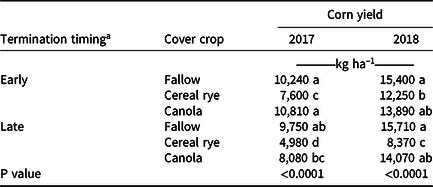
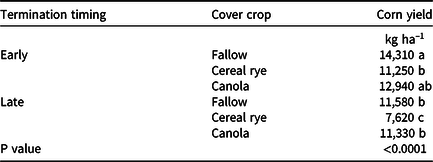
Corn grain yield data are presented separately by year for the TPAC location because of cover crop-by-year interactions (Table 7), whereas data for the SEPAC location are combined for both years (Table 8). Overall, early-terminated fallow plots resulted in the greatest corn yields. Early- and late-terminated cereal rye reduced corn grain yield at both locations in comparison to early-terminated fallow plots, ranging from 20% to 51% corn yield reduction (Table 7 and 8). The greatest corn yield reductions occurred for cereal rye plots terminated late (46% to 51% yield reduction). Canola terminated early did not result in corn yield losses; however, canola terminated late reduced corn grain yield by up to 21% in comparison to early-terminated fallow. Similarly, research by Duiker and Curran (Reference Duiker and Curran2005) reported greater corn yields following early termination of cover crops. In addition, when cereal rye was terminated late, other researchers have reported reduced corn grain yield (Eckert Reference Eckert1988; Munawar et al. Reference Munawar, Blevins, Frye and Saul1990). These results suggest that both early- and late-terminated cereal rye may reduce corn grain yield when no supplemental N fertilizers are applied preplant. Cereal rye was planted at 90 kg ha–1, the highest suggested rate in the Midwest Cover Crops Field Guide lresulting in very high aboveground biomass. Therefore, lower seeding rates of cereal rye may reduce the risk of corn yield loss. However, weed suppression may also be reduced at lower seeding rates.
Influence of cover crop and termination timing on corn grain yield for 2017 and 2018 at the Throckmorton Purdue Agricultural Center in Lafayette, IN.

a Early, early cover crop termination 2 wk before corn planting; Late, late cover crop termination 2 wk after corn planting. Data for 2017 and 2018 corn grain yield were separated (n = 4) because of cover crop-by-year interactions. Means followed by the same letter within a column are not statistically different according to Tukey’s HSD (P ≤ 0.05).
Influence of cover crop and termination timing on corn grain yield for 2017 and 2018 combined at the Southeastern Purdue Agricultural Center in Butlerville, IN.

a Early, early cover crop termination 2 wk before corn planting; Late, late cover crop termination 2 wk after corn planting. Data for 2017 and 2018 corn grain yield were combined (n = 8). Means followed by the same letter within a column are not statistically different according to Tukey’s HSD (P ≤ 0.05).
In conclusion, these results indicate that cereal rye is effective at suppressing emergence of both horseweed and giant ragweed, whereas canola is only effective at suppressing horseweed emergence. Additionally, late termination of cereal rye and canola did not reduce weed biomass and density compared to early termination. However, late termination of cereal rye and canola reduced corn grain yield in comparison to early termination. Therefore, we recommend that cereal rye and canola cover crops should be terminated 2 wk prior to corn planting to avoid corn yield reduction, especially when no supplemental N is applied preplant.
Acknowledgments
This research received no specific grant from any funding agency, commercial or not-for-profit sectors. No conflicts of interest have been declared.