1. Introduction
Online intercultural exchange, such as telecollaboration or eTandem, has received a substantial amount of attention over the last few decades. Online intercultural exchange (OIE) refers to the activity of having foreign language (L2) learners in one culture interact directly with partners in another culture via online communication tools, such as email, Skype, or messenger systems (O’Dowd, Reference O’Dowd2018). OIE has been popular since it first appeared in Europe in the 1990s, as it provides learners with opportunities to acquire intercultural competence and communication skills naturally and cost-effectively by interacting with native speakers of the target language (Cziko, Reference Cziko2005; Hertel, Reference Hertel2003). Research has shown that exposure to the target culture, even short-term or through indirect contact via emails or the telephone, strengthens L2 learners’ language proficiency and develops their understanding of the target culture (Barkhuizen & Feryok, Reference Barkhuizen and Feryok2006; Göbel & Helmke, Reference Göbel and Helmke2010). Also, it is generally expected that online interactions consist of voluntary exchanges that enable participants to share the languages and cultures of others in ways that involve less mediation by teachers and more learner autonomy (Thorne, Reference Thorne, Belz and Thorne2006). Furthermore, during online exchanges, students may have the opportunity to notice and internalize the target community’s sociocultural norms, conversational routines, or socially expected behavior, thereby potentially facilitating the incidental learning of intercultural and social skills. These intangible aspects of a culture may not be readily explained or taught in class (Hinkel, Reference Hinkel, -Murcia, Brinton and Snow2014) but are often acquired through socialization processes (Scollon & Scollon, Reference Scollon and Scollon2001), such as intercultural exchanges.
Due to these benefits, an increasing number of teachers throughout the world implement OIE (Çiftçi & Savaş, Reference Çiftçi and Savaş2018). Despite the increasing use of OIE, however, few scholars have paid attention to methodological dimensions or implementation-related issues. To date, much of the extant research on OIE has focused primarily on the linguistic and cultural gains of the interactions or intercultural misunderstandings during interactions (Belz, Reference Belz2005; O’Dowd & Ritter, Reference O’Dowd and Ritter2006; O’Rourke, Reference O’Rourke2005; Tudini, Reference Tudini2003; Ware, Reference Ware2005; Ware & Kramsch, Reference Ware and Kramsch2005). As participants in OIE learn through direct contact with intercultural partners rather than through teachers’ instruction, methodological decisions – such as grouping types and task designs – may have the potential to influence student learning outcomes. Thus the purpose of the current study is to respond to this pedagogical need by examining major implementation issues related to online exchanges, including group composition (one-on-one vs. multiple-to-multiple) and task design (student-selected vs. teacher-assigned). The results elucidate the pedagogical implications of this approach and underscore several points that should be considered when organizing and implementing a class-based OIE project.
2. Literature review
2.1 Group size and group composition
Many researchers in the field of second language acquisition have emphasized the role of social interactions in language development and have advocated for the use of groups for language learning (Storch, Reference Storch2002; Swain, Reference Swain and Lantolf2000). Specifically, Long (Reference Long and Anivan1990) identified five advantages of using small groups in L2 teaching: (1) it increases the amount of language practice, (2) it enhances the quality of student conversations, (3) it individualizes instruction by allowing students to work at their own speed, (4) it fosters a comfortable and intimate environment, and (5) it promotes students’ motivation related to language learning.
It, however, should be noted that group work may not necessarily result in positive learning outcomes compared to individual work. According to social interdependence theory (Johnson & Johnson, Reference Johnson and Johnson1989, Reference Johnson and Johnson2009), groups must satisfy the necessary conditions – sharing joint goals and forming positive interdependence – to attain higher achievement and productivity than individuals working alone (Johnson & Johnson, Reference Johnson and Johnson2005). Social interdependence theory suggests that there are two types of social interdependence, positive or negative, depending on how individuals perceive others’ actions related to their goal achievements. Positive interdependence (cooperation) can occur when individuals perceive that both their own and other group members’ actions positively contribute to the attainment of all their goals and when they acknowledge that they must cooperate to reach these goals. In contrast, negative interdependence (competition) arises when individuals perceive that they are competitively connected and believe that others’ actions interfere with the achievement of their own goals and vice versa. Successful group collaboration requires positive interdependence and shared mutual interests.
Moreover, group size and group composition are important considerations, especially in online group-based learning, as they can affect the dynamics of interactions and the learning outcomes (Strijbos, Martens & Jochems, Reference Strijbos, Martens and Jochems2004). Jacobs and Ball (Reference Jacobs and Ball1996) suggested that the ideal group size for physical face-to-face classrooms is pairs or groups of three or four students, as this configuration promotes the participation of all group members and facilitates group management. In a computer-assisted cooperative learning mode, AbuSeileek (Reference AbuSeileek2012) found that the five-student group in university English classes had the highest score on a communication skills post-test compared to groups of two to seven members; those with between four to six members scored higher than the two-student group on the same test. In a similar computer-supported learning context at a Taiwanese university, Shaw (Reference Shaw2013) found that differences in participation and satisfaction with a business programming course were not statistically significant among groups of two to six students, although the two-student group showed the highest participation and satisfaction. The results of these studies illuminate the optimal group size for conventional or computer-supported teaching environments; however, this research has limited implications for online intercultural exchanges that bring classes into group interactions with geographically distant partners. A refined understanding is needed regarding the most effective group size to enhance the quality and quantity of group interactions in OIE situations.
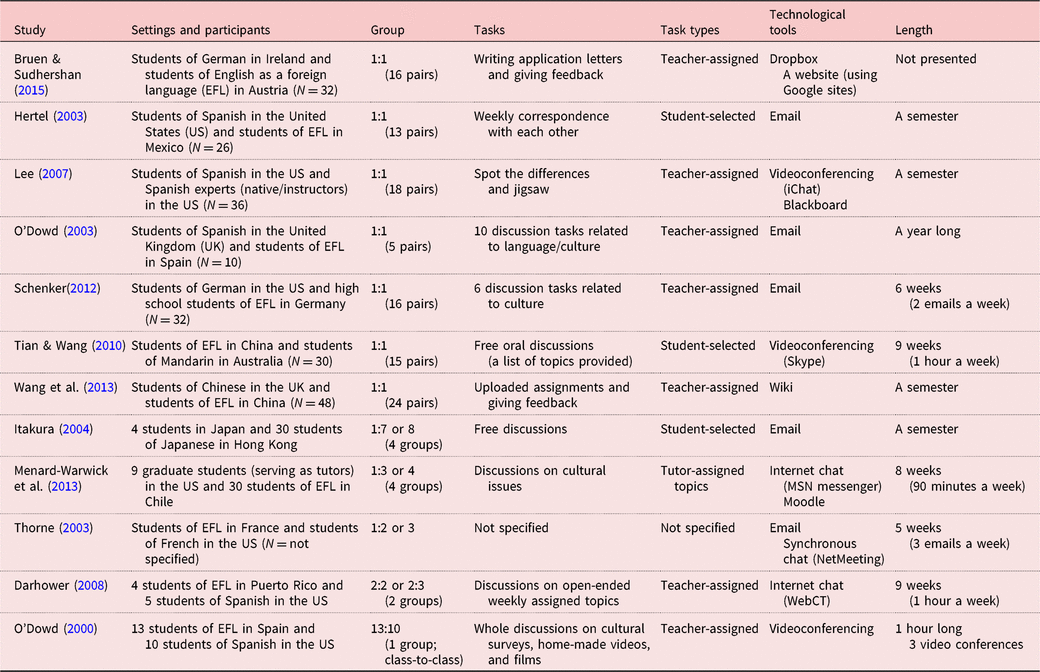
With regard to group composition, it is common in OIE to divide participants into one-on-one pairs (Bruen & Sudhershan, Reference Bruen and Sudhershan2015; Hertel, Reference Hertel2003; Lee, Reference Lee2007; O’Dowd, Reference O’Dowd2003; Schenker, Reference Schenker2012; Tian & Wang, Reference Tian and Wang2010; Wang, Zou, Wang & Xing, Reference Wang, Zou, Wang and Xing2013), one-to-multiple groups (Itakura, Reference Itakura2004; Menard-Warwick, Heredia-Herrera & Palmer, Reference Menard-Warwick, Heredia-Herrera and Palmer2013; Thorne, Reference Thorne2003), or multiple-to-multiple groups (Darhower, Reference Darhower2008; O’Dowd, Reference O’Dowd2000). All these studies were conducted at the university level but in diverse countries using different lengths of exchanges, task types, and a variety of computer-based synchronous or asynchronous tools (for a list of these studies with explanatory details, see Table 1). Most studies mentioned group composition briefly, with little discussion on this issue, as group composition was not their focus. Here, we synthesized the findings that were relevant to group composition.
Summary of studies on online intercultural exchanges

On the one hand, one-on-one configurations may help learners build an intimate relationship, provide emotional support, and exclude the possibility of having a freeloader in the group (Lee, Reference Lee2007). Moreover, Tian and Wang (Reference Tian and Wang2010) found that eTandem partners formed an equal and balanced relationship and received support from their partners in terms of linguistic and intercultural learning. Pairing a learner with a single native speaker, however, may carry the risk of reinforcing stereotypes or creating new ones, particularly when a partner has ethnocentric perspectives or a low willingness to interact. For example, based on data from Spanish and British university students who exchanged emails for a year, O’Dowd (Reference O’Dowd2003) demonstrated varying degrees of success in interactions; some partners actively engaged in cultural and linguistic exchanges, whereas others were disappointed or even frustrated with their partners’ unwillingness to participate or ethnocentric attitudes. This study indicated that individual learners’ attitudes toward the target culture and their current intercultural competence affected their partner’s learning and ultimately the success of exchanges.
On the other hand, one-to-multiple groups, which are formed due to an uneven number of participating students, could pose more serious problems (Itakura, Reference Itakura2004; Menard-Warwick et al., Reference Menard-Warwick, Heredia-Herrera and Palmer2013; Thorne, Reference Thorne2003). Itakura (Reference Itakura2004) elucidated this issue when one-to-seven (or eight) partnerships were formed by matching 30 Hong Kong university learners of Japanese with 4 native Japanese speakers. The Hong Kong students were notably affected by the Japanese speakers’ utterances and even formed new stereotypes while completing tasks that required them to perform a study on Japanese culture. Itakura emphasized the importance of group formation and recommended that students gain exposure to the diverse perspectives of more than one native speaker to reduce the chance of generating new stereotypes. Furthermore, sharing a partner in the one-to-multiple structure may cause stress on the part of the participants. In Thorne’s (Reference Thorne2003) study, when each French student was paired with two or three American students as key-pals, American students expressed frustration with a single partner’s slow email responses and his or her divided commitments to several partners.
In the context of the previous studies, one may reach the conclusion that access to more than one native speaker, such as in multiple-to-multiple groups (e.g. Darhower, Reference Darhower2008; O’Dowd, Reference O’Dowd2000), would be more appropriate. This configuration may compensate for the weaknesses of having a sole partner and provide learners with multiple sources for cultural and linguistic exchanges. However, it should be noted that, as the group gets larger, the group members also tend to feel that their role contributes less to the group’s joint work and success (Kerr, Reference Kerr, Forgas, Williams and Wheeler2001).
Thus, there is still considerable uncertainty about which group size and group composition can maximize individual contributions, as well as group interactions, in OIE settings. Reflecting the results of the previous studies, we selected two types of group composition (one-on-one vs. multiple-to-multiple) and group size (two vs. four and six) for investigation. Under conditions wherein each group had an equal number of native speakers, the current study examined which group composition and group size were more conducive to enhancing the quantity and quality of interactions in OIE.
2.2 The effect of learner choice in task design
Another important methodological decision in OIE is related to task design. Collaborative tasks in OIE may play a pivotal role in helping students in distant locations interact regularly with their partners and engage naturally in negotiating meaning and exploring culture-related issues (O’Dowd & Ware, Reference O’Dowd and Ware2009). Before interactions, the two educational institutions should confer on specific issues such as the topics, types, structures, and the medium of interaction while simultaneously considering the costs and constraints of their social, cultural, and institutional settings (Belz & Müller-Hartmann, Reference Belz and Müller-Hartmann2003). Typically, instructors or researchers make these decisions; students have been mostly excluded from the decision-making process (e.g. Lee, Reference Lee2007; O’Dowd, Reference O’Dowd2003; Schenker, Reference Schenker2012). At best, students have been allowed to generate discussion topics on their own (Hertel, Reference Hertel2003; Itakura, Reference Itakura2004) or choose from a list (Tian & Wang, Reference Tian and Wang2010). Table 1 shows the task types of these studies.
Learners’ attitudes and choices, however, should be taken into account in the decision-making process to promote second language learning (Rao, Reference Rao2002; Savignon & Wang, Reference Savignon and Wang2003). It is particularly important in distance learning to incorporate students’ perspectives in collaborative tasks because involving students in the decision-making process may lead them to be active learners and take responsibility for their own learning (Andrade & Bunker, Reference Andrade and Bunker2009). Learners may practice autonomy and self-regulation through the decision-making process regarding such issues as the tasks, materials, or goals to be included in OIE (Oxford, Reference Oxford, Hurd and Lewis2008).
Although some scholars have recognized the importance of learners’ voluntary contributions and learner autonomy for creating productive online exchanges (Bruen & Sudhershan, Reference Bruen and Sudhershan2015; Thorne, Reference Thorne, Belz and Thorne2006), there has been a dearth of research investigating how students’ different levels of autonomy lead to different patterns of interactions. Thus far, very little research has been conducted on this topic. For instance, Appel and Gilabert (Reference Appel and Gilabert2002) compared instructor-assigned tasks with free tasks among students learning English as a foreign language (EFL) in Barcelona and Spanish learners in Dublin. After completing four tasks (three assigned tasks and one free task), some students reported that they had difficulty choosing their own topics, whereas others enjoyed selecting a topic of interest. However, it is possible that the students were not sufficiently accustomed to enjoying the freedom of making decisions, as there were an unequal number of opportunities to engage in each type of task in this study (i.e. three assigned tasks vs. one free task). Also, in a telecollaborative exchange that involved American learners of Spanish and Spanish students of English, O’Dowd and Ware (Reference O’Dowd and Ware2009) found that American students favored open tasks that gave students freedom to choose topics, whereas Spanish students preferred relatively closed tasks that directed students to follow already assigned tasks without wasting time. However, the students’ preferences may not be directly comparable in this study because the American and Spanish students engaged in two types of tasks. Recently, El-Hariri (Reference El-Hariri2016) reported that Austrian students who interacted with Spanish students through videoconferencing preferred assigned tasks but demanded relatively open tasks that would allow them some freedom to choose. This study, however, reported the results of only the Austrian students, offering a one-sided view of the phenomenon. Based on the gaps in the literature, the present study investigated the effects of task design (i.e. student-selected and teacher-assigned tasks) on student engagement by providing the same number of opportunities to complete each task, having students experience both types of tasks, and collecting data from both institutions.
3. Method
This study aims to fill a research gap by focusing on the implementation issues related to mobile-based intercultural exchanges and by answering the following questions:
1. Which type of grouping (one-on-one vs. multiple-to-multiple) is more effective in enhancing the quantity of group interactions?
2. Which type of grouping (one-on-one vs. multiple-to-multiple) is more effective in enhancing the quality of group interactions?
3. What is the effect of task design (teacher-assigned vs. student-selected) on student engagement?
3.1 Participants
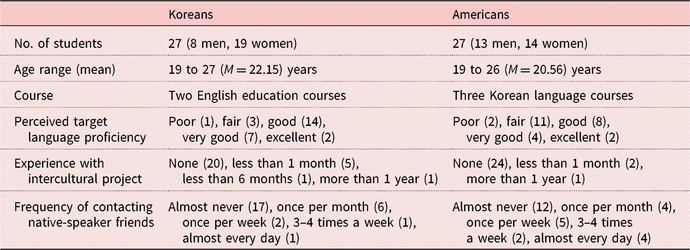
The sample consisted of 54 university students: 27 learners of English in South Korea and 27 learners of Korean in the United States (US; see Table 2). Approximately 85% of the sample had limited opportunities to interact with native speakers in their daily life, and 88% had no experience in OIE. The Korean students had studied English as a mandatory subject in secondary school and were working toward a degree in English education. The American students were taking Korean as a supplementary subject at the university while studying toward degrees in engineering, computer science, international studies, and so on. Due to the different durations of language study between the groups, there was a gap between their perceived levels of target language proficiency.
Overview of participants (N = 54)

Note.The number in parentheses means the number of students corresponding to each category.
3.2 Instruments
We used a pre-background questionnaire, a post-activity questionnaire, semi-structured interviews, and chat scripts extracted from a mobile-based messenger application. Both pre- and post-questionnaires were constructed using Qualtrics, a web-based survey software. Prior to the exchange project, participants completed a pre-background survey (consisting of 15 questions) asking gender, age, years of study, perceived language proficiency, and experience with OIE. After the exchanges, a post-activity survey, consisting of two sections, was conducted. The portion of the post-survey related to the group composition and task design can be found in the Appendix. Adapted from Wang et al. (Reference Wang, Zou, Wang and Xing2013), the first section focused on group composition and asked participants to report the perceived usefulness of and their involvement in, enjoyment of, and satisfaction with the exchanges by rating items on a 6-point Likert scale as well as by answering open-ended questions. We also asked students to describe their experience in pair and group interactions by selecting a maximum of five adjectives from a list or providing their own. The adjective list included 12 positive and 12 negative adjectives applicable to interactions. Adjective checklists have been employed to identify psychological attributes and to assess emotions and mood in behavioral and psychological research for more than 30 years (McCleary, Reference McCleary1995; Nemouchi, Reference Nemouchi2007). The second section elicited information on task design. Based on Wang (Reference Wang2007) and Flowerday and Schraw (Reference Flowerday and Schraw2003), we created 15 statements regarding choice/freedom, positive emotions, and interest/involvement. Students were asked to indicate their agreement with each statement about teacher-assigned tasks and student-selected tasks on a 6-point Likert scale. To elicit in-depth information regarding group composition and task design, we conducted semi-structured interviews.
We used the mobile-based KakaoTalk messenger application as an interaction tool. This mobile talk program is a multifaceted tool that is globally available to public users, enabling people in any location to chat synchronously; send text, voice, and video messages; and make voice or video calls free of charge when an Internet connection is available. Unlike other chat applications, the KakaoTalk messenger provides a variety of functions, such as poll creation, schedule sharing, announcements, and file sharing, all of which helped students to create tasks freely. Moreover, the KakaoTalk program has the ability to save and export chat scripts to email, which allowed the researchers to examine the quantity of interactions, including contact frequency, number of words in written chats, and voice/face talk time.
3.3 Design and procedures
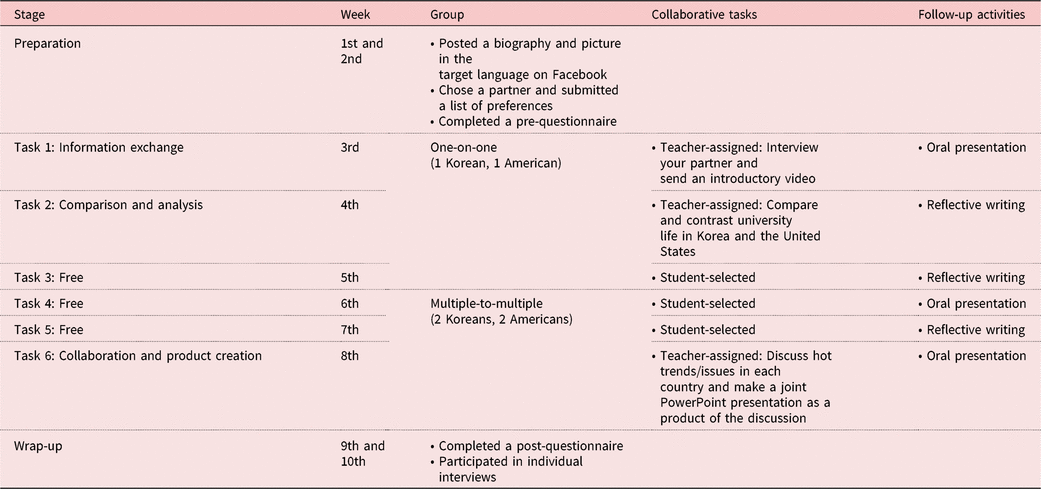
We constructed group compositions and tasks as shown in Table 3. At the beginning of the semester, we introduced an intercultural project and explained the whole procedure and specific schedules of the requirements using an explanation sheet. We also provided students with a paper that described the assessment criteria in three sections: three reflective writings (30%), three oral presentations (30%), and a minimum participation requirement (twice a week; 40%). This was converted to the final grade for the course (25% in Korea and 20% in the US).
Overview of the procedure

During the preparation, each instructor uploaded an introductory message in the target language onto the class Facebook page and asked the students to introduce themselves in a similar way. After reviewing the introductory biographies, the Korean and American students submitted a list of their preferred partners. As personalized matching based on students’ preferences could reduce the frequency of mismatched partnerships and increase that of good partnerships (Müller-Hartmann, Reference Müller-Hartmann2000; Wang, Berger & Szilas, Reference Wang, Berger and Szilas2012), we carefully matched them to form 27 pairs. Soon after being matched with one-on-one partners, all students completed a pre-survey for 20 minutes in class and were encouraged to contact their partner to get to know each other.
We designed the investigation so that all participants would experience both one-on-one and multiple-to-multiple interactions to elicit students’ comparative evaluations of the different group compositions. For the first three weeks, students interacted in pairs; subsequently, two pairs including two Koreans and two Americans became one group and, except for one group containing six people due to the uneven number of students, these participants interacted in groups of four for the remaining three weeks. For six weeks, the students were required to contact their partners in the target language at least twice a week totaling one hour per week. For example, if the students talked in Korean for 30 minutes on Tuesday, they communicated in English for 30 minutes on Thursday.
Students were also asked to complete weekly tasks, including three teacher-assigned and three student-selected tasks. Following O’Dowd and Ware’s study (Reference O’Dowd and Ware2009), we offered three teacher-assigned tasks involving information exchange (interview your partner), comparison and analysis (university lifestyles), and collaboration/product creation (create a joint PowerPoint). For the student-selected tasks, students were free to choose topics or formats depending on their interests.
As a pedagogical device to finalize what had been learned and an evaluative tool to gauge students’ learning, students submitted three reflective writings in the target language and made three oral presentations about their findings in their native language. Reflective writing allowed the students to review the discussions, organize their ideas at a deeper level of reflection and critical thinking, and practice writing in the target language. Oral presentation in class offered students the opportunity to seek more resources on the Internet for their class presentation, share their intercultural experiences with classmates, and listen to other groups’ findings.
After 6 weeks of interaction, all students completed a post-questionnaire for 30 minutes in class. At the end of the semester, each instructor individually interviewed 37 students (27 Koreans and 10 Americans) in their native language for 30 minutes. The semi-structured interview questions asked about students’ overall experiences with the project, their relationships with their partners, their roles in the group interactions, the perceived benefits and weaknesses of student-selected and teacher-assigned tasks, and any challenges with the online exchanges. The interviews were audio-recorded and transcribed for analysis.
3.4 Data analysis
We used a mixed-methods approach by triangulating the data collected through different types of sources, including mobile chats, questionnaires, and interviews. To compare the effectiveness of one-on-one and multiple-to-multiple interactions quantitatively (research question 1), we computed each student’s average number of words written in chats and average amount of calling by dividing the total number of words and the amount of calling by the number of students in each group. The mobile chat scripts exported by the students included written chats and records of the amount of calling, which was documented automatically. Subsequently, we calculated the average weekly contact frequency and time spent between messages for one-on-one and multiple-to-multiple groups.
Furthermore, to examine whether the quality of interactions differed between pairs and small groups (research question 2), we used Likert-scale survey responses, adjective checklists, and content analysis of answers to open-ended and interview questions. Regarding the survey items, we conducted pairwise comparisons on the items addressing involvement, enjoyment, satisfaction, usefulness, and willingness. In terms of the adjective checklists, a frequency table showing the top 10 adjectives that best described each group interaction was created. Content analysis was also applied to the responses to open-ended questions and interviews to gain in-depth information regarding the quality of the interactions. While reading through the responses to open-ended questions and the interview material, the first author used the NVivo program to assign categories to each segment based on the content. The categories emerging from the data were carefully coded and classified (Miles & Huberman, Reference Miles and Huberman1984). Using the coding scheme, the second researcher reviewed all segments in each category to check that the assigned segments were appropriately coded. Any disagreements between the two researchers were re-reviewed and re-coded.
Finally, to determine the effect of task design (teacher-assigned and student-selected) on student engagement (research question 3), we used survey responses and open-ended questions. For the 15 survey items, using SPSS we conducted exploratory factor analysis and performed paired t-tests on the extracted factors to compare the effects of teacher-assigned and student-selected tasks. We also used responses to open-ended questions to provide details regarding the students’ attitudes toward task design.
4. Findings and discussion
4.1 Effectiveness of group composition in terms of quantity of interactions
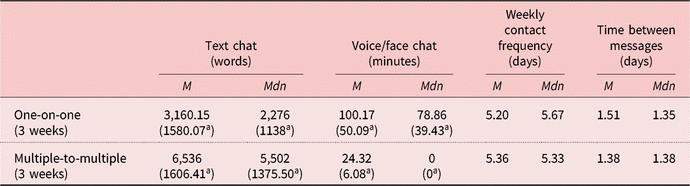
Using the exported mobile chats, we investigated the number of one-on-one and multiple-to-multiple interactions as measured by the number of words, the chatting time, the weekly contact frequency, and the time between messages. As shown in Table 4, the average number of words per individual for three weeks was 1,580 in one-on-one and 1,606 in multiple-to-multiple interactions, reflecting that there was little difference between pairs and four (or six)-student groups in this regard. In terms of weekly contact frequency, students communicated with their partners an average of five times per week regardless of whether in pairs or groups. Similarly, the time between messages per week was less than two days for both the pairs and the groups, indicating that students regularly interacted with their partners regardless of group size. This finding is in line with Shaw’s study (Reference Shaw2013), which reported that participation rates, as measured by the number of messages posted on online forums, did not statistically differ among groups of two to six students. It may be assumed that slight differences in small group sizes may not strongly influence contact frequency or the number of chats.
Analysis of total interactions by the quantity and frequency of mobile chats

a Text or voice/face chat per person.
Regarding voice or face chats, the average talk time per person reflected a notable discrepancy between pair and group interactions. We divided the total amounts of voice/face calling of pairs (100 minutes) and each group (24 minutes) into the number of the participants in each configuration (two vs. four), resulting in 50 minutes and six minutes per person, respectively (see Table 4). A closer look at the data and the median indicated that students in all pairs used voice or face chatting to communicate, whereas only two of the 13 groups communicated via voice talk. One reason for this is that all pairs were required to use voice or face calling in the first week of the project for the purpose of getting to know each other and learning about the voice/face calling function of the KakaoTalk messenger program, whereas this requirement was not imposed on the group interactions that began in the fourth week. Additionally, talking with four group members simultaneously causes overlapping conversations and frequent disconnections due to technical problems.
Our findings of regular weekly contact and long text chats, regardless of group size, warrant additional consideration. Although not all studies on OIE have reported either contact frequency or number of words in chats, one study presented such information, permitting a glimpse of the benefits of using mobile phones as a communication tool. Appel and Guerrero (Reference Appel, Guerrero, Macià, Cervera and Ramos2006) investigated the effects of using tasks when Irish learners of Spanish and Spanish learners of English interacted in pairs for two months via email. In their study, the average time between messages was 3.7 days (when assigned tasks) and 8.6 days (when not assigned tasks), whereas the average time between messages was shorter in the present study: 1.5 days (in pairs) and 1.4 days (in groups). Also, in their study, the average number of words written for two months per individual was 1,379 (when assigned tasks) and 1,048 (when not assigned tasks), whereas the average number of words written for three weeks per individual was 1,580 (in pairs) and 1,606 (in groups) in the present study.
Although we cannot exclude the possibility that several factors may have influenced the contact frequency and the number of words, we speculate that one major reason for the discrepancy relates to the communication tool (i.e. computers vs. mobile phones). Our assumption is in line with Mendoza’s (Reference Mendoza2014) findings. In this study, Japanese university students communicated with their classmates more frequently through a mobile-based communication application than they did via computer-mediated communication tools. The benefits of mobile-based tools, including convenience, accessibility, speed, and ease of use, with which computer-based tools cannot compete, may have led to the numerousness and regularity of interactions in the current study regardless of whether such interactions occurred in pairs or in groups. We paid particular attention to the quantitative aspects of the interactions because frequent contacts and numerous messages may induce conditions under which authentic interactions can occur, and interpersonal relationships can be developed. This aspect seems worthy of note because some previous studies (Chun, Reference Chun2011; Thorne, Reference Thorne2003; Wang et al., Reference Wang, Zou, Wang and Xing2013) that used asynchronous computer-based tools, such as emails, wikis, or discussion forums, highlighted their inappropriateness as communication tools for facilitating true interactions or building interpersonal relationships. This points to the pedagogical and practical value of the mobile phone as an effective tool for OIE.
4.2 Effectiveness of group composition in terms of quality of interactions
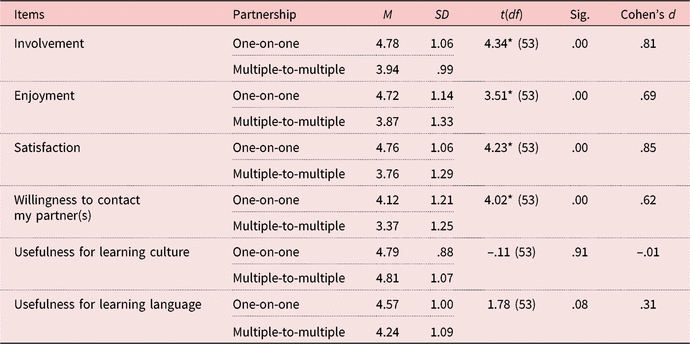
In contrast to the quantitative aspects, our data reflected clear differences between pair and group communications regarding the qualitative aspects. To examine the quality of one-on-one and multiple-to-multiple interactions, we examined learners’ perceptions of the group compositions based on questionnaire items, adjective checklists, open-ended questions, and interviews. First, as shown in Table 5, the results of the pairwise comparisons on the 6-point Likert scale survey items indicated that the students significantly favored one-on-one interactions over multiple-to-multiple ones in terms of involvement, enjoyment, satisfaction, and willingness to contact partners after completing the project. Regarding perceived usefulness, however, the students reported that the pair and group interactions were similarly advantageous for learning the target culture and the language, with no significant difference between pairs and groups.
Pairwise comparisons between one-on-one and multiple-to-multiple partnerships

* p < .05.
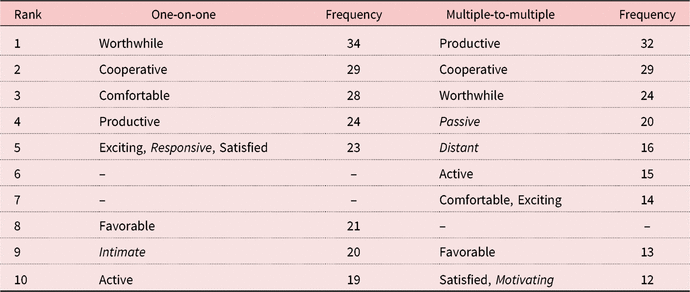
Second, the adjective checklist indicated that eight of the 10 adjectives were identical, although the order of the adjectives differed between pairs and groups (see Table 6). Only five adjectives did not overlap: responsive and intimate for one-on-one groups and passive, distant, and motivating for multiple-to-multiple groups. In particular, four adjectives, including responsive and intimate versus passive and distant, were apparently opposite in nature, illustrating the unique features of each interaction.
Frequencies of adjectives in an adjective checklist

Note. The adjectives that did not overlap between groups are presented in italics.
Furthermore, through a repetitive process of coding responses to open-ended questions and interviews, we identified several themes describing the qualities of one-on-one and multiple-to-multiple interactions. The main themes included (1) involvement, intimacy, and responsiveness; (2) language learning; (3) cultural learning; and (4) partner quality issues. First, students felt that one-on-one communications led to the development of an intimate relationship and connectedness between the partners, which prompted them to respond quickly to their partner’s questions to meet their partner’s needs. One American student stated, “I felt that I could connect deeply with my partner and make a real friend.” Another American student also commented, “When I voice-called my partner, it was a lot more personal. (…) So, I thought there was a good connection between us. I had a lot of fun talking to my partner.” In multiple-to-multiple interactions, however, students were less involved and less responsive in communications because they did not feel obligated to respond to their partners, expecting that someone else in the group would respond. Many students commented that their involvement, enthusiasm, and intimacy decreased in the multiple-to-multiple group interactions due to low levels of participation and responsiveness. For example, students offered the following comments:
In the group interactions, my involvement was slightly less because there were more people talking, so I felt like I did not have to contribute as much as when it was a one-on-one interaction.
I think one-on-one is just a more intimate experience; as a group, this project definitely felt more like work.
The problem is that these differences in the qualities of the interaction may have led to different language learning experiences. With regard to the first research question, when we compared the data about the usefulness of each type of group for language learning, we found a non-significant difference (p = .08) between one-on-one (M = 4.57) and multiple-to-multiple (M = 4.24) interactions. However, the qualitative data provided a detailed view of this phenomenon. Regarding pair interactions, many students mentioned that they were able to pay particular attention to their partner’s language due to the focused interactions, received linguistic and emotional support from their partners, and gained confidence in communicating with native speakers of the target language. Korean and American students’ comments regarding one-on-one interactions are as follows:
In one-on-one communications, I concentrated on my partner’s sentences and words not to misunderstand the meaning, so I was able to monitor how my partner spoke or wrote.
When we talked via a voice call, my partner was patient with me and provided me with support for what I did not know how to say.
My partner was very helpful and complimented me a lot, which gave me confidence; ultimately, I think I learned to be more confident in my skills.
Previous studies support this finding. Lee (Reference Lee2007) reported that American learners of Spanish who were paired with Spanish native speakers developed interpersonal relationships and received emotional support from their partners in one-on-one desktop videoconferencing. Tian and Wang (Reference Tian and Wang2010) also found that both Chinese and Australian students who interacted in each other’s native language in pairs via Skype reported that they felt improvements in their linguistic competence. It seems that one-on-one interactions tend to enable students to pay more attention to their partner’s utterances and provide linguistic feedback and support, which may be less readily available in multiple-to-multiple interactions. As described in the following, students commented on the missed opportunities to experience linguistic and emotional support in the group chats:
While I would be typing something, someone else would be sending a message, and I felt that the conversation went a lot further than it did with just two people.
I felt that my partners were growing quite impatient with me because I was so slow in Korean. It was hard because I was trying my best, but my Korean is not very good. I felt really bad, and so I tried to type faster, and in the process, they couldn’t understand what I was trying to say. It discouraged me from using Korean.
With regard to learning culture, however, having more than one native speaker in the group may be more advantageous for broadening students’ perspectives on cultural issues. Incidental learning about the sociocultural norms of the target culture can occur by observing groupmates’ interactions. When we compared the perceptions about usefulness of each modality for learning culture, no statistical difference (p = .91) was found between one-on-one (M = 4.79) and multiple-to-multiple (M = 4.81) interactions. However, the qualitative data offered a slightly different view. Some students mentioned that they were confused about whether their partner’s ideas on a particular issue were generally accepted thoughts or reflected the opinions of only that individual. They stated that pair interactions may establish or reinforce certain stereotypes due to the limited source providers, whereas group interactions allowed them to listen to different perspectives. It is plausible that, as evidenced by AbuSeileek’s (Reference AbuSeileek2012) finding, groups of four or six students had access to more knowledge resources and benefited more from the diversity of their group than did pairs. Students offered the following comments:
In groups, I was able to observe the fact that the two Americans had different ideas regarding the same issue. When one person was unaware of something and not able to respond, the other person filled up the gap. Group interactions were fun and useful for learning culture and different views.
It was also more useful for learning the Korean culture and language since there was more than just one individual and, by observing the interaction between the Korean group members, I could garner a better sense/understanding of certain Korean cultural customs or norms.
The last theme to emerge from the qualitative analysis related to the quality of partners. Indeed, the quality of the interactions seemed to depend on the partner’s responsiveness and motivation to communicate. Several students complained that their one-on-one partner participated less than they did and voiced dissatisfaction with their dominant communication style by commenting, “My partner was not as invested as I was, and it affected how I felt about the interactions” or “My partner and I were not able to communicate well. I did not like the way that my partner sent messages unilaterally.” Issues related to partners mainly occurred in one-on-one interactions, which indicates a potential problem in pair composition. Because collaborative tasks are typically carried out with the help of a partner, it is particularly important to be matched with good partners who are responsive and willing to interact. If a student were assigned to a reluctant or irresponsible partner and left to complete the tasks alone, the intercultural exchange may cause anxiety and frustration. In this regard, four- or six-student group interactions may reduce the risk of being matched with a sole unwilling partner, as there are at least three more people to respond. Thus, some of our students who complained about their one-on-one partner’s lack of responsiveness enjoyed the group interactions. Also, some students mentioned that multiple-to-multiple interactions induced reluctant one-on-one partners to participate in discussions. One Korean student commented, “My American partner did not respond frequently in one-on-one interactions, but I felt that he cared and participated more in group communications. I think it is probably because there was another American peer who meets him in class.” It seems reasonable to assume that classmates’ presence may encourage unwilling students to at least respond to the group interactions as a face-saving gesture or courtesy.
Theoretically, positive social interdependence may form in both pair and group interactions during the OIE, because the group members must cooperate to achieve joint goals and share mutual interests, such as completing tasks (Johnson & Johnson, Reference Johnson and Johnson1989, Reference Johnson and Johnson2009). Moreover, the use of mobile phones as communication tools provided one necessary condition for the development of friendships by enabling frequent interactions. However, having deep conversations and establishing intimate relationships may be relatively easier in one-on-one communications than in multiple-to-multiple communications, due to the undivided attention partners provide to each other (Belz, Reference Belz2002). This is closely related to our participants’ comments that they felt like they were making friends in one-on-one interactions, whereas multiple-to-multiple communications were perceived as work. However, groups provide a good alternative with regard to learning about different perspectives on cultural issues and eliminating the stress or frustration caused by irresponsible partners.
4.3 Effect of task design on student engagement
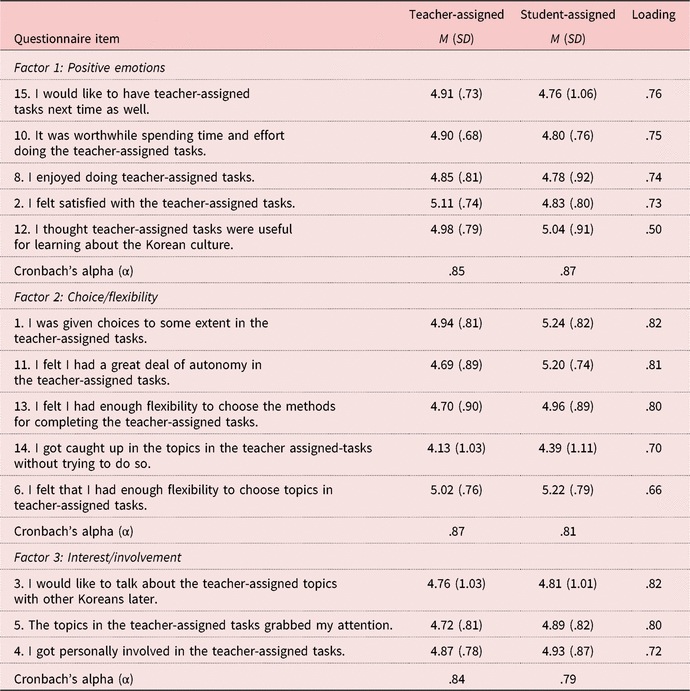
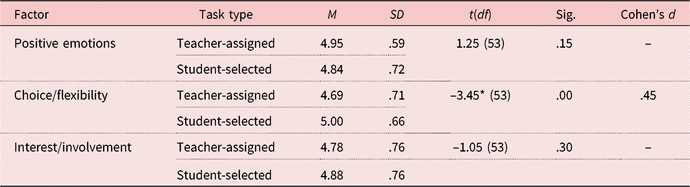
Another dimension pertinent to methodological decisions of OIE concerns task design. We examined students’ attitudes toward teacher-assigned and student-selected tasks using questionnaires. First, we asked students which task type they preferred via a multiple-choice question. Half the students (n = 27) liked both tasks, 15 students preferred teacher-assigned tasks, 11 students chose student-selected tasks, and one student reported that he or she did not like either. Second, we elicited more detailed views with 15 items rated on a 6-point Likert scale. Through exploratory factor analysis with a varimax rotation, we extracted three factors. Although three items were cross-loaded based on the criteria of a minimum eigenvalue greater than 1.0 and factor loadings greater than .40 (Stevens, Reference Stevens2009), we decided to keep one item (#11) due to its large factor loading (.81) and close theoretical connections with Factor 2. Table 7 presents the means, standard deviations, reliabilities, and factor loadings. Reliabilities ranged from .79 to .87, indicating good internal consistency (Nunnally & Bernstein, Reference Nunnally and Bernstein1994). The three extracted factors were labelled positive emotions, choice/flexibility, and interest/involvement. We then conducted paired t-tests on the three factors to compare students’ attitudes toward teacher-assigned and student-selected tasks. As shown in Table 8, the results indicated that learners perceived the teacher-assigned and student-selected tasks as similarly positive and interesting. The only significant difference was found in terms of choice/flexibility, indicating that students had a higher level of choice and flexibility in student-selected tasks than in teacher-assigned tasks.
Three-factor solution and means (standard deviations) of task types

Note. Factor loadings are based on the responses for the teacher-assigned tasks; percentage variance explained: total variance, 70.57; Factor 1, 24.96; Factor 2, 23.70; Factor 3, 21.91.
Pairwise comparisons between teacher-assigned and student-assigned tasks

* p < .05.
To gain an in-depth understanding of the meaning of having more choice/flexibility in terms of task completion, we examined students’ responses to open-ended questions. In general, the students appreciated the autonomy, creativity, freedom, and flexibility of the student-selected tasks. As shown in the following comments, the students felt more responsible, paid more attention, and were more emotionally invested and engaged in the project when having choices:
Because I chose the topic, it made me more focused on the project and generated more questions.
Student-selected tasks allow for more involvement and more of a personal stake in the project.
Student-selected tasks allow for more creativity and therefore more emotional or overall investment from students.
Having more choices and flexibility, however, may not always ensure good results. Although student-selected tasks gave students more opportunities to explore cultural issues that they had wondered about, students also commented that they experienced difficulties in selecting a topic as a group and did not like spending time in the selection process. They commented, “It took too much time to decide on a topic” and “There was a lot of effort and disagreement coming up with the tasks.” Also, some students complained that their ideas were not taken seriously, stating, “In the group conversations, I found that my opinions were not really considered when selecting the topics of discussion.” Several students also indicated that student-selected tasks did not always result in productive discussions. Two American students commented, “In a lot of cases, the topics that we came up with as students were really complicated or hard to talk about” and “The student-selected tasks had more variance in the quality of the topic.”
For these reasons, some students favored teacher-assigned tasks. Students reported that the teacher-assigned tasks were beneficial not only because they prompted discussion but also because teacher-assigned topics provided good talking points for cultural exchange. One Korean student offered the following comment:
I first expected that student-selected tasks would be more interesting because we would have more options. Unexpectedly, the student-selected topics were less interesting and limited. I guess it was probably because I lack the ability to think beyond my own boundaries. In the end, I liked teacher-assigned tasks better as I had to contact my partners more frequently and made a greater effort to complete the teacher-assigned tasks.
Based on the literature claiming that choices improve motivation and learning outcomes (Flowerday & Schraw, Reference Flowerday and Schraw2000; Renwick & McPherson, Reference Renwick and McPherson2002; Reynolds & Symons, Reference Reynolds and Symons2001), we expected that students would have stronger preferences for involvement in, experiences of flexibility with, and interest in the student-selected tasks. Our results, however, were consistent with only a part of these predictions.
These findings lead to two conclusions. First, teacher-assigned tasks may effectively promote learner engagement and quality interactions. Teacher-assigned tasks enabled students to begin discussion early and helped them engage in productive and culturally enriching exchanges involving a deeper level of discussion. Although student choices elicited personal investment, they provided less assurance about the quality of the interactions due to students’ selection of highly complicated or varied topics. Similar to our findings, Appel and Guerrero (Reference Appel, Guerrero, Macià, Cervera and Ramos2006) reported that students who were assigned tasks with specific instructions and topics produced more words and maintained email correspondence more regularly in an eTandem project, whereas those without tasks showed varied linguistic outputs and frequencies of email exchanges depending on their motivation and interest. Collectively, offering teacher-assigned tasks with specific instructions may help students take better advantage of intercultural exchanges, regardless of whether the students are knowledgeable about cultural issues or motivated to interact.
Second, having choices may be a double-edged sword. Although our participants paid more attention, generated creative ideas, and put more emotional investment in student-selected tasks, they simultaneously seemed to encounter difficulties with conditions in which they were given freedom and had to make choices, which is consistent with Appel and Gilabert (Reference Appel and Gilabert2002). It is undeniable that offering choice-making opportunities may be the key to enabling students to feel interested in tasks, maximizing their task engagement, and developing creativity (Flowerday & Schraw, Reference Flowerday and Schraw2000; Morgan, Reference Morgan2006). However, it should be noted that more freedom or increased choices may be unappealing or, sometimes, daunting, because it forces individuals to gather more information than they currently possess to make good decisions (Schwartz, Reference Schwartz2000). At times, choices may lead to less involvement and a lower quality of work, especially for those who have low self-efficacy in task completion or are less knowledgeable about the tasks (Flowerday, Schraw & Stevens, Reference Flowerday, Schraw and Stevens2004; Schwartz, Reference Schwartz2000). Thus, teachers should be aware of the advantages and disadvantages of teacher-assigned and student-selected tasks and customize OIE based on their students’ needs and characteristics. Although we acknowledge that our findings may not be generalizable to other populations due to the small sample size and context-specific variables, we believe that the findings of the current study could identify issues worth considering when teachers design tasks intended to promote student engagement.
5. Conclusion
In this study, we investigated the effects of group composition (one-on-one vs. multiple-to-multiple) and task design (teacher-assigned vs. student-selected) on the quantity and quality of interactions and the student engagement in mobile-based intercultural exchanges between Korean learners of English and American learners of Korean. We found that the two types of group composition did not significantly differ in terms of the quantity of the interactions, including the contact frequency and the number of words in written chats. In terms of the quality of the interactions, however, considerable differences were found according to group composition; specifically, a one-on-one configuration was more effective in developing intimacy and learning the target language, whereas multiple-to-multiple interactions were useful for learning about different perspectives on cultural issues. Furthermore, although students had a higher level of choice and flexibility in the student-selected tasks, learner choice did not necessarily guarantee a high quality of interactions. Rather, teacher-assigned tasks guided students to start discussion early and productively.
Despite the widespread implementation of telecollaboration or eTandem, many teachers tend to initiate OIE without sufficient preparation and consideration, which is likely to result in wasted time and effort for teachers and students (Appel & Guerrero, Reference Appel, Guerrero, Macià, Cervera and Ramos2006). The current study was designed to provide teachers and researchers with empirical evidence and practical perspectives on the implementation issues by comparing the varied effects of one-on-one versus multiple-to-multiple interactions and teacher-assigned versus student-selected tasks. Our study does not merely intend to present the advantages or disadvantages of different group compositions and task designs but proposes that students have different learning experiences depending on the pedagogical design of the learning environment. Merely assigning students to participate in OIE may not naturally lead to intercultural and linguistic gains (O’Dowd, Reference O’Dowd2003), and a well-structured pedagogical plan should be developed based on empirical data to help students benefit from these exchanges. It is our hope that this study can serve as a basis for designing OIE and provide insight for educators who plan to implement OIE.
Acknowledgements
This work was supported by the Development Fund Foundation, Gyeongsang National University, 2018.
Ethical statement
The participants in this study were treated in accordance with the rules and regulations of the institutional review board of each institution in South Korea and the USA. Written informed consent was obtained from the participants after the study was explained in full, and the data were collected only from volunteer students. Also, all the data were treated anonymously. There is no conflict of interest in this study.
Appendix
Section I. Group composition
Note. The same questions were repeated for the one-on-one and group interactions, respectively.
1. How long did you interact with your Korean (American) partner(s) per week on average?

2. Think about the one-on-one interaction with your Korean partner. How would you describe your feelings in terms of the following?
2-1. In one-on-one interactions, I felt …

2-2. Please give reasons for your answers above.
3-1. How would you describe your one-on-one interaction? Please choose the adjectives(s) that best describe(s) your experience (max: five items).

3-2. If you’d like to add adjectives for describing the one-on-one interaction other than the adjectives listed above, please write them here (optional).
4. If you were given a choice between one-on-one and group interactions, which would you choose and why?
5. Any further comments and suggestions on group composition for future classes.
Section II. Task design
1-1. Indicate your preferences.
(1) I prefer doing teacher-assigned tasks.
(2) I prefer doing student-selected tasks.
(3) I don’t mind either task.
(4) I don’t like either of the tasks.
1-2. Please provide reasons for your answer.
Note. The same questions were repeated for the teacher-assigned and student-selected tasks, respectively.
2. Thinking of the teacher-assigned tasks, indicate your agreement with the following statements.

3. How should tasks for an intercultural project be designed? Regarding tasks, please write everything that comes to mind, including any suggestions or recommendations.
About the authors
Juhee Lee (PhD, University of Texas at Austin) is an assistant professor in the Department of English Education at Gyeongsang National University in South Korea. Her research interests include second language reading and writing, teacher education, and learner motivation. Her work has been published in The Modern Language Journal, Reading Research Quarterly, System, Language Learning, ELT Journal, and so on.
Jayoung Song received her PhD in foreign language education from the University of Texas at Austin. Currently, she is a lecturer and a Korean program coordinator at Rice University. Her research interests include Korean language pedagogy, intercultural communication, technology-enhanced language learning, and foreign language assessment.
Author ORCIDs
Juhee Lee, https://orcid.org/0000-0002-3109-5140
Jayoung Song, https://orcid.org/0000-0003-1941-7976