Introduction
The number of patients admitted to the emergency department in South Korea is on the rise, increasing the demand for medical specialty in the emergency department. According to nationwide data from the Health Insurance Review and Assessment Service, an average of 372 778 people visited the hospital annually from 2010 to 2019 for foreign bodies in the ear, nose and throat. According to the 2018 Emergency Medical Statistical Yearbook of South Korea,1 emergency care by otolaryngologists constituted 101 462 cases in 518 emergency medical institutes during the year, accounting for 1.0 per cent of all emergency department visits. Of these, 18 816 patients were hospitalised and 11 died in the hospital. However, various departments of medical specialties, including the departments of otorhinolaryngology at many institutes, are frequently unable to provide emergency care because of their workforce structure. In order to provide efficient emergency department treatment with limited resources, such medical demands require accurate prediction by identifying the types and frequency of ENT emergencies.
Foreign bodies in the ear, nose and throat are known to account for approximately 10 per cent of all ENT-related emergency department visits.Reference Park and Lee2–Reference Mangussi-Gomes, Andrade, Matos, Kosugi and de Oliveira Penido4 Most foreign bodies can be successfully removed through simple procedures. However, the situation may be more complex and can require hospitalisation depending on the location and type of foreign material and there may be complications.Reference Figueiredo, de Azevedo, de Ávila Kós and Tomita3–Reference Ngo, Ng and Sim8 In particular, paediatric patients tend not to cooperate during foreign body removal, necessitating additional measures such as sedation.Reference Brown, Denmark, Wittlake, Vargas, Watson and Crabb9 Tracheobronchial or oesophageal foreign bodies are more of an emergency because they may result in serious complications.Reference Karakoç, Karadağ, Akbenlioğlu, Ersu, Yıldızeli and Yüksel10–Reference Crockett, Sperry, Miller, Shaheen and Dellon12 Most studies in this field focus on paediatric patients.
In this study, we aimed to analyse the characteristics and clinical prognosis of patients of all ages visiting an emergency department as a result of a foreign body in the ear, nose or throat. Our ultimate goal was to provide this as basic data to improve emergency department care for such patients.
Materials and methods
Setting and data collection
This was a retrospective cohort study of patients visiting the emergency department of Ewha Womans University Mokdong Hospital from January 2010 to December 2019. This institute is a tertiary academic hospital and a fourth-degree emergency department. It serves a catchment population covering eight regions in Seoul and is responsible for a population of three million, according to the 2019 population estimate of the Korean Statistical Information Service. This was a single-centre study; therefore, patients visiting local or smaller institutions were not included.
The study population was identified using the chief complaint and diagnosis at the emergency department according to their medical records. We included patients with a chief complaint of a ‘foreign body’, ‘foreign body sensation’, or ‘foreign body sense’ in the ‘ear’, ‘auditory canal’, ‘nose’, ‘nostril’, ‘nasal cavity’, ‘throat’, ‘mouth’ or ‘neck’. We also included patients diagnosed with a ‘foreign body’ in the ‘ear’, ‘nasal sinus’, ‘nostril’, ‘pharynx’, ‘larynx’, ‘trachea’, ‘bronchus’, ‘mouth’, ‘oesophagus’ or ‘stomach’, based on the 7th Korean Standard Classification of Disease.13 Cases where the location of the foreign body could not be identified were excluded. This study was approved by the institutional review board of Ewha Womans University Mokdong Hospital. The authors assert that all procedures contributing to this work comply with the ethical standards of the relevant national and institutional guidelines on human experimentation (institutional review board number: 2020-06-039) and with the Helsinki Declaration of 1975, as revised in 2008.
Outcome measures
The study population was divided into three groups according to the entry route of the foreign body (ear, nose or mouth). Data were obtained via the electronic medical records of the hospital. We collected the following case data: sex, age, date and time of emergency department visit, onset time of symptom, route of emergency department entry, mode of arrival, the main section of the emergency department treatment, date and time of emergency department departure, result of emergency department treatment, and date and time of hospital discharge. Based on these variables, the time interval from injury to emergency department visit, duration of emergency department stay and length of hospitalisation were calculated.
Statistical analysis
Continuous data are expressed as mean with standard deviation or median with interquartile ranges. Categorical data are expressed as frequencies and percentages. Cases were classified according to the entry route of the foreign body, and we compared the general characteristics and clinical findings among these groups. For items requiring statistical comparison, a one-way analysis of variance or a Kruskal–Wallis test was used for continuous variables, and a chi-squared test was used for categorical variables. A two-tailed p-value less than 0.05 was considered statistically significant. Statistical analyses were carried out using SPSS® statistical software (version 21.0).
Results
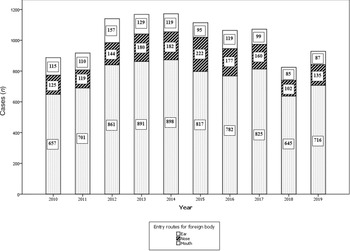
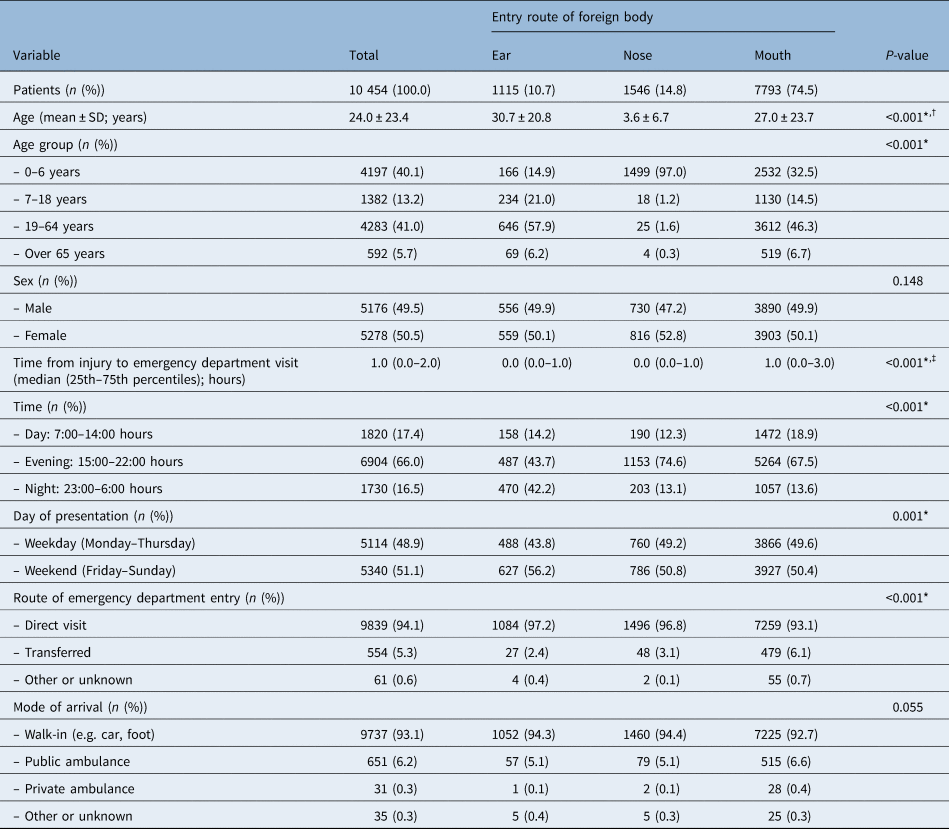
From January 2010 to December 2019, 676 142 patients visited the emergency department of Ewha Womans University Mokdong Hospital. Among them, we included 10 454 (1.5 per cent) patients vising the emergency department because of a foreign body in the ear, nose or throat. The mean age of the patients was 24.0 (± 23.4) years, with 5176 males (49.5 per cent) and 5278 females (50.5 per cent) (Table 1). The number of patients per year ranged from 832 (2018) to 1200 (2013) (Figure 1).
Graph showing the number of patients with a foreign body that entered through the ear, nose or mouth who visited the emergency department, by year.

General characteristics of patients

P-values were calculated using a chi-squared test. *Statistically significant value; †one-way analysis of variance; ‡Kruskal–Wallis test. SD = standard deviation
General characteristics of patients
We analysed the general characteristics of the three groups (Table 1). There were 1115 patients (10.7 per cent) in the ear group, 1546 (14.8 per cent) in the nose group and 7793 (74.5 per cent) in the mouth group. There was an association between the age and foreign-body entry route (p < 0.001). The mean age was the lowest in the nose group (3.6 years), much higher in the mouth group (27.0 years) and the highest in the ear group (30.7 years). We analysed the distribution by age group, dividing patients into preschool children (0–6 years old), school children and adolescents (7–18 years old), adults (19–64 years old), and the elderly (65 years old or older).
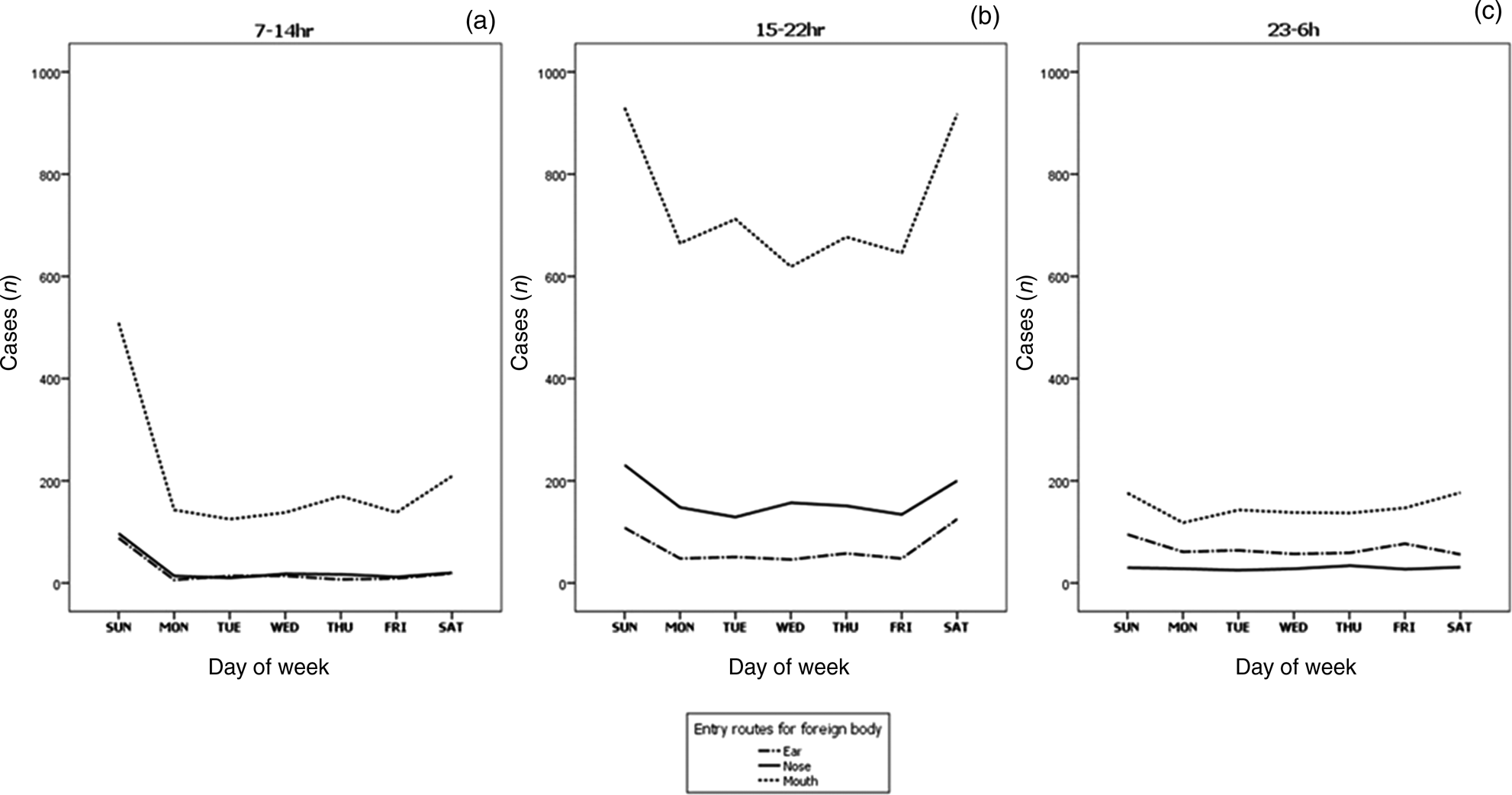
In the nose group, most individuals were preschool children (97.0 per cent), and in the ear and mouth groups, the highest proportion of patients were adults (ear group, 57.9 per cent vs mouth group, 46.3 per cent). We observed a relationship between the time of day of the emergency department visit and the foreign-body entry route (p < 0.001). The proportion of night-time emergency department visits was highest in the ear group (42.2 per cent vs nose group, 13.1 per cent vs mouth group, 13.6 per cent) (Figure 2). Weekday versus weekend emergency department visits were also linked to the foreign-body entry route (p = 0.001). The rate of weekend emergency department visits was highest in the ear group (56.2 per cent vs nose group, 50.8 per cent, vs mouth group, 50.4 per cent). The route of emergency department entry was also related to the foreign-body entry route (p < 0.001). More patients in the mouth group were transferred to the emergency department (6.1 per cent) than patients in the other groups. There were no statistically significant differences between the groups in terms of the distribution of sex and mode of arrival.
Graph showing the number of patients with a foreign body that entered through the ear, nose or mouth who visited the emergency department, by time and day of the week.

Clinical findings and outcomes
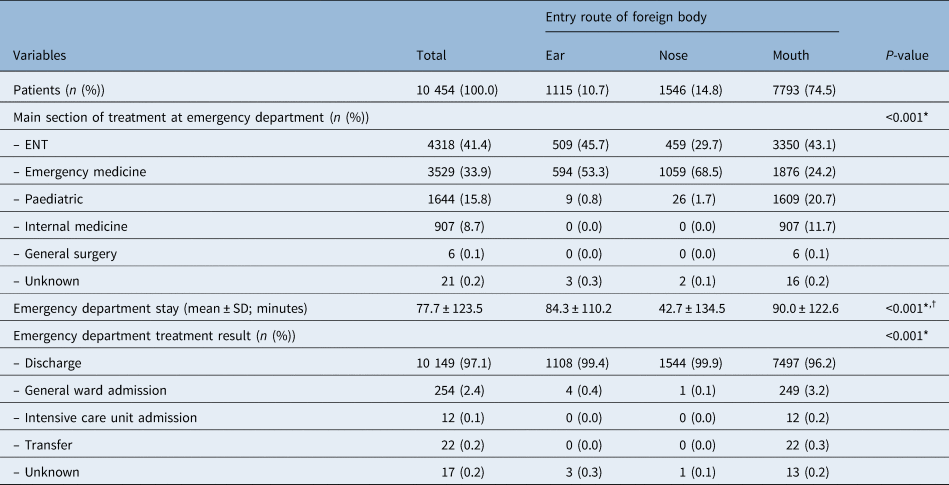
Clinical findings and outcomes were compared between the three groups and are summarised in Table 2. We observed a correlation between the main emergency department section of treatment and the foreign-body entry route (p < 0.001). The ENT section was the most common section of treatment, with 4318 cases (41.4 per cent); there were 3529 cases (33.9 per cent) treated in the emergency medicine section, 1644 (15.8 per cent) in the paediatric section and 907 (8.7 per cent) in the internal medicine section.
Clinical findings and outcomes of patients

*Statistically significant value; †one-way analysis of variance. P-values were calculated using a chi-squared test or one-way analysis of variance. SD = standard deviation
The most common section of treatment in the ear and nose groups was the emergency medicine section, and for the mouth group, it was the ENT section. There was an association between the emergency department stay and foreign-body entry route (p < 0.001), and emergency department stay was the longest in the mouth group, with a mean duration of 90 minutes. Emergency department treatment result and foreign-body entry route were related (p < 0.001); overall, 97.1 per cent were discharged, 2.4 per cent were admitted to the general ward and 0.1 per cent were admitted to the intensive care unit. In the mouth group, the rate of general ward admission was higher than that in the other groups (ear group, 0.4 per cent vs nose group, 0.1 per cent vs mouth group, 3.2 per cent).
Specific cases of admission
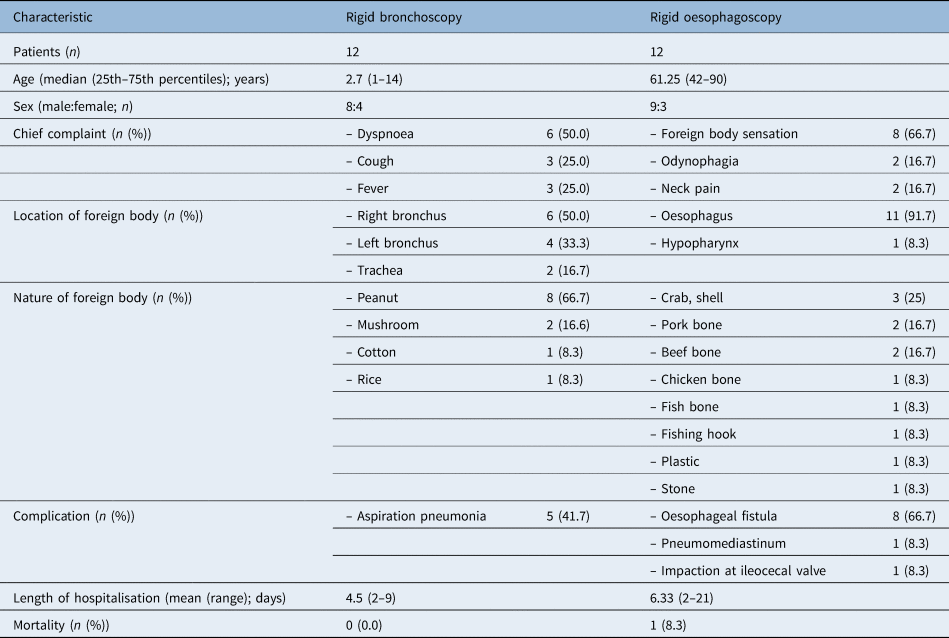
Overall, 266 patients (2.5 per cent) were admitted to our hospital, and the distribution in each group is indicated in Table 2. Of these patients, the foreign objects had to be removed under general anaesthesia for four cases in the ear group and one in the nose group because the patients were too young to cooperate (less than six years of age). The other 261 hospitalised patients were in the mouth group and needed gastroesophageal endoscopy, oesophagoscopy, bronchoscopy or surgical treatment because of the oesophageal perforation or movement of the foreign body from its original location. In this study, 12 of 907 patients who underwent rigid oesophagoscopy had foreign bodies that could not be resolved using conservative treatment (including muscle relaxants) by the gastroenterology department prior to consultation with the ENT department.
Table 3 summarises the characteristics of patients undergoing rigid bronchoscopy or rigid oesophagoscopy by ENT specialists. All 12 patients requiring bronchoscopic foreign body removal were children, and all 12 patients requiring oesophagoscopic foreign body removal were adults. In terms of complications, pneumonia occurred in five patients who required rigid bronchoscopy. In the oesophagoscopy group, eight patients were discharged after nil-per-os maintenance to treat an oesophageal fistula and one patient died because of pneumomediastinum and mediastinitis. The final complication in the oesophagoscopic group was that of a failed rigid oesophagoscopic removal because of the large size of the foreign body, after which it passed into the stomach; obstruction of the ileocecal valve occurred, and the foreign body was surgically removed.
Demographic and clinical characteristics of patients undergoing rigid bronchoscopy or oesophagoscopy by an ENT specialist

Discussion
Foreign bodies are frequently encountered in emergency otorhinolaryngology and sometimes lead to complications of differing severity.Reference Park and Lee2,Reference Mukherjee, Haldar, Dutta, Dutta, Saha and Sinha7,Reference Brown, Denmark, Wittlake, Vargas, Watson and Crabb9,Reference Park, Jung, Kwak and Jung14 According to the American Association of Poison Control Center, there were 93 197 foreign body removals in 2018, more than 70 per cent of which occurred in children aged 5 or younger.Reference Park, Jung, Kwak and Jung14 An individual may be exposed to a foreign body because of carelessness or an accident. Most cases are successfully managed by emergency department staff; however, some cases required a referral to an ENT specialist. In this study, 41.4 per cent of the foreign-body emergencies required otorhinolaryngology treatment. Otolaryngology deals with most of the natural body orifices through which foreign bodies may be introduced, namely the mouth, nostrils and ears.
The most common anatomical locations of foreign bodies differed according to age; most foreign-body exposures occurred in children between the ages of 0 and 6 years (40.1 per cent). In particular, foreign bodies in the nose were most frequent in patients under the age of 6 years (97.0 per cent). Previous studies of paediatric patients also discovered a higher rate of nasal foreign bodies in the younger patient groups.Reference Mukherjee, Haldar, Dutta, Dutta, Saha and Sinha7,Reference Park, Jung, Kwak and Jung14 In the current study, for patients aged 7 and older, foreign bodies in the throat were the most common (84.1 per cent) followed by those in the ear (15.2 per cent) and nose (0.8 per cent).
The method of removing foreign bodies depends on the type of body, its location and the degree of patient cooperation. Quick and atraumatic removal of foreign bodies is challenging for emergency department and ENT physicians. Complications and morbidity often occur from repeated attempts at removal. Procedural sedation is commonly used in emergency department management of foreign bodies in the ear and nose in paediatric cases. In a previous study, 25 per cent of children with foreign bodies in the ear and 21 per cent with foreign bodies in the nose underwent procedural sedation in the emergency department.Reference Brown, Denmark, Wittlake, Vargas, Watson and Crabb9
In our study, no aspiration of nasal foreign bodies occurred. There was only one paediatric patient in this study. As this patient did not cooperate, they were hospitalised and the foreign body was removed during sedation; no repeat attempts were necessary (Table 2). In healthy patients with intact airway reflexes, foreign bodies in the nasopharynx are rarely aspirated into the trachea. The estimated risk for this complication is less than 6 in 10 000 cases. In addition, a previous study reports that there are no cases of foreign bodies spontaneously entering the bronchi through the nasal cavity.Reference Qureshi, Lowe and McKiernan15 However, aspiration of a nasal foreign body has been known to occur during attempts at removal and the risk is likely increased when extraction is attempted by inexperienced clinicians or under circumstances in which appropriate instruments or personnel to ensure adequate restraint are lacking.Reference Mishra, Bhakta, Kumar, Al Abri and Burad16 A dislodged foreign object in the postnasal space can accidentally be aspirated or pushed back in an attempt at removal and may result in acute respiratory obstruction.Reference Kalan and Tariq17
The otorhinolaryngological intervention was the most common type of intervention in our study for cases of foreign bodies in the throat (43.1 per cent), and the emergency department stay was also the longest in this group (90.0 ± 122.6 minutes). However, in the actual clinical setting, the majority of patients with foreign bodies in the throat undergo ENT consultation, which accounts for a large portion of ENT care in the emergency department. This is because, even though the main section in the emergency department is internal medicine, an attempt is made to identify and remove foreign bodies through ENT consultation before considering hospitalisation or endoscopy. In addition, foreign bodies in the throat were the only causes of intensive care unit hospitalisation and the cause of the single mortality in our study.
Oesophageal foreign bodies are relatively uncommon in otorhinolaryngology. There are various types and sizes of foreign bodies, and they may cause serious complications depending on the region and duration of the intervention and accompanying diseases.Reference Crockett, Sperry, Miller, Shaheen and Dellon12 Complications of oesophageal foreign bodies include oesophagitis, oesophageal laceration, oesophageal stenosis, oesophageal perforation and mediastinitis, and oesophageal abscess; therefore, diagnosis and treatment should not be delayed.Reference Bendet, Horowitz, Heyman, Faibel and Kronenberg11 For patients who visit the emergency department, chest pain, throat discomfort, dysphagia, odynophagia or difficulty in managing oral secretions are indicative of oesophageal foreign-body impactions. In East Asia, including Korea, the intake of seafood is high and the incidence of patients visiting the hospital because of ENT foreign bodies is also high. Moreover, sharp fish bones are the most commonly observed ENT foreign bodies in that population.Reference Chee and Sethi18,Reference Ma, Lee, Lee, Yim and Kim19 Unlike in the West, meat is not always cut into small pieces using a knife during meals; in many cases, it is consumed as a bolus using chopsticks. This may be why muscle relaxants frequently do not resolve ENT foreign bodies in East Asia. Prompt treatment using laryngoscopy and rigid oesophagoscopy is required, particularly for proximal impactions, paediatric cases and for those where flexible, upper endoscopy fails to remove the foreign body.
• Providing efficient treatment in emergency departments with limited resources requires accurate prediction of the types and frequencies of ENT emergencies
• Of 676 142 emergency visits in this study, 10 454 (1.5 per cent) were because of foreign bodies that entered through the ear, nose or throat
• Of the 10 454 cases, 7793 (74.5 per cent) foreign bodies entered through the mouth
• Intensive care and the single in-hospital mortality occurred only in the mouth group
• Rigid bronchoscopy and oesophagoscopy were necessary in only 12 cases
Tracheobronchial foreign bodies in infants and children may cause serious complications, especially if the diagnosis is delayed. Diagnosis of such foreign bodies is mainly performed through medical history and physical findings because, in many cases, infants and children cannot express foreign body aspirations unaided.Reference Saquib Mallick, Rauf Khan and Al-Bassam20,Reference Bittencourt, Camargos, Scheinmann and de Blic21 If a foreign body in the bronchus is not removed, it can cause inflammation and necrosis of the mucous membrane of the respiratory tract. Possible complications include pneumonia, atelectasis, emphysema, bronchiectasis and tracheobronchial fistula.Reference Midulla, Guidi, Barbato, Capocaccia, Forenza and Marseglia22,Reference Tokar, Ozkan and Ilhan23 In our study, 5 out of 12 children developed aspiration pneumonia (Table 3) The best treatment of such foreign bodies is direct identification and removal by an ENT specialist via bronchoscopy.
There were several limitations to this study. First, patients were identified based on the main symptoms and diagnosis. Since the data were not prospectively collected, it is possible that cases were not included because the main symptom was atypical or the foreign body-related diagnosis was omitted. However, this is an inevitable limitation of retrospective research. Second, we could not determine the type of foreign body, exact foreign-body location and the method of removal because of the retrospective nature of the study. Future research is necessary to identify and analyse the types of foreign bodies removed, especially in cases with a long emergency department stay or hospitalisation.
Conclusion
In conclusion, out of ENT foreign body-related visits to our emergency department, 74.5 per cent were because of oral foreign bodies, 41.4 per cent were treated in the ENT section and 97.1 per cent were discharged after emergency department treatment. Intensive care unit admission and the in-hospital mortality occurred only in the mouth group. Rigid bronchoscopy and rigid oesophagoscopy were conducted in 12 cases by an ENT specialist. Clinical findings differed depending on the foreign-body entry route.
Acknowledgements
We would like to acknowledge our emergency department and ENT staff for their support.
Competing interests
None declared