The most effective methods of controlling transmission of multidrug-resistant organisms (MDROs) in healthcare settings remain controversial.Reference Morgan, Murthy and Munoz-Price 1 , Reference Cohen, Cohen and Shang 2 MDRO control efforts often employ nonspecific interventions, such as hand hygiene, with organism-specific interventions such as active detection of MDRO colonization and subsequent use of contact precautions (CPs).Reference Calfee, Salgado and Milstone 3 – Reference Siegel, Rhinehart, Jackson and Chiarello 5 Currently recommended organism-specific interventions can be resource intensive, and evaluations of some of these practices have produced conflicting results.Reference Morgan, Murthy and Munoz-Price 1 , Reference Cohen, Cohen and Shang 2 Interventions such as decolonization for methicillin-resistant Staphylococcus aureus (MRSA) have provided alternative approaches to MDRO control that might be easier to implement.Reference Huang, Septimus and Kleinman 6 To investigate the presence of MDRO infection control policies, healthcare facilities were surveyed via the National Healthcare Safety Network (NHSN) 2014 Annual Facility Survey. 7
METHODS
The NHSN is the largest healthcare-associated infection (HAI) surveillance system in the United States; it is managed by the Centers for Disease Control and Prevention (CDC). Since 2011, healthcare facilities have been required to submit HAI data to the NHSN for participation in the Centers for Medicare and Medicaid Services Quality Reporting Programs. Due to the expansion of federal and state mandates, nearly all short-stay acute care hospitals (ACHs), long-term acute care hospitals (LTACHs), and inpatient rehabilitation facilities (IRFs) in the United States are reporting data to the NHSN. Facilities enrolled in the NHSN must complete an annual survey that includes questions about infection control policies. 4 In most cases, the facility’s infection preventionist (IP) completes the survey; however, respondents are encouraged to consult with the hospital epidemiologist and/or quality improvement coordinator. This survey was approved by the Office of Management and Budget prior to administration (OMB No. 0920-0666) and was completed by ACHs, LTACHs, and IRFs at the beginning of 2015. Data were analyzed using SAS 9.3 and were stratified by the US Census Division. 8
RESULTS
The 2014 Annual Facility Survey was completed by 4,228 ACHs, 464 LTACHs, and 261 IRFs. The number of IPs on staff in ACHs (median, 1; interdecile range, 1–3) was directly proportional to the hospital’s reported bed size. In both LTACHs and IRFs, the median number of IPs was 1 (interdecile range, 1–2). The median amount of time spent per week on surveillance activities was 20 hours in ACHs (interdecile range, 5–60), 15 hours in LTACHs (interdecile range, 5–30), and 13 hours in IRFs (interdecile range, 4–28).
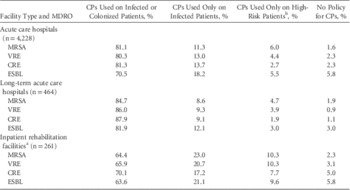
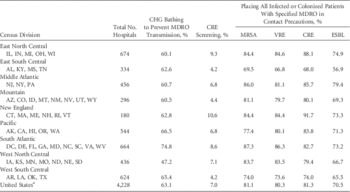
Approximately 80% of ACHs reported having a policy in place for the use of CPs on patients infected or colonized with MRSA, carbapenem-resistant Enterobacteriaceae (CRE), or vancomycin-resistant Enterococci (VRE); approximately 70% reported a CP policy for extended-spectrum β-lactamase-producing Enterobacteriaceae (ESBL). The geographic divisions 8 with the highest percentage of ACHs using CPs for infected or colonized patients were the South Atlantic (MRSA [87.3%] and VRE [86.3%]), New England (CRE [91.7%]), and the Middle Atlantic (ESBL [79.4%]). For all 4 MDROs, the East South Central division had the lowest percentage of ACHs reporting policies for CPs, ranging from 56.9% for ESBLs to 69.5% for MRSA (Table 2).
Compared with ACHs, a greater proportion of LTACHs reported policies for CPs; this ranged from 81.9% for ESBL to 87.9% for CRE (Table 1). Policies for CPs among IRFs ranged from 63.6% for ESBL to 70.1% for CRE.
Percentage of Facilities with Policies for Placing Patients Infected or Colonized with Specific MDRO in Contact Precautions as Reported on the 2014 National Healthcare Safety Network Annual Facility Survey, by Facility Type and MDRO

NOTE. MDRO, Multidrug-resistant organism; CPs, contact precautions; CRE, carbapenem-resistant Enterobacteriaceae; ESBL, extended-spectrum β-lactamase (includes ESBL-producing or extended-spectrum cephalosporin-resistant Enterobacteriaceae); MRSA, methicillin-resistant Staphylococcus aureus; VRE, vancomycin-resistant Enterococci.
a Inpatient Rehabilitation Facility (IRF) values represent IRFs enrolled in NHSN as free-standing rehabilitation hospitals. Data from IRF locations within an affiliated NHSN acute care hospital are included in the hospital’s survey. A standard definition for IRF can be found at https://www.cms.gov/Medicare/Provider-Enrollment-and-Certification/CertificationandComplianc/InpatientRehab.html.
b High-risk patients include those admitted to high-risk settings (eg, critical care units), or those with high-risk characteristics (eg, wounds, diarrhea, indwelling device).
Between 89% and 92% of all facilities indicated that, when MDROs are identified from a clinical or screening culture, infection prevention and/or clinical staff are notified within 4 hours. This rapid communication was reported by 91.2% of ACHs with an on-site laboratory, compared to 84.7% with an off-site laboratory. When receiving patients with MDROs from other facilities, ACHs reported being notified about the patient’s MDRO status less often (median response, 75% of the time; interdecile range, 10%–100%) compared with LTACHs (median, 90%; interdecile range, 50%–100%) and IRFs (95%; interdecile range, 75%–100%).
Policies for routine CRE screening cultures varied by region and were reported by 7.0% of ACHs (Table 2), 11.9% of LTACHs, and 5.7% of IRFs. The most frequently reported strategy among ACHs involved screening patients epidemiologically linked to newly identified CRE patients; LTACHs and IRFs frequently reported screening of all patients, or only high-risk patients, at admission. A second supplemental strategy, chlorhexidine bathing, was reported by 63.1% of ACHs (Table 2), 49.4% of LTACHs, and 16.9% of IRFs.
Percentage of Acute Care Hospitals with Policies for Routinely Performing Selected Infection Control Interventions as Reported on the 2014 National Healthcare Safety Network Annual Facility Survey, by US Census Division

NOTE. CHG, chlorhexidine; CRE, carbapenem-resistant Enterobacteriaceae; ESBL, extended-spectrum β-lactamase (includes ESBL-producing or extended-spectrum cephalosporin-resistant Enterobacteriaceae); MDRO, multidrug-resistant organism; MRSA, methicillin-resistant Staphylococcus aureus; VRE, vancomycin-resistant Enterococci.
a Total counts for the United States include hospitals in Puerto Rico, Virgin Islands, Guam, and overseas military facilities that are not included in any region displayed on the table.
DISCUSSION
Our findings indicate that nearly 20% of ACHs did not have CP policies for patients infected or colonized with MRSA or VRE, potentially reflecting the controversy around its use for endemic MDROs. Policies for CPs were less common among IRFs compared to ACHs and LTACHs; however, across all facility types, CPs were reported least frequently for ESBL patients. Chlorhexidine bathing for MDRO control was reported less frequently than CPs but was still used in ~50% of LTACHs and 63% of ACHs. Notably, although the reported policies were similar across the United States, some regional variability may exist. The reasons for this variability are unknown but could reflect different perceptions about the most effective MDRO control methods. Less than 10% of facilities had a policy for routine CRE screening (including screening of epidemiologically linked contacts), a suggested intervention in the CDC CRE Toolkit. 4 This might reflect the lower and relatively heterogeneous incidence of CRE compared to other MDROs.Reference Guh, Bulens and Mu 9
In most cases, our results demonstrated a lower percentage of facilities using CPs compared with earlier studies. Morgan et alReference Morgan, Murthy and Munoz-Price 1 surveyed the Society of Healthcare Epidemiology of America Research Network and found that 92% of 87 respondents employed CPs for MRSA and VRE, compared with 81.1% and 80.3%, respectively, of hospitals from the NHSN annual survey. Furthermore, Russell et alReference Russel, Beekmann and Polgreen 10 reported that 93% of 364 physicians in the Emerging Infections Network were routinely using CPs for MRSA, and Drees et alReference Drees, Pineles, Harris and Morgan 11 reported 100% of respondent facilities (n=46) using CPs for MRSA and VRE. Due to the uniquely representative data obtained from the NHSN, it is likely that our results accurately depict CP policies in the United States as our study was not limited by a small sample size.
Our study has several strengths. Results were obtained from a mandatory survey that captured data from almost 5,000 healthcare facilities (nearly 100% response rate). Thus, these data represent a current and widespread assessment of select infection control policies across the United States. However, our findings are subject to several limitations. Data were self-reported from facilities and were not anonymous. The accuracy of these data was not verified by the CDC. In addition, interpretations of the survey questions by respondents may have varied. Some questions asked, “Does the facility routinely place patients ... in contact precautions?” We interpreted these results to be reflective of facility-level policies; however, the word “routinely” may have been construed as the presence of a policy plus some level of adherence. Thus, there may have been underreporting of the presence of policies in cases of minimal adherence or within specialty hospitals to which MDRO patients are rarely admitted.
In summary, policies for the routine use of CPs were common, but not universal, in US healthcare facilities; policies for chlorhexidine bathing were also common particularly in ACHs. Communication from laboratories regarding MDROs occurred frequently although communication at time of transfer remains a target for improvement. The extent to which changes are occurring in the adoption of and adherence to these policies will require additional data to determine.
ACKNOWLEDGMENTS
We thank the NHSN participants and the infection control community for their ongoing efforts to prevent infections and improve patient safety. The findings and conclusions in this report are those of the authors and do not necessarily represent the official position of the Centers for Disease Control and Prevention or the Agency for Toxic Substances and Diseases Registry.
Financial support. The NHSN surveillance system is supported by the Division of Healthcare Quality Promotion, Centers for Disease Control and Prevention.
Potential conflicts of interest. All authors report no conflicts of interest relevant to this article.