I. INTRODUCTION
With rapid development of modern industry, the traditional wear-resistant material such as conventional martensitic wear-resistant steel cannot satisfy the requirement of certain working conditions involving high impact. The steel with a better combination of high strength, decent toughness, and high wear resistance is required urgently to be applied in railways and machinery industries. Reference Lyu, Zhu and Olofsson1 Hence, low-alloy wear resistant steel normally requires heat treatment to increase hardness and toughness. Parameters such as the quenching temperature, tempering temperature, and partitioning temperature influence largely the matrix and the precipitates, the mechanical properties of tempered martensitic steel. Reference Pan, Chang and Chang2
Conventional heat treatment of low alloy martensitic wear-resistant steel is quenching and low temperature tempering (Q&T), resulting in the formation of tempered martensite which has a good combination of strength, hardness, and toughness. Reference Tao, Xiaoman and Cuiyan3–Reference Wang, Zhong, Rong and Xu5 To further improve the impact toughness, a novel heat treatment, Quenching and Partitioning (Q&P), Reference Speer, Matlock, De Cooman and Schroth6 has been used in low alloy martensitic wear resistant steel.
In 1960s, Kinsman and Shyne found that diffusion of carbon from martensite to austenite stabilized the austenite phase which was referred as “thermal stabilization”. Reference Misra, Zheng, Wu and Karjalainen7 In 1970s, Thomas Reference Rao and Thomas8,Reference Sarikaya and Thomas9 found that the amount of carbon increased from 0.27 to 1.04% in the retained austenite between the martensite bars when quenched to the room temperature. In 1983, Xu Zuyao Reference Zuyao and Xuemin10 claimed that the time of carbon distribution was in the magnitude of 10−7 s by theoretical calculation. Based on the theory of carbon partitioning which was in favor of the stability of the austenite, the concept of thermal stabilization had been matured into the Q&P heat treatment. Q&P heat treatment was first proposed by Speer et al. Reference Speer, Edmonds, Rizzo and Matlock11,Reference Edmonds, He, Rizzo, De Cooman, Matlock and Speer12 to improve the ductility without affecting strength to producing the steel with martensite and high fraction of retained austenite. The existence of stable retained austenite contributes to higher ductility.
Recently, the effect of retained austenite on ductility has been studied. One is the transformation-induced plasticity effect, which involves releasing local stress concentration through austenite to martensite transformation. Reference Chatterjee, Wang, Yang and Bhadeshia13 The other one is the blocking microcrack propagation effect. Reference Lee, Kim, Kim and Lee14 Another reason is that austenite can continuously absorb dislocations from martensite during deformation, causing the decline of the average dislocation density in martensite laths. Reference Zhang, Zhang, Guo, Chen and Rong15
The Q&P process involves: (i) a fast quenching from a partial or full austenitization to a quenching temperature (T q) between martensite-start temperature (M s) and martensite-finish temperature (M f) to obtain carbon-supersaturated martensite and untransformed austenite; (ii) an immediate partitioning treatment either at or above the initial quenching temperature (T q) for a period of time to enrich the remained austenite with carbon escaping from the supersaturated martensite to austenite. In general, the microstructure of steel resulting from the Q&P process is characterized by martensite and carbon-rich stabilized austenite. Reference Zhong, Wang, Wang and Rong16,Reference Xu, Yan, Liu and Li17
In the past few years, more attention have been devoted to the combination of strength and toughness achieved by Q&P process to produce new generation of advanced high strength steels (AHSS). Reference Mola and De Cooman18 Few attempts, however, have been made to improve the wear resistance of AHSS. Besides, most of the previous researches on Q&P process were conducted with hot-rolled steel, while in the current study all of the samples were directly heat treated after casting.
The Q&P heat treatment largely depends on the chemical composition, correspondingly affect the microstructure and mechanical properties. Reference Maheswari, Ghosh Chowdhury, Hari Kumar and Sankaran19 In the current research, various quenching temperatures, partitioning temperatures, and partitioning times were taken into an orthogonal experiment to achieve the optimal heat treatment of martensite wear-resistant steel.
II. EXPERIMENTAL PROCEDURES
A. Sample preparation
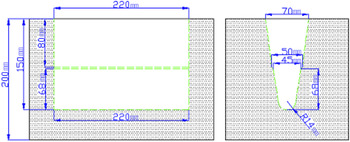
The melt used in this experiment was prepared in a 500 kg medium frequency induction furnace by using charge materials of steel scrap, ferrochrome, ferromolybdenum, ferrosilicon, manganese steel, and ferrovanadium. Finally, Aluminum was conducted to a final deoxidation. After tapping within the temperature ranging from1640 °C to 1660 °C, the melt was poured into a ladle, and then transferred to Y-block CO2 water glass sand molds shown in Fig. 1. Chemical analysis was conducted by spectrometry from chilled samples obtained during casting, and the final chemical compositions are shown in Table I. The samples used for heat treatment were machined from Y-block.
Dimensions of separated Y-block test bars.

Chemical composition (wt%) of experimental samples.

B. Heat treatment
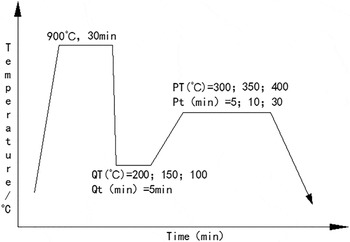
The Q&P heat treatment procedure started with austenitization (900 °C) in a high temperature box resistance furnace. After holding at austenitization temperature for 30 min, the specimens were quenched in first salt bath at different quenching temperature for 5 min. Immediately, the specimens were transferred to the second salt bath at partitioning temperature for certain time (partitioning time) before quenching into oil to room temperature. Integrating the set parameters of Q&P process, the heat treatment process is shown in Fig. 2. Where QT is quenching temperature, Qt is quenching time, PT is partitioning temperature and Pt is partitioning time. Traditional Q&T process were also conducted on some samples as the references. The austenitization temperature and austenitization time were equal to the Q&P process. The tempering temperature was 250 °C.
The procedure of the Q&P treatment.

Since Q&P is a process of multiparameter interaction, any subtle change can affect the microstructure and mechanical properties of steel. To ascertain the optimal process parameters with less testing times, orthogonal experimental design, based on the commonly used parametric range, was introduced to find the rational match of the important parameters. Twenty-seven experiments would be needed if the tests were designed just by round permutation and combination, but by using orthogonal design method, nine experiments are needed in the first array. In the next array, we designed a supplemental heat treatment experiment, which used the parameters optimized from the first array, to inspect the validity of the orthogonal design method.
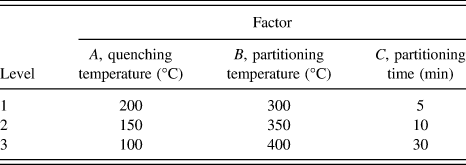
In this study, the three parameters are quenching temperature, partitioning time, and partitioning temperature, respectively. For each parameter, three levels are designed. We chose L9(33) type orthogonal form, as shown in Table II. Impact energy, room temperature tensile properties and HRC values of the tested steel under different heat treatment conditions were tested to find the optimal parameters of Q&P process.
Factors and levels of the Q&P heat treatment.

C. Test methods
Samples for metallograph were prepared in the traditional method: roughed by abrasive papers (the particle sizes are 100, 200, 400, 600, 800, and 1200), followed by polishing with Chromium oxide polish solution. Microstructure of samples after heat treatment was observed by a Philips-quanta-2000 scanning electron microscope (SEM; FEI Company, Hillsboro, Oregon) equipped with an energy dispersive spectrometer (EDS) analyzer. Tensile (σb) test was performed on the SHT4605 universal testing machine and the specimen size was Φ10 mm × 140 mm according to Chinese Standard Method GBT228.1-2010. 20 Samples with V-notch were taken into impact tests using a JB-30 Charpy Impact Testing Machine (Wuzhong Material Tester Ltd. Co., Wuzhong, China). 21 The Rockwell Hardness of samples was measured in a HR-150 Rockwell Hardness tester (Ai Yu Equipment Ltd. Co., Shanghai, China). 22
It is known that magnetic measurement is more reliable for detecting retained austenite fraction than x-ray measurement. Reference Zhao, Van Dijk, Brück, Sietsma and Van der Zwaag23 Therefore, magnetic measurement has been used to determine the volume fraction of retained austenite in heat treated samples. A HH-15 Vibrating sample magnetometer has been used in the experiment and the specimens were machined to 1 mm × 1 mm × 1 mm. The saturation magnetization values were obtained from the magnetization curve and the standard sample was obtained by quenching and tempering at 250 °C. Finally, the volume of retained austenite was calculated by the following formula (1),
 $${V_{\rm{A}}} = {{{I_{\rm{s}}} - {I_{\rm{t}}}} \over {{I_{\rm{s}}}}} \times 100\% \quad ,$$
where V A is the volume of retained austenite; I s and I t are the saturation magnetization values of the standard sample and tested samples, respectively.
The specimens of wear test were machined to Φ5 × 12 mm. The wear resistance was evaluated by loss of weight in the ML-100 pin-on-disc tribometer (Shijing Group Ltd. Co., Jinan City, China) according to GB/T 12444-2006. 24 The load in this experiment was 10 N and total sliding distance of every sample was 420 m.
III. RESULTS AND DISCUSSION
A. Analysis of orthogonal experimental results
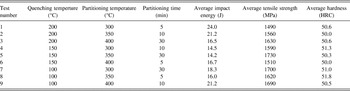
Impact energy, tensile strength and bulk hardness (HRC) of steel samples after various Q&P heat treatments are presented in Table III.
Results of mechanical properties under different orthogonal experiment parameters.

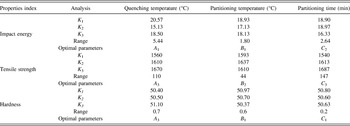
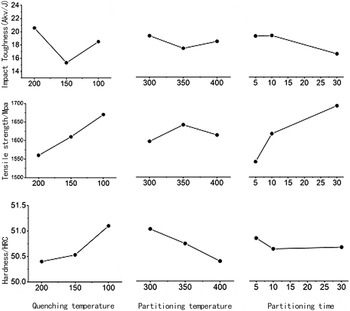
For evaluating the effect of each parameter to mechanical properties, the direct-vision and range analysis is shown in Table IV. Here the K 1, K 2, and K 3 represent the average impact toughness, tensile strength and hardness corresponding to each parameter from level 1 to 3, and the A, B, C represent three factors in orthogonal experiment, respectively. Range is the difference between the maximum and minimum values of each level for a specified factor. The experimental results are depicted in Fig. 3. As can seen from the factor index graphs and variance analysis tables: (i) Partitioning temperature had a limited effect on impact toughness and quenching temperature exhibited the most obvious influence on the experimental results. (ii) Partitioning temperature had a limited effect on strength and partitioning time played the critical role in the experimental results. (iii) Partitioning time had a limited effect on hardness and quenching temperature exhibited the most obvious influence on the experimental results.
Range analysis of the properties after Q&P heat treatment.

Influence of factors on the impact toughness, tensile strength and hardness.
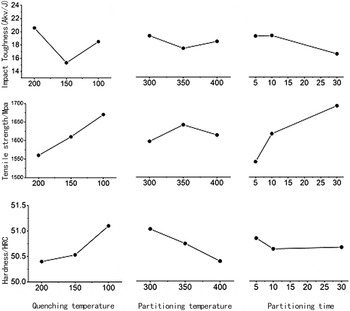
From the orthogonal experiment results, the quenching temperature was the most important influencial factor for impact energy and hardness and partitioning time for tensile strength. Hence, quenching temperature and partitioning time were considered as the primary factors on the microstructure and properties of the tested steel. Considering the complex effects of each parameter obtained by the analysis from orthogonal experiment, the optimal parameters are: quenching temperature is 100 °C; partitioning temperature is 350 °C; partitioning time is 10 min.
B. The relative volume fraction of retained austenite
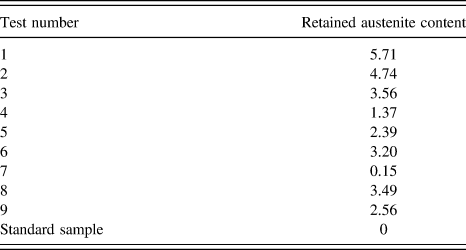
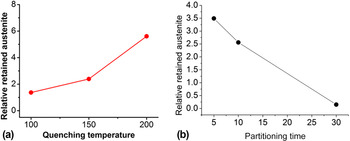
The relative volume fraction of retained austenite after different heat treatments is listed in Table V. The relative volume fraction of retained austenite was obtained by comparing with the traditional heat treatment, quenching and tempering at 250 °C. Because of the importance of quenching temperature and partitioning time, the variations of relative volume fraction of retained austenite with the quenching temperature when partitioning time was 10 min and partitioning time when quenching temperature was 100 °C, determined by magnetic measurements, are shown, respectively, in Fig. 4.
Relative retained austenite content (%) compared with standard sample.

Effect of quenching temperature and partitioning time on the relative retained austenite: (a) quenching temperature; (b) partitioning time.

From Fig. 4(a), with the increasing quenching temperature, the relative volume fraction of retained austenite increased. The sample quenching at 200 °C had the largest amount of retained austenite. The amount of martensite fraction in the quenched steel was calculated using the Koistinen–Marburger equation. Reference Krauss25 With the increase of quenching temperature, the fraction of initial martensite decreased and the austenite increased. Hence, more austenite will be at room temperature. This can contribute to the increase of retained austenite.
From Fig. 4(b), the volume fraction of retained austenite showed a downward trend with the increment of partitioning time. The volume fraction of retained austenite reached the maximum after partitioning for 5 min. A work by Nayak Reference Nayak, Anumolu, Misra, Kim and Lee26 et al. found that the formation of ε-carbide in tested steel contained more Cr and the presence of high Cr content leads to cementite formation when Q&P test was conducted. So for longer partitioning time, alloying elements Cr and Mo et al. consumed certain amount of carbon by carbide formation, then carbon depletion will occur and less carbon was used to stable the austenite. In this work, because of the existence of Cr and Mo, the formation of carbide precipitation which was important for the wear resistance maybe the reason for decrease of stable retained austenite content. When the partitioning time is 5 min, the amount of carbide was so little that cannot affect the content of retained austenite. When partitioning time became longer, the content of retained austenite decreased.
C. SEM investigation and EDS analysis
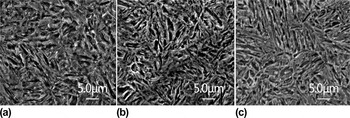
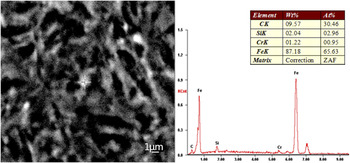
To confirm the reason for loss of retained austenite in different partitioning times, Fig. 5 shows the microstructure of samples partitioning at different temperatures after quenching at 100 °C. As we can see from Fig. 5, the microstructure consists of lath-like martensite and retained austenite largely. The configuration of lath-like martensite does not change much and no significant differences are present in the size of martensite lath compared with the microstructure under different partitioning times. But for longer partitioning time, some white granular particle appeared in the matrix. EDS analysis had been used to analyze the composition of white particle and results are shown in Fig. 6. The white particle is (Fe, Cr)3C7. The appearance of carbides showed that addition of Si did not completely inhibit the precipitation of carbides and longer partitioning time maybe the main reason for carbide precipitation. The carbide precipitation contributed to the loss of retained austenite.
The microstructure of samples in different partitioning times: (a) partitioning at 350 °C for 5 min; (b) partitioning at 400 °C for 10 min; (c) partitioning at 300 °C for 30 min.

EDS analysis of carbide in sample 7 (quenching at 100 °C, partitioning at 300 °C for 30 min).

D. Compared with Q&T treatment
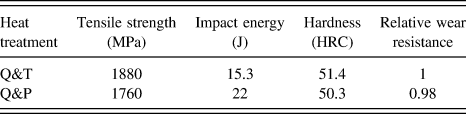
Table VI shows the tensile strength, toughness, hardness and wear loss of the specimens treated after Q&T treatment and optimal Q&P treatment parameters. It is clear that the samples after Q&T treatment possessed the highest tensile strength over 1750 MPa, but impact energy was quite low (only about 15 J). The samples under Q&P treatment displayed higher toughness and maintained relative high tensile strength. The tensile strength of the material after Q&P heat treatment reduced about 6.38%, while the impact energy increased by 43.79%. The hardness of samples treated by Q&P treatment was similar to that under Q&T treatment. The wear resistance of the samples under Q&P heat treatment was even better than that of traditional heat treatment.
Mechanical properties and wear resistance of Q&P and Q&T heat treatment.

IV. CONCLUSION
The major conclusions derived from the present investigations are:
-
(1) Through the orthogonal experiment, the optimal parameters of Q&P Process for low-alloy wear resistant steel (ZG30CSiMnCrMoV) was obtained, quenching at 100 °C, partitioning at 350 °C for 10 min. That is to say that, the hardness and impact toughness of the samples can achieve the best fit and the best performance.
-
(2) The microstructure of the steel through Q&P heat treatment consisted of martensite laths. With the increment of partitioning time, carbide precipitates appeared and were distributed in matrix.
-
(3) Q&P heat treatment can improve the toughness of low alloy wear resistant steel without sacrificing the wear resistant and strength.