

Introduction
In early 2014, Russia annexed Crimea from Ukraine and began shortly thereafter sponsoring armed rebel groups in the eastern Ukrainian region of Donbas. Russia also escalated an international campaign of disinformation against the United States and its European allies. Aside from expanding its media activities abroad through RT and Sputnik, Russia has ‘intensified its social media presence, hiring thousands of trolls and establishing new information outlets on the Internet’.Footnote 1 Accordingly, Russia now uses ‘active measures’, a term drawn from the KGB lexicon to describe a form of political warfare that partly involves fake news, social media, and forged missives to influence public opinion in target countries.Footnote 2 Observers agree that Russia employs information warfare to deter unfavourable policy responses to its behaviour in East Central Europe.Footnote 3
The North Atlantic Treaty Organization (NATO) has taken concrete steps against Russian disinformation campaigns. Based in Riga, the NATO Strategic Communications Centre of Excellence (CoE) sees countering Russian disinformation as its core objective. Its location is deliberate: Latvia has a relatively large Russophone minority, making it potentially susceptible to Russian efforts to shape its domestic politics via propaganda and ethnic subversion. In September 2017, the European Union (EU) and NATO sponsored the establishment of a new CoE for Countering Hybrid Threats in Helsinki out of the concern that potential adversaries could use disinformation to exploit European vulnerabilities created by historical grievances and political polarisation. Beyond these infrastructural initiatives, NATO members have tackled specific instances of disinformation. One notorious case involved false rumours disseminated on social media that German soldiers deployed in the local NATO battlegroup raped a Lithuanian girl.Footnote 4 Canadian troops were similarly targeted by a pro-Kremlin disinformation campaign after assuming leadership of the NATO battlegroup in Latvia.Footnote 5 The US Senate has commissioned reports to examine ongoing Russian disinformation efforts.Footnote 6
International disinformation campaigns have thus provoked anxiety among contemporary defence planners, not least because authoritarian governments can potentially exploit the openness and transparency of democratic societies. If this anxiety is justified – that disinformation produces strategic effects that favour authoritarian adversaries – then the implications for democratic survival are worrisome. Democracies might find themselves under pressure to curb certain freedoms so as to reduce their vulnerabilities. Otherwise, they risk being undermined from within. As this article argues, the strategic effects of international disinformation campaigns are exaggerated.Footnote 7
I argue that international disinformation campaigns are ineffective insofar as the balance of power is concerned. That is, they will not change a state's alignment and armament decisions, which may be of ultimate interest to the disinforming adversary. To be effective at all, disinformation must somehow overcome three powerful obstacles. The first stems from international anarchy, which creates not only uncertainty over how to interpret international signals, but also scepticism towards information that is conveyed by, or appears partial to, adversaries. Any information broadcasted by adversaries could very well be disinformation.
The second barrier relates to the pre-existing ideological commitments and mindsets of those individuals who may be exposed to disinformation. To process incoming information, state leaders generally rely on rules of thumb and personal experiences despite having privileged access to intelligence collected by their state's politico-military institutions. Public opinion – the most likely target of an international disinformation campaign – arguably might affect a state's ability to rally support for its international strategy. Yet average citizens may even be more wont to assess policies through the lens of partisanship and ideology. They are not impressionable blank slates that get randomly exposed to disinformation and subsequently form beliefs in line with the adversary's preferences. Of course, whether public opinion even matters for foreign policy is debatable.
The third obstacle concerns the countermeasures that a target could take against an international disinformation campaign. These countermeasures include quick corrections and preventing the repetition of falsehoods, and may be viable even in the presence of political polarisation. At first glance political polarisation might enable a disinforming adversary. However, exploiting political polarisation has its own challenges. If the disinformation reflects the interests or preferred narratives of the adversary too obviously, then it will be discounted as the product of foreign machinations. Opposition groups could use the disinformation campaign to discredit its supposed beneficiary. If the disinformation is too subtle, then it risks resembling political opinions already salient within the popular discourse found in the target society, at best reinforcing people's prior convictions.
For the rest of this article, I define key terms before reviewing how different International Relations theories would comprehend disinformation, if at all. I highlight how these theories offer at worst contradictory and at best incomplete insights into whether an international disinformation campaign should work. I then describe the three barriers that any disinformation campaign must overcome in order to affect policies relating to the balance of power. To probe the plausibility of my argument, I discuss evidence from the disinformation campaign that Russia has waged against the Baltic countries since at least the 2014 annexation of Crimea. Scholars and pundits frequently assert that Russia wages a robust disinformation campaign to which the Baltic countries are uniquely vulnerable. The available evidence suggests that this campaign has had little impact. I conclude by outlining a future research agenda.
Disinformation and International Relations theory
This section first defines disinformation before addressing how International Relations theories grapple with the concept, to the extent that they do.
Defining disinformation
Disinformation is a type of information inasmuch as it purports to represent data or knowledge.Footnote 8 However, following Don Fallis, I define disinformation as ‘misleading information that has the function of misleading’.Footnote 9 A disinformation campaign is a systematic government effort aimed at using disinformation to mislead a particular audience – whether a government or key members of society – in order to influence the policy process. This definition excludes truthful statements, accidental falsehoods, jokes, sarcastic comments, accidental truths, satire, and implausible lies. Jokes and satire, for example, might seem to mislead, but such trickery is temporary because their main purpose is to provoke laughter, to illuminate ironic situations, or to provide social or political commentary. A historical example of disinformation is how the Nationalists during the Spanish Civil War denied their complicity in the Guernica bombing by blaming that city's devastation on Republican scorched earth tactics.Footnote 10 Disinformation is thus distinct from misinformation. Whereas disinformation is ‘information that is incorrect by intent’, misinformation is ‘information that is incorrect by accident’.Footnote 11 Disinformation serves to benefit the source at the expense of the target, but that may not always be the case. An individual misleading their doctor intentionally could receive the wrong treatment to his or her detriment.Footnote 12
Disinformation is not necessarily propaganda, although the two concepts overlap significantly. Some scholars see propaganda as being ‘consciously designed to serve the interests, either directly or indirectly, of the propagandists and their political masters. The aim of propaganda is to persuade its subject that there is only one valid point of view and to eliminate all other options.’Footnote 13 Being functionally misleading is not an essential requirement for propaganda since it can be factually or normatively correct.Footnote 14 British propaganda in the First World War correctly highlighted how Germany committed atrocities in Belgium despite sensationalising German behaviour and motivations for emotional effect.Footnote 15 That said, most propaganda likely contains deliberate errors.
Disinformation is thus a subset of deception, which is the ‘process by which actions are chosen to manipulate beliefs so as to take advantage of the erroneous inferences’.Footnote 16 One action is lying, as when ‘an individual purposely takes steps that are designed to prevent others from knowing the full truth – as that individual understands it – about a particular matter’.Footnote 17 Deception often serves to coerce because the deceiver seeks to alter the estimates regarding the costs and benefits of actions that the target might undertake. Accordingly, deception could be useful for shaping perceptions of the constraints that might discourage (encourage) a target from adopting a strategy that is unfavourable (favourable) from the perspective of the source.Footnote 18 Lastly, deception can help the deceiver to escape culpability and responsibility for actions already taken.
International Relations theory and disinformation
Disinformation has not received much theoretical attention in International Relations scholarship. After all, research on deception is itself underdeveloped. John Mearsheimer finds that national leaders rarely lie to each other despite acknowledging that states occasionally bluff to gain an advantage or feign weakness in order to catch adversaries off guard.Footnote 19 Indeed, scholars recognise that states have incentives to misrepresent their intentions and capabilities so as to strike better bargains. Yet the literature on deception – limited as it is – has focused largely on domestic or even bureaucratic politics.Footnote 20 Several sophisticated studies examine deception and war making, but with respect to how democratic leaders try to mobilise mass support around controversial policy decisions.Footnote 21 Politicised intelligence estimates have the potential to be disinformation, especially if they deliberately mislead leaders into thinking that their policy preferences have bona fide empirical support from the intelligence community.Footnote 22 However, research on the subject does not frame politicised intelligence as disinformation per se. When scholars do explicitly address international disinformation, they largely focus on specific states like Russia and the policy challenges that they instigate.Footnote 23
Mainstream International Relations theories offer contradictory guidance with respect to disinformation. Consider structural realism, which explains international politics on the basis of how material capabilities are distributed within the international system.Footnote 24 This perspective seems to preclude disinformation from having any influence, but whether intelligence counts as a material capability is unclear. After all, states develop intelligence and counterintelligence capabilities for national security purposes. Intelligence helps states estimate others’ intentions, resolve, and capabilities, whereas counterintelligence helps defend against, if not defeat, the intelligence efforts of others. Even if anarchy encourages states to assume the worst of intentions, as offensive realists claim, better intelligence capabilities should still empower a state vis-à-vis others.Footnote 25 If intelligence counts as a material capability, then disinformation could have an effect so long as it succeeds in obfuscating capabilities. Still, this hypothesis differs somewhat from the common concern that international disinformation campaigns strive to undermine the policy process of a target society. Interestingly, some scholars argue that even propaganda is material. As Harold Lasswell explains, ‘[t]he making of propaganda is primarily a “material” activity in the sense that it depends upon the control of instruments of production, such as presses capable of turning out magazines, pamphlets and books; and it depends upon hours of labour devoted to processing and distributing the product.’Footnote 26
Because of the importance they accord to information, rationalists are better positioned to assess the effects of disinformation. They agree with structural realists that anarchy generates uncertainty over the intentions of others, but they do not believe that this uncertainty is intractable.Footnote 27 States could demonstrate their willingness to cooperate and to abide by their agreements. Specifically, they can resort to signalling and screening in order to acquire information about intentions, which then would be used to distinguish between status quo or revisionist states, or between offensive-minded or defensive-minded states.Footnote 28 Accordingly, intelligence organisations perform an important task that rationalists can better appreciate.
Not every action constitutes a credible signal, however. For rationalists, some signals are cheap talk, either because states of any type – sincere or insincere, benign or revisionist, and so forth – could have sent them or because these signals do not affect utilitarian payoffs. Other signals are costly but might still vary in their credibility. Sunk cost signals (for example, providing military aid) flow from actions that require costs to be paid upfront, whereas hand-tying signals (for example, signing an alliance treaty) flow from actions that could bind future decision-making.Footnote 29 Hand-tying signals are allegedly more credible because states rationally should only incorporate prospective costs in decisions moving forward. The implication regarding disinformation is clear: states should only believe in disinformation so long as the disinforming signal is costly to make. Yet costly signals are supposed to be genuine markers of intent since not every state can do so. From the rationalist standpoint, costly disinformation is oxymoronic because costs supposedly serve to distinguish sincere states from insincere ones.
Constructivism has its own handicaps in theorising about disinformation. Notwithstanding whether they really are functionally misleading, the research on international strategic narratives has largely focused on how their operationalisation and content.Footnote 30 More importantly, the constructivist literature on argumentation and persuasion generally privileges certain norms and values since the motives of state leaders are fundamentally unknowable.Footnote 31 Theories about persuasion assume that states are honest and open not only to dialogue, but also to reconsidering previously held beliefs in the face of logically or empirically valid arguments. This assumption may be appropriate if those states inhabit a ‘common lifeworld’ of shared meanings, identities, and norms.Footnote 32 Nevertheless, a question arises: why argue in the first place if ideological affinity already exists?Footnote 33 Of course, constructivists recognise that states can sometimes exploit norms to their advantage. States could elicit concessions by shaming those who are hypocritical.Footnote 34 Yet these arguments still assume that the norms used for shaming hypocritical states are valid, if not commonly accepted.
The same problematic assumption appears in scholarly accounts of rhetorical coercion. Ronald Krebs and Patrick Thaddeus Jackson emphasise the necessary presence of rhetorical ‘commonplaces’ that ‘enable and constrain speakers’ rhetorical possibilities’.Footnote 35 States succeed in employing rhetorical coercion not because of pre-existing normative commitments, appeals to reason, or material interests, but because the winning argument is ‘socially sustainable – because the audience deems rhetorical deployments acceptable and others impermissible’.Footnote 36 Krebs and Jackson admit that ‘[w]here such ties are strong and dense – that is, within such regional groupings of states, where international anarchy (as even realists might concede) is most attenuated – rhetorical coercion remains distinctly possible.’Footnote 37
Such arguments raise more questions than provide answers with respect to disinformation. Though a disinforming state could exploit the moral hypocrisy of others to its advantage, it is ultimately uninterested in open dialogue and better arguments. Why should a state wage disinformation campaigns if it lives in the same ‘lifeworld’ where basic agreements about norms and values already exist? Admittedly, disinformation smacks of rhetorical coercion and social ties are plausible conduits for it. However, that does not imply that international anarchy has less force in the relations between disinforming states and their targets. Indeed, disinformation shakes up norms because deception – once uncovered – damages the trust that some scholars see as necessary for cooperation.Footnote 38 Enemies, more than friends, are the targets of international disinformation campaigns, and so disinformation reflects anarchy rather than its absence.
Finally, disinformation differs from bullshitting (BSing), which Lee J. M. Seymour defines as a rhetorical activity that is indifferent to the truth. Though BSing ‘relies on a performative logic in which impressions are paramount’, the impressions created through BSing are ends onto themselves.Footnote 39 BSing ‘involves ignorance of reality rather than the distortion of it’.Footnote 40 In contrast, the government waging a disinformation campaign strives to mislead certain audiences in order to achieve certain policy objectives. In international relations, these policy objectives would involve inducing favourable changes (or preventing unfavourable changes) in the behaviour of others. These changes may vary in their sweep and in the time they take to be felt. Ranging from the broadest and long-term to the narrowest and the short-term, these effects can include the undermining of the legitimate authority of a target government or political system; the degradation of a national political discourse; the alteration of the perceived costs associated with certain policies pursued by the target; and the manufacturing of plausible deniability that the disinforming state can then exploit.
Why disinformation should not work in international politics
The purported effects of disinformation are extraordinarily difficult to isolate, especially because a disinformation campaign might be complementary to other tools of statecraft – economic, cyber, military, or diplomatic – that are aimed at influencing a target's behaviour. Moreover, many confounding variables could affect the legitimacy of any authority or the quality of a national discourse. Mindful of these issues, I assert that the ultimate aim of disinformation is to affect the target state's ability to generate military capabilities or willingness to align itself with others against the disinforming state – that is, disinformation serves to affect the balance of power. A disinforming state likely only cares about the national discourse or legitimate authority of a target society or government to the extent that such factors affect whether the state can mobilise resources in support of its foreign policy and military strategy. Put differently, unless its foreign policy is nihilist, it does not seek to sow confusion, to exploit political polarisation, or to undermine trust in local political institutions for their own sake. To echo what Harold Lasswell writes of propaganda, disinformation aims to ‘economize the material cost of power’ or ‘to economize the material cost of world dominance’.Footnote 41
I argue that a disinformation campaign must overcome three significant barriers in order to have strategic effects, especially in relation to states’ abilities to generate military power through alliances or armaments: first, the fundamental uncertainty that international anarchy generates over any information broadcasted by adversaries; second, the pre-existing prejudices of elites and citizens; and third, the countermeasures that are available even amid political polarisation.
Barrier one: Anarchy and uncertainty
Anarchy refers to the absence of a central authority in international politics that can make rules for states to follow, monitor those rules, and enforce those rules should non-compliance occur. Scholars disagree over how much anarchy matters in shaping state behaviour. Structural realists contend that anarchy overwhelmingly influences international politics because it generates such uncertainty that states fearfully assume others are predatory. States thus discount most pieces of information conveyed by others because the possibility of exploitation cannot be dismissed.Footnote 42 Structural realists themselves are divided into two camps. Offensive realists argue that planning on the basis of worst-case scenarios is rational and that great powers at least will strive to achieve regional hegemony so as to be secure.Footnote 43 Defensive realists are less pessimistic since expansionism should occur only under certain conditions of the security dilemma.Footnote 44 Yet offensive and defensive realists alike posit that anarchy has such an impact on international politics that domestic politics, historical experience, and ideology hardly explain their behaviour.
This rigid view of anarchy is a minority one. Neoclassical Realists agree that anarchy has causal primacy in affecting state behaviour, but they believe that foreign policymaking is also a function of unit-level (that is, state-level) variables. Liberal theorists of international politics recognise that states bargain with each other under anarchy, but believe that state-level variables have causal primacy instead.Footnote 45 What is important for my argument is that states do not ‘necessarily respond as fluidly as fluidly and mechanically to changing international circumstances as structural realist balance-of-power theories imply’.Footnote 46 Differences in state capacity and type produce variation in those responses.
More importantly, the signals that states broadcast to one other are often ambiguous because of anarchy.Footnote 47 Clarity in the nature of a threat, the time horizons involved, and what can be done is rare. Different responses follow because the signal is open to multiple interpretations, if detected at all. There are good reasons to be sceptical of the rationalist proposition that states can cleanly and credibly signal their intentions. First, leaders and experts will fail to converge on a singular model that explains how different facets of international relations operate. The underlying causal relations in political life are too complex to comprehend, leading political actors to make contrasting assessments and to prefer different policies in their decision-making.Footnote 48 Second, the competition for power is so acute that even so-called security seeking states ‘would inherently, inevitably, or interminably favour maintain the status quo’ is doubtful.Footnote 49 Third, the problem of uncertainty is not just technical. Political life is where not only power structures are prone to contestation, but also the knowledge claims, values, and meanings that actors will accord to real-world phenomenon.Footnote 50 That is not to say that no objective facts exist and that everything is intersubjective. However, because political action is often intertwined with struggles over power, the meaning of political action is not as self-evident as modern rationalists and empiricists might argue. Even when states abide by the same norms, they might still disagree in their interpretations of them. Epistemic disagreements are most intense between adversaries – the ones likely to wage disinformation campaigns in the first place – since ‘governments will experience a strong compulsion to expect the worst from their enemy’, thus making power considerations relevant.Footnote 51
These insights have significance for disinformation. Anarchy generates fundamental uncertainty about the true state of the world, making much information ambiguous in nature. Multiple interpretations of events are often possible and states are likely to be distrustful of the information conveyed by the adversaries, however sincere. Indeed, anarchy invites scepticism about knowledge claims in international politics, precisely because struggles to affix meaning are entangled with the competition for power. The result is that information broadcasted by states – especially adversarial ones – will likely be discounted. The information may be truthful, but it could be deliberately false instead. Put simply, information could just as well be disinformation.
Barrier two: Pre-existing prejudices of elites and citizens
As states are not billiard balls that simply hit each other against an anarchic backdrop, state-society relations often shape how a government conducts itself internationally. Broadly speaking, states have a foreign policy executive (FPE) responsible for designing and implement a strategy to deal with international threats and challenges. States also have a society at large that encompasses members of the public who can be mobilised to provide resources in the service of the state.
Information access and processing vary between these two audiences. Members of the FPE have privileged access to information thanks to the politico-military state institutions that they control. Whether they use this information or rely on their own beliefs and experiences is debatable.Footnote 52 Whichever is the case, they are prone to non-rationality precisely because they are human. Leaders ‘frequently err in how they process information, their calculations of relative power, their identification of the options at their disposal, and their assessments of the likely consequences of their actions’.Footnote 53 In contrast, members of the general public do not have access to the intelligence gathered from covert and overt collection efforts that the FPE has. They are more ignorant and are liable to discount those threats that might seem to them as remote but are nevertheless salient to leaders.Footnote 54 Average citizens thus are even more prone to prejudices, heuristic thinking, or their own lived experiences than the FPE in forming their attitudes about foreign policy.Footnote 55 Ideology – a coherent set of beliefs about how politics is and should be ordered institutionally, economically, and socially – also shapes individual thinking about international politics. Thomas Christensen declares that ‘citizens are more likely than state elites to adopt stylized and ideological views of international conditions and proper responses to them’.Footnote 56
Such views of how individuals form political beliefs or attitudes contrast with rationalist perspectives. According to the ideals of (rationalist) democratic theory, individual voters should review the platforms of each political party with good faith, understand the issues of contention, evaluate the performance of the incumbent, process new information about opposing candidates objectively, make predictions about how the incumbent and its opponents will perform, and ultimately select which candidate will benefit their material welfare the most. A similar presumption lies at the heart of standard rationalist claims regarding domestic politics and coercive diplomacy. Audience cost theory, for example, surmises that voters – regardless of their partisanship – will punish leaders who fail to back public threats because of the resulting national loss of face.Footnote 57
That average voters are prejudiced and ignorant of international politics accords with the empirical evidence. Summarising decades of research on comparative political behaviour, Larry Bartels remarks that ‘[o]ne of the most striking contributions to political science of half a century of survey research has been to document how poorly ordinary citizens approximate a classical ideal of informed democratic citizenship.’Footnote 58 Scholars have consistently shown how political partisanship is a cause rather than an effect of information processing.Footnote 59 Pre-existing political preferences can influence economic perceptions; decisions on whether to support military conflict abroad; and attitudes towards climate change.Footnote 60 Moreover, although some research has found that more political information can affect attitudes and change behaviour, others have found that such effects are probably much more modest than often presumed once unobserved differences between informed and uninformed voters are recognised.Footnote 61
The level of attention that average voters devote to international affairs may be a function of the size of their home country. The typical voter will neither grasp balance of power politics nor heed faraway, indirect external threats to national security.Footnote 62 Such a description may apply mostly to voters of the United States or any country geographically removed from a major threat. For countries located close to their main threats, average citizens might be even less inclined to believe in information conveyed by, or information that appears favourable to, an adversary than usual. Still, the importance of geographical proximity should not be overstated, especially in the nuclear age. Evidence exists of American voters punishing dovish candidates when the international environment appears threatening.Footnote 63 Richard K. Hermann argues that those individuals who identify themselves more with their nation will be more likely to interpret information from abroad prejudicially.Footnote 64
What do these observations mean for the effectiveness of international disinformation campaigns? Presumably, disinformation campaigns serve to drive a wedge between the FPE and members of the public with the ultimate aim to affect alignment and armament policies that risk being unfavourable to the disinforming state. However, arguments about disinformation campaigns being effective implicitly assume both a model of cognition on the part of target audiences as well as the ability of those audiences – usually held to be members of the wider population – to influence policies through the ballot box or public opinion.
The above discussion challenges the validity of such arguments. To begin with, they assume that target audiences not only are randomly exposed to disinformation but also have mindsets that are tabula rasa, making them relatively easy to sway. This assumption is mistaken: average citizens are not impressionable blank slates. They do not readily accept or even consider pieces of information conveyed to them. Shaping the information that they receive are ideological commitments and partisan identities in addition to their own experiences, rules of thumb, and the pieces of conventional wisdom that they have acquired over their lifetimes.Footnote 65 Of course, citizens are not completely impervious to new information, misleading or truthful. Rather, disinformation has to overcome obstacles at the individual level in order to change minds. This challenge multiplies in magnitude if the disinforming state needs to sway a sufficient share of a target population to bend public opinion and electoral outcomes to its liking. Moreover, average citizens in states might vary in their attentiveness to foreign affairs and so may be unreceptive to disinformation for different reasons. Citizens of states located far from their threats may process information about foreign affairs largely on the basis of their personal experiences and pre-existing ideological and partisan commitments. Citizens of states much closer to their direct threats will tend towards scepticism to any information that appears to be created by, or favourably predisposed to, an adversary. Whether public opinion affects foreign policy in democracies is debatable.Footnote 66
An adversary thus faces difficulties in spreading disinformation. It cannot broadcast disinformation that so clearly reflects its worldview, interests, or preferred narrative. Otherwise, members of the target audience will recognise the effort at duplicity and thus discount the content of the disinformation campaign as a deliberate ploy at manipulation. Still, disinformation has to overcome individual-level barriers: namely, the existing prejudices and ideological commitments of citizens. Striving to surmount these obstacles may be misplaced when the FPE of the target country could use privileged information to inform its decision-making regarding the balance of power.
Barrier three: Countermeasures
Perhaps disinformation is most effective if the domestic politics of a target society is highly polarised. The disinforming state could try to swing political outcomes in its favour by spreading disinformation that undercuts the legitimacy or platform of one political group to the benefit of another. To use Soviet revolutionary Vladimir Lenin's phraseology, the disinforming state might even find ‘useful idiots’ who disseminate its preferred message so that it gains circulation within a body politic. This counterargument seems to have some merit. Research has linked invocations of ‘fake news’ with political polarisation, whereas some journalists conjectured that ‘fake news’ and political polarisation enabled Donald J. Trump to win the 2016 US presidential election.Footnote 67 A disinforming adversary could exploit the vulnerabilities of a polarised democracy.
Yet this counterargument still underestimates the many challenges that the disinforming state must overcome in mounting its campaign. After all, the state targeted by the disinformation campaign is not an inanimate object. It can adopt countermeasures to reduce the impact of falsehoods, especially when the spread of which may benefit an adversary. These countermeasures can include making quick corrections and minimising repetition of false reforms as well as ‘reducing partisan and ideological cues in stories intended to reduce misinformation’.Footnote 68 Alternatively, the target can respond with its own disinformation campaign. Leading propaganda theorist Lasswell acknowledges that ‘[propaganda] efforts often nullify one another’.Footnote 69
Another difficulty stems from how the competition for political offices or public opinion is intrinsically adversarial. The disinforming state incurs risk by allying itself closely to one political group or party. If the partnership is too visible or incontrovertibly true, then the opposition could use it to accuse the colluding groups of treason in order to gain support from those who have not yet made up their minds. For example, one public opinion survey conducted in Ukraine after the 2004 presidential election uncovered evidence that members of the public saw great power interventions as improper. The survey revealed that at the time at least Western or American interventions were regarded worse than Russian ones.Footnote 70 Indeed, the development of Ukrainian nationalism since 2014 suggests that energising one group could harden the opposition, thereby negating the effect.Footnote 71 Accordingly, the disinforming state may want to keep its support covert sometimes, thereby preserving plausible deniability and reducing the risk of backlash. It will thus need to calibrate a message that is attuned to the popular discourse found in the target society. This message will likely overlap with political opinions that are already salient, with the disinforming state finding itself conveying messages to those who ex ante are receptive to it. Ideally, the disinforming state should heed the Goldilocks principle: the disinformation is not obvious enough to be discounted, but not subtle enough that it simply repeats what is already said such that it gets lost in the discourse. However, finding a ‘moderate’ and thus effective piece of disinformation is hard amid political polarisation precisely because so much of society has already determined its position on various issues.
Some new research has questioned the standard view that states will always prefer to be covert in their interventions. Dov Levin finds that a great power might choose to undertake an overt intervention in an election when its outcome is highly uncertain.Footnote 72 Electoral interventions usually involve threats and/or promises regarding the provision of campaign funds and other pre-election concessions to the preferred contestant. They can involve also ‘the creation of campaign materials for the preferred side’.Footnote 73 Still, Levin admits that the successful intervener will likely have received indications – from the benefiting contestant – that the target society will react positively to it and not deploy strong countermeasures. And so disinformation may not be a necessary – let alone the most effective – feature of such interventions; it could even be counterproductive if the disinforming state is reviled and its deception efforts are transparent. Campaign materials must still resonate with a sufficient share of the electorate and so appeal to common prejudices. Partisan beliefs would likely influence perceptions of those materials. A field experiment conducted in Lebanon after the 2009 parliamentary election finds that respondents will view an intervener favourably if it supports their side.Footnote 74 Conversely, they will view it unfavourably if it supports the other side. These studies are silent as to whether even a successful intervention against a target state yields policy dividends over time. Recent research has found that foreign imposed regime changes do not necessarily mean more cooperative relations between the intervener and its target.Footnote 75
Discussion
Disinformation is a poor instrument for affecting international outcomes that pertain to the balance of power. I argue that anarchy creates such uncertainty that not only are signals often open to multiple interpretations, but also that states and their societies will be sceptical of information conveyed by adversaries. Indeed, neither leaders nor average citizens are easily receptive to disinformation. Though they have privileged access to intelligence gleaned by their state's politico-military institutions, leaders are not necessarily rational in how they process information. This non-rationality applies with greater force with average citizens. They are not blank slates and so interpret the information that they receive through the lenses of their own partisan identities, ideologies, lived experiences, and the rules of thumb that they have acquired. Even when the target society exhibits high levels of political polarisation, the disinforming state still has to overcome countermeasures. Accordingly, it may not want to be too obvious in its messaging. Countermeasures are possible. Subtlety has its downsides. The disinforming state may find itself preaching to the choir in electing for a message that resonates with a target audience. To be sure, my argument does not preclude disinformation from having other undesirable effects on politics. Some experts warn that ‘exposure to it or similarly dubious and inflammatory content can still undermine the quality of public debate, promote misperceptions, foster greater hostility toward political opponents, and corrode trust in government and journalism’.Footnote 76
Three rebuttals are possible. One is that international disinformation campaigns deepen the divisions within the country so as to make governing more difficult. Studies have indeed found that political polarisation leads to legislative gridlock, especially under divided government.Footnote 77 Political polarisation is not entirely undesirable: it helps clarify voters’ choices, strengthen political parties, and improve policy representation.Footnote 78 Still, the effect of deepening political polarisation on the foreign and defence policy outputs of importance to the disinforming adversary is unclear. In the American context at least, Peter Dombrowski and Simon Reich uncover more continuity than change in the Trump administration's military posture despite the greater political polarisation that Russian electoral meddling might have caused.Footnote 79
Another rebuttal may hold that the aim of disinformation may be to create confusion rather than to highlight a particular course of action. Disinformation thus serves to pollute the information environment with noise, thus making target countries uncertain as to which policy to pursue. Yet who is confused? If citizens are confused, then why this should matter remains unanswered given their general lack of understanding regarding foreign policy issues. If leaders are confused, then they should be able to rely on their politico-military institutions to supply them with the necessary intelligence that can reduce their sense of bewilderment. Indeed, as Rory Cormac and Richard Aldrich argue, ‘many covert actions are an open secret’ that might create gaps in perceptions, but could also serve to cultivate strategic narratives for international and domestic consumption.Footnote 80 Nevertheless, leaders may simply resort to falling back on their intuitions and preferred rules of thumb.
A third rebuttal could argue that disinformation is most effective when advancing an irredentist agenda – that is, when it serves to mobilise rather than to persuade minority groups in foreign societies so as to destabilise a target regime. Yet those groups must already be very ready to mobilise for disinformation to matter. Consider Nazi Germany's support of the Sudeten German Party in mid-1930s Czechoslovakia. Arguments about the effectiveness of any disinformation campaign it mounted must grapple with other developments that prompted the 1938 Sudeten Crisis and enabled Nazi Germany to annex the Sudetenland. Nationalism was already pervasive among Sudeten Germans following the First World War when they found themselves living in the newly created Czechoslovak state.Footnote 81 Sudeten German elites accommodated themselves to Prague upon realising that support from Berlin was not forthcoming. The situation changed in the early 1930s after Sudeten Germans bore the brunt of Czechoslovak land reforms and the massive unemployment that attended the Great Depression.Footnote 82 In protest against discrimination, perceived or real, Sudeten Germans were already mobilising before the Czechoslovak authorities first suppressed the Sudeten Nazi Party and then expelled Sudeten nationalists from government posts – moves that further inflamed tensions.Footnote 83 What this case suggests is that an irredentist situation must be very combustible before any disinformation campaign can effectively mobilise its targets.Footnote 84 Otherwise, the campaign will be dissonant with the lived experiences of the target.Footnote 85
A major question remains. If international disinformation campaigns have questionable effectiveness, then why would states ever engage in them? At least three reasons might account for this discrepancy. First, disinforming states could be overestimating their own abilities, underestimating the ability of targets to use countermeasures, or both. After all, making predictions about international outcomes or the effectiveness of certain strategies is hard. A society that exhibits high degrees of political polarisation could be a tempting target precisely because, all things equal, it does seem more vulnerable than a politically unified one.Footnote 86 Indeed, the costs of waging a disinformation campaign are relatively low and perhaps easier to manage. Other efforts at influence – whether through economic assistance or military threats – can be more expensive, have questionable effectiveness themselves, and may be prone to escalating commitments.Footnote 87 Second, the disinforming state could have a long-term strategy: it wishes to erode the legitimacy of political institutions and poison a national discourse over time. However, if the target regime indeed becomes thoroughly undermined and delegitimised, then that outcome may have more to do with the factors that had made the target society appear susceptible to disinformation in the first place.Footnote 88
The third reason for mounting a disinformation campaign may have little to do with influencing other states. Domestic society – not an enemy society abroad – may be the true target audience of the disinforming state.Footnote 89 Broadcasting preferred ideologies and counternarratives abroad through various media agencies or state organs can be a sign that the state is engaging in resistance against others that it sees as dominating the international system.Footnote 90 Accordingly, as with Viktor Orbán's feud against George Soros, the regime is legitimating its authority on its foreign policy record against external threats, real or imagined.Footnote 91 A disinformation campaign becomes part of a larger performance intended to create an impression on the domestic audience that the state is addressing its security challenges. Of course, the disinforming state cannot pretend that it is not engaging in a disinformation campaign abroad so as to enjoy this benefit. However, the disinforming state might be willing to sacrifice subtlety in order to reap that very benefit. Yet doing so might further undermine the strategic effectiveness of its disinformation campaign.
The case of Russian disinformation (2014–17)
What of the disinformation campaign now waged by Russia against European states and societies? The standard argument is that Russia has a coherent strategy of circulating false information in the Baltic region so as to elicit favourable policy changes from Estonia, Latvia, and Lithuania. This case is thus useful for determining the plausibility of my argument. Many analysts claim that Russia's disinformation campaign should be effective against the Baltic countries for at least two reasons.
The first is that Russia is highly capable and willing to spread disinformation. Marcel Van Herpen describes how Russia deploys state-controlled news outlets like RT and Sputnik News for the purposes of broadcasting pro-Russian narratives in various media markets abroad.Footnote 92 Keir Giles writes that ‘Russia has built up a highly developed information warfare arsenal NATO and EU are currently unable to compete with.’Footnote 93 Jānis Bērziņš argues that ‘the Russian view of modern warfare is based on the idea the main battlespace is the mind and, as a result, new-generation wars are to be dominated by information and psychological warfare, in order to achieve superiority in troops and weapons control, morally and psychologically depressing the enemy's armed forces personnel and civil population.’Footnote 94 Rod Thornton asserts that the Russian military has adopted a form of asymmetric warfare (asimmetrichnaya voina) whereby Moscow can impose its will on other states without the use of kinetic force.Footnote 95 Direct military confrontation is unnecessary since some conflicts can be won psychologically. Russia has also escalated its activities on social media and the Internet to wage information warfare.Footnote 96 Some observers note that the Russian disinformation campaign is most intense in the Baltic region.Footnote 97 In 2016, the Kremlin-sponsored Sputnik News became available in all three Baltic languages, but Russia had already been long engaged in discursive disputes with its Baltic neighbours, especially over Soviet war memorials.Footnote 98
The second reason concerns the perceived vulnerability of the three Baltic states. Russia's disinformation campaign is unsettling since all three share a land border with Russia, possess small militaries, and have minority ethnic Russian populations. The Baltic states worry that Russia might try to destabilise them from within and attempt a Crimea-like operation in order to restore imperial control over them.Footnote 99 Alternatively, the disinformation campaign might be part of a larger strategy designed to isolate those countries from NATO and to bring them within its sphere of influence. As one Latvian politician warns, ‘[Russians’] real strategy is not to militarily occupy the Baltic States … [w]hat they would love is at least one of the Baltic States with a government that they can control.’Footnote 100 Scholars assert that these countries are ‘especially vulnerable’ to Russian tactics.Footnote 101 Russian information warfare against the Baltic countries began sometime before 2014, but it has since intensified, especially after the 2016 Warsaw Summit. This meeting saw NATO members agree to deploy four rotational battalion-sized battlegroups to reassure the Baltic states and Poland with a defence posture called the Enhanced Forward Presence (eFP).
The Baltic countries vary in their military vulnerabilities, ethnic ties with Russia, and their internal politics. Of the three, the Lithuanian military is about twice the size of either Estonia or Latvia. Lithuania also has the smallest share of a Russophone population. Still, with a semi-presidential system, Lithuania has been the most politically polarised than its neighbouring parliamentary republics, of which Estonia is the least.Footnote 102 Lithuania remains vulnerable because it lies between Belarus and the Russian exclave of Kaliningrad, thus providing the only land bridge connecting continental NATO and the other Baltic countries. The Baltic countries thus provide an ideal setting for examining arguments about the effectiveness of Russian disinformation. On the one hand, because they are militarily vulnerable to a geographically proximate threat, citizens of those states might be sufficiently alarmed so as to be distrustful of any information conveyed by Russia (as per my argument). On the other hand, Russia has sufficient familiarity with those societies that it should be able to tailor the substance of its disinformation campaign, thereby heeding the Goldilocks principle and achieving effectiveness. Russia could even use disinformation to mobilise members of the local Russophone communities to destabilise the Baltic states. Familiarity cuts both ways, though. Having historically endured occupation, the Baltic countries should be much more sceptical to information broadcast by Russia in the manner consistent with my argument.
Theoretically, Russian disinformation achieves success abroad if it accomplishes two tasks in tandem. The first is that the disinformation campaign misleads a sufficient number of individuals within a target society into adopting beliefs that they would not otherwise have. The second is that the target state changes certain policies pertaining to the balance of power in a favourable direction. These changes occur because a sufficient number of citizens voted for certain candidates that they would not have otherwise preferred, began disapproving of policies unfavourable to the disinforming state, or both. The policies of importance to the disinforming adversary are those that concern the balance of power. Specifically, the disinforming adversary seeks to convince its target that it should forgo alliance-related measures and refrain from developing military capabilities. To be sure, the most appropriate research design for tackling this question would be a survey experiment. The treatment and control groups would be similar to one another with the exception that only the former is exposed to Russian disinformation over time. Differences in these groups’ average beliefs about key aspects of foreign and defence policies and, more importantly, their voting behaviour, would be attributable to exposure to Russian disinformation. Unfortunately, this research design would be very costly to undertake; nor can one can be implemented retroactively in light of key elections that have already taken place.
The effects of Russian disinformation
Consider first the content of the Russian disinformation campaign against the Baltic states. The discourse featured in this campaign lacks subtlety. Take, for example, an article in the Russian language pro-Kremlin website NewsBalt that criticised surveys conducted in Lithuania that found how 81 per cent of respondents approved of the NATO presence in their country.Footnote 103 It alleged that the survey grossly exaggerated Lithuanians’ support for the German forces rotating in their country and served to signal Lithuanian support to the United States, adding that the deployment was unconstitutional. This news site also has a special section organised around the theme of ‘Soft Occupation of the USA by Poland and the Baltic States’; it contains articles describing Polish efforts to dominate the region, the offensive military plans of Norway, and the US State Department's efforts in glorifying the ‘fascist … Forest Bandits’ (Forest Brothers, partisans who fought the Soviet Union after the Second World War).Footnote 104
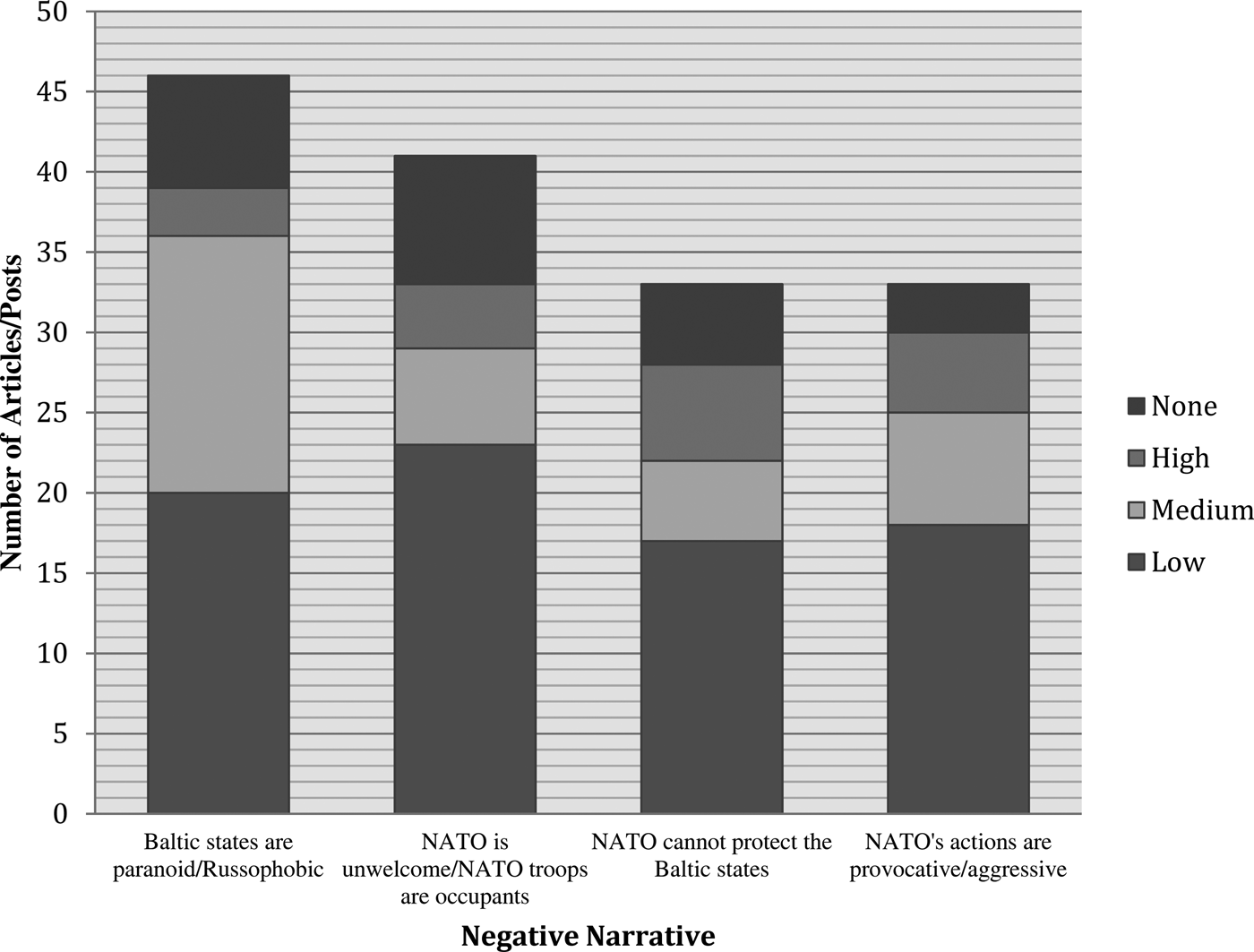
Such articles are part of a larger package of news pieces that criticise Baltic support for NATO. According to research conducted by the Atlantic Council's Digital Forensic Research Lab (DFRL), Russian-language media has promoted several negative narratives amid the eFP deployments in the Baltic region. During the critical period between February and March 2017, when the deployments were just arriving, the four most common narratives are that ‘The Baltic States Are Paranoid and/or Russophobic’, “NATO is Unwelcome/NATO Troops Are Occupants’, ‘NATO Cannot Protect Baltic States’, and ‘NATO's Actions are Provocative/Aggressive’.Footnote 105 Note how directly contradictory these narratives are when considered together. The Baltic states cannot be at once Russophobic but unwelcoming to NATO. Neither can NATO be defenceless against Russia in the region and still deploy a forward presence that directly threatens it. Russia may indeed be BSing, but it could simply be struggling to find a disinforming narrative that resonates with target audiences. These inconsistencies undermine the overall message.”
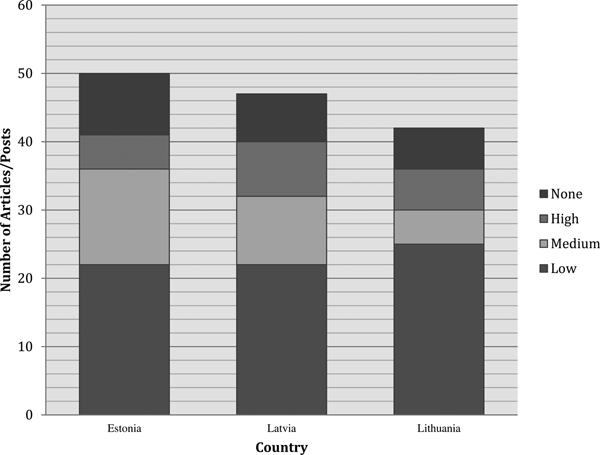
Popular engagement of articles containing these narratives – measured in terms of shares – appears limited. According to DFRL data, articles or posts advancing the four most common negative narratives acquired little traction when the eFP deployments had just arrived and local impressions were still forming. Figure 1 shows that the majority of narratives elicited mostly little reaction in the region, with engagements in Poland also counted. Figure 2 disaggregates the data by each Baltic country. Estonia and Latvia see the most engagement relative to Lithuania, a figure that makes sense given how their populations are about 25 per cent Russophone. Nevertheless, these narratives seem to elicit little reaction from Russian readers despite them theoretically being the most likely to consume news that is both in their first language and favourable to the Kremlin.
Engagement of articles/posts by negative narrative in the Baltic states and Poland. ‘Low’ engagement means fewer than 20 shares, ‘Medium’ is 21–100 shares, and ‘High’ exceeds 100 shares.

Engagement of articles/posts by country. ‘Low’ engagement means fewer than 20 shares, ‘Medium’ is 21–100 shares, and ‘High’ exceeds 100 shares.

Although the data presented above only give a snapshot of the general disinformation campaign, they should be considered alongside data on public attitudes towards NATO as well as government policies. A poll conducted in December 2015 by the public opinion research company RAIT – at the order of the Ministry of National Defense – found that 81 per cent and 82 per cent of Lithuanians surveyed support Lithuania's NATO membership and a permanent presence of NATO allies on Lithuanian territory. Sixty-seven per cent favour increasing defence spending to 2 per cent of the GDP by 2020, whereas 23 per cent disagreed.Footnote 106 Over the course of the year attitudes appeared stable, with a slight increase in support for NATO membership at 3 per cent.Footnote 107 These attitudes are mostly shared elsewhere in the region. A March 2017 survey commissioned by the Estonian Ministry of National Defence found that 78 per cent of Estonian-speakers are confident in NATO, although only 24 per cent of Russophones in Estonia share this assessment. Confidence in Estonia's state institutions, including its security apparatus, increased in 2017 from previous years.Footnote 108 In Latvia, a November 2016 poll reported that the percentage of Latvians supporting NATO remained stable from the previous year, with 59 per cent reporting that they felt that NATO enhances national security.Footnote 109 Admittedly, Latvian speakers and Russian speakers have been divided on NATO, with the former reporting more favourable attitudes about Latvia's membership in the alliance than the latter (73 per cent to 38 per cent).Footnote 110 Non-governmental surveys have reported similar findings. A Gallup World poll conducted throughout 2016 found that majorities of respondents in Lithuania (57 per cent), and Estonia (52 per cent) see NATO as protection. 49 per cent of Latvian respondents shared the same sentiment.Footnote 111
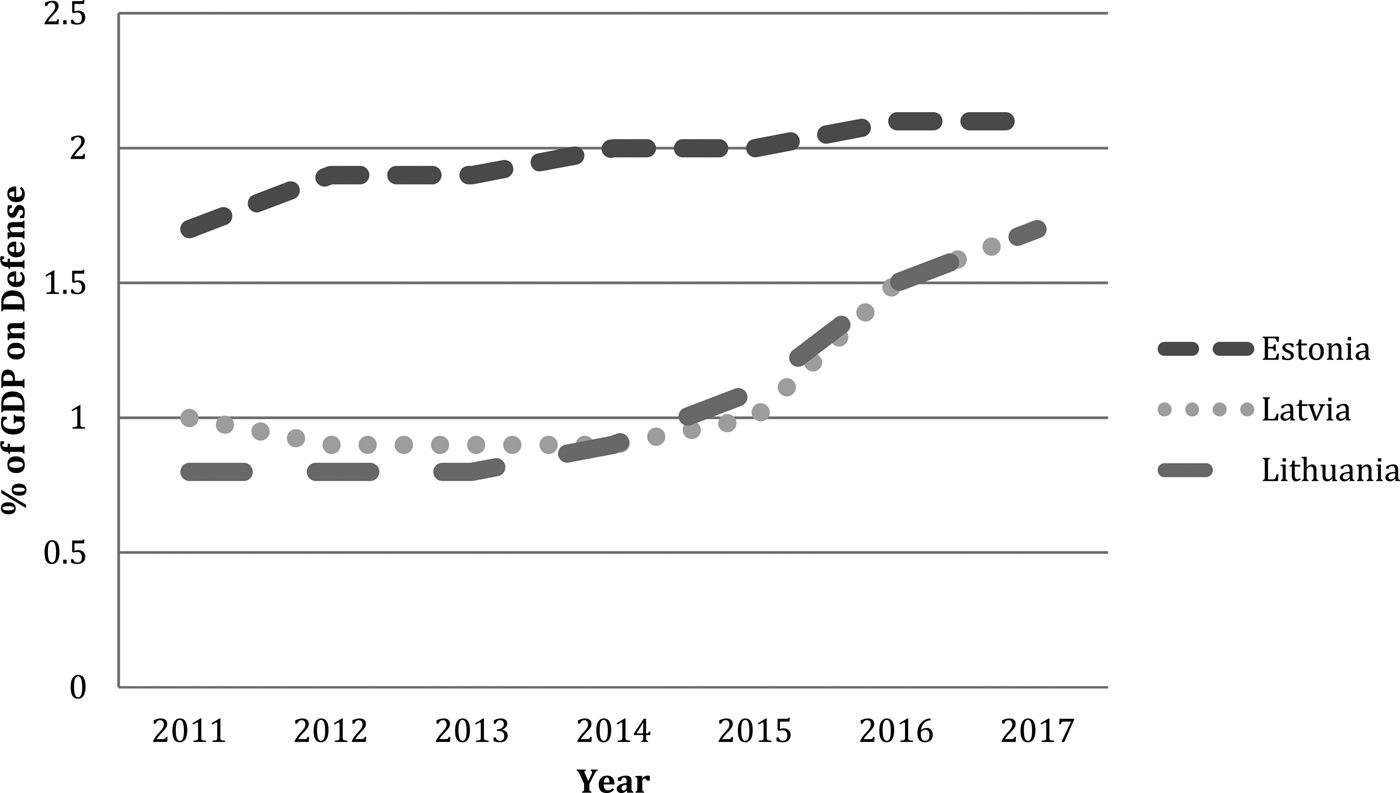
As for government policies, the simplest indicator to gauge the effectiveness of a disinformation campaign is to see whether it has any effect on alignments and military spending. Figure 3 highlights the trend lines in military spending in the last five years. The perceived uptick in Russian disinformation does not seem to have shaped spending patterns. To the contrary, defence spending continues to rise, especially in Latvia and Lithuania where governments had decided to cut military expenditures dramatically during the global financial crisis. Estonia has largely kept to the NATO-wide 2 per cent spending commitment, as reaffirmed in the 2014 Wales Summit. Although these countries would never be able to match Russia militarily, they are investing in denial capabilities that can complicate efforts by Russia to achieve battlefield success at low cost. They are also improving military infrastructures on their territories for alliance use and providing better equipment and training for citizens who may have to fight insurgencies in the event of a Russian invasion.Footnote 112
Defence spending as percentage of GDP.

Conclusion
Policymakers, pundits, and observers worry that states like Russia and China are spreading false narratives and disseminating rumours in order to shape public attitudes and, by extension, government policies to their liking. The disinformation campaign waged by Russia has caused much anxiety in particular. By actively advancing pro-Kremlin messages and attacking the legitimacy and platforms of political groups, Russia is trying to undermine NATO and its members from within, presumably to weaken their resolve to unite and to develop military capabilities. Unfortunately, existing theories in International Relations scholarship provide limited, if not contradictory, guidance on how to assess international disinformation campaigns.
This article casts doubt on whether international disinformation campaigns are effective. To begin with, anarchy creates not only uncertainty over how to interpret signals in international politics, but also scepticism since truth claims and interpretations of reality are wrapped up in power competition, especially between adversaries. Rules of thumb, prejudices, lived experiences, and so forth shape how information is processed. This view of cognition applies especially to average citizens – a view that has empirical support in the scholarly literature on political behaviour. The result is a double challenge for the disinforming state. It cannot be too obvious in its duplicity because anarchy gives states reason to doubt the messaging broadcast by adversaries. Yet it also has to contend with the biases and attachments of target audiences. Even under political polarisation the disinforming state has to wrestle with potential countermeasures. It will have trouble relaying a subtle enough message that does not preach to the choir but still sways a sufficient number of people to effect policy change. Evidence from Russia's disinformation campaign suggests that key targets of the campaign – especially in the Baltic region – seem unmoved. To be sure, these countries should not be complacent when it comes to Russian disinformation. Countermeasures like quickly dispelling rumours and falsehoods should be undertaken, not least to preserve the quality of political discourse. Precisely because international organisations like NATO are not complacent, they are blunting the potential effect of disinformation even more.
Evidence drawn elsewhere around the world supports the proposition that disinformation has had much less impact than commonly assumed. Right-wing populist politics has gained traction across Europe and the United States. Yet multiple causes can drive these outcomes (for example, economic inequality; stagnating middle-class incomes; deteriorating public services) such that populist success probably would have occurred absent Russian disinformation. The scholarship examining whether political attitudes change due to disinformation provides additional grounds for scepticism. Consider the issue of reach. One analysis examined the use of both news and false news outlets and found that no fake news website analysed in France and Italy – two highly polarised societies – had an average monthly reach that exceeded 3.5 per cent of the online population. Most reached less than 1 per cent. Furthermore, the ratio of total minutes spent on fake news websites to time spent on the most popular news websites in Italy and France was about 1:18 and 1:59, respectively. Fake news sites like RT and Sputnik News were crowded out. Similarly, an internal Facebook study on accounts suspected to be connected with information operations – for which states may be responsible – concluded that ‘the reach of the content spread by these accounts was less than one-tenth of one per cent of the total reach of civic content on Facebook’.Footnote 113 Another issue concerns receptivity. A survey examined the effectiveness of Russian propaganda efforts in Russia, Ukraine, Azerbaijan, and Kyrgyzstan.Footnote 114 Even in these countries where we would expect higher receptivity to Russia than within NATO, the survey reported mixed findings. Another study estimates that a quarter of Americans visited a fake news website in the last month of the 2016 US Presidential election.Footnote 115 However, those who visited fake news websites the most were Trump supporters who browsed intensely pro-Trump websites. A small minority was responsible for most of these visits. Exposure was selective and reinforced the echo chamber. Nevertheless, consistent with my argument, much more continuity than change has characterised the Trump administration's operational (not rhetorical) approach to US alliances and armament policies despite the rhetoric of the presidential campaign.Footnote 116
This article opens up several avenues for research. One possibility unexplored in this article is that adversaries face a ‘window of opportunity’ in waging international disinformation campaigns. With the creation of a new telecommunications medium, adversaries might perceive that the institutions governing those technologies are underdeveloped and so can exploit gaps in order to spread disinformation. The rise of mass media with radio and newspaper is one historical example. The recent advent of social media is another. However, these windows of opportunity can close quickly once target governments recognise the need to regulate the new technology and to adopt countermeasures against their adversaries.Footnote 117 The controversy surrounding Cambridge Analytica's harvesting of Facebook data during the 2016 Presidential election is illustrative. If Russia did indeed leverage these data to pursue a robust disinformation campaign against the United States, then Congressional actions and Facebook alike would combine to hamper Russia's ability to repeat such an effort. Future research should examine how these windows of opportunity open and close.
Scholars should also investigate the conditions under which states wage disinformation campaigns. Indeed, Russia's current campaign is puzzling. If popular support for NATO is unwavering and local NATO members are deepening their alignments and armament policies, then why does Russia persist in spreading disinformation? As intimated above, one hypothesis concerns Russian domestic politics. The Kremlin broadcasts disinformation abroad to prevent challenges to its authority at home. Yet other hypotheses are possible. Leaders of the disinforming state could become rhetorically entrapped by the disinformation used to legitimate their hold in power.Footnote 118 Alternatively, they might come to believe their own deliberate falsehoods.
For democracies, this article bears some unexpected good news. Autocracies would have a major advantage if international disinformation campaigns were really effective. They can exploit weaknesses in democratic societies that exist simply because of their own constitutional make-up. To fight disinformation and to ensure that adversaries do not succeed in duping their publics to act against the national interest, governments in democracies may be tempted to curb certain freedoms. They might even wish to resort to counter-disinformation themselves. Ironically, one significant bulwark against those dangers is the very thing that has alarmed some democratic theorists: the prejudices and partisan identities of citizens.
Author ORCIDs
Alexander Lanoszka, 0000-0001-6812-3873
Acknowledgements
For helpful commentary on previous drafts, the author thanks Andrew Bowen, Michael Hunzeker, Raymond Kuo, Deborah Welch Larson, Jennifer Lind, Steve Miller, Luis Simón, Jeffrey Taliaferro, in addition to Timothy Edmunds and two anonymous reviewers. Vismante Dailidenaite and Anastasia Agafonova provided excellent research assistance. A previous version of this article was presented at the 2018 ISA Annual Convention in San Francisco, California. This research has received support from the Institute for European Studies of the Vrije Universiteit Brussel and its project on political warfare and European security. All remaining errors are mine.
Alexander Lanoszka is Assistant Professor of International Relations in the Department of Political Science at the University of Waterloo and Honorary Fellow in the Department of International Politics at City, University of London.