INTRODUCTION
In the 1960s, Elizabeth French (Reference French1963; Reference French1964; Reference French1965; Reference French1966; Reference French1967; Reference French1969) published a series of seminal papers on Mycenaean pottery in the Annual of the British School at Athens. One of these papers discussed a large deposit of pottery found in front of the northern end of the Great Poros Wall: the long, curving wall, faced with ashlar work in poros limestone that supported the eastern side of the earthen mound above the Tomb of Clytemnestra (Fig. 1).Footnote 1 The paper is entitled ‘A group of Late Helladic IIIB1 pottery from Mycenae’ (French Reference French1966). In this article, French (Reference French1966, 216) assigned the deposit a Late Helladic (LH) IIIB1 date, although she thought that the pottery ‘may even represent an earlier aspect of LH IIIB1 style’. Confirmation of this view was provided by Wardle (Reference Wardle1969, 261; 1973, 304–7) and Mountjoy (Reference Mountjoy1976, 81–2, table 1; 1986, 93, 121), who traced the development of Mycenaean pottery throughout the LH IIIB period. The style of pottery is now known as early LH IIIB1 (e.g. Wardle Reference Wardle1973, 304; Mountjoy Reference Mountjoy1986, 93; Iakovidis et al. Reference Iakovidis, French, Shelton, Lavery, Jansen and Ioannides2003, 52). The deposit is significant not only because it shows the pottery shapes and motifs in use at the beginning of LH IIIB (French Reference French1966; Wardle Reference Wardle1973, 304–6), but also because it helps date the construction of the Tomb of Clytemnestra and is thought to represent the remains of offerings or a ritual feast associated with the tomb (French Reference French, MacKenzie and Roueche1989, 125; Reference French2002, 71; Hood Reference Hood1953b, 84; Hope Simpson Reference Hope Simpson1981, 13–14; Iakovidis et al. Reference Iakovidis, French, Shelton, Lavery, Jansen and Ioannides2003, 52; Mason Reference Mason2013, 116–17).
Mycenae: the Perseia Area, with the Great Poros Wall (Taylour Reference Taylour1955, pl. 36, with additional labels). Reproduced with the permission of the British School at Athens.

The deposit was found in July 1952. Although French was working at Mycenae at the time of its discovery (Wace Reference Wace1953a, 3), the deposit was actually excavated by Sinclair Hood. He found the deposit while investigating the area immediately to the south of the Perseia Fountain House. The remains of this Hellenistic structure lie just to the north-east of the Tomb of Clytemnestra (Wace Reference Wace1953b) (Figs 1 and 2). Hood (Reference Hood1953a) published a report detailing the excavation of the Fountain House in which he included a brief description of the discovery of the pottery deposit.
Plan of the Perseia Fountain House (Hood Reference Hood1953a, pl. 12). Reproduced with the permission of the British School at Athens.

From French (Reference French1966, 217) and Hood (Reference Hood1953a, 23–4, pl. 12) we learn that the deposit appeared in four trenches: Prehistoric Cemetery Central (PCC) III, where it rested on a surface of hard tramped earth; PCC IV, where it lay directly on bedrock; and PCC III Extension East (Ext E) and Area VII, where it rested on white clay plaster floors (Fig. 2). Hood (Reference Hood1953a, 23; 1953b, 84, 86) informs us that the deposit appeared just below the modern ground surface. French (Reference French1966, 217) elaborates on this, stating that it ‘came from Levels 2 and 3, immediately below the surface soil and extended only 0.20 m in depth’. ‘Below the level of the tramped-earth surface and of the plaster floors’, Hood (Reference Hood1953a, 24) tells us that there ‘was a fairly uniform fill, which appears to represent debris from the ruins of houses with walls of mud-brick’. He goes on to state that ‘from the fill … below the level of the white clay plaster floors down to the rock, along with Middle Helladic (MH) type plain wares, several scraps of painted pottery of early LH appearance were recovered’. He also mentions that there were various features, such as pits and shallow channels, cut into the bedrock in all four trenches (Hood Reference Hood1953a, 23–5).
This is the extent of the published information on the stratigraphy of the four trenches associated with the pottery deposit. Given the significance of the deposit, this is somewhat surprising. We clearly need an accurate account of the stratigraphy. Thankfully, Hood's excavation notebook contains a great deal of unpublished information, allowing us to better understand the archaeological history of the area. It highlights some inaccuracies and omissions in the published accounts, brief though they are. One particularly important fact that emerges from an examination of the notebook is that just below the white clay plaster floors in PCC III Ext E and Area VII there was another surface, and lying on this there was another deposit of pottery, unconnected to the one above. In both trenches the layer between the white clay plaster floors and this other surface was designated Level 3. French included the pottery from Level 3 of PCC III Ext E in her analysis. Although she did not openly state this in her paper, the kept material from PCC III Ext E reveals that she did, as some of the sherds from Level 3 are illustrated in her article (French Reference French1966, figs 6:29, 8:5,9,15,16,19, pl. 48:d7). An examination of the sherds from Level 3 of PCC III Ext E shows that they are of early LH IIIB1 date, which contrasts sharply with Hood's statement that the pottery found beneath the white clay plaster floors dated to the MH and early LH periods.
This paper will not only present the stratigraphy of the four trenches associated with the pottery deposit, but will also demonstrate that the pottery from Level 3 of PCC III Ext E came from an earlier stratigraphic layer. The sherds from this level will then be discussed and compared with the material from the pottery deposit. But first, it is important to provide the general context of the pottery deposit by looking at the surfaces associated with it – the white clay plaster floors and the surface of hard tramped earth – and then to summarise what is known about the deposit itself, particularly its composition and significance.
THE SURFACES AND THE POTTERY DEPOSIT
The white clay plaster floors
Hood (Reference Hood1953a, 23) reported that during his exploration of the area immediately to the south of the Perseia Fountain House he encountered close to the modern ground surface ‘a well-defined level marked by floors coated with white clay plaster’. He went on to state that ‘this level of white clay plaster floors could be traced right across the area’ from PCC III Ext E on the west side, through Areas VII, XIV, XIa and X, to Area IX on the east side (Hood Reference Hood1953a, 23, pl. 12) (Fig. 2). The level of the plaster floors appears to have continued to the east of the Fountain House, too, for two trenches on the eastern side of the structure also produced white clay plaster floors: Area XII, excavated by Hood (Reference Hood1952, 3, 57, 80), and Area Z, excavated by Lord William Taylour (Reference Taylour1955, 199–201, pl. 36) (Fig. 1). The floors date to the Mycenaean period (Hood Reference Hood1953a, 23).
In Area X, as stated by Wace (Reference Wace1953c) and illustrated by Hood (Reference Hood1952, 52–3) on the rough plan of this trench in his notebook, a white clay plaster floor covered almost the entire area of the trench south of the steps next to the Main Wall of the Fountain House. What is more, this trench, in a cutting on the south side of wall ε, produced evidence of at least four successive white clay plaster floors, indicating that the floor was occasionally re-laid (Hood Reference Hood1953a, 23). In Areas XIV and IX, to the west and east of Area X respectively, there were two white clay plaster floors, one above the other. Section drawings in Hood's notebook show that in both of these trenches the plaster floors were fairly level and that there was black earth immediately beneath the lower floors (Hood Reference Hood1952, 37–9, 90–1). In PCC III Ext E and Area VII, both of which were to the west of Area XIV, there was just one white clay plaster floor (Hood Reference Hood1952, 74–5, 88–9, 114).
Hood (Reference Hood1952, 59) established that the highest white clay plaster floor in Area X was originally connected to the upper of the two plaster floors in Area IX, and it seems likely that the upper floor in Area XIV, together with the floors in PCC III Ext E and Area VII, also formed part of this particular white clay plaster floor. This roughly level floor, stretching from PCC III Ext E to Area IX and from the southern edge of Area X to the Main Wall of the Fountain House, would have measured approximately 18 m by 7 m, making an area of roughly 126 m2. It could have been much larger than this if it continued to the east, to include the white clay plaster floors found in Areas XII and Z, and also to the north, where it would necessarily have been destroyed by the construction of the Fountain House.
To the south, the white clay plaster floors appear to have been bounded by the East–West Wall: the long, straight wall that stretched along the crest of the ridge (Fig. 1). This structure is believed to have demarcated the northern limit of a sacred area comprising the Tomb of Aegisthus (dated to LH IIA) and the Prehistoric Cemetery (MH–LH II burials) (Desborough Reference Desborough1954, 258, 260; Taylour Reference Taylour1955, 205; Alden Reference Alden2000, 17–18; Iakovidis et al. Reference Iakovidis, French, Shelton, Lavery, Jansen and Ioannides2003, 52). The exact date of the East–West Wall is unknown, but it was certainly built after the Tomb of Aegisthus and predates the construction of the Tomb of Clytemnestra (Taylour Reference Taylour1955, 204–5, 211; Alden Reference Alden2000, 17–18).
Hood (Reference Hood1953a, 23–4) thought that the plaster floors may have belonged to one or more Mycenaean buildings. There were ‘two short stretches of rubble walling (δ, ε) in the same horizon as the white clay plaster floors’ (Hood Reference Hood1953a, 23), yet neither of these was definitely associated with any of the floors (Hood Reference Hood1953a, 23; Wace Reference Wace1953c). This led Wace (Reference Wace1953c) to dismiss the idea that the plaster floors in Area X belonged to a building, although he could not perceive their actual purpose. It is possible that the largest and highest white clay plaster floor in the area served as a formal public open space, where rituals and events that bonded the elite and people of Mycenae together were held. Lying just outside the citadel, it would have been an ideal location for such activities. In an article on Mycenaean courts and squares in Mycenaean towns, Cavanagh (Reference Cavanagh and Branigan2001, 131) concluded that ‘the search for a public meeting place, where populace and rulers might come together, has failed’. Perhaps this was such a place at Mycenae.
The surface of hard tramped earth
Neither PCC III nor PCC IV produced any traces of white clay plaster floors (Hood Reference Hood1952, 30, 32, 113). In PCC III, Hood (Reference Hood1952, 113; 1953a, 23–4) did, however, encounter a surface of hard tramped earth, which abutted against the base of the bottom course of stones of the rubble foundation of the Great Poros Wall. This surface was created either during or directly after the construction of the Great Poros Wall (Mason Reference Mason2013, 114). Hood (Reference Hood1953a, 23) noted that the surface of hard tramped earth was ‘at the same level’ as the highest white clay plaster floor and was ‘evidently in use at the same time’. It seems that the surface served to connect the wall to the plaster floor.
Hood (Reference Hood1953a, 23, pl. 12) labelled his section of the rubble foundation of the Great Poros Wall ‘curved wall α’. Preserved only one or two courses high, curved wall α is about 0.20 m in height and just under 1 m wide (Hood Reference Hood1952, 110; Reference Hood1953a, 24; Wace Reference Wace1952, 16) (Figs 2 and 3).
Curved wall α, with wall λ to the left and the citadel of Mycenae behind (July 2022).

The deposit of pottery
The deposit consisted of ‘a great mass of pottery fragments’ (Hood Reference Hood1953a, 23). We know that 1867 sherds were kept, although this represents just the tip of the iceberg, because all of the unpainted sherds and most of the sherds with only linear decoration were thrown away (French Reference French1963, 49 n. 71; 1966, 217). Hood (Reference Hood1953a, 23) was fairly confident that the deposit represented the remains of whole pots rather than being just a mass of miscellaneous fragments. After examining the pottery from PCC III and PCC IV, French (Reference French1963, 49; Reference French1966) concluded that most of the sherds belonged to kylikes, deep bowls, stemmed bowls and small stirrup jars. There were very few other shapes in the deposit (French Reference French1963, 49), although it did include many fragments of terracotta figurines of various types (Hood Reference Hood1953a, 24; Reference Hood1953b, 85; French Reference French1963, 49; Reference French1966, 233–4). The deposit is regarded as a closed group (French Reference French1963, 49; Reference French1966, 217).
Given that the majority of the sherds come from vessels associated with the consumption of food and drink, it has been argued that the deposit represents the remains of a feast linked to the Tomb of Clytemnestra, and that this feast was held either to celebrate the successful completion of the tomb or as part of the funerary rites relating to the first interment within it (Mason Reference Mason2013, 116). From the area of bare rock and the surface of hard tramped earth immediately in front of the Great Poros Wall, this feast would surely have extended across the entire area of the large white clay plaster floor. It has also been suggested that at the end of the feast the pots were deliberately broken by throwing them against the northern end of the Great Poros Wall or onto the ground in much the same way as kylikes were customarily smashed in Mycenaean funerary rites (Mason Reference Mason2013, 116). If so, afterwards, much of the area, particularly the part immediately in front of the Great Poros Wall, would have been littered with fragments of broken pots.
We know that the rubble foundation of the Great Poros Wall was covered at the end of the process to construct the Tomb of Clytemnestra, and it seems that the pottery was used as fill to help conceal the section of the foundation at the northern end of the wall (Mason Reference Mason2013, 112, 116). It goes without saying that any pottery not already lying immediately in front of the Great Poros Wall would have to have been shifted to the western side of the area. Using the pottery as fill would have ensured that the remains of the feast were permanently tied to the tomb.
This theory best explains the content of the deposit – vessels connected with consumption of food and drink – and its context – as fill to help conceal the rubble foundation of the Great Poros Wall. As the deposit lies on a surface that abutted against the bottom of the wall, it gives a terminus ante quem of early LH IIIB1 for the construction of the Tomb of Clytemnestra.Footnote 2
THE STRATIGRAPHY
We can now examine the stratigraphy of the four trenches associated with the deposit in detail. PCC IV will be looked at first, so that PCC III, PCC III Ext E and Area VII can be studied in order from west to east. The information presented below is taken from Hood's Reference Hood1952 excavation notebook, which is held in the Mycenae Excavations Archive in the Faculty of Classics, University of Cambridge.
The entries in the notebook are usually quite short, but, nevertheless, provide useful summaries of the layers, features and pottery encountered in each trench. Judging by the style and the abbreviations, they were clearly written for Hood's own benefit: to act as an aide-mémoire when writing his report. This means that some of the entries can be interpreted in different ways.
Hood excavated the trenches in ‘Levels’, with the layer of earth immediately below the modern ground surface designated Level 1. Usually, these corresponded to the stratigraphic layers encountered, although sometimes features were given level numbers, such as a pit in PCC IV (Level 4). As our trenches were excavated completely independently of each other, the levels in one trench are not necessarily the same as those in an adjacent trench; for example, a layer of brown earth and stones was Level 5 in Area VII but Level 6 in PCC III Ext E. Unfortunately, Hood did not always record the thickness of each layer. Moreover, although he included rough plans, and sometimes sections, of our four trenches, he neglected to make a note of the dimensions of the trenches. We, therefore, have to refer to the published plan for this information (Hood Reference Hood1953a, pl. 12) (Fig. 2).
The director of the British Excavations at Mycenae in 1952 was Alan Wace. He recorded his own observations in his Director's Daybook (Wace Reference Wace1952). In the case of our four trenches, his entries, unfortunately, only describe the excavation of the pottery deposit in general terms rather than giving any detailed information on the stratigraphy associated with it (Wace Reference Wace1952, 16, 19, 22, 24).
PCC IV
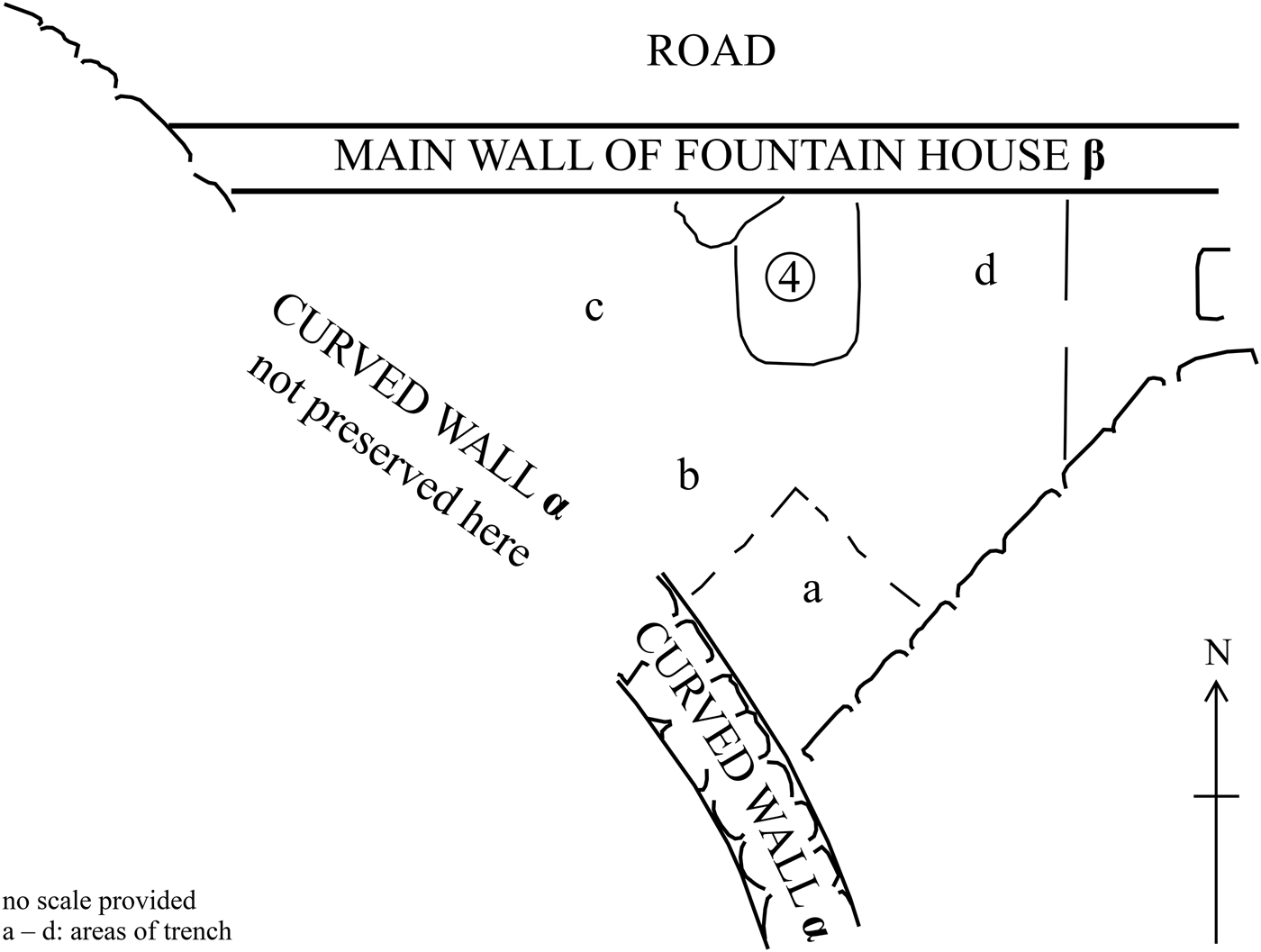
The simple plan of PCC IV in Hood's notebook shows that this trench was roughly triangular in shape, bordered by the Main Wall of the Fountain House, curved wall α (although the rubble foundation of the Great Poros Wall is only partially preserved here) and walls κ and λ (Hood Reference Hood1952, 33). Walls κ and λ, later renamed η and β respectively (Hood Reference Hood1953a, 25, pl. 12), separated PCC IV from PCC III (Figs 2, 3, 4 and 5). Wall κ is later than both the Great Poros Wall and the pottery deposit, because it abuts against curved wall α and was built above the deposit. Wall λ, which extends from curved wall α almost to the Main Wall of the Fountain House, is later still because it lies on top of wall κ.Footnote 3 The length of the edge of PCC IV as defined by the course of the Great Poros Wall was about 6 m (Hood Reference Hood1953a, pl. 12).
Plan of PCC IV (after Hood Reference Hood1952, 33).

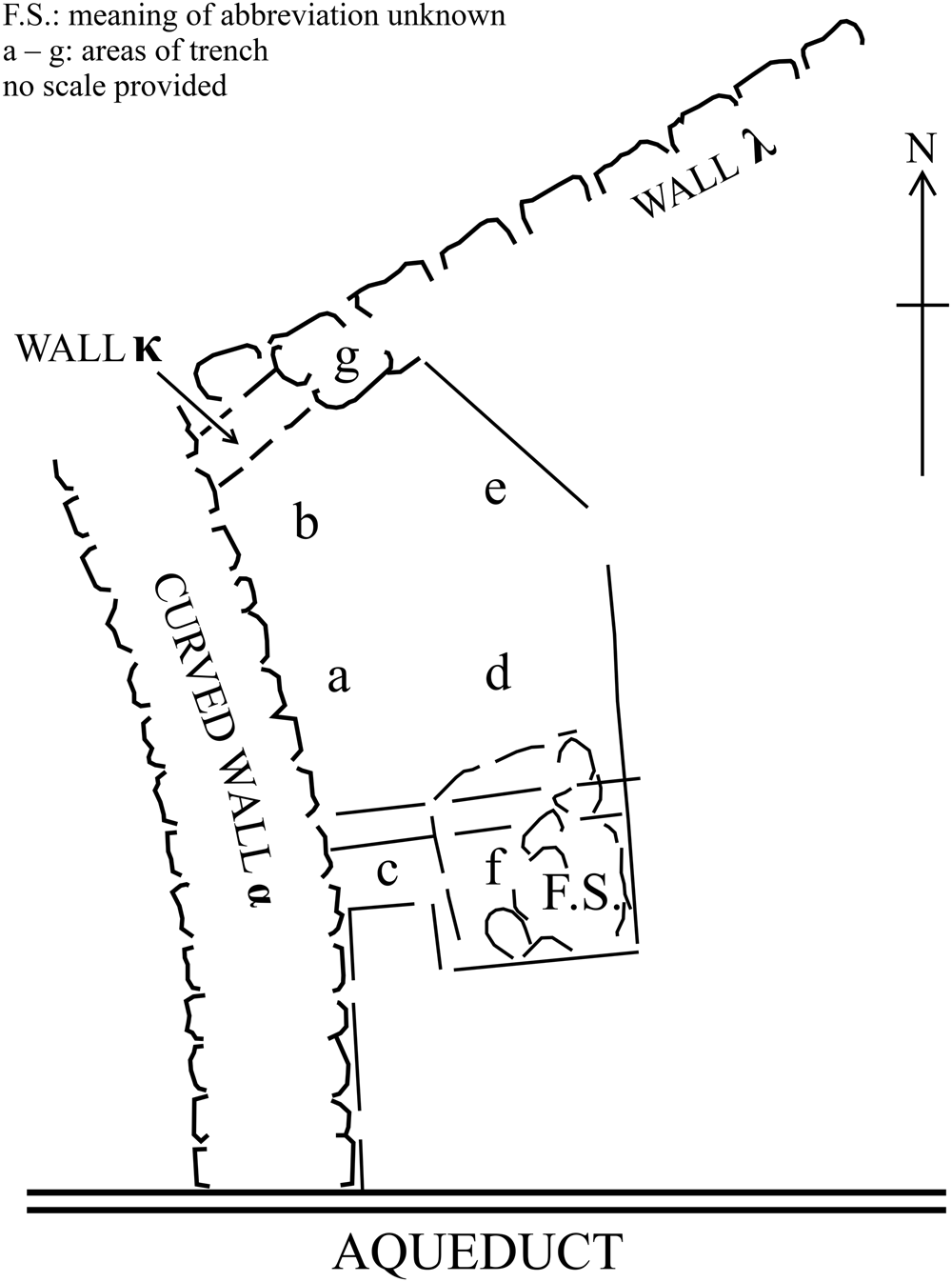
Plan of PCC III (after Hood Reference Hood1952, 31).

Level 1 yielded mainly Mycenaean sherds (Hood Reference Hood1952, 32, pottery notes). Level 2 was in areas ‘a’, ‘b’ and ‘c’. There was hard earth with small stones only in area ‘a’, i.e. the south corner of PCC IV. The pottery deposit appeared in area ‘a’ and the adjacent area to the north, ‘b’, and extended about 1.50 m from curved wall α (Fig. 4). It rested directly on bedrock, which was 0.10–0.20 m down (Hood Reference Hood1952, 32–3, 35, 110). Level 3 was next to the Main Wall of the Fountain House in area ‘d’. It produced only a few Mycenaean sherds (Hood Reference Hood1952, 32–3, pottery notes). Lastly, Level 4 was a shallow rectangular pit, oriented roughly north–south (Fig. 4). Approximately 1.40 m long, 0.80 m wide and 0.15 m deep, it was filled with earth containing LH III sherds, very similar to those found in Level 1, and including some of LH IIIB date (Hood Reference Hood1952, 32–3, pottery notes; Reference Hood1953a, 25). Hood (Reference Hood1952, 32, 110; Reference Hood1953a, 25) labelled it ‘pit π’ and thought that it was possibly a plundered and eroded MH grave.
PCC III
PCC III was immediately to the south of PCC IV and, like PCC IV, was next to curved wall α. The length of the edge following the wall was approximately 5 m (Hood Reference Hood1953a, pl. 12). The shape of PCC III in the published plan is somewhat different from that shown in the rough plans of the trench in Hood's notebook (Hood Reference Hood1952, 31, 80; Reference Hood1953a, pl. 12). Hood (Reference Hood1952, 30–1; Reference Hood1953a, pl. 12) divided PCC III into seven areas, labelled ‘a’ to ‘g’, but, except in areas ‘c’ and ‘f’, which were excavated to bedrock, he did not investigate beneath the surface of hard tramped earth (Figs 2 and 5). He drew no sections of the trench.
Level 1 produced the same sort of pottery as Level 1 of PCC IV (Hood Reference Hood1952, 30, pottery notes). The depth of this level was not recorded, although it appears to have been only a few centimetres thick (Hood Reference Hood1952, 30; Reference Hood1953b, 84, 86). Level 2 was a layer of soft earth. It continued down to the surface of hard tramped earth, which was about 0.20 m below the top of curved wall α and abutted against the base of the wall. Level 2 contained the pottery deposit, which covered the entire area of the trench (Hood Reference Hood1952, 30, 113, pottery notes; Reference Hood1953a, 23–4). In area ‘b’ only, which was at the north-west corner of the trench, there were two layers: Level 2 itself and Level 2a underneath (Fig. 5). About 0.10 m deep, Level 2a consisted of soft earth with a large number of stones. There were some sherds among and below the stones and these were regarded as part of the same deposit (Hood Reference Hood1952, 30–1, 113). It should be noted here that area ‘b’ was next to area ‘a’ of PCC IV, where there were also stones mixed in with the soil, although in area ‘a’ the earth was described as hard, not soft. Perhaps the stones in these two adjacent areas were left over from the construction of the Great Poros Wall and, like the sherds of the deposit, were used as fill to conceal the foundation (Mason Reference Mason2013, 116). The stones in area ‘b’ of PCC III were certainly of the type used in the construction of the wall, because Hood (Reference Hood1952, 113) wondered if they had fallen from the wall.
Level 3 was in a pit located in area ‘f’, at the south-east corner of PCC III (Fig. 5). The dimensions of this pit were not recorded, although there is a note stating that it was more than 0.50 m deep (Hood Reference Hood1952, 30–1, pottery notes). Level 3 consisted of the same soft earth encountered in Levels 2 and 2a, and, like these levels, contained sherds belonging to the pottery deposit (Hood Reference Hood1952, 30–1). In his initial entry for Level 3, Hood (Reference Hood1952, 30) used the word ‘ditto’ to state that the characteristics of the level were the same as those of Level 2, although it is unclear whether he meant that the earth of Level 3 had stones (like Level 2a) or did not have stones (like Level 2). The rough plan shows some possible stones in the area of the pit, along with the letters FS, which could mean ‘full of stones’, but could equally mean ‘full of sherds’ or ‘find spot’ (Fig. 5). Significantly, in his summary of PCC III, Hood (Reference Hood1952, 113) only mentioned that stones were found in area ‘b’. If they are stones in the plan, then they probably belonged to the traces of a wall that were discovered in Level 1 in the south-east corner of PCC III (Hood Reference Hood1952, 113). On balance, Level 3 most probably did not contain stones.
Beneath the pit and continuing down to bedrock, Level 4 was brown earth containing some MH sherds and one LH IIIB sherd (Hood Reference Hood1952, 30–1, pottery notes). Lastly, Level 5 was a channel cut in the bedrock (Figs 2 and 5). Running roughly east–west, it apparently yielded some LH III pottery (Hood Reference Hood1952, 30–1, pottery notes). The depth at which bedrock was encountered was not recorded.
PCC III Ext E
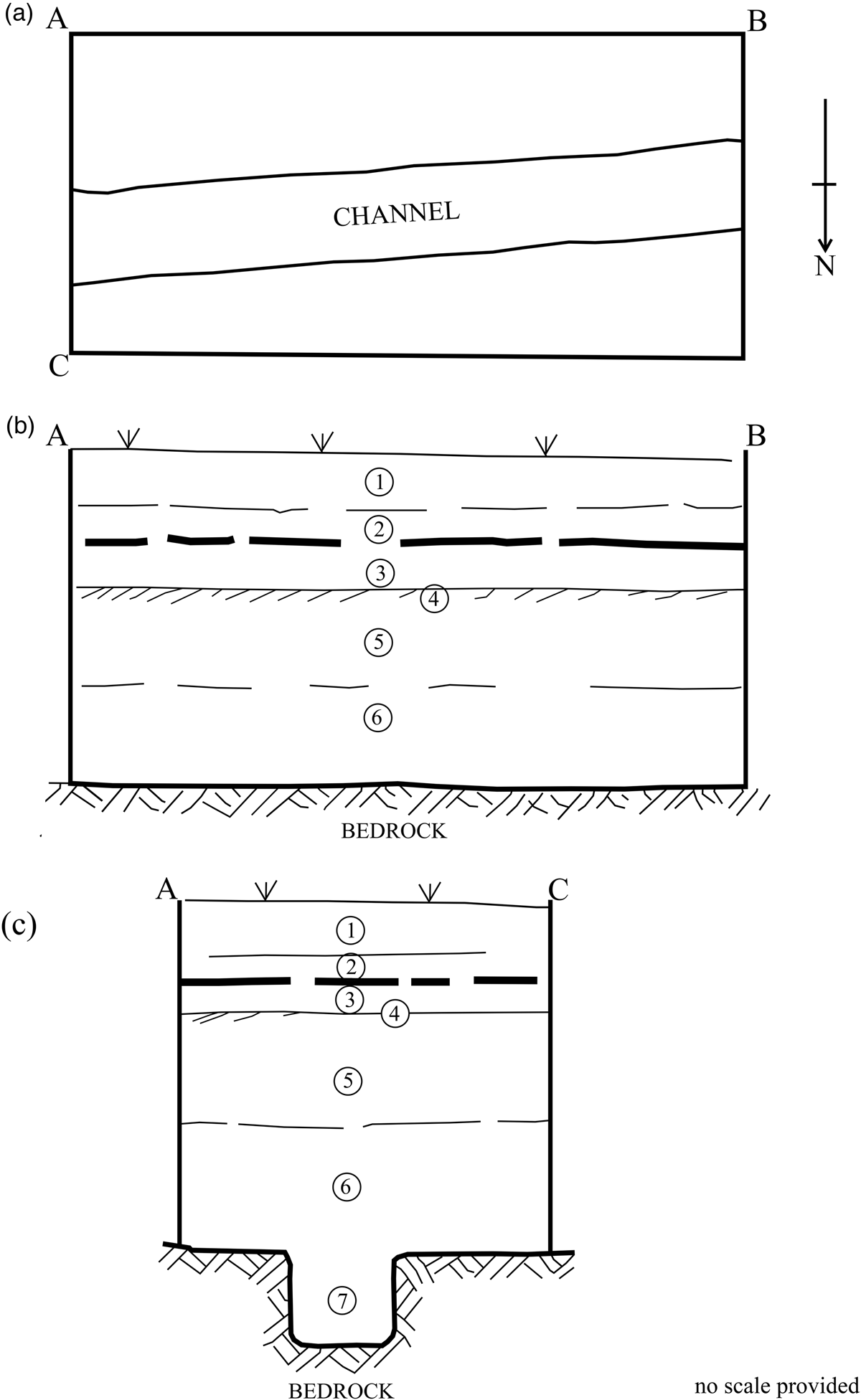
PCC III Ext E was a small rectangular trench less than 1 m to the east of PCC III. It measured approximately 1.50 m east–west by 1 m north–south (Hood Reference Hood1953a, pl. 12). Hood (Reference Hood1952, 89) included a rough plan and two simple section drawings of the trench in his notebook (Figs 2 and 6). The sections not only show that the modern ground surface, the strata/levels and the bedrock in the area of PCC III Ext E were all roughly horizontal but that the strata in both sections were the same (Fig. 6bc).
Plan and sections of PCC III Ext E (after Hood Reference Hood1952, 89).

Level 1 continued to 0.20 m down and contained some MH sherds and one or two pieces of Hellenistic pottery; the rest of the sherds were Mycenaean (Hood Reference Hood1952, 88–9, pottery notes). Level 2 was between 0.20 m down and the white clay plaster floor, which, although badly damaged, was quite distinct. This can be seen in the sections of the trench (Fig. 6bc). The remains of the white clay plaster floor appeared at a depth of 0.25–0.27 m below the modern ground surface (Hood Reference Hood1952, 88–9, 114). Level 2 yielded a large quantity of sherds, and this was identified as a continuation of the pottery deposit found in Level 2 of PCC III (Hood Reference Hood1952, 88).
Level 3 was the earth immediately beneath the white clay plaster floor. It, too, contained a deposit of pottery, which was composed of a ‘huge number’ of sherds of fine wares (Hood Reference Hood1952, 88–9, pottery notes). Hood (Reference Hood1952, pottery notes) compared the pottery of Levels 2 and 3 and noted that kylix stems and sherds of large vessels were more common in Level 2 than in Level 3. Level 4 was a layer of hard reddish earth, which was encountered at a depth of 0.30 m below the modern ground surface and extended across the entire area of the trench (Hood Reference Hood1952, 88–9) (Fig. 6bc). Hood (Reference Hood1952, 88) noted that this layer formed the floor for Level 3, meaning that it was the surface upon which the deposit in Level 3 rested. It was evidently the surface in the area of PCC III Ext E before the white clay plaster floor was extended across the area.
Level 5 was a layer of brown earth, whereas Level 6 was a layer of brown earth and stones lying immediately above bedrock (Fig. 6bc). Level 6 contained very little pottery and only a few of the sherds were painted (Hood Reference Hood1952, 88–9, pottery notes). Finally, Level 7 was a channel cut in the bedrock (Hood Reference Hood1952, 88–9) (Fig. 6ac).
Area VII
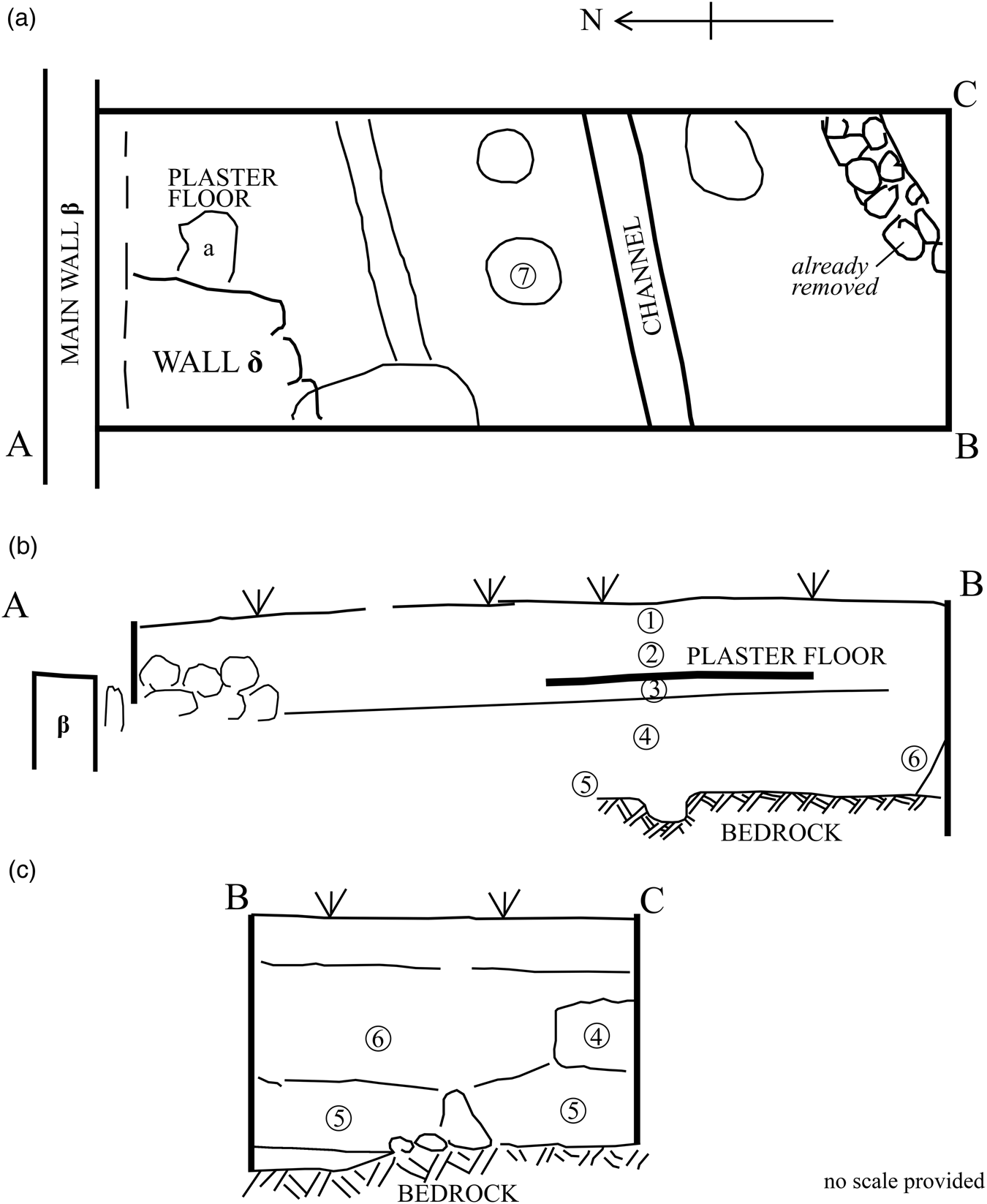
Approximately 0.50 m to the east of PCC III Ext E, Area VII was a rectangular trench, oriented north–south, with its northern end at the Main Wall of the Fountain House. It was about 2 m wide and 7.50 m long (Hood Reference Hood1953a, pl. 12). Again, Hood (Reference Hood1952, 75) drew a rough plan and two simple section drawings of the trench in his notebook (Figs 2 and 7). One of the sections shows that the modern ground surface sloped gradually down from south to north (Fig. 7b).
Plan and sections of Area VII (after Hood Reference Hood1952, 75).

Level 1 was the surface layer. Level 2, like Level 2a of PCC III, with which it was equated, consisted of soft earth and small stones. The pottery deposit was found in this level but only on the western side of Area VII; it was resting on the remains of the white clay plaster floor, which appeared in the southern half of the trench (Hood Reference Hood1952, 74–5, 113; Reference Hood1953a, 24) (Fig. 7b). In the north-west corner of Area VII was wall δ. Only the east face of this rubble wall was clearly defined. In front of this face, a patch of the white clay plaster floor was found and labelled ‘a’ (Fig. 7a). It did not abut against the wall: there was a 0.03–0.04 m gap between the plaster floor and the wall, leading Hood (Reference Hood1952, 115) to believe that the floor had been cut through to allow the construction of the wall.
Composed of soft earth and small stones, Level 3 was immediately beneath the white clay plaster floor. The lowest part of Level 3 contained a ‘concentration’ of sherds of LH IIIB date, several of which were decorated (Hood Reference Hood1952, 74–5, pottery notes). The north–south section drawing of Area VII shows a thin layer running almost the entire length of the trench at the base of Level 3. It slopes down gradually from south to north (Hood Reference Hood1952, 75) (Fig. 7b). The layer does not reach the southern edge of the trench. Moreover, it does not appear in the section drawing of the south end of Area VII, so we do not know whether it extended across the whole width of the trench. Hood did not record the layer's texture or colour, but it equates to the hard reddish layer found in PCC III Ext E.
As noted above, below the hard reddish layer in PCC III Ext E there was a layer of brown earth (Level 5) and then a layer of brown earth and stones (Level 6). It was the same in Area VII: the brown earth was Level 4 and the layer of brown earth and stones lying immediately above bedrock was Level 5 (Hood Reference Hood1952, 74–5) (Fig. 7bc). Level 6 was earth and stones at the south end of Area VII. In the section of the south end of the trench, it appears above Levels 4 and 5 (Fig. 7c). It contained a lot of MH pottery and one LH III sherd (Hood Reference Hood1952, 74–5, pottery notes).
Level 7 was a circular pit located roughly in the middle of the trench (Fig. 7a). Cut into the bedrock, it had a diameter of 0.65 m and a depth of 0.30 m. It was filled with soft earth and contained only a few MH sherds (Hood Reference Hood1952, 74–5, 115). There were two rock-cut channels in Area VII. Both were oriented roughly east–west (Hood Reference Hood1952, 75, 115) (Fig. 7ab). The channel in the southern half of the trench evidently formed a single continuous channel with the ones in PCC III and PCC III Ext E (Hood Reference Hood1953a, 24–5, pl. 12) (Fig. 2). The date and purpose of these channels is not known (Hood Reference Hood1953a, 25; Wace Reference Wace1953c). At the southern end of Area VII, there was a shallow pit, cut into the bedrock and visible in the section, and part of a rubble wall, which was built on the bedrock (Fig. 7ac). Probably MH in date and consisting of only one course of small stones, this wall was less than 0.10 m high and about 0.40 m wide (Hood Reference Hood1952, 75, 115; Reference Hood1953a, 24). There were also some holes cut in the bedrock (Hood Reference Hood1952, 115; Reference Hood1953a, 25).
Hood did not record in his notebook the depth at which bedrock was reached in either Area VII or PCC III Ext E, although in his report he stated that in both these trenches it lay at an average depth of about 1 m below the modern ground surface (Hood Reference Hood1953a, 24).
Summary of the stratigraphy: the unpublished v. published accounts
Having examined the stratigraphy of the four trenches, we can now compare the unpublished and published accounts. What emerges is that there are several discrepancies between the two. Three in particular – namely the hitherto unreported pit in PCC III, the appearance of a ‘new’ surface immediately below the white clay plaster floors in PCC III Ext E and Area VII, and a deposit of pottery associated with this surface – markedly change our understanding of the archaeological history of the area.
In PCC IV, the pottery deposit appeared only in Level 2. In PCC III, the deposit was discovered in Levels 2 and 3: on the surface of hard tramped earth and in the pit, respectively. In this trench, Levels 2 and 3 are stratigraphically the same, as the soft earth and the pottery deposit ran across the surface of hard tramped earth and also filled the pit. Hood failed to mention the pit in his report and the feature was omitted from the published plan. French likewise neglected to mention the feature in her article. After announcing that the pottery deposit was found resting on the surface of hard tramped earth, she simply stated that it came from Levels 2 and 3 and was only 0.20 m deep (French Reference French1966, 217), giving the impression that both levels were between the modern ground surface and the surface of hard tramped earth. French (Reference French1966, 217) mentioned that she used Hood's notebook, so she must have extracted these details from the pages referring to PCC III.
The pottery deposit also appeared in PCC III Ext E and Area VII. In both these trenches it was encountered in Level 2, which was immediately above the remains of the white clay plaster floor. In Area VII, the earth was soft and mixed with stones, as in Level 2a of area ‘b’ of PCC III. Just below the white clay plaster floor in PCC III Ext E and Area VII there was another surface. In PCC III Ext E, and probably in Area VII, too, this was of hard reddish earth and encountered at a depth of 0.30 m below the modern ground surface. In his report, Hood said nothing about this surface.
In PCC III Ext E and Area VII, the level between the white clay plaster floor and this ‘new’ surface was labelled Level 3. In PCC III Ext E, the surface itself was designated Level 4. On this surface/in the earth of Level 3 of PCC III Ext E and Area VII there was another deposit of pottery. This pottery is clearly stratigraphically earlier than the main deposit of pottery found in our four trenches. Consequently, the pottery recovered from Level 3 of PCC III Ext E does not belong with the other material, yet French included this pottery in her analysis. French (pers. comm. 2018) did not remember the reason for doing this, although it was probably because in PCC III the pottery deposit was recovered from Levels 2 and 3 and in the extension of the trench to the east there were likewise deposits of pottery in both Levels 2 and 3.
It should be mentioned here that the surface of hard reddish earth appears to have been on the same level as the lower of the two white clay plaster floors found in Area XIV, the next trench to the east of Area VII. At the west end of Area XIV, the earth above the lower plaster floor was designated Level 3 (Hood Reference Hood1952, 90–1, pottery notes). Hood (Reference Hood1952, pottery notes) observed that it contained LH IIIB pottery but nothing earlier. It seems, therefore, that the deposit extended further to the east.
Below the surface of hard reddish earth in PCC III Ext E and Area VII, there was a layer of brown earth, then a layer of brown earth and stones lying immediately above bedrock. Whether this can be described as ‘a fairly uniform fill’ and represented the remains of mud-brick houses, as argued by Hood (Reference Hood1953a, 24), is open to question.
THE POTTERY FROM LEVEL 3 OF PCC III EXT E
The pottery storage notes for the British Excavations at Mycenae state that Box 15 contains ‘the deposit of pots, published in BSA 61’; in other words, the box holds the sherd material from PCC III, including PCC III Ext E, and PCC IV. The box is kept in the storeroom of the Mycenae Museum. The sherds, which are individually marked, are loose in the box and all mixed together. There is a central divider in the box, separating the contents into two parts. There is no obvious reason why the sherds were split into two groups; however, in order to ensure that the contents of the two halves were not mixed up, they were treated separately.Footnote 4
Box 15 produced 54 sherds from Level 3 of PCC III Ext E: there were 35 in the front half and 19 in the back half. Since Hood (Reference Hood1952, pottery notes) stressed that a ‘huge number’ of sherds was recovered from Level 3, it is evident that only a selection was kept. (The material was evidently subjected to the same sorting process as the sherds from PCC III and PCC IV.) His description of the sherds as being small in size and exclusively from fine wares is correct (Hood Reference Hood1952, pottery notes).
A description of the kept sherds follows. It should be noted first that French (Reference French1966, 219, 222), referring to all the material that she studied for her paper, so including the sherds from Level 3 of PCC III Ext E (hereafter abbreviated to Level 3), stated that the stirrup jars sherds and almost all of the kylix body sherds are too small to enable the exact shape of the vessel to be identified. Moreover, many of the kylix rim sherds with a painted lip could not be assigned to a particular type. She deduced, however, that the kylikes are mainly Furumark Shape (FS) 258A (the Zygouries type) and FS 258B (which have a painted rim and are decorated most commonly with vertical whorl-shells) and the stirrup jars are probably FS 173 (globular) and FS 179–80 (squat).Footnote 5 The deep bowl sherds are FS 284 and all are of Group A (French Reference French1963, 49; Reference French1966, 219, 222). In order to compare the pottery of Level 3 with that of the deposit found mainly in PCC III and PCC IV (hereafter abbreviated to the main deposit), following the example set by French, the shape and decoration of the sherds were examined.
The pottery from Level 3 can also be compared with the sherd material recovered from pit 1, a large rubbish pit, found at the Mycenaean settlement at Tsoungiza, in the Nemea Valley, north of Mycenae. Pit 1 contained over 20,000 sherds, all of which were kept and come from a wide range of painted and unpainted vessels (Thomas Reference Thomas2005). Considered a closed group, the pottery deposit dates to ‘the early part of LH IIIB1’ (Thomas Reference Thomas2005, 453).
The shapes
Of the 54 sherds from Level 3, 40 are from open shapes, while only 14 are from closed shapes, meaning that the sherds of open vessels outnumber those of closed vessels by roughly three to one. In the main deposit, on the other hand, the total number of sherds of open shapes is roughly double that of the closed shapes (French Reference French1966, 235). The high proportion of closed vessels in the main deposit has been remarked upon as being unusual, because closed vessels are normally few in number in settlement deposits (Wardle Reference Wardle1973, 305, 307).
Closed shapes
The stirrup jar was the most common closed vessel in LH IIIB (Mountjoy Reference Mountjoy1993, 80), and in the main deposit the vast majority of the sherds of closed shapes belong to this type of vessel (French Reference French1966, 235). It is not surprising, therefore, that the identifiable closed shape sherds from Level 3 come exclusively from stirrup jars. The sherds all appear to be from small globular and squat types (Figs 8, 9 and 10). There are two false spouts. The disk of one of the false spouts is flat, and although broken in half, it is apparent that the central open circle on it was surrounded by a spiral, indicating an LH IIIB1 date for the piece (Fig. 8b). The disk of the other false spout has a convex profile (Fig. 9). Of the 42 false spouts studied by French (Reference French1966, 219, fig. 1:3) and dated by her to LH IIIB1, just 13 have this ‘distinct bump’. Similarly, only a few of the disks from pit 1 at Tsoungiza (hereafter abbreviated to pit 1) display a convex profile (Thomas Reference Thomas2005, 472, fig. 8:21). This type of disk profile is found on stirrup jars from LH IIIA2 onwards (Mountjoy Reference Mountjoy1986, 77–81).
Closed shapes from Level 3 of PCC III Ext E: handle and false neck of stirrup jar (front of Box 15).

Closed shapes from Level 3 of PCC III Ext E: false neck of stirrup jar (back of Box 15).

Closed shapes from Level 3 of PCC III Ext E: stirrup jar and unidentified sherds (left, front of Box 15; right, back of box).

Open shapes
The open shape sherds from Level 3 consist of 21 kylix sherds, 13 deep bowl sherds, two stemmed bowl sherds and one conical bowl sherd. Three sherds could not be assigned to a specific shape (Figs 11, 12, 13 and 14). The rim sherds are generally too small to enable the diameter to be estimated. The order of popularity of the open shape sherds from Level 3 reflects that in the main deposit, where the most popular open shape is the kylix, followed by the deep bowl and then the stemmed bowl (French Reference French1966, 222, 235). The kylix was certainly the dominant open shape vessel at the start of LH IIIB, and the Zygouries kylix, specifically, is a characteristic feature of the early LH IIIB1 pottery phase (Wardle Reference Wardle1973, 304–6; Mountjoy Reference Mountjoy1986, 93, 113–5; Reference Mountjoy1993, 80–2).
Open shapes from Level 3 of PCC III Ext E: kylix sherds (front of Box 15).

Open shapes from Level 3 of PCC III Ext E: kylix sherds (back of Box 15).

Open shapes from Level 3 of PCC III Ext E: deep bowl sherds (left, front of Box 15; right, back of box).

Open shapes from Level 3 of PCC III Ext E: stemmed bowl, conical bowl and unidentified sherds (left, front of Box 15; right, back of box).

Kylikes
Among the kylix sherds, there are two rim sherds of the Zygouries type, FS 258A (Fig. 11ab), and two rim sherds of FS 258B kylikes, one of which is decorated with a vertical whorl-shell (Figs 11c and 12a). One of the body sherds displays several vertical whorl-shells arranged in a circumcurrent pattern, demonstrating that it, too, is from an FS 258B kylix (Fig. 12b). French (Reference French1966, 227, fig. 6:29) illustrated one of the kylix body sherds from Level 3 and described it as having whorl-shells of ‘the composition type’ (Fig. 11j). This type of decoration is usually dated to LH IIIA2 late and is normally associated with FS 257 kylikes (Furumark Reference Furumark1941, fig. 51; Reference Furumark, Åström, Hägg and Walberg1992, pl. 141; French Reference French1965, 179; Mountjoy Reference Mountjoy1986, fig. 107:7).
There are apparently two other sherds from FS 257 kylikes in the Level 3 material. The bottom of a handle is decorated with a pair of tails that run through a group of fine lines, which would have defined the base of the decorative zone on the vessel. This decoration indicates that the kylix was FS 257 (Fig. 12d). Also, one of the kylix rim sherds, apparently adorned with an octopus motif, has a distinctly rounded lip – another feature of FS 257 kylikes (Fig. 11e). By comparison, in pit 1 ‘a small but significant number’ of sherds of FS 257 kylikes were found alongside those of the FS 258 kylikes (Thomas Reference Thomas2005, 479). FS 257 kylikes were first produced in LH IIIA2 late (Furumark Reference Furumark1941, 628, fig. 17; Reference Furumark, Åström, Hägg and Walberg1992, pls 140–1; Mountjoy Reference Mountjoy1986, 67, 88–90). It is possible that the sherds represent survivals from this period, although it seems more likely that this type of kylix was still being produced in early LH IIIB1.
Deep bowls
All the deep bowl sherds, FS 284, from Level 3 belong to Group A. Group A deep bowls first appeared at the end of LH IIIA2, although they were rare at this time. Pottery deposits from Mycenae and Tiryns show that they were common from the start of LH IIIB1 (indeed, their introduction is used to mark the transition from LH IIIA to LH IIIB) and, as the period progressed, gradually become more popular than kylikes (French Reference French1965, 159, 194; Wardle Reference Wardle1969, 265–6; Reference Wardle1973, 305–6, 318; Mountjoy Reference Mountjoy1976, 82; Reference Mountjoy1986, 67, 91, 93, 117, 205; Reference Mountjoy1993, 72, 81).
Level 3 produced six rim sherds of deep bowls (Fig. 13a–f). They have straight, slightly flaring or flaring profiles. This variety is reflected in the deep bowl sherds from the main deposit and pit 1 (French Reference French1966, fig. 7; Thomas Reference Thomas2005, 487, figs 15, 16, 17). From the middle of LH IIIB, the rims of Group A deep bowls are normally flaring (French Reference French1969, fig. 5; Mountjoy Reference Mountjoy1986, 129–30; Wardle Reference Wardle1973, 312–14). As with the main deposit and pit 1, the most common motif on the deep bowl sherds from Level 3 is Furumark Motif (FM) 75 panelled patterns (French Reference French1966, 235; Thomas Reference Thomas2005, 489).
Conical and stemmed bowls
One rim sherd from Level 3 is very similar to an LH IIIB1 rim sherd illustrated by French (Reference French1966, fig. 2:1): the profile and the decorative scheme are identical; the only discernible difference is that the Level 3 sherd has less lines in the foliate band on the rim (Fig. 14c). French (Reference French1966, 223, 231) labelled the sherd she illustrated simply as a bowl. The flat down-sloping rims and the decoration of both sherds indicate that they belong to either deep, FS 290, or spouted, FS 300, 301, conical bowls.
The stemmed bowl, FS 305, is represented by just two sherds: one rim and one body. Both display some of the typical linear decoration of LH IIIB1 stemmed bowls: the rim sherd has a band over the rim and a medium band below, while the body sherd has two medium bands below the decorative zone (Fig. 14ab). In sharp contrast to the pottery assemblages of the main deposit and Level 3, the stemmed bowl is ‘the most common identifiable decorated shape’ in the sherd material recovered from pit 1, although the reason for the preference of the shape at Tsoungiza is unknown (Thomas Reference Thomas2005, 497).
The motifs
The five most popular motifs in the main deposit are FM 18 flower, FM 23 whorl-shell, FM 53 wavy line, FM 58 parallel chevrons and FM 75 panelled patterns (French Reference French1966, 235). The same five motifs are likewise the most prevalent in the material from Level 3. Given the small size of the Level 3 sherds, it is not surprising that most of the motifs are incomplete and that a few completely escape identification.
FM 18 flower
Seven sherds from Level 3 are definitely decorated with flowers (Figs 10a, 11a, 12a, 13aeg and 14e). Like the sherds of the main deposit, the motif appears on kylikes, deep bowls and stirrup jars (French Reference French1966, 219, 222–3, 225, 235). However, despite the fact that the flower is by far the most common motif on the stirrup jar shoulder zone sherds in the main deposit (French Reference French1966, 219, 223), only one such sherd from Level 3 is decorated with a flower (Fig. 10a). The voluted type of flower, FM 18A, appears on one kylix sherd and three deep bowl sherds (Figs 12a and 13aeg). One of these deep bowl sherds is illustrated by French (Reference French1966, pl. 48:d7) (Fig. 13e), while another displays a flower that appears to be identical to one on a deep bowl from pit 1 (see Thomas Reference Thomas2005, 489, fig. 15:2) (Fig. 13g). The hybrid type of flower, FM 18B, specifically the horned variety, adorns a rim sherd of a Zygouries kylix (Fig. 11a). The flowers depicted are all LH IIIB types (see Furumark Reference Furumark1941, figs 42, 44–5).
FM 23 whorl-shell
This motif appears on seven kylix sherds and two deep bowl sherds (Figs 11cf–j, 12b and 13bf). The fact that most of these are kylix sherds is not unexpected, for in the material studied by French (Reference French1966, 226, 235), the vast majority of the sherds displaying whorl-shells come from kylikes. All of the whorl-shells on the sherds from Level 3, except those on one sherd, are placed vertically. Whorl-shells began to be painted vertically towards the end of LH IIIA2, and their placement this way became the norm in LH IIIB1 (French Reference French1965, 178; Mountjoy Reference Mountjoy1986, 90; Reference Mountjoy1993, 72, 82). The kylix sherds with vertical whorl-shells from Level 3 all appear to be from FS 258 kylikes (Figs 11cf–i and 12b).
FM 53 wavy line
French (Reference French1966, 230) noted that amongst the sherds of the main deposit FM 53 wavy line is ‘very common in the body zones of stirrup jars’. Similarly, four of the six stirrup jar body sherds from Level 3 are decorated with wavy lines (Fig. 10efhi). All of the wavy line types depicted on these sherds are classified as LH IIIB (see Furumark Reference Furumark1941, fig. 65).
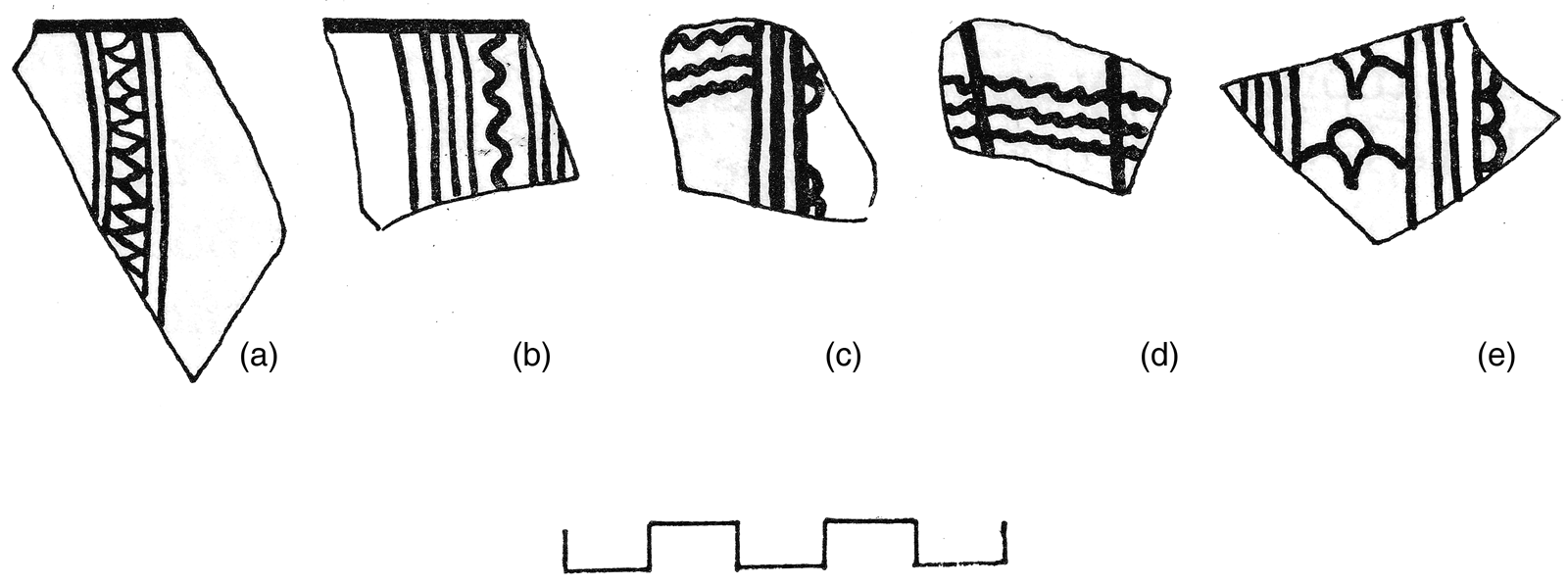
A wavy line also adorns a deep bowl sherd. The motif is placed vertically between two triglyphs (composed of groups of vertical lines) in order to form a single coherent design. It is illustrated and given an LH IIIB1 date by French (Reference French1966, 233, fig. 8:9) (Figs 13c and 15b). Other sherds from Level 3 also have triglyphs with wavy lines, but these will be discussed under panelled patterns below, as the wavy lines are integral elements of the triglyphs.
‘Types of triglyphs on deep bowls’: five sherds from Level 3 of PCC III Ext E illustrated by French (Reference French1966, fig. 8). Reproduced with the permission of the British School at Athens.

FM 58 parallel chevrons
Three of the stirrup jar sherds from Level 3 are decorated with parallel chevrons. Two are shoulder zone sherds, with the chevrons radiating from the position of the false spout, and the other is a body sherd, with the chevrons enclosed in a horizontal band (Fig. 10cdg). French (Reference French1966, 230) observed that in the material she studied parallel chevrons are ‘very common on stirrup jars’ and assigned the sherds decorated with this motif in the aforementioned ways an LH IIIB1 date.
French (Reference French1966, 230) noticed that amongst the LH IIIB1 kylix sherds that she examined, ‘five have a stemmed version’ of parallel chevrons, although ‘two of these have curved lines instead of real chevrons’. In other words, she identified three sherds decorated with proper parallel chevrons with stems. One of these, from the main deposit, is illustrated by French (Reference French1966, fig. 3:29). This should leave just two more; however, there are three sherds from Level 3 with stemmed parallel chevrons, although the two lines forming the stem on one of these are hard to see (Fig. 11klm). It appears, therefore, that Level 3 produced most of the kylix body sherds decorated with this version of the motif.
FM 75 panelled patterns
In the main deposit, ‘this type of pattern belongs almost exclusively to deep bowls and stemmed bowls’ (French Reference French1966, 233). This situation is reflected in the nine sherds from Level 3 decorated with triglyphs: eight come from deep bowls and one belongs to a stemmed bowl (Figs 13cdh–m and 14a). Five of these sherds, all from deep bowls, are illustrated by French (Reference French1966, 233, fig. 8:5,9,15,16,19) and dated by her to LH IIIB1 (Figs 13cdhij and 15a–e).
Two of the sherds illustrated by French have triglyphs with horizontal wavy lines (Figs 13ij and 15cd). Another deep bowl sherd and the stemmed bowl sherd also have triglyphs with horizontal wavy lines (Figs 13k and 14a). It is worth noting that on all four of these sherds there is spacing within the wavy lines.
CONCLUSIONS
This examination of the stratigraphy of the four trenches associated with the pottery deposit both amends and expands our understanding of this small but significant area of Mycenae and enables the deposit to be placed in its proper chronological framework. The latest structure built in the area was the Perseia Fountain House, dating to the Hellenistic period, but the earliest activity in the area dates right back to the MH, with various features, including a circular pit cut into the bedrock and a wall built on it.
The next significant activity in the area was the construction of the East–West Wall, erected in either LH II or LH IIIA. Subsequently, a surface of hard reddish earth was created. The pottery associated with this surface dates to early LH IIIB1. The surface was succeeded by a fairly level floor of white clay plaster, which apparently extended across the area immediately to the north of the East–West Wall. It is possible that this white clay plaster floor served as a formal public open space, where rituals and events that bonded the elite and people of Mycenae together were held.
Next, the Great Poros Wall was constructed and a surface of hard tramped earth, lying at the same level as and extending to the white clay plaster floor, was created in front of it. A large amount of pottery was deposited on the surface of hard tramped earth. The pottery deposit continued to the north, following the curve of the Great Poros Wall, where it lay on bedrock, and also extended to the east, running across the white clay plaster floor as far as the western side of Area VII. A proportion of the pottery was also deposited in a pit dug close to the wall. The pottery seems to have been the remains of a ritual feast associated with the Tomb of Clytemnestra and was then used as fill to cover the rubble foundation of the Great Poros Wall. Perhaps libations were poured into the pit during the feast. The pottery deposit dates this period of activity to early LH IIIB1.
Like the pit, the surface of hard reddish earth was not reported by either Hood or French. This surface, lying immediately beneath the white clay plaster floor, was found in PCC III Ext E. In Area VII, just to the east of PCC III Ext E, a layer at the same level and equating to the surface of hard reddish earth was encountered. On this surface in PCC III Ext E and Area VII, there was another deposit of pottery. The surface of hard reddish earth in PCC III Ext E was designated Level 4 and the earth and pottery resting on it Level 3. Of the ‘huge number’ of sherds recovered from Level 3, 54 decorated pieces were kept and, apparently due to a misunderstanding of the stratigraphy of the area, were regarded as part of the main deposit and included by French (Reference French1966) in her pottery study. We know this because a total of seven sherds from Level 3 are illustrated in her paper: six are drawn and one is shown in a photograph. In her figure showing types of triglyphs on deep bowls, five of the 31 sherds illustrated are from Level 3 (French Reference French1966, fig. 8) (Fig. 15). Perhaps the sherds from Level 3, like those of the main deposit, represent the remains of ritual activity in the area.
Fifty-four sherds is by no means a large group; however, the above examination of the shapes and motifs makes it clear that the sherds are of early LH IIIB1 date. The group significantly contains examples of both the Zygouries kylix, FS 258A, and the type most commonly decorated with vertical whorl-shells, FS 258B, together with pieces of Group A deep bowls, FS 284. Moreover, the order of popularity of the open shape vessels represented in the group reflects that in the main deposit, namely, from most to least abundant, kylikes, deep bowls and stemmed bowls. The group is also akin to the material from pit 1, although at Tsoungiza the stemmed bowl was the most popular decorated vessel. The five most common motifs on the sherds from Level 3 also mirror the situation in the main deposit; the motifs are FM 18 flower, FM 23 whorl-shell, FM 53 wavy line, FM 58 parallel chevrons and FM 75 panelled patterns. Parallel chevrons with stems and triglyphs with horizontal wavy lines with spacing appear to be particular features of the motifs on the Level 3 sherds. The stirrup jar is the only closed vessel represented in the group.
The pottery from Level 3 of PCC III Ext E was found not only on the surface of hard reddish earth but also immediately below the white clay plaster floor in this trench. On the white clay plaster floor in PCC III Ext E was the pottery belonging to the main deposit. This deposit extended to the west, where it lay on the surface of hard tramped earth, which abutted against the base of the rubble foundation of the Great Poros Wall. As we now have early LH IIIB1 pottery lying both on and immediately beneath the stratum consisting of the surface of hard tramped earth and the white clay plaster floor, there can be no doubt that this layer dates to early LH IIIB1.
The fact that we now know that there was another deposit of early LH IIIB1 pottery lying just beneath the main deposit came as a result of consulting Hood's excavation notebook. The notebooks of the British Excavations at Mycenae are an invaluable resource, which, as we have seen, can both enhance and/or change our understanding of the archaeology of this important Late Bronze Age site.
APPENDIX: CATALOGUE OF POTTERY FROM LEVEL 3 OF PCC III EXT E
Closed shapes
Stirrup jars
1. Handle of stirrup jar. Reserved triangle at top of handle; reddish-brown paint (Fig. 8a).
2. False neck and part of one handle of stirrup jar. Flat disk at top of false neck. Reserved triangle at top of handle; disk decorated with spiral and open circle at centre; band at bottom of false neck; black paint (Fig. 8b).
3. False neck and top of one handle of stirrup jar. Convex disk at top of false neck. Reserved triangle at top of handle; disk decorated with either a spiral or concentric circles and a solid circle at centre; band at bottom of false neck; faded black paint (Fig. 9).
4. Shoulder zone sherd of stirrup jar. FM 18C flower, unvoluted, probably type 130; black paint (Fig. 10a).
5. Shoulder zone sherd of stirrup jar. Unidentified motif; red paint (Fig. 10b).
6. Shoulder zone sherd of stirrup jar. FM 58 parallel chevrons; brown to black paint (Fig. 10c).
7. Shoulder zone sherd of stirrup jar. FM 58 parallel chevrons; black paint (Fig. 10d).
8. Body sherd of stirrup jar. FM 48 quirk, type 17; FM 53 wavy line, horizontal, type 29; reddish-brown paint (Fig. 10e).
9. Body sherd of stirrup jar. FM 53 wavy line, horizontal, type 17; reddish-brown paint (Fig. 10f).
10. Body sherd of stirrup jar. FM 58 parallel chevrons, type 33; faded black paint (Fig. 10g).
11. Body sherd of stirrup jar. FM 53 wavy line, vertical, type 35; faded black paint (Fig. 10h).
12. Body sherd of stirrup jar. FM 53 wavy line, vertical; brown paint (Fig. 10i).
13. Body sherd of stirrup jar. FM 61 zigzag; brown to black paint (Fig. 10k).
Open shapes
Kylikes
15. Rim sherd of kylix, FS 258A, Zygouries type. FM 18B flower, hybrid, horns, type 45, but with dots in horns; reddish-brownish paint (Fig. 11a).
16. Rim sherd of kylix, FS 258A, Zygouries type. FM 48 quirk, type 15, vertical; unidentified motif on right; red paint (Fig. 11b).
17. Rim sherd of kylix, FS 258B. FM 23 whorl-shell, vertical; rim band; black paint (Fig. 11c).
18. Rim sherd of kylix. Unidentified motif; rim band; faded black paint (Fig. 11d).
19. Rim sherd of kylix, FS 257. FM 21 cuttlefish; rim band; brown to black paint (Fig. 11e).
20. Rim sherd of kylix, FS 258B. FM 18A flower, voluted; rim band; black paint (Fig. 12a).
21. Body sherd of kylix, FS 258. FM 23 whorl-shell, vertical, with wavy line in stem; reddish-brown paint. French (Reference French1966, 226, fig. 6:12–17) did not include this type of stem in her list of whorl-shell stem variations (Fig. 11f).
22. Body sherd of kylix, FS 258. FM 23 whorl-shell, vertical; brown to black paint (Fig. 11g).
23. Body sherd of kylix, FS 258. FM 23 whorl-shell, vertical; brown paint (Fig. 11h).
24. Body sherd of kylix, FS 258. FM 23 whorl-shell, vertical; black paint (Fig. 11i).
25. Body sherd of kylix, FS 257. FM 23 whorl-shell, composition/group; reddish-brown paint. Illustrated by French (Reference French1966, fig. 6:29) (Fig. 11j).
26. Body sherd of kylix, FS 258B. FM 23 whorl-shell, type 10, vertical, circumcurrent; fine line at base of decorative zone; black paint (Fig. 12b).
27. Body sherd of kylix, FS 258. FM 58 parallel chevrons, stemmed, vertical; faded black paint (Fig. 11k).
28. Body sherd of kylix, FS 258. FM 58 parallel chevrons, stemmed, vertical; brown to black paint (Fig. 11l).
29. Body sherd of kylix. FM 58 parallel chevrons, stemmed; brown paint (Fig. 11m).
30. Body sherd, probably of kylix. FM 58 parallel chevrons, vertical; black paint (Fig. 12c).
31. Body sherd, probably of kylix. FM 27 sea anemone, type 23, dot rosette, between unidentified motifs; group of narrow bands at base of decorative zone; brown to black paint (Fig. 11n).
32. Body sherd, probably of kylix. FM 62 tricurved arch, with fill ornament; band at base of decorative zone; brown to black paint (Fig. 11o).
33. Body sherd/part of handle of kylix, FS 257. Pair of tails at base of handle; group of fine lines; brown to black paint (Fig. 12d).
34. Body sherd of kylix. FM 27 sea anemone, type 23, dot rosette, between stems of unidentified motif; red to brown paint (Fig. 12e).
35. Body sherd of kylix. FM 45 U-pattern; bottom of rim band; brown paint. Described by French (Reference French1966, 229): the sherd ‘has a band of small rather rough Us in an open zone’ (Fig. 12f).
Deep bowls
36. Rim sherd of deep bowl, FS 284, Group A. Straight rim. FM 18A flower, voluted, probably type 24; rim band; black paint (Fig. 13a).
37. Rim sherd of deep bowl, FS 284, Group A. Flaring rim. FM 23 whorl-shell, vertical, on right, unidentified motif on left; rim band; black paint (Fig. 13b).
38. Rim sherd of deep bowl, FS 284, Group A. Slightly flaring rim. FM 75 panelled patterns: triglyph, type 1, group of vertical lines, with FM 53 wavy line, type 17, vertical; rim band; faded black paint. Illustrated by French (Reference French1966, fig. 8.9) (Figs 13c and 15b).
39. Rim sherd of deep bowl, FS 284, Group A. Slightly flaring rim. FM 75 panelled patterns: triglyph, type 10, zigzag; rim band; narrow band below rim on inside; red paint. Illustrated by French (Reference French1966, fig. 8:5) (Figs 13d and 15a).
40. Rim sherd of deep bowl, FS 284, Group A. Slightly flaring rim. FM 18A flower, voluted; rim band; narrow band below rim on inside; brown to black paint. Illustrated by French (Reference French1966, pl. 48:d7) (Fig. 13e).
41. Rim sherd of deep bowl, FS 284, Group A. Slightly flaring rim. FM 23 whorl-shell, vertical; rim band; black paint (Fig. 13f).
42. Body sherd of deep bowl, FS 284, Group A. FM 18A flower, voluted, similar to type 27; red paint (Fig. 13g).
43. Body sherd of deep bowl, FS 284, Group A. FM 75 panelled patterns: triglyph, type 1, group of vertical lines, with FM 25 bivalve shell, type 28, vertical, and fringe of FM 42 joining semicircles, triglyph border, type 9; red to black paint. Illustrated by French (Reference French1966, fig. 8:19) (Figs 13h and 15e).
44. Body sherd of deep bowl, FS 284, Group A. FM 75 panelled patterns: triglyph, type 4, horizontal wavy lines but with spacing and extending beyond vertical edges of triglyph; brown paint. Illustrated by French (Reference French1966, fig. 8:16) and described by her as ‘unusual’ (French Reference French1966, 238) (Figs 13i and 15d).
45. Body sherd of deep bowl, FS 284, Group A. FM 75 panelled patterns: triglyph, type 4, horizontal wavy lines but with spacing, and fringe of FM 42 joining semicircles, type 9, triglyph border, but with spacing; brown paint. Illustrated by French (Reference French1966, fig. 8:15) (Figs 13j and 15c).
46. Body sherd of deep bowl, FS 284, Group A. FS 75 panelled patterns, triglyph, probably type 5, horizontal wavy lines but with spacing; brown paint (Fig. 13k).
47. Body sherd of deep bowl, FS 284, Group A. FM 75 panelled patterns: triglyph, type 8, parallel chevrons; group of fine lines at base of decorative zone; red paint (Fig. 13l).
48. Body sherd of deep bowl, FS 284, Group A. FM 75 panelled patterns: triglyph of unidentified type; group of fine lines at base of decorative zone; black paint (Fig. 13m).
Stemmed and conical bowls
49. Body sherd of stemmed bowl, FS 305. FM 75 panelled patterns: triglyph, type 5, horizontal wavy lines but with spacing; two medium bands at base of decorative zone; red paint (Fig. 14a).
50. Rim sherd of stemmed bowl, FS 305. Rounded lip to rim; estimated diameter of rim 0.18 m. FM 62 tricurved arch, with fill ornament; rim band; medium band below rim on outside; black paint (Fig. 14b).
51. Rim sherd of deep conical bowl, FS 290, or spouted conical bowl, FS 300, 301. Flat down-sloping rim. FM 64 foliate band on rim, apparently with spacing between groups of lines; medium band below rim on outside and inside; red paint (Fig. 14c).
ACKNOWLEDGEMENTS
I would like to thank the following: the British School at Athens for arranging for me to examine the pottery at Mycenae and for granting me permission to use previously published figures; Alkestis Papadimitriou; Viki Papamichalopoulou; the staff of the Mycenae Museum, especially Nikos Katsoulieris and Grigoris Chronis; Sheila Braime for kindly undertaking the time-consuming task of looking through all the sherds in Box 15 to find those from Level 3 of PCC III Ext E; Kim Shelton for all her help and support; Stephanie Aulsebrook for reading and suggesting improvements to the text, for reproducing the diagrams in Hood's notebook and for helping to prepare the figures; Elizabeth Postgate, Tanya Applegath, Eddy Buranakul, and my wife, Sachiko, and daughter, Katie, for also helping to prepare the figures; Yannis Galanakis and Rebecca Naylor for facilitating the use of the Mycenae Excavations Archive; Peter Liddel; Joshua Hey; Nick Thorpe; Monika Lapinska; Paulina Jurkowska; Phedra Komodromou; the two anonymous referees; and the residents of Mycenae for their kindness and hospitality, especially the Christopoulos family (Klitemnistra Hotel), the Koukelis family (Electra Restaurant) and Kostas Maurogiannis (Mycenae Taxi Tours). Needless to say, I retain all responsibility for any mistakes or misinterpretations. Lastly, I would like to thank my friend and mentor Lisa French for encouraging me to write this paper. I greatly appreciate all of her advice and support over the years. This paper is dedicated to her memory and serves as my tribute to her great contribution to Mycenaean archaeology.