Introduction
Wolves are widely distributed in Eurasia and North America but, having suffered from extensive persecution in the past, today they are found in rather fragmented populations in Europe (Tauriņš, Reference Tauriņš1982; Boitani, Reference Boitani2000; Salvatori & Linnell, Reference Salvatori and Linnell2005). Overall, in the Baltic States of Lithuania, Latvia and Estonia the wolf population has been described as stable (Salvatori & Linnell, Reference Salvatori and Linnell2005).
In Latvia, wolves have been present since the early postglacial period (Tauriņš, Reference Tauriņš1982), and the size of the population has greatly depended on the extent to which they have been hunted, varying from near extinction to more than 1000 animals (Ozoliņš et al., Reference Ozoliņš, Andersone and Pupila2001). The State Forest Service of Latvia estimated that 655 wolves inhabited Latvia in 2007–2008. Recent morphometric data on skulls showed differences between individuals of the eastern and western populations (Andersone & Ozoliņš, Reference Andersone and Ozoliņš2000), which suggests fragmentation of the population.
Wolves are one of three wild representatives, besides red foxes (Vulpes vulpes) and raccoon dogs (Nyctereutes procyonoides), of the Canidae family living in Latvia (Tauriņš, Reference Tauriņš1982), and all three are game animals. Wolves in Latvia are, however, a specially protected species with limits on exploitation (Law on the Conservation of Species and Biotopes, 16 March 2000; Regulation No. 396 of the Ministers' Cabinet ‘List of specially protected species and species with exploitation limits’, 2000). The hunting season for wolves lasts from 15 July to 31 March (Hunting Law, LV, 107 (2872), 23 July 2003) in accordance with harvest limits defined by the State Forest Service. The general principles of wolf management in Latvia are described by Andersone-Lilley & Ozoliņš (Reference Andersone-Lilley and Ozoliņš2005). During the 2007/08 hunting season the hunting quota was 150 animals (unpublished State Forest Service data).
Wolf helminth fauna have been studied by several researchers in various parts of the wolf distribution range (Craig & Craig, Reference Craig and Craig2005) including parts of north-east Europe (e.g. Sołtys, Reference Sołtys1964; Kazlauskas & Prūsaitė, Reference Kazlauskas and Prūsaitė1976; Jushkov, Reference Jushkov1995; Kloch et al., Reference Kloch, Bednarska and Bajer2005; Moks et al., Reference Moks, Jõgisalu, Saarma, Talvik, Järvis and Valdmann2006; Szczęsna et al., Reference Szczęsna, Popiołek and Śmietana2007).
While there are data available on Trichinella spp. in wild animals in Latvia (Kapel et al., 2003; Keidans et al., Reference Keidans, Krūklite, Keidane and Kapel2004; Malakauskas et al., Reference Malakauskas, Paulauskas, Järvis, Keidans, Eddi and Kapel2007), other wild mammal helminths in Latvia have been researched only for the Eurasian lynx (Lynx lynx) (Bagrade et al., Reference Bagrade, Vismanis, Kirjušina and Ozoliņš2003), red fox (Keidāns et al., Reference Keidāns, Krūklīte and Keidāne2005), otter (Lutra lutra) (Vismanis & Ozoliņš, Reference Vismanis and Ozoliņš2002), some ungulate species (Artiodactyla), and the brown hare (Lepus europaeus) (Priedītis & Daija, Reference Priedītis, Daija and Sarma1972). This paper is the first to present data on the helminth fauna of wolves in Latvia.
Materials and methods
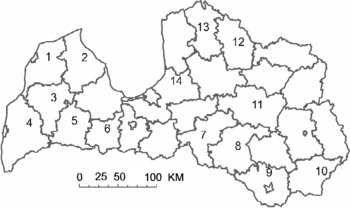
Material for helminth research was collected from hunted wolves throughout Latvia, but mainly from western parts of the country (fig. 1). Latvia is the central country of the Baltic States (Estonia, Latvia and Lithuania) and is located in north-eastern Europe on the east coast of the Baltic Sea. Its geographic coordinates are 57°00′N latitude and 25°00′E longitude; area: 64.589 km2 (data from the Latvian Institute; available at www.li.lv).
Wolf collecting sites (districts) in Latvia: 1, Ventspils (n = 5); 2, Talsi (n = 5); 3, Kuldīga (n = 3); 4, Liepāja (n = 3); 5, Saldus (n = 3); 6, Dobele (n = 2); 7, Aizkraukle (n = 2); 8, Jēkabpils (n = 3); 9, Daugavpils (n = 1); 10, Krāslava (n = 1); 11, Madona (n = 2); 12, Valka (n = 1); 13, Valmiera (n = 2); 14, Rīga (n = 1).

A total of 34 wolves were examined. Wolves were sexed and classified as adults or juveniles according to hunters' estimates. The absolute ages of 21 wolves were defined. One canine tooth was extracted from each animal's skull and approximately 1.5 cm was sawn off from the tip of the root. Techniques described by Klevezal (Reference Klevezal1988), including decalcification, freezing, sectioning, staining and mounting on a glass slide, were used. Counting of incremental lines of the tooth cement was performed, which allowed the age in years to be ascertained. Taking into account the birth season for the species (the end of April to beginning of June in Latvia), the age in years and the hunting date, the age in months for each animal was calculated. The youngest wolf whose absolute age was known was 4 months old while the oldest was 7 years and 5 months old.
Animal carcasses were kept frozen until examination. The trachea, lungs, heart, intestinal tract, liver, gall bladder, spleen, kidneys and urinary bladder were separated and examined according to conventional helminthological methods. All helminths found were removed and placed in a fixative agent − 70% ethanol. Trichinella and Echinococcus specimens were preserved in 90% ethanol. Helminths were counted and identified according to Abuladze (Reference Abuladze and Skrjabin1964), Verster (Reference Verster1969), Kozlov (Reference Kozlov1977) and Loos-Frank (Reference Loos-Frank2000). Determination of cestodes of the genus Taenia was based on the crown of rostrellar hooks – they were cut off and mounted en face in Berlese's fluid (Loos-Frank, Reference Loos-Frank2000). Identification was made based on the number, shape, size and arrangement of rostellar hooks (Abuladze, Reference Abuladze and Skrjabin1964; Verster, Reference Verster1969; Loos-Frank, Reference Loos-Frank2000).
A diaphragm muscle sample was used to detect Trichinella according to the reference method laid down in the EC Commission Regulation No. 2075/2005 (EC Commission, 2005).
Prevalence data (percentage of samples infected) and intensity (mean intensity ± standard error of the mean (SEM)) of the parasitic invasion were analysed according to age, sex and location (western/eastern part of the territory of Latvia) using the Mann–Whitney test. SPSS for Windows (SPSS Inc., Chicago, Illinois, USA) was used for statistical analysis.
Results and discussion
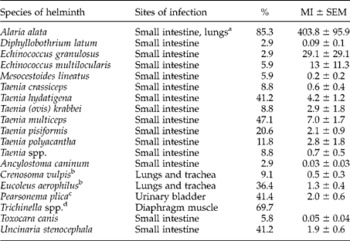
A total of 17 helminth species were identified belonging to the following taxonomic groups: Cestoda – ten species, Nematoda – six species and Trematoda – one species (table 1).
The overall prevalence (%) and mean intensity (MI) of helminths in wolves from Latvia.

a A. alata in lungs was detected in three wolves.
b Lungs and trachea of 33 wolves were examined.
c Urinary bladder of 29 wolves were examined.
d Diaphragm muscle of 33 wolves were examined.
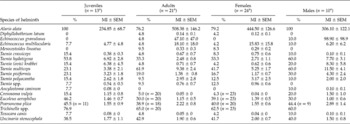
Alaria alata (85.3%) and Trichinella spp. (69.7%) were the most common parasites among the wolf population, followed by Taenia multiceps (47.1%), Pearsonema plica (41.4%), Taenia hydatigena (41.2%) and Uncinaria stenocephala (41.2%) (table 1). Alaria alata was located not only in the wolves' intestinal tract but also in their lungs (for three out of the 34 investigated wolves). Diphyllobothrium latum, Echinococcus granulosus and Ancylostoma caninum were discovered only in a single case. Mesocestoides lineatus was discovered only in adult females (table 2). All animals were infected with at least one species and a maximum of eight species of helminths. Parasitism involving one, two or seven parasite species per animal was found in 8.8% of cases, three species in 14.7%, four, five or six species in 17.7% and eight species in 5.8% of cases. The mean number of parasite species per host was 4.4 and the average number of helminths was 471.8, ranging from 1 to 2345.
The prevalence (%) and mean intensity (MI) of helminths in wolves, relative to host age and gender.

a Unless otherwise stated.
Significant statistical differences were found only in Taenia multiceps – it was statistically more prevalent in adult than in juvenile animals (table 2, P < 0.05). Our data showed a tendency for parasite species to be more prevalent in juvenile than in adult animals and in males more than in females (table 2). However, due to the small proportion of positive (parasite detected) animals in the sample group, this tendency was not statistically significant. There was no statistically significant difference in diversity of helminth fauna in animals from the western and eastern parts of the country, but only seven animals from the eastern part of Latvia were examined.
Altogether, 72 helminth species have been recorded in wolves across their distribution range. The most prevalent helminth species in Palearctic populations are the tapeworm T. hydatigena, gut nematode U. stenocephala and gut fluke A. alata (Craig & Craig, Reference Craig and Craig2005). Wolves typically have common parasite species (not species-specific), most of which are obtained via their food (Tumanov, Reference Tumanov2003).
Concurrently with the study of helminth fauna we examined the content of the wolves' stomachs. This was collected and investigated, thus creating a database, not only on the feeding habits of each animal, but also on the possibility of parasite transmission in the predator–prey relationship. So far, data on the feeding habits of wolves in Latvia have revealed wild ungulates (cervids and wild boar) and beaver as the wolves' dominant prey. Several species of small and medium-sized carnivore (domestic dog (Canis lupus familiaris), raccoon dog, red fox, badger (Meles meles), otter and weasel (Mustela nivalis)) as well as some small rodents and insectivores were detected in the stomach content of wolves. However, their occurrence was comparatively low (Andersone & Ozoliņš, Reference Andersone and Ozoliņš2004).
The data on wolf feeding habits (Andersone & Ozoliņš, Reference Andersone and Ozoliņš2004) and research on ungulate and wild boar helminth fauna (Priedītis & Daija, Reference Priedītis, Daija and Sarma1972) in Latvia support the theory that the parasites are obtained via food. The larval stage of T. hydatigena – one of the most frequent Cestoda parasites in wolves in our research (table 1), was reported in cervids and wild boar. In addition, the moose (Alces alces) was the most frequently (19 out of 20 investigated animals) infected of all cervids (Priedītis & Daija, Reference Priedītis, Daija and Sarma1972). Studies carried out in Poland (Wojcik et al., Reference Wojcik, Franckiewicz-Grygon and Zbikowska2001, Reference Wojcik, Franckiewicz-Grygon and Zbikowska2002) and the Republic of Croatia (Jakšić et al., Reference Jakšić, Uhitil and Vučemilo2002) reveal the aforementioned interconnection – metacercariae of A. alata were found in the muscle tissue of wild boars, suggesting that this source of infection may be responsible for the presence of this trematode in wolves. Similar data have been obtained from Spain (Segovia et al., Reference Segovia, Torres, Miquel, Llaneza and Feliu2001) and Latvia (M. Kirjušina, personal communication).
The wolf helminth fauna in Latvia is similar to that in neighbouring countries, which is probably due to the similarity in their diets (Okarma, Reference Okarma1995; Jędrzejewska & Jędrzejewski, Reference Jędrzejewska and Jędrzejewski1998). Data from these regions show A. alata, T. hydatigena and U. stenocephala to be the most frequent (Kazlauskas & Prūsaitė, Reference Kazlauskas and Prūsaitė1976; Shimalov & Shimalov, Reference Shimalov and Shimalov2000; Moks et al., Reference Moks, Jõgisalu, Saarma, Talvik, Järvis and Valdmann2006). It can be said that wolves in the Baltic countries, Belarus and Poland are predominantly infected by gastrointestinal helminths that mainly exhibit indirect life cycles. This can be explained by host–parasite relationships – a wide range of vertebrates and invertebrates serve as prey species for wolves and are intermediate hosts for parasites (Tumanov, Reference Tumanov2003; Craig & Craig, Reference Craig and Craig2005).
Not only could the helminth fauna help interpret the food habits of carnivores, but also, to a certain extent, the overlapping of niches among predators. Intraguild predation in carnivores, in this case wolves feeding on foxes and raccoon dogs, shows that wolves probably host the same helminth species as their prey. Thus, for example, in the research on hunting practices and the prevalence of Trichinella infection in wolves, it is mentioned that carnivore–carnivore transmission could explain the high prevalence of this parasite in the natural carnivore population. Hunting practices also strengthen this transmission as skinned wolf carcasses are often left in the forest as bait (Pozio et al., Reference Pozio, Casulli, Bologov, Marucci and La Rosa2001).
Trichinella spp. is a very common wolf parasite in various parts of its range (Tumanov, Reference Tumanov2003), although some data suggest that some carnivores, including wolves, play only a secondary role in the ecology of sylvatic trichinellosis, due to their low density (Pozio, Reference Pozio1998; Jarvis & Miller, Reference Jarvis and Miller2004). Transmission of Trichinella is through predation, scavenging or cannibalism, and allows the parasite to adapt to a wide range of hosts and ecosystems (Pozio, Reference Pozio1998). Data from Lithuania show that trichinellosis among wild carnivores was most prevalent in wolves (35.0%) (Kazlauskas & Prūsaitė, Reference Kazlauskas and Prūsaitė1976) and lynx (61.5%) (Kazlauskas & Matuzevičius, Reference Kazlauskas and Matuzevičius1981), but some recent investigations (Senutaitę & Grikienienę, Reference Senutaitę and Grikienienę2001) revealed that only one wolf out of seven examined animals was infected. A high prevalence of trichinellosis in wolves has been recorded in Estonia – from 75.0% (Pozio et al., Reference Pozio, Miller, Jarvis, Kapel and La Rosa1998) to 50% (Moks et al., Reference Moks, Jõgisalu, Saarma, Talvik, Järvis and Valdmann2006). The larvae of Trichinella found in wolves in Latvia were sent for species identification to the Community Reference Laboratory for Parasites (Instituto Superiore di Sanità) in Rome, Italy. In Latvia, trichinellosis in wolves is very frequent (table 1), suggesting that this species can play an important role in maintaining the sylvatic cycle of Trichinella in the wild in Latvia.
Echinococcosis is one of the world's most geographically widespread parasitic zoonoses. Two species of the genus Echinococcus – E. granulosus and E. multilocularis – are known to occur in Europe, causing a significant public health problem (Eckert et al., Reference Eckert, Conraths and Tackmann2000; Craig et al., Reference Craig, Rogan and Campos-Ponce2003). The infection of wolves with E. granulosus in Europe has been reported from Belarus (11.5%) (Shimalov & Shimalov, Reference Shimalov and Shimalov2000), Lithuania (2.4%) (Kazlauskas & Prūsaitė, Reference Kazlauskas and Prūsaitė1976), Estonia (4%) (Moks et al., Reference Moks, Jõgisalu, Saarma, Talvik, Järvis and Valdmann2006), Italy (Guberti et al., Reference Guberti, Stancampiano and Francisci1993) and Finland (Hirvela-Koski et al., Reference Hirvela-Koski, Haukisalmi, Kilpela, Nylund and Koski2003). The infection of wolves by E. multilocularis has been reported in Slovakia (Martínek et al., Reference Martínek, Kolárová, Hapl and Literák2001). In Latvia, parasites belonging to the Echinococcus genus were recorded in only three of the examined wolves. Species identification by morphological features, as described by Abuladze (Reference Abuladze and Skrjabin1964) and Kozlov (Reference Kozlov1977), revealed that E. multilocularis was found in two wolves and E. granulosus in one wolf. Species confirmation by genetic analysis is planned.
Acknowledgements
The authors are grateful to Voldemārs Rēders and all the state foresters and hunters who provided us with wolf carcasses. The authors thank Alda Pupila for assistance in wolf absolute age determination. The authors also thank Dr David Hetherington for correcting the English. The research is supported by the European Social Fund.