Introduction
This study is the second of the two experiments to investigate the effect of alternative sustainable pig production systems and mixing at loading on factors such as behaviour during transport and lairage, cortisol and creatine kinase (CK) in slaughter blood and meat quality characteristics. In the first study (Barton Gade, Reference Barton Gade2008), pigs raised outdoors were compared to pigs raised conventionally in a barren environment. The results showed that outdoor pig production had the potential to improve some aspects of pig welfare in the pre-slaughter period. Outdoor pigs settled more quickly during transport and lay down to a greater extent at the end of transport and lairage periods; they showed less aggression, particularly during lairage, and had less unacceptable skin damage compared to conventionally raised pigs. In addition, there were a number of indications that conventionally raised pigs may have found mixing pre-slaughter to be more physically stressful than outdoor pigs did.
Outdoor production, i.e. where pigs are born and raised outdoors, covers only a minor part of the many alternative production systems found, at least in northern Europe. Most free range systems demand that pigs are born outdoors but move piglets indoors after weaning, albeit giving them more space than in conventional systems, access to an outdoor area, straw, etc. The aim of this study was to compare free range pigs, which are taken indoors at weaning and raised indoors in an enriched environment, with conventionally raised pigs, either mixed or non-mixed at loading, with respect to behaviour during transport and lairage, blood chemistry at slaughter and meat quality characteristics.
Methods
The experiment was carried out under practical commercial conditions using the same transport vehicle, the same abattoir and similar methodology as the first experiment (Barton Gade, Reference Barton Gade2008). Here only a brief description will be given. A free range producer who could provide the requisite number of pigs was found and this producer was then matched to a conventional producer situated relatively close by, who used the same crossbreed, the same fasting period before collection and who had a delivery system capable of keeping pigs from different farm pens separately before loading. These farms were not the same as in the first study. Although not controlled, it is likely that the pigs were free of the halothane-sensitive allele, as this has been the goal in Danish breeding work since 1986.
The experiment consisted of a total of 224 pigs, 112 pigs were free range pigs and 112 were conventionally raised pigs, equally divided into mixed and non-mixed groups. Pigs were mainly D–LY crosses, where D = Duroc, Y = Large White and L = Landrace. Average live weight was 107 kg (range 97 to 116 kg) and 104 kg (range 91 to 114 kg) for free range and conventionally raised pigs, respectively. Sex and live weight were randomly distributed within the experimental group. Free range pigs were born and raised outdoors until weaning, which took place not earlier than 4 weeks of age. They were then transferred to indoor pens with straw and access to an outdoor area. Total floor space at 95 to 110 kg live weight was minimum 1.30 m2 per free range pig of which minimum 0.60 m2 was a resting area with straw and 0.55 m2 an outdoor area. Conventionally raised pigs were born indoors in crates and weaned no earlier than 3 weeks of age. Fattening took place in a fully slatted system with no straw. Space allowance at 85 to 110 kg was minimum 0.65 m2 per pig. Pigs from both systems had no fasting period before collection. All male pigs in both systems were castrated within the first week of life by procedures in accordance with Danish legislation.
The transport vehicle was rigged with video cameras and audio equipment above each of the four compartments the day before the start of the experiment. Collection from the two producers occurred sequentially, in each case filling one compartment with pigs from the same farm pen (unmixed group) and one from two or three farm pens (mixed group). In all, four transports were carried out, alternating between producers and compartments such that at the end of the experiment all experimental groups had been transported in all vehicle compartments once. This procedure meant that despite differences in transport time between days, the average transport time for experimental groups was similar with a maximum variation of 2 min between groups. All pigs were marked with an unambiguous identification number on their backs at loading in such a way that it was possible to see whether pigs came from different farm pens or not. A group size of 14 was used with a target stocking density of 0.35 m2 per 100 kg pig, which was the Danish regulation for transports of less than 4 h at that time. However, in practice, stocking densities were 0.37 and 0.38 m2 per 100 kg pig for free range and conventionally raised pigs, respectively. Pig behaviour was recorded in all four compartments throughout the transport using video and audio equipment. The first pig was loaded at average 0537 h (range 0520 to 0550 h) and the mean journey time was on average 2 h 35 min (range 2 h 21 min to 2 h 47 min). Pigs transported in compartments 3 and 4 were transported on average 46 min less than pigs transported in compartments 1 and 2. Environmental temperature averaged 17.5°C at the start of the journey (range 13°C to 21°C) and 19.7°C on arrival at the abattoir (range 17.3°C to 21.4°C), corresponding to typical Danish summer conditions. Relative humidity varied between 60% and 99% at the start of the journey (average 82%) and 61% to 87% on arrival at the abattoir (average 76%). Winds were light (5 to 6 m/s).
Pigs were carefully off-loaded at the abattoir without the use of an electrical goad and lairaged in the same groups as on the transport vehicle. Stocking densities in the lairage were 0.48 and 0.50 m2 per 100 kg pig for free range and conventionally raised pigs, respectively. A video camera was mounted over each lairage pen to monitor pig behaviour during lairage and an audio equipment measured sound. Average time from arrival at the lairage to driving the first pigs to stunning was 2 h 3 min (range 1 h 56 min to 2 h 11 min). Pigs were driven considerately in lairage groups, in the same order as they entered, to groupwise stunning using CO2, without the use of an electric goad.
Variables
Pigs were tattooed at sticking and the identification number read off, so that it was possible to follow each pig subsequently. Blood samples were collected at sticking in heparinised tubes for the evaluation of cortisol and CK using an ELISA assay (DRG, Marburg, Germany) and CK-NAC 1552147 test kit from Boehringer Mannheim, Germany, respectively. Each carcass was evaluated for skin damage in the rear, middle and shoulder area according to the scale described by Barton Gade et al. (1996) and temperature and pH were measured 42 min post mortem in the semimembranosus (S) and longissimus dorsi (LD) muscles using Testotherm 9010 equipment (Germany) and a Knick Portamess pH-meter (Berlin, Germany), respectively. The day after slaughter, all carcasses were measured for pH in S, LD, biceps femoris (BF) and semispinalis capitis (SC) muscles and internal reflection (meat quality marbling (MQM) value) was recorded for S, BF and LD. Actual measuring points used for the four muscles are as shown in Barton Gade et al. (1996).
The body posture (standing, sitting, lying) of each pig was noted at 2½ min intervals throughout the journey and lairage and the percentages of pigs standing, sitting and lying were then calculated. The total number of aggressive events during the whole journey or lairage period was noted, as follows:
• ‘threat’ (fast sideways movement of the head by one pig towards another, that does not react other than by moving away)
• mutual ‘threat’ by two pigs
• one pig bites (or tries to bite) another, that does not reciprocate
• mutual biting by two (or more) pigs, i.e. a fight proper
In the event of mutual biting, the length of the encounter was noted in seconds and divided into short fights (encounters lasting less than 15 s), medium long fights (15 to 30 s) and long fights (>30 s). If the pause between bouts is longer than 10 s, the next bout of fighting is considered to be a new fight.
Statistical analyses
Quantitative characterisitics
Quantitative characteristics such as blood chemistry and meat quality parameters were investigated using an ANOVA (PROC MIXED procedure; SAS, 2002–2003) with the following model:

where i refers to system (free range or conventional), j to treatment (mixing or non-mixing), k to repetition (slaughter days 1 to 4), ατij to the interaction between system and treatment, Pijk to the random effect of pigs within the same group and εij to residual error.
Changes in posture
The changes in posture of pigs during transport and lairage were investigated using a general linear model procedure (SAS, 2002–2003), where system, mixing, posture at 10 min intervals after the commencement of transport or lairage and all two-way interactions between these were included. Non-significant interactions were excluded. For transport, compartments 1 and 2 and compartments 3 and 4 were analysed separately, as the transport pattern was different. For lairage, all compartments were treated together.
Events during transport and lairage
The number of aggressive events during transport were investigated using a Poisson model (GENMOD procedure) and the following basic model:

where μ is the general level, α system gives the effect of rearing system, β mixing the effect of mixing, γ time the effect of transport time (loading pigs first or last), δ day is the systematic effect of day (includes variations in environmental conditions during transport and lairage and the number of farm pens in mixed groups) and αβ and γβ are two-way interactions. Events during lairage were treated similarly but the time factor was excluded, as there was no difference in the average lairage time of experimental groups. Model adjustment was necessary for fights, as described in detail in Barton Gade (Reference Barton Gade2008). Mixed groups were treated similarly (Barton Gade, Reference Barton Gade2008).
The GENMOD procedure was not suitable for the analysis of unacceptable skin damage, due to too few observations. Here, the χ 2 test was used to give an indication of the effect of system and mixing. Finally, interrelationships between the measured parameters were investigated using Pearson correlation coefficients.
Results
Posture during transport and lairage
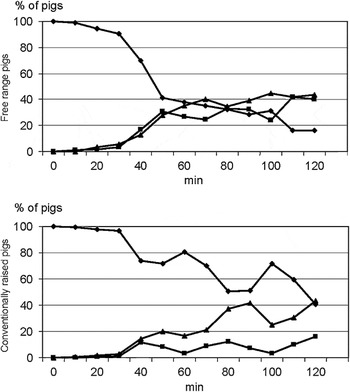
Changes in posture are illustrated in Figure 1 for longest transport (compartments 1 and 2), where changes are expected to be most clear, and results blocked at 10 min intervals for clarity. Rearing system significantly affected posture during transport (compartments 1 and 2, P < 0.001, <0.05 and <0.001 for percentages standing, sitting and lying, respectively). The results for the shortest transport (compartments 3 and 4) are not shown, but even here the rearing system showed significant changes in posture for percentages sitting and lying, P < 0.01 and <0.001, respectively. Mixing had no effect on posture during transport. Free range pigs showed a progressive decrease in the number of pigs standing and an increase in sitting and lying pigs, as the journey progressed (Figure 1). At the end of the journey, only 18% were standing, 42% were sitting and 40% were lying down. Conventionally raised pigs remained standing for longer and were less likely to lie towards the end of the transport. At the end of the journey 40% were standing, 42% sitting and 18% lying.
Posture during consecutive 10 min periods from the start of transport in relation to rearing system for compartments 1 and 2. Posture:  % standing;
 % sitting;
 % lying.

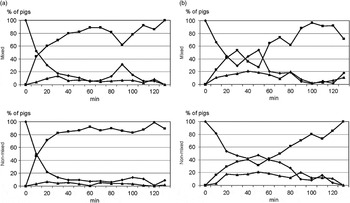
For lairage, there was a significant interaction between rearing system and mixing for all postures (P < 0.05, <0.05 and <0.01 for percentages standing, sitting and lying, respectively). Free range pigs showed an essentially similar pattern, irrespective of mixing (Figure 2a). They began to lie down immediately after arriving at the lairage and at the end of the lairage period almost all pigs were lying down. Very few free range pigs sat during lairage, whether mixed or not. Non-mixed conventionally raised pigs showed a steady increase in the percentage of pigs lying down, although at a slower rate than free range pigs, but all pigs were lying down at the end of the lairage period (Figure 2b). Mixed conventionally raised pigs showed a similar pattern but with greater variation than those with non-mixing due to disturbance from fighting individuals. Conventionally raised pigs showed a greater tendency to sit during lairage compared to free range pigs, irrespective of mixing.
(a) Posture during consecutive 10 min periods from the start of lairage for free range pigs in relation to mixing. Posture:  % standing;
 % sitting;
 % lying. (b) Posture during consecutive 10 min periods from the start of lairage for conventionally raised pigs in relation to mixing. Posture:
 % standing;
 % sitting;
 % lying.

Behaviour during transport and lairage
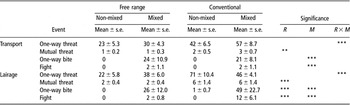
Table 1 shows the mean number of events during transport and lairage in relation to rearing system and mixing. There were significant interactions for one-way threats both during transport and lairage. For conventionally raised pigs, mixing during transport led to more one-way threats than non-mixing, whereas there was no difference for free range pigs. During lairage, non-mixed conventionally raised pigs had more one-way threats than mixed conventionally raised pigs, whereas the opposite was the case for free range pigs. Conventionally raised pigs also had more mutual threats than free range pigs during transport but similar numbers of one-way bites and fights. Mixing did not affect the frequency of mutual threat during transport but one-way bites and fights were exclusively confined to mixed groups. Mutual threats, one-way bites and fights were significantly more frequent in conventionally raised pigs than in free range pigs during lairage. Mixing did not affect the number of mutual threats during lairage but most one-way bites and all fights occurred in mixed groups.
Number of aggressive events during transport and lairage in relation to rearing system and mixing

***P < 0.001, **P < 0.01, *P < 0.05.
Free range pigs showed similar frequencies of one-way biting and fights during transport and lairage, and fights were almost always less than 15 s, whereas conventionally raised pigs showed a much higher activity during lairage compared to transport, and fights were often of longer duration. Thus, 19 of the 49 registered fights during lairage were longer than 15 s in mixed conventionally raised pigs compared to only one of the six registered fights in free range pigs. Conventionally raised pigs showed one-way bites, when non-mixed in the lairage, although at a low level. Free range pigs did not show this behaviour. In two of the four mixed groups of conventionally raised pigs, chasing activity with biting from the side and behind occurred. Such activity occurred only in one of the four mixed groups of free range pigs and only to a lesser extent. Individual free range pigs showing aggression during transport also showed aggression during lairage, whereas this was the case only in two of the four groups of mixed conventionally raised pigs.
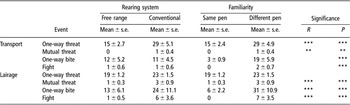
The mean number of events in relation to farm pen are shown in Table 2. There were no significant interactions, when only mixed groups were considered. With the exception of one-way threat in the lairage, all manifestations of aggression during transport were significantly higher when pigs came from different farm pens, i.e. were unfamiliar with one another, than when they were reared together. However, one-way biting, although not fighting, did occur between familiar pigs in mixed groups, both during transport and lairage, and both free range and conventionally raised pigs showed this behaviour.
Number of aggressive events in mixed groups in relation to whether pigs originated from the same farm pen (familiar pigs) or from different farm pens (unfamiliar pigs)

***P < 0.001, **P < 0.01, *P < 0.05.
Skin damage
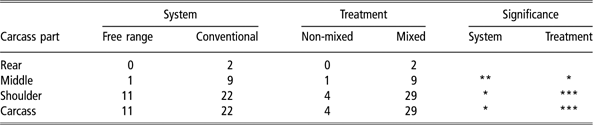
The percentage of pigs with unacceptable skin damage scores (scores 3 and 4) is shown in Table 3. Conventionally raised pigs had significantly more unacceptable skin damage in the middle and shoulder areas of the carcass and in the carcass as a whole compared to free range pigs. Mixing also affected skin damage with levels being significantly higher in the middle, shoulder and carcass in mixed groups compared to non-mixed ones. Pigs with skin damage scores of four (severe skin damage) were always involved in fights, whereas pigs with skin damage scores of 3 were mainly but not always involved in fights or were attacked by others.
Percentages of pigs with unacceptable skin damage scores (scores 3 and 4)
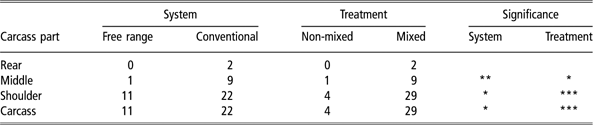
***P < 0.001, **P < 0.01, *P < 0.05.
Blood chemistry and post mortem glycolysis
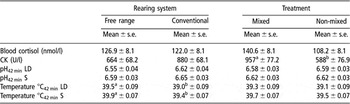
Cortisol in slaughter blood was not affected by the rearing system but mixing tended to give higher levels than non-mixing (Table 4, P = 0.066). CK in slaughter blood tended to be higher in conventionally raised pigs compared to free range pigs (P = 0.078) and mixing led to a significantly higher CK activity compared to non-mixing.
Blood analyses and pH and temperature early post mortem in relation to rearing system and mixing
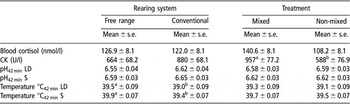
CK = creatine kinase; LD = longissimus dorsi; S = semimembranosus.
Means with different superscripts are significantly different: P < 0.05. There were no significant interactions.
Neither rearing system nor treatment affected pH values measured early post mortem. The pH level was high in all experimental groups and low pH-values (below 6.0) did not occur. Conventionally raised pigs had significantly lower muscle temperatures in both LD and S compared to free range pigs. Mixing had no significant effect on muscle temperatures early post mortem, although there was a tendency to a higher temperature in S with mixing (P = 0.064).
Ultimate pH and internal reflectance (MQM values)
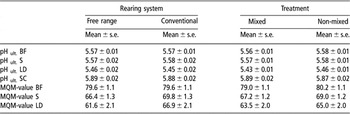
Ultimate pH-values in BF, S, LD or SC were not significantly affected by the rearing system or mixing (Table 5), and very few pigs showed higher than normal pH-values in any of the muscles measured. However, all of these were mixed, conventionally raised pigs (2% of S ⩾ 5.8 and 5% of SC ⩾ 6.3). MQM values in BF, S and LD were not affected by either rearing system or mixing, but MQM values indicative of pale, soft and exudative (PSE) meat tended to be higher in conventionally raised pigs than in free range pigs, especially when these were mixed. Thus, 9% of BF muscles were ⩾95 units, 9% of S muscles ⩾85 units and 5% of LD muscles were ⩾80 in mixed, conventionally raised pigs. The corresponding figures for non-mixed conventionally raised pigs were 3%, 5% and 5%, respectively, for mixed free-range pigs 2%, 2% and 4% and non-mixed free-range pigs 4%, 4% and 0%. The differences were significant only for MQM values in S (χ 2 test, P < 0.05).
Ultimate pH and MQM values in relation to rearing system and mixing

BF = biceps femoris; S = semimembranosus; SC = semispinalis capitis; LD = longissimus dorsi.
There were no significant main effects or interactions.
Interrelationships
Correlations between measured parameters were low or non-significant. Cortisol concentration showed significant correlations with CK (r = 0.20, P < 0.01), temperature early post mortem in S and LD (both r = 0.14, P < 0.05), ultimate pH in SC (r = 0.14, P < 0.05), skin damage scores in the middle and shoulder area of the carcase (r = 0.15 and 0.17, respectively, both P < 0.05) and MQM value in BF (r = −0.20, P < 0.01). CK activity was correlated with temperature early post mortem in S (r = 0.14, P < 0.05), skin damage scores in the middle and shoulder area of the carcase (r = 0.14 and 0.32, P < 0.05 and <0.001, respectively) and ultimate pH in SC (r = 0.22, P < 0.001). In general, pH measured early post mortem was not related to meat quality the day after slaughter but muscle temperature in S was correlated to skin damage score in the shoulder area (r = 0.14, P < 0.05) and MQM values in S and LD (r = −0.20 and −0.22, P < 0.01 and <0.001, respectively). Skin damage scores also showed significant correlations with ultimate pH in SC (r = 0.16 and 0.21, P < 0.05 and <0.01 for the middle and shoulder areas of the carcass, respectively) and MQM value in LD (r = −0.19, P < 0.01 for the shoulder area).
Discussion
Posture
Free range pigs settled faster and a greater proportion of them lay down towards the end of the transport compared to conventionally raised pigs. The results of this study are therefore remarkably similar to the previous study (Barton Gade, Reference Barton Gade2008), where outdoor pigs were compared to conventionally raised pigs. In the comparison with outdoor pigs, it was hypothesised that some of the differences in posture found may have been due to an unintentional difference in stocking density during transport. However, as the same trends were also apparent in this study, where stocking densities were essentially similar, it seems that rearing systems with various degrees of environmental enrichment may have a direct effect on posture during transport, so that pigs are less reactive when exposed to new environments. De Jong et al. (Reference De Jong, Prelle, van de Burgwal, Lambooij, Korte, Blokhuis and Koolhaas2000) also showed that pigs reared in a barren environment and mixed with unfamiliar animals tended to spend more time walking and standing on the truck than mixed pigs reared in an enriched environment.
Postural changes during lairage also supported the view that pigs raised with environmental enrichment were less affected by conditions at the abattoir. Posture in free range pigs was unaffected by mixing. Both groups settled quickly and most pigs were lying down at the end of the 2 h lairage period. Conventionally raised pigs settled less quickly and mixing led to a greater variability in posture during the course of lairage than non-mixing. The likely cause of the variation was fighting, which disturbed resting pigs and made them stand. These results are supported by those of De Jong et al. (Reference De Jong, Prelle, van de Burgwal, Lambooij, Korte, Blokhuis and Koolhaas2000) and Lebret et al. (Reference Lebret, Meunier-Salaün, Foury, Mormède, Dransfield and Dourmand2006) but not the previous study, where mixing had no effect on posture in the lairage. Irrespective of the rearing system or mixing, almost all pigs were lying at the end of the lairage period in this study in contrast to the comparison of outdoor and conventionally raised pigs, where this was never achieved. The present study was carried out under Danish summer conditions, whereas the previous comparison was carried out in winter. It may be that pigs are more in need of rest after transport at higher than at lower temperatures.
Behaviour
One-way threats during transport were more frequent with mixing for conventionally raised pigs but unaffected by mixing for free range pigs. Mutual threats were more likely in conventionally raised pigs during transport but one-way bites and fights during transport were similar for the two rearing systems. These results differ in some respects from the previous study (Barton Gade, Reference Barton Gade2008), where aggressive activity was higher in conventionally raised pigs than in outdoor pigs, and where a low level of one-way biting also occurred in non-mixed conventionally raised pigs. The number of fights during transport was unaffected by the rearing system in both studies. During lairage, where pigs have more space to show aggression, the level of aggressive activity was highest in conventionally raised pigs. One-way threats were, however, higher with non-mixing than with mixing for conventionally raised pigs. The results of this study are, therefore, broadly similar to the previous study (Barton Gade, Reference Barton Gade2008). Both studies showed a higher number of one-way threats in non-mixed groups than in mixed groups for conventionally raised pigs, indicating that conventionally raised pigs could be more reactive to their environment compared to free range or outdoor pigs. Both showed a higher number of mutual threats and fights in conventionally raised pigs compared to outdoor or free range pigs, and both showed that one-way biting occurred in non-mixed groups of conventionally raised pigs, although the difference was smaller in the present study.
Rearing conditions for free range and outdoor pigs were similar up to weaning with the free range group being raised in an environmentally enriched system thereafter, while outdoor pigs remained outdoors. In Barton Gade (Reference Barton Gade2008), it was postulated that social behaviour learned before and after weaning was important for both the level of aggression and its manifestation during transport and lairage. The results of this study show that it is likely that social behaviour learned during the first 4 weeks of life is important. Several research groups have shown that farrowing conditions affect the reactions of piglets to novel environments and social confrontation at weaning (O’Connell and Beattie, Reference O’Connell and Beattie1999; Beattie et al., Reference Beattie, O’Connell and Moss2000; Cox and Cooper, Reference Cox and Cooper2001). Results suggest that socialised piglets are less reactive to novel environments and unfamiliar animals, and are less aggressive. This and the previous study show that these changes seem to be long lasting and that they are still valid when pigs reach slaughter weight. Olsson et al. (Reference Olsson, de Jonge, Schuurman and Helmond1999) also showed that the effects of rearing conditions were long lasting and that pigs born outdoors were less reactive to challenges such as exposure to novel objects and short-term social confrontation.
Mixing at loading increased most manifestations of aggression both during transport and lairage, both in this and the previous study. Most one-way bites and all fights occurred in mixed groups and mainly between unfamiliar animals. Lebret et al. (Reference Lebret, Meunier-Salaün, Foury, Mormède, Dransfield and Dourmand2006) also found no agonistic behaviour during lairage in environmentally enriched and conventionally raised pigs, when these were kept in their social groups.
Skin damage
As could be expected from their lower levels of aggression, free range pigs had less unacceptable skin damage in the carcass compared to conventionally raised pigs. In this study, there were no significant differences in the level of unacceptable skin damage in the rear part of the carcass, as was the case in the comparison between outdoor and conventionally raised pigs (Barton Gade, Reference Barton Gade2008). However, chasing activity was less pronounced in this study, so that the pattern of skin damage was more typical of reciprocal fighting than bullying, as shown by Turner et al. (Reference Turner, Farnworth, White, Brotherstone, Mendl, Knap, Penny and Lawrence2006) for growing pigs on farm. Mixing led to higher levels of unacceptable skin damage in the shoulder, middle and carcass compared to non-mixing. Many studies have previously shown that the frequency of unacceptable skin damage is highest in mixed pigs (Karlsson and Lundström, Reference Karlsson and Lundström1992; Warriss, 1996; Brown et al., Reference Brown, Knowles, Edwards and Warriss1999).
Blood chemistry
Cortisol concentrations in slaughter blood, which are commonly accepted as a measure of the psychological effects of treatment (Warriss et al., Reference Warriss, Brown, Knowles, Edwards, Kettlewell and Guise1998b), were not affected by the rearing system in this study. This would indicate that pigs may react psychologically to pre-slaughter handling in the same way, irrespective of how they are raised. The previous study (Barton Gade, Reference Barton Gade2008), De Jong et al. (Reference De Jong, Prelle, van de Burgwal, Lambooij, Korte, Blokhuis and Koolhaas2000) and Lebret et al. (Reference Lebret, Meunier-Salaün, Foury, Mormède, Dransfield and Dourmand2006) also found cortisol levels at slaughter to be similar in pigs raised conventionally or with environmental enrichment. CK activities in slaughter blood were not significantly affected by the rearing system in this study and thus were in agreement with the previous study and Lebret et al. (Reference Lebret, Meunier-Salaün, Foury, Mormède, Dransfield and Dourmand2006).
Mixing at loading gave higher CK activities in slaughter blood compared to non-mixing, as well as a tendency towards higher cortisol levels. CK activity is a measure of physical stress and muscle damage (Warriss et al., Reference Warriss, Brown, Knowles, Edwards, Kettlewell and Guise1998b), and these results indicate that the pigs in this study may have found mixing to be both psychologically and physically more stressful than non-mixing. This result is in contrast to the previous study (Barton Gade, Reference Barton Gade2008), where there was only an effect of mixing on CK activities for conventionally raised pigs. It was hypothesised that the lack of effect of mixing on CK activity in outdoor pigs may have been due to their better physical condition combined with lower levels of aggression. This study shows that the difference in physical conditions between conventionally raised pigs and free range pigs may be less, as CK activities only tended to be higher in the former.
Meat quality characteristics
Rearing system had no effect on muscle pH-values early post mortem but muscle temperatures were lowest in conventionally raised pigs. The previous study not only confirmed this finding but also showed that pH in LD early post mortem was higher in conventionally raised pigs than in outdoor pigs. Lebret et al. (Reference Lebret, Meunier-Salaün, Foury, Mormède, Dransfield and Dourmand2006) found no effect of rearing system on either temperature or pH measured 30 min post mortem. Mixing had no effect on either muscle temperature or muscle pH early post mortem in this study, or in the previous comparison with outdoor pigs. This is in contrast to the findings of Karlsson and Lundström (Reference Karlsson and Lundström1992) and D’Souza et al. (Reference D’Souza, Dunshea, Leury and Warner1999), who showed that mixing led to, respectively, lower and higher pH-values measured 40 to 50 min post mortem.
In contrast to Barton Gade (Reference Barton Gade2008), mean ultimate pH-levels and MQM values were unaffected by the rearing system in this study. At the same time, higher than normal pH-values were less prevalent, being found only at a low level in mixed, conventionally raised pigs. PSE incidence tended to be higher in conventionally raised pigs in the present study, especially with mixing. Despite the increased energy expenditure that must have occurred due to aggression, mixing had no effect on ultimate pH and MQM values in either study. Thus, these studies could not confirm the results of Terlouw et al. (Reference Terlouw, Porcher and Fernandez2005), who showed that fighting behaviour during mixing affected colour lightness and ultimate pH. However, there was a tendency for mixed conventionally raised pigs to have a higher incidence of PSE muscle in this study and a higher incidence of higher than normal pH-values in the previous study. Thus, there are some indications that mixing may have had a greater effect on conventionally raised pigs than on free range or outdoor pigs. Meat quality results are, of course, affected by the pre-slaughter handling procedures used, and there were differences between the two experiments in fasting time and duration of transport, which were longest in the comparison between outdoor and conventionally raised pigs. Both Barton Gade (1997) and Fortin (Reference Fortin2002) showed that longer pre-slaughter handling periods led to higher incidences of dark, firm and dry (DFD) muscle and lower incidences of PSE muscle, and the lower environmental temperatures during transport in the previous study (Barton Gade, 2008) would also have tended to increase energy expenditure during transport to maintain body temperature, thus making quality deviations in ultimate pH more likely.
Interrelationships
Correlations between the measured parameters were low or non-significant. Increased cortisol concentration and CK activity in slaughter blood was associated with higher muscle temperatures early post mortem, higher skin damage scores in the middle and shoulder areas of the carcass as well as higher ultimate pH-values in SC. Cortisol concentration was also negatively associated with MQM value in BF. Skin damage scores in the middle and shoulder area were positively related to ultimate pH in SC and, in addition, negatively to MQM value in LD for the shoulder area. These results were similar to those of the previous study for CK but not for cortisol (Barton Gade, Reference Barton Gade2008), but in line with those of Warriss et al. (Reference Warriss, Brown, Barton Gade, Santos, Nanni Costa, Lambooij and Geers1998a), who showed that pigs with more skin blemish had higher levels of cortisol and CK in their blood at slaughter as well as meat with higher ultimate pH. The correlations in the present study were never higher than 0.32, and hence much lower than those reported by Terlouw et al. (Reference Terlouw, Porcher and Fernandez2005), where fighting behaviour on mixing pre-slaughter could explain up to 32% of the variability in colour lightness and up to 42% of the variation in ultimate pH.
Conclusions
This study showed that free range pig production has the capability of improving some aspects of pig welfare pre-slaughter compared to conventional pig production. Free range pigs rested more quickly, were less aggressive during lairage and had less unacceptable skin damage. Combined with the previous study, where outdoor and conventionally raised pigs were compared, it seems that social behaviour learned before weaning and/or a more enriched environment after weaning may be important for both the level of aggression and its manifestation in the pre-slaughter period. Mixing pigs at loading led to more disturbance, a higher level of aggression and more unacceptable skin damage, even though no further mixing occurred at the abattoir. Mixing should therefore be avoided in pig production systems that are marketed as welfare friendly.
Acknowledgements
The author would like to acknowledge the team behind this project, particularly Lars Blaabjerg, Maiken Baltzer and Peter Vorup, for expert field work and Eli V. Olsen and Marjatta Oksama, for statistical advice, Birthe Pedersen, Danish Crown, who helped to find producers for the project and finally Steve Brown and colleagues from the University of Bristol for cortisol analyses. This research was partly financed by the 5th Framework Programme of the European Commission, Contract No. QLK5-CT-2000-00162 and partly by the Danish Meat Association in Copenhagen.