

Long recognized as a case that left tenement cigar workers in New York City unprotected from hazards to their health, the New York State high court's In re Jacobs ruling in 1885 also raised anew disagreements regarding the extent of legislative powers known as “police” that were reserved to the states by the federal constitution. Upholding unfettered freedom of contract, the Jacobs ruling prevailed as a governing precedent through a string of related cases until its reversal in Holden v. Hardy, 1898, a working hours law for Utah miners and smelter workers. Between Jacobs and Holden, new thinking emerged on the meaning of class, the role of government, and the drivers of the wealth of nations. In Holden, drawing from Munn v. Illinois, the U.S. Supreme Court located a public interest in sustaining the health and strength of such workers on the grounds that the entire public depended on their productive capacity to ensure the public good of a strong and growing state economy. This precedent did not hold for New York State bakers in Lochner v. New York, but it became controlling again in West Coast Hotel v. Parish, which elevated the broadened conception of “police” from Holden to the national level. As labor union membership along with other vital structures of the New Deal order have declined during the New Gilded Age, employment regulation has tended to relapse toward the individualist, contractarian regime of the Old Gilded Age announced in In re Jacobs.
ALBANY, Jan. 20, 1885.—“The Court of Appeals decided to-day that the Tenement House Cigar bill, passed last Winter, is unconstitutional.”Footnote 1
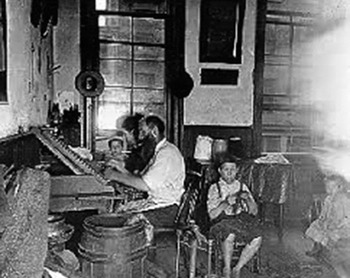
Bohemian cigar makers at work in a tenement, New York City, around 1889. Photographer: Jacob Riis Courtesy Library of Congress.
For many cigar makers in the 1880s, the New York State high court's decision in the In re Jacobs case was a bitter disappointment. Against these workers’ hopeful expectations, the court of appeals struck down a state law passed in 1883 and again in 1884 that banned tenement house production of cigars. Reversing a lower state court decision that had upheld the act, New York's high court ruled that this early example of workers’ protective legislation violated the rights of both tenement owners and tenement cigar makers to contract freely for their property or their labor.Footnote 2 Against the lawmakers’ claim that the tenement ban was a valid exercise of the state's police power, this ruling marked a fateful proclamation of a legal workplace order governed solely by unregulated competition between putative legal equals in which several types of labor standards regulation were for some decades thereafter rarely permitted.Footnote 3
The Jacobs precedent gave new impulse to a regime of arch individualism that had been building for some time in the legal treatment of employment relations. In striking down the anti-tenement law, the state's high court also derailed elected officials’ attempts through several types of regulation to extend the reach of state-level police powers in ways intended to protect the public good. Beyond validating a particularly exploitative species of industrial homework, the New York court established individual “freedom of contract” as the standard to be observed in the broad area of social relations that included measures intended to protect against job hazards and regulate workplaces and work hours. Between 1885 and the turn of the century, the Jacobs ruling became an influential precedent, cited constantly in other state-level cases and controlling in many of those cases, which obstructed efforts to mitigate widely perceived class injustice and to redress inequality in the distribution of income and wealth.Footnote 4
This article offers a five-pronged examination of the circumstances and consequences surrounding the pivotal In re Jacobs decision of 1885 and its aftermath through the end of the nineteenth century. First, it details movements and events underway in New York City leading up to the regulatory legislation that provoked that decision, with particular attention to the carefully framed, evidence-backed arguments offered by organized cigar makers who defended a ban on tenement house production as a vital public health measure essential for protection of tenement-dwelling cigar workers and those living among them.
Second, it situates the dispute regarding the anti-tenement law's validity in the longer history of opposition between competing conceptualizations of the nature and extent of the state-level powers known as “police” or “internal police” that followed from the creation of a federal republic in 1789 and the designation in its new constitution of certain powers reserved to the individual states. This analysis attends particularly to differences welling up over time regarding appropriate and legitimate methods for achieving the “public good” in light of the industrial transformation of the national economy and society that had accelerated since the 1870s, leaving in limbo a key antebellum meaning for the concept of “free labor” that, as pronounced by Abraham Lincoln in 1859, had defined expectations for northern wage workers. Endorsing classic labor theory of value in his Wisconsin State Fair address, Lincoln had described the northern free labor system as one that ensured the public good, in that those who worked hard would still assuredly rise to independent proprietorship, thus maintaining a producer republic.Footnote 5 But the actually existing organization of the new Gilded Age economy had undermined that vision, tightly circumscribing the potential for achieving a just polity through the exercise of individual agency that was mediated mainly through the relations of contract between putative yet—argued many—merely fictional equals. Thus we need to query here to what extent, and aimed how, did various parties find it essential to construct new visions of the public good and to reimagine the role of an internal police for the new economic era.
Third, against a background of innovative work on the original meanings and uses of “police,” this narrative follows the further consequences of the judicial rejection of legislated reforms in the field of employment regulation from Jacobs in 1885 through a genre of related cases across the remainder of the Gilded Age. It highlights how the precedent set in Jacobs was widely applied in later cases brought against state-level laws such as those that banned the “truck” system of issuing wage payments in scrip, mandated paying miners by accurate weight, and set limits on working hours for selected types of workers—regulations that went far beyond decades earlier measures for controlling child labor. Then suddenly, we shall see, a resolution was reached in a majority ruling in Holden v. Hardy, 1898, that dissented from the Jacobs freedom of contract rule. Holden located a valid public interest in restricting the hours of labor in certain occupations, with heavy penalties for employers’ violations. Conferring new meaning on the Munn v. Illinois finding regarding how private actions became “affected with a public interest,” the Holden court upheld an eight-hour day for Utah miners and smelter workers. We unveil here the important story of how the entry of social and economic conceptions of the public good finally—if only briefly at the time, but resurrected in the New Deal era—overturned classical legal theory.
Fourth, by embedding events running from Jacobs to Holden in the broader intellectual context of the period, this study broadens the lens well beyond legal history to take account of important contemporary strands in intellectual and political history that had profound implications for ways of regarding the structure of society, the role of government, and the drivers of the wealth of nations. In these pivotal decades, theories and methods sanctioned in newly potent bodies of economic and social theory undermined belief in the independent agency of the rational, calculating, deal-making individual enshrined in Lockean and Smithian liberalism. New economic and social knowledge contributed thus to the construction of a more statist, more democratic “new liberalism” much at odds with, and effectively critical of, belief in actually free contract between a capitalist employer of that era and a typically much-less empowered individual wage worker. Our account explores the impact of framing ideologies on varied visions of the employment contract.
Finally, readers will find here an essential historical framing for struggles currently underway in the “New Gilded Age” involving employment relations. As labor union membership and bargaining power have declined along with vital legal and social structures of the New Deal order, employment regulation has tended to relapse toward the individualist, contractarian regime of the Old U.S. Gilded Age.Footnote 6 Justified by public choice and regulatory capture theories held by Ronald Coase, George Stigler, and others, public policy has tilted away from worker protection, just as regulatory bodies and rules have been significantly retailored to a “free market” vision of the public good. Right-to-work laws now extend into the old industrial heartland. Workers have lost important bargaining rights and suffered over three decades of an increasingly financialized economy from stagnant wages, even as an increased share of national income and wealth is divided among powerful CEOs and affluent shareholders. Profits parked offshore, increased foreign direct investment, and favorable trade treaties have funded job migration to lower-wage markets. Yet the rapid economic growth promised from these policies has faltered or—in the aftermath of the 2008 recession—failed altogether for some time.Footnote 7
In this milieu, here and there, now and then, extending even into the Trump presidency, governments at the local, state, and national levels have turned again to invoking their police powers in response to controversies regarding the conditions of employment. Employment legislation, executive orders, or agency rules have set acceptable levels for the minimum wage, determined eligibility for overtime pay, required workplace health care coverage, mandated gender and racial equity in hiring and pay, resisted classification of workers as independent contractors ineligible for benefits, protected aspects of union organizing on workplace premises, defended employees’ intellectual property rights, provided sanctuary for undocumented workers and families, and even governed use of medical cannabis at the workplace.Footnote 8
Providing perspective on these developments, we begin again with New York City cigar makers’ successful attempt to win and defend state lawmakers’ exercise of an “internal police.”
CIGAR MAKERS AND LAW MAKERS SEEK A STRONG LAW
From the early 1870s, the New York City cigar makers union sought a strong and positive law outlawing tenement-house cigar making.Footnote 9 A powerful mobilization of New York City's organized cigar makers and their ardent sympathizers had won legislative support for such regulation as a measure essential, they argued, to protecting the health and safety of workers in the trade. These arguments cited in defense of their demands the effects that exposure to tobacco and its noxious smells within the close environs of poor people's living quarters had upon those workers’ health. As early as 1874, a meeting of the German cigar makers union and other unions had assembled “to protest against cigar-making and other factory work in tenement houses, owing to the danger to the health of the inmates.” Speakers blamed “constantly inhaling the narcotic and poisonous vapors of moist tobacco” for impairing the health of workers, many of them women and children who were “toiling sixteen to eighteen hours in twenty-four, only to earn a meagre [sic] living.”Footnote 10
Thus their demand for government action was based squarely, as they described it, on a well-established health-related rationale for exercise of a state's police powers. Their protests cited high death rates among babies exposed to noxious fumes and children who worked in such quarters. A message from “one of the City physicians” affirmed the health threat of tenement cigar manufacture. Those affected most seriously, a Bohemian speaker proclaimed, were the roughly six thousand persons of that ethnicity who lived, suffering from bad air, in overcrowded tenements on the city's east side. Broadening the scope of the damage to include the wider community and public as well, the meeting asserted that the impairment of health from this cause affected not only a large portion of the workers themselves, “but also of those residing in the neighborhood.”Footnote 11
Protests continued, waxing and waning according to the degree of unity or disorganization in the cigar making trade, the state of the economy, and the perceived provocation at hand. When the likelihood of achieving protective legislation waned, direct action at times ensued. In the following year, striking cigar makers of the Schwartz Kopf factory attacked a family being moved in to make cigars in a tenement next door, and before the police dispersed them they broke up the furniture of these potential competitors. Workers in the trade who had suffered repeated wage cuts during the 1870s depression also mobilized a series of strikes for higher wages. One such strike, in 1879, again produced strident denunciation of tenement production, in the language characteristically designed to invoke “police” action by lawmakers, “as being dangerous to health and morals.”Footnote 12 A few days later a large mass meeting rallied in support of a resolution by the United States Senate's Finance Committee in favor of an amendment to the U.S. revenue laws that would tax tenement cigar making out of existence. The Cigar Makers Union had drafted the Senate committee's resolution and sent its leader, Adolph Strasser, to Washington to lobby for its passage. In response, reported the New York Times, the Senate Finance Committee “proposed amendment to the Revenue law, which aims to abolish the tenement-house cigar-making system.”Footnote 13
Adding an economic justification to their crusade, opponents of cigar making in tenements charged again in 1880 that it drastically lowered wages in the trade, thus impoverishing a major segment of the city's working class. A German speaker at the meeting, M. Homrichhausen, testified that “manufacturers, in their greed … resorted to that system of labor to obtain work cheap.” Noting that at least forty or fifty such work locations existed on the east side of the city, hiring mostly Bohemian immigrants who earned half what factory-based cigar makers did, the meeting empowered a committee led by Cigar Makers International Union leader John Swinton to bring further action against the evil.Footnote 14
In the pursuit of state-level legislation, Local 144 of the Cigar Makers Union had added a new strategy for promoting the cause after the 1879 strike wave. Gompers, convinced that the entire public would respond to demands for reform if the facts were known, turned to publishing in N.Y. Volkszeitung the results of on-site investigations of tenement production. In Hermann Blaskopf's tenement, for example, visiting inspectors found, fifteen families lived, four to a floor, each crowded into only a main room and a bedroom. Tobacco was stacked everywhere and the smell of tobacco permeated the air. Working from 6:00 in the morning until 10:00 or later at night, mostly immigrant families with two workers produced 2800 cigars a week and earned from $4.25 to $6.00 in wages, from which was deducted $7.00 to $9.00 per month for rent. In another home, similarly arranged, tobacco was stacked and processed everywhere—on the marriage bed, on the kitchen table, in the hallways, atop a bin in the yard where children played. If a water closet existed, its drain was often clogged, emitting a nauseating stench from a mix of urine and tobacco scraps.Footnote 15
Producing such reports aimed to convert the parochial grievances of the cigar makers into a broadly shared civic consciousness of an obvious evil that could, and should, be corrected through responsible exercise of the state's police powers. Given a well-orchestrated campaign to widen the base, the state-level effort finally gained passage in early 1883, and again in 1884, of bills that banned tenement production. The final New York State anti-tenement law rendered illegal in designated cities a formerly legal private activity conducted within a privately owned property by individual private parties through the mechanism of private contract. Proclaiming this location of production prejudicial to public health, welfare, and safety, it prescribed penalties for noncompliance with its legislated ban on industrial homework in the cigar making industry.Footnote 16 Cigar manufacturers’ warnings that much of the trade would leave the state were offset by organized workers’ claims that the trade would expand if handled only in factories, as many dealers in cigars refused to buy from New York, wishing not to be sold the tenement house product. After touring the tenement manufacturing districts with Samuel Gompers, newly elected state assemblyman Theodore Roosevelt strongly supported the bill, and Governor Grover Cleveland, with some misgivings, signed it.Footnote 17
The highest New York state court moved to invalidate the anti-tenement law in stages. Initially, in 1884, the court struck down the law on the grounds that, despite its stated intention to apply to such work only in tenement houses, its imprecise wording allowed its application to any dwelling in the city. The court endorsed the view that tenement houses were considered “apt to be ill-ventilated, unclean, and packed full of inmates and to become centers or radiating points of contagious disease” that “might become the proper subjects of sanitary regulation in the interest of the public health.” If a revision that corrected the “misleading and deceptive” wording of the law should come before it, the court held somewhat ominously, it would then be necessary to consider “whether the act as a whole is within the police powers of the state, and capable of being sustained under the Constitution.”Footnote 18
And precisely this reckoning ensued following a hasty revision of the anti-tenement law. Acting on a speeded-up second appeal against a second lower court ruling that upheld the ban, New York's high court reversed the lower judicial action in what distinguished legal historian Edwin Borchard later termed an “Individualist Manifesto.”Footnote 19 More than this, the high court ruling mounted a rather amazing denunciation of the law as foreshadowing a “return to feudalism.”
Such legislation may invade one class of rights today and another tomorrow, and if it can be sanctioned under the Constitution, while far removed in time we will not be far away in practical statesmanship from those ages when governmental prefects supervised the building of houses, the rearing of cattle, the sowing of seed, and the reaping of grain, and governmental ordinances regulated the movements and labor of artisans, the rate of wages, the price of food, the diet and clothing of the people, and a large range of other affairs long since in all civilized lands regarded as outside of governmental functions.
Detecting inadmissible legislative action from the perspective of assumed doctrinal constraints, the appeals court raised two key issues: What would constitute a sufficient threat to public health to justify preventive legislation; and, more compelling in the view of the court, what would demonstrate the presence of a general public rather than merely a special class whose health and safety must be protected by exercise of the police powers.Footnote 20
EMPLOYMENT LAW AND THE DEBATE REGARDING EXERCISE OF THE “POLICE”
This brings us to the need for a consideration of the term “police” in the historical context that surrounded its application in this case and in other employment law cases during the Gilded Age. We examine as well the reception of the court's action on the grounds stated—impermissible class legislation. We should note here that the term “police” had been used for decades without the compounded label “police power” employed by some studies done in the Jacobs era, among them the oft-cited Christopher G. Tiedeman study of 1886, A Treatise on the Limitations of the Police Power of the United States. Further, it is clear from the brilliant work done by legal historian Christopher Tomlins that the distinctive and controversial claim for “police” earlier, and still in key locations in this period, had been that it referred to a set of powers not attached to “the United States,” but rather reserved to be exercised by the several independent states as separate partners in the federal system.Footnote 21
Through much of the colonial era, communities that were separated by wide distances from others had necessarily governed themselves by passing needed regulations aimed toward seeking internal unity and social harmony, without recourse to a distant central authority. Continuing in the early national era, the obligation inherent in and recognized for this “internal police” extended to all those legal actions that would contribute to the general welfare, health, morals, and prosperity of a given public in a specific place and time. A pioneering study by William Hastings in 1900 referred to the “Power of state to regulate its police” and the “Internal police of the state” as applying to all “Purely internal affairs whether of trading or police” that did not transgress the power of Congress to regulate commerce. A key precedent was set in New York v. Miln, 1837, which upheld a New York law requiring a ship master to report the names of those alighting at ports there and to post a bond against their becoming wards of the state. The majority ruling referred to a finding by Chief Justice John Marshall that had defined it as among the powers of each state “to advance the safety, prosperity, and happiness of its people,” except as restrained by the constitution of the United States. Using the term as a noun, Marshall's ruling had referred to the “police” as a residuary power, “the remnant of sovereignty left with them on the creation of the federal government.”Footnote 22
Hastings's reference also signaled what had developed in the founding era as a sharp disagreement between anti-federalists and federalists regarding how best to chart the course of future development for the new nation. For our purposes, it serves well to note a congruence between this division and the opposition, now well established in a rich historiography, between those who held strongly to an inherited civic republican tradition that commended the promotion of the public good through active community deliberation, through discourse conducted in an accessible public sphere, and ultimately through politics, as against those who—embracing the Scottish Enlightenment teachings of Adam Smith and David Hume—relied upon an “unseen hand” and the force of custom to convert each individual's self-interested private competition in the market into the general good.Footnote 23
The meaning of police in the formative decades of the new nation had encompassed a communal jurisdiction over the distribution of income and wealth. As noted by Tomlins, “The police paradigm was that of distributive justice politically managed—in other words, purposeful administrative activity by a democratic state for the promotion of human happiness and the maximization of individual and collective creative energies.”Footnote 24 This conception of the public good depended for its realization on positive legislative action and administrative supervision empowered to achieve desired collective ends. Thus states and localities would ban some actions, require others, inspect to ensure compliance, punish infractions, and remove dangers as needed to ensure the locally anointed definition of the public good, including a widely shared prosperity.
Yet rising up alongside this rendition of the method of rule by police was the alternative of encouraging development of a bountiful economy by relying upon the rule of law in a legal regime aimed above all to protect private property from invasion by popular legislative branches goaded on by a mass public. From Locke, Hobbes, and Smith, per historian Joyce Appleby, American revolutionaries had learned to think of men (only men, and white) as rational, not ruled by passion; as aware that time moved forward in a progressive direction, not in cycles of good and bad rule, and as persuaded that all humans started equal.Footnote 25
As envisaged by Madison, by Hamilton, by John Marshall in his pursuit of the preeminence of judicial review, and by other nationalists and liberals of similar views, the new nation might benefit most reliably from a release of individual energies mediated through relations of contract protected by an independent judiciary. Wrote Hamilton against invasive rules, “These [legislative transgressions] sometimes extend no farther than to the injury of the private rights of particular classes of citizens, by unjust and partial laws. Here also the firmness of the judicial magistracy is of vast importance in mitigating the severity and confining the operation of such laws. It not only serves to moderate the immediate mischiefs of those which may have been passed, but it operates as a check upon the legislative body in passing them.” Even as individual self-interest begat greater plenty, offered Madison, a myriad of particular interests spread across a wide space would balance one another, maintaining general peace and progress. And it would help if a sturdy rule of law imposed by judges placed some restraint upon localities.Footnote 26
But according to Tomlins we must understand that the rule of law and the rule of police were not synonymous. They rather described two different, even distinctly opposing modes for governing the whole and directing its path forward. Capitalist elites, in this framing, believed they had cause to fear the redistributive urges of politically empowered and envious multitudes. They therefore favored a rule of judge-made law to restrain these lower sorts, seeking as well to promote further accumulation by enterprising individuals through provision of supportive institutions such as, in a Hamiltonian vein, a national bank and protection for infant industries. “The story, then, is not one of the displacement of police by free market liberalism; the market regime required police,” Tomlins explains. “Rather, the issue is the nature of the transformation in the conception of police wrought by the system of natural liberty—the purge of public happiness, the stress on private security—that was necessary before police and the market could complement rather than contradict each other.”Footnote 27 And the private security that counted most in this liberal-individualist mode of governance was the security of private property.Footnote 28
The early decades of the nineteenth century then represented a time of growing opposition between these two visions of development—through politics, communal action, and the exercise of the police to secure the public good; or through government withdrawal, possessive individualism, and an unimpeded acceleration of private enterprise. In the early republic the exercise of police found expression in the systems of mixed public and private enterprise, chronicled in the 1940s by “commonwealth school” historians Louis Hartz, Milton Heath, and Oscar and Mary Handlin, which had aided the construction of transportation facilities, partly at public expense, that were likely to benefit a broad sector of a state's public as a whole. But government promotion of such projects ended abruptly in the 1830s with the so-called withdrawal from internal improvements, that is, the abandonment of, and even in some cases legislation forbidding further use of, public funds for such infrastructure projects.Footnote 29
This transition, we have learned, coincided more or less with a “market revolution,” actually a longer but accelerating evolution, also centering on the 1830s. Key elements in the further “marketization” and “liberalization” of the economy included the Jacksonian assault on the national bank; the rise of sectional animosities regarding monetary, tariff, and infrastructure policies; the failure of a Whig vision of mixed and balanced regional development achieved through politics; and the entanglement of such issues with rising tides of both anti-slavery and pro-slavery sentiments leading to growing sectional animosity.Footnote 30 The transition from the first, quasi-party system of federalists and anti-federalists to a more highly partisan second party system of Jacksonian Democrats and Whigs that arrayed against each other expanded electorates who were mobilized by a politically subsidized, highly partisan press. As the scale of enterprise grew to include higher numbers of long-term wage-earning apprentices, the artisanal republican dream of “propertied independence” less often came true. Elites in communities along the main pathways of enterprise began to introduce new forms of police to control the lifestyles and amusements of these often unruly subordinates off the job by restricting behaviors that were lewd, promiscuous, raucous, and intemperate. Such measures included a ban on nude bathing, controls on prostitution, and the widespread movement to enact prohibition.Footnote 31
Given such moralizing and prescriptive uses of the internal police, we must sustain reservations regarding how far they continued to operate to promote the ends of social and economic democracy that might have resulted from the authority historians assert that they granted lawmakers to “police” in the interest of the whole public the distribution of income and wealth. By removing lower-wage tenement house competitors the anti-tenement law would have added to the ranks of higher paid, unionized factory workers, likely also redistributing profits from the cigar trade. But how much precedent there was for prior, actually redistributive motives and consequences of the internal police we cannot yet say. Even so, disguised as a move against “class legislation,” the New York high court's action must be seen as an intentional action against redistribution, and as well as an action—unannounced, possibly not even fully aware—indirectly against public influence upon the determination of wages.
A “DOUBLE MOVEMENT” IN MID- TO LATE-NINETEENTH-CENTURY INTERNAL POLICE
Despite the ascendance of a legal culture that prioritized security of property over communal happiness, a double movement regarding the balance between judge-made law and internal police persisted at mid-century. William Novak's masterful study The People's Welfare offers plentiful evidence of repeated action by local and state legislative bodies empowering sanitary police, beginning with Louisiana's in 1855, to act against nuisances harmful to health. Regarding concern for property rights in this regard, U.S. Army surgeon John Billings announced that a person's “liberty and his control of his property are only guaranteed to him on condition that they shall be so exercised as not to … be injurious to the health of the community at large.”Footnote 32
Across a broad spectrum of controls, Novak's account documents hundreds of cases showing aggressive public-interest regulation by local governing bodies and state legislatures between the 1830s and the 1870s. These regulations fell within four main domains: controlling nuisances, policing public health and morals, guaranteeing public safety, and ensuring equal access for buyers in local markets. Novak's chapters report legislative rulemaking under the headings of “Fire and the Relative Rights of Property,” “Public Ways: The Legal Construction of Public Space,” and “Public Morality: Disorderly Houses and Demon Rum.” Most relevant for our purposes, they also define a major category of “Quarantines, Noxious Trades, and Medical Police,” which includes individual sections titled “Quarantine,” “Offensive Trades,” and “The Road to Slaughterhouse.” Against the plethora of such state-level police regulations over the middle decades of the nineteenth century, clearly the addition of the due process and equal protection clauses of the Fourteenth Amendment served to reinforce restraints already available through the Fifth Amendment.Footnote 33
In cases of protective legislation, a typical source of a health-related threat to the public welfare was a nuisance emitting an unpleasant odor such as the numerous small slaughterhouses set up by individual butchers all over a city that were at issue in the Slaughterhouse Cases of 1879, to which Novak devotes a chapter. In that landmark ruling, the Supreme Court majority upheld a requirement to locate all slaughtering in a single regulated and confined location. Yet in their dissenting opinions Justices Stephen Field, Salmon P. Chase, Noah Swayne, and Joseph Bradley laid the basis for later successful assertions, as in Jacobs, of inviolable individual liberty, free contract, and property rights against a similar asserted need for protection against a hazard to health. Indeed, it was only in Jacobs that the doctrine of vested rights achieved a basis fully in the due process clauses, as foreshadowed in these dissents in the Slaughterhouse Cases and again a few years later in Butchers Union Co. v. Crescent City Co.Footnote 34
But violation of individual contract rights was only one element of the rejection of the anti-tenement law. The ax that the New York high court used to chop down the tree of attempted social protection in 1885 was the charge that the anti-tenement law addressed one of a species of contracts that belonged to a forbidden category of lawmaking known as “class legislation.” Rather than safeguarding the entire community from a preventable nuisance or danger, the Jacobs majority ruled, the anti-tenement law impermissibly protected only a small slice of the whole public, a particular type from within the whole. Thus the New York state legislature's movement, twice we must recall, to pioneer in the making of a new kind of employment law must, in the eyes of this court, be considered contrary to the public interest and inimical to the public good.Footnote 35
Although never entirely uncontested, the view that class legislation was unconstitutional had authority in U.S. constitutional law from its earliest days, descending from the revolutionary fervor for equality and its animus against the kinds of special privileges that were common in monarchies. In a foundational study of this doctrine, historian William E. Nelson traces multiple sources of its long-standing influence. Among them, he cites the wide appeal of social contractarian thought and the impact of Enlightenment natural rights doctrine in the early republic, the reaction against national authority over individual states’ powers in the Jacksonian era, and the abolitionist view that slaves deserved not only freedom but all the individual rights of white Americans. He credits the framers of the Fourteenth Amendment not only with intending to extend civil rights to all [male] citizens and assert the authority of the national government over the states in matters involving “equal protection.” They aimed also to disallow the infamous Black Codes passed by southern states that explicitly limited the individual contract rights of recently freed African American persons, forcing them into essentially unfree labor as sharecroppers or tenants. Yet this concern for safeguarding liberty of contract showed itself to quite different effect in the Jacobs decision—as the basis for the New York high court's rejection of the anti-tenement law.Footnote 36
Here, in light of the ongoing industrial transformation of the economy, class as a category had for many acquired a sharply altered meaning. As then prominent economist Henry R. Seager noted early in the next century, restrictive labor laws in the Gilded Age were “condemned because the judges had in mind the conditions of an earlier industrial society in which wage-earners were not a class by themselves and consequently were not in need of special protection.” As many older stock white Americans began moving up into salaried positions in the emerging corporate order, recent immigrants had replaced them in emerging mass production industries that served a national market. This was true in department stores where low-paid shop girls labored, in New York City's garment trades, and even for the production of handmade items of mass consumption such as cigars.Footnote 37 Those with artisanal skills could no longer look confidently toward rising to independent self-employment. Displacing the free labor system, these transformations in the meaning and practice of labor had produced relations of production in which “class” was no longer a “special interest.” It figured now as a social structure consequent upon the proletarianization of labor, accelerating from the 1870s forward, which divided society horizontally.Footnote 38
New meanings of class mirrored the new realities of employment for workers in manufacturing. In the employment relations that had for decades been displacing the free labor system of independent artisans and upwardly mobile journeyman producers, the actors who mattered most in constructing employment relations were industrial capitalists rising to create new large-scale, capital intensive manufacturing industries and members of the proletarianized working class whose labor, through hired foremen and managers, they commanded. Given these relations, workers since the Civil War had mobilized in new national unions organized mainly by the Knights of Labor and the American Federation of Labor. As labor historians have long documented, philosophical differences between these organizations were wide, with the Knights committed at a national policy level to organizing both owners and non-owners on a path toward instating cooperative enterprise in place of work relations requiring non-owning, hired labor. Opposing this model, the AFL under the leadership of immigrant English Marxist Samuel Gompers, himself formerly a cigar worker, aimed at unionizing skilled workers. Where their skills were essential for continued production, they might prevail in bargaining, and when necessary in strikes, against the power of capital.Footnote 39
Class-conscious workers across the country organized strikes against major employers, notably in the Great Railroad Strike of 1877 and in the massive strikes against the Gould railroad system in 1885 and 1886. Forcible repression in the latter case signaled the onset of the decline of the Knights formula calling for a unity of all producers. In the same moment, the nationwide eight-hour movement, led in Chicago by anarcho-socialists, intensified class feeling as police rounded up strikers following the Haymarket bombing. Subsequently the bloody Homestead and Pullman Strikes and the New Orleans general strike offered further evidence for recognition on many sides that class had become the newly salient marker of identity that was driving recourse to collective action.
The new meanings of class and “class interest” aroused plenty of interest among intellectuals then writing. The historical economics and the cultural sociology that commanded scholarly attention disavowed belief in supposed universal laws such as the alleged unfailing efficacy of competition. Following Charles Horton Cooley and later George Herbert Mead, social theorists adopted belief in the social formation of individual selves. Economists Richard T. Ely, Henry Carter Adams, Simon Patten, and Edmund James set up economics departments in universities and formed the American Economic Association, initially on a platform that flatly rejected laissez-faire, the classical Smithian liberalism that had been an economic orthodoxy in elite circles through the middle decades of the nineteenth century. Professing initially in public forums, Adams at Michigan and Ely at Wisconsin counseled unleashing active state-level intervention toward achieving a wider public good that was fair to workers and positive for society. They would—in Adams's language—raise the moral plane of competition through labor standards regulation. They thus counseled a vigorous recourse to the “internal police.”Footnote 40
Yale's Arthur Hadley—more conservative than Ely or Adams and not yet willing to join the laissez-faire-condemning American Economic Association—became something of a voice of sweet reason for that day in a wide-ranging discussion put on by Science in 1886 of the implications of economic theory for public policy, just a year after In re Jacobs. Simply put, he historicized the principle of free contract by explaining how the rise of machine industries on a great scale and the removal of the employer from the workplace, allowing him to shift responsibility for accidents onto alleged negligent employees or fellow servants, had fostered abuses. The common use of a corporate form of business organization expunged the liability of most owners of shares and let managers at times get away with acting recklessly or irresponsibly. In tight times, businesses resorted to either cutthroat competition or unenforceable pooling to see that variable and at least some fixed costs stayed covered. Hadley held persuasively that all these changes had rendered the absolute right of “men to make their own bargains” claimed by the courts to a considerable degree obsolete. They had also left the propertied class so much stronger than others that injustice often resulted. Still a believer, though, in voluntarism over extensive public regulation, Hadley rather ineffectually defended legislation to mandate incorporation of both industrial mergers and labor unions, such that each could be held responsible as entities for actions not in the public interest.Footnote 41
On the far right side of conservative thought, John William Burgess, leading political scientist at New York's Columbia University, soon chastised American scholars who had studied in Germany with being smitten by the false lures of socialism; in their new positions of academic leadership, he charged, they aimed to indoctrinate their students into the radical cast of mind that would celebrate the passage of labor laws that cut, disastrously in his view, into sacrosanct individual property rights. As a prophylactic against this form of infection, he celebrated the “constitutional, independent, unpolitical judiciary, and the supremacy of the judiciary over the other departments in all cases where private rights are concerned” as “the most momentous product of modern political science.”Footnote 42
The Jacobs court fulfilled Burgess's fondest wish with its charge that the anti-tenement law was class legislation. In its ruling the court reduced capitalism to exchange, leaving out the circumstances of production that would be needed to create the value to be exchanged. But the new meaning of class became manifest in union cigar makers' retort that it was the Jacobs ruling, not the tenement law, that was class legislation. Adopting the vision of “class” that their life experiences and for many also their exposure to socialism in a major center of its influence had likely given them, they hurled a charge of corruption by capitalist elites against the New York state high court. Its decision reeked not of equal rights and universal justice but of class prejudice, they proclaimed defiantly. At a full-house meeting at Cooper Union, English, German, and Bohemian speakers condemned the decision as “made by the court at the direction of the capitalists … who are desirous of crushing labor.” Resolutions called for the organization of a labor party capable of passing laws that would be held to be constitutional and would benefit labor. Strikes to improve conditions followed in subsequent years, even at the behest of the tenement cigar workers themselves, whom the factory workers aided in sympathy.Footnote 43
The ban on class legislation pronounced in Jacobs instigated a further shift in the direction of judicial restraints on efforts by state legislatures to regulate relations between employers and employed.Footnote 44 This shift occurred in the face of an increasingly well-documented pattern in which unregulated and often cutthroat competition between employers drove the “moral plane of competition” down to the level of the most unscrupulous employers, who would hire young children, demand excessively long hours at work often in unsafe conditions, and deny workers a decent wage. On this basis, reformers demanded that positive law should privilege the basic need for decent subsistence and thus uphold the human rights of individuals over property and contract rights, even if some hard-pressed workers might, in their desperate need to survive, claim a protected right to contract themselves or their children to work as they “chose” to do.Footnote 45
For our purposes the Jacobs ruling also opened a new chapter in the history of democratic policy making.Footnote 46 Historian Edwin Borchard cites this as the initial case of a genre in which the courts moved “to arrogate to themselves this immense power of finally passing on social legislation,” which the New York high court did “in the Jacobs case by questioning the integrity of the legislative use of the police power.”Footnote 47 The court had indeed condemned the law as legislative misapplication of the essential categories of police and public:
While generally it is for the legislature to determine what laws are required to protect and secure the public health, comfort and safety, under the guise of police regulations it may not arbitrarily infringe upon personal or property rights; and its determination as to what is a proper exercise of the power is not final or conclusive, but is subject to the scrutiny of the courts. When, therefore, the legislature passes an act ostensibly for the public health, but which does not relate to, and is inappropriate for the purpose, and which destroys the property or interferes with the rights of the citizen, it is within the province of the court to determine this fact and to declare the act violative of the constitutional guaranties [sic] of those rights.Footnote 48
In assessing this formative event in legal reasoning, we must recognize that so reprimanding New York lawmakers was no routine or little noticed matter. In addition to the popular outcry, the sharp turn taken in Jacobs was noted by prominent attorney Peter Butler Olney, who had argued in defense of the New York statute before the court of appeals. Olney referred to what in his view were settled principles governing the exercise of the police powers in matters involving protection of the public health. The first precedent he cited was Wynehamer v. the People, a case involving a New York state law passed in 1855 that had made it a criminal offense to sell intoxicating liquors on the grounds—prevalent in the temperance movement at the time—that they were harmful to the public health, morals, and safety. Against Wynehamer's complaints that his property rights had been violated, the state court of appeals agreed, but only on the grounds that the appellant had acquired the confiscated liquors before the statute had been passed, thus giving the state's action an ex post facto character.Footnote 49
Indeed, the state's high court was especially full throated in its affirmation of a very broad legislative authority. Said a member of the majority, “The occasion and necessity for the exercise of the power embodied in a statute is wholly a matter of legislative judgment and discretion. … Whoever bestows the slightest reflection upon the nature and character of the judicial office, will see that … to draw it within their jurisdiction, would be a clear invasion of the legislative province and a usurpation of legislative power.”Footnote 50
Following the Jacobs finding, reformers demanded reinvigorating the police power to protect workers whose health and safety were compromised not only by the unique hazards of a particular type of workplace but also by the number of working hours required, and even by restrictions that employers placed upon their use of their earnings. State legislatures responded by extending their attempts to regulate workplace conditions. Thus, in Pennsylvania and other states lawmakers moved to end the so-called truck system, in which workers were paid in scrip redeemable only at company stores. In evading anti-truck laws, ironically, employers who overworked and underpaid laborers or compelled their living and shopping patterns could rely on an inherited conception of republican manhood. In their responses, state court rulings almost identical to the Jacobs finding extended the field of employment law that a liberty of contract judicial stance could seal off from regulation.Footnote 51
One such involved the vicious “truck system.” In Godcharles v. Wigeman, 1886, the Pennsylvania Supreme Court nullified a state law that required monthly payment in cash wages. The ruling hung on the court's determination—as in Jacobs—that the law constituted a form of class legislation. Workers were independent agents who were legally of age and competent, the court ruled, and thus capable of making their own contracts to sell their labor as they wished. In aggressively gendered language, the court declared the law “an insulting attempt to put the laborer under a legislative tutelage, which is not only degrading to his manhood, but subversive of his rights as a citizen of the United States.”Footnote 52 Their ruling echoed Justice Field's famous Slaughter House dissent that had declared, “Liberty, in its broad sense as understood in this country, means the right … of one to use his faculties in all lawful ways, to live and work where he will, to earn his livelihood in any lawful calling, and to pursue any lawful trade or avocation.”Footnote 53
Liberty “as understood in this country!” Was there a settled understanding of the meaning of liberty “in this country?” In the same historical moment that Haymarket erupted in violence following a mass demonstration against killings of strikers by police at the McCormick reaper works a few days earlier? At the height of the movement for the eight-hour day? Or had the court here, as in Jacobs, moved to instate a particular meaning of liberty as—in a specified class of labor standards cases—ever more fully untrammeled freedom from “state interference,” a term of art in Anglo-U.S. political discourse from the early nineteenth century whose use here also reflected the ascendance of an individualist and property rights-regarding meaning of police. Citing a tendency of state legislatures to overreach in defining their police powers and a consequent judicial duty of strict scrutiny, the New York Court of Appeals had spoken directly to the question in Jacobs, saying: “But under the pretense of prescribing a police regulation, the State cannot be permitted to encroach upon any of the just rights of the citizen which the Constitution intended to secure against abridgment.”Footnote 54
CLASS AND “CLASS LEGISLATION” IN THE POST-JACOBS ERA
But whose constitution? And in the mid-1880s, when the “labor question” was foremost among civic concerns, whose State? New discourses regarding the answers to such questions arose over the brief span of years between the harsh 1870s depression and the Jacobs judgment. An alternative method for defining the public good had been forming then through a rapid acceleration and deepening of the investigative capacities of state and national governments and the rising demands of working- and middle-class reformers for better-regulated employment standards. State legislatures authorized factory inspection, investigated mine disasters, and established bureaus of mines to keep watch on underground working conditions. Special investigating committees headed by members of an incipient congressional labor bloc took testimony from leaders of organized labor who understood workers’ hardships in modern-class terms. Congressional supporters then sought solutions that recognized organized workers for bargaining purposes as the equals of organized capital, including proposals not always acceptable to organized workers for arbitration of disputes and national chartering of unions. They also ended contract immigration and repeatedly sought, unsuccessfully, to curtail immigration over all. Congress created a U.S. Bureau of Labor Statistics in 1885, the exact moment of the Jacobs ruling. Special committees looked into the causes of strikes, as in the case of the House Select Committee Investigation of Labor Troubles in the Southwest.Footnote 55
These investigations advanced a different meaning of “class” from what the courts provided. Largely in agreement with vocabularies offered by the labor movement itself, social investigators often also fostered a growing recognition of the existence of an industrial society organized increasingly into two major segments—two often warring social classes whose interests were substantively opposed. In its institutions and the formation and expression of its diverse economic and social identities, the opposing sectors of this class society were separated in a fragile manner by what historians have dubbed a “new middle class” that included new types of salaried workers and many members of recently redefined or emerging professions.Footnote 56
Legislative scrutiny flagged the looming danger to the wider public good of the increasingly violent clashes between these hostile upper and lower classes. Individualism must give way, in these readings, to recognition of the inherent collectivism of modern industrial life and of the duty of responsible and responsive governments to mitigate industrial evils. Yet, against this grain, an intentionally disruptive court ruling in Jacobs had found that “the police power which every state possesses … however broad and comprehensive, is not above the constitution.”Footnote 57
An even stronger condemnation of a legislature's alleged paternalism appeared in the West Virginia Supreme Court of Appeals ruling that struck down a state law, like Jacobs also earlier upheld by a lower court, that outlawed payment of miners in scrip unless payable in thirty days in lawful money.Footnote 58 Condemning the act as class legislation, outraged state justices determined in State v. Goodwill that this law was “a species of sumptuary legislation which has been universally condemned, as an attempt to degrade the intelligence, virtue, and manhood of the American laborer, and foist upon the people a paternal government of the most objectionable character, because it assumes that the employer is a knave, and the laborer an imbecile.”Footnote 59
“Universally condemned?” Or, again, condemned in a judicial language of manliness and attempted paternalism? The gendered discourse adopted again here might have silenced some adverse reaction in an era that often fetishized manly virtues. But citizens and lawmakers in other states were not deterred from seeking legislated solutions to key parts of the labor question, including—to no immediate avail—methods for regulating the labor of women. Courts often deemed women alongside male workers to be wronged by legislative impairments to a property right in their labor. Strict scrutiny was applied particularly to claims for the need for legislation to protect women workers’ health. Thus in the familiar Illinois case Ritchie v. People, 1895, the state supreme court invalidated section 5 of the Factory and Workshop Inspection Statute for violating a prohibition of the Illinois constitution against abridging free contract. It acted as well for what it saw as an unwarranted claim that the “public” health was harmed when women worked more than eight hours in manufacturing. “When a health law is challenged in the courts as unconstitutional on the ground that it arbitrarily interferes with personal liberty and private property without due process of law,” this by then familiarly worded ruling read, the court must see “that the public health is the end actually aimed at, and that it is appropriate and adapted to that end. This we have not been able to see in this law, and we must, therefore, pronounce it unconstitutional and void.”Footnote 60
Citing Jacobs once again to denounce the singling out of female citizens here, the court called for authority upon the declaration in Minor v. Happersett “that a woman is both a ‘citizen’ and a ‘person.’” Thus the Illinois law had mandated unacceptable class legislation twice over. This court also—ironically in retrospect, given later cases—quoted the learned legal writer Christopher Tiedeman as follows: “There can be no more justification for the prohibition of the prosecution of certain callings by women because the employment will prove hurtful to themselves than it would be for the state to prohibit men from working in the manufacture of white lead because they are apt to contract lead poisoning, or to prohibit occupation in certain parts of iron-smelting works, because the lives of the men so engaged are materially shortened.”Footnote 61
THE HOLDEN V. HARDY REJECTION OF THE JACOBS RULE—VIA MUNN!
Yet public pressure for protective legislation covering employment, especially in particularly dangerous occupations, continued, even as those hazards multiplied with the extension of factory, railroad, and mining labor. In the early 1890s, for example, well-organized miners and their supporters in Utah lobbied intensely for an eight-hour law, which they won from the state's lawmakers. Aimed to prevent judicial censure of such a law, Utah's first state constitution had specifically required the legislature to use its police powers to protect the health and safety of workers in factories, mines, and smelters. The desired Utah law limiting working hours in mines and smelting operations to eight per day had been upheld in 1897 by Utah's state high court. And, in a remarkable turn of events, the United States Supreme Court upheld it again against defendant Holden's appeal in Holden v. Hardy (1898).Footnote 62
Ohio Coal miners at work in the Gilded Age. Image from Andrew Roy, The Practical Miner's Companion; or, Papers on Geology and Mining in the Ohio Coal Field (Columbus, OH: Westbote Printing Company, 1885), 108–10. Courtesy of “The Work of a Coal Miner in the Gilded Age and Progressive Era,” https://ehistory.osu.edu/exhibitions/gildedage/content/WorkOfCoalMiner.

Some employers flouted these new rules. One such, Holden, was convicted of employing one man for ten hour days in a mine and another for twelve hour days in a smelter, in knowing violation of the eight-hour law for both employments. In the Utah courts, Holden's defense mobilized every available argument against the law. Citing Jacobs, counsel argued that it deprived individuals of full age and competence of their rightful exercise of liberty of contract and that it violated the equal protection of the law guaranteed by the Fourteenth Amendment.Footnote 63
Acting preemptively to fend off a public interest claim for the law, Holden's defense attorneys also made a sharp distinction between the Utah law and the well-known Illinois law regulating storage charges by grain elevators. In Munn v. Illinois, 1877, earlier mentioned, the Supreme Court had determined that the broader public interest in reasonable rates overrode individual property rights of the owners of those facilities, who exercised a monopoly of storing and marketing Midwestern grain. Exploiting the Munn language and logic, employer Holden's defense contended sarcastically that, for the Utah law to stand, the whole public must need protection from the working hours required of only a few mine and smelter workers whom those others did not know and would never see. Pressing the point, Holden's attorneys contrasted sharply the conflicting high court holdings in Jacobs and Munn.Footnote 64
Although Munn rejected restraints that earlier courts had imposed on state police powers legislation, its controlling language had proved difficult to apply elsewhere. Intoned by Justice Morrison Waite, the Munn language had spoken eloquently of the important role of the states’ police powers: “Under the police powers, government regulates the conduct of its citizens,” he had explained, “and the manner in which each shall use his property, when such regulation becomes necessary for the public good.” But Justice Waite's further refinement of what created a public interest was both more universal in potential application and more oblique. “When, therefore, one devotes his property to a use in which the public has an interest, he in effect grants to the public an interest in that use, and must submit to be controlled by the public for the common good to the extent of the interest he has thus created.” Footnote 65
At first glance, Waite's language had seemed to suggest that a clear distinction between uses of property that did, and did not, affect the entire public might be easily detected. But shortly before Holden came to trial an important review of contemporary legal thinking found considerable confusion amidst ever-greater pressure for certainty. The situation was urgent, this prominent law review study found: “For the questions involved are much more than mere legal ones turning upon the application of generally conceded legal principles, or the construction of doubtful phrases. They put in issue the deep underlying matters of political economy which are agitating the whole civilized world of our day.”Footnote 66
Holden's defense attorneys took up this challenge by further circumscribing the application of Munn through a vigorous defense of an employer's essential prerogatives in managing an industry. “The character of the work to be performed, the number of hours a day in which the employe shall work, and the amount of compensation to be paid therefor are purely and necessarily personal matters between the parties to the contract,” they insisted. In a virtual paean to the spirit of capitalism, the defense proclaimed that the key determinant of conditions of employment must always be solely whether the employer saw the prospect of profit in it, given the level of demand in the market. Workers could be asked to work overtime or cut to half time or half wages, as those prospects required. No more should the legislature dictate hours of labor than should it have the right to force the owner of capital to run his business at a loss. In aiming to protect what could only be seen as a special class of workers from an alleged evil that certainly did not endanger the whole public, pled the appellants, the Utah legislature had committed an act that was always constitutionally wrong and thus impermissible. It had violated the right of the citizen to pursue any lawful calling as he saw fit. The court should therefore not depart from the received wisdom of sticking to untrammeled free contract in matters involving working hours and conditions.Footnote 67
In considering this argument, the Holden court made progress in the direction of clarifying the issue raised by the charge of class legislation, but not by attempting to draw a new bright line. Rather, against the defense attorneys’ resort to the natural rights universality of classical legalism, the majority ruling made a decisive turn toward re-historicizing the role and practice of state governments in defining the need for regulation under their police powers. A court's duty thus was to look beyond merely formal or theoretical categories and, acting case by case, to weigh the actual conditions behind labor contracts and the actual effects of specific employment relations on the human beings affected. Reaching back to antiquity and on through many decades of English common law, the ruling cited numerous examples of actions and conditions previously banned without question that the states, invoking their police powers, had later permitted, such as the emancipation of married women. Others cited had been earlier permitted and later banned, such as imprisonment for debt, intoxicating drink, even lotteries. States with large amounts of mining and manufacturing required ventilating shafts in mines and mandated installing guards on dangerous machinery.Footnote 68
The influence of historicism entered here. Writing for the majority in defense of this point, Justice Henry Billings Brown proclaimed the law a “progressive science.” Thus the U.S. Constitution should not be considered so inflexible “as to deprive the States of the power to so amend their laws as to make them conform to the wishes of the citizens as they may deem best for the public welfare without bringing them into conflict with the supreme law of the land.”Footnote 69 Though the right of contract was essential, wrote Brown for the court, so were limitations set by the internal police on its use, especially “owing to an enormous increase in the number of occupations which are dangerous, or so far detrimental to the health of employes as to demand special precautions for their well-being and protection.” Most notably, the Holden majority moved to add to the typical justification for action—the public health, safety, and morals—a further claim explaining why the public rightly must regulate contracts for employment. Breaking new ground by further interpreting Munn, the court proclaimed that private actions in the certain industries became clothed with a public interest because their impact upon the designated workers had consequences for the community at large that overrode concerns about individual rights.Footnote 70
Brown launched here a judicial discourse loaded with meanings that he drew from observation of the rapidly changing nature of capitalism. Attention should be given to the impact of employment relations that were distinctive to the current era, he insisted, including forms of labor that required an intensity of effort and exposure to harms well beyond those demanded in earlier times. Experience had demonstrated that the underground labor of miners dealing with constant exposure to foul air and dust set this form of work apart as provably dangerous to health.Footnote 71 In these same large-scale, capital-intensive industries, toil in large groups that were easily hired and lightly fired had become normal to workers’ lives. These conditions of inequality in bargaining power between employers and prospective hands might well overwhelm the individual worker's capacity to contract freely—surely so if that meant he could contract equally—in his own behalf.Footnote 72
The Holden court recognized that individual rights on both sides of the labor contract must be seen in their prevailing context. These rights then were not subject to the universal laws hallowed in Enlightenment and natural rights philosophy or in laissez-faire economics. Their meanings were in need of new construction as the ways they could be exercised through the employment bargain were in a process of transformation. New employment relations brought in by capital-intensive processes had greatly empowered the employer class while disempowering many types of wage workers, placing them under the pressure of necessity for continued employment for wages to support their families.Footnote 73
But where in this line of reasoning was the indisputable link to the public good? Simply in this regard, wrote Brown for the court: “The rights of labor shall have just protection through laws calculated to promote the industrial welfare of the State.” In keeping with this new category of public concern, such police actions were not laws aimed solely to ease undue burdens on workers for their own sake. Rather, the state's industrial welfare depended on maintaining an ample and effective industrial work force, the court recognized here explicitly. Therefore a general public interest could require controlling the impact of the working conditions of any such particular groups on their health and welfare, as their capacity to work at full strength was essential to ensuring the continued productive capacity of the general economy as a whole. This was particularly true for so constitutive an industry as mining. Thus Holden moved toward a return to the distributive function of internal police—to the meaning that included provision for ensuring full use of the “collective creative energies” to enable plentiful subsistence and a general happiness.Footnote 74
The public good was explicitly economized in that moment as what we recognize today as an enlarging GDP. For securing this, the unseen hand no longer worked. This finding dramatically recovered a “police powers” justification for state-level employment regulation that Jacobs and later cases in the same vein had taken away. Making this case, Justice Brown took the country to school on the origins and uses of the Fourteenth Amendment, carefully historicizing its context to demonstrate that the law at issue in Holden did not violate it in the outrageous manner that Jim Crow laws in fact, he held, routinely had. He lavishly commended Justice Lemuel Shaw's opinion in Commonwealth v. Alger. “Rights of property, like all other social and conventional rights,” Shaw had proclaimed “are subject to such reasonable limitations in their enjoyment, as shall prevent them from being injurious, and to such reasonable restraints and regulations established by law as the legislature, under the governing and controlling power vested in them by the Constitution, may think necessary and expedient.” Building from there, Brown found that protection considered formally and functionally equal might in actual fact be dangerous to a general public whose continued prosperity depended on sustaining the laboring capacities of all its working men. This larger dependency warranted regulation on behalf of the general public good of the terms of employment allowed under particularly dangerous conditions.Footnote 75
Earlier cases had involved arguments that supposedly free labor contracts were often actually unfree. But the distinctiveness of Holden v. Hardy lay elsewhere—in the way that it redefined the conception, drawn from Munn, of ways that property could be “affected with a public interest.” Here such property included workplaces, mines and smelting works included, needing forms of employment that—required beyond a given time each day—undermined the health and strength of workers. In mines, workers labored “beneath the surface of the earth, where the operative is deprived of fresh air and sunlight, and is frequently subjected to foul atmosphere and a very high temperature, or to the influence of noxious gases, generated by the process of refining and smelting.” Such workers’ well-being was an individual possession, to be sure, but the Holden ruling defined it also as an aspect of community welfare, a possession of a public, if you will, that was essential to sustaining the productivity of the economy as a whole.Footnote 76
This vital precedent did not survive in the case of a ten-hour law for New York bakers decided in Lochner v. New York, 1907. Yet it had nevertheless opened a crack in a door later sprung wide by West Coast Hotel v. Parrish in 1937, citing the very same kind of public interest rationale for employment regulation first offered in Holden. More, it put down a marker for making a revolution in labor standards regulation in the late New Deal's turn to a nationwide “internal police,” with the (still sadly biased against women, rural workers, and people of color) Fair Labor Standards Act.
It would be far too strong to infer that Justice Brown blamed capital for proletarianizing labor, or even that he placed class and class relations at the center of his legal vision. Yet, stressing a constitutive element for the actual exercise of rights in the new structure of power relations in key parts of the economy, he expanded for the majority on the new dimension he asserted of the public interest:
But the fact that both parties are of full age and competent to contract does not necessarily deprive the State of the power to interfere where the parties do not stand upon an equality, or where the public health demands that one party to the contract shall be protected against himself. “The State still retains an interest in his welfare, however reckless he may be. The whole is no greater than the sum of all the parts, and when the individual health, safety and welfare are sacrificed or neglected, the State must suffer.”Footnote 77
“The State must suffer!” No matter how “reckless” the individual might be, the court determined, the state had a separate and higher interest in maintaining his labor power and the health, endurance, and continuing labor power of its wage-earning masses as a whole. Here then, Brown flatly repudiated the theory, floated initially in Jacobs, that backers of employment laws invoked the police powers as a ruse for sneaking class legislation onto the books in disguise. Here the focus of concern was the welfare of society, the public good of “the whole,” not the special interest of any of its parts.
Indeed, Brown had earlier shown the capacity to uphold exercise of the internal police against the absolute sanctity of individually owned property. To conserve marine species, New York's state legislature outlawed the catching of fish by any means “otherwise than by hook and line or rod held in hand.” The law explicitly prohibited action for damages to recoup losses from the seizure and destruction of fishing nets placed in state waters to harvest large numbers of fish. When a county official, Steele, did seize and destroy such nets, their owner, Lawton, sued demanding payment by Steele on the grounds that he had been deprived of his property and his guaranteed liberty without due process.Footnote 78
In Lawton v. Steele, 1894, the state courts found for the plaintiff and required Steele to pay damages and costs. Reversing this ruling, the U.S. Supreme Court held that the legislation had in fact been constitutional; therefore Steele had acted properly and owed nothing. Writing for the majority, Justice Brown saw the fish law as a valid use of police powers. Perhaps a bit whimsically, he opined that “the extent and limits of what is known as the police power have been a fruitful subject of discussion in the appellate courts of nearly every state in the Union.” But, Brown continued, “the state may interfere whereover [sic] the public interests demand it, and in this particular a large discretion is necessarily vested in the legislature to determine, not only what the interests of the public require, but what measures are necessary for the protection of such interests.” Even so he posited, the object to be protected must be “the interests of the public generally, as distinguished from those of a particular class.”Footnote 79
Brown typically judged cautiously on the high court and held largely with established precedents. Yet despite his own always comfortable living standard, Holden v. Hardy was not the first instance in which he decided in favor of limiting the prerogatives of a wealthier class of Americans. He dissented from the Supreme Court ruling in Pollack v. Farmers Loan and Trust that in 1892 struck down a federal income tax law that exempted incomes below $4,000. The majority faulted the law because the tax was not assessed proportionally according to the populations of the states. Against this line of argument, Brown argued passionately that a system that taxed the relatively wealthy and offered relief to lower earners was good public policy for a democracy.
“If men who have an income or property beyond their pressing needs are not the ones to pay taxes,” he wrote, “it is difficult to say who are. … [A] declaration that every income tax must be laid according to the rule of apportionment … involves nothing less than a surrender of the taxing power to the moneyed class. … Even the spectre of socialism is conjured up to frighten Congress from laying taxes upon the people in proportion to their ability to pay them. It is certainly a strange commentary upon the Constitution of the United States and upon a democratic government that Congress has no power to lay a tax which is one of the main sources of revenue of nearly every civilized State. … I hope it may not prove the first step toward the submergence of the liberties of the people in a sordid despotism of wealth.”Footnote 80
Granted, Brown's concern in the Holden case for the health and welfare of workers cannot be fully distinguished from a view of miners and smelter workers as instrumental to sustaining the profits, rents, and interest that flowed to the capitalist class. Others could be hired to work the hours lost to the decision with, likely, little added expense. Nor have we sufficient records beyond his judicial opinions that allow us to recover the key influences that shaped his political ideology. It is likely, even so, as a figure called upon to decide such highly controversial cases, that he was aware of significant new developments in political economy and social reform thought, noted above, that challenged traditional assumptions regarding the efficacy of unrestrained competition. Making matters worse, he surely noticed, the depressions of the 1870s, 1880s, and 1890s had led to unprecedented numbers of business failures, exacerbated—as Thorstein Veblen would soon explain—by the mismatch between capitalists’ relentless production for profit as against workers disciplined production for use. Unemployment rates as high as 25 percent—higher in major manufacturing regions—spread the suffering, leaving poor relief inadequate to the often desperate need for assistance.Footnote 81
In these circumstances, thinkers who advocated a more statist, more democratic turn in public philosophy outlined a “new liberalism” that invoked government intervention extending far beyond the typical limits earlier claimed for the police powers of the individual states.Footnote 82 Pressing varied legislative agendas, social and municipal reform movements demanded an expansion of the acceptable boundaries of an internal police. Mostly female progressives began founding settlement houses to study and aid the urban poor. Soon they sought to discredit rusty notions of a sharp distinction between a deserving and undeserving poor that had long justified limiting poor relief mainly to skimpy local assistance to the “indoor poor” except in the most dire moments of overwhelming need. Along with others, they demanded labor standards regulation, sought housing reform, attacked price gouging monopolies, demanded factory inspection and mine safety laws, crusaded for workers’ rights, advocated a legal eight-hour day, and condemned violent policing of labor strikes. Critical journalism emerged as a profession whose leading members chastised the Rockefellers of the world, Social Gospelers preached an actively reformist Christianity, and others—mainly African Americans—condemned Jim Crow. Pressed by progressives and populists alike, the national government began regulating railroad rates in 1887 and banned monopolies in 1890, while local governments were taking over water and gas supplies.Footnote 83
This extension of statist control alarmed many business leaders, corporate lawyers, leading conservative economists, and sympathetic civic leaders. Together, they instigated the elaboration of an alternative, non-statist “new liberalism” that was also inherently collectivist. Known to scholars as corporate liberalism, this movement aimed to fashion voluntary methods for economic stabilization that involved mounting a gigantic merger movement, seeking through political influence to curb antitrust prosecutions, diverting redundant capital to foreign investment, and offering limited recognition to the conservative wing of the union movement.Footnote 84
Although the Holden court's judgment was far from invoking either of these new ideological currents, it did in effect anticipate the onset of what “more statist” reformers in England later referred to as “welfare economics.” The suggestion in Holden that “the State” might suffer from a demand for excessive working hours preceded by two decades a similar argument by English economist A. C. Pigou. A student of Alfred Marshall, Pigou examined in his pathbreaking Economics of Welfare, 1920, the factors needed to shape the capacity for sustained productivity growth in a national economy. Regarding “Hours of Labour,” he wrote: “It is evident that, after a point, an addition to the hours of labour normally worked in any industry would, by wearing out the workpeople, ultimately lessen, rather than increase, the national dividend.” In today's language, he referred to the gross domestic product, or GDP.Footnote 85
Like Brown, Pigou refuted the view that the self-interest of both parties to a work contract would guarantee a socially beneficial result. “Prima facie,” Pigou wrote, “it might be thought that … the self-interest of employers and workpeople must prevent unduly long hours from being worked. There is, however, a large volume of experience, which contradicts this optimistic view and suggests that private self-interest has often seriously failed in this matter.”Footnote 86 Exactly so, the Holden majority held in 1898, as it credited the people's elected representatives in Utah for noting the impact of the unequal power relations at play in the making of a labor contract. The Holden court had thus abolished the “bright line” set down back in 1885 in Jacobs against employment standards deemed to protect only a particular class and not the whole public. Indeed, for the benefit and welfare of the new industrial capitalist order in this instance, this court nullified equating Utah lawmakers’ action for the public good and what had been reified as class legislation.Footnote 87
By the late 1890s, then, the judicial discourse regarding the police powers had become bipolar, and results varied from state to state, allowing for conflicting measures of the demands of protecting the public good. In a similar case, In re Morgan (1899), Colorado's high court took the opposite path to Holden, ruling it “beyond the power of the legislature, under the guise of the police power, to prohibit an adult man who desires to work thereat from working more than eight hours a day, on the ground that working longer may … injure his own health.” The case involved the petition of Morgan, who had contracted to work for ten hours a day as a smelter operator, for a writ of habeas corpus to win release from prison, where he languished after violating the ban on working more than eight hours a day. In its ruling, the court “held that state police power did not extend to the abolition of rights, the exercise of which did not involve an infringement of the rights of others.” Unlike the Holden court in Utah, the Morgan court did indeed draw a bright line between a valid exercise of the police powers and what this court deemed an invalid exercise that aimed, in effect, at overriding the individual's liberty and property rights in order to protect a person from himself.Footnote 88
A novel and contentious rights discourse had thus developed in the ongoing consideration of the extent of legislative police powers in regard to matters raised by the new organization of capitalism. In this vein, the Jacobs, Godcharles, and Morgan cases represent for historian William Forbath “the failure of late nineteenth-century public use and police power doctrines to extend their guidance to labor-strife management.” Indeed, as Forbath has shown, even as reformers and receptive lawmakers continuously pushed for worker protection, state courts struck down over sixty labor standards laws during the late nineteenth century, many of them in rulings where liberty of contract trumped protection against workplace evils. Public use and police power doctrines that were freely exercised in the middle decades of the nineteenth century to safeguard the people's health or morals had much more disputed application to important areas of employment regulation in the U.S. Jacobs era.Footnote 89
Between Jacobs and Holden, lawmakers and judges had engaged in a highly formalized minuet, in which dancers with conflicting ideologies and values had sparred over which of them might “lead.” In the ordinary run of cases, the effect of liberty of contract rulings had left the parameters of individual and collective wages and working conditions to determination by the workings of competition in an allegedly “free” market that open immigration, rapid mechanization, and scientific management kept chronically overstocked with labor.
Yet we must also accept in light of Holden that the boundary erected by the New York high court at the start of the Jacobs era had exhibited cracks, even for male workers. The absolutist quality of freedom of contract restrictions came strongly into question in Holden v. Hardy, emboldening states to push against its iron fences. Arguments on behalf of a wider meaning for the public interest and a broader rationale for permissible restraints on freedom of contract continued to be pressed and, as in a working-hours case for factory workers, in Bunting v. Oregon, 1917, occasionally to succeed. The path from Jacobs in 1885 to Holden in 1898 had branched, allowing alternate routes to the designation of a public interest. This divergence would widen with the further articulation of statist new liberalism and the eventual flowering of legal realism.Footnote 90
CONCLUSION
The argument to this point is that developments in newly controversial realms of Gilded Age employment policy incited tensions between state lawmakers responding to citizens’ demands for labor standards reform and a generation of judges schooled in, and solicitous to sustain, an increasingly outdated meaning for what constituted “class legislation.” Widening out the lens, the analysis offered here has witnessed the rise from the mid-1880s of a discursive and normative opposition between legislatures’ attempts to raise the moral level of competition and judicial strictures against new (or restored) uses of the police powers. Bolstered by intellectual currents—Social Darwinism among them—that reinvigorated an Americanized version of laissez-faire, these constitutional limitations were also newly energized by the uses that judges made of the due process and equal protection clauses of the Fourteenth Amendment. They underwrote a judicial turn toward strict scrutiny of state-level regulatory powers and—within that frame—toward denial of discretionary police powers of state lawmakers that had been much more routinely honored in earlier times.
Given the often prescriptive uses of the internal police detailed here, we must sustain reservations regarding how far they were normally intended to democratize the distribution of income and wealth. By removing lower-wage tenement house competitors the anti-tenement law would have added to the ranks of higher paid, unionized factory workers, likely also redistributing profits from the cigar trade. In this sense, disguised as a move against “class legislation,” the New York high court's action must be seen as an intentional action against redistribution, and as well as an action—unannounced and perhaps in this case not even fully aware—against a public role in the determination of wages. But how much precedent there was prior to Jacobs for actually redistributive motives and consequences of the internal police, and thus how unprecedented in that larger context the anti-tenement law was, we cannot yet say.
We would remiss nevertheless not to credit the repeated subsequent actions of elected state lawmakers aimed to redress the increasingly unequal relations of employment. More than this, lower courts often affirmed and upheld legislators’ efforts to rearm their police powers by regulating the terms of employment in ways that, notwithstanding accusations of class politics, they also deemed essential to the public interest. In the wider realm of civic discourse, concentration of capital in its corporate form, the extensive proletarianization of wage labor, the menace of ever-rising income and wealth inequality, and dramatic developments in public philosophy justified subordination of legal individualism to new theories and methods for collective oversight of capitalist social formations. Such interventions were often sealed off from implementation by the higher judiciary. Yet, following the Holden v. Hardy extension of the Munn principle, following its validation of protection for endangered mine and smelter workers as a policy “affected with a public interest,” that seal was porous.
And the Holden ruling finally returned like the repressed in West Coast Hotel v. Parrish, 1937. The high court there held as follows: That the “power under the Constitution to restrict freedom of contract … may be exercised in the public interest with respect to contracts between employer and employee is undeniable.” The first supporting authority claimed for this plenary power was Holden v. Hardy! Also relating its stance to Waite's ruling opinion in Munn v. Illinois, the West Coast Hotel court continued: “In dealing with the relation of employer and employed, the legislature has necessarily a wide field of discretion in order that there may be suitable protection of health and safety, and that peace and good order may be promoted through regulations designed to insure wholesome conditions of work and freedom from oppression.”Footnote 91
In pressing its case for relying on the Holden precedent, the New Deal court proclaimed: “The point that has been strongly stressed that adult employees should be deemed competent to make their own contracts was decisively met nearly forty years ago in Holden v. Hardy, supra, where we pointed out the inequality in the footing of the parties.” Its ruling opinion then followed exactly the finding of Holden to the effect that the state had a duty to interfere where the parties to a contract were unequal in their actual power to express their best interests, and when individual self-interest was therefore not a safe guide either to the contracting worker or to the wider public. Then, again, as in Holden, the state acting through its legislators must step in.Footnote 92
In the interim between Holden and West Coast Hotel, what we might call “class injustice” continued, even in what had become irrevocably a class-defined form of capitalism in which individuals in a wage relation to employers could seldom bargain equally. Yet the path to vindication of a new form of “internal police” had been well marked, if not routinely followed, in Holden, supported by a progressive turn in wider social thought toward liberal statism that reached a kind of apogee in the New Deal. When, in the midst of the Great Depression, the Wagner Act broke through the dam holding back workers’ organization, the political empowerment of industrial workers finally vindicated Samuel Gompers's directive that workers must look first to the union in order to move the state. Even after West Coast Hotel, the limited coverage of the Fair Labor Standards Act was further proof that the battle for adequate worker protection would still be hard won.Footnote 93
It has become even harder in the shadow of the New Deal order's decline. Something like the Jacobs era returned in the freedom of contract core of the “right to work” provision of the Taft-Hartley Act of 1947, adopted immediately in several southern states and spreading recently to the old industrial core. The initial impact of right to work—frustration of the CIO's southern strategy and weakening of the union movement—eroded the capacity of organized labor and has undercut efforts by similarly inclined lawmakers to protect and improve employment regulation, including through maintaining fair and regular working hours and a realistic living wage.Footnote 94
It is these aspects of the present situation— the decline of labor unions; the stagnation of wages; the erosion of employment standards; the weakening of collective bargaining; the loss of strong enforcement structures that once prevailed under the National Labor Relations Board; the ruthless exploitation of low-paid service workers; the escalation of income and wealth inequality since the 1970s; the massive movement of manufacturing to low-wage countries with minimal and often unenforced labor standards; the threatened further devolution of remaining control over employment standards to the states; the already accomplished devolution in 1997 through Temporary Aid to Needy Families of eligibility for cash assistance; the continuously mounted Republican effort to repeal the Affordable Care Act; and the confusion and division within the once much more worker friendly Democratic Party—that must impel us to newly reinvigorate and extend fully to the national level the once potent mechanism of an “internal police.”


