1. Introduction
United States – Anti-dumping and Countervailing Measures on Large Residential Washers from Korea (US–Washing Machines)Footnote 1 is the latest in nearly two decades of disputes over the WTO consistency of the practice of zeroing when calculating anti-dumping (AD) margins. The US–Washing Machines dispute is noteworthy because it is the first challenge to zeroing under the second sentence of Article 2.4.2 of the Anti-Dumping Agreement (ADA). Under this clause, dumping margins are calculated using the weighted average normal value to individual export transactions (W-T) methodology rather than the weighted average-to-weighted average (W-W) comparison or a transaction-transaction (T-T) methodologies.
The text of the ADA supports the view that W-W and T-T are the ‘normal’ methods for establishing the dumping margin and W-T is the ‘exceptional’ method. The first two methods are not conditioned on any factual circumstances and are thus expected to be used by default. Conversely, W-T is conditioned on two factors: first, authorities must have first found ‘a pattern of export prices which differ significantly among different purchasers, regions or time periods’; second, authorities must explain why, in light of these differences, they cannot use W-W or T-T. The finding of a pattern of export prices that could be considered statistical outliers is thus a necessary but not a sufficient condition in order to have legitimate recourse to W-T. The ADA includes a rebuttable presumption that the presence of statistical outliers notwithstanding, W-W or T-T could still be usefully employed in an anti-dumping investigation. In this vein, W-T could legitimately be characterized as an ‘exceptional’ procedure to establish the dumping margin.
Under US procedures, the exceptional method entails: (1) identifying a pattern of prices that differ significantly from other export prices (sometimes called the ‘targeted’ set); and (2) applying the W-T method to some or, in certain circumstances, all export transactions. In addition, the US applies zeroing when computing the dumping margin under the exceptional method on some or all transactions, depending on case specifics. The US position is that because the dumping amounts are identical under the W-W and W-T methods (‘mathematically equivalent’), zeroing is implicitly permitted under the exceptional method else the exceptional method is moot.
Korea made a series of ‘as applied’ and ‘as such’ challenges to the US’ AD practices in original investigations and reviews.Footnote 2 The WTO Appellate Body (AB) ruled that (i) the US method for establishing the pattern was inconsistent ‘as such’ with Article 2.4.2; (ii) the W-T comparison methodology could only be applied to the transactions found to be part of the pattern of targeted prices; (iii) not all transactions had to be included in the margin calculation, and (iv) the US’ use of zeroing was inconsistent ‘as applied’ under Article 2.4.2 and ‘as such’ under Article 2.4 and Article 9.3 of the ADA.
While the AB largely sided with Korea, the US has to be happy with a couple of aspects of the decision. For instance, the AB agreed with the US argument that dumping amounts from the non-pattern sales should not offset any dumping found among the pattern sales. Said differently, the AB ruled that the second sentence of Article 2.4.2 of the ADA allows the dumping margin to be based on the W-T methodology for the pattern sales to the exclusion of non-pattern transactions and that provision does not make room for combining of comparison methodologies. The implications of this ruling are unclear but we expect future disputes involving the implementation.
In addition, and likely to be of great importance going forward, the AB did not respond to the question regarding the meaning of the second condition embedded in Article 2.4.2 of the ADA that must be present in order to have legitimate recourse to W-T, namely, the obligation to demonstrate that recourse to W-W and/or T-T cannot appropriately solve the problem of significant outliers. Without some guidance, there is the very real possibility that the exceptional method will become the new normal.
With US–Washing Machines zeroing was once again ruled inconsistent with the ADA – although this time again with a split decision, since one member of the AB issued a minority opinion holding that zeroing is permissible under W-TFootnote 3 – the AB, in our view at least, again closed the door to zeroing. Yet, we are nevertheless concerned that the AB did not take adequate action to ensure that W-T is in practice (and not only in statutory language) an ‘exceptional’ methodology to establish dumping margins. The AB's guidelines in US–Washing Machines might give a clever investigative authority enough leeway to produce margins using the ‘exceptional’ method sans zeroing that are similar to margins produced using the preferred methods with zeroing. Said differently, the US may have lost the zeroing battle in US–Washing Machines, but it has not lost the war. Zeroing will, at best, die another day.
The rest of the paper is organized as follows. In Section 2, we briefly discuss the case law on zeroing so far, thus setting the background against which the current dispute was litigated. In Section 3, we discuss the AB Report on US–Washing Machines. We ask the question why the issue of zeroing has become a recurring theme, and advance a few thoughts on this issue regarding the manner in which the WTO adjudicating bodies have approached it so far (3.1). We then explain the novel aspects (compared to prior case law on zeroing) in this litigation (3.2), and then we move on to present the findings of the AB paying particular attention to the methodology used by the AB to reach its findings (3.3). We conclude this section by discussing the effects of the AB decision (3.4). In Section 4, we provide our critical evaluation of the present dispute. We focus on the questions that the AB half-addressed or did not address at all. The heart of our criticism lies precisely in the fact that an uninhibited recourse to the ‘exceptional’ method can reproduce the results of zeroing that the AB has outlawed. In Section 5, we recap our main conclusions.
2. Review of the case law before US–Washing Machines
Before discussing the WTO case law, it will be helpful to review how zeroing affects dumping margins under the preferred methods (i.e., without the complication of pattern and non-pattern groups). Later we will extend this example to discuss the US’ implementation of targeted dumping.
In a typical case there will be a series of export transactions, i = 1, 2, …, n. The investigating authority will compute the dumping amount for each transaction i (DA i) using one of the approved methods in Article 2.4.2 of the ADA (W-W, T-T, or perhaps W-T).Footnote 4 The dumping amount is defined as the difference between the normal value and the export value.
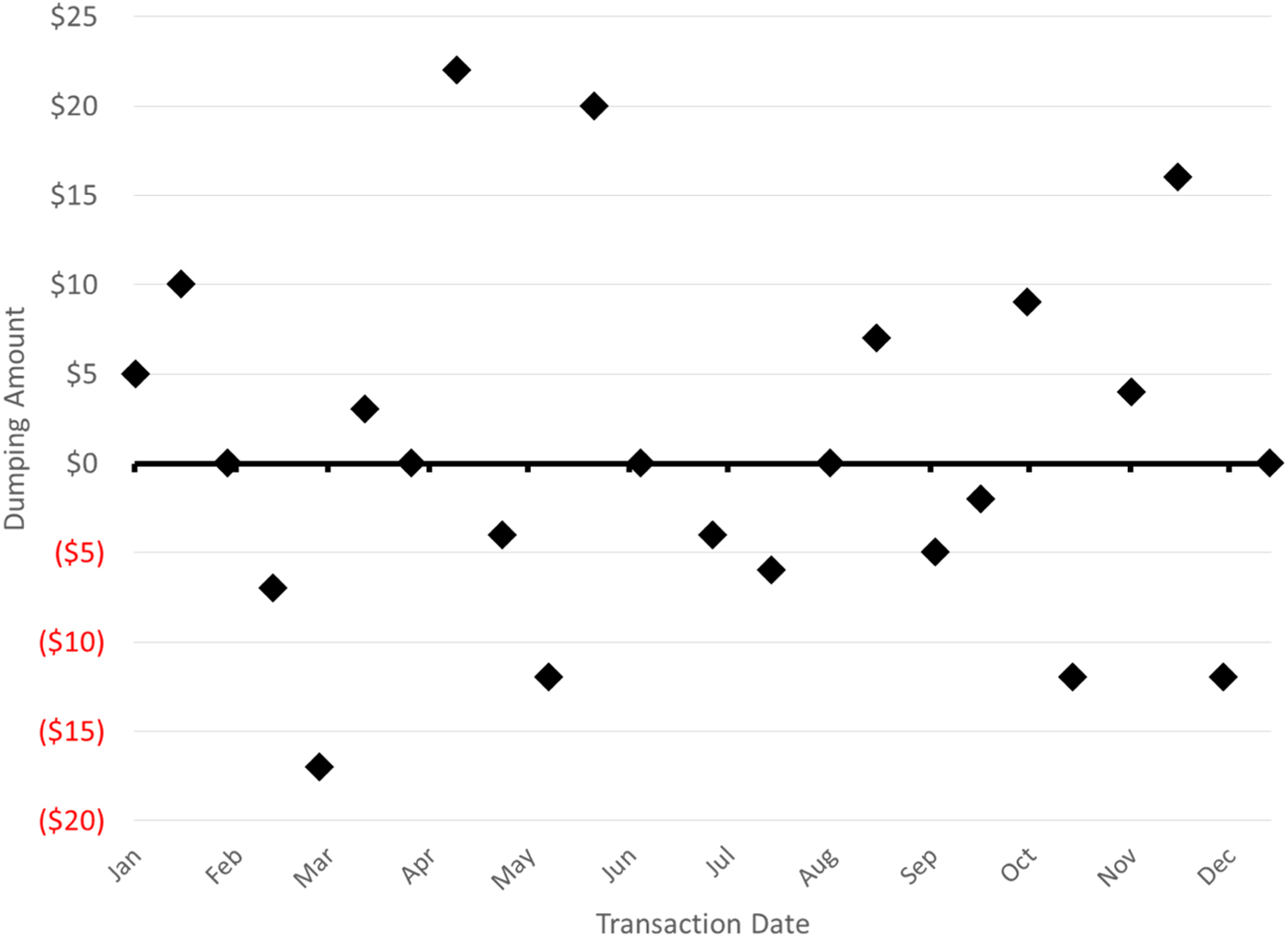
Figure 1 graphs the hypothetical dumping amounts for our example. The transactions occurred over a 12-month period (the x-axis). As seen, the dumping amount varies from transaction to transaction, with some transactions having positive amounts (i.e., normal value greater than the export value), some having zero dumping amounts, and others have negative amounts (i.e., normal value less than the export value).
Dumping amounts for hypothetical set of transactions

Once the dumping amounts are calculated, the dumping margin is computed by summing the (weighted average) dumping amounts and then dividing by the net export price. If there is no zeroing, all transactions are included when computing the numerator. Given that we are assuming one unit is exported for each transaction, we can write the dumping margin (DM) as
 $$DM^{No\; Zeroing} = \; \displaystyle{{\mathop \sum \nolimits_{i = 1}^n DA_i} \over {Net\; Export\; Price}}$$
The methods described in Article 2.4.2 for computing the dumping amount determine how the terms in the numerator (DA i) are calculated.Footnote 5 Article 2.4.2, however, does not explicitly address whether the authority needs to include all transactions in the numerator.Footnote 6 Zeroing is an example of a rule that determines which of the n observations are included in the numerator.
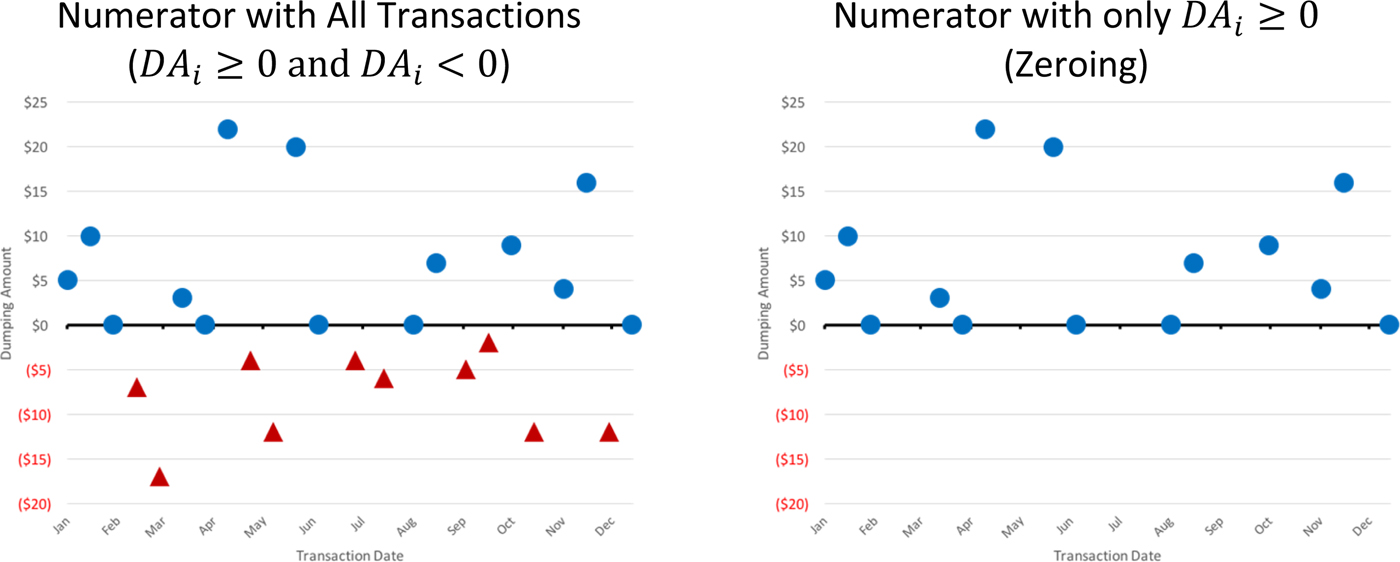
To better understand zeroing, we divide the n transactions into two groups: those with non-negative dumping amounts (DA i ≥ 0) and those with negative dumping amounts (DA i < 0). Figure 2 (the left-hand panel) depicts the same dumping amounts as in Figure 1. However, in this figure we distinguish between positive and negative dumping amounts. In Figure 2, transactions with positive dumping amounts are depicted with blue circles, and those with negative dumping amounts are depicted with red triangles.
The effect of zeroing on the DM numerator

Using the commutative property, we can rewrite the dumping margin formula without zeroing as
 $$DM^{No\; Zeroing} = \; \displaystyle{{\mathop \sum \nolimits_{Positive} DA_i + \mathop \sum \nolimits_{Negative} DA_i \;} \over {Net\; Export\; Price}}$$
Zeroing is the practice of ‘dropping’ all transactions with negative dumping amounts (DA i <0) from the numerator when computing the dumping margin.Footnote 7 This is depicted in the right-hand panel of Figure 2. With zeroing the dumping margin is defined as
 $$DM^{ZEROING} = \; \displaystyle{{\mathop \sum \nolimits_{Positive} DA_i} \over {Net\; Export\; Price}}$$
Zeroing, or the excluding of dumping amounts for some transactions, effectively means the authority ignores transactions that could possibly exonerate the alleged dumper.
The zeroing practice was repeatedly challenged in the GATT in cases brought by Norway, Japan, and Brazil, effectively on the ground that it was Not a fair comparison method because it produced a biased result.Footnote 8 None of the GATT Panels found that the zeroing practice violated the Anti-Dumping Code.
2.1 The nature of WTO jurisprudence on zeroing
At least 30 separate Panel and AB decisions have found the practice of zeroing to be inconsistent with the ADA. According to Bown and Prusa (Reference Bown, Prusa, Martin and Mattoo2011), it is quite likely that the WTO AB has devoted more time to zeroing than any other single issue in the WTO.
Several comments about these decisions are warranted. First, the initial set of zeroing disputes involved original investigations. The EU (European Union), which lost the first two zeroing disputes, soon stopped the practice, although not immediately so.Footnote 9 The United States, on the other hand, very reluctantly (and very slowly) ceased using zeroing during the original investigation-stage, despite the many WTO AB rulings against the practice.
Second, soon after the initial AB decisions, members began to challenge the US use of zeroing in reviews. The issue of margin calculation in reviews is primarily an issue for the US, which utilizes a retrospective system wherein the dumping margin calculated in the initial investigation only establishes the deposit rate. This means the actual dumping margin is established during an administrative review. The US position that the ADA did not bar zeroing in reviews hinged on one specific phrase, ‘during the investigation phase’ in the first sentence of Article 2.4.2.
Three Panels, US–Zeroing (EC), US–Zeroing (Japan), and US–Stainless Steel (Mexico),Footnote 10 agreed with the US contention that the phrase ‘during the investigation phase’ limited the applicability of Article 2.4.2 of the ADA to the original investigation. The panel in US–Zeroing (EC) conducted the probably most extensive analysis in WTO case law yet of the meaning of ‘fair comparison’, a term that appears, of course, in Article 2.4 of the ADA. Interestingly, despite the extent of the analysis provided by the panel in this case, the AB did not address the panel's analysis on this score head on, and decided the matter by finding that the language of Article 9.3 of the ADA, when considered in the light of Article 2.1 of the ADA, prohibited zeroing even in the context of administrative reviews. The AB reversed the two other panels’ findings in a comprehensive manner. All this to say that the AB, maybe involuntarily, contributed to the mess surrounding zeroing by not providing a clear and comprehensive statement explaining why zeroing is not conducive to fair comparison.Footnote 11
Third, the nature of the WTO jurisprudence has likely contributed to the number of disputes. The practice of the Panels and AB has typically been to craft very narrow determinations, probably in the attempt to reduce accusations of ‘judicial activism’, or because they are quite conscious of the fact that zeroing is a very contentious issue. As a result, important issues are often left unaddressed on ‘judicial economy’ grounds. This custom opens the door for the respondent country to limit the applicability of a ruling. The ‘legal’ justification for this attitude is that the AB decisions on zeroing were often unclear until essentially the same issue had been challenged again.
With respect to zeroing, the judicial economy exercised by the AB in the initial cases meant that many issues (e.g., alternative methods of zeroing, its appropriate use during different stages in a case, etc.) were not discussed. This allowed the US to interpret the early rulings very narrowly and resulted in more cases being filed (Bown and Sykes, Reference Bown and Sykes2008).
Fourth, for all intents and purposes uncertainty about the WTO consistency of zeroing in original investigations and reviews was resolved by 2006 following the decisions in US–Zeroing (EC), US–Zeroing (Japan), and, US–Continued Zeroing (EC) where the AB upheld the complainants’ expansive claims against the practice.
2.2 An anatomy of zeroing disputes
In Table 1, we list all disputes where the consistency of zeroing with the ADA was discussed.Footnote 12 As can be seen, case law has addressed this issue in various constellations: its consistency during the initial investigation, and during the review stage, and, as we will see later, its consistency under Article 2.4.2 of the ADA but also Article 9.3 of the ADA.
WTO disputes involving zeroing

Notes: a The Panel's zeroing decision was not appealed to the AB.
b OI = Original Investigations; R = Reviews
Source: Compiled by the authors from information on the WTO website.
As can be seen, with the exception of the first two instances, all disputes concern measures adopted by the US. For the US, zeroing has become some sort of a cause célèbre. The US has refused to acknowledge the intellectual legitimacy of the various pronouncements by panels and the AB on this score, and the number of disputes involving it on the side of the defendant is the best proof to this effect.
With two exceptions, panels and the AB have consistently outlawed the practice of zeroing.Footnote 13 In fact, zeroing is one of the very rare areas where a panel has not followed prior rulings of the AB.Footnote 14 And it is precisely because of a case of ‘disobedience’ that in US–Stainless Steel (Mexico), the AB re-visited all prior case law, and held that it expected panels to follow prior AB findings dealing with the same issue (para. 158):
It is well settled that Appellate Body reports are not binding, except with respect to resolving the particular dispute between the parties. This, however, does not mean that subsequent panels are free to disregard the legal interpretations and the ratio decidendi contained in previous Appellate Body reports that have been adopted by the DSB. In Japan–Alcoholic Beverages II, the Appellate Body found that:
[a]dopted panel reports are an important part of the GATT acquis. They are often considered by subsequent panels. They create legitimate expectations among WTO Members, and, therefore, should be taken into account where they are relevant to any dispute.
(italics in the original)Following this admonition, the AB case law on zeroing has been followed by all subsequent panels dealing with this issue.
2.3 Why is zeroing a recurring theme?
One might legitimately wonder whether the volume of litigation regarding zeroing is simply due to bad faith behaviour by those that continue to have recourse to this methodology. We still lack, nevertheless, a theory to distinguish between good faith and bad faith disputes. In fact, we lack the theory to predict when disputes will arise in equilibrium. Still, it is at best puzzling why after 2006, the year when zeroing was judged GATT inconsistent irrespective of whether it had occurred in the realm of an original or a review case, we have experienced so many disputes.Footnote 15
The WTO adjudicating bodies have to some extent contributed to the uncertainty regarding the treatment of zeroing in various ways, including the narrow findings that they have consistently issued when dealing with this kind of disputes.
WTO judges are, of course, agents that must respect Article 3.2 of DSU, namely to avoid acting as lawmakers. They are called to clarify the balance of rights and obligations struck by the WTO members, but they cannot add to the rights and obligations. Narrow judgments, ‘one case at a time’ in Sunstein's (Reference Sunstein1999) memorable expression, are more suited to the institutional role for panelists. Ideally, they should litigate the case before them, without prejudging the outcome of marginal ‘comparable’ transactions through sweeping language. Once comparability between transactions has been established though, they should repeat prior decisions, unless of course we are in presence of distinguishing factors.
The question thus, to ask is: ‘What does the ADA have to say about zeroing?’ Nothing is the short answer. So how, then, did panels and the AB so far decide the issue? They interpreted Article 2.4.2 of the ADA,Footnote 16 which reads:
Subject to the provisions governing fair comparison in paragraph 4, the existence of margins of dumping during the investigation phase shall normally be established on the basis of a comparison of a weighted average normal value with a weighted average of prices of all comparable export transactions or by a comparison of normal value and export prices on a transaction-to-transaction basis. A normal value established on a weighted average basis may be compared to prices of individual export transactions if the authorities find a pattern of export prices which differ significantly among different purchasers, regions or time periods, and if an explanation is provided as to why such differences cannot be taken into account appropriately by the use of a weighted average-to-weighted average or transaction-to-transaction comparison. (emphasis added)
In our view, the words in italics hold the key towards deciding whether zeroing is ADA consistent. These words, nevertheless, are far from conclusive. It is clear that the existence of dumping cannot be presumed. Furthermore, one could not ab initio exclude that some of the transactions are dumped, whereas some are not. The question is whether both sets of transactions (e.g., dumped, and non-dumped) can legitimately form part of the calculation, or whether only dumped transactions should be taken into account. This provision on its face does not prejudge the response to this question one way or the other.
This provision is meant to honour the overarching obligation of WTO members that wish to impose AD duties, namely, to perform a ‘fair comparison’.
Once again though, we are confronted with a similar scenario as in the case of Article 2.4.2 of the ADA. It is simply impossible to decide by looking at the term ‘fair comparison’ on its face whether only dumped or, conversely, whether all transactions during a reference period should be taken into account when establishing the ADA-consistent methodology to specify the dumping margin.
What should a judge do when the statutory language is unclear? The obvious place to look for a response is, of course, the negotiating record. And yet, for unfathomable reasons, panels and the AB almost never make use of this option. Panels dealing with zeroing (and the AB on occasion) have taken distance from this attitude, and US–Zeroing (EC) provides a comprehensive discussion of the negotiating record.Footnote 17
It is true that, as per Article 32 of the Vienna Convention on the Law of Treaties (VLCT),Footnote 18 there is no obligation to research the negotiating history. In many instances, it might be totally unwarranted. When the text is unclear though, judges have a lot to learn from inquiring into the rationale for including and/or excluding certain proposals. Stewart et al. (Reference Stewart, Markel, Kerwin and Stewart1993) discusses this issue in even more detail than the Panel Reports we have referred to (pp. 1537–1543). Japan and Korea had tabled a proposal to ban zeroing, which, however, was thwarted by Canada, the European Union, and the United States. At that time, all three were practicing zeroing, hence their common front against the Japanese/Korean proposal. Now the fact that the proposal was thwarted does not mean that zeroing ipso facto was legal. At best, there was a disagreement between trading nations on this issue at the moment when the ADA was concluded.
Subsequent practice has, of course, put this disagreement to rest. A series of WTO Panel and AB Reports have condemned zeroing, irrespective whether W-W or T-T has been used, and irrespective whether zeroing took place during the original investigation phase, or while reviewing the necessity of keeping AD duties in place. The AB Report on US–Washing Machines did not deviate from this line of thinking. It condemned zeroing even when practiced in the realm of the W-T methodology.
None of these reports though nailed the decisive nail in the coffin of zeroing. In report after report, we read that zeroing is illegal, but the US might have legitimately sometimes thought that its arguments had not been properly addressed. The AB, for example, never explained persuasively why the establishment of a dumping margin does not presuppose what the term itself suggests, that is, dumping. Why should an investigating authority, in this line of argument, look into non-dumped transactions when the very purpose of the exercise is to establish the exact opposite, that is, a dumping margin? Persuasive arguments on why this should be the case have been advanced in the literature, that much is for sure.Footnote 19 Panel and AB Reports though look more like a set of affirmations, rather than a persuasive deconstruction of zeroing.
In similar vein, the many arguments concerning the probative value of the negotiating history and prevailing practice at the time of negotiation of the ADA, irrespective of their intellectual legitimacy, were not properly counteracted either. Indeed, US–Washing Machines emerges as a rare occurrence where the AB has taken a look into the negotiating history, even if, when doing that, it simply confirmed an opinion on the inconsistency of zeroing that it had already reached without paying any attention to whatever negotiators had discussed.Footnote 20
There is a very telling passage in the AB Report in US–Continued Zeroing (EC), where, in a separate but concurring opinion, a member of the AB stated the following (para. 312):
There is little point in further rehearsing the fine points of these interpretations. In my view, there is every reason to survey this debate with humility. There are arguments of substance made on both sides; but one issue is unavoidable. In matters of adjudication, there must be an end to every great debate. The Appellate Body exists to clarify the meaning of the covered agreements. On the question of zeroing it has spoken definitively. Its decisions have been adopted by the DSB. The membership of the WTO is entitled to rely upon these outcomes. Whatever the difficulty of interpreting the meaning of ‘dumping’, it cannot bear a meaning that is both exporter-specific and transaction-specific. We have sought to elucidate the notion of permissibility in the second sentence of Article 17(6)(ii). The range of meanings that may constitute a permissible interpretation does not encompass meanings of such wide variability, and even contradiction, so as to accommodate the two rival interpretations. One must prevail. The Appellate Body has decided the matter. At a point in every debate, there comes a time when it is more important for the system of dispute resolution to have a definitive outcome, than further to pick up on the entrails of battles past. With respect to zeroing, that time has come.
Really? Whatever the erudite member of the AB might have thought when writing these lines, he/sheFootnote 21 must have factored in that this was a very shallow line of argumentation to persuade an administration that was so hot on this issue to simply accept and abandon. If at all the words ‘arguments of substance made on both sides’ were an implicit acknowledgment of the force of arguments raised by the US lawyers before the WTO adjudicating bodies. Furthermore, the US has never been happy with the manner in which the WTO AB (and Panels as well) have understood the ‘deferential’ standard that it had introduced following the hard won battle during the Uruguay Round negotiations.Footnote 22
Is this affirmation though enough to put to bed a debate? Does it suffice that the best the AB can come up with is a statement to the effect that a debate should be put to bed simply because it was time to do so? Under the circumstances, it was not unreasonable for the US administration to think that it could have one more shot at zeroing. It is against this background that US–Washing Machines saw the light of day.
3. The question before the AB and the response
In US–Zeroing (EC), the AB had found that the use of zeroing under W-T in administrative reviews was inconsistent with Article 9.3 of the ADA (para. 133). The AB had not, nonetheless, addressed head on the question whether Article 2.4.2 of the ADA permits the use of zeroing when applying W-T.Footnote 23
3.1 Distinguishing factors in US–Washing Machines
The first sentence of Article 2.4.2 of the ADA gives preference to computing dumping amounts via a comparison of a weighted average normal value with a weighted average of prices of all comparable export transactions (W-W) or by a comparison of normal value and export prices on a transaction-to-transaction basis (T-T). As discussed above, the second sentence of Article 2.4.2 creates an opportunity for a third method (W-T).
Interestingly, there is little evidence the US used this third, ‘exceptional’, method in the post Uruguay Round era. In fact, the US did not even have any established procedures to perform the pattern test. This oversight was remediated following the AB rulings that zeroing under W-W and T-T was inconsistent with the ADA.
Thus, while there have been nearly 30 Panel and AB decisions declaring zeroing inconsistent with the ADA, all of those rulings, bar the narrow ruling in US–Zeroing (EC) mentioned above, involved the W-T or T-T methodologies. The US–Washing Machines dispute is the first opportunity for the AB to opine whether zeroing was permitted under the W-T methodology.
3.2 The AB decision
It is always informative to read the WTO Panels’ and AB decisions against their factual background. It is particularly so when dealing with the jurisprudence on zeroing. First, as stated above, all case law on zeroing so far has developed incrementally, at a very slow pace. Second, Korea attacked W-T as practiced by the US administration. There is nothing like a clear, horizontal guidance instructing authorities how to practice W-T. One might, of course, retort that the same is true for W-W or T-T. This is true. There are not many ways to define ‘weighted average’ though, and the only real issue regarding T-T is chronological proximity of sales at home and abroad.
The conditions for having recourse to W-T though, are a matter for interpretation in and of themselves. Indeed, how is a ‘pattern of export prices, which differ significantly among different purchasers, regions or time periods’ established? Recall it is this pattern that serves as proxy to show ‘targeted dumping’, the term often used to describe the situation reflected in Article 2.4.2 of the ADA, which has been endorsed by the AB, as we will see later. What kind of information should an investigating authority provide to this effect? And what kind of explanation is necessary for an investigating authority to justify that it could not have calculated the margins through W-W or T-T?
A look into the positions of the parties first will help us better understand the facts of this dispute, and how they gave rise to the complaints advanced by the complainant, Korea.
3.2.1 The positions of the parties
The US procedures applying W-T have evolved since 2006.Footnote 24 Bae (Reference Bae2017) explains that Korea challenged the consistency of two methodologies that the US administration successively applied to perform W-T. Whether a deliberate tactic or not, the US change in procedures complicate the dispute process since the approach used in the original investigation was no longer in use at the time of the AB's deliberations. Hence, depending on how narrowly the AB's Report was crafted, the US could easily argue it had already complied with any adverse rulings in US–Washing Machines (i.e., that the US had already changed its policy).
During the original investigation, the US applied what is referred to as the ‘Nails II’ test, described in paras. 5.3 and 5.4 of the AB Report. Under Nails II, the investigating authority, the US Department of Commerce (USDOC), would perform a two-stage test. First, it would perform a ‘standard deviation’ test where it would test whether the prices of allegedly dumped product to the targeted group were more than one standard deviation below the prices to non-targeted customers. Second, the USDOC would perform a ‘gap’ test where it would test whether the difference in prices to the targeted group and the lowest higher price to the non-targeted group was larger than the average gap in the data.Footnote 25 If both tests were satisfied, the USDOC would apply W-T and zeroing to all transactions (both targeted and non-targeted).
Not long after the Washers original investigation, the USDOC introduced a new procedure for identifying targeted dumping called ‘Differential Price Methodology’ (DPM).Footnote 26 DPM was applied in the administrative review in US–Washing Machines and, more generally, has replaced Nails II.
DPM is a three-step procedure. First, the USDOC would apply a statistical measure called ‘Cohen's d’, whereby it would evaluate the extent to which prices to a particular targeted group (i.e., a purchaser, region or time period) differed from all other prices. The USDOC would determine if the net prices to the targeted group differed by more than the Cohen's d threshold. Under DPM, when establishing the targeted group, the US ‘flagged’ not only low priced transactions (as it had under Nails II) but also those it deemed were ‘too high’.
Second, the USDOC would apply a ‘ratio test’ where it computed the ratio of trade that satisfied Cohen's d to the value of all trade.Footnote 27 If the share was more than 66%, then W-T would be used for all transactions (and the USDOC would zero all transactions). If the share was more than 33% but less than 66%, then W-T would be applied to targeted transactions, and W-W would be applied to non-targeted transactions. In this scenario, the USDOC would zero only the targeted transactions, but it would disregard the dumping amounts arising from the non-targeted group if the sum was negative (this is referred to as ‘systemic disregarding’ by Korea).
Third, the USDOC would test if the dumping margin produced by the exceptional method ‘meaningfully differed’ from the margin produced by the preferred methods. According to the USDOC, if there were a 25% relative change in the weighted average dumping margin or if the weighted average dumping margin moves across the de minimis threshold, then the difference would be deemed meaningful.Footnote 28
Korea challenged all aspects of the US’ procedures from how the USDOC established a pattern and the validity of its statistical ‘tests’ to the use of zeroing and the lack of justification for why the preferred methods were inadequate.
As the preceding paragraphs suggest, understanding the legal and economic issues is obscured by the technical and complicated procedures adopted by the US. To clarify how DPM operated, we now extend the example discussed above. Given space constraints, we focus on DPM's use of zeroing and do not discuss (at any length) Korea's challenge regarding the US’ pattern test.Footnote 29
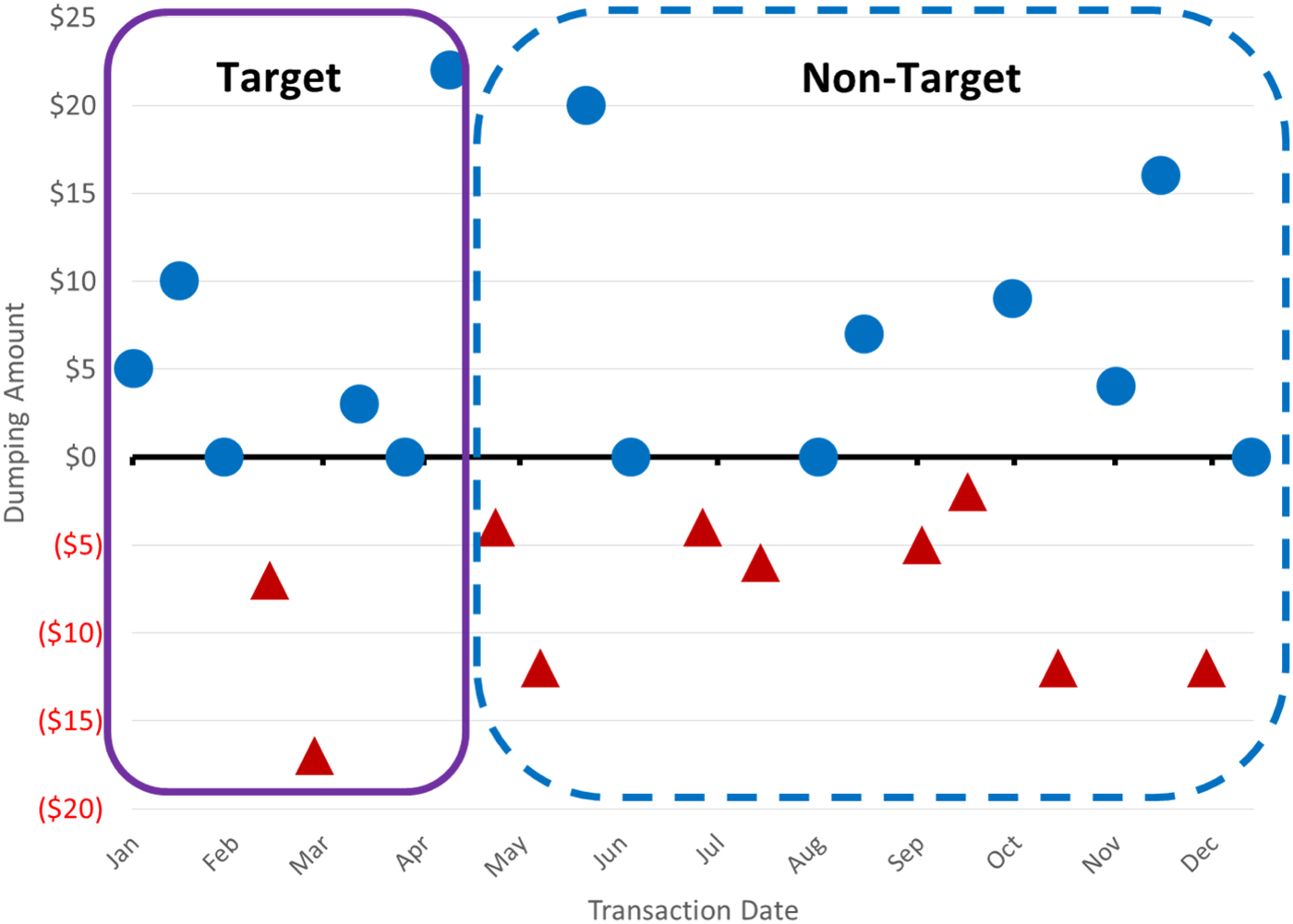
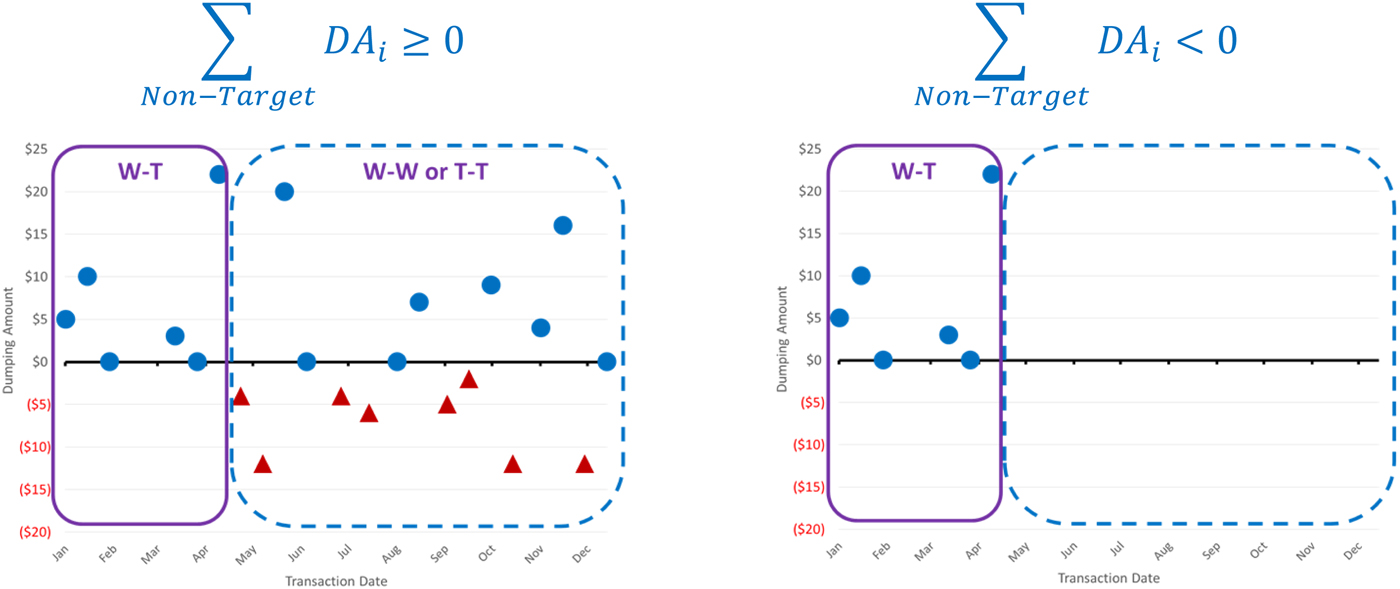
For purposes of this paper, we will assume that the investigating authority has identified the pattern or targeted group (say, in the case of the US, using Cohen's d) and that the targeted transactions fall within the solid line in Figure 3.Footnote 30 The non-targeted transactions are enclosed by the dashed line.
Dividing transactions into targeted and non-targeted

Once the pattern had been identified, the USDOC's next step was the ‘ratio test’. Under DPM, the US approach at this second step depended on the share of the total value of sales accounted for by the targeted group. In Figure 4, we depict the approach when the targeted group accounts for 66% or more of the sales (Scenario A). As seen, all negative dumping amounts – both in the targeted and non-targeted groups – were zeroed.
US method for calculating the numerator of DM: Scenario A – targeted group has large share of value

In Figure 5, we depict the case when the targeted group accounts for between 33% and 66% of the sales (Scenario B). Here the USDOC computed the dumping amount using the W-T method for the targeted group and W-W (or T-T) for the non-targeted group. In addition, the US zeroed transactions in the targeted group. In the left-hand panel in` Figure 5, we show the approach when the aggregate dumping amount from the non-targeted group is positive ( $\sum\nolimits_{Non - Target} {DA_i \gt 0\;} $). In this case, the US authority would add that amount to the targeted amount. By contrast, in the right-hand panel in Figure 5 we show the approach when the aggregate dumping amount from the non-targeted group is negative. In this case, the USDOC would drop all margins from the non-targeted group (i.e., it would not offset the targeted dumping amount).
US method for calculating the numerator of DM: Scenario B – targeted group has moderate share of value

Finally, if the targeted group accounted for less than 33% of the sales (Scenario C), then the US authority would deem that the pattern requirement was not satisfied and it would calculate the dumping amount using one of the preferred methods (W-W or T-T) and would not zero. In effect, in this scenario the US would not do targeted dumping and simply use one of the preferred methods (as depicted in the left-hand panel of Figure 2).
With this graphical depiction in mind, we now discuss the outcome and the reasoning of the AB Report.
3.2.2 Zeroing is illegal and here is why (because I've told you so)
The AB once again condemned the practice of zeroing. As a result, it is clear that zeroing is illegal (i) no matter the methodology being used (W-W; T-T; W-T), and/or (ii) no matter the stage of the investigation (original; administrative; sunset).
Alas, yet again, the AB did not provide a persuasive explanation that would put the issue beyond doubt. It explained comprehensively the purpose of Article 2.4.2 of the ADA and rejected the argument of mathematical equivalence. But the AB stopped there. As a result, we know that the US defense of zeroing has been rejected, without knowing nonetheless what is wrong with zeroing. We advance a few thoughts on this score in Section 4.
3.2.3 The purpose of Article 2.4.2 of the ADA
Following the Panel's analysis in this respect (paras. 7.27 et seq. in the Panel Report), the AB held that the purpose of the second sentence of Article 2.4.2 of the ADA is to address (‘unmask’ in the Panel's expression) targeted dumping (paras. 5.167 et seq. of the AB Report).
Alas, ‘targeted dumping’ is not defined anywhere in the ADA, other than the reference to ‘purchaser, time period, and region’ in this provision. So we know, as a matter of statutory language, the identity of targets, but we do not know in what ‘targeting’ consists.
The AB did not address this issue at all. The Panel did so, in rather oblique manner we should add. Without defining ‘targeting’, it held that investigating authorities must show that W-T is necessary to address ‘targeted dumping’ in that they must demonstrate that the observed outliers are the effect of targeted dumping and not of other factors. It did not explain how many other factors an investigating authority must examine (the ‘breadth and width’ of examination in other words), but it did find that the USDOC had failed this test by not examining alternative explanations (paras. 7.71 et seq., and especially, 7.76, and 7.77 of the Panel Report).
We will return to this issue later, in Section 4. Suffice to state for now that the AB held that W-T must serve one purpose, namely, to address targeted (by purchaser, region, or time period) dumping.
3.2.4 How to choose the universe of patterned transactions?
Korea had argued before the Panel that the USDOC was wrong in using only quantitative criteria, as described above under the DPM methodology, when choosing the patterned transactions. In Korea's view, the USDOC should be required to consider qualitative criteria as well. In advancing its claim, Korea argued, inter alia, that the term ‘significant’ appearing in the body of Article 2.4.2 of the ADA, cannot be understood simply as ‘large’, the latter denoting a quantitative only dimension. It must be linked to some sort of impact-analysis in order to show that W-T is warranted. The Panel rejected this claim, holding that nothing in the ADA required from the USDOC to adopt qualitative criteria as well when deciding on the universe of patterned transactions (paras. 7.44 et seq. of the Panel Report).
The AB rejected the Panel's approach on this score. In a few paragraphs (paras. 5.61–5.66 of the AB Report), it held that, when choosing the universe of patterned transactions, the AB should look into qualitative criteria as well. It held on this point that:
The significance … may indeed be affected by objective market factors, such as the nature of the product under consideration, the industry at issue, the market structure, or the intensity of competition … Hence, what may be deemed ‘significant’ price difference in one instance may fail to meet the same threshold when different variables are considered. For example … in a more price-competitive market, smaller differences might be significant. (para. 5.63)
Nevertheless, this apparently is where the duty of the investigating authority ends. It does not have to also examine the causes for significant differences (para. 5.65).
3.2.5 Why not zero the patterned transactions?: Mathematical equivalence
The US had advanced before the Panel and the AB that, unless zeroing were permitted, W-T would yield the same result as W-W – the so-called mathematical equivalence justification for zeroing. This redundancy could not have been the intended understanding of the framers of the ADA and therefore, in the US view, must mean zeroing is allowed under W-T.
Echoing the Panel in this respect, the AB dismissed in clear and unambiguous terms this claim. It held that this cannot be the case since the universe of transactions under W-W and W-T is not the same (paras. 5.161–5.163).Footnote 31 In other words, because the AB ruled that W-T can only be applied to the targeted set, the dumping margin under the exceptional method in not mathematically equivalent to that produced by W-W under the preferred method (which would be based on all transactions).
Think of the following illustration (assume volumes traded are symmetric across transactions, so we do not have to control for discrepancies in order to provide the weighted average):
NV 12 10 12 10 16
EP 10 10 12 8 10
EP* 10 5 5 5 10
NV is of course, the Normal Value, EP is the Export Price, and EP* is the unusual export price that triggers the recourse to third exceptional method, since, we assume, exporters target one particular region. The WANV is 15, and the WAEP, 10. There is no reason to look for the WAEP*, since, the third method is W-T. The issue for the investigating authority will be to decide on which transactions constitute the ‘pattern’. If it decides that all five transactions in EP* do so, then only the first and fifth case could be described as cases of mathematical equivalence. If it decides nonetheless, that only the second, third, and fourth transaction constitute the ‘pattern’, then there would be no case of mathematical equivalence at all. Furthermore, transactions 1 and 5, could yield results other than 10. Hence, we would obtain mathematical equivalence not only accidentally, but in many cases never.
3.3 Minority opinion
Zeroing decisions have on several occasions been accompanied by dissenting opinions, and this one, as we have already noted above, was no exception.
In paras. 5.191 et seq., one member of the Division of AB discussing US–Washing Machines held that, unless if zeroing were allowed, investigating authorities will not be in position to ‘fully’ deal with targeted dumping.
Alas, this dissenting opinion leaves us with more questions than answers. Besides an affirmation to the effect that only zeroing allows investigating authorities to fully deal with targeted dumping, there is no analysis substantiating this point of view. Is it because of the mathematical equivalence argument discussed above? If yes, then the author of the opinion should have engaged with this opinion. HeFootnote 32 did not. And how should one understand ‘fully’ addressing targeted dumping? Why does W-T only partially address it? There is no explanation on this front, either.
3.4 The effect of the AB decision
Following the AB ruling, an investigating authority having recourse to W-T must: (i) include in the numerator only the export prices of the outliers (or targeted group) as defined in Article 2.4.2 of the ADA and (ii) include in the denominator the weighted average of all transactions
The AB's ruling means an investigating authority cannot zero negative dumping margins that might exist in the numerator. Second, when invoking the exceptional method the investigating authority must base the dumping amounts only on the targeted set.
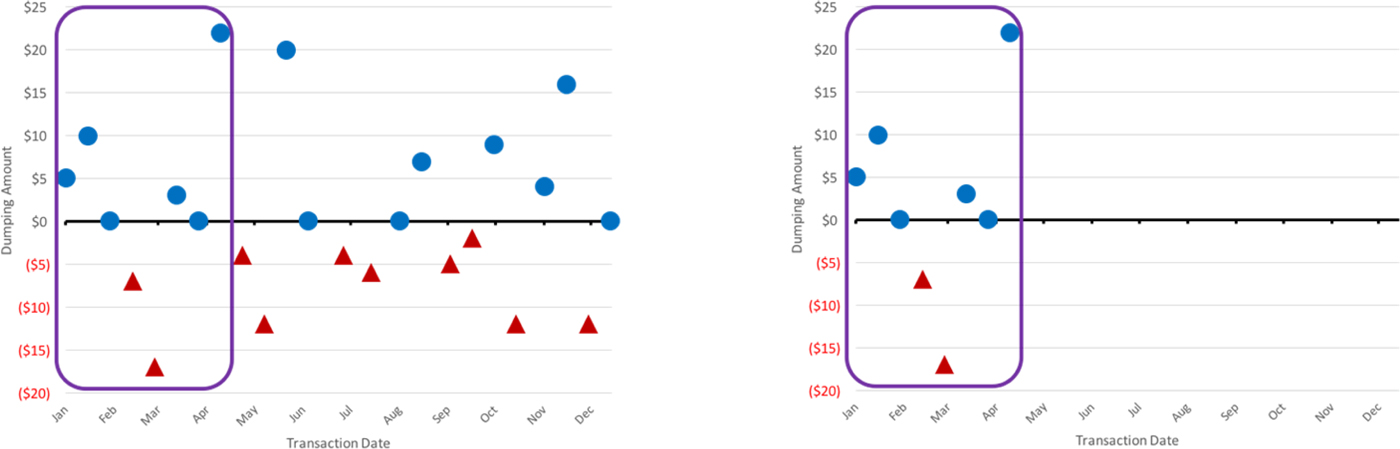
Let us now consider the practical effect of the AB's determination in US–Washing Machines by continuing the graphical example developed above. According to the AB, the US must perform two steps: (i) identify the pattern and (ii) compute the dumping amount using the W-T method for the targeted group (no zeroing) and then compute the dumping margin using only the dumping amounts from targeted transactions.Footnote 33
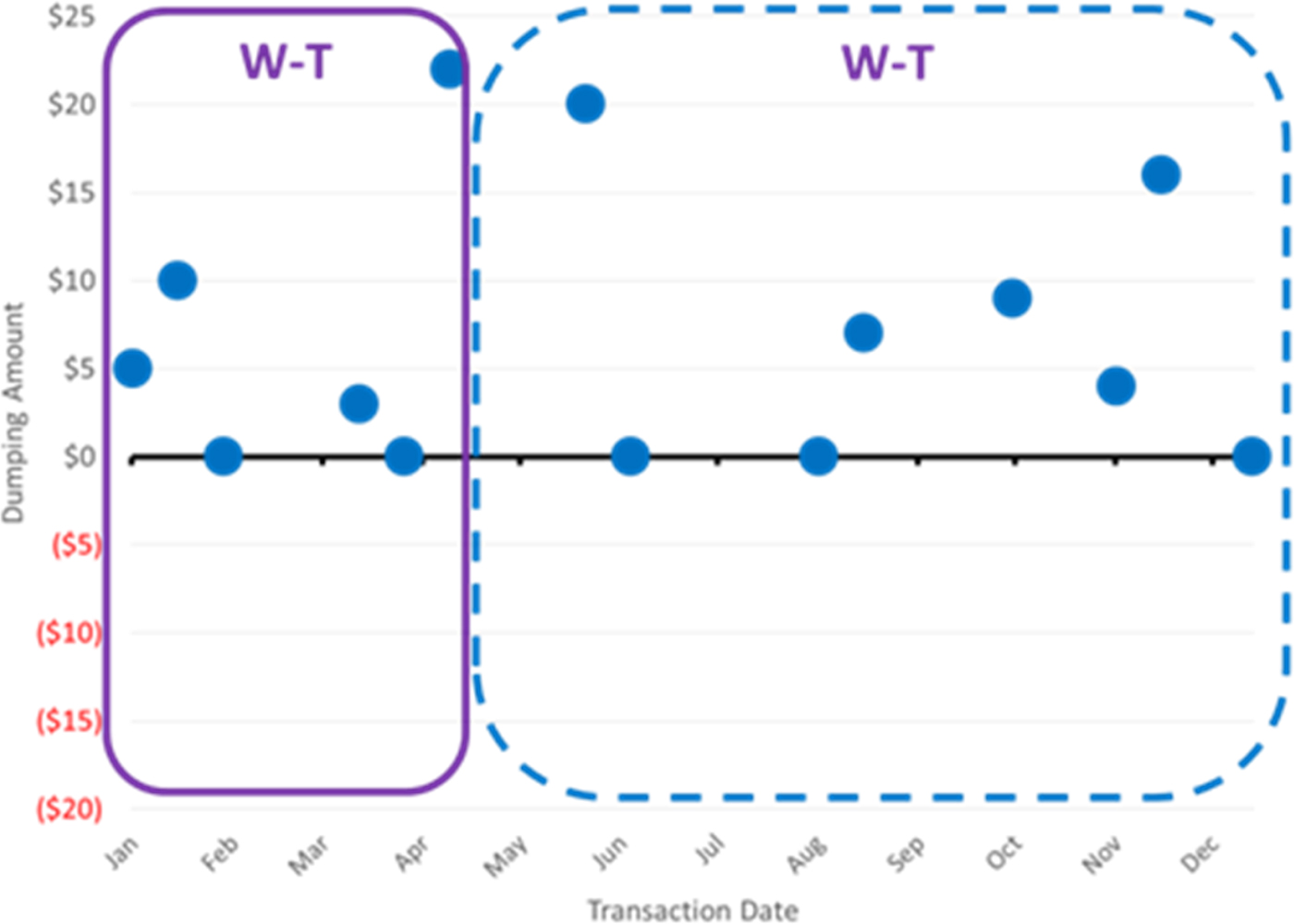
Figure 6 depicts what the AB's decision means for investigating authorities. In the left-hand panel, we depict the targeted transactions. The AB did not dictate the methods for identifying the pattern but only ruled that the approach used by the US in the present case was WTO inconsistent. For discussion purposes, we assume the US eventually develops an approach for identifying the targeted group that is WTO consistent. The next step is to calculate the dumping margin using W-T where ‘W’ is the weighted average of all transactions (pattern and non-pattern).
AB suggested method for calculating the dumping margin

According the AB in US–Washing Machines, the numerator should include only the transactions from the targeted group and the dumping amounts from the non-targeted group, whether positive or negative, should be dropped.Footnote 34
While the AB may have thought it had found a way to preserve the principle that zeroing is not a fair comparison and also allow the W-T exceptional method to produce margins that differ from W-W method, we believe that the US–Washing Machines decision may effectively resurrect the effects of zeroing. As we discussed above, zeroing drops transactions with negative dumping amounts from the numerator of the dumping margin formula. But, as seen in the right-hand panel of Figure 6 the AB's decision implies that investigating authorities can drop transactions from the numerator. The difference is that it cannot simply drop those with negative dumping amounts but rather can drop all transactions from the non-targeted group.
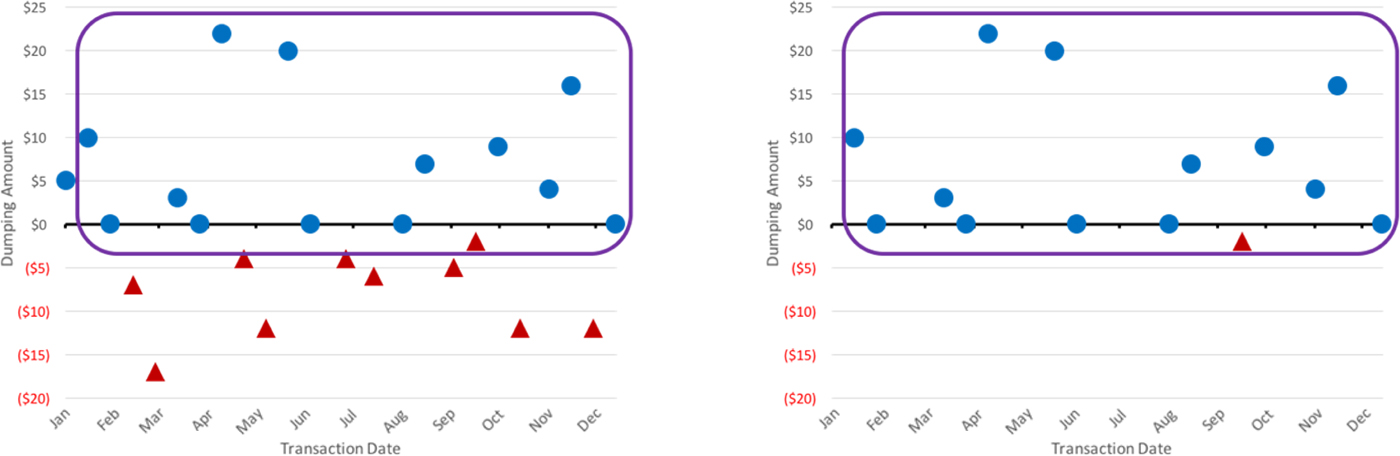
The issue, then, is the procedures investigating authorities use to define the targeted and non-targeted groups. In Figure 7, we depict a hypothetical scenario. Here we imagine an investigating authority defines the targeted group in such a way that the targeted group is almost entirely composed of transactions with positive dumping amounts. Consequently, according to the AB decision in US–Washing Machines, the basis for computing the dumping amount will be almost entirely composed of positive dumping amounts and will exclude virtually all transactions with negative dumping amounts. For all intents and purposes, the AB sanctioned method for targeted dumping risks reproducing the W-W margin with zeroing. That is, the effect of zeroing will re-emerge via the targeted dumping procedure.
Backdoor zeroing

Given the lack of guidance the AB provided on how an investigating authority should define the pattern, WTO members are almost certainly confronted with continued zeroing-related disputes. Must an authority use the same approach to defining the pattern in each case? Or, can the authority change its approach from case to case? And, even if the same approach is used in each case, must the same threshold for what constitutes a significant pattern be used in each case? Bown and Prusa (Reference Bown, Prusa, Martin and Mattoo2011) estimate that approximately half of US cases with AD duties would have de minimis margins ‘but for’ zeroing. Given the political pressure to offer contingent protection, it seems inevitable that some countries will increasingly turn to targeted allegations and the AB's ‘quasi zeroing’ guideline to produce margins.
4. Critical evaluation of the AB report
In what follows, we present our critical evaluation of the AB Report. We start with an overall assessment of the report, and then we move to discuss the two issues that the AB left unanswered, and by doing so might have opened the door to additional zeroing-related litigation in the future, when it might have been thought that the door had been shut for good.
4.1 Overall assessment
The AB cannot be criticized for what it did but for what it did not do. In our view, it correctly dismissed the arguments about mathematical equivalence, but for some reason did not go the extra mile and explain once and for all what is the conceptual problem with zeroing. We will attempt to do so in 4.2.1. In similar vein, it correctly rejected the Panel's attitude to disregard ‘qualitative’ elements when establishing the need to have recourse to W-T, but stopped short from explaining itself as to how an investigating authority can justify whether recourse is appropriate in the first place.
4.2 Unanswered questions
4.2.1 Zeroing
The AB did state that zeroing is ADA inconsistent, but once again it satisfied itself to ‘I have told you so in the past’ line of reasoning, rather than a rational explanation why this should be the case.
The intellectual support for this thesis should be that, since duties will be imposed on future transactions,Footnote 35 it is the totality of transactions that occurred during a representative period that should serve as basis for the assessment of duties, and not a part of them. The latter could suffer from selection bias.Footnote 36
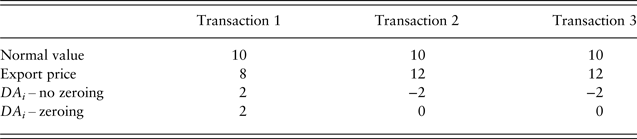
Think of it this way. Suppose during the period of investigation (POI), the foreign firm has been exporting widgets to the home country at prices given in Table 2.
WTO disputes involving zeroing

If zeroing were permitted, the dumping amounts for Transactions 2 and 3 would be discarded, and exports of widgets originating in Foreign would be burdened with additional AD duties, even though the average dumping amount is negative.
Assuming the volume of trade is the same across all three transactions, two-thirds of the volume of exports has not been dumped. It is only one-third of the volume that has been dumped. Should the one-third share of exports provide the basis for the future level of duties paid by all exports to this market? No, was the response in a number of Panel and AB Reports, since, arguably, this practice would run counter to the overarching requirement for a ‘fair comparison’ (Article 2.4 of the ADA).
We add that the opposite conclusion would have been unfair precisely because of the prospective nature of the anti-dumping imposition. The best guess we have about pricing behaviour in the future is pricing in the past, during the reference period that constitutes the POI. Unless something happens that changes the existing picture, and the onus in this case should be on the investigating authority to show that this has indeed been the case, pricing patterns of the period leading up to the investigation process should not be significantly altered from the end of the process onwards.
4.2.2 Justifying the recourse to the ‘exceptional method’
We have already explained how the AB has reversed the Panel's finding regarding the (ir-)relevance of qualitative elements when establishing the pattern (paras. 5.61–5.66 of the AB Report). Having found that the USDOC though, had incorrectly ‘zeroed’ transactions when applying W-T, the AB refrained from explaining its view on what an investigating authority must do in order to justify recourse to W-T. This omission could be important. It all depends on how seriously panels and the AB will apply the requirement to use ‘qualitative’ elements when having recourse to W-T.
At the moment, all we have with respect to requiring an explanation is the Panel's findings in this respect. In paras. 7.71 et seq. (and especially in 7.76–7.77), the Panel held that, since the purpose of Article 2.4.2 of the ADA is to unmask targeted dumping, investigating authorities should examine alternative explanations that might explain the existence of outliers (pricing to a purchaser, a region, or during a time period). How far should this duty take an investigating authority? Should it be confined to claims brought by the parties (inspired by the case law on ‘known factors’ in the jurisprudence concerning contingent protection instruments)? Should it go out and look ex officio for other factors?
Alas, we have no clue as to what is expected from investigating authorities. So here is an idea. Investigating authorities should, at the very least, explain why recourse to W-W or T-T cannot adequately take care of ‘targeted dumping’. In other words, what are the advantages of W-T in order to unmask targeted dumping, now that zeroing has been outlawed, keeping in mind that this is an ‘exceptional’ method that only sparingly should be used, that is, only when the other two methods yield unsatisfactory results. At the present time, it appears the US’ justification can be simply stated as ‘because the AD margin is higher under W-T’.
It bears repetition that this obligation should be read in conjunction with the obligation to properly establish the pattern. There the AB alluded to the obligation imposed on investigating authorities to examine the competitive conditions of the given market. This analysis should at the very least inform the explanation why recourse to W-T is necessary.
5. Concluding remarks
Rather remarkably, nearly 20 years after the first WTO dispute involving zeroing the WTO DSU remains unable to bring the issue to a conclusion. US–Washing Machines is the latest, but we fear not the last, dispute on the issue. As it has over and over again, the WTO AB ruled that zeroing is inconsistent with the ADA, even under the exceptional W-T method.
While this case may be the last case to focus on zeroing, we believe it will not be the last case involving the general issue of when and how and investigating authority can exclude certain transactions from the numerator of dumping margin calculation. What is required to trigger the exceptional method? It seems likely to us that an authority interested in maximizing the size of the dumping margin can manipulate the transactions in the targeted set so as produce margins that are similar to those that would occur with zeroing. If this indeed happens, the effects of zeroing are likely to linger.