Introduction
Although there are numerous histological types of parotid gland tumour, they are usually divided into either benign or malignant. The pre-operative and intra-operative diagnoses are important in determining treatment strategies. For this purpose, fine-needle aspiration cytology (FNAC) and frozen section biopsy are widely performed. However, it is generally considered that FNAC and frozen section biopsy do not necessarily identify parotid gland malignancy; this is because of the wide range of histological types and variations in cytopathologist experience.Reference Wong1, Reference Seethala, LiVolsi and Baloch2 On the other hand, an open biopsy of a parotid gland tumour is not recommended given the risk of tumour dissemination and facial nerve injury. In our institution, both FNAC and frozen section biopsy have been utilised for almost all cases of parotid gland tumours, in order to manage surgical procedures properly.
The interpretation of these diagnostic findings varies according to each individual institution. Additionally, there have been no detailed reports on malignant diagnosis made by frozen section biopsy and histology in cases diagnosed as benign by FNAC. In the current study, we focused on parotid gland tumours diagnosed as benign by FNAC, and investigated the necessity of frozen section biopsy for those tumours.
Materials and methods
We included 132 parotid gland tumour patients who underwent operations between April 2006 and June 2016. Of these, 104 cases were diagnosed as having benign tumours by FNAC and underwent frozen section biopsy. Fine-needle aspiration cytology was performed under ultrasound guidance. Class I or II was determined to be benign according to Papanicolaou's classification. Portions of the resected tumour and its capsule were submitted for frozen section biopsy.
In this retrospective study, the results of frozen section biopsy were analysed and compared with the final histological diagnosis. Histological diagnosis was based on the World Health Organization International Classification of Diseases (2005). This study was approved by our institutional review board.
Results
Among the 104 cases diagnosed as benign by FNAC, 102 cases and 2 cases were diagnosed as benign and malignant, respectively, by frozen section biopsy. The final histological diagnoses showed that 98 cases were benign and 6 cases were malignant. For the two cases diagnosed as malignant by frozen section biopsy, malignancy was determined based on the final histological diagnosis. Four cases diagnosed as benign by both FNAC and frozen section biopsy were determined to be malignant in the final histological diagnosis (Figure 1). The sensitivity and specificity values of frozen section biopsy in detecting malignant tumours were 33 per cent and 100 per cent, respectively, in the 104 cases.
Results of frozen section biopsy (FSB) and final histological diagnosis in 104 cases with benign fine-needle aspiration cytology (FNAC).

The histological tumour types in the 98 cases that were histologically diagnosed as benign included: 59 cases of pleomorphic adenoma, 30 cases of Warthin tumour, 4 cases of basal cell adenoma, 2 cases of oncocytoma, 2 cases of lymphoepithelial cyst and 1 case of benign epithelial tumour. The histological malignant tumour types in the remaining six cases included: three cases of basal cell adenocarcinoma, one case of acinic cell carcinoma, one case of adenoid cystic carcinoma and one case of malignant lymphoma.
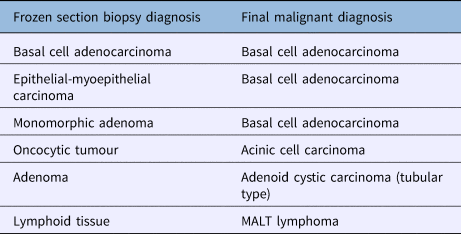
A comparison of the frozen section biopsy and final malignant diagnoses in six cases with an incorrect benign FNAC diagnosis is shown in Table 1. Concordance between the frozen section biopsy and final diagnosis was seen in only one case of basal cell adenocarcinoma.
Frozen section biopsy and final malignant diagnoses*

* In six cases with an incorrect benign fine-needle aspiration cytology diagnosis. MALT = mucosa-associated lymphoid tissue
Discussion
Frozen section biopsy in parotid surgery has three general purposes: clarification of diagnosis, confirmation of surgical margin status, and determination of nerve and/or cervical node involvement. With the advent of FNAC, frozen section biopsy is less often required, and its role has shifted from being a diagnostic tool to margin assessment.Reference Schmidt, Hunt, Hall, Wilson and Layfield3 Fine-needle aspiration cytology is a safe and minimally invasive procedure. In addition, it has a well-established role in the pre-operative diagnosis of salivary gland lesions.
• This study focused on parotid gland tumours diagnosed as benign by fine-needle aspiration cytology (FNAC), and investigated the necessity of frozen section biopsy for those tumours
• The sensitivity of frozen section biopsy in cases of parotid gland neoplasm with benign FNAC was 33 per cent
• The necessity of frozen section biopsy in cases with benign FNAC may be low in parotid gland surgery
On average, FNAC has high specificity (97 per cent), while the sensitivity is somewhat lower (80 per cent).Reference Schmidt, Hall, Wilson and Layfield4 The false-negative rate of FNAC (20 per cent) is an issue of concern. In the present study, 6 of the 104 (6 per cent) cases with benign FNAC were diagnosed as malignant in the final pathological diagnosis. This result is concordant with previous reports, which showed rates ranging from 6.3 per centReference Seethala, LiVolsi and Baloch2 to 8.5 per cent.Reference Zbären, Guélat, Loosli and Stauffer5 However, there have been no detailed reports on the usefulness of frozen section biopsy for accurate malignant diagnosis for cases with benign FNAC.
In the present study, apart from the 104 cases with benign FNAC, 19 cases had indeterminate FNAC and 9 cases showed malignant FNAC. Among the 19 cases, 13, 3 and 3 cases were diagnosed as benign, indeterminate and malignant, respectively, by frozen section biopsy. Final histological diagnoses showed the 13 cases were benign and the remaining 6 cases were malignant. This suggests that frozen section biopsy properly distinguishes benign from malignant tumours in the indeterminate FNAC cases. In addition, among the nine cases with malignant FNAC, all were diagnosed as malignant by both frozen section biopsy and final histological diagnosis. This suggests that frozen section biopsy is not necessary for malignant FNAC cases.
Therefore, the value of frozen section biopsy for diagnosis of malignancy in cases with benign FNAC is of great interest to most head and neck surgeons. However, the role of frozen section biopsy in those cases has been controversial. Arabi Mianroodi et al. described three cases with false-negative FNAC diagnosed as malignant by subsequent frozen section biopsy.Reference Arabi Mianroodi, Sigston and Vallance6 In addition, Fakhry et al. found that false-negative FNAC results were corrected by frozen section biopsy in four of eight cases.Reference Fakhry, Santini, Lagier, Dessi and Giovanni7 These two reports concluded to recommend the use of frozen section biopsy in parotid surgery. In contrast, Patel et al. showed that frozen section biopsy detected 0 per cent of false-negative FNAC, and concluded that frozen section biopsy appeared to be of limited clinical use after benign FNAC.Reference Patel, Scognamiglio, Kutler, Kuhel, Gromis and Phillips8
In the present study, the sensitivity of frozen section biopsy in cases with benign FNAC was low, at 33 per cent, while the specificity was 100 per cent. Table 1 shows diagnoses made by frozen section biopsy and final histological diagnosis in six cases with incorrect benign FNAC. Among the three cases diagnosed as having basal cell adenocarcinoma by final histological diagnosis, only one case was correctly identified by frozen section biopsy. For the remaining two cases, malignancy was identified by frozen section biopsy only in one case.
The six cases diagnosed as malignant in the final pathological diagnosis were of relatively low-grade malignancy. The low sensitivity of frozen section biopsy in benign FNAC cases may be due to the difficulty in identifying low-grade malignancy with this procedure. In support of this hypothesis, Olsen et al. reported that 11 of 53 cases diagnosed as having suspected benign tumour by frozen section biopsy were proved to be malignant on permanent pathology, including 10 cases of low-grade malignancy.Reference Olsen, Moore and Lewis9 In addition, Nishikado et al. reported that non-diagnosis by frozen section biopsy was predominant in basal cell carcinoma, epithelial-myoepithelial carcinoma and carcinoma ex pleomorphic adenoma.Reference Nishikado, Kawata, Haginomori, Terada, Higashino and Kurisu10
There may be another reason for the low sensitivity of frozen section biopsy in the present study. Submitting a tumour as a whole, including the surrounding tissue rather than a part of the tumour, for frozen section biopsy might have increased the sensitivity. Tumour circumscription, microscopic invasion and overall architecture can be best evaluated on frozen section biopsy.Reference Seethala, LiVolsi and Baloch2
In conclusion, the sensitivity of frozen section biopsy in parotid gland tumour cases with benign FNAC was 33 per cent. While high-grade tumours are relatively easily diagnosed by FNAC, frozen section biopsy has difficulty in diagnosing low-grade tumours. Thus, for cases with benign FNAC, frozen section biopsy may not be essential in parotid gland surgery.
Competing interests
None declared