The most serious mental and physical health effects for individual outcomes such as broad-based morbidity or mortality are associated with perceived social isolation (i.e., loneliness; Cacioppo, Capitanio, & Cacioppo, Reference Cacioppo, Capitanio and Cacioppo2014), whether measured objectively or subjectively (Holt-Lunstad, Smith, Baker, Harris, & Stephenson, Reference Holt-Lunstad, Smith, Baker, Harris and Stephenson2015); it is as strong a risk factor as smoking, obesity, sedentary lifestyle, and high blood pressure (Cacioppo et al., Reference Cacioppo, Capitanio and Cacioppo2014; Holt-Lunstad et al., Reference Holt-Lunstad, Smith, Baker, Harris and Stephenson2015). A meta-analysis has revealed the odds ratio for increased mortality for loneliness is 1.45, approximately double the odds ratio for increased mortality for obesity (Holt-Lunstad, Smith, & Layton, Reference Holt-Lunstad, Smith and Layton2010). The evidence is also clear that loneliness is strongly linked to multiple facets of adverse mental health outcomes throughout the life span (Shevlin, McElroy, & Murphy, Reference Shevlin, McElroy and Murphy2014; Vanhalst, Luyckx, & Goossens, Reference Vanhalst, Luyckx and Goossens2014).
Loneliness is a subjective emotional state that has been defined as a negative, unpleasant or distressing feeling. This state of negative affect accompanies the perception that one's social needs are not being met by the quantity or especially the quality of one's social relationships (Peplau & Perlman, Reference Peplau, Perlman, Peplau and Perlman1982). Loneliness is also a debilitating psychological condition characterised by a deep sense of social isolation, emptiness, worthlessness, lack of control, and personal threat (VanderWeele, Hawkley, & Cacioppo, Reference VanderWeele, Hawkley and Cacioppo2012). While loneliness does not discriminate, during adolescence it is normative and to some extent expected because at this time significant changes occur in social expectations, roles, interactions, and relationships (Qualter et al., Reference Qualter, Vanhalst, Harris, Van Roekel, Lodder, Bangee and Verhagen2015). Moreover, research has demonstrated that the developmental course of loneliness is heterogeneous (Schinka, VanDulmen, Bossarte, & Swahn, Reference Schinka, VanDulmen, Bossarte and Swahn2012; Qualter et al., Reference Qualter, Brown, Rotenberg, Vanhalst, Harris, Goossens and Munn2013). That is, levels of loneliness are not stable, and not all children and adolescents follow the same pattern of loneliness over time.
Loneliness in Adolescents
Adolescence is the peak period of high risk for loneliness (Hall-Lande, Eisenberg, Christenson, & Neumark-Sztainer, Reference Hall-Lande, Eisenberg, Christenson and Neumark-Sztainer2007) with 66–79% of young people reporting feelings of loneliness at some time, and 15–30% describing these feelings as persistent and painful (Brennan, Reference Brennan, Peplau and Perlman1982; Heinrich & Gullone, Reference Heinrich and Gullone2006). Surprisingly, however, most research has emanated from adults or young adults, with comparatively little work being conducted with adolescents. Of the earlier research undertaken with adolescents, loneliness was commonly represented as unidimensional (i.e., loneliness is the same for everyone across circumstances and causes, and can be measured by means of a single scale; see Russell, Reference Russell1996; Russell, Peplau, & Cutrona, Reference Russell, Peplau and Cutrona1980). Recent research, however, has provided compelling evidence that loneliness is best represented by a multidimensional model (i.e., varying in intensity and across causes and circumstances, and where different social relationships give rise to different forms of loneliness; e.g., Dahlberg, Reference Dahlberg2007; Goossens et al., Reference Goossens, Lasgaard, Luyckx, Vanhalst, Mathias and Masy2009; Hawkley, Gu, Luo, & Cacioppo, Reference Hawkley, Gu, Luo and Cacioppo2012; Houghton, Hattie, Wood, Carroll, Martin, & Tan, Reference Houghton, Hattie, Wood, Carroll, Martin and Tan2014; Maes, Vanhalst, Spithoven, Van den Noortgate, & Goossens, Reference Maes, Vanhalst, Spithoven, Van den Noortgate and Goossens2015).
Testing competing factor models on data from 534 Dutch adolescents (ages 15–18 years) using nine different instruments (14 subscales), Goossens et al. (Reference Goossens, Lasgaard, Luyckx, Vanhalst, Mathias and Masy2009) demonstrated the superiority of a four-factor model of loneliness and solitude (i.e., peer- or friendship-related loneliness, family loneliness, positive attitude to solitude, and negative attitude to solitude).
Houghton et al. (Reference Houghton, Hattie, Wood, Carroll, Martin and Tan2014), building on the work of Goossens et al. (Reference Goossens, Lasgaard, Luyckx, Vanhalst, Mathias and Masy2009), developed a new multidimensional measure of loneliness in adolescents. Three separate studies employing exploratory factor analysis (explaining 42% of the total variance) and confirmatory factor analysis with data from approximately 2,000 10- to 16-year-old adolescents confirmed the superiority of a 24-item, four-factor model (i.e., friendship-related loneliness, isolation, negative attitude to solitude, and positive attitude to solitude). It was also found that females reported significantly higher scores than males for friendship-related loneliness (i.e., having reliable, trustworthy, supportive friends) and that as adolescents got older, having a negative attitude to solitude declined, while having a positive attitude to solitude increased. In other words, young people recognised the benefits of spending time on their own as they got older. Houghton et al. (Reference Houghton, Hattie, Wood, Carroll, Martin and Tan2014) also found that adolescents in remote/rural schools reported higher levels of negative attitude to solitude (i.e., boredom, time dragging, and wishing there was a friend) compared to those in urban schools.
While this research provided strong support for a four-factor model of loneliness, it also enabled individuals to be placed on the friendship/isolation (i.e., loneliness) and positive/negative attitude to solitude dimensions, so that practitioners and clinicians across a range of interrelated disciplines could more specifically identify and target aspects of loneliness. This is important because recent research (Maes et al., Reference Maes, Vanhalst, Spithoven, Van den Noortgate and Goossens2015) found distinct groups of adolescents, each with unique profiles of loneliness and positive and negative attitudes towards being alone.
Loneliness and Mental Wellbeing in Adolescents
Loneliness has the potential to become chronic and in some cases pathological (Asher & Paquette, Reference Asher and Paquette2003; Miller, Reference Miller2011), particularly during adolescence (Galanaki, Polychronopoulou, & Babalis, Reference Galanaki, Polychronopoulou and Babalis2008). Research has established clear links between loneliness and psychiatric morbidity (Shevlin et al., Reference Shevlin, McElroy and Murphy2014), somatic symptoms (Lohre, 2012), depression, suicide ideation, and violence (McWhirter, Besett-Alesch, Horibata, & Gat, Reference McWhirter, Besett-Alesch, Horibata and Gat2002); parasuicide and self-harm (Lasgaard, Goossens, & Elklit, Reference Lasgaard, Goossens and Elklit2011); suicidiality (Gallagher, Prinstein, Simon, & Spirito, Reference Gallagher, Prinstein, Simon and Spirito2014); health and wellbeing (Ronka, Rautio, Koiranen, Sunnari, & Taanila, Reference Rönkä, Rautio, Koiranen, Sunnari and Taanila2014), eating, and sleep disturbances (Cacioppo et al., Reference Cacioppo, Ernst, Burleson, McClintock, Malarkey, Hawkley and Berntson2000); alcohol use, general health problems, less than optimal wellbeing, and somatic complaints (Krause-Parello, Reference Krause-Parello2008); and greater levels of stress (Hawkley & Cacioppo, Reference Hawkley and Cacioppo2003). Moreover, failure to resolve loneliness prior to moving out of adolescence can have serious consequences for adolescent wellbeing (Stickley, Koyanagi, Koposov, Schwab-Stone, & Ruchkin, Reference Stickley, Koyanagi, Koposov, Schwab-Stone and Ruchkin2014), particularly in terms of adverse mental health outcomes (for a review, see Heinrich & Gullone, Reference Heinrich and Gullone2006).
Positive mental wellbeing has emerged as an important protective factor against mental health issues (Gargiulo & Stokes, Reference Gargiulo and Stokes2009) and it has been posited that it (i.e., positive mental wellbeing) has the potential to improve quality of life, prevent mental illness, and reduce the immediate and future use of health services (Keyes, Dhingra, & Simoes, Reference Keyes, Dhingra and Simoes2010). As a consequence, many countries now actively promote positive mental wellbeing among adolescents as a national priority (see Clarke et al., Reference Clarke, Friede, Putz, Ashdown, Martin, Blake and Platt2011). Two aspects combined comprise the broad concept of mental wellbeing, namely hedonic (i.e., happiness, subjective wellbeing) and eudemonic (i.e., positive functioning) wellbeing (Clarke et al., Reference Clarke, Friede, Putz, Ashdown, Martin, Blake and Platt2011; Ryan & Deci, Reference Ryan and Deci2001; Tennant, Hiller et al., Reference Tennant, Hiller, Fishwick, Platt, Joseph, Weich and Stewart-Brown2007). According to Keyes (Reference Keyes2007) it takes a combination of these to be considered as mentally healthy. However, the World Health Organization (WHO, 2004) has argued that although there is a need to promote positive mental wellbeing in young people, there is also compelling evidence for developing an understanding of the determinants of positive mental wellbeing and its associated outcomes.
In sum, previous research has established strong links between loneliness and adverse mental health. However, these studies have tended to utilise unidimensional measures of loneliness, even though it (i.e., loneliness) is best conceptualised as multidimensional. Further, although positive mental wellbeing is known to be an important protective factor against mental health issues, the associations between different dimensions of loneliness and positive mental wellbeing in adolescence have yet to be examined. The current study advances the literature by examining the associations between multidimensional loneliness and positive mental wellbeing. It was expected that the models of loneliness and positive mental wellbeing in the current study would exhibit satisfactory fit and that the different dimensions of loneliness would be significantly associated with positive mental wellbeing in adolescents. Further, because of the heterogeneous nature of loneliness (Schinka et al., Reference Schinka, VanDulmen, Bossarte and Swahn2012) and findings from previous research showing females report having reliable, trustworthy, supportive friends more so than males (Houghton et al., Reference Houghton, Hattie, Wood, Carroll, Martin and Tan2014), solitude becomes more attractive to adolescents as they get older (Houghton et al., Reference Houghton, Hattie, Wood, Carroll, Martin and Tan2014; Leary, Herbst, & McCrary, Reference Leary, Herbst and McCrary2003) and that adolescents in remote/rural areas find solitude less appealing (Houghton et al., Reference Houghton, Hattie, Wood, Carroll, Martin and Tan2014), we predict there will be differences in the associations between loneliness and positive mental wellbeing in relation to age, gender, and geographical location (urban vs. rural).
Method
Participants and Settings
The sample comprised 1,143 adolescents aged from 10.1 to 16 years (530 males, 598 females; 15 missing; Mage = 13.2, SD = 1.2) from five randomly selected high schools and two randomly selected primary schools. Of the 1,143 participants, 31 were in Grade 5 (age 10 years), 33 in Grade 6 (age 11 years), 226 in Grade 7 (age 12 years), 396 in Grade 8 (age 13 years), 297 in Grade 9 (age 14 years) and 144 in Grade 10 (age 15–16 years). All participating high schools and primary schools were located across a range of socio-economic status (SES) areas as indexed by their postal codes from the Socio-Economic Indexes for Areas within Western Australia (Australian Bureau of Statistics, 2008). Based on this, 13.6% of students were located in low SES areas, 64.6% in middle SES areas, and 21.8% in high SES areas. Of the schools, five were located in the urban area of Perth, the capital city of Western Australia (n = 944 participants), and one high school and one primary school were situated in rural areas (n = 199 participants).
Instrumentation
The 24-item Perth Aloneness Scale (PALS; Houghton et al., Reference Houghton, Hattie, Wood, Carroll, Martin and Tan2014) was administered to all 1,143 participants. The PALS, which has a Grade 4.5 readability level (Flesch-Kincaid Grade Level; age 9.5 years and above), utilises a 6-point scale represented by the descriptors never, rarely, sometimes, often, very often, and always, with higher scores suggestive of higher levels of loneliness and attitudes to solitude. The psychometric properties of the PALS have been established through exploratory factor analysis from data supplied by 694, 10- to 18-year-olds (Mage = 13.01 years). This yielded a four-factor structure (friendship-related loneliness, isolation, negative attitude to solitude, and positive attitude to solitude). The Cronbach's alpha coefficient was acceptable for each subscale: friendship-related loneliness (i.e., having reliable, trustworthy supportive friends α = .86), isolation (i.e., having few friends or believing that there was no one around offering support α = .80), positive attitude to solitude (i.e., positive aspects and benefits of being alone such as relaxing, happiness α = .78) and negative attitude to solitude (i.e., negative aspects of being alone such as time dragging, unhappiness, isolation α = .77).
Competing measurement models evaluated using confirmatory factor analysis with data from 380 10- to 18-year-olds provided further support for the superiority of the four-factor model (comparative fit index [CFI] = .92, root mean-square error or approximation [RMSEA] = .05). A subsequent study involving 235 adolescents (ages 10.0–16 years, Mage = 13.8 years) confirmed the superiority of the first-order model (CFI = .92, RMSEA = .06) (for a full description of the development of the PALS, see Houghton et al., Reference Houghton, Hattie, Wood, Carroll, Martin and Tan2014). The Cronbach's alpha coefficients were again acceptable for each subscale (i.e., friendship-related loneliness α = .91; isolation α = .80; positive attitude to solitude α = .86; and negative attitude to solitude α = .80). Test–retest reliability (9 months apart) with 250 participants to examine the stability of the loneliness dimensions over time revealed correlation coefficients of: friendship-related loneliness .61, isolation .59, negative attitude to solitude .67, and positive attitude to solitude .64 (all p < .01).
The Warwick-Edinburgh Mental Well Being Scale (WEMWBS; Tennant, Hiller et al., Reference Tennant, Hiller, Fishwick, Platt, Joseph, Weich and Stewart-Brown2007; Tennant, Joseph, & Stewart-Brown, Reference Tennant, Joseph and Stewart-Brown2007) comprises 14 positively worded items to which participants respond using a 5-point Likert scale (scored 1 none of the time, 2 rarely, 3 some of the time, 4 often, 5 all of the time), thereby providing a total score of 14 to 70. Responses are based on participants’ feelings over the previous 2 weeks. Higher levels of positive mental wellbeing are indicated by higher scores. Examples of items include: ‘I've been feeling cheerful’, ‘I've been feeling optimistic about the future’, ‘I've been thinking clearly’, ‘I've been able to make up my own mind about things’. The data supporting its use for measuring the latent trait of positive mental wellbeing is extensive among adults (see Bartram, Sinclair, & Baldwin, Reference Bartram, Sinclair and Baldwin2012; Clarke et al., Reference Clarke, Friede, Putz, Ashdown, Martin, Blake and Platt2011; Houghton et al., Reference Houghton, Wood, Marais, Rosenberg, Ferguson and Pettigrew2015; Lloyd & Devine, Reference Lloyd and Devine2012; Stewart-Brown et al., Reference Stewart-Brown, Tennant, Tennant, Platt, Parkinson and Weich2009; Tennant, Hiller et al., Reference Tennant, Hiller, Fishwick, Platt, Joseph, Weich and Stewart-Brown2007; Vaingankar et al., Reference Vaingankar, Subramaniam, Chong, Abdin, Edelen, Picco and Sherbourne2011) and there is growing support for its use among adolescents. Clarke et al. (Reference Clarke, Friede, Putz, Ashdown, Martin, Blake and Platt2011) reported excellent fit statistics (CFI = 1.000, RMSEA = 0.003) for a single underlying construct for the 14-item WEMWBS from data supplied by 1,650 13- to 16-year-olds. More recently, Hunter, Houghton, and Wood (Reference Hunter, Houghton and Wood2015) found the full 14-item measurement model demonstrated marginal fit: CFI = .93, RMSEA = .080, while the shortened seven-item model demonstrated better fit: CFI = .98, RMSEA = .066 (n = 829 13- to 16-year-olds).
Procedure
Permission to conduct the research was initially obtained from the Human Research Ethics Committee of the administering university and the State Department of Education. In addition, it was ensured that all procedures complied with the ethical standards of the Australian Psychological Society Code of Ethics (2007; Australian Psychological Society, 2007) and the Helsinki Declaration of 1975 (as revised in 2008). Following this, 12 schools were randomly selected from a mix of socio-economic and urban/rural areas and their principals contacted to ascertain their interest in participating. Seven schools agreed to participate and information sheets explaining the research, along with consent forms for parents and students, were delivered to these schools. Informed consent was obtained from all individual participants included in the study. The sample of 1,143 students represented an affirmative return rate of 71%.
The PALS and WEMWBS were administered to the participants in groups of approximately 15–25 students during their regular class time by school personnel nominated by the principals to liaise with the researchers. Each scale administrator was provided with a written set of instructions to ensure standardisation of administration. Prior to completing the instrument, all participants were verbally informed of the nature of the research and were assured of the anonymity of their responses. They were also given the opportunity to withdraw from the study if they wished. None of the participants did so.
Results
To test that our models of loneliness (24-item PALS) and positive mental wellbeing (14-item WEMWBS) exhibited satisfactory fit, confirmatory factor analyses were conducted. AMOS 22.0 was used to perform these analyses and we used four indices to assess the goodness of fit of a first-order measurement model: the CFI and non-normed fit index (Tucker-Lewis index [TLI]; CFI and TLI: above .95 indicates good fit, above .90 indicates adequate fit), the RMSEA (.05 or less indicates good fit, .08 or less indicates adequate fit), and chi-square (non-significant values represent good fit).
PALS
The 24-item, four-factor measurement model demonstrated a good fitting model: χ2(df = 246) = 1186.625, p = .01, CFI = .92, TLI = .90, RMSEA = .058 (90% CI: .058, .061). The Cronbach's alpha coefficient was also acceptable for each subscale: friendship-related loneliness (α = .90), isolation (α = .80), positive attitude to solitude (α = .81), and negative attitude to solitude (α = .77).
WEMWBS
The full 14-item one-factor measurement model demonstrated a good fitting model: χ2(df = 77) = 554.67, p = .01, CFI = .94, TLI = .92, RMSEA = .07 (90% CI: .068, .080). The Cronbach's alpha coefficient was also satisfactory (α = .92).
Therefore, as expected, the models of loneliness and positive mental wellbeing exhibited satisfactory model fit.
Loneliness and Positive Mental Wellbeing
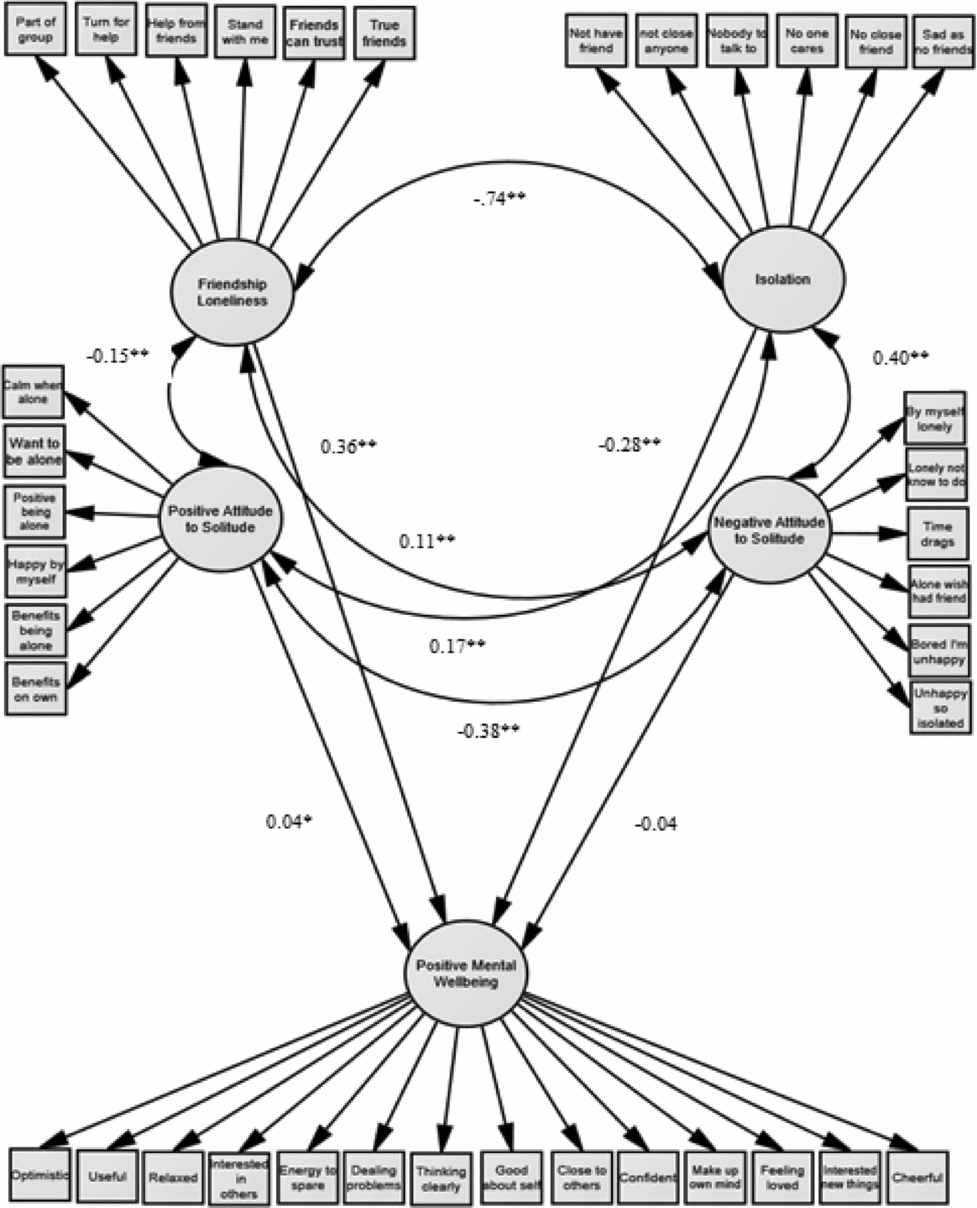
To more systematically evaluate the relationships between the different dimensions of loneliness (i.e., the two behaviour and the two attitude factors) and overall positive mental wellbeing, a structural equation model was specified. There was good fit for this model (chi-square = 2204.47, df = 619, p < .001, CFI = .90, TLI = .89, RMSEA = .052 (90 % CI: .050, .054). As can be seen in Figure 1, the two loneliness behaviour factors (i.e., friendship-related loneliness and isolation) and one of the two attitudes (i.e., positive attitude towards solitude) factors had significant associations with positive mental wellbeing. In the case of friendship-related loneliness and positive attitudes to solitude, the associations were positive, while for isolation it was negative. Negative attitude to solitude was not significantly associated with positive mental wellbeing.
Structural model showing associations between loneliness dimensions and positive mental wellbeing.

To further examine the associations between the four loneliness factors (identified in the factor analyses above) and positive mental wellbeing, a series of regression analyses were conducted. In particular, we sought to determine whether these associations remained after controlling for covariates that were relevant due to the study design. These covariates were gender (‘male’ as the reference category), geographical location of the school (two values ‘urban’ or ‘rural’, with ‘urban’ being the reference category), and school grade level. Since our study was administered to participants in seven randomly selected schools across different grade levels, it was important to control for this in the analysis. The participants ranged from school grade level 5 to school grade level 10, and this control variable was included in the model as a categorical variable, with the lowest grade level (i.e., school grade level 5 as the reference category). Because students enter school at roughly the same age, the grade variable was used as a proxy for age, with ages corresponding to each grade level, these being: Grade 5 (10 years old), Grade 6 (11 years old), Grade 7 (12 years old), Grade 8 (13 years old), Grade 9 (14–15 years old), and Grade 10 (15–16 years old).
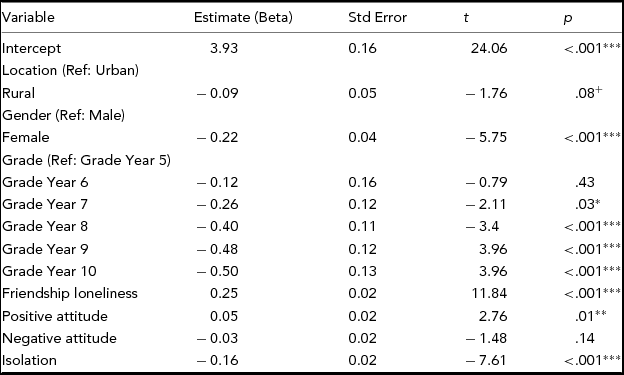
Our final regression model appears in Table 1. The estimated model coefficients give the expected change in the outcome variable, that is, positive mental wellbeing, for a one-unit increase in the explanatory variables, all else being equal. The regression analysis revealed that the four loneliness factors and the control variables (gender, geographical location, and school grade level) contributed significantly to positive mental wellbeing, with an adjusted R-squared of 31.4%. Based on these results, it can be seen that there are statistically significant effects for the loneliness factors on positive mental wellbeing, even after adding the controls. An increase in the factor corresponding to participants’ friendship-related loneliness had a significantly greater association with positive mental wellbeing (p < .001). Also, an increase in participants’ positive attitudes to solitude was significantly associated with an increase in positive mental wellbeing (p < .05). On the other hand, an increase in the factor corresponding to isolation was associated with a decrease in positive mental wellbeing (p < .001).
Standardised Beta Regression Weights, t Tests, and Probabilities for the Contributing Variables of Age, Sex, and Geographical Location in Positive Mental Wellbeing
Note: R-squared = .3211, Adjusted R-squared = 0.3143
Significance level codes: +p < .1, *p < .05, **p < .01, ***p < .001.
With regard to gender, females reported having lower positive mental wellbeing (p < .001). Females also reported lower scores on friendship-related loneliness and positive attitude to solitude, and higher scores on isolation. The variable capturing negative attitude to solitude did not significantly affect positive mental wellbeing. Additionally, there appears to be a marginal geographical location effect, with participants in rural areas less likely to have high positive mental wellbeing when compared to those in urban areas (p = .08). In addition, adolescents in rural areas reported lower levels of isolation.
With reference to the effect of school grade level, compared to school grade level 5 participants, school grade level 6 participants had lower positive mental wellbeing (although it was not significantly different (p = .43). However, for school grade level 7 and onwards this difference becomes significant. Noticeably, the magnitude of the effects is increasingly negative, and this is evidence that as participants grow older their positive mental wellbeing decreases.
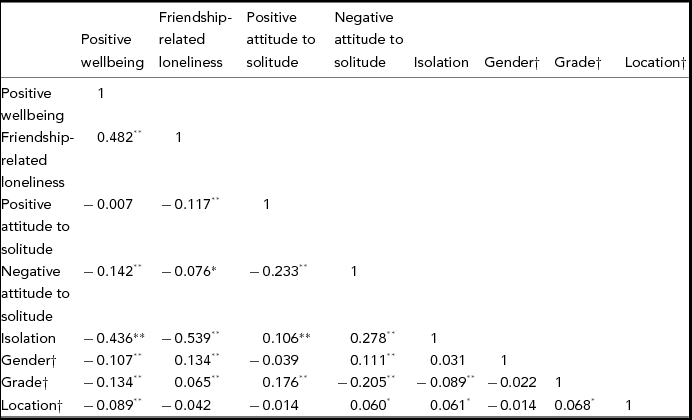
The correlations between positive mental wellbeing and the four loneliness factors are given in Table 2.
Correlation Matrix for the Main Explanatory Variables With Positive Mental Wellbeing
Note: *p < .05 (2−tailed); **p < .01 (2-tailed)
† These are categorical variables, and therefore non-parametric correlations are provided.
Discussion
The adverse mental health outcomes linked with loneliness in adolescence clearly mark it as a major health concern (Holt-Lunstad et al., Reference Holt-Lunstad, Smith, Baker, Harris and Stephenson2015). Although loneliness is to be expected during adolescence, in up to 30% of individuals it can become chronic and in some cases pathological (Heinrich & Gullone, Reference Heinrich and Gullone2006), and for some young people it can lead to suicidal behaviour (Gallagher et al., Reference Gallagher, Prinstein, Simon and Spirito2014). The impact of loneliness was demonstrated in a study with 2,000 Finnish 12- to 18-year-olds who cited ‘fear of future loneliness’ as their major concern (Lindfors, Solantaus, & Rimpelä, Reference Lindfors, Solantaus and Rimpelä2012). Moreover, a recent meta-analysis (Holt-Lunstad et al., Reference Holt-Lunstad, Smith, Baker, Harris and Stephenson2015) concluded that loneliness will reach epidemic proportions by 2030. Therefore, the associations between loneliness and mental wellbeing and any differences in these associations need to be disentangled.
Research to date has demonstrated that 90% of adolescents are able to differentiate between being lonely and being alone (Galanaki, Reference Galanaki2004; Liepins & Cline, Reference Liepins and Cline2011), the majority being able to do so from as young as 10 years of age. Moreover, the ability to distinguish between aloneness, loneliness, and solitude increases as young people mature (Chipuer, Reference Chipuer2001). This distinction is said to be important because ‘attitudes toward being alone might affect one's vulnerability to feeling lonely when alone’ (Goossens et al., Reference Goossens, Lasgaard, Luyckx, Vanhalst, Mathias and Masy2009, p. 890). In the present study, negative attitude towards solitude did not have a significant impact on adolescents’ positive mental wellbeing. However, the association between positive attitude to solitude and positive mental wellbeing was significant. According to Buchholz and Catton (Reference Buchholz and Catton1999), adolescents actively seek and appreciate solitude for positive reasons (e.g., fostering self-reflection, creativity, and relaxation), and defining oneself as a person who likes to spend time alone (i.e., having a positive attitude to solitude) may narrow the gap between actual and ideal social networks, and in doing so, reduce feelings of loneliness (Vanhalst, Goossens, Luyckx, Scholte, & Engels, Reference Vanhalst, Goossens, Luyckx, Scholte and Engels2013).
What the regression analysis and structural model demonstrated is that adolescents in this study attached substantial significance to the behavioural dimensions of friendship-related loneliness and isolation. Friendship-related loneliness was represented by items pertaining to quality of friendships, such as having true friends who can be trusted, who can be turned to for support, and who will stand by you. Conversely, items such as ‘I do not have a close friend’, ‘I feel like I do not have a friend in the world’, ‘I have nobody to talk to’, ‘No one cares much about me’ represented the isolation factor. Previous research has demonstrated that it is not the number of friends that is important because one can have many friends and still be lonely yet have few friends and not be lonely (Fischer & Phillips Reference Fischer and Phillips1979; Qualter & Munn, Reference Qualter and Munn2002). Moreover, according to Holt-Lunstad et al. (Reference Holt-Lunstad, Smith, Baker, Harris and Stephenson2015) some people prefer to be alone. Rather, it is the quality of friends that matters, especially in adolescence (see Qualter et al., Reference Qualter, Vanhalst, Harris, Van Roekel, Lodder, Bangee and Verhagen2015). Asher and Paquette (Reference Asher and Paquette2003) and Masi, Chen, Hawkley, and Cacioppo (Reference Masi, Chen, Hawkley and Cacioppo2011) argued that having at least one quality friend is particularly important.
The negative association between isolation and positive mental wellbeing is in line with previous research showing a lack of friends can give rise to stress, which causes psychological states (negative self-talk and other related cognitions and attributional states) and loneliness. If experienced consistently this can result in poorer emotional health outcomes in adolescence and beyond, including mental health problems (Cacioppo & Hawkley, Reference Cacioppo and Hawkley2009; Qualter et al., Reference Qualter, Brown, Rotenberg, Vanhalst, Harris, Goossens and Munn2013; Schinka et al., Reference Schinka, VanDulmen, Bossarte and Swahn2012). Thus, the impact of isolation on the mental and behavioural health outcomes of young people can be substantial.
With reference to the impact of gender on loneliness, females in the present study reported lower levels of both friendship-related loneliness and positive attitudes to solitude than males. Conversely, they reported higher levels of isolation. These findings are contrary to previous research showing that females are less socially lonely than their male peers (De Jong Gierveld & Van Tilburg, Reference De Jong Gierveld and Van Tilburg2010; Houghton et al., Reference Houghton, Hattie, Wood, Carroll, Martin and Tan2014). Furthermore, females reported having lower levels of positive mental wellbeing. This latter point aligns with previous studies on body image, depression, anxiety and somatic complaints that clearly demonstrate gender differences favouring men over women (Aslund, Starrin, & Nilsson, Reference Aslund, Starrin and Nilsson2010; Frost & McKelvie, Reference Frost and McKelvie2004). Furthermore, adolescent boys (age 15 years) have significantly better body image, anxiety, depression and somatic complaints scores than adolescent girls (Gestsdottir et al., Reference Gestsdottir, Arnarsson, Magnusson, Arngrimsson, Sveinsson and Johannsson2015).
In the present study, young people in rural locations reported lower levels of isolation. This finding may offer further support to the importance of quality of friendships, rather than the number of friends one has. For example, there are often fewer opportunities for social interaction for adolescents in rural areas compared to urban areas, thereby potentially increasing perceptions of social isolation (i.e., loneliness; see Shilubane et al., Reference Shilubane, Ruiter, Bos, van den Borne, James and Reddy2012). However, although the number of friendships in rural areas may be more limited because of geographical isolation, the quality of these friendships may be stronger and more stable and as such play an important role in providing social support for young people. This is an important finding in the light of higher prevalence rates of mental health problems and suicide in rural areas as a result of psychosocial, behavioural and demographic variables that differ from those in urban areas (see Australian Bureau of Statistics, 2012).
The influence of age on loneliness was experienced by all adolescents in the present study. The highest levels of friendship-related loneliness and positive attitudes to solitude, along with the lowest levels of isolation, were reported by the younger adolescents in school grade level five (aged 10 years). This pattern with the loneliness dimensions was repeated as each school grade level progressed, with the older school grade level 10 adolescents having the lowest levels of friendship related loneliness and positive attitudes to solitude and the highest levels of isolation than any of the other grade levels. This suggests that having friends who can be trusted and turned to, and who can be relied on, are more important during early adolescence, but this becomes less important with increasing age. While some research suggests the opposite — that is, closer ties with peers and peer groups develop when adolescents begin to move away from family and home-centred activities (Chipuer & Pretty, Reference Chipuer and Pretty2000) — it is possible that the adolescents in the present study had not reached this stage yet. Moreover, Perth is one of the most isolated capital cities in the world and young people are known to remain at home as they complete their secondary and tertiary studies. Thus, the finding may be unique to the sample recruited.
The significant impact of age on feelings of isolation may also be because any move towards independence comes with the associated risk of ‘increased feelings of separateness . . . and vulnerability to, emotional and social loneliness’ (Brennan, Reference Brennan, Peplau and Perlman1982, pp. 285–286), which can heighten adolescents’ predisposition to adverse mental and behavioural health outcomes.
It must be acknowledged that data were obtained from adolescents within one Australian state and future research should recruit adolescents from different states. Furthermore, although the distinction between state loneliness (i.e., current and immediate feelings of loneliness) and trait loneliness (i.e., a relatively enduring experience of loneliness) has previously been made (Cramer & Barry, Reference Cramer and Barry1999), this should be a focus of future research using the PALS.
In conclusion, the pain experienced by young people from loneliness is real, with studies of neural activation showing that the pain from loneliness resembles the affective component of the physical pain response — in other words, it hurts to be lonely! (Eisenberger, Lieberman, & Williams, Reference Eisenberger, Lieberman and Williams2003). Innamorati et al. (Reference Innamorati, Pompili, Gonda, Amore, Serafini, Niolu and Girardi2011) hypothesised that the pain arising from the perceptions of having no friends, along with having a negative attitude to being alone, can lead to a depressed state or some other psychosomatic state, and this can create a sense of paralysing hopelessness and unutterable futility. However, the full structural model and regression analyses that examined loneliness and positive mental wellbeing in the present study demonstrated no significant associations between negative attitudes to solitude and positive mental wellbeing. Rather, it was the behavioural dimensions of friendship-related loneliness and isolation and having a positive attitude to solitude that were significantly associated with positive mental wellbeing.
This present research has extended previous work by identifying the associations between different dimensions of loneliness and positive mental wellbeing, and in doing so has developed a greater understanding of the multidimensional nature of loneliness and its relationship with mental wellbeing in adolescents.
Acknowledgments
This study was funded by the Western Australian Health Promotion Foundation (Healthway) and in part by an Australian Research Council (ARC) Discovery grant from the Australian government.