Introduction
Neck abscesses in children remain a relatively common problem.Reference Elden, Grundfast and Vezina1 Although acute suppurative lymphadenitis usually resolves with antibiotic therapy, a significant number of cases may progress to abscess formation.Reference Simo, Hartley, Rapado, Zarod, Sanyal and Rothera2 These abscesses present differently in children compared with adults, with more subtle signs in children.Reference Coticchia, Getnick, Yun and Arnold3 Some studies have focused on deep neck abscesses (parapharyngeal, retropharyngeal),Reference Choi, Vezina and Grundfast4–Reference Parhiscar and Har-El6 while others have included cutaneous abscesses.Reference Simo, Hartley, Rapado, Zarod, Sanyal and Rothera2, Reference Cmejrek, Coticchia and Arnold7, Reference Dodds and Maniglia8 Controversy exists regarding the choice of empirical antimicrobial therapy for neck abscesses.Reference Ungkanont, Yellon, Weissman, Casselbrant, Gonzalez-Valdepena and Bluestone9
Atypical (non-tuberculous) mycobacterial infection has become one of the important differential diagnoses of cervical lymphadenopathy in children.Reference Benson-Mitchell and Buchanan10, Reference Cox, Brightwell and Riordan11
The aim of this study was to identify the presenting symptoms, the causative organisms, the appropriateness of prescribed antibiotics and the role of atypical mycobacteria in deep and cutaneous neck abscesses in children.
Methods and materials
A retrospective analysis of 64 children who had undergone incision and drainage of neck abscesses at Leeds General Infirmary from 1 February 2002 to 31 July 2006 was performed. The demographical details of the patients had been documented. The site, symptoms, operating surgeon, surgical approach, organisms cultured, imaging, antibiotics prescribed, complications, period of hospitalisation and outcome were studied. Abscesses in the anterior and posterior triangle, parotid, submandibular, submental, retropharyngeal and parapharyngeal spaces were included in the study. Peri-orbital, peri-tonsillar, temporal, mastoid, cheek and lip abscesses were excluded. The outcome was evaluated on the basis of complications, abscess resolution and the length of hospitalisation. Pus specimens obtained intra-operatively were cultured and plates were examined after 24 and 48 hours incubation at 37°C. Mycobacteria were cultured using the Bactec MGITTM 960 system (BD, Franklin lakes, New Jersey, USA). Needle aspiration preceded incision and drainage in the intra-oral approach in order to obtain pus for culture. This may have reduced the risk of contamination with normal mucosal flora. The pus sample was obtained via a needle aspirate prior to the incision in the external approach, or via a cotton-tipped applicator after the incision. Drains were used after the incision of all abscesses, using predominantly the external surgical drainage approach.
Results
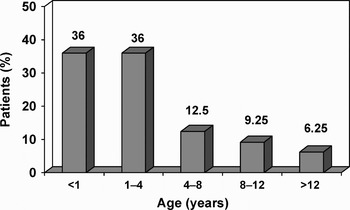
A total of 64 children underwent incision and drainage of neck abscesses. There were 40 boys (62.5 per cent) and 24 girls (37.5 per cent). Patients ranged in age from 10 days to 15 years, with a mean presenting age of 44.2 months (3.68 years). There were 46 (72 per cent) patients under the age of four years. Age distribution is described in Figure 1.
Age distribution of patients with neck abscesses requiring incision and drainage.

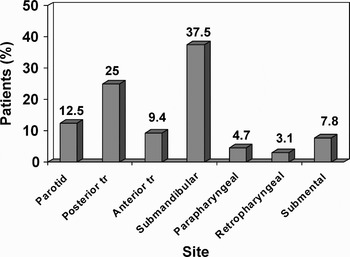
The most common signs and symptoms were neck mass (96.9 per cent), fever (54.7 per cent), poor oral intake (12.6 per cent), abnormal oropharyngeal examination (7.8 per cent) and neck stiffness (6.3 per cent). Respiratory distress, cellulitis and agitation were each reported in 4.7 per cent. The commonest site of infection was the submandibular region (37.5 per cent), followed by the posterior triangle (25 per cent) and parotid (12.5 per cent). Parapharyngeal and retropharyngeal abscesses were diagnosed in 7.8 per cent (Figure 2).
Sites of neck abscesses. tr = triangle

The period of hospitalisation ranged from one to 10 days, with mean of 3.7 (± standard deviation of 1.9) days.
An external surgical drainage approach was used in 90.6 per cent of patients, while an intra-oral approach was used in 9.4 per cent.
Imaging facilities were used in 43.8 per cent of the patients, mainly ultrasound (US) scanning, which was used in 24 patients (37.5 per cent). Computed tomography (CT) scanning was used in three (4.7 per cent) patients who had retropharyngeal and parapharyngeal abscesses, while a plain soft tissue film was used in one (1.6 per cent) patient with a retropharyngeal abscess.
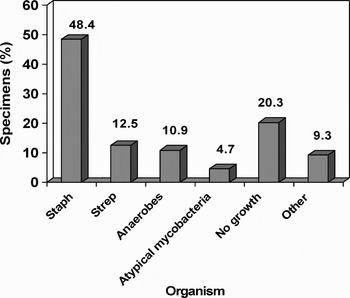
The most common organisms cultured from the pus (intra-operatively) were Staphylococcus aureus (48.4 per cent) and streptococcus species (‘viridans type’ and ‘milleri type’) (12.5 per cent). One-fifth (20.3 per cent) of specimens were reported as ‘no growth’ after the required period of incubation. Atypical mycobacteria were found in 4.7 per cent of the specimens. There were two mycobacterial infections in the submandibular region (one culture-negative, confirmed histologically; the other Mycobacterium avium complex) and one in the parotid (Mycobacterium malmoense), which were all treated with primary incision and drainage and subsequent anti-mycobacterial chemotherapy. Other organisms accounted for about 10 per cent of specimens, and included haemophilus species (1.6 per cent), moraxella species (1.6 per cent), normal oral and skin flora (4.7 per cent), and yeast (1.6 per cent). No methicillin-resistant Slaphylococcus aureus (MRSA) was isolated in this series (Figure 3).
Organisms cultured from intra-operative pus samples. Staph = staphylococcus species; strep = streptococcus species

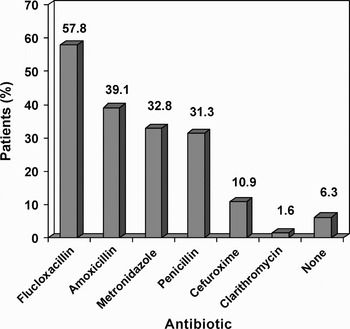
A wide variety of antibiotics was used intravenously. The commonest were flucloxacillin (57.8 per cent) and amoxicillin (39.1 per cent) (Figure 4).
Intravenous antibiotics used for treatment of neck abscesses.

The abscess recurred in three patients (4.7 per cent) and required re-drainage (after 18, 26 and 30 days, variously). Two of the abscesses which recurred were in the parotid region and one was in the submental region (originating from a thyroglossal cyst). One of the recurrent abscesses was caused by an atypical mycobacterium.
Tracheostomy was not required in any of the patients, and none required intubation and ventilation.
There was no mortality in this series of patients, and the outcome was satisfactory (i.e. no complication or mortality) in 95.3 per cent.
Discussion
In this study, the mean age of children with neck abscesses was 44.2 months, which was consistent with other studies.Reference Simo, Hartley, Rapado, Zarod, Sanyal and Rothera2–Reference Choi, Vezina and Grundfast4 Children younger than four years old accounted for 72 per cent of the patients; this may be related to an immature immune system in this group of patients.Reference Coticchia, Getnick, Yun and Arnold3, Reference Cmejrek, Coticchia and Arnold7
The most common presenting symptoms and signs in our series were neck mass, fever and poor oral intake; this was consistent with other studies.Reference Elden, Grundfast and Vezina1–Reference Coticchia, Getnick, Yun and Arnold3
Similar results were found by Cmejrek et al.,Reference Cmejrek, Coticchia and Arnold7 who studied 25 infants (younger than nine months) and suggested that poor oral intake along with neck mass in infants is an indicator of odynophagia or dysphagia.
The submandibular region was the most common site of neck abscesses (37.5 per cent), followed by the posterior triangle (25 per cent); this is consistent with other studies.Reference Simo, Hartley, Rapado, Zarod, Sanyal and Rothera2, Reference Cmejrek, Coticchia and Arnold7, Reference Tom and Rice12, Reference Beck13 However, other authors found a predominance of retropharyngeal and parapharyngeal abscesses.Reference Ungkanont, Yellon, Weissman, Casselbrant, Gonzalez-Valdepena and Bluestone9, Reference Gidley, Ghorayeb and Stiernberg14
Staphylococcus aureus was the most common organism cultured from the pus (48.8 per cent), and was sensitive to flucloxacillin or erythromycin in all cases. Staphylococcus aureus is well known for its ability to form abscesses, and most studies recognise S aureus as the predominant organism causing neck abscess.Reference Simo, Hartley, Rapado, Zarod, Sanyal and Rothera2, Reference Coticchia, Getnick, Yun and Arnold3, Reference Nagy, Pizzuto, Backstrom and Brodsky5, Reference Cmejrek, Coticchia and Arnold7, Reference Ungkanont, Yellon, Weissman, Casselbrant, Gonzalez-Valdepena and Bluestone9, Reference Gidley, Ghorayeb and Stiernberg14, Reference Brook15
Streptococcus species were recovered from 12.5 per cent of the infections, mostly from retro- and parapharyngeal abscesses, as one would expect, due to the presence of these organisms in the oropharyngeal flora. Although previous studies established a relationship between the causative organism and the site of the infection, Simo et al. Reference Simo, Hartley, Rapado, Zarod, Sanyal and Rothera2 did not find any correlation between the possible site of origin of the infection and the organism cultured.
Although anaerobes were cultured from 10.9 per cent of the specimens (a lower rate than that suggested by Coticchia et al. Reference Coticchia, Getnick, Yun and Arnold3 and Tami and ParkerReference Tami and Parker16), metronidazole was overused in about a third of the patients (32.8 per cent).
Our ‘no growth’ rate (20.3 per cent) is consistent with other reports.Reference Nagy, Pizzuto, Backstrom and Brodsky5, Reference Tom and Rice12, Reference Gidley, Ghorayeb and Stiernberg14 This may be explained by the use of oral antibiotics prior to admission to hospital. In our series, atypical mycobacteria were found in only 4.7 per cent of the specimens, a lower rate than that found by Simo et al. Reference Simo, Hartley, Rapado, Zarod, Sanyal and Rothera2 In each of these cases, the patient presented with a painless neck mass in the absence of fever, systemic upset or poor oral intake. It is now recognised that the most common presentation of non-tuberculous mycobacteria is a cervico-facial mass.Reference Simo, Hartley, Rapado, Zarod, Sanyal and Rothera2, Reference Benson-Mitchell and Buchanan10, Reference Cox, Brightwell and Riordan11
Imaging modalities had been used in 43.8 per cent of our patients. The majority (82.4 per cent) of patients who stayed less than three days in hospital did not have any imaging. All the patients who had CT scanning stayed in hospital five days or more.
Previous studies which compared US and CT scanning for the detection of neck abscesses found that US was non-invasive and safer than CT. Reference Elden, Grundfast and Vezina1 Ultrasound scanning is a non-invasive and reliable diagnostic tool due to its accessibility.Reference Quraishi, O'Halpin and Blayney17 In our series, US scanning was used more than CT scanning (37.5 vs 4.7 per cent) and it was sensitive in 87.5 per cent of cases (i.e. 21 abscesses had positive results, out of 24 abscesses scanned).
In our series, CT scanning of the neck was reserved for those patients with para- or retropharyngeal abscesses which failed to respond to 24–48 hours of medical treatment.
All the patients in this series had been treated with intravenous antibiotics and incision and drainage of the abscess. Different antibiotics were used, according to the surgeon's choice. Generally, the most common antibiotics used were flucloxacillin (57.8 per cent) and amoxicillin (39.1 per cent). A combination of flucloxacillin and amoxicillin/penicillin was used in 42 per cent, which we would consider as unnecessary.
The majority (90.6 per cent) of the neck abscesses had been drained extra-orally, while the intra-oral approach (9.4 per cent) had been reserved for para- and retropharyngeal abscesses. The intra-oral approach is deemed to be safer in abscesses medial to the great vessels of the neck.Reference Parhiscar and Har-El6, Reference Cmejrek, Coticchia and Arnold7
The period of hospitalisation (mean 3.7 days) was an important prognostic factor and affected the overall outcome of the treatment; this is consistent with other studies.Reference Elden, Grundfast and Vezina1, Reference Coticchia, Getnick, Yun and Arnold3, Reference Cmejrek, Coticchia and Arnold7 All patients with retro- and parapharyngeal abscesses stayed in hospital five days or more, which implies the importance of early recognition, using imaging modalities (CT or US scanning), and prompt treatment of these deep neck abscesses.
• Paediatric neck abscesses remain a common problem
• In this study of 64 children with neck abscesses, Staphylococcus aureus (48.4 per cent) was the commonest cultured organism
• Atypical mycobacteria were found in 4.7 per cent of the specimens
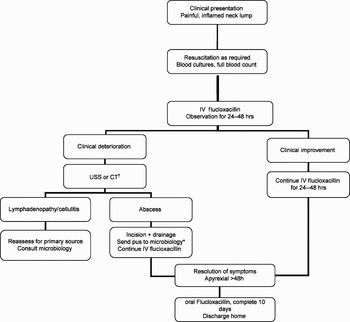
• An algorithm for the management of paediatric neck abscesses is proposed
The complication rate in our series was 4.7 per cent. These complications mainly comprised recurrence of the abscesses, requiring re-drainage. This was consistent with other studies.Reference Simo, Hartley, Rapado, Zarod, Sanyal and Rothera2, Reference Coticchia, Getnick, Yun and Arnold3, Reference Cmejrek, Coticchia and Arnold7
One of the complications was in a case of parotid atypical mycobacterial infection, which was treated initially with incision and drainage. The abscess recurred after a few weeks and required formal resection along with anti-tuberculous chemotherapy.
Conclusions
Neck abscesses remain relatively common despite the use of antibiotics. They can cause potential complications. Early diagnosis, appropriately prescribed intravenous antibiotics and surgical drainage remain the central core of treatment. Staphylococcus aureus is the most common causative organism and remained susceptible to flucloxacillin in our patient population. Atypical mycobacterial infection is an important differential diagnosis of a cervico-facial mass. Delay in diagnosis and treatment leads to recurrence. Therefore, based on this study, our institution has proposed an empirical antimicrobial therapy protocol for neck abscesses (Figure 5).
Proposed algorithm for the management of paediatric neck abscess. *Send pus sample to microbiology for urgent microscopy for bacteria and acid-fast bacilli. †Computed tomography (CT) scan reserved for para- and retropharyngeal neck abscesses. USS =ultrasound scan, IV = intravenous. In case of immediate- type penicillin allergy, vancomycin is the preferred alternative. When penicillin allergy history is vague or reaction delayed in onset, cefuroxime can be used