It is fair to say that a great swath of forest was sacrificed for the study of negative campaigning. As we might hope and expect, a great deal has been learned since our initial assumptions that negative ads would be the downfall of our republic. (For an excellent review of this literature, see Geer Reference Geer2006). This PS symposium and a spate of recent work (for example, see Herbst Reference Herbst2010; Shea and Fiorina Reference Shea and Fiorina2012; Sobieraj and Berry Reference Sobieraj and Berry2011), suggest growing interest in a somewhat different form of negativity: the tone of political discourse, or what we might call levels of civility in politics. Much of this work has centered on the impact of nasty politics on individuals (Forgette and Morris Reference Forgette and Morris2006; Mutz Reference Mutz2007; Mutz and Reeves Reference Mutz and Reeves2005; Fridkin and Kenney Reference Fridkin and Kenney2008). Might vitriol turn off citizens and lead to increased levels of distrust and cynicism?
An important part of this exploration is tracing the use of nasty political rhetoric over time. Here we see the literature less developed, with the notable exception being Atchuler and Blumin (2001). A number of case studies imply our politics has always been a bit rough (Cummins Reference Cummins2007; Scher Reference Scher1997), which has become the traditional wisdom. Pundit and scholar Michael Barone recently noted, “From time to time, I go back to find the golden age of civility and it has proved elusive” (as cited in Gerhart, Oct. 12, Reference Gerhart2009). Susan Herbst notes, “Most scholars and writers … bemoan a decline of civility in American politics and social life, [which] is a shame, since so many historians have documented phenomena to disprove this view, such as the horrendous dirty presidential campaigns of the past” (Reference Herbst2010, 23–24). Beyond assuring us that we will get through this tough period, recounting the tales of incivility in the past does not account for change or variations.
Data presented in this research challenges this assumption by defining periods of “nasty politics.” Instead of dismissing the current period as “more of the same,” or pointing to vague notions of “rough periods” in our history, our aim is to quantify the high and low points of civility in politics. By relying on a novel content analysis approach, we uncover evidence of the periodization of uncivil rhetoric and find that these periods neatly fit traditionally defined critical realignment periods.
THE CURRENT CONTEXT
Mudslinging in politics, suggests Scher is “as American as apple pie” (Reference Scher1997, 27). The 2008 race was no exception. Several forces primed the pump for a nasty campaign—such as record breaking spending in both the general election and in the Democratic primary, difficult cross-cutting issues, a steep economic downturn, a tough Democratic primary, the prominence of radio and television political talk shows, the heightened use of blogs, and a novel form of political rhetoric used by Sarah Palin. Few future historians will suggest the 2008 campaign as exceptionally nasty, out of the ordinary. Rhetoric during the post-election period is a different story, however. By the spring and summer of 2009, most people had agreed that politics took a nasty turn—centered principally on the president's signature policy initiative: health-care reform.
To get the word out and to win public support for their plan, Democratic congressional leaders hosted a series of town hall meetings across the country in the summer of 2009. Many of these meetings were organized, thoughtful, and civil. Others were not. Many degenerated into angry protests. In early August, for instance, a health-care town hall was held in Tampa, Florida. It was sponsored by Democratic representative Kathy Castor and Florida state representative Betty Reed. A massive crowd, upwards of 1,500 people, packed the meeting room and spilled into the street. As Castor began to speak, scuffles broke out as people tried to get into the meeting room. Her introductory remarks were drowned out by chants of “Read the bill, read the bill!” and “Tyranny!” An event organizer came to the microphone to admonish the crowd: “If pushing and shoving continues, we will have to clear the room. The police will make the decision if it is still safe.” At one point, a freelance videographer was pushed to the ground. Another man was treated for minor injuries after a scuffle left his shirt partially torn from his body. “That's the most violent anyone has been towards me,” noted the man. “It was surprising, to say the least” (FoxNews.com, 2009).
Pennsylvania senator Arlen Specter confronted hostile crowds at a number of his events. In Philadelphia, Specter was accompanied by Department of Health and Human Services secretary Kathleen Sebelius to a town hall meeting. Over and over again, both were shouted down by angry protesters. A week later, some 300 people packed a community college auditorium in Lebanon, Pennsylvania. Barely able to address the crowd due to persistent interruptions and shouts, Senator Specter became increasingly frustrated. At one point, an irate constituent jumped to the aisle, waving a set of papers in Specter's face. Security guards quickly jumped in, holding the ranting man back. In a rage, the man told Specter, “One day, God is going to stand before you and he's going to judge you and the rest of your damn cronies up on the hill, and then you will get your just dessert” (Rucker, Reference Rucker2009).
Stories of angry conservative protesters were common. A man opposing health-care reform hung freshman legislators in effigy with an awkwardly worded placard reading, “Congress Traitors the American.” After seeing his colleagues endure these difficult town hall meetings, one member of Congress cancelled his own meeting, only to later receive a death threat for doing so. The district office of a Georgia representative was defaced with a swastika, and the lawmaker, who happens to be African American, has been the recipient of racist hate mail (Shea and Fiorina Reference Shea and Fiorina2012, 6).
Heated constituent events are not unprecedented in American history. Quite the contrary, this sort of rancor has been especially acute during tough times and when government has faced momentous issues, such as the economic crisis in the summer of 2009. Imagine what some of the meetings were like during the civil rights era and during the Vietnam War. Of course, the ideological right does not have a monopoly on this behavior. George W. Bush was the target of a great deal of vitriol during his eight years in the White House. A prominent member of the US Senate called him a “liar” and another suggested, “I sometimes feel that Alfred E. Neuman is in charge in Washington” (a reference to the iconic dufus of Mad Magazine fame). Bush was hung in effigy on numerous occasions, skewered on liberal blogs, and often depicted as Hitler on posters and signs (Shea and Fiorina Reference Shea and Fiorina2012, 5).
Yet, many people began to wonder if a line had been crossed and if politics in America had taken different turn. In the wake of those acrimonious town hall meetings, New York Times columnist Thomas Friedman pondered whether we can “seriously discuss serious issues any longer and make decisions on the basis of the national interest” (September 29, 2009). A few months later, a Republican representative shouted “You lie!” during a presidential address at the House of Representatives—an unprecedented display of incivility.
The vitriol surrounding the final health-care reform vote in April of 2010 stunned even the most seasoned observers. Some protesters yelled racial slurs at African American members of Congress, and one legislator was allegedly spat on as he entered the Capitol Building to vote. Outbursts on the floor of the House made headlines, and radio and television commentators were unrepentant in their use of incendiary language. With death threats against legislators, bricks thrown through legislative office windows, and a coffin left at the door of a representative, it seemed that seasoned conservative commentator Peggy Noonan was right when she asserted in the Wall Street Journal, “It's a mistake not to see something new, something raw and bitter and dangerous, in the particular moment we're in” (Reference Noonan2010).
THE MORE THINGS CHANGE, THE MORE THINGS STAY THE SAME
Many others argue that, just as in electoral politics, political rhetoric over policy disputes has always been hard-hitting; what we are seeing during Barack Obama's first term is unexceptional. Often, the “nothing new” perspective offers vivid illustrations of nasty behavior from the past. We know in 1804 Alexander Hamilton died after being shot by Aaron Burr—possibly a low point for political civility in the early days of our political system. We are reminded of Alexis de Tocqueville's take on our political culture in the 1830s: “There is still some memory of the strict code of politeness, but no one knows quite what it said or where to find it.” We hear of the breakdown of our political process prior to the Civil War and of how representative Preston S. Brooks of South Carolina used his cane to beat senator Charles Sumner of Massachusetts into bloody unconsciousness on the floor of the United State Senate on May 22, 1856. We also know of the infamous floor brawl in the US House of Representatives as members debated Kansas' proslavery Lecompton Constitution late into the night of February 5–6, 1858. It seems that more than 50 congressional members joined the melee. Most people have heard about the bruising campaign between Democrat Grover Cleveland and Republican James Blaine and the contentious period of the 1890s. The McCarthy era was no picnic, and the Vietnam/civil rights/counter-cultural period of the 1960s was a tough time. The implicit, occasionally explicit, assumption drawn from these accounts is that uncivil behavior is either static or simply boils up from time to time. One newspaper editorial noted, “Let us not dwell unduly on the idea that this moment in history is unique. For better or for worse, uncivil politics are part of our national tradition” (Daily Star 2010).
A somewhat different take on the historical role of incivility has been offered by Susan Herbst (Reference Herbst2010). In her book, Rude Democracy: Civility and Incivility in American Politics (which carries an illustration of the “caning” on the cover), Herbst makes that argument that uncivil behavior has been a mainstay of our politics. Yet, our understanding of harsh rhetoric as either “good or bad,” or “more or less,” distorts the true importance of these acts: their strategic uses. She writes, “Apart from these cases of chronic, uniform, or innate civility or incivility, which are unusual, we should think of civility as a strategic weapon in politics. It is a tool that is used intentionally, for better or worse” (Herbst Reference Herbst2010, 6).
From either the “boils up” or “strategic use” perspective, only a modest effort to quantify levels of political rancor over time has been made. Incivility is nothing new because we can easily point to particular events or campaigns. Moreover, we know little about the extent to which particular uncivil acts by elites—such as nasty comments by candidates or insults leveled by members of Congress—draw the attention of average citizens. Geer, in his powerful defense of negative campaign practices, suggests as much: “We do not know enough about negativity in campaigns, current or past, to make any generalizations with much confidence” (Reference Geer2006, 9). Reacting to the notion that incivility has increased, Geer suggests, “There is a tendency for political observers to leap to conclusions that the available data do not support” (Reference Geer2006, 10).
QUANTITATIVE ANALYSIS OF INCIVILITY
Sobieraj and Berry (Reference Sobieraj and Berry2011) explore “outrage” by members of the media. They considered outrage to be manifestations of language and behavior, including insulting language, character assassination, and use of obscene language, among 10 other forms. They dismiss measurements of broadcast or Internet news as too new to consistently measure trends and determined that newspaper columns are the best measurable medium. By studying the 10 most widely syndicated columnists over 10-week periods in 1955, 1975, and 2009, they discovered a clear difference in the levels of outrage that permeate the news. In brief, there was a dramatic increase in 2009.
Sobieraj and Berry move our exploration in the right direction, but their use of 10-week blocks from three years in relatively recent history may give us insufficient data to show that this trend reaches back several decades and even into the nineteenth century. Is there any reasonable way to conduct a broad-base content analysis of political discourse during all of our nation's history, without surrendering a legion of research assistants to the cause? It now seems there is.
Technology through Google Labs now allows us to examine the prevalence of words and phrases in books extending back to 1800. Books Ngram Viewer contains a compilation of 5.2 million books amounting to approximately 4% of all books ever published. It is the “first tool of its kind, capable of precisely and rapidly quantifying cultural trends based on massive quantities of data” (Michel et al. Reference Michel, Shen, Aiden, Veres, Gray, Team and Orwant2011, 1).
The use of the Books Ngram Viewer has led to a field of study known as “culturomics,” which explores how words and phrases utilized by authors display societal trends. Scholars at the Cultural Observatory at Harvard University recently published “Quantitative Analysis of Culture Using Millions of Digitized Books,” which explores the legitimacy of using this tool for research (Michel et al. Reference Michel, Shen, Aiden, Veres, Gray, Team and Orwant2011). They conclude that this tool provides “rigorous quantitative inquiry into a wide array of new phenomena spanning the social sciences and the humanities” (1).
How is this tool used? The researcher selects a timeframe, a particular language (English versus American English, for example), and words or phrases to be searched. Words or phrases that were used in consistent ways throughout the time frame must be carefully selected. For example, if one were studying issues related to homosexuality, it would be folly to insert “gay” into the analysis. We find that usage of “gay” remains more or less stable until the 1980s, when there is a spike due to a change in the word's meaning. In short, one must verify that effects were due to “actual changes in what interests us,” and not “changes in the language we use to describe things” (Michel et al. Reference Michel, Shen, Aiden, Veres, Gray, Team and Orwant2011). Also, bear in mind that the tool provides a relative measure of usage or a percentage of instances when the word or phrase was used.
Regarding issues related to civility in politics, the terms “partisan” and “polarization,” and even “civil” do not seem to apply, as these were not used in a consistent way throughout American history. For example, “civility” and “incivility” were vastly more common in the early 1800s than any time in the twentieth century. To account for this issue of consistent usage, we selected terms that have had a consistent meaning over time: “mean politics,” “bitter politics,” “hateful politics,” “filthy politics,” and “nasty politics.”
FINDINGS
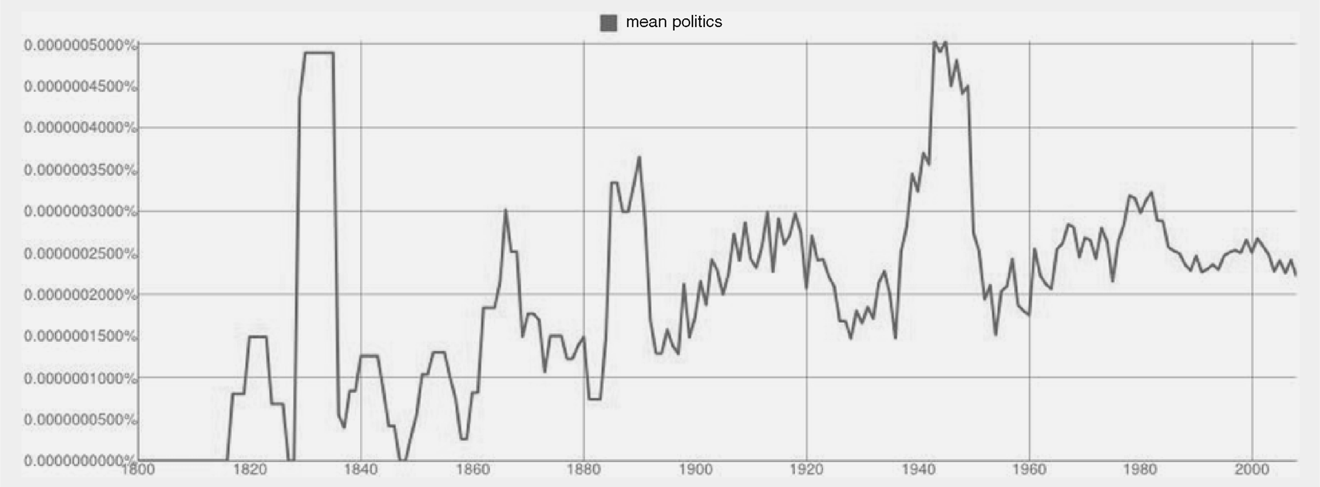
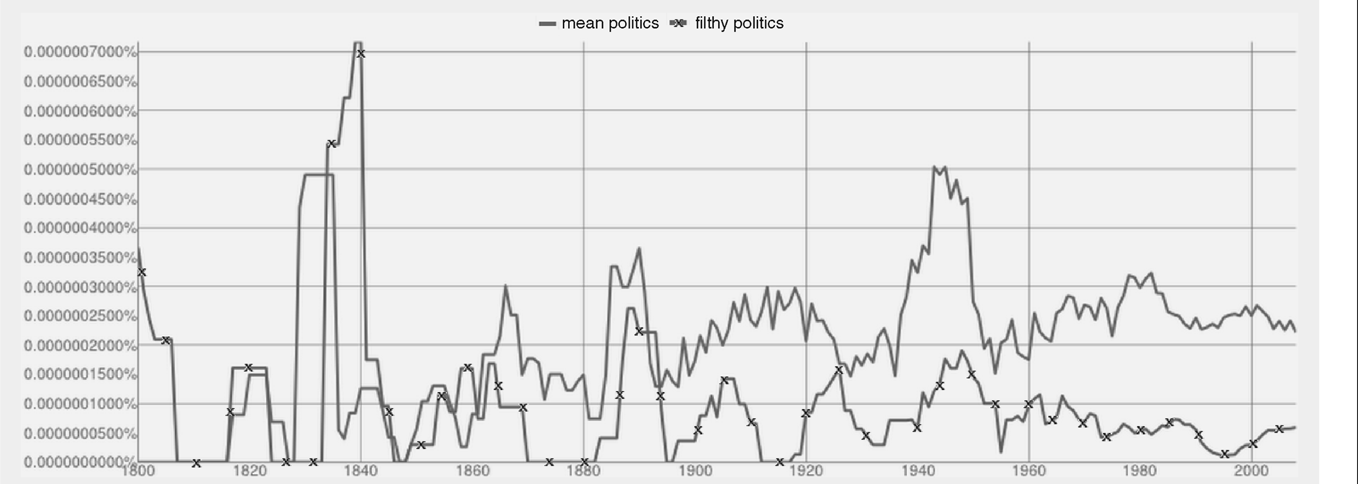
The results are shown in figures 1 through 3. Several important findings come to light.
• Construct validity rests on the idea that different indicators of the same concept should yield similar results, whereas different properties should yield different measurement results regardless of the measuring instrument (Nachmias and Nachmias Reference Nachmias and Nachmias1992, 162). This seems to be the case with our analysis. Whereas the terms are far from tautological, there appears to be a tight fit between the phrases used to assess nasty politics.
• To ensure that our terms were used correctly in the context of vitriol in politics, we reviewed a sampling of the texts identified in the content analysis. Four of our terms—“bitter politics,” “hateful politics,” “filthy politics,” and “nasty politics”—were used in the context we had imagined. One example of use of “bitter politics” was in a journal in 1828, which referred to newspaper columnists at the time, stating, “Hence their columns are filled with old and vulgar anecdotes, party, weak, local and bitter politics, and stale intelligence” (The Medical Intelligencer 1828, 614). The term “mean politics” was generally used in the way we imagined, such as an in an oration published in 1854: “… words that come pouring down from those heights of patriotism upon our mean politics and our shifty statesmanship, like a cataract” (Chapin Reference Chapin1854, 7). We should note, however, that this term was occasionally used in a different context, such as “by that, I mean politics.” It is difficult to know how often this occurred. Even so, we are hard pressed to imagine why this latter usage would vary significantly over time, or why it would move in tandem with terms such as “filthy politics” and “hateful politics.”
• The data clearly demonstrate that writing about nasty politics varied greatly over the last 200 years. The rise and fall of the usage of “mean politics” and “filthy politics,” in particular, is rather remarkable.
• There appears to be a distinct pattern between the rise and fall of “negative periods.” Roughly speaking, it seems to be a 20- to 30-year cycle. For example, writing of nasty politics is rather high in the post-Civil War period, with a rapid decline 25 years later.
• These data correspond with what many have suggested about our recent politics. All measures climb since the 1980s.
• Finally, and perhaps most important, it appears that the peaks in writing about nasty politics occurs in tandem with what many historians and political scientists have called critical elections. That is, there seems to be remarkable consistency between the high points in our measure of nasty politics and the traditionally defined critical realignment periods of the late 1820s, the mid-1860s, 1896, and 1932 (Key Reference Key1955; Burnham Reference Burnham1970; Sundquist Reference Sundquist1983; among many others).
Search Results for “Mean Politics”
Source: Google labs Books Ngram Viewer, April 2, 2012

Search Results for “Mean Politics” and “Filthy Politics”
Source: Google labs Books Ngram Viewer, April 2, 2012.

Search Results for “Mean Politics,” “Bitter Politics,” “Hateful Politics,” and “Nasty Politics”
Source: Google labs Books Ngram Viewer, April 2, 2012.

DISCUSSION
Our data do not provide direct evidence that nasty rhetoric was used at any point in American history. Rather, we provide evidence that authors of books saw fit to describe politics in America as nasty, mean, hurtful, bitter, and filthy at different levels at different times. We cannot imagine why they would use such terms if it were not true. As such, this data provided convincing evidence that we have experienced periods of rough-and-tumble politics, and it is not sufficient to suggest our politics has always been uncivil—just as it is not correct to assume the current acrimony is novel. Perhaps politics in the United States has never seen a golden age of civility, but it seems the environment was a bit more cordial during some eras than others.
If we adopt Herbst's (Reference Herbst2010) view of incivility as a strategic weapon, our analysis indicates that the use of this tool by political actors likely springs from divisive electoral contests; its use has ebbed and flowed in predictable patterns. In driving populist sentiment, incessant and fierce rhetoric likely aided Andrew Jackson in not only winning office, but defining an era. A generation later, parties harnessed the rhetorical tool of political incivility to energize sectional electorates, ultimately consolidating spheres of influence as America marched toward its Civil War. Labor probably used fierce rhetoric to make gains during the industrial revolution, as muckrakers took on the corporate establishment and political machines used extreme tactics to control entire cities. Republicans likely employed harsh rhetoric to mount opposition to FDR's policies in the 1930s, and Joseph McCarthy and his followers certainly used uncivil practices to gain national prominence during the Red Scare. In the 1960s, uncivil behavior may have led to great advances in civil rights, and in the new media age, the angry Republicans and Tea Party followers have harnessed extreme incivility, from disrupting town hall meetings on health care to violent protest signs used at rallies.
One scholar of political tolerance claims that civility “has very much less value when greater issues are at stake” (Marcus Reference Marcus and Crotty2001, 123). We caution against this notion of civility, as the categorization “greater issues” is entirely subjective. Certainly in the 1960s, uses of civil disobedience were just means for the ends of civil rights activists. But we also see the era of McCarthyism, when the construction of a greater issue was used for political opportunity often at the expense of innocent Americans.
Viewed under the lens of Herbst's strategic tool theory, our data suggests at times in history, political actors believed issues to be vital—something beyond the usual—and ratcheting-up acrimonious rhetoric made good sense. These “greater issues” include the role of the national government, corruption, war, industrialization, sweeping policy changes, threats of communism, and civil rights. No definitive rule applies uncivil politics to critical elections, but we note an unmistakable correlation between the two. When Americans are drawn into the political arena because of deep-seated beliefs and cross-cutting policy concerns, things can get nasty.
Also, note the gradual, steady trend toward the negative pole for the last 30 years. Unlike other periods of incivility, a particular policy dispute or cross-cutting election at the heart of this escalation is difficult to identify. Although there has not been a realignment like those identified by scholar V.O. Key in his work on critical elections, it is clear that something is occurring. One explanation is the ideological purification of the parties. Fiorina, who uses the term “party sorting,” explores the relevance of a number of issues to party identification during the past few decades, and in every case the correlation increases dramatically in the 1980s (Reference Fiorina2009, chap. 3). Abramowitz suggests much the same: “In 1972, the correlated between ideology and party identification was .32; in 1992 it was .44; and in 2004 it was .63” (Reference Abramowitz2010, 45). This implies the root of incivility is an ideological gap between the parties. Historically, that distance was greatest during short bursts of intense disputes (i.e., critical elections). Cross-cutting issues were resolved by staking out a claim and forcing the electorate to pick a side. In the current climate, however, a host of social, demographic, and political forces have created a prolonged period of partisan polarization. We also wonder if new technologies, such as narrowcasting, microtargeting, and niche marketing, mobilize individual voters around personal hot button issues rather than around broad themes. If so, what is the incentive for these actors to pull back from using these techniques? That is, the current era of nasty politics may not abate for some time.
Finally, as recurrent as these periods may be, nasty politics are fraught with danger for democracy. We may see higher levels of engagement, but many people are left with a bad taste in their mouth and ill feelings about their fellow citizens. As E. J. Dionne noted several years ago, “a nation that hates politics will not long thrive as a democracy” (Reference Dionne1991, 355). The losing side must also accept their new status as the minority party, and the system must reestablish civil deliberation to move forward on policy questions. What if they refuse to accept this role, or refuse to acknowledge the legitimacy of majority party or even our governing institutions? Given the policy challenges that we face, a prolonged period of nasty politics is something to fret about. ■