Acute rheumatic fever is a non-suppurative, autoimmune, multi-systemic response to group A streptococcal pharyngitis. Its subsequent complication, rheumatic heart disease, is an important public health problem and the most common cause of acquired heart disease in developing countries.Reference Marijon, Mirabel, Celermajer and Jouven 1 Although acute rheumatic cardiac involvement presents in the form of pancarditis, valve insufficiency related to endocarditis is the most prominent clinical manifestation. Echocardiography is the gold standard method for demonstrating the grade of valve insufficiency and enlargements in the end-systolic/end-diastolic diameters of the left ventricle and, consequently, the severity of carditis. Echocardiography should be performed by experienced specialists; however, it is expensive, is not in common use, and, as a consequence, it cannot be performed in all patients diagnosed with acute rheumatic fever.Reference Esen, Argun and Pamukçu 2
As a calcium-dependent, actin-regulatory, 82–84 kDa protein, gelsolin is essential for cell locomotion and phagocytosis and was first identified in the cytoplasm.Reference Bucki, Byfield and Kulakowska 3 , Reference Wang, Cheng and Chen 4 Plasma gelsolin, the extracellular gelsolin isoform, is a circulating protein in the blood of healthy individuals and is a part of the “actin-scavenging” system.Reference Lee, Drager, Stossel, Moore and Rogers 5 The gelsolin-binding ligand, actin, is an extremely conserved cytoskeleton protein that is involved in cell motility and in maintenance of cell shape, and is ordinarily separated from the extracellular environment by intact plasma membranes. The deterioration of the cell membrane causes the release of intracellular proteins into the systemic circulation. Actin filaments in plasma increase the blood viscosity, obstruct small blood vessels, enhance the severity of bacterial infection, and has also been shown to be toxic to endothelial cells in culture. The integrative explanation for low plasma gelsolin levels under an acute inflammatory condition is the exposure of actin to plasma because of injury. Plasma gelsolin is primarily related to the fast severing and removal of actin filaments released from dead cells into the blood stream.Reference DiNubile 6 , Reference Peddada, Sagar and Ashish 7 The main function of plasma gelsolin is to protect seriously ill patients from their own inflammatory response. Reduced plasma gelsolin levels have been observed in severe trauma, critical illness, sepsis, chronic haemodialysis, myocardial infarction, and in many inflammatory diseases, such as systemic lupus erythematosus, rheumatoid arthritis, and multiple sclerosis.Reference Bucki, Byfield and Kulakowska 3 − Reference Peddada, Sagar and Ashish 7
The aim of this study was to determine whether plasma gelsolin depletion was associated with acute rheumatic carditis. In addition, we investigated whether there were correlations among the reduction in plasma gelsolin level and serum inflammatory markers, the grade of valvular insufficiency detected on echocardiography, and enlargement in the left ventricular end-diastolic and end-systolic diameters – namely, the severity of carditis.
Materials and methods
This prospective study was carried out at Erciyes University Medical Faculty between January, 2012 and December, 2012 with the approval of the Ethics Committee. A total of 37 patients diagnosed with acute rheumatic carditis were included in the patient group and 24 healthy children were included in the control group.
All patients were examined by a paediatric cardiologist. The diagnosis of acute rheumatic fever was made according to modified Jones criteria, revised in 1992.Reference Dajani, Ayoub and Bierman 8 The major criteria include carditis, polyarthritis, Sydenham’s chorea, erythema marginatum, and subcutaneous nodules. The minor criteria include arthralgia, fever, elevated acute-phase reactants such as erythrocyte sedimentation rate, C-reactive protein, and a prolonged PR interval on the electrocardiogram. The diagnosis of acute rheumatic fever was based on the presence of two major or one major and two minor criteria in the patient. Echocardiography was performed by the same paediatric cardiologist. The World Health Organization’s echocardiographic criteria for carditis include length of colour jet >1 cm, colour jet identified in at least two planes, mosaic colour jet with a peak rate >2.5 m/s, and presence of a signal – holodiastolic for aortic regurgitation or holosystolic for mitral regurgitation. 9
Patients with any chronic disease, using medications, with associated infections, and renal and hepatic dysfunction were excluded from the study. In the patient group, antistreptolysin O, erythrocyte sedimentation rate, C-reactive protein, white blood cell count, haemoglobin level, platelet counts, mean platelet volume, platelet distribution width, creatine kinase-MB, troponin I, pro-brain natriuretic peptide levels, and plasma gelsolin levels were measured and echocardiography was performed at the time of initial diagnosis in the patient group. In the control group, the plasma gelsolin level was determined and echocardiography was performed.
Venous blood samples of the healthy individuals and patients were drawn on admission. The blood samples were immediately placed in sterile etilen diamin tetra asetik asit test tubes and centrifuged at 2000–3000rpm for 20 minutes at 4°C to collect plasma. Plasma was stored at −70°C until assayed. The concentration of gelsolin in plasma was analysed by enzyme-linked immunosorbent assay using commercial kits (Hangzhou Eastbiopharm Co., Ltd, Hangzhou, Zhejiang, China) in accordance with the manufacturer’s instructions.
Secondary prophylaxis with benzathine penicillin G with a 3-week interval was started in all patients after establishing the diagnosis of acute rheumatic carditis. Oral steroids were given to the patients with moderate-to-severe carditis at a dose of 2 mg/kg daily (maximum 60 mg daily). Although the dosage of the steroid was gradually decreased 2 to 4 weeks later, oral aspirin was included in the therapy regimen at a dose of 80–100 mg/kg daily. Oral aspirin was given alone at a dose of 80–100 mg/kg daily to patients with mild carditis. Anti-congestive therapy was started in patients revealing signs of heart failure.
Results
Study population characteristics
The study included 37 children with rheumatic carditis, comprising 20 girls and 17 boys, and 24 healthy control children, comprising 16 girls and 8 boys. The ages of children ranged from 5 to 15 years (mean 11±2.37 years) in the study group and from 3.5 to 18 years (mean 11.8±4.36 years) in the control group. There were no statistically significant differences between the study and control groups regarding age (p=0.40) and gender (p=0.42) distribution. At diagnosis, 29 patients had carditis and arthritis, and eight patients had carditis and chorea.
Although mitral regurgitation was detected in 36 out of 37 patients (97%), three patients had grade 3 mitral insufficiency, 19 patients had grade 2 mitral insufficiency, 12 patients had grade 1 mitral insufficiency, and two patients had very mild mitral regurgitation. Although aortic insufficiency was detected in 17 out of 37 patients (45%), one patient had grade 2 aortic insufficiency, 10 patients had grade 1 aortic insufficiency, and six patients had very mild aortic insufficiency. Of 37 patients, 16 had both aortic insufficiency and mitral insufficiency. Among the echocardiographic parameters, although a statistically significant difference was detected between the left ventricular end-diastolic diameters of the patient and control group, no statistically significant difference was detected between the left ventricular end-systolic diameters of the patient and control group (Table 1).
Comparison of echocardiographic values in patients and control patients (z scores).

Change of plasma gelsolin level in acute rheumatic carditis at diagnosis
The plasma gelsolin levels of the patients with rheumatic carditis were significantly lower than those of control patients (p<0.05). The mean plasma gelsolin levels were found to be 197.27±218.51 mg/l for the patient group and 322.0±255.46 mg/l for the control group. There was no statistically significant difference between the patients who had carditis and arthritis (201.93±220.49 mg/l) and patients who had carditis and chorea (180.37±225.09 mg/l) in terms of gelsolin level at diagnosis (p=0.10).
Correlation between plasma gelsolin level and echocardiographic parameters
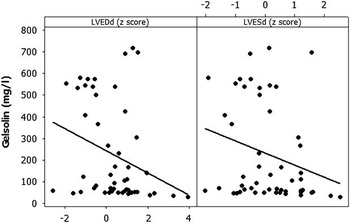
Negative correlations were detected among the plasma gelsolin level and the severity of mitral insufficiency (ρ=−0.290; p=0.030), left ventricular end-diastolic diameter z score (ρ=−0.333; p=0.017), and left ventricular end-systolic diameter z score (ρ=−0.307; p=0.028) (Fig 1). No correlation was detected, however, between the plasma gelsolin level and severity of aortic insufficiency (p>0.05).
Gelsolin and left ventricular end-diastolic diameter z score (LVEDd) (ρ=−0.333; p=0.017) and gelsolin and left ventricular end-systolic diameter z score (LVEDs) (ρ=−0,307; p=0.028); negative correlation in acute rheumatic carditis.

Changes in inflammatory markers and haematologic parameters in acute rheumatic carditis at diagnosis
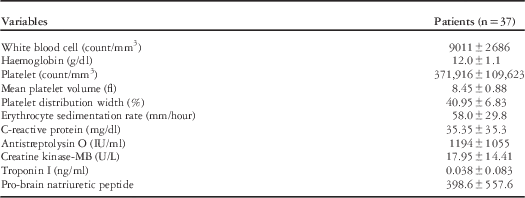
Antistreptolysin O, erythrocyte sedimentation rate, C-reactive protein, white blood cell count, haemoglobin count, platelet count, mean platelet volume, platelet distribution width, creatine kinase-MB, Troponin I, and pro-brain natriuretic peptide tests were measured in the patient group (Table 2). As evidence of prior group A streptococcus infection, the elevated antistreptolysin O titer was 100%.
Laboratory characteristics of patients with rheumatic carditis at diagnosis.

Data are presented as mean and standard deviation
Correlation among inflammatory markers, haematologic parameters, and echocardiographic parameters
A significant positive correlation was found between the pro-brain natriuretic peptide level and grade of mitral insufficiency (ρ=0.456; p=0.019). No correlations were detected, however, among the pro-brain natriuretic peptide level and severity of aortic insufficiency, left ventricular end-diastolic diameter z score, and left ventricular end-systolic diameter z score (p>0.05). On the other hand, although there was a negative correlation between the plasma gelsolin and pro-brain natriuretic peptide level, it was not statistically significant (ρ=−0.062; p=0.763). A significant negative correlation was found between white blood cell count and the left ventricular end-diastolic diameter z score (ρ=−0.479; p=0.006). No significant correlation was found among the other parameters in question (p>0.05).
Statistical analysis
Data were analysed using the IBM SPPS Statistics 21 SigmaStat 3.5 package program. Normal distribution of the data was analysed by the Shapiro–Wilk test. The independent samples t-test was used for comparing normally distributed variables between two groups and the Mann–Whitney U test was used for analysing non-normally distributed variables. The Kruskal–Wallis test was used in the comparisons among three groups and the Dunn test was used as a multiple comparison test (post-hoc test). The χ2 test and Fisher’s exact test were used for the comparison between categorical variables. Spearman’s correlation analysis was used for analysing the correlation among the numerical variables. A p value <0.05 was accepted as statistically significant.
Discussion
As far as we know, this is the first study on plasma gelsolin levels in patients with acute rheumatic carditis. In this study, the plasma gelsolin levels in patients with acute rheumatic carditis were found to be low at diagnosis. In addition, strong negative correlations were found among the low plasma gelsolin levels and the grade of mitral insufficiency, left ventricular end-diastolic, and end-systolic diameters.
Acute rheumatic fever is an autoimmune disease that develops secondary to abnormal immune response against group A streptococcal infections as a result of genetic predisposition.Reference Marijon, Mirabel, Celermajer and Jouven 1 Acute rheumatic fever is a major public health problem in developing countries. Carditis is the most serious manifestation of acute rheumatic fever and may result in rheumatic heart disease. The incidence of carditis in acute rheumatic fever has been reported in the range of 30–45% in previous studies.Reference Lee, Naguwa, Cheema and Gershwin 10
Despite the fact that the development of the disease has been largely explained in studies on the aetiopathogenesis of acute rheumatic fever, it is obvious that numerous future studies are required when we consider the complexity of immune mechanisms and the point at which science stands today. These studies will provide new information about the aetiopathogenesis of the disease while mediating the development of more powerful and specific therapies against the immune response, which is difficult to prevent with the current therapies, and, consequently, against the process leading to rheumatic heart disease.
As far as is known, the abnormal immune response in rheumatic carditis includes cellular and humoral mechanisms. Inflammation, cellular inflammation, and lesions specific to rheumatic heart disease develop as a result of a process involving numerous cytokines.Reference Guilherma and Kalil 11 – Reference Kütükçüler and Narin 13
Plasma gelsolin is an important member of the extracellular actin-scavenger system, which is capable of severing and scavenging circulating actin microfilaments. Actin is a cytoskeleton protein responsible for maintaining the shape and motility of the cell, and it is released into circulation as a result of cell death. Circulating actin microfilaments change blood flow characteristics by increasing blood viscosity, and they may even cause the obstruction of small blood vessels.Reference Haddad, Harper, Guoth, Pietra and Sanger 14 Actin may give rise to an increase in certain major components of proinflammatory cytokine products.Reference Wang, Cheng and Chen 4 The continual presence of actin microfilaments in the circulatory system may result in a condition similar to multiple organ dysfunction syndrome.Reference Peddada, Sagar and Ashish 7 Its potential toxicity to endothelial cells has also been demonstrated in cell cultures.Reference Erukhimov, Tang and Johnson 15
Until now, reduced gelsolin levels have been reported in acute respiratory distress syndrome, acute lung damage, acute liver damage, surgery, sepsis, trauma, and septic shock.Reference Peddada, Sagar and Ashish 7 Lee et alReference Lee, Drager, Stossel, Moore and Rogers 5 reported that plasma gelsolin was a potential prognostic biomarker for critically ill surgical patients. Cohen et alReference Cohen, Bucki and Byfield 16 obtained evidence indicating that exogenous gelsolin might reduce morbidity from sepsis in a rat model. Furthermore, a reduction in the circulating gelsolin level was reported in rheumatoid arthritis, which is a chronic inflammatory disease.Reference Osborn, Verdrengh, Stossel, Tarkowski and Bokarewa 17 Hu et alReference Hu, Li and Li 18 reported reduced plasma gelsolin levels and a negative correlation between disease activity and plasma gelsolin level in patients with rheumatoid arthritis or systemic lupus erythematosus. The main function of plasma gelsolin is to protect the host from the severe disease related to the inappropriate inflammatory response of the host against itself. The reduced gelsolin level in acute rheumatic carditis may be explained as the use of gelsolin by the body as a protective mechanism against the inflammatory process. Although rheumatic carditis presents in the form of pancarditis, endocarditis is the essential lesion that causes most of the clinical manifestations and is mainly responsible for morbidity.
Previous studies have revealed that brain natriuretic peptide levels are increased in rheumatic heart diseases because of atrial dilatation. Esen et alReference Esen, Argun and Pamukçu 2 pro-brain natriuretic peptide levels were shown to be positively correlated with left atrium diameters. Similarly in the present study, significant positive correlation was found between the pro-brain natriuretic peptide level and the grade of mitral insufficiency.
The limitations of the study are the measuring of plasma gelsolin level only at diagnosis and the relatively small sample size.
Conclusion
This study revealed evidence that the plasma gelsolin level might be used as a biomarker for demonstrating the severity of disease in patients with acute rheumatic carditis. Data obtained from the serial measurements of plasma gelsolin levels in the course of the disease may provide a better understanding of the relationship between acute rheumatic carditis and gelsolin. In addition, further studies involving acute rheumatic fever patients without carditis would provide a better understanding of the pathogenesis and allow the development of new treatment modalities.
Acknowledgements
All authors contributed extensively and equally to this work.
Financial Support
This research received no specific grant from any funding agency, commercial or not-for-profit sectors.
Conflicts of Interest
None.
Ethical Standards
The ethical aspects were respected and the research was approved by the Committee of Ethics and Research of Erciyes University.