INTRODUCTION
The beginning of the second millennium bc in the Aegean saw the emergence of the palatial system on Crete. This phenomenon was accompanied by the development of luxury craft products and specialised craftsmanship. Among the goods made, those of the stone vase industry displayed some of the highest levels of skill: they had appeared relatively early in the Cyclades and Crete. Indeed, their origins can be placed in the Neolithic – Early Bronze Age I–II period, during the fourth–third millennium bc, reaching their highest technological expertise and skill levels in the Early Cycladic II–III and the MM III–LM IFootnote 1 phases respectively. On the Greek mainland the situation is slightly different. It is possible that the very first stone vessels, which already demonstrate a certain level of ability, came with the early migrants of the Pre-Pottery Neolithic B communities from the Levant (Perlès Reference Perlès2001, 54). But a small-scale local industry of stone vases was established soon after during the Early Neolithic phase (Devetzi Reference Devetzi and Papathanassopoulos1996, 135–6; Wijnen Reference Wijnen1981, 77–8; Perlès Reference Perlès2001, 221). However, from the Middle Neolithic to the Early Bronze Age the stone vessels occurred sporadically and some of them were certainly imported from the Cyclades and Crete.
It is only at the MH III – LH I transition that a more substantial production emerged on the mainland, located specifically in the Argolid. This industry was undoubtedly directly connected to the establishment of Mycenaean culture and was certainly promoted by the emergent elite. The attraction felt by the new ruling class for the acquisition of prestige goods (either locally produced or exotic), in order to demonstrate their power, appears particularly clearly in the shaft graves of Mycenae. The grave circles provide examples of the first developed and complex vases on the mainland, which were certainly of Minoan origin. Most vessels demonstrate such perfectly controlled skill and techniques as to suggest manufacture by experienced craftsmen – and only the Minoans fit the picture at that time. But, while most of the vases were, in all likelihood, imports, it is plausible to suppose that Minoan craftsmen settled in the region could have produced some pieces in local workshops.
During the next period (LH IIA) the main features of Mycenaean civilisation, initiated during MH III – LH I, became more developed. Between LH IIB and LH IIIB all the components of Mycenaean society spread across much of the Greek mainland: by LH IIIA1, the centralised Mycenaean palatial system had been firmly established. Then and later, Mycenaean overseas trade burgeoned. During the LH II–III period, Egyptian and Minoan vessels made at an earlier period continued to be imported onto the mainland (Sakellarakis Reference Sakellarakis1976, 179; Tournavitou Reference Tournavitou1995, 215, 221–2). Mycenaean domination on Crete, from the LM II period, may well have seen the movement of Minoan craftsmen to the mainland centres (Hood Reference Hood1978, 24, 40–1; Demakopoulou Reference Demakopoulou, Drissen and Farnoux1997, 111–12). The stone vase trade now declined markedly on Crete, though earlier-made vessels were still available for transport off island. Finally, as indicated by Warren (Reference Warren1967, 197–201), a local Knossian industry, producing vases with local shapes and in softer stones, was established by LM IIIA1.
How then must the technological evolution of this industry be considered? The possibility that expatriate Cretan craftsmen had gradually transmitted to local Mycenaean apprentices their knowledge between the MH III and the LH II is extremely strong. However, does this necessarily mean that the know-how involved in the mainland production sequence was entirely and durably Minoan, or that local technological innovations were also possible, accompanying the development of local shapes?
THE CORPUS
The study of Mycenaean techniques and industry is based essentially on the analysis of 20 vases of the LH III period, from the Ivory Houses at Mycenae.Footnote 2 This reconstruction has been expanded by analysis of four earlier pieces datable to the LH I–II from the chamber tombs of Mycenae.Footnote 3 This case study gives new data for the restitution of the first stages of the lapidary craftsmanship presented in this paper.
Group from the Mycenae chamber tombs
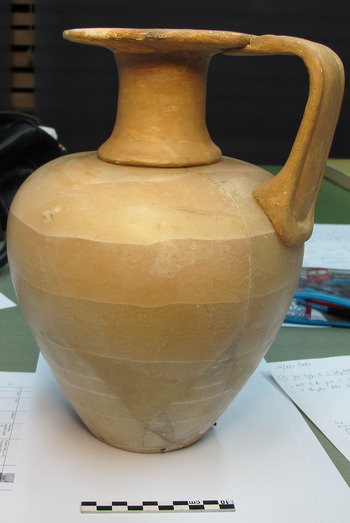
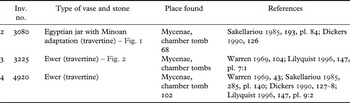
This group (Tables 1 and 2) is composed of vases with shapes and decoration that are typically Aegean; the extent to which they can be identified with Minoan craftsmen is indeterminable. Two parts of a rhyton in chlorite, no. 2490, decorated with a motif of octopus, and an Egyptian jar in calcite, no. 3080, transformed by Minoans (Fig. 1), are from Minoan Crete. Two other objects in the list raise the problem of copies of Egyptian vessels and Egyptianising productions made in the eastern Mediterranean.
Egyptian jar in travertine transformed by Minoan craftsmen, no. 3080.

Partly Mycenaean production.

Copies of Egyptian/Egyptianising vessels and Egyptian imports.

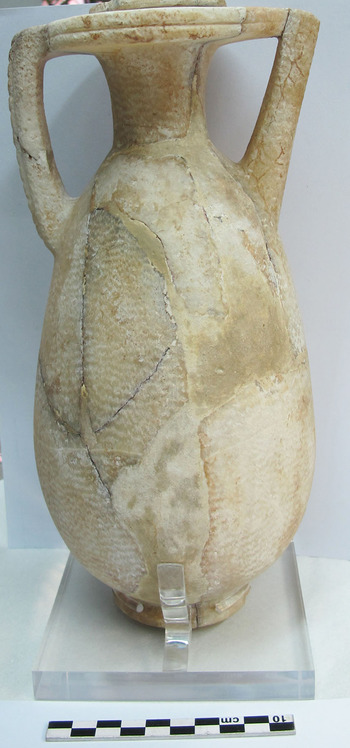
These two jars (nos. 3225 and 4920) were worked from a white rock, certainly Egyptian travertine,Footnote 4 suggesting connections at some level with Egyptian production. However, their shapes are very unusual: they find no counterparts in either the Egyptian or Minoan repertoires (Fig. 2). Views on the origin of the jar no. 3225 are divided. According to Warren the vase could be seen as an Egyptian import (Warren Reference Warren, Laffineur and Betancourt1997, 220). However, a few close parallels are known from the Levant, with a similar spout and handle: the first is a jug in travertine from Kamid el-Loz (Lilyquist Reference Lilyquist and Hachmann1996, 147, pl. 17, 1–3) and the second is a jar from Hazor (Yadin Reference Yadin1960, pl. CL:5, CXCVI:3). The jar from Mycenae appears, therefore, to have a Levantine origin; Lilyquist reinforced this view on the basis of observation of similar morphological details in the Middle Bronze Age pottery of Jericho (Lilyquist Reference Lilyquist and Hachmann1996, 147; Bevan Reference Bevan2007, 145; Sparks Reference Sparks2007, 64, 337).
Ewer in travertine, no. 3225.

Group from the Ivory Houses
This group includes a sample of 20 complete or fragmentary vessels, selected from the larger corpus of over a hundred pieces from the Ivory Houses of Mycenae. In this complex, the House of the Shields provided the most important assemblage of stone vases, essentially represented by finished vessels, in what Tournavitou interpreted as a storage area (Tournavitou Reference Tournavitou1995, 233).
However, a lid from the House of the Shields (Tournavitou Reference Tournavitou1995, 223, pl. 28c) and another piece found in the House of the Sphinxes have been described as possibly unfinished. Even if these two stone objects represent only isolated occurrences, and thus do not provide clear evidence of regular production in the area (Tournavitou Reference Tournavitou1995, 233), they could yet supply clues on the stone vessels’ manufacture. The presence of several pieces of Mycenaean shape in the Ivory Houses area, both finished and unfinished, could be an indicator that, during LH IIIA, local production, on a more or less reduced scale, did indeed exist (Tournavitou Reference Tournavitou1995, 233–4). But it remains impossible to precisely locate this activity.
A few other jars of the same date and manufacturing techniques, deriving also from the mainland, form a group named the ‘Mycenae Ivory House-Style Vessels’ by Bevan. If the majority were found in the Ivory Houses, some rare pieces (about a dozen) of this type occurred out of Mycenae, in Attica, Argolid, Messenia, and Crete (Bevan Reference Bevan2007, 163–5, 241–3, fig. 7:13), suggesting that others places of production could have existed.
Vases of Mycenaean morphology
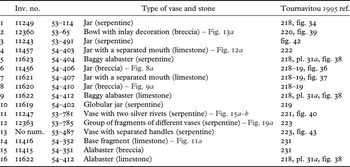
This group is listed in Table 3. Concerning the choice of raw materials, Mycenaean craftsmen used mainly bioclastic limestone, brecciated limestone, conglomerate, serpentine, and lapis lacedaemonius. Even if petrographic analyses are necessary in order to identify the precise sources, the principal ones were certainly situated in southern mainland Greece, and Laconia can be identified as the place of origin of the lapis lacedaemonius (Bevan Reference Bevan2007, 164). The majority of the Mycenaean stone vases studied here were worked either from a fine and homogeneous serpentine (black or olive green) or from limestone. Other vessels appeared in more heterogeneous rocks like breccia or coarser limestone, such as the cup no. 54–352.
Vases of Mycenaean morphology.

Egyptian or Egyptianising stone vases
This group (Table 4) consists mostly of travertine vases. Concerning their chronological attribution, the jar fragment no. 55–51 belongs to a shape produced during the Predynastic – Old Kingdom period and the jar no. 53–162 to one produced during the Eighteenth Dynasty (Fig. 3). The two other pieces are too fragmentary to be clearly identified and dated.
Egyptian jar in travertine, XVIIIth dynasty, no. 53–162.

Egyptian or Egyptianising stone vases.

METHODOLOGY
To identify the techniques employed, a multidisciplinary approach was adopted, which combines data obtained by tribology,Footnote 5 archaeology and ethnoarchaeology, specifically the studies of traditional workshops in India,Footnote 6 Egypt (Hester and Heizer Reference Hester and Heizer1981), and Iran (Wulff Reference Wulff1966). These data allowed us to develop a series of working hypotheses tentatively identifying the tools and manufacturing processes used. These assumptions were then tested and reproduced in field experiments in order to obtain a database of the different traces diagnostic of each technique.Footnote 7
Traces of the manufacturing process on the archaeological objects were observed at different scales of magnification. An initial, macroscopic, examination was performed by the naked eye, which allowed us to determine and select samples of the more representative manufacturing traces. These marks were then recorded by taking impressions in silicone rubber. Two replicas from the Ivory Houses were analysed at the LTDS in Lyon using specific roughness parameters, and measured with a confocal rugosimeter and with an interferometer.
Then, these results were compared with the traces obtained during the experiments in order to identify the processes used. This reconstitution gives rise to clues about the transmission of the new techniques, as well as the organisation of production within the workshops.
MANUFACTURING TECHNIQUES OF THE GROUP FROM THE CHAMBER TOMBS
The start of the local industry
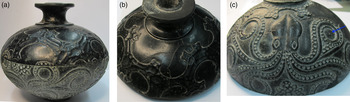
The two pieces of vase no. 2490, decorated with an octopus and a rocky seascape, could illuminate the origins of local production (Fig. 4a ). Indeed, the style and techniques employed demonstrate that the artefact was produced in Crete during MM III – LM I. However, only the upper part of the original object is preserved (Fig. 4b ). The lower half, which demonstrated a different type of technical expertise, was added later and carved in another block of stone.Footnote 8 This unusual process appears to have been as the result of repair work, undertaken by a local craftsman during LH II (Sakellarakis Reference Sakellarakis1976, 184, pl. XI: 31; Sakellariou Reference Sakellariou1985, pl. 18: 2490).
(a) Rhyton in chlorite decorated with a motif of octopus and rocks, no. 2490; (b) surviving original Minoan upper half; (c) replacement of the lower part by a Mycenaean imitation with possible traces of compass use.

Variant production methods can be observed on each part of the two extant pieces. The relief decoration is deeper on the upper piece and the polishing much more skilfully achieved. At the very end of the manufacturing process a particular procedure was employed for obtaining a glossy and well-polished surface. The lower part is characterised by the use of a drill bit, probably hand manipulated, to create the cavities in the rock motifs. This type of tool generated a homogeneous pattern, totally different in style from the Minoan part of the vase. The use of the compass appears to have been deployed on this part, for the setting out of the octopus tentacles (Fig. 4c ).
The decoration process itself provides evidence of the Minoan origins of the vase. The Minoans made a number of rhyta in chlorite with relief decoration, which were considered as luxury goods. Indeed, fragments of this type of vessel were preserved a long time after they had been broken. For example, the fragment AE 1247 (Warren Reference Warren1969, 85, P477) shows traces of polishing and a glossy surface on several broken surfaces, which confirms that it was used, kept, or at least handled for a time after its fracturing. This could corroborate Rehak's hypothesis about bull's head rhyta and chlorite vessels with relief decoration. According to the author, these vessels were meant to be destroyed after use and the pieces were distributed to the participants (Rehak Reference Rehak, Laffineur and Niemeier1995). But the high value of these objects is suggested by the conservation of broken pieces. Indeed, the hypothetical Minoan tradition of breaking the chlorite vessels appears not to have been transmitted to the mainland, where, however, an attempt at repair can be observed on the rhyton presented here.
The study of manufacturing traces is problematic for this type of vessel. Indeed, the original surfaces of the pieces could have been modified in the course of broken fragments’ reuse by the Minoans.Footnote 9 However, some observations concerning the manufacturing process itself can be made. It was suggested that all the relief-carved vessels were covered with gold leaf to imitate the repoussé technique of vessels in metal (Warren Reference Warren1969, 162–3; Higgins Reference Higgins1997, 153–6; Bevan Reference Bevan2007, 122–3, 255 note 14). However, only three examples from Zakros and Palaikastro were found with gold traces (Koehl Reference Koehl2006, 53, nos. 204, 296 and 771). Research into the polychromatic effect on some pieces, created by the assemblage of further materials (Logue Reference Logue2004, 150; Rehak Reference Rehak, Laffineur and Niemeier1995, 442–3), suggests that not all relief-carved vases were integrally gilded: it is possible that only part of the vases was covered with gold.
Here, Minoan craftsmen employed two different possible approaches. The first is based on establishing a colour/tonal contrast between the carved motifs and the background, following the polychromatic tradition. The freshly worked marks appear generally to be of a lighter coloration, contrasting with the darker background, and so strengthening the relief effect. This type of method can be observed on the triton shell rhyton of Malia (Morero Reference Morero2009, 437–46; Morero in preparation). Other rhyta of this category do not demonstrate the use of that decorative technique, presenting rather a uniform, artificially darkened, surface. This process of darkening was performed at the very end of the manufacturing sequence, after the execution of the relief decoration. The type of polishing and the level of achievement reached by this technique modify the colour of the stone (Procopiou Reference Procopiou2013b), but the surface could also be completely coated with oil or wax, which darkened the colour of the chlorite and created a glossy appearance.Footnote 10 This process can be identified on other objects from Knossos, for example three fragments from the Ashmolean Museum (nos. AE 1247, AE 1569, AN 1938.605).Footnote 11 The coexistence of distinct procedures in the same group of vessels suggests the existence of more than one workshop and necessitates a reconsideration of Warren's hypothesis (Reference Warren1969, 174–180). According to the author, a single workshop, specialising in the production of steatite or chlorite vases with relief scenes, was established at Knossos. This statement is certainly true and the octopus-decorated rhyton was probably made there. However, the Mycenaean part seems to be closer to the technique of decoration seen on the triton shell of Malia. Does this suggest a Minoan artisan familiar with the Maliot approach to such work? The preliminary study of this material does not yet give an answer.
The execution of the lower part of the two-part vase no. 2490 demonstrates a lower level of expertise and skill than the upper putative Knossian part (Sakellarakis Reference Sakellarakis1976, 84). This could therefore suggest the presence of Minoan craftsmen transmitting their skill and expertise to Mycenaean apprentices, as suggested by Krzyszkowska for the seal production on the mainland in MH III/LH I (Krzyszkowska Reference Krzyszkowska2005, 235-6). The presence of compass marks on the Mycenaean part suggests also that Minoans and Mycenaeans shared the same techniques. At present it is difficult to identify which centre employed the tool first and transmitted this knowledge to the other. Indeed, it is far from clear that it was deployed on Minoan vessels until the LM II–III (Warren Reference Warren1969, 158–9; Evely Reference Evely1980; Evely Reference Evely1993, 192), simultaneous with Mycenaean production. However, a possible earlier usage of the compass, for complex designs, was also suggested on the mainland (LH I), as well as in Neopalatial Crete (Evely Reference Evely1993, 192, 194 note 117).Footnote 12
Imports from Crete or Egypt and local copies
As for the period of the shaft graves, imported stone vases are attested in the chamber tombs. The ovoid Egyptian alabaster no. 3080 was certainly transformed by the Cretan workshops before its transfer to the mainland. Indeed, the conversion of an Egyptian vase into a Minoan one is well known: numerous instances are found in Crete during the MM III – LM I (Warren Reference Warren1969, 107). Moreover, like the upper half of the octopus-decorated vase, it seems difficult to attribute this type of complex work to mainland workshops. They did not possess at this time a sufficient technological expertise in working stone for making elaborated shapes of vases. However, as we shall see below, this particular method of work was transmitted later to the Mycenaeans, and finally became an important part of the local manufacturing method.
Lilyquist recognised the vase no. 3225 as a Levantine production (see below) and the ewer no. 4920 as an Aegean Egyptianising copy (Lilyquist Reference Lilyquist and Hachmann1996, 147) because the shapes are non-Egyptian. However, other potential origins must be considered too and Egypt cannot be totally excluded. Indeed, the stone seems to be Egyptian travertine.Footnote 13 Such unusual shapes could also find another explanation: they might be the result of an individual order, perhaps for export, or even an attempt to create a new form. Technological parameters, particularly the identification of the hollowing techniques, become here a significant feature in determining the origin of the artefacts. Fortunately, each centre potentially involved (Crete, north and south Levant, Mycenae or Egypt) employed different tools and techniques. But in this case the interior of the vase was completely polished to remove the hollowing marks, so that its identification is impossible. This absence of diagnostic traces enables us to rule out a Mycenaean LH III origin.Footnote 14 Nevertheless, as previously stated for the jar with the relief octopus, the very beginnings of the local industry in the LH II phase will have mobilised both Cretan craftsmen and Mycenaean apprentices, and so could plausibly have given rise to Egyptianising copies produced with Minoan techniques. Consequently, a mainland origin of this piece cannot fully be excluded.
THE MANUFACTURING TECHNIQUES OF THE IVORY HOUSES GROUP OF VESSELS
Local shapes
Method
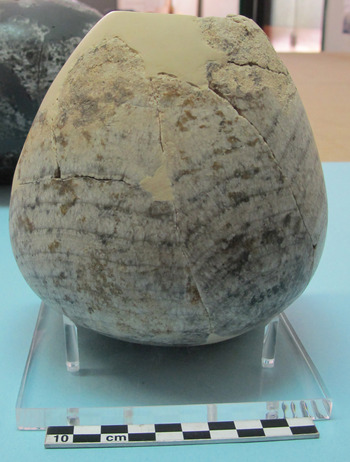
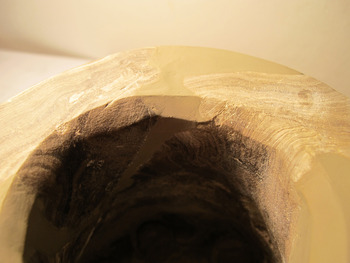
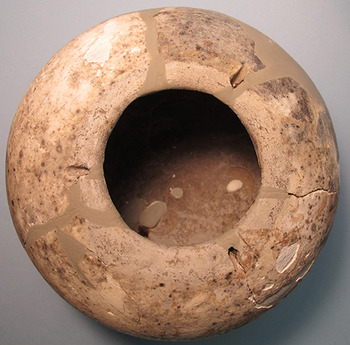
The fully developed Mycenaean industry reveals a manufacturing sequence both original and uncommon. For example, in general practice in the eastern Mediterranean workshops (Crete and Egypt especially) the craftsmen left the working of the handles until after the hollowing process of the vessel interior. Once the inside profile was made, a final polishing process produced the external lines. But in the Mycenaean workshops, the collar and/or the handles were created separately, to be joined to the body at the end of the manufacturing process. That is generally the case for the jars of the Ivory Houses (Tournavitou Reference Tournavitou1995, 215–16). Furthermore, the steps followed in manufacturing the body itself are singular: the working up to a smooth finish of the entire external surface was largely completed before the internal drilling operations. Only the ultimate polishing was completed after. The surface at the vase mouth had been flattened out early on: flaking is visible here, created accidentally around the mouth edge during the drilling operation (Fig. 5 and 6). This flaking confirms that the drilling took place after the smoothing of the external surface; otherwise the craftsman would have erased these marks before the final polishing of the exterior.Footnote 15 This evidence indicates a working sequence different from the Minoan one, where the craftsmen had carried out the hollowing before finalising the external shape (Morero Reference Morero and Poursat2013).
Mycenaean jar showing irregular contour of its mouth, no. 54–404.

Mycenaean jar showing an irregular contour of the mouth, no. 54–412.

The place of carving any relief details and decoration in this manufacturing sequence seems variable. Sometimes it is much more than a simple ornamentation on the exterior surface: rather it forms an integral part of the external form and was done during the early stage of shaping. But on some pieces, the decoration was added in a second operation on totally finished vases: it can consequently be viewed as a subsequent makeover. The addition of this type of decoration might even be performed in a different workshop.
Cutting process of the external shape
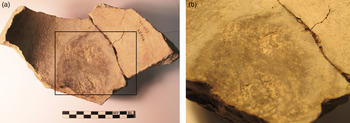
During this early phase of the manufacturing process, the external form was definitively fixed: the surface was shaped and refined. The limestone vase no. 54–352 conserves the marks of this stage of work. The traces of the roughing-out process are still visible, undertaken by a combination of percussion, with a stone pounder, and abrasion processes (Fig. 7). A final smoothing and polishing operation was then generally carried out to erase the traces of this phase of shaping. The use of a rough abrasive, first carried out with blocks of a coarse-grained stone, was followed by a finer smoothing process. In this stage, stone polishers (Procopiou Reference Procopiou and Poursat2013a) or abrasive powders of decreasing grain-size and hardness (e.g. emery, crushed quartz or obsidian) were used with water.
Cup in limestone showing picking traces on the base, no. 54–352.

Hollowing process
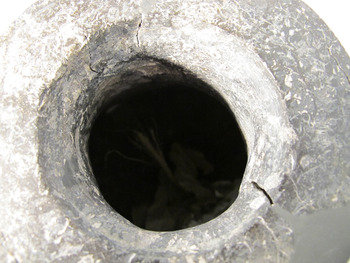
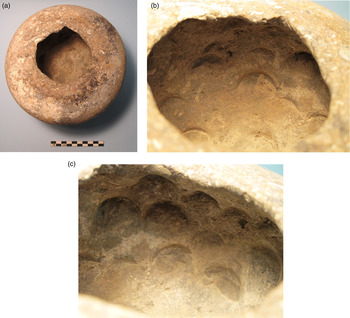
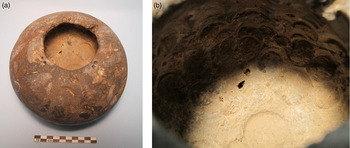
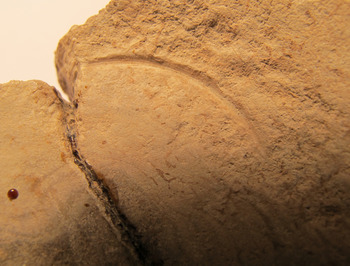
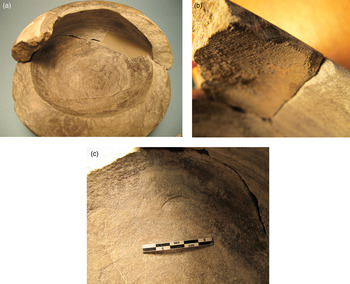
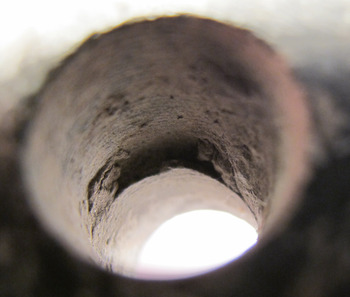
The vases studied feature an inner space opened out generally into a globular or pear-shaped form. If opened and conical forms existed, they are uncommon. The majority of the Mycenaean products have a morpho-technological homogeneity. The same processes and techniques, based on the use of the tubular drill alone, were employed to create enlarged internal profiles (Tournavitou Reference Tournavitou1995, 218). A series of juxtaposed perforations were drilled to create the inner space. This technique is attested as early as the Old Kingdom (third millennium) in Egypt for the manufacture of granite sarcophagi (Stocks Reference Stocks2003, 172–3). The use of the ‘honeycombing’ technique for the stone vessel industry first appeared in Neopalatial Crete.Footnote 16 The different centres developed the practice in distinctive ways: the Minoan and Egyptian workshops employed it for making open vessels (like shallow and conical-wall bowls, cylindrical shapes); the Mycenaeans for closed shapes. Distinctive approaches were adopted also with respect to the organisation of the drilling sequences. In the Mycenaean system, the operator began by boring a first central shaft (Fig. 8b and 9b ). Then, he proceeded by successive drillings around this preliminary perforation, enlarging the cavity in a more or less systematic manner. When the area under the shoulder was reached, the craftsman carried out a series of drillings at an angle to the vertical axis of the vase. The operator could tip his tube for boring through or change the position of the draft (Fig. 8c ). Generally, the craftsmen employed drills of roughly the same diameters (ranging from 2 to 3 cm). But in certain cases, the use of two different sizes is visible on the same object (e.g. 53–114 and 54–410 jars, Fig. 9b ).Footnote 17 For example, on the jar no. 54–351 two tubes of 2.2 cm and 1.5 cm could be identified. The fine walls of these drills (between 1 and 2 mm, on average) suggest the use of copper or bronze tubes more than a reed with its thicker walls, as visible in traces left in the jar no. 54–352 (Fig. 10).
(a) Mycenaean jar, no. 54–406; (b) organisation of the series of tubular drillings around a first central bore; (c) series of tubular drilling below the shoulder of the vessel.

(a) Mycenaean Jar, no. 54–410; (b) traces in the cavity indicating the use of two tubes of different sizes.

Cup in limestone showing a trace of tubular drilling, indicating the use of metallic tubes with very thick wall, no. 54–352.

The bow drill was certainly employed to agitate the tube, as indicated by the drilling traces concordant with a back-and-forth rotating motion. Field experiments showed that the ideal size for the copper tube, manipulated by a single operator, with a bow drill, is a diameter of 2–3 cm. Traces of these dimensions were also identified on the Mycenaean vessels studied, corroborating this identification. Finally, the use of a small mobile drill like the vertical bow drill, allowing a relatively large flexibility of movement, seems likely. This feature is essential for the Mycenaean procedure in the eventuality of the use of an almost horizontal position of the tool for drilling some parts. Moreover, the abrasion patterns on the surfaces of these bored holes (and the cores removed) indicate a wear process achieved by free movement of abrasive particles against the stone. This excludes the use of any system for maintaining a fixed and stable contact between the tube, the abrasives and the stone, like the Minoan technology that involved the use of wax (Morero Reference Morero and Poursat2013). Here, the tubular drill was employed alone, with abrasives and water (Vargiolu et al. Reference Vargiolu, Morero, Boleti, Procopiou, Pailler-Mattei and Zahouani2007). Without further analysis and experimentation it is difficult to identify the abrasives employed. Potentially, they included sand, crushed emery, obsidian, quartz and pumice (Warren Reference Warren1969, 160; Evely Reference Evely1993, 192); for secure identification, the study of micro-traces must be carried out in the LTDS.
Once the drilling was completed, the craftsmen had recourse to a particular technique to extract the bore core. According to the experimental reconstructions, when the drill reaches a certain depth in the stone, a sharp blow applied to the tube itself will break off the bore core. This phenomenon certainly explains the absence of chisel cut-marks, unlike those observed on some of the Minoan bore cores (Morero Reference Morero2009).
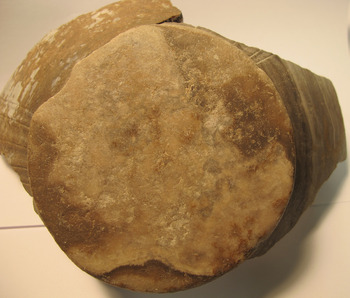
Finally, some adjustments were carried out on the interior, accomplished with varying levels of skill. In some rare cases the craftsman has carefully removed almost all the drilling traces by polishing (cup no. 54–352 or the jar no. 54–403). The work marks that remained discernible in those jars suggest the following sequence: once the bore core was removed, the entire surface was pecked, rendering it roughly flattened. Traces of deeper impacts are visible in the bottom of the limestone cup no. 54–352 (Fig. 11b ). Then, the surface was rubbed down with one or more calibres of grinding and polishing stones to smooth the surface, as indicated by the overlapping of striation marks on the jar no. 54–403 (Fig. 12b–c ). But this technique seems rare and is only attested on these two pieces. Instead, on the majority of the vessels studied, in spite of the resulting roughness the annular grooves from the deeper cuts of the tube's end were left visible. This is particularly evident in areas inaccessible to the eye, such as under the shoulder.
(a) Cup in limestone, no. 54–352; (b) traces of picking and abrasion in the bottom.

(a) Mycenaean jar, no. 54–403; (b) scraping traces; (c) trace of a deeper tubular drilling operation remaining after the polishing of the surface.

Decorating and finishing processes
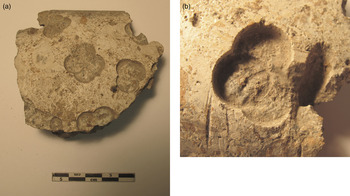
Some pieces reveal a decorative treatment that derives from the external shaping process itself: it is not simply an incised or worked linear ornamentation, but a group of elements cut so as to stand in relief, arranged and highlighted by incisions. In the same way, the deeply cut motifs on the surface of the limestone vase nos. 53–65, meant to receive inlays of stone, were an integral part of the external shaping procedure (Fig. 13a ). These strategies involve forward planning and anticipation. Thus, creating the decoration before the hollowing-out stage could be interpreted as a safeguard: the solid body will withstand the stresses of working the exterior better than a hollow one. Various systems of such decoration are identified: (a) inlay, (b) linear incisions, (c) relief decoration associated with linear incisions.
(a) Jar in limestone with trefoil or quatrefoil patterns made by series of tubular drillings, no. 53–65; (b) detail of the tubular drilling marks.

Inlay decoration appears on the limestone vase fragment no. 53–65. This technique was used to create the trefoil or quatrefoil patterns (Fig. 13b ). Each lobe was produced by tubular drills of 1.1 to 2.0 cm in diameter. Then, a paste or a piece of stone were fitted inside and stuck with an adhesive that has today disappeared.
The vases nos. 53–491, 54–352 and 54–404, and several fragments of the group 53–785, show an incised linear decoration. In general, the lines were made by the repeated passage of a cutting tool on the same line, excising a V-shaped groove. The presence in these grooves of isolated lines with deviated trajectories suggests the use of a free hand tool (Fig. 14a –c) like a thin metal or stone blade. However, isolated lines observed on the limestone vase indicate the use of a different tool for the engraving process, more likely a pointed instrument. One more type of tool can be suggested: the width of some incised grooves, together with the regularity of the incisions present inside them, indicates the use of an abrading stone (a polishing tool of fine sandstone or schist, working with an abrasive powder and water). Even if the use of the bow lathe is extremely doubtful, it cannot be totally excluded in theory for some deep cuts, characterised by extremely straight and constant proportions.Footnote 18
Mycenaean jars with incised linear decoration: (a) jar no. 54–352; (b) jar no. 53–491; (c) jar no. 54–404.

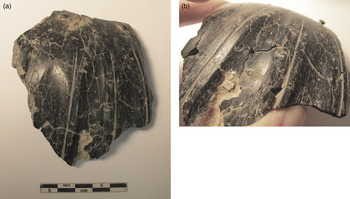
Linear enhancement is often associated with a relief-carved decoration and generally is meant to highlight the outlines of the relief element itself. It emphasises the different levels of the relief. The technique, previously described for the two-part jar decorated with an octopus, was certainly inherited from the Minoan workshops. Maintaining the difference in the coloration of the incised areas reinforces the contrast. Indeed, where the entire vessel was polished and sometimes coated with substances that promote uniformity and darkness to the colour of the rock, the incised grooves do not demonstrate the effects of this treatment and remain a colour-tone lighter. This type of decoration appears on the vase no. 53–781 (Fig. 15a–b ), on many fragments of the group 53–785, and on the handle no. 54–487 (Fig. 16). The decoration in relief was unquestionably the result of well-planned work. As mentioned previously, it had to be carried out at the same time as the preliminary stages of exterior shaping (see above). The linear cut-work, lighter in colour, was performed at the end of the process, once the surfaces were perfectly polished.
(a) Mycenaean jar with incised linear decoration, no. 53–781; (b) detail of the incised linear decoration.

Isolated handle with incised linear decoration, no. 54–487.

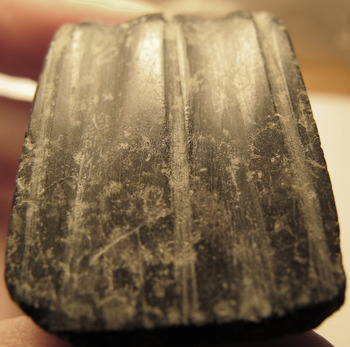
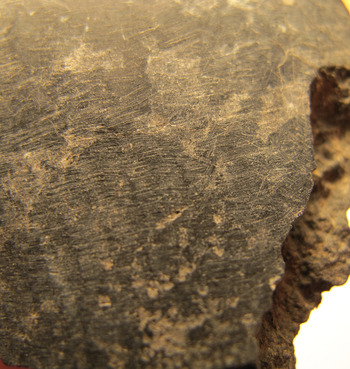
The final stage is that of the finishing process, aimed at making the vase's surface uniform by removing and/or hiding the remaining traces of the previous stage of work. This may be accomplished to various levels of excellence, up to the total disappearance of working traces and a perfectly polished surface. The fact that this final polishing operation was performed using abrasive powders of gradually reduced coarseness is attested by the decreasing thickness of the striations on the surface of some vessels (Fig. 17). The abrasive particles were manipulated against the wall of the vases by a piece of cloth or leather. Then, oil or wax could have been applied on the surface to further the impression of uniformity by darkening the stone (Fig. 18).
Jar fragment with a matte surface and polishing striations, fragment of the group no. 53–785.

Jar fragment with a glossy surface and grooves of extremely fine polishing, fragment of the group no. 53–785.

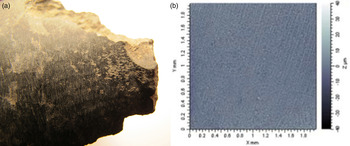
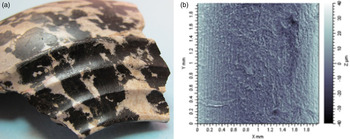
For this stage of work, it was not possible, using the interferometer, to obtain an accurate picture of the traces on the surfaces of the vessels with darkened walls. However, the use of a polishing technique, with the aim of giving a visual impression of smoothing, was observed on other earlier productions from the eastern Mediterranean. The Egyptian fragment no. 55–51 (see Table 4), also from the Ivory Houses, is a comparable example. Thus, the observation with the naked eye of the Mycenaean piece no. 53–785 reveals a matte surface, covered with deep grooves, while an initial examination of the Egyptian piece gives the impression of a homogeneous surface, smooth and shiny. However, the microscopic observation of both surfaces reveals completely different patterns. Indeed, compared with the Mycenaean artefact's wall (Fig. 19b ), the striations on the Egyptian vase are much more pronounced and the surface is rougher (Fig. 20b ). This illusion was created by the brightness of the surface, which was certainly obtained by covering the wall with wax.Footnote 19
(a) Fragment of a Mycenaean jar showing traces of polishing, fragment of the group no. 53–785; (b) view of the micro-striations from the polishing process, analysed on the fragment, by interferometer, at the LTDS.

(a) Fragment of the Egyptian vase, no. 55–51; (b) view of the micro-striations from the polishing process analysed on the piece by interferometer, at the LTDS.

Pieces manufactured apart from the body
Collars, handles and feet are always made separately and then joined to the body. The collars of the sample studied (vases no. 54–403 and 54–407) were made in the same stone, and probably from the same block of raw material, as the body itself (Fig. 21).
Mycenaean jar, no. 54–407.

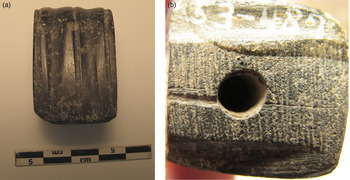
We can therefore assume that they were carved in the same workshop at much the same time. The same techniques were used for the manufacture of both the separate parts and the bodies proper. The presence of facets on the handle no. 54–487 (Fig. 22a ) indicates the use of blades (of stone or metal), as well as a rough abrasive (Fig. 22b ), in its manufacture. The handle was also drilled from side to side with a tubular bit (Fig. 23). Finally, as for the body itself, the separate pieces were polished.
(a) Isolated handle, no. 54–487; (b) abrasion marks from the shaping process on the handle.

Isolated handle showing the traces related to a perforation made with tubular drill, no. 54–487.

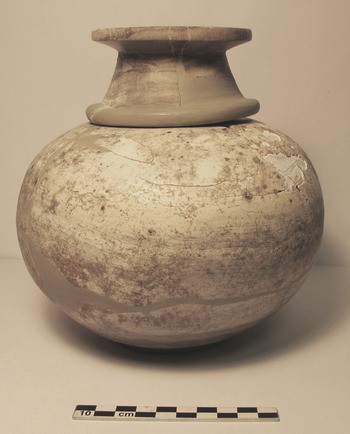
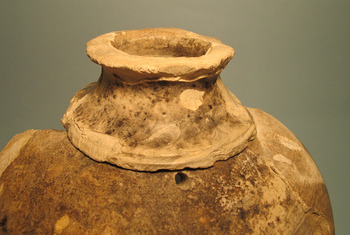
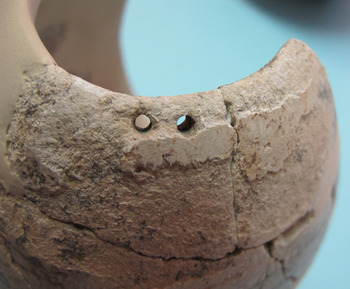
The elements were then attached to the body by a system of rivets, pegs and wires. For example, three holes, still visible on the mouth of the vases nos. 54–403, 54–407, 53–162, were pierced for the attachment of a collar (Fig. 24–26). This system appears similar to the method developed, during the Second Palatial period in Crete, for the addition of a collar and handles on a Minoan rhyton and in the modification of Egyptian vases (Warren Reference Warren1969, 109). However, the Cretan origin of this technique is not necessarily certain as the method is attested also for the manufacture of Mycenaean metal vases. The handles were made separately from the bowl and then attached to the body by rivets (Laffineur Reference Laffineur1977, 75–6).
Mycenaean jar with perforations made for the adjunction of the collar, no. 54–403.

Mycenaean jar with perforations made for the adjunction of the collar, no. 54–407.

Mycenaean jar with perforations made for the adjunction of the collar, no. 53–162.

One vase seems to have been reworked. This is a piriform Egyptian jar (no. 53–162, Figs. 3 and 26). The drilling technique and the raw material undoubtedly indicate the Egyptian origin of the vessel (see below). This Egyptian vase had a collar, which was removed by Aegean craftsmen. The cutting marks resulting from this operation were then polished away and the perforations were made. Those holes were certainly intended for the addition of another collar or handles to make the whole conform more closely to local tastes, or for the attachment of something to close the mouth. Whether these changes were made by a Mycenaean workshop or by a Minoan craftsman is almost impossible to tell. However, as pointed out by Warren, transforming foreign vessels appeared to be rather a Cretan practice (Warren Reference Warren1969, 105–15; Warren Reference Warren, Laffineur and Betancourt1997); the vase could then be exported.
Foreign shapes
Copies of foreign forms or foreign-inspired shapes are not attested in the corpus. The vessels that look Egyptian show all the characteristics of being Egyptian productions: the stones used – calcite or porphyritic rocks (or diorite) – are of Egyptian origin; moreover, tellingly, the manufacturing techniques employed are incontestably Egyptian. Indeed, the coarse annular grooves from the drilling process of the jar no. 55–51 present the exact form and characteristics associated with the use of the Egyptian stone borers (Morero Reference Morero and Pfälzner2011). The polishing process is also different (see Fig. 20a–b ). The challenge is in deciphering whether the Egyptian vases were brought to the mainland by the Egyptians themselves or by the Minoans, and in which period.
TECHNOLOGICAL TRANSFERS
It seems, then, that a great part of Mycenaean skill derives from contact with Minoan craftsmanship. From a technological point of view, the approach developed for the drilling process of the interior is purely a native one, based as it is entirely on the use of the tubular drill. As well as being used for hollowing the interior of the vessels, the tool cut the patterns meant to receive the inlay decoration. This single-tool approach is an uncommon practice, even unique, in eastern Mediterranean stone vessel traditions. The tubular drill was used from the Early Bronze III and Middle Bronze Age in the Balkans and mainland Greece for drilling the hammer-axes. However, the application of the ‘honeycombing’ technique to stone vase manufacture appeared as early as the third millennium bc in Egypt and later during the mid-second millennium bc (LM I or earlier) in Crete. The close relationship between Minoan and Mycenaean craftsmanship suggests, in all likelihood, a transfer of this process from Crete during the LH I phase. At that point, a totally different technological approach arose in the Mycenaean workshops. Indeed, in Crete, even if the Minoans used the multiple one-drill size ‘honeycombing’, the tubular drill was also used as the first step of the drilling sequence for large vases: a sizable core was drilled, which was then cut into several bore cores of smaller diameter. Warren described this procedure with regard to the unfinished jar of Akrotiri (Warren Reference Warren and Doumas1978). Other vessels with a narrow mouth were hollowed by juxtaposition of tubular drilling of the same diameter (Evely Reference Evely1993, 185, 190, pl. 44:3 and 4). However, this type of drilling sequence is rarely attested in Crete for the process of enlarging the interior space and is even less well known with the use of the tube as the only drill bit. Generally, a final step of regularisation is also often detectable, involving the use of solid wooden bits.Footnote 20
Similarly, the technique of decoration by inlay, as showed on the jar fragment no. 53–65, existed earlier in Crete and is attested by vases from Knossos, dated to the First Palace period (Evely Reference Evely1993, 178, pl. 46:5 to 8). However, a Minoan jar from the Ashmolean Museum (AE 835) demonstrates a different technical approach. The Minoans here used a solid wooden drill bit, not the tubular as did the Mycenaeans, for drilling the holes of the inlay decoration. While Mycenaean craftsmen may have taken some inspiration from the Minoan ornamental repertoire, they were able to adapt their working to their own technology and kit.
The perception of an acceptable level of work and the ‘quality’ of the finished products were also distinctive to the Mycenaean world. Heavy traces from the shaping process (coarse and deep striations) are still visible on the surface, indicating that the polishing sequences (by increasingly finer grades of abrasives) were not always done very carefully. However, these traces still appear on lustrated surfaces (e.g. vase no. 53–781). One can therefore suggest that the Mycenaean idea of achievement is sometimes more concerned with first creating a sensation of lustre and then of a homogenisation by surface darkening, rather than a perfect smoothing of the surface.Footnote 21
To conclude, the techniques used, as well as the organisation of the production, are distinctive from those of other eastern Mediterranean centres, including Crete. If a large number of technical elements (tubular drilling in series, production of the vessels in several parts) derive from a Minoan heritage, the Mycenaeans seem to have quickly developed their own approach – with their own technological emphases, serving purely Mycenaean forms. The production of an object on the basis of separately made elements was initially a Minoan approach, and was adopted for Mycenaean production, but appeared far less commonly in the other regions of the eastern Mediterranean, and probably also in Crete. Indeed, the restricted production of stone vessels in Mycenaean Crete reveals the use of another technological repertoire. At this period, the industry was characterised by the production of gypsum vessels in Knossos, essentially worked with chisels (Evely Reference Evely1980; Reference Evely1993, 187).Footnote 22
WORKSHOP AND ORGANISATION IN MYCENAE
Technological study indicates the possible coexistence of different types of organisation in the Mycenaean workshops. First, the drilling process seems based on the work of only one craftsman. However, it is difficult to determine if the same operator was able to manage the work at all stages of the manufacturing sequences or if different experts were devoted to specific tasks and techniques. The second option seems, however, to be more likely. Indeed, a Linear B tablet indicates the existence of a specialism that existed during the Mycenaean period in Knossos that could be interpreted as the ‘driller’ (Landenius Enegren Reference Landenius Enegren, Gillis, Risberg and Sjöberg2000, 34–5). Moreover ethnoarchaeological studies of traditional Indian workshops indicate the existence of different experts specialising in a particular task, especially for the polishing process (Kenoyer, Vidale and Bhan Reference Kenoyer, Vidale and Bhan1991, 59; Procopiou Reference Procopiou2013b).
The concentration in single workshops of the whole manufacturing sequence, (executed by one or two craftsmen, a specialist and an apprentice) cannot be totally excluded.Footnote 23 However, the existence, on the one hand, of workshops devoted to the production of the vessel bodies and, on the other hand, of places devoted to the transformation or the finishing of stone vases, can be reasonably asserted. The existence of such workshops is suggested by the circumstances of the Ivory Houses from Mycenae. The unfinished lids (nos. 53–415a and 54–331) and handles have been discovered in isolation, separate from any other indications of stone vase production, in the House of the Sphinxes and the House of Shields (Tournavitou Reference Tournavitou1995, 217–34). The handles were meant to be added to the vessel bodies (Tournavitou Reference Tournavitou1995, 229–30). In the House of the Sphinxes, room 1 has delivered isolated handles and no evidence of associated vases (Tournavitou Reference Tournavitou1995, 233). On the basis of this evidence, such areas could be interpreted as ones devoted to the transformation of finished products by the addition of handles or collars. Indeed, they would appear to be points of storage and assembly rather than production (Tournavitou Reference Tournavitou1995, 233–4; Bevan Reference Bevan2007, 165).Footnote 24 Indeed, this organisation suggests the existence of a storage place for finished vases prior to their assembly or conversion. This hypothesis can be argued for the material in the House of the Sphinxes, where fragments of jars in diorite, breccia and crystalline limestone have been discovered (Tournavitou Reference Tournavitou1995, 231). As suggested by Tournavitou, the diorite vase is doubtless an Egyptian import, as confirmed by the rock itself, but also by the techniques observed. It would therefore be stored in this place until the addition of new elements, like handles. Furthermore, it is possible that the vase was transformed by the addition of a fluted decoration on the mouth, which could have been carried out in a Mycenaean workshop. It might also be suggested that Mycenaean finished products were modified in these places, some time after their production period, in response to a ‘fad’ or a specific request from the owner. However, these areas could be considered not only as transformation workshops, but also as places of ‘stone vase finishing’. In this case, the approach to the working process would be different. The vase, made of several parts, would not be considered as a coherent and integral whole whose conception lies within the mind's eye of one craftsman, but would be more like a puzzle in which each part is the product of distinct specialists, who worked in separate locations. The existence of this type of production could be supported for jars such as nos. 53–114 and 54–403, which have lids carved from stone blanks different from that used for their bodies. These rare instances perhaps leave open the possibility that several workshops were involved in the manufacture of the whole assemblage.
However, while such a hypothesis cannot be totally excluded, the manufacture of the different parts seems more likely to be the product of the same workshop. Indeed, the drilling method used by the Mycenaeans required the fabrication of the narrow collar separately from the body. Then, for practical reasons related to their transportation, they arrived in the place of storage prior to their distribution, in a kit form. Once at such an area (at Mycenae, at the House of Sphinxes, for example), all component parts would be sorted and joined together. Moreover, the drilling method developed by the Mycenaeans should have generated a large number of bore cores. However, very few examples are attested. One can suggest a methodical collection of these unwanted pieces for reuse for another purpose. But for Mycenae it is more appropriate to consider a workshop which produced the bodies and the other additional parts in a specific location (outside the city for example). Then, a second workshop added the supplementary handles or collar. Furthermore, the existence of a small-scale industry of imported vases undergoing transformation also remains possible.