


Lived experience narratives are often used to provide depth of understanding to an area of study in medicine, using ‘real world’ exemplars that explicate theory and models of practice. In our case, the narratives in this part help us understand how the social context of the authors and the people they discuss shape collective experience, and drive the way institutions and individuals respond to sexual harassment within their profession.
When we present this work, we are often told that cases of sexual harassment are unusual, or unique, or outliers. ‘We have been working in this field for years’, senior leaders tell us ‘and we have never seen a case of sexual harassment between doctors’. They may then suggest that survivors must be a little fragile, requiring further training in resilience, or that perpetrators are simply outliers, ‘bad apples’ in an otherwise highly professional community of senior doctors.
The quantitative evidence, of course, does not support this narrative, but in our experience, the narrative remains remarkably resilient. Rape myths continue to influence our collective understanding of this difficult area, and there is deep cognitive dissonance when we suggest sexual harassment occurs in the cold, hard light of day in a busy hospital, or that perpetrators can be highly respected senior consultants, and survivors can be privileged, intelligent, capable doctors.
Part three is the core of the book. The reason this book exists is because of questions around context. In our early work, we noticed that the majority of the writing in this area was coming from Australia, the UK, Canada and the US, with relatively few contributions from other countries. As qualitative researchers, we are well aware that context is critical if we are to understand social phenomena. In order to understand the relationship between context and sexual harassment, we needed to broaden our experience and understanding.
Over the last ten years, we have reached out to leaders in the field in multiple countries. It has been a deeply challenging task. Many advocates have set up communities through social media, but these are rarely publicly accessible, even if they use English as their main language for discussion. Many survivors are understandably reluctant to speak, and so become almost impossible to find, supporting the narrative that survivorship is rare in medicine. Our work was interrupted by the COVID-19 pandemic, when several authors redirected their energies into clinical, public health and leadership work in their own countries. Nevertheless, in this part, we present a community of practice, with survivors, advocates, colleagues, leaders, academics and mentors willing to collaborate to deepen our collective understanding in this challenging area.
Aims
The aim of this part is to explore how the context of the survivor, perpetrator, policy environment, legal framework, medical training structure and medical workplace conditions interact to influence how and why sexual harassment occurs.
Methodology
In each chapter, we have asked a diverse group of authors to present three elements:
An overview of their unique context, including common metrics for gender equity using the UN Sustainable Development Goal 6, and the author’s own reflection on the way gender impacts their life and work.
A description of a case of sexual harassment in their country, which may be identified, or may be a conglomerate synthesised from multiple narratives.
A reflection that enables each team of authors to reflect on what we can learn from their contexts and experiences.
This is a large part, because we were determined to provide a breadth of contexts. We decided to use the World Health Organization (WHO) regions, to ensure we had diverse authorship. We are well aware that, as white privileged authors, we were likely to have a subconscious bias towards contexts like our own. We have sought in this part to capture the voices of people from all WHO regions. The countries represented are:
Nigeria and Zambia from the African region
Mexico and the United States of America from the region of the Americas
Austria, Germany and the United Kingdom from the European region
Iran and Pakistan from the Eastern Mediterranean region
Australia, Brunei, Japan and Malaysia from the Western Pacific region
Using this sampling frame, we have strived to achieve a diverse sample, drawing on multiple accounts and reflections from different countries. We have prioritised the authentic voice and experience of women doctors. In these chapters, you will read people’s accounts of experiences, sometimes raw and painful, sometimes presented in composite form. Together, they give a rich and diverse narrative about the experience and understanding of sexual harassment in a variety of medical contexts, and together demonstrate clearly just how complex it is to eradicate it.
The Australian Context
Australia is a settler-colonial State, and its head of State is still a British monarch. Britain established six colonies on the continent of Australia, and these colonies negotiated the establishment of a federal commonwealth in 1901. (Reference Grimshaw1) The colonies became states, retaining sole legislative jurisdiction over some areas, including health, while others, such as immigration, became the sole responsibility of the federal government. (Reference Healy2) Australia is now formally independent from Britain, but retains close cultural and legal similarities.
Australia is the sixth largest country in the world based on land area, but its population remains comparatively small, reaching just under twenty-six million in March 2022. (3) Rural industries, including mining and agriculture, loom large in the Australian cultural consciousness, but approximately 90% of Australians live in urban areas. (4) Australian rural and remote communities can be highly isolated, and lack essential services, with some remote communities hundreds of kilometres from their nearest neighbours. As with other Organisation for Economic Co-operation and Development (OECD) nations, service industries make up a large portion of the Australian economy. The small population can result in labour shortages in some industries, including health care, and skilled migrants are often treated as a solution to this issue. In 2023, 30.7% of Australians had been born overseas. (5)
Race and Gender
The Indigenous, or Aboriginal and Torres Strait Islander, communities that predated British colonial rule have been subject to continuing and brutal oppression and marginalisation by a colonial regime that has systematically eroded Indigenous individuals’ access and connection to culture, identity, land and their own ways of knowing and being. (5). Modern Australia has been imposed upon the traditional lands or Country of hundreds of Indigenous nations. Successive waves of immigration in Australia have led to complex cultural and racial dynamics. From the late eighteenth to the mid nineteenth century, migration to Australia consisted of a mix of British convicts and British ‘free settlers’. ‘White’ Australians descended from these and other generations of British migrants form the largest ethnic group of Australians to this day.
Infographic Australia. Infographics were provided by CartoGIS Services, The Australian National University. Population: from World Bank https://databank.worldbank.org/source/population-estimates-and-projections. Sustainable Development Progress, global ranking and statistics on women in the workplace, women in management and intimate partner violence: from United Nations SDGs Data Portal https://unstats.un.org/sdgs/dataportal. Female doctor percentage: from Global health workforce statistics www.who.int/data/gho/data/themes/topics/health-workforce. Legislation and law statements: from the World Bank gender data portal 2023 https://genderdata.worldbank.org/en/indicators. Maternal mortality statistics: from the Global Health Observatory 2020 https://mmr2020.srhr.org. Infant mortality statistics: from United Nations International Children’s Fund (UNICEF) https://data.unicef.org/topic/child-survival/under-five-mortality.

Figure 18.1 Long description
The infographic provides information about Australia, with a population of 26.4 million and 41 doctors per 10,000 people. It highlights several gender-related statistics. 62 per cent of women participate in the workforce. 37.8 per cent of women are in managerial positions. 23 per cent of women have experienced intimate partner violence. Maternal mortality is 2.9 per 100,000. Infant mortality under 5 is 380 per 100,000. 43.2 per cent of doctors are women.
The infographic lists the presence or absence of law and policy on gender equality. In Australia:
– a woman can get a job in the same way as a man.
– there is legislation on sexual harassment in employment.
– there is legislation specifically addressing domestic violence.
– the law prohibits discrimination in employment based on gender.
– criminal penalties or civil remedies exist for sexual harassment in employment.
– the law mandates equal remuneration for females and males for work of equal value.
The S D G Gender Index global ranking is 14, and is stable.
In the later nineteenth century, growing agricultural and mining industries attracted more diverse migrants, including many from Asia and the Pacific Islands. (Reference McNeill and Marmo6; Reference Stead and Davies7) Non-white migrants experienced discrimination, abusive working conditions and exploitative labour practices, including indentured labour, and there has been race-based violence throughout Australian history. (Reference Stead and Davies7; Reference Mar8) For the first half of the twentieth century, the vast majority of non-white migrants were rejected, and some non-white residents were deported, in what is known as the ‘White Australia’ policy. The ‘White Australia’ policy was officially ended in 1973. Racism continues to be an unpleasant undercurrent in Australian culture and is a common political target. (Reference Elkin9)
Of note, ‘White Australia’ policies were never accepted by all Australians. Hodges describes the way Australian multiculturalism developed over time, and the complex race relations that have characterised Australian culture. He argues that although Australia had a series of policies, including ‘1901–1945 (bad white Australia policy); 1945–65 (not-quite as bad assimilationist policy); 1972–96 (trying-to-be-good multiculturalism policy); 1997–present (bad new regressive policy)’, these policies were continually challenged. The policies ‘ignore the complex connections people have always made in Australia, even before Federation’. (Reference Hodge10) Australians have a long tradition of championing diversity and human rights which runs in parallel to racist discourses. (Reference Tazreiter11–Reference Bottomley13)
There is a similar history of gender-based violence, with one in four Australian women experiencing intimate partner violence. (Reference Bottomley13) Aboriginal and Torres Strait Islander women are at higher risk. (Reference Bottomley13) Despite public protest, and a recent ‘Australian of the Year’ who championed this cause, (Reference Wheildon15) one woman dies every eleven days due to domestic homicide. (14) The prevalence appears to be rising.
Australia has important cultural myths that shape the experience and response to gender-based and race-based violence. Australians are generally proud of convict heritage, and the anti-establishment and anti-authority culture prevalent in Australia’s history and literature is represented in the so-called ‘tall poppy syndrome’, a description of the way high achieving or successful Australians are often seen as untrustworthy, arrogant and selfish opportunists who need to be ‘cut down to size’. (Reference Peeters16) This form of classist prejudice plays into rape myths, where doctor survivors may not be well supported or acknowledged because they are privileged, and therefore not seen as vulnerable. (Reference Krahé, Kury, Redo and Shea17) The narrative of ‘mateship’ and the myth of egalitarianism (a ‘fair go for all’) obscure the uncomfortable history of racism, sexism, harassment and interpersonal violence that shapes Australia’s history. (Reference Austin and Fozdar18)
Medical Workforce and Health Care Services
The so-called State–Federal divide in health care means financial and policy approaches to health can be confusing and contradictory. General Practitioner trainees are funded and managed through the Federal budget, while other doctors in training are funded and managed primarily in State government-run hospitals. The division between the two systems is one reason why cultural change is difficult.
GPs train and work in small community businesses, and their patients are partly or fully reimbursed through a fee for service insurance scheme called Medicare. Non-GP doctors generally train in salaried positions in State-run hospitals where patients are fully subsidised. Some service delivery models, and some kinds of health care workers, work with distinctive populations with distinctive needs in distinctive ways that are not necessarily encompassed by this description of the mainstream system. Aboriginal Community-Controlled Health Organisations (ACCHOs), for example, often offer salaries rather than fees for service.
The multiple management systems involved in health care make it challenging for doctors in training to understand their rights in any given workplace. Most doctors in training rotate through multiple workplaces, and may need to manage the policy environments of their workplaces, their training organisations and the civil and criminal legal systems of State and Federal courts. Understandably, this can be confusing and impede reporting of sexual harassment.
Australia has a long tradition of fly-in, fly-out (FIFO) services, including the Royal Flying Doctor Service, which has a century-long tradition of supplying health care to isolated communities; however, this does not fully compensate for a lack of rural services. Some remote communities, particularly those with high Aboriginal and Torres Strait Islander populations, have very poor access to health care services. Despite the narrative that Australia has ‘universal health care’, there is a deep divide between health experience access for rich and poor, and between urban, rural and remote populations. These divides exert a profound influence on the kinds of health care experiences an individual may have, and the kinds of experiences a health care worker may have in their ‘workplace’. There are also areas with their own microculture, such as mining communities and farming communities. Outer metropolitan communities are often highly racially diverse. Intersecting marginalisations can mean health care workers can have very different sociocultural experiences, depending on the location of their work.
International Medical Graduate Experience and Vulnerabilities
Over 40% of the rural medical workforce are International Medical Graduates. (19) International Medical Graduates who seek to obtain registration in Australia must complete an International Medical Graduate (IMG) programme to do so. (Reference Board20) In most medical disciplines, after attaining medical registration in Australia, IMGs must work for many years in a ‘priority area’ and obtain a permanent residents’ visa or citizenship in order to provide services covered by Medicare rebates. Theoretically, these conditions are designed to incentivise practising in locations, services, or communities that are under-served. In practice, these conditions appear designed to exploit skilled labour. (Reference Healey, Fakes and Nair21–23)
After undergoing the difficulty and expense of emigrating, IMGs face a range of personal challenges: they start on temporary residency visas, with limited rights, no access to Medicare for their own health care, and a future that is dependent on the immigration arm of the government and the medical training and regulation bodies working in concert with one another to facilitate their career. (Reference Healey, Fakes and Nair21) Doctors who previously held more senior positions must ‘prove themselves again’ under this system with little opportunity for recognition of prior professional expertise (23) and IMGs’ ability to continue to live and work in the country is partly contingent on continuing to work in services that, in rural and remote ‘areas of need’, often leave them profoundly isolated from formal and social systems to protect them from abuse by clients or colleagues. (Reference Board20–23)
Gender in Australian Medicine
Although women are evenly represented in medical graduates, they are not evenly represented across disciplines, or in leadership. (Reference Bismark24; Reference Shalit25) Sexual harassment has been an important dialogue in recent years, with several high-profile cases discussed in the national discourse and described in our discussion. (Reference White26–Reference Colenbrander, Causer and Haire32) High prestige disciplines are still seen as ‘boy’s clubs’, particularly in anaesthetics (Reference Carter33), surgery (Reference Lim34) and cardiology. (Reference Burgess35) Doctors from marginalised groups are at higher risk of discrimination and harassment. (Reference Pascoe36)
In surgery in particular, Australia follows the global trend of being relatively hostile to female surgeons, with less female representation in leadership, and persistent microaggressions towards female surgeons in practice. (Reference Sprow37) Qualitative research in this area suggests there are four types of implicit bias that restrict women from thriving in surgical training and practice: workplace factors such as access to parental leave and role models, epistemic injustices such as unfair assessments of women surgeons’ performance by patients and senior colleagues, objectification and the assumption that they will carry out more emotional labour in their work and life. (Reference Hutchison38)
There are assumptions about ‘Lady doctor’ work that are pervasive, and affect all disciplines. ‘Lady doctors’ are seen by the community to be more empathic, generous, self-sacrificial and interpersonally capable. (Reference West39) These widespread assumptions lead not only to shape the type of work women do, but also the remuneration. In Australia, the medical gender pay gap is wide, (Reference FitzGerald40; Reference Grossman41) and while procedural work is highly valued, cognitive and interpersonal work is not. (Reference Grossman41) Specialties characterised by high emotional labour extract a deep personal toll on contemporary doctors. (Reference Quadrio42–Reference Jenkins44) Doctors in high prestige disciplines, such as neurosurgery, often echo other forms of privilege, and these doctors are more likely to be white, male and Australian born. (Reference McAlpine and Drummond45)
Interestingly, there is often unease between female junior doctors and nurses, which has deep roots in Victorian history. (Reference McAlpine and Drummond45; Reference Heggie46) In our study, one of the participants commented that
Females and medicine are walking this tightrope between being strong and all those traditional male qualities, making decisions, getting on with it and solving problems. Not creating dramas, I guess being a good girl and then also being approachable and nice to the nursing staff.
The unease and fraught power relationships between female doctors and nurses alienates junior doctors from the women who could be their natural allies in the prevention of sexual harassment.
Women doctors also carry the burden of emotional labour outside of their profession. Professor Carolyn Quadrio, a child and adolescent psychiatrist in Melbourne, mentions in a podcast the legacy of domestic violence and emotional work carried by women. She describes her background in a Greek immigrant family, and the legacy of grief, pain and sorry women carry. ‘Women were the emotional organ of the family’, she says, ‘the work of grieving was done by the women’. (Reference Quadrio and Howpage48) She expresses concern that this generation of young doctors are busy managing immediate trauma and are therefore less able to manage longer term concerns around structural barriers: ‘You have to deal with the immediate wound before you think about the battle.’ (Reference Quadrio and Howpage48)
Law
Prosecuting sexual offences generally involves requiring the prosecution to prove the complainant did not consent, and while each state largely emphasises free or voluntary agreement in its definition of consent, each jurisdiction has slightly different definitions of consent as well as different legislation regarding the conditions under which consent may be considered ‘impossible’ or ‘non-existent’ (e.g. if the complainant was drugged or unconscious). (Reference Mathews and Bismark49)
In criminal cases, a jury must determine if the prosecution has proven beyond reasonable doubt that the complainant did not consent to the sexual behaviour in question, considering the complainant’s state of mind at the time. (Reference Mathews and Bismark49) Workplace sexual harms are comparatively rarely prosecuted in criminal court, (50) in part because workplace sexual harms often do not meet the threshold of ‘sexual offence’ definitions, and in part because criminal cases can be costly in relation to one’s time, energy, and finances. Cases often involve specific features that can be re-traumatising and difficult to endure for survivors.
The external bodies that may use civil courts or independent tribunals to receive and respond to allegations of workplace sexual harassment include anti-discrimination or human rights bodies, industrial relations or employment tribunals or the Fair Work Commission, or workplace health and safety bodies or regulators. (Reference Smith51)
Applications to the Fair Work Commission and Industrial Relations/Employment Tribunals
The Fair Work Commission (FWC) is a national workplace relations tribunal. Recent amendments to the Fair Work Act (2009) have empowered the FWC, from November 2021, to hear complaints of workplace sexual harassment and respond to applications for general protections, complaints of unfair dismissal and unlawful termination, and issue orders to stop workplace sexual harassment. (Reference Smith51) ‘Orders’ to stop specified behaviours are a kind of formal legal warning which, if violated, may be enforced by pursuing remedy through civil courts and may include a fine.
The Work Health and Safety Act 2011 (Cth) and Work Health and Safety Regulations 2011 (Cth) specify that employers or workplaces are obligated to prevent (or, if this is not possible, minimise) occupational risks and hazards that endanger the wellbeing of people in the workplace (employee or otherwise). The federal policy body responsible for developing workplace health and safety ‘model laws’, Safe Work Australia, interprets this obligation to include a duty to prevent workplace sexual harms, (Reference Smith51) including a duty for businesses to coordinate work health and safety responsibilities (and how they may be discharged) with other businesses with which they work or share premises.
Medical Education
Doctors in Australia train in universities, with extensive workplace-based learning occurring simultaneously in hospitals, community health centres and general practices. After an undergraduate degree, or an undergraduate and postgraduate degree, the medical students graduate and undertake a series of rotations as ‘junior doctors’, also known as interns in the first year, then residents. After a few years of generalist training, most residents apply to a specialty training scheme and become registrars.
Australian universities have a historical issue with sexual harassment on campus, particularly in residential colleges. In 2016, the peak body representing the thirty-nine universities of Australia (Universities Australia, or UA) launched the Respect. Now. Always. initiative to prevent sexual harms in universities and improve university responses to sexual harms, (Reference MacDermott52–55) including two national surveys of student safety (Reference MacDermott52–53) and culminating in agreements between universities on plans to address sexual harms of students over the next several years, including public accountability measures. (53–55)
Specialty training schemes are run by medical specialist colleges, where the profession is responsible for training and certifying doctors to practise in the discipline. On completing their requisite training, they become fellows of the relevant college, and are then registered by Australian Health Practitioners Regulation Agency as specialists in their relevant discipline.
Learning environments are accredited by the Australian Medical Council to ensure training occurs in high quality environments. General practice is a little different because GPs are funded through the federal government, and practice in private rather than public medical workplaces. Training is heavily subsidised by the federal government and is regulated differently to other medical disciplines. GP trainees are required to undertake some of their training in underserved communities to partially offset this cost, and form a significant workforce for rural and remote Australia. International Medical Graduates have additional training and certification requirements. (23)
Rapid turnover of placements means doctors rarely settle into teams, and may have difficulty acculturating to their context. Sexual harassment policies also overlap. A student, for instance, has a policy framework in their training hospital as well as their university, and a registrar reports to their college as well as their hospital or general practice. Add in legal options, and medical regulatory bodies, and doctors in training can be very confused about who to report to, and what will happen if they do.
Medical Regulation
Australian doctors, including medical students, are regulated by the Medical Board, a federal organisation that is managed by the Australian Health Practitioners Regulation Agency. This agency is responsible for registering health professionals, and the Board hears cases of potential professional misconduct. The Board can temporarily or permanently deregister a health practitioner, which means they are unable to practise their profession in Australia. There are a number of other less severe options for the Board, including education, remediation and supervision. (57)
The Medical Board’s aim is ‘to protect the public’. While the Board does hear cases where a doctor’s behaviour in their personal lives indicates a potential risk to patients (e.g. criminal behaviour, violence and fraud), reports of sexual harassment between colleagues have been relatively rare.
However, there have been some important decisions which shape our understanding of the Board’s stance on these issues. In one case, (58) a doctor had sexually harassed a patient and had consequently undertaken disciplinary action (including an educational course on professional boundaries), then two years later sexually harassed a nurse who worked with him in a hospital.
The Board took immediate action and suspended his licence during the investigation, and he appealed to the Tribunal, arguing that this action was too severe because his misconduct against a co-worker should not be considered equally as egregious as his misconduct towards a patient: ‘to equate conduct between a doctor and a colleague to a doctor and a patient erroneously diminishes the importance of the unique features of a doctor patient relationship’. The Tribunal rejected this argument, and responded:
We do not accept that the conduct of the Respondent to a nurse, working with him in a hospital, where the only reason for his employment in that place must be to apply his knowledge and skill to the medical care of patients in that venue, can be seen in any lesser way than if his conduct had been visited upon a patient he was treating. It was his position as a medical practitioner which gave him access to Person A. In the circumstance of the relationship the Respondent held with Person A in that place, he exercised authority over her and she was, in our opinion, a ‘vulnerable person’ because of that relationship.
In this response, the Tribunal indicated recognition that sexual harassment between colleagues in a medical workplace not only constitutes professional misconduct, but that it involves power dynamics through the hierarchy of the medical workplace that render workers vulnerable.
Case Study
In the foreword to this book, Yoo Young (Dominique) Lee tells us about the sexual assault that changed her career and her life. To our knowledge, hers is the first case in Australia where a doctor who has sexually assaulted another doctor is found guilty in a criminal court. In Australia, a victim of crime is invited to present an impact statement to the court. The following excerpts are from the victim impact statement for Dr Lee.
‘Before the assault, I was a confident, vivacious young thirty-two-year-old woman without a doubt in my mind about my abilities. I was loved by my friends and colleagues because of my fun-loving, caring and bubbly nature. November 22, 2013, everything changed. My whole belief system collapsed. For weeks, I could not comprehend what had happened. I could not understand why my trust was betrayed. I wondered how I could have so stupidly misunderstood the intentions of someone I considered a mentor. I called all other staff specialists in the department by their first name, but I always called the offender Prof because I viewed him as a well-rounded, high functioning clinician and a leader, I respected him so much.
The shock of the assault and the loss of memory haunted me every minute of the day and for the first time in my life, I forgot how to speak. I could not eat or sleep. I found myself avoiding people at work, and I could not hold a conversation with patients. The constant intrusive thoughts and questions about why I was chosen to be the victim of such a despicable crime have robbed me of my confidence and self-worth …
Time is supposed to heal all wounds, but I am still waiting … Every time I’m reminded of the incident, I still feel the same rage, shame, and desire to just disappear. I received a letter of apology from the offender many months ago. His words blame his actions on work stress, life stress, and alcohol and drugs. What I read in this letter are excuses and not an apology …
As doctors, we have a responsibility. As a child, I longed to be a doctor so I can help people. Not just patients but anyone who needs help. When we graduate from medical school, we all swear the Hippocratic Oath. Part of the oath states: “I will remember that I remain a member of society, with special obligations to all my fellow human beings.” I love that. I love that I have the privilege of working alongside people who feel the same way, about how precious life is as I do. I have always respected and looked up to my senior colleagues for the hard work they do, the sacrifices they make for our patients and future generations …
I knew that by informing the authorities about what happened, I was at risk of being labelled a troublemaker. In a highly hierarchical world of medicine this is the most dreaded label. The impact on my career could be irreversible. I was told on several occasions that I would be the one to lose in this trial. I stood by my decision because even if he was not found guilty, it might prevent him from hurting other women. The offender told me himself that reporting the matter would not result in a good outcome in any way. There is an obvious imbalance of power and I couldn’t help but feel small. I am well aware of the resources and connections the offender has that I don’t have …
During the two years before the trial, I worried about how my going forward with the case would impact on my career. I decided few months after the assault that my career in radiation oncology is over, and that I would be left to pursue a career in a different speciality. I had even come to terms with the fact that I may have to leave medicine altogether …
The assault had a major impact on my view on self-worth and I am no longer able to socialize as I used to. My previous relationship drifted apart because of the distance I created. I still struggle to communicate my feelings freely with family and friends …
Although I am not left with physical scars, I am left with deep emotional scars. My world is broken and it will never be the same.’ (59)
Prelude
Before and immediately after the assault, Dr Lee viewed her relationship with John Kearsley as a mentor. However, as time passed, she came to realise that his behaviour was deliberate and predatory. When she reflected on the vulnerabilities experienced by junior doctors, she commented that attrition of self-esteem, hierarchical power relations and lack of respect for interpersonal boundaries was enculturated early in medical school.
When I went through med school, we got into theatre and I was told to stand in a corner and not speak. And it wasn’t surprising if the consultant who you’ve worked with for six weeks didn’t know your name. I think all of that (affects) your self-esteem and makes you think that they’re really important and you’re nothing … Medicine is very hierarchical … And I think that gives them the power to abuse that respect.
She also described the similarities between the supervisor–trainee relationship and other hierarchical and dependent relationships.
I think being a junior doctor is like being in an abusive relationship. … A lot of boundary transgressions, like expecting somebody to come in all weekend when they’re not paid for it. The controller and the controlled. You know how the relationship between your boss and the trainees is often like a weird parental relationship?
In retrospect, Dr Lee felt that medical training teaches junior doctors to suppress emotions, conceal problems, and strive for perfection, which ultimately makes them more vulnerable.
I think, as a profession, we’re not very good at recognising our own emotions, and I think most of us have very poor coping strategies for lots of different problems, and we’re supposed to somehow deal with problems by ourselves without asking people. And I think because, as doctors, we’re so busy focusing on other people all the time, we’re very poor at recognising our own issues. And often, when things are wrong, you don’t know what’s wrong. So I think that’s one of the reasons why people drink a lot and do have unhealthful behaviours … we learn to shut it down.
Assault
Dr Lee describes her experience in the foreword of this book, but in summary, she was invited to a professor’s home for dinner to discuss mentorship. He had a family, and as it is not unusual to have a dinner with a supervisor and their family in Australia, this was not an initial concern. Because she was drugged prior to the assault, she does not recall all of the evening, but she does recall waking up during the assault. She had difficulty putting on her shoes, so was obviously still cognitively impaired when she left his house.
The morning after the assault, she disclosed the situation to a medical friend, and this friend facilitated an appointment with a GP, advocating for her and insisting that they do a drug screen.
The incident happened on Friday night, and on Tuesday, the GP practice called me and said, ‘the urine toxicology’s come back and you have benzodiazepines in it’. The whole thing is no longer a mistake, and it shocked me he had criminal intent. And so, I thought about it for a while and I … I remember my friend and I even made an anonymous phone call to police and asked, what one should do, saying that this is the case that involves a friend. And police are going, you should tell your friend to come into the local police station.
And then, I called the victim helpline and I thought about it for a while and I thought, well, I just couldn’t imagine that this is a behaviour that somebody in his 60s would’ve suddenly developed. And if somebody else who had this done to them had reported it earlier, it wouldn’t have happened to me. And thereby, if I let it slide and something similar happened to somebody else …
I was actually extremely lucky that I didn’t crash my car on the way home and didn’t kill someone on the road or die myself.
Dissociation is a common response to trauma, and reduces the victim’s ability to think and respond appropriately. It also impacts on their ability to function professionally. In her victim impact statement, Dr Lee discussed how she had changed from being open and engaging to being quite withdrawn and isolated. It was difficult in this highly traumatised state to speak at all, let alone to report behaviour that is often experienced as shameful.
Limbo
In Australia, legal and organisational processes require prolonged periods of confidentiality, because court cases take many months and even years to be heard. Like other victims, Dr Lee had to endure many months of silence, isolation and self-doubt. Dr Lee managed to complete her training, but the trauma impacted her professional and personal life deeply.
Although Dr Lee had similar confusing reporting avenues to consider, the benzodiazepines she was given decided her course of action.
There was an obvious imbalance of power and I couldn’t help but feel small, (but) even if he was not found guilty, it might prevent him from hurting other women.
She did have support from friends, family and some senior colleagues, which was essential. No restrictions were placed on his medical licence until he pleaded guilty two years after the assault, leading to his suspension. It was not until 2019, over three years after his conviction, that he was finally deregistered.
When Dr Lee reflected on the situation, she commented on the expectation that she manage interpersonal conflict herself:
I think there are so many things along the way that could have gone wrong, so much more wrong than it did. I just didn’t think I could live with myself. It went beyond trying to protect myself and my line of work, because, obviously, you don’t want to be a trouble-maker and I’ve never been the sort of trainee to complain about things.
Exposure
Although Dr Lee chose to keep her name confidential in the court case, she was aware that many colleagues knew what had happened. That loss of anonymity and gossip were painful, and made her workplace feel quite unsafe. As a doctor who was used to having a high degree of control and agency, the lack of control over the perceptions of others was unsettling.
And I think one of the difficulties is that I feel like all the work that I put in during my medical career is ruined and now people are free to have an opinion about me based on this thing, and I have no control over that.
She was also deeply disturbed by the number of character references supplied by her colleagues for the perpetrator, even after he pleaded guilty to the assault.
On the trial day, the prosecutor asked me to go through the folder of – oh, it was huge – of character references, and tell me who I know and what I make of these people … One of them was written by a consultant who told me she feels terrible about what’s happened. I don’t know whether it’s poor judgement or a lack of information on how to handle these situations.
Aftermath
Dr Lee revealed that after the conviction, instead of feeling triumphant, she was engulfed by profound shame. She felt humiliated, believing that her own weaknesses had blinded her and made her vulnerable to being handpicked, groomed and victimised by a man she had trusted. Dr Lee found it difficult to re-establish her career and sense of self. She describes feeling vulnerable and exposed at work.
When I went back to work, I found myself hugging the walls because the floor no longer felt safe.
When she became a consultant herself, she questioned her role in supervising and mentoring junior staff. Do we teach in the hidden curriculum this sense of over compliance? Is professionalism about being unemotional, and in total control? Dr Lee sees her role as nurturing the next generation, arming them with the skills to self -protect. She is working on her biography, and continues to reflect on how this experience shaped her life as a doctor and a person.
The reason I went into medicine is to help people, and it’s not just inside a hospital or in your clinical room, if you see someone sick on the road, you will help. I think as doctors we have a duty to protect each other and patients. It’s a core thing that I can’t negotiate. A lot of people say to me oh, you’re really brave and lots of people wouldn’t have done what you’ve done, but to me, actually, there is no alternative.
Discussion
In 2014, when we first started working in this area, there was very little written about the issue of sexual harassment in medicine. Everything changed in 2015, when Gabrielle McMullin, an Australian vascular surgeon, launched her book on gender equity. (Reference McMullin and Matthews (ed.)60) In her speech at the launch, she discussed sexual harassment in her discipline of surgery. ‘What I tell my trainees is that, if you are approached for sex, probably the safest thing to do in terms of your career is to comply with the request’, she said, ‘If you complain … you’ll be exposed, you’ll be hung up to dry, you won’t be able to work … you absolutely would be seen as a liability moving forward.’ (Reference McMullin and Matthews (ed.)60)
Her comments sparked a cascade of disclosures, discussions, policy work and predictable outrage. (Reference Drummond61) There was fierce debate about the accuracy and advisability of her claims. ‘Of course I don’t condone any form of sexual harassment, and the advice that I gave to potential surgical trainees was irony’, Dr McMullin told the ABC, ‘but unfortunately that is the truth at the moment – that women do not get supported if they make a complaint’. (Reference Matthews62) The Royal Australian College of Surgeons initially denied the claims of sexual harassment in the profession, but soon pivoted to a public apology and a sustained campaign of education and policy reform they called ‘Operating with Respect’. (Reference Coopes63–65)
Almost a decade later, the impact of that intervention is still debated. There continues to be confusion around appropriate professional behaviour, interactions and approaches to teaching within surgical departments, (Reference Lim34) and surgery remains a highly gendered profession. (Reference Pascoe36) Dr Rhea Liang is a well-known voice for equity in the surgical profession, and has written extensively about the lived experience of being a woman surgeon, and sharing a conversation with female surgeons at a conference. ‘It is a privilege to be ordinary in a space’, she says. ‘To be ordinary means to be so normalised that it does not require additional comment. To belong so much that work arrangements are fashioned to fit around your needs and not those of a different, stereotyped norm.’ (Reference Liang, Anthony and Leditschke68; Reference Liang69) Lockhart and Blatt are much more blunt in their comments on women surgeons. ‘We have cracked the ceiling’, they say ‘but how long must we walk on broken glass?’ (Reference Lockhart and Blatt70)
Of course, sexual harassment in medicine is not limited to surgery or to women, and studies have now been performed on a number of disciplines within Australia. (Reference Braid71–Reference Herweck73) They make for sobering reading. But whenever we present our work on sexual harassment in medicine, we have been surprised that the same questions keep rising to the surface. Why is there so much silence around this issue? How can it be occurring in the light of day in our medical institutions? And why do survivors not report this criminal behaviour?
As we present this work in various forums, we have an extraordinary split experience. Survivors come to us, or write to us and tell us quietly about sexual abuse that occurred two or twenty or even fifty years ago that they have never disclosed. They thank as for our work and reveal how profoundly damaging the abuse has been, both personally and professionally. At the same time, senior members of our profession who are good, committed teachers, clinicians and leaders ask why it is that survivors don’t report the abuse. If they don’t tell us, they say, how can we possibly change this behaviour?
We believe there are several reasons for the silencing of survivors.
Cumulative Microaggressions: ‘We’re Just Too Used To It’
Junior doctors learn in a hierarchy and are expected to be compliant with the needs of the team. Many junior doctors, particularly those who live with intersectional disprivilege, learn to tolerate sexist and racist microaggressions, from the profession, their multidisciplinary colleagues and the community. (Reference Herweck73–Reference Wheeler76) In this environment, it is unsurprising that junior doctors can become tolerant of unacceptable conduct. It is also understandable that managing repeated microaggressions leaves less cognitive and emotional capacity for recognising and responding to harassment. (Reference Wheeler76) International Medical Graduates in Australia practise under a moratorium, which binds them to a decade of service in an underserved community. (Reference Healey, Fakes and Nair21–23) It is highly unlikely that an IMG will risk a complaint when their visas are dependent on their supervisors, their college or hospital, the Medical Board and the Australian Government.
The Role of Invalidation and Shame
Doctors are also part of a community, and the community continues to blame survivors for their own trauma. Rape myths invalidate survivor experiences, minimising the impact of trauma, and leading to underreporting of sexual harassment. (77–78) It is surprisingly difficult to break the perception that rape only happens to those who ‘deserve’ it, due to their choice of clothing, behaviour, location or even their body types. (77–78) These myths are pervasive, and are reinforced in the media, (79) the courts (80) and the broader social world. (81–82) The recent treatment of Brittany Higgins, who was sexually assaulted in our Australian Parliament House, has provided a clear warning for survivors. Being a survivor, and making a story public, comes with deep personal and reputational consequences that can destroy personal and professional wellbeing.
For a survivor in medicine, rape myths cause cognitive dissonance. Doctors are privileged, and therefore do not fit the public image of either a survivor or a perpetrator. Whenever we present this work, we inevitably face the question, ‘How can sexual harassment occur in the cold, hard light of day in a busy hospital?’, closely followed by a suggestion that young doctors may benefit from resilience training. The narratives that survivors are ‘sensitive snowflakes’ (Reference Haslop, O’Rourke and Southern83) who misinterpret the behaviour of their senior colleagues is often matched with a similar narrative that perpetrators are merely ‘bad apples’ and therefore should be managed individually. Thinking this way means they see no need for systemic change. (Reference Searle84)
Career Impact: ‘Does Anyone Ever Report These Things and Come Out on Top?’
Sexual abuse in the medical profession is not just a personal trauma, it is also a professional betrayal. When the workplace, the courts, the colleges or the collegiate community fail to respond appropriately, the personal trauma of sexual abuse is compounded by institutional betrayal that threatens recovery. (85–87) In the last ten years, there has been a concerted effort by Australian colleges, universities, hospitals and the Medical Board to address the issue of sexual harassment. Most now have policies and processes in place for reporting.
The Australian Human Rights Commission recently published their landmark report, Respect@work, (85) and it is this report that led to positive changes in national legislation. (Reference Nawaz86) Australian law now requires that all workplaces have a positive duty to report, ensuring hospitals, universities and other medical workplaces comply with the Sex Discrimination Act around sexual safety at work.
However, reporting sexual abuse in medicine has profound consequences, since young doctors rely on senior colleagues for support. Like the military, the hierarchy of medicine diminishes the likelihood of reporting abuse. (87) Young doctors fear ‘whistleblowing’, feeling it may bias fair assessment for training, and also their continued access to collegiate networks that will sustain their careers in the longer term. (87–88) There is also confusion about the process of reporting. Sexual abuse in the workplace is managed by a series of institutions with overlapping roles and responsibilities (89–90).
It is unrealistic to expect a junior doctor to navigate this complexity. In our study, we found time and time again that there was a difference between written policies and expected behaviour, so survivors distrust the institutional response to reporting. (Reference Healey, Fakes and Nair21; 50; Reference Braid71; 90) The anti-harassment posters on the walls reflect a law that is not always enforced, and the written policies around the reporting of abuse do not always reflect what they see happening in their working environments.
Personal Impact: ‘My World Is Broken and Will Never Be the Same’
In our study, we found that participants not only experience personal trauma, but they also experience a profound shift in their world view and their professional identity. Such a shift is likely to junior doctors to lose confidence and agency. The cost of a court case is also prohibitive for a junior doctor, especially as the hope of a successful outcome is slim. The risk of re-traumatising is high. Many doctors reflect the views of Judge Madgwick when sentencing a person for sexual assault: he described the victim as a ‘heroine of fortitude’ for surviving the hearing. (89) Many women believe that taking a sexual assault to court provides no benefit to the victim, even if it may forward the cause of justice for others by serving as a deterrent. Taking a case to court involves surviving ‘a theatre of shame’. (90)
Betrayal Blindness: ‘Was It Really Abuse?’
Betrayal trauma theory suggests that underreporting may also be linked to a purposeful, if unconscious, method of ‘not-knowing’. (91) Freyd and colleagues found that a close and dependent relationship between the perpetrator and victim predicted memory impairment for physical and sexual abuse. (92) After abuse, betrayal trauma theory suggests that victims may dissociate to maintain important relationships, by unconsciously not-knowing about information that would threaten it. (92; 93) Victims who have survived childhood trauma are more likely to suffer betrayal trauma and are more likely to dissociate, (93) reducing their capacity to register and respond to betrayal. (94; 95) Given prevalence estimates of 8–31% for girls, (96) it is likely that some victims of sexual trauma in medicine are also survivors of childhood trauma. In betrayal trauma, ‘the best way to keep a secret is not to know it in the first place; unawareness is a powerful survival technique when information is too dangerous to know’. (Reference Walton29)
‘Betrayal blindness’ can also be experienced by bystanders. This may involve consciously pretending not to know to avoid consequences in social relationships (the ‘Emperor’s New Clothes’ phenomenon) or may mean that bystanders remain truly unaware of the trauma. Bystander blindness protects the bystander by helping them avoid seeing and responding to risk. Acknowledging trauma threatens their own interpersonal, physical and moral security. (97)
Betrayal trauma has also been linked to poorer outcomes in mental health, including depression, anxiety, and PTSD. (98) This is particularly evident when institutions fail to protect victims or negatively respond to them. Therefore, it is essential that we understand how both abuse and betrayal influence the narratives of victims of sexual abuse in the medical profession – their understanding of causative factors, their initial response to the trauma, their experience of suffering, their decisions around reporting, and their longer term recovery. Survivors may not report because they genuinely have been consciously and unconsciously silenced. (99)
In Australia, the importance of bystanders was raised by the military. In 2013, an investigation was launched into sexual violence and gendered abuse in the Army. (100) The Chief of Army, Lieutenant General David Morrison gave a powerful speech that is still cited as a turning point in the national consciousness around sexual harassment and gendered workplace relations. Morrison was already known for his stance on gender equity, and this speech was written by his speech writer, Lieutenant Colonel Cate McGregor, who is transgender.
The speech was a masterclass in cultural leadership, with a visibly angry Morrison delivering a powerful directive. The most quoted phrase from this speech is the call to bystanders, where he stated, ‘the standard you walk past is the standard you accept’. However, there are other important messages in this speech that shaped not only the dialogue around sexual harassment, but also the role of men and male leaders in particular in eradicating it.
I have stated categorically, many times, that the Army has to be an inclusive organisation, in which every soldier, man and woman, is able to reach their full potential and is encouraged to do so. Those who think that it is ok to behave in a way that demeans or exploits their colleagues, have no place in this army …
If that does not suit you … then get out!!
You may find another employer where your attitude and behaviour is acceptable, but I doubt it. The same goes to those who think toughness is built on humiliating others.
Every one of us is responsible for the culture and reputation of our army and the environment in which we work. If you become aware of any individual degrading another, then show moral courage and take a stand against it.
I will be ruthless in ridding the army of people who cannot live up to it’s values … The standard you walk past is the standard you accept. That goes for all of us, but especially those, who by their rank, have a leadership role.
If we are a great national institution, if we care about the legacy left to us by those who have served before us, if we care about the legacy we leave to those who, in turn will protect and secure Australia, then it is up to us to make a difference. If you’re not up to it, find something else to do with your life. There is no place for you among this band of brothers and sisters.
Restorative Justice
Institutional trauma needs institutional healing. Part of this healing involves understanding and responding to failures in the system that contribute to vulnerability. In 2023, we held an Australasian Summit on sexual harassment in medicine, and focused on the trajectory of health promotion, from primary to quaternary prevention.
Australia has made a significant effort over the last ten years to eradicate sexual harassment, but the problem undoubtedly persists. In medicine, the greatest weapon a perpetrator has is the tendency of the survivor to shut down and be silenced. Until we understand how to enable the survivor to speak, we suspect the behaviour will continue, perhaps in more subtle ways that are difficult to challenge.
Introduction and Context
(Academic) Medicine is believed to have gendered structures, as it was formerly a male-dominated discipline, and is still adhering to a mostly male-connoted idea of career and professional success. (Reference Laurence, Gorlich and Simmenroth1–Reference Siller4) Studies conducted in Austria with medical students and staff working in academic medicine have shown that gender discrimination is to the disadvantage of women (Reference Siller5) and power differentials between genders and professions (Reference Siller6; Reference Tsouroufli7) are still noticeable in academic medicine. These facets of and in medicine are increasingly discussed, but progress to a more equal, diverse, and respectful working environment has been slow. Owing to the #metoo movement, sexualized harassment and sexual abuse in general, (Reference Brunner and Partlow-Lefevre8) but also specifically in medicine, (Reference Jagsi9–Reference Zhang12) have attracted public attention. This chapter analyses sexualized harassment and gender discrimination in academic medicine in Austria.
Reflecting on one’s positioning and making these reflections explicit is important in research and has been widely discussed in feminist research. (Reference Harding13–Reference Sweet16) Our socialization as researchers and as former medical students, respectively, and as women shapes the outline of this chapter. Our research interests focus on uncovering neglected and invisible voices in academia and academic medicine and deconstructing power structures, which impede change and a respectful working environment. This focus is guided by an intersectional framework (Reference Moradi and Grzanka17) to dissect power relations contributing to inequalities, silencing, and marginalization. Our intersectional feminist points of view inform critical insider (due to a background as medical doctors, former medical students) but also outsider (due to a background in psychology) perspectives on medical education and academic medicine.
Gender in Society
Austria is a democratic state and member state of the European Union (EU). To date, Austria has a population of about nine million people, with the majority of the population ranging from nineteen to sixty-four years of age. Austria is often described as a conservative welfare state. (Reference Riederer and Berghammer18; Reference Schmidt19) Regarding gender equality, Austria is marked by formally providing equal access and treatment on the one hand, and traditional and conservative role allocation on the other. For example, access to social services and individual health care is granted by law to all citizens irrespective of their gender; however, some gender inequality persists, for example regarding the allocation of power (in terms of political, social, and economic power and decision-making positions to the disadvantage of women) and unpaid labour affecting women disproportionally. Compared to the EU-average of 70.2, Austria has a gender equality index of 71.2 (100 is full equality), but is lower than the EU-average regarding the dimension of power and gender equality in decision making. (20) Such a result means that gender equality has not yet been reached regarding representation in political positions (e.g. parliament, government), economic positions such as corporate boards of large national corporations or social positions in large research funding organisations. However, compared to the EU-average, Austria has a higher percental share of women in such positions, except for board members of the central bank and in decision-making positions of the national Olympic sport organizations. (21) Increasing gender equality was listed as one of Austria’s three main challenges towards achieving the Agenda 2030 SDG (Sustainable Development Goals) targets. (22) Education is an important aspect, and it can be observed that tertiary education levels are increasing for all genders, (23) with more women than men completing tertiary education. (24) Despite this development, overall employment rates (paid labour) consistently have been more than 10% lower in the female population with more than four times as many women being part-time employed. (25) Women are spending almost 4% more time doing labour each day than men, with paid labour accounting for less than half of it, while the same figure for men is a little below three quarters of their time. (26) These factors contribute to a national gender wage gap of 12.2%, ranking above the OECD-average. (27) Working part-time often turns into a long-term arrangement (Reference Riederer and Berghammer18) and appears strongly connected to women with children and childcare responsibilities, (Reference Schmidt19) representing a major form of unpaid labour. Schmidt (Reference Schmidt19) also refers in this context to the creation of an ideal working norm for women with children/childcare responsibilities.
Infographic Austria. Infographics were provided by CartoGIS Services, The Australian National University. Population: from World Bank https://databank.worldbank.org/source/population-estimates-and-projections. Sustainable Development Progress, global ranking and statistics on women in the workplace, women in management and intimate partner violence: from United Nations SDGs Data Portal https://unstats.un.org/sdgs/dataportal. Female doctor percentage: from Global health workforce statistics www.who.int/data/gho/data/themes/topics/health-workforce. Legislation and law statements: from the World Bank gender data portal 2023 https://genderdata.worldbank.org/en/indicators. Maternal mortality statistics: from the Global Health Observatory 2020 https://mmr2020.srhr.org. Infant mortality statistics: from United Nations International Children’s Fund (UNICEF) https://data.unicef.org/topic/child-survival/under-five-mortality
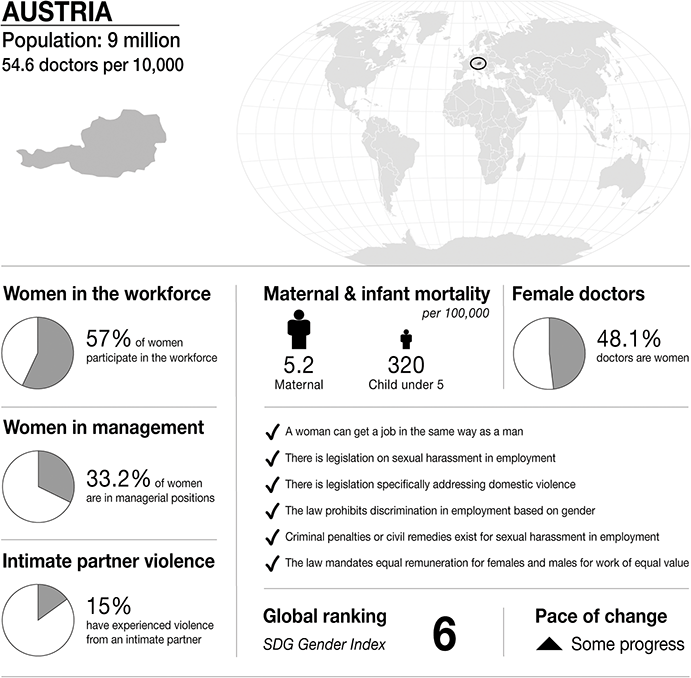
Figure 19.1 Long description
The infographic provides information about Austria, with a population of 9 million and 54.6 doctors per 10,000 people. It highlights several gender-related statistics. 57 per cent of women participate in the workforce. 33.2 per cent of women are in managerial positions. 15 per cent of women have experienced intimate partner violence. Maternal mortality is 5.2 per 100,000. Infant mortality under 5 is 320 per 100,000. 48.1 per cent of doctors are women.
The infographic lists the presence or absence of law and policy on gender equality. In Austria:
– a woman can get a job in the same way as a man.
– there is legislation on sexual harassment in employment.
– there is legislation specifically addressing domestic violence.
– the law prohibits discrimination in employment based on gender.
– criminal penalties or civil remedies exist for sexual harassment in employment.
– the law mandates equal remuneration for females and males for work of equal value.
S D G Gender Index global ranking is 6, and there has been some progress.
Intimate relations and founding a family with children are often marked by traditional gender role allocation. An Austrian study on three cases of differently shared parental leave in heterosexual couples (Reference Schmidt28) showed that negotiating parental leave is father-led, thus focusing on father’s parental leave as a bonus. Simultaneously, masculinity ‘remains hegemonic in being superior to femininity’ (28, p. 382). Pursuing non-normative, more gender-equal, care and parental leave arrangements was also found to be associated with relationship challenges. (Reference Mauerer and Schmidt29) Additionally, some restrictive gender roles are represented in several aspects of everyday life. For example, Kollmayer, Schober and Spiel (Reference Kollmayer, Schober and Spiel30) argue that teachers should be better equipped with knowledge about gender roles and gender bias and should reflect on gender differences in students’ performance and motivation to prevent (unintentional) reinforcement of limiting and restrictive gender roles and gender beliefs.
In the EU-wide study on violence against women, physical and /or sexual violence from a partner or a non-partner was experienced by about 20% of adult women in Austria. Thirty-eight per cent of women reported having experienced psychological violence in adulthood. (31) A more recent survey on gender-based violence in the EU has shown even higher numbers of physical and/or sexual violence by a partner or non-partner: about 35% of adult women in Austria reported these. Additionally, this survey included violence in the workplace and showed that almost 27% of working adult women experienced sexual harassment at work. (32) The numbers indicate that harassment and violence are considered more or less acceptable. But higher numbers of reported violence and harassment also indicate less acceptability of violence and harassment. (33) Austria has several pillars to respond to violence, including legislation, inter-agency collaboration, and non-governmental and governmental actors. The second GREVIO report on addressing violence against women in Austria has shown that Austria has made progress regarding improved legislation to prevent and respond to violence, increased funding of activities and interventions, training of specific professional groups (e.g. medical doctors) and creating specialized counselling services throughout Austria. Further recommendations target, for example, long-term action plans and evaluation. (34)
Gender in Medicine
Overall, the medical profession attracts women in increasing numbers. Currently, more women than men study medicine in Austria. (35; 36) However, change in gender composition in medical personnel is not true for all qualification levels and ranks in academic medicine. Despite quotas, which are implemented in national legislation and at EU-level, affirmative action plans and monitoring committees in hiring processes, gender gaps persistent in higher ranks. The gender gap in high-ranking positions in medicine is discussed with reference to parenthood, lack of (female) role models and the need to improve working conditions towards a better work-life balance and more individualized career paths. (Reference Steiner-Hofbauer and Holzinger37) Currently, women are (and expect to continue to be) underrepresented in higher ranks and in specialist careers (Reference Kuhlmann38) despite the increasing numbers of female medical doctors.
Structures of academic medicine are embedded in historical, cultural, social, and gendered contexts and processes. These contexts and processes intersect. In Austria, academic medicine is described as having gendered structures that also determine different career outcomes to the disadvantage of women. In this context power was mostly ascribed to and accumulated by men. (Reference Siller6) Such a setting enables the accumulation of power over others, but also results in maintaining a system of disadvantaging those perceived as ‘weaker’. Strict hierarchies, decision-making as individual – but not collaborative – responsibility and privilege, non-transparent communication, competition at the cost of collaboration, and mistrust may occur in medicine and strengthen such a system. It can be hypothesized that safe learning environments may counter a transgenerational repetition of a system that disadvantages some over others. (Reference Kumagai, Jackson and Razack39; Reference Torralba, Jose and Byrne40) However, ‘old boys’ clubs’, gendered structures in (academic) medicine and gender stereotypes discriminating against women in advancing in their careers are still noticeable in studies on medicine and medical structures. (Reference Siller6; Reference Komlenac41) Humiliation and harassment of medical students in medical education is also occurring in Austria (Reference Siller4) – a finding which is reflected internationally, as bullying, harassment and discrimination are found in several studies. (Reference Scott42; Reference Averbuch, Eliya and Van Spall43)
Medical Education
Medical education starts with an undergraduate degree with, mostly, twelve semesters (six years at public universities), including internships, and completed by a year of clinical rotations as well as a diploma thesis. Thereafter, postgraduates who want to practise as a medical doctor complete nine months of basic training in different specialties, comprising at least three months in surgery and internal medicine each, followed by several years of specialty training and one or more exams. Whereas the undergraduate programme is anchored at medical universities or medical faculties, practical and postgraduate training may be completed at general hospitals or specialized institutions as defined in the Hospital Act. The contents and requirements of the training are regulated by the Austrian Medical Chamber. (Reference Ärztekammer44)
The considerable duration of training prolongs the time trainees are dependent on evaluations and having to progress in training. According to legislation, a person responsible for training, either a specialist or family practitioner depending on the type of training, oversees progress in training. (45) The perception of being exposed to extensive dependency is also underlined by students’ reports. (Reference Sarcletti and Schäfer46; Reference Kelm47) Additionally, in a study on medical students at the Viennese medical university in Austria, students reported the highest stressor to be performance pressure and self-set standards. (Reference Steiner-Hofbauer and Holzinger37) Another study on medical students in one Austrian teaching hospital has shown that about half of the students were reluctant to speak up when having a concern about patient safety. The authors connected these findings with hierarchical structures in hospitals and low perception of an encouraging environment to speak up. (Reference Schwappach48)
Law
In the context of the workplace, sexual harassment, discrimination based on sex/gender, equal treatment and equal pay are covered by equal treatment legislation. (Reference Thomasberger49) Austria has also introduced legislation to fight violence against women in the private sphere (in 1996) and has signed and ratified the Istanbul Convention Action on violence against women and domestic violence. (50) Sexual rights and gender equality are still marked by ambivalence. For example, conservative parties and groups have also subjected processes of liberation to protests, for example regarding decriminalization of abortion, and marriage and child adoption rights for same-sex couples, as well as gender-inclusive language. (Reference Mayer, Sauer, Kuhar and Paternotte51) Additionally, Thomasberger (Reference Thomasberger49) has summarized that ‘(t)he ratification of the Istanbul Convention did not result in any major changes in the existing legislation’, (49 p.49) which signals that Austria is already equipped with equal treatment and violence prevention legislation, but that there is also opportunity for further improving legislation. Thus, despite strong achievements in legislation and policy on violence prevention, discrimination and harassment, there is still the potential to improve gender equality and violence prevention, particularly regarding, for example, adopting comprehensive approaches or closing gaps and barriers for survivors to receive support. (52)
Sexual harassment and sexual discrimination are subsumed as discrimination based on sex/gender and are regulated in equal treatment acts – thus containing a non-discrimination rule. Sexual harassment and discrimination may also be criminal offences and be covered in the criminal code. (Reference Thomasberger49) Within the academic context, the University Act prescribes that public universities have an equal treatment committee, which monitors discrimination based on gender, sexual orientation, religion/worldview, ‘race’/ethnicity or age. To promote gender equality and equal treatment at universities, additional policies, such as the affirmative action plan for the promotion of women and equal treatment policies, are published in universities’ statutes. (53)
Sexual harassment is one form of discrimination based on gender and is prohibited at the workplace. It encompasses any sexual(ized) behaviour that denigrates a person and is not wanted, is inappropriate or is offensive. (54) If an employee is reporting sexual harassment, the employer has to act. These actions can be manifold but have to prevent further sexual harassment and must not be of disadvantage for the person reporting harassment (see e.g. Gleichbehandlungsanwaltschaft). These legal and regulatory frameworks are only some aspects to counteract sexual(ized) harassment and sexual(ized) violence. Other aspects may include the organizational culture, awareness of the prevalence of sexual harassment, safe spaces to report incidents and a supportive environment for the survivor.
Medical Regulation
As per the Federal Doctors’ Law, the Austrian Medical Chamber has to establish a mediation committee in every state in Austria. The main task of the committee is to solve disputes and to reach agreement between parties. If a disciplinary offence is suspected, the disciplinary council of the Austrian Medical Chamber should be involved. (Reference Ärztekammer55) Disciplinary sanctions range from a written reprimand to being removed from the professional register. (45)
Several councils (e.g. Ethics and Complaints Council; Working Group on Patients’ Safety) are in place to protect patients’ rights and to ensure that medical doctors comply with the doctor’s law and professional code. When medical errors occur, they are treated as an organizational issue, and not as an individual issue. (Reference Ärztekammer56)
Legal regulations, particularly regarding sexual harassment and discrimination, have been discussed in the previous section on law in this chapter.
Case Study
This fictional case study examines the interconnectedness and intersections of sexualized harassment and gender discrimination in academic medicine in Austria. To explore the stages of sexualized harassment and gender discrimination, the case study presented here is fictional, but inspired by studies on power abuse, discrimination, and harassment in academic medicine. (Reference Siller4; Reference Siller6; Reference Sarcletti and Schäfer46; Reference Kelm47; Reference Mayr57).
Sexualized harassment is defined as any sexually related behaviour which impedes a person’s dignity, and which is inappropriate, unwanted or offensive. This definition includes acts as well as sexually connoted inappropriate verbal and non-verbal behaviour. (54) We use the term ‘sexualized harassment’ to emphasize its implication of objectifying a person and misusing sexualities to construct power differentials.
Prelude
Maria studied medicine because she wanted to help others and to interact with people. However, during her medical education she noticed that the profession was also about power displays in the workplace. For example, she experienced the pressure to show an impeccable performance, to compete with others, and to adhere to a strict hierarchy. Additionally, medicine was gendered in terms of women being seen as ‘the others’, whereas men were often displayed as the norm or as an example of how to perform or act. Thus, career paths were mostly presumed to follow a linear path, which was most often associated with men’s career trajectories.
Maria often noticed that sexualized harassment in academic medicine was not seen as acceptable. Nevertheless, she hardly overheard others talking about such incidents; if it happened it was tabooed and hushed.
When Maria was in her final year of medical education, she already knew about strict hierarchies and the requirement to comply with instructions. She knew that as a student and as a medical doctor in training, she would be on the lower end of the food chain. Criticizing and complaining about a senior doctor might come with a cost – she told herself that she would not jeopardize her training spot and be compliant so she could learn and finally practice as a medical doctor in the specialty of her choice. After successfully completing her medical education, Maria found a training spot for her postgraduate basic training at a university hospital including her desired specialty as the final rotation. It was a small team which had a strong and competitive research strand as well as a patient care strand. The senior doctor had vast experience in research and a very good reputation in his field. Maria was happy to learn from him and to be supervised by him.
Assault
After some time, Maria noticed rumours and remarks being spread within her team. The women in her team were more often assigned to patient care, whereas the men spent more time in the lab to conduct research. If one of the female staff spent time in the lab, she heard others muttering about the ‘tyranny of quotas’, that women are better with patients than with cells, and that they would get pregnant anyway. One day, Maria was assigned to go to the lab instead of spending her time at the ward. She shared the lab with two of her colleagues, who were already more advanced in their training than she was. Maria was already nervous about coming to the lab, because of the remarks about women’s (in)ability to do research or pursue a career in research, or comments hypothesizing a sexual affair with the senior doctor, so they (the women) get assigned to the lab.
In the lab she felt her male colleague standing next to her, watching her every move. He looked up and down at her, telling her that he could help her whenever she needed it. Maria felt very uneasy, as the words by themselves sounded harmless, but him standing so very close to her and whispering with a coarse voice left her feeling dirty. When she got home that day, he called her asking if she wanted to get together to celebrate her day in the lab. She declined. The next evening, he called and asked her to meet because he was lonely, and he felt that there was a spark between them. She declined again. After that she got text messages and voice messages saying he missed her or that he was looking forward to meeting her in the lab. At work she felt increasingly tense, dreading to see him again. In the lab he kept his distance, but whenever she looked at him, he smiled and winked at her. Wherever she was, he was there too. The next day, she walked up to him, telling him to stop harassing her. He laughed and asked her if she was so tense because she ‘hadn’t gotten any in quite some time’ and to loosen up. Maria felt unsure if she overreacted. Nobody appeared to have seen or noticed anything as everyone kept working quietly.
Limbo
A few days later, Maria talked to one female colleague in her team, and told her about her interactions with said male colleague. The female colleague shrugged it off and reported that this particular colleague always tries to push the boundaries with the ‘new ones’. She told Maria to forget about it as he was harmless, and it was some kind of rite of passage every woman in this team must go through. She also told Maria that there is not much she could do and that it might also just be a misunderstanding. After talking to her, Maria felt unsure if she should talk to the senior doctor. She did not want to embarrass herself if it was indeed a misunderstanding.
At first Maria tried to let it go, but even after weeks she felt tense at work and startled when her phone rang. She sought out the equal treatment committee at the university. Unfortunately, she had deleted all texts and voice messages, and there were no witnesses in the room with her when he talked to her. The committee took her report and provided her with first steps that could be taken, which included talking to the head of the team, or talking to the accused aggressor.
Exposure
Maria felt unsure if she wanted any actions being taken. At work, everyone appeared to keep a distance from her. She felt that everyone avoided her. One day she overheard how the male colleague told another person that she, Maria, hit on him, and that she was now embarrassed about his rejection. Maria felt increasingly insecure. She told the equal treatment committee that she renounced her accusations and that she did not want any steps being taken. Maria feared retaliation by her male colleague and that this might impact her career opportunities. Her contract was only for a few more weeks so she decided to sit it out.
Aftermath
After her contract ended, Maria sought another training position, which was further away from this hospital. She felt embarrassed and powerless about what happened. After some time, she talked to close friends about it. They encouraged her and told her that it was not her fault. They also named it sexual harassment, but Maria had difficulties accepting it as sexual harassment. It did not fit her assumptions of sexual harassment.
Discussion
Sexualized harassment and discrimination in medicine, particularly if occurring among medical doctors, are known but often concealed phenomena. Within the context of abuse in medicine and between (future) medical doctors, Austria reflects the experiences of many (future) doctors internationally.
Those affected by sexualized harassment are often women and have junior positions, which is also found on an international level. (Reference Vargas11) Abuse may occur in intense and long supervising relations, which may facilitate harassment due to prolonged dependency on others to progress in training. These relations may simultaneously hinder reporting harassment due to fear of retaliation and fear of ineffective sanctions for perpetrators. Similar findings have been reported by a qualitative study on junior medical doctors in Ireland. (Reference Crowe, Clarke and Brugha58) It is learnt behaviour that hierarchies should not be challenged and those in lower positions, such as students or trainees, learn to endure abuse. Studies on medical doctors’ wellbeing and (improving) working conditions are increasing, but due to the scope of this chapter cannot be discussed here.
Our case study shows that sexualized harassment is an expression of power and domination over others. Regarding the Austrian sociocultural context, several levels reinforce power differentials and thus potentially harassment: legislation and regulations (e.g. training regulation) promote prolonged dependency during training and accountability in senior positions, which result in power differentials, hierarchies and potentially unchallenged instructions. At an organizational level, medical students face staff who must balance research, teaching, administration and – particularly in clinical positions – patient care. In this setting, students may learn that their wishes and needs as individuals and students have less priority. (Reference Sarcletti and Schäfer46) Additionally, harassment during medical education and fear of speaking out about it creates a vicious circle of normalizing such harassment and minimizing its effect on individual as well as on structural levels. Low numbers of reporting harassment appear to be connected to lack of safe spaces, dependency during undergraduate and postgraduate training – thus fear of retaliation – learnt compliance and not challenging instructions, little awareness about unacceptable behaviour and uncertainty about definitions of sexual harassment.
At a societal level, Ehalt (Reference Ehalt59) describes that adherence to authority has been replaced by neoliberalism and envy. Additionally, the importance of personal networks in professional lives might also hinder reporting abuse out of fear of being labelled as a whistle-blower and impeding one’s reputation and/or networking opportunities. Therefore, not wanting to attract negative attention has priority. Moreover, conservative gender role allocation in Austria as well as the gendered structures in medicine shape further inequalities for some groups that are assumed to have less power (e.g. minorities, women, persons in junior positions, students).
Others (Reference Moutier60–Reference Moutier63) have focused on the work climate in academic medicine and discussed interventions to increase a culture of respect. These efforts have proven effective in reducing many unprofessional or uncivil behaviours among faculty in academic medicine. (Reference Moutier63) Most interventions to reduce unprofessional behaviour, such as raising awareness, focused on individuals rather than institutional or organizational change. (Reference Tricco64) Additionally, changes in organizational culture, policy and process must occur in a sustainable way.
Sexualized harassment among doctors may be perceived as ‘individual problems’, but it interacts with systemic-organizational, societal, and historical facets. It is embedded in the gendered history and the present of medicine as a profession which may create inequalities. (Reference Siller6; Reference Riska65) The legal context in medicine produces and enables strict hierarchies and dependencies. The social status and prestige connected to the profession might result in a ‘need’ to accumulate power to protect one’s status and to gain control. Consequently, these aspects conceal abuse of power relations. Individual vulnerability aspects are embedded in such systems. Vulnerabilities due to gender or junior status (student or trainee) are reflections of artificially created dependencies and historical reproductions of ‘how things used to be’ regarding status and gender differences. The numerical increase of women in medicine has not changed this yet – and will not change the current systems – because it is not only about a mere numerical increase of women and minorities, but also about changing the culture in medicine. (Reference Leape62; Reference Bynum and Lindeman66; Reference Krugman, Jones and Lowenstein67) However, we should be aware that change occurs slowly and is most often met with resistance, resulting in the persistence of mistreatment. (Reference Fried68) Based on these considerations, the question arises: how can we break out of this vicious cycle and use our agency to help change the system for the better?
To answer this question, several measures are suggested in the current legal and societal context. However, it must be noted that these suggestions are not unique for the Austrian context and similar proposals have also been presented by others (Reference Zhang12; Reference Leape62). Additionally, such interventions to counteract sexualized harassment are not restricted to medicine, but implementation of interventions should consider the hierarchical context in which harassment takes place.
Raising Awareness and Knowledge on Sexualized Harassment
Global awareness raising was also activated by the #metoo movement, which helped spark discussions on sexualized harassment, discrimination, and abuse. (Reference Brunner and Partlow-Lefevre8) The movement can be a basis to build interventions. Every student and all staff should be aware of sexualized harassment, discrimination and abuse, its signs, facets, and its impact and they should know how to counteract it. Obligatory workshops that are offered repeatedly should be tailored so they are relevant and useful for anyone working in academic medicine.
Promoting Collaboration, Connectedness, and Participation
Deconstructing hierarchies is one necessary step to overcome abuse of power and barriers due to dependency and fear of retaliation. These strict hierarchies can be deconstructed by promoting a collaborative working environment with shared decision-making processes. Even though individual accountability in patient care still exists, such individual accountability is not needed in other contexts relating to, for example, teaching, publishing, or doing research. However, this approach is not equated with suspending leadership, but focuses on including all members of the organization in everyday processes.
Uncovering Systems of Abuse
Sexualized harassment, discrimination and abuse thrive in silence and neglect. Publicly demonstrating that sexualized harassment, discrimination, and abuse are serious issues, and that the organization should pursue a zero-tolerance approach, is needed to render this phenomenon visible. Also, others (62; 67; 68) have emphasized the need for visibility and a clear approach to uncovering systems of abuse.
Zero-Tolerance
Visibility should also be reflected in the consequences of sexualized harassment, discrimination, and abuse. Sanctions should be applied without exception. They can be manifold but must focus on the perpetrator and not on the survivor. For example, terminating the perpetrator’s contract or withdrawal of their resources should be chosen over ‘fixing’ the survivor. Additionally, visibility of such actions prevents gossip and misinformation.
Active Support by Contact Points
Committees and contact points that are not bound to directives are essential tools to operate in this field, and should be empowered to ensure action is taken. The head of the organization must be committed and in full support of actions taken. The contact points should also actively provide information on sexualized harassment, discrimination, and abuse, on contact details and on the process if sexualized harassment, discrimination, and abuse are reported. Currently, there are further initiatives on university campuses that focus particularly on sexualized violence.
Conclusion
Although much has already been done, more remains to be done. Sexualized harassment, discrimination, and abuse in medicine, particularly between colleagues, is a known fact few people dare to publicly talk about. Many mechanisms ranging from perceptions of the profession as morally impeccable to fear of retaliation keep the phenomenon hidden. The proposed aspects focus on uncovering abuse and on open management, which are essential for prevention and reduction of sexualized harassment, discrimination, and abuse.
International Medical Graduates: An Overview
The broadening of international professional and educational networks has seen both medical students and qualified professionals aspire to work and train overseas. Having attained their primary medical qualifications, international medical graduates (IMGs) migrate abroad, typically to high-income nations, generally seeking both personal fulfillment and professional development. (Reference Bhugra, Smith, Ventriglio, Rao, Ng and Javed1) Correspondingly, many developed countries such as Australia require the recruitment and employment of IMGs to address current and projected clinician shortages (Reference Healey, Fakes and Nair2) as national populations continue to climb. It is estimated that one in three doctors currently working within Australia and the UK, and one in four American doctors are foreign-trained. (Reference Healey, Fakes and Nair2) Following re-accreditation within their country of emigration, IMGs tend to work in undersupplied or lower-paying specialities, and are increasingly over-represented in primary care and family medicine. (Reference Bhugra, Smith, Ventriglio, Rao, Ng and Javed1; Reference Smith and Parkash3) They often find employment in densely populated, socio-economically disadvantaged areas or rural communities, which typically are less sought by domestically trained doctors. (Reference Bhugra, Smith, Ventriglio, Rao, Ng and Javed1) While an increasingly demanding career, the difficulty of medical practice for IMGs is compounded by other factors with which domestic physicians may not have to contend – specifically racial discrimination, professional inequity and disadvantage, and sexism.
Challenges in acculturation shape the experiences of IMGs. Manageable hurdles such as language barriers are often complicated by cultural insensitivity, overt racism and institutional discrimination. (Reference Al‐Haddad, Jamieson and Germeni4) This may be instigated and perpetuated within the administration, as well as by colleagues and patients. (Reference Healey, Fakes and Nair2; Reference Filut, Alvarez and Carnes5) IMGs consistently cite differences in ethnicity and language as a basis for the discrimination they encounter. (Reference Szafran, Woloschuk, Torti and Palacios Mackay6) Contending with nuances of non-verbal communication, such as hand gestures or facial expressions, dialects, accents, (Reference Triscott, Szafran, Waugh, Torti and Barton7) and unfamiliarity with vernacular terms, in turn exacerbates the IMGs’ difficulty to achieve effective communication. This causes reluctance by some to contribute to discussions. They in turn feel apprehensive that their limited participation may be misconstrued for lack of medical knowledge or even incompetence. (Reference Al‐Haddad, Jamieson and Germeni4) Such communication issues heighten the isolation of IMGs within the professional environment by making it difficult to socialize, achieve a sense of inclusion, forge genuine friendships and ultimately successfully integrate into their collegial community. (Reference Al‐Haddad, Jamieson and Germeni4; Reference Al‐Haddad8)
Infographic Brunei. Infographics were provided by CartoGIS Services, The Australian National University. Population: from World Bank https://databank.worldbank.org/source/population-estimates-and-projections. Sustainable Development Progress, global ranking and statistics on women in the workplace, women in management and intimate partner violence: from United Nations SDGs Data Portal https://unstats.un.org/sdgs/dataportal. Female doctor percentage: from Global health workforce statistics www.who.int/data/gho/data/themes/topics/health-workforce. Legislation and law statements: from the World Bank gender data portal 2023 https://genderdata.worldbank.org/en/indicators. Maternal mortality statistics: from the Global Health Observatory 2020 https://mmr2020.srhr.org. Infant mortality statistics: from United Nations International Children’s Fund (UNICEF) https://data.unicef.org/topic/child-survival/under-five-mortality
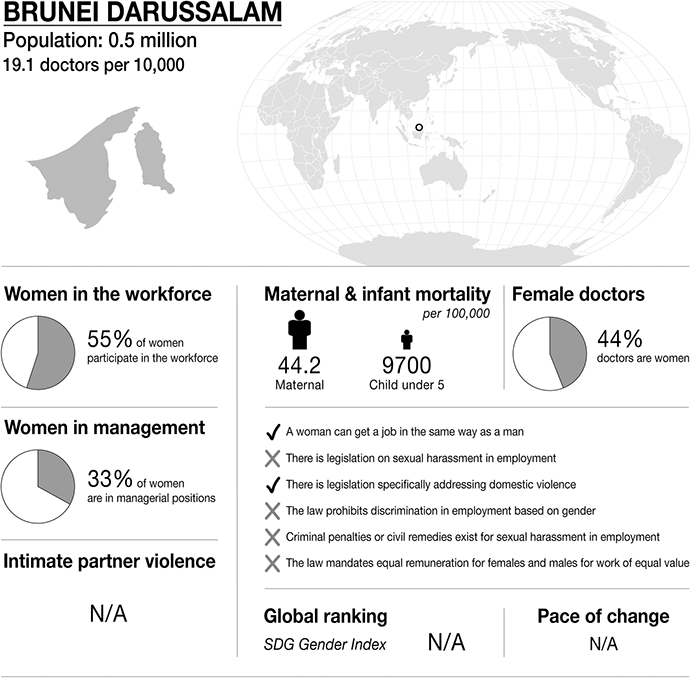
Figure 20.1 Long description
The infographic provides information about Brunei Darussalam, with a population of 0.5 million and 19.1 doctors per 10,000 people. It highlights several gender-related statistics. 55 per cent of women participate in the workforce. 33 per cent of women are in managerial positions. Maternal mortality is 44.2 per 100,000. Infant mortality under 5 is 9700 per 100,000. 44 per cent of doctors are women.
The infographic lists the presence or absence of law and policy on gender equality. In (country):
– a woman can get a job in the same way as a man.
– there is legislation specifically addressing domestic violence.
– there is no law that prohibits discrimination in employment based on gender.
– there is no legislation on sexual harassment in employment.
– there are no criminal penalties or civil remedies for sexual harassment in employment.
– there is no law mandating equal remuneration for females and males for work of equal value.
There is no S D G Gender Index global ranking available.
Over and above the demands of the mandatory requirements of the IMG training environment, instances of intimidation and harassment serve to increase their distress, impact their morale and intensify workplace dissatisfaction, (Reference Crutcher, Szafran, Woloschuk, Chatur and Hansen9) ultimately contributing detrimentally to the IMGs psychological health. (Reference Schut10) The psychological repercussions of contending with such intimidation and harassment are significant, as doctors struggling with mental illness are at increased risk of making errors and impacting the potential quality of their patient care. (Reference Crutcher, Szafran, Woloschuk, Chatur and Hansen9) Furthermore, the presence of actual or perceived ‘medical inferiority’ bias can intensify the IMGs sense of alienation, with some IMGs’ stating that they felt ‘overly observed’ and critiqued compared to their domestic peers. (Reference Al‐Haddad, Jamieson and Germeni4) Subsequently, they felt greater pressures to perform. (Reference Bhugra, Smith, Ventriglio, Rao, Ng and Javed1) Such examples of microaggression may subsequently translate to inequities of promotion opportunities as well as biased performance reviews. (Reference Filut, Alvarez and Carnes5) Managing such experiences may then be associated with increased distress and compounded workplace dissatisfaction, ultimately compromising their mental health and wellbeing. (Reference Filut, Alvarez and Carnes5)
The professional development and career progression of IMGs may also be disproportionately impacted. IMGs have been found (on average) to have poorer academic achievement (Reference Woolf, Viney, Rich, Jayaweera and Griffin11) and lower pass rates for postgraduate exams. (Reference Al‐Haddad, Jamieson and Germeni4; Reference Al-Haddad, Mulholland and Gardner12) As a result, they are less likely to achieve board certification (Reference Al‐Haddad, Jamieson and Germeni4) compared to the domestic medical graduates. Disparity also exists among IMGs who completed their education in developing countries compared to those who trained in developed nations, with the former more likely to experience marginalized career outcomes. (Reference Schut10) A number of factors explain the causation of this marginalisation; in general terms, this group’s experiences are compounded by a range of disadvantages including the less favourable conditions of skilled migration policies and the potential scepticism regarding the standard of their medical education. (Reference Schut10) The uninformed or biased perceptions of their cultural or linguistic dissimilarities to domestic physicians often work to make the IMGs appear less qualified. (Reference Schut10) This is in turn reflected in lower degrees of career satisfaction and perceived lack of collegial support as reported by IMG physicians. (Reference Bhugra, Smith, Ventriglio, Rao, Ng and Javed1; Reference Smith and Parkash3; Reference Katakam, Frintner, Pelaez-Velez and Chakraborty13)
IMGs often experience limited autonomy in regards to their geographical area of practice, which may further impact on their opportunities for future training and research prospects. This may impede their career progression and financial security. It may also widen the inequities in career pathways and may generate uncertainty concerning their career sustainability. (Reference Bhugra, Smith, Ventriglio, Rao, Ng and Javed1) Additionally, it may heighten their stress levels, exacerbate their social isolation and impact their self-esteem – all factors increasing the vulnerability of IMGs to experiencing burnout. (Reference Bhugra, Smith, Ventriglio, Rao, Ng and Javed1) The influence of medical inferiority bias and cultural racism is also purported to limit the advancement of IMGs within academic medicine. The ‘incongruence of diversity between lower-level faculty and senior leadership’ creates a sense of disenfranchisement within the work environment. This potentially may lead to professional dissatisfaction and necessitate the recalibration of one’s ambition to pursue academic leadership roles. (Reference Smith and Parkash3) Acquiescing to this disadvantage in career progression is commonplace and is seen as the ‘cost of being an immigrant’. (Reference Smith and Parkash3)
The aforementioned challenges may be intensified for female IMGs, with gender proving an additional basis for discrimination. (Reference Smith and Parkash3; Reference Szafran, Woloschuk, Torti and Palacios Mackay6) This may especially occur in male-dominated specialities. (Reference Bhugra, Smith, Ventriglio, Rao, Ng and Javed1) Female IMGs and their domestic counterparts are subject to sexist commentary and sexual harassment by clinicians, faculty and patients. This is further experienced with regards to pay inequality, general under-recognition, as well as gender-based stressors associated with role conflicts or biases. (Reference Bhugra, Smith, Ventriglio, Rao, Ng and Javed1; Reference Dellasega, Aruma and Andreae14) Female doctors often report a lack of respect for their authority. They highlight instances of being passively verbally dismissed by male colleagues, addressed by their first name as opposed to their male peers who are typically addressed by title, (Reference Dellasega, Aruma and Andreae14) or not having their position of authority as an educator respected by trainees and students. (Reference Triscott, Szafran, Waugh, Torti and Barton7) Additionally, their professional advancement has been impeded by incidences of differential or less affirming recommendations for faculty positions compared to male peers.
Female physicians may also encounter gendered stigma. They experience conflict in their life choices like pregnancy which may disrupt their training or influence their application for positions. Many are also concerned by the inadequacy of maternity leave options in relation to their career planning. (Reference Dellasega, Aruma and Andreae14) Exclusion from leadership roles is another major factor inhibiting their professional aspirations and further diminishes their potential for professional fulfillment. (Reference Dellasega, Aruma and Andreae14)
However, it is equally important to recognise that male IMGs may also experience gender-based challenges. This is commonly due to cross-cultural differences, in their communication styles, their professional expectations of themselves as doctors and the way they are treated by patients and colleagues. Similarly, IMGs who have not received education or training in the care of particular marginalised communities, including LGBTQIA+ patients may subsequently encounter professional difficulties, which in turn may affect their patient care. (Reference Triscott, Szafran, Waugh, Torti and Barton7)
It could be said that one’s choice to become a medical practitioner means that an individual is predestined to be challenged in many ways. Notwithstanding the intensity of the intellectual demands of this academic path and subsequent professional training, there also lies the complexity of functioning as a competent practitioner in the various professional settings. Navigating the professional and social networks of these environments is onerous at the best of times. However, for IMGs these challenges are compounded by a number of factors which combine to often negatively effect and indeed impede their professional journey with regards to their training and employment. Consequently, the nature of these challenges may bring with them potential negative impacts upon IMGs’ performance, their retention within the profession, and just as importantly, their overall wellbeing.
AN ANONYMOUS CASE STUDY FROM BRUNEI
Background
I come from Brunei, but ethnically I’m mostly Chinese. Brunei is a funny, little country. It’s so little that almost everyone knows everyone in one way or another, to the point where we recognize their car number plates. And people talk … a lot … about everyone. Probably because there’s not much to do. It is a Muslim country. Alcohol is not available for sale anywhere in the country, but you can bring your quota into the country for private consumption as long as you are not a Muslim. So there are no bars or clubs, and there is not much in the way of night life.
Brunei’s main resource is oil, so a lot of the expats in Brunei work in the oil and gas industry, just like my dad, though he’s not an expat. I hung out with a lot of my dad’s colleagues’ kids. Kids from England, Holland, France, USA, Australia, New Zealand, and the list goes on. There’s a little community of us, us families of the oil and gas industry, who are all members of a recreational club which has a few restaurants, pools, a gym, tennis courts, a golf course, basketball courts, badminton, squash, football fields, and a sailing club, and it’s on a beach. Spouses of the employees often ran particular social and enrichment groups such as aerobics, performing arts, silk painting, crochet, etc. Within this club, it seemed as if the rules that people normally follow in Brunei didn’t exist. I didn’t have to worry about wearing short shorts or a bikini because everyone else was dressed the same and no one looked at you twice. Outside though, that’s a different story. It is frowned upon for women to expose their decolletage, back, shoulders, midriff and thighs. Even if you cover up, people still stare at you because you might have a pretty face, nice hair or a desirable body shape. Interestingly though, most Bruneians are respectful and reserved.
You could say that I grew up in a mixed culture. I had ‘white’ friends who would greet you with a kiss on the cheek, and Asian friends who would greet you with a wave or a handshake. I adapted to both and changed my demeanor and accent depending on the company I was with. There is a certain behaviour that is expected of you as a child in the company of adults. You would always call an older person auntie or uncle, even if they are not related to you in any way. It’s just respectful. Back chatting, raising your voice or swearing is forbidden and will be met by physical punishment at home.
Now, why is this relevant? Because what you see on the outside is a far cry from what happens behind closed doors. I clearly recall many instances of domestic violence between my parents from the time I was about six years old. None of which I was allowed to speak of. I had to ‘save face’. But I was desperate. I needed my mum to get out of there. I honestly thought she was going to die at the hands of my dad. I came up with all sorts of ideas such as her moving back to Singapore and taking me and my brother with her, but she said she couldn’t financially support us and had to endure more of my dad’s abuse, just to give us the life she wanted us to have. I eventually told my paternal grandmother’s maid. I figured that she’s no relation to the family and therefore could find a way to help discreetly. She told my paternal grandmother and my dad’s sister who spoke with me about it. Unfortunately, my mum denied it and told me off about it saying I should never tell anyone anything.
Some time before I turned ten, my brother molested me. What I understood at the time was that he was ‘teaching me’. This included French kissing, what pubic hair looks like, finding my ‘hole’ (vagina), and how a penis gets hard. It felt wrong but I didn’t know it was wrong until a few years later. I didn’t know what it was called. I later learnt that it was really bad and I would get into a lot of trouble if anyone found out so I kept my mouth shut, out of embarrassment.
There aren’t any positive adjectives to describe my teenage years. I got into a lot of trouble with my parents as I rebelled. I was manipulated by my brother to think that he was the only person in the world who had my back so I took the blame for a number of things to protect him. I lied to my parents. My dad lost trust in me, but I never trusted him after seeing what he put my mum through. It was a terribly confusing time for me.
Medical Education
I knew from a young age exactly what I didn’t want in life. I had to leave Brunei. My parents were living a double life. A life that was perfect from the outside, but so, so horrible on the inside. We were playing pretend and I couldn’t be myself. I vowed to become financially independent from anything and anyone, so that I would never find myself in a situation similar to my mum’s. Doctor. That’s what I would be. Doctors are respected. It’s a prestigious profession. I would be untouchable. I had my first excuse to leave Brunei. I applied to London universities, the furthest away from Brunei my parents would let me go to, and I got in. I left Brunei alone with one overweight suitcase and one backpack. I brought my favourite pillow, a ridiculously large duvet because my mum was worried I would get cold, a tiny, one-cup rice cooker and slow cooker my mum bought me, and essential clothes and toiletries. I had only been to London once before to attend interviews for entry to medical schools, but I was confident that I would find my way to the halls of residence and uni with a map of London and the London Underground. I was on my way to be free from pretending. To be me.
Finding me, now that was one hell of a journey. What I discovered was that I yearned for acceptance by any means possible. I did what I thought would make people like me, from doing ridiculous dares to paying for meals or rounds or drinks. I had a father, but I didn’t have a father figure, someone I looked up to and could rely on, so I had boyfriends instead. Oh, and I clung on to them. I needed to be loved so badly. I met my most significant boyfriend at uni, and he is still a good friend of mine today. I have him and his family to thank for saving me when I was probably the most mentally unstable. He protected me when I was so vulnerable. We weren’t meant to be, but we still care deeply for each other.
I knew exactly what I didn’t want in a man. He had to be the exact opposite of my dad. He had to be non-Asian, a Christian or Catholic, open-minded and have a less prestigious profession to mine.
Sexual Harassment
Working as a junior doctor in London was character-shaping. A huge learning curve. On the first Wednesday in August every year, all the junior doctors move up a rank. For all med school leavers, this was the first day as an intern, and the previous interns to become a junior house officer, and so on. We were allowed to select our hospital preferences, but we were not guaranteed to get our first preference. I ended up in a hospital in northeast London. It was a beautiful, brand new hospital at the time and they put us interns up in lovely new apartments not far away. I didn’t know anyone. My external persona of confidence was built to hide my utter lack of it. I wanted to please people and to be liked. I was friendly with everyone and went to as many social gatherings as I could. All the interns and most junior doctors were lovely. The more senior doctors, on the other hand, they were, in general, scary people. I was certainly intimidated by them. There was a bullying culture because they had done the hard yards and felt they had the right to treat us the way they were treated.
On my surgical rotation, the specialist registrar on my team was doing some sort of study. It involved reviewing patients’ charts and collating data. He asked me to help, which I was more than happy to do. There was a little room full of patients’ charts and both of us went in. Everything happened so quickly. He locked the door behind us and pushed me down on the bench, started kissing me, licking my face and touching my body. I froze. Then rattling and a knock on the door. I pushed him off, jumped up and tried to open the door. You know how in movies, you see the poor victim trying to get away from the bad guy, and she can’t even put the key in the ignition of the car, and you’re screaming at the TV telling her to just slow down and the key would go in? That was exactly what it was like. I could not turn the lock and push the handle. I was fumbling. Panicking. I eventually got out after a few seconds, but it felt a lot longer than that. My friend was outside and I just ran in the opposite direction of that room and she followed me. Far enough away, I told her what happened. She immediately told me to report it, but I just wanted to go home. I tried to process what happened and work out what to do. I had to go back the next day and work with this guy. I wondered whether I would be taken seriously. I mean, this guy was a specialist registrar. He was basically the second in charge to the consultant. No one who needed to believe me would believe me. And even if they did, would they even class this as a reportable event? He didn’t rape me. He just kissed, licked and touched me. Was I being a sissy? Maybe it was my fault. Yes, that’s what it was. I was friendly with him and joked around, and maybe he got that vibe from me. It must be my fault. I will learn from this and try to be less friendly next time. So I didn’t report it. I acted like nothing happened and it was bloody awkward. He spoke to me the following day and apologized, saying that he didn’t know what came over him and to please not tell anyone. I shrugged it off and said, ‘Meh, no big deal. Forget about it’, but inside I just wanted to scream at him. I had to work under him for the next few months, which was really hard. Thankfully, I had the support of a colleague whom I had grown very close to as we worked on the same ward.
I moved to Brisbane in 2008 and worked at several different hospitals as part of the training process. I thought that there wouldn’t be much adapting to do as both countries speak English, cultures are pretty similar and medicine is medicine, right? Wrong! The culture shock moving from London to Brisbane was huge compared to the move from Brunei to London. Who would have thought? I struggled to understand Australian English because of the accent and the slang. Older Australians had a hard time understanding my British accent, so I forced myself to learn common Australian phrases, slang and eventually spoke with an Aussie accent. Medicine was hard too because guidelines, protocols, reference books, processes and procedures were different. Heck, even the use of brand names for medications was new to me. I looked like an idiot on a cardiology ward as an SHO asking what Cartia was. Oh, it’s just aspirin, but at 100 mg, not 75 mg? So I did what I felt I had to do and clinged to more senior doctors who would non-judgmentally guide me. Did they? Not really. Ridicule was commonplace. There were a handful who I thought were really helpful, but little did I know this was a recipe for assault.
There were many instances of inappropriate behaviour by more senior male doctors such as touching my inner thigh during grand rounds or meetings, sniffing my hair and neck, touching or squeezing my buttocks in the presence of a patient so I couldn’t do anything, undoing my bra clasps as a joke and many inappropriate text messages including one from a professor late at night asking to sleep next to me because his wife was on her period! After I refused, he treated me totally differently at work. He didn’t look at me and didn’t speak to me, instead of sharing jokes and laughing together which we used to do. I kind of felt guilty and almost sorry for him. It wasn’t long before he left the hospital suddenly and unexpectedly.
At one stage, I was working as Principal House Officer in an emergency department. I was seriously considering joining the training programme so I spent eighteen months working there and improving my skills and knowledge. My husband had been hobby home brewing for a number of years. One of the emergency consultants who had just resigned to return to his home country knew about this and asked if my husband could provide a keg for his son’s end of school party at their house and join in the fun, which he was more than happy to do. The emergency consultant’s wife and other kids were already overseas. We arranged to spend the night there with our three kids, knowing that we were going to be drinking. We had a ball. Our kids enjoyed swimming and playing games; then it was their bed time. We showered and put our kids to bed upstairs and we continued with the party. When the night was over, we headed to bed in our designated room. I fell asleep quickly with my husband next to me, but then I woke up to someone touching me. It was the consultant. He was kneeling on the floor beside me, stroking my buttocks and vulva and he put his fingers inside of me. I couldn’t move. I don’t know why. I felt sick. I know I said ‘Stop’ a number of times, but my voice was so weak. I heard him say, ‘Oh c’mon, you know you want this. You know I’ve always had a thing for you and I know you want me. Well, now you can.’ In my head I was thinking … Um, no! I thought we were just colleagues. You were my boss. I could hear him saying, ‘Mmmmm you are so fucking gorgeous and your pussy just gets me so fucking hard’, while he grabbed my hand and put it on his penis and with his other hand he continued molesting me. I elbowed my husband to try to wake him because my weak voice asking him to stop or asking for help didn’t get me anywhere. He just kept going. Again, I said, ‘Stop’, and elbowed my husband, told him to get out. It stopped. My husband fell back asleep. But my heart was pounding. Confused. Scared. Dirty. Disgusted. Angry. Asking myself what I did to make him think I felt that way towards him, or what I did to make him think he could do that to me.
Our kids came to our room in the morning and I had to act like normal Mummy. My husband had to transport his equipment back home. There wouldn’t have been enough space for all of us and his equipment in the car. He brought the equipment home and came back to get me. In the time he was gone, I was scared out of my mind. My kids desperately wanted to go for a swim again so I headed out of my room, down the stairs to watch them as they swam. I couldn’t believe it. The consultant acted like nothing happened. Nothing at all! I ignored him. It was so awkward. When I left with the kids, I was so relieved but yet I burst into tears almost as soon as I got in the car.
The consultant tried to keep in touch by sending me text messages and emails, but I never responded. Even his son tried to get in touch. I assume he didn’t know what happened and was confused as to why I didn’t want to have anything to do with them anymore.
This was a turning point for me. After this point, I stopped being friendly to any male doctor, I smiled less and I stopped attending social events organized by hospital colleagues.
I couldn’t stay in the hospital system any longer. In Australia, an International Medical Graduate is under a ten-year moratorium, where they have to work in a district of workforce shortage for ten years. This is scaled depending on how rural your placement is. The further away from the city you go, the less time you have under your moratorium. London to Brisbane was tough, but moving out to the country … man, that’s something else! Who would have thought that all you had to do to gain the trust of the local farmers as their doctor is to talk about the weather! So not only was I speaking differently and using words that don’t exist in the English dictionary, but the content of my conversations also had to change quick smart!
I specialized in general practice. I put everything I had into passing those exams: all my energy, time, and what felt like all the money I had. I turned all my anger and frustration into becoming a GP and I made it. I was my own boss. I took control.
I put everything behind me and moved on. I put on a hard, headstrong exterior so that I would never find myself in a similar situation again. I compartmentalized my past experiences and didn’t own them. Me writing this … this is me starting to own my experiences. It’s been such a difficult process. Until now, I didn’t recognize those events as assault. I recently asked my best friend from the London hospital I first worked in if he thought I came across as a slut. He was surprised and wondered why I would ask such a question. I told him about this book, which has made me reflect on my past. I did wonder why it kept happening to me because I was the common denominator. Surely there’s something in my persona or a big sign saying ‘slut’ on my forehead, I thought. My friend reassured me that I did nothing wrong, except maybe trust people too easily. I also learnt through the process of writing this that I’m really not alone, that this happens to so many people.
Brunei is a very safe country and the people are generally respectful. My trusting personality may have stemmed from this false sense of security, not truly understanding that there are real predators out there. My insecurity from growing up without a father figure, believing my brother that he was the only person who would look out for me and that we had a secret only he and I knew, and truly thinking I was ugly made me want to make up for these insecurities by being overly friendly and overly generous, which most likely led others to take advantage of this. As a foreign-trained doctor in Australia, I was further disadvantaged in a system I did not yet understand, and in a country where the culture and language were so unfamiliar.
Being a young, female, Asian GP, I filled my appointment book quickly. Managing mental illnesses in my patients is a big part of my day. For the most part, my past experiences helped me understand what my patients were going through, but there were times when I was guilty of thinking, ‘If only I could tell you that I get it because I’ve been there’, or ‘Oh, cry me a river! I’ve had to go through way worse’, or even a bit of jealousy that they are getting the help they need from their family and a doctor like myself, which I didn’t have access to. There were many, many other consultations that did bring up some painful memories and I had to act my way through it. Imagine trying to support someone when you haven’t had the support yourself. I have said goodbye to patients, shut the door, and just cried in my room, then get myself together before I run too late, and call my next patient in with a smile on my face. By the end of the day I’m pooped. I have nothing left to give to my family. I’ve become pretty good at leaving work at work so much so that when my husband asks how my day was, I will often reply with, ‘I can’t remember. Must have been okay.’
I had to do better. I learnt more about mental illness and available resources that may help my patients, which I used myself. Although my past experiences were traumatic, I don’t think I would be the doctor I am today otherwise. What strikes me as odd is the lack of support given to International Medical Graduates for their own mental health and wellbeing. As it is, we come into the country with nothing but a medical degree and we’re told to go forth and work in this health system, as long as it’s in a rural area where the availability of support, on-the-job training, and connections is limited and the spoken language and culture is different.
I wish for medical educators to encourage all doctors and medical students to read this book. Know that this happens. Don’t be a predator. Don’t let yourself fall victim to a doctor who thinks they have power over you and the ability to silence you. If you do, know that you’re not alone and it’s not your fault. It never was.
Introduction and Context
Gender in Society
With its currently 83.1 million citizens, Germany is the most populous country in the European Union. The traditional role model with women being the main providers of unpaid care work continues to exist in German society – with predictable negative consequences. Concerning their lifetime income, women earn only half as much as men. (Reference Boll, Jahn, Lagemann and Puckelwald1) In 2020, reactions to severe traumatic stresses and adjustment disorders were identified almost three times more often in women than in men – experts say mainly due to the double coping burden women carry. (2)
Concerning sexual harassment, several events in the last decade led to a wider public discussion about the topic. In 2013, the journalist Laura Himmelreich reported being sexually harassment by a politician. In the aftermath, thousands of women publicly shared their own experiences with sexual harassment under the hashtag #aufschrei, Geman for outcry. The debate that followed led to the first broad social debate about sexual harassment in Germany. (Reference Eddy and Cottrell3)
On New Year’s Eve 2015, hundreds of women were sexually harassed, some even raped, near the main train station in Cologne. More than 500 cases of sexual violence were officially reported, whereas only three of the perpetrators were convicted. (Reference Bosen4) The ensuing debate, again, brought focus to the topic and generated momentum for changes of the relevant laws. In fact, the events resulted in a reform of the law covering sexual offences, which now deems sexual harassment a criminal offence that can be pursued and punished under the law. (5)
Data on sexual harassment of women in Germany is scarce, but the existing data suggests that they are highly affected. Most of the available studies cover harassment in the workplace and report incidences as high as 70–80% depending on the type of harassment. One representative survey of the general population reported that 58.2% of German women had been affected by sexual harassment. (Reference Müller, Schröttle and Lebenssituation6)
Gender in Medicine
Approximately 63% of the nearly 98,700 medical students in Germany are women, with no significant drop until residency. (Reference Berufstätige Ärzte7) However, women are far less likely to hold higher ranked and leadership positions. In 2016, only 31% of senior physicians at thirty-four German university hospitals were women. (8) The situation becomes even worse for senior leadership positions such as university chairs, clinic directors or department heads: in 2019, women only held 13% of the leadership positions of the aforementioned hospitals. (9) Additionally, the German clinical workforce is less diverse than in other Western countries, with approximately 15% of the practising physicians holding a non-German passport, as recently reported by the German National Medical Board. (10)
Infographic Germany. Infographics were provided by CartoGIS Services, The Australian National University. Population: from World Bank https://databank.worldbank.org/source/population-estimates-and-projections. Sustainable Development Progress, global ranking and statistics on women in the workplace, women in management and intimate partner violence: from United Nations SDGs Data Portal https://unstats.un.org/sdgs/dataportal. Female doctor percentage: from Global health workforce statistics www.who.int/data/gho/data/themes/topics/health-workforce. Legislation and law statements: from the World Bank gender data portal 2023 https://genderdata.worldbank.org/en/indicators. Maternal mortality statistics: from the Global Health Observatory 2020 https://mmr2020.srhr.org. Infant mortality statistics: from United Nations International Children’s Fund (UNICEF) https://data.unicef.org/topic/child-survival/under-five-mortality.
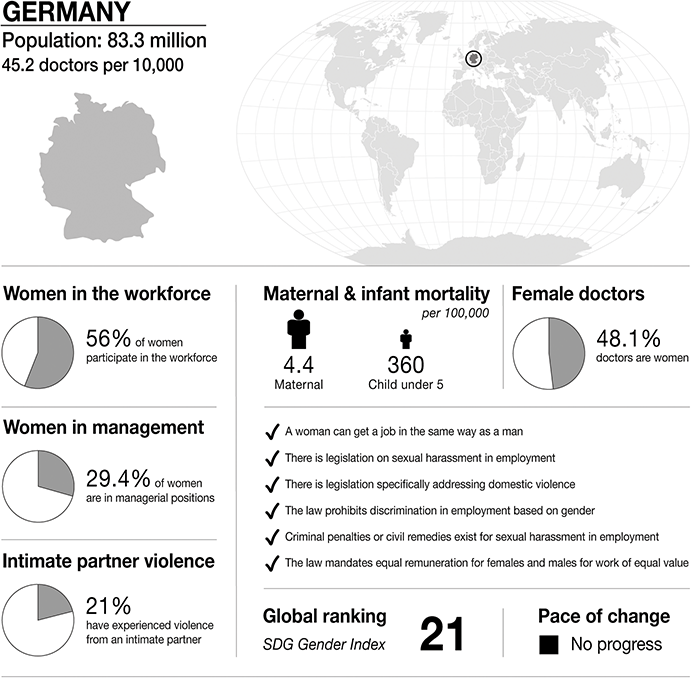
Figure 21.1 Long description
The infographic provides information about Germany, with a population of 83.3 million and 45.2 doctors per 10,000 people. It highlights several gender-related statistics. 56 per cent of women participate in the workforce. 29.4 per cent of women are in managerial positions. 21 per cent of women have experienced intimate partner violence. Maternal mortality is 4.4 per 100,000. Infant mortality under 5 is 360 per 100,000. 48.1 per cent of doctors are women.
The infographic lists the presence or absence of law and policy on gender equality. In Germany:
– a woman can get a job in the same way as a man.
– there is legislation on sexual harassment in employment.
– there is legislation specifically addressing domestic violence.
– the law prohibits discrimination in employment based on gender.
– criminal penalties or civil remedies exist for sexual harassment in employment.
– the law mandates equal remuneration for females and males for work of equal value.
S D G Gender Index global ranking is 21, and is stable.
However, these facts are not always met with reflection about systemic barriers that women might face in medicine; rather, the high numbers of undergraduates are used by some critics to try to limit access for women into the medical profession. (Reference Freyschmidt11; Reference Dordowsky12). For years, there has been an ongoing debate in the community about the percentage of women entering medicine, some deeming it ‘too high’. The impending shortage of senior physicians and the need for more and better part-time models are paternalistically called ‘gender-based’ problems – according to the critics women would take up the majority of training positions only to afterwards drop out to have children and work part-time to be able to look after them. (Reference Freyschmidt11; Reference Dordowsky12)
Sexual harassment in the workplace is an important factor in the systematic discrimination that women doctors are facing in the medical profession. First, women are consistently more affected than men. (Reference Sojo, Wood and Genat13–Reference Mclaughlin, Blackstone and Uggen17) In Germany, only one representative study exists thus far, but it shows a very high prevalence among female physicians working in a large university hospital: 76.1% had experienced at least one form of sexual harassment at work. (Reference Djermester18) Second, sexual harassment has far-reaching negative consequences on health and work capacity of the affected person. (Reference Lindquist and McKay15; Reference Parker and Griffin19–Reference Victor, Wichman and Malakkla23). In the aforementioned study, 77.1% of the sexually harassed women doctors experienced negative consequences like emotional turmoil, negative health impacts or work deterioration due to the harassment. (Reference Djermester18) Third, sexual harassment as a display of power can help maintaining existing power structures (Reference Johnson, Widnall and Benya24–Reference Menon26) and strengthen the ‘glass ceiling’, which prevents women from access to leadership positions in a male-dominated environment. In fact, if a woman physician’s work performance decreases due to repeated sexual harassment at work, this could make her seem less qualified for a leadership position and therefore add to re-establishing antiquated gender stereotypes. (Reference Bursten27; Reference Fitzgerald, Shullman, Bailey, Richards, Swecker and Gold28). The German medical system is still very hierarchical and slow in its accommodation of flexible work structures and non-linear careers, which is also reflected in its struggles to integrate diverse career models due to personal choice or structural barriers. Gender-related harassment displays intersectional dimensions in Germany as well; however, these are poorly researched in the biomedical field. A recent survey of students and lecturers enquiring about discriminatory experiences beyond sexual harassment highlighted multiple sources of discrimination, with sex/gender still being the dominant one. (Reference Ludwig, Jenner, Berger, Tappert, Kurmeyer, Oertelt-Prigione and Petzold29)
Medical Education
Studying medicine in Germany involves at least five years of university education. Before taking the final exam, students have to work for one year in a hospital, taking one trimester in surgery, one in internal medicine and one in another specialty of their choice. After successfully passing the final exam, young doctors start their training as residents to become a specialist. It takes at least five years of training to become a specialist, in most cases up to eight years full-time. The medical specialist training in Germany is structured according to the general education guideline created by the German Medical Association. In accordance with this national guideline, the federal states define their own specialist training guidelines, which residents have to fulfill in order to become a specialist in the specific region/state. The guidelines include a detailed description of the skills, knowledge and number of operations/procedures a candidate has to participate in or lead, in order to become a specialist. Senior doctors are responsible for the supervision, creating a situation of dependence for the residents.
Law
In Germany, sexual harassment in the workplace is forbidden by law, according to the General Equal Treatment Act (AGG – Allgemeines Gleichbehandlungsgesetz). Regarding sexual harassment, the AGG states that employers are responsible for taking appropriate measures to protect their employees. If the employer does not fulfill their duty to do so, employees have the right to refuse to continue working. The law, moreover, states that employees who speak up against sexual harassment at work and file an official complaint must be protected from any disadvantages because of it. Additionally, sexual harassment can also be a criminal offence. According to §184i of the Criminal Code, perpetrators of sexual harassment can be imprisoned for up to five years, the same punishment which can be enacted for sexual assault or rape (§177 Strafgesetzbuch [StGB]). (5)
Medical Regulation – What Happens to Doctors Guilty of Misconduct?
In Germany, all doctors are obliged to register at the German Medical Association. In case of a severe form of professional misconduct, doctors can lose their license to practice as a doctor. According to public court rulings, there is one documented case in which a doctor lost his medical licence because of sexual harassment at the workplace, since he harassed several female trainees. (Reference Köln30)
The medical board of the region of Nordrhine-Westphalia (Ärztekammer Nordrhein) was the first and only of the German federal medical chambers so far to establish a central contact service, consisting of three women lawyers, to which all doctors of their federal state can turn to for help concerning sexual harassment in the workplace. Systematic promotion of bystander intervention is only about to begin in the German medical environment. So far, there is no real tradition of colleagues helping each other. To the contrary, an advisor working in the equal opportunities consultation office of Charité-Universitätsmedizin Berlin explains that a lot of her daily work revolves around the lack of solidarity between team members and everyone’s fear of harming their own careers by supporting survivors of sexual harassment. One project aims to address these unhealthy cultures by fostering effective bystander interventions addressing sexual harassment in academic medicine among students of the same institution.
Case Study
Prelude
Sabrina had already worked two years as a resident in the field of plastic surgery when she took a new job at a large academic hospital.
She describes the team atmosphere as friendly, although she recalls the relation between the colleagues as quite detached. The only exception was Dr T – he was her supervisor, only a few years older than her, and she quickly felt comfortable around him due to his friendly manners and informal interaction. Being the main supervisor for the residents, he oversaw their training and assigned who would do which operation.
After a while Sabrina noticed that he seemed to favour her over her colleagues when it came to interesting cases and rare interventions that every one of the residents was keen on getting their hands on to complete their training catalogue. He also missed no opportunity to stress that he could help her to complete her training in a shorter time and to promote her research ambitions. As he offered her a position on his research team, she was over the moon.
In retrospect, she identifies his grooming behaviour as one of the main reasons why it was so hard for her to recognize and fend off the harassment that followed.
He invested in gaining my trust, showing highly supportive behaviour. For quite a long time, I thought he was just being nice, and was grateful that he supported me, for the demands of the training and the research projects were challenging.
Another reason which made it hard for her to correctly identify his behaviour was that it shifted only gradually. Slowly, he started to search for more physical contact with her, sitting or standing very close to her and sometimes casually laying his hand on her shoulder or her thigh while they were going over some patients’ records.
I felt uncomfortable in those situations but didn’t know what to do. The first time he touched me like this, I was just taken by surprise and thought it might have been a mistake. When it happened again, I asked myself if maybe I was overreacting, that it might just be another amicable gesture of his. My uncertainty about the legitimacy of my feelings grew as I also observed him touch some of my fellow female residents and that they seemingly weren’t bothered. So, I thought, come on, don’t make a fuss about it, just suck it up and focus on your work.
However, his behaviour got more and more intrusive. He started making ambiguous comments, suggesting to ‘do some research together, just the two of us, without the others’. Although she felt more and more uncomfortable around him, she still couldn’t tell him to stop. Asked about the reasons for her reluctance, she stated that she still feared to offend him, damaging their – as she thought – amicable relationship. Moreover, he held a position of power over her, as he was the one assigning the tasks and operations and who got recognised on scientific papers.
The fact that I was still in training made me and my fellow residents structurally vulnerable to his harassment – I depended on his benevolence and his support to get along with my training and my scientific career.
Sabrina tried to avoid him at work, spending a lot of time and energy thinking about how best to keep away from him. This constant pondering took a lot of her mental capacity, and she recalls problems concentrating on her actual work. She thought about telling a colleague about her situation but didn’t dare because she feared the consequences of the harassment becoming public.
During my first weeks I overheard some of my colleagues talk about a female doctor who had filed a complaint about one of the doctors because of sexual harassment. Shortly afterwards, she had left the hospital. My colleagues mainly concentrated on what she in their opinion had done wrong and said things like ‘Why does she have to create such a drama’, ‘Our team atmosphere is so good, he would never do something like that’.
Sabrina was worried that her colleagues would despise her for reporting Dr T, so she didn’t. Moreover, it reinforced the idea in her that she might be the one being overly sensitive.
His harassment didn’t stop, however, and the more she tried to keep her distance, the more he became intrusive. He started to pressure her to meet him after work for drinks, implying he would withdraw his support should she refuse. She declined, desperately searching for excuses.
Eventually one day as the two of them were performing a surgical intervention, he stepped behind her and pressed himself against her.
I was so shocked by this blatantly transgressive assault that I could not do anything but to pretend nothing had happened and to continue with the operation. Not one of the bystanders said anything. After what felt like ages, I fled the operation room and asked a colleague to replace me, stating that I wasn’t feeling well.
Limbo
Sabrina called in sick for the following days, feeling deeply humiliated and overwhelmed by the necessity to navigate the situation. She reproached herself for not speaking up, telling him to stop and unmasking the harassment, and she was shaken by the thought that eventually she was incapable of standing up for herself.
I also felt betrayed by my colleagues who didn’t do anything to help me in that situation. Moreover, it hurt to acknowledge that the recent assault had not been an isolated case, but that I had felt sexually harassed by Dr T for the last couple of months. However, at least the assault served one purpose: I finally saw him and his actions as what they were – abusive, outrageous, and deeply unprofessional. And I give myself credit for not going back to work, as the idea alone to get near Dr T was utterly revolting.
Now being able to label her experiences as sexual harassment eventually helped her to go to the Women’s and Equal Opportunity Commissioner and file a complaint against Dr T.
When I wanted to report they told me that they needed a full protocol and that it needed to be with my full name. As long as I refused to reveal my name openly, no disciplinary actions could be taken against Dr T. That was a heavy blow for me. I would have preferred to remain anonymous because I feared the consequences of openly accusing him.
Sabrina also learned that it would be best if some of her colleagues would be able to confirm the harassment and be willing to testify publicly.
Exposure
So, she finally spoke to some of her colleagues about the incidents. Unfortunately, she had to find out that none of them was willing to appear as a witness against Dr T.
One of my colleagues, who had been in the operation room when the final assault happened, openly admitted that although she had been aware of what Dr T was doing to me, she refused to back me up in the reporting process for she was anxious it would have a negative career impact. Another one of the female residents told me he had also often made sexist remarks about her and had touched her butt several times. Nevertheless, she also didn’t want to ‘make a big fuss about it, as it doesn’t bother me as much as it apparently bothers you’.
To experience this lack of solidarity hurt Sabrina deeply, and it was only of small consolation that she didn’t have to go back to work. He continued working in the same department and in the same position he held before. On Sabrina’s side, even colleagues she had considered friends shunned her from then on. The legal process only led to a warning letter to Dr T, issued by the hospital. More extensive measures against him could have only been taken had another witness confirmed her allegations.
Aftermath
Two years after the incidents, Sabrina is still struggling with its impacts on her life and career. She recalls still getting overwhelmed sometimes by the thought that he just carried on as if nothing had happened, whereas it left her with a shattered career, searching for a new job and a feeling of self-loathing. She experiences thinking that if she had had the courage to confront him earlier this might have never escalated.
I am seeing a psychotherapist which helps, and I am back at work, though unfortunately not in my original specialty, as it is a small field where people know each other. My new colleagues seem to be nice, and it helps me a lot to be part of a team again. However, I have noticed that I am quite reserved towards them, like I can’t rely on people’s friendliness anymore. What I hope will prevail though is the anger over what happened to me, and I hope I will be able to use it should someone try to molest me again.
Reflection
Overall, the German situation demonstrates the compounded impact of (a) limited attention to the topic of sexual harassment in training and organizational management, (b) a lack of representation of women and gender-diverse individuals in medical leadership, and (c) an absence of structural and systemic systems of accountability. Ideally, a change process should address all of these dimensions – from the (a) micro to the (b) meso and (c) macro levels of society. Single change agents will not be able to address all dimensions at the same time. Indeed, a concerted effort is essential in raising attention, building structures to support survivors and preventative structures to reduce incidence of sexual harassment in the future.
Some progress has been made in recent years in terms of data collection, public attention and establishment of exemplary implementation processes. The Federal Antidiscrimination Agency (Antidiskriminierungsstelle des Bundes – ADS) has commissioned a report about the incidence of sexual harassment and abuse in the professional field, hosted conferences on the topic and made it one of their primary focuses. In addition to data collection and outreach, they also provide independent consultation services for parties that cannot obtain support within their work environment or do not want to address potential experiences and events through internal channels. The report, published in 2022, has demonstrated that the health field is one of the most significantly affected domains, especially for hierarchically disadvantaged workers, such as junior nurses or health workers experiencing intersectional discrimination. (Reference Schröttle, Meshkova and Lehmann31)
The media has started to cover the topic more extensively in recent years. Instances of prominent cases of sexual harassment up to entire structures of deceit and cover-up have been exposed in different industries. The music and film industry had to reckon with a number of very public cases, as well as the publishing and media industry. Academia and extra-academic research organizations have been the centre of prominent and oftentimes structurally embedded cases as well. Of course, media coverage is partially driven by the topics that will gain most attention, but nevertheless, the sheer number of reports and affected industries clearly shows the systemic pattern. The growing attention to the topic and its systemic dimensions is, however, often also faced with growing backlash and recurrent patterns of singling out ‘bad actors’ until their eventual redemption in other positions or branches of the industry. The very structures that should prevent harassment and should protect survivors are oftentimes led by powerful actors with ties to the perpetrators – which might explain the limited consequences seen to date.
Structural change is somewhat easier to implement in organizations at the meso level, rather than broadly at the macro level. Starting in 2018 the Max Delbrück Center in Berlin, a large research organization, has implemented a broad and participatory process to design a campaign to reach all employees and raise awareness for the topic and develop internal guidelines for the prevention of harassment and structural interventions in case of incidents. (32) After an internal case of harassment, the organisation decided to tackle their insufficient intervention polices and wanted to implement a participatory process to increase representation and ownership of the process by the employees. In an initial open call, all employees interested in participating in the future task force were asked to contact human resources, which led to more than fifty individuals signing up (in an organisation with about 1,200 personnel). Among those who signed up were the official representatives of the teaching assistants, PhD students and postdoctoral groups that were already organised in a representative structure (representing about 500 employees). Furthermore, administrative staff, as well as principal investigators and professors, joined the initiative. A moderated co-creative process over eight months led to the concerted development of the envisioned deliverables through participation of all employee groups within the organisation, either through direct participation or through representation of their professional group. The process was extremely successful in delivering a new concerted guideline for the prevention of sexual harassment, clear internal procedures for the management of harassment cases, and a broad information campaign to sensitise all employees. An additional achievement of the participatory process was the feeling of ownership that the participants experienced during and after the process, especially groups that are usually less involved in decision-making processes.
At the macro level, to achieve structural and systemic levels of accountability, larger societal practices would have to be addressed. This would mean interventions to support accountability among all members of society leading to the kind of collective responsibility that would reduce primary occurrence and engender bystander interventions. While the legal framework has been expanded with §184i of the Criminal Code in 2016, allowing for the imprisonment of perpetrators of sexual harassment for up to five years, this paragraph has rarely been invoked to date and there have not been any exemplary cases. In addition to a legal framework, everyday interventions in school, universities and workplaces would have to be systematically devised. The reality is that it is very much up to teachers, lecturers and employers to incorporate the subject into their teaching or training activities.
Furthermore, the broad societal attention is also fostering some backlash in a context of shifting political priorities and preferences. Germany, as many other European countries, is experiencing a paternalist and right-wing backlash as a consequence of the progress made over the last decades. ‘Traditional’ values, which translate primarily into curtailing women’s rights, are erected as a beacon of right wing and nationalist parties, and criticism of feminist topics is one major unifying issue. The promotion of equal rights and, hence, the prevention of harassment – sexual or otherwise – is seen as a ‘woke’ attitude and openly ostracized by these political actors. Overall, the enactment of structural interventions to encourage equity and prevent harassment will most likely be left up to individuals and single organizations, and vocal advocates, rather than becoming a concerted political strategy for change.
In conclusion, harassment prevention in Germany is a moving field, with some progress made, but with a substantial need for upscaling of interventions to broadly address the topic at a societal level.
Introduction
In Iran, women encounter numerous challenges in the workplace, including pay inequity, (1) gender discrimination, and fewer promotion opportunities. (Reference Burn2; Reference Coffman, Exley and Niederle3)Among these, a particularly serious issue, which puts their safety in danger, is sexual harassment. Those subjected to sexual harassment often suffer from depression, anxiety, and other mental health issues, which pose significant risks to their overall health and interpersonal relationships. (Reference Luong and Green4) Additionally, sexual harassment can lead to job dissatisfaction, undermining the efficiency of health care services, and may compel victims to resign, thus jeopardizing their financial stability and career advancement. (Reference Burn2; Reference Kapila5)
Moreover, a critical concern in some regions, such as Iran, is the absence of legal measures criminalizing gender-based harassment in the workplace, leaving many without a legal recourse to challenge their harassers. This lack of legal protection, coupled with insufficient research and data on the subject, especially in the medical field, renders sexual harassment a hidden yet pervasive issue that continues to afflict countless women in their professional environments. (Reference Kapila5–Reference Sadeghi Fasaei and Larijani7) While such misconduct can occur in any workplace, health care services and hospitals are important because sexual harassment not only affects the targeted individuals but also potentially compromises patient care. Given that women constitute a substantial portion of hospital staff and more than 56% of health workers in Iran, sexual harassment can significantly affect overall hospital performance.
Gender in Iran
Iran, officially the Islamic Republic of Iran, located in Western Asia, is a nation with Persian as its official language and divided into thirty-one provinces. (Reference Zeighami, Mangolian Shahrbabaki and Dehghan8) Even though Iranian women have made significant progress in recent years, they still face many challenges in various fields. Although the rate of female literacy in Iran is 90 percent, the number of educated women has increased significantly through the years and they constitute 56% of the students of Iran’s public universities, (9) they continue to face significant obstacles in the job market. The 2023 Global Gender Gap Index highlights Iran’s challenges in gender equality: its score for economic participation and opportunity and the labour force participation rate are low (see figure 22.1). Iranian women are less likely to have roles as legislators, senior officials, and managers. (1; Reference Zeighami, Mangolian Shahrbabaki and Dehghan8–10)
Infographic Iran. Infographics were provided by CartoGIS Services, The Australian National University. Population: from World Bank https://databank.worldbank.org/source/population-estimates-and-projections. Sustainable Development Progress, global ranking and statistics on women in the workplace, women in management and intimate partner violence: from United Nations SDGs Data Portal https://unstats.un.org/sdgs/dataportal. Female doctor percentage: from Global health workforce statistics www.who.int/data/gho/data/themes/topics/health-workforce. Legislation and law statements: from the World Bank gender data portal 2023 https://genderdata.worldbank.org/en/indicators. Maternal mortality statistics: from the Global Health Observatory 2020 https://mmr2020.srhr.org. Infant mortality statistics: from United Nations International Children’s Fund (UNICEF) https://data.unicef.org/topic/child-survival/under-five-mortality.

Figure 22.1 Long description
The infographic provides information about Iran, with a population of 89.2 million and 15.1 doctors per 10,000 people. It highlights several gender-related statistics. 14 per cent of women participate in the workforce. 18.9 per cent of women are in managerial positions. 31 per cent of women have experienced intimate partner violence. Maternal mortality is 22 per 100,000. Infant mortality under 5 is 1200 per 100,000. 36.6 per cent of doctors are women.
The infographic lists the presence or absence of law and policy on gender equality. In Iran:
– a woman cannot get a job in the same way as a man.
– there is no legislation on sexual harassment in employment.
– there is no legislation specifically addressing domestic violence.
– the law does not prohibit discrimination in employment based on gender.
– there are no criminal penalties or civil remedies for sexual harassment in employment.
– there is no law that mandates equal remuneration for females and males for work of equal value.
S D G Gender Index global ranking is 104, and is stable.
The High Council for Human Rights in Iran indicates that women make up 25.2% of public managers across all executive levels, with a total of 19,597 female managers reported in 2020. (9–10) Additionally, Iran’s score for women’s political empowerment is low. (Reference Zeighami, Mangolian Shahrbabaki and Dehghan8) These statistics underscore the profound gender inequalities faced by Iranian women. Despite making up half of the population and outpacing men in literacy and educational achievements, women continue to struggle for equal participation in the labour market and face systemic barriers in political and economic leadership. The disparity remains stark, as discriminatory policies at all levels impede their societal advancement.
Recent Change
The compulsory hijab law in Iran, implemented in the wake of the 1979 Islamic Revolution, mandates women to wear the hijab in public. This regulation has become a focal point of contention and emblematic of broader gender-based restrictions within Iranian society. In recent years, resistance against this mandatory decree has markedly intensified. The tragic death of Mahsa Amini in September 2022, reportedly occurring during enforcement actions by the moral police regarding her hijab, catalysed extensive protests under the banner of ‘Women, Life, Freedom’. This incident provoked widespread outrage within Iran, where existing public discontent towards the government was already pronounced, further galvanizing a sustained and widespread protest movement. Amini’s death resonated profoundly across the nation, precipitating an unprecedented surge of demonstrations against the government. These protests swiftly gained traction, primarily spearheaded by young women advocating for fundamental rights. Significant participation was observed from both men and women, challenging not only the hijab mandate but also broader issues concerning freedoms and rights in Iran. Despite heightened government enforcement of hijab laws and increased penalties for non-compliance, numerous Iranian women persist in their resistance. This ongoing struggle underscores a pivotal facet of the broader campaign for women’s rights and freedoms in Iran. The situation serves as a poignant reminder of the enduring struggle for personal liberties and gender parity amidst stringent societal and legal constraints.
Gender in Medicine
While women have historically comprised the majority of the workforce in health care sectors, primarily as nurses, caregivers, and midwives, their roles have significantly diversified in recent years. According to the Medical Council of Iran, there are approximately 161,000 physicians in the country, with women representing about 71,000 of these. Human rights reports from Iran indicate that 52% of physicians are men and 48% are women.
Furthermore, women dominate certain specialties, comprising 98% of obstetricians and gynecologists, 40% of specialist doctors, and 30% of subspecialist doctors. In the academic sphere, women make up 34% of faculty members in medical sciences. Within the Ministry of Treatment and Medical Education, there are 13,531 women, with 12,883 serving as basic managers and experts, 647 as middle managers, and only one as a senior manager. (9) Despite the increasing number of female physicians and faculty members in medical sciences, leadership roles and higher positions in education remain predominantly male-dominated, reflecting a significant gap in achieving gender equality. (Reference Zeighami, Mangolian Shahrbabaki and Dehghan8; Reference Mosadeghrad11)
Medical Education
In Iran, the integration of health service delivery and health professional education is overseen by the Ministry of Health and Medical Education. This body coordinates with over sixty affiliated universities of medical sciences that provide health care services and are responsible for the education and training of 77% of the health workforce. (Reference Zeighami, Mangolian Shahrbabaki and Dehghan8; Reference Zeighami, Zakeri, Mangolian Shahrbabaki and Dehghan12) The undergraduate medical training in Iran spans seven years, culminating in an MD degree. This programme includes two years of Basic Science Training followed by an examination required to progress to the next phase, three and a half years of clinical training (incorporating theoretical education and hospital placements), followed by ‘Pre-Internship Examination’, which is a requirement to proceed to internship, and an eighteen-month internship period during which students must also complete a research dissertation. Medical students receive hands-on training in specialized hospital wards, under the supervision of board-certified faculty specialists. Upon successfully completing medical school and the dissertation, graduates must register with the Iranian Medical Council and obtain a Licence to Practise. This process also involves fulfilling a government service requirement, which includes military service for male doctors and service in remote areas for female doctors, lasting up to two years for general practitioners and between four to twelve years for specialists.
Sexual Harassment Law in Iran
Iran faces significant challenges regarding legal frameworks that address sexual harassment. The absence of specific laws criminalizing gender-based harassment in the workplace and inadequate enforcement mechanisms often prevent victims from filing legal complaints against their harassers. This lack of criminalization and insufficient enforcement measures, combined with ineffective and non-deterrent punishments, undermine the obligations of employers and the government to prevent sexual harassment and provide necessary training to inform victims of their rights. This education is crucial for preventing workplace harassment. (Reference Rizvani13)
Although Iranian law includes provisions criminalizing certain sexual offences and harassment, these provisions are limited to public disturbances, excluding private settings or work environments. Additionally, Article 637 of the Islamic Penal Code specifically addresses physical sexual intercourse and the implications of physical sexual harassment. According to this article, any sexual act between a man and a woman outside of marriage is considered a crime, and the perpetrators are punished. If a sexual act (sexual harassment) is committed through force or coercion, only the harasser is sentenced to punishment. However, the law requires the accused to confess before a judge, or the victim must present male witnesses to substantiate the claim, complicating the prosecution of such cases, since sexual harassment typically occurs in private places without witnesses. A critical issue is that sexual harassment, particularly in the workplace, lacks a clear definition. Existing laws are inadequate and do not directly address sexual harassment in the workplace. (Reference Rizvani13; Reference Mesri, Farajiha, Azadfallah and Azari14) Notably, existing laws do not cover verbal, non-verbal, or quid pro quo harassment in non-public settings such as workplaces. (Reference Rizvani13; Reference Bagheri15) Therefore, accurately defining and criminalizing sexual harassment in the law is crucial, and organizations should be legally obligated to train, prevent, and protect victims against sexual harassment.
Medical Regulations in Iran
In Iran, doctors who intend to practise must be legally registered with the Iranian Medical Council (IRIMC) and receive a membership/licence number. This licence is valid nationwide, recognizing the individual as a qualified doctor of medicine throughout the country. After successful registration, doctors receive a Membership Card. The IRIMC rigourously verifies each doctor’s identity and qualifications upon registration and maintains up-to-date records of all changes to ensure the accuracy of the medical register. IRIMC members must periodically update their profiles, including photos and contact details, and renew their membership cards every five years.
Additionally, all licensed medical staff must demonstrate their continued competence and ability to provide high-quality care through a relicensing process that also occurs every five years. To be relicensed, doctors must provide evidence of their participation in Continuing Professional Development (CPD) courses approved by the IRIMC or other accredited medical organizations, earning at least 25 CPD credits annually. The IRIMC also supervises doctors’ practices to ensure adherence to medical regulatory requirements and takes disciplinary action if these standards are not met. Actions can range from issuing warnings to suspending or placing conditions on their registration, or even removing a doctor from the register. Furthermore, the IRIMC issues Certificates of Good Standing (CGS) or Certificates of Professional Conduct to active registered members upon request. These certificates are required when doctors seek licensing in other jurisdictions and are issued after assessing the doctor’s disciplinary records, ensuring they are provided in a signed and sealed envelope to maintain confidentiality and integrity. (16)
Case Studies
When we focus on sexual harassment it is important to understand the problem from victims’ points of view and their experiences. In these cases, we encounter two different strategies to cope with sexual harassment. We examine two different cases to show how and why sexual harassment happens in health care environments and how the victims cope.
Case 1
Prelude
Case 1 is about a cosmetic dermatologist who experienced sexual harassment during her internship in a public hospital. Experiencing sexual harassment caused her to eventually leave the hospital and prefer working in a private office where such dynamics were less pronounced.
Assault
The survivor, who experienced sexual harassment while she was a medical intern in a public hospital, recounted her harrowing ordeal. Despite facing sexual assault from multiple individuals, her main harasser was an anesthesiologist in the operating room. She attributed the prevalence of such behaviour to the power dynamics and hierarchical relationships inherent in hospital settings. The victim believes that younger women and medical students are particularly vulnerable to sexual harassment because they have less power and authority within the hospital. Additionally, their relative lack of influence and status makes them prime targets for harassment, exacerbating the challenges they face in these professional environments.
She elaborated on the harassment and sexual assaults in hospital settings: Patients or their relatives ask for your phone number, request dates, or stare at you, but that’s not a big deal. However, when male physicians or colleagues harass you, it’s more intense and lasts longer. It’s not easy to cope with them.
One common form of harassment she encountered involved a group of male colleagues, including an anesthesiology specialist, who made inappropriate jokes about a patient’s private parts. She described the situation:
I had to stay there and listen to their jokes about patients’ private parts, which was disgusting and terrifying. I usually tried to busy myself with files and folders and pretended I wasn’t listening.
She felt unable to object to their behaviour because it would only worsen her situation. ‘I decided not to say anything and just pretended I wasn’t listening to their conversation, instead focusing on the patients’ medical reports’, she explained.
She had a worse experience. The primary perpetrator was the anesthesiologist, who was in his forties and married. He frequently asked her personal questions about her private life. She recounted,
He asked if I was in a relationship, about my family, and what I was going to do tonight. I normally didn’t answer his questions, gave him the cold shoulder, and showed I didn’t want to answer, but that didn’t deter him.
Eventually, he began physically harassing her. Whenever they were alone, he found excuses to come close and touch her. ‘He touched my back and backside or stood too close to me, and his hand touched my body whenever he wanted to explain something. He sometimes told me how beautiful I was’, she stated. She tried to avoid him, giving him the cold shoulder and not answering his questions directly to convey her discomfort, but he remained undeterred.
Feeling trapped, she knew that reporting such incidents often led to victim-blaming and gossip, which would further isolate her. She explained,
I felt terrible because I couldn’t do anything against him. He was famous and powerful, and I couldn’t even prove sexual harassment or physically and verbally confront him because I was a student and afraid of the negative consequences.
Moreover, she believed even if she reported his behaviour, it would not lead to any positive outcomes due to the power imbalance in the hospital.
The hospital environment is characterized by a marked hierarchy, which often influences the handling of sexual harassment incidents. Authority figures typically determine the consequences for harassers based on their position within the hospital. Doctors face no punishment due to their higher status, while nurses or other staff members might be more likely to be disciplined.
She noted that this disparity in handling harassment cases contributes to significant underreporting among women. Many do not report incidents due to the lack of meaningful consequences for perpetrators and the fear of being blamed by colleagues. Moreover, ‘students and interns have no power in hospitals, and other staff don’t care about them and often place blame on them’.
Desperate, she eventually confided in her classmates and a few female colleagues whom she trusted to avoid blame or gossip. ‘After I told my colleagues and classmates, they didn’t leave me alone with him and protected me’, she said gratefully. After some time, she finished her internship and left the hospital.
I was so lucky to have supportive colleagues and friends. In some hospitals, you can’t trust your colleagues because they blame you and spread rumours. When these protective measures fail or can’t be enforced, the situation becomes perilous, leaving victims isolated and unable to seek help or share their experiences.
She lamented the toxic hospital culture, stating,
The problem is that male doctors basically consider themselves the owners of the staff. Many times, a doctor may touch you, and you don’t like it, but because he has more power, you shouldn’t say anything to him; they become rude.
Her experiences underscore the need for systemic change within medical institutions to protect interns and staff from sexual harassment and foster an environment where such abuses of power are no longer tolerated. The reluctance to report harassment is often compounded by the perception that no punitive action will be taken against the harasser, coupled with the fear of exacerbating the situation or facing victim-blaming.
Limbo
At first, the victim believed the anesthesiologist’s touches were accidental, but as the behaviour persisted, she became certain it was intentional and felt increasingly distressed. ‘I just wanted to leave and never come back’, she admitted. Overwhelmed by her situation and the lack of support from hospital management, she doubted that they would act against a well-positioned doctor. She feared that the blame would inevitably fall on her, as it often does on women in similar situations. She described grappling with self-doubt and blame:
I felt terrible and asked myself, ‘Did I do something to make him think I was interested? Why didn’t I scream at him? Why am I so weak?’
These questions reflect the internal turmoil and guilt that victims of sexual harassment frequently endure, further worsening their emotional distress. The victim identified the absence of a formal reporting system as a significant barrier to addressing sexual harassment.
There is no reporting system, and victims have to report directly to managers, who are usually men. It’s not easy to talk about sexual harassment in front of them, especially since most have closer relationships with male doctors.
She believes that the lack of a clear, supportive pathway for addressing such harassment left her vulnerable to further incidents, extending the period during which she was harassed. This scenario highlights a critical gap in many organizational cultures and structures, where inadequate support and unclear reporting mechanisms significantly worsen the impact of such experiences on victims.
Exposure
The survivor in this case managed to disclose the incidents of harassment to a few close colleagues without immediate negative repercussions. She carefully chose whom to confide in, limiting her exposure and potential fallout by sharing her experiences only with those she trusted within her department. Despite this controlled disclosure, the ongoing harassment significantly impacted her wellbeing and professional satisfaction. She experienced a profound sense of job dissatisfaction, feeling that the discriminatory environment was intolerable. Ultimately, these feelings drove her to contemplate leaving the hospital entirely, seeking a workplace where she could feel safe and respected. This decision highlights the emotional and professional toll that sexual harassment can take, even when the immediate circle’s response is not overtly negative.
Aftermath
After enduring sexual harassment in the hospital, the survivor made a significant career shift, leaving the hospital setting to establish herself in the beauty industry and work as a cosmetic dermatologist. Now working from her private office, she feels empowered and in control of her professional environment. Despite this positive change, the residual effects of her past experiences continue to influence her attitudes and behaviours. She expressed a strong aversion to hospital environments and remains cautious in her interactions with male colleagues and coworkers. This cautious approach underscores the lasting impact that such traumatic experiences can have, affecting trust and comfort in professional settings long after the incidents have ceased.
Case 2
Prelude
In Case 2, the victim, after experiencing sexual harassment from a specialist, shared her ordeal with colleagues and classmates, only to discover that they too had suffered similar mistreatment. Together, they reported the incidents to the head nurse. Unfortunately, despite their collective efforts and testimonies, the harasser faced no consequences. This lack of action from the hospital administration led to widespread feelings of depression and job dissatisfaction among the victims. Feeling disillusioned by the ineffectiveness of the reporting system and the apparent impunity enjoyed by the harasser, the victim resolved to never formally report such incidents again. The survivor is a specialist in a private hospital now.
Assault
The victim was a medical student when she experienced sexual harassment from one of the physicians in a public hospital. She describes that the hospital was rife with sexual harassment, ranging from verbal comments and jokes about women’s bodies to inappropriate physical contact. She recounts how sexual jokes, comments about physical appearances, and lewd messages were common, coming from various individuals including male nurses, students, patients, and caregivers. Despite her efforts to confront these behaviours, she often found that her protests either were ignored or exacerbated the situation, leading her to either remove herself from the environment or try to ignore the comments.
Whenever male nurses or students tell jokes, commenting which is about women and harass me, I warn them not to start again, but sometimes I know that no matter how much I protest, they do their own thing or make it worse. As a result, I either go out or do not listen to them.
Her most troubling experiences involved an internist specialist during her internship. This perpetrator not only made sexual jokes but also demeaned women who objected by calling them old-fashioned. His behaviour escalated from verbal harassment to physical actions, particularly during times when fewer staff were present, such as night shifts. He would make comments about women’s bodies and inappropriately touch female staff under the guise of compliments or observations about their weight. The victim vividly recalled the first time this internist commented on her body, suggesting her uniform was fitted to accentuate her figure, which left her feeling shamed and angry. When she objected, he ridiculed her response, intensifying her frustration.
On one occasion, when they were alone, he used the pretense of explaining something to inappropriately touch her back and other parts of her body, prompting her to quickly leave the situation. The survivor explained ‘he wanted to explain something to me about a patient’s medical report and he started to touch my back and other parts of my body. I was shocked and terrified and made an excuse to leave. I felt disgusted and I just wanted to cry.’ The victim explained ‘I got anxious and did not want go to work because of him.’
At first, when he verbally harassed her, she could not understand if it was sexual harassment or not because based on some of her colleagues’ reactions it was ‘normal’ behaviour for men and the victim doubted her feelings, thinking perhaps she was overreacting to what was considered ‘normal’ behaviour. However, the physical harassment was a turning point that made her realize the severity of the situation. She felt depressed and unsure of what to do. After a while, when he continued his harassment, she reached out to other interns and nurses, discovering that many had similar or more severe forms of physical harassment experiences.
Limbo
In a state of limbo, the victim initially struggled with her negative feelings towards the harasser, unable to pinpoint why she felt this way. She recounts that upon reflection, she realized he often made derogatory jokes about women and inappropriate comments about patients and colleagues, which many seemed to dismiss as normal or ‘manly’ behaviour. This normalization within the workplace made her feel confused about her discomfort. When the harasser first physically touched her and made explicit comments about her body, she knew she needed to take action. She expressed regret over her inability to react more assertively in the moment, questioning why she didn’t confront him directly or even retaliate physically. ‘My biggest regret is why I did not do anything, screaming at him or even physical attack, but I did not do anything and just left him to continue his harassment’, she lamented. This paralysis was partly due to not knowing how to handle the situation or where to report his behaviour.
Exposure
Together, the survivor and her close colleagues approached the head nurse, who was sympathetic and advised them to formally report the behaviour so she could escalate it to hospital management. She explained, ‘Because the head of department was a man and his friend, we decided to talk with the head nurse, she told all of us should report his behaviour and she will talk with the managers of the hospital.’
Despite their reports, the outcome was deeply disappointing: the perpetrator was merely transferred to another department without any formal punishment, leaving the victims shocked and concerned that he might continue his behaviour elsewhere. This outcome highlights the challenges victims face in environments where the hierarchy protects the perpetrator rather than supports the victims, illustrating the need for more robust mechanisms to handle such complaints effectively and protect employees from repeated abuse.
Aftermath
In the aftermath of the management’s decision not to discipline the harasser, the victim felt deeply betrayed and became depressed. The lack of consequences for the harasser, despite numerous reports from multiple victims, left her disillusioned with the formal complaint processes. As a result, she resolved to never formally report sexual harassment again, opting instead for a more direct approach: confronting any future harasser verbally and physically. She rationalized this decision by stating, ‘When there is no punishment for harassers and you cannot even sue them in court or other places, the better solution is to defend yourself and make the situation worse for the harasser.’ Determined to empower herself and prevent further incidents, the victim pursued further education and became a specialist, now working in a private hospital. This career advancement was partly driven by her desire to create a professional environment where she could establish clear boundaries. She explained,
I changed my behaviour towards male colleagues and I am so serious in my workplace to show people I do not tolerate unprofessional behaviour and they should know their boundary.
By adopting a more assertive and serious demeanor at work, she aimed to deter inappropriate behaviour and establish herself as someone who could not be easily harassed. This shift in her professional approach reflects a broader strategy of self-empowerment and boundary-setting, illustrating how individuals might adapt to protect themselves in environments where institutional support and justice are lacking.
Discussion
Sexual harassment and assault in the workplace lead to a myriad of negative effects on women’s lives, including mental health impacts, job dissatisfaction, and diminished work performance. Women experience sexual harassment and assault across various workplace environments, but certain settings, such as health care environments and hospitals, exacerbate these issues significantly. In these settings, the repercussions extend beyond the individual victims, decreasing overall hospital efficiency and potentially endangering patients’ lives. Moreover, the societal implications are profound, fostering a culture of fear and insecurity that can deter women and young people from entering the workforce, thereby perpetuating male dominance.
In Iran, the issue of sexual harassment in health care settings requires examination from multiple perspectives. A critical factor is the lack of legal measures criminalizing sexual harassment in the workplace. Despite the significant challenges Iranian women face in changing their societal and familial roles, the prevailing legislative and social frameworks continue to marginalize women’s presence in the workforce. This deficiency in the legal system not only fails to protect victims but also tacitly encourages such behaviours by signalling a lack of consequences for perpetrators. Studies, such as those by Zeighami et al., (Reference Zeighami, Zakeri, Mangolian Shahrbabaki and Dehghan12) highlight that victims often refrain from reporting harassment due to this lack of supportive legislation and policy-making. Another significant issue is the hierarchical and male-dominated nature of workplace structures, particularly in the medical field. Studies by Colenbrander et al. (Reference Colenbrander, Causer and Haire17) demonstrate how the imbalance of power between superiors (typically male doctors) and subordinates can facilitate environments conducive to sexual harassment. In Iran, where the managerial hierarchy within hospitals is predominantly male, such structures enable male doctors to exploit their positions without fear of reprisal. (Reference Mosadeghrad11; Reference Mohajaran, Derakhshan Fard and Sayah18)
Moreover, the typical targets of sexual harassment include individuals who are inherently more vulnerable within the workplace, such as divorced or separated women, young women, women in non-traditional roles, women with disabilities, lesbian women, women from ethnic minorities, as well as gay men and young men from the LGBTQI+ community. (Reference McDonald19; Reference Siuta and Bergman20) These groups often face added instability and fear within their work environments. Their job insecurities couple with a pervasive culture of victim-blaming, and self-blaming prevents many women from reporting sexual harassment. This silence not only prolongs the duration of harassment but also complicates efforts to gather accurate statistics and develop effective solutions. It also hinders the legislative advocacy needed to create safer and more equitable workplace environments. (21)
Addressing sexual harassment effectively requires a multifaceted approach that includes legal reforms, cultural shifts within workplaces, and strengthened policies and support systems that empower victims to come forward and seek justice without fear of reprisal or stigma. Indeed, addressing sexual harassment in Iranian workplaces necessitates a series of foundational changes, beginning with the criminalization of sexual harassment. This step is crucial for establishing a legal framework that not only penalizes perpetrators but also signals a zero-tolerance policy towards such behaviour.
Here are the key strategies to prevent and handle sexual harassment effectively in Iran:
Legal Reform: Enact laws that explicitly criminalize all forms of sexual harassment in the workplace. This includes defining what constitutes sexual harassment clearly and comprehensively, covering a range of behaviours from verbal comments to physical actions.
Organizational Accountability: Require organizations to implement strict policies against sexual harassment. This involves creating and enforcing rules that deter such behaviour and hold perpetrators accountable. Organizations should also be made legally responsible for preventing workplace harassment and for taking swift and appropriate action when incidents occur.
Simplified Reporting Mechanisms: Establish confidential and accessible reporting channels within organizations. Victims should have multiple options for reporting harassment, including online platforms, dedicated hotlines, and the ability to report directly to a designated, trained officer rather than just direct supervisors who may be biased.
Victim Protection: Develop protective measures for victims post-reporting. This includes ensuring that they do not face retaliation from the harasser or other colleagues, potentially offering temporary reassignments for either the victim or the harasser during the investigation, and providing support services such as counseling.
Education and Training: Implement mandatory training sessions for all employees, including management, on recognizing, preventing, and responding to sexual harassment. Training should empower employees to recognize inappropriate behaviour and understand the correct steps to take if they or a colleague are harassed. This should also cover bystander intervention techniques to encourage supportive peer actions.
Cultural Change Initiatives: Encourage a shift in workplace culture through ongoing awareness programmes and cultural sensitivity training. These initiatives should aim to change the norms and behaviours that enable sexual harassment, promoting a more inclusive and respectful work environment. By adopting these strategies, not only can the immediate issue of sexual harassment be addressed, but the broader workplace culture in Iran can begin to shift towards a more equitable and safer environment for all employees, regardless of gender.
Conclusion
Addressing the pervasive issue of sexual harassment within Iran’s health care settings requires a multifaceted approach that acknowledges both systemic challenges and cultural dynamics. The absence of explicit legal protections and the hierarchical structure within medical institutions contribute significantly to the prevalence of harassment, impacting not only victims’ wellbeing but also overall workplace morale and efficiency. To foster meaningful change, it is imperative to enact stringent legal measures that criminalize all forms of sexual harassment and establish clear protocols for reporting and accountability. Organizations must be held accountable for implementing and enforcing anti-harassment policies that prioritize victim support and discourage retaliation. Moreover, comprehensive education and training programmes are essential to empower all employees, from management to frontline staff, in recognizing, preventing, and effectively responding to harassment incidents. Cultural change initiatives are equally crucial to challenge ingrained norms and promote a workplace culture rooted in respect, inclusivity, and gender equality. By addressing these systemic issues head-on and fostering a supportive environment where victims feel safe to come forward, Iran can begin to cultivate healthier and more equitable health care workplaces, ensuring the wellbeing and dignity of all employees.
Introduction
The Japanese medical community often perceives the anticipated childcare and familial responsibilities of female physicians as inherent impediments to their professional advancement. (Reference Matsui, Sato, Kato and Nishigori1; 2) Female doctors inadvertently perpetuate this stereotype, allowing traditional notions of women’s roles in Japanese society to be mirrored within the medical sector. Consequently, these notions remain unchallenged by both female physicians and the prevailing system. There’s a pervasive reluctance among women to confront these gender biases, with many adopting a passive stance towards their medical profession. (Reference Takahashi, Nin, Akano, Hasuike, Iijima and Suzuki3)
Contributing factors include extensive working hours and a scarcity of childcare facilities. Prior research suggests that the resulting fatigue diminishes their capacity to counteract such stereotypes. The extensive working hours and lack of childcare facilities underscore a palpable lack of work-life balance. (Reference Nomura, Yamazaki, Gruppen, Horie, Takeuchi and Illing4) Additionally, while the representation of female assistant professors and lecturers has seen a yearly rise, the ascendancy of these female professionals to professorships and other pivotal roles remains challenging. (Reference Kono, Watari and Tokuda5) Barriers persist in rectifying gender disparity within the Japanese medical domain. In this chapter, we initially elucidate the challenges Japan encounters, as derived from literature reviews, and subsequently delve into specific instances.
Gender in Japanese Society
In a detailed analysis of Japan’s gender dynamics as of January 2020, the population stood at 60.94 million men and 64.36 million women, reflecting a nearly balanced sex distribution. Yet disparities emerge in the workforce: men outnumber women by roughly 2:1 in full-time roles, while the ratio inverts to about 1:2 for non-regular and part-time positions, constraining women’s participatory role in the labour market. Consequently, women’s average income remains significantly subdued, approximately 40% lower than that of their male counterparts. (6)
Cultural Background
A detailed description of changes in women’s roles in Japan’s cultural context in recent years follows. Historically, Japan endorsed practices such as ‘retirement upon marriage’ or ‘retirement by age 30’, exclusively applying to female employees. (7) This unequal employment condition was seen as a problem; thus, the Labour Standards Law was enacted in 1947. This law was designed to consider the physiological and physical characteristics unique to women and establish the ‘principle of equal pay’, which prohibits gender-based wage disparities. Between 1985 and 1999, the following labour laws were enacted: the Equal Employment Opportunity Law (1986), which prohibited dismissal due to pregnancy, childbirth, or maternity leave; the Convention on the Elimination of All Forms of Discrimination against Women (1985); and the Child Care Leave Law (1991), which supports workers with nursing or childcare so that they can smoothly balance responsibilities and continue work (now the Child Care and Family Care Leave Act, 1999). (Reference Iki8)
Infographic Japan. Infographics were provided by CartoGIS Services, The Australian National University. Population: from World Bank https://databank.worldbank.org/source/population-estimates-and-projections. Sustainable Development Progress, global ranking and statistics on women in the workplace, women in management and intimate partner violence: from United Nations SDGs Data Portal https://unstats.un.org/sdgs/dataportal. Female doctor percentage: from Global health workforce statistics www.who.int/data/gho/data/themes/topics/health-workforce. Legislation and law statements: from the World Bank gender data portal 2023 https://genderdata.worldbank.org/en/indicators. Maternal mortality statistics: from the Global Health Observatory 2020 https://mmr2020.srhr.org. Infant mortality statistics: from United Nations International Children’s Fund (UNICEF) https://data.unicef.org/topic/child-survival/under-five-mortality.
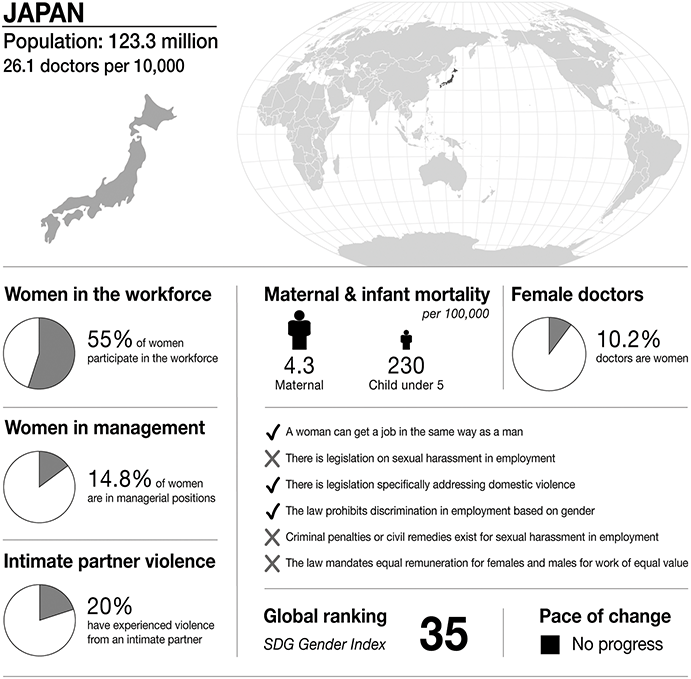
Figure 23.1 Long description
The infographic provides information about Japan, with a population of 123.3 million and 26.1 doctors per 10,000 people. It highlights several gender-related statistics. 55 per cent of women participate in the workforce. 14.8 per cent of women are in managerial positions. 20 per cent of women have experienced intimate partner violence. Maternal mortality is 4.3 per 100,000. Infant mortality under 5 is 230 per 100,000. 10.2 per cent of doctors are women.
The infographic lists the presence or absence of law and policy on gender equality. In (country):
– a woman can get a job in the same way as a man- the law prohibits discrimination in employment based on gender.
– there is legislation specifically addressing domestic violence.
– the law prohibits discrimination in employment based on gender.
– there is no legislation on sexual harassment in employment.
– criminal penalties or civil remedies for sexual harassment in employment do not exist.
– there is no law mandating equal remuneration for females and males for work of equal value.
S D G Gender Index global ranking is 35, and is stable.
Awareness about discrimination against women has also gradually increased. Between 1999 and 2022, there has been a shift in policies for women to improve gender equity. The Basic Act for a Gender Equal Society (1999) and the Law for the Promotion of Women’s Activities (2015) have been enacted, and the policy axis today insists on gender equality, inclusive of both men and women, rather than only for women. (Reference Iki8)
Changes in the Status of Women
Statistical data indicates changes in the status of Japanese women in recent years. It suggests that the number of women in the workforce has been increasing steadily, (10) and the percentage of female full-time employees (27.2%) has also increased. (9) However, the percentage of women in management positions remains low. (10) According to the Global Gender Gap Report 2021, women hold 14.7% of managerial positions, 9.9% of parliamentarian positions, and only 10% of all ministerial positions, with a score of 0.061 for ‘politics’ (0 being complete inequality and 1 being full equality). (11; 12) In 2016, the first female governor of Tokyo was finally elected, but there is yet to be a female prime minister in Japan. (13; 14)
Selective Dual-Surname System
A recent case highlights the issues Japanese women face: the selective dual-surname system. Under the current Civil Code, married couples are required to have the same family name when they marry, and to our knowledge, Japan is the only country in the world with such a requirement. (15) Hence, most women change their family names upon marriage. (16) With the advancement of women in the workforce, some advocate for the need to introduce a selective separation of the family names of married couples. However, the Supreme Court did not approve such a system. (17)
While the prevailing Japanese stereotype dictating that women should predominantly remain at home has evolved since the 1950s, gender-based discrimination persists. Women’s societal participation remains markedly unequal. Consequently, it is challenging to assert that Japan has achieved gender parity.
Gender in Medicine
In 2018, the total number of Japanese physicians was approximately 300,000, of which 21.9% were women. (18) The percentage of female physicians in Japan is the lowest in the OECD, (19) and many of them work as part-time or short-term regular employees rather than full-time employees. (20) As for the composition of each specialty by gender, the percentage of men engaged in internal medicine was 20.6%, orthopedics 8.5%, and surgery 5.3%, while the percentage of women engaged in internal medicine was 14.9%, pediatrics 8.9%, and ophthalmology 7.6%. (21) Men are more engaged in surgical specialties. (Reference Burgos and Josephson22)
Women Leaders in the Medical Community
According to Dr Kono et al., the number of female assistant professors has increased to 30% between 1980 and 2018, while the number of female professors has remained stagnant at less than 10%. (Reference Kono, Watari and Tokuda5) According to a 2011 survey by the Japanese Surgical Association, women comprised 14.6% of physician medical subcommittees and 6.3% of surgical societies. The current situation reveals the difficulties women face in getting promotions. It is rare for women to take on leadership roles in business or the medical world.
Sexual Harassment and Abuse in the Medical Community
In 2021, the Japanese Surgical Association conducted a sexual harassment survey among its female members. (23) Results showed that 50% of the respondents had been sexually harassed; 62% of female physicians had received negative comments about their pregnancies; and 28% had resigned or changed jobs because of pregnancy or the birth of their first child. (Reference Kawase, Nomura and Nomura24) In addition, 25% of female doctors had experienced sexual harassment, according to a survey by the National Doctor Union. (25)
According to a commercial physician membership platform Medical Restoration (m3.com), run by a private entity, 8.8% of male physicians and 60.9% of female physicians have indicated experiences of sexual harassment. Our study from April 2023 (n=430, response rate 80.4%, forthcoming) involving newly graduated resident physicians revealed that 28.7% of residents experienced some form of sexual harassment during their clinical clerkships; this comprised 17.2% encountering gender harassment and 9.0% facing unwanted sexual attention. Although no incidents of sexual violence or physical harm were reported, the potential for underreporting remains a concern.
Sexual Harassment in Hospitals
According to Japanese surveys, nurses, administrative staff, and doctors answered that they had ‘sometimes’ been sexually harassed. (26) Thus, the frequency of sexual harassment occurring in hospitals varies for several types of health care workers. Nurses tend to be more susceptible to sexual harassment, as compared to other health care workers. (Reference Amano27) Female physicians in Japan face both sexual harassment and pressure to sacrifice their jobs (their careers) because of life events such as marriage, pregnancy, childbirth, and child rearing. Therefore, it is difficult for female physicians to maintain an excellent work-life balance in Japan.
Medical Education
Undergraduate Training
In Japan’s university system, after high school graduation and six years of medical school education, students can take the National Medical Examination to obtain a medical licence. (28) However, private universities do not offer sufficient career support in undergraduate education as compared to public medical schools. According to Nagano et al., female physicians in private medical schools receive notably less career support, with only 20.7% being provided position support compared to 43.1% for men, and 20.7% receiving support for other job dimensions, as opposed to 70.6% for men. (Reference Nagano, Watari, Tamaki and Onigata29) Furthermore, female medical students are confronted with concerns regarding work-life balance, particularly in relation to matrimony and childbirth. (30) During entrance interviews, interviewers, who are physicians, often probe these students about life milestones such as marital plans. (30) Disturbingly, in 2018, discriminatory practices against female candidates were identified in four private medical school admissions processes. (31; Reference Kenji, Kunio and Takehisa32) The Ministry of Education, Culture, Sports, Science and Technology (MEXT) pointed out problems in medical school admissions and subsequently surveyed to clarify the status of improvement at each university. (31)
Postgraduate Training
After obtaining a medical licence, for specialization, doctors undergo two years of initial training under the Ministry of Health, Labour, and Welfare programme, followed by three to five years of postgraduate training. (28) The resident’s supervising physician conducts a clinical evaluation, (33) for submission to the hospital’s clinical training management committee, to decide the resident’s completion of training. Three primary issues exist. Firstly, when a resident’s supervisor is the perpetrator of harassment, it jeopardizes the resident’s training completion, thus inhibiting open discussion about the issue within psychological safety. Secondly, institutional guidelines predominantly focus on post-harassment actions, with a conspicuous absence of nationally standardized preventive measures or interventions. Lastly, the foundational guidelines for managing harassment prevention within Japan’s post-graduate education remain rudimentary, thereby relegating the decision-making process to the discretion of individual training centres.
Medical students and female doctors often ignore problems they are aware of because they do not want to get involved in further trouble. In fact, according to a survey by Medical Restoration (m3.com), 52.7% of those who said they had felt sexually harassed said it was by their immediate supervisor. (26) Female physicians are reluctant to speak up in the educational field because they do not want to make things awkward, with faculty members or senior doctors making it difficult for them to work.
Japanese Laws for Women
Laws such as the Equal Employment Opportunity Law (1972) and the Child Care and Family Care Leave Law (1992) contribute to the prevention and management of harassment for life events such as pregnancy and childbirth. (34) These laws also prohibit dismissal and other disadvantageous treatment due to pregnancy, childbirth, and childcare, and have been promoted to provide an environment where women can easily take appropriate leave. In addition, victims can also ask a neutral third-party organization to resolve harassment disputes against the offenders. With the enforcement of the revised Law for the Comprehensive Promotion of Labour Policies (i.e. the Power Harassment Law) (2018), employers’ measures against harassment have become an obligation. Companies are obligated to set up consultation services and implement measures to prevent recurrence. (35; 36) These laws are similar in their form to those of many developed countries in this area.
Operation of the Law on Sexual Harassment
While establishing a department dedicated to addressing harassment is commendable, the conservative cultural milieu of East Asia frequently hinders consultations from yielding prompt resolutions. Victims require tremendous bravery to approach the counseling department, and there have been instances where they faced unjust dismissals. (37) For instance, the number of consultations on the Equal Employment Opportunity Law (1972), the Part-Time Work Law, and the Child Care and Family Care Leave Law (1992) was 19,595, of which 7,323 (37.4%) (2019) were on sexual harassment. (38) Very few consultations led to disciplinary action such as transferring the perpetrators of sexual harassment to a different workplace. The recorded consultations are a small proportion of the actual number of sexual harassment cases occurring in the workplace.
According to a brochure disseminated by the Equal Employment Opportunity Office, a national governmental entity, sexual harassment is characterized in two primary categories. The first pertains to verbal manifestations, encompassing behaviours such as soliciting information about one’s sexual history, intentionally disseminating sexual rumours, making sexual innuendos or jests, repeatedly inviting individuals to meals or outings with romantic implications, and openly discussing one’s own sexual experiences. The second domain addresses physical and direct sexual actions, including coercion into sexual activities, unwarranted physical contact, circulating or displaying explicit imagery, forced lascivious behaviours, and rape.
From this delineation, it is evident that there are legislative efforts to categorize and perhaps manage manifestations of sexual harassment. However, a salient deficiency exists: while specific indecorous behaviours and unwarranted solicitations of sexual engagements are delineated, no overarching statute explicitly bans sexual harassment in its entirety. Until there is a legal provision that categorically proscribes sexual harassment, a comprehensive solution remains elusive. Thus, it is imperative for future legal frameworks to explicitly interdict sexual harassment (39).
Medical Regulation
Registration and Revocation System for Physicians
It is necessary to register as a doctor in Japan after passing the National Medical Practitioners Examination. The Ministry of Health, Labour, and Welfare (MHLW) manages details such as the name and legal domicile of the person who has obtained a medical licence. Second, the administrative punishment of physicians is outlined in the Medical Practitioners Law wherein the MHLW can issue a warning, suspend medical practice for three years, or revoke the licence of the offender. However, the MHLW must obtain the permission of the Medical Ethics Council before taking any action. (40)
Punishment of Doctors
According to ‘The concept of administrative punishment for doctors and dentists’ (41) of the Medical Ethics Subcommittee of the Medical Ethics Council, the degree of administrative punishment is determined by referring to the amount of punishment for judicial punishment. For example, indecent behaviour that takes advantage of one’s position as a doctor or dentist is considered a malicious act that betrays the public’s trust and will result in severe punishment. In other words, if doctors engage in sexual harassment or severe obscenity during medical treatment misusing their position, the harassment is likely to be illegal. (42) This will result in their suspension from medical practice or revocation of their medical licences.
However, the proceedings of the Medical Ethics Council, which examines and reviews the actions of doctors, are closed to the public and lack transparency. The names of doctors who have been suspended in practice are never made public. (43) The rights of doctors are overly protected despite inappropriate behaviour, and the opacity of the disciplinary and punishment processes is problematic. Another problem is that no specific punishment is mentioned for indecent behaviour towards peers (female doctors) in the hospital, and it is left up to each hospital and facility to decide what action needs to be taken. As a result, sexual harassment of female doctors by male colleagues is sometimes overlooked, (Reference Toshiko44) and male doctors are likely to continue medical practice without adequate punishment.
Therefore, clarifying the disciplinary process for physicians, stipulating clear disciplinary measures for sexual harassment of peers (female physicians) in the hospital, and ensuring that hospitals and facilities protect individuals (Reference Akihito45) are considered essential for improving gender bias.
Case Study
The following is a composite case of several people based on interviews. This illustrates how sexual harassment may be experienced and managed in Japan.
Setting
The characters are a male attending doctor A and a female Resident B, Resident C and Attending D. Attending A is educated, conscientious, and trusted by the residents. Among the three female residents, Resident B was particularly well supervised by Attending A. Neither Resident B nor others felt that this was a problem.
After one of my study sessions, Resident B received a message on social media from Attending A, saying that she was attractive and wanted to meet her in an empty room.
As soon as Resident B received this message, she discussed it with her trusted resident classmate C and her attending doctor D. When she did not reply to the message, she received another message from Attending A, saying that he did not want her to worry about it, and things were fine. After that, she did not receive any messages from Attending A.
Later, this incident became known to the others. Colleagues and junior staff made fun of Resident B, saying that she was invited because she was beautiful, that she must have been flirting with Attending A, and that Attending A was a womanizer, contrary to appearances. There were no other female residents in the room except Resident B. She felt frustrated that she could not say anything back and could only laugh along with them.
Prelude
There is a latent perception that men are superior in ability and position in a male-dominated environment in terms of numbers and status, and in a hierarchical relationship between attending doctors and residents. Such perceptions foster a culture in which women are evaluated not for their abilities but based on their appearance and charm.
Resident B thought that she had been treated by Attending A without any arbitrary intentions. However, from Attending A’s point of view, Resident B’s behaviour might have made him think that she loved him. She tried to remember each of their interactions to pinpoint which behaviour made him think so, but nothing came to mind.
Assault
Resident B was not physically harassed by Attending A. However, she was psychologically and socially harassed. She was afraid of what Attending A might do to her if she met him behind closed doors, and she was worried that her future career would be negatively affected if she rejected her supervisor. In addition, the comments of her colleagues and junior staff who found this incident amusing made Resident B feel uncomfortable at work and angry with them.
Some people may say that this is not sexual harassment because nothing was done. However, sexual harassment can cause indelible psychological scars on its victims, regardless of whether they are physically harmed.
Resident B suffered double sexual harassment, not only from Attending A but also from her colleagues and juniors who treated her unkindly. Since this incident was a one-time event, it is not worth remembering for the person who perpetrated this sexual harassment. However, for the victim, the suffering continues even now, and any trigger can suddenly recall the memory of the event.
Limbo
Resident B immediately consulted her trusted attending doctor and peers after receiving Attending A’s message. She knew she would not be able to resist Attending A if he harmed her behind closed doors. She also knew she would not be able to ignore what he did and continue working. However, she did not want all her colleagues or juniors to know about this. It was enough for Resident B to confide in someone who understood her suffering. She did not know how people found out about it later, but Resident B thought that she could confide in someone she trusted and then continue her work without telling anyone the whole story, and she did just that.
Exposure
When her name became known at work, and she saw her trusted colleagues talking about her with amusement, she was disappointed. She lost her trust in them and became angry.
How do I cope with this sense of betrayal when colleagues talk about me behind my back? At that time, she had to laugh it off. She did not want to say anything back to her colleagues or juniors and worsen her relationship with them.
Are the critics correct? Am I to blame? Resident B does not think so. While there was a comment that Resident B might have invited her superior, she did not remember misleading Attending A. She almost thought she was at fault, but she did not feel guilty. She did not feel guilty about what she had said or done, but she did not want to blame Attending A.
How do I keep working when everyone is talking about me? Resident B tried to think of the people who were likely to gossip or talk about her behind her back. She worked to keep a psychological distance from them by not socializing with them beyond work.
Aftermath
Resident B is now a senior resident working at a different hospital. Attending A continues to work in the same hospital. She positively reflected that she would now be able to deal with similar events if they occur in the future. She also thought that she would be able to advise other female doctors or medical students with similar experiences.
For Resident B, this incident triggered a strong desire to not want other women to go through the same thing. Rather than going public with her own experiences, she would first help the women near her.
Discussion
Current Problems
Society
In Japanese society, stereotypical ideas about gender roles such as ‘women are supposed to stay at home’ are still prevalent, making it difficult for women to change the way they work. (Reference Matsui, Sato, Kato and Nishigori1) It has been pointed out that this stereotypical way of thinking persists even among women. It is not difficult to change the system and rules. However, it is more challenging and time-consuming to change the culture, ‘the one that we women doctors embody’ through our education and cultural background. Studies from outside Japan have shown that family and national culture significantly influence women’s career advancement. (Reference Alers, Verdonk, Bor, Hamberg and Lagro-Janssen46; Reference Alwazzan and Rees47) As of 2022, women are still not playing an equal role in society, and the current situation in Japan is far from gender equal (Japan ranks 120th in a 2021 gender gap report). (12)
Medical Community
In the Japanese medical community, female doctors are more likely to be sexually harassed and sacrifice their careers because of their life events. (Reference Takahashi, Nin, Akano, Hasuike, Iijima and Suzuki3) There is a keen sense of not wanting to be in awkward situations with senior doctors, and even if there is a problem, action is often challenging. It is difficult for female doctors in Japan to have a proper work-life balance.
Laws
There are laws aimed at achieving gender equality and dealing with sexual harassment. (48) However, these laws are incomplete as far as specific consultation statistics and responses are concerned. The lack of laws prohibiting the act of sexual harassment is itself a significant problem. (49)
Regulation of Doctors
In the current situation, the punishment of doctors is unclear, and they are overly protected even if they are the cause of the problem.
Causes of Failure to Achieve Gender Equality
Unconscious Stereotypes
There are a deep-rooted stereotypical ideas about the division of labour in Japan, with women doing the housework and men doing the work outside the home. As a result, female physicians tend to leave the workforce after marriage to enter the home. The following are three studies and examples of stereotypes:
A questionnaire survey of female medical students reported that they accepted the inevitability of this forced choice of childcare and housework. (Reference Takahashi, Nin, Akano, Hasuike, Iijima and Suzuki3) Female medical students see this situation as inevitable and natural, and unconsciously give in to it. (Reference Ozaki50)
A study reported that ‘the process of integrating personal and professional identities of female doctors is greatly influenced by gender stereotypes that emphasize marriage, childbirth, and having a family, and prioritize the domestic role of wife and mother after marriage’. (Reference Matsui, Sato, Kato and Nishigori1) This study shows that the stereotype of female doctors being family oriented is deeply rooted.
While in medical school, Dr Uchida was told by male classmates that ‘being a doctor is hard work and not a woman’s job’ and ‘you can’t give birth or raise children’. (51) This statement shows that stereotypes take root among women and men. (Reference Izumi, Nomura and Higaki52)
From the above three cases, gender stereotypes about women’s roles which persist in Japan are likely to lead to difficulties at work and sexual harassment for female workers. Inadequate education on gender equality in educational institutions and clinical workplaces may also evoke unconscious stereotypes.
Social System with Poor Work-Life Balance
The second reason is that the Japanese social system does not allow women to have a good work-life balance. The following are three concrete examples of a poor work-life balance:
It has been pointed out that female doctors give up medical practice due to concerns such as working hours and lack of childcare facilities. (Reference Nomura, Yamazaki, Gruppen, Horie, Takeuchi and Illing4; Reference Nomura and Gohchi53)
In a survey about work-life balance promotion, nearly half the respondents answered that they did not think the relationship between themselves and their spouse/partner was equal in terms of childcare. (54) For female physicians with the heavy burden of childcare and housework, systems such as reduced work hours are beginning to be established through the Work-Life Balance Charter, (55) but they remain insufficient.
Female doctors experience a sense of inequality in the support system. (Reference Ono56) People in society find it challenging to have a good work-life balance because men and women have not achieved equality.
These three examples illustrate that the lack of work-life balance clearly makes it difficult for female doctors to concentrate on their work. It is essential to consider this issue as a problem for both female and male doctors.
Few Female Leaders and Educators in the Medical Field
The third cause of gender inequity is the lack of female leaders and educators in the field of medicine. Three concrete examples follow:
It has been reported that promotion of female doctors is hindered in Japanese universities and that there is a glass ceiling. (Reference Hashimoto57) The percentage of female physicians has increased from 10.0% to 21.1% over the past forty years, while female professors remained stagnant at less than 10% in 2004. (Reference Kono, Watari and Tokuda5)
According to Dr Nagano, the actual proportion of female doctors declines dramatically as academic rank increases in Japan, with only 4.7% women at the professor level. And the proportion of women in senior positions was significantly higher in private medical schools (28.2%) than in public medical schools (25.4%). (38) The percentage of women in senior positions, although higher in the private sector, is still low compared to men.
Studies have reported that fewer female organizers in meetings and conferences result in fewer female speakers. This study also suggests that if there are fewer women in leading positions, such as organizing the meeting or conference, fewer women are selected to speak. (Reference Homma, Motohashi and Ohtsubo58)
These three studies show few opportunities for women to take on leadership roles in the medical field. Furthermore, it is also clear that there is little likelihood that women will be appointed without more women leaders.
Insufficient Education around Gender Equality
In Japanese medical education, there is little education on gender issues, before or after graduation. According to Dr Nagano, (Reference Nagano, Watari, Tamaki and Onigata29) public medical schools provided more support for women in terms of positions and other job-related matters than private medical schools (exclusive positions for women in career advancement and research support: public 43.1% vs. private 20.7%, p = 0.043; regular employment available for shorter working time than full-time: public 70.6% vs. private 20.7%, p < 0.001). However, according to this study, more than half the medical schools do not support women. (Reference Nagano, Watari, Tamaki and Onigata29) A US study has shown that physicians are educated in several ways to deal with gender discrimination. As a result of this, female associate professor numbers increased, prejudice against women became apparent, and salary disparity improved. (Reference Fried, Francomano and MacDonald59) We should create facilities for better gender education in medical schools, hospitals, and facilities in Japan.
Because of these barriers, it is not surprising that fewer female physicians stay in the medical field.
The Malaysian Context
Gender in Society
Malaysia is in South-East Asia with a population of 32.5 million in 2020. Malaysia’s population is mainly divided into three categories: Bumiputera which has 69.3% of the population (Malay and Indigenous people); non-Bumiputera (non-native), which has mostly Chinese (22.8%) and Indian (6.9%) people; and others (1%). The current sex ratio is 106 males per 100 females for citizens and 156 males per 100 females for non-citizens. (1)
Gender equality has improved slightly in Malaysia, with the Malaysia Gender Gap Index (MGGI) increasing from 0.709 in 2019 to 0.714 in 2020. (1) MGGI measures the differences between men and women in fours sub-indices: political empowerment, health and survival, educational attainment, and economic participation and opportunity. A score of 1.0 (100%) indicates that the equality of women and men has been achieved. Women have surpassed men in the educational attainment sub-index with a score of 1.059 but not for the health and survival sub-index recorded (score of 0.956) nor for economic participation and opportunity (score of 0.738). A women’s labour force participation rate (LFPR) of 55.3% in 2020 was far behind neighbouring countries such as Singapore (69.7%) and Thailand (66.8%). There is no barrier for females to enter any industry or occupation in Malaysia. However, there are differences between the number of males and females in different sectors, reflecting the choices and aspirations of Malaysian females. (Reference Lim2) In 2015, 8.6% of females were involved in ‘human health and social work activities’, compared to 1.3% among males. In addition, females contributed to 48.5% of the medical doctors, 38.4% of the obstetrics and gynaecology specialists and 42.4% of psychiatrists. (Reference Arrizabalaga, Abellana, Vinas, Merino and Ascaso3)
Based on the Institut Public de Sondage d’Opinion Secteur (IPSOS) 2018 survey on gender equality, the top three issues facing Malaysian women were sexual harassment, sexual violence and sexualization of women in the media. (4) These findings are similar to women globally, except that the third issue worldwide has been physical violence. Gender equality is still challenged by negative cultural values and misconstrued religious beliefs around power, privilege and control held by men. These differences significantly drive sexual discrimination, gender-based violence and sexual harassment. Despite the government’s commitment to the Convention on the Elimination of All Forms of Discrimination against Women (CEDAW) and SDG5, and while in-roads have been made into education, health and labour, relatively few women hold positions in decision-making roles.
Infographic Malaysia. Infographics were provided by CartoGIS Services, The Australian National University. Population: from World Bank https://databank.worldbank.org/source/population-estimates-and-projections. Sustainable Development Progress, global ranking and statistics on women in the workplace, women in management and intimate partner violence: from United Nations SDGs Data Portal https://unstats.un.org/sdgs/dataportal. Female doctor percentage: from Global health workforce statistics www.who.int/data/gho/data/themes/topics/health-workforce. Legislation and law statements: from the World Bank gender data portal 2023 https://genderdata.worldbank.org/en/indicators. Maternal mortality statistics: from the Global Health Observatory 2020 https://mmr2020.srhr.org. Infant mortality statistics: from United Nations International Children’s Fund (UNICEF) https://data.unicef.org/topic/child-survival/under-five-mortality.

Figure 24.1 Long description
The infographic provides information about Malaysia, with a population of 34.2 million and 22.3 doctors per 10,000 people. It highlights several gender-related statistics. 52 per cent of women participate in the workforce. 23.2 per cent of women are in managerial positions. 19 per cent of women have experienced intimate partner violence. Maternal mortality is 21.1 per 100,000. Infant mortality under 5 is 780 per 100,000. 53 per cent of doctors are women.
The infographic lists the presence or absence of law and policy on gender equality. In Malaysia:
– a woman can get a job in the same way as a man.
– there is legislation on sexual harassment in employment.
– there is legislation specifically addressing domestic violence.
– the law does not prohibit discrimination in employment based on gender.
– there are no criminal penalties or civil remedies for sexual harassment in employment.
– there is no law that mandates equal remuneration for females and males for work of equal value.
The S D G Gender Index global ranking is 59, and there has been fast progress
Gender in Medicine
Gender disparities can occur in medical specialities, although these disparities may vary by country. Generally, females make up the majority in fields such as general practice, obstetrics and gynaecology, and palliative medicine, while men dominate in specialities such as cardiology and most surgical areas. (Reference Moberly5; 6) The reasons for this are unknown, but it could reflect women’s role in society, where they are seen as warm caregivers. Proportion-wise, a study conducted in 2014 found that far fewer female doctors attained consultant status compared to their male counterparts within a similar timeframe. (Reference Arrizabalaga, Abellana, Vinas, Merino and Ascaso3) There is limited up-to-date statistical data on gender distribution in the Malaysian health care workforce, but available figures suggest that the number of female doctors is rising in Malaysia. While 63.6 per cent of medical specialists were male in 2010, analysis within age groups revealed that Malaysian doctors were gradually shifting from a male-majority workforce towards a female-majority workforce. (6) The data showed that while medical specialists over sixty had an 85:15 male-to-female ratio, this ratio gradually progressed in the opposite direction with younger age groups. For medical specialists under thirty, the gender distribution was 39:61, favouring females. The trend was reversed with more senior specialists. The Ministry of Education of Malaysia reported that the proportion of female medical students enrolled in public universities was 63.3% in 2014. However, a lack of more recent data suggests that it remains uncertain whether these higher numbers of female medical students were translated into higher numbers of female clinical specialists and consultants. (Reference Arrizabalaga, Abellana, Vinas, Merino and Ascaso3; Reference Wan7)
Medical Education
Medicine is a very challenging field, and selection into medical school was only available for a select privileged few before the mushrooming of private medical schools. Medicine is a very desirable career among Malaysians. Many Malaysian parents aspire for their children to study medicine, which is perceived as a noble, honourable, and well-paid profession. The entry points into medical school are generally very competitive. Surviving medical school for five to six years can be gruelling. Furthermore, things do not get easier upon graduating as house officers. House officers have to wait a long time for a posting, which can be competitive, as permanent posts are limited. The remaining doctors may be offered positions working with the government under contract, which comes with significantly fewer benefits, such as access to speciality training.
There are a few pathways of study to become a doctor. Students can opt to train after completing a pre-university programme such as Form 6 (government schools), matriculation (in local colleges/universities) or other internationally recognized programmes such as A-Levels. (8) After a recognized pre-university programme is completed, a student can opt to study medicine at a public or private university. Currently, there are eleven public universities and twenty-two private universities offering medicine as a course that the Malaysian government recognises. (9) The curriculum in medical schools may not include modules on gender-based violence. Similarly, post-qualification training may not provide training on this topic.
An undergraduate medical course typically takes five years to complete before graduation. (8) After graduation, a medical graduate must complete two years of compulsory service as a house officer or intern at a designated tertiary-level public hospital anywhere in the country. Training includes postings in six compulsory departments, and each department has an appointed supervisor for house officers. Any medical graduate must be employed in a government hospital for house officer training and a further two years as a medical officer. At present, private hospitals in Malaysia do not offer house officer training. A medical officer can opt to pursue postgraduate training after serving another two years of compulsory service in a government hospital. (Reference Yong10). Postgraduate training typically takes four years, and fellowship training can range from three to four years. This can also be done at a government hospital or overseas. (Reference Yong10)
Legal Framework
Malaysia has different legislative instruments which can be used to address sexual harassment cases, but a standalone comprehensive sexual harassment law does not exist. The Penal Code requires proof beyond a reasonable doubt and is therefore rarely enforced in the case of sexual harassment. The following key legislations are referred to or used for sexual harassment cases. They include the Code on Prevention and Eradication of Sexual Harassment in the Workplace (1999); the Employment Act 1955 (amended 2012), Part XVA on sexual harassment, which provides guidelines on prevention in workplaces; and Tort of Sexual Harassment for civil action since 2016. (11) The draft of specific sexual harassment legislation was by the joint action group against violence against women (JAG-VAW). Currently, it is known as Joint Action Group on Gender Equality (JAG-GE) and has fourteen active women’s groups.
Women’s groups first proposed a draft sexual harassment bill in 2001. It was further developed by a Special Project Team on the Sexual Harassment bill and first presented to Parliament in 2021. Several provisions from the original Bill were dropped, including that of organizational duties, which would have provided provisions for organizations to have a duty to prevent and address sexual harassment. A Coalition on Advocacy of Sexual Harassment Bill 2021, comprising the JAG-GE, Engender Consultancy and Young Women Making Change, advocated for an initial comprehensive Sexual Harassment Bill. However, when the Sexual Harassment Bill 2021 was passed in 2022, it only defined sexual harassment, the setting up of a Tribunal to address sexual harassment cases and a committee to work on the guidelines and implementation of the new Act. Moving forward, women’s groups are intending to continue to work with the Ministry of Women, especially on guidelines for the new Sexual Harassment Act, including positive organisational duties. The Ministry of Women, Family and Community Development has announced that the Act will be implemented in stages, including the setting up of the Tribunal. We hope that this new Sexual Harassment Act will provide protection for all and prevent sexual harassment in the country.
Medical Regulation
All medical practitioners in Malaysia, regardless of whether they are in the public or private sectors, are regulated by one body, the Malaysian Medical Council (MMC). (12) All medical practitioners are required to abide by and comply with the Code of Professional Conduct of the MMC, and this is mainly to ensure propriety in professional practice by medical practitioners and to prevent abuse of professional privileges. The Code of Professional Conduct emphasises the health and welfare of the individual and family under the care of a practitioner as of the highest importance.
The council is comprised of medical professionals and was established under the Medical Act 1971 (amended 2012). The Medical Act is legislation related to the registration of medical practitioners and the practice of medicine. Together with the Medical Regulations 2017, the Medical Act deals with all disciplinary matters involving registered medical practitioners. If there are transgressions made of the expected norms of practice, it can result in punishment after a due process of inquiry.
The MMC has disciplinary jurisdiction over registered medical practitioners and will exercise it over anyone who has, for example, committed serious professional misconduct as outlined in the Code of Professional Misconduct or any other guidelines issued by the Council. Serious professional misconduct here refers to ‘a failure to meet the minimum standards of professional medical practice’ and ‘sufficiently immoral or outrageous or disgraceful character’. When a complaint is made in accordance with the Act, it is forwarded to the Complaint Management Committee (CMC), which comprises five council members who usually hold office for one year at a time. The CMC scrutinises each complaint, and if it meets their requirements, it is forwarded to a Preliminary Investigations Committee (PIC) and/or Disciplinary Board (DB). The PIC and DB members are selected from the Disciplinary Panel, which comprises council members and/or fully registered medical practitioners with at least ten years of registration under the Council. The Council then reviews the investigation of the mentioned panels and determines the next course of action. Depending on the offence, medical practitioners can be reprimanded, suspended, or struck off the registry. (13)
Case Studies
The pervasiveness of sexual harassment means that everyone and anyone is at risk, regardless of their background. We want to outline two scenarios on different ends of the spectrum of sexual harassment experience in Malaysia, which can help readers understand what survivors have endured. The cases below are based on true stories.
Case Study 1
Prelude
This is about a specialist who viewed her experiences as trivial, though unacceptable and uncomfortable, and led to the experiences being lost in her memory. Recent discussion on the topic sparked her memory of the incident and made her realise the intensity of her experience.
Assault
The survivor has had a few encounters with sexual harassment. Her first encounter was when she was a house officer (intern) doing her surgery rotation at a tertiary hospital. It was the norm for consultants to shout at surgeons during ward rounds and surgeons to regularly shout at medical officers (MOs) and house officers (HOs). However, stories of sexual harassment were rarely heard of or spoken about. There were, however, frequent rumours of surgeons pairing up with medical officers and house officers or fraternising outside work.
She assisted a surgeon in the operating theatre one day with a scrub nurse present. While the surgery was progressing, the surgeon asked her personal questions that made her uncomfortable. She was startled to be asked whether she had a boyfriend. Despite stating having one, he further asked whether she would go out clubbing and dancing during the weekends. She replied uncomfortably, ‘Not really …’, but was startled to get his statement that he would like to see her dancing and see her moving. ‘I felt very uncomfortable then and did not respond to his remarks. I looked pleadingly to the scrub nurse who was present for a reaction, but she appeared not to have noticed what had happened and was absorbed in her work.’
Her subsequent encounter was as a post-graduate trainee doing hospital rotations. She was assigned to an internal medicine ward and described her working experience as enriching but challenging sometimes. She enjoyed working with most of her colleagues in the department, who were supportive and willing to teach. One physician was exceptionally attentive and helpful. Although he was not the physician in charge of the ward, he occasionally came to the ward to help do rounds when the physician in charge was unavailable. He was professional in his conduct with patients and other staff. Still, the trainee noticed that he paid more attention to her and often asked her how she was coping in the posting and how she was doing her studying sessions outside the hospital premises.
He asked her personal questions, such as whether she was single and how often she travelled back home to her hometown. He even offered to coach her privately over lunch or dinner outside work. On a few occasions, he asked her if he could travel with her back to her hometown whenever she planned to. She felt strange about the inquiries and the offers since they were not close to begin with. She declined all his requests as she felt uncomfortable and suspicious of his intentions. In addition, it was known that he was married with a child, and his family was based in another state. A more unacceptable behaviour occurred a few times during ward rounds where he would put his hand on her shoulder or back while saying, ‘it’s ok, don’t worry’. Not knowing how best to react, she pretended not to notice as these incidents were in front of patients. She was confused about whether he was trying to be friendly, but she did know that his behaviour made her increasingly uncomfortable.
Limbo
The survivor related,
I wondered if I should do anything about it like reporting but did not do so because I felt that I did not have enough evidence to proceed with any report or enough basis. I did feel uncomfortable, confused about what to do next and afraid of the repercussions that I might face making a report against a surgeon. I was worried that my progression through the posting would be jeopardised. So, I brushed it off and continued to work as usual. I worked closely with that surgeon in doing rosters for house officers but kept a cautious distance during that period. I wanted to keep that incident locked away in the past.
In the second incident, as a trainee, she confided in another MO about her situation. She discovered that the perpetrator did have a history of similar behaviour with other MOs who were no longer in the posting. The other MO offered to inform the physician in charge of rosters not to slot her and the physician together in future. She faced no further problems throughout the duration of that posting.
Exposure
The survivor, in this case, did not encounter any issues when disclosing the incidents to others. Not many people knew of the incidents, as she revealed the details to a few close friends who were her colleagues in the concerned departments. She thought of the incidents as trivial, not realising at the time that she experienced sexual harassment. She believed there was insufficient concrete evidence to justify making a report and felt uncomfortable dealing with any scrutiny. Until now, she questioned herself if she had done something to provoke these advances. Her strategy was to go under the radar and continue working without causing fuss or disruption.
Aftermath
The survivor is now a specialist at a local university, and the incidents she experienced did not appear to hamper her career progression. She is, however, more empowered now and intends to work towards creating a safer working environment for other health care workers, such as working with this book chapter.
Case 2
Prelude
Case 2 involved a compilation of events experienced by ten survivors with a history of sexual harassment from a similar perpetrator and received national coverage in 2018. The information was retrieved from newspaper reporting and those handling the case, including officials who investigated the case. None of the survivors agreed to be interviewed when approached by a third person who assisted their case.
Assault
This case was a high-profile case involving a senior orthopaedic consultant who was also the head of the department (HOD) at a tertiary-level hospital. The perpetrator had a long-standing reputation for sexually harassing new house officers in his department, but complaints were either not made or did not make it to investigations by higher authorities. (Reference Zainal and Chung14) The perpetrator was a very senior consultant and a very influential and well-connected person in his discipline. House officers (HOs) who were exposed to his misconduct were terrified of making any official complaint for fear of being penalized. They are concerned that the heads of departments, who are responsible for deciding whether the HOs have completed a posting successfully, may discriminate against them. Failure to successfully complete any postings would then disrupt their career progression.
A survivor’s account was reported in the Star newspaper, where she was summoned to meet the HOD in his office. She said,
He then grabbed me and started to unbutton my shirt and kiss my lips. He said he was going to give me his ‘blessings’. I pushed him away and ran out of the room. I was shocked and depressed; I was disgusted.
Another HO detailed her account where she received advances during work and spotted a dark vehicle parked outside her apartment for an extended period. The HOD had texted her, saying he had found out where she lived and was waiting for her outside. (Reference Zainal and Chung14)
Limbo
The sexual harassment incidents had spanned many years, but many HOs who were affected did not come forward to complain. This changed when one of those affected did come forward to make an official complaint at the institution. The discussion spiralled into the national agenda when it came to the attention of the Ministry of Women, Family and Community. This Ministry then alerted the Ministry of Health and the then Minister of Health ordered an immediate investigation into the case. This resulted in several other HOs coming forward to make official complaints.
Exposure
Those affected grappled with all the possible outcomes of making a complaint, such as the HOD not signing them off to the next posting or receiving an unsatisfactory report resulting in a permanent blemish in their personnel files. In this case, no police reports were initially made. Some who did lodge reports within the organisation were left disappointed by the inaction. When news of the reports had broken, the perpetrator was told to go on leave and more survivors stepped forward with reports of his transgressions. (Reference Radhi15; 16)
An independent inquiry body was formed to investigate the matter. As the HOD was put on leave, he drafted a letter of support addressed to the inquiry body vouching for his good character and noting that under his leadership, his department achieved an excellent track record and that he was respected by many. He then pressured specialists, medical officers (MOs) and nurses in his department to sign it, going to the extent of identifying who had not done so and personally contacting them to request their signatures. (Reference Zainal and Chung14)
Aftermath
Based on the interviews with investigators, many of those who came forward had left the medical fraternity. They considered the challenges they faced, and decided they couldn’t focus on their job after such an ordeal. We were informed that at least one of the doctors has not recovered from the impact of the experience and is still receiving ongoing psychological support. The fate of those who went through similar experiences but did not lodge complaints is unknown.
There was also collateral damage in this case. After one month of investigations by the independent inquiry, the body recommended that the HOD be suspended from his duties. When investigations were completed months later, the HOD was terminated in all services upon the consent of the King of Malaysia. At around the same time, specialists from the same department were informed that the entire department (including fourteen specialists, twenty-five MOs and fifteen paramedics) would be getting transfer letters to different hospitals. Questions to top officials for reasons of the en-masse transfer were met with responses like, ‘It was to dismantle the toxic environment’, ‘the department was guilty by association and inaction’ and ‘it was collateral damage’. The transfer plan was eventually shelved after much opposition. (Reference Foon Fong17)
Discussion
Sexual harassment is everywhere. Even health care workers are not protected against it; worse still, in Malaysia, it remains hidden. The two cases discussed earlier highlighted the diversity of sexual harassment experiences and the different ways of responding to the situation. We believe that many more doctors are affected by sexual harassment but have decided to keep silent about it given the challenges towards help-seeking and disclosure. Unfortunately, good quality data on the prevalence of sexual harassment in Malaysia is scanty and practically non-existent for medical professionals.
Medical Fraternity
Sexual harassment seems to be a commonplace occurrence in the medical fraternity but is not usually reported. This was until a high-profile case came into light involving an eminent and senior orthopaedic surgeon who was also the head of his department at a leading tertiary-level hospital in the country. A house officer had lodged a formal complaint against him for sexual harassment, and the Ministry of Women’s Affairs raised the alarm and called for an investigation. It was then that the Ministry of Health opened investigations into the wrongdoings of the surgeon. This triggered a domino effect which saw several other junior doctors coming forward with complaints of harassment by the surgeon dating back several years.
While it was good that investigations into this surgeon had finally begun, it begged the question of why it took the intervention by not one but two ministries to initiate investigations. A system already exists for incidences such as this, but it was not utilised in this case(s). Another question raised is what the role of the surgeon’s hospital is in dealing with harassment. Were no complaints made at all to the hospital authorities? There appear to have been weaknesses in a system that should have functioned to provide a safe space for employees. There is also an apparent lack of deterrents in an existing system, which ideally should be built into the reporting system, the investigation processes, the provision of support for the survivor/perpetrator, and the actual redress or inquiry.
Several factors involving the health care environment may explain the reluctance of victims of sexual harassment to come forward. What was noted in the cases reported is that perpetrators of harassment are usually in a more senior post than the victim. Junior doctors are typically reliant on the assessment of senior doctors to progress within a posting and on to other postings. Hence, when harassment happens, junior doctors may be reluctant to lodge a formal complaint in writing for fear of jeopardising their careers. Compromises in a junior doctor’s career can range from minor actions such as not being included in the operating theatre for critical surgeries, to more major ones, like receiving a failing grade in an end-of-posting exam. It is this hierarchical nature of the medical community, the existence of ‘senior’ and ‘junior’ doctor labels, and fear of consequences to their careers that causes its members to enable predatory behaviour in a way to ‘save their necks’. To further aggravate this is the issue of power dynamics in the workplace, which is prevalent in the Malaysian working culture. Hofstede’s Power Distance Index was developed to measure power distribution between individuals in a business, culture, or nation. Malaysia scored the highest in this among countries all over the world, which means that Malaysia has the most significant power distance between employers and employees. (Reference Hofstede18) Hence, it is not surprising that junior doctors would be hesitant to call out harassing behaviour by their seniors.
The medical fraternity exists within a relatively small circle. This means that even when transfers occur due to disciplinary problems, there is still the tendency for a victim to run into a perpetrator later, as the circle is a small one. Another question that has arisen is whether the workplace is a safe space considering the potentially many (unreported) cases of harassment or bullying. Is there any safeguarding in place and is it given priority in the health care system? If there is a written policy in place, it is essential to ensure that the policy gets implemented. Looking back at these cases, awareness about sexual harassment and ways of getting help may need to be addressed. Junior doctors go through an orientation process when they begin their careers, and awareness of sexual harassment may be a useful component to add to their training.
Survivors
We examined how victims from two different perspectives dealt with their situations and how they ultimately carried on with their careers and lives. In the first case, the survivor experienced relatively minor but still significant encounters of sexual harassment. While instinctively knowing that something was off but unsure if what she was experiencing was sexual harassment, she went into survival mode and got out of the situation(s) by saying ‘no’ in a good-natured way by laughing it off rather than stating it assertively. It is not unusual for survivors to face confusion about the types of behaviours that fall into the category of sexual harassment and the perceived severity that warrants legal action. In contrast, the survivors from the second scenario suffered for months or years in fear and shame until one of them took a fateful step to lodge a report. While the public classifies the case as a triumph as the perpetrator was eventually found guilty and punished, with his practising licence revoked, this could not reverse the damage faced by survivors. The perpetrator is still a free man and was not convicted under a court of law for his crime because none of the survivors were keen to make a police report.
Ideally what should have been done in both cases was to immediately document in writing either in a book or electronic device what had transpired and with whom, when and if there were any witnesses present. The next step would be to report their experiences to a higher authority. That higher authority would then be responsible for investigating or appointing someone suitable to do so before appropriate action is taken. The survivor should then take note of the action taken by the investigating authorities, where keeping a timeline of events would be helpful.
In the short term, talking to someone, albeit a friend or counsellor, would help immensely in relieving a huge burden and getting clarity. This is provided when an appropriate response is given. Ignorance of others on sexual harassment matters can cause harm when the listener invalidates the experiences with reactions such as ‘you are being so sensitive’, discouraging the survivors from pursuing further action and speaking up. There is also the issue of normalising certain seniors’ ‘acceptable behaviours’, leading to a workplace culture of sexual harassment.
All health care workers should familiarise themselves with the available protocols (if any) for sexual harassment. While making a report is the idealistic approach to dealing with an encounter of sexual harassment, it is important to consider several issues that have plagued the minds of our survivors here. Firstly, the time between making a report and eventually taking action can be lengthy. As if the incident of harassment were not traumatising enough, the victim would be subjected to reliving the episode repeatedly while making the report and during the investigation. To top that off, victims often face retaliation in the form of intensified bullying as their perpetrators roam freely and blame victims. Victims often get blamed for the harassment they experience and are accused of provoking the attack in the first place.
On the other hand, when a report is made, action is not always taken. This is mainly the case when the perpetrator is in a position of power and influence. Hence, not only is no action taken to reprimand the perpetrator, but the victim is placed in an even more vulnerable position. The perpetrator, being a HOD, can exert power by not allowing the victim to complete the rotation within the department, jeopardising the completion of housemanship, which is compulsory to be confirmed in service.
The organisations here have an essential role in ensuring the workplace’s safety for all. Its policy in supporting its employees needs to be clear and solid. It also needs to take reports of sexual harassment seriously and take the necessary steps to investigate them and take action. This will ensure that all health care professionals feel safe at the workplace and act as a deterrent to perpetrators of sexual harassment. This would add further value to the organisation in the long run. These organisations (clinics, hospitals, ministries) would not be able to function without good leaders. Leaders need to place appropriate emphasis on sexual harassment, and politicians need the political will to emphasise the implementation of the newly approved Anti-Sexual Harassment Bill. (19)
Legal Issues
An issue with reporting sexual harassment is the high burden of proof that falls on the victims. Sexual harassment is, unfortunately, usually difficult to prove in the absence of physical evidence such as bruises or witnesses. Often the victims look like their complaints were made based on misunderstandings. There are also limitations in the availability of current legal remedies. The definition of sexual harassment itself is not very clear under Section 509 of the Penal Code, where it is stated ‘to insult the modesty of any person’ and ‘intrudes upon the privacy of such person’. (20) There is also no specific coverage of online sexual harassment in the Communications and Multimedia Act of 1998. (21)
There is also limited coverage of situations in the workplace. The Employment Act 1955 only applies to employers and employees in Peninsular Malaysia. (22) The Public Service Department Circular also mentions sexual harassment but is only restricted to the workplace in the public sector. Apart from that, there is an absence of legally mandated obligations by the public and private sectors to establish in-house policies and mechanisms to prevent and address sexual harassment. Presently, the Code of Practice on the Prevention and Eradication of Sexual Harassment only recommends that employers set up policy statements prohibiting sexual harassment in the organisation, protective and remedial measures (including complaint measures), as well as educational programmes (including training) to raise awareness of sexual harassment at all levels within the organisation. (19)
When a case goes to court, hearings are often time-consuming and expensive. The processes deprive survivors of their privacy. There is also a high burden of proof on the victims of sexual harassment as it is complicated to prove, and judges have to ascertain beyond reasonable doubt that the case is indeed one of sexual harassment. It is not surprising that many victims do not come forward due to this and the possible repercussions where the perpetrators do not usually get more than a rap on the wrist. Monetary compensation is only possible if a civil suit is to be pursued under the tort of sexual harassment. While this is not the most effective form of a deterrent for some perpetrators as it can be quickly paid off, it is also not what victims often seek, such as an apology or acknowledgement from the perpetrator that an offence has been committed.
Conclusion
While the topic of sexual harassment is an ongoing discussion, there is still reluctance among victims to come forward for action to be taken against perpetrators. This is despite regulations being in place and being improved over time. The closely linked medical fraternity should provide a safe space for all its members and not be seen as a challenge for disclosure of any forms of abuse. The Ministry of Women, Family and Community Development is the ministry responsible for the implementation of the Anti-Sexual Harassment Act. (Reference Nasri23) They are now doing roadshows to create awareness and provide information on the Anti-Sexual Harassment Act to the public, especially on the roles and responsibilities of individuals and companies. We trust more people will become aware of the issue of sexual harassment and will be able to take appropriate action with the implementation of this new Act.
Introduction
Violence in educational or work environments is a behavior that has been increasing, and Mexico is no exception. The behavior seems more common among medical students than in other faculties, perhaps due to the stress of high levels of responsibility they carry for the health and lives of others, where a mistake is intolerable. Among the different forms of abuse of students (undergraduate and graduate), which includes verbal abuse, physical violence, and discrimination based on race, sexual harassment and gender discrimination stand out. In the medical profession, sexual abuse is experienced in a particular way. Medical work is often immersive, and the boundaries between work and social life are blurred. In addition, the risk of both types of mistreatment is higher in hierarchical environments, organizations tolerant of sexual harassment, and when people in authority perpetrate it. Examples of harassment experienced by female medical students worldwide include educational inequities, stereotypical and sexist comments (including sexual jokes), sexual harassment (with inappropriate verbal or physical advances) and inappropriate touching.
We have contact with students and professionals at various stages in the career of the medical surgeon, as well as specialties and subspecialties. We have heard firsthand stories of abuse of power and harassment by physicians towards physicians. Therefore, we are very interested in carrying out a more in-depth study that can substantially impact stopping these acts that have been normalized in teaching medicine and in the path that must be followed to achieve certain career goals.
Gender in Society
Mexico has a total of 126,014,024 inhabitants, of which 51.2% are women. In the case of Mexico City (CDMX), the population is 9,209,944 inhabitants, of which 52.2% are women. Furthermore, the adult population of CDMX between 25 and 69 years old is 5,516,642 inhabitants, 53% of whom are women. All the above data is reflected in the population census conducted by the National Institute of Statistics and Geography (INEGI). (1)
Infographic Mexico. Infographics were provided by CartoGIS Services, The Australian National University. Population: from World Bank https://databank.worldbank.org/source/population-estimates-and-projections. Sustainable Development Progress, global ranking and statistics on women in the workplace, women in management and intimate partner violence: from United Nations SDGs Data Portal https://unstats.un.org/sdgs/dataportal. Female doctor percentage: from Global health workforce statistics www.who.int/data/gho/data/themes/topics/health-workforce. Legislation and law statements: from the World Bank gender data portal 2023 https://genderdata.worldbank.org/en/indicators. Maternal mortality statistics: from the Global Health Observatory 2020 https://mmr2020.srhr.org. Infant mortality statistics: from United Nations International Children’s Fund (UNICEF) https://data.unicef.org/topic/child-survival/under-five-mortality.
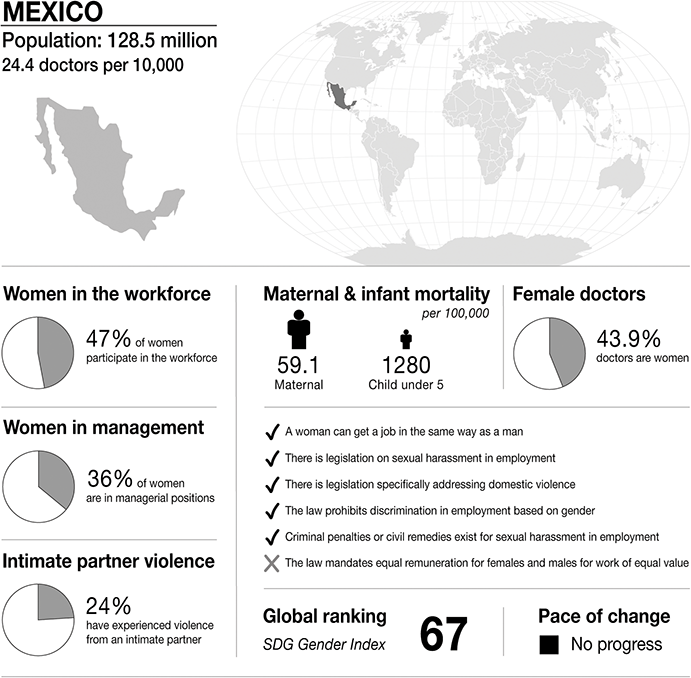
Figure 25.1 Long description
The infographic provides information about Mexico, with a population of 128.5 million and 24.4 doctors per 10,000 people. It highlights several gender-related statistics. 47 per cent of women participate in the workforce. 36 per cent of women are in managerial positions. 24 per cent of women have experienced intimate partner violence. Maternal mortality is 59.1 per 100,000. Infant mortality under 5 is 1280 per 100,000. 43.9 per cent of doctors are women.
The infographic lists the presence or absence of law and policy on gender equality. In Mexico:
– a woman can get a job in the same way as a man.
– there is legislation on sexual harassment in employment.
– there is legislation specifically addressing domestic violence.
– the law prohibits discrimination in employment based on gender.
– criminal penalties or civil remedies exist for sexual harassment in employment.
– there is no law that mandates equal remuneration for females and males for work of equal value.
The S D G Gender Index global ranking is 67, and is stable.
Considering the above data, we can affirm that there is a slight difference between the number of men and women in the country; however, this gap is exacerbated when we talk about the presence of women and men in positions of power and decision-making. A clear example of this difference and its prevalence was observed when, in 2014, the obligation of political parties to guarantee gender parity for the registration of candidacies to different elected positions was raised to Constitutional rank (INEGI-INMUJERES). (1) In Mexico City, the governor was appointed by the republic’s president, and the position had been assigned only to men. However, in 1999–2000, democratic election was established, and a woman was appointed interim governor. In the 2018 elections, Claudia Sheinbaum Pardo was elected as head of a government of science, and there was likewise a considerable increase in the participation and election of women for the mayoralties of the city. (Reference Fernández Poncela2)
According to INEGI 2020 statistics, 15.1% of the total population in Mexico is indigenous, and half are women. They are doubly discriminated against, first because of their indigenous status and second for gender reasons. Opportunities for indigenous women in labor, political participation, or schooling are very scarce and may even be non-existent in some ethnic groups. In the most challenging situations, some indigenous women who have not reached the age of majority are the object of transactions in exchange for some material good for their families. These acts are shielded using arguments about the uses and customs of various indigenous peoples. (Reference ChandomÍ3)
Gender in Medicine
In Mexico, there has been an increase in the number of women in the medical field. For example, in the last school year, 2019–20, the General Directorate of School Administration (DGAE) of the National Autonomous University of Mexico (UNAM) reported that 33% of the 1,930 students accepted for the career of a medical surgeon were women.
Since the 1990s, the gender breakdown in medical schools has been reversed, and to date, the female sex is predominant. This phenomenon has been dubbed the ‘feminization of medicine’. One projection suggests that by 2027 the percentage of women enrolled in medical schools will reach 60% nationally. (Reference Graue-Wiechers, Alarcón-Fuentes, Guevara-Guzman, Ostrosky-Wegman, T, 372ME, P, E and P4)
The presence of men stands out within management positions in health institutions and medical schools. However, the last decades have seen increased participation of women as leaders, mainly in medical education and some health institutions. Within medical education, the UNAM School of Medicine is one of the most representative of this change since more than half of the managerial positions, including secretaries and heads of academic departments, are held by women. In the research division, seven women head their departments, and the positron emission tomography/computed tomography (PET/CT) services, research, and teaching unit is headed by a woman.
Regarding medical specialties, a report published in 2022 found that from 2006 to 2015, the surgical specialties that showed an increase in female students graduating were otolaryngology (55%), cardiothoracic surgery (23%), coloproctology (21%) and pediatric surgery (17%). Regarding clinical specialties, those with an increase were pediatric cardiology (52%), allergy/clinical immunology (30%), pediatric neurology (28%), genetics (25%), and pediatric endocrinology (23%). (Reference Sepúlveda-Vildósola, González, López-Sepúlveda and Martínez-Escobar5) For instance, only three of the thirteen institutes that make up the National Institutes of Health have had or now have female medical directors. However, the remaining institutes’ general directorates have never been led by a woman. (Reference Rivera-Romano, Fresno, Hernández-Lemus, Martínez-García and Vallejo6) In our country, data regarding gender violence in medical students has been reported from 15.5–69%, more towards women than men. To mention a couple of examples, it was reported to have been performed through sexist insults (F: 11.5%; M: 3.4%) and personal academic favoritism (F: 9.0%, M: 2.9%). (7)
Sexual harassment has been reported to occur more frequently in clinical cycles (73.66%) than in primary cycles (26.34%). In both, women are the most affected, and occurrence increases with the number of years of study, being significantly higher during the fourth and fifth years of the degree course. Harassment manifests as unwanted invitations to go out on a date, inappropriate jokes, leering, questions to female students about their sexual habits, unwanted sexual conversations, obscene flirtatious comments, insinuations of sexual relations, unwanted sexual attentions, or academic blackmail. Sexual abuse affects 7–28% of students; 46–54% are women and 19–39% are men. The forms of abuse include being spied on in bathrooms, being forced to undress, showing sexual organs, observing masturbation, being pressured to perform oral sex, and fondling, among others. (7)
Medical Education
In Mexico, the body in charge of evaluating and certifying the quality of medical education is the Mexican Council for the Accreditation of Medical Education, (8) which establishes the standards to evaluate the quality of education. (Reference Salud9) The figures reported by COMAEM for the second semester of 2022 are ninety-one accredited programs, eleven with expired accreditation, one without accreditation, twenty-five in self-assessment, two unfavorable opinions, and twenty-four without the accreditation process. (Reference Salud9)
The accreditation considers standards from the administrative process to the evaluation of the students and the monitoring of graduates. COMAEM’s challenge is to certify medical education because of the increase in medical schools and students in the country (133,000 students in 2018). (Reference Rillo, Martínez-Carrillo, Conteras-Mayén, Valdéz-Ramos and Castillo-Cardiel10) On the other hand, medical education in Mexico is heterogeneous; there are more than 140 public and private medical schools with different programs and characteristics. (Reference Blancas and Bárcena11) In addition, about 50% of specialty students are enrolled in postgraduate training at UNAM. Although the school environment seeks to be free of violence, a factor that can substantially increase the risk of violence is social service. The social service component is integrated into the program to ensure students gain practical experience and develop a sense of social responsibility before becoming practicing physicians. However, it is unpaid and unregulated and the government does not offer safeguards for physicians. (Reference Blancas and Bárcena11)
Resident doctors do not have labor rights since their professional activity is considered a postgraduate scholarship. These factors increase the susceptibility of physicians to unsafe and violent environments. (Reference Machado, Ramírez, Sepúlveda and Márquez12) A resident physician in Mexico is a medical professional who enters a receiving medical unit to perform a specialty characterized by academic, assistance, and research activities that must be carried out during the time stipulated in the related academic and operative programs. In addition, these must be endorsed and supervised by a university institution.
Law
The Federal Labor Law, in article 133, states that ‘Employers or their representatives are prohibited from carrying out acts of harassment and sexual harassment against any person in the workplace or allowing or tolerating such acts.’ (13)
Public hospitals and clinics received at least 118 complaints of acts of harassment and sexual and labor harassment from workers, residents and intern medical students, and beneficiaries, from December 1, 2018 to June 2019. The complaints range from acts of workplace harassment (unjustified workload, mistreatment, threats, and physical aggression) to sexual aggression (verbal and physical). Some women even report having been drugged to be later sexually abused by medical personnel. (Reference Universal14) Workplace harassment in the hospital environment occurs mainly in administrative areas; in the medical area, it is little reported. (Reference Aldave, Hernandez-Garnica and Puga-Murgia15) In a study of professional burnout in the hospital environment, psychological harassment, the medical specialty area of participants and the year of residency contributed to professional burnout by 23%, while the gender of participants and the intensity of harassment did not. (Reference Tafoya, Jaimes-Medrano, Carrasco-Rojas, Rodríguez-Machain and Ortiz-León16)
Medical Regulation
The General Law for Equality between Women and Men (2006), the General Law for Women’s Access to a Life Free of Violence (2007), and the Regulation of the General Law for Women’s Access to a Life Free of Violence, to name a few, stipulate rules on sexual harassment and gender violence in the workplace in Mexico. However, unfortunately, the applicability depends on the institution. Since so few institutions have a Gender-Based Violence Committee, there is currently little control over cases of gender-based violence in hospitals. One example is the Mexican Institute of Social Security (IMSS). In its ‘Code of Conduct and Prevention of Conflicts of Interest of Public Servants of the IMSS’, section 7.2 calls for respecting human rights, equality, and non-discrimination and enforcing measures to stop any form of violence, harassment, or sexual or labor harassment towards any person in the workplace. (17) On the other hand, during their training as medical specialists, university students can be encouraged to learn about the various forms of violence and, more importantly, reliable reporting channels. (Reference Olivares Olivares, Gómez Zapata, Flores Félix, Castañeda Prado, Turrubiates Corolla, Esperón Hernández and Valdez-García18)
Case Study
Prelude
The isolation experienced by medical students occurs from the moment they enter medical school, as educational demands prevent them from maintaining the family, social roles, and social relationships they had outside of medicine up to that point. Then they are cut off from university life. From the third year of studies, they are sent to a hospital where they take classes and begin to get involved in hospital medical care activities, especially in the morning but also in the afternoon and at night with ‘on-call’ hours. This isolation takes the form of long days of study-work inside the hospital from the fifth year of the career, called Medical Internship, and reaches its maximum during the specialty studies, called Medical Residency, where the short time outside the hospital is used to sleep and study.
The so-called ‘teaching hospitals’ have in common a hierarchical structural design characterized by the isolation of their doctors in training, who have little or no contact with the outside world. This strips them of their belongings, roles, and social positions before entering. Isolation is reinforced by impersonal treatment such as calling them by their grade of training instead of by name: the students, the MIPS (medical interns in the fifth or sixth year of their career), the interns, the R1, 2, 3 (first, second, third or subsequent resident physicians).
Doctors in training also break with the ordinary spheres of life – sleep, work, and recreation – and everything converges in the same physical space, always in the company of the same people and under a hierarchical organization that imposes rigid schedules and plans. Moreover, the work assigned to students (undergraduate and graduate) tends to be alienating, as they receive minimal payments in exchange for long and exhausting workdays laden with high professional responsibility and sometimes without the necessary inputs. The medical profession’s isolation and inflexible hierarchical order place students under a strict surveillance system designed to ensure their cooperation and obedience, through systematic harassment and the imposition of rules that endorse their subordinate role (the MIP cannot speak directly with the person on secondment but only with R1 and the latter with R2 and so on), or through the imposition of diffuse and changing rules whose purpose is to endorse the power of authority over students. Some laws violate their autonomy by forcing them to ask permission to carry out basic activities such as going to the bathroom or eating. Or through the systematic application of punishments, which include verbal aggressions such as obscene nicknames or swearing, cursing or humiliating them by highlighting their mistakes, making fun of them or talking about them as if they were not present, and forcing them to participate in activities that disqualify them, such as performing unnecessary, meaningless or menial tasks (e.g. mopping the office, buying dinner in the early morning). In turn, it is common for interns or residents also to receive ‘punishment guards’, which prolongs their confinement and isolation within the hospital.
On the other hand, a system of privileges is also included. Their obedience is rewarded with a degree of restitution for what is lost within the hospital; therefore, students adapt to the extent that they obey the rules, avoid punishment, and accept the privileges granted. The differential treatment that female medical students receive protects them from the mistreatment and abuse to which their male colleagues are subjected. This apparent protection enables male students to achieve triumphs in the competitive world of medical training, because they can’t earn the same privileges if they do not endure the same ‘punishment’.
In addition to the above, gender-based violence among medical students is also manifested by the following:
1) Gender discrimination. Physicians and residents often target female medical students based on their physical attractiveness. As a result, their teaching responsibilities are often skewed towards flirtation or condescending protection of female students, stripping them of their role as students and thus excluding them from intellectual competence within the field.
2) Sexual harassment. The intensity of harassment experienced by female medical students ranges from subtle advances to explicit sexual harassment. It is thus a known pattern within the medical profession that operates with impunity and gives rise to a culture of sexual harassment within teaching hospitals.
Assault
When Sara was a MIP, she attended to a patient with a periodontal abscess during a night shift. In her hospital, an otolaryngologist would typically handle such a procedure, so Sara called the doctor. However, while the doctor was on the way, she left the patient and a family member in front of the office and went to see another consultation because the emergency room was overfull with patients that day.
I remember the call from the otolaryngologist, who shouted at me, asking where I was, that he was not going to pass the patient by himself, that I was not his employee. I ran out, and throughout the consultation, he kept asking me and evidencing the questions he did not know in front of the patient … I felt very humiliated. At the end of the consultation, he told me not to accompany the patient, you left her here alone, she can go out alone, and I need to talk to you … at that moment, I thought he was going to scold me. However, he began to take my hand; meanwhile, he asked me, ‘What are you going to do now to make up for your mistake?’ I gave answers like ‘I’ll buy him a coffee’, which we used to do when we messed up, but he caressed my hand and face and said, ‘But come on, think about it a little more; what can you offer me?’ At that moment, I was paralyzed; he put his arms around me and pulled/brought me closer to him; when he was about to kiss me, a classmate knocked on the door, and I ran out of that office …. I don’t remember being so scared.
Following the incident, the student said that the doctor would make remarks in the corridors:
if there were people around, he would only tell me ‘Dr you owe me something’; if there were no people around, he would come close to my ear and tell me ‘how much for oral sex? have you ever made love to me in a van?’ During surgeries, he would grab me by the waist and laugh; he would say it was to see how concentrated you were, doctor. At some point, I realized that I began to dress differently; I looked for the least provocative … I guess I felt somehow guilty as if I had provoked him. I felt guilty in some way, as if I had provoked it. When I talked about it with other colleagues, each one told her experience, and we said that’s why we shouldn’t be alone, or even someone mentioned that we should see the benefit of it.
Exposure
Sara remembers commenting with her classmates that they should report the aggressors but that many of them mentioned several cases where negative consequences ensued for the students and not the aggressors. Some minimized the abuse or blamed the victims: ‘it is also your fault, you are always smiling, and they see it as an invitation, they are men, they like to compete for attention, you should feel flattered to have the attention of the handsome and successful doctor [aggressor otolaryngologist]’ (Sara recalls).
In the case of the male colleagues, they often argued errors in the interpretation on the part of the female doctors:
it is that you also exaggerate, as a man you tell them something nice, you flatter them, or you invite them to go out, and they already feel that we are harassing them, they can no longer hug anyone, besides they wanted to be in a man’s place, right? Well, they have to tolerate our jokes.
According to Sara, she once saw how they ‘punished’ an inmate who complained about verbal abuse from the doctor. ‘They had a dilator that they used to call it (the “Oh my god”), and they made the joke of raping him with this object in the doctors’ office while they told us that this happens to those who gossip; that dog does not eat dog, and that we are their pets and we owe them obedience’, she says.
You don’t feel inclined to report it in this situation since you can see how these doctors and the hospital administration are friendly. You seek assistance at the institution, but there are no avenues for complaint or accompaniment.
Aftermath
Sara says that these experiences throughout her professional training modified her way of addressing patients and the concept she had of certain health professionals.
I stopped smiling all the time, I became drier, curter, more distant, I changed the way I dressed, I tried to keep a low profile. … I remember following the advice of a friend, it worked for me to go with an angry face as if I was going to kill them all, the tone of my voice was forced to be more serious and I started to make sexist and sexual jokes in an attempt to belong, although I still don’t feel comfortable with them.
Currently, Sara belongs to a gender commission of her university to generate a change and propose ways to support the doctors to report and accompanies them during the process of avoiding revictimization.
It took me years in psychotherapy to understand that it was not my fault, to begin to team up with other doctors who had reported and that despite going through similar or stronger experiences than mine, they still keep their essence and a deep desire to make changes, some of them today in positions of power making changes in their work areas.
Discussion
The number of women in medical schools has not significantly improved their position, which can be attributed to the medical environment’s highly hierarchical and androcentric nature. (Reference Llenas-García, Masiá, Pascual Perez, González-Cuello, Agulló Re, Romero Nieto, Amat Díaz, Padilla Urrea, Rodríguez Lucena and Wikman-Jorgensen19) Gender-based violence, understood as an act of power and force exerted on women and men based on social and cultural constructs and belonging to a specific sex, persists in several areas. (Reference Çinaroğlu, Efgan and Payza20) Thus, it is a structural process sedimented in a sociocultural order that legitimizes it and provides people with the conditions and skills to exercise it. This reinforces and qualifies sexual harassment as a desirable behavior; that is, it is a means of control and not an end. Power relationships, constructed at the macro level, are expressed at the micro level in relationships and power dynamics established in the school environment between peers, teachers, and students. (Reference Chinichian, Aghabiklooei, Mehrdad, Pouryaghoub and Orouji21)
An in-depth analysis of how social systems and institutions affect interpersonal violence that disproportionately harms women must be carried out. (Reference Jenner, Djermester and Oertelt-Prigione22) In the medical profession, the symbolic structure of power is reflected through the hierarchical systems of teaching, learning and practice. These hierarchies are permeated by the androcentric characteristics of our current society. Therefore, the medical community reproduces and transmits, through the hidden curriculum, forms of perception, thought, and action that keep women and men (who do not meet the social standards of masculinity) in an undervalued space of powerlessness. (Reference Wheatley, McKeon, Pebole, Wells, Rees, Ward and Rosenbaum23) For example, sexual violence is considered a device of corporeality whose existence obeys a strategic need to control female bodies and is exercised against women for being women because their aggressors think them to lack the minimum rights of respect. (Reference Rolland, Hadouiri, Haas-Jordache, Gouy, Mathieu, Goulard, Morvan and Frajerman24) In its exercise, the socially structured male subjectivity intervenes to desire and possess women at any cost. In its activity, the socially structured male subjectivity intervenes to choose and include women at any cost. This sociological subjectivity, in turn, causes women to perceive violence less, because they conceive many of these acts as standard within their culture, that is, socially legitimized behaviors that are not considered incorrect. (Reference Berbegal-Bolsas, Gasch-Gallén, Oliván-Blázquez, Sánchez Calavera, García-Arcega and Magallón-Botaya25)
Violence in the medical environment creates human rights, public health, and academic problems due to its effects on physicians’ physical and mental health and its extensive negative consequences on the health system. (Reference Sammut, Ferrer, Gorham, Hegarty, Kuruppu, Salvo and Bradbury-Jones26) Gendered patterns of interaction during medical specialty training play a decisive role in the constitution of medical culture. Medical culture impacts specialty choices but also interferes with learning and the ability to perform as professionals. This also includes worse interactions with patients because they function as a reproduction of the same gender structures that originated it. Female medical specialists are deprived of performing procedures essential to their specialty and subsequently will probably practice that specialty with insecurity and have to make up for deficiencies during their training.
Identifying gender violence will make it possible to deduce that it is an inherent and incorporated problem in the daily work of school hospitals. This practice is rooted in the hegemonic medical knowledge and bearers of hierarchical power, without any questioning, masculinized, naturalized, and normalized in daily practice through routines, attitudes, language, and management of this knowledge, which is legitimized by the hospital institution from the very organization of the services. (Reference Sammut, Ferrer, Gorham, Hegarty, Kuruppu, Salvo and Bradbury-Jones26) Therefore, the education and training of medical specialists ritualize the difference and the gap between male and female health personnel. Biological, social, and cultural differences are not considered to improve care but rather to justify the differences and naturalize the use of power and the forms of daily violence exercised in the institution, between male and female coworkers.
Introduction
Sexual harassment of doctors by doctors is ravaging the health care system, especially in developing and low resource countries like Nigeria, where there is a cultural and traditional preference for the male child. I am a victim of sexual harassment at the medical workplace. This has kindled my interest in the topic to investigate this problem in Nigeria. If I have the resources I will fight for the rights of women doctors to help victims of sexual harassment who are doctors. I conducted an international study in 2014 at the Medical Women’s International Association (MWIA) side event during the United Nations Commission on the Status of Women. The result of this pilot survey was presented during the MWIA conference in 2016 in Vienna. The presentation ignited the interest of the then MWIA president to conduct an international study of sexual harassment at the medical workplace, and I was part of the team that conducted the survey. The results of the study have been presented at different MWIA international and regional conferences, including other fora on women. I have also published articles on sexual harassment at the medical workplace titled ‘Sexual harassment at the workplace, an impediment to gender equality, a pilot study’ and ‘Sexual harassment against female residents, the role of hospital administrators and managers’. I suffered career retrogression and would not want anyone to have the same experience as a result of being sexually harassed by a senior colleague.
Gender in Nigerian Society
Nigeria is the most populous black nation in the world, the most populous country in Africa, the third most populous country in the world, and the biggest country in West Africa. (Reference Ogundare1) According to the 2006 population census, Nigeria has a population of 140,431,790 people with 69,086,302 females and 71,345,488 males. Nigeria occupies 923,769 square kilometres, where 909,890 square kilometres makes up the land mass and 13,879 square kilometres are water. (2) It is bounded by the Republic of Benin, Niger, Chad, Cameroon and the Gulf of Guinea. Of the Nigerian population, 17.50% of doctors were women in 2008. (3) The Federal Republic of Nigeria was divided into three divisions as at 1951. (Reference Ayate and Akwa4) These have given birth to thirty-six states with a capital territory at Abuja. Nigeria is also divided into six geopolitical zones namely North-East, North-West, North-Central, South-East, South-West, and South-South zone. Nigeria is a country where about 250 languages are spoken, with English acting as the lingua franca. Pidgin English is a creole language widely spoken in Nigeria, which is English mixed with words from the local languages. The tenses do not follow British, American or Australian English.
Infographic Nigeria. Infographics were provided by CartoGIS Services, The Australian National University. Population: from World Bank https://databank.worldbank.org/source/population-estimates-and-projections. Sustainable Development Progress, global ranking and statistics on women in the workplace, women in management and intimate partner violence: from United Nations SDGs Data Portal https://unstats.un.org/sdgs/dataportal. Female doctor percentage: from Global health workforce statistics www.who.int/data/gho/data/themes/topics/health-workforce. Legislation and law statements: from the World Bank gender data portal 2023 https://genderdata.worldbank.org/en/indicators. Maternal mortality statistics: from the Global Health Observatory 2020 https://mmr2020.srhr.org. Infant mortality statistics: from United Nations International Children’s Fund (UNICEF) https://data.unicef.org/topic/child-survival/under-five-mortality.

Figure 26.1 Long description
The infographic provides information about Nigeria, with a population of 223.8 million and 4 doctors per 10,000 people. It highlights several gender-related statistics. 52 per cent of women participate in the workforce. 30.3 per cent of women are in managerial positions. 24 per cent of women have experienced intimate partner violence. Maternal mortality is 1050 per 100,000. Infant mortality under 5 is 10700 per 100,000. 65.4 per cent of doctors are women.
The infographic lists the presence or absence of law and policy on gender equality. In Nigeria:
– a woman can get a job in the same way as a man.
– there is legislation on sexual harassment in employment.
– there is legislation specifically addressing domestic violence.
– criminal penalties or civil remedies exist for sexual harassment in employment.
– the law does not prohibit discrimination in employment based on gender.
– there is no law that mandates equal remuneration for females and males for work of equal value.
The S D G Gender Index global ranking is 130, and is stable.
In Nigeria, there is preference for the male child as families will prefer to have a son than a daughter, and this has affected girl-child education. It also affects the training of children, including the way females are treated from cradle to adulthood. Sons are given better feeds as children, and better education and health care. This is a problem where the girl-child may not be given formal education and may not be allowed to attend school. (Reference Tyeakaa, Amaka and Nor5) Some of the reasons for preference for the male child are religious misinterpretations, cultural beliefs, economic crisis, poverty, early marriage and teenage pregnancy. Women are expected to be at home and look after the children. Some people believe that educating a girl is a waste of resources as she will take the education to her husband’s house when she gets married. This is gradually changing as more parents are enrolling their daughters in school. Women are now occupying leadership positions in government. In some Nigerian cultures, women have traditional ceremonies they perform as rites of passage, celebration of womanhood and coming of age of the girl child. An example is the Iria ceremony performed by the Ibani people of Grand Bonny and Opobo of southern Nigeria.
Gender in Medicine
Choosing medicine as a career has increased among Nigerian women, (Reference Amadi6) though some specialties tend to be dominated by men. There remains a large gender difference in the choice of specialty. (Reference Jefferson, Bloor and Maynard7) Traditionally, women have assumed the responsibility for raising families and maintaining the household. (Reference Mobilos, Chan and Brown8) The gender roles defined by Nigerian society may affect the choice of medical specialty.
There are more Nigerian women doctors and medical students compared to earlier years. (Reference Amadi6) According to the Nigerian National Bureau of Statistics in 2015, 2016 and 2017 the proportion of doctors in Nigeria that were females was 34.1%, 34.1% and 34.6%, respectively. (Reference Diderichsen, Johansson, Verdonk, Lagrojanssen and Hanberg9)
Women have occupied leadership positions in health institutions, the Ministry of Health, hospital management boards and also politics both at the state and national levels. Dr Elizabeth Abimbola Oshodi was the first woman to be elected as president of the Nigerian Medical Association in 1988 for the 1988–1990 tenure. The Nigerian Medical Association is the umbrella association of all doctors and dentists practising in Nigeria. Prof Adenike Grange was the first Nigerian woman doctor appointed as a Nigerian minister of health. Other Nigerian women doctors have been provosts of medical colleges, deans and deputy vice-chancellors of universities and deputy governors of Nigerian states. Some of the reasons for the disparity in the proportion of male and female doctors are family and societal norms and beliefs which are being transferred to the health sector. (Reference Abdulgadir10)
Gradually, women doctors are penetrating the highly dominated male medical specialties such as orthopaedics, general surgery, burns and reconstructive surgery, obstetrics and gynaecology and urology. (Reference Amadi6; Reference Jefferson, Bloor and Maynard7; Reference Flyckt, White, Goodman, Mohr, Dutta and Zanotti11–Reference Yusufu, Ahmed, Odigie, Delia and Mohammed16). In Nigeria, females have dominated some specialties such as paediatrics, anesthesiology, internal medicine, ophthalmology, radiology, family medicine and community medicine. This reflects the cultural expectation that women will specialize more in fields of medicine that express the natural caring and nurturing nature of women as related to preventing diseases, helping and taking care of children (Reference Amadi6; Reference Abdulgadir10; Reference Chukwumah and Unweni17). There are few studies on sexual harassment among doctors practising in Nigeria and fewer on how women doctors are affected.
Medical Education
Medical education can be categorized into undergraduate and postgraduate medical education and continuing medical education. (Reference Malu18; Reference Ezeanolue19) Medical schools in Nigeria are known as colleges of medicine, colleges of health sciences or faculties of medicine, and are charged with the responsibility by law to train medical doctors (Reference Malu18; Reference Ezeanolue19) Undergraduate medical education takes six years and is regulated by the National University Commission (NUC) and the Medical and Dental Council of Nigeria (MDCN). (Reference Malu18; Reference Ibrahim20) After graduation, the young medical graduate undergoes internship followed by the National Youth Service Corps (NYSC). NYSC is a one-year compulsory programme which every Nigerian graduate thirty years and under must undergo irrespective of the course of study. Medical residency in Nigeria is largely sponsored by the government as only few missionary and privately owned hospitals offer residency training. Postgraduate academic degrees are awarded by the universities, (Reference Malu18) including postgraduate diplomas in some clinical specialties, for example anesthesiology. Residency training is regulated by the postgraduate medical colleges, which are the National Postgraduate Medical College of Nigeria (NPMCN) and the West African Postgraduate Medical College through its component colleges the West African College of Surgeons and the West African College of Physicians (Reference Malu18; Reference Ezeanolue19). These colleges periodically visit residency training accredited centres and medical colleges to see if they meet the approved guidelines for residency training. On completion of the residency training, the new consultant may be retained in the hospital where the residency training was done or asked to seek a job elsewhere. Junior doctors and medical students are vulnerable at every stage of their training to sexual harassment.
Law
Previously there was no legislation against sexual harassment at the workplace or in educational institutions. However, the National Industrial Court of Nigeria (NICN) in 2017 made an amendment of its civil procedure rules in which provision was made through Order 14, (21) titled ‘Sexual Harassment and Discrimination at the Workplace’. (22; 23) Sexual harassment is defined by the National Industrial Court of Nigeria as consisting physical conduct of a sexual nature, verbal and non-verbal forms of sexual harassment including quid pro quo harassment. (23) In 2019, a bill was proposed by the Nigerian Senate titled ‘Prevention, Prohibition and Redressal of Sexual Harassment in Tertiary Educational Institutions 2019’, which also defines sexual harassment and punishment for offenders if it occurs in higher institutions. (21) The law covers all students in tertiary institutions including medical students. Some medical schools and hospitals have their various guidelines and policies against sexual harassment. In institutions where there is no formal reporting system, the survivor reports to her supervisor, hospital management or authorities of the medical school or files the case in court. The supervisor may be a supervising consultant, head of department, faculty chair, dean, provost of a medical school, director of medical services, chairman of a medical advisory committee, head of a residency training programme or the chief medical director. A panel of enquiry is constituted to investigate the matter and make recommendations. Depending on the petition, the recommendations may or may not be considered by the hospital or medical school.
Medical Regulation
The practice of medicine and dentistry in Nigeria is regulated by the Medical and Dental Council of Nigeria (MDCN). (24) The MDCN ensures that medical and dental practice is conducted in an efficient way in Nigeria, safeguarding the health of its citizens. (Reference Ezeanolue19) Once a medical and dental student graduates from any Nigerian medical school, the new doctor is inducted and a temporary practising licence is issued, which is valid for two years to enable the doctor to practise medicine and dentistry as an intern under the tutelage and supervision of a consultant. At the end of the internship, the doctor applies to the MDCN, submitting the necessary assessment forms duly signed by the supervising consultants and the head of the hospital, which is the medical director or chief medical doctor of the hospital. Then a permanent practising licence is issued, which is renewed annually after attending the prescribed continuing medical education units. Medical and dental graduates from foreign universities sit for an examination conducted by the MDCN to enable them to practise in Nigeria.
The MDCN has published the ‘Code of Medical Ethics in Nigeria’, which guides medical practice in the country. (Reference Nwaohuocha25) Members of the public who feel aggrieved by any professional misconduct can report to the hospital management, the MDCN or the Nigerian Medical Association (NMA). If a report is made to the MDCN, a panel sits to investigate the allegation. Depending on the offences, the erring doctor may be suspended from medical or dental practice for a stipulated period of time or have his or her name permanently struck from the MDCN register.
Different hospitals have different policies and guidelines for disciplining erring doctors. A panel is set up to investigate any petition of misconduct and recommendations made to the hospital management. Punishments of doctors found guilty include apology to the patient, suspension for a number of months during which the salary of a doctor is withheld, removal from the workplace, and issuance of a query or warning letter. However, the health care sector includes a number of people and organisations with different expectations, opinions and backgrounds. Therefore, sometimes doctors who behave unprofessionally may be cautioned without any formal letter by their supervisor or fellow colleagues.
Case Study
Prelude
This case study involved interviewing a survivor of sexual harassment in which the perpetrator is a male doctor in a Nigerian teaching hospital. The survivor describes in her words what made her vulnerable:
I am single and generally in our society people look at single women as weak that can be humiliated as there is no one to speak for them. They are also seen as failures.
She identified single women in Nigeria as vulnerable to humiliation in the family, at the workplace and also in the community. Also, being a junior doctor is another factor of vulnerability to sexual harassment at the workplace. She was even confronted by male and female colleagues that she should deny the harassment and be quiet.
Assault
Dumebi is a female ophthalmology resident doctor at a Nigerian teaching hospital. She was happy about her job and was carrying out tasks assigned to her dutifully. In the department, they work in teams comprised of registrars, senior registrars, and consultants. When she joined the department, there was a senior registrar named Tosan who travelled to the United Kingdom for subspecialty training in a field whose training was not available in Nigeria. Tosan’s course lasted for six months, and he had already spent three months in the United Kingdom before Dumebi joined the faculty. Dumebi had not passed the primary examination which is the entry requirement for residency training in the postgraduate medical colleges in Nigeria.
Three months after Dumebi joined the department, Tosan returned from the United Kingdom. One day Dumebi and Tosan met at a taxi rank on their way to work and boarded the same taxi to work. While in the taxi they exchanged pleasantries and were engaged in a conversation. Tosan told Dumebi about a regional conference scheduled later that year overseas with sponsorship from the government. Dumebi told Tosan she was not interested as she just joined the department and was still familiarizing herself with the specialty and learning its rudiments. Tosan pressurized Dumebi to send a text message to the consultant in charge coordinating the trip and he forwarded the consultant’s number to Dumebi. After much pressure, Dumebi sent a text message to the coordinator of the trip. Tosan never mentioned to Dumebi that she would have to repay him after the conference.
One day, Tosan asked Dumebi for her USB drive, saying that he wanted to give her some academic resources to enable her to pass her residency primary examination. Dumebi gave Tosan her USB drive, and Tosan returned it back with his own USB drive of a higher capacity, as Dumebi’s could not contain all the resources. Dumebi thanked Tosan and took both drives, returning Tosan’s equipment in the next couple of days.
After the conference, Tosan started making sexual advances at Dumebi which she turned down, but he persisted. Tosan told Dumebi she had to pay him back for informing her about the conference. Tosan later reported Dumebi to their faculty chair, stating that Dumebi was disrespecting him. At this time, Dumebi had been sent for a three-month rotation in the surgery department and had been there just one week. Dumebi was recalled from her surgery rotation and told that a panel would be set in the department to investigate the issue. Dumebi was never sent back to complete her rotation in the surgery department.
At this time, Tosan was a candidate for the position of president of the junior doctors association of the hospital. Dumebi informed the association about what was going on. Her fellow junior doctors, both male and female, forced her to withdraw her complaint. Tosan sent a text message to Dumebi which read: ‘I do not think that life is all about squabbles. I still wonder why you would want to ridicule me.’ After some time, Dumebi’s name was removed from the departmental duty roster. Queries were issued to Dumebi titled, ‘insubordination to superior authority’, and a letter requesting Dumebi to seek medical help and send a report that she was medically fit. Dumebi had a mentor in the hospital who was a consultant in another department. One of the consultants in the hospital who was part of the hospital management committee sent Dumebi’s mentor a text message which reads: ‘Thank you madam good morning, please can you confirm if your girl Dr Dumebi has started treatment’. At this time, Tosan won his election and became president of the junior doctors’ association.
There was an offer for the purchase of land. Dumebi was interested and submitted the necessary documentation. After paying for the land, Tosan refused to give proper documents to Dumebi as her name was written in initials in the deed of conveyance. When Dumebi requested Tosan to write her name in full and not in initials; he refused. Instead he sent a text message to Dumebi: ‘Who knows why all the typists make the same mistake in your name. I did the right thing for all the allottees but the evil in your heart will not allow you to know good. Posterity will judge me but the evil in your heart must hunt you for life.’
Limbo
The survivor in this case never had the intention of reporting; worse is that there was no formal reporting system nor policies against sexual harassment in the hospital. This is an interesting case because usually it is the victim that reports first, but here the perpetrator reported that his victim was disrespecting him. When Dumebi was reported by the perpetrator, a panel was set up in the department to investigate the issue and it included both a male and female consultant. She and the perpetrator were interviewed separately and later together. At the end of both sessions, Dumebi was told that what she was claiming never happened as she had no evidence and was just making up stories against her perpetrator. Before then the perpetrator told Dumebi that once they got into the panel, she should start apologizing to him. The survivor said she was strong enough to face whatever it is as she will not give into any pressures mounted on her. A second panel was also set up by the hospital management, made up of professors and doctors from other departments. She attended the panel, but the recommendations of the two panels were never communicated to her. In her own way, she met with several senior doctors to intervene in the matter, but nothing was done.
Exposure
This case was different as her name was known from the beginning. There were a lot of gossips and false accusations as a result of the sexual harassment. Even a female ophthalmology senior registrar told the survivor that she was the cause of the sexual harassment and should apologize to the perpetrator. Reporting to female doctors did not save the situation as they all supported the perpetrator. She was never concerned about the grapevines (gossips and rumours at the workplace) as they are common in any workplace. Dumebi never blamed herself for what happened as she never saw anything wrong with her action. The only thing she thought was wrong is that she should not have given in to the pressure mounted on her by the perpetrator to joining the trip for the overseas conference, as there are two Nigerian proverbs that say, ‘free things can purge the stomach’ and ‘nothing goes for nothing’. She never argued with anyone since within her she knew she was sexually harassed even though she never saved all the discussions and text messages received from Tosan. She kept her cool and encouraged herself.
Aftermath
The abuse that occurred impacted on the personal and professional life of the survivor positively and negatively. The impact was positive on her personal life as she leant not to be subject to any form of pressure especially when it is coming from the opposite sex and someone of a higher cadre. She also learnt to avoid receiving favours that she does not merit as it may be bait. In this case, if she had not attended the conference, the perpetrator would not have had any opportunity of asking her for payback. The negative impact was that she was not allowed to complete her residency training in her specialty of choice. She experienced career retrogression and was tagged a ‘troublemaker and troublesome person’. It did not bother her. She is still a medical doctor practising her profession in another hospital. She was able to recover fully and never had any emotional and psychological breakdown because she never allowed it to disturb her and she self-encouraged herself. She had the will power and determination to become an ophthalmologist. Her incident became an eye opener in the first hospital where she worked, as other male doctors were surprised that with everything done to Dumebi, she never compromised her integrity, morality and self-esteem. She hopes to write a report about her experience to the United Nations to bring this problem to light, so that an international day can be dedicated to sexual harassment at the workplace. She also wishes to have a movement and foundation to help women doctor victims of sexual harassment by providing counselling and legal protection, and by helping them secure residency placement elsewhere if necessary. A part of her plans is to provide stipends to other victims if their salaries are stopped or their appointment terminated.
Discussion
In Nigeria generally, women are blamed if they are single as they are seen as being wayward with a bad character: that is why no man has taken her as his wife. Worse is if the female is a professional, for example a medical doctor. She is viewed as being choosy, selecting and setting high standards for suitors. Nigerian single women have been discriminated and stigmatized against in their families, at the workplace, in religious places and in the community, including doctors, as generally in Nigeria, marriage is viewed as a benchmark for measuring the decency of women. (Reference Nwaohuocha25) There are three groups of single women: the never married, the divorced and the widowed. The never married is the worst hit with discrimination and sexual harassment – including women doctors. It is considered abnormal in Nigerian society if a woman, even if she is a doctor, is still single beyond the conventional age considered for marriage in Nigeria. (Reference Ntoimo and Isingo-Abanihe26) In this case, this puts the woman at risk of sexual harassment at the workplace as she is seen as someone without a helper. She can be discriminated against and stigmatized by both male and female doctors. It is worse that even older single women doctors will also stigmatize and discriminate against a younger single female doctor. For instance, in the case discussed, the survivor was not protected by her fellow female colleagues. Even when she told a female professor who is also a doctor about what happened, the first question she asked the survivor was, ‘why are you not married?’ One begins to wonder if marital status is now a criterion for jobs at the medical workplace. Another woman doctor told the survivor that she knows the perpetrator very well, that he is a married man, and that she knows his wife and that therefore he cannot woo another woman. Even when panels are sent to investigate allegations of sexual harassment in Nigeria, if the victim is single most times the panel will start asking the victim why she is single, stating that it is man’s world, and intruding into the victim’s private life, asking questions like, ‘Are you engaged? Are you in a relationship? What happened in your last relationship? Are your parents or family worried that you are not yet married? Is there any other doctor or man in the hospital wooing you?’ She may even be told that she should be happy that a man is wooing her, that she should not see the harassment as unwelcome.
Job and work stress is a consequence of sexual harassment. Doctors are dealing with the lives of other people, hence when a survivor is experiencing job and work stress from sexual harassment by a male doctor it endangers the lives of her patients. She is at risk of making medical errors that can lead to wrong diagnosis or management, which can lead to accusations of negligence. Litigation may also be filed against her. Stress related to work impacts on the health of the woman doctor due to its psychosocial risks, and this affects the woman doctor herself and her family. (Reference Nkporbu and Douglas27) Trainers subject trainees to various forms of bullying. (Reference Yusufu, Ahmed, Odigie, Delia and Mohammed16) There is no protection for the trainees as it is the trainers that constitute panels of enquiry for sexual harassment, and it is also they who are the policy makers in the hospital and medical schools.
Due to various cultural norms and beliefs in Nigeria, women, including doctors, are held down from reaching their full potential or achieving the aspirations that they have in life. (Reference Abara28) Women are sexually harassed wherever they are. This is always influenced by culture. (Reference Abara28) Sexual harassment has a lot of organizational effects on women as it affects their career path and progression. (Reference Akinfala and Tuned29) The Nigerian traditions and customs discourage women doctors affected by sexual harassment from speaking out. (Reference Johnson30) Sexual harassment in the medical workplace is professional misconduct and a serious problem. It is a display of power. The victim/survivor is usually a subordinate to the perpetrator. The perpetrator is usually a male and a person of authority or someone higher in the hierarchy than the survivor. (29) Sexual harassment at the workplace is an impediment to gender equality in the medical community.
Current Situation in Nigeria
Culture affects the way women are treated wherever they are. Survivors of sexual harassment should have self-encouragement and strong self-esteem. They should not rely on anyone as even female doctors cannot be trusted when it comes to issues of sexual harassment. They should not allow the incident to disturb them emotionally and psychologically. They should develop deaf ears to all grapevines (gossips and rumours) in the hospital about the matter.
Sexual harassment at the workplace leads to a hostile work environment and career stagnation. This takes different forms, which includes retaliation, false allegations, demotion and stigmatization. One of the barriers to getting justice for sexual harassment is the stigmatization that follows it. In this case study, some women doctors approached the survivor, forcing her to keep quiet. Some were even angry with the survivor, saying that she was making false accusation against the perpetrator, that it is a common thing that happens at the medical workplace, and therefore there is nothing wrong even if it ever happened, as it is a normal thing for men to flirt even with their subordinates at the medical workplace and male doctors are not exceptions. As the perpetrator is a married man, letting people know about the incident may get to the ears of his spouse, and therefore it may disturb his marriage. A female consultant who was a member of one of the panels of enquiries told the survivor that she wants to put fire into another woman’s marriage. One begins to wonder if the survivor invited another woman’s husband to sexually harass her, yet she is blamed for being sexually harassed. Survivors do not report because they are ashamed and afraid of termination of their appointment if the incident of sexual harassment is reported to the hospital management and medical school authority. (Reference Johnson30) The case discussed is different as it was the perpetrator that reported his victim to a higher authority; this shows the level of injustice women doctors get when they are victims of sexual harassment.
Directions to Prevent Sexual Harassment in the Nigerian Health Sector
Strategies can be taken to prevent and manage sexual harassment of female doctors by male doctors in the Nigerian medical workplace:
1. A formal reporting system in all health institutions and medical schools with an office in the Federal Ministry of Health and Women’s Affairs dedicated to sexual harassment, where women can lodge such complaints. The Ministry of Justice should also provide legal aid to survivors. This will encourage survivors to come forward and lodge their complaints.
2. Establishment and implementation of policies against sexual harassment at the medical workplace and in medical schools to protect women doctors and female medical students.
3. Panels set up to investigate allegations of sexual harassment of doctors by doctors should have no bias. There should be justice. Survivors should be protected from any form of retaliation, victimization and discrimination, including making employment decisions and benefits dependent on unwelcomed sexual activity.
4. Perpetrators should also be disciplined appropriately no matter their rank or the position they occupy in the hospital.
5. Policies and strategies should be established against trainer–trainee bullying in all health institutions and medical schools irrespective of whether they are accredited for residency or not, to protect junior doctors, especially women doctors, resident doctors and early career doctors, from any form of trainer–trainee bullying by doctors.
6. Counselling should be made available for survivors who develop emotional and psychological breakdown following incidents of sexual harassment.
Recommendations
Various stakeholders in the health sector have roles to play in the management and prevention of sexual harassment against medical practitioners. This includes:
Supervisors and consultants
Hospital management, which includes the hospital management board, primary health care board and the hospital management committees
Heads of departments, deans, provosts of medical colleges and faculty chairs
The Nigerian Medical Association
The Medical Women’s Association of Nigeria
The National Association of Resident Doctors of Nigeria (NARD), which is the association of early career doctors/junior doctors in Nigeria.
Conclusion
Sometimes the survivor may consider quitting her job, especially due to the rumours and gossip that will be going on about her within the medical community. The survivor may also be at risk of demotion or dismissal and may not be allowed to attend conferences or update and refresher courses, including being sent for special rotations in other departments and hospitals required for the specialty by the postgraduate medical college that will qualify her to write the residency training examinations. The survivor may never get justice, as she may even be asked to refute the claims and apologize to her perpetrator. Strategies should be put in place by hospital managements and medical school authorities to prevent reoccurrence.
Context
Gender in Society
The Islamic Republic of Pakistan, located in South Asia, has a population of over 241 million, making it the world’s fifth-most populous country. (1) Pakistan has a young population, with approximately two-thirds below the age of twenty-nine. (1) About half of the population of the country are women. The 2023 population and housing survey revealed that only 48% of females are literate compared to 70% of men, with only 8.3% of women have access to tertiary education. (1) The female contribution in the paid workforce is only 20%. (2)
Pakistan has gender inequalities within its patriarchal society, where men are traditionally considered the primary breadwinners and decision-makers, while women are expected to fulfil domestic roles. The Global Gender Gap Report, 2022, published by the World Economic Forum, ranked Pakistan 145 out of 146 countries, (Reference Schwab, Samans, Zahidi, Leopold, Ratcheva and Hausmann3) higher than only Afghanistan. Women lag in every sphere of life, such as education, economic opportunities, access to health care, and political representation.
Gender inequality in health is evident from a high maternal mortality ratio of 186 deaths per 100,000 live births in 2019. (4) Women’s lack of autonomy in reproductive health decisions contributes to high fertility, poor health outcomes, and higher infant and maternal morbidity and mortality. (Reference Ali, Ali, Nadeem, Memon, Soofi and Madhani5) In many regions of the country, early marriages are common, which further exacerbates women’s health challenges. (Reference Ali, Ali, Nadeem, Memon, Soofi and Madhani5)
Pakistan, as the first Muslim country with a female prime minister (Benazir Bhutto in 1988), inspired greater female involvement in public life. During her tenure, a substantial female workforce, exceeding 100,000 female health workers, was established to deliver essential health care services in semi-urban and rural areas. These women played a pivotal role in altering societal perceptions of working women, contributing to the empowerment of women in rural Pakistan. (Reference Ahmed6)
Recent years have seen progress in gender equality, especially in urban areas. There has been a gradual increase in female education access, coupled with a decline in child and early marriages. Urban regions, marked by improved literacy rates and increased workforce participation, exhibit more diverse and progressive attitudes towards gender roles. Challenges persist in rural areas and lower economic strata, where conservative values and limited educational access contribute to traditional gender norms. (Reference Lohana, Alizai and Ahmed7)
Infographic Pakistan. Infographics were provided by CartoGIS Services, The Australian National University. Population: from World Bank https://databank.worldbank.org/source/population-estimates-and-projections. Sustainable Development Progress, global ranking and statistics on women in the workplace, women in management and intimate partner violence: from United Nations SDGs Data Portal https://unstats.un.org/sdgs/dataportal. Female doctor percentage: from Global health workforce statistics www.who.int/data/gho/data/themes/topics/health-workforce. Legislation and law statements: from the World Bank gender data portal 2023 https://genderdata.worldbank.org/en/indicators. Maternal mortality statistics: from the Global Health Observatory 2020 https://mmr2020.srhr.org. Infant mortality statistics: from United Nations International Children’s Fund (UNICEF) https://data.unicef.org/topic/child-survival/under-five-mortality.

Figure 27.1 Long description
The infographic provides information about Pakistan, with a population of 240.5 million and 10.8 doctors per 10,000 people. It highlights several gender-related statistics. 24 per cent of women participate in the workforce. 4.9 per cent of women are in managerial positions. 29 per cent of women have experienced intimate partner violence. Maternal mortality is 154 per 100,000. Infant mortality under 5 is 6300 per 100,000. 46.7 per cent of doctors are women.
The infographic lists the presence or absence of law and policy on gender equality. In Pakistan:
– a woman can get a job in the same way as a man.
– there is legislation on sexual harassment in employment.
– there is legislation specifically addressing domestic violence.
– the law prohibits discrimination in employment based on gender.
– criminal penalties or civil remedies exist for sexual harassment in employment.
– there is no law that mandates equal remuneration for females and males for work of equal value.
The S D G Gender Index global ranking is 123, and there has been some progress.
Gender in Medicine
As per a study published in 2023 on barriers faced by women doctors in Pakistan, out of a total 271,560 registered doctors, 127,468 (46.9%) are female. Despite the fact that around 80% students enrolled in medical colleges are female, the number of post-graduates registered with a medical licensing and regulatory body is below 50%. A number of reasons, such as family, employment, health care system or workplace related or social/cultural factors have been linked with this shortage. (Reference Raza, Jauhar, Rahim, Memon and Matloob8) Although no published studies were identified reporting sexual harassment of doctors by doctors in Pakistan, a number of studies highlighted harassment of female health care professionals. A descriptive cross-sectional study from the metropolitan city of Karachi on 350 married female nurses and doctors revealed 59.6% (n=204) prevalence of sexual abuse in the study participants, mainly by family members. (Reference Khan, Ali, Karmaliani and Asad9) In terms of experiencing sexual harassment at a workplace, a questionnaire-based survey conducted in a general hospital in Islamabad showed 16.9% of female nurses had experienced sexual harassment (physical), while 21.2% reported verbal sexual harassment by male physicians. (Reference Shaikh10) There are, however, reports of incidents of sexual harassment from newspapers; one such incident involved a hospital in Mirpur Khas (Sindh) where a doctor (anaesthetist) was beaten up by paramedics for alleged sexual harassment of a female co-worker. (Reference Shaikh11) In a similar incident a cardiac surgeon at the Pakistan Institute of Medical Sciences (PIMS) was found guilty of sexually harassing a junior doctor by an anti-sexual harassment committee and suspended from his job. (Reference Ghani12) In terms of women in leadership positions in the health care system, data from private medical institutions show only 10% of women were found to be in leadership positions such as chairperson, pro-vice chancellor, associate dean, head of department, or principal, etc., in medical institutions. (Reference Iftikhar, Yasmeen, Khan and Arooj13)
Medical Education
The evolution of medical education cannot be seen in isolation from prevailing conditions of culture, society and state. (14) In precolonial times, the region now considered Pakistan had traditional healers providing health services. Later, the British transformed health care by laying the foundations of modern medicine. After independence in 1947, Pakistan was left to rebuild the system from scratch. A pivotal development was the establishment of the Pakistan Medical and Dental Council (PMDC) to regulate medical profession education and practice. (15) In line with this, The College of Physicians and Surgeons was established in 1962 (CPSP). The College works to maintain specialist medical practice through the organization of postgraduate medical education, training and research. (16) According to the 2021 census, 173 medical colleges are now recognized by the PMDC. Out of these, Fatimah Jinnah Medical University is the only registered university that caters to women. Young female doctors study and work alongside their male colleagues and teachers at both an undergraduate and postgraduate level.
Workplace challenges reported by a nationwide study showed that bullying, harassment and absence of support has left a marked impact on female doctors, especially trainees. (Reference Malik, Inam, Martins, Janjua, Zahid and Khan17)
An interesting article published by the BBC showcased ‘The doctor brides revolutionizing Pakistan’s health care system’. (Reference Iqbal18) The article talks about how thousands of women qualify as doctors but half of them quit after graduation.
‘Everyone wants to show doctor brides as a trophy, but then they also want them to stay at home’, says Dr Sara Saeed Khurram when asked about the ‘doctor bride’ phenomenon. Khurram stopped medical practice as well after getting married and became part of the doctor bride phenomenon herself. Her personal struggles – moving to a new city after having her first daughter and postpartum depression – encouraged her to figure out how female doctors could get back into the medical workforce.
Khurram has now launched a telemedicine social enterprise with a majority female medical staff that provides quality health care to those in need.
A way out for these female doctors was online practice, according to an article published in the British Medical Journal: ‘Pakistan attracts 700 female doctors back into practice through online service’. (Reference Yusufzai19) Furthermore, sexual harassment among surgeons remains heinously underreported according to an article posted in the British Journal of Surgery, with 91.5% cases being unnoticed and 57.5% reporting suffering from severe burnout. (Reference Malik, Inam, Martins, Janjua, Zahid and Khan17)
Law
Legislation
In recent years much legislation has been approved to support women in cases of sexual harassment and assault. There is national legislation as well as some specific to provinces. Some of them include:
1. Prevention of Anti-Women Practices (Criminal Law Amendment) Act 2011 (pertaining to forced marriages and inheritance deprivation in the name of custom)
2. The Women in Distress and Detention Fund (Amendment) Act 2011
3. Right to Ownership (Women) Act 2011
4. The Acid Control and Acid Crime Prevention Act 2011
5. The Protection Against Harassment of Women at the Workplace Act 2010
6. Domestic Violence Prevention and Protection Act Sindh (2013) and Balochistan (2014)
7. Child Marriage Restraint Act (Punjab Marriage Restraint Amendment Act 2015, Sindh 2014)
8. Criminal Law (Amendment) (Offences relating to Rape) Act 2016
9. Criminal Law (Amendment) (Offences in the name or on pretext of Honor) Act 2016
10. Punjab Protection of Women against Violence Act 2016
11. Prevention of Electronic Crimes Act (PECA) 2016
12. Khyber Pakhtunkhwa Domestic Violence Against Women Act 2021
13. Anti-Rape (Investigation & Trial) Act 2021
Despite this legislation, the implementation of these laws is an issue due to reluctance of victims to lodge a complaint, poor police practices to collect evidence and support the victim, and a slow and inefficient legal system.
Role of the Legal System in Sexual Harassment Cases
Proving sexual harassment in court is difficult. Even if witnesses are available for sexual harassment, the court cases drag on for years. If the perpetrator is a person of influence or has connection with some person of influence, they may use their influence to malign and harass the victim and their families to drop the charges. In a patriarchal society such as Pakistan, women are often blamed as the ones who led the perpetrator to commit the crime, perhaps by wearing revealing clothes, inviting behaviours, or even being at the wrong place at the wrong time. There are some organizations who provide legal support to victims of sexual harassment, for example Asma Jehangir foundation and Hina Jilani law firm.
Courts may suggest psychological support for the victim; however, in most cases victims have to pay for those services.
Role of Police and Other Law Enforcing Organizations in Sexual Harassment Cases
People do not have faith in the police. The Pakistani police, with some exceptions, have deep rooted problems of corruption. Although there are now women police officers, generally women do not feel safe and would refrain from involving the police. In most cases, evidence is not collected properly or may even be tampered with to benefit the perpetrator. Women are also scared of negative publicity by involving the police. Involving the police means that the police can visit the house of the victim or call them to a police station at any hour. If the perpetrator is powerful, there are chances that the police will side with them due to being bribed or under the orders of some influential person. In many cases, the police tell the victim to patch things up with the perpetrator as such matters bring media coverage and shame to the family.
Role of Medical Organizations in Providing Legal Representation to Doctors in Civil or Criminal Cases
There are no formal medical organizations which represent doctors legally in cases of sexual harassment or other similar cases. The Pakistan Medical and Dental Council (20) is the only statutory publicly led organization that may address such grievances and may cancel licensure of doctors involved in sexual harassment. Doctors do not have insurance to cover their expenses in case they are involved in civil or criminal cases. The government may provide a defence attorney if they are unable to afford one. However, in most cases they organize these services themselves.
Medical Regulation
Every medical and dental practitioner is registered with the Pakistan Medical and Dental Council (PM&DC). Doctors are required to renew their license every five years. Any complaints of doctors are submitted to a disciplinary committee, which then oversees the entire process. Instructions on how to fill online complaint forms are available on the PM&DC website. (20) A leading newspaper reported in 2019 that approximately 75,000 doctors in the country were working with expired licenses. (20) All such doctors were informed through newspaper adverts to renew their licenses within a period of two weeks. Furthermore, the chief secretaries (civil servants) of each province were informed to communicate with doctors regarding updating their registration.
The PM&DC is responsible for maintaining the code of conduct and professional ethics and has the authority to cancel a doctor’s license.
Besides the above provisions,
1. patients can also file a complaint to provincial health care commissions for doctors’ negligence,
2. medical services in all four provinces and federal territory are also included in the Consumers Protection Act and
3. the Law of Torts, a pre-partition law, is still valid for medical malpractices in Pakistan. (Reference Waraich21)
A victim of medical negligence or sexual harassment has a right to lodge a First Information Report, or FIR (a written document by the police), against a doctor. A newspaper report from 2021 highlights a complaint by one of the female doctors and a polio worker accusing a senior health official of sexual harassment. They reported the case to Sindh province’s health minister. (Reference Ali22)
Professionalism can be taught in both undergraduate and postgraduate levels through classroom-based lectures, PowerPoint presentations, clinical demonstrations or scenario-based workshops. An editorial published in 2022 stated that such teaching is not formally taking place in many medical schools at present. (Reference Badshah, Mahboob and Yousaf23) A qualitative study of sixty young doctors who graduated from Pakistani medical universities revealed poor management skills, knowledge and practical application of medical professionalism. (Reference Jalil, Mahmood and Fischer24) Faculty and supervisors can also undergo regular updates and be role models for junior doctors.
Case Study
Navigating Justice: A Case Study on Workplace Sexual Harassment from Pakistan
Prelude
The cardiology specialty in Pakistan is predominantly male dominated, with very few female doctors choosing this field. In 2017, a female postgraduate trainee doctor in the Cardiology Unit of Pakistan’s federal hospital filed a written complaint with the anti-harassment committee of the hospital. In the complaint she accused a senior cardiac surgeon of sexual harassment. The surgeon had recently arrived from the United Kingdom.
She reported that due to the scarcity of females in this specialty, male doctors created a challenging environment through their ‘unethical and unprofessional behaviour’. The objective appears to be discouraging female doctors from pursuing cardiology.
She expressed her frustration, stating, ‘Hardly any women opt for cardiac surgery. I’m one of the few in Pakistan to do so, and work environments like this are disheartening.’
Assault
The female postgraduate trainee recounted instances where, during her duty at the cardiac centre, the surgeon called her to his office and allegedly touched her inappropriately while demonstrating an X-ray. Subsequently, when the surgeon summoned her again, she brought an intern with her. The intern also told her that she had experienced lewd comments from him.
The surgeon expressed displeasure at the presence of the intern. The trainee, feeling uncomfortable, began avoiding the professor, especially when called to his office alone. The surgeon started making derogatory remarks about her to colleagues, stating that it was unfortunate she chose cardiology as a female and that there was a ‘price’ to pay, suggesting she should leave cardiac surgery if unwilling.
The trainee claimed the surgeon threatened her with defamation if she reported the matter, leading to mental and psychological stress, ultimately resulting in a decline in her performance.
Limbo
Against the advice of her colleagues, the trainee filed a written complaint with the hospital’s anti-harassment committee. Despite this, the surgeon continued working in the cardiac unit, causing her extreme discomfort and fear. The surgeon, denying the charges, claimed the complaint was a conspiracy by a group opposing foreign qualified doctors in Pakistan.
Colleagues and friends suggested compromising with the surgeon to protect her reputation. The hospital involved the police in the inquiry, and during questioning, the trainee was pressured to reach a settlement due to the surgeon’s alleged strong political connections within the ruling party. These circumstances escalated her mental anguish, leading to sleep and appetite disturbances.
Exposure
The media covered the case, reporting it on the local news without mentioning her name. However, this drew attention from other doctors who inquired about her identity. Despite her awareness of the risks, she was worried about the potential outcome of the inquiry if it went against her.
While some colleagues were sympathetic, a few avoided her due to fear of the surgeon’s reaction. Even though other female staff also had a negative experience with the surgeon, they chose not to be involved in the case. The surgeon asserted to everyone that a false case had been registered against him under external pressure.
Aftermath
A four-member anti-harassment committee, after thorough deliberations, ruled in favour of the trainee, leading to the termination of the surgeon. The committee’s decision was promptly implemented, resulting in the suspension of the accused surgeon’s services.
Furthermore, the anti-harassment committee uncovered that the surgeon had been dismissed from a hospital in the United Kingdom due to sexual molestation complaints by two junior female colleagues. This incident occurred five years earlier, and the regulatory body in the UK deemed him unfit to practise. According to the Pakistan Medical and Dental Council, a doctor whose registration has been revoked by a foreign regulatory body is ineligible to practise in Pakistan. Despite this, the surgeon secured a position in a federal hospital through political connections.
The female trainee expressed gratitude for the justice served, emphasizing its importance not only for her security but for the wellbeing of other female employees as well.
Discussion
Numerous issues have been highlighted in this chapter; among them are gender inequalities, fewer females in leadership posts, not many female physicians in employment after graduating, no formal sexual harassment reporting procedures and policies in a number of medical institutions and facilities in both the public and private sectors. Gender equity in urban areas of the country is improving though. Although studies including systematic reviews have been published on various forms of workplace violence in hospitals, (Reference Rehan, Shan, Shuja, Khan, Hussain and Ochani25) there is a paucity of evidence in the published literature on sexual harassment. A number of reports, studies and newspaper columns have recommended having policies to address harassment at the workplace; however, little action has taken place over the years. Likewise, helplines for women facing challenges at home or work lack a robust mechanism for successful action plans. In the backdrop of no well-organized primary care health system, patient signposting, education or a referral pathway, reporting of such incidents is discouraged or masked. The lack of a facilitating environment at work and poor support from family members, particularly in-laws, adds more to the suffering of female physicians experiencing harassment. It leads to mental health issues, poor performance at work and relationship issues with partners. A deficiency of counselling or psychological support at work or its availability within the public sector badly affects those who are unable to afford private care. As for those female doctors who are not allowed by their spouse or in-laws to work after marriage, we shared success stories of individuals who have undergone hardships and utilized their experience to help others. (Reference Yusufzai19)
With regards to legislative reforms, we listed and mentioned a number of acts and laws relating to the protection of women; however, awareness and information dissemination to health care professionals and the ordinary person are missing links. Regarding a country which is predominantly rural with an adult literacy rate of 58% (2019) (26) and a significant proportion of youth population, its vulnerable population must have access to safe working environments and training or guidance in dealing with threatening situations. Acknowledging and encouraging speaking up and reporting such incidents at home and in the workplace must be ensured. Medical regulatory bodies should offer advice in such cases and bring about reforms in both undergraduate and postgraduate curricula/continuing medical education, focusing on professionalism training and the development of competencies. Incidents reported in newspapers showed sexual harassment complaints were escalated by victims to the higher ministerial level.
In the case study, we discussed a case of suffering in silence initially due to a number of societal pressures and also because the perpetrator had an influential background and network. The female doctor then took matters to an anti-harassment committee and eventually won the case, exposing a series of unpleasant actions by the male surgeon. Her act saved a lot of future trainees from getting manipulated and harassed by that doctor. She also set an example for other females to follow.
Pakistan is a committed and resilient nation, and it has the potential to overcome hardships and succeed. We do need to focus on being more organised and take measures to deal with harassment issues more seriously. We need to identify ways to talk to and train our future generations on what constitutes good touch and bad touch. Such training can take place at home or in schools; this will encourage those at risk to raise their voice. Moreover, a well-functioning primary care system with support networks in place will help in dealing with the abovementioned issues more effectively.
Introduction
Following the birth of my first child and the prospect of a changed career trajectory, I became involved with women doctors’ organisations both nationally and internationally. I was President of the UK Medical Women’s Federation from 2010–2012, and in 2012 became the Medical Women’s International Association (MWIA) representative to the World Health Organization. The latter made me realise the importance of violence against women and girls (VAWG) and that doctors should become involved, especially with prevention. Essential elements in prevention include the education of boys and girls in schools to develop healthier relationships, the education of health professionals to recognise the problem, and establishing how best to deal with perpetrators.
When I was MWIA President-elect (2016–19), MWIA carried out a survey of its members on Sexual Harassment which showed the extent of the problem among health professionals. In 2017 I organised another survey of MWIA members on Priorities for Medical Women, and sexual harassment was one of the five top priorities for women doctors. I spoke extensively on these subjects at the UN, at the WHO and in various countries around the world.
In 2021, as one of two health representatives on the Policy Committee of the UK Women’s Equality Party, sex and gender in relation to health, as well as VAWG and sexual harassment, were extensively discussed.
Overview
In the UK, the definition of sexual harassment was clarified by the 2010 Equality Act. It centres on behaviour that makes an individual ‘feel humiliated, offended or degraded’ and on ‘unwanted behaviour of a sexual nature’, which encompasses sexual jokes, touching, and sending emails of a sexual nature or putting up pornographic pictures; a claim that a comment was made in jest or as a compliment is not a defence.
The essence of sexual harassment is that:
a) the conduct is of a sexual nature
b) the conduct is unwanted.
Infographic United Kingdom. Infographics were provided by CartoGIS Services, The Australian National University. Population: from World Bank https://databank.worldbank.org/source/population-estimates-and-projections. Sustainable Development Progress, global ranking and statistics on women in the workplace, women in management and intimate partner violence: from United Nations SDGs Data Portal https://unstats.un.org/sdgs/dataportal. Female doctor percentage: from Global health workforce statistics www.who.int/data/gho/data/themes/topics/health-workforce. Legislation and law statements: from the World Bank gender data portal 2023 https://genderdata.worldbank.org/en/indicators. Maternal mortality statistics: from the Global Health Observatory 2020 https://mmr2020.srhr.org. Infant mortality statistics: from United Nations International Children’s Fund (UNICEF) https://data.unicef.org/topic/child-survival/under-five-mortality.
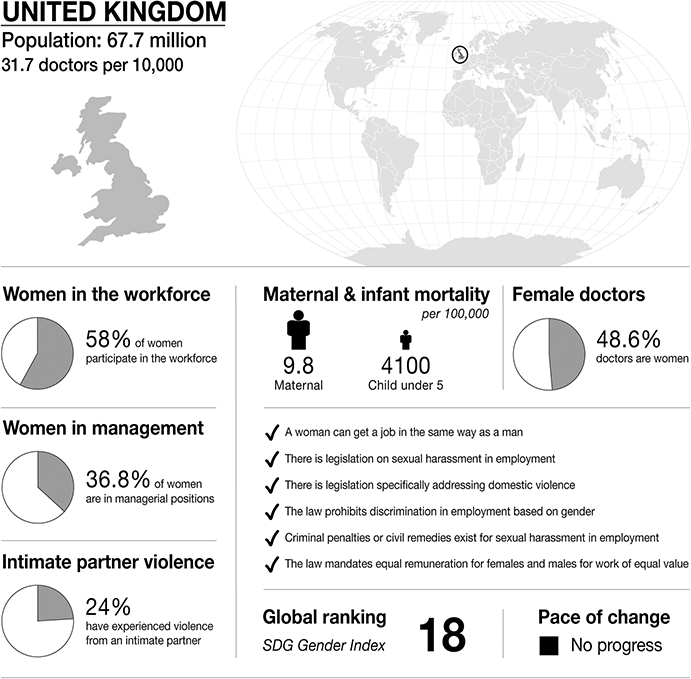
Figure 28.1 Long description
The infographic provides information about the United Kingdom, with a population of 67.7 million and 31.7 doctors per 10,000 people. It highlights several gender-related statistics. 58 per cent of women participate in the workforce. 36.8 per cent of women are in managerial positions. 24 per cent of women have experienced intimate partner violence. Maternal mortality is 9.8 per 100,000. Infant mortality under 5 is 4100 per 100,000. 48.6 per cent of doctors are women.
The infographic lists the presence or absence of law and policy on gender equality. In the United Kingdom:
– a woman can get a job in the same way as a man.
– there is legislation on sexual harassment in employment.
– there is legislation specifically addressing domestic violence.
– the law prohibits discrimination in employment based on gender.
– criminal penalties or civil remedies exist for sexual harassment in employment.
– the law mandates equal remuneration for females and males for work of equal value.
The S D G Gender Index global ranking is 18, and is stable
Certain hallmarks repeat themselves over and over again in cases of sexual harassment, sexual assault, rape and domestic violence – women and children are made to feel complicit by their abuser; the entirely rational fear of not being believed; the humiliation of coming forwards with an account of what happened; the knowledge that reporting an abuser in a position of authority – given the power he wields not just over the victim but those around them – may only make things worse.
Quoting American author Ursula Le Guin, ‘The power of the harasser, the abuser, the rapist depends above all on the silence of women.’
In 2016, the Trades Union Congress (TUC) in the UK issued its report ‘Still a bit of banter?’, which concluded that 52% of women at work suffered sexual harassment and that 80% of them did not report it. (1)
In June 2019, Unison published its NHS survey ‘It’s never OK’, which disclosed that the vast majority of those targeted were women (81%) and the incidents mainly involved perpetrators older than their target (61%), who were often in more powerful roles (37%). Nearly a third (31%) of those who had been sexually harassed said it occurred on a regular basis, and more than one in ten (12%) said it occurred weekly or daily. (2)
At the start of the #MeToo movement in 2018, many men expressed surprise at the number of women who had been the victims of sexual harassment. In 2017/18 a survey done by the Medical Women’s International Association revealed that 34% of women doctors suffered sexual harassment at work. For 22% of these, their job or future job depended on performing unwanted sexual behaviours. Fifty-two per cent said that someone was coming unnecessarily close in a physical or sexual way, and 62% received comments on appearance in an unwanted or sexual way. In 15% of cases, the women doctors were coerced to have physical contact that was unwanted or sexual, and 5% were coerced to have more serious sexual encounters, including rape.
In the UK, the gradual increase in the proportion of licensed doctors who are female has continued towards parity with male doctors but has slowed in recent years (figure 28.2). (3)
Women in medicine in the UK.
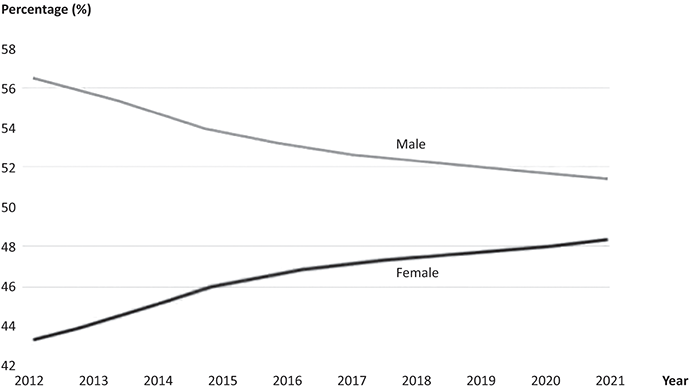
Figure 28.2 Long description
'The graph shows Percentage from 42 to 58 on the y-axis, and years from 2012 to 2021 on the x-axis. Line 1, Male: Starting at approximately 56.5 percent in 2012, the male percentage shows a steady decline over the years. The line decreases gradually, reaching about 51.5 percent by 2021. Line 2, Female: Beginning at around 43.5 percent in 2012, the female percentage demonstrates a consistent increase throughout the period. The line rises steadily, approaching 48.5 percent by 2021.
There is currently in the UK an almost equal balance of men and women joining the workforce each year. More women are entering medical school (64% of the medical student intake was female in 2021). This is largely counterbalanced by the increase in the number of international medical graduates (IMGs) whose primary medical qualification is from outside the UK and European Economic Area, who are mostly male. All specialties had an increasingly female composition between 2012 and 2021. The highest proportion of female doctors is seen in obstetrics and gynaecology (60%), followed by paediatrics (58%), general practice (57%), and public health (55%). The lowest proportion of female doctors is seen in surgery, which was 15% female in 2021, up from 9% in 2012. (3)
The number of IMGs in the UK has increased by 40% in the last five years (from 58,222 in 2017 to 81,457 in 2021) at a time when the number of UK graduates in the workforce has increased by 10% (from 162,634 to 178,173). The number of associate specialist doctors has grown at almost six times the rate of general practitioners in the last five years and four times the rate of consultants.
Women in Surgery
There remains in the UK a large gap between the numbers of women who go into training and those that become consultants, especially in surgery where there is a high drop-out rate. In 2018, 54% of foundation trainees in surgery were women, dropping down to 12% of consultant surgeons. (Reference Moberly4) The surgical specialties with the highest representation of female registrars are ophthalmology (50%), otolaryngology (48%), and paediatric surgery (45.5%), while the lowest are trauma and orthopaedics (21%), cardiothoracic surgery (21%), vascular surgery (25%), and neurosurgery (25%). (5)
It has long been an ‘open secret’ that surgery and surgical training have a problem with sexism, ranging from ‘bad jokes’ to sexual assault and even rape. (Reference Fleming and Fisher6)
Women in Universities and Academia
A poll of 56,499 university students in 2019 (7) showed that more than half said they had experienced unwanted advances and assault, including rape, with only 8% reporting the incident to the police or their university. Nearly two-thirds of the women surveyed said they did not feel confident in saying no to sex for fear doing so might lead to violence.
‘Unsafe spaces: ending sexual abuse in universities’ (Reference Tutchell and Edmonds8) highlights the role of the ‘lad culture’ in students’ sports clubs – especially rugby clubs – in creating a toxic atmosphere leading to sexual abuse and harassment, with abusers adopting a ‘pack mentality’. It also shines a light on sexual harassment and abuse by staff, including distinguished academics, where universities can be reluctant to take action because they want to keep their star performers.
In the wake of the Harvey Weinstein scandal in 2017, Dr Karen Kelsky, the originator of the #MeTooPhD hashtag, looked at the extent of the problem of sexual harassment across academia. (Reference Kelsky9) She set up a spreadsheet, allowing individuals to share their experiences. There was an overwhelming response with reports of violence, manipulative behaviour and sexual harassment.
The biggest surprise, the biggest insight that I gained from doing this spreadsheet is that it is really a false dichotomy to claim that there are serious incidents such as sexual assault and less serious incidents … .What I am interested in are the 40 women or the 100 women or the 1000 women – and we don’t know how many – that one man may have victimised and what they did not achieve because of him.
In 2018 in the UK, the Wellcome Trust announced that universities must now report findings of sexual misconduct investigations, and that the Trust will consider withholding funding from academics who have been found guilty of bullying or harassment. However, there are concerns that universities could settle complaints informally to hide problems, or that false claims could penalise innocent researchers. The effectiveness of the policy will rely on institutions being transparent. Researchers are under extreme pressure to bring in grants and publish research papers, providing a fertile breeding ground for bullying and harassment. ‘If an institution has someone bringing in huge amounts of overhead and publishing in prestigious journals, are they really going to take action against them if they are a bully? I think not’, said an Oxford academic. (Reference Else10)
Sexism in Medicine
Nine in ten female doctors have experienced sexism at work in the UK, including unwanted physical contact (31%), denial of opportunities and being asked to massage male colleagues in meetings. These findings emerged from a survey of doctors, which was a collaborative effort between the British Medical Association and Dr Chelcie Jewitt, a trainee hospital doctor and founder of the Sexism in Medicine campaign. (Reference Politis11) Over 70% of female respondents felt their clinical ability had been doubted or undervalued because of their gender. Fifty-six per cent of women had received unwanted verbal comments related to their gender. Forty-two per cent of doctors who had witnessed or experienced sexism felt they could not report it.
Hewitt and a GP colleague have launched a website where doctors can feel safe to talk about their experiences. Raising awareness is the first step, followed by campaigning for change.
Medical Regulation
Data obtained by the Independent newspaper in 2022 showed that between 2016 and 2020 an average of twenty-eight doctors have been sanctioned each year by the General Medical Council (GMC), which regulates more than 350,000 doctors in the UK, after allegations of sexual misconduct were proven against them. These figures probably reveal ‘the very tip of the iceberg’ in terms of the actual levels of sexual assault within health care (12; 13).
The majority of these doctors were erased from the register, meaning they lost their licence to practise. Of the proven allegations, forty-one were made by another health care professional, forty-two by a patient, and the remainder were unknown.
A doctor who has been erased cannot apply to be restored to the medical register for five years. At that stage, a tribunal will have to decide whether the doctor is fit to resume unrestricted medical practice.
In addition to the erasures, several doctors were suspended from the register after hearings for alleged sexual assault. The maximum suspension is twelve months. In deciding the length of the suspension, the GMC considers the seriousness of the findings of the investigation. A warning is issued if a doctor’s behaviour departs significantly from the GMC’s Good Medical Practice but restriction on registration is not necessary.
How Easy Is it to Bring a Case of Sexual Harassment to an Employment Tribunal in the UK?
Leaving aside sexual assault, which would be dealt with in a criminal court, harassment cases are brought under the Equality Act. Unfortunately, that tends to be one person’s word against another. It is then a case of looking at corroborative evidence, for example email correspondence or diaries, and asking whether the victim contacted human resources and raised a grievance. A lot of cases settle before they get to court, a level of compensation might be paid, other measures might be put in place. There is a great deal to be gained by resolving it as soon as possible. It is now the job of institutions to take responsibility for this.
Case Study
Instead of an individual case study of sexual harassment or abuse, I am going to discuss what happened in 2019 at the British Medical Association (BMA), the body which represents and stands up for doctors in the UK.
October 2019 was not a good month for the BMA. Headlines in the national and medical press with comments like ‘dark dinosaur infested depths of the world of GP politics’ and ‘Female doctors groped, propositioned and harassed by senior male colleagues in BMA’ shook the medical establishment.
An article written by two prominent women general practitioners (GPs) on the BMA General Practitioners’ Committee (GPC) had been published in GP online. (Reference Bostock14) GPC meetings take place once a month, with an overnight stay before the meeting for those who live far from London, and a dinner that evening. There seemed to be a lingering feeling of entitlement among some doctors, particularly towards younger women doctors and members of staff, which tended to emerge during drunken events such as conferences and dinners. Incidents included being touched inappropriately, lewd and inappropriate sexual remarks directed to or made about women, invitations or even instructions to accompany a male doctor to his hotel room, staring at a woman’s breasts, and inappropriate comments about a woman’s appearance. One senior woman on the GPC said that she felt unable to attend evenings of drinking and fine dining away from home without a family member to accompany her, after being propositioned by a male colleague.
It became clear that, as in many other spheres, there is a major problem with sexual harassment at the BMA, and a culture insensitive to gender equality.
The BMA commissioned a leading Queen’s Counsel (senior lawyer), Daphne Romney to investigate and to write a report on sex discrimination, sexual harassment and bullying within the BMA. (15) For many doctors it was very welcome.
The review revealed a culture in which women (doctors and staff) were bullied, undermined, and in some cases sexually harassed. It criticised the discriminatory culture at the BMA and the leadership for failing to call out bad behaviour. The allegations prompted other doctors to speak out. Since they spoke out, some of the women have been subjected to deeply unpleasant behaviour and allegations. One of the women doctors called for those responsible for the behaviour or for perpetuating it to consider leaving their posts to allow a culture change at the Association. The alleged perpetrators were not named in the report.
This is not just a GP committee problem. On GPC England, men outnumber women by two to one, although 54% of GPs are now women. On the Consultants’ Committee, women make up 25% of the committee although 37% of consultants are women. On the Staff and Associate Specialists’ Committee, men outnumber women by ten to one, although that branch of practice has roughly equal numbers of men and women.
As Romney says in her Report:
The majority of men in the BMA are not sexist or sexual harassers, and every committee is not riddled with discrimination, but problems with culture remain. There are now equal numbers of men and women in medicine, and we need to reflect that change by leaving that ‘old boys’ club’ culture behind, and embracing a forward looking, modern and equal world.
Living Our Values (LOV) and the Resolution Process
‘Living Our Values’ was incorporated in a Code of Conduct and a disciplinary procedure, now known as the Resolution Process, at the BMA in 2017. The Code was introduced to deter and also to deal with bad behaviours. It was rolled out to BMA committees to raise awareness of the union’s core values and expectations of staff in terms of behaviour.
The Code of Conduct should have dealt with the issues raised by the women GPs. However, it was abused and weaponised and not used as it should have been. Had it worked properly we would not have needed the Daphne Romney Report.
The Resolution Process has been used successfully to resolve many informal complaints, and to resolve some substantial complaints through the formal route, with adjudication by a panel of three doctors. However, the process has been undermined; there is a perception that the process is not effective (because its operation is shrouded in secrecy), and many perceive its application to be partial, which has deterred them from using it. Others have chosen not to use it because they are frightened of repercussions, and in the case of some staff, of losing their job.
Daphne Romney made thirty-one recommendations. The recommendations include education on equality, diversity and inclusion, a helpline for staff facing sexism or discrimination, an external independent complaints service, bespoke face-to-face training for all committee members, and mandatory training for committee chairs.
There must be a policy of zero tolerance, and there must be consequences for the perpetrators, once proven ‘guilty’. The BMA must have proper sympathetic reporting structures, and good collection of data. The current systems in place, including Codes of Conduct and the inappropriate acronym ‘LOV’ (‘Living our Values’), are inadequate. They are felt to be intimidating and unsupportive. Institutions should convey that reporting sexual harassment is important and courageous.
BMA committees should introduce quotas or minimum numbers of women in order to better reflect the percentages of men and women in each branch of practice. Daphne Romney accepted that quotas are very unpopular with some, but years of diversity reports and recruitment attempts have not managed to even out the gender balance on the major committees, particularly on the Staff and Associate Specialist Committee. She regarded this as a temporary measure to change the culture, perhaps for ten years, when hopefully the balance will change.
Members of committees should be prevented from standing for re-election for that committee after twelve years unless they hold an executive position. This will allow new members onto the committee. Members may seek re-election to that committee after three years. When I was on the GPC, some committee members had been in post for twenty-five years!
BMA members should be restricted in the number of committees they can sit on.
The BMA must ensure that there is adequate support, counselling and protection for the complainant and ensure that he or she is not victimised for having made a complaint. I have personally tried to speak with the GPs involved in the initial revelations, but most are reluctant to discuss the matter at all.
Existing strategies to tackle bullying, undermining behaviour and harassment focus on changing behaviour in the victim. It is more useful to focus on prevention, rather than mitigating strategies.
In spite of all the initiatives that have been introduced, the current methods for tackling mistreatment are perceived as ineffective and potentially damaging to victims.
The BMA Network of Elected Women (NEW) was set up in 2019. It is a group of BMA-elected medical women who aim to champion and strengthen female leadership and advance diversity for the benefit of the Association. The collaboration of different voices at all levels and from all backgrounds is key to unlocking women’s collective potential. There is now an informal WhatsApp group, a formal list server, a book club, and an after-school club, and webinars are planned.
A parallel and informal group of male allies (Active Allyship) has been established, which is separate but complementary. They advocate for greater gender equality at the BMA. Bystander training (see later) is planned as one of their activities, with a national programme carried out at a regional level.
What Has Been the Effect of the Daphne Romney Report?
Some senior members of the BMA said ‘How dare you raise this?’ when the women GPs went to the press. It was said that the BMA Code of Conduct should have been used, but the women doctors involved had no faith in the current processes.
It is now easier to acknowledge that sexual harassment is an issue. The Report has given women the support to speak up. It is interesting that there was resistance to setting up the Report in the first instance.
The current mandatory online training models are seen as ineffectual – people look up ‘correct’ answers and unthinkingly comply. Existing training sessions in diversity and equality are not taken seriously, especially by those who need them. I remember well when I was on the GPC from 2007 to 2012 the ‘nudging’ and jokes made during the equality and diversity sessions that we were required to attend. During a discussion on perceived lack of gender balance, there were eye rolls, and uncomfortable grunts in the GPC chamber.
Although doctors agree that some progress has been made since the Romney Report, more needs to be done to improve the situation. (Reference Limb16; 17) Since the publication of the Report, several women doctors have risen to leadership positions on committees, including the first ever female Chair of the GPC, and have had a very difficult time. The problems are far from over.
Discussion
It is clear that, in spite of all best efforts, sexual harassment remains a significant problem for women in medicine in the UK and worldwide. Women alone sharing their stories through websites, chat groups, spreadsheets, etc. is not enough. Formal policies have been in effect for years, but sexual harassment has not significantly decreased. Although robust organisational processes are necessary, they are insufficient to change cultures.
Systemwide change is needed, not only reporting and punishing offenders after the event. That approach leads to symbolic compliance with current law and avoiding liability but does not prevent sexual harassment. Institutions should have to report sexual harassment findings. It should be considered a form of scientific misconduct.
Bystander Training
It has been suggested that the profession must also articulate the ethical obligations of individuals who witness harassment and inequitable treatment. (Reference Mello and Jagsi18) In their New England Journal article in 2020 ‘Standing up against gender bias and harassment – a matter of professional ethics’, Mello and Jagsi stated that health professionals have a moral duty to intervene as bystanders (‘upstanding’). (Reference Mello and Jagsi18) This obligation should be described in codes of medical professional ethics and supported with institutional training. Bystander intervention is especially useful for conduct that is not severe or sustained enough to trigger institutional investigations. Witnessed incidents abound in the profession, and upstanding is therefore critical. Bystanders are more likely to intervene if they believe their organisation has effective mechanisms for addressing the problem.
Bystanders often have multiple, idiosyncratic, and conflicting interests, and experience painful dilemmas. How can they be supported to be more effective when faced with unacceptable behaviour? Rowe has some practical advice in ‘Fostering constructive action by peers and bystanders in organisations and communities’. (Reference Rowe19)
Potential responses to observed instances of sexual harassment and gender bias:
1. Document details of behaviours in a diary for possible future use. For example ‘10/3/19, 11.00: JB stated during surgery that female surgeons “are never good under pressure”.’
2. Remove the target from the situation. For example, ‘Mr King, I’m going to have Dr Target assist with another patient.’ ‘So sorry to interrupt – I really need Dr Target’s help in exam room 5.’
3. Provide support privately to the target of the behaviour. For example ‘I thought what he said was unacceptable, and I’m really sorry it happened. How are you doing? What can I do to support you?’ ‘I wanted to check in with you. Has Jim caused any further problems for you?’
4. Ask civil but pointed questions of the perpetrator in the moment. For example, ‘Do you really mean that?’, ‘What do you mean by that?’, ‘It sounded like you were saying … .’
5. Deflect the behaviour using humour.
6. Express disapproval of the behaviour to the perpetrator in a private setting.
7. Engage others to help deal with the behaviour if it recurs.
8. Name the behaviour as unacceptable on the spot.
9. Report the perpetrator to the institutional sexual harassment officer.
10. Remove the perpetrator from duties that might prompt a recurrence of the behaviour.
True culture change will occur more quickly if combating harassment is recognised not just as an institutional responsibility, but also as a personal ethical obligation of every health professional.
Prevention
Unfortunately, it is difficult to demonstrate that preventive measures are effective. Schemes therefore receive little or no investment.
The key is to start in schools.
Girls and young women aged between ten and twenty-four are more likely to be victims of sexual offences recorded by the police than older women. (Reference Jones, Farrelly and Barter20) According to a 2020 Government report, one-third of all female victims recorded by police were under fifteen years old.
Sexual harassment of girls is rife in schools but largely goes unreported and unaddressed. A 2017 report revealed that 37% of female students in mixed sex schools have personally experienced some form of sexual harassment, 24% have experienced unwanted touching of a sexual nature compared to 4% of boys, 58% of female students have experienced or witnessed sexual harassment at school, 66% have experienced sexist language. (21; 22) Many teachers feel ill-equipped to tackle the issue. Female teachers also experience harassment by pupils.
In 2020 the government introduced compulsory age-appropriate Relationship and Sex Education in all primary and secondary schools. (23) This is definitely a step in the right direction, but much remains to be done to improve it.
Sexism and Misogyny
Laura Bates founded the Everyday Sexism project in 2012, (Reference Bates24) inviting women on social media to detail sexist encounters they had had. In 2014 she published the book Everyday sexism: the project that inspired a worldwide movement. Bates was surprised at how many of the accounts came from girls in their mid-teens. She herself received torrents of abuse, including graphic rape and death threats.
Over the last five years she has concentrated her efforts on her work in schools. In 2018 ‘something changed’.
I started hearing boys coming out with some quite extreme things: feminism is a cancer, all women lie about rape, white men are the real victims of society … But the moment it really clicked for me was when they started repeating, at schools from rural Scotland to inner city London, the same wrong statistics.
This began her journey into the manosphere, posing as ‘Alex’, a confused young man looking on Reddit, and elsewhere, for answers. This took her from the Incels (Involuntary Celibates) to the MGTOW (Men Who Go Their Own Way). She went undercover to an MRA Conference (Men’s Rights Activists). It was a chilling experience. ‘The reality was that these are men you might walk past in the street’. The list of MRA grievances is long. They include the low attainment of some boys in schools; male suicide as a leading killer of men under fifty in the UK; higher levels of women entering higher education in some countries; male circumcision, or MGM; and the lack of provision for male victims of domestic violence. Other big issues are child custody, and false accusations of rape and sexual assault. Bates writes that these grievances are interpreted as attempts by feminists to control men’s lives. ‘At its simplest, the argument goes like this: if women’s sexual autonomy has given them wicked and tyrannical control over men’s lives, then women’s liberation is at the root of all male suffering. Therefore, the obvious remedy is to remove women’s freedom and independence and to use specifically sexual means … to do so.’ (Reference Bates25)
What came out very clearly in her research was that we were looking at hundreds of thousands of people, millions of views, so many different websites and forums. We are talking about a massive network.
The point Bates makes is both stark and subtle: there is a live community of violent extremists, operating online without censure, with a guiding ideology of misogyny, and with an aim of radicalising young boys. Her book, Men who hate women was published in 2020.
Existing stereotypes encourage boys to join misogynistic groups. Boys do not cry. Men do not talk about their feelings. There is a harking back to women staying at home. Feminism is the great evil and the root of all their problems. The men are often victims of sexual violence. They spout extreme rhetoric online. They have tried to de-fund women’s refuges.
Around 70% of boys in schools have come in contact with these groups. Almost none of the parents have heard of them.
We need to start taking extreme misogyny seriously rather than writing it off as a community of oddballs: not to do so is to utterly fail to keep this generation of boys and girls safe. We need to develop our understanding of how to help those boys at risk of going down this path and prevent it happening in the first place. As Bates says, ‘failing to act is the mark of a society that devalues not just women, but men.’ (Reference Bates25)
How Can Men Help in Prevention of Sexual Harassment?
There are many men who are supportive. We need men to call other men out. There must be disciplinary procedures for people who ‘cross the line’. The temptation to keep the matter private, as happens at present, is very great.
The Good Lads project is active in many universities and further education colleges. It includes mandatory sexual consent workshops for all freshers. (26) Active solidarity from groups of men such as football or rugby clubs is helpful. The White Ribbon Alliance (27) has a youth programme for schools, and the BMA’s Active Allyship is a definite step in the right direction.
We have to teach everyone the importance of consent and we have to start as early as possible.
Conclusion
It is clear that, in spite of all best efforts, sexual harassment remains a significant problem for women in medicine in the UK and worldwide. Women alone sharing their stories through websites, chat groups, spreadsheets, etc. is not enough. Formal policies have been in effect for years, but sexual harassment has not significantly decreased. Although robust organisational processes are necessary, they are insufficient to change cultures.
Systemwide change is needed and there must be adequate repercussions for the perpetrators. What really needs to change is men’s behaviour, starting in schools. Bystander Intervention and training are encouraging initiatives. Intervention is especially useful for conduct that is not severe or sustained enough to trigger investigations. And that is the majority of incidents.
Context
Gender in Society
In 2020, the United States (US) population was estimated to be 331 million people, of which 51.1% were women. (1) Although most Americans (72%) are white, the race and ethnicity of the US population is diversifying. The 2010 Census revealed the following racial demographics: 12.8% reported being Black; 5.7% Asian; 0.9% American Indian; 0.2% Native Hawaiian; 3.4% multiracial; and 18.4% Hispanic. (2) The modern role of women in the workforce first dramatically changed in the 1920s with two major events: new employment during World War I and the ratification of the Nineteenth Amendment to the US Constitution granting women the right to vote. (Reference Jones3; Reference Carnes, Morrissey and Geller4) Subsequently, social and cultural changes in the 1960s and 1970s prompted legal protections for women in education and the workplace, (Reference Carnes, Morrissey and Geller4) with women increasingly allowed to obtain post-secondary education. By 2018, women comprised 57% of college students and students, 49.5% of medical students, and 46.8% of the workforce. (5)
Cultural stereotypes continue to characterize women as ‘communal’ (e.g. kind, dependent, nurturing) while men are characterized as ‘agentic’ (e.g. logical, independent, strong). (Reference Heilman and Okimoto6) These stereotypes disadvantage women (and men) in domains such as science, medicine, and leadership, as competence can be viewed as a violation of a gender role. (Reference Carnes, Morrissey and Geller4; Reference Ashton-James, Tybur, Grießer and Costa7) Despite increased representation, women continue to be underrepresented in traditionally male-dominated professions, comprising 21.3% of protective service employees, 15.1% of architects and engineers, and 5% of CEO positions in S&P500 companies. Conversely, women remain clustered into ‘pink collar’ jobs, constituting 87.6% of health care support occupations, 94.5% of secretary and administrative assistant positions, and 95% of teaching assistants, kindergarten and elementary school teachers. (Reference Berdahl, Cooper, Glick, Livingston and Williams5) Occupational segregation, largely stemming from a continued cultural devaluation of work performed by women, contributes to a persistent gender wage gap. To enumerate, on average, women in the US earn 81.6% of what men earn, with the gap widening to 75% with increasing levels of education. (Reference Leisenring8) More concerning, gender-based discrimination, including sexual harassment, is reported by 50% of women in the US workforce, with few reporting the abuse to an authority. (Reference Das9) In 2017, the #MeToo movement brought awareness to sexual violence against women by advocating for survivors and encouraging them to speak out about their experiences. TIME’s UP Now, which had several industry-focused initiatives including TIME’s UP Healthcare, followed by bringing awareness of sexual harassment and discrimination in the workplace. TIME’s UP Foundation has expanded their mission to advocate for safe, fair, and dignified work for all women of all kinds, creating a society free of gender-based discrimination in the workplace and beyond. (Reference Kearl10; Reference O’Neil, Sojo, Fileborn, Scovelle and Milner11)
Infographic United States of America. Infographics were provided by CartoGIS Services, The Australian National University. Population: from World Bank https://databank.worldbank.org/source/population-estimates-and-projections. Sustainable Development Progress, global ranking and statistics on women in the workplace, women in management and intimate partner violence: from United Nations SDGs Data Portal https://unstats.un.org/sdgs/dataportal. Female doctor percentage: from Global health workforce statistics www.who.int/data/gho/data/themes/topics/health-workforce. Legislation and law statements: from the World Bank gender data portal 2023 https://genderdata.worldbank.org/en/indicators. Maternal mortality statistics: from the Global Health Observatory 2020 https://mmr2020.srhr.org. Infant mortality statistics: from United Nations International Children’s Fund (UNICEF) https://data.unicef.org/topic/child-survival/under-five-mortality.
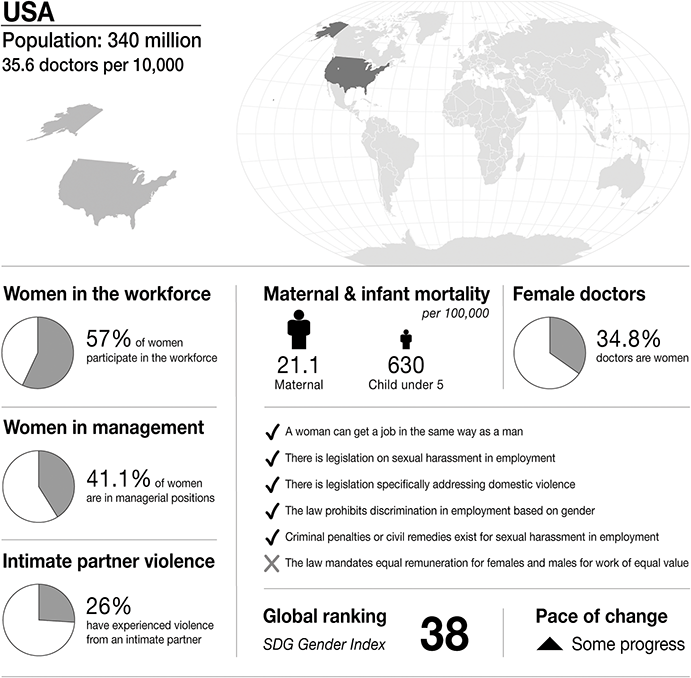
Figure 29.1 Long description
The infographic provides information about the United States, with a population of 340 million and 35.6 doctors per 10,000 people. It highlights several gender-related statistics. 57 per cent of women participate in the workforce. 41.1 per cent of women are in managerial positions. 26 per cent of women have experienced intimate partner violence. Maternal mortality is 21.1 per 100,000. Infant mortality under 5 is 630 per 100,000. 34.8 per cent of doctors are women.
The infographic lists the presence or absence of law and policy on gender equality. In the United States:
– a woman can get a job in the same way as a man.
– there is legislation on sexual harassment in employment.
– there is legislation specifically addressing domestic violence.
– the law prohibits discrimination in employment based on gender.
– criminal penalties or civil remedies exist for sexual harassment in employment.
– there is no law mandating equal remuneration for females and males for work of equal value.
The S D G Gender Index global ranking is 38, and there has been some progress
Gender in Medicine
The Women’s Health and Feminist Movements of the 1960s and 1970s served as an inflection point for US women to embark on careers in medicine. (Reference Carnes, Morrissey and Geller4) With admissions restrictions removed by laws enacted at the end of this cultural movement, a surge of women graduating from medical school was observed, with 20,000 women matriculating from 1970 to 1980, compared to 14,000 from 1930 to 1970. (Reference Braslow and Heins12) By 2003, women in the US applied to, entered and graduated from medical school at similar rates as men. However, the percentage of full-time women faculty that identify as underrepresented by race or ethnicity (URiM) has been essentially unchanged from 12% in 2009 to 13% in 2018. (Reference Lautenberger and Dandar13) This is particularly true for most surgical specialties in the US, which remain predominantly occupied by men. In 2017, 20.6% of general surgeons in the US were women, (Reference Aziz, DuCoin, Welsh, Paramo, Andreone, Butsch, Smith, Pories and Baxter14) with Black women surgeons representing just 1% of the academic surgical workforce. (Reference Berry, Khabele, Johnson-Mann, Henry-Tillman, Joseph and Turner15; Reference Aggarwal, Rosen, Nehemiah, Maina, Kelz, Aarons and Roberts16)
Increased representation of women physicians has not correlated with workplace equity. Although the overall percentage of full-time women faculty in US medical schools continues to rise, the majority of women faculty held the rank of instructor. (Reference Lautenberger and Dandar13) Moreover, there has been no narrowing of the gender gap over time. Women physicians employed by academic centers are less likely than men to be promoted or appointed department chair. (Reference Richter, Clark, Wick, Cruvinel, Durham and Shaw17) Women physicians face a persistent wage gap that cannot be explained by hours worked, skill or experience. (Reference Jena, Khullar, Ho, Olenski and Blumenthal18) Furthermore, women physicians perceive gender-based discrimination 2.5 times more frequently than men, with reported rates of sexual harassment as high as 80%. (Reference Stephens, Heisler, Temkin and Miller19–Reference Heisler, Stephens, Temkin and Miller21) The structural acceptance of these abusive behaviors adversely impacts physicians, surgeons, and patients and contributes to burnout and voluntary and involuntary departure from the medical profession. (Reference Aggarwal, Rosen, Nehemiah, Maina, Kelz, Aarons and Roberts16; Reference Nunez-Smith, Pilgrim, Wynia, Desai, Bright, Krumholz and Bradley22; Reference Linzer and Harwood23) Tragically, 40% of women reduce their hours to part-time or leave medicine entirely within six years of finishing training. (Reference Paturel24) With this percentage of attrition and reduction in the workforce (see figure 29.2), Government and Academic Medical Centers, and the health care system as a whole must start viewing attrition as a sentinel event that has the potential to threaten public health and safety. (Reference Lautenberger and Dandar13)
Seven-year promotion outcomes for US full-time academic faculty, 2008–2009.
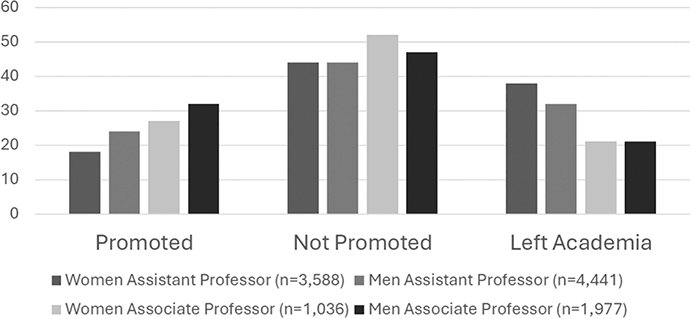
Figure 29.2 Long description
The horizontal axis represents promoted, not promoted, and left academic. The vertical axis ranges from 0 to 60 in increments of 10. The graph shows the following approximate data for: women assistant professor, n equals 3,588; men assistant professor, n equals 4,441; women associate professor, n equals 1,036; and men associate professor, n equals 1,977; respectively. 1. Promoted: 19, 24, 27, 32. 2. Not promoted: 44, 44, 52, 47. 3. Left academia: 39, 31.5, 21, 21.
Medical Education
To become a physician in the US, an undergraduate degree is obtained (usually four years), followed by a medical degree (four years). The cost of attending medical school has risen substantially, with the average debt incurred by medical school graduates reaching $200,000. The financial barrier to becoming a physician disproportionately impacts women, URiM and students from low socioeconomic backgrounds. (Reference Millo, Ho and Ubel25)
Training following medical school varies by specialty, ranging from three years to well over ten years. A ‘match’ system is employed to fill available training programs, in which a medical student interviews at various training programs and then ranks programs in order of preference. Lists from all medical students are compiled with corresponding lists from each training program, and a computerized algorithm determines where each medical student will complete post-graduate training. This legally binding process commits trainees to attending their assigned program. Once a residency has been completed in a specialty, some will pursue one or more fellowships, depending on the specific subspecialty or niche desired. The body that regulates all clinical residencies and fellowships in the US is the ACGME (Accreditation Council for Graduate Medical Education). A Residency Review Committee oversees the evaluation and accreditation of training programs within each specialty. Once accepted to residency or fellowship, physicians are employed and supported by federal funds designated to support physician education. (Reference DeZee, Artino, Elnicki, Hemmer and Durning26)
Historically, medicine and medical education have been very hierarchical, making those lower in hierarchy vulnerable to various types of mistreatment. Not only is this a hierarchy of authority, but while in training the trainee is reliant on those above them for professional opportunities, whether those be clinical, research, or leadership, as well as certification of competency and future employment opportunities.
Law
Two primary laws govern health care workplace sexual harassment in the US: Title VII of the Civil Rights Act, (27) originally passed in 1964, protects employees from discrimination based on race, color, religion, sex, and national origin; and Title IX of the Education Amendments Act, (28) passed in 1972, makes it illegal to discriminate on the basis of sex within educational programs or activities. Title IX applies to health care workers employed by entities that receive federal funding, like medical schools. In contrast, Title VII covers employment in any sector, including health care, and would cover health care workers employed by hospitals or other health care facilities. (Reference Silver and Sinha29)
This distinction is important, as medical students and physicians (interns, residents, fellows, and attendings) may fit both descriptors. Depending on the setting, their employer may be a medical school, a medical school teaching hospital, a hospital, or a combination of these. In the US, federal appellate courts have reached different decisions regarding whether Title VII or Title IX applies in these situations (known as a ‘circuit split’), meaning that the law is interpreted differently depending on locale. (Reference Diekman and Sinha30) A variety of state laws have emerged as a consequence of the #MeToo movement, (Reference Christiansen31) but these laws are limited in both scope and consequence as compared to the federal statutes. For instance, Title VII requires that harassing activity be ‘severe and pervasive’; some new state laws have lowered this high bar to include even a single instance of harassment, but the impact of these state laws remains unknown. That said, the uncertainty as to which federal law (Title VII or Title IX) protects health care workers who have experienced workplace sexual harassment is an issue only the US Supreme Court or the US Congress can resolve. Until that happens, clearer guidance is needed from the US Department of Labor’s Equal Employment Opportunity Commission (Title VII) and the US Department of Education’s Office of Civil Rights (Title IX), respectively.
Medical Regulation
Sexual misconduct in academic medicine is prevalent. A 2018 report of the National Academies of Sciences, Engineering, and Medicine (NASEM), entitled ‘Sexual harassment of women: climate, culture, and consequences in academic sciences, engineering, and medicine’, found that 45% of women in medicine experienced gender harassment before completing medical school and more than 50% of women faculty and staff have experienced gender harassment during employment. This rate for medical students is higher than for science or engineering students. (32)
In a study of early-investigator awardees, approximately 30% of women academic medical faculty in the US reported sexual harassment; among those reporting sexual harassment, 59% reported that it negatively impacted their professional confidence and 47% reported that it negatively impacted opportunities for career advancement. (Reference Jagsi, Griffith, Jones, Perumalswami, Ubel and Stewart33) Rates are even higher in some sub-specialties, as 67% of women vascular surgeons reported sexual harassment; only 7% of these incidents were reported to supervisors. (Reference Smeds and Aulivola34) Barriers to reporting, including fear of reprisal and retaliation, have been well-documented. (Reference Smeds and Aulivola34; Reference Binder, Garcia, Johnson and Fuentes-Afflick35)
Despite a high prevalence of sexual misconduct and significant negative outcomes for physicians and surgeons, most research on physician sexual misconduct focuses on acts against patients rather than between colleagues. (Reference AbuDagga, Carome and Wolfe36–Reference Gulrajani39) US state medical licensure boards and the Federation of State Medical Boards (FSMB) have the authority to investigate and discipline physicians who commit sexual misconduct by restricting, suspending, or revoking licensure to practice; (40) however, physician-on-physician sexual harassment is often investigated as a workplace misconduct issue. Furthermore, health care organizations have flexibility in reporting physicians accused of sexual misconduct to medical boards. (Reference AbuDagga, Carome and Wolfe36) Consequently, few academic medical faculty or physicians who are accused of sexual misconduct are sanctioned by medical boards. (Reference Espinoza and Hsiehchen41; Reference Liu and Hyman42) For example, an analysis of sexual misconduct-related reports indexed in the National Practitioner Data Bank from 2003 to 2013 revealed that a small number of physicians (N=1,039) were reported during that time period, and 70% of those reported were not disciplined by a medical board. (Reference AbuDagga, Wolfe, Carome and Oshel43) In the US, peers may be involved in reporting sexual misconduct but are rarely involved in disciplinary processes for physicians accused of sexual misconduct. Some US professional societies (e.g. American Association for the Advancement of Science) have created new policies and procedures for addressing sexual misconduct among their members, with those who violate these policies subject to removal from annual meetings and bans from attending future meetings. (Reference Bates, Jagsi, Gordon, Travis, Chatterjee and Gillis44) However, few professional societies provide publicly available statements or policies pertaining specifically to gender. (Reference Heisler, Miller, Stephens, Ton and Temkin45) Actions of individual organizations are unlikely to prompt significant, widespread change. To this end, recent publications emphasize a need for large-scale organizational and institutional change, (Reference Heisler, Miller, Stephens, Ton and Temkin45; Reference Fairchild, Holyfield and Byington46) as well as grass roots efforts to enforce codes of conduct, education, and training within academic institutions, health systems, professional societies, and private practices. (Reference von Gruenigen and Karlan47)
Case Study
This case is a first-person account by Dr Christine Heisler. ‘Dr Jarma’ is a pseudonym.
Prelude
As an intern covering minor surgical cases under direct supervision of my attending physician, I was fairly insulated from the egotistical behavior of this anesthesiologist. The stories and warnings from senior residents, nurses, scrub technologists and those same attendings were that he was difficult and could be hard on people. In truth, he was arrogant, condescending and rude. My encounters with him became more frequent and more inappropriate as I became more independent through residency and received a more substantial surgical caseload. He leaned into the power differential without overtly crossing a line into harassment. These interactions were not rare, nor specific to me. Rather, they were illustrative of an oppressor allowed to bully and intimidate anyone to maintain perception of power and an ineffectual organization that permitted it, unfettered.
After completing fellowship, I returned to my former residency program – now as an attending surgeon employed by a health care system. I would have the opportunity to train the residents in my surgical sub-specialty and to build the division which I now led. I was excited to work among the very talented attending surgeons who had trained me years ago. The only concern was that he was still there. As a member of the contracted group of anesthesiologists, this narcissist continued to reign the operating room (OR) suites, infecting the space with his arrogance and derision. His menacing presence continued without a specific direct incident. He was allowed to embed negativity throughout the surgical space without reprimand or consequence.
Assault
I had a major surgical case scheduled to start at 0730. I went to meet the patient in the pre-operative area, and he was behind a curtain talking with her and her family. He peered in my direction, informing me that he was talking with her and needed more time. I acknowledged his request, shut the curtain and stood by, waiting for my turn to talk with our patient. As his conversation turned from relevant medical history to social conversation and laughter, I again opened the curtain to signal I was ready to talk with the patient. He snapped at me, saying that he wasn’t done talking. I explained that I still needed time to talk with the patient before we proceeded to the OR, and he sharply and condescendingly replied that he would be done soon. I closed the curtain and stepped back a few feet. He finally emerged from the room and walked past me, indifferent. I met with the patient and her family to review our plan for surgery, the process of recovery and when she would see her family again.
I knew I needed to address the interaction in order to resolve the conflict. I approached him and asked to speak with him. I acknowledged the importance of his time to meet the patient and review the anesthesia plan for surgery, and noted that I did not appreciate his aggressive response nor his dismissive attitude about my time with the patient. He replied with a sharp tone that he was meeting the patient and developing a rapport with her and her family; my entering the space was disruptive to his time with her. I noted that his socializing with the patient continued, even after I specifically expressed my need to speak with her. I did not appreciate his blatant disregard of my time, nor his behavior in front of my patient, which was hostile and unprofessional. He rolled his eyes and told me to ‘Just calm down’. He reached behind me, patted me on the buttock and squeezed as he walked past me.
My instinct was to yell out or physically fight back at him for what he did to me. Instantaneously, I was reminded of my environment and my need to maintain professionalism, to control my emotions and my response. I was humiliated and embarrassed, left wondering if anyone saw this interaction or his action; yet I maintained integrity and continued on with the responsibilities that lay ahead.
In those subsequent few minutes as the patient was being wheeled from the pre-operative holding area to the OR, my mind was racing with the prior events. Eventually, I was in the OR with the team attempting to regain my focus on the case, but as my patient was prepped and draped, the harassment persisted. This anesthesiologist stood up behind the drapes, watching the surgical steps, and proceeded to comment on the case with nit-picking, criticism, condemnation, ridicule, and biting sarcasm. It was a totally inappropriate barrage of unnecessary negativity that did nothing but distract. My attempts to politely redirect him were futile. Finally, I sternly looked at him and requested that he stop his unprofessional behavior in front of the OR team. He then recoiled to his chair.
Limbo
I had no intention of reporting him. He was a prominent anesthesiologist in the institution and his reputation, though extremely despicable and reprehensible, was ingrained in the fabric of the OR and accepted by the institutional leadership.
I spoke with a male colleague later that day: ‘You won’t believe what happened to me …’ I blurted out the entire story. This colleague, a trusted confidant, was horrified to hear how I had been treated and unsurprisingly, immediately guessed the identity of the perpetrator. My colleague was unrelenting and said, ‘You have to report this. Dr Jarma crossed a line. He assaulted you!’ I explained that it wouldn’t matter. Nobody would believe me. It would be his word against mine. He offered to report on my behalf, to be my voice. I reluctantly agreed to allow him to report the event.
Shortly thereafter, I was called to a meeting with Human Resources, my department chair and two members of the Medical Staff Office. They requested details of the allegation, which I provided. Two profoundly imperative themes emerged from that meeting.
First, I was told that I had handled the situation incorrectly. I created a safety concern for my patient and my team by proceeding to the OR. I should have requested another anesthesiologist so I could focus on my job without additional distraction. Though there was no process available to guide me in this circumstance and the means of requesting another anesthesiologist would have resulted in questions and delay, my experience of being sexually harassed was distorted to imply that I was in the wrong by continuing with the case. In essence, I was potentially endangering my patient, my team, and my organization by doing the job: performing the scheduled operation. It was irrelevant that I had been sexually assaulted by a key member of the team.
More importantly, Dr Jarma was protected under the guise of ‘due process’. He would be allowed to work while they met with him and additional staff. As a physician, he shouldn’t suffer financial penalty just because I alleged inappropriate behavior. He would be treated fairly. In order to protect me, however, I was provided the option of paid leave. This would ensure I would not experience further interactions with him.
Exposure
I was bullied through the ongoing investigation process after the sexual harassment, which caused additional distress. Once, I was confronted by the Human Resources representative, who openly discussed my case in a busy cafeteria. She desired to update me as to the status of the investigation – Dr Jarma is aware, of course, and cooperating fully. Her attempt at timeliness was usurped by the lack of confidentiality. Worse, the rationale for this impromptu meeting was a request that I provide my story in writing.
While the investigation only took a few weeks, time seemed to stand still for me, as I was continually reminded of Dr Jarma’s presence. He was instructed to avoid direct contact or conversations with me, with which he complied. However, he was everywhere – the recovery room, the surgeon’s lounge, the hallways, and outside other operating rooms. He demonstrated complete lack of regard for my discomfort, and in fact seemed to revel in the awareness that he was abiding by the rules without being constrained by them.
At the final meeting with the investigation team, I was informed that, despite this assault occurring in a populated place during the busiest time of day, nobody could corroborate my claim. However, they learned through staff interviews that Dr Jarma had a pattern of unprofessional behavior including sexual harassment that violated organizational standards and was unlawful. As a result, the anesthesia group and hospital leadership agreed to reassign Dr Jarma to another hospital where he already worked, but now on a full-time basis. The final decision did not include any sort of serious punishment: revocation of hospital privileges, termination, suspension of medical licensure, or legal action.
Removing him from the OR environment resulted in excessive gossip occurring around me. ‘Did you hear what happened to Dr Jarma?’ ‘Yeah, I heard he was just being himself and it upset a sensitive surgeon.’ Occasionally, I was confronted with direct questions like ‘Did something happen between Dr Jarma and you?’ ‘Are you really the reason Dr Jarma was reassigned?’ ‘Are you doing okay? I heard about Dr Jarma and you.’ I maintained a professional demeanor and politely played dumb, or deflected the questions, acknowledging that these conversations were inappropriate, regardless of whomever they involved. Though the outcome removed this perpetrator from my hospital, he was allowed to work in another environment, thereby subjecting others to his abusive behavior. I didn’t feel like the outcome was satisfactory. I wanted to disclose everything – the indignities, the hostility, the abuse. This anesthesiologist sexually assaulted me in public in the presence of witnesses but was protected by this institution and allowed to maintain his professional standing and financial security. On the other hand, I suffered from threats, ridicule, disbelief, exposure, antagonizing behavior and revictimization.
Aftermath
Ideally, this sexual assault would have ended with vindication and institutional support; however, that was not the case. Eventually, I resigned from that health care institution; this incident and the institutional culture were the basis of my resignation. The resentment I carried from that situation, and how it was handled by hospital administration, still lingers, though it does lessen with the passage of time.
This experience is unfortunately not unique to attending surgeons, nor is it situationally rooted in one health care system. Through my educational and other leadership roles, I continue to help others navigate these emotional, professionally challenging, and unlawful situations. I have the great fortune to have developed a network of strong women colleagues that are similarly focused on creating an equitable, safe and dignified workplace environment for everyone in health care. Through our collaboration and collective passion for this cause, we strive to make this the new culture in medicine and surgery for future clinicians.
Discussion
For nearly twenty years, men and women have entered and graduated from US medical schools at equal rates. (Reference Lautenberger and Dandar13) In 2015, more than one-third of the physician workforce and nearly half of all physicians-in-training were women. (Reference Butkus, Serchen, Moyer, Bornstein and Hingle48) Although progress has been made towards gender diversity in the physician workforce, disparities related to gender remain widespread.
‘Gender roles’ that define traditionally male-typed traits and behaviors are termed ‘agentic’ because they involve human agency, while traditionally female-typed traits and behaviors are termed ‘communal’. (Reference Eagly49) A workplace environment that permits bias based upon presumed ‘gender roles’ is one where gender-based discrimination and sexual harassment is tolerated. (32) Many agentic actions, such as making decisions quickly and leading a team, are necessary for the effective practice of medicine. These practices and behaviors are acquired by women during medical training, particularly in surgical specialties. Yet the exhibition of ‘masculine’ behaviors and personality traits by women, including competence, can be perceived as a violation of gender roles, resulting in negative feedback and retaliation towards women physicians in the workplace. (Reference Heilman and Okimoto6; Reference Gabriel, Butts, Yuan, Rosen and Sliter50) Retaliation in the workplace is a form of unlawful discrimination. (51) As a result, women in medical school are more often directed towards communal specialties, such as family medicine, while men are directed towards more technical or procedural specialties, such as surgery. (Reference Salles, Awad, Goldin, Krus, Lee, Schwabe and Lai52; Reference Carnes, Bartels, Kaatz and Kolehmainen53) The surgical specialty of obstetrics and gynecology is one notable exception to this career-steering gender bias, yet in this specialty where 58% of the physicians are women, gender inequities persist. (Reference Heisler, Mark, Ton, Miller and Temkin54) Evidence supports the concept that feminization of a specialty is associated with declining status and wages. (Reference Heisler, Mark, Ton, Miller and Temkin54; Reference Pelley and Carnes55) Even when women enter higher status, higher paying specialties, they tend to be assigned lower status communal roles such as educators and providers of clinical care to women, relegating them to the lower end of the status and wage spectrum within the field. (Reference Carnes, Bartels, Kaatz and Kolehmainen53; Reference Pelley and Carnes55; 56)
Despite these well-described barriers to success for women in medicine, studies suggest that women may provide better clinical care in some settings, particularly for women patients. A large US database study demonstrated that hospitalized patients treated by women physicians had a relative risk reduction of 4% in mortality compared to patients cared for by men physicians. (Reference Tsugawa, Jena, Figueroa, Orav, Blumenthal and Jha57) Additionally, higher mortality was noted among women patients who are treated by men physicians following a heart attack. In the same study, however, this finding dissipated for men physicians with more exposure to women patients and women physicians. (Reference Greenwood, Carnahan and Huang58) In another study, patients operated on by women surgeons were found to have a 12% lower risk of death in the thirty-day postoperative period. (Reference Wallis, Ravi, Coburn, Nam, Detsky and Satkunasivam59) Unfortunately, these outcomes are often overlooked by both colleagues and patients. For example, women gynecologists have been shown to receive top patient satisfaction scores only half as often as men colleagues, owing to their gender alone. (Reference Rogo-Gupta, Haunschild, Altamirano, Maldonado and Fassiotto60)
While altruistic impulses lead individuals to pursue medicine, the workplace environment remains discriminatory towards women physicians. Multiple organizational factors lead to the tolerance of gender bias, discrimination and harassment in medicine, including minimal leadership training, power imbalances, a strict hierarchy, and a culture of silence. (Reference Pattani, Marquez, Dinyarian, Sharma, Bain, Moore and Straus61) A traditional, ‘masculine’ and hierarchical structure remains omnipresent. In hospital environments, fatigue and emotions are often at extremes and inhibitions can be lowered. Call rooms, empty spaces and late-night hours provide opportunity for sexual transgressions unlike that of any other profession.
Consistently high rates of discrimination and harassment of women physicians and trainees in medicine are reported. (32) An implacable misconception – that sexual harassment must involve sexual coercion or assault – allows the inequities faced by women in medicine to continue (32) because the burden of proof is too high. While egregious instances of forced attacks do occur, gender harassment represents a wider set of more common behaviors rooted in unconscious gender biases and assumptions that underpin the two-tiered work environment for doctors practicing medicine. Sexual harassment is better defined as a range of behaviors that devalue, demean or humiliate due to gender. (32)
Enforcement of gender discrimination and sexual harassment infringements within the medical profession and legal system is poor in the US. The number of years and financial burden required for training as a physician renders many women vulnerable to retaliation during their careers. Many health care institutions have opaque and outdated mechanisms for investigating claims of harassment. As result, reporting remains uncommon and satisfaction with the outcome of the process is low when incidents are disclosed. (Reference Nunez-Smith, Pilgrim, Wynia, Desai, Bright, Krumholz and Bradley22; Reference Smeds and Aulivola34; Reference Binder, Garcia, Johnson and Fuentes-Afflick35). In the US, legal claims of discrimination or harassment require the plaintiff to provide the burden of proof – the alleged perpetrator is ‘innocent until proven guilty’. This poses significant time and monetary barriers to filing a legal claim.
While women have achieved equity in medical school admissions, members of the profession must work together to create a workplace in which women physicians can thrive. Institutional entities must allocate a commensurate amount of financial and human resources to study and correct gender inequities, in order to mitigate the forecasted physician and surgeon US workforce shortages. Interventions to improve the workplace environment for women physicians must be structural and address the root causes of gender inequity. This is not only an ethical imperative, but critical to improving the delivery of care as diverse teams in health care provide more person-centered, high-quality care. (Reference Gomez and Bernet62)
The Harvard Business Review (Reference Myers and Sutcliffe66) summarized the impact of discrimination and harassment on the field of medicine, highlighting the impact on patient outcomes.
Allowing things to continue as they have for women in medicine is accepting a system where potentially higher quality care is denied to patients due to sexism and bad practices. In fact, the difference in patient mortality observed in male and female physicians is approximately the same magnitude as the difference in mortality that can be attributed to the last decade of scientific improvement in patient care. This means that excluding female physicians in the healthcare system sets our society back not only in gender equality but also in terms of the progress we should be making in medical care.
Widespread organizational transformation can be achieved. As a critical mass of women has been insufficient to change the culture, ‘critical actors’ – individuals who catalyse change in existing cultural systems – must be supported. (Reference Helitzer, Newbill, Cardinali, Morahan, Chang and Magrane63) The creation of a Gender Equity Task Force in a single institution recently provided proof of concept that a multifaceted approach to reducing gender-based discrimination is feasible. (Reference McKinley, Wang, Gartland, Westfal, Costantino and Schwartz64) Interventions included implicit bias testing for faculty and staff, professional messaging through clearly labelled badges, engagement with nursing leadership, improved reporting processes, transparency of policies, and training regarding discrimination. Equitable parental leave policies, applied to both parents, also help to shift norms overall to allow fathers and partners to take on truly equal participation in parenting while decreasing the stigma that women experience while taking leave. (Reference Stephens, Heisler, Temkin and Miller19) Additionally, term limits for the upper echelons of leadership can provide women opportunities in leadership, while inspiring a culture of supporting succession planning and mentorship. Evidence suggests that when such interventions are appropriately deployed, they are able to improve representation of women in leadership. (Reference Gharzai and Jagsi65)
Finally, the 2018 NASEM report on Sexual Harassment (32) made fifteen recommendations:
1. Create diverse, inclusive, and respectful environments
2. Address the most common form of sexual harassment: gender harassment
3. Move beyond legal compliance to address culture and climate
4. Improve transparency and accountability
5. Diffuse the hierarchical and dependent relationship between trainees and faculty
6. Provide support for the target
7. Strive for strong and diverse leadership
8. Measure progress
9. Incentivize change
10. Encourage involvement of professional societies and other organizations
11. Initiate legislative action
12. Address the failures to meaningfully enforce Title VII’s prohibition on sex discrimination
13. Increase federal agency action and collaboration
14. Conduct necessary research
15. Make the entire academic community responsible for reducing and preventing sexual harassment.
The US has been a leader for decades in providing cutting edge medical care and exporting health technology to the rest of the world. The #MeToo and TIME’s UP Health care movements have brought the prevalence and significance of sexual violence and assault against women to the forefront in society and within health care. The time is now for the American medical system to embrace gender equity for the benefit of its diverse workforce and to provide optimal patient care.
Introduction
One day as a young doctor, on my way out of the hospital, I bumped into one of my former Senior registrars who is now a consultant. ‘Maria!’ he said, ‘You look very nice.’ He gave me the long top-down look and lingered on the lower half of my body. I politely replied, ‘thank you’. ‘How is work going?’ ‘Fine.’ ‘What are you up to?’ And as he asked that follow up question, he continued to inappropriately stare at the lower half of my body. I tilted my head, staring right into his face with that look that is supposed to tell anyone actually looking at my face that, ‘I can see what you are doing, and you better stop it now.’ And then I answered, ‘Work and school as usual.’ He obviously had not even seen my facial expression. His stare was still on the lower half of my body. ‘I see. You look so good. Listen … Maria … You are married and I am married. Why don’t we get a room and make each other feel good?’ I stood there staring at him in disbelief, but he was clearly not registering. He is looking at me but he either can’t see what my face is saying or couldn’t care less. He continues, ‘Enh? You obviously do not have HIV and neither do I so … let’s just do that. We help each other out.’
I am too shocked to respond just yet. I am asking myself, what did I just miss? How did our conversation move from a greeting straight to the bed? How did a man with whom I always had purely academic conversations give himself permission to speak to me about all this? I felt violated. I was angry, disgusted and humiliated as to why I was not being seen as a professional.
This was my personal experience starting out as a young doctor. These kinds of experiences prompted us to work on this project to share real life stories of sexual harassment, bringing awareness and insight into this immorality, and pave the way for policy creation on sexual harassment in the workplace.
Gender in Society
Zambia is a landlocked, resource-rich country with sparsely populated land in the centre of Southern Africa. It shares its border with eight countries (Angola, Botswana, Democratic Republic of the Congo, Malawi, Mozambique, Namibia, Tanzania, and Zimbabwe) that serve as an expanded market for its goods. Its population, much of it urban, is estimated at about 17.9 million and growing rapidly at 2.8% per year, partly because of high fertility, resulting in the population doubling close to every twenty-five years. (1) Girls and women continue to remain vulnerable because of many age- and sex-specific social barriers and gender inequalities. High Gender-Based Violence (GBV) prevalence in Zambia, particularly in rural areas, is due to existing cultural norms and unequal power relations at the household level. The 2013/14 Zambia Demographic Health Survey (ZDHS) reports that from all women who had experienced any type of physical or sexual violence, only 43% sought help to stop the violence, 9% never sought help but told someone, and 42% did not seek help and never told anyone. (2) Where help was sought, GBV survivors most frequently sought it from their own family (69%) or from the husband or partner’s family (43.2%), while formal structures of support were hardly approached for help (e.g., police – 7.8%; medical staff – 1.5%; social work – 2.2%). Unfortunately, there are no cases of sexual harassment in the workplace from any sector which have been referred to the National Prosecution Authority (NPA), except for one in the recent past.
Infographic Zambia. Infographics were provided by CartoGIS Services, The Australian National University. Population: from World Bank https://databank.worldbank.org/source/population-estimates-and-projections. Sustainable Development Progress, global ranking and statistics on women in the workplace, women in management and intimate partner violence: from United Nations SDGs Data Portal https://unstats.un.org/sdgs/dataportal. Female doctor percentage: from Global health workforce statistics www.who.int/data/gho/data/themes/topics/health-workforce. Legislation and law statements: from the World Bank gender data portal 2023 https://genderdata.worldbank.org/en/indicators. Maternal mortality statistics: from the Global Health Observatory 2020 https://mmr2020.srhr.org. Infant mortality statistics: from United Nations International Children’s Fund (UNICEF) https://data.unicef.org/topic/child-survival/under-five-mortality.
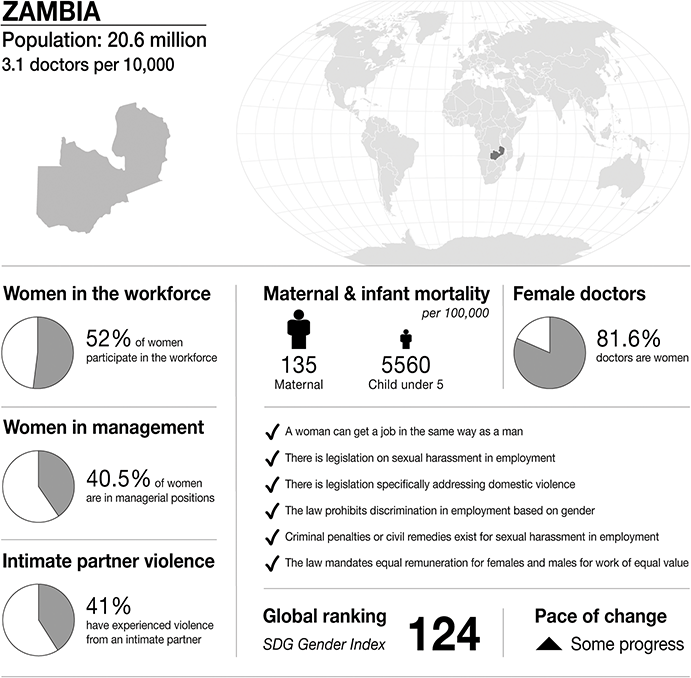
Figure 30.1 Long description
The infographic provides information about Zambia, with a population of 20.6 million and 3.1 doctors per 10,000 people. It highlights several gender-related statistics. 52 per cent of women participate in the workforce. 40.5 per cent of women are in managerial positions. 41 per cent of women have experienced intimate partner violence. Maternal mortality is 135 per 100,000. Infant mortality under 5 is 5560 per 100,000. 81.6 per cent of doctors are women.
The infographic lists the presence or absence of law and policy on gender equality. In Zambia:
– a woman can get a job in the same way as a man.
– there is legislation on sexual harassment in employment.
– there is legislation specifically addressing domestic violence.
– the law prohibits discrimination in employment based on gender.
– criminal penalties or civil remedies exist for sexual harassment in employment.
– the law mandates equal remuneration for females and males for work of equal value.
The S D G Gender Index global ranking is 124, and there is some progress.
Gender in Medicine
There has been a notable change in the number of women in medicine in Zambia, from one female medical student entering medical school about fifty years ago to some universities recording over 50% female medical student entry recently. Despite this great achievement we have great underrepresentation of women at the leadership level in the health sector in general. Over almost sixty years of independence, there has been no female doctor who has ever served as Minister of Health. Those doctors that have been ministers are male. Zambia has ten provinces: all provincial health offices are headed by male doctors. It is almost the same picture at the district level, where we have less than 10% representation in the 110 districts. Women remain underrepresented at the various levels of leadership in the health sector in Zambia in research, academia and hospital management.
On the other hand, in the private sector, including private hospitals, non-governmental organisations and international organisations, female doctors are heading these organisations, some with more than 100 employees. One of the reasons women abstain from leadership positions in Zambia is because workplace policies do not support the parental and family roles that women have. Women are slowly getting more support from partners in our society but women in leadership roles need more than just supportive partners. Our workplace systems need to be more inclusive and diverse for us to see a meaningful change. Women in the health sector in Zambia continue to be underrepresented in positions of authority. They are merely restricted to lower ranks of management.
A recent study showed that firms with female CEOs experience 48.3% less sexual harassment. An increase of one female director is associated with a 18.2% decrease in the sexual harassment rate. (Reference Au, Tremblay and You3) Of course, more is involved in reducing sexual harassment in workplaces. Increasing female leadership in the health sector is one way to start through deliberate collaborative and innovative leadership.
Medical Education
For a long time, there was just one public medical school in the country, but in the recent past we have seen an increase in the number of both public and private medical schools. The duration of training for a medical doctor varies between six and seven years depending on the institution. There are also a number of medical students that train in other countries like China and Russia, after which they come back home to practise medicine. The faculty under these universities are responsible for assessing competencies both at undergraduate and postgraduate levels. All newly trained and inducted medical doctors have a mandatory one-and-a-half-year internship as junior resident medical officers. On completion they may choose to undergo specialty training for another four years on average in their field of choice or remain as general medical officers. Certain fields tend to attract more women for specialisation, like paediatrics, and obstetrics and gynaecology, although the overall number of males is always higher. Other than a few private hospitals and non-governmental organisations (NGOs), the government, through the Ministry of Health, is the main employer of all medical doctors in Zambia. However, at the hospital level, the hierarchy in the department starts with the head of department, consultants, senior registrars, registrars, then the interns, and learning in the clinical environment is by apprenticeship. Therefore, the seniors play a major role in the career progression of the junior colleagues because they impart skills and knowledge, and complete the appraisals of students and junior doctors’ performance, in the form of logbooks. This, unfortunately, means doctors in junior positions, including students, are vulnerable to hierarchical abuse. Culturally, a junior may never offer criticism or any form of feedback to the superiors regarding their clinical learning environment for fear of jeopardising their career progression. Even though there no actual studies to indicate the level of abuse in the Zambian context, other studies have found that inappropriate behaviour, harassment, and belittlement of physicians-in-training was perpetrated mostly by fellow physicians in superior positions. (Reference Szafran, Woloschuk, Torti and Palacios Mackay4)
Law
Zambia has laws which prohibit sexual harassment in the workplace. These are the Gender Equity and Equality Act no. 22 of 2015, the Anti-Gender-Based Violence Act no. 1 of 2011 and the Penal Code. These acts provide criminal and civil sanctions. (5) The law generally deals with cases of sexual harassment very seriously, as the offence has a very strict punishment with a minimum of three years’ imprisonment and a maximum of fifteen years’ imprisonment. However, the evidentiary rules in offences of a sexual nature are quite onerous as they require corroboration. The evidence of the victim has to be corroborated by independent evidence which tends to establish the identity of the perpetrator and the commission of the offence. These corroborative rules are in place to guard against the danger of false implications. These rules are onerous as most incidents of sexual harassment occur in private, and in the absence of evidence such as text messages or an eyewitness it becomes difficult to prove a case beyond reasonable doubt.
There are specialised police, prosecution, and judiciary departments mandated to deal with cases of sexual harassment; however, the evidentiary requirements are the major impediment that may lead to perpetrators not being charged. Victims can receive support from One Stop Centres, which offer multi-disciplinary support in the form of counselling and legal advice. The police and the prosecution service also provide counselling and legal support as do non-governmental organisations. There are risks of retaliation and further harassment on a victim who reports, as most institutions both private and public do not have safety mechanisms that protect a victim from backlash. The medical doctors do not have an institution mandated to defend them in civil or criminal cases nor do they have insurance which would cover such costs. Women who report sexual harassment are often viewed as weak or are blamed for having seduced the man, for example, by their way of dressing. Additionally, many panels to resolve such issues are led by men who are less knowledgeable about sexual harassment.
Medical Regulation
In order for medical doctors to practise in Zambia, they have to register with the Health Profession’s Council of Zambia (HPCZ). The Council has the mandate to register and regulate all health facilities in Zambia, both public and private, and training institutions teaching health sciences. The HPCZ is a statutory regulatory body established under the Health Professions Act No. 24 of 2009 of the Laws of Zambia. The functions of the HPCZ as enshrined in the Act, among others, include the registration of health practitioners and regulation of their professional conduct. (6)
Professional misconduct may warrant disciplinary action, as spelt out in the organisation’s ethical code of conduct which states in part that personnel (health practitioners) exhibiting dishonest behaviour or corrupt practices, and indecent or violent behaviour, may lead to disciplinary proceedings even if the offence is not directly connected with the health practitioner’s profession. Some of the disciplinary measures include cancellation of registration, censure or counsel to the practitioner or otherwise imposition of fines. (7) Clearly there is no mention of sexual harassment of colleagues in this document. The role of colleagues and other professional bodies is not clearly spelt out in how an erring member should be disciplined. On the progressive side, the Public Service Management Division (PSMD), which is the regulator of all public workers doctors, including doctors, has recently revised the disciplinary code and procedures for handling offences in the public service, as of May 2023. Any form of sexual harassment on first breach results in instant dismissal from public service. (8)
Case Report
Prelude
Following ethics approval (#1652–2021), a survey using Google form documents that did not capture any personal information or identifiers was sent to the membership of the Medical Women Association of Zambia. Eight responded to the questionnaire and reported to have experienced sexual harassment, which happened between one to more than ten years ago. The sexual harassments which have been experienced by the survivors include inappropriate texting (3), inappropriate touching (3), inappropriate comments (7), physical contact (2) and rape (1). Three of the survivors are currently working in the same department as the perpetrators. Only one perpetrator was the same rank as the survivor, while the rest of the perpetrators were senior to the survivors at the time of the harassment.
Most survivors attributed organisational culture, followed by social context and personal vulnerabilities, as factors they thought contributed to the sexual harassment. Below are quotes from the survivors’ perspectives on what they consider put them at risk of such horrendous acts.
I’m not an assertive person … S1
He said it was what others were doing … S2
I am not sure why they felt they had to do that. I thought we had a professional and cordial relationship … S3 (this survivor experienced two different sexual harassments by two different doctors)
They appeared to use their connection to a much senior doctor … S4 (perpetrator thought the woman would comply because it gave her a point of connection with a senior doctor)
The comments and texts started in the workplace. Apparently, it was normal to talk about a woman’s body like just any other object and the jesting was perceived as normal … S5
According to ‘research’ he sleeps with every beautiful girl at work … S6
Seniors know juniors can’t report them for such, if they do it’s his word against mine … S7
He was going to sign my internship logbook for me to go for specialty training … S8
The Assault
Here we highlight the narratives given by two of the survivors.
One of the respondents (S5) narrated this.
In my unit at work, we planned a party to relax and socialize outside the work environment. One of the male doctors offered to host this party at his house. However, at the end of the party, I thought that I had drunk a little too much and was unsure I would drive home safely. The party host offered that I could spend a night at their house and go home the next day when sober. I woke up in the middle of the night and couldn’t believe what was happening; he was right on top of me, having penetrative sexual intercourse without my consent. I cried myself to sleep as I let him finish what he was doing. He raped me!!! Initially, I thought it was my fault because I had too much to drink, but then being in the company of people I knew, I thought I was safe and let my guard down. When I confronted him about it somehow, he turned it around to say I was to blame; I led him on.
However, this was plain simple: it was rape.
The second survivor (S6) explained an incident as having brewed from ward rounds.
He (head of the department) started making advances on the ward telling me how beautiful I am in front of everyone … I thought it was a joke … I never cared.
At the end of each rotation, junior residents get signed out before rotating through another specialty. As this junior officer went to the head of department’s office to be signed off, he grabbed her and started touching her breasts and asked for sex; but she found a way to escape and never looked back.
Limbo
An analysis of the responses reveals an alarming trend of systemic sexual harassment by male doctors of female doctors who were in the majority of the cases subordinates of the perpetrators. More than half of the respondents considered reporting the case; however, only two did report. Reports were made to the immediate supervisor and to the Ministry of Health. In both cases nothing came out of the reports, one respondent was told that it was normal for new young doctors to be approached by seniors and in the second one the complaint report went missing. There were no sanctions, nor was accountability meted out on the perpetrators for the reported cases. The only satisfaction that respondents got from reporting was that they experienced no further acts of harassment.
The major challenges faced by the respondents which prevented reporting were fear of reprisals and of being labelled difficult, in addition, respondents thought they would not be believed. Previous attempts by other female doctors to report had resulted in the whole hospital knowing of the incident: the lack of confidentiality and protection against retaliation were major deterring factors for non-disclosure. Other key considerations were that respondents did not want to create work tensions with perpetrators with whom they still had to work. Moreover, the lack of documented evidence of incidents of harassment contributed to the non-reporting, as respondents believed their word alone would not suffice. Knowledge of whom to report to was not known to all: only half of respondents knew where to go. Some respondents hoped for the incidents of sexual harassment to naturally go away, and half of the respondents stated that they did not have the personal strength to report as the process of doing so would be cumbersome and emotionally draining.
Exposure
Two of the survivors reported that they had experienced retaliation from the perpetrators and colleagues. And as a result, the survivor had to leave that hospital and find employment elsewhere. Three survivors had actually experienced thoughts of how they would cope with a sense of betrayal in the event that colleagues talked about them, and one of these narrated that she did not care only for her career. On the other hand, another survivor narrated the ordeal her friend went through when she reported a rape case at her institution, and we infer here that this friend unfortunately did not participate in our current survey, and hence we cannot comment on the specifics of the experience. This loss of anonymity and gossip has some repercussions on how the survivors would cope with the sense of betrayal. This survivor did not report her case, and she does not think she would recommend anyone to report a rape case at her hospital.
The social stigma and backlash can be worse than the event itself. I think part of my healing was because I wasn’t reminded of it every day by random strangers.
None of the survivors in this survey ever thought they needed to respond to critics or people talking about them if it came to light that their cases were exposed. One of the survivors alluded to thoughts of self-blame and said people have often misunderstood her friendliness. On the contrary, another survivor knew she would be criticised but the critics would not be correct to blame her for being female around men who are ill mannered. Some of the survivors did consider how they would cope working in an environment amidst the gossip and would have preferred to get a transfer. While another actually moved:
yes, I moved, ran away from all. It’s almost as if I was spoiling things for everybody …
Aftermath
After the incidents, the respondents expressed different feelings; some respondents felt the incident made them stronger. ‘I feel strong as I had a clear plan on how to gather evidence about the harassment and to report it.’ Another one responded, ‘A strong doctor.’ There was self-blame as well. ‘I always think I am a coward. I should have fought.’ Not reporting the incident meant they could go on without anybody knowing.
The impact the incident had on their personal and professional life was profound. It has led to suspicion and mistrust of male colleagues: ‘I am suspicious of male colleagues. I always prefer to work with female doctors on projects.’ A loss of respect as well:
Each time I work with a different male senior I am very closed up and scared he might be another individual to harass me. Meeting the perpetrators at work makes me have negative feelings towards them and I don’t respect them anymore.
Avoidance of male colleagues as well: ‘I am distant with male colleagues, and I am not usually comfortable in situations where I find myself alone with a male colleague.’
Respondents also described recovery in various ways that meant some state of forgetting, forgiveness or feeling comfortable about themselves and feeling comfortable in the company of male colleagues. Agonisingly, some have failed to recover. One described recovery as ‘Not happening as I see him with his smirk on his face.’ Others reached a place of recovery through counselling and prayer. Sadly, most have not fully recovered, and this remains a work in progress. Some respondents have used their experience to counsel others and raise awareness on the issue, seeking the benefit of others.
Discussion
The enactment of the Gender Equality and Equity Act, 2015 (No. 22 of 2015) was a key milestone in the progress towards gender equality and equity. Additionally, Zambia first adopted the National Gender Policy in 2000, and this was reviewed in 2014. This is great progress towards the elimination of sexual harassment in the workplace. The Gender Equity and Equality Act prohibits sexual harassment. The Employment Code, under the provisions of section 95(1), makes it mandatory for the employer to have a policy on harassment. (9) The key findings from this case study are that perpetrators of sexual harassment in the workplace among female doctors are mainly superiors, it is underreported, and the few reported cases yielded no repercussions on the perpetrators.
Medicine is dominated by males, and they hold most of the leadership positions. We found that most of the respondents were harassed by their superiors, people they held in high esteem due to the hierarchical nature of the field. Heads of department should be go-to people when sexual harassment has occurred; however, we found that they are key perpetrators themselves. So where do women run to? Female-led organisations have reported reduced rates of sexual harassment. (Reference Au, Tremblay and You3) The lack of clear work policies on sexual harassment to protect and support women has been a major barrier to prevention and supporting the survivors. The perception that sexual harassment is normal, as was seen with some of the responses, is wrong. Perpetrators and the so-called channels of communication, most of which are unfortunately headed by men, attribute the blame to the survivor, which they must then carry. A female reporting sexual harassment is shamed by society and this is a major hindrance to reporting: women feel like there is no point in reporting as they will just be exposed and blamed.
Zambia has been progressive in fulfilling its obligations to prevent discrimination against women by enacting laws which provide protection both in the private and public spheres. Despite these efforts, implementation of these laws has not been comprehensive or widespread, thus leaving women vulnerable to sexual harassment. Very few institutions, both private and public, have implemented the provisions of the law relating to workplace sexual violence. The public service, which employs most of the female doctors, recently revised its disciplinary code and procedures for handling offences; (8) however, they have not incorporated protective measures against retaliation, to appoint designated sexual harassment focal point persons to whom victims can report in a confidential manner and to enforce strict penalties against perpetrators. This inadequacy can be seen from the responses in the survey. Further, the prohibitive corroborative rules on sexual violence also deter victims from reporting as victims often do not have evidence of the harassment apart from their word.
In order to remedy these shortcomings, there is a need to have workplace sexual harassment policies in both the public and private sectors brought into conformity with the law. These policies should provide for confidential reporting, protection of victims and accountability of perpetrators. This should also be coupled with the corroborative evidentiary rules in the criminal justice sector being relaxed to encourage more victims to report cases to the police for prosecution.
From preliminary discussions with male colleagues, the first step in winning this fight is psychoeducation. The male doctors in Zambia seem unaware of what sexual harassment is for starters and only think it is recognizable when an overt request for sex is made, if there is physical touch, or worse still, when rape occurs. This is heartbreaking, to say the least. In addition, the impact is even less acknowledged. Perpetrators either have no knowledge or are dismissive of the impact of sexual harassment. The fact that it infringes on the career progression of the much-needed medical doctor in a nation where we still lack enough medical staff is tragic. It is also counterproductive to all the efforts being made to empower women at workplaces.
Sexual harassment results in mental health problems such as depression, anxiety, insomnia, post-traumatic stress disorder, low self-esteem, poor concentration, poor interpersonal relationships, anger outbursts and substance abuse. (Reference Adler, Vincent-Höper, Vaupel, Gregersen, Schablon and Nienhaus10–Reference Friborg, Hansen, Aldrich, Folker, Kjær, Nielsen, Rugulies and Madsen12) Sexual harassment also has a negative impact on work, resulting in absenteeism, demotivation, poor engagement, disintegration of teams, (13; Reference Dobbina and Kalevb14) transfers even to areas where staff might be less skilled or less passionate to work, and resignation. In addition, there has been an association between sexual harassment and the development of physical problems such as headache, dizziness, sleep disturbances, physical exhaustion, poor appetite, stomach-aches, and weight changes (both weight gain and loss). (9; Reference Gebregziabher Kahsay, Negarandeh, Dehghan Nayeri and Hasanpour15)
There is a need for mass psychoeducation and training sessions to improve the picture for women, because currently, such types of training are not readily available. These trainings should be targeted at both male and female physicians. It will help us get to a place where recognition of the impact is acknowledged. Recognition that sexual harassment negatively impacts wellbeing is insufficient without follow-up care interventions for the victims. This is vital. As discussions and training on sexual harassment begin, they tend to cause victims to experience re-traumatisation. Therefore, interventions should include readily available psychosocial support for victims in order to have an effective and comprehensive intervention. These interventions can include group therapy, brief interventions, individual therapy, and trauma-focused counselling.
The level of sensitivity to sexual harassment by an organisation determines the policies that are put in place. There has been notable general awareness of gender issues in Zambia. It has been noted that male-dominated professions report more sexual harassment against females. Thus, it is paramount for the Ministry of Health, which is the main employer for doctors, to define sexual harassment for its personnel. Strong policy statements of no tolerance of sexual harassment should be made by the Ministry of Health. Orientation of new staff must include education on sexual harassment for both female and male workers. Once workers understand what constitutes sexual harassment, it is easier for them to avoid sexual harassment behaviours and understand reporting mechanisms. The Ministry of Health should also develop strategies to provide support to victims of sexual harassment, like retaliation and counselling.
The Medical Women Association of Zambia (MWAZ) is the only association that focuses on providing a voice to address the interests and concerns of medical women and students. The Association represents an important platform through which membership can leverage opportunities and address challenges that influence their individual and professional development, with the ultimate goal of increasing medical women’s ability to positively impact the Zambian health care system. Issues regarding sexual abuse of female doctors working in Zambia are part of the core business of MWAZ. The association needs to ensure their members are working in a safe environment free from sexual abuse.
The most important role for MWAZ is to ensure the presence of sexual harassment policies in all workplaces in the health sector. The policies must be clear in definition of sexual harassment, and provide a clear reporting channel which protects the victim from retaliation. Currently, MWAZ, in collaboration with the Zambia Medical Association (ZMA), has made marked progress in formative works that are fundamental in the development of the policy document on sexual harassment of doctors. Support for the victim after the incident in the form of counselling must be assured. Periodic anonymous surveys with standard validated tools which can be adapted to the local context should be implemented to understand where and how sexual harassment is occurring and come up with strategies to curb it. More women should aspire and acquire the necessary skills to take up leadership roles.
Female medical students are affiliate members, and awareness of sexual harassment needs to start at the student level. A clear definition of sexual harassment must be taught to students. Orientation on sexual abuse in the workplace at induction into the medical field must be done. Further ongoing training on what constitutes sexual harassment among all members and affiliate members is key and should be done. MWAZ must have a committee on sexual harassment which ensures policies exist in workplaces and acts as an alert system for all female doctors who experience sexual harassment. The association must collaborate with associations with legal experts should legal redress be required. Only when female doctors work in a safe environment can they attain their full potential.
Sexual harassment is costly to the individual and the organisation. Robust training for both male and female doctors is required to break what has been described as an entrenched organisational culture of sexual harassment. Female doctors continue to be vulnerable to sexual harassment by male doctors due to many factors. The impact spans from reduced self-esteem and mental trauma to reduced productivity and change of career plan as the work environment is perceived as unsafe. Our reflection on the current situation of sexual harassment and abuse of women doctors in Zambia would be incomplete without including the perspectives from survivors on making workplaces safe for female doctors. Respondents recommended sexual harassment and violence workplace policies, highlighting raised awareness, a well-defined channel of reporting that is easily accessible to all doctors, confidentiality, action against perpetrators and support for victims. It is therefore important that the employer protects the employee from sexual harassment.
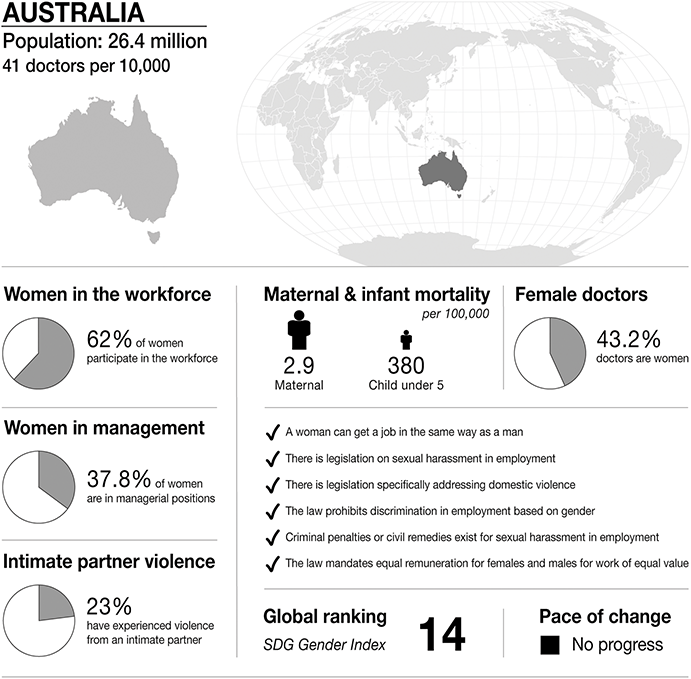
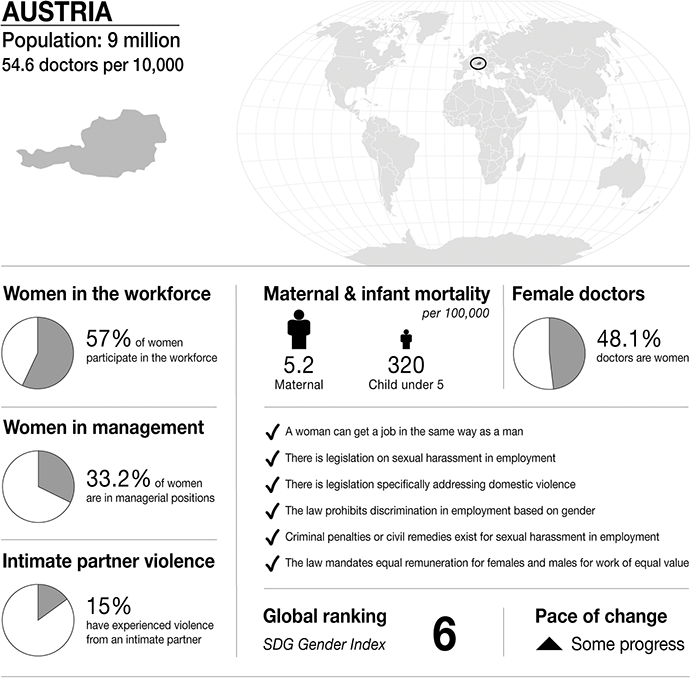
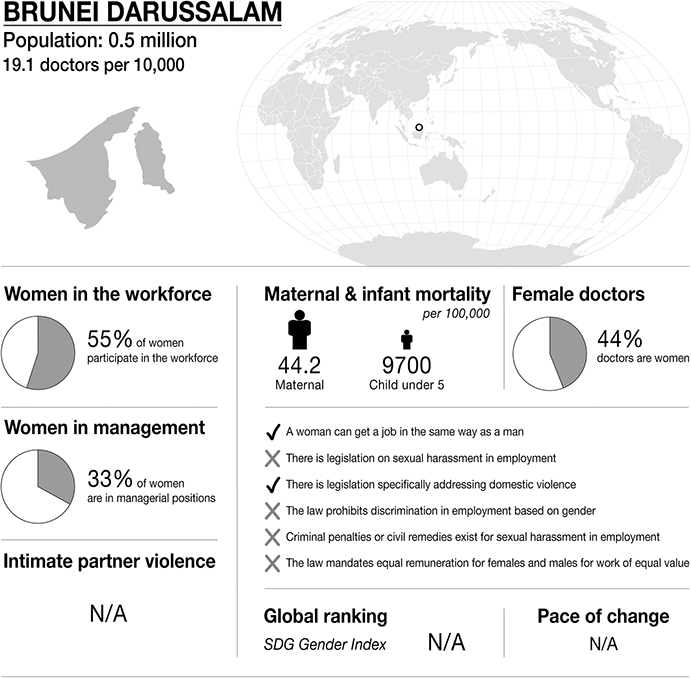
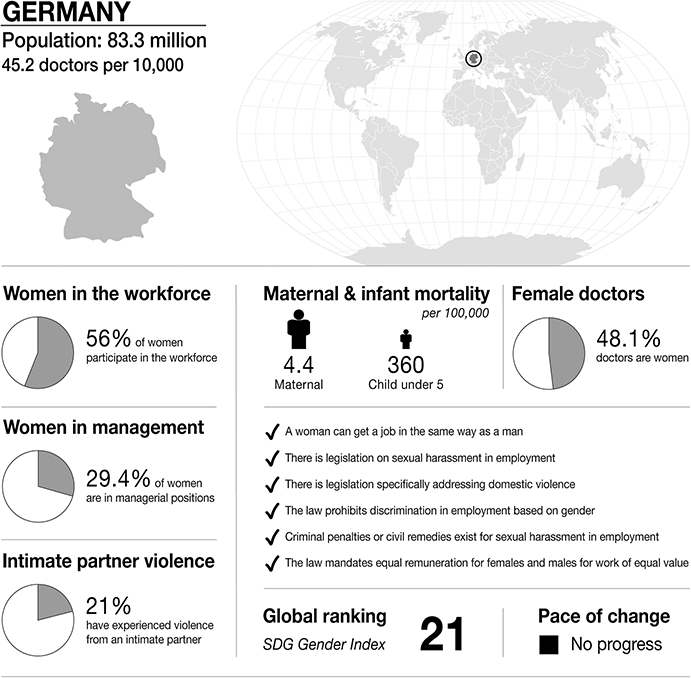
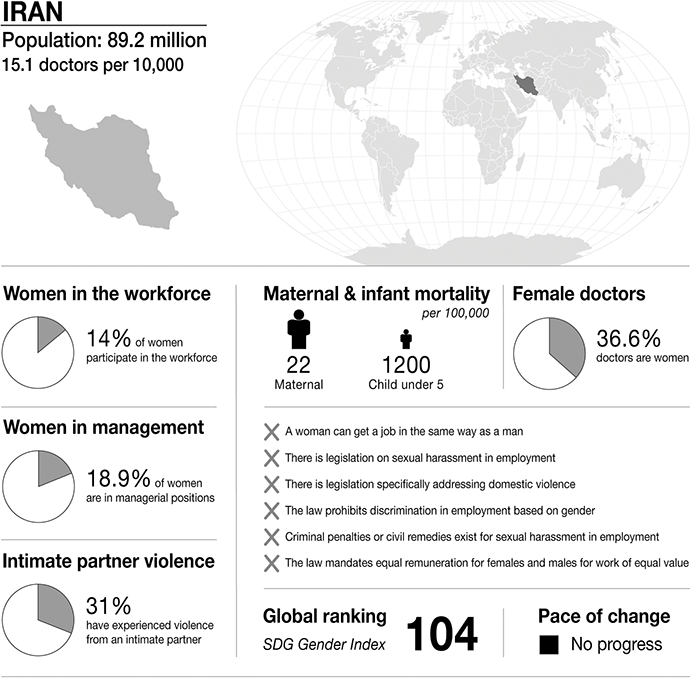
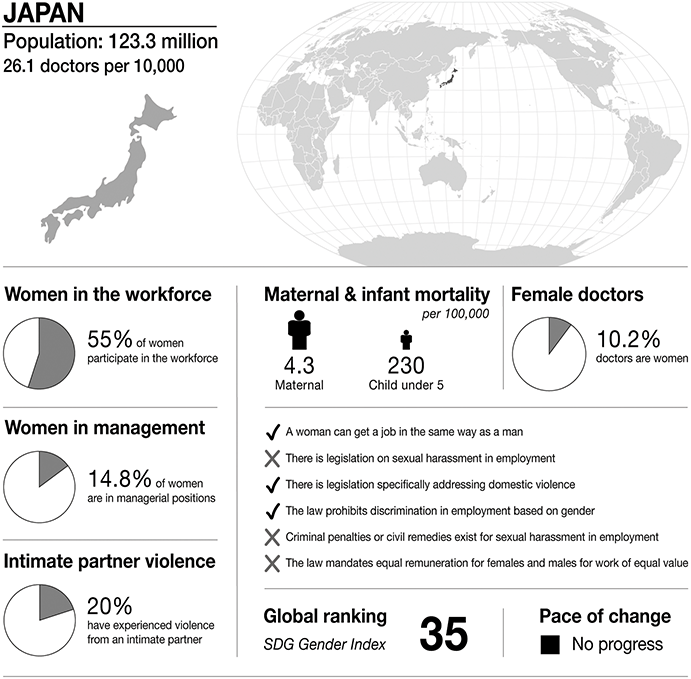
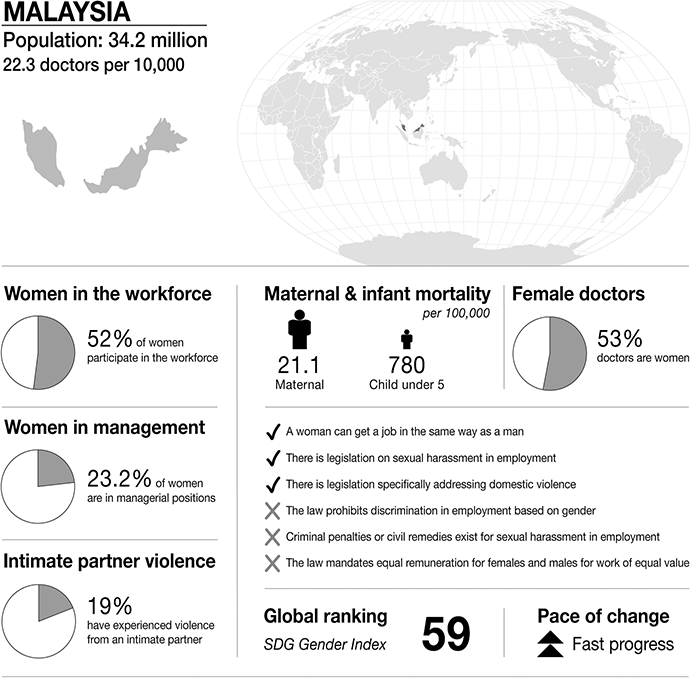
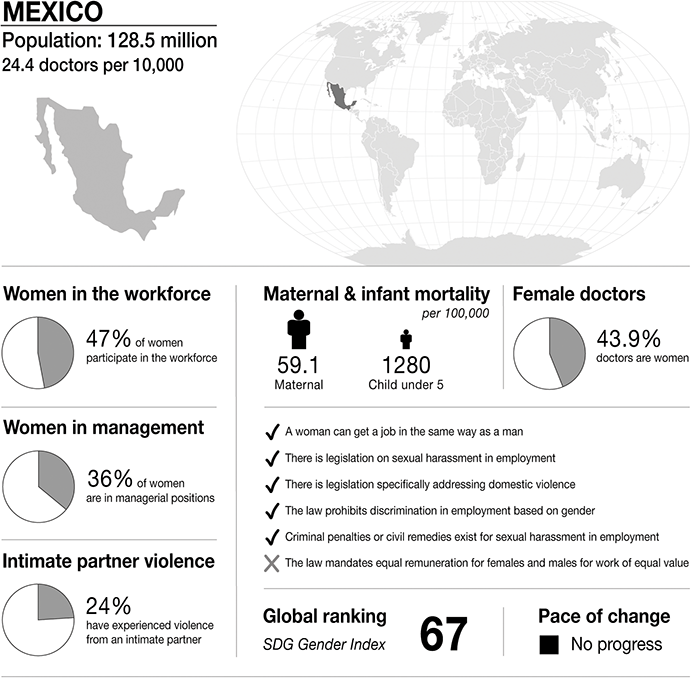
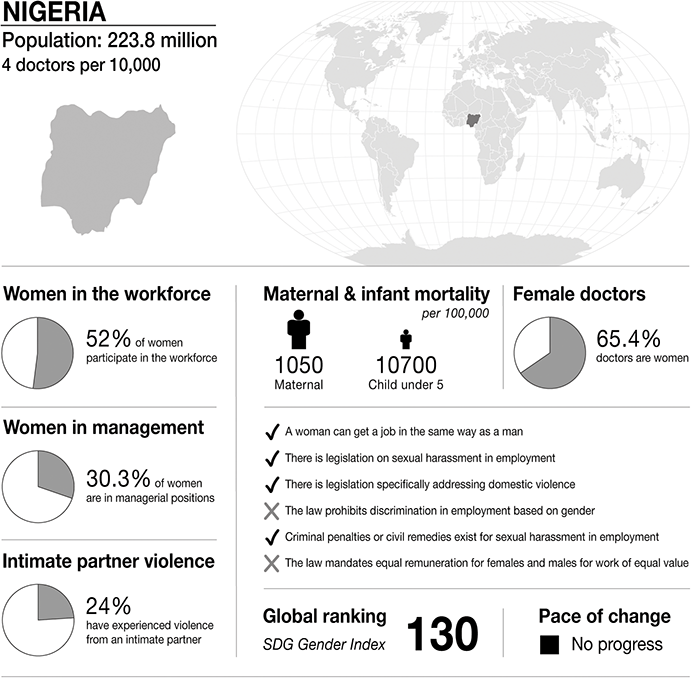
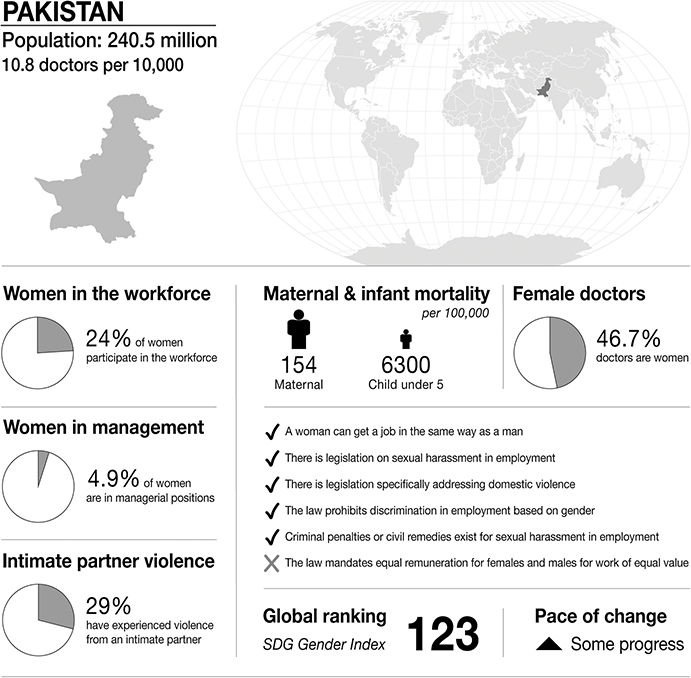
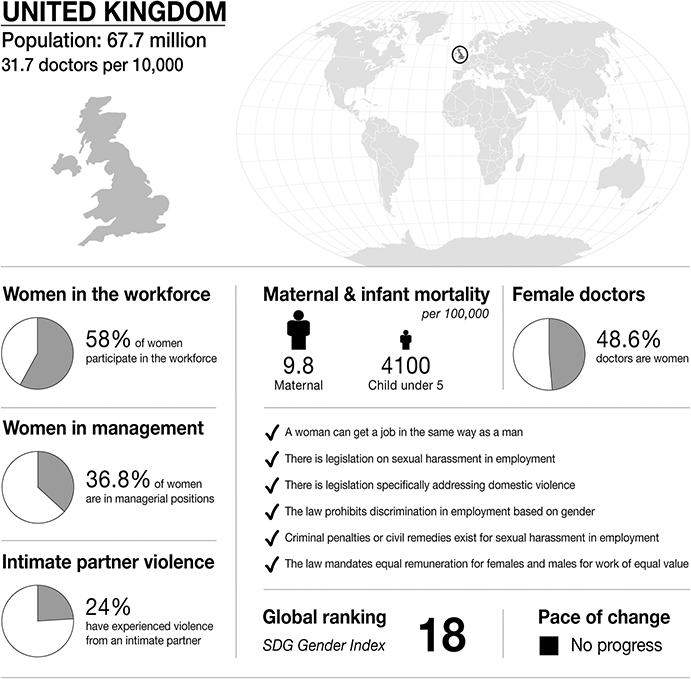
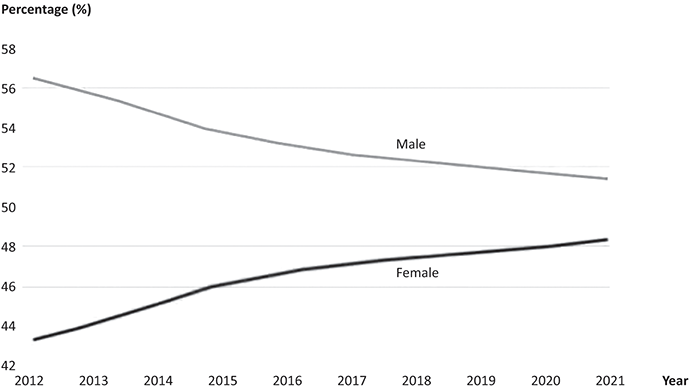
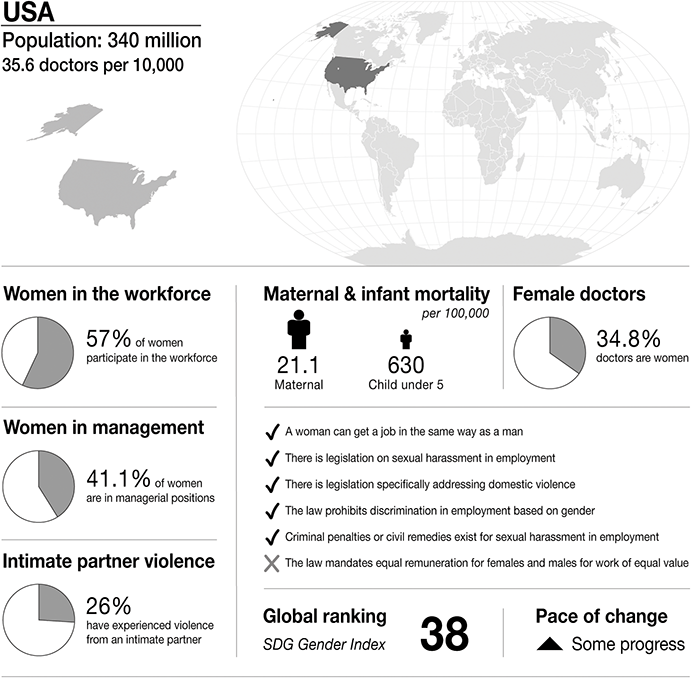
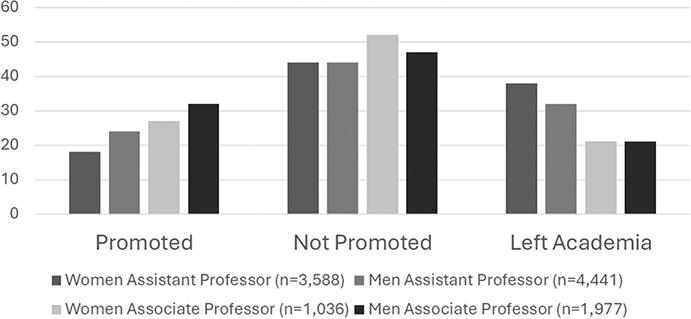
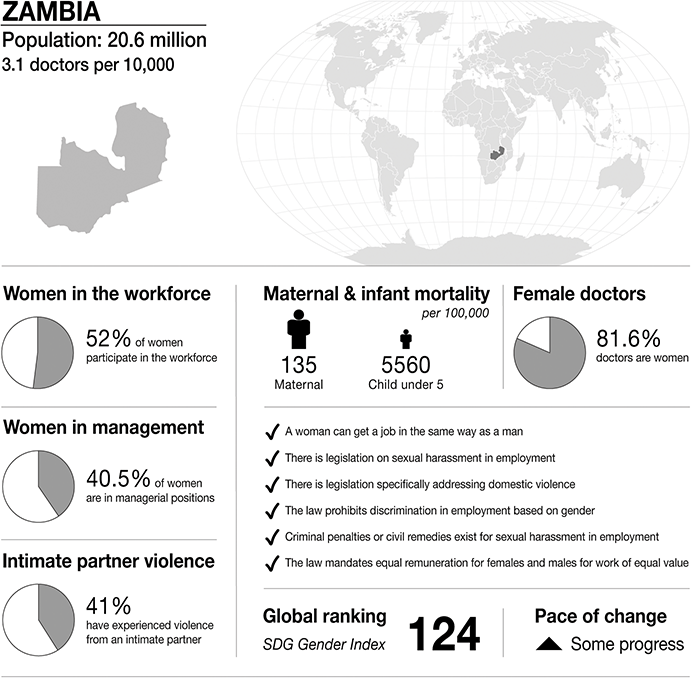

 Open access